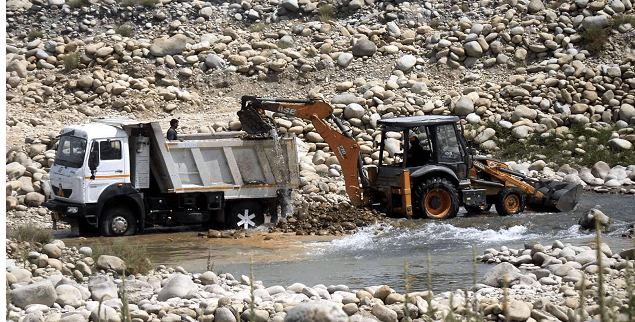
(Feature Image: Taken from a report titled “Mining in Nallah Romeshi: DMO Pulwama submits report” by Rising Kashmir, 04 Dec. 2024)
When it comes to environmental issues in Kashmir, the Srinagar based Dr. Raja Muzaffar Bhat dons many hats. He is an independent researcher, often tracking river courses, glacier zones and forest lands to gain firsthand insight into the unfolding impact of changing climate, land use on water sources, rivers and people. He is a writer with clear thoughts articulating concerns over ongoing environmental degradation in the region.
Dr. Bhat advocates sustainable development and outreaches concerned government departments through letters, RTIs and social media platforms which he uses efficiently to also expose the gaps between official claims and ground realities. He has also been part of Jammu & Kashmir RTI Movement. Treading the path steadily, he keeps applying new democratic methods. When necessary, he approaches the judiciary.
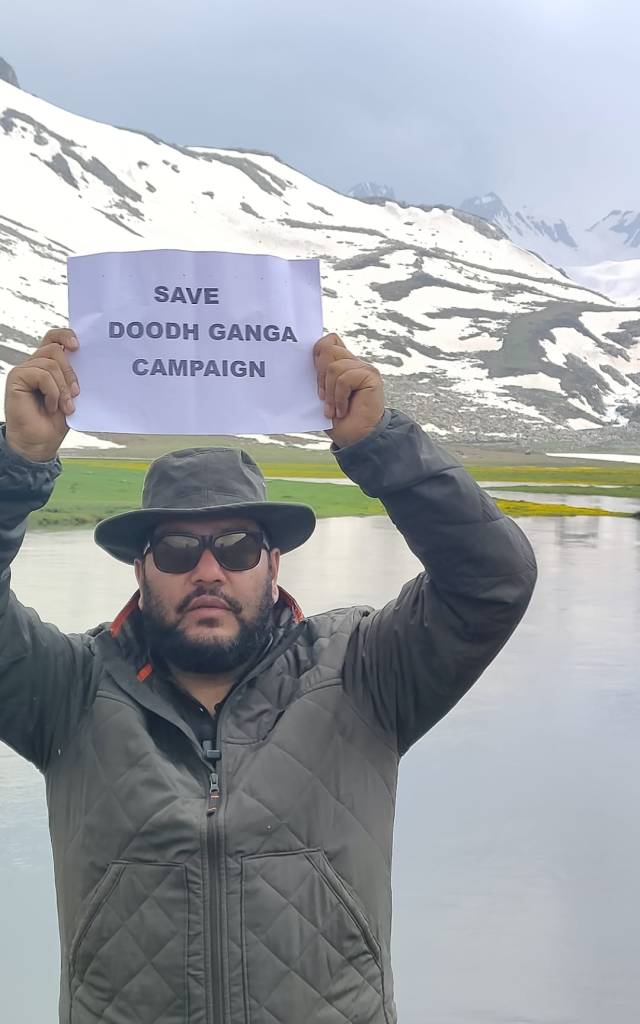
Over the past decade, he has filed over half a dozen petitions in the National Green Tribunal (NGT) and secured some noteworthy decisions particularly in the matter of Doodhganga Pollution, Solid Waste Management in Srinagar and unsustainable mining in pristine streams of Doodh Ganga, Shaili Ganga, Sukhnag, Sasara passing through Budgam and Pulwama districts. Following his petition, the NGT gave a landmark judgement in 2021 that can ensure protection of around 20,000 wetlands in the country
In this blog, Bhim Singh Rawat of SANDRP interviews Dr. Bhat about the key problems affecting riverbed mining governance in J&K and to understand its adverse impact on river eco-system and riparian communities.
1. What were your thoughts when you witnessed riverbed mining for the first time and realized it has become a substantial threat to the rivers?
Answer: Riverbed Mining was taking place in Kashmir for decades but that was done manually by local labourers and that didn’t have much impact on our rivers and streams in Kashmir but for the last 4 to 5 years heavy machinery is being used and that has caused massive destruction. When I saw it first time happening in my neighborhood I realized that Doodh Ganga won’t live long and launched a campaign to get it stopped. Save Doodh Ganga campaign was launched in 2021, and we succeeded to get mechanized riverbed mining stopped through NGT in May 2024.
2. Generally, hilly rivers have limited sand materials. So, what main minerals are mined in J&K rivers? How is the requirement of sand met? What is the scale of illegal (not approved by the government) riverbed mining in J&K?
Answer: The illegal miners excavate gravel and boulders from our streams and rivers. Sand is also available but in the downstream valley especially in Jhelum and some other streams. This is enough for local consumption. There are sand deposits in hills and karewas also, that are also illegally mined for sand requirements.
As per my information and research 95 % of riverbed mining and clay mining / sand mining is done illegally.
3. How many legally approved riverbed mining leases are active in the state? Is there any study assessing the annual demands of riverbed minerals (RBM), their annual availability and amount being mined on an annual basis there? In which main sectors are the minerals consumed?
Answer: The Riverbed mining leases are given through e auction since 2020 but the project proponents violate the Environmental Clearance (EC), they obtain from JK State Environmental Impact Assessment Authority (SEIAA). These ECs, I have challenged before NGT in Shali Ganga, Doodh Ganga, Romshi and Sasara cases and all the illegal work was halted.
Studies have been done by the Geology & Mining Department (G&M D) about annual availability, but they are violating their own studies as RBM is looted to a huge extent. In Sukhnag stream in Beerwah Budgam no EC was given and for 3 years a construction company looted Riverbed Material (RBM) especially boulders worth Rs 200 crores and not even Rs 2 crore of amount was realized.
The local District Magistrate (DM) has given permission for this which is known as Disposal Permit (DP) to clear RBM due to flooding, but there was no flood in this stream for last 5 years. Even in winter season and dry weather days the DM has given such permits. These documents have been placed on record before NGT which stayed the mining work in January 2025 after a team constituted by them (NGT) visited the site on Dec 26, 2024.
Pertinently, Sukhnag is a designated Trout Fish stream and even the Fisheries Department were not consulted by DM Budgam before issuing the so-called Short Term Permits-STPs or DPs.
4. Which are the main government departments involved in the governance of riverbed minerals in J&K? Please elaborate on the basic process of approving a riverbed mining lease, plans in J&K? How much revenue does riverbed mining generate? Is it a reason behind excessive riverbed mining?
Answer: The Fisheries, Irrigation & Flood Control, Geology & Mining, Revenue and the PHE Jal Shakti are the main government departments involved in the governance of riverbed minerals in J&K. From 2020 the mining lease is allocated by G&M Department after EC by SEIAA.
The response provided by the Mining Department in Assembly Question says that total revenue collected in the last 3 years amounts to more than Rs 395 crores. Rs 101.17 cr revenue was collected in 2022-23 which rose to Rs 175.47 cr in 2023-24 and up to January 2025, the revenue collection for the current financial year has reached Rs 118.80 crore.
The Mining Department in its reply also reported an increase in penalties collected for mining violations. In 2022-23, penalties amounting to 16.34 crore were imposed, which rose to 19.20 crore in 2023-24. Up to January 2025, Rs14.71 crore fines have already been collected.
The department has failed to reveal how much disaster has been caused to rivers and streams across J&K and also the loss to state exchequer. These details have also not been revealed. This needs an independent probe as the loss is much higher than Rs 395 crores. Being the petitioner in five cases of illegal riverbed mining in Sukhnag, Doodh Ganga, Shali Ganga, Romshi and Sasara, I say with authority that loss to state exchequer is five to ten times more and the environmental loss is even higher. Here is my detailed article on this: “Riverbed mining in J&K needs CBI inquiry”.
5. What are the basic environmental rules that miners are to abide by? Which norms do you find being violated? What are the key loopholes in the governance structures failing to ensure riverbed mining is done in a sustainable manner?
Answer: The J&K State Minor Mineral Concession Rules 2016 and the Guidelines of SEIAA have mentioned several rules which are compulsory to be followed by the mining companies.
Among these, I find norms like no use of heavy machines, not go more than 1 meter deep, using material locally, are generally violated. Similarly, almost 70 % of Standard and Specific Guidelines of SEIAA are violated. I have written extensively on this subject which can be seen here (1) “J&K: Riverbed Devastation” (2) “Need to Streamline Riverbed Mining in J&K”.
6. A. Can you elaborate on the adverse impacts of mechanized riverbed mining on water sources, aquatic ecosystems, livelihood of the people and river-based infrastructures (bridges, irrigation, power structures, roads, human habitations etc.) in J&K?
Answer: It impacts Fish population. The same has been wiped out in Romshi, Sasara, Doodh Ganga, Shali Ganga and Sukhnag around the mined areas. The excessive riverbed mining operations have also destroyed the livelihood of Fishermen.
I have also documented how indiscriminate riverbed mining activities have affected the surface as well as groundwater resources resulting in drying up of springs, tube wells and bore wells in mining affected areas. There are areas in the region where unabated mining in rivers have deepened their bed thus disturbing the water supply in small irrigation channels and in turn adversely affecting farming. Two of my articles as mentioned below throw light on the subject. (1) “Springs Drying up due to Illegal Riverbed Mining” and (2) “Scarred by mining”.
B. What is the scenario of death and violent incidents related to riverbed mining activities in J&K? (Miners often resort to attacking government officials, reporters, and activists. The deep pits created by excessive mining are resulting in drowning deaths. The vehicles involved in transportation cause road accidents etc.)
Answer: There are threats to activists and journalists reporting this. I have personally faced many threats, and I wrote to Police also about it. The Pits cause deaths due to drowning and many deaths were reported because of deep mining pits in the region the last 6 to 7 years.
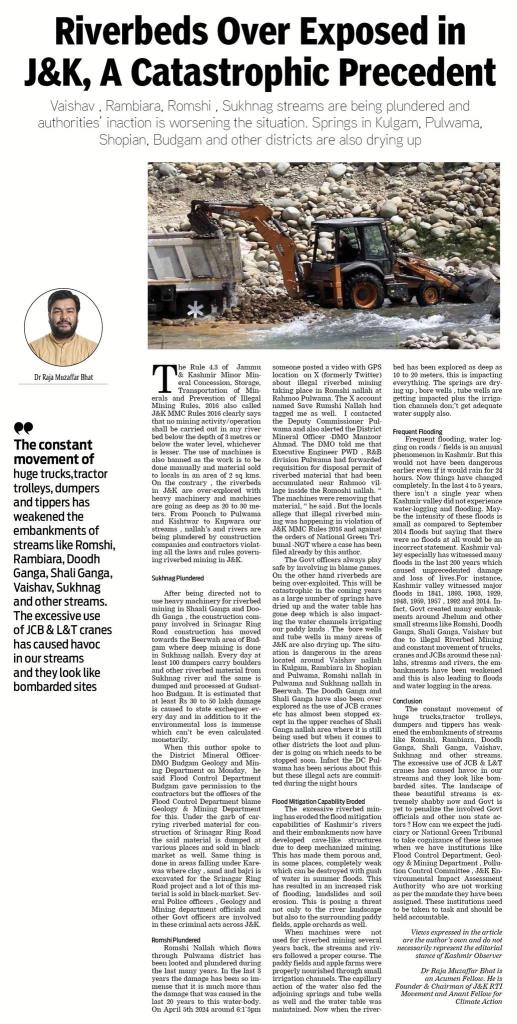
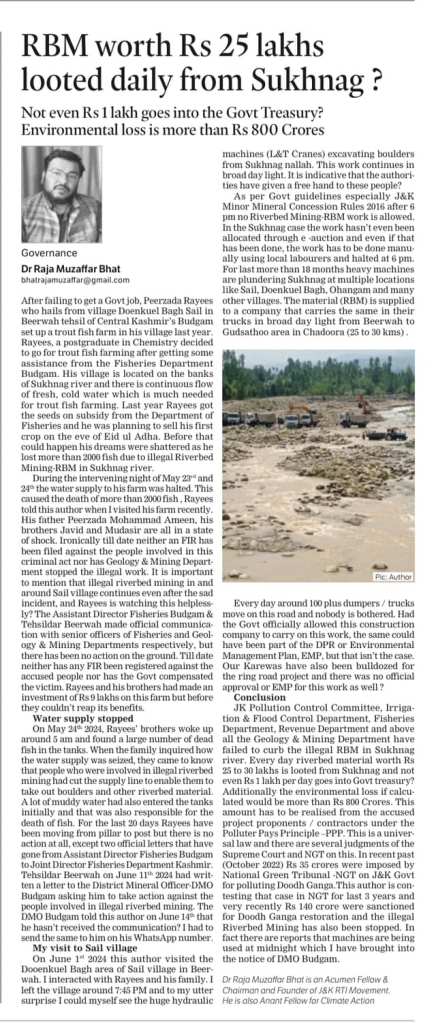
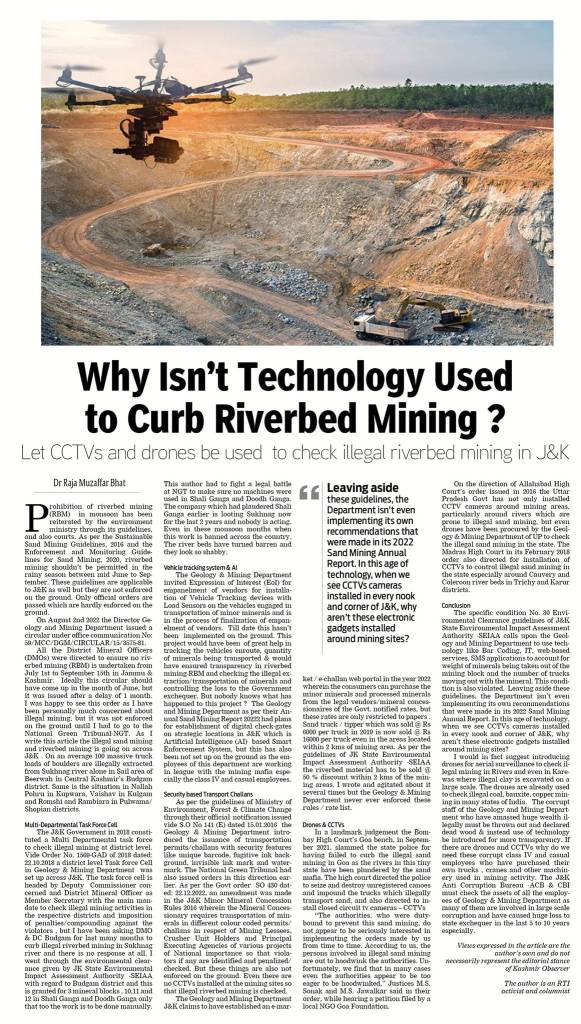
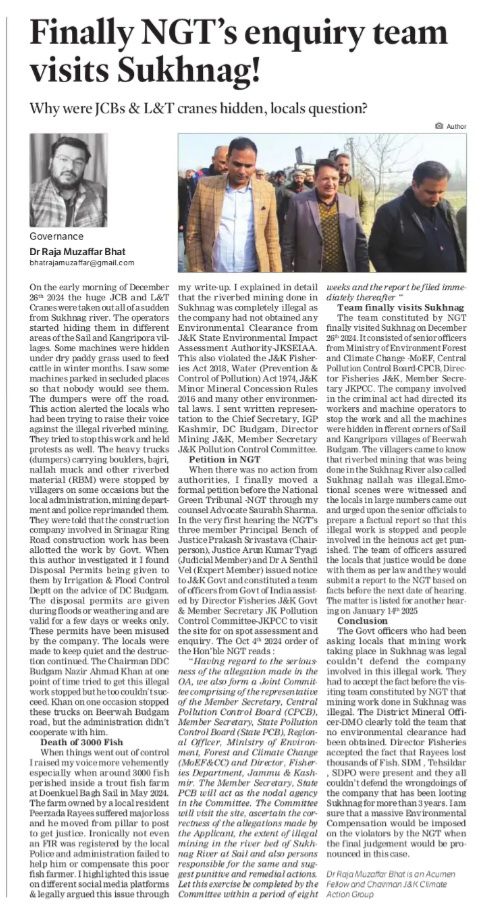
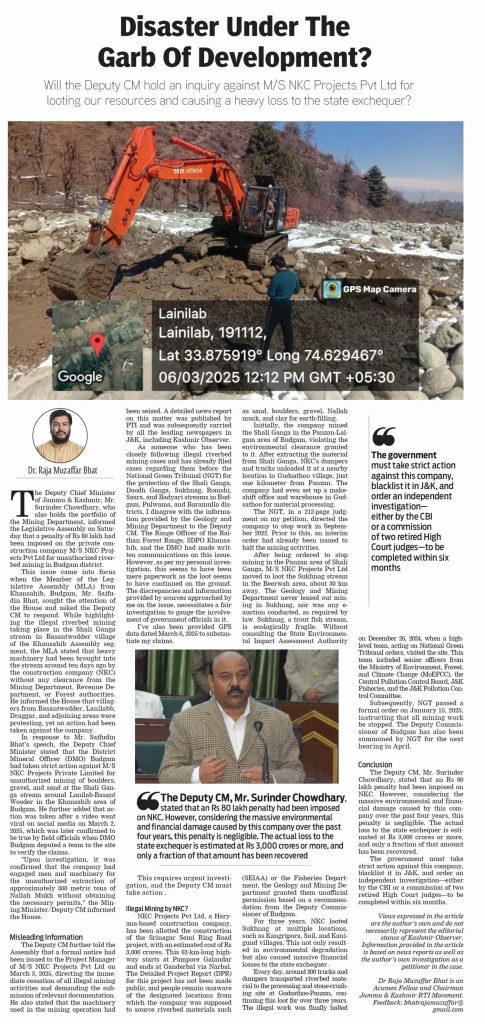
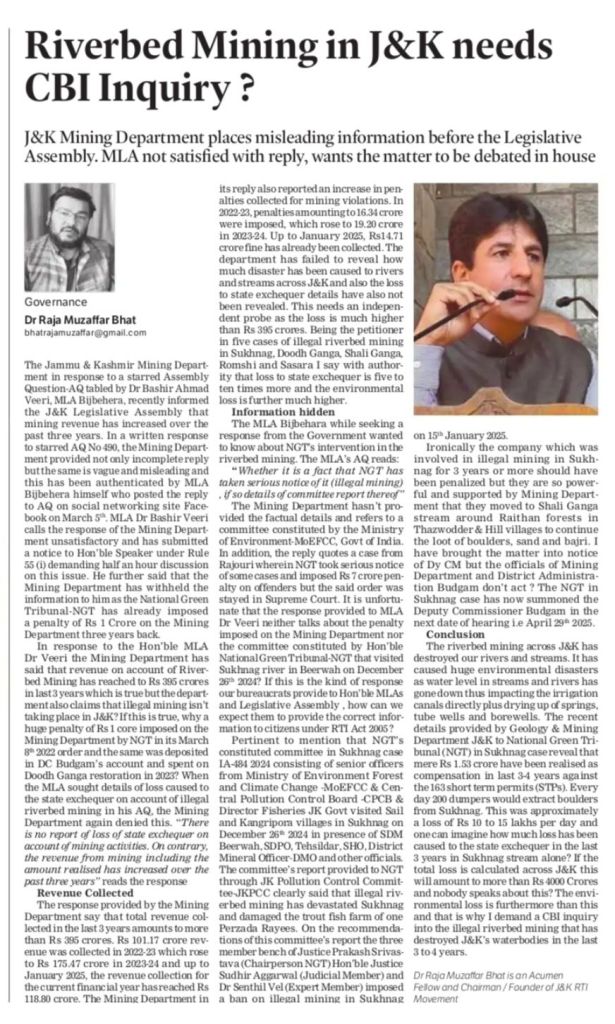
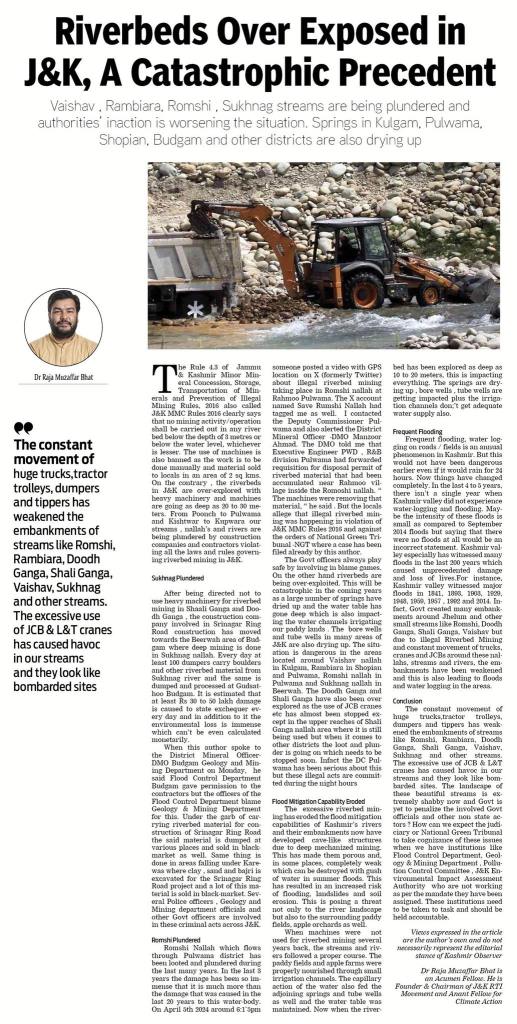
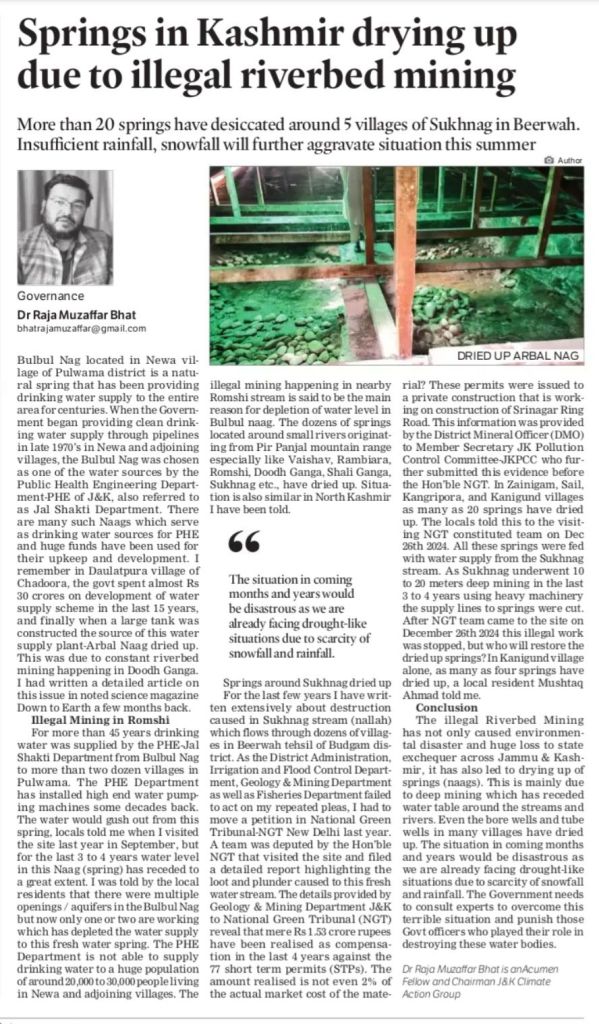
Articles by Dr. Bhat on various aspects of riverbed mining in Kashmir.
7. You often share the ground reports showing destructive riverbed mining activities with the officials, public representatives through social media. Do they take note of it and take satisfactory actions?
Answer: The Government takes notice on some occasions, but in most cases the illegal mining again resumes after sometime.
8. How many mining related cases have you filed in NGT? What were the key issues raised in the pleas? What has been the key outcome of these cases? Do you find legal intervention effective in addressing the menace? What has been the best order you have received so far? How well have the orders been implemented?
Answer: I have filed around 5 cases on Riverbed Mining in NGT in the last 5 years and in all cases I have got good orders and work has also been stopped. It took me 2 to 3 years for legal battle but finally the work was halted in Doodh Ganga, Shali Ganga, Romshi, Sasara, Sukhnag.
I think legal action is the only remedy and the NGT has been of great help to curb illegal mining in Budgam and Pulwama districts especially. More people from other districts need to come forward but maybe they are sacred?
9. How do you compare riverbed mining scenario before and after abrogation of article 356? How many manual miners were dependent on the profession? How have their livelihoods been impacted? How have they been coping with the situation now?
Answer: The livelihood of labourers was impacted as machines were openly used post 370. But in my 5 cases the labourers have got the work back now as project proponents avail their services instead of JCBs or L&T Cranes. But in other districts the work of local labourers has been impacted a lot due to the use of heavy machinery.
10. The demand for riverbed minerals is growing rapidly. On the other hand, the mechanized mining has its own sets of adverse impacts. So, what are the sustainable ways you suggest that can be effective in addressing the complex situation?
Answer: I think use of manufactured sand (M-sand), extracting building materials from Construction and Demolition (C&D) Waste are potential alternatives for RBM. Similarly, we need to explore using tunnelling waste which isn’t properly utilized at all in J&K. Then excavating clay and RBM from irrigation canals and flood channels which need massive desilting is also possible options with dual benefits.
11. What key changes are necessary in the governance of riverbed mining to achieve sustainable riverbed mining? What changes are necessary in terms of transparency? How can we achieve accountability of key govt functionaries? What regulatory changes are necessary, both in terms of rules and functioning of regulatory agencies? What role do the local communities need to have in the governance of riverbed mining?
I think, if used properly the use of technology like installation CCTVs and using drones around mining sites can be helpful in curbing the illegal mining menace. I have written in detail on this aspect: “Why Isn’t Technology Used to Curb Riverbed Mining”.
Local communities need to know the laws and rules governing Riverbed Mining. What I have observed is that they are ignorant of these issues and Govt officers, Police mislead them once they are bribed by the people involved in illegal mining.
For 3 years the Govt officers and police kept telling people around Doodh Ganga, Shali Ganga, Sukhnag, Romshi and Sasara that contractors have valid permission but that proved to be wrong. NGOs working on environmental issues must focus on riverbed mining and support activists and small NGOs working in this sector.
12. As an individual what are the limitations, difficulties and challenges you have been facing while pursuing the objective of ensuing sustainable riverbed mining in the region?
I am not alone in this fight. We don’t have an NGO, that is true, but as a group we are able to do great work for the protection of environmental resources which even big NGOs can’t do. I do face challenges, but I appreciate the support I get from my friends and fans who admire my work. I am indebted to my counsels like Rahul Chowdhary and Saurabh Sharma and their entire team who plead my cases in NGT while charging very small fees.
Bhim Singh Rawat (bhim.sandrp@gmail.com)
POST SCRIPT: Aug 28 2025:
The Supreme Court upheld the NGT’s order, stressing that a District Survey Report is valid only if backed by a proper replenishment study. The Court held that granting clearance without such scientific data amounted to a regulatory failure.
I had sought National Green Tribunal’s -NGT’s intervention in 2022 when a road construction company namely NKC Projects Pvt Ltd started looting Shali Ganga a small stream in Budgam district of Kashmir in violation of Guidelines of J&K Environmental Impact Assessment Authority-JKIA which prohibits use of heavy machinery like JCBs, L&T Poclain Cranes. The loot was immense and NGT in Sept 2022 banned the company from excavating riverbed material-RBM (Boulders, Bajri, Gravel, Sand etc).
After this ban this company started looting Sukhnag River – 30 kms away from Shali Ganga in Panzan Budgam. After more than 2 years NGT stayed that also-in Jan 2025 but the loot was immense – and this work was done without any Environmental Clearance
The fight will continue to ensure NKC Company pays Environmental Compensation for this loot and plunder in Jammu & Kashmir which is already facing severe environmental challenges like flash floods , muslides etc and in last 15 days more than 150 people have been killed in such disasters across J&K
All the ECs given in the past have to be declared null and void by the J & K Pollution Control Committee . I have already spoken to Chairman JKPCC Mr Vasu Yadav in this regard and requested him to calculate Environmental Compensation to be imposed on NKC Projects Pvt Ltd without any delay
Grateful to Anitha Shenoy Senior Advocate Hon Supreme Court for pleading my case free of cost
Raja Muzaffar Bhat
SC Judgement latest
SC Judgement latest
My Story in The Wire 2022- how Mining Mafia works in looting Shali Ganga
Mining Halted in Shali Ganga News Report
Mining Halted in Sukhnag News Report


In summerbugh lasjan near foot bridge their is illegal extraction of sand and they are now cutting river bed with jcbs and then they start extraction of sand
LikeLike