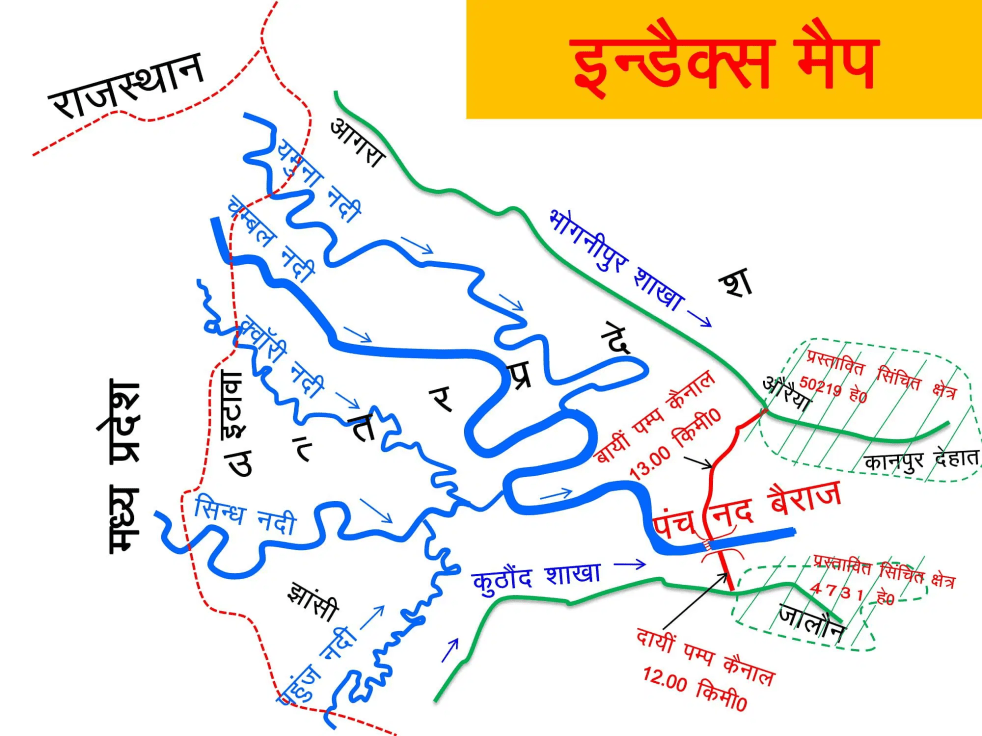
(Feature Image: Line drawing of proposed Pachnad Major Irrigation Project. Source: Amar Ujala)
The findings of the latest Project Dolphin Survey Report released on March 3, 2025, by Prime Minister Narendra Modi in presence of Union Environment Minister Bhupendra Yadav have raised significant concerns over proposed Pachnad Major Irrigation Project.
While the survey reiterates the adverse impacts of dams, barrages fragmenting the national aquatic animal’s habitat as the population has been found nearly absent between Narora barrage and Kanpur barrage stretch in main stem of Ganga, it also reveals that the endangered species are preferring refuge in Ganga tributaries and confluence points and has been found in highest numbers along 47 km long river stretch between Chambal and Pachnad in Bhind which still undammed.
The Pachnada is confluence of five rivers namely Yamuna, Chambal, Sindh, Pahuj and Kunwari and relatively rich in riverine fauna. Not just dolphins but critically endangered gharials, turtles, otters, muggers and several native fish and migratory bird species also have found among the last remaining intact habitat around this place. Hence it is extremely important to protect these rivers and aquatic species from large water abstraction projects.
However, the Uttar Pradesh government has been planning Pachnad Major Irrigation around the same place. The initial survey of the project has reportedly been done by CWC in Oct. 2021 and the DPR is under preparation. Though there is no official document available in public domain, some local media outlets often report that the project would involve construction of about 750 long and 9 meter high barrage near Sadhrapur village in Auraiya district downstream Pachnada. The estimated cost is Rs. 3000-5000 crore. The project will displace several villages in the area, they have been raising concerns.
Since Nov 2024, the MoEF’s Expert Appraisal Committee (EAC) on River Valley Projects has been considering the proposal for ToR. In its recent meeting held on Feb. 14, 2025, the EAC found that the project would submerge about 9118 ha of land including 1900 ha of National Chambal Gharial Wildlife Sanctuary. Seeking more information, the EAC has deferred the proposal. The project will also require permission from the National Board of Wild Life.
If it goes ahead, the project will certainly fragment the Yamuna river segment and will be detrimental for the survival of wildlife in Yamuna rivers around Pachnada. In light of the findings of dolphin survey report and given the ecological significance of Pachnada area, the EAC and the NBWL must reject the proposal, and the Centre and state government must explore better, cost-effective alternatives to meet the irrigational water needs.
The habitat of India’s national aquatic animal and other important endangered species around Pachnada requires protection and for that the Yamuna rivers segment there must be kept undammed. At the same time, the riverine habitat there is already under stress due to declining flows, increasing pollution, sand mining, hunting, fishing and other anthropogenic activities which need to be addressed on an urgent basis.
MoEF Decisions of EAC meeting held on Feb. 14, 2025: –Pachnad Major Irrigation Scheme (CCA : 24,328 Ha) in 24328 Ha at village Sadhrapur, Sub-Dist and Dist Auraiya, Uttar Pradesh by Irrigation & Water Resource Dept, Kanpur, Uttar Pradesh – Terms of Reference: “it was opined by the EAC that PP shall submit additional details sought in EAC 18th meeting held on 05.11.2024 along with above mentioned information.” https://parivesh.nic.in/utildoc/120992208_1740481231566.pdf (Feb. 2025)
DAMS & HEPs IN YAMUNA BASIN
Uttarakhand Govt focuses on infra, innovation The budget provisions include Rs 625 crore for Jamrani dam project, Rs 285 crore for Lakhwar project, Rs 75 crore for Song project, Rs 1268.70 crore under capital expenditure head for PWD, Rs 1065 crore for rural development under PMGSY and Rs 1843.44 crore under Jal Jeevan Mission. https://www.business-standard.com/india-news/uttarakhand-govt-presents-rs-1-trn-budget-focuses-on-infra-innovation-125022001025_1.html (20 Feb. 2025)
काश्तकारों की समस्याओं को लेकर डीएम को सौंपा ज्ञापन -लखवाड़ बहुद्देशीय परियोजना के तहत कटापत्थर बैराज निर्माण के लिए किये जा रहे भूमि अधिग्रहण से प्रभावित किसानों ने जिलाधिकारी से भेंट की और अपनी समस्याओं के निराकरण की मांग उठाई। किसानों ने कहा कि इससे पहले भी उन्होंने सात सूत्रीय ज्ञापन सौंपा था लेकिन उस पर अभी तक कोई कर्रवाई नहीं हुई है। उन्होंने कहा कि यदि समय रहते उनकी समस्याओं का हल नहीं हुआ तो वे किसी भी दशा में अपनी जमीनों का अधिग्रहण नहीं होने देंगे। https://www.livehindustan.com/uttarakhand/vikasnagar/story-farmers-demand-solutions-from-district-magistrate-amid-land-acquisition-issues-for-lakhwad-multi-purpose-4project-201738588255545.html (03 Feb. 2025)
MoEF Relevant agenda of FAC meeting to be held on Feb. 27, 2025: Proposal from GREENKO MP01 IREP PRIVATE Ltd FOR 17.5272 HA ADDITIONAL LAND FOR MP30 GANDHI SAGAR OFF-STREAM PSP FALLING UNDER RAMPURA PATHAR R.F, NEEMUCH FOREST DIVISION IN KHEMLA BLOCK(V), RAMPURA (T) IN NEEMUCH DIST, MADHYA PRADESH https://forestsclearance.nic.in/AgendaDetail.aspx
INTERLINKING OF YAMUNA RIVERS
Ken-Betwa Link Unanswered questions At a well-attended meeting at India International Centre in Delhi on Feb 20 2025, organised by VIDHI Centre for Legal Policy, a panel of speakers including Shri Shashi Shekhar (former secretary, Union Ministry of Water Resources) and Shri Jasbir Singh Chauhan (former Principle Chief Conservator of Forests, Madhya Pradesh) and Himanshu Thakkar of SANDRP, a number of fundamental questions were raised about the controversial Ken Betwa River Link Project. Unfortunately, no clear answers are forth coming from the authorities.
The questions raised range from basic justifiability of the project, problematic decision-making process at each stage of the project violating the statutory processes, the severe long term adverse impacts in Bundelkhand in whose name the project is being pushed, lack of consideration of feasible, cheaper, faster and more appropriate alternatives, among others. The people of Bundelkhand are largely in dark about the projects, its costs and benefits and impacts. Though the statutory Forest Clearance requires that the current hydropower component be scrapped, the project inaugurated by the Prime Minister in Dec 2024 does not follow the conditions of statutory clearance. https://sandrp.in/2025/02/24/drp-nb-240225-unanswered-questions-on-ken-betwa-project/ (24 Feb. 2025) Additionally, Shashi Shekhar, a former secretary of the Ministry of Water Resources, argued that the region’s hydrology does not justify a project of such scale. “They have justified it by manipulating data. If you consider the correct data, the ground reality and ecological factors, this project should not have gone through,” he said to PTI. Shekhar also questioned the government’s claim that the project would irrigate 10.62 lakh hectares, calling it “coming out of the air” and inconsistent with the ground reality. He also criticized the Supreme Court for failing to act despite the CEC’s objections and the known ecological concerns. https://timesofindia.indiatimes.com/india/ken-betwa-linking-project-experts-claim-project-politically-motivated-shouldnt-have-been-approved/articleshow/118447235.cms (21 Feb. 2025)
Project faces backlash But environmental experts warn that the project could have the opposite effect of what is intended. “The government has pushed the project through despite objections by experts. Instead of benefiting Bundelkhand, this project will devastate the region – destroying the tiger reserve, harming the rivers and disrupting local ecosystems,” said Himanshu Thakkar, an environmentalist and co-ordinator of the SANDRP. “Moreover, there is no publicly available data to support the claim that the Ken River has surplus water while the Betwa is deficient,” he said. “I was part of the Ministry of Water Resources’ expert committee on river linking, and we weren’t provided with this data either. There has been no peer review of the information.” https://www.theglobeandmail.com/world/article-bundelkhand-river-linking-project-faces-backlash/ (03 March 2025)
Linking plan faces protest Environmental experts warn the project will submerge nearly 98 sq km (38 sq miles) of the Panna Tiger Reserve, a 543 sq km sanctuary that successfully brought tigers back from local extinction in 2009. This could undo years of conservation efforts. “It’s unprecedented. We have never seen a core area of a national park being used for such a large-scale infrastructure project before,” says environmentalist Amit Bhatnagar. Questions have also been raised against the claim that the project is meant to channel excess water from the Ken river. Critics point out that the government has relied on outdated data from 2003, without independent verification, to calculate the river’s annual yield. https://www.bbc.com/news/articles/c4gwj2qy9pxo (24 Feb. 2025)
Good & Bad of River Linking Projects SK Sarkar, former secy, MoWR, toes the govt line on ILR without answering any questions. https://thewire.in/environment/the-good-and-bad-of-river-linking-projects/ (27 Feb. 2025)
Parvati-Kalisindh-Chambal Link बाणगंगा नदी में पानी बढ़ाने की बड़ी योजना जल संसाधन मंत्री सुरेश सिंह रावत ने शुक्रवार (Feb. 28) को विधानसभा को आश्वस्त किया कि बाणगंगा नदी में पानी डालने के लिए डीपीआर तैयार कर अग्रिम कार्यवाही की जाएगी । उन्होंने कहा कि बाण गंगा नदी में जल उपलब्धता में वृद्धि के लिए संशोधित पार्वती-कालीसिंध-चम्बल लिंक परियोजना के साथ-साथ बाणगंगा एवं रूपारेल बेसिन में जल आपूर्ति के क्रम में बजट घोषणा वर्ष 2025-26 में ‘’राणा प्रताप सागर बांध-ब्राह्मणी नदी से बीसलपुर बांध में जल अपवर्तन लिंक के कार्य किए जाएंगे। इनको आगे बढ़ाते हुए बीसलपुर बांध से बाण गंगा एवं रूपारेल नदी को चरणबद्ध रूप से जोड़े जाने सम्बन्धी कार्य की डीपीआर से ‘जयपुर, दौसा, सवाई माधोपुर, करौली, भरतपुर, डीग, अलवर’ के कार्य कराए जाएंगे https://www.patrika.com/jaipur-news/big-plan-to-increase-water-in-banganga-river-government-made-a-big-announcement-19430031 (28 Feb. 2025)
YAMUNA WATER SHARING DISPUTES
Rajasthan इंदिरा गांधी नहर से दो जिलों को मिलेगा 1100 क्यूसेक पानी राज्यसभा सांसद घनश्याम तिवाड़ी ने कहा कि केंद्र व राज्य सरकार से 79 हजार करोड़ रूपये की वित्तीय व प्रशासनिक स्वीकृती जारी हो गई है। राजस्थान के सीकर व झुझुंनूं जिले को अब इंदिरा गांधी नहर परियोजना से 1100 क्यूसेक पानी जल्द मिलेगा। उन्होंने नानी बीड के गंदे पानी से निजात के लिए भी 341 करोड़ रुपए का प्रस्ताव राज्य सरकार को भेजने व शेखावाटी को यमुना का पानी जल्द मिलने की बात भी कही। https://www.patrika.com/sikar-news/sikar-and-jhunjhunu-districts-will-soon-get-1100-cusecs-of-water-from-the-indira-gandhi-canal-project-19420375 (25 Feb. 2025)
YAMUNA AS WATERWAYS
Delhi Plans afloat to launch river cruise Delhi Tourism & Transportation Development Corp (DTTDC) has released a request for proposals to hire a private agency with prior experience to set up the cruise service in the capital. A private agency will be selected to operate a 7-8 km round-trip cruise, with modern, electric-powered, air-conditioned vessels running for approximately 270 days a year, except during the monsoon season when the river swells.
The private agency will be engaged by DTTDC to run the project for five years. While the ticket rates will be determined by DTTDC, the agency will share a percentage of its profit twice a year with the tourism body. The tourism body is likely to finalise the agency by mid-April, and the tourist activity may start by the end of 2025 or early 2026.
Officials said the Delhi govt’s irrigation and flood control department signed a MoU with the Inland Waterways Authority of India (IWAI) for a ferry ride or boat taxi project on the Yamuna in Sept 2024, and an expression of interest was also floated to start the facility between Sonia Vihar and Hanuman temple, near Wazirabad barrage. Sources, however, said the responsibility to run the project has now been handed over to the DTTDC, while IWAI, the irrigation and flood control department, DDA, and Delhi Jal Board will have defined roles to help in the execution.
Before this, the NCR Planning Board proposed a Yamuna Water Taxi Project with tentative stations located at Madanpur Khadar, Film City, Nizamuddin, and ITO. Before the assembly election, LG VK Saxena directed the DDA to explore the possibility of installing a ropeway or cableway that would carry passengers in cable cars across the river. https://timesofindia.indiatimes.com/city/delhi/plans-afloat-to-launch-river-cruise-on-yamuna/articleshow/118653866.cms (02 March 2025)
The plan involves developing a 6-km stretch of the Yamuna, from the Wazirabad barrage (Sonia Vihar) to Jagatpur (Shani temple), for tourist cruise operations, reported PTI. On Friday (Feb. 28), the DTTDC released a request for quotation (RFQ) to find a suitable operator for two solar or electric battery-powered cruises along the designated river stretch. Once operational, the initiative is expected to enhance river-cruise tourism, offering an eco-friendly and sustainable water transport option.
Each boat must accommodate 20-30 passengers and be capable of reaching speeds between five to seven knots. The boats must feature inboard bio-toilets (zero discharge), an announcement system, and safety jackets for passengers. The boats should be air-conditioned, leased or owned, and no older than two years. The operator must ensure at least four round trips per day, as outlined in the proposal. https://www.hindustantimes.com/india-news/delhi-government-plans-to-launch-cruise-service-on-yamuna-for-tourist-operations-101740864851011.html (02 Feb. 2025)
IWAI to prepare water taxi proposal in 2 weeks A proposal of water taxi project with an initial fleet of 20-25 passenger boats for inland water transport in Yamuna was made at a meeting of transport secretaries from NCR states. The project was proposed with tentative stations located at Madanpur Khadar, Film City, Nizamuddin and ITO to the NCR Planning Board (NCRPB), according to a report by the Times of India. The issue was discussed at length during the meeting.
An official from the IWAI said during the meeting that 1-1.2 metre water level is required for water transport and the Yamuna river front in Delhi should not only be developed for water transport but also for tourism and recreational purposes. The official added that before carrying out feasibility, a hydrography survey and traffic study needs to be carried out. The NCRPB has asked the IWAI to share the details of works, feasibility studies and the DPRs with it. The Board has also asked the IWAI to prepare the proposal in two weeks and it will likely consider funding the water taxi project. https://www.moneycontrol.com/news/india/in-mega-plan-for-yamuna-rejuvenation-a-proposal-for-water-taxi-project-12947965.html (23 Feb 2025)
YAMUNA FLOODPLAIN
Delhi NGT slams DDA for not halting encroachments on floodplains The NGT on Feb 6 reprimanded the Delhi Development Authority (DDA) for failing to comply with its 2019 order to remove encroachments from the Yamuna floodplains, adding that similar directives to the land agency from the Delhi high court and the Supreme Court have also fallen on deaf ears. The Tribunal referred to its latest directions from October 15, 2024, seeking details from DDA on the total number of encroachments on the floodplains in the river’s 22km stretch in Delhi, particularly in Majnu ka Tilla. It emphasised that floodplains cannot be occupied, as such encroachments harm the river’s ecology.
The tribunal had sought this information in the October order, but the report was only submitted on the morning of the hearing, violating court-mandated deadlines. The bench gave the DDA three weeks to respond and submit a detailed affidavit. The tribunal expressed frustration that more than five years had passed since its 2019 order, yet compliance remained lacking.
This is not the first time NGT has pulled up DDA over its handling of its projects on the Yamuna floodplains. Last month, the tribunal flagged excessive concretisation in six ongoing projects, including Asita East, two casting yards, two ghats, and the now-defunct Millennium Bus Depot site. It directed DDA to implement recommendations from the National Mission for Clean Ganga (NMCG) to restore ecological balance.
NGT has also been pushing for the completion of Yamuna floodplain demarcation, a process that has faced repeated delays. In March 2024, it ordered DDA and the Delhi government to finalise the demarcation using a one-in-100-year flood probability model instead of the earlier one-in-25-year approach. However, this directive remains unimplemented. https://www.hindustantimes.com/cities/delhi-news/ngtslams-dda-for-not-halting-encroachments-on-floodplains-101739297065832.html (12 Feb. 2025)
Orders to protect floodplain not yet implemented NGT had further directed that the Yamuna be kept free from encroachments, with DDA, DPCC, and forest department instructed to take action in accordance with the law,” the bench, headed by Justice Prakash Shrivastava, stated in its Feb 6 order.
It was reported in Aug 2024 that nearly 75% of the Yamuna floodplain had been encroached upon. A Delhi govt report from the same period found that 7,362.6 hectares of the total 9,700 hectares in Zone O — comprising the Yamuna floodplain — were under encroachment. DDA had reclaimed 300 acres by removing six dairies and three cricket grounds in an anti-encroachment drive conducted between Aug 2022 and Jan 2024 around the Yamuna floodplain, including biodiversity parks, eco-tourism areas, and other green zones. https://timesofindia.indiatimes.com/city/delhi/orders-to-protect-yamuna-not-yet-implemented-in-city-ngt/articleshow/118154152.cms (12 Feb. 2025)
HC rejects plea against uprooting of nurseries The Delhi High Court has observed that the Yamuna river in the national capital has surpassed the threshold and any interference in its restorative and rejuvenation is not justified. The Court was dealing with a plea moved by a nurseries welfare association working in the area of Yamuna Khadar falling in Zone ‘O’ of the Master Plan for Delhi-2021 i.e., the Yamuna Floodplains. The association was aggrieved by DDA action of uprooting their nurseries and destroying all the plantation with bulldozers.
It was claimed that the said demolition drive was conducted by DDA without giving an opportunity to be heard to the association members and without conducting a physical demarcation of the subject land as per the directions of the NGT in 2019. Justice Sharma observed that the petitioners woefully failed to demonstrate any reasonable and justifiable grounds to be afforded protection from dispossession over the subject land.
It added that the NGT has reiterated in various orders that the floodplains of Yamuna should not be permitted for construction, occupation or habitation and it is the duty of the DDA to maintain the natural features and ecology of the Yamuna floodplain. The Court said that the land in question fell under the Zonal Development Plan for Zone- ‘O’ and is required to be rid of encroachments, in the larger public interest, in terms of directions passed by the Supreme Court and the NGT. https://www.livelaw.in/high-court/delhi-high-court/delhi-high-court-yamuna-river-restoration-285434 (03 March 2025)
Delhi HC imposes cost on petitioners claiming floodplain land Recognising the sanctity of the Yamuna floodplain, Delhi High Court has begun imposing costs on petitioners staking claim to such land. In a series of orders passed on Monday (Feb. 03) and Tuesday (Feb. 04), the bench of Justice Dharmesh Sharma imposed a cost of Rs 5,000 on petitioners who claimed ownership of such land acquired by DDA for key projects, including construction of the Delhi-Meerut RRTS Project and the eco-plantation drive to restore the riverbed.
The court cited land records to show that the area was described as sailaab, i.e., the rainwater that gets accumulated sideways around the banks of the Yamuna, where some or other cultivation is carried out by people, including the petitioner, to grow vegetables. The court also rejected the plea of the farmer to carry on cultivation, citing an NGT order banning any person from carrying out any edible crops/fodder cultivation on the floodplain. https://timesofindia.indiatimes.com/city/delhi/court-imposes-cost-on-petitioners-claiming-yamuna-floodplain-land/articleshow/117959924.cms (06 Feb. 2025) https://www.livelaw.in/high-court/delhi-high-court/dda-public-project-rail-transport-yamuna-river-banks-encroachment-282954 (04 Feb. 2025)
Floodplain से Farmers को हटाकर Park बनाना कितना सही? अक्टूबर 2024 में हमने अपनी विस्तृत रिपोर्ट में बताया था कि कैसे दिल्ली विकास प्राधिकरण यमुना के फ्लड प्लेन में कई जगहों पर कंक्रीट बिछा रहा है. जबकि एनजीटी की सख्त गाइडलाइन है कि यमुना के फ्लड प्लेन पर किसी तरह की डंपिंग, निर्माण आदि नहीं होना चाहिए. बावजूद इसके दिल्ली विकास प्राधिकरण यमुना में अब एक और जगह पर पार्क बनाने और दिल्ली के लोगों के लिए प्रकृति से जुड़ाव के नाम पर नए सिरे से निर्माण और कंक्रीट बिछाया जा रहा है. इस प्रोजेक्ट का नाम है डीडीए असिता वेस्ट और लोकेशन है राजघाट. इस पार्क को यमुना वाटिका भी कहा जा रहा है. बता दें कि जहां पर यह पार्क बन रहा है, वहां पर पहले दिल्ली के बहुत सारे किसान खेती करते थे. लेकिन बीते कुछ सालों में इन्हें यहां से हटा दिया गया है और उनके घरों पर भी बुलडोजर चला दिया गया है. लेकिन क्या किसानों को हटाकर उनकी खेती वाली जगह पर डीडीए द्वारा पार्क बनाना यमुना के फ्लड प्लेन के लिए उचित है? https://www.youtube.com/watch?v=LX0SXjtLico (17 Feb. 2025)
Residents of hutments near Yamuna Bridge in the Shastri Park area are leaving their homes after receiving eviction notices on March 2. The planned demolition drive has raised concerns among the displaced residents, who are worried about their future and lack of support from political parties and government authorities. https://timesofindia.indiatimes.com/city/delhi/shastri-park-residents-protest-forced-eviction-ahead-of-demolition-drive-near-yamuna-bridge/articleshow/118698858.cms (04 March 2025)
Uttar Pradesh CWC demarcates floodplain areas across 17 districts Central Water Commission (CWC) has officially demarcated floodplain areas of the Yamuna river across 17 districts in UP and Delhi. The move follows the NGT taking suo-motu cognizance of a TOI report and ordering the commission to submit a detailed report to the tribunal; an official notification has thus been issued in this regard.
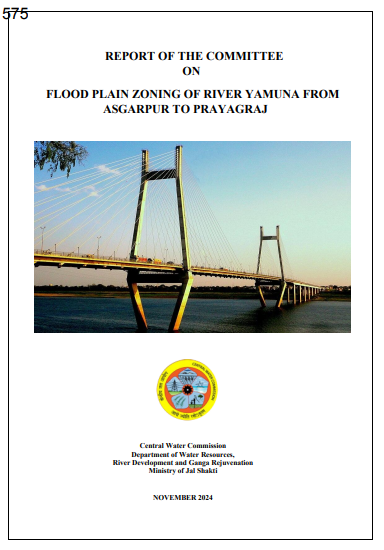
In Dec, the commission finalised the flood zone report, detailing latitude and longitude coordinates for the designated areas in 17 districts, including Gautam Buddh Nagar, Mathura, Agra, Kanpur, and Prayagraj, along with Delhi. After completing physical verification, the report was submitted to NGT, and the commission formally issued the flood zone notification in Jan.
To determine the floodplain areas, the CWC engaged a Hyderabad-based remote sensing company. An 11-member committee, comprising officials from the commission and the irrigation department, participated in the process. The floodplain was mapped using Differential Global Positioning System (DGPS) technology. The final document consists of 456 pages, while the commission’s full report spans 521 pages. https://timesofindia.indiatimes.com/city/agra/after-ngt-order-cwc-demarcates-yamuna-floodplain-areas-across-17-up-dists-del/articleshow/117891607.cms (03 Feb. 2025) The CWC report can be seen here.
Govt demarcates floodplain The government, on 22 January, issued a notification demarcating the Yamuna floodplain, following an order in this regard from the NGT, which had been hearing a petition from Agra environmentalist Dr Sharad Gupta. The contours of the Yamuna floodplain were determined scientifically, based on records of the past 100 years, according to the government. The government notification will affect areas in 17 districts of Uttar Pradesh, including Agra. It restricts any new constructions in the flood area, but the government is yet to clarify what will happen to the already-constructed buildings and those living in them.
-The notification declared a 5.09-km stretch on the right bank of the Yamuna and a 2.55-km stretch on the left bank flood-prone. It banned new constructions in this zone with immediate effect and declared existing constructions illegal. The Yamuna flows for roughly 167 km within the border of Agra. In UP, its total length from Asgarpur to Naav is 1,056 km. Along the Yamuna, the government-demarcated flood area is 15,925 sqkm.
-Hearings over the demarcation of the flood area along the Yamuna have been ongoing in the NGT for the last three years. The NGT first sought information from the irrigation department on whether there was any demarcation of the flood area. On receiving a negative answer, the NGT constituted and directed a high-level committee to demarcate the flood area from Haryana to Prayagraj. The river coast in major cities, such as Delhi and Agra, was then divided into three categories for the study. https://theprint.in/india/over-5000-buildings-in-agra-face-risk-of-demolition-after-up-govt-demarcates-yamuna-floodplain/2478998/ (04 Feb. 2025)
Haryana-Uttar Pradesh HC directs survey of river course The Punjab and Haryana High Court has directed the Surveyor-General of India to carry out a comprehensive study of Yamuna River’s shifting course and its impact on the territorial boundaries between the Haryana and Uttar Pradesh. It has been asked to collaborate with the revenue agencies of the two States for the purpose. “Directions are passed to the Surveyor-General of India, with the help of both the revenue agencies in the State of Haryana and in the State of Uttar Pradesh, undertake the exercise of studying the pattern of changes in the course of the river Yamuna and the consequential effects thereof on the territories respectively falling in the State of Haryana and the State of Uttar Pradesh,” Justice Sureshwar Thakur and Justice Vikas Suri asserted. https://www.tribuneindia.com/news/haryana/high-court-directs-survey-of-yamuna-river-course-boundary-delineation-between-haryana-up/ (17 Feb 2025)
Shifting river fueled land ownership tussle The case in which the directions were laid out earlier this month is linked to landowners from Manjhawali village in Haryana, who possess 300 bighas of land along the Yamuna. The petitioners, Ishwar Singh and others, were seeking correction of revenue records concerning the land’s ownership status. Initially, this land was within Haryana’s territory, but due to changes in the river’s course, it shifted into Uttar Pradesh. However, under a settlement of 1984, Uttar Pradesh transferred the revenue records of the said land to Haryana, but state officials allegedly failed to update them accordingly. https://theprint.in/judiciary/how-yamunas-shifting-course-has-fuelled-a-decades-long-land-ownership-tussle-between-haryana-up/2506458/ (22 Feb. 2025)
YAMUNA FLOWS
Uttar Pradesh Adani company’s ‘illegal’ construction without green nod An application last week was filed with the NGT for an immediate stay on construction activities at the controversial 1,600 MW thermal power plant in Mirzapur district. Mirzapur Thermal Energy (UP) Private Ltd is a subsidiary of the Adani Group. It’s alleged to have built a boundary wall and levelled the ground without getting mandatory environmental clearance first. While hearing the petition yesterday (Feb. 19), a three-member principal bench of NGTsaid it was “dissatisfied” over construction. Justice Sudhir Agarwal asked the Adani Group if the project proponent had any environmental clearance to start construction. When the company’s counsel said no, Agarwal said, “If you don’t have a valid EC, how can you continue these activities?” https://www.newslaundry.com/2025/02/20/petition-seeks-immediate-stay-on-adani-companys-illegal-construction-without-green-nod (20 Feb. 2025)
YAMUNA POLLUTION
Yamuna Manthan River Need Attention beyond Politics & Elections The key central government departments including Agricultural Ministry, MoEF, MoJS, MoUA, CWC, UYRB, CPCB, NMCG, DDA, along with the Agricultural, Irrigation, Water Supply, Mining departments and pollution control boards in basin states have huge role to play in keeping the river pollution free and flowing. One hopes that the central government will work sincerely with new Delhi government of whichever parties is elected in Delhi and also with other elected state governments in Yamuna basin to actually work for the revival of the river. https://sandrp.in/2025/02/05/yamuna-manthan-050225-river-need-attention-beyond-politics-elections/ (05 Feb. 2025)
SANDRP Blog An Action Plan for Yamuna It was great to see that river figured prominently in the just concluded Delhi Assembly Elections where BJP has come to power in the state after 27 years. Prime Minister Narendra Modi assured Delhi that the BJP government will make every effort to clean Yamuna. “It may be a long haul but Mother Yamuna will surely bless our efforts,” he said. Will this help the cause of the River? https://sandrp.in/2025/02/28/an-action-plan-for-yamuna-in-delhi/ (28 Feb. 2025)
दिल्ली में नई सरकार: क्या अब निर्मल होगी यमुना? दिल्ली विधानसभा चुनाव प्रचार के दौरान यमुना नदी प्रदूषण एक महत्वपूर्ण राजनितिक मुद्दा बना। चुनाव जीतने के बाद स्वयं प्रधानमंत्री और भाजपा पार्टी के वरिष्ठ नेताओं ने ‘आप’ सरकार की हार के लिए यमुना की दुर्दशा को एक प्रमुख कारण बताया। साथ में यमुना को साफ करने की बात कही। ऐसे में क्या दिल्ली के नागरिक एक स्वच्छ बहती नदी की उम्मीद रख सकते हैं? https://tinyurl.com/2cjw4e9n (16 Feb. 2025) अगर केंद्र सरकार एवं यमुना बेसिन सरकारें 1994 में हुए अपर यमुना रिवर बोर्ड समझौते की समीक्षा के दौरान यमुना नदी में पर्यावरणीय प्रवाह बढ़ाने पर कोई ठोस कदम उठाते हैं तो दिल्ली में यमुना नदी के प्रदुषण में सुधार की अपेक्षा की जा सकती है। (Bhim Singh Rawat SANDRP, Dainik Jagran 13 Feb. 2025) https://www.facebook.com/share/p/1BokQc83e4/
How promises to clean river can translate into action Article by SANDRP coordinator on Yamuna in Tribune today. https://www.tribuneindia.com/news/comment/how-promises-to-clean-yamuna-can-translate-into-action (11 Feb. 2025)
Plan to appease middle class by imitating Sabarmati RFD As I noted in another blog, a sharp critique of the plan to clean the Yamuna along Sabarmati’s lines has already emerged. Senior environmentalist Bhim Singh Rawat (SANDRP) calls it “the most alarming proposal,” pointing out that in Ahmedabad, Narmada canal water is used to create an artificial reservoir in the city stretch of the Sabarmati, effectively turning it into a stagnant pond.
“Meanwhile,” he adds, “untreated sewage discharges into the Sabarmati & natural riverbanks are being replaced with concrete commercial developments.” https://www.counterview.net/2025/02/gujarat-in-delhi-plan-to-appease-middle.html (20 Feb 2025)
No move to restore natural flow -Insisting that this approach “contradicts the goal of reducing pressure on the Yamuna and improving its environmental flow,” B S Rawat, SANDRP points out contradictions in floodplain conservation policies. “On one hand, ₹700 crore has been allocated to make Delhi flood-free; on the other, commercial constructions under the guise of riverfront beautification are proposed. This raises concerns about potential violations of the NGT 2015 orders and setbacks to past conservation efforts.”
-“The most alarming proposal is to develop a Yamuna Riverfront like Ahmedabad’s Sabarmati Riverfront,” says Rawat. He notes, “In Ahmedabad, a canal supplies Narmada River water to create an artificial reservoir in the city stretch of the Sabarmati, effectively turning it into a stagnant pond. Meanwhile, untreated sewage continues to be discharged into the river, and natural riverbanks are being replaced with concrete commercial developments.” https://www.counterview.net/2025/02/no-move-to-restore-yamunas-natural-flow.html (19 Feb 2025)
Experts call clean up move ‘temporary’ According to Bhim Singh Rawat, of SANDRP, cleaning the river using heavy machinery has been tried before without success. “It is a temporary solution, designed to grab attention,” he said. He added, “From a scientific perspective, several key factors define the health of any river—its catchment area, tributaries, water flow and quality, aquatic and riparian biodiversity, floodplains, etc. However, over the past three decades, efforts to clean the Yamuna have been prioritised, while other crucial factors affecting the river—such as deforestation, the deterioration of its tributaries, excessive water extraction through dams and barrages, mechanised sand mining, and the decline of aquatic life—have received little attention.” https://www.newindianexpress.com/cities/delhi/2025/Feb/18/yamuna-clean-up-begins-but-experts-call-move-temporary (18 Feb. 2025)
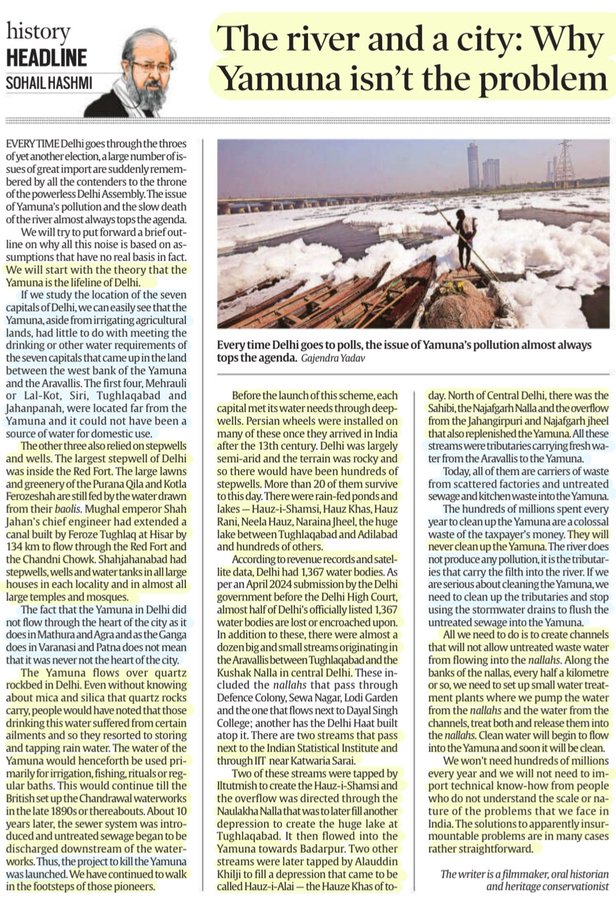
Delhi’s lifeline isn’t what you think Historian Sohail Hashmi provides correct historical perspective about Yamuna. His suggestion that it is tributaries and not Yamuna that are the problem is right, but it is tributaries that make the river. https://indianexpress.com/article/opinion/columns/yamuna-pollution-myth-delhi-lifeline-9819108/ (16 Feb. 2025)
Reimagining Yamuna’s future Effective River water resource management will need the Central and state govts to work closely to devise an action plan, especially taking different climate change scenarios into consideration. (Ranjana Ray Chaudhuri, PhD, TERI) https://www.newindianexpress.com/explainers/2025/Feb/16/status-of-river-yamuna-reimagining-delhis-future-2 (16 Feb. 2025)
Yamuna needs more than money Currently, Delhi takes water from the Yamuna and returns sewage to it. Now it must take water and also return water to the river (Sunita Narain) https://indianexpress.com/article/opinion/columns/yamuna-pollution-myth-delhi-lifeline-9819108/ 04 March 2025)
What can bring river back to life Experts feel the efficiency of STPs has to be increased and their full functioning ensured. No sewer should be left untapped and reverse monitoring employed to trace and fix the source of industrial effluents. https://timesofindia.indiatimes.com/city/delhi/what-can-bring-yamuna-back-to-life/articleshowprint/118126088.cms (11 Feb. 2025)
Cleaning not possible in 3 years The 27th report of the Parliamentary Standing Committee on Water Resources titled ‘Review of Upper Yamuna River Cleaning Projects up to Delhi and Riverbed Management in Delhi’ has flagged a usually under-played but critical issue of environmental flows or e-flows for the river. The report emphatically states that lack of adequate fresh owing water due to upstream dams and water supply projects are the key factors behind continuous degradation of river, making all the pollution control and river cleaning projects into ineffective and futile exercises. ([Shailendra Yashwant) https://www.deccanherald.com/opinion/no-it-is-not-possible-to-clean-up-yamuna-in-three-years-3417047 (22 Feb. 2025)
4 -year plan to clean up river This article by Anjal Prakash outlines a four-year strategy to clean the Yamuna and restore its health by the next Delhi election 2030. https://indianexpress.com/article/opinion/columns/delhi-new-government-yamuna-clean-up-plan-9830183/ (11 Feb. 2025)
Curse of a river It must be pointed out that cleaning of our rivers, as also of our air, is an inter-state activity. To clean these two rivers, all the states, whether it be Uttarakhand, UP, Bihar, or West Bengal, must come up with a joint and time-bound action plan. (Rashme Sehgal) https://www.freepressjournal.in/analysis/the-curse-of-yamuna-maiya (17 Feb. 2025)
Politically driven as it may be, the attention being showered on the Yamuna is not undeserved, writes Vimlendu Jha. https://www.thequint.com/opinion/delhi-yamuna-river-a-neglected-polluted-lifeline (05 Feb. 2025)
Yamuna’s pollution crisis is a multi-state failure. https://www.business-standard.com/india-news/beyond-delhi-yamuna-s-pollution-crisis-is-a-multi-state-failure-125021900400_1.html (19 Feb. 2025)
Crippled by decades of neglect and pollution, it poses a daunting restoration challenge. A look at the complexities and efforts to revive this vital waterway. https://www.newindianexpress.com/xplore/2025/Feb/15/yamuna-awaits-a-kiss-of-life (16 Feb 2025)
Uphill task The BJP, which came to power in Delhi after 27 years promising to clean Yamuna River, seems to have hit the ground running, but is cleaning the Yamuna a simple task? https://www.indiatoday.in/india/video/yamuna-river-delhis-lifeline-struggles-with-pollution-and-neglect-2683505-2025-02-21 (21 Feb. 2025)
Photographer wins for pollution picture Somenath Mukhopadhyay’s shot of a woman offering Chhath Puja in the Yamuna near Delhi, the river’s water white with foam, wows judges at the Nature inFocus Photography Awards. He clicked the image in November 2019. https://www.telegraphindia.com/gallery/bengal-photographer-wins-special-mention-for-yamuna-pollution-picture-photogallery/cid/2085373 (24 Feb. 2025)
EDIT A river must flow In 2006, the Sheila Dikshit govt planned interceptor drains to connect the city’s STPs with localities that are outside the sewer lines. The Delhi government has spent about Rs 2,400-crore on the project, which has missed several deadlines. In many places, sewer lines have been laid, but the STPs have not been upgraded. The overhaul planned by the Delhi government will have to reckon with the fact that the volume of the city’s sewage has increased by at least 100 MGD in the 19 years since the interceptor project was planned.
The 30-year water-sharing agreement between five Yamuna basin states is slated to be renegotiated this year. In the past 10 years, the Delhi and Haryana governments have been at loggerheads over the river. The new Delhi government will have to engage better with its counterparts in neighbouring states to ensure greater flows to the city. https://indianexpress.com/article/opinion/editorials/express-view-on-l-g-plan-to-clean-up-yamuna-a-river-must-flow-9852643/ (24 Feb. 2025)
रूपरेखा के साथ जिम्मेदारी भी तय हो यह अच्छा तो है कि केंद्रीय जलशक्ति मंत्रालय यमुना को स्वच्छ करने के लिए एक नई योजना की रूपरेखा बना रहा है, लेकिन क्या ऐसी योजना तैयार करने के लिए दिल्ली में सत्ता परिवर्तन की प्रतीक्षा की जा रही थी। ऐसी कोई योजना तो पहले भी बनाई जा सकती थी। प्रश्न यह है कि ऐसा क्यों नहीं किया गया। क्या यमुना को स्वच्छ करना केंद्र सरकार की भी जिम्मेदारी नहीं थी। केंद्रीय जलशक्ति मंत्रालय की पहल पर भले ही यह कहा जा रहा हो कि यमुना की सफाई के काम को एक अभियान का रूप दिया जाएगा और उसे एक निश्चित समयसीमा में स्वच्छ किया जाएगा, लेकिन इस पर भरोसा करना इसलिए कठिन है, क्योंकि यमुना केवल दिल्ली में ही प्रदूषित नहीं है।
नदियों को साफ-स्वच्छ करने को दलगत राजनीति का प्रश्न नहीं बनाया जाना चाहिए। इसलिए और भी नहीं, क्योंकि अपने देश में अधिकांश नदियां बुरी तरह प्रदूषित हैं। उन्हें प्रदूषण से मुक्त करने में न तो राज्य सरकारें सफल हो पा रही हैं और न ही केंद्र। स्थिति यह है कि नदियों को प्रदूषण से बचाने के लिए आवश्यक बुनियादी काम भी नहीं हो पा रहे हैं। https://www.jagran.com/editorial/nazariya-yamuna-river-cleaning-responsibility-and-framework-decided-by-government-23893612.html (02 March 2025)
Delhi SC hopes for better coordination The Supreme Court on Feb 25 expressed optimism about better implementation of plans to clean the Yamuna, citing a “change of circumstance” in Delhi after the BJP formed the government in Delhi. Observing that a BJP government is in place in neighbouring Haryana too—from where the Yamuna flows into the Capital—a bench headed by justice Bhushan R Gavai said: “With the change of circumstance, disputes between the Haryana and Delhi governments may not arise.”
The court was hearing a suo motu petition of 2021 on remediation of polluted rivers, with a focus on cleaning the Yamuna, due to the constant refrain by the Delhi government of high ammonia content in the Yamuna that could not be processed by treatment plans that ultimately led to water shortfall in the Capital.
On Feb 25, the court asked Additional Solicitor General (ASG) Aishwarya Bhati, who was representing both the Centre and Delhi govt, whether the issue can be sent to the NGT, which has been monitoring the Yamuna pollution case since 2017. The bench, also comprising justice Augustine George Masih, said, “You (ASG) take instructions on whether any other case on Yamuna pollution is pending before this court. Consult your officials in the MoEFCC & Delhi govt with regard to the issues involved in this petition. In the changed circumstances, there will be better implementation of plans.”
Senior advocate Meenakshi Arora, assisting the court as amicus curiae along with advocate Vanshaja Shukla, told the court that prior to the top court taking up this matter suo motu in Jan 2021, the NGT had passed various orders and was monitoring the implementation of the river clean-up through a Yamuna Monitoring Committee. This committee was disbanded after Jan 2021, Arora informed the court. The court said it will examine whether the issue needs to be sent back to NGT. However, in the event there was any other matter on the Yamuna pollution pending in this court, all petitions on the issue need to be consolidated, the bench observed. https://www.hindustantimes.com/cities/delhi-news/sc-hopes-for-smoother-yamuna-clean-up-due-to-bjp-govt-in-delhi-101740507121393.html (26 Feb. 2025)
A bench of Justices B R Gavai and A G Masih was hearing a suo motu case, titled ‘Remediation of polluted rivers’, registered by the court in Jan 2021 regarding the pollution of water bodies by untreated sewage. An SC bench presided by the then Chief Justice of India S A Bobde had taken suo motu cognizance of the matter while hearing a plea by the Delhi Jal Board, which alleged that Haryana was dumping untreated discharge in the Yamuna, leading to a spike in ammonia levels. https://indianexpress.com/article/india/delhi-changed-circumstances-better-implementation-sc-yamuna-pollution-9856133/ (25 Feb. 2025)
NGT asks DPCC to file report on illegal dyeing units After the authorities informed NGT that they took action against dyeing units in Khyala and Meethapur village in Delhi, the applicant, an environmental activist, told NGT that more illegal units were operating in these areas. The tribunal has directed Delhi Pollution Control Committee to take action and submit status report in 4 weeks.
In the other matter, the joint committee, which inspected dyeing units in Jan, said Municipal Corporation of Delhi had served a show-cause notice to six units and sealed one in Ghoda village. The committee also observed traces of coloured effluent in drains near 10-15 units, which were found to be locked. The committee recommended that MCD also take action against these 10-15 units and asked DPCC to levy environmental compensation. https://timesofindia.indiatimes.com/city/delhi/ngt-seeks-report-from-dpcc-after-plea-claims-illegal-dyeing-units-still-operating/articleshow/118539234.cms (25 Feb. 2025)
₹ 1,503 cr spent in past 6 yrs to clean Yamuna Centre has in past six years disbursed Rs 1503 Cr to UP, Haryana and Delhi for Yamuna cleaning, Delhi’s share being Rs 1091 Cr. CPCB is monitoring Water quality on monthly basis. https://www.tribuneindia.com/news/india/1503-cr-spent-in-past-6-yrs-to-clean-yamuna/ (05 Feb. 2025)
River at City’s entry not fit for bathing: CPCB report Soon after the CM took her oath at Ramlila Maidan, the CPCB submitted a report to the NGT stating that the water quality of the river at the Palla and Wazirabad monitoring stations were not even fit for bathing. According to the CPCB report, the BOD level at Palla was as high as 6 mg/litre and 5 mg/litre at Wazirabad on October 29, 2024. On December 16, 2024, the BOD rose dramatically to 13 mg/litre at Palla. On December 17, 2024, the BOD level at Wazirabad was 6 mg/litre. The faecal coliform at Palla on December 16, 2024, was 9,400 MPN per 100 ml, which has to be less than 2,500 MPN/100 ml as per Primary Water Quality for Outdoor Bathing, the CPCB said. The FC was within permissible limits at Wazirabad.
The CPCB carried out further tests, including Drain No. 8 which joins Yamuna near Palla at Haryana border on December 17, 2024. The value of BOD was 39 mg/litre. CPCB also told the NGT that according to the DPCC, in January and June 2024, the BOD at Wazirabad was 6-9 mg/litre and FC was 400-3,500 MPN/100 ml. https://www.tribuneindia.com/news/haryana/yamuna-at-entry-to-delhi-not-fit-for-open-bathing-cpcb/ (23 Feb. 2025)
High ammonia again in Yamuna -The elevated ammonia levels, stemming from industrial operations upstream in Haryana, may disrupt the water distribution in the city. However, the supply wasn’t affected on Wednesday (March 05), officials said.
-“The level of ammonia had shot up for some time, but it is now largely on declining trends. There was no issue in terms of water production as we get additional water from Munak Canal to dilute it at Wazirabad,” said an official on the condition of anonymity.
-Since last year, DJB has expressed concerns about Haryana releasing water containing excessive ammonia into Yamuna. The planned ammonia treatment facility at Wazirabad, due for completion by 2023, still remains unbuilt. https://timesofindia.indiatimes.com/city/delhi/ammonia-up-in-river-again-water-supply-not-hit-as-yet/articleshow/118741874.cms (06 March 2025)
Ammonia level rises yet again The ammonia level in the Yamuna spiked again in the past two days, and on Friday (Feb. 21), measured around 8ppm. This is likely to affect the water production at the water treatment plants, which are designed to manage ammonia only up to 1ppm. “The water treatment plants have not been shut down yet, but if the situation does not change, water production may be reduced,” said a DJB official requesting anonymity. Delhi Jal Board itself did not respond to queries & neither confirmed nor denied the rise in ammonia levels in the river. https://timesofindia.indiatimes.com/city/delhi/ammonia-level-rises-in-yamuna-yet-again-may-hit-water-supply/articleshowprint/118460178.cms (22 Feb 2025)
DPCC submits Yamuna rejuvenation plan to PMO The DPCC presented a document to the PMO last week regarding the cleaning and rejuvenation of the Yamuna. The plan to curb pollution includes a 100 per cent sewage treatment initiative, which involves upgrading 37 existing STPs and constructing new ones. The city’s sewage treatment capacity is set to increase from 792 MGD in 2023 to 964.5 MGD by December 2026, with a new STP planned at Delhi Gate and 40 new decentralised STPs (DSTPs) being prepared. Additionally, 14 existing STPs are scheduled for upgradation by December 2026.
To improve water quality, the document has emphasised the need for a minimum environmental flow (E-flow) of 23 cumecs (437 MGD). However, due to existing water shortages, the current flow into Delhi is nearly nil. Pending dam projects, including Renuka, Lakhawar and Kishau, could help address this gap, it said. https://www.ndtv.com/india-news/delhi-pollution-control-panel-submits-yamuna-rejuvenation-plan-to-pms-office-7748581 (19 Feb 2025)
MoJS consults Sabarmati RFD experts for action plan According to sources, for the ‘Yamuna Master Plan’, the Jal Shakti Ministry consulted experts who built Gujarat’s Sabarmati river front. Additionally, a few meetings have also been held by the ministry, sources said. https://www.indiatoday.in/cities/delhi/story/yamuna-cleaning-pollution-master-plan-centre-forms-pm-narendra-modi-approval-bjp-aap-2686842-2025-02-28 (28 Feb. 2025)
TERI shares plan to clean river in 3 years The Energy and Resources Institute (TERI) has prepared a brief action plan to clean river Yamuna. According to TERI sources, the plan outlines actions required to improve river health has been shared with Delhi govt and is awaiting a response. TERI claims that the river could be rejuvenated within three years under its 10-point action plan. https://timesofindia.indiatimes.com/city/delhi/yamuna-most-polluted-this-jan-in-5-years-dpcc-report/articleshowprint/118539242.cms (25 Feb. 2025)
L-G’s Four-Pronged Strategy Cleaning the riverbed: The trash, garbage and silt in the Yamuna river stream will be removed. Cleaning the drains: Cleaning operations in the Najafgarh Drain, Supplementary Drain, and all other major drains will start simultaneously. Fixing Sewage Treatment Plants: The authorities will keep a watch on the existing STPs and maintain the output. Increasing treatment: Time-bound construction of new STPs/DSTPs on drains to meet the shortfall of treating nearly 400 MGD of sewer. https://www.news18.com/india/delhi-l-g-rolls-out-four-pronged-strategy-to-clean-yamuna-sets-deadline-for-rivers-revival-within-3-years-9229524.html (16 Feb. 2025)
Plan to clean river in 3 years: LG The LG office further stated that the plan would require seamless coordination between various agencies and departments in the city, including Delhi Jal Board, Irrigation & Flood Control Department, Municipal Corporation of Delhi, Public Works Department, and Delhi Development Authority. “The river rejuvenation works will be monitored on a weekly basis…Delhi Pollution Control Committee has been directed to keep a strict vigil on the discharge of untreated effluent by industrial units into the drains,” it added. https://timesofindia.indiatimes.com/city/delhi/plan-to-clean-yamuna-in-3-years-lg/articleshow/118308673.cms (17 Feb. 2025)
DJB Proposes 100-Day Yamuna Plan In the next three months, the DJB will focus primarily on minimising untreated sewage discharge into the Yamuna while addressing issues of drain overflow in the city. Officials have confirmed plans for desilting major underground trunk sewer lines, implementing drainage trapping measures, and upgrading 4 STPs. The new BJP govt has pledged the cleaning of the Yamuna as a significant electoral commitment.
One of the major projects that could be commissioned in the next 100 days is the Okhla STP. The Okhla STP will have a capacity of treating 140 million gallons per day (MGD) of sewage once it’s fully operational. The project is a joint venture between the National Mission for Clean Ganga and DJB, started in 2017. It is now nearing completion & is expected to be ready soon.
According to DJB officials, the estimated cost of the project is Rs 665 crore. While almost 85% of the funds were contributed by the central govt under the Yamuna Action Plan-III, the remaining were given by the Delhi govt. DJB has 37 STPs and is trying to increase its treatment capacity by carrying out upgradation work on several plants. The work started in the previous govt, but the completion of these projects in Rithala, Rohini, Narela, and a few others is on the plan. https://timesofindia.indiatimes.com/city/delhi/with-fund-flow-assurance-djb-proposes-100-day-yamuna-plan/articleshow/118511098.cms (23 Feb. 2025)
Have 365 days plan: CM Rekha Gupta said on Feb 21, just over 30 hours after being sworn in, that dealing with pollution has to be a year-round activity and her govt will have a 365-day plan. Concerned about any water or power crisis this summer because of rising demand, Gupta said a long-term plan will be drafted to seek water from UP, Uttarakhand, Haryana and Punjab. “I am Haryana’s daughter too and I will ask them for more water,” she said, hopefully. Except for Punjab, all these states have BJP govts. https://timesofindia.indiatimes.com/india/year-round-plan-in-works-to-tackle-air-water-pollution-delhi-cm-rekha-gupta/articleshow/118462335.cms (22 Feb. 2025) CM Rekha Gupta performed ‘Yamuna Aarti’ along with her cabinet colleagues at Vasudev Ghat on Thursday (Feb. 20) soon after formally taking charge as the ninth CM of the national capital at the Secretariat. https://www.business-standard.com/india-news/delhi-cm-rekha-gupta-ministers-perform-yamuna-aarti-at-vasudev-ghat-125022001067_1.html (20 Feb. 2025) Interestingly, Arvind Kejriwal had also performed Yamuna Aarti at Gita ghat in Nov 2015 after becoming the chief minister to mark the beginning of his promise to clean the river. However, 10 years down the line Yamuna pollution was one of the key factors that led to his defeat. https://timesofindia.indiatimes.com/india/with-aarti-on-day-1-cm-rekha-gupta-takes-first-step-to-make-yamuna-identity-of-delhi/articleshow/118426172.cms (20 Feb. 2025)
‘River will be cleaned by Chhath’ Cabinet minister Pankaj Kumar Singh has made an ambitious claim, assuring residents that the Yamuna would be cleaned by the upcoming Chhath festival. “You will see a transformed Yamuna by the next Chhath… We will pass the necessary decisions in the first Cabinet meeting and implement development schemes. As someone from Purvanchal, I promise you a clean and beautiful Yamuna,” he said. https://www.tribuneindia.com/news/delhi/yamuna-cleanup-to-2500-aid-tough-road-ahead-for-bjp/ (21 Feb. 2025)
Will develop 48km stretch to get facelift: Verma Delhi water minister Parvesh Verma stated that the entire 48 km stretch will be redeveloped into a green zone comprising jogging path, picnic spot dotted with small eateries and stalls. He assured that rules against the river pollution will be made stricter. “The industries releasing the industrial waste into the Yamuna will be fined.” https://www.newindianexpress.com/cities/delhi/2025/Feb/28/48-km-stretch-along-yamuna-to-get-facelift (28 Feb. 2025)

Haryana Dainik Bhaskar reports on how untreated effluents from Yamuna Nagar, Karnal, Panipat, Sonipat and Faridabad dists polluting Yamuna in addition to causing sufferings to local villagers along the polluting drains. https://www.facebook.com/share/p/1CPCeVKUjT/ (25 Feb 2025)
Make river water potable: CPS Chief Principal Secretary (CPS) to the CM Rajesh Khullar on Feb 22 held a meeting of the officials concerned on the Yamuna Action Plan at the DC Camp office and sought a detailed report to the headquarters by next week. He also directed the officials to clean the Yamuna and maintain the parameters at Tajewala Head in Yamunanagar district, from where the river water is released up to the last point in Haryana.
Khullar said approximately 11MLD sewage is being discharged into drains without treatment from the city. The capacity of STPs is more than 168.8 MLD, but the total discharge from the city is approximately 95 MLD. However, as per a report of the HSPCB, 70% of wastewater reaches STPs, the remaining 31 per cent is being directly discharged into the drain. Around 11.5 MLD is discharged into drain number 1 while 20.11 MLD is discharged into drain number 2, which is a big cause of pollution in Yamuna. DC Dahiya said Karnal drain and drain number-1 mixed with the Yamuna at Khojkipur village of the district. “We have a plan to make three pond systems near the Khojkipur village to clean the drain water. With this system, around 50 per cent water would be cleaned,” the DC maintained. https://www.tribuneindia.com/news/haryana/clean-yamuna-make-river-water-potable-cps-khullar-to-officials/ (23 Feb. 2025)
83% of industrial units releasing effluents polluting Yamuna The report by the committee, submitted to NGT earlier in January month, said that of the 136 industrial units that generate effluents in Sonipat’s Barhi Industrial Area, 113 were relying on sub-par primary effluent treatment plants (PETPs). The tribunal had formed the committee of officials of the CPCB and SPCB while hearing a petition, which was filed by Delhi-based activist Varun Gulati in May 2024. In the latest hearing on Jan 8, the NGT bench also impleaded the NMCG to respond on the findings of the report as Yamuna flows into the Ganga river. The next hearing in the case is scheduled for Feb 27.
-CPCB had found in a March-Dec 2021 survey that Panipat contributed most of ammoniacal nitrogen – a key byproduct of the textile industry – to Yamuna waters, followed by Gurgaon (25.2%), Faridabad (15%) and Sonipat (10.1%). In 2023, HSPCB had told NGT – which was hearing another case – that the state generates 1,461 MLD of wastewater, of which 921 MLD is treated at 11 sewage treatment plants. https://timesofindia.indiatimes.com/city/gurgaon/83-of-industrial-units-releasing-effluents-polluting-yamuna-finds-ngt-committee/articleshowprint/117214432.cms (14 Jan. 2025)
Faridabad 366 ‘polluting’ industries on NGT radar The NGT has constituted a joint committee to investigate if 366 industries are violating environmental norms in Faridabad and are responsible for polluting air and water. The committee is expected to submit its report to the tribunal within eight weeks. The order was uploaded on Saturday. Faridabad district magistrate will act as the nodal agency in the joint committee. The next date of hearing is on May 20. https://timesofindia.indiatimes.com/city/gurgaon/366-polluting-industries-on-ngt-radar-joint-panel-set-up-for-probe-in-haryana/articleshow/118397427.cms (20 Feb. 2025)The NGT order comes in response to a petition filed by one Narender Sirohi, a resident here, on February 2 in which he has alleged that a large number of industrial units situated in the area comprising the villages of Saroorpur, Kureshipur, Madalpur, Karnera, Fatehpur Tagah, Nangla, Nekpur, Ghazipur, Kheri Gujran and Bhankri in the district had been operating in gross violation of environmental norms and without the permission of departments like the HSPCB. It has been submitted that the majority of the units here operating unlawfully on agricultural land do not have the mandatory Consent to Establish (CTE) and Consent to Operate (CTO) permission from the Pollution Control Department. https://www.tribuneindia.com/news/haryana/ngt-notice-to-depts-over-violation-of-pollution-norms-by-366-fbad-units/ (16 Feb. 2025)
Uttar Pradesh Residents seek a clean Yamuna, riverfront Members of the District Development Residents Welfare Association (DDRWA) wrote to the deputy chief minister, urging that officials organise a cleaning drive for the stretch of the river that flows in Noida. Citing sustained neglect and sewage disposal in the river, residents have also demanded the development of a riverfront in the city. Officials in the national capital have announced plans for an initiative to clean and develop the riverfront in Delhi following the recent elections. Residents in the city took inspiration from the project and raised demands for similar work to be conducted in the city as well. The Yamuna river stretches roughly 23km along Noida. https://timesofindia.indiatimes.com/city/noida/delhi-residents-seek-a-clean-yamuna-riverfront-write-to-deputy-cm/articleshow/118510896.cms (23 Feb. 2025)
रामदत्त त्रिपाठी: -यमुना की गंगा संगम तक की दर्दभरी कहानी: यमुना नदी का प्रदूषण और उसकी समस्याएं। उद्गम से लेकर वृंदावन-मथुरा तक, जानिए कैसे यमुना का पानी शहरी और औद्योगिक गंदगी से प्रदूषित हो जाता है। (भाग 1) https://tinyurl.com/25e4xdk5 (05 Feb. 2025) वृंदावन-मथुरा-आगरा की यमुना की दर्द-ए-दास्तां (भाग 2) https://hindi.indiawaterportal.org/river-and-pond/the-sad-story-of-yamuna-of-vrindavan-mathura-agra-part-2 (05 Feb. 2025) यमुना नदी में बढ़ते प्रदूषण से दिल्ली से आगरा तक के शहरों और गांवों में लगभग दो करोड़ लोग पेयजल संकट और बीमारियों से जूझ रहे हैं। मछुवारों के रोजगार पर भी इसका गहरा असर पड़ा है। (भाग 3) https://hindi.indiawaterportal.org/river-and-pond/delhi-to-agra-lack-of-drinking-water-crisis-of-disease-and-unemployment-and-the-tale-of-yamuna-part-3 (16 Feb. 2025) आगरा से प्रयागराज संगम तक की यमुना की दर्द-ए-दास्तां (भाग 4) https://hindi.indiawaterportal.org/river-and-pond/dard-e-dastan-of-yamuna-from-agra-to-prayagraj-sangam-part-4 (16 Feb. 2025)
YAMUNA RIVERS
Noida To keep Ganga-Yamuna pollution free during Mahakumbh, the administration has claimed to ensure no effluents release in Hindon. Here is the Hindon river on Feb. 23 brimful of pollution in Noida. The same happened about two weeks back. No action has been taken on past complaints regarding the issue. https://www.facebook.com/reel/593789293644025 ( 24 Feb. 2025)
NGT raps govt over Hindon pollution The NGT has again reprimanded the UP government for failing to control pollution in river Hindon and observed that no effective action was taken to control the discharge of industrial effluents, untreated sewage, and unprocessed solid waste into the Hindon and its tributaries, Kali West and Krishni. The case stems from a petition filed by Noida resident Abhisht Kusum Gupta in March 2022, drawing attention to the severe pollution in the river due to the continuous discharge of untreated waste and effluents. The plea highlighted that despite repeated directives, authorities had failed to take concrete pollution control measures, leading to significant environmental degradation.
NGT has now sought a fresh affidavit within six weeks, outlining a timebound action plan for implementing CPCB’s recommendations. The matter has now been listed for further hearing to May 6, 2025. https://www.hindustantimes.com/cities/noida-news/ngt-raps-uttar-pardesh-govt-over-hindon-pollution-seeks-fresh-affidavit-101738607881741-amp.html (4 Feb 2025)
Illegal construction on Hindon floodplain demolished In Jan 2025, a joint operation by Noida authority, revenue dept and police was carried out, and demolition of unauthorised buildings was carried in the area, said district administration officials. A recent inspection by Anuj Nehra, SDM, Dadri, alongside other officials, however, found that illegal reconstruction had been carried out at the same site. The district administration took immediate action and deployed JCB machines to once again demolish the unauthorised structures, officials said. https://www.hindustantimes.com/cities/noida-news/illegal-constructions-resurface-in-hindon-floodplains-5-booked-101740768578674.html (01 March 2025)
37 villages told to clear illegal constructions from floodplains The administration has made it clear that it will not be liable for any damages caused by flooding in these areas and will not provide compensation for losses incurred on account of illegal developments. Additionally, no flood protection measures will be undertaken in these areas. The administration also warned that any damages resulting from unauthorized structures will be recovered from those responsible for such constructions. Residents and encroachers have been urged to voluntarily remove illegal constructions. Officials informed that if the encroachments are not cleared voluntarily, strict legal action will be taken against violators.
The administration has also urged people not to buy or invest in land in the floodplain areas, as no construction will be permitted, and legal action will be taken against violators. The Gautam Budh Nagar administration had issued a similar directive in May 2024 as well, appealing to residents to raze or demolish their illegally build houses and establishments on the floodplains of the Yamuna and Hindon. The district administration has been issuing warnings against illegal establishments on the floodplains and issuing a fresh warning on Friday (Feb. 07), that if any illegal construction is being carried out in these areas, it must be removed immediately, citing government order dated 16.03.2010 and the NGT order dated 20.05.2013. The district administration has emphasized that no construction of any kind is permitted on these sites.https://www.hindustantimes.com/cities/noida-news/greater-noida-37-villages-told-to-clear-illegal-constructions-from-hindon-yamuna-floodplains-101738951883184.html (08 Feb. 2025)
Madhya Pradesh Project to rejuvenate Yamuna-Chambal In a mega initiative, WWF-India has launched a four-year multi-stakeholder initiative on the Chambal-Yamuna river system, along with Genpact, a global advanced technology services and solutions company. “Through this initiative, WWF-India will work with key stakeholders, including local communities, the Govts of UP, MP and Rajasthan and the NMCG, to enhance understanding of the river—its hydrology, morphology, ecology and governance to develop valuable insights and pave the way for long-term conservation of one of India’s important perennial rivers,” said Ravi Singh, Secretary General & CEO, WWF-India.
Over the next four years, the project will work towards enhancing the understanding of environmental flows (quantity, quality and timing of freshwater flows) in key rivers of the Chambal and Yamuna basin. The project, involving more than 50,000 farmers, will demonstrate models to enhance ows through improved agricultural water management in the Parbati-Sindh and Kali rivers, which are part of the Chambal-Yamuna-Ganga system in MP and UP. It will also empower Mitras (friends of rivers) for the conservation of habitats of Ganga river dolphins and gharials in an 80-km stretch of the Chambal-Yamuna rivers and work towards stabilising their populations. https://www.deccanherald.com/environment/wwf-launches-initiative-to-rejuvenate-chambal-yamuna-rivers-3381894 (31 Jan. 2025)
Raw sewage pollutes Chandraloi river The case was initiated suo motu based on a news report titled Four endangered crocodiles found dead in the Chandraloi river in Kota; experts wonder if pollution is to blame, published in The Indian Express on Dec 6, 2024. The NGT, on Dec 19, 2024, constituted a joint committee to inspect the site, conduct biomonitoring and bioassay tests, and submit a report. The joint committee conducted site visits on Jan 24 & 25, 2025 and collected water samples from nine representative locations where crocodile deaths had been reported between Nov 30 and Dec 4, 2024.
The report highlighted that organic pollution from untreated sewage entering the Chandraloi river is a significant issue. The report acknowledged systemic issues in Kota’s sewage infrastructure, leading to raw sewage entering the Chandraloi river. The Chandraloi river is a small tributary of the Chambal river. As it flows along the outer periphery of Kota, it merges with the Kansua Nalah, which carries some of the city’s domestic sewage, treated industrial effluent, and agricultural runoff. Crocodiles inhabit the Chandraloi river along its length. https://www.downtoearth.org.in/environment/daily-court-digest-major-environment-orders-february-24-2025 (25 Feb. 2025)
बेतवा की कहानी, बेतवा की जुबानी This Hindi documentary by Environment Story reveals that Betwa river has dried up at its origin place due to some construction and encroachment works. Few springs fed by Kollar dam seepage are feeding the river course there. The river is further polluted by industrial waste from Mandideep area and sewage pollution from Bhopal city making its water unfit for drinking and bathing purposes. In later course too the river continues to suffer from water extraction, floodplain encraochment and mining activities.
It also informs that the NGT in 2015 asked the MP govt and local administration to tap the drains polluting the river and remove encroachment from its floodplain. However, the situation has only worsen even after 10 years of the order. It summaries that the Betwa river has turned seasonal due to human activities and it is important to revive the river to achieve clean Ganaga objectives. https://www.youtube.com/watch?v=DDDK4-LROqU&t=124s (27 Feb. 2025)
Ujjain Shipra नदी की हालत देख भड़के संतों की चेतावनी मोक्ष दायिनी शिप्रा जिसके जल से सिंहस्थ में स्नान किया जाता है। इस नदी की स्वच्छ और प्रवाहमान बनाने के सरकार करोड़ो रूपए पानी की तरह बहा रही है। इसी शिप्रा की शुद्धता के लिए प्रदेश सरकार ने इंदौर से आने वाली कान्ह नदी का मुंह ही मोड़ दिया, ताकि शिप्रा नदी को दूषित होने से बचाया जा सके। शिप्रा में मिल रही गंदगी और नदी की दुर्दशा देखकर साधु संतों में खासा आक्रोष दिखा। संतों से प्रशासन को चेतावनी भी दी कि समय रहते इसमें सुधार कर लिया जाए वर्ना परिणाम अच्छे नहीं होंगे। https://www.youtube.com/watch?v=Z-D1fXuLeYU (22 Feb. 2025)
सिंहस्थ 2028 से पहले प्रदूषण से पूरी तरह मुक्त होगी शिप्रा सिंहस्थ 2028 से पहले मध्य प्रदेश की धर्मनगरी उज्जैन में स्थित मोक्षदायिनी शिप्रा को अविरल और प्रदूषण मुक्त बनाने के लिए नमामि गंगे की तर्ज पर ‘नमामि शिप्रा’ अभियान की शुरुआत होने जा रही है। इसके जरिये ही उज्जैन नगरी का भी कायाकल्प किया जाएगा। उज्जैन नगर की जरूरतों और विकास को ध्यान में रखते हुए सिंहस्थ 2028 पर केंद्रित कार्यों का क्रियान्वयन किया जाएगा। सरकार ने प्रोजेक्ट को पूरा करने के लिए पीआईयू यानी प्रोजेक्ट इंप्लीमेंटेशन यूनिट का गठन भी कर दिया है। प्रोजेक्ट इंप्लीमेंटेशन यूनिट को नमामि शिप्रा परियोजना प्रबंधन इकाई नाम दिया गया है। 2028 से पहले शिप्रा नदी पर निर्माणाधीन समेत सभी परियोजनाओं को 3 साल में पूरा करने का टारगेट सेट किया गया है। https://www.patrika.com/ujjain-news/shipra-river-will-completely-free-from-pollution-before-simhastha-2028-mp-government-master-plan-ready-19336338 (22 Jan. 2025)
MINING IN YAMUNA RIVERS
Report Sand mining continue to pose threat to Yamuna Illegal mining in the Yamuna River, which primarily takes place in Haryana, Uttar Pradesh, Uttarakhand and Delhi, has been a growing concern for years. The situation is particularly problematic due to the extraction of sand and gravel from the riverbed, which is often done without any regulatory oversight or adherence to environmental standards.
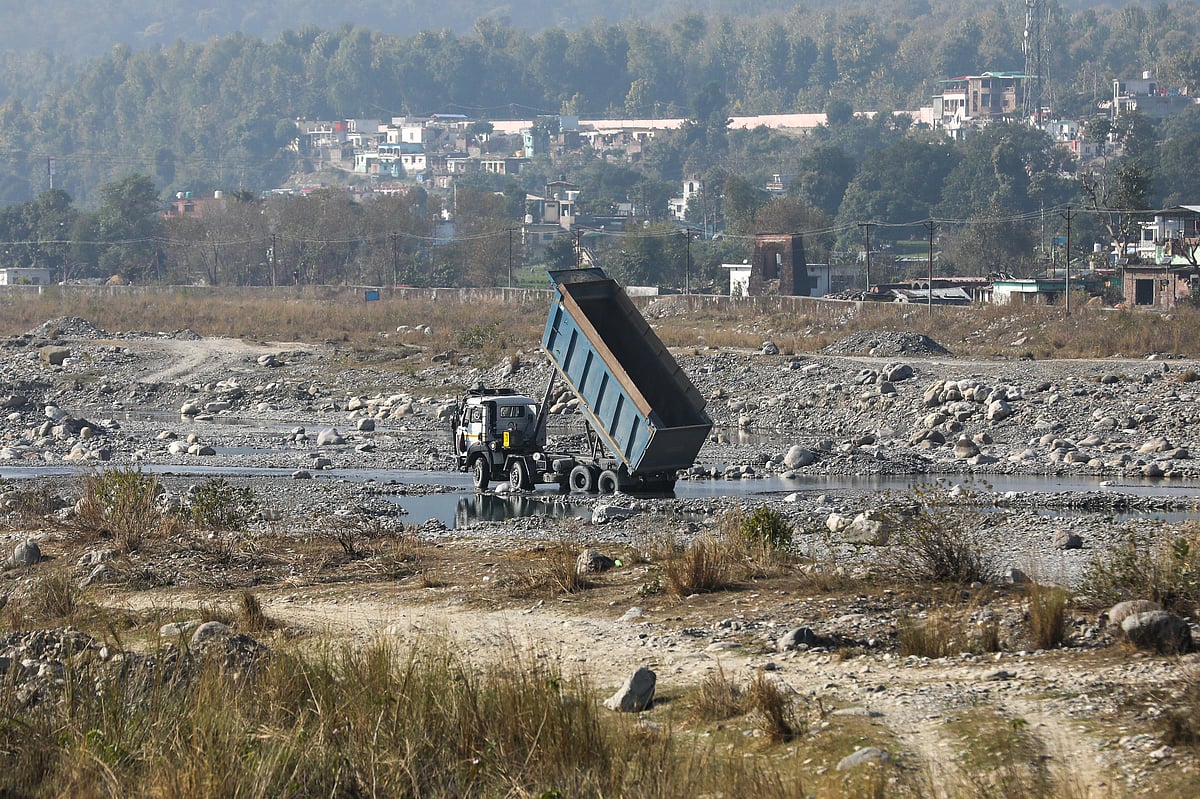
Despite various initiatives, such as increasing patrols and imposing fines, the persistence of illegal mining continues to pose a serious challenge for environmental protection and sustainable development in the region. In addition to environmental harm, illegal mining often results in adverse social consequences. The practice is frequently linked to corruption and exploitation, with workers subjected to poor working conditions and minimal pay. In some cases, illegal miners operate in regions where law enforcement and regulations are weak, further complicating efforts to address the issue. https://www.downtoearth.org.in/water/sand-mining-riverbed-erosion-continue-to-pose-existential-threat-for-yamuna (24 Feb. 2025)
Haryana HC slams police for ‘stifling’ illegal mining investigation The Punjab and Haryana high court described the failure of the police and department of mining to arrest a single person out of the 82 mentioned by four individuals who had been previously arrested in an illegal mining case as “shocking.” The court said that from submission of the counsels, “it was apparent that senior officers of the department of mining and police are involved in the entire scam and the Haryana police is now trying to stifle the investigation, which cannot be permitted.”
Commissioner of police, Panchkula, was directed to remain present in court on the next date of hearing. The case was registered after illegal mining was reported from Pinjore, Barwala, Raipur Rani, and Chandimandir in Panchkula district. Last Nov, crime branch of Panchkula police arrested three individuals involved in illegal mining in the district. The accused were later released on bail.
-During interrogation, the accused alleged that home guard Deepak was involved in the illegal mining racket, acting as a middleman between miners and many govt officials. The home guard would allegedly receive a commission for facilitating illegal mining activities, it was alleged. Earlier, Deepak, along with two others, got interim bail from the HC. https://timesofindia.indiatimes.com/city/chandigarh/high-court-slams-haryana-police-for-stifling-illegal-mining-investigation/articleshowprint/118565326.cms (26 Feb. 2025)
Panchkula cop involved in illegal mining arrested The SIT has arrested ASI Malkit Beniwal for being involved in an illegal mining case in Panchkula. He was presented before the Panchkula court today, which sent him to Ambala jail instead of granting police remand. Beniwal, stationed at the Barwala police post, is implicated in the Barwala area mining case. The SIT, led by DCP Himadri Kaushik and ACP Vikram Nehra, sought a three-day remand, which the court rejected. The scam, discovered in December 2024 via WhatsApp groups, led to an FIR at Chandimandir police station. The investigation revealed a large network of 82 suspects; 69 have been questioned. Home guard Deepak Sharma, the alleged mastermind, is under scrutiny for facilitating deals between officials, police, and miners. https://www.hindustantimes.com/cities/chandigarh-news/panchkula-cop-involved-in-illegal-sand-mining-arrested-101740861970744.html (02 March 2025)
Calls bare police-miner nexus in Panchkula Several police officers, including of the DSP rank, are under scrutiny as the investigation into the Panchkula mining scam has revealed that hundreds of calls were exchanged between them, middlemen, and illegal miners. WhatsApp groups were allegedly used to share information about vehicle registration numbers carrying illegally mined sand, so that these could be allowed to pass without being checked.
The Punjab and Haryana High Court has not only issued strictures on the delayed investigation against police officers but has also directed the Commissioner of Police, Panchkula, to appear in person on March 3. According to an FIR, which is based on source-based information, Deepak Sharma, a Home Guard, acted as a middleman for officers at police stations and posts in the Pinjore and Chandimandir areas, collecting bribes from illegal miners on their behalf.
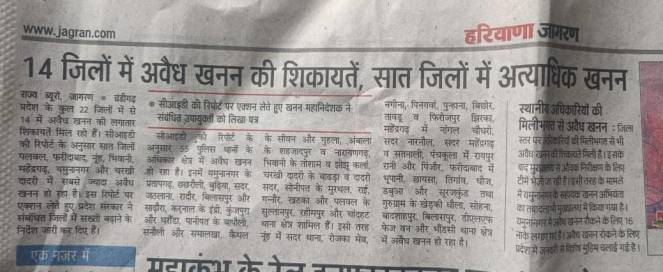
After the HC on Feb 19 commented that “the investigation into the present case has not made any headway and rather it appears that every attempt is being made to screen the senior police officers,” the Panchkula police arrested 3 low-ranking officials. https://www.tribuneindia.com/news/haryana/calls-bare-police-miner-nexus-in-panchkula/ (2 Mar 2025)
Residents allege rampant sand mining in Yamuna Authorities in this Haryana district have set up 16 checkpoints to curb illegal mining and the unauthorised transportation of minerals. The move comes following a directive from deputy commissioner Parth Gupta in compliance with an NGT verdict and a request from the state’s mines and geology department. District officials have deployed personnel from multiple departments to monitor these checkpoints, inspect mineral trucks, and submit daily reports to the DC’s office. SDMs have been assigned to oversee operations in their respective areas and coordinate with local police, mining officials, and law enforcement. The teams will verify transit permits (e-Ravaana) for trucks, tippers, and tractor-trailers that transport mineral.
Despite this crackdown, concerns persist about rampant illegal mining, in the Jathlana area of the Yamuna river particularly. Haryana Anti-Corruption Society president, Waryam Singh, alleged that earthmoving machines kept extracting sand all night, while authorities turned a blind eye to this violation.” Locals such as advocate Sarvjeet Singh, Avtar Singh, Amarjeet, Balwant, Harnam, and Pankaj claimed that despite regulations prohibiting mining before sunrise and after sunset, this illicit activity had impacted the Yamuna’s natural river flow and degraded its environment. Waryam Singh accused some govt officials of facilitating illegal mining for personal gain. With mounting environmental and economic concerns, residents urge the state govt to enforce stricter measures against illegal mining in the region. https://timesofindia.indiatimes.com/city/chandigarh/yamunanagar-administration-place-special-check-posts-to-curb-illegal-mining-residents-allege-rampant-sand-mining-in-yamuna-river/articleshow/118460204.cms (21 Feb. 2025)
Yamunanagar divided into 5 zones to check illegal mining As per an order passed by Chandar Bhushan Tiwari, Assistant Mining Engineer, Yamunanagar district, there are 32 legal mining blocks (mining quarries) in the district. But at present, only five mining blocks are operational and the remaining are non-functional, as they are suspended or expired. Tiwari said they were facing a major problem in the Bailgarh area, therefore, they had decided to depute extra workforce to check illegal mining.
Sources said the Yamuna was a big source of illegal mining and most stone crushers and screening plants were situated in the area, including Devdhar, Ballewala, Doiwala, Bhud Majra and Belgarh villages. Besides, illegal mining was allegedly carried out in seasonal rivulets situated in other parts of the district, and in agricultural fields with the consent of landowners/farmers. https://www.tribuneindia.com/news/haryana/yamunanagar-dist-divided-into-5-zones-to-check-illegal-mining/ (06 Feb. 2025)
Two brothers were killed and a woman was injured when the motorcycle they were riding was allegedly hit by a tipper near Tunde Ki Tapriyan village on the Sadhaura-Ranjitpur road in Yamunanagar. https://www.tribuneindia.com/news/haryana/two-brothers-killed-in-ynagar-road-accident/ (15 Feb. 2025)
NGT serves notices to mining dept & SEIAA over Aravali land auction NGT has issued notices to State Environmental Impact Assessment Authority (SEIAA) and the mining department of Haryana in the wake of the auctioning of protected Aravali land for mining in Mahendergarh’s Rajawas. The SEIAA and the mining department of Haryana have been given a four-week deadline to submit their responses.
-The state govt on June 20, 2023, issued a notification designating 506 acres of Aravalis in Rajawas as ‘protected’ under the Forest (Conservation) Act. However, simultaneously, the mining department auctioned one-quarter of this protected land, prompting opposition from locals, who are now pursuing the area’s designation as a wildlife reserve. https://timesofindia.indiatimes.com/city/gurgaon/ngt-serves-notices-to-mining-dept-seiaa-over-aravali-land-auction/articleshowprint/117895372.cms (04 Feb. 2025)
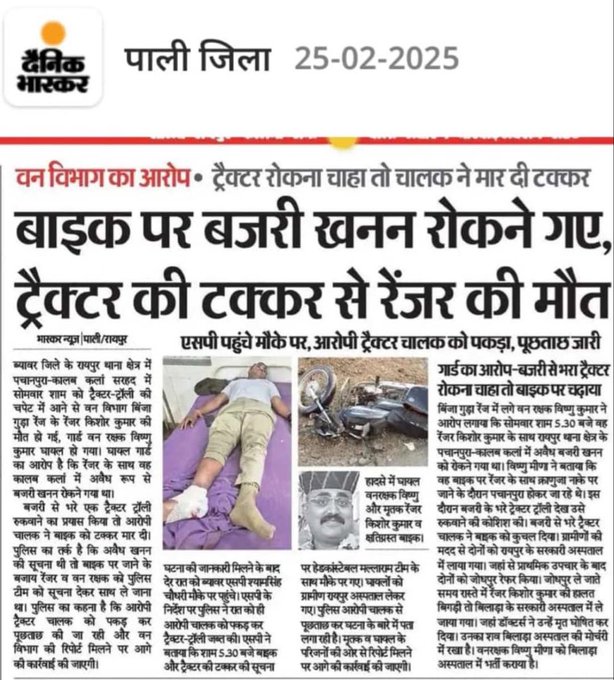
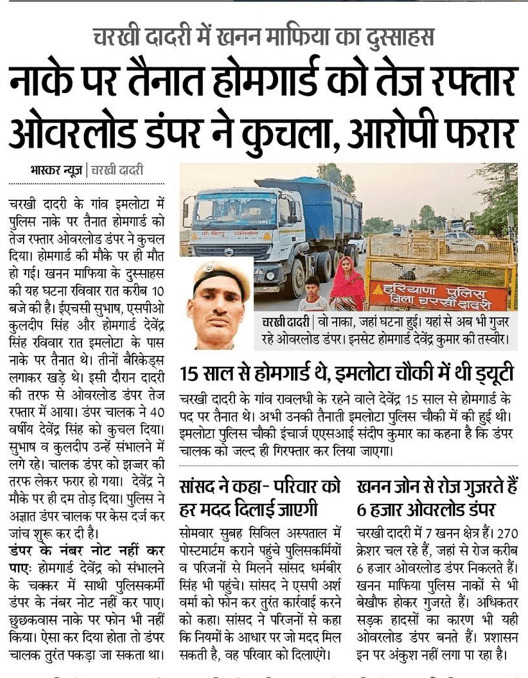
Haryana- Rajasthan In just 2 days 2 more front line defenders lost their lives to sand/stone mafia operations. While overload stone dumper mowed down 40 years old home guard Devendar Singh on Feb 23 in Charkhi Dadri, Haryana; a forest ranger Kishor Kumar was killed by illegal sand carrying tractor in Pali, Rajasthan on Feb 24. https://www.facebook.com/share/p/1GY78Gc143/
Rajasthan पाली जिले के रायपुर मारवाड़ में हुए सड़क हादसे में क्षेत्रीय वन अधिकारी की मौत हो गई, जबकि उनके साथ जा रहे वनरक्षक गंभीर घायल हो गए। जानकारी के अनुसार क्षेत्रीय वन अधिकारी प्रथम किशोर कुमार बींजागुड़ा रेंज अपनी बाइक पर वनरक्षक विष्णु कुमार मीणा के साथ कानूजा जा रहे थे। जब वे कालब खुर्द के पास पहुंचे, तभी सामने से आ रहे एक अवैध बजरी से भरे ट्रैक्टर ने उन्हें टक्कर मार दी। दुर्घटना के बाद घटनास्थल पर ग्रामीणों की भीड़ जुट गई। https://www.patrika.com/pali-news/regional-forest-officer-dies-after-being-hit-by-a-tractor-loaded-with-illegal-gravel-19421950 (25 Feb. 2025)
Can’t probe sand mining due to resource constraints: CBI -Expressing concern over the Central Investigation Bureau’s inability to probe the cases of illegal sand and gravel mining citing resource constraints, the Rajasthan high court has asked CBI director Praveen Sood to appear before it.
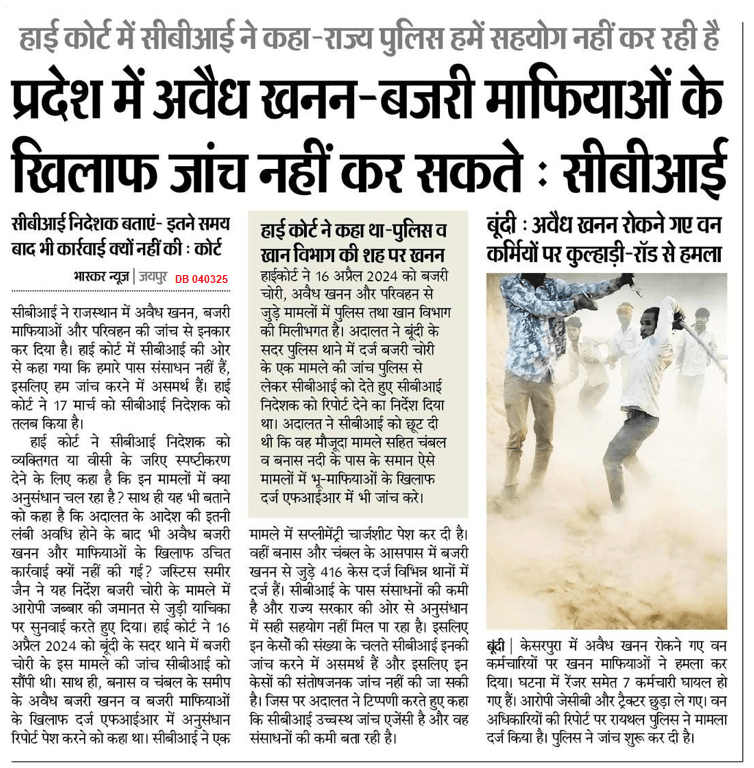
-The high court noted on March 4 that “such limitations were unexpected from India’s premier investigating agency,” and directed Sood to appear either in person or through video conferencing when the case comes up for hearing on March 17.
-In April 2024, the high court had directed the CBI to investigate illegal sand mining on the state’s Chambal and Banas riverbeds. The directive came in the case of one Shahrukh, who is accused of transporting 40 metric tonnes of sand in a dumper without a valid permit. The court asked the agency to investigate other sand mafias of the state too. Following that order, a case was registered by the central agency. https://thewire.in/law/unexpected-rajasthan-hc-cbi-director-praveen-sood-illegal-mining (05 March 2025)
Madhya Pradesh राजगढ़ में जारी है अवैध रेत खनन, 5 नदियां हो रही प्रभावित अगस्त 2024 में रेत माफियाओं ने प्रशासनिक अमले को घेरा, नायब तहसीलदर को धमकी दी, और उन्हें ट्रैक्टर से टक्कर भी मारी। यह खबर बताती है कि राजगढ़ में किस तरह रेत माफिया निरंकुश हैं और अवैध खनन को रोकने के लिए बनी तमाम नीतियां ज़मीन पर कारगर नहीं हो रही हैं। ग्राउंड रिपोर्ट ने राजगढ़ में उन इलाकों का दौरा किया जहां अवैध रुप से खनन हो रहा है, और यह जानने का प्रयास किया कि यह खनन नदियों और पारिस्थितिकी तंत्र को कैसे प्रभावित कर रहा है। https://groundreport.in/ground-report-hindi/sand-mining-in-parvati-kalisindh-rivers-of-rajgadh-madhya-pradesh-8750355 (24 Feb. 2025)
YAMUNA WETLANDS, LAKES, WATER BODIES
Ajmer SC asks: How a city can become smart without protecting the water bodies, wetlands The Supreme Court here has hit the nail and raised a very fundamental question that is relevant to all the cities across India as they are all guilty of allowing encroachments and destruction of local water bodies in their respective areas. This is a suicidal step as it has adverse impact on the cities in multiple ways and yet, most cities consider this smart and in fact get away with it. There is also no National Urban Water Policy guiding the cities solve the puzzle of multiple issues handled by multiple departments, including some by the local, state and central governments. This self-created mess in the cities comes handy for the various vested interests in encroaching more water bodies. The judiciary, so far has also not been effective in addressing this issue with any effectiveness. https://sandrp.in/2025/03/03/drp-nb-030325-supreme-court-asks-how-a-city-can-become-smart-without-protecting-the-water-bodies-wetlands/ (03 March 2025) The Supreme Court recently expressed displeasure with the State of Rajasthan’s failure to comply with its earlier order regarding the restoration of wetlands in Ajmer City as part of the Union’s Smart City Development Mission and warned of potential contempt proceedings if the orders remain unfulfilled. “In view of non-compliance with the order dated 1 Dec 2023, before we consider of initiating action under the Contempt of Courts Act, 1971, we direct the Chief Secretary of State of Rajasthan to appear before the court through video-conferencing on March 17 2025″ said the court.
“If the State of Rajasthan is seriously interested in purging the contempt, we expect the Chief Secretary to file his personal affidavit reporting compliance with at least some of the directions issued under the impugned judgment as well as under the order dated 13 Dec, 2021 passed by the NGT.”, the court said. https://www.livelaw.in/top-stories/how-a-city-can-become-smart-without-protecting-water-bodieswetlands-supreme-court-summons-rajasthan-chief-secretary-284780 (24 Feb. 2025)
Mathura Jodhpur Jhal wetland being developed as bird sanctuary Jodhpur Jhal, a wetland spread over 64 ha in the Koh village of Mathura’s Farah block, is being transformed into a bird sanctuary, officials said. Located just eight kilometres from the Sur Sarovar Bird Sanctuary in Agra and 35 kms from the Keoladeo National Park in Bharatpur, the wetland is expected to become a significant attraction for bird watchers and tourists, they said.
Shailjakant Mishra, vice-chairman of the Uttar Pradesh Braj Teerth Vikas Parishad, visited the site to review its development. Mishra inspected the ongoing constructions and offered suggestions for improvements based on feedback from environment and bird experts. The sanctuary will feature seven water bodies, 13 islands, and a 2,200-metre nature trail with 13 huts for visitors to rest. The project is being executed with a budget of Rs 8.66 crore, they added. https://theprint.in/india/jodhpur-jhal-wetland-in-ups-mathura-being-developed-as-bird-sanctuary/2381425/ (30 Nov. 2024)
Haryana Artificial wetlands fuel 10% growth in wetlands area The total wetland area in Haryana grew from 33,649ha in 2017-18 to 36,984.5ha in 2023-24, marking an increase of 3,335.5ha, or 10%. This growth is largely due to the creation and expansion of human-made wetlands, such as artificial ponds, tanks and waterlogged areas, as per a report titled “Indian Wetlands: High Resolution Remote Sensing Assessment and Analysis” by the Space Applications Centre. https://timesofindia.indiatimes.com/city/gurgaon/artificial-wetlands-fuel-10-growth-in-haryanas-water-bodies-3k-ha-added-in-6-years/articleshowprint/118586610.cms (27 Feb. 2025)
Unchecked cow dung dumping threatens ‘Amrit Sarovar’ project Despite crores of rupees being spent on these Sarovars, poor maintenance and villagers’ lack of cooperation are threatening their effectiveness. The wastewater treatment systems, designed to filter water for irrigation and other uses, are frequently choked by cow dung and other waste. According to sources, at least 20 villages in Karnal district —including Ramba, Chochra and Ballah — are facing severe issues due to cow dung disposal into drains.
In Karnal district, the government initially sanctioned 75 Sarovars, later expanding the plan to cover all water bodies under the Amrit Sarovar scheme. The cost of developing an Amrit Sarovar is approximately Rs 18 lakh per acre, while upgrading it to Amrit Plus costs around Rs 29-30 lakh per acre. However, village panchayats, responsible for maintenance, often lack funds and resources, leading to neglect. https://www.tribuneindia.com/news/haryana/unchecked-cow-dung-dumping-threatens-amrit-sarovar-water-rejuvenation-project-2/ (05 Feb. 2025)
GROUNDWATER IN YAMUNA BASIN
Delhi Was earthquake caused due to groundwater extraction? “Studies have shown that groundwater extraction could be a potential trigger. When there is less water, the pressure in the rocks is released, causing a quake,” explained CP Rajendran, adjunct professor, School of Natural Sciences and Engineering, National Institute of Advance Studies.
-The low magnitude but moderate seismicity rate of Delhi region exhibits significant variation, both in short-term at annual seasonal scale and in long-term at decadal scale, a 2021 study published in the journal Scientific Reports suggested. However, it correlates with the anthropogenic groundwater pumping for extensive irrigation, urban activities and seasonally controlled hydrological loading (related to changes in water storage), cycle of Indo-Ganga Basin-hosted freshwater aquifers. https://www.downtoearth.org.in/natural-disasters/was-the-delhi-earthquake-caused-due-to-groundwater-extraction-expert-calls-for-studies-to-explore-link (17 Feb. 2025)
Haryana Gurgaon among 16 districts where GW contaminants high 16 dists of Haryana, including Gurgaon, have been grappling with high levels of groundwater contamination, according to the Central Ground Water Board’s (CGWB) annual quality report for 2024. The investigation found multiple contaminants exceed the permissible limit set by Bureau of Indian Standards (BIS), including uranium, nitrates, arsenic, chloride, and fluoride. Uranium concentration surpassed the safety threshold of 30 parts per billion (ppb) in several districts.
The CGWB report also suggested that extensive fertiliser use in farmland could be contributing to the high uranium concentrations, as phosphate and bicarbonates in the soil enhance uranium mobility and leaching. The problem is exacerbated by unsustainable water management practices. According to Fawzia Tarannum, co-founder and strategic adviser of GuruJal, factors such as inefficient paddy cultivation methods, rapid urbanisation, and diminishing water sources have contributed to the deteriorating situation. The city’s heavy reliance on groundwater, combined with reduced surface water availability and ineffective conservation measures, has created a hydra-headed water resource challenge. https://timesofindia.indiatimes.com/city/gurgaon/gurgaon-among-16-haryana-districts-where-groundwater-contaminants-high/articleshowprint/118248557.cms (14 Feb. 2025)
Retired IFSs urge PM to scrap safari project -In their letter, 37 retired Indian Forest Service (IFS) officers, including the former principal chief conservators of forests, argued that the project is focused on boosting tourism rather than conserving wildlife. They also highlighted the “alarming destruction” of India’s oldest mountain range due to mining, quarrying, real estate development, and deforestation. The retired forest officers pointed out that human activities in the Aravallis, which stretch across Gujarat, Rajasthan, Haryana, and end near Delhi, have destroyed wildlife habitats, leading to human-wildlife conflicts and severely depleted groundwater in many areas. https://www.telegraphindia.com/india/not-conservation-just-tourism-retired-forest-officers-urge-pm-modi-to-scrap-haryanas-10000-acre-safari-project/cid/2082700 (10 Feb. 2025)
Aravali zoo safari Ph-1: Canal water to be supplied for wildlife “Treated water infrastructure for vegetation exists presently. Additionally, a 3 MLD pipeline of tertiary treated water is operational, recharging 20 waterbodies in Sakatpur and Gairatpur Bas. We intend to establish another canal water pipeline,” said Subhash Yadav, conservator of forest, south Haryana. Officials estimate that 10 cusecs of water will be needed for the first phase of development. The final figures will be released in the DPR. https://timesofindia.indiatimes.com/city/gurgaon/aravali-zoo-safari-ph-1-to-cover-2-5k-acres-canal-water-to-be-supplied-for-wildlife/articleshowprint/118310202.cms (17 Feb. 2025)
YAMUNA URBAN WATER
Delhi Take a walk into water rich past The walk was organized by Tales of City in collaboration with Niyogi Books, publisher of Delhi Heritage — Top 10 Baolis by Vikramjit Singh Rooprai, who led the walk. Tales of City is a travel and heritage enterprise that organizes curated walks across major Indian cities, offering a blend of history, art, tradition and interactions to present the true essence of a city to its people. The uniquely curated walk was a holistic experience that piqued interest in Delhi’s myriad heritage sites. https://www.civilsocietyonline.com/lifestyle/take-a-walk-into-delhis-fabulous-water-rich-past/ (22 Feb. 2025)
LG asks officials to talk to Haryana for water in summer LG VK Saxena chaired a high-level meeting on Tuesday (Feb. 18) to review the Summer Action Plan and strategies for uninterrupted water supply in the capital amid the impending summer heat. Senior officials from various departments, including the DJB, attended the meeting at the LG Secretariat. A major agenda was ensuring adequate water supply during peak summer months, with the LG directing officials to initiate talks with Haryana for sufficient water availability between May and June. https://www.newindianexpress.com/cities/delhi/2025/Feb/19/lg-saxena-asks-officials-to-talk-to-haryana-for-water-in-summer (19 Feb. 2025)
Residents of DDA’s Narela flats flag poor facilities While the DDA put up close to 10,000 flats for sale in three schemes launched this year, at a 25% discount, it has been able to sell just over a quarter (2,628) of its units. Ujjwal Sharma (22), his two siblings, and parents have taken possession of their one-bedroom EWS flat, but they don’t stay there. They live in the nearby Bhorgarh village. “Paani jo aata hai vo khaara aata hai aur vo bhi kabhi kabhi hi aata hai (There is no water and even when there is supply, it is not clean),” says Ujjwal’s mother, who did not wish to be named.
On complaints by residents of lack of connectivity and water supply, the DDA spokesperson blamed “non-cooperation from the previous Delhi government”. “The DTC and Delhi Jal Board, which was under the administrative control of the previous Delhi government, were reluctant to support DDA in its endeavour to develop the sub city… Despite payments being made to DJB by the DDA, water supply was not provided as per the committed timelines by the former. https://indianexpress.com/article/cities/delhi/no-water-poor-security-lack-of-public-transport-why-dda-flats-in-narela-yet-to-find-takers-agency-pins-blame-on-aap-govt-9860365/ (28 Feb 2025)
Noida NGT pulls up authority over discharging treated sewage water The NGT has taken suo motu cognisance of allegations that the New Okhla Industrial Development Authority (Noida) has been discharging treated sewage water into drains instead of utilising it for irrigation and other productive purposes. The tribunal acted after an HT report on June 11, 2024, highlighted the issue. During a hearing on February 6, the NGT emphasised the importance of conserving natural resources and directed Noida to submit a timeline for achieving 100% utilisation of treated sewage water.
NGT, taking note of the lack of accountability, remarked that currently only 20% of treated water is being utilised, while the rest is wasted. An NGT bench comprising justice Arun Kumar Tyagi and expert member Dr A. Senthil Vel said, “The authority had submitted that the laying of pipelines for connecting the STPs was in the advanced stage, and some were likely to be completed by December 2024. But learnt counsel for the respondent has informed that work is not yet complete, and he is not in a position to disclose how much progress in the work for laying of the pipeline has been made and what percentage of work remains to be completed.”
According to an October 15, 2024, response filed by Noida before the tribunal, the authority generates 260 MLD of treated water but manages to reuse only 68 MLD, leaving 192 MLD—nearly 74%—to be discharged into drains. The authority claimed it is working to enhance reuse by laying supply pipelines. Taking a strict stance, the NGT directed Noida to ensure complete utilisation of treated water.
“The candid admission of learnt counsel appearing for respondent No. 2 (Noida) is that about 20% of STP-treated water is being presently utilised and the rest is thrown/discharged in the drain by the authority,” the bench noted. “STP-treated water has its own value since it can be utilised in different projects, which can help in saving natural water. We direct the authority to place on record the comprehensive plan along with the timeline for 100% utilisation of STP-treated water. Let the same be filed within a period of four weeks,” the tribunal said during the hearing. The case will now be heard by the NGT on May 15, 2025, for further proceedings. https://www.hindustantimes.com/cities/noida-news/ngt-pulls-up-noida-authority-over-discharging-treated-sewage-water-101739646498735.html (16 Feb. 2025)
41 of 63 builders found using groundwater, NGT told While hearing the matter on February 4, the NGT directed the Greater Noida authority and the Uttar Pradesh Pollution Control Board (UPPCB) to verify claims made by developers regarding their use of treated sewage plant (STP) water instead of groundwater. The tribunal also gave developers who have not yet provided details on their water sources an additional week to submit their affidavits.
-It directed the Greater Noida authority and UPPCB to verify the disclosures made by realtors regarding their source of supply and submit a report to the tribunal within eight weeks. “Identifying the actual sources of water will clarify whether the projects are genuinely using STP-treated water or drawing groundwater. This verification is crucial to ensure transparency and accountability in water usage”, said the petitioner. Next hearing on April 28, 2025. https://www.hindustantimes.com/cities/noida-news/41-of-63-builders-in-greater-noida-found-using-groundwater-ngt-told-101739299646436.html (12 Feb 2025)
GB Nagar Admin orders strict action on water conservation Additionally, as part of the “Catch the Rain” initiative, DM on Feb. 14 ordered the installation of rooftop rainwater harvesting systems in all government and semi-government buildings, including schools, community centres, and health centres. Parks and public spaces must also have rainwater conservation measures to boost groundwater levels, he said. Officials have also been instructed to prevent illegal encroachments along the Yamuna and Hindon rivers through continuous monitoring. Any unauthorized construction must be stopped immediately. “Officials must remain vigilant and take immediate action to stop unauthorized construction”, DM added. https://www.hindustantimes.com/cities/noida-news/gb-nagar-admin-orders-strict-action-on-pollution-afforestation-water-conservation-101739559590362.html (15 Feb. 2025)
Admin wants all RWH units repaired before monsoon Environmental activist Vikrant Tongad, an invited member of the committee, highlighted the poor maintenance of rainwater harvesting systems in both govt and private buildings. Following the recommendations, three development authorities of Noida, Greater Noida, and Yamuna Expressway have been directed to issue notices to allottees, commercial establishments, and metro stations, directing them to clean and repair rainwater harvesting systems before the monsoon. “Many institutions have non-functional or poorly maintained RWH structures, leading to the wastage of millions of litres of rainwater every year. Timely maintenance is crucial for improving groundwater recharge and addressing the city’s water crisis,” Tongad said. In a similar move to address groundwater depletion, the administration had last month directed the officials concerning for preparation and allocation of a detailed list of ponds to facilitate groundwater recharge in the district. https://www.hindustantimes.com/cities/noida-news/gb-nagar-admin-wants-all-rainwater-harvesting-units-repaired-before-monsoon-101740681787975.html (28 Feb. 2025)
Gurugram Toxic leachate from Bandhwari poisoning Aravalis: SPCB Leachate specimens collected from the Aravalis just outside Bandhwari landfill and near a farmhouse contain noxious substances and chemicals, substantially higher than the permissible limits, SPCB has said. The findings suggest that untreated leachate may be percolating into the environment, potentially causing severe ecological deterioration. Seven samples were collected on Jan 2 for analyses to evaluate if untreated leachate was being discharged into the fragile ecosystem of the Aravalis.
-The analyses were conducted after NGT directed HSPCB to collect samples of the leachate in Aravalis near the waste plant as the greens have alleged that the toxic liquid has been seeping into the groundwater from the Bandhwari landfill.. https://timesofindia.indiatimes.com/city/gurgaon/toxic-leachate-from-bandhwari-poisoning-aravalis-says-pollution-board/articleshowprint/118155625.cms (12 Feb 2025)
Dehradun Plan to restore wells stagnates In June 2023, following directives from the CM and chief secretary, MDDA instructed the administration and relevant departments to identify old wells, restore them, and repurpose them for water conservation. However, no progress has been made. “The SDMs were tasked with identifying wells through the revenue department, but the process never took off,” said a senior MDDA official. Initially, the project was delayed due to a shortage of manpower and a shift in focus toward major events like the G20 Summit and the Global Investors Summit. Over time, the initiative faded into obscurity, leaving the city’s historic wells neglected. Many of these wells, some dating back to the British era, were once integral to the city’s water supply system and even served as tourist attractions. Today, most have fallen into disrepair. https://timesofindia.indiatimes.com/city/dehradun/plan-to-restore-doons-historic-wells-stagnates-iconic-structures-in-ruins/articleshow/118509527.cms (23 Feb. 2025)
MONSOON IN YAMUNA BASIN
Himachal Pradesh 80% rain deficit The state has witnessed an 80 per cent rain deficit since January with only 29.7 mm precipitation having been recorded against the normal of 149.4 mm. Most of the rivulets and “khuds” like Neugal, Mand, Baner and Binwa in Kangra have dried up and most of the irrigation channels too have no water. Solan has suffered a cumulative deficit of 89 per cent in January and February as per data of the meteorological department. Popular hill station Kasauli in Solan has been hit hard with the district recording only 4.8 mm of rainfall against the normal of 54.9 mm — a 91.3 per cent shortfall. In the past 25 years, similar extreme deficits were witnessed in 2007, 2016 and 2024. Villages around Kasauli had seen severe water shortage last year also.
-Fearing that Himachal could face an acute water shortage in summer months, Jal Shakti Minister Mukesh Agnihotri has urged the Centre to fund a project for snow and water conservation to recharge groundwater. https://www.tribuneindia.com/news/himachal/80-rain-deficit-himachal-pradesh-stares-at-unusual-winter-drought/ (20 Feb. 2025)
75% Less Rainfall -Himachal Pradesh has recorded 75% less rainfall than normal from January 1 to February 11, leading to drought-like conditions in several districts. According to official data, the expected rainfall for this period was 117.9 mm, but the state received only 29.4 mm. The significant shortfall has raised concerns for agriculture, particularly for apple growers and winter crops.
-Bilaspur has recorded the highest rainfall deficit at 91%, followed by Hamirpur (88%), Kangra (86%), Sirmour (85%), Solan (85%), and Una (88%). Other affected districts include Chamba (71%), Kullu (60%), Lahaul-Spiti (69%), Mandi (69%), Kinnaur (89%), and Shimla (78%). The lack of precipitation has left many areas struggling with dry soil and declining water availability, impacting both farming and groundwater recharge. https://thenewshimachal.com/2025/02/with-75-less-rainfall-himachal-faces-drought-like-conditions-in-several-districts/ (12 Feb. 2025)
Haryana 59% winter rain deficit IMD data shows Haryana received only 11.1 mm of rainfall between Jan 1 and Feb 20, significantly lower than the normal 27.2 mm, which is a 59% deficit. The average rainfall for the two winter months in 2024 was 13.6 mm—also a 50% deficit. -According to the IMD data, Kaithal, in northwest Haryana, received the least rain in the corresponding period—3.3 mm against a normal of 30.7 mm, an 89% deficit. It was followed by Karnal, about 150km north of Gurgaon, which received 5.7 mm of rainfall, which is 87% below the normal of 43.1 mm. At 20.2 mm, Gurgaon saw 9% deficit rain against a normal of 22.1 mm. Faridabad got 16.2 mm of rainfall, 36% below the normal 25.1 mm. Palwal received 11.3 mm of rainfall, 33% below the normal 16.7 mm. https://timesofindia.indiatimes.com/city/gurgaon/59-winter-rain-deficit-in-haryana-farmers-fear-dip-in-wheat-yield/articleshowprint/118461875.cms (22 Feb. 2025)
FLOOD
Delhi 2023 floods were due to closing of floodgates: Verma -“In 2023, Delhi faced a flood. Previously, all the floodgates were closed, but now they have been repaired and raised to prevent future flooding,” Verma said. “Our biggest commitment is to completely clean and restore the Yamuna. As of now, 1,300 metric tonnes of garbage have been removed in the last 10 days. The Delhi Development Authority will restore the riverbed and encroachments are being removed,” the minister said. https://timesofindia.indiatimes.com/city/delhi/in-2023-delhi-faced-flood-as-floodgates-were-closed-1300-tonnes-of-garbage-removed-from-yamuna-in-past-10-days-says-minister-parvesh-verma/articleshow/118728086.cms (05 March 2025)
URBAN FLOODS
Delhi Desilt drains by monsoon: NGT The NGT Feb 21, 2025 directed the additional chief secretary of the irrigation and flood control department (I&FCD) of Delhi to submit an undertaking by Feb 25, 2025 to complete desilting 24 drains that fall into River Yamuna within the stipulated timeline. The official was directed to appear virtually on the next date of hearing on Feb 27, 2025 to appraise the court about the details of the manner in which the timeline will be adhered to. The drains included Sonia Vihar drain, Najafgarh drain, Shahdara drain, Barapulla drain and Tuglakabad drain, among others. I&FCD submitted a report Feb 20, 2025 disclosing the status of desilting. The report also mentioned the targeted quantity of desilting. https://www.downtoearth.org.in/environment/daily-court-digest-major-environment-orders-february-21-2025 (24 Feb. 2025) https://hindi.downtoearth.org.in/river/24-drains-falling-into-yamuna-should-be-cleaned-before-monsoon-ngt (21 Feb. 2025)
Gurugram New drain to help avert flooding at Rajiv Chowk Fourteen months after the work was allotted in Oct 2023 for the construction of a 1.5km drain along Rajiv Chowk and Jail Land Complex, GMDA has finally begun work. The Rs 2.1 crore project faced prolonged delays due to pending clearance from the forest department. The project, which was planned in 2020, aims to tackle persistent waterlogging at the intersection — one of the busiest in the city, notorious for traffic snarls during heavy rains. Originally scheduled for completion within six months, GMDA plans to complete the construction before the arrival of monsoon this year.
As part of the project, a compensatory plantation of 950 trees is planned in Behlpa panchayat.The drainage network was planned in 2020 but faced repeated setbacks. Despite GMDA allotting the works to an agency in 2020, it stalled due to the Covid-19 pandemic. Later, the forest department raised objections to the project, which led to the contractor withdrawing from it. It was only in June 2023 that a fresh estimate was prepared, and administrative approval was secured. The contract was awarded again in Oct 2023. https://timesofindia.indiatimes.com/city/gurgaon/new-drain-to-help-avert-flooding-at-rajiv-chowk-in-gurgaon/articleshow/117895020.cms (04 Feb. 2025)
Noida Road over Shahberi drain to ease traffic The municipal corporation has prepared a detailed project report (DPR) for strengthening the Shahberi drain from near the ABES college intersection up to the Shahberi culvert to bring relief from urban flooding and has also proposed the construction of an “elevated motorable road” to bring relief from traffic congestion, the officials said on Thursday (Feb. 20). https://www.hindustantimes.com/cities/noida-news/road-over-shahberi-drain-to-ease-traffic-in-crossings-republik-101740075464937.html (21 Feb. 2025)
RELEVANT REPORTS
Mahakumbh 2025 Science on if Ganga is really self-cleaning The Ganga River is no longer the self-cleansing force it once was. Its silicate-rich water, and less so, its myriad bot-like bacteriophages, are fading as the human stain deepens. Restoring the river isn’t just a matter of environmental conservation or a public health imperative. It is critical that this ceaseless engine of carbon capture isn’t lost to modern neglect. (Pranay Lal) https://theprint.in/opinion/is-ganga-self-cleaning-what-science-says/2510541/ (25 Feb. 2025)
Rivers’ natural flow keeps them clean According to the NGT 2017 judgment, the Indian govt formed a group of secretaries on June 6, 2014, to examine the Ganga rejuvenation action plan. Rivers naturally have the ability to purify themselves, absorbing and treating organic waste. However, in the present context, excessive extraction of water for drinking, irrigation, industries and power generation is deteriorating the water quality of rivers. With extreme reduction in water flow, especially in dry seasons, the flow of the Ganga has seriously decreased, the group had told NGT in an official response. https://www.downtoearth.org.in/water/maha-kumbh-2025-rivers-natural-flow-is-what-keeps-them-clean-but-is-it-enough-for-ganga-to-self-purify?556677 (25 Feb. 2025)
Drawing a line between faith & science But the river Ganga like many other waterbodies in India remains the most polluted and phages cannot match their proverbial might with the humongous quantity of human waste and industrial effluents flowing into the Ganga, despite the limited level of phages-bacterial interactions. (CP Rajendran) https://www.etvbharat.com/en/!opinion/the-ganga-pollution-needs-a-reality-check-drawing-a-line-between-faith-and-science-enn25030103222 (1 Mar 2025)
Weak attempts to refute pollution fly in the face of facts That the spike in fecal coliform has happened despite the “special measures” that authorities have taken in preparation for the Maha Kumbh shows the lack of political will to clean up the river over the long term, said Himanshu Thakkar, water expert and coordinator of SANDRP. The cleaning up of the Ganga should happen across the year and not just during the Kumbhs, and the information of water quality should be listed at the sites of the Kumbh because people have the right to know what they are getting into, he added. https://thewire.in/environment/why-adityanaths-weak-attempts-to-refute-ganga-pollution-fly-in-the-face-of-facts/ (19 Feb. 2025)
“You made people bathe in sewage’: NGT “You have made 500 million people bathe in polluted sewage water, water that was not fit for bathing, and people had to drink that water,” the bench said. The bench, headed by Justice Prakash Srivastava, also criticised UPPCB for failing to submit a comprehensive report. “It seems you are under some kind of pressure,” the bench noted. The NGT bench further questioned as to why no significant action was taken to address pollution in the river before the start of the fair. It was clearly visible that sewage was directly flowing into the rivers. “Two weeks have passed and no concrete steps have been taken by UPPCB. This is very serious,” referring to a report filed by the CPCB on Feb 3, 2025, the NGT said. https://www.downtoearth.org.in/water/you-made-500-million-people-bathe-in-polluted-sewage-water-ngts-stern-remarks-on-uppcb-raises-safety-concerns (18 Feb 2025)
Report Slow progress in ‘Namami Gange’ project Only 69% of funds allocated to the Namami Gange Programme were utilised up to 2024-25, according to a PRS Legislative Research analysis. With more than 450 industries failing to meet pollution norms, PRS said in its Demand for Grants 2025-26 Analysis for the Union Jal Shakti ministry. Additionally, sewage treatment capacity remains a bottleneck. Of the targeted 7,000 MLD treatment capacity, only 52% has been achieved, leading to continued discharge of untreated sewage into the river. https://www.newindianexpress.com/nation/2025/Feb/25/think-tank-flags-slow-progress-in-namami-gange-project-only-69-of-funds-used (25 Feb. 2025)
RFDs harming rivers They constrict river flow and harm their ecology. Experts say efforts should be directed towards improving water quality instead. (Vaishnavi Rathore) https://scroll.in/article/1079330/from-pune-to-delhi-riverfront-projects-are-all-the-rage-but-evidence-shows-they-harm-rivers (20 Feb. 2025)
Book Review Saving Himalayan rivers Three recent books about Himalayan rivers look at their history and geography, and how they nourished civilisations downstream. The thread running through all three books is the need to recognise the ecosystem services that the inhabitants of High Asia provide by protecting our rivers. Not all rivers need to be monetised, conserving rivers and the cultures they retain protects a nation’s natural wealth into the future as the humans of High Asia try to survive climate breakdown. The highlands will be under even more pressure in the coming decades as people in the plains migrate en masse to higher latitudes or higher altitudes to escape deadly heat and ocean expansion. https://nepalitimes.com/here-now/saving-what-is-left-of-himalayan-rivers (22 Feb. 2025)
Compiled by Bhim Singh Rawat (bhim.sandrp@gmail.com)
Also see: Yamuna Manthan 05 Feb. 2025 and Yamuna Manthan 02 Jan. 2025
Follow us on: www.facebook.com/sandrp.in; https://twitter.com/Indian_Rivers
In memory of Late Manoj Mishra, Convenor of Yamuna Jiye Abhiyan, SANDRP is publishing monthly Yamuna Manthan from Feb 2024. It’s a compilation of developments related to Yamuna River. This is 14th such monthly report in the series and we will try to release same updates in the first week of every month. The main purpose of the exercise is to monitor, document and research all the issues affecting the Yamuna rivers and riverine people so that all concerned may get updated information on ground realities of the river and its people. All are requested to read, share and give suggestions to improve it.

 SANDRP