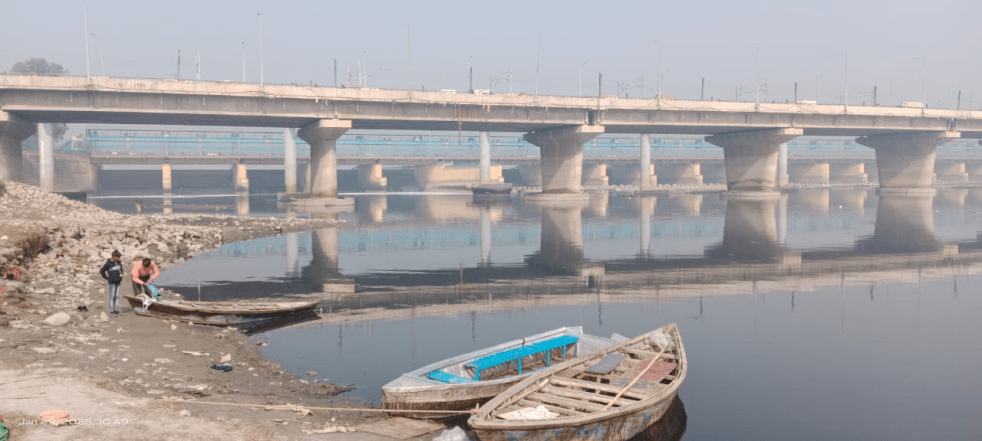
(Feature Image: Yamuna river downstream Okhla barrage in Delhi on Jan 29, 2025. Bhim Singh Rawat/SANDRP)
Political blame games surrounding the Delhi assembly election have brought Yamuna in focus for about past one month. Disappointingly, the central and all state govts in basin are responsible for continual degradation of river and none of the parties have offered practical solutions to improve the condition of the river in the national capital.
It’s a fact that the pollution from Haryana drains, namely Dhanaura Escape in Karnal, Drain No 2 in Panipat and Drain No. 6 and 8 in Sonipat have been bringing untreated effluents in increasing amounts in the river upstream of Delhi, ultimately severely crippling the Wazirabad barrage based potable water supply in the city. In addition to diversion of river waters for industrial, irrigational and potable demands from Hathni Kund Barrage, increasing unsustainable mechanized mining for about past eight years have been ruining lean season flows in the river in upper segment. The concerned central govt departments and Haryana government are required to address these issues effectively as part of a solution to improve the health of river in Delhi.
Then, in Delhi, 900-1100 MLD sewage is being dumped in river and huge funds are being spent on pollution abatement infrastructure (STPs, CETPs) without ensuring that they operate to meet the desired objectives. In fact, sewage is a resource and can provide multiple benefits if treated properly. The STP treated water can be used for secondary purposes. The city also needs to seriously work on harvesting rainwater in a big way. At the same time, Delhi’s own water sources, the lakes, ponds, waterbodies and floodplain, green cover need protection and revival. For this, Delhi govt urgently require a water policy which if enforced properly can hugely reduce pressure on river and groundwater resources and lead to considerable improvement in the river.
The key central government departments including Agricultural Ministry, MoEF, MoJS, MoUA, CWC, UYRB, CPCB, NMCG, DDA, along with the Agricultural, Irrigation, Water Supply, Mining departments and pollution control boards in basin states have huge role to play in keeping the river pollution free and flowing. One hopes that the central government will work sincerely with new Delhi government of whichever parties is elected in Delhi and also with other elected state governments in Yamuna basin to actually work for the revival of the river.
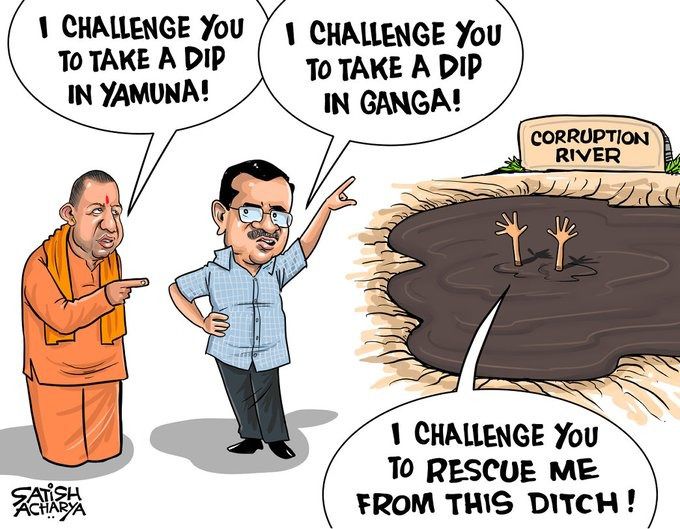
A year-wise look at promises, accusations & inaction Himanshu Thakkar, coordinator of the SANDRP, told The Wire that “Much of the 2015 plan hasn’t been implemented.” “It’s true that untreated wastewater comes from Haryana and UP. This issue has even reached the courts. Industrial effluents from Haryana have also been found in Delhi’s waters,” he continued. “Still, until Wazirabad, the water remains relatively clean. If Delhi’s STPs (Sewage Treatment Plants) and CETPs (Common Effluent Treatment Plants) for industries functioned properly, Yamuna could improve. But most don’t work, and nobody knows why and what needs to be done about it. There is little transparency. Last week, the High Court reprimanded DJB for failing to install flow meters. Deadlines keep getting extended, and news of court orders keeps going viral.”
No particular party can be held solely responsible, Thakkar said, and nor can the Delhi government alone fix the issue – the Union government too has a role to play. “The central government cannot simply wash its hands of the Yamuna. The CPCB (Central Pollution Control Board), Central Water Commission, Ministry of Environment, NMCG (National Mission for Clean Ganga), and DDA all fall under the central government,” he argued.
“The Delhi government has failed to bring effective change. It has broken multiple promises – such as decentralising STPs, protecting lakes and ponds, and installing bulk water meters. Sewerage connectivity has improved to some extent, but it remains inadequate. The DJB (Delhi Jal Board) is no different from the government in its inefficiency. CETPs [controlled by Delhi government controlled DSIIDC] are in as poor a state as STPs.”
The Yamuna is not alone in its polluted state, he added. “The BJP has also ruled Delhi, but its track record on the Yamuna – or any river in BJP-ruled states – is no better. The Ganga’s condition is equally poor. No river in this country can be considered clean. The problem is not a lack of funds; plenty is spent on infrastructure. The real issues are governance, transparency, and accountability. We need participatory management of STPs.” https://thewire.in/environment/aap-yamuna-clean-up-10-years (03 Feb. 2025)
Political pow-wow is mere poll posturing“Yamuna water coming from Haryana is laced with pollutants such as ammonia. The issue has been discussed in the high court and the Supreme Court too. Haryana is supposed to send clean water. In fact, pollutants come from Uttar Pradesh too,” Himanshu Thakkar of the South Asia Network on Dams, Rivers and People (SANDRP) told The Telegraph. Have any of the political parties put the required effort to clean the Yamuna? Thakkar replied in the negative. “BJP, Congress or AAP, no one has a good track record,” he said. “They are not addressing the problem. In India most rivers are interstate and so the mismanagement of rivers and blame game for competitive populism comes up during polls. The Centre is majorly responsible. It has spent thousands of crores on the Ganga but look at the condition.” https://www.telegraphindia.com/india/dont-drink-the-water-why-political-pow-wow-over-the-yamuna-is-mere-political-posturing/cid/2080747 (31 Jan 2025)
Slugfest shines spotlight on a key river pollutantsIndustrial units in Haryana play their part in sullying the Yamuna’s waters, Delhi does far worse. Several experts have called the stretch of the Yamuna through Delhi a “dead river”. Bhim Singh Rawat, member of the SANDRP, said the frequent ammonia spikes in the river were on account of untreated effluents finding their way downstream from Haryana to Wazirabad. “We know of drain number six in Sonepat and drain number two in Panipat, which frequently bring untreated effluents into the Yamuna. This leads to a spike in the ammonia content and the only solution is to crackdown on the source of these effluents,” he said.
Referring to the Yamuna in Delhi as a “dead” river, Rawat said DO levels turning nil was a clear indicator of that. “It shows no aquatic life can survive this stretch of the river and the solution remains simple. One, to trap sewage and connect them to sewage treatment plants & ensure they function as required. Secondly, the environmental or e-flow of the river needs to be increased. With increased flow, pollutants will naturally be flushed out to a large extent,” he said. https://www.hindustantimes.com/cities/delhi-news/slugfest-shines-spotlight-on-a-key-water-pollutant-in-yamuna-101738090677290.html (29 Jan. 2025)
Politics over pollution Bhim Singh Rawat, SANDRP, said, “The year 2025 is extremely crucial for Yamuna and it’s revival. In 1994, the upper Yamuna basin river board was formed. It advocated division of water between the states. That order is scheduled for review in 2025. That agreement has a huge role to play as far as the Yamuna problem in Delhi is concerned since the share of water for river Yamuna got restricted.”
A river without its flow is not a river. It can’t clean itself, rejuvenate itself. Even the river basins are seeing constructions, encroachments. You have made the river linear, restricted its flow by making so many bridges. You have made a total human control system. You have 25 bridges on the river. Five are under construction. So, after every 500-600 metre, you have a bridge. So you have kind of straight jacketed the river. Its linear connectivity, its vertical connectivity, they are finishing everything,” he added. He also pointed out how everyone, whether it’s the Centre or the Delhi government, talks about cleaning the Yamuna but no one focuses on increasing its flow. https://www.news18.com/india/yamuna-will-be-clean-in-a-month-if-what-environmentalists-say-on-delhis-water-politics-9208072.html (31 Jan. 2025) Bhim Singh Rawat, SANDRP and Pankaj Kumar talking to video report by CNN News 18 on reasons behind present water crisis in Delhi due to rising pollution levels in Yamuna river. https://www.youtube.com/watch?v=StjHcf9FwYk (29 Jan. 2025) Bhim Singh Rawat, SANDRP, on Jan. 29 explaining reasons behind Yamuna pollution in Delhi to Rahul Gandhi, leader of opposition. https://www.youtube.com/watch?v=x0Aw5Xn2_HA (30 Jan. 2025)
Delhi HC warns DJB of contempt action High Court has warned Delhi Jal Board (DJB) to get its act together on STPs or face contempt of court action. The court was reviewing steps taken to improve STP’s working to combat heavy pollution in the river. It also put Delhi State Industrial and Infrastructure Development Corporation (DSIDC) on notice, seeking details about the status of effluent treatment plants operated by it to treat industrial waste that enters Yamuna. A special bench of Justices Prathiba M Singh and Manmeet PS Arora in an order passed on Jan 28 termed the delay by DJB in installing flow meters and sensors at all of its 37 STPs “completely not acceptable” when the high court had last year made it “categorical and clear” that all 37 STPs should have the devices installed at the point of discharge.
DJB informed the court that of 37 STPs, flow meters were installed only at the effluent outlets of 22 STPs, while for 4 more STPs, installation is expected by March 2025. When the court questioned the DJB official about the delay, he said estimates were being prepared and the meters would be installed in 11 STPs by June. The court cautioned that it was holding back from punishing the DJB official for now but if the meters were not installed in a month, it won’t “hesitate in taking strict and stern action in accordance with the law, both under the Contempt of Courts Act and any other law applicable to ensure that the directions of the court are properly complied with.” [It is not clear if the flow meters and sensors already installed at 22 STPs as claimed are functioning, if the readings are in public domain and what do they say.] https://timesofindia.indiatimes.com/city/delhi/flow-meters-sensors-not-in-all-stps-hc-warns-djb-of-contempt-action/articleshow/117701980.cms (29 Jan. 2025)
इस सबके बीच बड़ा सवाल यही है कि क्या वाकई यमुना के पानी में कोई ‘जहर’ है? यमुना का उच्च अमोनिया वाला पानी आखिर कितना खतरनाक हो सकता है? और क्या वाकई अमोनिया के चलते दिल्ली में पानी की कमी हो सकती है? https://www.youtube.com/watch?v=WgqrEoe_r-8 (01 Feb. 2025)
दागदार Yamuna में एलजी की भूमिका जनवरी 2023 में एनजीटी ने अश्विनी यादव बनाम राष्ट्रीय राजधानी क्षेत्र की सरकार मामले में एक फैसला सुनाया. फैसले में एनजीटी ने यमुना के प्रदूषण को लेकर एक उच्च स्तरीय कमेटी का गठन किया. साथ ही दिल्ली के लेफ्टिनेंट गवर्नर यानि एलजी विनय कुमार सक्सेना को इसका चेयरपर्सन बनाया. जनवरी 2023 से लेकर अब तक इस कमेटी की बैठकें हो चुकी हैं. इसकी पहली बैठक जनवरी 2023 में और आखिरी अगस्त 2024 में हुई. https://www.youtube.com/watch (16 Jan. 2025)
Reasons behind pollution A significant portion of the pollution comes from untreated sewage. Delhi generates millions of liters of sewage every day, much of which ends up in Yamuna without proper treatment. Industrial waste, chemicals, and other hazardous materials also contribute to the river’s deterioration. Encroachments along the riverbanks, including illegal settlements and buildings, have further contributed to the pollution and blocked the natural flow of the river. https://www.youtube.com/watch?v=ZiVftw6isUo (30 Jan. 2025)
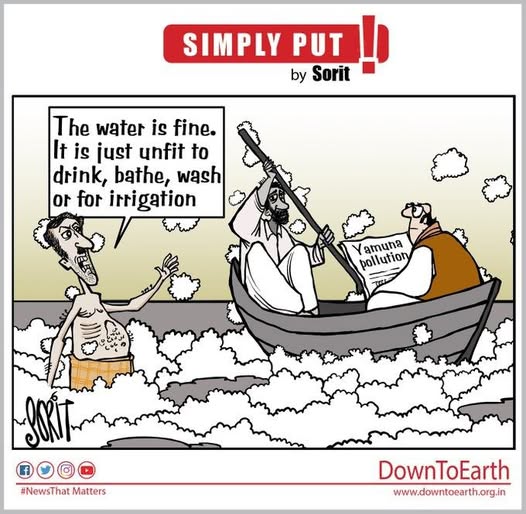
A doctor running a small clinic in Jagatpur village talks about skin infections that have become “very common” during the recent years. “Whenever villagers take a dip in the polluted river, they complain of rashes and itching,” he says. “I get a lot of such cases during Chhath Puja.” https://indianexpress.com/article/cities/delhi/river-of-my-childhood-doesnt-exist-anymore-it-is-a-cesspool-now-9817873/ (05 Feb. 2025)
Weeks before Delhi polls, Kalindi residents’ wish for clean Yamuna remains unfulfilled. https://www.telegraphindia.com/india/weeks-before-delhi-polls-kalindi-residents-wish-for-clean-yamuna-remains-unfulfilled/cid/2076769 (10 Jan. 2025)
Study Microplastics found in GW, river, soilMicro plastics have been found in groundwater (in almost all 11 districts of Delhi), Yamuna and soil samples as per interim report (for premonsoon samples) of a TERI study commissioned in Feb 2024 by Delhi Govt. The final report will be submitted later this year.
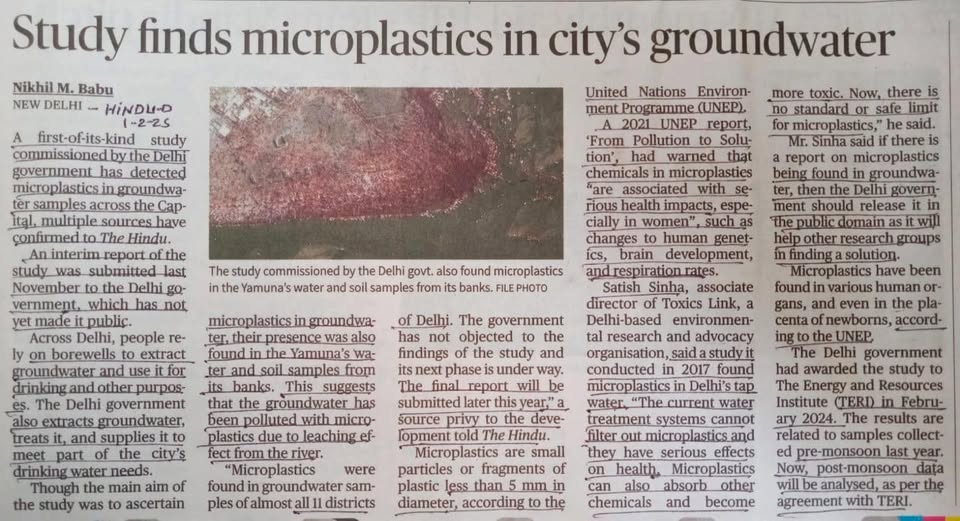
A study in 2017 found microplastics in Delhi’s tap water. As of now there is no standards or safe limit related to micro plastics. The report is not yet in public domain. https://www.thehindu.com/news/cities/Delhi/study-finds-microplastics-in-delhis-groundwater/article69165906.ece (01 Feb. 2025)
Ghaziabad Jal Nigam replies to NGT’s notice Noting that the UP Jal Nigam was under statutory obligation to carry out functions relating to preparation, execution, promotion and financing schemes for sewerage and sewerage disposal, the tribunal in September had issued a show cause to the corporation’s Managing Director (MD), saying why prosecution may not be initiated against him and other responsible authorities.
In the reply submitted to the NGT on Nov 18, the corp said it had no independent funds to finance any projects. “It is humbly submitted before this tribunal that prosecution under section 43 of the Water Act (punishment for failing to prevent or control pollution) may not be initiated against the undersigned (MD) and other responsible authorities,” the reply said.
It said the corporation was “completely dependent upon the state govt for financing of schemes” and that the body was required to submit periodic reports on its activities, projects, finances, and compliance with its statutory responsibilities. The reply said the UP Jal Nigam’s role was “limited to the preparation and execution of projects as per govt directives, without financial accountability for funding.” https://www.indiatvnews.com/news/india/yamuna-pollution-up-jal-nigam-replies-to-ngt-s-notice-says-no-financially-independent-2024-11-19-962429 (19 Nov 2024)
Gurugram STPs set for revamp, to stop river pollution To enhance wastewater treatment and reduce pollution in the Najafgarh drain and Yamuna river, GMDA is set to upgrade two existing STPs to tertiary treatment plants. The 100 MLD STP at Dhanwapur and 120 MLD STP at Behrampur will be upgraded into tertiary treatment plants to ensure compliance with wastewater discharge norms. The project will take at least two years to complete once the work starts. The govt approved the upgrade of these STPs in July 2023 and sanctioned Rs 75.5 crore for the Dhanwapur STP and Rs 50.6 crore for the Behrampur STP. The plan was approved in Dec 2020 but was shelved due to technical ambiguities in the tender process and limited demand in the Dhanwapur area. However, following the HSPCB’s revised norms issued in Sept 2023, the GMDA is now proceeding with the upgrade.
Presently, 5 STPs operate in Gurgaon with a combined capacity of 388 MLD — 218 MLD at Dhanwapur and 170 MLD at Behrampur. Both plants, constructed by HSVP in 2015, use advanced technologies for water treatment. According to GMDA, 218 MLD of sewage treated at Dhanwapur is discharged into irrigation channels maintained by the Irrigation Department, benefiting agricultural activities in 13 villages of Gurgaon and Jhajjar districts. From Behrampur, 160 MLD of treated sewage is partly utilised for horticulture, industrial purposes, and groundwater recharge, with the remaining discharged into the Badshahpur drain. https://timesofindia.indiatimes.com/city/gurgaon/stps-set-for-revamp-to-stop-waste-flowing-into-yamuna/articleshow/117362003.cms (19 Jan. 2025)
Haryana Rs 230 cr green damages not collected, NGT serves notice to govt The bench of judicial magistrate Sudhir Agarwal and expert member Dr A Senthil Vel on Dec 20 gave the state govt and Haryana State Pollution Control Board (HSPCB) a month to reply. The tribunal was hearing a plea filed by Delhi resident Varun Gulati, who argued that govt and HSPCB’s “inefficiency” in recovering environmental compensation was harming the environment by preventing restoration, remediation and rejuvenation efforts. Asked about the plea, an HSPCB official said the board was taking immediate steps to recover compensation from polluters. Next hearing on Feb 13. https://timesofindia.indiatimes.com/city/gurgaon/rs-230-cr-green-damages-not-collected-ngt-serves-notice-to-haryana/articleshow/116609567.cms (24 Dec 2024)
“As per the records, which we managed to get through RTI queries, we could quantify the arrears of Rs 150 crore plus from pollution units from Gurugram and Faridabad only. Here we are talking about the environmental compensation slapped on the polluters. Now we are waiting for the reply from the HSPCB and the state govt to have the exact figure,” said Gulati.
Over the last few years, the NGT has slapped environmental compensation on various polluters. Besides the builders and colonisers of Panipat and Sonipat, who have been accused of releasing untreated waste into the Yamuna river, there are examples of industrial discharge, especially from dyeing units and other polluting units, being released into the sewage without any treatment. https://timesofindia.indiatimes.com/city/chandigarh/give-penalty-info-on-polluting-units-in-month-ngt-tells-hry/articleshow/116578667.cms (23 Dec. 2024)
A yr gone, ₹140cr green fines still not recovered HSPCB is yet to recover penalties amounting to Rs 140 crore imposed on polluting industrial and commercial units in the city as environmental compensation (EC) over the past 16 months. From Dec 1, 2022, to April 30 this year, a total of Rs 134 crore was imposed as EC in the north circle of Gurgaon, and Rs 6 crore in the south circle. But no recovery of fines has been made so far.
Experts suggest that the delay in penalty recovery could be a strategy to benefit the violators, as EC might be written off if the units are declared dismantled or non-functional. Delhi-based activist Varun Gulati, who filed an RTI on this issue, said, “It’s clear that HSPCB has failed to do its job, even though it has imposed EC. Instead of paying up the fines, many of the ‘sealed’ or ‘closed’ units just begin operations somewhere else in Gurgaon, Faridabad, Sonipat, or nearby places. The owners get away by saying the units have been dismantled or closed after the fines were imposed. This reveals the huge nexus between HSPCB staff and these polluters.” https://timesofindia.indiatimes.com/city/gurgaon/haryana-state-pollution-control-board-fails-to-recover-140-crore-green-fines/articleshow/111700047.cms (13 July 2024)
6 polluting units, 2 builders slapped with Rs 44.5cr fine in Panipat HSPCB Regional Officer (RO) Bhupinder Singh Chahal said six industrial units, including a liquor factory in Samalkha and the National Fertiliser Limited (NFL), and two builders had been slapped with an environmental compensation of Rs 36 crore and Rs 8.5 crore, respectively, for violating the pollution control norms. Following the complaint of Delhi-based environmentalist Varun Gulati, the HSPCB imposed a compensation of Rs 5.97 crore on TDI Infratech, a building company, in Panipat and Rs 3.48 crore on Ansal Infrastructure for non-compliance of pollution norms. https://www.tribuneindia.com/news/haryana/6-polluting-units-2-builders-slapped-with-44-5-cr-fine-in-panipat/ (12 Dec. 2024)
NGT raps board for non-recovery of green compensation from Panipat builders The NGT has pulled up the HSPCB for the non-recovery of environmental compensation from builders Ansal and TDI in a case regarding violation of pollution norms. The board sought 4 weeks to recover the compensation & for the compliance of the orders passed against the builders. The complainant alleged before the NGT that Ansal and TDI had developed residential projects in Panipat, but the STP was not functional & resulted in discharge of sewage in the green belt or into the drain. The builders had not even obtained the consent to operate & environmental clearance. https://www.tribuneindia.com/news/haryana/ngt-raps-board-for-non-recovery-of-green-compensation-from-panipat-builders/ (09 Nov. 2024)
NGT reduces EC for Amazon from ₹13.12 lakhs to ₹6 lakhs for violation of STP norms In an appeal under Section 18(1) read with Section 16 of the NGT Act, 2010 (‘NGT Act’) against an order passed by the HSPCB, levying EC of Rs. 13,12,500/- on Amazon Seller Services Pvt Ltd at Bilaspur for violation for 70 days, Prakash Shrivastava, Chairperson and Dr. A. Senthil Vel, Expert Member, reduced the number of days of violation from 70 days to 32 days. Accordingly, the EC was reduced to Rs. 6 lakhs as per the calculation of the RO, HSPCB. https://www.scconline.com/blog/post/2024/06/03/ngt-modifies-hspcb-order-levying-rs-13-lakhs-amazon-rs-6-lakhs/ (03 June 2024)
Madhya Pradesh CM says no action on Carbide waste till court order The waste disposal plant in Pithampur is situated close to Gambhir river, a source of water supply to Yeshwant Sagar reservoir — which supplies water to 40% of Indore. Amid rising opposition to the incineration of Bhopal gas tragedy waste in Pithampur, CM Mohan Yadav said on Jan 4 the state govt will take the people’s concerns to court, and no action will be carried out until further court orders. Protests by Pithampur citizens continued for the second day on Jan 4. At least 80 industries were forced to shut operations as workers, apprehensive about their safety amid escalating unrest in the industrial township, did not report for duty. https://timesofindia.indiatimes.com/india/amid-protests-mp-cm-mohan-yadav-says-no-action-on-carbide-waste-till-court-order/articleshow/116951925.cms (05 Jan. 2025)
DAMS & HEPs IN YAMUNA BASIN
Himachal Pradesh CWC inspects Renukaji Dam site The CWC inspection team has conducted a detailed site inspection of the Renukaji Dam project and will prepare a detailed report outlining their findings and recommendations to the central govt. The report aims to resolve construction challenges and streamline progress. Acting as the principal consultant for Himachal Pradesh Power Corp Ltd, the CWC is instrumental in ensuring the dam’s timely completion. The initial phase involves building three 1.5-km diversion tunnels to redirect the Giri River temporarily, paving the way for the dam’s foundation work. The project is expected to become operational by 2030. https://www.tribuneindia.com/news/himachal/cwc-inspects-renukaji-dam-site-set-to-expedite-work/ (05 Jan. 2025)
Govt to allocate 22 new HEPs of 828 MW capacityThe projects, ranging from 6.5 MW to 400 MW, are located across the districts of Kullu, Chamba, Kinnaur, Lahaul-Spiti, and Shimla. The CM said the largest allocation comprising nine projects with a total capacity of 595 MW is planned for the Chenab river basin. Additionally, eight projects totalling 169 MW are earmarked for the Sutlej river basin, four projects with a combined capacity of 55 MW for the Ravi basin and one project with a capacity of 9 MW for the Beas basin.
He said for the first time, the state government would allot these projects to other states, union territories and central and state undertakings. “The projects would be assigned on a 40-year lease with an upfront premium of Rs 10 lakh per MW,” said the CM. https://www.business-standard.com/economy/news/himachal-to-allocate-22-new-hydropower-projects-of-828-mw-capacity-sukhu-125010200587_1.html (02 Jan. 2025)
Uttarakhand छोटे हाइड्रो पावर प्रोजेक्ट बढ़ाने पर फोकससीएम धामी ने Jan 12 को देहरादून में आयोजित ‘अंतरराष्ट्रीय प्रवासी उत्तराखंडी सम्मेलन’ के दौरान मीडिया से बातचीत में यह बात कही। मुख्यमंत्री ने कहा कि पहले चरण में 28 स्मॉल हाइड्रो पावर प्रोजेक्ट जल्द शुरू किए जा रहे हैं। https://www.livehindustan.com/uttarakhand/focus-on-increasing-small-hydro-power-projects-cm-dhami-told-what-preparationse-201736734557712.amp.html (13 Jan. 2024)
INTERLINKING OF YAMUNA RIVERS
Ken-Betwa Link प्रोजेक्ट का क्यों हो रहा है विरोध BBC ground report by Vishnukant Tiwari: छत्तरपुर ज़िले के धौड़न गांव का अस्तित्व अब ख़त्म होने वाला है. यहां के लोगों ने बताया कि वो किन दिक्कतों से जूझ रहे हैं. गांव की रहने वाली लक्ष्मी आदिवासी बताती हैं कि उनके पैदा होने से पहले ही गांव में बिजली नहीं है. वो कहती हैं कि गांव में अस्पताल तक नहीं हैं. केन-बेतवा अब केवल नदी नहीं, बल्कि नदियों को जोड़ने की विकास परियोजना है, और धौड़न गांव इस केन-बेतवा रिवर लिंकिंग प्रोजेक्ट का केंद्र है. लोग इस परियोजना को लेकर विरोध भी जता रहे हैं. इससे करीब 21 गांव डूब जाएंगे. हालांकि सरकार के अलग दावे हैं. https://www.youtube.com/watch (24 Jan. 2025) इसे विडंबना ही कहेंगे कि कभी बिजली नहीं देखने वाला यह गाँव, अब देश के कई ज़िलों को रोशन करने के लिए डूबने जा रहा है. https://www.bbc.com/hindi/articles/c4gzmzk9rn3o (27 Jan 2025)
This video shows how farmers and people of Panna district in MP have remained deprived while UP takes away the Ken Waters so far. The Kan Betwa Project is going to continue in the same mode. https://www.youtube.com/watch?v=BBYnNS1o3L0 (07 Jan. 2024)
Bids invited for restoration of Ken Main CanalIrrigation Department, Uttar Pradesh has invited bids for the restoration of Ken Main Canal under Ken-Betwa Link Project. The work will extend from km. 0 to 31.6 in restoration of Ken Canal System, and from km. 31.600 to 59.338 under Ken-Betwa Link Project at a cost of Rs 188.52 crore and Rs 167.33 crore respectively. The specifications include excavation, earthework in embankment, cement concrete and RCC works, PVC water seal, cement concrete canal lining and other works, and is to be completed in 36 months for both contracts. The bid submission due date for both is 12 Feb 2025. https://www.projectstoday.com/News/Bids-invited-for-restoration-of-Ken-Main-Canal-under-Ken-Betwa-Link-Project (07 Jan. 2025)
केन बेतवा जोड़ के गणित में घाटे का नतीजा केन-बेतवा जोड़ परियोजना की लागात के एक चौथाई से भी कम धन खर्च कर समूचे बुंदेलखंड के पारंपरिक तालाब, बावड़ी कुओं और जोहड़ों की मरम्म्त की जा सकती है। सिकुड़ गई छोटी नदियों को उनके मूल स्वरूप में लाने के लिए काम हो सकता है। समूचे बुंदेलखंड में एक हजार साल पुराने हजारों चंदेलकालीन तालाब, लाख उपेक्षा व रखरखाव के अभाव के बावजूद आज भी लेागों के गले व खेत तर कर रहे हैं। बुंदेलखंड की किस्मत बदलने को छोटी परियोजनाएं कम व्यय में बगैर पुनर्वास या जंगल कटाई के ज्यादा कारगर होंगी, जिनकी योजना भी स्थानीय स्तर पर बने। (पंकज चतुर्वेदी) https://indiaclimatechange.com/result-of-deficit-in-mathematics-of-ken-betwa-addition/ (31 Dec 2024)
Tribals opposing KBL ProjectFor the tribals whose lands are being submerged, it is a stark reminder of the cost of progress. Their fight is not just against the loss of their homes but against a system that they feel has ignored their rights for far too long. As these tribal communities continue to voice their demands — adequate compensation, proper rehabilitation, and respect for their rights — one question looms large: Will their voices be heard before the waters rise, or will the cost of development drown the hopes of these vulnerable communities? https://twocircles.net/2025jan02/451057.html (02 Jan. 2025)
Interlinking of rivers to hit agri outputPunjab Assembly Speaker Kultar Singh Sandhwan on Jan 2 called for a comprehensive review of the Centre’s river interlinking initiative, saying it has the potential to adversely impact agriculture productivity. Referring to the Ken-Betwa river project, he said scientific research indicates such interventions could significantly alter natural hydrological systems. “Such large-scale hydrological modifications may disrupt established monsoon patterns, potentially endangering agricultural sustainability and affecting multiple sectors nationwide,” he added. https://www.tribuneindia.com/news/punjab/interlinking-of-rivers-to-hit-agri-output-says-speaker/ (04 Jan. 2025)
UP CM absent on KBL launching This report raises the question we raised on Dec 25 itself, about absence of UP CM at the Ken Betwa project inaugural. But provides no answers. https://theprint.in/pre-truth/no-yogi-at-ken-betwa-river-link-project-launch-was-never-even-on-pmos-guest-list/2428123/ (03 Jan. 2025)
EDIT Linking of rivers calls for extreme cautionThe Ken-Betwa linking project has been challenged on many grounds. It will submerge about 10% of the Panna Tiger Reserve and affect the entire biodiversity of the area. About 23 lakh trees will be felled. There are questions about the availability of surplus water to be transferred. Some experts have said that linking will make both the Ken and the Betwa basins water-deficient, and affect rainfall, sedimentation, soil fertility, and natural water storage capacity. It is also pointed out that there are alternatives, and the government has gone ahead with the project, ignoring the recommendations of an empowered committee. Extreme caution is needed in executing projects that seek to change nature, because the damage they cause is often irreversible. https://www.deccanherald.com/opinion/editorial/linking-of-rivers-calls-for-extreme-caution-3335669 (30 Dec. 2024)
PKC Link Rajasthan river-link could submerge 37 sqkm in TROf the PKC-ERCP’s total submergence area of 408.86 sq km in Rajasthan, 227 sq km will go under the reservoir of a proposed 39-m-high and 1.6-km-long dam across Banas river, a tributary of Chambal, near village Doongri, about 30 km from Sawai Madhopur town.
– The project envisages the submergence of 37 sq km in the Ranthambhore tiger reserve effectively cutting it into two sections, according to project documents reviewed by The Indian Express. The submergence will be caused by the largest dam proposed under the Parbati-Kalisindh-Chambal-Eastern Rajasthan Canal Project (PKC-ERCP), which is part of the ambitious Interlinking of Rivers (ILR) program. https://indianexpress.com/article/india/rajasthan-river-link-lifeline-could-submerge-37-sq-km-in-tiger-reserve-9777266/ (14 Jan. 2025)
YAMUNA WATER DISPUTES
Haryana-Rajasthan Opposition questions water sharing MoU Reacting to the MoU, Congress state president Govind Singh Dotasra said, by mortgaging Rajasthan’s interests and making Haryana the dominant beneficiary in the MoU, the BJP govt is accused of misleading the people of Shekhawati for superficial applause. The truth, as opposition leaders claimed, is that the Memorandum of Understanding (MoU) signed on Feb 17, 2024, for drafting a new Detailed Project Report (DPR) between Rajasthan and Haryana violates the terms of the original 1994 agreement and surrenders Rajasthan’s interests.
“Under the new agreement, Haryana will receive 24,000 cusec of water first, and only if surplus water remains or additional water becomes available during the monsoon will Rajasthan receive its share. Haryana Chief Minister himself confirmed this during a meeting in Delhi on Jan 7,” said Dotasra. The opposition further alleges that CM Sharma capitulated to Haryana’s demands. “The Central Water Commission (CWC) typically controls water allocation, yet Haryana unilaterally decided on a 24,000-cusec allocation, up from its previous claims of 13,000 and later 18,000 cusecs. Despite this, CM Sharma signed the agreement without safeguarding Rajasthan’s interests,” alleged Dotasra. https://timesofindia.indiatimes.com/city/jaipur/yamuna-water-deal-to-benefit-shekhawati-oppn-slams-mou/articleshow/117130292.cms (11 Jan. 2025)
YAMUNA FLOODPLAIN
Delhi NGT asks DDA to deconcretise projects on floodplain After NGT took suo motu cognisance of a news report last year on the concretisation on the floodplain and sought a report, NMCG visited all six sites — Asita East, a casting yard in Baansera and another 2km from Signature Bridge, Millennium Bus Depot, Surghat, and Qudsia Ghat (now named Vasudev Ghat) — last Sept and recommended deconcretisation. CPCB also filed a report. In its order dated Jan 21, NGT mentioned its 2015 order when guidelines were issued for regulating construction on the Yamuna floodplain. It stated that no permanent structure or concretisation was allowed on the floodplain, barring exceptional cases. NGT directed DDA to comply with the remedial actions suggested by the NMCG team and the observations in the CPCB report “as expeditiously as possible without causing any unnecessary delay”.
The casting yard near Signature Bridge belongs to Delhi Metro Rail Corporation. “DDA must follow up with DMRC cast yard officials for compliance with its notices,” the report stated. At Millennium Bus Depot, the parking depot was constructed during Commonwealth Games 2010. “Four-lane parking stretches were observed. A test on fly-ash availability and material on site may be carried out to reach any conclusion before dismantling these parking tracks. Based on the outcome of this test, DDA may submit an action plan, in addition to Ecosystem Restoration and Rejuvenation Plan for the site for handling this demolition waste under the supervision of a competent regulatory authority,” said the report. https://timesofindia.indiatimes.com/city/delhi/ngt-asks-dda-to-deconcretise-projects-on-yamuna-floodplain/articleshow/117465460.cms (22 Jan. 2025) The NGT had last April taken suo motu cognisance of a news report which mentioned that DDA had failed to take action against illegal construction on the Yamuna floodplains. The report had mentioned these six projects, prompting the NGT to ask agencies such as the NMCG and the CPCB to look into the allegations.
In its January 21 order, NGT cited construction violations against the tribunal’s 2015 order in the matter of ‘Manoj Mishra vs. Union of India & Ors.’ wherein guidelines were issued for regulating the construction on the Yamuna floodplains. These guidelines had said that no permanent structures or concretisation are allowed in the floodplain, barring in exceptional cases. NGT further ordered DDA to comply with remedial actions suggested by NMCG, who had in October reported that all these projects have deconcretisation involved. https://www.hindustantimes.com/cities/delhi-news/deconcretise-yamuna-on-lines-of-clean-ganga-ngt-tells-dda-101737570852158.html (23 Jan. 2025) 21 जनवरी, 2025 को, एनजीटी ने डीडीए को यमुना बाढ़ क्षेत्र की बहाली का निर्देश दिया है। अदालत ने यह भी कहा है कि बहाली के लिए एनएमसीजी द्वारा गठित टीम और सीपीसीबी की रिपोर्ट के सुझावों का पालन किया जाना चाहिए। यह काम बिना किसी अनावश्यक देरी के, जितनी जल्दी हो सके, पूरा किया जाना चाहिए। https://hindi.downtoearth.org.in/river/ngt-directs-dda-to-restore-yamuna-flood-area-as-soon-as-possible (22 Jan. 2025)
Sabarmati RFD type revamp for Yamuna: Shah A Sabarmati River-front type redevelopment of the Yamuna and conversion of leasehold to freehold for properties given to partition refugees settled in the city were the highlights of BJP’s Manifesto Part-3 released by Home Minister Amit Shah on Saturday for Delhi Assembly election to be held on February 5. https://theshillongtimes.com/2025/01/25/sabarmati-river-front-type-revamp-for-yamuna-shah-promises-in-delhi-sankalp-patra-3/ (25 Jan. 2025)
LG asks DDA to start survey process cable cars across river LG VK Saxena on Wednesday (Jan. 01) directed DDA to start the process of surveying and selecting sites for the installation of a ropeway or cableway that would carry passengers in cable cars across the river. The cable cars will operate during fixed hours from morning to night and will have a capacity of about 50 passengers each. DDA will select the sites in the vicinity of metro stations on either side of the river to install the system without any encroachment or concretisation of the floodplain, the LG office said. Saxena has instructed DDA to submit the preliminary report within a month. https://timesofindia.indiatimes.com/city/delhi/cable-cars-across-yamuna-soon-delhi-lg-asks-dda-to-start-survey-process/articleshow/116871348.cms (02 Jan. 2025)
Rajasthan HC initiates proceedings against encroachments over rivers, water bodies The High Court of Rajasthan initiated suo motu proceedings based on a news article published in ‘Rajasthan Patrika’. The article highlights that despite numerous directions issued by the courts and NGT, several rivers along with various other water bodies across the State are facing severe encroachment, jeopardising the well-being of all living organisms and environment. The High Court observed that such news indicated serious failure of the Central and state governments, particularly MoEFCC and Ministry of Jal Shakti, in protecting rivers from illegal encroachments. It also noted that the draft River Conservation Zone (Regulation of Harmful Activities) Rules, 2012 and the notifications regarding river conservation zone and river regulation zone in 2015 remain unimplemented till date. The High Court issued show cause notice on why the directions for constituting committees at state level, divisional level and district level should not be issued. It also proposed the demolition of illegal and unauthorised constructions and encroachments on the rivers, flood plains and catchment areas of all rivers, water bodies, water courses and water channels. https://www.barandbench.com/columns/important-environmental-law-orders-and-judgments-passed-in-2024 (24 Oct. 2024)
Uttar Pradesh Govt demarcates floodplain -The government, on 22 January, issued a notification demarcating the Yamuna floodplain, following an order in this regard from the NGT, which had been hearing a petition from Agra environmentalist Dr Sharad Gupta. The contours of the Yamuna floodplain were determined scientifically, based on records of the past 100 years, according to the government. The government notification will affect areas in 17 districts of Uttar Pradesh, including Agra. It restricts any new constructions in the flood area, but the government is yet to clarify what will happen to the already-constructed buildings and those living in them.
-The notification declared a 5.09-kilometre stretch on the right bank of the Yamuna and a 2.55-km stretch on the left bank flood-prone. It banned new constructions in this zone with immediate effect and declared existing constructions illegal. The Yamuna flows for roughly 167 km within the border of Agra. In UP, its total length from Asgarpur to Naav is 1,056 km. Along the Yamuna, the government-demarcated flood area is 15,925 sqkm.
-Hearings over the demarcation of the flood area along the Yamuna have been ongoing in the NGT for the last three years. The NGT first sought information from the irrigation department on whether there was any demarcation of the flood area. On receiving a negative answer, the NGT constituted and directed a high-level committee to demarcate the flood area from Haryana to Prayagraj. The river coast in major cities, such as Delhi and Agra, was then divided into three categories for the study. https://theprint.in/india/over-5000-buildings-in-agra-face-risk-of-demolition-after-up-govt-demarcates-yamuna-floodplain/2478998/ (04 Feb. 2025)
आगरा के पर्यावरणविद डॉ. शरद गुप्ता की नेशनल ग्रीन ट्रिब्यूनल में दायर याचिका में प्रदेश सरकार ने यमुना नदी के डूब क्षेत्रों की अधिसूचना जारी की है। असगरपुर से इटावा तक 526.97 किमी और शाहपुर से 453.88 किमी के हिस्से के साथ इटावा और शाहपुर के बीच 75 किमी के हिस्से को भी डूब क्षेत्र में तय किया गया है। सभी 17 जिलों में 200 मीटर की दूरी पर ही जिओ कॉर्डिनेट्स तय किए गए हैं, जो डूब क्षेत्र की जानकारी यमुना के दोनों ओर देंगे। इसका पूरा ब्योरा केंद्रीय जल आयोग की रिपोर्ट में दिया गया है।
केंद्रीय जल आयोग ने 8 विभागों के विशेषज्ञों के साथ मिलकर 100 साल की बाढ़ का अध्ययन कर रिपोर्ट तैयार की है। इसमें एक से 5 वर्ष, 5 से 25 और 25 से 100 साल के बीच आई बाढ़ में डूबे क्षेत्रों का ब्योरा दिया गया है। 100 सालों की बाढ़ के आधार पर आगरा में 167.6 किमी हिस्सा डूब क्षेत्र में है। 4032 वर्ग किमी में फैले आगरा का 4.1 फीसदी हिस्सा बाढ़ का शिकार हुआ था। मथुरा में 287.7 किमी हिस्सा डूब क्षेत्र में है, जो जिले का 8.6 फीसदी है। इसी तरह फिरोजाबाद में 56.8 किमी हिस्सा डूब क्षेत्र है, जो पूरे जिले का केवल 2.3 फीसदी रहेगा। यहां 1.90 किमी दूरी तक अधिकतम डूब क्षेत्र तय किया गया है।
केंद्रीय जल आयोग ने सेटेलाइट और 100 साल की बाढ़ के अध्ययन के बाद तय किए यमुना नदी के डूब क्षेत्र पर अपनी सिफारिश में कहा है कि प्रदेश सरकार चाहे तो यमुना नदी के डूब क्षेत्र में तय किए गए जिओ कॉर्डिनेटस का ग्राउंड ट्रुथ वेरिफिकेशन करा सकती है। इसी आधार पर हर 200 मीटर दूरी पर पिलर लगाकर पहचान की सिफारिश की गई है। आगरा में यह जिओ कॉर्डिनेट्स 1404 से शुरू होकर 3524 तक रखे गए हैं। इनकी संख्या 2120 है। https://www.amarujala.com/uttar-pradesh/agra/yamuna-flood-plains-colonies-built-around-yamuna-in-submergence-area-or-not-know-what-will-happen-2025-02-04 (04 Feb. 2025)
YAMUNA FLOODS
Delhi Forecast for 2023 floods was inaccurate Centre has accepted to NGT, that the forecast for Yamuna flow in 2023 flood was faulty. Rare acceptance. https://www.thehindu.com/news/cities/Delhi/forecast-for-2023-delhi-floods-was-inaccurate-as-flow-of-yamuna-was-marred-by-silt-muck-centre-to-ngt/article69077725.ece (9 Jan 2025)
River congestion impaired 2023 floods forecast The reply filed by the MoJS and CWC on January 4 said the high discharge downstream of Hathnikund Barrage created a flood situation in River Yamuna near Delhi. “Due to this, the flow of the Delhi Railway Bridge site increased continuously and crossed the previous high flow level of 207.49 metre at 13:00 hrs on July 12, 2023, and achieved the highest peak water level of 208.66 metre at 18:00 hrs on July 13,” it said. The flood forecast, it said, required the water channel to be in a “free flow state” and changes in flow conditions upstream and downstream of the flood forecasting station could “compromise” accuracy.
It said the free-flowing conditions did not exist between Wazirabad and Okhla barrages because of the non-opening of all the gates of ITO Barrage, the formation of islands of silt deposits, trees in the river’s course and muck disposal at various locations due to bridge construction activities across the river. “All these factors resulted in congestion in the river in Delhi reach and if the free flow condition of the channel is compromised, then, the forecast issued will not match with the actual forecast,” the reply said. A committee headed by the CWCs chairperson suggested the departments concerned in Delhi to take corrective measures for the future, it said. https://www.hindustantimes.com/india-news/conman-sukesh-chandras-declares-overseas-income-of-rs-7-640-crore-offers-to-pay-tax-pm-modi-nirmala-sitharaman-101736660668590.html (08 Jan. 2025)
YAMUNA RIVERS
Uttar Pradesh NGT raps govt over Hindon pollution, seeks fresh affidavit The NGT has again reprimanded the UP government for failing to control pollution in river Hindon and observed that no effective action was taken to control the discharge of industrial effluents, untreated sewage, and unprocessed solid waste into the Hindon and its tributaries, Kali West and Krishni. The case stems from a petition filed by Noida resident Abhisht Kusum Gupta in March 2022, drawing attention to the severe pollution in the river due to the continuous discharge of untreated waste and effluents. The plea highlighted that despite repeated directives, authorities had failed to take concrete pollution control measures, leading to significant environmental degradation.
The NGT started hearing the case and directed the UPPCB, CPCB, and other state agencies to implement remedial steps.In its latest order, an NGT bench noted that the affidavit submitted by the UP chief secretary lacked crucial details regarding the treatment of construction and demolition (C&D) waste, the operational efficiency of STPs, and the enforcement of environmental penalties. The tribunal has now sought a fresh affidavit within six weeks, outlining a timebound action plan for implementing CPCB’s recommendations.
Another major concern flagged by the NGT was that 52 of 55 drains continue to discharge untreated sewage into the Hindon. Additionally, the government failed to submit water quality test reports for Hindon and its tributaries, despite repeated directives to do so. The affidavit also disclosed that there are 366 industries in the Hindon river basin, of which 123 are non-compliant with pollution norms. While closure orders were issued for 30 such units, the affidavit did not clarify whether these orders were enforced or whether environmental compensation (EC) was recovered from polluters. The report also revealed that the Hindon river basin generates 943.63MLD of sewage, with a treatment gap of 155.68MLD. Although 19 STPs with a total capacity of 921MLD exist, the tribunal observed that no details were provided on their capacity utilisation or whether they meet the requisite pollution standards. The matter has now been listed for further hearing to May 6, 2025. https://www.hindustantimes.com/cities/noida-news/ngt-raps-uttar-pardesh-govt-over-hindon-pollution-seeks-fresh-affidavit-101738607881741-amp.html (04 Feb. 2025)
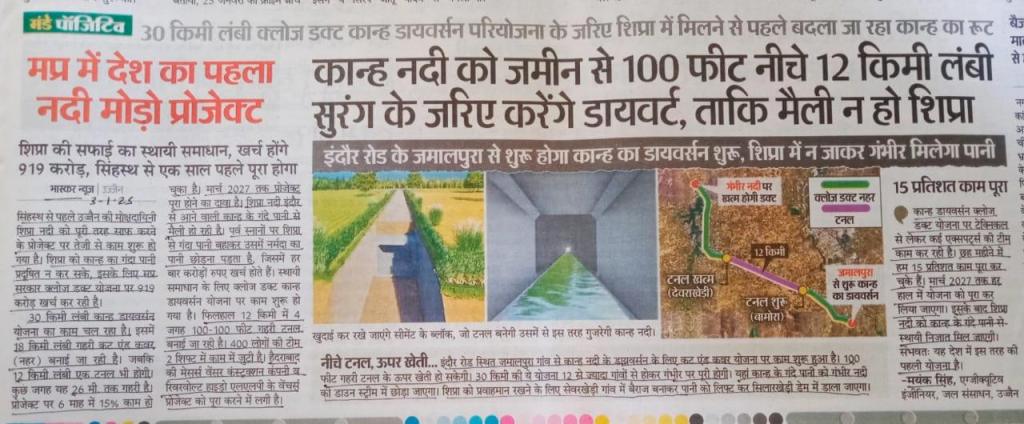
Madhya Pradesh To avoid Kanh River (Bringing sewage from Indore) polluting Kshipra River in Ujjain on whose banks Kumbh is to happen next in 2028, a 30 km long aqua duct (including 18 km long covered diversion canal and 12 km long tunnel) is being constructed over Kanh River to take it directly downstream of Gambhir river, at a cost of Rs 919 Cr. This River Diversion projects seems to acknowledge complete failure of our pollution control mechanisms. https://www.etvbharat.com/hi/!state/mp-kanh-close-duct-project-will-clean-shipra-before-simhastha-2028-kanh-river-route-diverted-madhya-pradesh-news-mps25020303670 (03 Feb. 2025)
Delhi Sahibi once a river now a drainSahibi river emanated from the Sewar hills of Rajasthan’s Sikar district and flowed through the states of Rajasthan, Haryana and Delhi. Earlier existence of temples and mosques around the river shows the religious significance of the river. In the ancient Hindy texts of Rigveda and Manusmriti Sahibi river is named as the Drishadvati river.
-It was 300 km long when it used to flow with gushes of water, however, now it consumes the drainage water and its massive contamination. Due to this, Sahibi is no longer a river as the city’s contaminated water and waste from factories and industries gets collected here. https://www.dnaindia.com/india/report-once-delhi-s-main-water-source-this-river-has-now-turned-into-sahibi-river-najafgarh-nallah-3126610 (12 Jan. 2025)
YAMUNA FISH, FISHERFOLKS
Delhi While most young people are moving away from their family occupation of plying boats on the Yamuna in Delhi, Ganesh Pandit is the exception. https://ruralindiaonline.org/en/articles/row-row-row-your-boat…/ (11 Jan. 2025)
MINING IN YAMUNA RIVERS
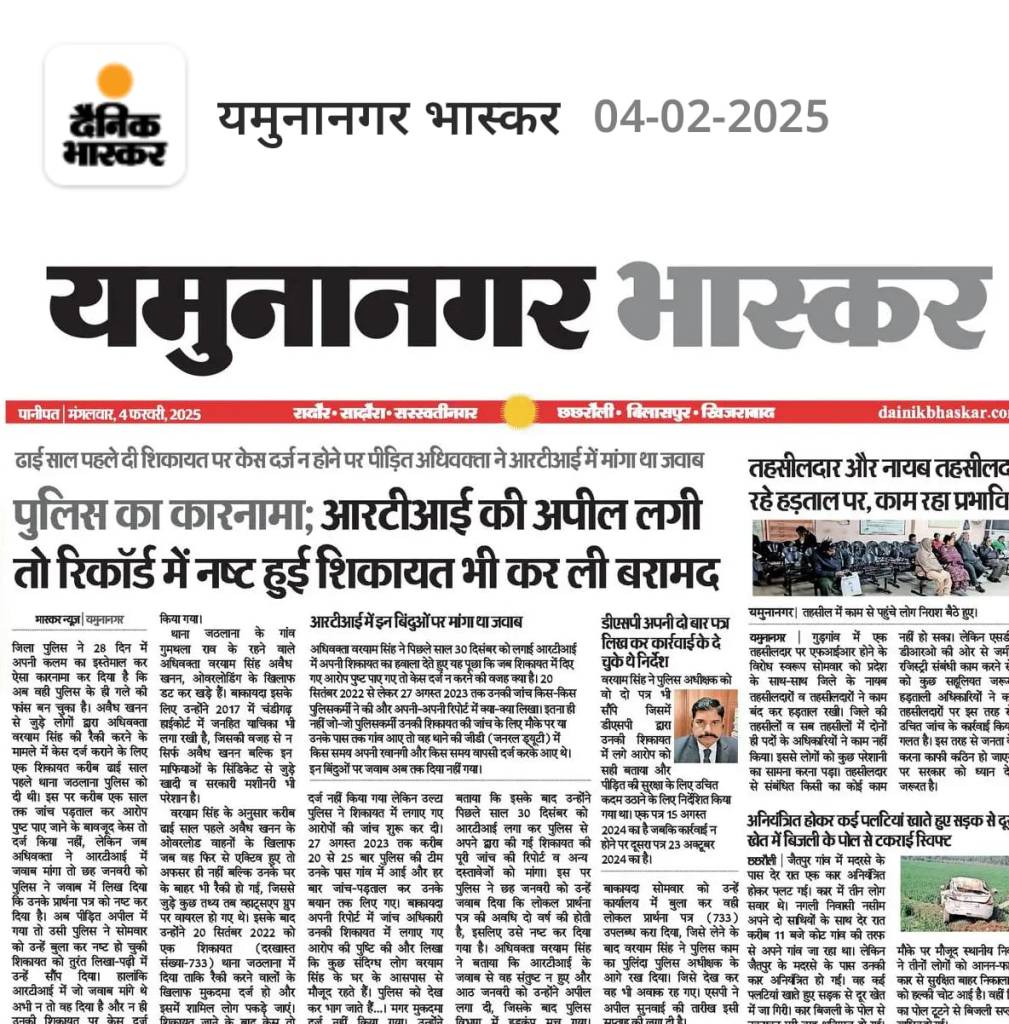
Haryana An interesting case: RTI application filed by activist Waryam Singh of Yamuna Nagar revealed that police has destroyed his complaint seeking information about spying over his movements by people involved in illegal sand mining in Yamuna river. The report also mentions that local police failed take action in the matter despite being directed by DSP twice.
वाट्सअप ग्रुप से हो रही अधिकारियों की रेकी यमुनानगर जिले में अवैध खनन को लेकर नया खुलासा हुआ है। अवैध खनन करने वाले वाट्सअप ग्रुप से अफसरों की रेकी कर रहे हैं। पुलिस व प्रशासनिक अफसरों की एक-एक पल की जानकारी दी जाती है। ओके रिपोर्ट होने पर ही खनन के वाहन आगे बढ़ते हैं। सोशल मीडिया पर एक ग्रुप की वीडियो वायरल होने के बाद खलबली मची है। खनन विभाग के अफसरों ने भी मामले की जांच शुरू कर दी है। एंटी करप्शन सोसाइटी के प्रदेशाध्यक्ष और अधिवक्ता वरयाम सिंह ने कहा कि रेकी ग्रुप के जरिए बड़े-बड़े गैर कानूनी काम इन ग्रुपों के जरिये हो रहे हैं। उनका कहना है कि अधिकारी तक इन ग्रुपों के बारे में जानते हैं। लेकिन, इन ग्रुपों पर कंट्रोल नहीं लगा है। वरयाम सिंह ने कहा कि हमने साल 2020 में इन ग्रुपों के खिलाफ एक मामला दर्ज कराया था। जिसके बाद इसके लिए एक एसआईटी बनी थी लेकिन वो सिर्फ कागजों तक ही सीमित रह गई। https://www.amarujala.com/haryana/yamuna-nagar/officials-are-being-monitored-through-whatsapp-groups-yamuna-nagar-news-c-246-1-ymn1002-131254-2025-01-10 (10 Jan. 2025)
SC slams ED for ‘inhuman’ interrogation in illegal mining caseA bench comprising Justices Abhay S Oka and Augustine George Masih expressed strong disapproval of the ED’s investigative practices, describing the situation as a “shocking state of affairs” and accusing the agency of coercing an individual into making a statement. The court upheld the Punjab and Haryana High Court’s decision to quash the arrest of former Haryana Congress MLA Surender Panwar in a money laundering case related to illegal mining. Panwar had been arrested by the central agency in July at 1.40 am after undergoing nearly 15 hours of questioning, according to a report by The Times of India. https://www.business-standard.com/india-news/supreme-court-criticism-ed-interrogation-punjab-haryana-high-court-decision-125010300632_1.html (03 Jan. 2025)
Consent move for mining on Aravali land notified as forestDespite National Green Tribunal’s notices in Oct 2024 to various authorities, including the Union environment ministry and Haryana govt, on the auction of protected Aravali land for mining in Mahendergarh’s Rajawas, the official process to lease the land out has not been paused. The state director general of mines recently directed Mahendragarh’s deputy commissioner to obtain consent from Rajawas village’s gram panchayat through a formal resolution for mining operations in the area, which covers 119.55 acres, identified by khasra numbers 91, 96, 97, 98, 99, 102 and 103, which was classified as forest land on June 20, 2023. https://timesofindia.indiatimes.com/city/gurgaon/despite-ngt-notice-haryana-pushes-mining-in-aravalis/articleshowprint/117466955.cms (23 Jan. 2025)
Illegal mining returns to haunt AravallisResidents of Pichopa Kalan village in Haryana’s Charkhi Dadri district were on Wednesday (Jan. 15) evening jolted by the sound of an explosion that reduced a significant portion of a hillock to rubble. The blast was allegedly orchestrated by a powerful mining cartel operating with tacit support from state authorities, marking yet another alarming instance of illegal mining in the region.
Activists and locals say this is only the latest episode in a troubling pattern stretching across Haryana, from Mewat (Nuh) to Bhiwani’s Dadam hills and the Haryana-Rajasthan border. They accuse authorities of turning a blind eye to blatant violations, emboldened by political patronage and official inaction. Despite a Supreme Court ban on mining in the ecologically critical Aravalli range, such activities persist unabated. https://www.hindustantimes.com/india-news/with-a-blast-fear-of-illegal-mining-returns-to-haunt-aravallis-in-gurugram-101737050431940.html (17 Jan 2025)
Mining rampant in Aravalis despite curbs Despite a blanket ban imposed by the Supreme Court in 2009 in three south Haryana districts (Gurgaon, Nuh and Faridabad), quarrying of stones and sand remains a means of sustenance for locals who supply to the construction industry. Officials said the rocky terrain makes it arduous for the authorities to crack down on the miners. Multiple narrow roads cutting through forests lead to Rajasthan.
A mining department team noted that an area of 200 metres in length, 10m in width and two metres in depth had been mined in Rava, amounting to 6,000 MT of stones. Last year, authorities found that 85.8 crore metric tonnes of stones had been mined from the Aravalis of Rava, Naharika and Chitoda in Firozpur Jhirkha, Nuh. The mining department quantified this loss to a monetary value of Rs 2,000 crore. https://timesofindia.indiatimes.com/city/gurgaon/mining-rampant-in-aravalis-despite-curbs-3-key-illegal-routes-blocked-after-checks/articleshow/117379249.cms (20 Jan. 2025)
Illegal mining starts eroding protective Aravalli barrier Illegal mining in the Aravalli range threatens biodiversity, groundwater, and local communities, leading to severe ecological & economic consequences. https://www.hindustantimes.com/cities/gurugram-news/illegal-mining-in-gurugram-starts-eroding-protective-aravalli-barrier-101737220465679.html (18 Jan 2025)
Mine to destroy An ecological crisis looms large as Aravalli hills get flattened and Haryana dithers on an effective strategy to counter illegal mining. Between 1975 and 2019, nearly 8 per cent of the Aravalli hill range has disappeared, says a study covering four states, projecting the losses to rise to around 22 per cent by 2059 if ‘explosive’ urbanisation and mining continue at the current pace in Delhi-NCR. Researchers from the Central University of Rajasthan studied satellite images and land-use maps between 1975 and 2019 to come up with the estimates. Data showed that 5,772.7 sq km (7.6 per cent) of the Aravalli range was flattened during the 44-year period. Of this, nearly 5 per cent (3,676 sq km) of the hills was converted into barren land and another 776.8 sq km (around 1 per cent) into settlements. The projected loss by 2059 of the total Aravalli area is 16,360 sq km. https://www.tribuneindia.com/news/in-depth/mine-to-destroy (12 Jan. 2025)
Uttar Pradesh मंडावर में रेत खनन पर एनजीटी ने लगाई रोक शामली जिले के मंडावर में राष्ट्रीय हरित अधिकरण (एनजीटी) ने रेत खनन पर आगामी आदेशों तक रोक लगा दी है। कहा कि यहां अवैध रूप से रेत खनन किया जा रहा था। जिला प्रशासन ने एनजीटी के आदेश पर खनन को बंद कराने की बात कहीं है। एनजीटी के अध्यक्ष न्यायमूर्ति प्रकाश श्रीवास्तव और अन्य ने यह आदेश जारी किया। कहा कि शामली के मंडावर में अवैध रूप से रेत खनन चल रहा था। आगामी 26 मई आगामी सुनवाई तक खनन पर रोक लगाई गई है। कहा गया है कि दो कंपनियां अवैध रूप से रेत खनन कर सरकार को भी करोड़ों रुपये का चूना लगाया था। जिला खनन अधिकारी एके द्विवेदी का कहना है कि एनजीटी के आदेश मिले हैं, मंडावर में खनन पर रोक के आदेश दिए गए हैं। कल टीम को भेजकर खनन बंद कराया जाएगा। एनजीटी ने मंडावर में अवैध रूप से रेत खनन की बात कहीं है। अब सवाल यह उठता है कि जब मंडावर में अवैध रूप से रेत खनन चल रहा था तो प्रशासन की नजर उस पर क्यों नहीं पड़ी? आखिर क्यों एनजीटी को आगे आना पड़ा। https://www.amarujala.com/uttar-pradesh/shamli/ngt-bans-sand-mining-in-mandawar-shamli-news-c-26-1-sal1002-136172-2025-01-31 (31 Jan. 2025)
यमुना किनारे अवैध रेत खनन से जल स्तर में गिरावटप्रयागराज जिले में एक तरफ महाकुंभ की तैयारी चल रही है दूसरी तरफ जिले में यमुना नदी के किनारे अवैध रेत खनन जारी है। एनजीटी में सीपीसीबी ने एक मामले में जारी अपनी रिपोर्ट में यह स्पष्ट किया है कि खनन के कारण यमुना नदी के जलस्तर में गिरावट हो रही है। एनजीटी में जस्टिस प्रकाश श्रीवास्तव की अध्यक्षता वाली पीठ ने रेत खनन मामले को स्वतः संज्ञान लेकर सुनवाई कर रही है। मामले की सुनवाई 23 दिसंबर को गई। एनजीटी ने पाया कि प्रयागराज में यमुना नदी के जल स्तर में गिरावट के कारण इन्टेक वेल और जल शोधन संयंत्रों में पानी की आपूर्ति प्रभावित हो रही है। वहीं, एनजीटी में जिला मजिस्ट्रेट प्रयागराज की रिपोर्ट के मुताबिक जल स्तर को स्थिर करने और समस्या के समाधान के लिए समिति की ओर से कई सुझाव दिए गए हैं। https://hindi.downtoearth.org.in/river/water-level-falling-due-to-illegal-sand-mining-along-yamuna-river-in-prayagraj-cpcb-report-in-ngt (03 Jan. 2025)
Rajasthan Cop chasing sand mafia tractor shot at, 3 arrested A police constable sustained bullet injuries after being shot at while chasing a tractor carrying illegally mined sand (bajri) in Rajakhera area of Dholpur district on Monday (Jan. 20) night. Sand mining is prohibited in the area, particularly around the crocodile sanctuary, as per SC orders. Responding to the attack, the district police mobilised 13 teams to identify and arrest the culprits. The operation extended through the night and the cops finally zeroed in on three suspects in the forested Chambal area on Tuesday morning.
Police confronting the suspects led to an exchange of fire. All three suspects were arrested after sustaining gunshot wounds during the encounter. Dholpur SP Sandeep Meharda said a police team on routine patrol had intercepted the sand-laden tractor and chased it when it didn’t stop, even recording a video of the same. “A youth escorting the tractor on a bike fired at the police vehicle near Silawat Mod, injuring constable Ramsahay in the shoulder,” the SP said. The injured constable was rushed to a hospital in Agra, where his condition is stable. https://timesofindia.indiatimes.com/india/rajasthan-cop-chasing-sand-mafia-tractor-shot-at-3-arrested/articleshow/117437810.cms (22 Jan. 2025)
Madhya Pradesh Sand mafias attack officials in Bhind Sand mafias allegedly attacked a team of the Mining Department in Bhind district during inspection on Friday (Jan. 31). According to information, the incident took place in Umri police station limits of Bhind district on Thursday (Jan. 30) night. During the inspection, the team stopped a tractor trolley loaded with sand and started to interrogate the driver. Upon learning about the intervention, members of the sand mafia arrived at the scene in their vehicles. In an effort to free the vehicle, they attacked the Mining Department team by pelting stones. However, the police reached the stop immediately and took the matter under control. Fortunately, no casualties were reported at the scene. As the police arrived, the accused fled the scene and are absconding at present. The police have now launched an investigation into the incident. https://www.freepressjournal.in/bhopal/mp-sand-mafias-attack-mining-dept-officials-during-inspection-in-bhind (31 Jan. 2025) भिंड जिले से एक बड़ी खबर है.यहां के कलेक्टर संजीव श्रीवास्तव की गाड़ी पर हमला हुआ है. रेत माफियाओं ने उन पर हमला किया है. इसमें वे बाल-बाल बच गए हैं. दरअसल कलेक्टर संजीव श्रीवास्तव को लंबे समय से सूचना मिल रही थी कि रेत की अवैध तस्करी हो रही है. इसे पकड़ने के लिए उन्होंने खुद बीड़ा उठाया. गुरुवार (Jan. 30) की देर रात को सूचना मिलने के बाद वे स्थानीय युवकों के साथ निजी गाड़ी में बैठकर कार्रवाई के लिए गए थे. कलेक्टर ने रेत से भरे एक ट्रैक्टर को भी पकड़ा था. कलेक्टर को बचाने के लिए उनके सुरक्षाकर्मी ने किए 4 से 5 राउंड फायर किए. https://mpcg.ndtv.in/madhya-pradesh-news/bhind-collector-sanjeev-shrivastava-sand-mafias-attacked-vehicle-7601533 (31 Jan. 2025)
NMDC to extract diamonds from mine near tiger reserveIndia’s state-run miner NMDC is expected to extract 6,500 carats of diamonds, worth $3.4 million, this fiscal year from ores in a mine near a tiger reserve, after receiving mining clearances last year. The miner faced delays in securing environmental clearances and had to halt mining for over three years at the Panna mine in Madhya Pradesh due to its proximity to the tiger reserve.
The Supreme Court later permitted NMDC (NMDC.NS), opens new tab to mine, subject to certain guidelines, paving the way for the company to resume operations. “We will start ore mining from the mines in two-three months, and in the mean while diamonds are processed through feeding of old stockpiles,” the company told Reuters in an e-mailed statement.
Since resuming operations, the company has extracted diamonds worth 3,700 carats or $1.93 million from the ore. The mine, covering an area of 275.96 hectares (681.91 acres), first began operations in the early 1970s and is the only mechanised diamond mine in the country.
Global and domestic mining companies have also tried to mine diamonds at the Bunder project, near the Panna reserve in Madhya Pradesh, but with little success. Before exiting the Bunder project in 2016-17, Anglo-Australian mining giant Rio Tinto spent about $90 million over 14 years on the mine. Since Rio Tinto’s departure, mining has not started at the Bunder project, largely due to concerns over its location in a forested area home to tigers and other wildlife. https://www.reuters.com/world/india/indias-nmdc-extract-diamonds-worth-34-mln-mine-near-tiger-reserve-2025-01-20/ (20 Jan. 2025)
Report NGT directs reappraisal of ECs granted by DEIAA for mining leases NGT has directed that the ECs granted at the district level by District Environment Impact Assessment Authorities (DEIAAs) should be reappraised by the SEIAA at the state level. The direction was passed in an application challenging the validity of OMs which extended the validity of the ECs granted by DEIAA. The applicant argued that these OMs contradicted the judgments of the Supreme Court and the NGT. NGT considered the legal development of the amendments to the Environment Impact Assessment Notification, 2006, in 2016 which allowed DEIAAs to grant ECs for mining projects with area less than 25 ha (twenty-five hectares) without public consultation. This was deemed inconsistent with the judgments of the Supreme Court, which mandated stricter environmental assessments for mining activities. NGT had previously directed that such procedures be aligned with the directions of the Supreme Court and all ECs. https://www.barandbench.com/columns/important-environmental-law-orders-and-judgments-passed-in-2024 (22 Oct. 2024)
YAMUNA WETLANDS, LAKES, WATER BODIES
Indore, Udaipur get wetland city accreditation, Bhopal misses-Bhopal, the third city which was nominated along with Indore and Udaipur by India for being considered in the august list, however missed out to be accredited by the Committee. The state capital missed the opportunity of getting accreditation amid certain concerns expressed by citizen groups over possible damage to ecological character of Bhoj wetland in the city. The concerned citizens had last year reported the matter to the Convention secretariat, flagging how a certain proposed road project cutting through the catchment area of the Bhoj wetland may not only threaten the lifeline of Bhopal but also the wildlife and the other water bodies. https://timesofindia.indiatimes.com/india/indore-and-udaipur-become-the-first-two-indian-cities-to-join-the-global-list-of-wetland-accredited-cities/articleshowprint/117558751.cms (26 Jan 2025)
GB Nagar NGT seeks response on delay in notification of Dhanauri Wetland The principal bench of the NGT on Wednesday (Jan. 23) directed the UP govt to place on record in four weeks the status of notifying the Dhanauri water body near Jewar airport as a wetland. It also sought to know why the state’s forest department had sought three months’ time for the issue when it had already decided to declare the site a wetland. It added that since the matter was previously heard before a bench with a different combination, further hearing was not possible, but it directed the UP government to place on record in four weeks the status of the wetland notification. The bench also reminded the UP government that notifying the wetland was one thing but ensuring that the birds roosting at the water body, including migratory birds, are not disturbed due to the Jewar airport’s operations is another task.
Petitioner Arya’s prayer is that the Dhanauri water body should be declared a Ramsar site and bird sanctuary. Arya has pointed out that the Jewar Airport was granted environmental clearance with the specific condition of conserving birds and other fauna. The conservation plan prepared as per the clearance conditions has recommended that Dhanauri should be declared as a bird sanctuary or a conservation reserve while the Union Environment Ministry had in 2019 sought a proposal to declare it as a Ramsar site. https://indianexpress.com/article/india/dhanauri-wetland-status-jewar-airport-ngt-9793272/ (23 Jan. 2025)
Greater Noida Authority prepares DPR to protect Surajpur wetland The authority Jan. 17 said this wetland can be protected with the technical help from research institutes, NGOs, and environmental experts, who are willing to come forward to protect this wildlife habitat located right in the heart of industrial city of Greater Noida. “The authority has decided to set up a 45 MLD STP that can treat the wastewater,” said Ashutosh Dwivedi, additional chief executive officer, Greater Noida authority. In addition to these efforts, the authority plans to develop community-based programmes that educate local residents and farmers on sustainable water usage and wetland protection. This will include promoting water-efficient irrigation techniques and encouraging sustainable farming practices to reduce the impact of agricultural run-off on the wetland. Regular monitoring and evaluation systems will also be put in place to track water levels, quality, and biodiversity in the area, ensuring long-term conservation efforts.
The Surajpur wetland and sanctuary is spread 325 hectares, including 60 hectares of a natural lake located on Dadri-Surajpur-Chhalera (DSC) road in Greater Noida, 20km from Noida. On the other side of this sanctuary, reputed developers are coming up with residential and mixed-land use projects. Right in front of its gate, agricultural land is being sold for residential use without approvals from local authorities. Some farmers have sold their land to small developers, who are selling plots to others. “Apart from planning to clean wastewater and spreading awareness among the community, the authority must also prohibit illegal construction around the wetland because it poses a huge threat to the wetland, which is a crucial green lung for the city. This wetland plays a crucial role in recharging the groundwater table of this region,” said Harendra Bhati, founder member of citizens’ group called Active Citizen Team. https://www.hindustantimes.com/cities/noida-news/greater-noida-authority-prepares-detailed-project-report-to-protect-surajpur-wetland-101737139860129.html (18 Jan. 2025) Taking cognizance of the constant water pollution at the Surajpur Wetland, the Greater Noida authority directed officials to undertake measures to clean up the site and prevent further pollution, said officials. The instructions came following a review meeting on September 20, held in response to significant damage to the wetland’s trees and plants, possibly from unchecked disposal of chemical and dirty waste from nearby industrial units and residential areas, said an official from Greater Noida authority. https://www.hindustantimes.com/cities/noida-news/greater-noida-draws-up-plan-to-save-surajpur-wetland-from-polluted-discharge-101727978263633.html (04 Oct. 2024)
GROUNDWATER IN YAMUNA BASIN
Uttar Pradesh On the brink of a groundwater crisis Uttar Pradesh is India’s largest extractor of groundwater, driven by farming practices that heavily strain its resources. A six-month analysis and investigation of groundwater data reveal how water-thirsty crops, unregulated borewells, and a lack of policy enforcement are pushing the state toward a dire water scarcity. (Varsha Singh) https://www.downtoearth.org.in/water/water-guzzling-crops-push-uttar-pradesh-to-the-brink-of-a-groundwater-crisis (29 Jan. 2025)
Haryana Gurugram extracted from aquifers double of what it recharged last yearWhile the Gurugram city’s sustainable annual groundwater extraction limit is 20,333 million-hectare metres (ham), it ended up withdrawing 43,262 ham in 2024, data released by the National Compilation on Dynamic Groundwater Resources of India showed. This extraction rate was the third highest in Haryana, following Kurukshetra (228%) and Panipat (222%). Kaithal (190%) and Faridabad (180%) were close behind.
-Gurgaon currently receives 570 MLD of fresh water from rivers, falling short of its peak summer demand of 675 MLD. With a growing population and insufficient surface water supply, the city’s residents increasingly rely on groundwater to meet their daily needs, experts pointed out.
-Five districts – Gurgaon, Panipat, Kaithal, Karnal, and Kurukshetra – were found to have exhausted their groundwater resources for future use. And the entire state of Haryana now has only 1.1 lakh ham of groundwater available for the future, the report stated.
-The state’s overall groundwater extraction rate showed a slight increase from 135.7% to 136% over the past one year. Haryana’s total extractable groundwater was calculated at 9.3 lakh ham, yet actual extraction reached 12 lakh ham during this period. https://timesofindia.indiatimes.com/city/gurgaon/guzzling-groundwater-gurgaon-extracted-from-aquifers-double-of-what-it-recharged-last-year/articleshowprint/117341621.cms (18 Jan. 2025)
Set target to recharge groundwater in 500 villages: CM The CM said the work of recharging groundwater should be carried out in accordance with the vision of PM Modi and directed to build as many ponds as possible in the dark zone so that water can be stored during the rainy season. While chairing a review meeting of the Haryana Pond and waste water management authority, Saini also directed to explore the possibilities of using the Hansi-Butana link canal for water storage. The CM was informed that 19,716 sarovars have been built in the state under the pond authority, out of which 18,813 are in villages and the rest are in cities.
The CM said the Amrit Sarita Yojana was envisaged in the ‘sankalp patra’ and that under this assurance the embankments of all the canals and rivers of the state must be strengthened. He said this work can be done under the MGNREGA scheme. He also instructed officials to form a task force to stop theft of water from canals. Saini issued instructions to make arrangements for water drainage through solar pumps to fix the waterlogging in Charkhi Dadri, Jhajjar, Mahendragarh, Sonipat, Rohtak and some other areas. https://www.hindustantimes.com/cities/chandigarh-news/set-target-to-recharge-groundwater-in-500-villages-haryana-cm-101737136257493.html (18 Jan. 2025)
YAMUNA URBAN WATER
Noida Ganga water supply for housing societies soonThe Noida authority is likely to start supplying the Ganga water into dozens of housing societies soon as it has laid the pipeline required for the project, officials said. These societies, located in Sector 128, 129, 130, 131, 132, 134 and 135 among others, fall between the Yamuna, and Noida Expressways depending upon the ground water for drinking water needs as yet. “As the testing of the newly laid water pipeline has been completed, we are likely to start the Ganga water supply in these areas by February 15, 2025,” said Lokesh M, CEO, Noida authority. The authority approved ₹4.95 crore budget for this line in its recent board meeting for completion of this project. “After the success of this project, the authority will work on another crucial line that will ensure the Ganga water supply to another residential cluster of newly built group housing in Sector 151 and 150 along Noida Expressway,” he added.
As per the Noida authority, the city needs 400 MLD water to meet the water needs out of which 240 MLD water is delivered by Upper Ganga canal and rest is procured from the underground resources. The authority’s water works department has laid 5.50 km long pipeline from sector 69 UGR (under ground reservoir) to sector 137 and 132 so that the Ganga water can be delivered in these housing societies and plotted areas. According to the authority’s water department their 5 out of 11 Ranney wells are completely shut. And 126 tubewells out of 431 are not functional due to some technical issues. As a result the supply of groundwater is also gets affected during the festival season troubling residents. However the authority has planned to repair these 5 Ranney wells so that the water supply remains smooth even when the Ganga water supply is disrupted in November or December, when the Upper Ganga canal is de-silted annually, said officials.
Gautam Budh Nagar district development residents’ welfare association, a citizens group chairman NP Singh said, “The Noida authority should also work on rainwater conservation during the rainy season so that we can store and recycle this water for drinking purposes. By doing this we can stop extracting the groundwater for drinking purposes. We have suggested that the authority must use only Ganga water and the stored rainwater through better management without exploiting the precious ground water that needs to be conserved.” https://www.hindustantimes.com/cities/noida-news/noidaganga-water-supply-for-housing-societies-soon-101738523432706.html (03 Feb. 2025)
Ghaziabad 5 RO plants extracting GW illegally to be sealed The district groundwater committee will seal five unauthorised RO plants in Loni and impose Rs 2 lakh fine on each unit. The decision was taken during a meeting chaired by the district magistrate, where officials reviewed complaints against groundwater violators on Friday (Jan. 03). “The committee received complaints against five illegal RO plants operating in Loni in Dec. These units extract groundwater illegally for RO plants and then bottle this water for local supply,” said Srishhti Jaiswal, nodal officer, district groundwater committee. “Once we receive a complaint, our team inspects the respective establishments and sends a notice, giving them 15 days to shut down the illegal activity and submit an affidavit. If they do not comply, the establishments are sealed and fined,” she added.
The district has been grappling with rapid depletion of groundwater levels, which, according to the latest reports, dropped by nearly 7 metres between the pre and post-monsoon periods. Earlier in Dec, notices were issued to over 61 residential societies for operating unauthorised borewells, demanding a comprehensive status report within 30 days. During the meeting, the committee processed 32 applications under the Uttar Pradesh Ground Water (Management and Regulation) Act. “These included requests for registration of wells, NOC renewals for domestic, agricultural, industrial and commercial use, as well as registrations of drilling agencies. Of these, 23 applications were approved, while nine were rejected,” said Jaiswal.
District magistrate Indra Vikram Singh directed officials to allocate funds for water harvesting and Jal Shakti Center projects through the rural engineering department. “Apart from this, we will inspect district ponds to assess their role in groundwater recharge. The external beautification of ponds should be secondary, while their role in groundwater recharge is of more importance,” the DM said during the meeting. https://timesofindia.indiatimes.com/city/noida/5-ro-plants-found-extracting-groundwater-illegally-to-be-sealed/articleshow/116946769.cms (04 Jan. 2024)
Delhi Water-starved village gets notice for extracting GWShikarpur, one of the capital’s few agricultural villages, situated close to the Najafgarh drain and Delhi-Haryana border, has for years struggled with the problem of scarcity amidst plenty. Thirty to 40 per cent of its farmland – 450 acres – remains submerged in water that overflows from the Najafgarh drain which is the old Sahibi river, now carrying polluted water. This water has to be pumped out and diverted. It’s water from borewells and tubewells that irrigates their fields.
-So, a notice from the district administration dated Dec 16, asking the entire village to appear before the tehsildar for illegally extracting groundwater has put the villagers in a quandary. It is not just their fields that they are worried about. Despite Delhi govt’s lip service to improve life in villages for many years, the village has extreme shortage of potable water since it is located at the tailend of the Delhi Jal Board supply line. Besides, many pipelines taking the water to houses in this village are in a decrepit state. Threat of legal action, a hefty penalty of Rs 1 lakh and even imprisonment has got the villagers worried. https://timesofindia.indiatimes.com/city/delhi/water-starved-delhi-village-gets-a-notice-it-wasnt-meant-to-for-extracting-groundwater/articleshow/116868054.cms (02 Jan. 2025)
Gurugram Sewage flows back to flood Ardee City township Roads in Ardee City began flooding overnight and were under ankle-deep sewage by Jan 20, forcing thousands of families to remain confined to their homes. The situation became so severe that senior officials from MCG and GMDA rushed in to inspect the affected area, where streets had transformed into sewage-filled waterways and raised serious concerns about public health. The flooding was caused by desilting work being carried out by GMDA in neighbouring Sector 52.
Officials said the development authority was conducting desilting operations on the master sewer line stretching from Kanhai Chowk to Sispal Vihar. During this process, the main sewer line was plugged, and the flow was redirected to an alternative manhole using pumps.
However, when the primary pump malfunctioned, a tractor-mounted pump was deployed as a backup. The situation deteriorated late on Sunday (Jan. 19) night when a group of people allegedly interfered with the tractor-mounted pump’s operation and forced it to stop. The interruption in flow caused sewage to back up and flood the neighbourhood’s streets. While GMDA dubbed them “miscreants”, sources said the protesters were a group of local residents who were objecting to the loud noise from the tractor-mounted pump. https://timesofindia.indiatimes.com/city/gurgaon/protest-stops-drain-work-sewage-flows-back-to-flood-ardee-city-township/articleshow/117406900.cms (21 Jan. 2025)
NGT issues notice to SPCB over ₹1.5 cr fine on society for STP fault The NGT has issued notice to the SPCB in an appeal filed by the Freedom Park Society, Gurugram, challenging the penalty of ₹1.55 crore imposed as Environmental Compensation for fault in STP. The appeal contests the order dated November 26, 2024, through which HSPCB levied a penalty of ₹1,55,62,500 on the ground that when the sample was collected by Regional Officer, Gurugram (SPCB), in August 2022, the STP was damaged due to stormwater flooded in STP. It was argued by advocate Sumit Gehlot that over-flooding occurred in the whole Gurugram area in August 2022 and the problem arose in the STP due to the heavy rainfall and not because of any default on the part of his client. https://www.hindustantimes.com/cities/chandigarh-news/15cr-penalty-on-society-for-stp-fault-ngt-issues-notice-to-haryana-pollution-board-101737227907958.html (19 Jan. 2025)
RELEVANT REPORTS
Debris flow: A threat to emerging infraAbstract: The present study aimed to understand the debris flow characteristics in view of frequent extreme rainfall events, expansion of road networks, tourist influx, and population pressure in the NW & Central Himalaya. Notably, majority of the human settlements, roads, bridges, buildings, and even protection measures in the NW & Central Himalaya do not take into consideration such debris flow impact scenario despite a history of debris flow disasters. The Voellmy-Salm rheology dependent dynamic runout simulation method was used to determine the debris flow pressure and velocity regime in 9 debris flow locations belonging to different litho-tectonic conditions. https://www.researchgate.net/publication/384610334_Debris_flow_in_indian_himalaya_A_threat_to_emerging_infrastructure (Jan. 2025)
Kumbh 2025 Can the Ganga Survive the Kumbh Mela?As millions of Indians flock to the Kumbh Mela in Allahabad (now Prayagraj), one needs to look at how the Ganga and Yamuna rivers are doing. Can the river ecosystem take the shock of about 40 million people living and bathing in it? The situation is so dire that the sight of dead fish floating in the Ganga and Yamuna is common now. Can the Ganga survive another Kumbh? It will, but her ecosystem will be destroyed for humans, plants and marine life alike. This could become a hot bed for infections and further pollute the river. I do not think the river will be able to heal or nourish anyone for very long afterwards. https://thewire.in/environment/can-the-ganga-survive-the-kumbh-mela/ (14 Jan. 2025)
India’s outcast toilet cleaners keeping Hindu festival goingCritical to the festival’s running are the 5,000 workers hired just to clean the toilets — and nearly all of them belong to the lower rungs of an age-old rigid social hierarchy that divides Hindus by function and social standing.
– But latrine after latrine AFP visited, particularly in the toilets close to the bathing areas, overflowed with faeces. Covering their noses with scarves to avoid the stench, sanitation workers periodically spritzed water to clean the mess. With the relentless crowds, it seemed like a losing battle. “Big people come, shit, and we have to clean so that we can eat,” said 30-year-old Sangeeta Devi. “That is life.” https://www.yahoo.com/news/indias-outcast-toilet-cleaners-keeping-093453964.html (16 Jan. 2025)
NGT curious about disappearance of 1400,000 tonnes of legacy wasteDuring the hearing on Jan. 20, the bench, dissatisfied with the responses from the Municipal Corporation, observed, “Six months ago, I personally saw piles of millions of tonnes of waste in Prayagraj, where has it suddenly gone?” The bench then told the corporation’s lawyer, “You claim to have disposed of 14 lakh tonnes of legacy waste in six months, if that’s true, then tell us how this massive amount of waste was managed in such a short time? Why not apply this method to clean up the waste in Delhi, which has been there for years?” The NGT has requested clarification on all these queries from the corporation at the next hearing. https://www.downtoearth.org.in/waste/mahakumbh-2024-ngt-curious-about-sudden-disapperance-of-1400000-tonnes-of-prayagrajs-legacy-waste (22 Jan. 2025)
Plea in NGT seeking compliance to its order A plea has been filed in the NGT principal bench seeking directions to CPCB, UPPCB and other authorities to ensure the compliance of the guidelines issued by NGT pertaining to maintaining purity of the rivers during the ongoing Maha Kumbh Mela at Prayagraj. The plea, filed by ex-Indian Police Service officer and political activist Amitabh Thakur, highlights that NGT’s Dec. 28 directions include uploading various data, like the sample analysis report including performance of STPs and geo-tubes, analytical reports of periodic samples collected at the outlet of STPs and advanced oxidation. https://www.livelaw.in/environment/maha-kumbh-2025-plea-in-ngt-maintain-purity-of-river-water-pollution-281105 (16 Jan. 2025)
Ganga asks to be left aloneLet alone its status as a civilisational symbol and a sacred entity for millions, even as India’s national river, the Ganga, has not been accorded the dignity granted to other national emblems, such as the national flag. The lifeline of the nation is now on the brink of collapse because of flawed government policies. Preserving the Ganga is imperative for securing India’s future. Most importantly, one must remember that the name “Ganga” is derived from the root gam, meaning gach, that is, “to flow”. Thus, the uninterrupted full flow of the Ganga is non-negotiable, and without this, the rejuvenation of the Ganga is impossible. (Mallika Bhanot, C.P. Rajendran) https://frontline.thehindu.com/environment/ganga-basin-dams-hydro-electric-power-biodiversity-himalayas-joshimath-climate-change/article69067642.ece (13 Jan. 2025)
DRP NB India’s non-functional STPs It is a pity that there is neither a debate on this issue, nor any will to do anything about this in central or any of the state governments. Even when promise to address the rejuvenation of Ganga and its tributaries including Yamuna has come from the highest level of at least three Prime Ministers we see no discernible improvement in the state of these rivers. And there is no doubt that non-functional STPs are a major contributing factor for the state of our rivers. https://sandrp.in/2025/01/27/drp-nb-270125-indias-non-functional-sewage-treatment-plants/ (27 Jan. 2025)
Report In 14 PCBs, only 167 posts filled out of total 2,228Reflecting tardy progress on compliance of NGT order to fill up vacant posts across pollution control boards in the country by April end, only 167 posts out of 2,228 vacancies have been filled so far in 12 states and two union territories. The CPCB, the country’s top pollution control watchdog, submitted this information to the NGT on Friday (Jan. 24). Based on affidavits submitted to the NGT last year, out of 11,562 sanctioned posts, 5,671 or 49.04 per cent, were reported to be vacant in 28 states and 8 union territories.
The CPCB had not received progress reports on filling of the remaining 3,443 vacancies from 16 SPCBs and 6 PCCs of union territories, the CPCB’s affidavit stated. Pollution control boards cited delays due to reasons ranging from unavailability of candidates from feeder cadres in other state departments, backlog in filling reserved quota posts, conduct of recruitment exams and vacancies which were under process due to promotions.
The CPCB’s affidavit was filed in compliance with an order passed by the NGT’s principal bench last September 11, 2024, directing all states, except Punjab, Haryana, Delhi, Rajasthan, and Uttar Pradesh to fill vacant posts by April 30, 2025. The NGT’s direction left out states falling in the National Capital Region as a Supreme Court order of August 27, 2024 had already covered them. Out of 5,671 posts, the CPCB’s affidavit consisted of data for 2,228 posts across 12 states and 2 union territories. https://indianexpress.com/article/india/in-14-pollution-control-boards-only-167-posts-filled-out-of-total-2228-9801046/ (27 Jan. 2025)
Tamil Nadu SC orders strict action against all tanneries polluting Palar The Supreme Court on Jan 30 issued a series of stringent directives to address the severe environmental degradation caused by tannery industries in Tamil Nadu’s Vellore district, ordering that the state must recover from industries responsible for discharging untreated effluents into the Palar River the cost of ecological restoration and compensation for affected communities. The top court highlighted the catastrophic impact on water bodies, groundwater and agricultural lands, which has led to economic hardship for farmers and posed significant public health risks. A bench comprising justices JB Pardiwala and R Mahadevan described the environmental damage as “ecocide”, “irreversible”, highlighting the catastrophic impact on water bodies, groundwater and agricultural lands, which has led to economic hardship for farmers and posed significant public health risks. It directed that compliance reports be submitted every four months and made it clear that failure to comply would result in severe consequences. https://www.hindustantimes.com/india-news/sc-orders-strict-action-against-all-tanneries-polluting-palar-river-101738264149256.html (31 Jan. 2025)
Study Database for flood events enhanced with catchment attributes Abstract: This first-of-its-kind flood events database called INDOFLOODS is developed using a unique approach of combining long-term station discharge observations with official flooding thresholds for warning and danger water level. Flooding information includes start and end time, peak flood level and discharge and its date of occurrence, flood volume, event duration, time to peak, and recession time. Along with metadata such as upstream catchment area, coordinates, shapefiles, river and tributary names, the database is augmented with large number of geomorphological, climatological, event-scale precipitation, landcover, soil, lithology, and anthropogenic characteristics derived at the catchment scale. https://journals.ametsoc.org/view/journals/bams/aop/BAMS-D-24-0008.1/BAMS-D-24-0008.1.xml (28 Jan. 2025)
Improving streamflow predictionAbstract Considering the influence of dams is crucial for the effectiveness of HMs and ML methods for improving streamflow simulations and predictions. In addition, ML-based multi-model ensemble streamflow from HMs performs better than individual models, highlighting the need for multi-model-based streamflow forecast systems. The post-processing of streamflow simulated by the hydrological models using ML significantly improved overall streamflow simulations, with limited improvement in high-flow conditions. The combination of physics-based hydrological models, observed climate data, and ML methods improve streamflow predictions for flood magnitude, timing, and inundated area, which can be valuable for developing flood early warning systems in India. https://agupubs.onlinelibrary.wiley.com/doi/full/10.1029/2024WR038192 (17 Jan. 2025)
Controls on runoff efficiency in South Asian river basinsOverall, this comprehensive study of the behavior of Runoff efficiency (RE) over the South Asian River basins, concludes that RE is influenced by both climatology and basin physiography. Monitoring changing RE has implications for water availability, flash floods, erosion, etc. Further, improving understanding of RE can enhance runoff prediction skills. The future scope of the study would be investigating the behavior of RE variability during hydrological extremes such as floods & droughts. https://www.sciencedirect.com/science/article/abs/pii/S0022169425000186 (20 Jan 2025)
Sedimentation shifted Rivers have never been as diverse as they are today, with human activities influencing their morphologies and contents. Catherine Russell discusses recent research that founds a crucial new sub-branch of sedimentology: plastic-sediment interactions. https://geoscientist.online/sections/features/sedimentation-shifted/ (1 Dec 2023)
Urbanisation responsible for water-quality deteriorationA new analysis of 625 studies from 63 countries shows that the global expansion of built-up areas has fundamentally degraded water quality across the globe and suggests increases in forest cover can help reduce water pollution risks. Overall, the study indicates that the impact of land-use change on water quality has been intensifying since the 1990s and that negative effects from contamination and pollution are driven by urbanisation and agricultural land changes. https://environment.ec.europa.eu/news/global-urbanisation-identified-landscape-change-most-responsible-water-quality-deterioration-over-2025-01-16_en (16 Jan. 2025)
Discussion River Rights & responsibilities The Wednesdays for Water session on, ‘River Rights and Responsibilities’, focus is on the nuances of the legal, regulatory, social, political, cultural, and spiritual, framework of the rights and responsibilities of the society over Rivers in India. In addition, the Right of the River for River only is looked into. The session speakers are Supreme Court Lawyer Avdhesh Pratap and Prof. Venkatesh Dutta and Namrata Kabra is the Discussant. https://www.youtube.com/watch?v=uMOcuNEBaZQ (09 Jan. 2025)
London Rewilding Rivers Project More than 27km of river in London has been improved since 2000, with 17.5km enhanced in the last six years alone. Projects include re-landscaping, removing culverts (concrete channels), creating new reed beds, planting up water margins and engaging the local community. https://www.thames21.org.uk/joinacampaign/londonriversweek2023/rewilding-londons-rivers/
Compiled by Bhim Singh Rawat (bhim.sandrp@gmail.com)
Also see: Yamuna Manthan 02 Jan. 2025 and Yamuna Manthan 05 Dec. 2024
Follow us on: www.facebook.com/sandrp.in; https://twitter.com/Indian_Rivers
NOTE: In memory of Late Manoj Mishra, Convenor of Yamuna Jiye Abhiyan, SANDRP is publishing monthly Yamuna Manthan from Feb 2024. It’s a monthly compilation of developments related to Yamuna River. This is Thirteenth such monthly report in the series, and we will try to release same updates in the first week of every month. Idea is to monitor, document and research the issues affecting the Yamuna rivers and riverine people so that all concerned may get updated information on ground realities of the river and its people.
All are requested to read, share and give suggestions to improve it.

 SANDRP