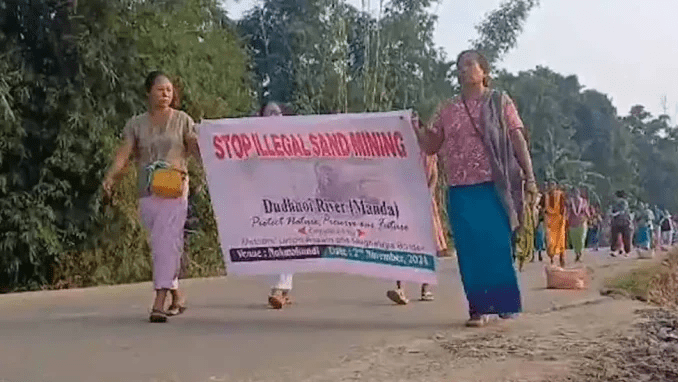
(Feature Image: Mother’s Union protest rally against sand mining. Image Source: Nagaland Post, 03 Nov 2024)
The ongoing protest by the Mother’s Union against sand mining in Dudhnoi River along the Assam Meghalaya border has brought to focus the serious implications of unsustainable sand mining, whether legal or illegal. The campaign has wide based support from the Garo Students Union, All Bodo Students Union, Krishak Mukti Sangram Samiti and other groups.
The campaign has highlighted that due to use of motorized equipment to extract sand, the water level in the Dudhnoi river is dropping hugely, including during rainy season. The campaign has also pointed out that the forest, mining, transport and police departments have been allowing over loaded sand laden dumpers with or without proper challans.
The problems faced by people along the Duhnoi River along Assam Meghalaya border are typical of the problems faced by millions all over the country, the manifestations and their intensity may be somewhat different. The lack of adequate response from the governments, regulators including MoEF and also media and judiciary is also typical. One hopes that the issues raised by the campaign are resolved, but also there are systemic changes brought to ensure such problems elsewhere are also effectively resolved.
Assam-Meghalaya Mothers lead protest against sand mining in Dudhnoi A protest rally led by the Mothers’ Union of Assam & Meghalaya, along with the Garo Students’ Union (GSU), has brought the issue of rampant sand mining in the Dudhnoi River to the forefront. Hundreds of frustrated villagers, including women carrying babies, took to NH 217 to demand an immediate halt to the destructive practice.
The rally, which saw the participation of over a thousand people from various communities, NGOs, and student unions like the All-Bodo Students’ Union (ABSU) and the Krishak Mukti Sangram Samiti (KMSS), marched from Damra High School Playground to Nokmakundi Playground in the Dudhnoi Legislative Assembly Constituency (LAC).
Mothers’ Union President Soma Marak highlighted the severe environmental impact of sand mining. “The water level in the Dudhnoi River has been decreasing drastically, even during the rainy season. Sand smugglers use motorised equipment to extract sand, causing massive erosion from Dudhnoi to villages in Meghalaya,” Marak said.
ABSU advisor Dhiraj Hazowary criticised the sand mafia for wreaking havoc on nature through illegal sand mining and disregarding govt regulations. He alleged that forest, transport, and police depts turn a blind eye to overloaded sand-laden dumpers, even when they transport sand without proper challans or exceed permitted loads. Instead, he noted, authorities focus enforcement efforts on e-rickshaws, scooters, & bikes. https://www.eastmojo.com/assam/2024/11/23/assam-mothers-lead-protest-against-sand-mining-in-dudhnoi/ (23 Nov. 2024)
When a number of irate tribal women with infants in their arms demonstrated on the National Highway, the image of the villagers’ suffering from sand mining was brought to light. According to Soma Marak, president of the Mothers’ Union, the water level in the Dudnoi River is dropping daily as a result of mining. “We see far less water than we have in the river, even during the rainy seasons. However, severe erosion began in the region from Dudhnoi to various villages in Meghalaya as a result of sand smugglers utilizing motors to remove the sand from the river,” added Soma Marak. https://www.sentinelassam.com/north-east-india-news/assam-news/assam-mothers-union-stages-protest-against-sand-mining-in-dudhnoi-river (23 Nov. 2024)
Soma Marak also said, “State govt of Assam planned to decrease erosion in the rivers and therefore Assam state minister Pijyush Hazarika also visited many river side places in Dudhnoi area along with the RHAC Chief Tankeswar Rabha and ordered the department to work for stopping erosion. What is the point of spending unnecessary money on these things when sand mining continues in the river day and night?” https://www.indiatodayne.in/assam/video/assam-dudhnoi-residents-protest-sand-mining-impact-on-water-levels-and-livelihoods-1125471-2024-11-22 (22 Nov. 2024)
The move came after Assam failed to stop what residents termed an illegal exercise, where more than 200 dumper trucks are plying regularly. Despite repeated objections to the Goalpara District Commissioner and DFO against sand mining from the river, the acts continued. We want this menace to stop when everyone knows it is illegal but is still being allowed for reasons best known to them, said a resident of Kasumari, Brayan Marak.
Residents of the Damra area have been enraged after their written and verbal objections drew no reaction from those in power, while illegal sand mining continued despite objections from the residents. They pointed out that despite several offices and check gates for illegal activities along the route to Guwahati where the sand is sold, no one lifts a finger, pointing to some in the present Assam government being involved. https://theshillongtimes.com/2024/11/23/rally-against-illegal-sand-mining-in-dudhnoi-river/ (23 Nov 2024)
Spearheaded by the Mothers’ Union of the Assam-Meghalaya border, the groups held a meeting at Nokmakundi village playground, followed by a rally to press the govt into action. Local MLA Jadob Swargiary, representing the Dudhnoi Constituency, shared the communities’ concerns and revealed he had raised the issue with Assam’s Forest Minister and Chief Minister, as well as in the Assam State Assembly. “Till date, no reply has been given by the authorities. Those involved in mining don’t obey the rules and regulations, and the entire area is affected by erosion and other problems,” Swargiary said.
Echoing the concerns, Marak of GSU warned that the unchecked mining could lead to fatal consequences, as witnessed in the Boko River area, where two lives were lost due to mining. The GWC President called for unity, stating, “We must stand united against sand mining, whether it is legal or illegal.” The Mothers’ Union announced plans to directly engage with Assam’s Chief Minister and other key ministers, with Marak adding, “If this doesn’t work, we will continue to protest, block roads, and do whatever it takes to stop the sand mining.” https://www.eastmojo.com/top-news/2024/11/03/no-end-to-protests-at-assam-meghalaya-border-over-sand-mining/ (03 Nov. 2024)
HYDRO POWER PROJECTS
Uttarakhand Villagers conduct ceremony to ‘save’ 9th century shrine Haat village in Chamoli (Uttarakhand), historically a centre for Sanskrit scholarship and a key stopover for Badrinath pilgrims, is home to the Laxmi Narayan temple, whose sanctum has remained unchanged since the 9th or 10th century. However, the villagers say their cultural heritage faces a grave threat as it has been earmarked as a muck dumping site for the under-construction 444 MW Vishnugad-Pipalkoti hydro power plant. A legal battle on the issue is ongoing.
– To draw attention to their concerns, the village recently hosted a three-day ceremony attended by prominent seers and spiritual leaders, including Swami Mukundananda, a representative of the shankaracharya of Jyotirmath Peeth, who vowed, “I would lay down my life to protect this cultural heritage.” Swami Shivanand Saraswati of Haridwar-based Matri Sadan, also participated in the ceremony. He said, “It is of utmost importance that the village’s culture and religious sites are protected.”
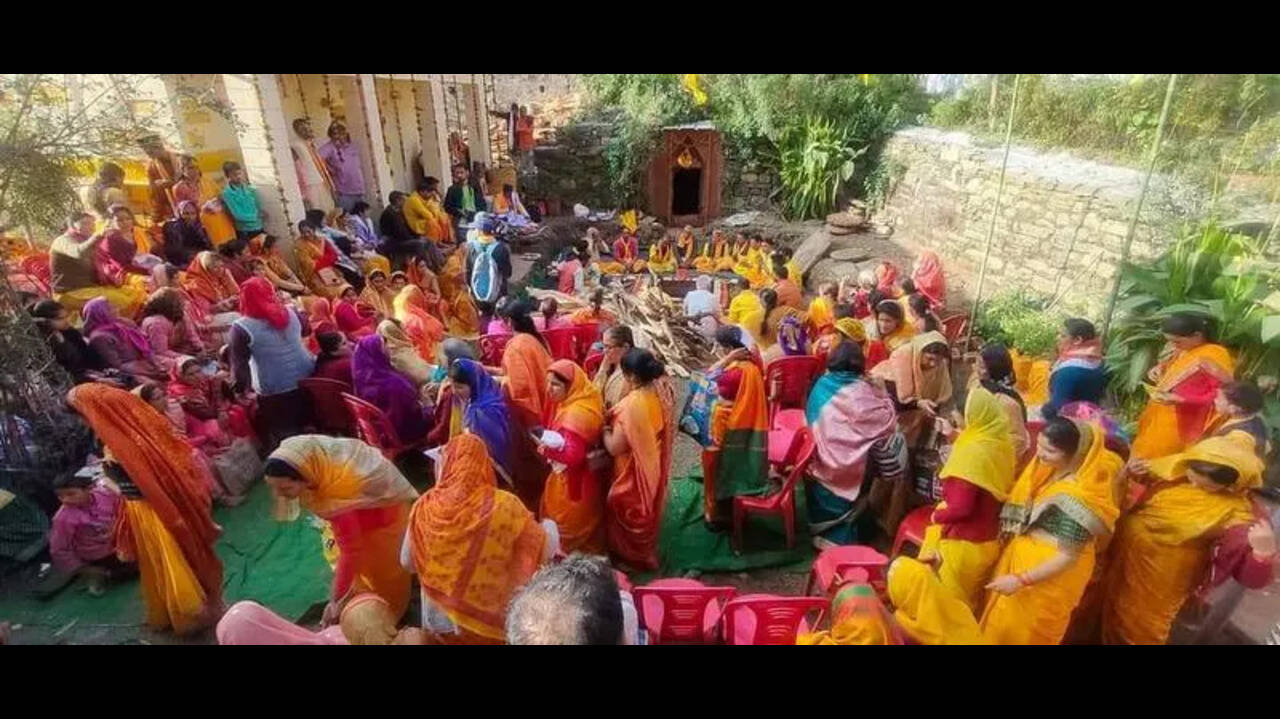
– Rajendra Hatwal, the village pradhan said, “The ceremony was meant to highlight our concerns. We want the entire Haat Narayan Temple complex to be protected and villagers affected by the project rehabilitated so that daily prayers and rituals for the deity can continue. How will the next generation learn and uphold this culture if they are not even living where the temple is located?” Ashish Kumar, regional director of the state archaeological department, said that “he was unaware of the issue but would investigate.” https://timesofindia.indiatimes.com/city/dehradun/villagers-rally-to-save-ancient-laxmi-narayan-temple-from-hydro-power-threat/articleshow/115425877.cms (18 Nov. 2024)
JBSS threatens to restart agitation over unmet promises The Joshimath Bachao Sangharsh Samiti (JBSS), a local advocacy group representing residents of the subsidence-hit Jyotirmath (formerly Joshimath), announced on Sunday (Nov. 24) that they will resume their agitation if the govt fails to fulfil its promise of immediate rehabilitation for the affected families who have been living in their damaged homes for the past two years. JBSS also criticized the recent order by the district administration, which permitted residents in the safe zone to repair their homes, calling it ‘incomplete’. “The order is completely different from what was discussed and agreed upon in our last meeting with the officials. We had requested permission for new construction and prefabricated structures in the safe zones,” Atul Sati, convenor of JBSS. said.
In Nov 2023, a high-level committee led by Union home minister and minister of cooperation, Amit Shah, had approved a Recovery and Reconstruction (R&R) plan worth Rs 1658 crore for Jyotirmath. As part of the approved plan, nearly Rs 1080 crore will be provided as central assistance from the NDRF. The state govt will contribute Rs 126 crore from its SDRF, along with an additional Rs 451 crore from its state budget. This allocation includes Rs 91 crore for land acquisition related to resettlement. The recovery plan is set to be executed over a period of three years. https://timesofindia.indiatimes.com/city/dehradun/jyotirmath-residents-threaten-agitation-over-delayed-rehabilitation-efforts/articleshow/115632761.cms (24 Nov. 2024)
Fast development destabilizes Himalaya region Fast development destabilizes India’s Himalaya region: As India boosts its infrastructure development in the Himalayan region, many ongoing construction projects are putting pressure on the fragile ecosystem. DW traveled to Uttarakhand, where communities are paying a high price. https://www.dw.com/en/fast-development-destabilizes-indias-himalaya-region/video-70840566 (21 Nov. 2024)
Himachal Pradesh 3 months on, Malana village remains cut off More than three months have passed since a flash flood had wiped away the road to Malana in the Parvati valley of Kullu but the village continues to remain cut off from the rest of the district. The link road, around 8 km in length, is yet to be rebuilt from the project site of Malana Hydro Dam-I, which also got damaged in the flash flood, up to near Malana village. In the absence of road connectivity, the villagers are forced to cover the 8 km distance on foot in case they wish to visit any other part of the district.
– The 86-MW Malana-I project has been developed by Malana Power Company Ltd (MPCL), while the 100-MW Malana-II project is owned by the Greenko Group. The road from Jari village to Malana-I project has been repaired and rebuilt by the MPCL. However, the Greenko Group is yet to rebuild the road that comes under its area of operation – from Malana-I to the village and up to the Malana-II project site. https://timesofindia.indiatimes.com/city/shimla/malana-village-cut-off-for-over-three-months-after-devastating-flash-flood/articleshow/115611832.cms (24 Nov. 2024)
MoEF Decisions of EAC meeting on River Valley Projects held on Nov 5, 2024:
1. Khadakwasala Fursungi Tunnel Project substitute to New Mutha Right Bank Canal KM 1 to Km 34 in 23.8364 Ha at Village Akole, Rui etc, Sub-dist Indapur, Haveli, Pune, Mah – Terms of Reference: APPROVED
2. Panchnad Major Irrigation Scheme (CCA : 24,328 Ha) in 24328 Ha at village Sadhrapur, Sub-District and District Auraiya, Uttar Pradesh by Irrigation and Water Resource Department, Kanpur, Uttar Pradesh – Terms of Reference: In view of ecological sensitivity of the proposed project site the Sub-committee of EAC members shall conduct a site visit before making any recommendations to the project site.
3. 1500 MW Pane Open Loop Pumped Storage Project in 290.87 ha at Villages Khanu, Pane and Vagheri, Taluka Mahad and Velhe, District Raigad and Pune Mah by JSW Energy PSP Seven Limited – Amendment for Terms of References: APPROVED
4. Sukhpura Off-Stream Closed Loop Pumped Storage Project -2560 MW in 788.6761 Ha in Village Sukhpura, Lakshmikhera, and Nahargarh etc., Sub District Rawatbhata, District Chittaurgarh, Rajasthan by Greenko Energies Pvt Ltd– Amendment for Terms of Reference: APPROVED https://parivesh.nic.in/utildoc/111657975_1731754427455.pdf (Nov. 2024)
Agenda of the EAC meeting on River Valley Projects to be held on Nov 30, 2024:
1. Myntdu Leshka Hydro Electric Project Stage-II (3X70) MW in 85.229 Ha at Village Bataw, Amtra, Satpator, Kharkhana and Tarangblang, Sub-district Khliehriat and Amlarem, District East Jaintia Hills and West Jaintia Hills, Meghalaya by Meghalaya Power Generation Corp Ltd for Environmental Clearance
2. Chentikheda Major Irrigation Project (CCA: 15300 ha) in 1361.25 Ha at Villages AGRA, BIJAIPUR, DEVRA, GARHI and etc., Sub-district Vijaypur and Sabalgarh, District Sheopur and Morena, Madhya Pradesh for Terms of Reference
3. Hidising Irrigation Project (CCA: 2958 ha) in 386.91 Ha Village Kararasinga, Sub District Purunakot, District Anugul, Odisha by for Terms of Reference
4. Teesta Hydroelectric Project Stage-III (1200 MW) in 213.8831 ha at Village Lingdong, Kazor, Barfok, Meyong etc Sub-district Mangan & Chungthang, North District, Sikkim by Sikkim Urja Ltd – Amendment in Environmental Clearance
5. Warsgaon Warangi Pumped Storage Project (1500 MW) in 226.16 Ha at Village Khanu, Teckpole and Warangi, Sub Dist Velhe & Mahad, Dist Pune & Raigad, Mah by Adani Green Energy Ltd – Terms of Reference
6. Sikaser Open loop Pumped Storage Hydro-electric Project (1200 MW) in 160 Ha at Village EAST RAIPUR PF, Sub-district Bindranavagarh, Dist Gariyaband, Chhattisgarh by for Terms of Reference https://parivesh.nic.in/utildoc/111809814_1731998162367.pdf (Nov. 2024)
DAMS
Polavaram Project Will complete Polavaram by 2027: CM According to CM Naidu, the Centre has so far sanctioned Rs 12,157 crore for the Rs 55,000-crore project, which it is ready to give in two years’ time. Until now, he said the union government released Rs 2,348 crore and reimbursed Rs 468 crore, totalling Rs 2,900 crore. Giving a timeline of March 2026 for completing the new diaphragm wall of the national project, Naidu said the work on the wall will begin by January 2025. https://www.deccanherald.com/india/andhra-pradesh/polavaram-project-will-be-completed-by-2027-at-any-cost-says-andhra-cm-3283430 (20 Nov. 2024)
Committed to execute dam at height of 45.72 meters: Minister WRD minister Nimmala Ramanaidu said the state government was committed to construct the Polavaram dam at a height of 45.72 metres and ruled out any chance to reduce it. In reply to queries raised by members Duvvarapu Rama Rao, B. Tirumala Naidu and Thota Trimurthulu during Question Hour in the Legislative Council here on Friday (Nov. 22), the minister alleged that the previous YSRC government had diverted the Central funds to the tune of Rs 3,385 crore meant for the Polavaram project.
With regard to the component-wise progress of works during 2019-24, the minister said the head works were completed to the tune of 6.96 per cent, left main canal-2.08 per cent and right main canal 1.61 per cent. He said Rs 273.48 crore to be paid for various works done up to the end of October 2024 while the balance works would be completed by December 2027. https://www.deccanchronicle.com/southern-states/andhra-pradesh/ap-committed-to-execute-polavaram-dam-at-height-of-4572-meters-minister-1840495 (22 Nov. 2024)
Kaleshwaram Project Ghose panel to cross-examine 52 engineers The Justice PC Ghose Commission, which is probing damages to the three barrages—Medigadda, Annaram, and Sundilla—is likely to summon 52 junior irrigation engineers who worked at the field level for cross-examination. This is in addition to senior IAS officers who held the posts of irrigation secretaries, senior irrigation officials and executing agencies of the three barrages from Nov 25. The commission is expected to decide on summoning former CM K Chandrasekhar Rao, who handled the irrigation portfolio between 2018 and 2023, and T Harish Rao, who held the irrigation portfolio between 2014 and 2018, a week after cross-examinations of officers. https://timesofindia.indiatimes.com/city/hyderabad/justice-pc-ghose-commission-to-cross-examine-52-engineers-in-klis-probe/articleshowprint/115576778.cms (23 Nov. 2024)
URBAN RIVERS
Tawi; Jammu JDA rebuts RFD environmental concerns at NGTThe Jammu Development Authority (JDA) has strongly defended the Tawi Barrage and Riverfront projects at a recent NGT hearing, responding to the allegations of severe ecological harm. The case was prompted by a report from sandrp.in, titled “Tawi Barrage & Riverfront Projects in Jammu Destroying River, Inviting Disaster”, which raised concerns about potential environmental damage and increased disaster risks associated with the projects. https://ziraattimes.com/2024/11/jda-defends-tawi-barrage-riverfront-projects-at-ngt-rebuts-environmental-concerns/ (22 Nov. 2024)
Sabarmati; Ahmedabad CETPs ineffective finds study A study finds that CETPs in the city are inadequate in treating wastewater to discharge standards and are releasing untreated wastewater into the Sabarmati, damaging the river ecosystem. https://www.indiawaterportal.org/water-quality-and-pollution/waste-water-/effectiveness-of-common-effluent-treatment-plants-cetps-in-ahmedabad-city (18 Nov. 2024)
Arkavathy, Bengaluru Mercury, cancer-causing pesticide found in river Heavy metals and toxic substances, including mercury, banned pesticide DDT, cancercausing polycyclic aromatic hydrocarbons (PAH), and uoride, have been found in the Arkavathy River, a vital water source for agriculture and horticulture in Karnataka. The findings come from recent tests on water and sediment samples collected from the river.
-Madhuri Mandava, co-founder of Paani Earth, emphasised the lack of surface water and sediment standards for key contaminants as a major hurdle. The SPCB does not monitor heavy metals or PAHs in Arkavathy waters, leaving a critical gap in pollution oversight. The study also incorporated data from research institutions like the ATREE. A detailed report, including ndings on water quality from the Vrishabhavathi Valley, is expected to be released soon. https://www.deccanherald.com/india/karnataka/mercury-cancer-causing-pesticide-found-in-arkavathy-river-water-samples-3286677 (22 Nov. 2024)
Buddha Dariya; Ludhiana Activists raise concern over pollution Several environmentalists in Abohar have raised their voices against pollution caused by Buddha Nullah in Ludhiana. They said water pollution was a matter of concern, and the govt needed to take it seriously, at a meeting on Nov 20. They told authorities that the contaminated water of Buddha Nullah was being poured into the Sutlej and reaching the public through various canals, thus causing water-borne diseases. The activists also submitted a memorandum to SDM Krishna Pal Rajput, urging the state government to stop the supply of the contaminated water. Rajput ensured the delegation that he would take up the problem with the state. https://www.tribuneindia.com/news/punjab/activists-raise-concern-over-water-pollution/ (21 Nov 2024)
CM urged to act on Dariya pollution A group of retired bureaucrats, police officers, and army veterans from the Kirti Kisan Forum has written to CM Bhagwant Mann, demanding quick action to address the pollution in the Buddha Dariya. The forum called for PPCB’s orders for shutting the untreated-waste outlets of CETPs along Tajpur Road. The PPCB’s directives are based on what the CPCB recommended more than a month ago. They demanded an inquiry into the reasons behind the delay in its implementation and if official negligence had allowed untreated chemical waste to continue polluting the water.
Activists from the Kale Pani Da Morcha have engaged with residents near Tajpur Road’s dyeing units, requesting them to join a Dec 3 program of forcing the authorities concerned into halting pollution. They said the sullied channel remained the only source of drinking water for many, as groundwater had also become unfit. The Kirti Kisan Forum warned against any more delays in executing the PPCB’s orders. https://timesofindia.indiatimes.com/city/ludhiana/urgent-action-needed-retired-officials-demand-punjab-cm-address-dariya-pollution/articleshow/115581193.cms (23 Nov. 2024)
Crackdown on dairy farms after review Municipal corporation officials have intensified their efforts to curb pollution by dairy farmers in the Haibowal dairy complex, issuing four challans on Tuesday (Nov. 19) for unclean surroundings and improper disposal of cow dung waste. The move follows a high-level review meeting in Chandigarh to address pollution in the Buddha Dariya, chaired by local bodies minister Ravjot Singh and attended by AAP MP Balbir Singh Seechewal, MLAs, and MC officials.
Effluent treatment plants (ETPs) have been installed in the dairy complex, but many units have tampered with the wastewater lines designed to connect to the ETPs. Officials said that in the absence of proper disposal, dung either enters the sewer system or flows into the Buddha Dariya, both of which are prohibited. The enforcement drive is set to continue in the coming days as officials work to mitigate pollution from dairy farms. https://timesofindia.indiatimes.com/city/ludhiana/urgent-action-on-dairy-farms-ludhiana-intensifies-fight-against-water-pollution/articleshow/115504393.cms (21 Nov. 2024)
Joint panel inspects treatment plants The first meeting of the joint committee of central and state departments formed by the MoJS for addressing the challenges pertaining to Buddha Nullah was held under the chairmanship of Manish Kumar, director, environment and climate change, department of science, technology and environment, at Circuit House on Wednesday (Nov. 20). Discussions were held regarding the sources of pollution including the pollution caused by industry, dairy units, etc. The respective departments were directed to submit a report regarding the steps which have already been taken and what steps have been proposed for addressing the challenges.
After the meeting, the members led by committee chairman Manish Kumar visited the sites alongside the drain, including STP Jamalpur, ETP in Tajpur road dairy complex, intermediate pumping station, Gaushala site and CETP of Tajpur road and Focal point dyeing industry. Kumar said that detailed discussions were held regarding the challenges during the meeting. Future action plans will now be proposed and finalised in the next meetings of the committee. The final report would then be submitted to the Ministry of Jal Shakti. https://www.hindustantimes.com/cities/chandigarh-news/ludhiana-joint-panel-inspects-buddha-nullah-treatment-plants-101732119481372.html (20 Nov. 2024)
Activists cast doubts over Haibowal ETP’s efficacy Activists from Public Awareness Committee (PAC) and Buddha Dariya Action Forum (BDAF) intensified their efforts on Sunday (Nov. 17), conducting a detailed analysis of the 3.75 MLD ETP at Haibowal Dairy Complex. The inspection confirmed that while the ETP is operational, there are significant concerns about its ability to effectively handle the wastewater. Specifically, the dairy sludge entering the system is at an exceptionally high ratio, overwhelming the plant’s capacity. The activists claimed that despite the ETP being functional, a disturbing amount of polluted water continues to be discharged into Buddha Dariya through two outlets. https://timesofindia.indiatimes.com/city/ludhiana/concerns-raised-over-effectiveness-of-haibowal-dairy-etp-as-activists-demand-action/articleshow/115395812.cms (18 Nov. 2024)
Kukrail; Lucknow ₹67cr project stops sewage from 17 drains The Kukrail river interception and diversion (I&D) project was successfully completed on Saturday (Nov. 23). The ₹67.65 crore initiative, approved in the 2020-21 fiscal year, now ensures that sewage from the 17 drains is intercepted and diverted to the Kukrail sewage pumping station (SPS) through a 6 km-long sewer line. The sewage is then treated at the 345 MLD STP in Bharwara. https://www.hindustantimes.com/cities/lucknow-news/kukrail-river-cleansed-rs-67cr-project-stops-sewage-from-17-drains-101732377013741.html (23 Nov. 2024)
RIVERS
Opinion How do you care for a river if you never see it? Will govts allow rivers and the air and nights a life, their older lives, so that ‘a new Upanishad’, a new Riversong, can be composed within our own hearts? (Sumana Roy) https://indianexpress.com/article/opinion/columns/how-do-you-care-for-a-river-if-you-never-see-it-9676640/ (19 Nov. 2024)
Ladakh Why is this Indian river called the “river of death” ? The Shyok River is a tributary of the Indus River, which flows through northern Ladakh, & into Gilgit-Baltistan in Pakistan, through very rugged terrains. At approximately 550 kms, it has even been nicknamed “The River of Death”. But what is the story behind this gothic name?
The name “Shyok” is coined from the Tibetan words “shag” gravel and “gyog” spread, meaning large gravel spreads left by the river periodically when it overflows. However, the same river is called “the river of death” in Yarkandi which engulfs ‘the danger of crossing it’. The Central Asian traders, traveling from Yarkand to Leh, had precarious navigation along the treacherous waters of the Shyok River during the bitter winter months. Because the currents were unpredictable and icy, many people died while crossing the river, thereby earning the river its somber name. https://timesofindia.indiatimes.com/etimes/trending/why-is-this-indian-river-called-river-of-death/articleshow/115409656.cms (24 Nov. 2024)
Rajasthan Luni defy our imaginations of a river This is the story of the Luni in regions closer to the source – farmers shifting to more lucrative but highly water-intensive crops, which comes at a steep cost. Both groundwater and surface water, drawn from wells, are naturally replenished (to some extent) by Luni’s seasonal flow.

However, the impact of dams, sand mining, climate change, and over-extraction has severely diminished the river’s reach, leaving it barely flowing beyond Alniyawas, just 40kms from the source of the river. As a result, farmers downstream are increasingly forced to depend on expensive borewells, which must drill ever deeper, often tapping into only saline aquifers. https://veditum.org/2024/11/14/the-imaginations-and-realities-of-a-river/ (14 Nov. 2024)
Tamil Nadu Villagers oppose tungsten mine block in ESZ Activists and villagers have taken objection to mining of tungsten in the ecologically sensitive zone with Arittapatti consisting of a chain of seven barren granite hillocks and the distinctive landscape of rocky hills acting as a watershed, supporting 72 lakes, 200 natural spring pools, and 3 check dams. https://www.deccanherald.com/india/tamil-nadu/centre-auctions-tungsten-mine-block-in-eco-sensitive-region-in-tamil-nadu-activists-urge-cm-to-revoke-permission-3283089 (19 Nov. 2024)
GANGA SANDRP Blog Pindar Valley: Potentially Dangerous Landslides Dam in Kunwari The initial landslide has caused a lake to form before 2022, which repeatedly drained. Since 2022 drainage is no longer possible and it has increased in size by November 2024. Large parts of the Kunwari Village have been destroyed and are likely to continue to be affected in the coming months. https://sandrp.in/2024/11/22/uttarakhand-kunwari-potentially-dangerous-for-landslides-dam-in-pindar-valley/ (22 Nov. 2024)

पिंडर घाटी: कुंवारी में भूस्खलन निर्मित बांध के संभावित खतरे यह संभावना है कि प्रभावित पहाड़ी ढ़लान पर हलचल जारी रहेगी और यह 2025 के मानसून के दौरान फिर से गति पकड़ लेगी, तथा बड़े पैमाने पर हलचल के कारण झील का आकार और भी बढ़ जाएगा। https://shorturl.at/ywdKh (23 Nov. 2024)
Govt plans winter Char Dham yatra In order to ensure that pilgrims coming to the winter abodes do not face any problems, the public works department (PWD) will work on road repairs and widening, while the tourism department will promote homestays and renovate rest houses on the route. State govt has sought proposals to enhance infrastructure in this regard. Additionally, the tourism department plans to deploy doctors and state disaster response force (SDRF) teams on the route to ensure the safety of pilgrims.
47 lakh devotees visited the Char Dham shrines from May 10 to Nov 17 2024, compared to 54 lakh last year. While 16.5 lakh pilgrims visited Kedarnath and 14.3 lakh visited Badrinath, Gangotri and Yamunotri recorded 8.1 lakh and 7.1 lakh visitors respectively. Officials attributed the slight decline in numbers to extended spells of monsoon rains and damage caused by landslides on the Kedarnath trek route. https://timesofindia.indiatimes.com/city/dehradun/uttarakhand-government-plans-major-winter-char-dham-yatra-to-boost-pilgrimage-and-local-economy/articleshow/115461042.cms (19 Nov 2024)
NMCG Decisions taken in 58th executive committee meeting The 58th Executive Committee meeting of the National Mission for Clean Ganga (NMCG) approved various vital projects.
A vital project for assessing the Environmental flow of the Chambal, Son, Damodar and Tons rivers has been approved by the Executive Committee. With an estimated budget of Rs. 11 crore.
Project has been approved for conservation of the Ganga River Dolphin. The project titled ‘Advancing Rescue System for the Protection of Stranded Ganges River Dolphins’ has an estimated budget of Rs.1 crore. It aims to develop a specialized rescue vehicle, the ‘Dolphin Ambulance’, to assist dolphins in distress.
Project for the Conservation of endangered turtles in the Ganga basin in Uttar Pradesh has also been approved. The objective of this initiative is not only to rehabilitate endangered turtle species but also to reintroduce three highly threatened species, alongside establishing a Spatial Monitoring and Reporting Tool at the National Chambal Sanctuary. This project is estimated to cost Rs. 78.09 lakh.
The rehabilitation of the 50 MLD STP at Keorapukur in Kolkata has been approved with a revised budget of Rs. 114.27 crore, up from the initial Rs. 67.06 crore. The project includes provision for 15 years of operation and maintenance, ensuring its long-term success.
In Bardhaman, steps have been taken with the revised approval of the Integrated Septage Treatment Plant project. This project has now been sanctioned with a revised budget of Rs. 10.35 crore, up from the previous Rs. 6.46 crore. Under this project, a 50 KLD capacity FSTP (Faecal sludge treatment plant) will be constructed. https://pib.gov.in/PressReleaseIframePage.aspx?PRID=2073248 (14 Nov. 2024)
Talk River Ganga, communities, cultures and Livelihood by Vidya Bhushan Rawat. https://countercurrents.org/2024/11/river-ganga-communities-cultures-and-livelihood/ (20 Nov 2024)
YAMUNA Delhi Reclaiming floodplain bit by bit?? This report does not mention the illegal encroachments by official agencies and also by DDA, and where DDA is taking no action. Large number of bridges have also added to the encroachments, but the report mentions only one. The report also does not point out that DDA has not implemented the orders of the court to demarcate the floodplain. https://timesofindia.indiatimes.com/city/delhi/delhi-takes-major-steps-to-combat-flooding-issues-by-reclaiming-yamuna-floodplain/articleshow/115392825.cms (18 Nov. 2024)
19 out of 37 STPs not up to standard: DPCC report The report, dated Nov 5, is part of the monthly assessment report for Oct, reveals that a large chunk of STPs are yet to meet the prescribed norms set for parameters such as faecal coliform, BOD & total suspended solids (TSS), among others.
Bhim Singh Rawat, a of SANDRP, said that the water utility has missed multiple deadlines to increase and upgrade Delhi’s STP network. “This is the reason DJB has been rapped by both the Delhi high court and NGT in the past. Yet we don’t seem to see the urgency to take corrective action,” he said. https://www.hindustantimes.com/cities/delhi-news/19-out-of-37-sewage-treatment-plants-in-delhi-not-up-to-standard-dpcc-report-101732471475883.html (25 Nov. 2024)
STPs do not meet standards: DPCC The report said that the DJB’s STPs are not adhering to norms, mostly concerning faecal coliform, which indicates the presence of raw sewage and excreta in the water. Apart from faecal coliform, many STPs failed to meet the standards for BOD and total suspended solids. There were then 28 such STPs with exponentially high faecal levels. Officials at STPs, however, stated that at present, 18 STPs have working disinfection facilities either through chlorination or UV treatment, while 9 STPs are under construction with UV treatment facilities, & the process of installing UV devices at others is in the pipeline. https://timesofindia.indiatimes.com/city/delhi/19-out-of-37-delhi-sewage-treatment-plants-fail-to-meet-standards-raising-pollution-concerns/articleshow/115633454.cms (25 Nov 2024)
NGT imposes ₹25cr fine on MCD, DJB The NGT on Nov 21 imposed environmental compensation of ₹25.22 cr on each of the MCD and DJB for failing to check pollution of stormwater drains and subsequently, the Yamuna. The DJB was pulled up for connecting drains carrying sewage and polluted waste with stormwater ones, and not maintaining separate lines for the past few years, while the MCD was penalised for covering drains, altering their shape and polluting the Yamuna. Both bodies were asked to deposit the fine with the CPCB in two months.
The court noted that stormwater drains in Delhi were designed well and should not be polluted so that they can be used for groundwater recharge. The order also quoted a 2016 report by the NCRPB that made remarks on encroachment of natural drainage channels, covering of drains and constructions over them, silting of drains, and mixing of sewage and drainage. Citing it, NGT directed partial removal of cover across the length of stormwater drains at different intervals so that not only cleaning or desilting becomes convenient and possible, but also so gases and foul smells do not shoot out from a single point. NGT also directed DJB to take steps for immediate diversion or tapping of drains carrying sewage meeting the stormwater drain by taking appropriate steps within three months. https://www.hindustantimes.com/cities/delhi-news/ngt-imposes-25-crore-fine-on-mcd-djb-over-yamuna-pollution-101732296948901.html (23 Nov. 2024)
STPs not up to mark: HC A bench of Chief Justice Manmohan and Justice Manmeet PS Arora suggested that tamper-proof meters be installed at STPs to track both operational timings and electricity usage. Furthermore, the court directed that this data be uploaded in real-time to the websites of the CPCB, DJB & the Chief Secretary’s office. The court also called for the installation of sensors at discharge points where treated water flows into the river. These sensors would monitor critical water quality parameters, including BOD, COD, TSS, Fecal Coliform & Dissolved Phosphate. https://www.newindianexpress.com/cities/delhi/2024/Nov/20/stps-not-up-to-mark-polluting-yamuna-delhi-hc (20 Nov. 2024)
Most STPs being upgraded: DJB NGT had earlier taken suo motu cognisance of a TOI report, stating that despite treatment, about 75% of STPs operated by DJB were failing to get even close to treating the E coli or faecal coliform. However, DJB did not respond on time, due to which the tribunal, during a hearing in Aug, imposed a fine of Rs 10,000 upon CEO, DJB, for non-appearance before the tribunal and not filing the response. However, DJB filed a response dated Nov 21, where it asserted that most of its STPs were in the process of upgradation, while various others were now adhering to norms.
DJB, which operates 38 STPs, said Delhi’s estimated sewage generation was 792 MGD, which was 80% of its daily water production of 990 MGD. It asserted that against the sewage generation of 792 MGD, its installed capacity was just 712 MGD, which it treated through 38 STPs. It said that out of 38 STPs, 18 catering to 375.4 MGD of sewage were complying with standards, and nine catering to 245 MGD were under upgradation and would comply by March next year.
DJB further stated that it was constructing 9 STPs – 2 at Okhla & 7 at Sonia Vihar — which would be ready by March next year, while 9 other STPs would be upgraded by March 2026. Three other STPs currently functional at Okhla, however, were not complying with norms. However, as per details further furnished by DJB in the same report, it did not disclose the details of faecal coliform. The report further pointed out that barring 18 STPs, others did not adhere to the prescribed norms for TSS and BOD. https://timesofindia.indiatimes.com/city/delhi/djb-reports-most-sewage-treatment-plants-upgraded-amid-ngt-concerns/articleshow/115575896.cms (22 Nov 2024)
NGT seeks report on waste removal from river banks The NGT has directed the MCD to provide complete details about the removal of waste on the banks of Yamuna river in the national capital. The green body was hearing a plea saying domestic, dry and waste garbage had been dumped on the banks of river Yamuna in Wazirabad and Jagatpur villages. In an order passed on November 13, a bench of NGT Chairperson Justice Prakash Shrivastava noted the submissions of the counsel for MCD that the cleaning work was in progress in the entire stretch of 4.3 km and that 10 workers had been deployed at the spot. It said the details had to be provided within four weeks. The matter has been posted on March 6 for further proceedings. https://www.theweek.in/wire-updates/national/2024/11/20/lgd17-green-delhi-yamuna.html (20 Nov 2024)
Ammonia up in river, water production hit The ammonia levels in the Yamuna rose once again on Monday (Nov. 18) night, forcing DJB to curtail water production at the major Wazirabad water treatment plant (WTP) by 15% on Tuesday (Nov. 19). This is the third such recorded episode this year when the pollution in the river increased, affecting the water treatment network. The problem is likely to impact the water supply in central Delhi and some localities in south Delhi. This year, the ammonia spike was also reported by officials in Jan, Feb and Oct, affecting the production of drinking water at various WTPs, mainly Wazirabad.
Citizens Front for Water Democracy, a group of water activists, wrote to Delhi govt last week about the rising levels of ammonia in water and raised concerns about public safety. “The rise of ammonia content in the Yamuna at Wazirabad pond and its upstream has become routine and very frequent for the past four to five years. This badly affects treatment at DJB’s WTPs, resulting in reduced supply and creating a huge scarcity of water in the command area,” said activist SA Naqvi. https://timesofindia.indiatimes.com/city/delhi/ammonia-levels-surge-in-yamuna-leading-to-water-supply-crisis-in-delhi/articleshow/115461967.cms (20 Nov. 2024)
Define DDA, MCD jurisdictions: Delhi HC The High Court has recently directed the MCD and the DDA to demarcate their respective jurisdictions to ensure accountability in tackling illegal constructions. This order comes in the wake of a PIL concerning alleged illegal construction near Hazrat Nizamuddin Dargah, which had previously been ignored by both authorities despite a work stop notice from the ASI. The petition highlighted the failure of both civic bodies to act against the encroachment, prompting the court to act. The court also instructed the MCD to act against officials found liable for not addressing the illegal construction. The HC directed the government and the PWD to address a plea requesting the construction of a FoB near the Zoo on Mathura Road. The plea says that pedestrian safety took a hit during the G20 Summit when the red light near the Zoo bus stop was removed. https://www.newindianexpress.com/cities/delhi/2024/Nov/23/define-dda-mcd-jurisdictions-delhi-hc (23 Nov. 2024) The Court added that the illegal construction in this case appeared to have been carried out with the tacit support, if not active connivance, of the authorities. The Court had, therefore, ordered a Central Bureau of Investigation (CBI) investigation into the matter by an order passed in February this year. The MCD and DDA later submitted that the said construction has since been fully demolished. Considering this development, the Court has disposed of the PIL. https://www.barandbench.com/news/delhi-high-court-mcd-dda-encroachments (22 Nov. 2024)
Uttara Pradesh NGT forms panel on Pahuj pollution The NGT has formed a panel to suggest remedial measures to tackle the problem of pollution in the Pahuj river in Jhansi district. The tribunal was hearing a petition alleging that the river has shrunk due to pollution and encroachment and that sewage is discharged and solid waste thrown into it. The river is a tributary of the Sindh and the Yamuna and was once regarded as the lifeline of Jhansi and surrounding areas, the plea has said.
The NGT said the district magistrate will be the nodal agency for coordination. “The joint committee will visit the site of the river flowing from district Jhansi, ascertain the source of its pollution, take the water sample, get the analysis done and submit the analysis report and also suggest the remedial measure,” the tribunal said. The matter has been posted on Nov 28 for further proceedings. https://theprint.in/india/jhansi-river-pollution-ngt-forms-panel-to-suggest-remedial-measures/2240974/ (24 Aug. 2024)
Vrindavan Widows of Vrindavan celebrate Diwali on banks of Yamuna. https://www.deccanherald.com/india/uttar-pradesh/widows-of-vrindavan-celebrate-diwali-on-banks-of-yamuna-3254208 (30 Oct. 2024)
RIVERS BIODIVERSITY
Bihar NDRC remains non-operational 8 months since inauguration Eight months after the inauguration of the National Dolphin Research Centre (NDRC) in Bihar, the country’s first centre dedicated to conserving the endangered Gangetic river dolphin, remains non-operational. The facility lies defunct due to a lack of advanced, expensive equipment and skilled manpower. The institute, located near the Ganga river in Patna, was inaugurated by CM Nitish Kumar on March 4, 2024. Despite its much-anticipated opening, the centre has seen no activity and stands as a glaring example of official neglect. Visitors are greeted by stray dogs, groups of locals from nearby slums sitting and chatting and locked glass doors. A few private security guards are the only visible presence. This inaction has significantly delayed vital research on Gangetic dolphins. https://www.downtoearth.org.in/wildlife-biodiversity/indias-first-dolphin-research-centre-remains-non-operational-8-months-since-inauguration (18 Nov. 2024)
Uttar Pradesh ‘Dolphin Mitras’ The forest department in a press communique stated that stakeholders like sailors, fishermen and students, who belong to the villages near the Ganga will be deployed as Dolphin Mitras. From time to time, they will keep an eye on the migration pattern of dolphins and ensure that no such activity takes place at those spots that could harm them because there is a possibility of large number of fishing incidents in the river during winter.
Currently, provision has been made to identify 6 Dolphin Mitras each in Varanasi & Ghazipur. The honorarium fixed for the conservation work done by them will also be paid by the department. To join this project, interested persons can send their application in the attached format to the Circle Office / Divisional Forest Officer Office / Regional Forest Officer Kashi by Nov 26 and may also mail details to @cfvaranasi2@yahoo.com. https://www.hindustantimes.com/cities/others/now-dolphin-mitras-to-protect-endangered-gangetic-species-101732044404502.html (20 Nov. 2024)
FISH, FISHERIES, FISHERFOLKS
SANDRP Blog WFD 2024: Important Studies, Reports on River Fish, Fisherfolks During past one year, there have been several new studies and reports published amplifying the adverse effects of developmental projects including dams, waterways, river interlinking, invasive fish species, degradation of rivers and climate change on river fish and fisherfolks in India.
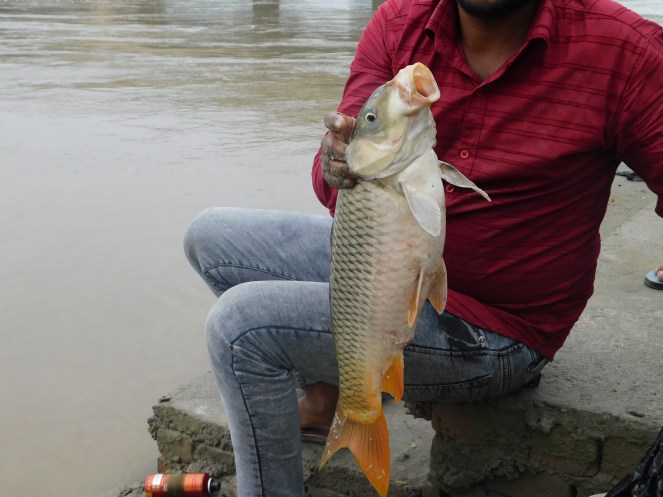
In the last part of the annul overview on the World Fisheries Day on Nov 21 2024, we focus on these important studies and reports highlighting the threats and challenges on freshwater fish and fisherfolks. https://sandrp.in/2024/11/21/world-fisheries-day-2024-important-studies-reports-on-river-fish-fisherfolks/ (21 Nov. 2024)
WFD 2024: Top Ten Positive Fisheries Reports from India On the occasion of World Fisheries Day 2024 which is celebrated on November 21 annually, we compile top ten positive developments during the last one year on the issues of fish, fisheries and fisherfolks from India. https://sandrp.in/2024/11/20/world-fisheries-day-2024-top-ten-positive-fisheries-reports-from-india/ (20 Nov. 2024)
WFD 2024: Fish Suffering, Fisherfolks Struggling, Threats Growing This yearend round up complies the top ten reports outlining how the fish and fisherfolks in India have been facing existential crisis due to govts’ apathy, various developmental projects and growing climate change threats. https://sandrp.in/2024/11/20/world-fisheries-day-2024-fish-suffering-fisherfolks-struggling-threats- (20 Nov. 2024)
WFD 2024: MASS FISH KILL in Indian Rivers, Wetlands Continue Over the past several years Indian rivers have been witnessing mass fish death incidents primarily due to decreasing flows, increasing pollution and other anthropogenic activities. As we celebrate World Fisheries Day 2024, SANDRP compiles the reports revealing mass fish kill incidents in our rivers over the past one year across. https://sandrp.in/2024/11/20/world-fisheries-day-2024-fish-suffering-fisherfolks-struggling-threats-growing/ (21 Nov. 2024)
Manipur ALAFUM underscores plight of Loktak fisherfolk On the occasion of World Fishery Day, the All Loktak Fishers Union Manipur (ALAFUM) has underscored the plight of the fishing population of Loktak and others who are engaged in capture fishery. As a Union of fishing families of the Loktak lake, ALAFUM has expressed concern that fisherfolk of Loktak are not treated as legal fisherpersons. The ALAFUM press note issued by secretary Rajen Oinam, underscored that the Fishery Department as well as the Loktak Development Authority (LDA) do not have proper data of the fishing population of Loktak till date. It accused the LDA of treating the fisherfolk as “occupiers”, and not as fishing families who have lived and fished at Loktak for generations.
Recalling the burning of several floating homes of Loktak fishers by the LDA in November of 2011, ALAFUM said that it condemns the act to this day and continues to mark the day every year as “Loktak Arson Day”. Additionally, the press release said that the Fishery Department exists only for culture fishery (rearing and harvesting fish in small bodies of water) as those engaged in capture fishing at Loktak have not been provided with identity cards as fishers till date. Subsequently, they have been deprived of schemes, loans and other State facilities as fishers. This is because people who fish at Loktak are not considered as fishers, reasoned ALAFUM. Urging the law makers to understand the role played by the fishing population of Loktak in particular and capture fishery at large, ALAFUM has appealed to the Government to recognize and support capture fishery and treat the fishing families equally as those engaged with culture fishery. https://e-pao.net/GP.asp?src=15..221124.nov24 (24 Nov. 2024)
Uttar Pradesh Dominance of exotic fish species in Yamuna, NGT told -Dominance of exotic fish species in Yamuna, NGT told The NGT has been informed that exotic fish species dominate the river Yamuna, while Indian fish species have declined. The green body was hearing the issue of the decreasing population of Indian fish species in the Yamuna. It had earlier sought a response from authorities, including the Central Inland Fisheries Research Institute (CIFRI) in Prayagraj.
It further said that the Tenualosa Ilisha(Hilsa/ Ilish) fishery had been totally wiped out from the riverine stretch in Prayagraj since 2010 due to the construction of the Farakka barrage. According to the report, the exotic fishery in the Yamuna was primarily represented by Common Carp (Cyprinus carpio), Nile tilapia (Oreochromis Niloticus), and Clarias Gariepinus. Other significant contributors included Clarias Gariepinus (Thai Mangur) at Delhi (Wazirabad).
Referring to the studies about their composition, the report said, “These indicate an overall dominance of exotic fish species in the river Yamuna.” The tribunal, meanwhile, noted the recommendations for addressing the issue, such as prohibiting illegal fishing gears, enhanced monitoring, control and surveillance during the fishing ban, implementing strategic ranching practices, maintenance of proper records of fish catch data, banning the release of exotic fish for rituals, maintaining continuous water flow, addressing source pollution and increasing awareness. It also sought a response from the secretaries of the Union ministries of Jal Shakti and Fisheries and Animal Husbandry. The matter has been posted on March 3 for further proceedings. https://theprint.in/india/dominance-of-exotic-fish-species-in-yamuna-ngt-told/2351532/ (11 Nov 2024)
75K carp fingerlings stocked in Ganga On the occasion of World Fisheries Day, an awareness seminar was organised by the Fisheries department at Sant Ravidas Ghat on Thursday (Nov. 21) to honour fishermen, under the River/Ranching program initiated by the National Fisheries Development Board (NFDB) as part of the Prime Minister’s Matsya Sampada Yojana. During this event, 75,000 Indian major carp fish fingerlings, sized 80-100 mm, were stocked in the Ganga.
The native fish species and their numbers in major rivers and associated water bodies have been declining over the past 10 years. The primary reasons include local fishermen using zero-size nets to catch juvenile fish and using pesticides for fishing. Additionally, during the breeding season in July-August, brooders are hunted, leading to the premature killing of fish in the Ganga and other major rivers, posing a significant threat to fish resource conservation. https://timesofindia.indiatimes.com/city/varanasi/varanasi-celebrates-world-fisheries-day-with-major-carp-fish-stocking-event-to-boost-ganga-ecosystem/articleshow/115561660.cms (22 Nov 2024)
Report Experts discuss sustainable fisheries & aquaculture solutions Dept of Fisheries under the Ministry of Fisheries, Animal Husbandry & Dairying celebrated the World Fisheries Day 2024 with the theme India’s Blue Transformation: Strengthening Small-Scale and Sustainable Fisheries.
Initiatives and projects like 5th Marine Fisheries Census, National Plan of Action on Sharks, India’s endorsement to the Regional Plan of Action on IUU (Illegal, Unreported and Unregulated) Fishing, the International Maritime Organisation-Food and Agricultural Organisation (IMO-FAO) GloLitter Partnership Project etc. were launched on this occasion. The event included two technical sessions. The first being, “South-South and Triangular Cooperation: Food Safety and Security through Sustainable Fisheries and Aquaculture”. The second session, “Climate Change: Challenges in Fisheries and Way Forward,” addressed climate impacts, resilience-building, & mitigation strategies. https://pib.gov.in/PressReleaseIframePage.aspx?PRID=2075664 (21 Nov 2024)
Uttarakhand, J&K bag top fish production awards On the occasion, states and UTs were honoured for their contribution to the growth of fisheries and aquaculture sector in the country. Kerala bagged the award for the Best Marine State; Telangana as the Best Inland State; Uttarakhand as the Best Himalayan State and Jammu & Kashmir as the Best Union Territory. Among districts, Kollam (Kerala) won the Best Marine District award, Kanker in Chhattisgarh was named the Best Inland District while Darrang in Assam received the Best Himalayan and Northeastern District award. Kulgam in Jammu & Kashmir was honoured as the Best District in a Union Territory. Around 30 million people are involved in the field across the value chain. https://www.tribuneindia.com/news/india/world-fisheries-day-ukhand-jk-bag-top-fish-production-awards/ (22 Nov. 2024)
Telangana State wins national award for fisheries The Telangana fisheries department hosts 5,901 fisheries and cooperative societies, with a total membership of 4,13,120. Since December 2023, 225 new societies have been established, enrolling 8,069 new members.
Further strengthening the cooperative network. Under the Group Accidental Insurance Scheme, a premium of Rs 139.77 lakh was paid to insure the lives of 4.16 lakh fishers, setting a notable example. Additionally, the construction of new fishponds was sanctioned, covering an area of 195.94 hectares with a project cost of Rs 2145.44 lakh.
To conserve and promote striped murrel fish, a Center of Excellence is being set up at the Yellampalli Reservoir in Mancherial district in collaboration with ICAR-Central Institute of Freshwater Aquaculture (CIFA). In 2024, Telangana achieved fish production of 4.56 lakh tons, generating a revenue of ₹7,059.04 crore, significantly contributing to the state’s economy. https://www.siasat.com/telangana-wins-national-award-for-fisheries-3135994/ (23 Nov. 2024)
SAND MINING
Report SC directs state govts to constitute SEIAA in 6 weeks The above direction was made when the Supreme Court was hearing a civil appeal against an order of the National Green Tribunal which disapproved the grant of Environment Clearances in certain leases by the District Environment Impact Assessment Authorities (DEIAA) instead of SEIAA.
The bench of CJI Sanjiv Khanna and Justice Sanjay Kumar was hearing a challenge by the Union to the order of NGT, Delhi dated Sep 13, 2018 directed the Ministry of Environment, Forest to revise its 2016 notification which exempts regulatory clearances in mining leases for areas upto 25 ha.
-The notications challenged before the NGT dated 15.01.2016, 20.01.2016 and 01.07.2016 had the effect of diluting the procedure for obtaining environmental clearance in respect of mining of minor minerals for areas from 0 to 25 hectares as it brought such leases within ‘B-2 category projects’ where Public Consultation, Environment Impact Assessment (EIA) and Environment Management Plan (EMP) was exempted.
-Notably, under the B-2 category projects, the EC was to be granted by the DEIAA as opposed to SEIAA which oversees grants in B-1 category projects (leases of areas between 50-25 hectares).
-The bench of NGT noted that such notications, particularly of January 15, 2016 were contrary to the Supreme Court decision in Deepak Kumar Vs. State of Haryana & Ors, where it was held that all mining leases in respect of its size would require to obtain Environmental Clearance and be subjected to strict regulatory framework as that of all major minerals.
-The matter will now be heard in January 2025. https://www.livelaw.in/top-stories/constitute-state-environment-impact-assessment-authorities-in-6-weeks-if-absent-supreme-court-directs-states-275734 (20 Nov. 2024)
Uttara Pradesh SC sets aside ‘completely erroneous’ NGT order Taking serious note of the massive illegal sand mining carried out in Dhasan River in Jhansi, the Supreme Court has set aside the NGT order and asked the tribunal to hear the matter again. Observing that the fact finding recorded in the NGT order was completely erroneous, a two-judge Bench of the apex court, headed by Justice Abhay S. Oka and also comprising Justice Ujjal Bhuyan, has said that the tribunal ought to have gone into the allegations of breach of the terms and conditions made in the application before it.
Advocate Akash Vashishtha, appearing for the appellant, Naveen Kumar, submitted that as many as 31 paragraphs pointing out violations of 49 General and Specific Conditions imposed by the Environmental Clearance (EC) were disregarded outright by the tribunal. The observations of the tribunal in the order were completely inconsistent with each other, he said. The NGT order was in complete breach of the EC, he added. The apex court has asked the NGT to decide the original application afresh, as expeditiously as possible. https://www.newindianexpress.com/nation/2024/Feb/15/sc-sets-aside-completely-erroneous-ngt-order-allowing-dhasan-river-sand-mining-application (15 Feb. 2024)
Bihar Worker buried alive A daily-wage worker was buried alive in a sand pit allegedly during illegal mining from the banks of Kiul river in Lakhisarai district early on Nov 20. According to police, the death of Aman Kumar, alias Golden (28), was due to the negligence of an earth mover driver involved in the illegal sand mining at Ghosikundi village in Kiul area. Police said illegal sand mining mafias use earth movers to remove sand beyond the govt-designated areas. “The driver fled the scene, leaving the trapped worker behind, resulting in his death on the spot. Upon receiving information from other workers present at the scene, villagers arrived at the scene and managed to retrieve the body after much effort,” said Kiul police station in charge Bijendra Kumar Singh. He added so far, they have not received any application from the family of the deceased. https://timesofindia.indiatimes.com/city/patna/illegal-sand-mining-tragedy-worker-dies-after-being-buried-alive-in-bihar/articleshow/115492719.cms (20 Nov 2024)
Goa Expert panel gives nod to issue sand mining permits The state-level expert appraisal committee (SEAC) on Oct 4 recommended to the state environment impact assessment authority (SEIAA) to grant environmental clearance (EC) to the directorate of mines and geology (DMG) for manual extraction of sand in the Mandovi and Zuari rivers. It has imposed certain conditions which include extraction only during 6am-6pm and a complete ban during the monsoon. “The permission for sand extraction by manual means should be 70-30% between the traditional and the non-traditional extractors,” SEAC said. It has directed the DMG to issue permits to individuals to carry out 1,000 m³ of sand mining per year in 14 different zones across these rivers.
A ‘Patrolling-cum-Flying Squad’, a complaint monitoring mechanism comprising senior-level representatives from stakeholder departments and authorities should be in place, it stated. “A dedicated helpline number may be provided for effective redressal of complaints. The said squad/ committee shall enforce the conditions of this clearance and be authorized to file FIR/ criminal cases in case of violations and to stop illegal sand extraction and seize equipment, vehicles, etc., used in illegal sand extraction,” SEAC said.
The permit holder shall undertake adequate safeguard measures during extraction. “No sand extraction and allied activities are allowed during the monsoon season from June 1 to Sep 30,” SEAC said. “The National Institute of Oceanography (NIO) shall carry out bathymetry and other studies, including monitoring in the months of January and May, and the reports shall be submitted to this authority,” SEAC said. The permit holder shall keep a correct account of the quantity of mineral exported, dispatched from the site, mode of transport, registration number of the vehicle, person-in-charge of the vehicle, mine plan, details of the permit holder, etc.
Considering the probability of ecological impacts due to sand extraction on the riverine ecosystem, the authority mandates that the Goa State Biodiversity Board (GSBB) periodically monitors riverine and riparian biodiversity on a sampling mode, SEAC said. “This environmental clearance (EC) does not absolve the applicant from obtaining other statutory and administrative clearances/NoCs permissions, as applicable, from other statutory and administrative authorities concerned,” SEAC said, and further added, “An appropriate mechanism is evolved to ensure an assured back-flow of the share of revenue generated to a revenue village in whose jurisdiction sand extraction is carried out.” https://timesofindia.indiatimes.com/city/goa/expert-panel-gives-nod-to-issue-sand-mining-permits/articleshow/113949070.cms (05 Oct. 2024)
Andhra Pradesh APCC chief demands probe into sand mining ‘scam’ APCC chief YS Sharmila has demanded an in-depth probe into the alleged sand mining scam involving former director of Mines and Geology VG Venkata Reddy. Sharmila said people close to them (YSRC leaders) were favoured and NGT rules and regulations were given a go by in sand mining. The State revenue had gone into the pockets of a few individuals. “Not just ACB, but there is a need for a CBI inquiry into this loot of natural resources in Andhra Pradesh,” the PCC chief said. https://www.newindianexpress.com/states/andhra-pradesh/2024/Sep/29/apcc-chief-ys-sharmila-demands-probe-into-sand-mining-scam (29 Sept. 2024)
Tamil Nadu Action taken against illegal mining along Vaigai, HC told The State has told the Madurai Bench of the Madras High Court that appropriate action has been taken against illegal sand mining along Vaigai river in Anaipatti & Siddhargal Natham in Nilakottai in Dindigul dist. It was submitted that action had been taken against the jurisdictional Village Administrative Officer and Tahsildar. The police have taken effective steps and seized the vehicles used in the illegal sand mining; it was submitted. The court was hearing a petition by V. Maharajan of Dindigul district who sought direction to the authorities to act against the illegal sand mining along the Vaigai river in Anaipatti and Siddhargal Natham. Taking note of the action by the authorities, the court disposed of the petition. https://www.thehindu.com/news/cities/Madurai/action-taken-against-illegal-sand-mining-activities-along-vaigai-river-hc-told/article68630784.ece (11 Sep 2024)
WETLANDS, LAKES, WATER BODIES
Jammu & Kashmir EPG seeks inquiry over Mirgund Wetland’s deteriorating condition During a recent visit, the EPG team found the wetland devoid of water marshes, or bird activity an indicator of the severe ecological degradation. Land mafias have also exploited the situation by marking plots with cement blocks and undertaking earth filling to raise ground levels, likely for sale or construction purposes. The team noted that the wetland’s boundaries, as recorded in official revenue documents, were indistinguishable on the ground, exacerbating the encroachment issue.
Although the Wildlife Department has begun efforts to reclaim encroached areas on the northern side of the wetland by erecting boundary pillars, the process has been agonizingly slow, taking over 15 years of legal battles in the courts. The EPG team also identified failures in water management as a key factor behind the wetland’s deterioration. The Sukhnag Nallah, which could supply water to the wetland, remains disconnected due to a closed MS iron gate at the offtake point in Rakh Kawoosa village.
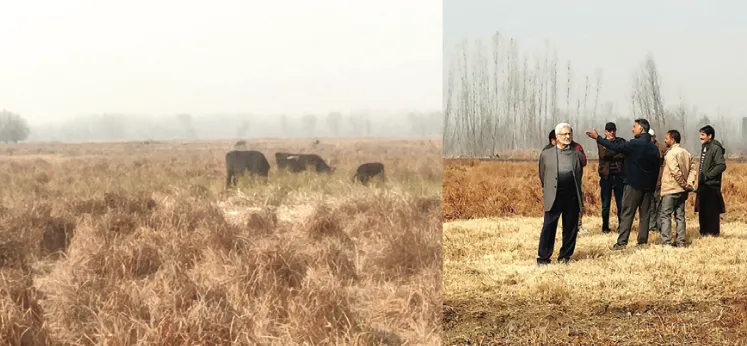
The team observed that opening this gate could immediately restore water flow to the wetland, but no action has been taken in this regard. The EPG has called for an immediate high-level inquiry to determine the circumstances that led to the current state of the wetland. https://www.greaterkashmir.com/kashmir/epg-seeks-inquiry-over-mirgund-wetlands-deteriorating-condition/ (22 Nov. 2024)
WATER OPTIONS
Centre “Bhu-Neer” Portal launched for GW withdrawal permits The MoJS Minister C.R. Paatil digitally launched the newly developed “Bhu-Neer” portal on Sept. 19 during the concluding ceremony of India Water Week 2024. The “Bhu-Neer” is an advanced portal developed by Central Ground Water Authority (CGWA), under the Ministry of Jal Shakti, in collaboration with the National Informatics Centre (NIC), for improved groundwater regulation across the country. This portal will serve as a one-stop platform for managing and regulating groundwater resources, aimed at ensuring transparency, efficiency, and sustainability in groundwater usage. “Bhu-Neer” is designed to provide comprehensive details regarding the legal framework governing groundwater extraction, regulations at the state and national levels. Its centralized database will allow users to access critical information on groundwater compliance, policies, and sustainable practices. https://pib.gov.in/PressReleasePage.aspx?PRID=2074919 (20 Nov. 2024)
GROUNDWATER
Tamil Nadu ‘4K observation wells inadequate to tackle GW challenges’ Farmers say 4,016 observation wells to monitor groundwater levels currently installed are incommensurate for the state’s 17,000 villages. As per the farmers the observation wells are installed at the firka level, but ideally, at least one well should be set up in every village to provide accurate data on groundwater levels. K Balasubramani, state secretary of Tamil Nadu Vivasaya Munnetra Kazhagam (Farmers Association), said, “In addition to installing observation wells, the government must develop infrastructure for rainwater harvesting in all villages. A few years ago, the state government actively pushed rainwater harvesting schemes in every household, but the momentum has slowed down.”
Speaking on condition of anonymity, a senior official from WRD said, “Unless the state government allocates funds for such projects, it will be impossible to implement them. Compared to other Southern states, Tamil Nadu depends heavily on ground water sources as other states have adequate storage of surface water.” Given the state’s financial situation, we have recommended a phased implementation, but the proposals are still awaiting approval, he added.
Another WRD official emphasized the need for technological upgrades. “Currently, we monitor observation wells manually, which provide data once in 24 hours. We have proposed a telemetry system that can automatically measure and transmit groundwater data four times a day,” the official said. A detailed project report has been submitted for financial approval, he added. https://www.newindianexpress.com/states/tamil-nadu/2024/Nov/21/farmers-4k-observation-wells-in-tn-inadequate-to-tackle-groundwater-challenges (21 Nov. 2024)
Study Earth’s rotation has tilted 31.5 inches Over less than two decades, our groundwater pumping has tilted the Earth by 31.5 inches. To put this into perspective, this water redistribution equates to approximately 0.24 inches of sea-level rise. The study, which included data from 1993 through 2010, showed that pumping as much as 2,150 gigatons of groundwater has caused a shift in the Earth’s tilt. The study is published in the journal Geophysical Research Letters.
“Our study shows that among climate-related causes, the redistribution of groundwater actually has the largest impact on the drift of the rotational pole,” said Ki-Weon Seo, a geophysicist at Seoul National University. We may not think about where our water goes after we use it, but most of it ends up being transported to the oceans. “Observing changes in Earth’s rotational pole is useful for understanding continent-scale water storage variations,” said Seo.
Unlike the water you see in rivers and lakes, groundwater is hidden away, acting like nature’s hidden water bank. It plays a crucial role in the water cycle, providing a steady supply of water even during dry spells when surface water might be scarce.
The new revelations about groundwater pumping open new doors for our understanding of climate change and our capacity for action. It is imperative to balance human needs with environmental conservation, which requires innovative approaches to water usage, such as enhanced irrigation systems, rainwater harvesting, and improved municipal water management. Furthermore, global cooperation among countries is essential to create comprehensive policies that address the equitable distribution and consumption of water resources. https://www.earth.com/news/our-everyday-water-use-is-literally-tilting-the-earth/ (24 Nov. 2024)
URBAN LAKES, WETLANDS
Hyderabad HYDRAA Commissioner promises time-bound inquiry into Ameenpur encroachments Hyderabad Disaster Response and Asset Protection Agency (HYDRAA) Commissioner A.V. Ranganath visited several colonies in Ameenpur municipality following complaints from residents about encroachments affecting parks and lakes, as well as a lake submerging residential layouts. Later, Mr. Ranganath highlighted concerns surrounding Peddacheruvu, one of the biggest lakes in the municipality. This expansion has reportedly led to the submergence of nearby residential layouts. “A time-bound inquiry will be launched,” said Mr. Ranganath, adding that the extent of the lake as per records would be thoroughly verified. https://www.thehindu.com/news/national/telangana/hydraa-commissioner-promises-time-bound-inquiry-into-ameenpur-encroachments/article68885617.ece (20 Nov. 2024)
NGT warns DJB official for bid to ‘mislead’ it on pond pollution NGT has warned a DJB official against misleading it regarding the functioning of a decentralized sewage treatment plant (DSTP) at Smriti Van in south Delhi’s Vasant Kunj, which was meant to revive the pond Macchli Ka Talaab. The tribunal noted that the pond had no dissolved oxygen and was being filled with sewage. It ordered DJB and DDA to resolve their differences and ensure only treated water flows into the pond.
“From the reply of DJB on Nov 13, we find that there is no proper coordination between DJB and DDA. Hence, we direct that CEO, DJB, and vice-chairman/acting vice-chairman, DDA, hold a meeting and settle this difference. DJB and DDA will file the affidavit disclosing that the issue relating to lack of coordination has been solved and responsibility about the operation of DSTP has been fixed. Let the same be filed within three weeks,” NGT said. https://timesofindia.indiatimes.com/city/delhi/ngt-slams-djb-for-misleading-on-pond-pollution-crisis-in-delhi/articleshow/115633974.cms (25 Nov. 2024)
Noida Lack of upkeep keeping winter birds away from wetlands Okhla Bird Sanctuary has not yet welcomed any winter migratory water bird species so far this year. The sanctuary’s deteriorating condition is believed to be the reason behind the absence of these avian visitors. Similarly, Surajpur wetland has also experienced a lack of winter birds, with only five species observed as of last week against 15-20 species last year. Over the past few years, the sanctuary’s ecosystem has been negatively impacted by various factors, resulting in a diminished capacity to attract and support the wide array of migratory birds that previously frequented its waters.
Ecologist TK Roy told TOI, “Unfortunately, due to mismanagement and the destruction of wildlife and birdlife habitats, the sanctuary has been transformed into a highly disturbed entertainment park.” Roy added that unauthorised concrete structures have been erected on the grounds, which has further degraded the natural environment that once supported a thriving ecosystem. As a result of these detrimental changes, the resident water bird population has suffered a significant decline, with fewer than 15 species now present in the sanctuary — and their numbers have dwindled to alarmingly low levels. https://timesofindia.indiatimes.com/city/noida/winter-birds-absent-from-noida-wetlands-due-to-neglect/articleshow/114891924.cms (03 Nov. 2024)
URBAN WATER
Bengaluru 31 villages await Cauvery water supply The recent assurance by the Bangalore Water Supply and Sewerage Board (BWSSB) and Deputy Chief Minister DK Shivakumar regarding the supply of Cauvery water to 110 villages merged into Bruhat Bengaluru Mahanagara Palike (BBMP) has failed to meet the expectations of residents in several areas. While BWSSB promised that water would be supplied after the inauguration of Cauvery Stage-V on October 16, many of the 31 villages in KR Puram and Mahadevapura constituencies are still awaiting for the supply. https://www.newindianexpress.com/cities/bengaluru/2024/Nov/23/31-villages-in-kr-puram-mahadevapura-await-cauvery-water-supply (23 Nov. 2024)
Hyderabad City to get Godavari water The state govt has decided to enhance Hyderabad’s drinking water supply by utilising 20 tmc ft of water from the Godavari River, sourced through the Mallannasagar and Konda Pochammasagar as part of second phase of Godavari drinking water project. CM A. Revanth Reddy on Nov. 23 directed officials to expedite the project by inviting tenders within a week. He also instructed them to prepare a detailed report on the costs and feasibility of transferring water from each reservoir. The govt revised strategy replaces the BRS government’s Keshavapuram reservoir project, which was subject to delays due to land acquisition and logistical challenges. The new approach involves supplying water directly from Mallannasagar, bypassing intermediate reservoirs, saving the state exchequer Rs 2,000 crore. https://www.deccanchronicle.com/southern-states/telangana/revanth-reddy-reviews-plans-for-godavari-water-transfer-to-hyderabad-1840653 (23 Nov. 2024)
Noida Residents sprinkling ‘rain’ to tackle toxic pollution With panic setting in because of toxic pollution levels in Delhi-NCR this week, several housing societies in Noida resorted to sprinkling water from high-rise terraces to settle dust and pollutants, to create a rain-like effect. Several RWAs also sprinkled water on the roads and pavements that are adjacent to their societies.
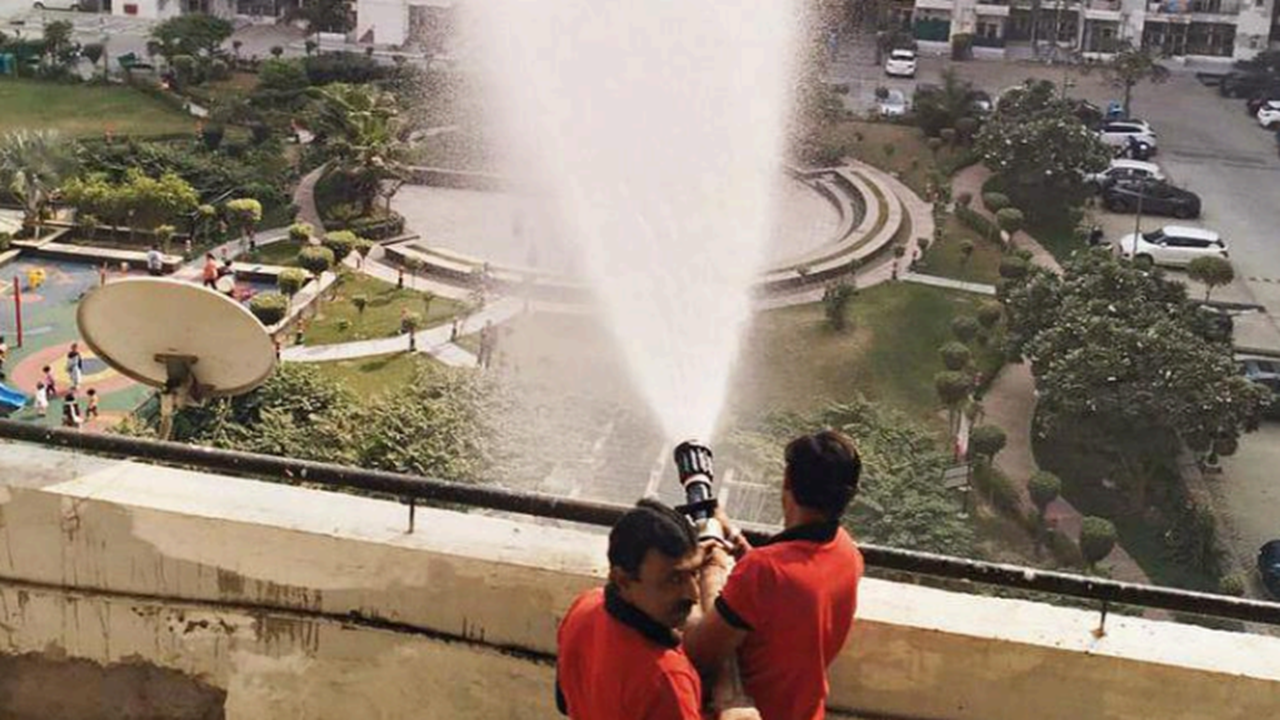
Meanwhile, the Noida Authority has also been sprinkling water on 100 to 125 km stretch daily. While any initiative to tackle pollution is a welcome one, sprinkling of water can at best have a localised limited impact when the entire airshed is highly polluted. https://timesofindia.indiatimes.com/city/noida/noida-condos-combat-toxic-pollution-with-sprinkler-rain-initiative/articleshowprint/115500849.cms (21 Nov. 2024)
AGRICULTURE
Tamil Nadu Mighty efforts to bring back native forests “In this time of climate change, I think ecological restoration and rewilding is extremely important,” said Godwin Vasanth Bosco, a Nilgiris-based naturalist and restoration practitioner. “What we’re trying to do is to help nature restore itself.” “This whole place was tea plantations and this stream was not flowing throughout the year,” said Bosco, the ecologist. “Since we began our restoration work, it flows through the year and the trees and bamboo have grown well along the stream.
Environmentalists say industrial-scale tea farming has destroyed the soil’s nutrients and led to conflict with animals like elephants and gaur, or Indian bison, that have little forest left to live in. Estimates say nearly 135,000 acres of tea have been planted across the mountains, damaging close to 70% of native grasslands and forests. “There is no biological diversity,” Gokul Halan, a Nilgiris-based water expert, said of the tea farms. “It doesn’t support the local fauna nor is it a food source.”
Officials of Tamil Nadu, of which the Nilgiris district is a part, earmarked $24 million earlier this year to encourage farmers to shift away from chemical-laden fertilizers to help preserve soil health. The state’s forest department officials also announced plans last year to plant nearly 60,000 native trees in the region. https://apnews.com/article/tea-restoration-native-plants-climate-change-25adeaf034873ce3035530275daa3ca2 (19 Nov. 2024)
Maharashtra Sugar workers risk kidnapping, assault & murder But the sugar workers of Maharashtra are far from free. With no written contracts, they are at the mercy of their employers to decide when they may leave. They frequently work under the threat of violence, abduction and murder. There is no official data about how often such treatment occurs, and abuses often go unreported because workers fear retaliation. But workers’ rights groups, local government authorities, experts and even some mill owners say that kidnapping is not uncommon and that workers have little recourse.
Earlier this year The Times and The Fuller Project revealed that household-name companies and Indian politicians profit off a brutal system that forces children to work, pushes them into underage marriages and coerces women to get unnecessary hysterectomies to keep them working in the fields, unencumbered by menstruation or routine ailments. All of those abuses can be linked to what is known as bonded labor, a system in which workers are perpetually in debt to their employers and cannot leave.
Far from addressing the problem, the Maharashtra govt denies that it exists. A court affidavit this year on behalf of several state agencies said that sugar laborers were “free to move anywhere and they are never imprisoned by the employer.” The mill where Mr. Dutta says he was held, Jaywant Sugars, denied any involvement. The mill has many customers and has supplied Sucden, a major commodity broker that says it commands 15 percent of the global sugar trade. https://www.nytimes.com/2024/11/21/world/asia/india-sugar-industry-labor-abuse.html (21 Nov 2024)
ENVIRONMENT GOVERNANCE
Report NGT calls for nationwide reports on tree loss The NGT has directed all states and UTs to submit detailed reports on tree loss, emphasising that the issue is a “pan-India” concern. This order came during a hearing on the alleged loss of 2.33 million ha tree cover in India since 2000.
In its order of Nov 18, a bench of judicial member Justice Sudhir Agarwal & expert member Afroz Ahmad acknowledged the submissions from the Survey of India regarding forest cover data, maintained by the Forest Survey of India (FSI). The tribunal instructed the FSI’s Director General in Dehradun to produce a report detailing the country’s forest cover from 2000 onwards. The report is to provide updates at five-year intervals up to Mar 2024, with a focus on the north India.
The NGT also directed all states and UTs to submit their assessments, including the current forest status, reasons for deforestation, and the measures undertaken for conservation and forest management. The decision followed a recent dispute between the MoEFCC, the FSI, and the Global Forest Watch. The ministry and FSI refuted the claims of Global Forest watch that India had lost approximately six per cent of its forest cover since 2000, as reported by the global monitoring organization. https://www.guwahatiplus.com/india/national-green-tribunal-calls-for-nationwide-reports-on-tree-loss (22 Nov. 2024)
A ‘bribery scheme’ to bag lucrative solar power contracts The indictment of industrialist Gautam Adani and his business associates by the U.S. Department of Justice (DoJ) presents detailed allegations regarding the processes followed by senior executives of Adani Green Energy Ltd. and Azure Power Global Ltd. (a renewable energy company headquartered in New Delhi, which used to be listed on the New York stock exchange) to bribe Indian government officials and secure lucrative solar power contracts.
The indictment starts by explaining the alleged motivation for their resort to a bribery scheme. Between December 2019 and July 2020, Azure Power and a subsidiary of Adani Green Energy won, and were issued, letters of award (LOAs) for a manufacturing-linked solar tender offered by the Solar Energy Corporation of India (SECI), a company of the Union Ministry of New and Renewable Energy whose mission is to increase the use of renewable energy in India. https://www.thehindu.com/business/Industry/gautam-adani-indictments-a-bribery-scheme-to-bag-lucrative-solar-power-contracts/article68894475.ece (22 Nov. 2024)
According to the NYT report, Solar Energy Corporation of India struggled to secure customers due to expensive energy costs for Indian states. Meanwhile, the prosecutors allege that Adani and associates utilised bribes to persuade Indian states to purchase their solar energy which termed “the world’s largest solar award” by the company.
“As a part of the award, AGEL will develop 8 GW of solar projects along with a commitment that will see Adani Solar establish 2 GW of additional solar cell and module manufacturing capacity. This award, the largest of its type, ever, in the world, will entail a single investment of Rs. 45,000 crores (US $6 billion) and will create 400,000 direct and indirect jobs. It will also displace 900 million tonnes of carbon dioxide over its lifetime,” Adani Green Energy Limited announced in June 2020 after securing the contract.
“This is the single biggest investment announced since the launch Atma Nirbhar Bharat Abhiyan (Self Reliant India Program). It is also another significant step in India continuing to lead the world in battling climate change and furthering the commitment the Hon’ble Prime Minister of India made to the world at the COP 21 summit in Paris in 2015,” the company added. https://timesofindia.indiatimes.com/business/india-business/worlds-largest-solar-award-the-deal-at-centre-of-us-charges-against-adani-group/articleshow/115531188.cms (21 Nov. 2024)
CLIMATE CHANGE
Study Rising floods, droughts & threats to food security -A new report on climate change has predicted significant shifts that could impact India’s economy and food security. Droughts and floods are also projected to increase, as per the climate model data, which will have a damaging impact on the economy, health, and food supply of the people. The climate report ‘Climate Change Projections for India (2021 -2040)’ was released by Azim Premji University on Sunday, outlining projections for India over the next two decades. The report aims to guide policymakers, educators, and NGOs in developing targeted strategies to mitigate climate change impacts and safeguard vulnerable communities. https://indianexpress.com/article/world/climate-change/climate-change-report-rising-floods-droughts-threats-india-food-security-9674541/ (17 Nov. 2024)
More Rain In Gujarat, Less In Himalayas India’s rainfall patterns are set to shift dramatically due to climate change, with Gujarat and Rajasthan expected to experience up to 50% more rainfall in high emission scenario by 2040 compared to 1960. In contrast, the Himalayan regions may face significant and alarming rainfall deficits, severely impacting agriculture, water resources, and local economies, according to a study by Azim Premji University. The analysis highlights a westward shift in the southwest monsoon, which traditionally brings more rain to eastern and northeastern states.
– Meanwhile, the Indian Himalayas, stretching from Kashmir to Arunachal Pradesh, are likely to see up to 15% less rainfall. Areas like north Sikkim and Arunachal Pradesh could face severe and acute water shortages, adversely affecting agriculture, drinking water availability, and natural ecosystems in these already vulnerable regions. This could lead to long-term consequences for local communities and biodiversity. https://www.outlookindia.com/brand-studio/blogs/climate-change-more-rain-in-gujarat-less-in-himalayas (18 Nov. 2024)
Climate change will disrupt rain patter The new climate data set (2021-2040) for India released by the Azim Premji University offers critical insights into how climate change will impact the country over the next two decades. The report states that the monsoon shows a rather grim picture where a major part of the country will experience a decrease in precipitation in the Indian Himalayas. The west & southwest states like Gujarat, Rajasthan, Karnataka and parts of Uttar Pradesh, Madhya Pradesh, including parts of Ladakh, will experience an increase in precipitation of 20 to 60%, with the highest being in Gujarat (50 to 60%). On the other hand, the SW monsoon will see a shift from east to west with the normally drier west states experiencing higher rainfall. https://bangaloremirror.indiatimes.com/bangalore/others/climate-change-will-disrupt-rain-pattern/articleshow/115391386.cms (18 Nov. 2024)
COP 29 Overtime Baku talks fail to deliver on new climate finance target After running into overtime, the Conference of the Parties (COP29) at Baku in Azerbaijan, hosting 198 countries for nearly a fortnight, finally adopted a ‘roadmap’, or a weaker form of an agreement, to say in traditional climate-talks parlance.
While setting the stage for kickstarting UN-approved carbon markets, the Conference failed to deliver on the main goal: a New Collective Quantified Goal on climate finance (NCQG). Amidst opposition and protests, a deal was agreed upon early Sunday to “aim to mobilise” $1.3 trillion a year by 2035, with developed countries agreeing to “lead efforts” to pool in $300 billion a year as a base figure. https://www.thehindu.com/sci-tech/energy-and-environment/overtime-baku-talks-fail-to-deliver-on-new-climate-finance-target/article68905050.ece (24 Nov. 2024)
Opinion India needs an environmental health regulatory agency Having such an agency in India, which it currently lacks, would look at the interlinked issues of climate, environment, health and the economy in a holistic way. https://www.thehindu.com/opinion/lead/india-needs-an-environmental-health-regulatory-agency/article68895068.ece (22 Nov. 2024)
SOUTH ASIA
IWT Will India’s initiative turn out to be a significant breakthrough in reorienting the Indus Water Treaty? https://www.livelaw.in/articles/indias-initiative-turn-out-significant-breakthrough-reorienting-indus-water-treaty-276115 (23 Nov. 2024)
Nepal Ecological imbalance in Kali Gandaki river Environmentalists and conservationists alike have expressed their concern over the existential threat and ecological imbalance posed by the proposed development projects based on the Kali Gandaki River. The Gandaki river system that lies in the central part of the country originates in the Tibetan plateau and traverses through districts like Mustang, Myagdi, Baglung, Parbat, Syangja and Gulmi and so on to eventually merge into the Ganges in India. The campaigners involved in the ‘Kali Gandaki Conservation Campaign’ have been pressing for a holistic approach to developmental efforts in and around the River which is one of the vital river systems in the country.
Untoward and excessive extraction of soil, stones and other aggregates have threatened the ecological aspect of the river besides risking the lives and livelihood of those depended on the river, the campaigners voiced. The campaigners have called for taking into account sustainable infrastructure development and environmental conservation while advancing proposed mega projects such as Kali Gandaki-Tinau Diversion Multipurpose Project and Kali Gandaki reservoir-based hydro power project among others. At present, environment impact assessment is underway for the 640-mega watt reservoir-based Kali Gandaki hydro power project. The project lies in Baglung and Parbat districts. The Campaign has claimed that both of these projects were not viable from river and ecological conservation point of view.
The campaigners have called for keeping the Kaligandaki’s natural course intact as it is connected to the spiritual, cultural prestige, biological and nature diversity as well as to human livelihood. Besides, the Kali Gandaki is the only river in the world where the rare ‘shaligram’ or the ammonite stones are found. The Hindus consider the ammonite stones as the symbol of their god Vishnu. Therefore, the river carried great religious significance to the Hindus. It is feared that increasing encroachment on the river will pose threat to the ammonite stone source. https://risingnepaldaily.com/news/52418 (22 Nov. 2024)
West Seti Hydropower Project The Investment Board of Nepal (IBN) has decided to award the contract for the construction of the 750 MW West Seti Hydropower Project to the NHPC Ltd. The company has prepared a detailed project report (DPR) and an MOU was signed in Aug 2022. After the DPR has been finalised, a project development agreement (PDA) will be signed between Nepal and India. https://risingnepaldaily.com/news/52210 (19 Nov. 2024)
Bhutan Collaboration to study GLOF threats The Newcastle University in the UK has partnered with the Druk Holding and Investments (DHI) to study the stability of glacial lakes, assess GLOF risks, and identify necessary adaptation measures. The collaboration, which began in March 2024 and will run until 2027, will assess the growing threats of GLOFs in the Eastern Himalayas, particularly in Bhutan. The partnership has already invested Nu 19.6 million (USD 19.66 million) in research and monitoring. Bhutan, which is particularly vulnerable, is ranked fourth globally for GLOF risk, with the Punatsangchhu basin identified as one of the most perilous areas.
“Bhutan is the most vulnerable country globally to GLOFs because its population, infrastructure, natural heritage and hydro-power generation capacity lie downstream of glacial lakes,” Professor Rachel Carr, head of physical geography in Newcastle University Newcastle said. “The primary employment sector and subsistence farming is vulnerable to GLOF as well as rising transboundary hazards.” A key component of the study will involve the Punatsangchhu catchment, identified as one of the highest-risk areas globally for GLOFs.
Through this partnership, the team plans to deploy a network of low-cost sensors to monitor glacial lake dynamics, assess potential GLOF triggers, and integrate data with existing early warning systems (EWS). This will involve monitoring key factors such as lake levels, temperature changes, moraine stability, and other critical parameters to forecast GLOF events and improve disaster preparedness. The research also focuses on the stability of the moraine dam at Thorthomi Lake, one of the most critical sites for GLOF risks in the country. https://kuenselonline.com/uk-bhutan-collaboration-to-tackle-glof-threats/ (23 Nov. 2024)
Pakistan 8 Oct 2005 Hattian Bala landslide The 8 October 2005 Hattian Bala landslide in Pak Occupied Kashmir was the largest landslide triggered by the appalling Mw=7.6 Kashmir Earthquake that day, which killed over 87,000 people. The Hattian Bala landslide is believed to have accounted for about 1,000 fatalities. The remains of the failure are still visible on Google Earth – it’s located at [34.1393, 73.7232]. The estimated the volume of the landslide was 68 million cubic metres, with a length of 2.6 km and an average thickness of 63 metres.

The landslide blocked the valley, creating two lakes, the largest of which caused considerable concern regarding a breach event. As a consequence, attempts were made to construct a spillway to manage the lake level. The dam did finally breach in 9 February 2010. This was subsequently described in a paper (Konagai and Sattar 2011) in the journal Landslides. They estimate that the breach released 36 million cubic metres of water. The flood caused a great deal of damage downstream, but this was undoubtedly reduced by the presence of the spillway. https://eos.org/thelandslideblog/hattian-bala-landslide (19 Nov. 2024)
CHINA
3 upstream dams in Tibet; a disaster in making China is proceeding with the construction of massive hydropower dams on the upper reaches of the Machu (Yellow River) in Tibet despite mounting scientific concerns about potential geological disasters and severe environmental consequences. This region, already seismically unstable and heavily impacted by climate change, poses substantial risks. Chinese scientists warn that the combined effects of intense human activity and adverse climate change have led to significant ecological and environmental problems in the upper reaches of the Yellow River.
– Dams here must be among the world’s tallest, standing 300 to 400 meters high. If one dam fails, a catastrophic chain reaction could potentially trigger the collapse of successive dams, much like a tsunami of water. Danger To The Permafrost Zone: Building dams at high altitudes in Tibet presents another risk: thawing permafrost. Tibet’s permafrost zone is the largest outside the Arctic, and construction on this unstable ground presents a significant challenge. As the permafrost thaws each summer and freezes again in winter, the shifting subsoil may threaten the dam’s stability.
The Yangkhil (Yangqu) hydropower station, the first major dam built upriver on the Machu, has destroyed an entire Tibetan community. Eyewitness accounts detail the forced dismantling of homes and the destruction of a monastery, which was removed from the protected heritage list before demolition. https://www.eurasiantimes.com/china-builds-at-least-three-upstream-dams/ (22 Nov. 2024)
ASIA
Brutal transformation of rivers that nurtured cradle of civilization Govt initiatives have transformed the region. Turkey’s Southeast Anatolia Project, begun in 1977, involved constructing 22 dams and 19 hydroelectric power plants in the Euphrates and Tigris basins. The Keban, Karakaya, Atatürk, Birecik, and Karkamış dams have gone up on the Euphrates; on the Tigris, Turkey has built the Devegeçidi, Ilısu, Batman, Dicle, Kralkızı, and Garzan dams, and Iraq, a dam at Mosul.
-Hundreds of settlements, natural areas, and archaeological remains have been submerged. Pollution has fouled the waters. People who for generations have farmed lands now flooded by reservoirs were compelled to leave their homes and move to crowded cities. The dam barriers prevent fish from migrating and reproducing and interrupt the flow of life-giving nutrients. Plant communities have vanished beneath the reservoirs; wild animals and birds have been displaced. https://outofedenwalk.nationalgeographic.org/blogs/lab-talk/2024-11-kurdish-photographer-records-brutal-transformation-rivers-once-nurtured-cradle-civilization (21 Nov. 2024)
THE REST OF THE WORLD
USA Salmon return to lay eggs in historic habitat after largest dam removal These are scenes local tribes have dreamed of seeing for decades as they fought to bring down four hydroelectric dams blocking passage for struggling salmon along more than 400 miles (644 kilometers) of the Klamath River and its tributaries along the Oregon-California border.
Now, less than a month after those dams came down in the largest dam removal project in U.S. history, salmon are once more returning to spawn in cool creeks that have been cut off to them for generations. Video shot by the Yurok Tribe show that hundreds of salmon have made it to tributaries between the former Iron Gate and Copco dams, a hopeful sign for the newly freed waterway. https://apnews.com/article/klamath-dam-removal-salmon-spawning-4240169b4bfa327a6a67383ab536e971 (17 Nov. 2024)
SANDRP
Also see: DRP 18 Nov. 2024 & DRP 11 Nov. 2024
Follow us on: www.facebook.com/sandrp.in; https://twitter.com/Indian_Rivers

 SANDRP