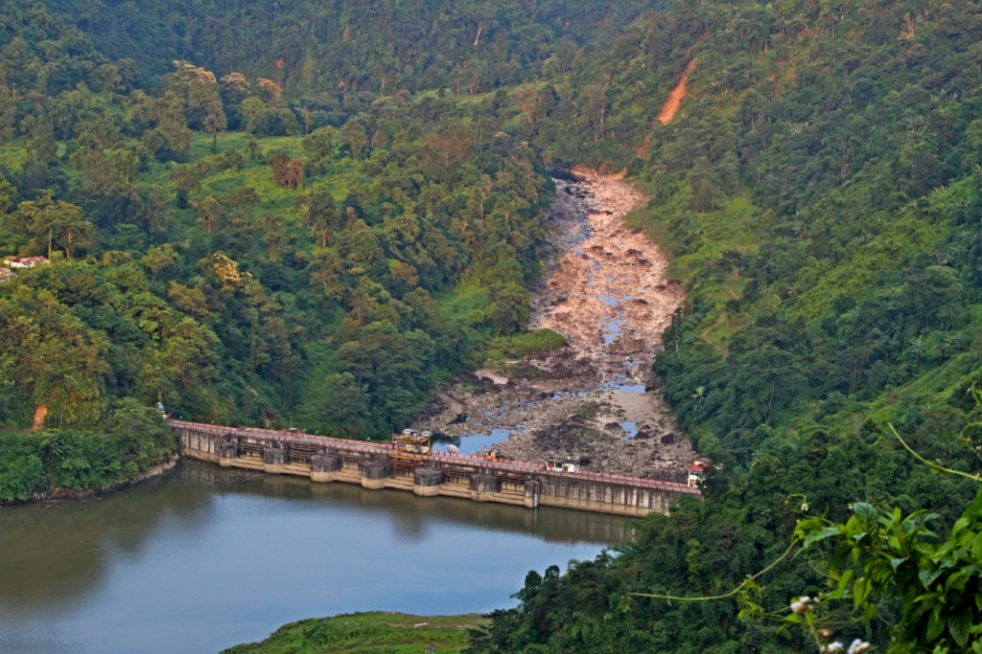
(Feature Image: The Ranganadi dam in Arunachal Pradesh. In February 2019 the dam released an unprecedented amount of silt, with severe impacts for the river’s biodiversity and the livelihoods of people who live along its banks. Image Credit: Karen Conniff / Flickr, CC BY-NC 2.0/Source: Dialogue Earth)
A new study of available scientific publications on impact of Hydropower projects on biodiversity provides a thorough review of the subject. The review does not directly give a call not to construct more such destructive projects. But it is useful for anyone concerned about the impact of dam projects on rivers.
The study discusses the impacts of hydropower projects on both aquatic and semi-aquatic species in riverine ecosystem and cumulative impacts spatially and temporally across river basins. Dams disrupt longitudinal connectivity and act as physical barriers in upstream-downstream movement of species. Upstream of dam, there is static water environment rather than flowing river environment. In the downstream, the hydropower projects adversely affect the water flow, sediment flow, thermal regimes, affecting water quality and environmental cues for the fish movement. All these also affect the floodplains both upstream and downstream.
If one goes through any of the Environment Impact Reports, Cumulative Impact Assessments or Carrying Capacity studies of any dam, hydropower projects or even river linking projects and river basins, we find none of these aspects in any credible way in India. And yet almost all the dams and hydropower projects in India get away with such shoddy, unscientific, dishonest reports and there are no consequences for the EIA/ CIA consultants.
Possibly one of the direct impacts of this is the new report that has come this week which says India has been ranked at No 176 in a Global Nature Conservation Index for 180 countries. Does all this induce any concern among the official agencies, or do they see all this as another feather in their cap?
Study Hydropower impacts on riverine biodiversity Abstract In this Review, authors discuss the impacts of hydropower on aquatic and semi-aquatic species in riverine ecosystems and how these impacts accumulate spatially and temporally across basins. Dams act as physical barriers that disrupt longitudinal connectivity and upstream–downstream movement of species. Impoundment creates still-water habitats upstream of dams and leads to declines in lotic-adapted species. Intermittent water releases modify the natural flow, sediment and thermal regimes in downstream channels, altering water quality, substrate structure and environmental cues that are vital for species to complete their life cycles, resulting in reduced reproduction success. Moreover, retention effects of reservoirs and flow regulation alter river–floodplain exchanges of water, sediment and nutrients, modifying the habitats on which riverine species depend. Improvements to flow regulation, fishway design and sediment redistribution can mitigate these ecological impacts. Future research should support reforms to dam operations and design adaptations to balance renewable electricity development and biodiversity conservation through systematic basin-scale planning, long-term monitoring, adaptive management and involving multiple actors in decision-making. https://www.nature.com/articles/s43017-024-00596-0 (14 Oct. 2024)
Report India ranked 176 out of 180 in 2024 Global Nature Conservation Index The index attributed India’s low ranking mainly to rising threats to biodiversity and the inefficient management of land. Researchers said that there was a need for sustainable land use practices as land conversion for urban, industrial and agricultural purposes had reached 53%. They also said that several factors such as the loss of habitat and fragmentation by agriculture, urbanisation and infrastructural development pose risks to the country’s biodiversity. “An alarming 23,300 sq km of tree cover was lost between 2001 and 2019 due to ongoing deforestation,” it noted.
“India faces both alarming biodiversity challenges and promising opportunities,” the researchers said. “The country’s biodiversity richness is under constant threat due to a population density that equals some of the world’s most congested areas and a doubled population since the late 1970s.” Enacting regulations that support sustainable development, allocation of funds for environmental preservation and promoting efficient conservation measures depend on the dedication of policymakers, they added. https://scroll.in/latest/1074946/india-ranked-176-out-of-180-in-2024-global-nature-conservation-index (26 Oct. 2024)
HYDRO POWER PROJECTS
Sikkim Damning the Future One year from the Teesta stage 3 dam collapse at Chungthang village in north Sikkim, seasoned journalist Snigdhendu Bhattacharya surveys the steep social, environmental and financial cost of hydropower development in the north eastern region of India, in this conversation with Centre for Financial Accountability’s Amitanshu Verma. https://www.youtube.com/watch?v=CwBJBWp5w54 (23 Oct. 2024)
Teesta V HEP suffered ₹327 cr damages The NHPC on Tuesday (Oct. 22) said a major landslide in Sikkim affected its 510 MW Teesta-V Power Station and the estimated loss was around Rs 327.67 crore. The power station is currently not operational and undergoing restoration works after flash flood of October, 2023, the company stated in a regulatory filing. https://www.indiatodayne.in/sikkim/story/sikkim-landslide-caused-rs-327-crore-loss-to-teesta-v-project-nhpc-1109891-2024-10-23 (23 Oct. 2024)
Arunachal Pradesh Protest against Siang valley HEP The project has been facing protests from the local population, which fears severe ecological impact due to the construction of the dam. According to local reports, data collection efforts by NHPC have been thwarted by locals who are apprehensive that the project will harm aquatic ecology. NHPC, however, is advocating for the project on the grounds of national security and the adverse impact of the Chinese dam.
The project was first conceptualised in 2018 by the Ministry of Jal Shakti as an irrigation-cum-power project. Lack of funds and support from the state government, coupled with local protests, caused no progress, said officials. Some officials also indicated that the rehabilitation of the local population continues to be a major challenge, as they fear loss of jobs and arable land for cultivation, especially rice. The 3 Gw Dibang Valley hydro project on the Siang river has faced years of protests over similar concerns. https://www.business-standard.com/economy/news/arunachal-s-siang-valley-dam-project-on-fast-track-to-counter-china-threat-124102000508_1.html (21 Oct. 2024)
A public consultation meeting on the proposed 12,500 MW Siang Upper Multipurpose Project (SUMP) was organised by the All Upper Siang District Students’ Union (AUSDSU) at Yingkiong. The discussion centred on the pre-feasibility report of the project. Elected public representatives, civil society organisations and representatives from project-affected families attended the meeting on Oct 19. Affected people registered a vocal protest against the proposed project before the meeting in which high security police personnel checked them by seizing their placards & banners. https://www.newindianexpress.com/nation/2024/Oct/21/public-raise-concern-over-12500-mw-siang-upper-multipurpose-project-to-mps-mlas-of-arunachal-pradesh (21 Oct. 2024)
Jammu & Kashmir Terror attacks wake up call infra projects The location opens an opportunity for a terror group through the Gurez valley or Mashkoh, both challenging routes but with minimal chances of being discovered. Further investigations will confirm the mode of execution by the perpetrators but this places under threat several other infrastructure projects in the outlying areas. There is the Kishanganga project very close to the LoC at the entrance to the Gurez valley and the two projects in the Jhelum Valley, Uri 1 and Uri 2, besides some others, including railway projects in the vicinity of Banihal & Qazigund. https://indianexpress.com/article/opinion/columns/jammu-and-kashmir-militant-attack-9632131/ (22 Oct. 2024) The Centre is executing 51 mega projects (those valued at more than ₹150 crore) in the Union Territory (UT), according to the Ministry of Statistics and Programme Implementation (MOSPI). These projects were initially estimated to cost ₹76,000 crore, but their cost has risen by 56 per cent to ₹1.16 trillion, the data shows. These include marquee projects such as the Udhampur-Srinagar-Baramulla Rail Link (USBRL). Stuck since 1995, the project costs ₹42,500 crore and is nearing completion, with a variety of trials taking place on the Chenab Bridge – the highest rail bridge in the world. https://www.business-standard.com/india-news/mega-project-builders-in-j-k-assess-risks-but-no-immediate-alarm-124102101123_1.html (22 Oct. 2024)
Himachal Pradesh Lambadug HEP repairs stalled More than five months after the leak in the hydroelectric project’s penstock near Multhan village in Kangra district of Himachal Pradesh, the repair and maintenance work is yet to be carried out as the impasse between the project management and the villagers continues over the issue of compensation. On May 10, the 25-MW Lambadug Hydroelectric Project suffered a leak in its penstock, causing damage to property and farmlands in Multhan village in the Chhota Bhangal (Barot) region of Kangra district. The gushing water from the project entered houses, shops and agricultural fields as panicked residents hurried to safer locations. The Lambadug Hydroelectric Power Project is being executed by Megha Engineering and Infrastructures Limited (MEIL), which is a holding company of KU Hydro Power Private Limited. Harpal Singh, joint chief operating officer of KU Hydro Private Limited, said the deadlock still continues between residents of Multhan village and KU Hydro. “We had appealed in the high court on 13 September, following which, the court passed directions on 17 September to the deputy commissioner to resolve the matter within three weeks,” he added.
– “The issue is still not resolved and the restoration work is at standstill. After the incident, the revenue department calculated total loss to the tune of ₹2.24 crore and KU Hydro is ready to deposit the money into government accounts for further payments to villagers. Multhan residents are asking ₹25 lakh compensation to each family, whereas families’ details are not available,” Singh said.
– Multhan panchayat pradhan Suresh Kumar (Bhanto) said the farmland of local villagers has been destroyed to such a level that it will remain uncultivable for the next 10 to 15 years. “The villagers are seeking compensation as per their crop losses. While shopkeepers in the market have received compensation ten times higher, the project authorities are unwilling to provide the compensation demanded by the villagers,” he said. “They are not engaging with the Panchayat or the villagers. The villagers obstructed access to the project after being sidelined by the project management. It is essential that they deal with the Panchayat and the community to address the damages caused. Until a satisfactory agreement is reached, we will not allow them to use our path,” he added. https://www.hindustantimes.com/cities/chandigarh-news/himachal-kangra-hydro-project-repairs-stalled-as-impasse-between-mgmt-locals-drags-on- (26 Oct. 2024)
PWD, SJVNL sign ₹ 70 cr MoU for road widening projects Presiding over the MoU signing ceremony here, PWD Minister Vikramaditya Singh said that the MoU had been signed for the widening of Sunni-Luhri road, Gharat Nala-Khaira road, Shimla-Mandi road and Dhali-Devidhar road. He said that during his recent visit to Delhi, he had urged the Central government to declare five important roads including the Salapad-Tattapani-Sunni-Khaira-Luhri road, as national highways. https://www.business-standard.com/india-news/pwd-sjvnl-sign-mou-worth-rs-70-cr-for-road-widening-projects-in-himachal-124102101051_1.html (21 Oct. 2024)
Uttarakhand Glaciers melting at alarming pace Experts at the Wadia Institute of Himalayan Geology, Dehradun, claim that all 900 glaciers located in Uttarakhand are melting due to global warming. Some of the important glaciers that are melting at a fast pace are Gangotri, Satopanth, Bhagirathi and Raikhana. Dr Manish Mehta of the institute said, “Glacier melting is a natural process. However, the speed at which they are melting is worrying. Of the 9,575 glaciers in the Himalayan region, 900 are in Uttarakhand, and all are melting owing to the global warming.” Explaining the ramifications, Mehta said, “There could be water scarcity in the region due to the melting of the glaciers. This will also impact electricity generation. Notably, the nutrient supply to the Gangetic plains will also decrease. Also, aquatic species in rivers will eventually become extinct.” https://www.tribuneindia.com/news/uttarakhand/uttarakhand-glaciers-melting-at-alarming-pace-may-trigger-water-scarcity/ (25 Oct. 2024)
Report Demands a new democratic financial system The collective statement on the 80th anniversary of the Bretton Woods Institutions. Over 200 organizations, campaigns, and concerned individuals have signed onto this statement. https://www.cenfa.org/indian-csos-wb-imf-80/ (23 Oct. 2024)
MoEF Agenda of the meeting of EAC On River Valley Projects to be held on Nov 5 2024:
1. Khadakwasala Fursungi Tunnel Project Substitute to New Mutha Right Bank Canal KM 1 to Km 34 in an area of 23.8364 Ha at Village Akole, Rui etc, Sub-district Indapur, Haveli, Pune City, etc, District Pune, Maharashtra – Reconsideration for Terms of References
2. Pachnad Major Irrigation Scheme (CCA: 24,328 Ha) in 24328 Ha at village Sadhrapur, Sub-District and District Auraiya, Uttar Pradesh – Terms of References
3. 1500 MW Pane Open Loop Pumped Storage Project in 290.87 ha at Villages Khanu, Pane and Vagheri, Taluka Mahad and Velhe, District Raigad and Pune Maharashtra by JSW Energy PSP Seven Ltd– Amendment for Terms of References
4. Sukhpura Off-Stream Closed Loop Pumped Storage Project (OCPSP)-2560 MW in 788.6761Ha in Village Sukhpura, Lakshmikhera, and Nahargarh etc., Sub District Rawatbhata, District Chittaurgarh, Rajasthan by Avaada Hydropower Battery Private Limited – Amendment for Terms of References. https://parivesh.nic.in/utildoc/110185600_1729685102781.pdf (Oct. 2024)
Relevant decisions of meeting of FAC held on Oct 24 2024: 1. Proposal for change in CA site: by North Eastern Electric Power Corp Ltd for nonforestry use of 59.90 ha. of forest land for implementation of 240 MW Heo Hydro Electric Project in Arunachal Pradesh: Conditional approval.
2. Proposal for change in CA site : by North Eastern Electric Power Corp Ltd for non-forest use of 52.8 ha forest land (surface land- 47.7 ha, river-bed2.3 ha & underground area-2.8 ha) for Tato-I HEP 186 MW in Shi-Yomi Dist earlier in West Sian Dist of Arunachal Pradesh: Conditional Approval. https://forestsclearance.nic.in/writereaddata/FAC_Minutes/101118124112141ApprovedMoMofA (Oct. 2024)
DAMS
Kaleshwaram Project Inadequate geological studies plagued barrage construction Inadequate testing of the soil and the Godavari river bed before the construction of the Medigadda, Annaram and Sundilla barrages of the Kaleshwaram lift irrigation scheme (KLIS) was launched, necessitated revision of designs and drawings during the construction phase, the Justice P.C. Ghose commission of inquiry was informed on Oct 24. Responding to questions from Justice Ghose, KLIS former engineer-on-chief K.N. Venkateswarulu said that only eight or nine boreholes were drilled before the detailed project report (DPR) was prepared. These were insufficient, he said and added that the chief engineer of the Central Designs Organisation (CDO) of the irrigation department would be the right person to comment on this aspect.
Venkateswarlu also informed the commission that the location of the Annaram and Sundilla barrages were changed, and geotechnical and geophysical tests at the revised locations were left to the contracting agencies – Afcons for Annaram and Navayuga for Sundilla.
During the questioning it also emerged that the KLIS project did not have permissions from the Central Water Commission as well as environmental clearance for a revised DPR for the project, both of which Venkateswarulu said were true. https://www.deccanchronicle.com/southern-states/telangana/inadequate-geological-studies-plagued-kaleshwaram-barrages-construction- (25 Oct. 2024)
‘Lack of flood velocity assessment may have led to Medigadda damage’ Lack of flood velocity assessment could be one of the main reasons for the damage suffered by Medigadda Barrage blocks, Chief Engineer Sudhakar Reddy has stated before the Justice P.C. Ghose Commission of Inquiry going into the alleged irregularities in the planning, design, construction, quality control, operation and maintenance of the three barrages of Kaleshwaram Project. https://www.thehindu.com/news/national/telangana/lack-of-flood-velocity-assessment-may-have-led-to-medigadda-damage/article68800031.ece (26 Oct. 2024)
Are you a rubber stamp? Panel asks CE for signing certificates “Are you a rubber stamp?” Ramagundam Chief Engineer K Sudhakar Reddy was bluntly asked by PC Ghose, chairman of the Commission of Inquiry on the Kaleshwaram project. The question was in response to Sudhakar Reddy’s admission that he signed the substantial completion certificate without verifying the records. Sudhakar Reddy, who worked as superintending engineer for the Kaleshwaram project earlier, deposed before the Commission for cross-examination at BRKR Bhavan on Saturday. When asked whether completion certificates were issued about Medigadda, Annaram and Sundilla, he disclosed that the substantial completion certificate was issued for Medigadda barrage and completion certificates for Annaram and Sundilla barrages. The chief engineer admitted that the executive engineer (EE) issued the substantial certificate for Medigadda and he, as a superintending engineer, countersigned it. The Commission then asked whether he verified records before countersigning the certificate, and Sudhakar Reddy said “no”. https://www.newindianexpress.com/states/telangana/2024/Oct/27/kaleshwaram-project-inquiry-are-you-a-rubber-stamp-panel-asks-ce-for-signing-certificates (27 Oct. 2024)
‘No corrective steps taken after defects found’ The Operation and Maintenance (O&M) wing of the Irrigation Department had submitted a report to the then Ramagundam engineer-in-chief (ENC), but he did not take any measures to maintain the Kaleshwaram Lift Irrigation Scheme. Appearing before the Commission of Inquiry on Kaleshwaram, headed by Justice PC Ghose for cross-examination, Irrigation Engineer-in-Chief (O&M and Quality Control) B Nagendra Rao said that they identified some problems in Medigadda, Annaram and Sundilla barrages in October and November 2021 and submitted reports to the then Ramagundam ENC. But, he failed to take steps to minimise the damage to the barrages.
But, the then Ramagundam ENC never sent any report stating that there were problems in the maintenance of barrages of Kaleshwaram, Nagendra Rao said. The then ENC of Ramagundam N Venkateswarlu would depose before the Commission on Thursday. https://www.newindianexpress.com/states/telangana/2024/Oct/24/no-corrective-steps-taken-after-defects-found-in-klis-barrages-irrigation-engineer-in-chief-b-nagendra- (24 Oct. 2024)
Medigadda ‘urgency’ led to disaster at KLIS The Justice PC Ghose commission of inquiry was informed that a decision was taken to increase the height of the cofferdam at Medigadda to ensure round-the-year work for the speedy work, and that there was a sense of urgency to complete the task. This came amidst design revisions, changes in the original plan, and increased cost of construction, the commission was informed.
– The second official to be questioned on Friday (Oct. 25) was K.S.S. Chandrashekar, former superintending engineer in the Central Designs Organisation (CDO), the unit of the irrigation department that designed the barrage. He said the CDO had to recast designs, and provide alternatives for Medigadda as the complete site conditions were not reported to the organisation initially. Chandrashekar said that when the first general arrangement drawings were made, the only data on soil available was that it was sand but later data showed there was gravel and sandstone under the river bed. This meant the original design of sheet piles was not suitable. https://www.deccanchronicle.com/southern-states/telangana/medigadda-urgency-marked-rush-to-finish-project-1833112 (26 Oct 2024)
No Sight of NDSA Report, Likely Only by Dec 31 On the occasion of Medigadda dam disaster’s one year completion on Oct 21, NDSA to provide report about the Kaleshwaram Dam disaster only by the end of 2024, provided all the geo technical and test reports are submitted by Oct 31.
If the irrigation department does not submit all the reports by October 31, it is unlikely that the NDSA will be able to pursue the matter further, the sources said. Serious doubts exist whether there would eventually be a report from the NDSA as the authority also expressed its displeasure and ‘resentment’ at how irrigation officials had grouted the cavities under the foundation of all three barrages, something that the NDSA did not recommend. https://www.deccanchronicle.com/southern-states/telangana/no-sight-of-ndsa-report-likely-only-by-december-31-1831825 (21 Oct 2024)
BRS Contract Didn’t List Godavari as River A small but crucial fact – that the Godavari is a river — was omitted from the contract that the irrigation department under the BRS government signed with L&T PES-JV during the construction of the Medigadda barrage. This ended up costing the state more than Rs.61 crore, an expenditure that could have been avoided, for a cofferdam – meant to stop, and divert water — to enable construction at the Medigadda barrage site.
The cofferdam is dismantled after the main structure comes up. The bid documents specified that the cost of building the cofferdam, and its later dismantling, must be borne by the contractor. However, the bid document only mentioned a cofferdam constructed across a ‘nala’, a ‘vagu’, or a ‘drain’. That the fact that Godavari is a river on which the Medigadda, Annaram and Sundilla barrages were built was never included these bid documents. https://www.deccanchronicle.com/southern-states/telangana/brs-contract-didnt-list-godavari-as-river-1833376 (27 Oct. 2024)
Polavaram Project MoJS to hold talks with experts Notwithstanding state govt’s plans to complete Polavaram project by 2027, contract agencies are seeking more time to finish the works. Experts say that the hurried completion of key structures might result in their damage causing threat to the safety of the project in future. The finalisation of designs for various components is also crucial for the early completion of the project. Union Jal Shakti ministry has decided to conduct a discussion with international experts, agencies involved execution of the project work in the first week of November.
– According to sources, Bauer Engineering Company, the contractor of diaphragm wall, wanted to complete the toughest structure underneath water sheet in the Godavari only in two seasons. This is expected to be completed only by June, 2026. Subsequently, the main dam contractor Meil, reportedly, has sought another three years to complete construction of Earth Core Rock Fill (ECRF) dam and other structures which means that the first phase of the project could be completed only around 2030.
– “The world’s first Earth Core Rock Fill Dam, the Polavaram project, is technically the most complex to handle as it was planned on a river with flow of 50 lakh cusecs. Also, the construction of a one-and-a-half-meter wide plastic concrete diaphragm wall, which is being constructed from the bottom of the dam to the rock layers, is more complex. Due to such background, the construction of diaphragm wall took about 15 months in the past and it was damaged during 2019 and 2020 floods,” said Dr K Srinivasa Varma, an expert in dam engineering. He said that rushing through to complete such a complex structure within eight months is unwise, unscientific and very dangerous. https://timesofindia.indiatimes.com/city/vijayawada/jal-shakti-ministry-consults-experts-as-polavaram-project-faces-delays-and-safety-concerns/articleshow/114631148.cms (26 Oct. 2024)
Karnataka Protesting farmers threaten to march to Linganamakki dam site The farmer union in Sagar on Wednesday (Oct. 23) vowed to reclaim land at the Sharavathi backwaters, threatening to barge into the Linganamakki dam. Farmer leader Dinesh Shiravala has announced to undertake a march to the dam site on Thursday (Oct. 24). The dam, located in Sharavathi valley and built across the mighty Sharavathi river, is located 120km from Shivamogga city. Thousands of families were displaced during the construction of the dam in the 1960s. Now, forest authorities have served eviction notices to these displaced families where they had settled down. Speaking to reporters at the protest site in Sagar town, Dinesh said the state govt has neglected agitating farmers, seeking to secure the rights of those displaced. District officials had met the protesters on Tuesday, but no solution could be hammered out. https://timesofindia.indiatimes.com/city/mysuru/farmers-plan-bold-march-to-linganamakki-dam-amid-eviction-threats/articleshow/114516738.cms (23 Oct. 2024)
Himachal Pradesh Panel evaluates Renuka Ji dam project in Sirmaur The Local Funds Accounts Committee of Himachal Pradesh, led by chairman, Sanjay Ratna and joined by members Satpal Satti, Keval Singh Pathania and Vivek Sharma conducted an in-depth inspection of the Renuka Ji Dam Project on the Giri river in Sirmaur district. The two-day tour included Nahan MLA Ajay Solanki and was part of efforts to evaluate the progress and address issues tied to this key project, designated as a National Project due to its potential to serve Himachal Pradesh and the National Capital Region (NCR). https://www.tribuneindia.com/news/himachal/panel-evaluates-renuka-ji-dam-project-in-sirmaur-dist/ (28 Oct. 2024)
INTERSTATE WATER DISPUTES
Krishna Water Disputes Concerns over telemetry system -There are concerns that Andhra Pradesh’s drawls may be underreported due to the malfunctioning of telemetry systems installed at the Krishna basin projects and their outlets, forcing officials to rely on manual readings. The replacement of these telemetry systems to address the conflicting water-sharing situation is high on the agenda but has been delayed due to financial constraints.
-Many of the telemetries installed in both States are outdated and need newer versions of technology. All four telemetries at the Nagarjuna Sagar, including those on the right canal, left canal, and SLBC, have not provided accurate readings for a significant time, placing Telangana at a disadvantage. As a result, Telangana is paying a high price for these discrepancies, highlighting the urgent need for technological upgrades and accurate monitoring systems to ensure fair water sharing between the states.
-A team from the Central Water Commission (CWC) visited the telemetries at the NSP and Srisailam outlets and took stock of their functioning. The State irrigation authorities are planning to make a strong case about the inaccuracy of the telemetry readings at the upcoming Krishna River Management Board meeting scheduled for October 23 while seeking further clarity on the status of its share of water saved through measures aimed at judicious utilization. https://telanganatoday.com/disparity-continues-in-krishna-water-sharing-by-telangana-and-ap (20 Oct. 2024)
RIVERS AS NATIONAL WATERWAYS
Telangana Somasila to Srisailam river cruise from Oct. 26 Following directives from Minister Jupalli Krishna Rao, the cruise from Somashila to Srisailam in Nagarkurnool district running between the Nallamala foresrt area and scenic hills will be available starting October 26. A double-decker, air-conditioned boat with a 120-passenger capacity has been stationed at the Somashila in Kollapur mandal for this purpose. The journey spanning 120 km from Somashila to Srisailam, will take approximately 7 hours. Sivakrishna, the in-charge of the cruise, announced that ticket prices are Rs. 2,000 for adults and Rs. 1,600 for children. https://www.deccanchronicle.com/southern-states/telangana/new-river-cruise-from-somashila-to-srisailam-to-launch-on-october-26-1832869 (25 Oct. 2024)
URBAN RIVERS
SANDRP Blog When the riverbanks bloom in color In this fascinating photo blog, Parineeta Dandekar (Text) and Abhay Kanvinde (photos) provide some glimpses of rather unusually colourful river bed of Mula-Mutha River Bed downstream of Khadakwasla dam one day just before Navaratri. Plz Watch, Share.
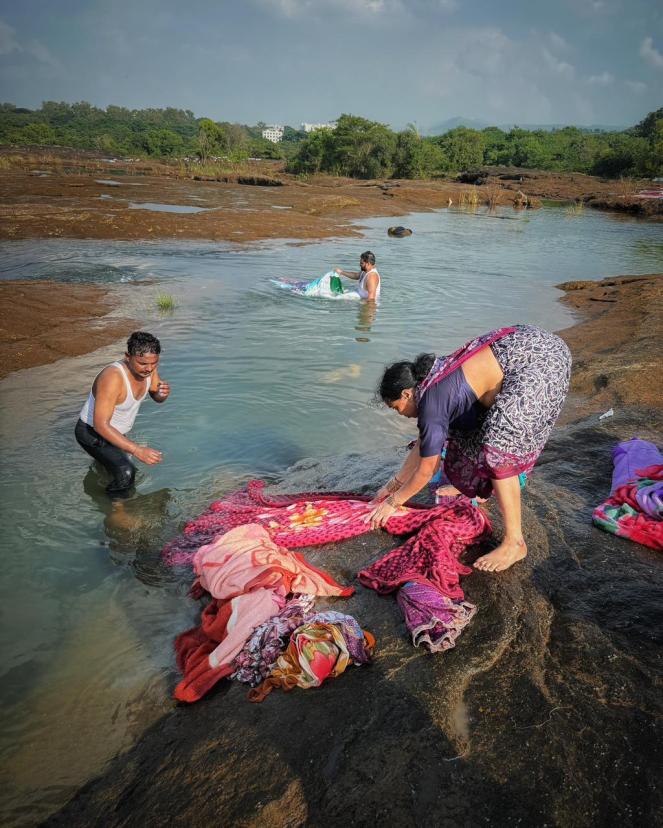
https://sandrp.in/2024/10/23/when-riverbanks-bloom-in-color/ (21 Oct. 2024)
Tawi; Jammu Will conduct EIA for RFD constrcution activities: JSCL Robust environment management plan is being followed in letter and spirit while executing Tawi River Front Development Project and more than 24,000 trees and shrubs will be planted in the open green spaces to further protect the environment. Moreover, artificial lake will go a long way in recharging the ground water aquifers. This has been conveyed to the NGT by the Chief Executive Officer of Jammu Smart City Limited (JSCL) in response to the directions issued on May 22, 2024 in an Original Application wherein it has been claimed that large number of trees are likely to be axed while executing the Tawi River Front Development Project.
Disclosing that next stage of project may involve some developmental/construction activity in pockets of the reclaimed land, the JSCL said that all such activities will be taken up only after conducting EIA and obtaining environment clearance from the concerned authorities as stipulated under Environmental (Protection) Rules, 1986 and notification of Ministry of Environment and Forests dated September 14, 2006. https://www.dailyexcelsior.com/robust-environment-mgmt-plan-being-followed-strictly-for-tawi-river-front-project-jscl-to-ngt/ (08 Sept. 2024)
Pune MPCB issues notice to Ranjangaon MIDC over water pollution On October 22 – nearly a month after the Maharashtra Pollution Control Board (MPCB) issued notice to the Kurkumbh Maharashtra Industrial Development Corporation (MIDC) over water pollution in the Kurkumbh area – the pollution watchdog issued notice to the Ranjangaon MIDC for similar reasons. The board had earlier granted consent to the MIDC which is valid up to December 2026. However, it received several complaints about water pollution and serious violation of environmental norms following which, a board official visited the MIDC CETP in September this year. According to the notice, the MPCB official during the visit found that the aerators of equalisation tanks, sludge pumps of oil separator, clarifier and online display board were not in operation. Furthermore, the MIDC had not completed upgradation of the CETP. Moreover, the joint vigilance samples (JVS) analysis highlighted that the treated effluent exceeded the permitted limit. https://www.hindustantimes.com/cities/pune-news/after-kurkumbh-mpcb-issues-notice-to-ranjangaon-midc-over-water-pollution-101729701115480.html (23 Oct. 2024)
Musi; Hyderabad Deputy CM Mallu Bhatti Vikramarka has announced that residential towers will be constructed for Musi evictees near the river in Hyderabad. https://www.siasat.com/hyderabad-to-get-residential-towers-for-musi-evictees-near-river-says-dy-cm-3120840/ (27 Oct. 2024)
RIVERS
Book Is a river alive? At the heart of IS A RIVER ALIVE? is a single, transformative idea: that rivers are not mere matter for human use, but living beings – who should be recognized as such in both imagination and law. Macfarlane takes the reader on a mind-expanding global journey into the history, futures, people and places of this ancient, urgent concept.

https://davidhigham.co.uk/books-dh/is-a-river-alive/
Arunachal Pradesh River cleaning prog underway in Basar The 4th edition of the weeklong ‘River cleaning and water conservation programme’ was declared open by Leparada DC Atul Tayeng at the Hie bridge point here in the district on Tuesday (Oct. 15) morning. The programme is one of the marked calendar events, organised under the aegis of social organisation Gumin Rvgo Kwalaju (GRK), from 14 to 21 October every year, with the aim of cleaning the rivers and other water bodies to balance the aquatic ecosystem, promote cleanliness and healthy atmosphere, and further conserve water through plantation and protection initiatives in the catchment areas. https://arunachaltimes.in/index.php/2024/10/16/river-cleaning-water-conservation-prog-underway-in-basar/ (16 Oct. 2024)
Tamil Nadu Toxic foam frapples Kelavarapalli dam water Mounds of 10-foot-thick white foam appeared after water was released from the dam at Hosur on Thursday (Oct. 24). As water inflow surged into the Kelavarapalli dam, officials undertook precautionary water discharges that led to the emergence of the toxic foam along the Kelavarapalli-Thattiganapalli road. This foamy phenomenon, similar to that of the River Yamun’s, primarily attributed to sewage discharge into the South Pennai River, has raised significant health and environmental concerns. https://www.outlookindia.com/national/after-yamuna-river-toxic-foam-grapples-keralavalapalli-dam-water (26 Oct. 2024)
Telangana River & muse to go behind a wall Located at the foothill of the Vikarabad ridge, the Ramalingeswara Swamy temple pond in Pudur is the originating point of the Musi River that flows through Hyderabad and onwards to Nalgonda. A 1797 colour painting shows the pond, locally known as gundam, surrounded by tall trees and an arcade of niches. The scene has not changed much since then.
As the walls of the Indian Navy’s Very Low Frequency Station go up, the access to pond is going to get limited. “The wall will cut the easy passage of wild animals in the region. The Damagundam temple site is a watering hole for animals. I have seen blackbuck, neelgai and other animals sipping water in the lake. How the walling up of the forest will impact wildlife has to be studied,” says G. Venkatesh who lives in Manneguda. https://www.thehindu.com/news/national/telangana/telanganas-river-and-muse-to-go-behind-a-wall/article68795787.ece (26 Oct. 2024)
Himachal Pradesh How govt allowed polluting units in Una: NGT The NGT has put the Himachal Pradesh government in a dock questioning the setting up of three industries, falling under ‘A’ and ‘B’ category, in Una’s Pandoga Industrial Area without procuring the Environment Clearance (EC) certificate — mandatory for such units — and issued a notice to the state government to file its reply within four weeks. A tribunal bench comprising Justice Sudhir Agarwal and expert member Dr Afroz Ahmad also highlighted how the state government had excused itself from obtaining the EC from the Ministry of Environment, Forest and Climate Change (MoEFCC) in 2015 by submitting that the Industrial Area was coming up in an area which was less than 500 hectares in size and that no category ‘A’ and ‘B’ industries would be set up here.
Issuing a notice, the tribunal gave four week’s time to AG Rattan and Principal Secretary, Industry, Himachal Pradesh to submit their reply and fixed the next hearing for December 12. The tribunal also impleaded the three industrial units — M/s Hindustan Pectin Farmdirect Powder, Ingredients Pvt Citric Acid Ltd; M/s Ian Macleod Distillers India Pvt Ltd; and M/s Ambaji Enterprises — which were found to be of category of ‘A’ and ‘B’, as respondents.
In September, the NGT had imposed a fine of Rs 10,000 each on principal secretary, industries, and principal chief conservator of forests, Himachal Pradesh, for failing to appear in person before it in the same matter. During an earlier the tribunal had directed both the officers to appear in person to explain about “the felling of trees and the failure of the state government to build a CETP” in the industrial area. https://indianexpress.com/article/cities/chandigarh/ngt-himachal-pradesh-pollution-una-pandoga-industrial-area-9641132/ (27 Oct. 2024)
GANGA Uttar Pradesh NGT issues notice over river pollution by meat units The NGT has sought a response from the UP govt and others in a matter regarding the alleged throwing of waste products by a meat processing company in a river in Sambhal district. The NGT was hearing a plea accusing India Frozen Foods Private Ltd of throwing industrial waste, including debris and blood of animals, into the Sot River, a tributary of the Ganga River. According to the complaint, the area near the factory had a fetid stench as its bio-filter unit was non-functional. The bench noted the submissions of the petitioner’s counsel, according to which, the company had the sanctioned capacity of slaughtering 350 cattle but it was slaughtering more than 700 cattle. The respondents are the state of Uttar Pradesh, its pollution control board, Indian Frozen Foods Pvt Ltd and the district magistrate concerned. The matter has been posted on January 14 for further proceedings. https://www.thehindu.com/news/national/uttar-pradesh/up-river-pollution-by-meat-processing-company-ngt-issues-notice/article68776194.ece (20 Oct. 2024)
13 सितंबर, 2024 के आदेश के बाद एनजीटी में दाखिल एक अनुपालन रिपोर्ट में सीपीसीबी ने 22 अक्तूबर, 2024 को बताया है कि उत्तर प्रदेश के गंगा किनारे बसे जिलों में 225 नाले ऐसे हैं जो अब भी सीवेज ट्रीटमेंट प्लांट से जुड़ नहीं पाए हैं। साथ ही इन नालों के जरिए सीवेज, औद्योगिक अपशिष्ट और सतही प्रवाह गंगा या उसकी सहायक नदियों में गिर रहा है। सीपीसीबी और यूपीपीसीबी ने 2023 में मानसून के बाद गंगा और उसकी सहायक नदियों में सीधे गिरने वाले 326 नालों की संयुक्त निगरानी के मुताबिक महज 101 नाले ही विभिन्न एसटीपी से जुड़े हैं, 188 नाले गंगा में और शेष 138 नाले सहायक नदियों में सीधा गिर रहे हैं। https://hindi.downtoearth.org.in/river/waste-from-drains-in-up-is-falling-directly-into-ganga-and-its-tributaries (24 Oct. 2024)
Uttarakhand ब्रह्मपुरी में ओशो गंगा धाम ने वन क्षेत्र पर अवैध रूप से अतिक्रमण किया है, इसके साथ ही उनके द्वारा किया कुछ निर्माण बाढ़ संभावित क्षेत्र में भी किया गया है। यह जानकारी संयुक्त समिति ने 21 अक्टूबर, 2024 को अपनी रिपोर्ट में दी है। गौरतलब है कि संयुक्त समिति ने 24 सितंबर, 2024 को टिहरी गढ़वाल के ब्रह्मपुरी में स्थित ओशो गंगा धाम परिसर का निरीक्षण किया था।
राजस्व और वन विभाग द्वारा भूमि की संयुक्त माप के दौरान यह पाया गया कि ओशो गंगा धाम 0.4146 हेक्टेयर भूमि पर स्थित है। हालांकि, पट्टे के तहत केवल 0.2089 हेक्टेयर भूमि को ही मंजूरी दी गई है। इस कब्जे वाली भूमि में से 0.1566 हेक्टेयर पर इमारतें हैं, जबकि 0.2580 हेक्टेयर भूमि खाली पड़ी है। परिसर में कोई सीवेज ट्रीटमेंट प्लांट नहीं है। वहीं नदी के किनारे एक सेप्टिक टैंक का निर्माण किया गया है। निरीक्षण में पाया गया कि संपत्ति पर एक हॉल, आवासीय कॉटेज और टिन के अस्थाई शेड भी बनाए गए थे। यह हिस्सा उस क्षेत्र में आता है जहां 100 वर्षों में बाढ़ आंके का खतरा है। रिपोर्ट में यह भी कहा गया है, “ये निर्माण गंगा नदी के केंद्र से करीब 63 मीटर की दूरी पर हैं। https://hindi.downtoearth.org.in/forests/osho-ganga-dham-in-tehri-garhwal-has-illegally-encroached-upon-forest-area-report (24 Oct. 2024)
YAMUNA Delhi River groans under neglect in national capital Bheem Singh Rawat, associate coordinator, South Asia Network on Dams, Rivers and People (SANDRP), said, “DDA’s claims of no wetlands encroachment and recovering 477.79 hectares of the floodplain are questionable and misleading. DDA itself has allotted several hectares of Yamuna floodplain to various construction companies and has not been able to restore the degraded floodplain to its original ecosystem, including about 60-hectare Millennium bus depot floodplain land.”
“The legacy construction waste of bridges is still scattered in floodplains and riverbeds. The rubble, concrete mixtures and solid waste are being dumped in floodplains along the eastern embankments between ITO and Wazirabad barrage. DDA has not even cleared the waste left behind following the removal of some illegal settlements in the floodplain,” he added. He also shared, “Presently, the Yamuna floodplain areas downstream, Delhi Noida, Greater Noida, Faridabad and Palwal have been undergoing large-scale encroachments in the form of farmhouses and unauthorised residential colonies. But the DoWR, RD & GR (Department of Water Resources, River Development and Ganga Rejuvenation) and the parliamentary committee report have turned a blind eye to this.”
SANDRP, in its review report, had stated, “It is time for all the basin govts and decision makers to realise that unless at least 50 % of available water at Hathni Kund Barrage is not released in the Yamuna as environmental flows, the plans and projects to clean and protect the river will not achieve desired results.” https://www.newindianexpress.com/cities/delhi/2024/Oct/28/yamuna-pollution-a-river-groans-under-neglect-in-the-national-capital (28 Oct. 2024)
Floodplain encroachment going on This News Laundry’s exclusive video report also featuring Himanshu Thakkar coordinator SANDRP and Bhim Singh Rawat associate coordinator SANDRP details the ongoing abuse and encroachments of Yamuna river floodplain in Delhi by various govt agencies including the DDA in the name of development and beautification in outright violation of High Court, NGT orders.
https://www.youtube.com/watch?v=MzprJ2CzT-U (26 Oct 2024)
Bhim Singh Rawat, a Yamuna activist and member of the SANDRP said that all three states share responsibility for polluting the river. “The extreme levels of frothing clearly indicates that the ecological health of the river is very bad and it has no dissolved oxygen. In long term, sprinkling defoaming agents is not a solution. One measure could be release of more water from Hathnikund barrage to flush the river and ensure ecological flow. Right now, only 3000-10,000 cusecs of flow is being noticed.” https://www.hindustantimes.com/cities/delhi-news/aap-blames-neighbouring-states-for-yamuna-foam-101729449418288.html (21 Oct. 2024)
No step taken to tackle frothing According to DJB officials, the defoamer used last year was safe and was used after conducting several tests where it proved to be harmless to humans. From mid-month, DJB will deploy portable anti-surfactant sprinklers downstream of Okhla barrage before and during the Chhath Puja, claimed an official who participated in the meeting.
Two years ago, given the recurring nature of the problem, the NMCG constituted a joint committee comprising officials of DJB, irrigation and flood control (I&FC) department, DPCC and the Upper Yamuna River Board. This panel met on Sept 19 to chart out a plan for Chhath. https://timesofindia.indiatimes.com/city/delhi/djb-to-combat-yamuna-frothing-with-chemical-anti-frothing-measures/articleshow/114358341.cms (19 Oct. 2024)
Sprinkling of anti-foam agent begins – Delhi Jal Board (DJB) teams on Tuesday (Oct. 22) began sprinkling anti-foaming solutions to counter the build-up of the toxic froth around the Okhla barrage, officials with the water utility said. DJB officials said around 12-15 tonne of a diluted anti-foaming agent is expected to be used in the process, adding that the exercise will continue till Chhath, scheduled to be celebrated between November 6 and 8. https://www.hindustantimes.com/cities/others/sprinkling-of-anti-foam-agent-in-yamuna-begins-101729624336666.html (23 Oct. 2024)
Detailed discussion on Yamuna froth issue. https://www.youtube.com/watch?v=nuSgxIn7K78 (21 Oct. 2024)
Despite a recent report by the DPCC claiming that dissolved phosphate levels in the treated water entering the Yamuna River are within permissible limits, images of froth on the river’s surface ahead of Chhath Puja have caused alarm among residents of the national capital. Experts have expressed doubts, suggest ing that the visible pollution contradicts the report’s findings. https://thepatriot.in/reports/foam-and-fear-are-officials-distorting-yamuna-pollution-data-59891 (24 Oct. 2024)
Water crisis amid river’s toxicity Water supplies in Lutyens’ Delhi have been significantly disrupted over the past few days due to rising pollution in the Yamuna River. At least 27 prime locations, including government headquarters, have been left with limited access to water. Water supply will not be available Sunday in these areas, according to an official statement. Toxic foam accumulation in the Yamuna has forced the shutdown of the Sonia Vihar Water Treatment Plant, impacting potable water availability in the areas managed by the New Delhi Municipal Council (NDMC) and the Delhi Jal Board.
The Sonia Vihar Water Treatment Plant, built in 2004, serves nearly 3.5 million residents, processing water from both the Ganga and Yamuna rivers. With rising ammonia levels in the Yamuna, the raw water supply to the plant has been affected, causing widespread water shortages across NDMC zones. NDMC, which relies on 125 MLD (million litres per day) from the Wazirabad, Chandrawal and Sonia Vihar water treatment plants, has been struggling to maintain consistent supply. https://indianexpress.com/article/cities/delhi/no-water-supply-in-prime-locations-today-water-crisis-in-lutyens-delhi-amid-yamunas-toxicity-9640703/ (27 Oct. 2024)
Delhi residents face potential water shortages due to maintenance work on the Upper Ganga Canal and high ammonia levels in the Yamuna River, reducing the operating capacity of key water treatment plants to 30%. The disruption could affect several regions until November 1, 2024. https://economictimes.indiatimes.com/news/india/delhi-jal-board-issues-alert-says-supply-to-be-affected-till-november-1/articleshow/114656018.cms (27 Oct. 2024)
Noida Momnathal village located between Yamuna and Hindon rivers in Noida bearing the brunt of pollution in both rivers. https://www.youtube.com/watch?v=AAN2GnYnsrg (23 Oct. 2024)
Agra To retain the structural integrity of the Taj Mahal, a free-flowing Yamuna in its original form is a must. A free-flowing, unpolluted Yamuna is also paramount to the welfare and health of millions dependent on its services (C.P. Rajendran). https://www.etvbharat.com/en/!opinion/river-yamuna-in-delhi-urgent-need-to-restore-a-dying-river-enn24102303798 (23 Oct. 2024)
Panipat NGT imposes ₹60 lakh eco fine on liquor factory in Samalkha The unit had already deposited Rs 27 lakh as interim environmental compensation to the Haryana State Pollution Control Board (HSPCB) on August 6. Ramesh Kumar, a farmer in Chulkana village, had filed a complaint to the HSPCB and NGT regarding discharge of effluents, chemical and gases by Haryana Organics Limited, a liquor manufacturing unit in Samalkha, which was destroying and adversely affecting his crops.
The NGT has directed the HSPCB to impose upon the liquor factory and recover from it an additional environmental compensation of Rs 33.6 lakh. It has also directed to give Rs 5 lakh out of Rs 27 lakh to the complainant, who is a farmer of Chulkana village. The environmental court directed the HSPCB to prepare and implement an action plan of Rs 22 lakh for protection and improvement of environment in the area. https://www.tribuneindia.com/news/haryana/ngt-imposes-60-lakh-eco-fine-on-liquor-factory-in-samalkha/ (27 Oct. 2024)
RIVERS BIODIVERSITY
Arunachal Pradesh New plant species discovered from Dibang Valley A new plant species has been discovered from Dibang Valley district by a group of researchers from Jorhat (Assam)-based North East Institute of Science & Technology (NEIST). “The plant belongs to the begonia sect platycentrum,” it informed in a release. The species has been named ‘begonia neisti’ to honour the NEIST on the successful completion of its 60 years and its immense contribution through science and technology towards the benefit of the local people of the Northeast region of India.
“According to a checklist of begonia species from Dibang Valley, eight species have been recorded. Now, begonia neisti has joined this growing list of unique flora from the region,” the NEIST informed in a release. The species was collected during a 2023 floristic expedition in the moist hilly slopes between Hunli and Anini. https://arunachaltimes.in/index.php/2024/10/26/new-plant-species-discovered-from-dibang-valley/ (26 Oct. 2024)
SAND MINING
Madhya Pradesh Sand mining co staff crushed to death with tractor in Datia An employee of a sand mining company was crushed to death by a sand-laden tractor-trolley on the Hatlai bypass in Datia on Friday (Oct. 25) morning. The incident occurred around 7am when Ankit, part of the Rajasthan-based Riddhi Siddhi Company’s flying squad, attempted to stop the tractor transporting illegal sand. Ankit was monitoring the area with his colleagues—Anant Singh, Santosh, Jeetu, Anil, and Golu—when the tractor approached from the village of Chhata. As he stepped onto the road to signal the driver, the tractor, driven by Abhishek, ran over him and fled the scene. Colleagues rushed Ankit to the district hospital, where he was declared dead. Police registered a case against the tractor driver based on a complaint from Ankit’s father. Authorities are now investigating the matter to locate the driver. https://timesofindia.indiatimes.com/city/bhopal/tragic-accident-sand-mining-employee-crushed-by-tractor-in-datia/articleshow/114634283.cms (27 Oct. 2024)
Haryana ₹3.57-cr penalty over illegal mining The SPCB has imposed a fine of Rs 3.57 crore on 11 persons, who allegedly carried out illegal mining on panchayat land in Kohliwala and Mandewala villages of Yamunanagar district. The action was recently taken on the report of a joint committee formed on the order NGT. In his complaint to the NGT in 2022, Balwinder Kumar of Kohliwala village alleged that illegal mining was being carried out on a big portion of 156 acres of panchayat land in Kohliwala and Mandewala villages falling under Bhud Kalan gram panchayat of Yamunanagar district. He further alleged that khair trees were being cut illegally from this land, and all this was happening in connivance with officials of the local administration.
The complainant further submitted that he made complaints to the authorities concerned, but no action had been taken on his complaint. He also alleged that instead of taking action against persons involved in illegal mining, false cases were registered against him. After getting complaint from Balwinder Kumar, the NGT formed a joint committee comprising the Director of Mines and Geology, Pollution Control Board; the District Forest Officer; and the Deputy Commissioner, Yamunanagar.
The committee undertook site visits and found out the factual position with the help of video recording. “Taking an action on the report of the joint committee, we have imposed an environmental compensation of Rs 3,57,84,180 on 11 persons belonging to Kohliwala and Mandewala villages for carrying out illegal mining on panchayat land of Bhud Kalan gram panchayat,” said Virender Punia, Regional Officer, HSPCB, Yamunanagar. He said more persons were being identified who were involved in the illegal mining case. https://www.tribuneindia.com/news/haryana/11-slapped-with-3-57-crore-penalty-over-illegal-mining-in-yamunanagar-villages/ (20 Oct. 2024)
Jammu & Kashmir Illegal riverbed mining vandalising river’s biota In blatant violation of rules, heavy machinery is used to extract riverbed material at Sail, Doenkuel Bagh, Ohangam and its adjoining villages. Sukhnag is known for trout fish and haphazard excavation of riverbed material is causing extensive damage to aquatic life. Earlier this year, halting of water flow to a trout fish farm due to haphazard riverbed mining led to death of over 2000 trout. https://www.greaterkashmir.com/opinion/illegal-riverbed-mining-vandalising-rivers-flora-and-fauna/ (22 Oct. 2024)
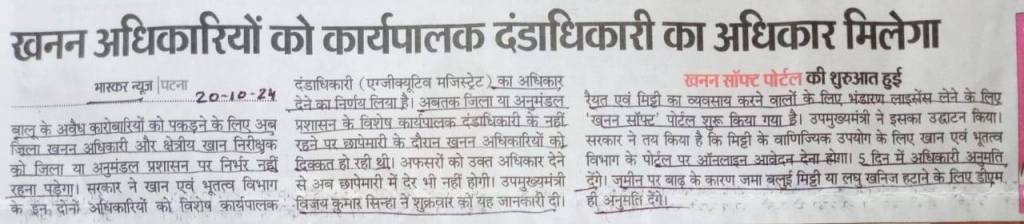
Bihar Govt of thinking of giving powers of executive magistrate to some of the mining officers like the district mining officers.
Andhra Pradesh Indiscriminate sand mining goes on at Dusi reach Mining and shifting are going at the reach round-the-clock in the name of domestic use, though officials say permissions were not given for excavation Srikakulam: Sand mafia is reportedly indiscriminately excavating sand in the name of domestic use and selling it at high prices in some parts of district. It is alleged that vested interests are misusing of free sand policy at Dusi reach in Nagavali river in Amadalavalasa mandal. In fact, no permission was given to the sand mining at Dusi reach but locally influential political leaders and their followers are digging and shifting the sand through tractors and heavy lorries round-the-clock for the last several days. https://www.thehansindia.com/andhra-pradesh/indiscriminate-sand-mining-goes-on-at-dusi-reach-916952 (25 Oct. 2024)
WETLANDS, LAKES, WATER BODIES
Tamil Nadu Encroachments on Koladi Lake must go: Madras HC Encroachments found on a water body should be removed even if they belong to the Chola era, Madras high court has said. The first bench comprising Chief Justice K R Sriram and Judge Senthilkumar Ramamoorthy made the observations on Thursday (Oct. 24) when suo motu proceedings it had initiated based on an article in The Times of India, which was published on Oct 19, came up for hearing. The article detailed rampant encroachments on the Koladi Lake in Tiruverkadu. The bench also appointed former advocate general R Shanmugasundaram the amicus curiae to assist the court in the case. https://timesofindia.indiatimes.com/city/chennai/madras-high-court-orders-removal-of-historical-lake-encroachments/articleshow/114557262.cms (24 Oct. 2024)
The TOI report spoke of illegal construction of 250 houses on Koladi Lake and how encroachers were working overtime to grab the lake by building houses right inside the water spread area. Many of these illegal constructions already managed to get electricity connections, the article pointed out. Though the registered size of the lake is 169 acres, it has now shrunk to 112 acres. Its original water holding capacity is 2.7 million cubic metres with a surplus discharge of 164 cusecs. S Sekharan, who has moved the NGT and himself a waterbody restoration activist, said Tangedco and GCC were the main culprits. “They provide EB connections to waterbody encroachers and GCC installs streetlights for them. If these both are there, encroachers then get roads. The administration is supporting encroachers,” he said. https://timesofindia.indiatimes.com/city/chennai/madras-high-court-takes-action-against-illegal-encroachments-on-koladi-lake/articleshow/114381881.cms (19 Oct. 2024)
Kerala Ernakulam leads in paddy and wetland conversions Since the 2018 amendment to the Kerala Conservation of Paddy Land and Wetland Act, the state has “settled” a substantial 428,789 applications for land conversion under Forms 5, 6, 7, and 9 of the Act, as of September 30 this year. Of these, 72,050 applications were related to land in Ernakulam, accounting for 17% of all settlements statewide. Thrissur followed with 48,064 applications settled, while Idukki saw the fewest, with only 4,719 applications. However, details on the actual extent of paddy lands and wetlands converted remain unavailable. The commissionerate’s disaster management office did not disclose specifics on land converted or reclaimed, suggesting instead that such information be requested from village offices. The high volume of applications suggests the Act’s intent is being compromised, with 288,156 more applications for land conversion pending across Kerala, including 59,985 from Ernakulam alone. https://timesofindia.indiatimes.com/city/kochi/alarming-rate-of-paddy-and-wetland-conversions-in-ernakulam-district/articleshow/114656115.cms (27 Oct. 2024)
WATER OPTIONS
Tamil Nadu Soil conservation boosts water retention in 40 tribal villages Soil conservation and water retention measures were rolled out across 40 tribal villages in the Tirupattur Forest Division as part of a project aimed at reclaiming and improving tribal lands. The initiative, spearheaded by Tamil Nadu Biodiversity Conservation and Greening Project Climate Change Response (TBGPCCR), is expected to benefit these villages by reducing soil erosion and boosting groundwater levels. Project director I Anwardeen said eight methods were introduced to manage natural water resources more effectively. These methods include well recharge pits, water absorption trenches, trench-cum-bunds, stone bunds, loose rock check dams, recharge shafts, and percolation ponds. Each technique was tailored to address specific soil and water challenges in the region. https://timesofindia.indiatimes.com/city/chennai/innovative-soil-conservation-techniques-enhance-water-retention-in-40-tribal-villages/articleshow/114664127.cms (28 Oct. 2024)
Madhya Pradesh Transformation of Khadkiya Ghat village through water access Khadkiya Ghat village, located under Bhanpura Panchayat in the Dhar district, has undergone a remarkable transformation from a community grappling with water scarcity and health issues to one thriving with access to clean drinking water. This change has largely been fueled by the initiatives of the Dehradun-based Centre for Business and Entrepreneurial Development (CBED) and supported financially by Frank Water, UK. This case study highlights the journey of Durgabai Muwel, a 41-year-old villager, and her family, illustrating the significant impact of these efforts on the entire community. https://www.indiawaterportal.org/drinking-water/from-scarcity-to-abundance (23 Oct. 2024)
Kerala Admin plans to revive Surangas in Kasaragod By incorporating Suranga restoration into the Mahatma Gandhi National Rural Employment Guarantee Scheme (MGNREGS), the district administration seeks to promote water conservation, improve livelihoods, and foster women’s leadership in community development through the “Nari Shakthi Se Jal Shakthi” campaign.
A groundwater department officer said, “We will collect the number of surangas in Kasaragod with the help of Kudumbashree and renovate them through MGNREGS. We are planning to execute the project as part of JSA. In the initial phase, we plan to conduct a survey to determine the number of Surangas in the district. Kasaragod is divided into six blocks, of which Kasaragod block is considered a critical block as the majority of the recharged water is used and Manjeshwar block is considered a semi-critical block.” https://www.newindianexpress.com/states/kerala/2024/Oct/21/district-administration-plans-to-revive-surangas-to-tackle-water-scarcity-in-kasaragod (21 Oct. 2024)
Report Weeds of change The business of using water hyacinth is pocket and planet friendly. The raw material is available in abundance and easy to work with. It is also “a sustainable alternative to energy-intensive raw material,” says environmentalist Mike Pandey. Additionally, by removing it from the water, the entrepreneurs are supporting cleaning up the water bodies. They then convert the weed to an array of utility items including lifestyle products such as handbags, office stationery, home décor items, paper and more, which further, generates income.
IUCN recognises water hyacinth as one of the 100 most aggressive invasive species and as one of the top 10 worst weeds in the world. The invasion is so quick that just ten water hyacinth plants can reproduce 6.55 lakh plants covering approximately 0.5 hectares of water surface within eight months. “Biodegradability, waste management, and water conservation are among its many benefits,” added Pandey, whose Earth Matters Foundation trains women to make products out of water hyacinth. For women of local communities, manufacturing eco-friendly products from water hyacinth means achieving a better work-life balance closer to home, financial stability, and improved living standards.

In rural areas where women face limitations on stepping out, water hyacinth enables them to earn an income while working from home, says Mayank Ojha, assistant project coordinator with the WII. The NMCG has entrusted WII with a project, “Jalaj—connecting river and people to realise Arth Ganga.” Among other empowerment tools, WII also trains communities, especially women living along the river, to use water hyacinth to create sustainable products. https://india.mongabay.com/2024/10/weeds-of-change/ (21 Oct. 2024)
MoHUA RWH initiative launched As part of the nationwide water conservation campaign – Jal Sanchay Jan Bhagidari, the Ministry of Housing and Urban Affairs (MoHUA) will implement rainwater harvesting systems (RWHS) to facilitate groundwater recharge in all its premises across states. The premises include offices, institutions and residential colonies under MoHUA. The ministry recently directed the Central Public Works Department (CPWD) to promote groundwater recharge activities. In response, the CPWD has issued instructions to implement rainwater collection and storage systems in its buildings, using ‘affordable and low cost’ method mobilising internal resources or Corporate Social Responsibility (CSR) funds.
The department has also asked its officials concerned to ensure all existing RWHS are mapped, made functional and maintained well. For seamless tracking and monitoring, the officials have further been asked to upload the details of action taken on the portal created for the purpose by the Jal Shakti (JS) ministry. The CPWD is a construction management department under MoHUA that provides services from project concept to completion, consultancy and maintenance management for Government offices. https://www.newindianexpress.com/nation/2024/Oct/26/mohua-launches-rainwater-harvesting-initiative-to-boost-groundwater-recharge-nationwide (27 Oct. 2024)
GROUNDWATER
Study 64.6bn cubic metres of GW in Punjab & Haryana in 17 years Punjab and Haryana have lost a staggering 64.6 billion cubic metres of groundwater in the 17 years between 2003 to 2020, a study has found, underscoring the possible effect of urbanisation on this rapidly depleting resource, researchers from IIT-Delhi and Nasa’s Hydrological Sciences Laboratory estimate. The study, titled ‘Detection and Social Economic Attribution of Groundwater Depletion in India’, was published on Oct 14 in the Hydrogeology Journal.
The paper cited other research to note that “substantial groundwater depletion” was observed in Gurgaon and Faridabad, where water-intensive paddy cultivation is minimal — indicating that much of the resource in these areas was likely because of the urban sprawl. Data showed that groundwater level declined 8-10% in Punjab and Haryana from 2000 to 2015. In the two states, the growth rate of factories was 69% in FY 2004-2005 and this went up to 170% in FY 2018-2019. Similarly, urbanisation growth was 10% in 2001, and this went up to 20% by 2011. https://timesofindia.indiatimes.com/city/gurgaon/massive-groundwater-loss-punjab-haryana-deplete-646-billion-cubic-metres-in-17-years/articleshow/114662709.cms (28 Oct. 224)
Chhattisgarh High levels of uranium in groundwater Dangerously high uranium levels – three to four times the World Health Organization’s 15 microgram per litre limit and higher even than the government’s limit of 30 micrograms per litre – have been recorded in drinking water sources across at least six Chhattisgarh districts, significantly increasing the risk of cancers and pulmonary conditions, as well as skin and kidney diseases, in these areas. https://www.ndtv.com/india-news/uranium-in-drinking-water-in-india-chhattisgarh-red-flag-as-uranium-in-drinking-water-is-3-4-times-above-limit-6845521 (22 Oct. 2024)
URBAN LAKES, WETLANDS
Hyderabad HYDRAA to prosecute errant officials The HYDRAA is now planning to clear the debris from the area and restore and revive lakes, while also working towards taking actions on officials who issued permissions to encroachers. HYDRAA is reportedly working closely with police commissionerates, government bodies and legal teams to compile evidence and file cases against officials involved in the violations. Officials stated that they are actively working towards restoring the ecological health of lakes. They said the main goal of HYDRAA is to revive and restore lakes and water bodies within the Outer Ring Road (ORR) limits of Hyderabad.
HYDRAA has already filed a complaint against Nizampet municipal commissioner P. Ramakrishna Rao, Bachupally MRO Phool Singh, Chandanagar’s assistant city planner M. Rajkumar, Chandanagar Circle 21 deputy commissioner N. Sudama, Medchal district’s assistant director of survey and land records K. Srinivasulu and HMDA assistant planning officer Sudhir Kumar. However, the High Court has granted anticipatory bail to Bachupally MRO Phool Singh, Nizampet municipal commissioner P. Ramakrishna Rao and HMDA assistant planning officer Sudhir Kumar, while the High Court asked the government and HYDRAA not to arrest Medchal’s Survey and Land Records assistant director K. Srinivasulu. https://www.deccanchronicle.com/southern-states/telangana/hydraa-to-prosecute-errant-officials-to-clear-debris-from-encroached-lakes-1831186 (18 Oct. 2024)
Bengaluru ‘No construction within 50 feet of SWD or near lakes’ Deputy CM and Bengaluru Development Minister D.K. Shivakumar on Oct. 24 has ordered the Bruhat Bengaluru Mahanagara Palike (BBMP) not to allow any construction within 50 feet of a storm-water drain (SWD) and near lakes. He also directed the BBMP to prepare a master plan to connect lakes. The BBMP will prepare a plan to build channels to connect lakes to ensure rainwater flows into the lakes. The BBMP was also instructed to ensure that sewage does not flow into the lakes. https://www.thehindu.com/news/cities/bangalore/no-construction-within-50-feet-of-swd-or-near-lakes-dks-tells-bbmp/article68792470.ece (25 Oct. 2024)
Gurugram NBWL flags farmhouses, highrises built near Sultanpur park The standing committee of the National Board for Wildlife (NBWL) has directed Haryana govt to submit an action-taken report after a district panel flagged at least 70 violations, including illegal construction of housing societies and farmhouses, near the protected Sultanpur wetland. Construction and other non-forest activities are barred or restricted in a 5km radius around the Sultanpur National Park, which was designated a Ramsar site just last year. This perimeter, called the eco-sensitive zone (ESZ), acts as a buffer to protect the wetland and the wildlife there.
Last month, the intergovernmental panel — comprising Gurgaon deputy commissioner, officials of the irrigation department, state wetland authority, chief wildlife warden, and experts from the Indian Institute of Roorkee — carried out an inspection of the area. The violations they spotted include encroachments on the Sultanpur Jheel, construction of an affordable housing colony in Garhi Harsaru, another multi-storey residential project in Dhorka village, and farmhouses in Farrukhnagar, the panel told SNBWL in a report submitted this July. https://timesofindia.indiatimes.com/city/gurgaon/wildlife-panel-flags-illegal-construction-near-sultanpur-wetland-urgent-action-required/articleshow/114598808.cms (26 Oct. 2024)
URBAN WATER
Bengaluru Cauvery stage VI work will start this fiscal: BWSSB chief “We’re almost through with the DPR for Cauvery Stage VI. We felt this work should be executed immediately after Stage V without delay as the govt feels Bengaluru must be protected from any water crises. We’re confident of completing groundbreaking by the end of this fiscal,” BWSSB chairperson Ram Prasath Manohar told TOI.
“While BWSSB and the govt are doing everything to increase the Cauvery water supply to address the long-term problems, the city must use other resources. Conserving water, using recycled water, and improving groundwater must all go hand in hand if we want a sustainable model. We’ve already introduced a policy to use recycled water in apartments and treated water for construction, etc.,” Manohar said, cautioning against over-dependence on Cauvery water.
Admitting that rainwater harvesting (RWH) hasn’t gone as planned, he said people should comply. “In the long run, this needs to improve as we’re yet to reach old buildings and even with new houses, the compliance has not been very encouraging. People think that establishing RWH affects the integrity of their buildings and also reduces the availability of land, which is not true,” he said.
S Vishwanath, an independent water expert, said the city needs Cauvery water, groundwater, rainwater, and treated wastewater. “If the rain fails during a particular year, then rainwater or groundwater will simply not be sufficient for this population. We need to do inward harvesting, groundwater recharge, and wastewater reuse.” https://timesofindia.indiatimes.com/city/bengaluru/bengalurus-cauvery-stage-v-launched-stage-vi-planned-amid-water-crisis-solutions/articleshow/114403529.cms (20 Oct. 2024)
Quenching ever-growing thirst, from 100 km away As the Cauvery V Stage is commissioned and piped water supply starts to 110 villages around Bengaluru, The Hindu reports on the teething problems of the project and larger concerns of the city’s over reliance on the Cauvery. https://www.thehindu.com/news/cities/bangalore/quenching-bengalurus-ever-growing-thirst-from-100-km-away/article68789799.ece (25 Oct. 2024) Lakhs of residents in the erstwhile 110 villages have yet to apply for water connections because the BWSSB has not yet developed water supply infrastructure in their neighborhoods, a critical link from the house taps to BWSSB’s distribution lines. https://www.deccanherald.com/india/karnataka/bengaluru/thirsty-city-reality-of-water-access-in-bengaluru-s-expanding-suburbs-3250629 (27 Oct. 2024)
The BWSSB is ready to provide water to the 55,000 connections already established and plans to extend new connections to applicants within 15 to 30 days. However, BWSSB has decided to provide Cauvery water connections to apartments only if they comply with NGT regulations. Apartments with more than 120 flats are required to have a STP and must use at least 30% of treated water for non-drinking purposes. Furthermore, aerators must be installed on all taps. Only apartments meeting these criteria will be eligible for water connections. The BWSSB plans to supply water to apartments based on average consumption, providing water two to three times a week. https://bangaloremirror.indiatimes.com/bangalore/others/ngt-norms-essential-for-apartment-water-supply/articleshow/114631042.cms (27 Oct. 2024)
WATER
According to this report, Centre is preparing a mega water conservation plan that will include lifting water from coastal rivers and taking it to catchments, storing water in the local tanks and desilting reservoirs. Insufficient details to comment, but off hand, parts of it do not seem plausible.

EDIT Case for water as common good A report by the Global Commission on the Economics of Water suggests a global pact to conserve water. For that to happen, however, countries must tweak its findings to their contexts. India, for instance, would need to find better ways to resolve conflicts over aquifers within their borders before thinking of a global pact.
– A major assessment of hydrological systems has concluded that the global water crisis could spiral out of control if urgent remedial measures are not undertaken. Set up by the Netherlands in 2022, the Global Commission on the Economics of Water draws on the findings of leading scientists and other experts to arrive at a comprehensive understanding of the management of aquifers worldwide.
– The panel urges countries to rethink how water is regarded: As a global common good, not as an endlessly renewable resource… Similarly, industries too are rarely penalised for polluting water. About 80 per cent of the wastewater generated by industries worldwide is not recycled, the panel reveals… Despite the interconnectedness of water systems, there is no global governance system for water. https://indianexpress.com/article/opinion/editorials/water-crisis-global-food-production-9630489/ (21 Oct. 2024)
AGRICULTURE
Karnataka First of its kind ‘farmers’ school’ opened A group of teachers has come forward to open a first-of-its-kind ‘Farmers’ School’, which is ‘of the farmers and for the farmers’, at Alakere village in Mandya taluk. The idea is to empower those engaged in agriculture and also those keen on taking it up as a profession or hobby. Led by Sathyamurthy, a lecturer from Mandya, the seven-member group, all teachers from families of farmers, decided to open the school after seeing the plight of farmers during last year’s drought and Covid-19 pandemic, and also considering various problems, including the increasing number of suicides by farmers. The aim of the group is to make agriculture lucrative and farmers self-reliant in all aspects. This will help prevent migration of youngsters from villages to cities in search of jobs and also farmers from selling their land. https://www.newindianexpress.com/states/karnataka/2024/Oct/22/first-of-its-kind-farmers-school-opened-in-karnataka (22 Oct. 2024)
MONSOON 2024
SANDRP Blog High Rainfall days in India’s districts in SW Monsoon 2024 This analysis, based on IMD’s Daily District wise rainfall bulletins, provides month wise and state wise figures of district days when rainfall in a day in a district was 50-100 mm, 100-150 mm, 150-200 mm, 200-250 mm and 250+ mm.
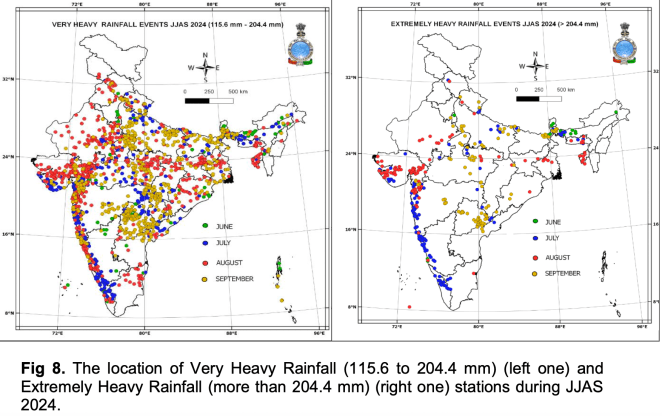
It also provides figures similarly from IMD for Very Heavy Rainfall and Extremely Heavy Rainfall for the years 2020 to 2024 and shows how frequency of such events is increasing even through rainfall is lower like in SW Monsoon 2024 compared to those in SW Monsoon 2020. Plz Read, Share. https://sandrp.in/2024/10/24/high-rainfall-days-in-indias-districts-in-sw-monsoon- (24 Oct. 2024)
Centre Weather forecasts will now be available to Panchayats The Ministry of Panchayati Raj (MoPR), in collaboration with the India Meteorological Department (IMD), Ministry of Earth Sciences (MoES), is set to launch an initiative to provide Gram Panchayats with 5 days daily weather forecasting and provision to check hourly weather forecast – Gram Panchayat-Level Weather Forecasting – on 24th October 2024 at Vigyan Bhawan, New Delhi. This initiative will directly benefit farmers and villagers. This is the first time that localized weather forecasts will be available at the Gram Panchayat level, supported by IMD’s expanded sensor coverage. The forecasts will be disseminated through the Ministry’s digital platforms: e-GramSwaraj; the Meri Panchayat app; and Gram Manchitra, a spatial planning tool that provides geospatial insights for development projects. https://pib.gov.in/PressReleasePage.aspx?PRID=2067232 (23 Oct. 2024)
Himachal Pradesh Post-monsoon rain deficit reaches 97% The state received 0.7 mm of rain on average from October 1 to October 24, against a normal rainfall of 22.9 mm, a deficit of 97 per cent, the Meteorological department said. Bilaspur, Chamba, Hamirpur, Kullu, Sirmaur, and Solan districts did not see any rain in the period. There was a deficit was 99 per cent in Lahaul and Spiti and Shimla districts, 98 per cent in Kinnaur, and 94 per cent in Kangra district. Mandi and Una districts recorded rain deficits at 82 and 52 per cent. The dry spell is set to continue till October 31, the Met said. https://www.deccanherald.com/india/himachal-pradesh/post-monsoon-rain-deficit-reaches-97-in-himachal-high-temp-across-state-3247995 (25 Oct. 2024)
FLOOD 2024
SANDRP Blog Frequent 2024 Floods in Bhagalpur-Bihar In this guest article, Ruchi Shree describes her experience of facing and watching Bhalgalpur Ganga floods in Sept 2024 and compares them with her earlier experience in Aug 2021.
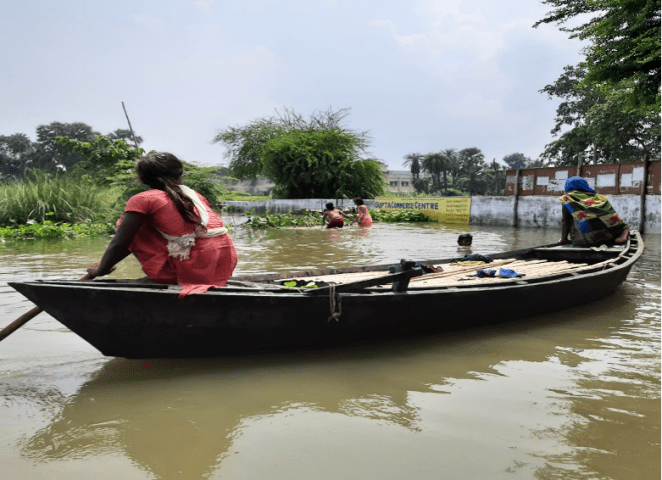
In SW Monsoon 2024, Bihar and also Bhagalpur had below normal rainfall and she wonders what are the implications and causes of such intense floods in times of deficit rainfall. Climate Change, Farakka backwaters, dredging for navigation, plastic pollution among others? https://sandrp.in/2024/10/22/frequent-2024-floods-in-bhagalpur-bihar-causes-and- (22 Oct. 2024)
बिहार बाढ़ की एक बड़ी वजह कोसी में जमी गाद, क्या है समाधान? कोसी नदी हर साल करीब 120 मिलियन क्यूबिक मीटर गाद बहाकर लाती है जिससे नदी का बेड या पेट उथला हो गया है और बाढ़ का खतरा बढ़ा है। कोसी में सालाना आने वाली गाद में 94 प्रतिशत हिस्सा सिर्फ मॉनसून के महीनों का होता है। इस साल आई बाढ़ में उसकी मात्रा और अधिक बढ़ गई है। कोसी के कई इलाकों में खेतों में पानी व गाद भर जाने से खरीफ की फसल खराब हो गई और रबी की खेती को भी नुकसान होने का अंदेशा है। कोसी बैराज की डिस्चार्ज क्षमता 9.50 लाख क्यूसेक है, लेकिन 6.15 लाख क्यूसेक पानी छोड़ने पर ही यह बैराज के ऊपर से बहने लगा। यह बैराज की सेहत व भविष्य में बाढ़ के खतरों को लेकर एक खतरनाक संकेत है। जानकार कहते हैं कि नदी के ऊपर तटबंध और बराज जैसी संरचनाओं की वजह से गाद जमा हो रहा है और बाढ़ का खतरा बढ़ रहा है। https://hindi.mongabay.com/2024/10/24/silt-deposited-in-kosi-is-a-major-reason-for-floods-in-bihar/ (24 Oct. 2024)
तटबंध सिर्फ नदियों को नहीं बांधते। तटबंध केवल स्पेस को खण्डित नहीं करते। तटबंध वास्तव में समय और स्थान को स्थिर कर देते हैं। तटबंध के अन्दर जो कुछ भी रह जाता है, वह अदृश्य और अयोग्य हो जाता है। वहाँ समय रुक जाता है। तटबंधों के भीतर रहने वाले लोगों के जीवन के साथ भी कुछ ऐसा ही हुआ है। कोशी दियारा की समस्या उलझ चुकी है। इसे सुलझाने के लिए संवेदनशीलता की आवश्यकता है। जल्दबाजी और अड़ियल रवैया अपनाने से कोई मदद नहीं मिलेगी। https://climateeast.in/kosi-river-flood-and-its-impact-on-common-life-by-rahul-yaduka/ (28 Oct. 2024)
Tamil Nadu Flood alert after water from Sathanur dam released A flood alert to 15 villages along the bank of the Thenpennai River has been issued by the Water Resources Department (WRD) as 1,000 cusecs of water per second is being released from the Sathanur dam in Tiruvannamalai on Sunday (October 27, 2024), after the level reached 114.50 feet as against the dam’s total capacity of 119 feet. The water from the dam has been released for the third time since September when 850 cusecs of water were released then. This time, the villages on the foothills of Kalvarayan Hills such as Lalpettai, Kattumannarkoil, Thattakudi, Mullakudi and Paruthikudi received heavy rainfall. These villages come under Tirukkoyilur, Vanapuram and Thandrampet taluks in Villupuram, Kallakurichi and Tiruvannamalai districts respectively. https://www.thehindu.com/news/national/tamil-nadu/flood-alert-issued-to-15-villages-in-tamil-nadu-after-water-from-sathanur-dam-in-tiruvannamalai-released/article68802711.ece (27 Oct. 2024)
HFL BREACH
Tamil Nadu River Bhavani in Cauvery basin at Gandhavayal site in Coimbatore district has crossed old HFL 95.15 meter dated 24.11.2013 at 03:00 hour on 23.10.2024 and set 95.33 meter as new HFL at 07:00 hour on 23.10.2024 which is 0.18 meter higher than the old HFL. The river stayed in extreme flood for about 05 hours before water level dropped quickly. The sharp decline is reportedly due to breach in river banks at the site.
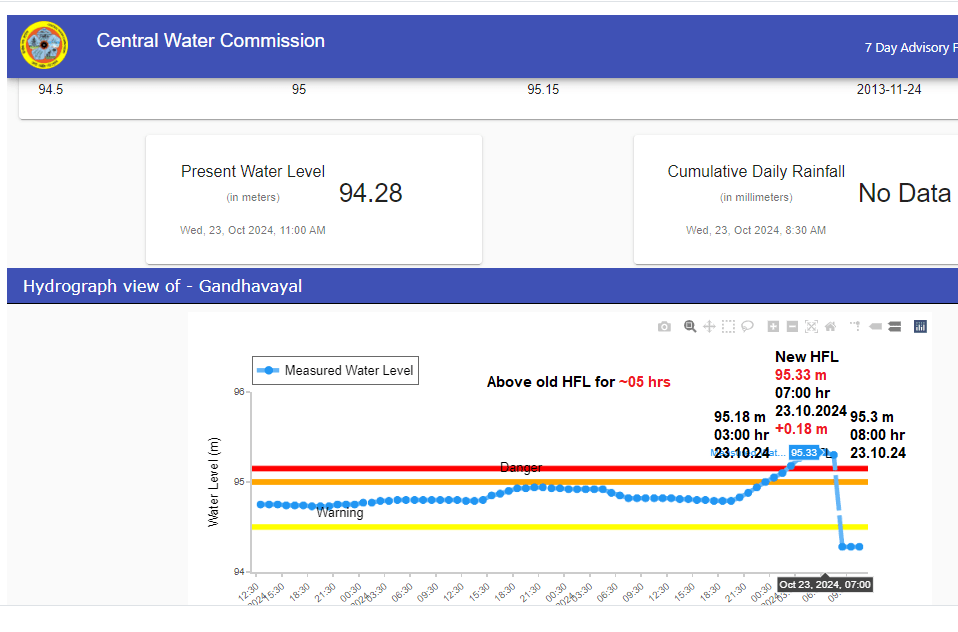
URBAN FLOODS
Gurugram GMDA plans ₹30 cr storm water drains The Gurugram Metropolitan Development Authority (GMDA) has prepared a detailed plan to build a stormwater drainage network to address persistent waterlogging issues in sectors 37C, 37D, and along Pataudi Road from Umang Bhardwaj Chowk to Gadoli village. The project, estimated to cost around ₹30 crore, aims to divert stormwater to the Badshahpur drain, reducing flooding during the monsoon season, said officials. https://www.hindustantimes.com/cities/gurugram-news/gmda-plans-30-cr-storm-water-drains-for-sectors-37c-37d-101729661446479.html (30 Oct. 2024)
Faridabad Deep cleaning of drains begins After launching a drive to clean the main sewer lines in the city, the Faridabad Metropolitan Development Authority (FMDA) has taken up the work to clean the major stormwater drains. Eight drains having a length of around 30 km will be cleaned. According to sources in the civic administration, though the total length of main drains in the city is around 138 km, it will be for the first time that deep cleaning work has been taken up at the most vulnerable areas. The network includes 37 major and minor drains (nullahs), and most of these remain choked round the year, resulting in filthy civic conditions. Last year, the government had announced a budget of Rs 977 crore for the rejuvenation of civic amenities in the city. https://www.tribuneindia.com/news/haryana/in-a-first-deep-cleaning-of-drains-begins-in-faridabad/ (26 Oct. 2024)
Chennai GCC using ‘sump and pump’ method The Greater Chennai Corporation (GCC) is using a ‘sump and pump’ method in 48 flood-prone locations to prevent reverse flow of stormwater in drains and to pump out water from low-lying areas. When it rains heavily, canals swell, leading to water entering drains and flooding residential areas. The GCC has constructed sumps just before the outfall points of drains. Officials said drain outfalls are usually five to six feet below the topmost part of a canal, and swelling canals can hold up water in drains. Such ‘sump and pump’ systems are installed along the Otteri Nullah in Pulianthope, North Avenue Canal in Korattur, four points of Buckingham Canal in North Chennai, Veerangal Odai and others. Nearly 114 hundred HP pumps are used for this initiative, which is a common in countries like the Netherlands, to drain water from low-lying areas. https://timesofindia.indiatimes.com/city/chennai/gcc-using-sump-and-pump-method-to-prevent-reverse-flow-of-stormwater/articleshow/114323281.cms (17 Oct. 2024) The State government is planning to create sumps on all Open Space Reservation (OSR) lands, including parks and playgrounds, to conserve rainwater and control flooding. A survey of all OSR lands in the city and its suburbs will be completed in a few days for the creation of a huge network of sumps to boost the underground water storage capacity, civic officials said. https://www.thehindu.com/news/cities/chennai/all-osr-lands-in-chennai-to-get-sumps-to-conserve-rainwater-and-mitigate-floods/article68800303.ece (26 Oct. 2024)
CLOUD BURSTS
Himachal Pradesh Central team visits flood-hit areas A team from the Centre visited flood-ravaged Mandi district on Thursday (Oct. 24). The losses due to recent cloudbursts and floods in the district have been estimated to be Rs 213.50 crore. The eight-member interministerial team was led by Mihir Kumar, joint secretary of MHA. It visited Terang village and the surrounding areas in Chauhar Valley of Mandi district where a flash flood wreaked havoc on August 1. The team also visited the flood-hit villages of Matt and Vamanu. https://timesofindia.indiatimes.com/city/shimla/central-team-assesses-26-million-damage-in-mandi-flood- (25 Oct. 2024)
LANDSLIDES
Kerala State can access ₹783 crore from SDRF: Centre to HC The Union government on Friday (Oct. 18) informed the Kerala High Court that Rs 782.99 crore is available in the State Disaster Relief Fund (SDRF), which can be used for Wayanad landslide rehabilitation work. The Centre stated that Rs 782.99 crore, including Rs 388 crore (comprising a central share of Rs 291.20 crore and a state share of Rs 96.80 crore) allocated for 2024-25, is available in the SDRF account However, the State Disaster Management Authority submitted that the balance amount of Rs 394.99 crore from the previous year in the SDRF account is earmarked for the payment of work undertaken during that period. It also stated that the Rs 388 crore allotted for the current year is a routine allocation for overall disaster management activities. The state maintained that it requires special financial assistance specifically for rehabilitation efforts in Wayanad. https://www.newindianexpress.com/states/kerala/2024/Oct/19/kerala-can-access-783-crore-from-sdrf-centre-informs-high-court (19 Oct. 2024)
ENVIRONMENT GOVERNANCE
Supreme Court EPA rendered toothless due to Centre’s inaction The Supreme Court on Oct 23 observed that the section 15 of the Environment Protection Act has been rendered “toothless” due to the Centre’s inaction after the 2023 Jan Vishwas Amendment which replaced punishment for violation of the Act with penalties.
“This provision has been rendered completely ineffective due to inaction on the part of Government of India…In the absence of machinery created by the government of India, Section 15 as amended has become toothless and there is nothing in the hands of law enforcement authorities to strictly enforce the provisions of EPA. Therefore, those who violate the laws are now scot-free as no action can be taken against them. Learned ASG assures the court that within two weeks, entire machinery will be in existence”, the Court observed in its order.
The questioned the Union of India’s failure to implement an effective machinery under the Environmental Protection Act (EPA), 1986. Justice Oka remarked that the EPA had become “toothless” following the amendment to Section 15, which replaced punishment for violation of the Act with penalties.
Justice Oka pointed out that the procedure to impose penalties under the amended section had not been operationalized. The Union Govt had failed to frame Rules to support the section and appoint adjudicating officers under section 15C to impose these penalties, leaving law enforcement agencies powerless, the Court observed. Additional Solicitor General Aishwarya Bhati assured the Court that Section 15 of EPA would be fully operationalized within 10 days. Further hearing on Nov 4, 2024. https://www.livelaw.in/top-stories/environment-protection-act-rendered-toothless-due-to-centres-inaction-supreme-court-273362 (23 Oct. 2024)
Ladakh Massive energy project is shrouded in mystery With Ladakh under central rule, locals say their concerns about loss of land and livelihood have gone unheard. https://scroll.in/article/1073644/ (01 Oct. 2024)
CLIMATE CHANGE
COP 16 ‘Humanity is on the verge of ‘shattering Earth’s natural limits’ Scientists say human activity has pushed the world into the danger zone in seven out of eight indicators of planetary safety. Under a business-as-usual scenario, biodiversity loss will accelerate, with more species surviving only in zoos. The biodiversity crisis is not just about other species – humans also rely on the natural world for food, clean water and air to breathe. Experts warn that ecosystems are starting to approach tipping points – where they shift into a new, degraded state that further reduces their resilience.
Key issues to be discussed at Cop16 include whether wealthy countries will meet their target of contributing a minimum of $20bn annually for low and middle-income countries by 2025, as well as all nations outlining their domestic targets to protect biodiversity – less than 20% had done so ahead of the meeting. https://www.theguardian.com/environment/2024/oct/21/humanity-earth-natural-limits-biodiversity-warning-cop16-conference-scientists-academics (21 Oct. 2024)
Earth system Plants and animals play significant parts in keeping nature humming, from cycling nutrients throughout an ecosystem to aerating soils and engineering rivers. Without plants and animals, the world would not be habitable for humans. Whether it is insects pollinating crops, plants filtering fresh water supplies, or forests providing timber for construction, nature and its critters deliver a wealth of materials and services to the global economy for free.
About $44 trillion of the world’s annual economic output – or roughly half the total – relies on these natural resources and services, opens new tab, according to the World Economic Forum. That includes $2.1 trillion in the United States, $2.4 trillion in the European Union and $2.7 trillion in China. The World Bank estimates that the collapse of certain ecosystem services, such as fisheries or native forests, could cost the world economy $2.7 trillion, opens new tab annually by 2030, about 2.3% of global output. The U.N. Environmental Programme estimates spending on nature, opens new tab needs to increase to $542 billion annually by 2030, up from $200 billion as of 2022, to halt nature loss and meet climate goals. https://www.reuters.com/business/environment/cop16-forests-oceans-nature-dire-state-2024-10-18/ (18 Oct. 2024)
SOUTH ASIA
Pakistan ChatGPT-generated reasons cited for Rs500b project failure The government has rejected a Rs100 million report on the collapse of the Neelum-Jhelum Hydropower Project tunnel, as it emerged that the report’s findings and recommendations were accessible on an artificial intelligence tool – ChatGPT. Instead of taking the responsible people to the task, it was proposed to the government in the meeting on Friday that either the tunnel should be rebuilt with an estimated cost of Rs250 billion to Rs300 billion or it should be repaired by spending around Rs20 billion, according to a cabinet minister. However, the Wapda officials categorically told the meeting that there was no guarantee that the repaired work could last more than six years. Both options were rejected by he Planning Minister. A follow-up session is planned for next week to further refine strategies for the project’s rehabilitation.
– According to a report by an English daily, an independent panel of experts had raised red flags last year about the headrace tunnel (HRT) of the project, as well as recommending preventive measures that were not implemented before the 969-megawatt project, valued at over Rs500 billion, was shut down in May. The experts pointed out that independent specialists while investigating the tailrace tunnel (TRT) collapse of July 2022, had pointed out a big geographical fault on the main boundary thrust. The fault that caused the TRT collapse could again be the same in the case of the HRT as well, just below the Jhelum River crossing, according to the media report. https://tribune.com.pk/story/2505551/chatgpt-generated-reasons-cited-for-rs500b-project-failure (27 Oct. 2024)
PM forms body for input on Neelam Jhelum power project fault Prime Minister Shahbaz Sharif has constituted a committee to recommend remedial measures for repair/rehabilitation of Head Race Tunnel (HRT) of 969 MW Neelum Jhelum Hydropower Project (NJHPP) in a. month along with costs and source of funds.
In July 2022 due to the blockage caused by the collapse of the headrace tunnel of the powerhouse the project was closed down for almost 20 months. The repairs work cost Rs6 billion and finally the supply from the project to the national grid was restored in August 2023. However, it was restricted to 530MW against the installed capacity of 969 MW. Again major cracks were discovered in the headrace tunnel in April 2024 and the Project was officially shutdown on May 2, 2024. https://www.nation.com.pk/25-Oct-2024/pm-forms-body-for-input-on-neelam-jhelum-power-project-fault (25 Oct. 2024)
Can nature based solution protect from climate change Nature-based solutions promote the participation of local communities in enhancing climate adaptation efforts because no one understands the impact of climate change better than those who experience it first-hand. The National Adaptation Plan of Pakistan (2023) emphasises upon the importance of “nature-based solutions” (NBS) as a vital element in the country’s climate policy. Nature-based solutions are actions to protect, conserve, restore, and sustainably use and manage ecosystems in a way that addresses social, economic, and environmental challenges while simultaneously benefitting human well-being and biodiversity. https://thefridaytimes.com/18-Oct-2024/can-nature-based-solutions-protect-pakistan-from-climate-crisis (18 Oct. 2024)
EUROPE
Ukraine Kakhovka Dam: Will nature be allowed to revive when war ends? The dynamiting of the Kakhovka dam on Ukraine’s Dnieper River just before dawn on June 6 last year rapidly emptied Europe’s largest hydroelectric reservoir. Some 14 million acre-feet of water hurtled downstream for more than 100 miles to the sea. Around 80 villages were flooded, more than 100 people died, and more than 40 nature reserves were engulfed. In the Black Sea, the flood delivered a flush of industrial toxins, land mines, agricultural chemicals, sediment, and freshwater that killed fish and unleashed swarms of algae along the coast.
– Ecologists initially warned that the sediments exposed on the reservoir’s bed would either turn to desert and unleash dust storms laced with toxic detritus, or else be invaded by alien species. Neither has happened, according to Anna Kuzemko, a botanist at the M.G. Kholodny Institute of Botany in Kyiv, who has made three field trips to the reservoir bed
– But now the ecological consequences of this war crime — widely presumed to be perpetrated by the dam’s Russian occupiers — are being seen in a different light. The bed of the former reservoir is rapidly rewilding, with extensive thickets of native willow trees growing. The country’s ecologists are calling for plans for a new dam to be dropped, in favor of nurturing the ecological renewal.
– Kakhovka took 830 square miles of flooded land to provide just 357 megawatts of generating capacity. That is more than three times the land take for America’s Hoover Dam, to deliver less than a fifth of the power. Simonov calculates that, rather than rebuilding this “Soviet monster,” the same energy capacity could be delivered by installing solar panels across fewer than 10 square miles, little more than 1 percent of the area flooded by the original dam. https://e360.yale.edu/features/ukraine-war-wilding (21 Oct. 2024)
THE REST OF THE WORLD
Report Challenges in weir removal & hydropower renovation explored Weirs (or low-head dams) are described as being some of the “most abundant and impactful structures to freshwater ecosystems”, and over the past few decades there has been an increased effort to remove them, especially across Europe and North America. Existing weirs that exceed their lifespan have been targeted for removal due to concerns over public safety and liability, as well as restoring water flows and the movement of sediments, materials, and species that have otherwise been impeded for up to 100 years or more. https://www.waterpowermagazine.com/analysis/challenges-in-weir-removal-and-hydropower-renovation-explored/ (24 Oct. 2024)
Australia ‘When dams fail, people die’: Finding the flaw in Paradise Since it went up quickly and cheaply, thanks to modern big-build techniques, the troubles with Paradise Dam have been laid out in a stream of headlines that have embarrassed political leaders, infuriated the community and set off a major inquiry and ballooning remediation costs. But it’s also the story, untold until now, of an unassuming engineer who identified the threat to tens of thousands of people through his ingenuity, a forensic pursuit of answers and an ability to see a worrying future in a smear of concrete dust. To do that, Brisbane-based global dam specialist Jon Williams and his small team invented a virtual time machine that not only saved an unsuspecting regional population from a potential inland tsunami but changed what engineers across the globe thought they understood about dam construction. Built for about $200 million, Paradise Dam has already cost Queensland taxpayers more than $165 million in attempts at fixes even before the state government, amid community anger and resistance, decided to knock it down and build a second headwall directly in front of the original. By the time that happens the cost will be at least $1.2 billion more.
– By 2005 the dam, 38 metres high and 600m long, was complete, expedited by a roller-compacted concrete (RCC) construction method and costing just $200 million. There was a deep flaw in Paradise that only started to emerge after extreme weather devastated Bundaberg and the farming community and led, eventually, to the dam’s terminal diagnosis.
In Jan 2013, following a storm, Paradise Dam overflowed, a torrent pouring over the spillway and crashing into the river below before surging downstream, covering farmland and inundating much of Bundaberg. Dam operator Sunwater estimates 1.5 million Meter Cube a day spilled over the wall at the flood’s peak, churning at the base of the concrete spillway for days. It was almost two months before the overflow eased enough for inspectors to get close to the wall’s base, where they found a 15-metre cavity carved from rock and concrete. That was just the first sign of trouble. A commission of inquiry later found the apron was not wide enough to prevent severe scouring and was at risk of collapsing in a major overflow.
– Enter global engineering firm GHD’s dam design manager James Willey and principal engineer Jon Williams, whose masterful knowledge of concrete was about to be put to its toughest test. Paradise Dam, Williams says, was built with “very fast and cheap” RCC, a construction method developed in the 1970s that has become a popular choice for big dams. “You move it with a conveyor or a truck, you push it with a ’dozer and you compact it with a road roller, hence roller-compacted concrete.” Each RCC layer is about 300mm thick and, once placed, rolled and compacted, the next layer goes on top. After the 2013 flood, as engineers repaired the void at the base of Paradise Dam, they noticed the layers of concrete were not holding together as they should. Months of testing in 2019 concluded another severe flood could create a risk of the layers shearing and the wall effectively coming apart at the seams.
– “The stability was less than required by the dam safety guidelines,” James Willey says. Unaware there were more problems with the RCC wall than it knew, the Queensland government ordered work to lower the top of the spillway by 5.8m and almost halve the water in the reservoir, reducing pressure on the wall. Farmers protested after the 2019 drought year. By early 2021, work to lower the dam wall was complete, reducing storage capacity from 300,000ML to 170,000ML.
– But by that time, Jon Williams had picked up worrying signs of an even bigger problem in concrete and rock samples stored for testing in a shed tucked away to the side of the dam. Core samples of concrete meant to survive the elements for a century were breaking down. “They came back with [test results showing] only about 25 per cent of the original design strength and I was like, OK, that’s not expected.”
– Experts from the US, Canada, New Zealand and Australia were engaged as a technical review panel to assess the next steps. “Those experts came back and said, ‘Yeah, you actually need to investigate this further,’” Williams recalls. But there was no way to do that easily on dams because it had not been done before. “You don’t normally test for degradation of concrete structures, as concrete is normally a very durable material,” Williams says. “The literature search we did … did not come up with a method of testing degradation for dams.”
– It took just over a year to develop methods, gain approval from the international panel and set up a lab. In mid-2022 the team began a series of tests including repeatedly soaking samples in water from the dam reservoir, in some cases for four months, drying them, soaking them again, then testing their strength by compressing them until they crumbled, asking the panel to challenge their work at each step. “One of our review panel members commented that the process we’d come up with was worthy of a master’s thesis,” Williams says. “So that gives you an idea of the rigorous nature of what we were doing.” By the end of 2023, the tests had revealed the concrete was degrading at an alarming rate. They found the strength of the samples had degraded by an average of 75 per cent, James Willey says, but “some samples were probably closer to 90%”.
– RCC dams by design have less cement but Paradise Dam has among the lowest in the world. It contains 2.5 per cent cementitious material — the average is 8 per cent — putting it in the bottom 1 per cent of 900 RCC dams across the globe. In the slightly acidic, sub-tropical environment of the Burnett River, the lean mix was prone to carbonisation, a chemical reaction that occurs when calcium in cement comes into contact with air and becomes calcium carbonate, or limestone. As dam water laps against the wall, it washes out the limestone, leaving cavities that allow more water in. Clay in the concrete mix adds to the problem by constantly expanding, shrinking and cracking. As the cement turns to limestone and washes out, what remains swells and shrinks through humid wet seasons and baking dry months, causing irreversible “microcracking and degradation”.
– In January 2024, Sunwater and the Queensland government broke the news. There would be no restoration. The dam had to be completely rebuilt.
– And when dams fail “they fail extremely rapidly and that’s when people die”. “The lessons learned may not be so much for engineers but for the people that engage them,” Dr Macintosh says. “Dams, if they’re unsafe they’re hazardous, there’s no two ways about that — not only to life and limb but also for the economy as well.
– The dam was built by an alliance of Burnett Water, Hydro Electric Corporation (trading as Hydro Tasmania), SMEC Australia, Macmahon Contractors and Walter Construction Group. Sunwater took control on completion. After the decision to build a new wall, Premier Steven Miles was asked if legal action would be taken to recover costs from any of the parties associated with the design and construction. “We have sought advice on that … and unfortunately the entities that would be responsible are no longer in a legal state that we could seek compensation from them,” he said. https://www.abc.net.au/news/2024-10-22/paradise-dam-failure-rebuild-project-qld-election-water-issues/104009524 (22 Oct. 2024)
Nigeria Years of govt failures caused a flood ‘worse than Boko Haram’ For years, villagers who lived near the Alau dam in northeastern Nigeria had told government officials that the structure was broken and the reservoir behind it too full. But in early September, after heavy rains, a half-dozen officials stood overlooking the brimming reservoir, their feet squelching in the mud as they tried to reassure Nigerians that the dam was in good condition. “The dam is not broken,” Alhaji Bukar Tijani, the government official leading the delegation, said that day. “People should not be afraid.” Four days later, water ripped through the Alau dam wall, leaving two-thirds of the city of Maiduguri underwater, killing up to 1,000 people, said rescue and security workers, and displacing nearly half a million.

– But in fact, government agencies knew the dam was badly damaged and did not fix it or correct operational mistakes despite repeated warnings, both from local residents and from engineers who spent six years studying the dam. Eight months before the dam collapsed, one of the engineers, Mala Gutti, warned dam officials that the structure was under intense hydraulic pressure and at risk of “catastrophic failure.”
– The government’s failure to prevent the Alau dam disaster has raised concerns about more than 300 other dams “in dire need of maintenance” in Nigeria, according to Connected Development, a local nongovernmental organization.
– Alau dam was constructed of masonry and earth in 1985 by a Greek contractor for the federal government, with the promise of improving the water supply to Maiduguri and nearby farmland.
– Mr. Gutti, the engineer at the University of Maiduguri, began studying the dam in 2017. He and his team found that the agency overseeing the dam — the Chad Basin Development Agency — had spent years, possibly decades, letting the dam overfill before opening its sluice gates. The first principle of dam safety is to not let it overfill, Mr. Gutti said. But according to his research, this was done over and over again, putting the dam under intense hydraulic pressure. https://www.nytimes.com/2024/10/27/world/africa/nigeria-dam-disaster-flood.html (27 Oct. 2024)
SANDRP
Also see: DRP 21 Oct. 2024 & DRP 14 Oct. 2024
Follow us on: www.facebook.com/sandrp.in; https://twitter.com/Indian_Rivers

 SANDRP