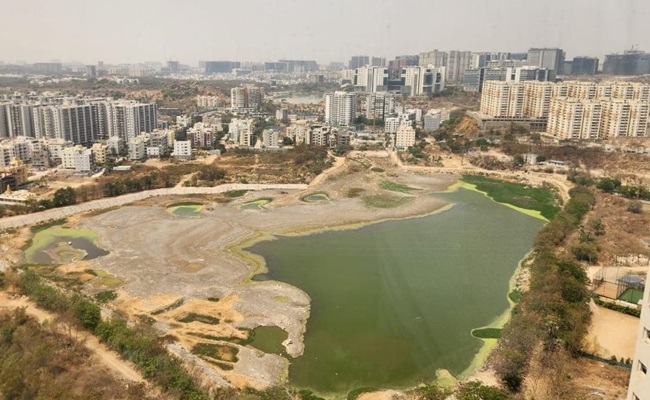
(Feature Image: An analysis of satellite imaging of 54 lakes taken in 1979 and 2023, secured by the HYDRAA from the NRSA shows that 40 lakes or nearly 75 per cent of lakes have shrunk by half. (Image: Twitter/DC)
The Hyderabad Disaster Response and Asset Monitoring and Protection Agency, or Hydra was established under GO 99, dated July 19 2024. A task the agency has taken up in all seriousness is protection of water bodies in the Hyderabad Capital Region (it includes 4 districts). To begin with it has started demolition of buildings illegally built inside the Full Tank Area (FTL) and Buffer area of the water bodies.
In July, Telangana Chief Minister Revanth Reddy replaced the Enforcement, Vigilance and Disaster Management (EVDM) wing of the government with Hydra, a body mandated to tackle illegal encroachment on water bodies in the Greater Hyderabad Municipal Corporation (GHMC) limits and surrounding areas. Its strength was upgraded from around 800 to 2,200 and its officials came directly under the principal secretary, municipal administration and urban development or the CM himself. “Hydra will also ensure the protection of water bodies in and around Hyderabad,” former EVDM commissioner and Hydra chief A V Ranganath said during its inception.
Hydra has so far acted upon 166 encroachments and recovered 43.54 acres of land since its inception. The most number of encroachments – 54 – were located on the banks of the Chintal cheruvu (lake) in Gajularamaram area followed by 45 in Bhumruq Dowla Lake in Rajendra Nagar. The Gandipet lake, one of the primary water sources of drinking water for Hyderabad, had 24 encroachments.
Hydra became controversial when the High Court on August 21 observed that the Hydra needs to follow due procedure before demolishing structures and ordered a status quo regarding a property related to the opposition BRS leader.
There is no doubt that serious efforts are required to protect urban water bodies and remove encroachments on them on an urgent basis. If Hydra is able to achieve it in a sustained, law and policy driven manner, it will indeed be a landmark step and a model for the rest of India.
Hyderabad HC issues guidelines to HYDRA Firstly, the title of the encroachers and the persons who made unauthorised constructions shall be perused, if any. Secondly, permissions obtained illegally from various authorities, including GHMC, municipalities and gram panchayats should be gathered. Thirdly, HYDRA shall not show any discrimination between owners of small extents of land that is 60 to 100 sq. yards and one acre and above. Fourthly, HYDRA shall follow the procedure laid down under GO Ms. 99, dated 19.07.2024, establishing HYDRA.
Fifthly, HYDRA has to take steps by following due procedure laid down under the GO so as to enable the citizens to repose confidence in the state. These guidelines were issued in a writ plea filed by Pradeep Reddy Badvelu, alleging that authorities from the irrigation and command area development department, revenue authorities and HYDRA had interfered with peaceful possession of the farmhouse, situated at Janmada village in Janwada gram panchayat, Shankarpally mandal, Rangareddy district, belonging to the petitioner. https://www.deccanchronicle.com/southern-states/telangana/hc-issues-guidelines-to-hydraa-before-it-decides-on-demolitions-1819156 (26 Aug. 2024)
Govt strengthens HYDRA with more powers Chief Secretary A. Santhi Kumari convened a high-level meeting at the Secretariat on Aug 26, which collectors from the four districts within the ORR limits, as well as senior officials from the police, irrigation, municipal administration and urban development (MA&UD), and law departments. The meeting’s primary focus was to devise a comprehensive action plan to implement the orders issued by the Telangana High Court regarding the removal of encroachments on lakes, ponds and the preservation of government properties. Chief Secretary Santhi Kumari announced that guidelines are being prepared to transfer full responsibility for the protection of lakes, parks, canals, and other government lands under the ORR to HYDRA. The meeting discussed the transfer of more powers and additional personnel to HYDRA to ensure the protection of these vital areas. In addition, the conservation of key lakes, including Osmansagar and Himayatsagar, will be transferred from the HMWS&SB to HYDRA. https://www.deccanchronicle.com/southern-states/telangana/hydraa-to-get-more-powers-and-staff-for-protecting-lakes-and-govt-properties-1819933 (29 Aug. 2024)
Empowering HYDRA to protect lakes The government has recently shown proactive approach in tackling the encroachment of water bodies. By granting powers to HYDRA, the state has taken a significant step towards preserving its precious water resources. With its newfound powers, HYDRA can effectively monitor and protect water bodies, prevent encroachments, and take swift action against those who dare to harm our environment. https://globalbihari.com/empowering-hydra-to-protect-lakes-of-hyderabad/ (29 Aug. 2024)
Activist responds to Owaisi’s opposition to HYDRA demolitions Social activist Dr Lubna Sarwath emphasized the importance of accurate data on water bodies to combat encroachments, stating that GHMC has been neglecting this issue for years. Dr Sarwath provided examples of how lakes in Hyderabad, such as those in KBR Park, Indira Park, and Public Gardens, have been reduced to small ponds or completely removed from databases. Dr Sarwath also referenced a 2007 list by HMDA of 2,857 lakes, arguing that it was incomplete and that her colleague had identified 300 additional lakes that were overlooked. Despite their efforts, the government has yet to respond or take action on these concerns.
She warned that the consequences of ignoring these issues could be severe, referencing recent incidents where people, particularly those from economically disadvantaged backgrounds, were washed away in floodwaters. Dr Sarwath urged to restore nalas, tanks, reservoirs, and local streams to prevent further tragedies. Dr Sarwath also criticized the inaction of those in power, questioning whether they truly support the legality of lake preservation. She noted that wealthier individuals often protest demolitions and challenge them in court, while those with fewer resources suffer the consequences. https://www.siasat.com/hyderabad-activist-responds-to-owaisis-opposition-to-hydra-demolitions-3085457/ (27 Aug. 2024)
Forum for Good Governance wants builders to be punished The Forum for Good Governance has urged the Telangana government to take measures so that builders should be made responsible for apartment complexes constructed in the full tank level or buffer zones of the lakes, and not the purchasers of flats. When the HYDRAA pulls down such complexes, the properties of the builder should be confiscated and the people who lose their flats should be compensated. In case that’s not possible, the residents should be provided alternative land and financial help, the forum said in a letter addressed to the CM A. Revanth Reddy.
A procedure must be laid for the builders for construction of high-rise buildings, whereby the builder has to first register the land in his or company’s name, get the layout approved by the relevant authorities, and only then go ahead with selling of the plots or flats. Agencies involved in registration and layout approval are charging huge fee but evading responsibility by not verifying the ownership of the property. There is a need to make the agencies verify ownership before registration or approval of plans, a letter from the Forum said. https://www.thehindu.com/news/national/telangana/forum-for-good-governance-wants-builders-to-be-punished/article68573532.ece (28 Aug. 2024)
1,100 buildings found in FTL, buffer zones of 13 lakes Rangareddy and Medchal districts, the revenue department has slapped notices on 1,100 buildings, including 204 in the vicinity of Durgam Cheruvu in Madhapur, asking why they should not be razed. Senior officials said this was just the tip of the iceberg. “The 1,100 unauthorised structures are only a sample. There could be thousands of such structures, including independent houses and apartments, in FTL and buffer zones on the lakes,” an official said.
Among the 1,100 structures, 462 are in FTL and 634 in buffer zones of the lakes, revenue authorities claimed. A majority of these illegal structures have come up in and around 13 lakes in the two districts. The over century-old Hasmathpet lake (Boin Cheruvu) in Old Bowenpally leads the charts with 148 buildings within the FTL of the lake, with Chinnarayauni Cheruvu (Old Alwal Cheruvu) in Alwal next with 105 illegal structures. These structures in 13 lakes were identified in the second and third weeks of Feb. A report was submitted to Telangana high court in March. https://timesofindia.indiatimes.com/city/hyderabad/illegal-structures-found-in-ftl-and-buffer-zones-of-13-lakes-in-hyderabad/articleshow/112935909.cms (31 Aug. 2024)
No halt in HYDRA demolition drive: CM In the midst of intense political debates surrounding the demolitions of illegal structures by HYDRAA that were constructed on lake beds in Hyderabad, CM A. Revanth Reddy on Wednesday made a series of bold statements, firmly asserting that HYDRAA’s demolition operations will not be halted. The Chief Minister reiterated that the preservation of lakes, ponds and water bodies is his administration’s top priority, stressing that these actions are devoid of any political bias. He stressed that his actions were driven by public interest and not by any political affiliations adding that HYDRAA’s demolition drive in Hyderabad will proceed as planned, with no exceptions, including areas in the new city and old city. https://www.deccanchronicle.com/southern-states/telangana/hydraa-will-not-halt-demolitions-says-revanth-1819796 (28 Aug. 2024)
All lake encroachments will be demolished In its bid to protect water bodies, the state government has decided to extend demolition of illegal structures built on lake beds across all 33 districts. This decision follows the success of the ongoing demolition drive by HYDRAA in Hyderabad, which has received an overwhelming response from the public. Prabhakar, in-charge minister for Hyderabad district said that Hyderabad, once known as a city of lakes, has seen many of its water bodies fall victim to illegal encroachments and the government’s demolition drive aims to reverse this trend and restore the city’s natural heritage. The state government also made it clear that this initiative transcended political affiliations, focusing solely on the conservation of natural resources. https://www.deccanchronicle.com/southern-states/telangana/all-lake-encroachments-in-state-will-be-demolished-says-ponnam-1819160 (26 Aug. 2024)
Removal of encroachments on Ramarthi Cheruvu sought People of Arsapally on Aug 27 staged protests at Ramarthi cheruvu in Nizamabad demanding removal of encroachments of Ramarthi cheruvu which has shrunk from 30 acres to 12 acres. They urged district collector to initiate action in this regard. Ramarthi cheruvu is located on Nizamabad-Bodhan main road. Traders have encroached on the water tank. In the backdrop of HYDRAA demolitions in Hyderabad, residents of Arsapally visited the water body and observed the encroachments on the tank. They raised slogans against the encroachers and demanded their immediate removal. https://www.deccanchronicle.com/southern-states/telangana/removal-of-encroachments-on-ramarthi-cheruvu-sought-1819566 (28 Aug. 2024)
HYDRA begins demolition in Appa Cheruvu lakebed HYDRAA began demolishing structures built on the fringes of the Appa Cheruvu in the Gaganpahad area of Hyderabad on Aug 31. The Appa Cheruvu was one of the lakes that sent its flood waters roaring in Oct 13-14, 2020 — floods that swept away a family, killing four members, and destroyed the road connectivity between Bengaluru and Hyderabad. https://www.thehindu.com/news/national/telangana/hydraa-begins-demolitions-in-appa-cheruvu-lake-bed/article68588857.ece (31 Aug. 2024)
GHMC, HMDA officials booked over lake encroachments A GHMC and an HMDA official have been booked by the Cyberabad EVW wing for permitting constructions in Full Tank Level (FTL) and buffer zones of lakes in Hyderabad. According to local reports, at least 50 officials have been listed following investigations, since HYDRA began carrying out demolitions of illegal encroachment of lakes in Hyderabad. At least 6 officials, including the GHMC and HMDA officials, have been booked so far. https://www.siasat.com/ghmc-hmda-officials-booked-over-lake-encroachments-in-hyderabad-3087863/ (31 Aug. 2024)
Hydra now focuses on illegal apartments, colonies The State Govt, which has taken up a massive drive to free at least a great part of the lakes and water bodies from encroachments, is now drawing up a special action plan to demolish not only the properties of bigwigs but also illegal residential apartments and colonies which are constructed in FTL and buffer zones. The govt wants to take up proper scientific study and a fool-proof action plan lest it led to backlash from the middle-class sections who had invested their hard-earned money in buying such flats since the builders had claimed they had all the approvals of relevant authorities. https://www.thehansindia.com/news/cities/hyderabad/now-hydra-glare-on-colonies-apartments-903506 (31 Aug. 2024)
HYDRA demolishes illegal structures in Ramnagar The demolished structures were primarily businesses built by occupying the nala (drain) in Manemma Colony, which had severely obstructed the stormwater drainage system, leading to frequent flooding and road blockages in the area. The cleared areas are expected to improve accessibility and restore proper stormwater drainage, alleviating the longstanding issues faced by the local community. Residents of Manemma Colony (Malamma Galli) in Ramnagar expressed their relief and gratitude for HYDRAA’s prompt action. The demolition has also sparked controversy, with some of those affected claiming that they had lived in the area for decades and had been paying property taxes and utility bills.
This demolition marks HYDRAA’s 166th operation since its inception, further solidifying the agency’s reputation for taking swift and uncompromising action against illegal encroachments. The agency previously garnered national attention after the demolition of the actor Nagarjuna-owned N-Convention, which had been illegally built on the full tank level (FTL) of Thammidikunta lake in Madhapur. https://www.deccanchronicle.com/southern-states/telangana/hydraa-acts-on-complaint-demolishes-illegal-structures-in-ramnagar-1820141 (30 Aug. 2024)
Firangi Nala survey fuels speculation of KTR’s farmhouse demolition Suspense over the fate of the Janwada farmhouse linked to BRS working president K.T. Rama Rao and allegedly built inside the prohibited zone of Osmansagar reservoir peaked on Aug 27 with officials from Revenue and Irrigation departments visiting the site for an inspection of a major nala that feeds Osmansagar, and encroachments on the nala. There have been repeated allegations that the Janwada farmhouse was built after the Firangi Nala was encroached upon and blocked to facilitate its construction and prevent flooding during the rainy season. On Aug 27, revenue officials from Rangareddy district, accompanied by irrigation officials, surveyed the nala, or what remains of it, with one official saying that the nala was a vital channel for Osmansagar reservoir. https://www.deccanchronicle.com/southern-states/telangana/firangi-nala-survey-fuels-speculation-of-ktrs-farmhouse-demolition-1819496 (27 Aug. 2024)
Here is another high profile lake encroachment by a Congress leader. Unlike other leaders, this Congress leader occupied a vast area of the Surram or Surya Rao Cheruvu in Mankhal village, Rangareddy. It was a well planned encroachment. To begin with, the flood flow passage from the upstream areas was converted into a concrete jungle and nearly 50 percent of the lake area was occupied for developing a real estate venture, which is close to Srisailam Highway. https://telanganatoday.com/another-high-profile-lake-encroachment-by-congress-leader (30 Aug. 2024) https://indianexpress.com/article/cities/hyderabad/politicians-industrialists-film-stars-in-hyderabad-long-arm-of-the-hydra-causes-a-stir-9540534/ (30 Aug. 2024)
FTL refers to the maximum water level that a lake, tank, or other water body can reach, representing the upper limit of water storage. It indicates the highest point that water can log or traces of water can be found around the lake or water body. The Buffer Zone is the designated area around the FTL that is kept clear of any development. The width of the Buffer Zone varies based on the size of the lake or nala (a stream or watercourse). This zone is crucial for preventing encroachments and preserving the natural ecosystem around the water bodies. https://www.deccanchronicle.com/southern-states/telangana/hydraa-demolitions-all-you-want-to-know-about-ftl-buffer-zone-1819329 (27 Aug. 2024)
HYDRO POWER PROJECTS
SANDRP Blog August 2024: Mismanagement Damages Mahan-III HEP In Chhattisgarh Disappointingly, the disaster management page on the Surajpur district website is totally blank. It is noteworthy that the Mahan-III HEP incident is followed by NDMC’s Iron Ore dam induced flood disaster in Dantewada district of the state in July 2024.
In that case too the administration has so far not made the inquiry report public. It appears, this incident will go the same way, suggesting the concerned government departments and project proponent have no intention to draw essential lessons from the avoidable disasters time and again. https://sandrp.in/2024/08/30/august-2024-mismanagement-damages-mahan-iii-hep-in-chhattisgarh/ (30 Aug. 2024)
North-East Centre approves CFA for development of HEPs The Union Cabinet has approved the proposal of the Ministry of Power for providing Central Financial Assistance (CFA) to the State Governments of NER towards their equity participation for development of Hydro Electric Projects in the North Eastern Region (NER) through Joint Venture (JV) Collaboration between State entities and Central Public Sector Undertakings. This scheme has an outlay of Rs. 4136 crore to be implemented from FY 2024-25 to FY 2031-32. A cumulative hydro capacity of about 15000 MW (comes to Rs 27.6 lakhs per MW) would be supported under the scheme. The scheme would be funded through 10% Gross Budgetary Support (GBS) for North Eastern Region from the total outlay of the Ministry of Power. The Scheme formulated by the Ministry of Power provides for formation of a Joint Venture (JV) Company for all the projects of a Central PSU with the State Govt. The grant towards equity portion of the State Government of NER would be capped at 24% of the total project equity subject to a maximum of Rs.750 crore per project. The cap of Rs.750 crore for each project would be revisited, if required, on a case-to-case basis. The ratio of equity of the CPSU and the State Government in the JV would be maintained at the time of disbursing of the grant. Central Financial Assistance would be limited to only viable Hydro Electric Projects. States would be required to waive / stagger free power and / or reimburse SGST to make the project viable.
– The Government of India has been taking several policy initiatives to address the issues impeding Hydro Power development. To promote the hydro power sector and to make it more viable, the Cabinet, on 7th March, 2019, approved measures, viz., declaring large hydro power projects as Renewable Energy sources, Hydro Power Purchase Obligations (HPOs), tariff rationalization measures through escalating tariff, budgetary support for flood moderation in storage HEP and budgetary support for the cost of enabling infrastructure, i.e., construction of roads and bridges. https://pib.gov.in/PressReleasePage.aspx?PRID=2049320 (28 Aug. 2024) With the introduction of this scheme, participation of state governments in hydro development will be encouraged and risk and responsibilities will be shared in a more equitable manner, the statement said. The issues like land acquisition, rehabilitation & resettlement and local law & order issues would be reduced with state governments becoming stakeholders. https://www.business-standard.com/india-news/centre-approves-rs-4-136-cr-for-15-gw-hydropower-projects-in-northeast-124082800793_1.html (28 Aug. 2024)
Arunachal Pradesh Villagers protest NHPC survey for Siang Multipurpose Project The protest was held at Dite Dime, which is one of the three proposed dam sites. This protest arose as an NHPC team was set to conduct a survey for the project’s feasibility report. Organised collectively by the All Adi Welfare Society, the Siang Indigenous Farmer’s Forum (SIFF), and the Bango Students Union, the protest drew participants from Komkar, Geku, Sitang, Parong, and Rieu, all set to be affected by the proposed project. The villagers said that they discovered the planned survey through social media, which spurred their opposition.
SIFF Siang unit joint secretary Tabeng Siram expressed strong dissatisfaction with the government’s decision to conduct the survey without prior notification to those affected. Parong, is the first proposed dam site with 120 households. Siram criticised the government for not communicating with the villagers who are set to be impacted. During an election rally in January in Mariyang in Upper Siang and Pangin in Siang district, Khandu had promised that the Siang hydropower project would move forward only after thorough consultations with the affected communities.
However, Siram and others feel this promise has been disregarded, leading to disappointment and a sense of betrayal among the villagers. Siram voiced the distress of many anxious villagers, questioning where they would go if displaced from their land. With the government appearing unresponsive to the affected villagers’ concerns, further protests are anticipated in the region, which has a strong history of opposing mega dams on the revered Siang river. Meanwhile, villagers from Parong have lodged an FIR against the NHPC and the executing agencies for conducting the survey and PFR in violation of their constitutional and legal rights. https://arunachaltimes.in/index.php/2024/09/01/villagers-protest-nhpc-survey-for-siang-multipurpose-project/ (01 Sept. 2024)
The locals are opposing the mega hydropower project on river Siang citing that it is a threat to their land, livelihood, environment and way of life. Dite Dime, Parong and Uggeng are the three proposed sites of the project. Over 600 locals staged the protests against the “forceful survey-cum-pre-feasibility report (PFR)”. They shouted slogans against the government and the NHPC. The protests were organised by All Adi Welfare Society, Siang Indigenous Farmers’ Forum and Banggo Students’ Union. https://www.newindianexpress.com/nation/2024/Aug/31/arunachal-locals-oppose-nhpc-survey-for-mega-dam-project (31 Aug. 2024)
Seems like this article is using things like google search figures over the years to push a competitive dam narrative on Brahmaputra. https://www.hindustantimes.com/lifestyle/art-culture/connecting-the-drops-mridula-ramesh-writes-on-india-china-and-the-mighty-brahmaputra-101725015391018.html (30 Aug. 2024)
Frequent mass wasting in Tibet a cause for worry A new study on the high frequency of mass wasting events in the Sedongpu Gully of the Tibetan Plateau since 2017 and the rapid warming of the area, which rarely experienced temperatures beyond 0º C before 2012, could be bad signs for India, specifically the country’s Northeast. According to their paper, more than 700 million cubic metres of debris have been mobilised in the Sedongpu gully catchment since 2017. The combination of long-term warming and intense local shaking due to earthquakes has greatly enhanced landslide activity in the area. The impact on humans has been low because it is so remote.
However, environment scientists in Assam said the study underlining landslides was ominous for areas hundreds of kilometres downstream. The threat has been accentuated by big dams such as the 510-MW Zangmu on the Tsangpo and India’s planned projects on the Siang. “China plans to set up a 60 Gw project on the Tsangpo, which will [have] thrice the capacity of the Three Gorges project on the Yangtze, the world’s largest hydropower plant,” said Partha Jyoti Das, the head of the Water, Climate, and Hazard Division of Aaranyak, a Guwahati-based biodiversity research organisation. “This region is characterised by enormous geophysical instability and experienced the 8.6-magnitude Assam-Tibet or Medog earthquake in 1950, one of the biggest of the 20th century. The 6.4-magnitude Nyingchi earthquake hit the same region in November 2017.”
“It is high time we undertook similar studies to monitor the status & trends of geophysical events leading to landslides, rockfalls & other erosional processes that could affect the geomorphic & hydrological regime of the Brahmaputra & its tributaries apart from attending to sediment management,” Dr. Das said. https://www.thehindu.com/sci-tech/energy-and-environment/frequent-mass-wasting-in-tibet-a-cause-for-worry-in-india/article68564709.ece (26 Aug 2024)
SJVN signs pact to develop 5 HEPs The SJVN Limited has signed a MoA with the state govt for executing five run-of-the-river scheme hydro projects of 5,097 MW capacity in the state through a joint venture mode. The projects are 3,097 MW Etalin, 680 MW Attunli, 500 MW Emini, 420 MW Amulin and 400 MW Mihumdon hydroelectric projects. According to an SJVN spokesperson, of the five projects, Etalin and Attunli HEPs are in the advanced stages of clearance. The construction of these two projects will involve a total investment of around Rs 44,000 crore and would add about 15,787 million units of electricity generation annually. https://www.tribuneindia.com/news/himachal/sjvn-arunachal-govt-ink-pact-for-5-hydel-projects/ (31 Aug. 2024)
Governor KT Parnaik apprised union Minister of State for Heavy Industries & Steel Bhupathi Raju Srinivasa Varma of state’s potential in the hydropower and tourism sectors during a meeting at the Raj Bhavan here on Sunday (Sept. 01). Parnaik said that the strategically important state has more than 58,000 MW of hydro potential “and only a small portion has been harnessed so far.” https://arunachaltimes.in/index.php/2024/09/02/guv-highlights-states-hydropower-tourism-potential/ (02 Sept. 2024) Dumporijo MLA Rode Bui recently met NHPC Chairman RK Choudhary inFaridabad, Haryana, and discussed the proposed Subansiri Upper Hydroelectric Project (SUHEP) in Upper Subansiri district. During the meeting, Bui urged the NHPC chairman to expedite the remaining formalities and procedures,so that the project can be started soon. https://arunachaltimes.in/index.php/2024/09/01/bui-meets-nhpc-dir-discusses-proposed-suhep/ (01 Sept. 2024)
Sikkim Landslide a warning to upcoming HEPs Experts concur that the Centre needs to re-consider such hydro projects. “Are we ready for such a geological surprise?” asks Himanshu Thakkar of the South Asia Network of Dams, Rivers and People. Thakkar says Sikkim’s landslides were the result of ‘improper’ geological assessment before construction in 2008. “Such projects would repeatedly fail if complex geological settings of the region keep getting ignored,” Thakkar adds. https://www.newindianexpress.com/xplore/2024/Aug/31/sikkim-landslide-is-a-warning-to-upcoming-hydro-projects (31 Aug. 2024)
Study begins at 6 high risk glacial lakes A fortnight-long study was launched on Aug 31 to evaluate the volume, depth and longitudinal profile of six high-risk glacial lakes in Sikkim. Being conducted at the behest of the National Disaster Management Authority (NDMA), the Glacial Lake Susceptibility Assessment Study (GLSAS) will help characterise the physical dimensions of the lakes using a bathymetry survey.
The study will perform a geophysical assessment of the moraine dam to evaluate its stability and potential risk factors using an Electrical Resistivity Tomography survey (ERT) and Ground Penetrating Radar (GPR). The objective of this expedition to Mangan district is to conduct a detailed susceptibility assessment of the high-risk Tenchungkha, Khangchung Chho, Lachen Khangtse, Lachung Khangtse, La Tsho and Shako Chho glacial lakes.
– The expedition will make a slope stability assessment of the glacial lake to assess mass movement hazards. Besides, the study will conduct a morphometric survey of the glacial lake and its adjacent landscape, measure lake discharge and assess the outlet flow dynamics to understand the lake’s hydrology and use a drone for 3D terrain mapping to build a high-resolution terrain model. https://timesofindia.indiatimes.com/science/fortnight-long-study-begins-at-6-high-risk-glacial-lakes-in-sikkim/articleshow/112956293.cms (31 Aug. 2024)
Manipur Why is MINT raising this issue of Tipaimukh dam that India seems to have shelved long back, due to protests within India. https://www.livemint.com/news/bangladesh-accuses-india-of-non-cooperation-tipaimukh-dam-row-to-farakka-barrage-water-disputes-explained-in-5-pts-11724659573737.html (26 Aug. 2024)
SJVN Climate Change resulted in adverse hydrological conditions for HEPs: CMD Climate Change-induced erratic weather patterns resulted in adverse hydrological conditions for our flagship hydro projects, said SJVN Limited’s Chairman and Managing Director (CMD) Sushil Sharma. “Financial year 2023-24 has been a challenging year for the company on the operational front. The impact of Climate Change is becoming visible in the form of erratic weather patterns across the globe,” said the SJVN CMD in the company’s annual report for 2023-24. “Heavy rains and flash floods during the peak generation period followed by sub-normal discharge during the remaining part of the year resulted in adverse hydrological conditions for our flagship hydro projects,” said Sharma. https://psuwatch.com/newsupdates/climate-change-resulted-in-adverse-hydrological-conditions-for-sjvn-hydro-projects-cmd (26 Aug. 2024) SJVN has secured bluechip status. This upgrade, which propels the company from a Mini-Ratna to a full-fledged bluechip enterprise, is largely driven by its ambitious capital expenditure (capex) plan, totaling an impressive Rs 25,000 crore. https://www.himachalheadlines.com/business/sjvn-achieves-bluechip-status-a-new-chapter-in-indias-energy-sector/ (31 Aug. 2024)
NHPC As per order from Department of Public Enterprise (Ministry of Finance) on 30.08.2024, NHPC has been declared a ‘Navratna Company, thereby giving it greater operational and financial autonomy. https://pib.gov.in/PressReleseDetailm.aspx?PRID=2050374 (31 Aug 2024)
Jammu & Kashmir Ganderbal HEP’s endless wait continues The 93-MW New Ganderbal Hydropower Project, a long-awaited initiative first announced in 1996, continues to face delays and uncertainties nearly three decades after its inception. The project enters its 28th year since conception. https://www.greaterkashmir.com/front-page-2/new-ganderbal-hydropower-projects-endless-wait-continues/ (26 Aug. 2024)
Bihar The SJVN Director (Finance and Personnel), Akhileshwar Singh, met the Minister of Energy of Bihar, Bijendra Prasad Yadav to deliberate on significant projects under consideration in the state, including the 1000-MW Durgawati Pumped Storage Project (PSP) & Dagmara Multi-purpose Project with Floating Solar. https://www.tribuneindia.com/news/himachal/sjvn-arunachal-govt-ink-pact-for-5-hydel-projects/ (31 Aug. 2024)
MoEF Decisions of meeting of EAC on River Valley Projects held on Aug 13 2024:
1. Uri-I Stage-II Hydroelectric Project (240 MW) by NHPC Ltd at BARAMULLA,JAMMU & KASHMIR for EC: More Info Sought
2. Bilaspur Pump Storage Project (1000 MW) by JINDAL RENEWABLE POWER Pvt Ltd at BILASPUR, CHHATTISGARH for TOR: Approved
3. MP30 Gandhi Sagar Standalone Pump Storage Project by GREENKO MP01 IREP Pvt Ltd at NEEMUCH, MADHYA PRADESH for amendment in EC: Approved.
4. Shahpur Pump Storage Project (2520 MW) in 624.1702 Ha at Kaloni, Baint and Mungawali villages, Shahabad Tehsil, Dist Baran, (Raj) by Greenko Energies Pvt Ltd for Environmental Clearance: Approved.
5. Directions of the Hon’ble National Green Tribunal, Southern Bench at Chennai in MA No 3 of 2024 in OA No 71 of 2020 in the matter of Gavinolla Srinivas and others vs Union of India and others: Work done is required for DPR.
6. Harmonization and Optimization of Environmental Clearance Conditions: MoEF to prepare comparative chart and share with EAC. https://parivesh.nic.in/utildoc/93371912_1724738167484.pdf
DAMS
Report Safety aspects should get top priority Dam Safety should be considered the decisive factor in all situations of conflict between project benefits and dam safety, on the basis of the non-negotiable principle that ultimately human life is most precious. https://countercurrents.org/2024/08/when-taking-decisions-on-dams-safety-aspects-should-get-top-priority-as-nothing-can-be-more-precious-than-human-life/ (30 Aug. 2024)
Polavaram Project CWC demands more details from Odisha The CWC has strangely, asked the Odisha government to come up with more technical details on what could be the maximum level of floods to the Godavari river at Polavaram and also on the quantum of backwaters of the Polavaram project. CWC should have on the contrary provided convincing information about backwater studies in public domain. Officials from AP, Odisha, Chhattisgarh and Telangana met in New Delhi under the aegis of the Central Water Commission on Aug 28. The meeting discussed fears expressed by Odisha vis-a-vis submergence of its land by Polavaram backwaters.
Meanwhile, the Union Cabinet is learnt to have given its approval for release of Rs 12,157 crore for the Polavaram project works. https://www.deccanchronicle.com/southern-states/andhra-pradesh/cwc-demands-more-details-from-odisha-on-polavaram-floods-1819745 (28 Aug. 2024)
AP, 3 states discuss backwater impacts Representatives of Andhra Pradesh, Telangana, Odisha and Chhattisgarh would meet in New Delhi on Aug 28 under the aegis of the Central Water Commission to discuss Polavaram project’s backwaters impact. Odisha is seeking a study on the impact of the backwaters in the event of the project receiving floods of 50 lakh cusecs. It wants matching relief for submergence of its land.
– The CWC maintains that the Godavari river on which the Polavaram Dam is coming up witnessed the highest floods of 36 lakh cusecs in 1986. Reports are that the river experiences heavy floods of upto 36 lakh cusecs once in 100 years and 50 lakh cusecs once in 10,000 years. The Odisha government is not convinced and said a flood level of 50 lakh cusecs at the Polavaram dam could be expected and remedial steps must be taken accordingly. AP says that if they accept Odisha’s demand, the cost of compensation for the land submerged due to backwaters of Polavaram and for rehabilitation and resettlement package will cost a lot. AP cannot afford to bear such a burden, it argues. https://www.deccanchronicle.com/southern-states/andhra-pradesh/ap-3-states-to-discuss-polavaram-dam-backwater-impact-in-delhi-1819505 (28 Aug. 2024)
Kaleshwaram Project Malkapet reservoir works stalled The contractor had stalled the works as bills worth about Rs.11 crore were not cleared by the govt. Despite letters from officials, the govt has not released the amount. The project, in Konaraopet mandal, was part of Package-9 of the Kaleshwaram Lift Irrigation Project. Officials said 80 % work has been completed. While the cost of package-9 is Rs 1,000 cr, the worth of the 3 tmc capacity Malkapet reservoir is Rs.550 cr. https://telanganatoday.com/malkapet-reservoir-works-stalled-officials-wait-for-funds-approvals (30 Aug. 2024)
Mullaperiyar Dam Sword of damocles hanging over Kerala Malayala Manorama, the influential Malayalam Daily, joins the debate on Mullaperiyar Dam, which has been raging in Kerala after the Wayanad landslide disaster, with an article by former Kerala irrigation department Chief Engineer V.K.Mahanudevan. In the Op-Ed, he argues that Kerala should pass a Mullaperiyar Disaster Alleviation Law in the state Assembly. He says this law should specify that in the event of a disaster Tamil Nadu government must be made responsible for it and they should pay compensation to the victims of the disaster. Further, it should be made clear that if the Dam breaks no new Dam will be built in its place. https://countercurrents.org/2024/08/mullaperiyar-dam-the-sword-of-damocles-hanging-over-kerala/ (30 Aug. 2024)
Can tunnel address concerns? Metroman E. Sreedharan has suggested that a tunnel at the height of 100 feet could easily resolve the issue concerning the strength of the Mullaperiyar reservoir. Delivering the keynote address at a seminar on ‘Mullapperiyar, the fear and future’ organised by the National Hindu League (NHL) in Kozhikode on August 28 (Wednesday), the renowned Engineer said that a 4-km-long, 6-m-wide tunnel could be constructed at a height of 100 feet. This tunnel could divert excess water from the Mullaperiyar reservoir, once the water level exceeds 100 feet, to the Vaigai River in Tamil Nadu, where it could be stored in smaller reservoi₹https://www.thehindu.com/news/cities/kozhikode/new-tunnel-walls-pillars-proposed-to-strengthen-mullapperiyar-dam/article68577643.ece (28 Aug. 2024)
INTERLINKING OF RIVERS
Ken-Betwa Linking What is said here is not very clear: मुख्यमंत्री डॉ. यादव ने अनुरोध किया कि स्वीकृत केन-बेतवा लिंक परियोजना के अंतर्गत वर्तमान में प्रावधानित दमोह-पन्ना उद्वहन सिंचाई योजना से 90,100 हेक्टेयर सिंचाई के स्थान पर लगभग 2,50,000 हैक्टेयर की पत्ने एवं ब्यरमा सिंचाई परियोजना को शामिल किया जाना उचित होगा। https://www.amarujala.com/madhya-pradesh/bhopal/mp-news-in-principle-approval-on-increasing-the-area-of-irrigation-through-ken-betwa-link-consideration-of-2024-08-29 (29 Aug. 2024)
RIVERS AS NATIONAL WATERWAYS
Madhya Pradesh Is cruise in Narmada legal, just or justified? The Tourism Department’s cruise project on the Narmada river faces strong opposition due to potential ecological disruption and impacts on local fishing communities. Environmentalists and locals have raised significant concerns, resulting in legal action that halted the project; critics emphasize the lack of thorough environmental and social impact assessments. Despite court orders to stop the project and associated construction, the work is continued. Hence, it raises a concern on the integrity of these authorities towards legal mechanisms in protecting rivers and natural environment of the country.
– The Madhya Pradesh Tourism Department proposed to start cruise ship services for tourists on the Narmada River, in early 2022. The cruise ships, yet to become operational, will go from Badwani in Madhya Pradesh to the Statue of Unity in Kevadiya, Gujarat, covering a distance of approximately 135 km. Each ship will carry 70 passengers in luxury and 56 passengers in the budget cruise vessels. These cruises will exclusively cater to tourists, providing facilities like bars, swimming pool, water sports and other leisure activities. Infrastructure for this project includes the construction of floating jetties and additional amenities to support tourists. Two additional sites, Hanfeshwar and Silarja, have been identified as stoppage points along the route. https://india.mongabay.com/2024/08/commentary-a-cruise-on-the-narmada-river-is-it-legal-just-or-justified/ (29 Aug. 2024)
मथुरा – प्राइवेट पब्लिक पार्टनरशिप (पीपीपी) माडल पर इस क्रूज का संचालन किया जा रहा है। इसका संचालन एलकेमी समूह की कंपनी मथुरा क्रूज लाइन प्राइवेट लिमिटेड करेगी। 125 सीटर क्रूज में एक बार में 45 मिनट का सफर श्रद्धालु कर सकेंगे। फिलहाल इसे बंगाली घाट से चलाने का योजना है। इस क्रूज को गरुड़ नाम दिया गया है, श्रद्धालुओं को जिस स्थान से क्रूज में बैठाया जाएगा, उसी स्थान पर उन्हें उतारा जाएगा। https://www.jagran.com/lite/uttar-pradesh/mathura-travel-in-yamuna-river-with-garun-cruse-know-ticket-price-and-time-23784983.html (26 Aug 2024)
IRRIGATION
Uttar Pradesh -हरिद्वार स्थित गंग नहर में भी भारी मात्रा में सिल्ट आ गई है. जिसके चलते यूपी सिंचाई विभाग ने हरिद्वार से कानपुर तक जाने वाली गंग नहर को फिलहाल बंद कर दिया है. इस नहर के बंद होने से कानपुर तक गंग नहर सूख गई है. सिंचाई विभाग जल्द ही गंग नहर से सिल्ट हटाने की कार्रवाई करेगा. https://www.etvbharat.com/amp/hi/!state/up-irrigation-department-has-closed-ganga-canal-to-clean-silt-in-haridwar-uttarakhand-news-uts24082404113 (24 Aug 2024)
Karnataka 37 WRD staffers caught for fake documents Sleuths from Central Crime Branch (CCB) arrested 37 C-division staffers from the water resources department on charges of producing fake marks cards to land jobs in Oct 2022. Police also arrested 11 middlemen, three of them govt employees, for helping them secure job. They are looking for 25 more staffers, who are on the run. https://timesofindia.indiatimes.com/city/bengaluru/37-water-resource-department-staffers-arrested-for-fake-documents/articleshow/112929305.cms (30 Aug. 2024)
URBAN RIVERS
SANDRP Blog Flood Lines, RFD & Citizen Heroes: Story of Pune Floods Parineeta Dandekar tells the story of worsening situation of Pune rivers in spite of valiant persistent efforts by individuals and group over the years. Basically because it is the govt functionaries that are responsible for the actions that are worsening the state of Pune’s rivers. https://sandrp.in/2024/08/30/flood-lines-riverfront-development-and-citizen-heroes-story-of-pune-floods/ (30 Aug. 2024)
Pune Citizens hold silent march to show support for rivers The use of blue rakhis and the silent nature of the march seem to emphasise both the gravity of the issue and the unity of the participants. By tying rakhis to Lakdi Pul, they symbolically connected their commitment to river conservation with a physical landmark, creating a visual representation of their message. The choice to remain silent and maintain solemn expressions likely underscored the seriousness of their cause and helped to focus attention on the importance of protecting the rivers.
Pune River Revival (PRR) Forum activist Prajakta Mahajan said, “The motive of the march was apolitical; to express empathy for those affected by the floods. Additionally, there is a concern about whether the RFD Project has obtained environmental clearance,”. Environmental activist Shamim Pathan highlighted a critical issue: the recent heavy rainfall, exceeding three inches, which led to significant flooding and water intrusion into homes across Pune. She emphasised the urgency of addressing river health and urban planning to manage such extreme weather events more effectively. https://punemirror.com/pune/civic/citizens-hold-silent-march-to-show-support-for-rivers/cid1724650610.htm (26 Aug. 2024)
RFD is a bad idea The controversial project, spanning 44 kilometres of the Mula, Mutha and Mula-Mutha, aims to construct embankments, walkways, plazas, access roads, gardens and plant trees along the riverbanks. It is more about creating land for construction than cleaning and rejuvenating the rivers whose debilitated ecosystems are crying for attention. The glaring contradictions between the Detailed Project Report and the Environment Impact Assessment report point to impending destruction of the rive₹Unwilling to take this lying down, armed with information and passion, Punekars are fighting back every inch. https://questionofcities.org/why-punes-riverfront-development-is-a-bad-idea/ (23 Aug. 2024)
Mula-Mutha flood line study delayed A High Court-mandated committee has been formed to reassess the flood lines of Pune’s Mula and Mutha rivers, crucial waterways for the city. Initially, the report was to be submitted within four weeks, but it has now been revealed that the study will require six to seven months to complete.
The blue and red flood lines for the Mula and Mutha rivers, which flow through Pune city, were initially established in 2011 and 2016. However, these flood lines were not properly planned, overlooking significant issues such as the flooding of many drains downstream of the Khadakwasla Dam. Environmentalist Sarang Yadwadkar, Sajag Naagrik Manch President Vivek Velankar, and RTI activist Vijay Kumbhar filed a PIL, arguing that the existing flood lines increase the risk of flooding and do not adequately protect citizens.
Petitioner Vivek Velankar, President of Sajag Naagrik Manch, commented, “If the committee members are committed, the report may be prepared within the timeframe set by the Bombay High Court. However, if there is a lack of determination, this work could be delayed.” https://www.punekarnews.in/pune-mula-mutha-flood-line-study-delayed-new-report-now-expected-in-6-7-months/ (20 Aug. 2024)
Effluents badly contaminate rivers in PCMC limits The Pimpri Chinchwad Municipal Corporation’s (PCMC) annual environment status report (ESR) stated that Pavana, Indrayani and Mula rivers, passing through its areas, were heavily polluted because of discharge of untreated domestic and industrial effluents. The ESR said the quality of water in these rivers was not suitable for aquatic life, since the average DO in them is below 4 mg/l. It could lead to incidents like mass fish deaths — as has been reported in Indrayani and Pavana rivers in the past.
Chemical tests revealed that Pavana river is more polluted because it passes through the heart of the city and 65 nullahs flow into it. Industrial effluent is the likely reason for contamination of Indrayani since it flows through industrial areas and is the second most polluted river after Pavana. Nine nullahs flow into Mula and 12 into Indrayani, the report said. A total of 408 MLD of sewage is generated within Pimpri Chinchwad limits and 364 MLD is treated. https://timesofindia.indiatimes.com/city/pune/effluents-contaminate-rivers-in-pcmc-report/articleshow/112694541.cms (22 Aug. 2024)
Green activist Prashant Raul questioned whether the civic body was sleeping despite knowing about the pollution and its source. “The water quality of the rivers is better when they are outside the PCMC limits and deteriorates as they flow into the PCMC limits. The ESR is wrong and misleading and the objection has been raised by us. We have written to the chief minister of state and environment ministry about it. Besides, a lot of information is fake and the data is just copy-pasted from past reports,” he claimed.
Sanjay Kulkarni, head of the PCMC environment department, said, that the nullahs within the PCMC limits primarily serve as outlets for rainwater. “These nullahs and drains eventually merge into the Pawana, Mula, and Indrayani rivers. Due to the direct mixing of polluted industrial water and domestic sewage in the drains, the rivers are becoming increasingly polluted which is a matter of great concern,” he said. https://www.hindustantimes.com/cities/pune-news/rivers-in-pimpri-chinchwad-polluted-throughout-the-year-report-101724697217659.html (27 April 2024) The ESR also highlighted that the city’s STPs currently treat 477 MLD out of a total capacity of 576 MLD. Additionally, the Central Government has approved 11 more STPs with a combined capacity of 396 MLD to further reduce pollution in the Mula-Mutha River. https://www.punekarnews.in/pune-mutha-river-pollution-levels-surpass-mula-mutha-reveals-pmc-report/ (22 Aug. 2024)
Indrayani: Foam found floating For the past two days, foam has been found in the Indrayani riverbed, particularly in areas of Dehu and Alandi, due to increased pollution. The foam, which has appeared near the Siddhabet dam, highlights the ongoing pollution in the river, even during the rainy season. The continuous neglect by authorities has resulted in devotees witnessing a polluted riverbed throughout the year. Despite numerous complaints and the severity of the situation, no concrete measures have been implemented by the collector, the municipal corporation, the Alandi Municipal Council, or MPCB to address the issue of pollution in the Indrayani river. Villagers in Alandi and the municipal council administration allege that the PCMC is primarily responsible for the foam in the Indrayani river. Although drinking water is currently being supplied to Alandi from the Bhama Askhed dam, the ongoing presence of contaminated water in the river poses a potential public health risk for residents of villages along its banks. https://punemirror.com/PCMC/indrayani-river-on-high-alert-foam-found-floating-environmental-concerns-emerge-again/cid1724649030.htm (26 Aug. 2024)
Dr. Soma Mishra gives an overview of recent discoveries in emerging contaminants and their potential risks to health and the environment. https://www.youtube.com/watch?v=91ADnyL36dk (30 Aug. 2024)
Vishwamitri; Vadodara River revamp still on paper A number of name changes over a decade and even after the formation of a Special Purpose Vehicle (SPV) to execute the plans, the Vishwamitri river rejuvenation project, which was first proposed in 2010, is yet to see the light of the day. CM Bhupendra Patel’s latest announcement of Rs 1,200 crore for the “historic project” to mitigate Vadodara’s flood problem is yet another in the series of assurances given by the civic body as well as the state government to the city’s residents.
Rohit Prajapati of the Paryavaran Suraksha Samiti, says, “Understanding the ecology of the Vishwamitri is especially critical since it is a unique habitat for ‘Schedule I Species’ as listed by the IUCN. The Vishwamitri project should be intended to increase the flood carrying capacity, clean the river to make it pollution-free, retain and replenish the water, create a safe habitat for crocodiles, integrate with slum redevelopment policy, increase groundwater recharge, create public and recreational spaces, strengthen the river edge, improve accessibility and connectivity, generate resources to pay for all of the foregoing and integrate with city development.”
The activists sought an interim order to restrain VMC from proceeding with the project on the assertion that it had not obtained EC. VMC filed a withdrawal application stating the project was in an “early stage”. NGT then asked the civic body to maintain status quo and not carry out any further construction and development-enabling activities within the area of VRDP until and unless the prior EC is obtained for the said project. “Currently, following several legal notices we have served the VMC, the mapping of the floor plan of the river is going on which will help us identify the exact encroachments, ravines and points of interlinking the river with the ponds,” said Prajapati. https://indianexpress.com/article/cities/ahmedabad/vishwamitri-revamp-still-on-paper-9542707/ (31 Aug. 2024)
Buddha Dariya; Ludhiana Police complaint filed against PPCB officials The representatives of “Kale Paani da Morcha”, a civilian movement started to clean Buddha Nullah, on Friday (Aug. 30) submitted a complaint to Ludhiana police demanding criminal proceedings and registration of FIR against Punjab Pollution Control Board (PPCB) officials. They accused PPCB member secretary Gurindar Singh Majithia, chief environmental engineer (Ludhiana) Pardeep Gupta and other unidentified persons of conniving with dyeing industries and brazenly letting them throw toxic waste into the stream, which further pollutes Sutlej river.
The team submitted the complaint to Ludhiana police commissioner Kuldeep Singh Chahal and mentioned that the senior PPCB officials should be booked under the several sections of Environment (Protection) Act, Water (Prevention and Control of Pollution) Act and other sections of Bhartiya Nyaya Sahnita (BNS) for “brazenly playing with the lives of common people”. They also submitted to the police a copy of the letter which was produced by the Central Pollution Control Board (CPCB) in the NGT recently. https://indianexpress.com/article/cities/chandigarh/buddha-nullah-pollution-police-complaint-against-ppcb-officials-kale-paani-da-morcha-9542233/ (30 Aug. 2024)
Activists protest against pollution in Buddha Nullah Under the banner ‘Kale pani da morcha’, thousands of people from Ludhiana, Ferozepur, Abohar, Fazilka, Rajasthan, etc. gathered near Verka milk plant here to save Buddha Nullah. The members of ‘Kale pani da morcha’ maintained that the political party currently governing Punjab repeatedly raised the issue on a large scale before coming to power, making their silence now both surprising and unfortunate. The people of Punjab demand freedom from this toxic black water. They demonstrated today that they will achieve this freedom whether the government takes action or people take it themselves, said the organisers.
Jaskirat Singh from Naroa said that till date, the government has neither taken firm action against the industries polluting water nor addressed the corrupt officials within Punjab Pollution Board. If the government fails to shut down the illegal industries and take concrete steps to halt the pollution of the Sutlej and other rivers within the next two weeks, there will be no choice but to proceed with the previously announced action on September 15. The full responsibility for the consequences will rest with the Punjab Government. The team, in consultation with all supporting organisations, will plan the next course of action accordingly, said Singh. https://www.tribuneindia.com/news/ludhiana/activists-protest-against-pollution-in-buddha-nullah-demand-action/ (26 Aug. 2024)
Greens protest chemical waste dumping into Buddha Nullah Green activists raised their voice against the chemical water being thrown into the Buddha Nullah near Jamalpur area here on Sunday (Aug. 25). Environmentalists gathered together and held the placards of poor governance in their hands. Activists highlighted that government agencies have admitted that the water flowing in Buddha Nullah is currently unfit for agricultural use. This admission highlights the severe levels of pollution caused by industrial activities, which exceed acceptable limits. To restore the health of the river, it is essential to follow zero liquid discharge (ZLD) practices. https://www.hindustantimes.com/cities/chandigarh-news/green-activists-protest-chemical-waste-dumping-into-buddha-nullah-101724605048804.html (25 Aug. 2024)
Environmentalists urge CM to address pollution issue The pro- environment organisations Warrior Moms, Earth Warriors and The Sikh Forum, have written to CM Bhagwant Mann drawing his attention about two critical environmental issues facing the state; the alarming depletion of groundwater in Punjab and persistent pollution of the Buddha Dariya.
The latest Buddha Dariya Rejuvenation Project, launched in 2020 with a budget of Rs 519 crore, faces significant setbacks, including unresolved land disputes and non-functional effluent treatment plants. The gravity of the situation becomes even more alarming when we consider the latest report published by the Punjab Pollution Control Board in May 2024. This stark degradation underscores the Buddha Dariya’s severe pollution, which not only threatens the Satluj River but also has far-reaching consequences for the health of communities downstream. https://timesofindia.indiatimes.com/city/chandigarh/environmental-groups-urge-punjab-cm-bhagwant-mann-to-address-groundwater-crisis-and-buddha-dariya-pollution/articleshow/112835629.cms (27 Aug. 2024)
Cooum; Chennai: Congress MP representing Sivaganga, Karti Chidambaram, on Friday (Aug. 30) sought a white paper on all the schemes promised by the authorities to clean up Cooum river in the city. In his post on X he wrote, “A white paper on all the schemes to date which promised to clean up the Cooum is needed. Chennai Rivers Restoration Trust must release it.” His posts come in the wake of Chennai Mayor R Priya announcing at Thursday’s (Aug. 29) council meeting that ₹529 crore had been spent to restore the river out of the sanctioned ₹750 crore. About 700 encroachments in the river are yet to be removed, and 400 are stuck in court cases. https://timesofindia.indiatimes.com/city/chennai/karti-chidambaram-calls-for-white-paper-on-cooum-river-restoration-progress/articleshow/112935913.cms (31 Aug. 2024)
RIVERS
Study 81 rivers have high concentration of heavy metals Monitoring stations in 99 dists in 13 states over 81 rivers and tributaries of the country have extremely high concentration of one or more trace and toxic heavy metals, including arsenic, cadmium, copper, iron, lead, lead, mercury and nickel, the study titled Status of trace and toxic metals in Rivers of India by the CWC indicated.
The report based on monitoring of samples from 10 river basins of India for the nine toxic heavy metals showed the presence of arsenic, mercury and chromium in 30, 18 and 16 stations across 14, 11 and 16 rivers, respectively.
141 (43 %) of the 328 river monitoring stations observed during Jan-Dec 2022 had alarming levels of one or more toxic heavy metals. https://www.downtoearth.org.in/amp/story/rivers/81-indian-rivers-tributaries-have-extremely-high-concentration-of-one-or-more-heavy-metals (26 Aug 2024)
UN Half the world’s countries have degraded freshwater systems In half the world’s countries one or more types of freshwater ecosystems are degraded, including rivers, lakes and aquifers. River flow has significantly decreased, surface water bodies are shrinking or being lost, ambient water is growing more polluted, and water management is off-track. These are some of the findings of three reports tracking progress on freshwater, published on Aug. 28 by UN-Water and the UN Environment Program (UNEP). The triennial series of reports is focused on progress towards achieving the goal of “clean water and sanitation for all” (SDG 6) through protecting and restoring freshwater sources. https://www.unep.org/news-and-stories/press-release/half-worlds-countries-have-degraded-freshwater-systems-un-finds (28 Aug. 2024)
Report 10 rivers with unusual names https://timesofindia.indiatimes.com/life-style/spotlight/web-stories/10-rivers-with-unusual-names/photostory/112973418.cms (02 Sept. 2024)
Chhattisgarh Deforestation drive in Hasdeo restarts The deforestation drive in Pendramar forest started on Friday (Aug. 30) for the second phase of the Parsa East Kente Basan (PEKB) mining project, even as locals and tribals protested, activists said, adding that around 250,000 trees are likely to be felled over 1,136 hectares of the Hasdeo Aranya forest region. Alok Shukla, the convenor of Chhattisgarh Bachao Andolan, who has been leading the protest in Hasdeo for the past decade, said that the deforestation is illegal and violates the rights of tribal communities enshrined in the fifth schedule of our Constitution.
In October 2021, the ICFRE and WII submitted a study report to the state govt according to which the Hasdeo Arand forest is one of the largest contiguous stretches of dense forest in central India, spanning 170,000 hectares. The forest is also the catchment of the river Hasdeo, the Mahanadi’s largest tributary, and is therefore critical for perennial river flow. It is also the watershed for the Hasdeo Bango reservoir, which is critical for the irrigation of 300,000 hectares of double-cropped land in Chhattisgarh. https://www.hindustantimes.com/india-news/250k-trees-to-be-cut-in-hasdeo-forest-as-second-phase-of-mining-commences-101725082866615.html (31 Aug. 2024)
For a decade, one of India’s last contiguous forest landscapes has been the site of an asymmetrical battle between impoverished Adivasi villagers and a mining firm owned by the country’s richest man. Since 2013, Adani Enterprises has been excavating coal from an open cast mine spread over 762 hectares in the Hasdeo Arand forest of north Chhattisgarh. If government clearances come through, it could soon expand the Parsa East and Kanta Basan mine, as well as open two other mines called Parsa and Kente Extension in the same area requiring another 2,037 hectares of forest to be cleared. https://scroll.in/article/1039654/investigation-adani-power-stations-get-coal-from-hasdeo-arand-mine-allocated-to-rajasthan (14 Dec. 2022)
Yettinahole Project CM to inaugurate the project on Sept. 06 The previous Congress govt had accorded an administrative approval for Rs 12,912.36 crore project in 2014, Shivakumar said. He said that some issues over acquisition of land, including forest land had hindered the progress of the project. “Once the issues are sorted out, water will flow into the canals and to the Vani Vilas Sagar dam. Currently, water is being lifted from seven weirs (check dams). The cost of the project, which hopes to provide 24.01 tmcft of water to address acute drinking water shortage in seven central and south districts, has shot up to Rs 23,251 crore. The project proposal comprises two components namely drinking water and tank filling. The main idea of the project is to take care of the drinking water needs of the identified areas (38 towns and over 6,600 villages in 29 taluks).
It is observed and established that the total quantum of water required for drinking water component (considering the projected population as on 2023-24) is about 15.029 tmcft, including augmentation of TG Halli and Hesarghatta reservoirs and drinking water supply to Devanahalli industrial area and surrounding areas. 9.9 tmcft to fill 507 tanks and ponds in the region.https://www.deccanherald.com/india/karnataka/cm-to-inaugurate-yettinahole-project-on-september-6-3172917 (02 Sept. 2024)
CAUVERY Trichy ₹14 cr RFD gets nod -The maiden riverfront project for Trichy city proposed on the southern bank of Cauvery river passing along Odathurai Road has been approved by the municipal administration department. A detailed project report (DPR) completed by the city corporation has estimated the cost of the project at `14 crore.
-As Cauvery river holds both cultural and economic importance, a master plan prepared for Trichy with projections for 2041 had suggested riverfront development for the city to tackle pollution and other non-conforming activities.
-Taking cue from the report, Trichy corporation identified a 250-metre-long stretch on the southern bank of the river between Thillainayagam bathing ghat on Odathurai road and the railway bridge across the river. About 60,000 square feet of unutilised area on the river bank will be put to use for the project.
-The DPR has adopted the ‘city of elements’ plan by American urban planner Kevin Lynch for the project. Schemes under Tamil Nadu Urban Infrastructure Financial Services Limited (TNUIFSL) are also considered for obtaining funds.
-Making the project more environment-friendly, Trichy corporation has also drafted a plan to install a sewage treatment plant (STP) near the riverfront to re-treat wastewater discharged from residential and commercial areas in ward 15 into the river. https://timesofindia.indiatimes.com/city/trichy/rs-14-crore-cauvery-riverfront-project-gets-govt-nod/amp_articleshow/112758038.cms (24 Aug. 2024)
KRISHNA Study Changing water quality of Bhima Calculations of water quality index (WQI) using the measured parameters showed ‘bad to very bad’ and ‘medium to good’ water quality along the Bhima River and its tributaries. In-depth analyses of WQI indicates pollution ‘hot-spots’ and hints toward the need for urgent basin-level mitigation strategies to be implemented for improvement of the Upper Bhima basin. https://iopscience.iop.org/article/10.1088/2515-7620/ad75ec
GODAVARI Telangana Illegal structures in buffer zone of Rallavagu to be demolished About 10 to 15 allegedly illegal structures that were found to be in the buffer zone of Rallavagu, which passes through agriculture fields and residential colonies of the district centre, would be demolished soon. Rallavagu is a tributary of Godavari river and once a source of irrigation for farme₹It flows for 7.5 kilometres in the town. However, the structures including huts were built in the buffer zone of the stream, affecting the course of the water body.
A survey was carried out as part of identification of the government land to construct a proposed retaining wall to prevent flooding of low-lying areas in the district centre by backwater of Godavari and rainwater of Rallavagu. The retaining wall is going to be constructed at an estimated cost of Rs 260 crore soon. Officials said that the buffer zone of the stream varies from 80 metres to 120 metres. They noted that surveys were already conducted to fix the maximum water level. They stated that the stream entered private lands measuring in 20 acres over a period of time. They opined that a stream could naturally change its course and compensation could be given to owners of the lands. https://telanganatoday.com/mancherial-illegal-structures-in-buffer-zone-of-rallavagu-to-be-demolished (26 Aug. 2024)
NARMADA Madhya Pradesh चुटका परमाणु संयंत्र: सवालों की गूंज और विरोध की आवाज चुटका परमाणु विरोधी संघर्ष समिति के दादु लाल कुङापे और मीरा बाई मरावी, तथा बरगी बांध विस्थापित एवं प्रभावित संघ के राज कुमार सिन्हा ने संयुक्त बयान में परियोजना के संभावित पर्यावरणीय प्रभाव और भूकंपीय गतिविधियों को लेकर गंभीर सवाल उठाए हैं। बयान में कहा गया है कि परियोजना को लेकर उठाए गए सवालों के जवाब अब तक नहीं मिले हैं। नर्मदा घाटी में पिछले तीन वर्षों में 37 बार भूकंप आ चुका है। चुटका परियोजना में भी विस्फोटक गतिविधियों के कारण भूगर्भीय हलचल की संभावना है।
संगठन ने पूछा है कि यदि किसी दुर्घटना की स्थिति उत्पन्न होती है, तो आसपास के आदिवासी गांवों को तत्काल खाली कराने की क्या योजना है। साथ ही, नर्मदा नदी की जैव विविधता और पानी की गुणवत्ता पर पड़ने वाले असर को कैसे संतुलित किया जाएगा, यह भी स्पष्ट नहीं है। संघ ने मांग की है कि चुटका संयंत्र से उत्पादित बिजली की दर सार्वजनिक की जाए, स्थानीय आदिवासी समुदायों की चिंताओं को प्राथमिकता दी जाए, और इस परियोजना के खतरों पर व्यापक विमर्श हो। https://www.deshgaon.com/voices/questions-raised-over-chutka-nuclear-plant-project-on-narmada-rive/ (28 Aug. 2024)
BRAHMAPUTRA Assam An environmental imagination Is ‘flood control’ even possible in geographies like the Brahmaputra valley with such a potent monsoon? Must every flood be a disaster? A resident of a riverside village in Majuli once told me: “Nodikhon bor komal, moromere subo lage” (The river is too delicate, it should be touched with love). How about we commit to that: to love our rivers, again? (Mitul Baruah, Associate Professor, Ashoka University) https://www.telegraphindia.com/opinion/an-environmental-imagination-rural-communities-realise-the-risks-posed-by-embankments-very-well/cid/2044731 (31 Aug. 2024)
Jammu & Kashmir Save the springs Springs are not only groundwater discharge points in lakes and mountains but also an important part of our eco-system. Kashmir is dotted with springs, however, most of these water sources face threat of extinction due to pollution and haphazard constructions. Jhelum river, considered to be the lifeline of Kashmir, originates from Verinag spring in south Kashmir. Besides, there are major springs in Srinagar, Achabal, Kokernag, Malaknag,Martand and Ganderbal. Springs are one of the major water sources of several water bodies.
Popularly known as Chashma, from ages, springs have been playing an important role in meeting drinking water needs and irrigation, replenishing water bodies with fresh lease of water. Studies reveal that water from 87 percent of spring water can be used for drinking purposes in Kashmir. However, in absence of proper management of springs, these aquifers are losing their carrying capacity and water quality. Major threats to Kashmir springs include pollution by sewage and fertilizer influx, deforestation, siltation, constructions and climate change.
It is pathetic to see the deplorable condition of springs on the banks of water bodies in Srinagar. Several springs have been buried under garbage and debris near Aanchar, Khushalsar and Gilsar lakes in Srinagar. Once considered to be sacred, springs are facing an onslaught of human greed and official apathy!
We have to understand that restoration of springs assumes significance in view of prolonged dry spells and rising temperature due to climate change. Kashmir this year witnessed dry winter and hot summer. The indicators of climate changes are clearly visible in Kashmir. These springs can be lifesavers during drought-like situations. It is high time that all stakeholders join hands to safeguard springs from extinction. All the springs need to be mapped and secured. It is our responsibility to restore and sustain these springs. Let’s bring dying springs back to life and sustain the environment for future generations. https://www.greaterkashmir.com/opinion/save-springs/ (02 Sept. 2024)
GANGA NMCG 9 projects worth Rs 265 cr approved These projects were greenlit during the 56th executive committee meeting chaired by NMCG DG Rajeev Kumar Mital in New Delhi.
Uttar Pradesh: -Establishment of an 8 KLD capacity Faecal Sludge Treatment Plant in Dalmau of Raebareli costing Rs 4.40 crore. Interception, diversion of drains polluting Kali River in Bulandshahar and the construction of 10 MLD STP costing ₹50.98 crore. Construction of an Arth Ganga Centre and the branding of the Chheoki Railway Station in Prayagraj for Rs 1.80 crore. This Rs 81.09 lakh project, proposed by the Babasaheb Bhimrao Ambedkar Central University in Lucknow for restoration plan for lower and tributaries in the Upper Gomti River Basin through nature-based solutions.
West Bengal: -Rs 7.11 crore project to install new penstock gates and renovate existing ones along the Beliaghata Circular Canal in Kolkata. Renovation of electric crematoriums in Santipur, Garulia and Chakdha municipalities under the World Bank-funded PBIG component. This Rs 2.89 crore project, also based on the DBOT model, includes a five-year O&M period.
Jharkhand: -Rs 25.89 crore for Integrated Management Plan (IMP) for the conservation of the Udhwa Lake Bird Sanctuary.
Bihar: – Rs 52.85 crore for the Munger Sewerage Network and STP including a 30 MLD capacity STP and a 175-km-long sewerage network, with O&M responsibilities transitioning to the state government after 15 yea₹ https://theprint.in/india/nmcg-approves-9-projects-worth-rs-265-crore-to-reduce-pollution-in-ganga/2246160/ (30 Aug. 2024)
Uttarakhand Locals protest BRO’s green nod for road widening project Residents are particularly concerned that conditions recommended by the Supreme Court (SC) appointed high powered committee (HPC) on the Char Dham project which were referred to in SC’s order dated December 14, 2021 in respect of the stretch of around 100 km connecting Uttarkashi to Gangotri and passing through the Bhagirathi ESZ, have been ignored. One of BRO’s forest clearance applications for the widening of NH-34 between KM 8 (Bhaironghati) to KM 29.300 (Jhalla) under the project, available on the ministry’s Parivesh website shows some these discrepancies. The application states that the stretch is not located within a Protected Area or ESZ, although the stretch in fact falls within the Bhagirathi ESZ. The application seeks diversion of 41.92 ha of forest land and the details of trees to be felled shows that hundreds of Deodar trees will have to be cleared.
Himalayi Nagrik Drishti Manch, a civil society organisation of residents from Uttarkashi and neighbouring areas wrote to the environment ministry on Tuesday (Aug. 27) raising an alarm over the environmental impact of road widening in the Bhagirathi ESZ. They demanded an immediate cancellation of two forest clearance proposals in violation of the SC’s order and the committee’s recommendations. “Suspend the present Uttarkashi BRO Commanding Officer and Divisional Forest Officer, who are prima facie responsible for misleading the Government of Uttarakhand and the Government of India by giving the above mentioned wrong and misleading information…,” the letter said. Details available on Parivesh website suggests that ministry has not yet cleared the application for forest clearance. The ministry did not immediately respond to HT’s queries. https://www.hindustantimes.com/india-news/locals-protest-bro-s-green-nod-for-char-dham-road-widening-project-101724870664580.html (29 Aug. 2024)
Part of Joshimath-Auli road collapses A significant portion of the Joshimath-Auli road collapsed on Tuesday (Aug. 27), which hampered access to the skiing resort of Auli from Joshimath. The collapse was attributed by local residents and activists to alleged construction work by the Indo-Tibetan Border Police (ITBP), which has a battalion headquarters at Joshimath. “An around 20m-long stretch of the single-lane road collapsed,” said a resident of Sunil municipal ward. The damaged road restricted the movement of heavy vehicles and trucks belonging to the Indian Army and ITBP, both of which have a significant presence in Auli, just over 10km from Joshimath. However, it remained unclear whether the road collapse was due to the alleged construction activity or was result of a new round of subsidence in the town, which experienced sudden and severe land subsidence last year.
Notably, around 1,000 residential and commercial structures in Joshimath were classified as “high-risk”, slated for evacuation and eventual demolition, as per the disaster management department. These at-risk houses are predominantly located in four municipal wards, including Manohar Bagh, Sunil, Marwari and Singdhar, which have been most affected by the vertical sinking of land, which suddenly aggravated in Jan 2023, leading to extensive displacement of the residents. Serving as the gateway to Badrinath temple, Sikh shrine Hemkund Sahib, skiing destination Auli, and UNESCO World Heritage site Valley of Flowers, Joshimath encompasses an area of 2.8 sq km, comprising approximately 2,364 buildings across nine administrative wards. https://timesofindia.indiatimes.com/city/dehradun/part-of-joshimath-auli-road-collapses-hampers-traffic/articleshow/112847026.cms (28 Aug. 2024)
Varunavat mountain, 32 families asked to evacuate A second landslide hit Varunavat Parvat in Uttarkashi on Friday (Aug. 30), three days after the first rockfall on Tuesday (Aug. 27), that had led to the evacuation of over 200 residents. Following the latest landslide, district authorities have asked 32 families in the Gufiyara area to shift to safer locations. The repeated rockfall from the mountain, which overlooks Uttarkashi town, has revived memories of a series of similar landslides in 2003 when over 3,000 people were evacuated, and around 100 buildings in the hill town were damaged. Fearing a repeat of the incident 21 years later, residents of Uttarkashi, which is regarded as the gateway to the Char Dham shrine towns of Gangotri and Yamunotri, are a worried lot. https://timesofindia.indiatimes.com/city/dehradun/second-round-of-landslides-on-varunavat-mountain-32-families-asked-to-evacuate/articleshow/112961904.cms (01 Sept. 2024)
A series of land submergence and landslides triggered by rains have led to the displacement and migration of people from many districts. The situation has worsened in Gopeshwar and Tehri, where landslides and soil erosion have threatened human life and property. Reports from district headquarters said in Gopeshwar’s Kinjhani village, at least 60 families are forced to abandon their homes and seek shelter in safer areas. Similarly, 31 families are affected in Tehri’s Bhilangana block. Cracks have appeared in the fields of Kinjhani village’s lower areas, causing loss of agricultural land. Fourteen affected families are currently living in schools, while 44 families have moved to their relatives’ homes. https://www.newindianexpress.com/nation/2024/Aug/29/uttarakhand-landslides-wreak-havoc-in-villages-families-displaced (29 Aug. 2024)
CM appoints ousted Corbett chief as head of Rajaji reserve Ignoring a request from his Forest Minister and Chief Secretary to reconsider the appointment, CM Pushkar Singh Dhami has handed charge of the Rajaji Tiger Reserve to an officer who was removed two years ago as head of the Corbett Tiger Reserve after the High Court took note of illegal tree felling and construction there. Records show that Dhami conveyed his decision to appoint Chief Conservator of Forest (CCF) Rahul, an Indian Forest Service officer who uses only his first name, as director of Rajaji Tiger Reserve on August 8 through a handwritten file noting. On August 9, the officer, who had been holding a non-field posting at the Monitoring, Evaluation, IT & Modernization division of the Forest department, was officially given charge of the new post, the records show.
In December 2021, The Indian Express reported how the state government had started work on a tiger safari in Corbett before receiving Forest clearance from the Centre. The report highlighted how the state embarked on a construction spree worth at least Rs 157 crore – six times the approved project cost — without legal, administrative or financial sanction. In January 2022, the Uttarakhand High Court directed the state government to take action against officials responsible for the illegal activities. In April 2022, the state suspended two forest officers and removed Rahul from the post of Corbett’s director. He was attached to the office of the Principal Chief Conservator of Forest (PCCF) in Dehradun.
In 2023, the issue reached the Supreme Court. This March, the apex court came down heavily on the Uttarakhand govt and ordered that a committee be set up to suggest ways for repairing the ecological damage. A month earlier, in Feb, the Enforcement Directorate searched multiple premises belonging to Uttarakhand’s former Forest Minister Harak Singh Rawat in connection with alleged illegal activities inside Corbett. Earlier this month, the CBI questioned Rawat and also sought the state’s nod for questioning Forest officers allegedly involved in the case. https://indianexpress.com/article/india/uttarakhand-cm-pushkar-singh-dhami-overrules-minister-chief-secy-to-post-ousted-corbett-chief-as-head-of-rajaji-reserve-9538601/ (30 Aug 2024)
Snowless Om Parvat first time in history is alarming Experts have pointed to scanty rainfall and scattered snowfall in the upper Himalayan region over the past five years as primary reasons for this unprecedented event. The region has experienced a significant decrease in precipitation, which has directly impacted the snow cover on Om Parvat. Additionally, the rise in vehicular pollution and global warming have exacerbated the situation. Sunil Nautiyal, Director of the GB Pant National Institute of Himalayan Environment in Almora, highlighted the role of increased temperatures in the eco-sensitive zones of the Himalayas. He emphasized that the growing number of fuel-driven vehicles and rampant forest fires have contributed to the degradation of these sensitive areas.
Efforts to mitigate the effects of climate change in the region must include reducing vehicular emissions, managing forest fires, and promoting sustainable tourism practices. Determining the bearing capacity of sensitive areas and implementing strict regulations on vehicle usage can help preserve the natural beauty and ecological integrity of the Himalayas. The disappearance of snow from Om Parvat serves as a wake-up call for policymakers, environmentalists, and the global community to take immediate and effective action to combat climate change and safeguard our planet’s future. https://timesofindia.indiatimes.com/etimes/trending/why-disappearing-of-snow-from-om-parvat-for-the-first-time-in-history-is-alarming/articleshow/112867628.cms (28 Aug. 2024)
Snow disappears from Om Parvat Dhan Singh Bisht, who is in charge of the base camp of Adi Kailash yatra in Dharchula, said, “It is for the first time in my 22 years of service in Kumaon Mandal Vikas Nigam that I saw a completely snowless Om Parvat.” The annual snow melting rate at Om Parvat used to be 95-99 per cent earlier, but this year it melted completely, the KMVN official said. However, after snowfall on Monday (Aug. 26) night, snow has returned to Om Parvat, Bisht said. Scanty rain and scattered snowfall in the upper Himalayan region over the past five years may have been the reason behind the total disappearance of snow this year from Om Parvat, he said.
A manifold increase in tourist footfall in the region following PM Modi’s visit to Jolingkong in October last year is also seen as a factor behind the phenomenon. “Tourist footfall has gone up 10 times since Modi’s visit to Jolingkong for a darshan of the Adi Kailash peak,” said Krishna Garbiyal, a resident of Garbiyang village of Vyas Valley. https://www.ndtv.com/india-news/snow-disappears-from-uttarakhands-om-parvat-for-the-first-time-ever-6434675 (28 Aug. 2024)
जनकवि गिरीश तिवारी गिर्दा की 14वीं पुण्यतिथि
एक तरफ बर्बाद बस्तियां-एक तरफ हो तुम, एक तरफ डूबती कश्तियां-एक तरफ हो तुम,
एक तरफ है सूखी नदियां-एक तरफ हो तुम, एक तरफ है प्यासी दुनियां- एक तरफ हो तुम.
अजी वाह! क्या बात तुम्हारी, तुम तो पानी के व्यापारी, खेल तुम्हारा, तुम्हीं खिलाड़ी, बिछी हुई ये बिसात तुम्हारी,
सारा पानी चूस रहे हो, नदी-समंदर लूट रहे हो, गंगा-यमुना की छाती पर, कंकड़-पत्थर कूट रहे हो.
उफ!! तुम्हारी ये खुदगर्जी, चलेगी कब तक ये मनमर्जी, जिस दिन डोलेगी ये धरती,सर से निकलेगी सब मस्ती,
महल-चौबारे बह जायेंगे, खाली रौखड़ रह जायेंगे. बूंद-बूंद को तरसोगे जब. बोल व्यापारी-तब क्या होगा? https://www.etvbharat.com/hindi/uttarakhand/state/dehradun/tributes-paid-to-girish-tiwari-girda-on-his-12th-death-anniversary/uttarakhand20220822104907771771827 (22 Aug. 2022)
YAMUNA Delhi 75% of floodplain is encroached upon DDA now claims that 7362 ha out of 9700 ha of total Yamuna floodplains in Delhi is encroached upon. Is this its way of regularising encroachments?
The data emerged following a survey conducted by DDA, using satellite imaging and drone photographs, on the direction of the Delhi high court. A senior Delhi govt official said that following the directions of the high-level committee, DDA also conducted ground-truthing of geo-spatial maps of the Yamuna floodplains to ascertain the extent of encroachment.
HC has already asked DDA to fence floodplain The floodplain is a crucial part of the river’s ecosystem and important for recharging groundwater. Officials said there are at least four separate cases going on in the high court and Supreme Court related to encroachment and illegal construction on the floodplain. https://timesofindia.indiatimes.com/city/delhi/75-of-yamuna-floodplain-is-encroached-upon-dda/articleshow/112910533.cms (30 Aug. 2024)
चेतावनी दे रहा इतिहास, सितंबर में आई हैं ज्यादा बाढ़, दिल्ली रहे तैयार दिल्ली में यमुना नदी में बाढ़ का खतरा अभी भी टला हुआ नहीं है। मौसम वैज्ञानिकों और जल विशेषज्ञों का मानना है कि इस वर्ष भी मॉनसून के अंत में बाढ़ आ सकती है। मौसम विभाग के अनुसार मॉनसून सीजन में अभी भी काफी समय बाकी है और सितंबर में अच्छी बारिश होने की संभावना है। साउथ एशिया नेटवर्क ऑन डैम्स, रिवर्स एंड पीपल्स (SANDRP) के भीम सिंह रावत ने बताया कि मॉनसून के तीन महीने बीत चुके हैं, अभी तक यमुना में बाढ़ की स्थिति नहीं आई है। एक बार भी ऐसा नहीं हुआ कि पानी के स्तर ने 40 हजार क्यूसेक के स्तर को क्रॉस किया हो। जबकि, बाढ़ के लिए एक बार में करीब डेढ़ लाख क्यूसेक तक पानी छोड़ा जाना चाहिए। इसका यह मतलब नहीं है कि दिल्ली में अब बाढ़ का खतरा टल गया है। आईएमडी का आकलन है कि मॉनसून लेट जा रहा है। सितंबर में काफी अच्छी बारिश है। आशंका है कि इस बार भी फ्लड के एक-दो स्पैल हो सकते हैं, फिर चाहे वह दो से तीन लाख क्यूसेक पानी वाले हों, यानि हल्की बाढ़ आए। भीम सिंह रावत के अनुसार ऐसा बहुत कम होता है कि पूरा मॉनसून सीजन बिना बाढ़ के गुजर जाए। नदी के लिए यह स्थिति बहुत खराब मानी जाती है। https://navbharattimes.indiatimes.com/metro/delhi/other-news/delhiites-should-be-ready-threat-for-yamuna-there-have-been-more-floods-in-september/articleshow/112960914.cms (01 Sept. 2024)
Work on 3 STPs nearing completion Will the Giant STPs perform to their promised capacity qualitatively and quantitatively? Track record of such plants do not inspire confidence. Why no go for decentralised STPs? Bhim Singh Rawat of SANDRP says as long as sewage continues to enter Delhi’s SWDs and eventually in Yamuna, the river can not see an improvement. “Thus it is important to have these STPs operational as the gap between sewage generated and actually being treated needs to be bridged” he said. https://www.pressreader.com/india/hindustan-times-st-noida/20240831/281754159673309 (31 Aug. 2024)
MCD seals 4 illegal jeans dyeing factories The MCD on Sunday (Sept. 01) sealed four illegal jeans dyeing factories in southwest Najafgarh following a complaint that these units were using chemicals that were causing pollution. The now-sealed factories were using hazardous chemicals like hydrogen peroxide, sulphuric acid, formic acid, caustic soda, bleaching agents, detergents, and hydrochloric acid. The wastewater from these units is toxic for treatment plants and harms the river ecosystem. Apart from the MCD, officials from the Delhi Police and DPCC were also present during the sealing operations. Bhim Singh Rawat, a Yamuna activist and Associate Coordinator of the South Asia Network on Dams, Rivers and People, stated that the waste from dyeing units contains phosphates, which contribute to foam formation in the river. https://www.indiatoday.in/cities/delhi/story/delhi-mcd-jeans-dyeing-industries-sealed-najafgarh-pollution-police-yamuna-river-2591978-2024-09-02 (02 Sept. 2024)
Govt draws up ₹400cr plan for desilting 22 drains Under the jurisdiction of different agencies so far, Delhi govt’s urban development department on April 29 issued an order handing over these drains to the irrigation and flood control department as a single agency for better maintenance and operation. While 15 of these drains were maintained by MCD, 3 belonged to NDMCl and MCD jointly and 4 were under the jurisdiction of other agencies. According to officials, the respective agencies carried out desilting in the run-up to the monsoon this year, but only 16.4% of the work could be completed.
As per an estimate, the cumulative quantity of silt still deposited in these drains is nearly 115 lakh cubic metres. A senior Delhi govt official said completely desilting these drains may take three-four years, though Delhi High Court has given the deadline of Dec 31 to complete the process. While the quantity survey for desilting is likely to begin Oct 15 after the withdrawal of the monsoon, the preliminary budgetary requirement has been estimated at Rs 404.6 crore. Officials said Delhi govt’s finance department has been requested to make a budgetary provision of Rs 275 crore in the current financial year. https://timesofindia.indiatimes.com/city/delhi/delhi-govt-allocates-400cr-for-desilting-22-key-drains/articleshow/112878175.cms (29 Aug. 2024)
Delhi’s Sunehri, Kushak and Barapulla drains are being declogged, about 5000 tons of debris have been removed in last three weeks. It is not clear where the removed debris is being dumped. https://www.hindustantimes.com/cities/delhi-news/key-drains-being-declogged-on-war-footing-delhi-lg-101724648927159.html (26 Aug. 2024)
RIVERS BIODIVERSITY
Vadodara Crocodiles have taken over city -The Vishwamitri River flows from East to West, situated between the larger perennial rivers Mahi and Narmada. Kartik Maharaj, the deputy conservator of forests (DCF) in Vadodara, explained in a Times of India report that the Narmada River hosts a significant population of crocodiles, which often navigate through a vast network of irrigation canals. These crocodiles venture into the canals, eventually settling in ponds across different talukas, with many migrating from one waterbody to another via these canals.
-Over the years, the crocodile population in the Vishwamitri River has steadily increased. The most recent census in 2021 counted 1,000 crocodiles in the river, a significant rise from 250 in 2015. “The numbers have gone up in the latest census as crocodiles staying in Vishwamitri River have no natural enemy. They have adapted to the environs and get enough food too,” Maharaj noted. Officials involved in the census said Vadodara easily has the highest number of crocodiles among all districts of Gujarat.
-A study published in the International Journal of Scientific Research in Biological Sciences found that reptiles have developed potent antimicrobial abilities within their immune systems or gut microbiomes. This adaptation helps them successfully combat the bacteria in the polluted river, allowing them to thrive despite the heavily contaminated environment. https://www.firstpost.com/explainers/gujarat-floods-how-hundreds-of-crocodiles-have-taken-over-vadodara-13809817.html (30 Aug. 2024)
FISH, FISHERIES, FISHERFOLKS
Kerala Kufos, Fisheries dept to boost native fishery resources in reservoirs The Kerala University of Fisheries and Ocean Studies (Kufos) has announced an extended collaboration with the Fisheries department to enhance native fishery resources in reservoi₹The announcement was made by Vice-Chancellor T. Pradeep Kumar here on August 29 (Thursday). He also distributed native fish seeds. The distribution is part of the Fish Production and Development Project in Dams 2024-25, which is being implemented by the Department of Fisheries in reservoirs in Thrissur district. The department has chosen Manjakuri, an endangered species listed on the IUCN Red List, as the initial candidate for stocking in the Peringalkuthu reservoir of the Chalakudy river, according to a press release.
The first phase of the ceremony was marked by handing over fish fingerlings to Tasleema, Fisheries officer at Chalakudy Malsya Bhavan, during the event held at the university headquarte₹The Vice-Chancellor pledged full support to the department in expanding the scheme to more dams in the State. Registrar in Charge Dinesh Kaipilli, M.K. Sajeevan, project investigator, Anvar Ali P.H., Rajeev Raghavan, and farm manager Bindumol Abraham were present on the occasion, said the release. https://www.thehindu.com/news/cities/Kochi/kufos-fisheries-dept-to-work-together-to-boost-native-fishery-resources-in-reservoirs/article68581161.ece (29 Aug. 2024)
Real-time water quality sensors to monitor Periyar Ernakulam district administration has recommended a continuous real-time monitoring of the water quality in the 3-km Eloor-Edayar stretch of the Periyar river to check incidents such as mass fish kill and discolouration of the waterbody. It has informed the Kerala government that the Kufos, which probed the mass fish kill near the Pathalam regulator and the downstream on May 20 and 21, has suggested installing permanent water quality probes in different parts of the river to ensure continuous monitoring of the water quality parameters.
Experts of the varsity, who were part of the investigating team, had also suggested regular sampling system along the 3-km industrial stretch of the river. The report has suggested the need to maintain a minimum flow in the river during the lean period to prevent hypoxia (oxygen depletion) due to water stagnation. It has recommended periodical operation of regulators in order to maintain the minimum flow. This was part of the action plan for the rejuvenation of the river prepared as per the directives issued by the NGT. https://www.thehindu.com/news/national/kerala/real-time-water-quality-sensors-recommended-to-check-pollution-along-edayar-stretch-of-periyar-river-in-kerala/article68276893.ece (11 Jun 2024)
SAND MINING
MoEF Ban on riverbed mining during monsoons Union Ministry of Environment and Forests has written to all states and Union Territories that no riverbed quarrying or mining operation should be carried out during monsoon, monsoon period as defined by IMD. The Chief Secretary, Uttarakhand in a letter on May 17 requested the Ministry to amend/extend the period of sand mining stipulated in the approvals granted by the ministry for quarrying of sand to bring uniformity in the approvals granted for sand mining in the forest areas, the Forest Advisory Committee stated in its meeting held on July 4. “A similar request has also been received in respect of a proposal pertaining to the state of Himachal Pradesh wherein, it has been requested to extend the period of working till July which is currently allowed till May,” FAC noted.
-Based on decision of FAC, the ministry has now written to all states and UTs that: “The validity of sand quarrying operations, as stipulated in the approvals granted by the Ministry under the Van (Sanrakshan Evam Samvardhan) Adhiniyam, 1980 in the past stands modified to the extent as mentioned in the condition (i), as stated above.” The condition (i) is that no mining operations should be carried out during the monsoon period. Further, state government and union territory administrations shall adhere to the provisions of the Sustainable Sand Mining Guidelines, 2016 and Enforcement and Monitoring Guidelines for Sand Mining, 2020 issued by the ministry to ensure sustainable sand quarrying from the rivers beds in the forest areas.
-The monsoon plays an important role in replenishing sand and boulder material. The Enforcement & Monitoring Guidelines for Sand Mining 2020 recommend four surveys: the first in the month of April for recording the level of mining lease before the monsoon; the second survey at the time of closing of mines for monsoon season to provide the quantity of the material excavated before the monsoon; the third, after the monsoon to know the quantum of material deposited/replenished in the mining lease; and the fourth at the end of March to know the quantity of material excavated during the financial year. https://www.hindustantimes.com/india-news/centre-bans-riverbed-mining-operations-during-monsoons-101725044926548.html (31 Aug. 2024)
Punjab Can army be roped in to track illegal mining: HC The Punjab and Haryana high court (HC) has asked the Centre if army can be deployed to ascertain illegal mining in the rivers along the border with Pakistan. The order was passed by the bench of chief justice Sheel Nagu and justice Anil Kshetarpal during resumed hearing of a PIL in which it is overseeing steps being taken by the Punjab government to check illegal mining in the state, especially along border areas. “Learned counsel appearing on behalf of Union of India is directed to seek instructions and file an affidavit as to whether the army can be deputed to conduct aerial or land survey to find out whether illegal mining of sand is going on?” the bench of chief justice observed while seeking response by September 18.
The court took serious note of an application moved by a Punjab resident, who had appended a letter from additional director general of police (intelligence) to secretary, mining and biology, Punjab, written on February 22 regarding illegal mining in different locations of Punjab. In August 2022, the high court had restrained the state government from allowing mining along Ravi river in Pathankot and Gurdaspur, along the Pakistan border. The order was passed after the army and the Border Security Force (BSF), in their reports to the high court, had termed it threat to the national security. Meanwhile, in response to the order passed in November 2023, the Centre has told the court that to facilitate the respective state governments and to get requisite clearance from the ministry of defence, local ministry authorities have been designated as nodal points to accord such clearance. https://www.hindustantimes.com/cities/chandigarh-news/can-army-be-roped-in-to-track-illegal-mining-along-pak-border-hc-asks-centre-101724439899022.html (24 Aug. 2024) https://www.livelaw.in/high-court/punjab-and-haryana-high-court/punjab-haryana-high-court-asks-whether-army-can-be-deputed-to-conduct-aerial-or-land-survey-to-find-out-whether-illegal-mining-of-sand-is-going-on-267815 (27 Aug. 2024)
Rajasthan Due to illegal sand mining, as per local people, Khari River (A tributary of Banas river) in Ajmer district has started flowing in opposite direction over a stretch of 4 kms.
West Bengal Illegal mining leaves a dent on ecology & economy Article about riverbed mining in North Bengal rivers. https://www.hindustantimes.com/india-news/illegal-mining-leaves-a-dent-on-bengal-s-ecology-and-economy-101724784086160.html (28 Aug. 2024)
Goa Govt to get new EC for traditional sand mine ops A fresh environmental clearance (EC) will be sought and based on that, permits will be issued to traditional sand extractors, govt told the High Court on Thursday (Aug. 29). The process will be completed within the next four months, advocate general Devidas Pangam said, adding that govt will focus on expediting the matter. Camurlim Traditional Sand Extractor Owners Association, through their president Vivekanandkumar Khorjuvenkar, went to the HC seeking permission to start legal sand mining.
Pangam said the old EC for sand mining has not been withdrawn but is pending before the green tribunal. “The matter is not proceeding further and one of the grounds was that no district survey report was prepared by the collector,” he told the media after the hearing. He added, “Therefore, instead of applying for a lease or licence based on that EC, we have decided to apply for a fresh EC to issue new permits. The old EC is not withdrawn, but we will not act based on that.” https://timesofindia.indiatimes.com/city/goa/govt-will-get-new-green-nod-for-traditional-sand-mine-ops/articleshow/112905434.cms (30 Aug. 2024)
Meghalaya Committee to address issue of sand & stone quarrying The government has announced a decision to form a committee to address the issue of stone quarry and stone crusher units—between the employees and workers—following the implementation of the Meghalaya Minor Minerals Concession Rules (MMMCR), 2016. The decision came in the midst of the ongoing Autumn session of the Meghalaya Legislative Assembly.
A meeting was held between the state government and the Joint Action Committee (JAC) of the Stone Crushers Owners’ Association, Quarry Owners’, and Workers’ Association; following which the decision to form the government committee was arrived at. The committee of around 10-12 members from the JAC, apart from officials from the Meghalaya state government, will explore the possibilities of making rules flexible to benefit the small quarry owne₹https://assamtribune.com/north-east/meghalaya-govt-to-form-committee-to-address-issue-of-sand-mining-and-stone-quarrying-1549708 (30 Aug. 2024)
Andhra Pradesh Sand shortage hits construction is a stop on sand mining on Krishna and Godavari basins and other rivers as a petition has been filed in SC about illegal sand mining in the rive₹The previous government stored sand stocks at various points to make use them during rainy season. However, after elections, most of these stocks have run out at East Godavari district. The state government has fixed Rs 260 to Rs 270 per tonne of sand at sand points and the consumer would bear the transport charges. Maximum 20 tonnes of sand are given per day to a consumer who submits his aadhar card. But middlemen by using political influences stocked sand and sell it at high prices. https://www.deccanchronicle.com/southern-states/andhra-pradesh/sand-shortage-hits-construction-in-andhra-pradesh-1819478 (27 Aug. 2024)
Madhya Pradesh सीहोर के बुधनी तहसील के लाड़कुई में एक दर्दनाक घटना हुई, जहां देर रात रेत से भरे डंपर ने एक गाय और उसके बछड़े को कुचल दिया। इस दुर्घटना में दोनों की मौके पर ही दर्दनाक मौत हो गई। घटना के बाद आक्रोशित ग्रामीणों ने मुख्य सड़क पर जाम लगाकर धरना प्रदर्शन किया और गौशाला बनाने की मांग की। https://lalluram.com/budhni-havoc-of-sand-filled-dumper-cow-and-its-calf-crushed/ (29 Aug. 2024)
WETLANDS, LAKES, WATER BODIES
Madhya Pradesh Wetlands conservation needs more than notifying Ramsar sites -Experts say that if real conservation is to be practised, much more needs to be done beyond notifying a site under the international convention. A Ramsar site gets international attention and potentially a spurt in tourism. The jury is still out on whether tourism can aid in the conservation efforts or adversely affect it. The notification also helps in securing finance for development of the site through soft loans. But does all of this offer real avenues for conservation? “While it is a welcome move to notify a Ramsar site, a bigger step for the government towards more effective conservation options for the site is following of the Wetlands (Conservation and Management) Rules, 2017,” says urban planner Prakhar Rathi.
-The Wetlands (Conservation and Management) Rules, 2017, notified under the Environment (Protection) Act, 1986, are still to be effectively implemented in Madhya Pradesh. For instance, the State Wetland Authority set up under the rules has met only thrice in the past seven yea₹Also, under the rules, the state government had decided to notify all reservoirs larger than 2.25 hectares. This would ensure their protection as it would also involve identification of their boundaries to prevent encroachments. This too has not been taken up. https://www.indiatoday.in/india-today-insight/story/why-conservation-of-water-bodies-needs-more-than-notifying-ramsar-sites-2585189-2024-08-20 (20 Aug. 2024)
Goa Wetland galvanises Chimbel to oppose Unity Mall project Chimbel residents, during a gram sabha held on Sunday (Aug. 25), unanimously decided to resist the Goa Tourism Development Corporation’s move to build a Unity Mall in the village. The gram sabha members argued that the proposed location for the mall is “a wetland area adjacent to Chimbel lake”, which is considered ecologically fragile. They said that the site must be conserved, and that no construction should be allowed. Biodiversity Management Committee chairperson Govind Shirodkar said, “We are not opposed to the Unity Mall, we are opposing the proposed location. He alleged that numerous trees have already been cut down for the project, and that this will result in significant harm to the environment. “Earlier, govt wanted to set up an IT park at the same location; this time they want a mall there, but we will oppose it tooth and nail,” he said.
Sarpanch Sandesh Shirodkar said that no application has been submitted to the panchayat by any authority seeking permission for the proposed Unity Mall project. Despite this, he pledged his support to the villagers in their resistance against the project. Meanwhile, the residents also resolved that the provisional No Objection Certificate (NOC) granted to a property developer for the sub-division of plots to make way for a mega construction project near the village crematorium should be revoked. https://timesofindia.indiatimes.com/city/goa/wetland-galvanises-chimbel-to-oppose-unity-mall-project/articleshow/112787434.cms (26 Aug. 2024)
Odisha NGT seeks SPCB affidavit on ‘degradation’ of Asrukhola wetland NGT has issued notice to SPCB to file an affidavit on the degradation of Asrukhola wetland spread over Cuttack, Kendrapada and Jagatsinghpur districts. NGT’s east zone bench in Kolkata issued the notice on a petition filed by Asrukhola Development Council claiming to represent 29 gram panchayats in the three districts. According to the petition, closure of the mouth of Sukpaika river and strengthening of the embankment of Chitrotpala river in the 1970s had prevented the inflow of water during floods, thereby resulting in drying up of certain lower regions of Asrukhola wetland. The petition sought NGT’s intervention for rejuvenation of the 11-km stretch of the dead Sukpaika river, also known as Kaninai, and then connect it to Asrukhola wetland for its long-term sustainability. The bench fixed Oct 15 for further consideration of the matter along with the SPCB’s affidavit.
The plea sought the tribunal’s direction for rejuvenation and protection of the 63-km stretch of the wetland, which is vital to mitigate the impact of natural disasters like floods in the coastal districts. The bench of Justice B Amit Sthalekar (judicial member) and Arun Kumar Verma (expert member) impleaded SPCB as a party in the case on Aug 21 following submissions by advocate Sankar Prasad Pani representing the petitioner. Pani pointed out that SPCB had already requested the water resources department in 2021 to take necessary action at the earliest to restore the quality of Ashrukhola wetland by reviving its natural flow. https://timesofindia.indiatimes.com/city/cuttack/ngt-seeks-ospcb-affidavit-on-degradation-of-asrukhola-wetland/articleshow/112849765.cms (28 Aug. 2024)
Jammu & Kashmir NGT forms committee to tackle pollution in Dal The NGT has formed a joint committee to tackle pollution in Srinagar’s Dal Lake. The tribunal has also directed the committee to prepare environmental management guidelines for houseboats. “The Committee will ascertain the sources of pollution in Dal Lake and will find out the persons/ entities responsible for the same and will take appropriate remedial and punitive action. The Committee will also prepare environmental management guidelines for houseboats,” the order dated August 21 stated. The matter will be heard further on December 2, 2024.
The Tribunal was hearing a suo motu matter regarding the deteriorating condition of Dal Lake caused by the discharge of municipal sewage and other pollutants from various sources. The proceedings were initiated based on a news article in The Wire titled “The Drowning Jewel – Tapestry of Dal Lake’s Decline and the Fishing Community’s Struggle in Kashmir” On May 8, the NGT issued notices to the J&KPCC and the CPCB. The response from the Member Secretary of the J&KPCC revealed the unabated flow of untreated domestic water into channels and the violation of environmental norms. It further disclosed that untreated sewage flows into Dal Lake from areas like Telbal and Lalbazar. Additionally, there are about 910 houseboats in Dal and Nigeen Lake, and their wastewater often gets discharged into Dal Lake without any treatment. https://www.barandbench.com/news/ngt-committee-pollution-dal-lake-guidelines-houseboats (27 Aug. 2024)
Prevent siltation of Wular -Due to anthropogenic pressures and haphazard construction activities in catchments, Wular is facing several problems especially siltation and pollution. Though authorities are taking several measures to restore the glory of Wular, the pace of conservation is slower than its deterioration. https://m.greaterkashmir.com/article/prevent-siltation-of-wular-lake/324375/amp (26 Aug 2024)
Photo essay: Harvesting livelihood from dying Kashmir Lake Animal carcasses, polythene, plastic, drainage from the nearby towns and the capital Srinagar flows into the Wular, polluting it to the extent where its aquatic life is threatened and with it the livelihoods of thousands of people, said Mohammad Ashraf, a chestnut farmer from Bandipora.
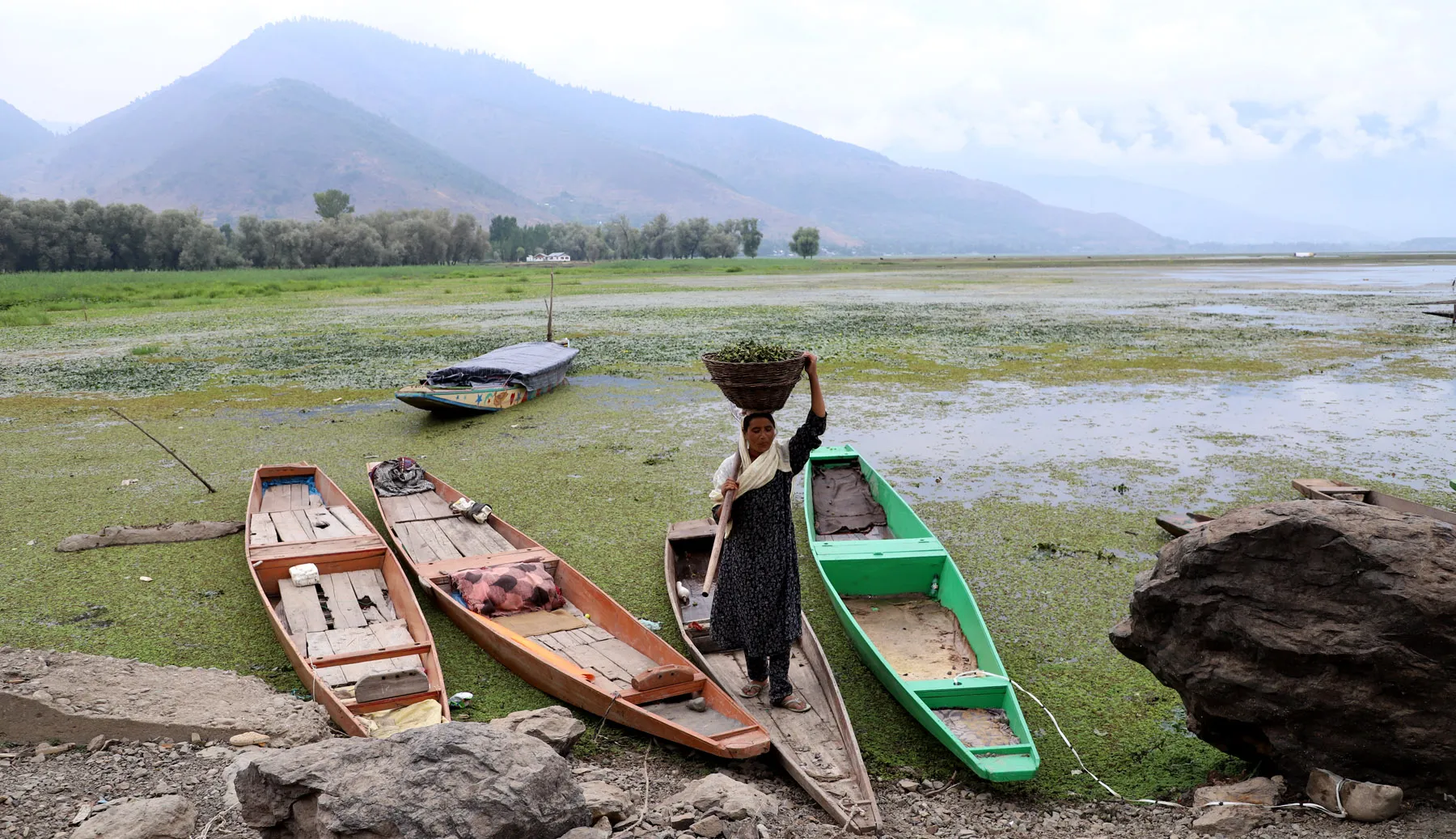
“If the administration maintains its focus on making the lake clean, the aquatic life would be saved, and we will do much better,” Ashraf told Greater Kashmir. Cleaning the lake is indispensable to protect many people’s livelihood, he said. https://www.greaterkashmir.com/latest-news/photo-essay-harvesting-livelihood-from-dying-kashmir-lake/ (28 Aug. 2024)
West Bengal Chinese nets endangering wetlands’ aquatic eco-system -A fishing net, prohibited in Bangladesh for at least three years, is now being employed extensively across Bengal, endangering not only fish but also endangered turtles and diverse array of wetland birds. Bangladesh prohibited the manufacture, storage and utilisation of China Duari nets through a draft notification in 2021 because of the menace they posed to wetland faunal communities.
-According to members of Human and Environment Alliance League (HEAL), the nets were mainly being used in Nadia, Malda, Murshidabad, South 24 Parganas and Cooch Behar. “China Duari nets are placed in shallow water bodies where they entrap fish that ingress through the funnel-like inlets. The mesh size is so small that even fries are incapable of escaping. Once deployed, the nets remain in wetlands for days, ensnaring not only fish but also invertebrates, frogs, snakes and birds. The potential to entrap fries and young fingerlings can lead to a significant decline in fish population over time. In fact, China Duari poses a major threat to the entire wetland animal community. These nets are also being increasingly employed for turtle poaching in Murshidabad,” said HEAL’s Suvrajyoti Chatterjee. https://timesofindia.indiatimes.com/city/kolkata/chinese-nets-endangering-turtles-and-birds-in-bengal-wetlands/articleshow/112772002.cms (25 Aug 2024)
MoEF Sahbhagita Mission for wetlands conservation A two-day regional workshop under the Sahbhagita Mission, focused on the conservation and management of wetlands, was held in Kolkata on Thursday and Friday (Aug 29 & 30). This workshop was the seventh in a series of regional workshops under the Sahbhagita Mission and the second of the FY 2024-25. Previous workshops have been held in Srinagar, Goa, Kochi, Imphal, Bhubaneswar, and Hyderabad.
The workshop included several key sessions: a consultation on the proposed amendment of the Wetlands (Conservation and Management) Rules, 2017; a demonstration of the online IMP submission process being developed through the Wetlands of India portal; a discussion on enhancing the participation of Wetland Mitras in conservation efforts; and a showcase of private sector involvement in landscape-level wetland management in Munger, Bihar. https://timesofindia.indiatimes.com/india/regional-sahbhagita-mission-to-boost-wetlands-conservation-in-eastern-states-of-india/articleshow/112933228.cms (30 Aug. 2024)
WATER OPTIONS
Pune PMC to survey all wells, natural springs for better GW management The survey intends to gather detailed information on each and every well and spring, including the location (latitude, longitude, and address); type of well (whether it’s a dug well, step well, or natural spring); and its operational status (whether the well is operational, non-operational, or functional only during certain seasons). Dimensions such as the size and depth of the well in metres will be measured, and the purpose of any installed pumps, whether for domestic, irrigation or industrial use will be noted. The data collected will be used to identify critical recharge areas that need protection, and to plan for future improvements in water infrastructure.
Additionally, the survey will assess the water quality, determining whether it is clear, smelly, or turbid. Ownership details will be recorded, whether the well is private or belongs to a society; and is managed by the PMC or government or is a community resource. Lastly, the year of construction will be documented along with any recharge infrastructure in place such as rainwater harvesting tanks, spring recharge systems, percolation pits, or borewell recharge systems. https://www.hindustantimes.com/cities/pune-news/pmc-to-survey-all-wells-and-natural-springs-for-better-groundwater-management-101725041654988.html (31 Aug. 2024)
Delhi 10 water bodies at Asola Bhatti to store 80mn litres Forest and wildlife department has created 10 water bodies at south Delhi’s Asola Bhatti Wildlife Sanctuary over the past nine months to collectively store around 80 million litres of water, officials aware of the development said. They said that the water bodies have been created at topographically strategic locations where water naturally accumulates. The creation of these 10 water bodies has also been shared by the CPCB in a report to the NGT. CPCB inspected Asola in June, on NGT orders seeking details of the revival of water bodies in Delhi, including at the sanctuary.
The department said the average depth of 10 water bodies, all of which were carved out at Sahoorpur, Satbari and Maidangarhi, is around three metres and the average area is 0.9 acres. Four each have been created at Satbari and Sahoorpur, while two have been created at Maidangarhi. “The water bodies are nearly an acre in size. The largest water body is spread across 1.21 acres at Sahoorpur and the smallest is around 0.68 acres, at Satbari,” the forest official, on condition of anonymity, said. Over time, the official said they also plan to assess the impact of water bodies in terms of groundwater recharge. https://www.hindustantimes.com/cities/delhi-news/10-water-bodies-at-asola-bhatti-to-store-80mn-litres-recharge-groundwater-table-101724695717737.html (27 Aug. 2024)
GROUNDWATER
Punjab Danger swells in wells High levels of arsenic, uranium, iron, and nitrate have contaminated groundwater in the Amritsar and Tarn Taran areas of Majha region. The joint research of Pondicherry University’s earth sciences department and Fatehgarh Sahib’s World University has revealed alarming indicators for public health.
These institutes had evaluated the levels and spatial distribution of potentially toxic elements (PTEs) — arsenic (As), iron (Fe), uranium (U), and nitrate (NO3-) — in 2,709 groundwater samples that the state’s water supply and sanitation department had drawn from Majha’s Tarn Taran, Amritsar, Gurdaspur, and Pathankot districts. The analysis of this data suggested that arsenic levels in 16% or 334 of the locations in the study zone had surpassed the safe limit of 0.05 parts per million (ppm). Amritsar was the worst case, followed by Gurdaspur and Tarn Taran. Pathankot was the only district within safe limits. https://timesofindia.indiatimes.com/city/chandigarh/high-levels-of-arsenic-uranium-iron-and-nitrate-contaminate-groundwater-in-amritsar-and-tarn-taran-punjab/articleshow/112960513.cms (01 Sept. 2024)
URBAN LAKES, WETLANDS
Chennai Ennore-Pulicat: NGT seeks invasive mussels removal plan The southern bench of the NGT has directed the Chief Secretary to furnish a plan of action within a week for removing invasive mussels from Ennore – Pulicat wetlands.
During the hearing of a petition filed by Kumaresan Sooluran, a resident of Ennore, regarding the spread of invasive mussels in the Kosasthalaiyar river, the Additional Advocate General (AAG) submitted that the Chief Secretary had recently chaired a meeting on the issue, following a prior direction from the bench. The matter has been posted for hearing on September 6. https://www.thehindu.com/news/cities/chennai/gssngt-directs-chief-secretary-to-submit-action-plan-soon-for-removing-invasive-mussels-from-ennore-pulicat-wetlands/article68586264.ece (31 Aug. 2024)
URBAN WATER
Bengaluru Experts raise concerns over ₹12,690 cr tunnel road project -Dr D Paramesha Naik, Professor, Department of Environmental Science, Bangalore University, expressed his reservations over the project. He pointed out that the project could face problems with geological complexities with hard rocks and fissures, making tunneling difficult and expensive; major disruptions in water table, affecting nearby water sources and structures; Bengaluru’s soil being prone to settlement and instability, potentially affecting tunnel structural integrity; special design considerations for tunnel stability; and environmental concerns as tunneling can impact nearby ecosystems, water bodies, and air quality.
-It was precisely due to these challenges and the high costs that the idea of having a Metro Rail network completely underground in Bengaluru was not taken. The experts have instead batted for sustainable solutions to address traffic issues by optimising existing infrastructure, improving public transport and promoting sustainable urban planning more effectively. https://www.newindianexpress.com/states/karnataka/2024/Aug/30/experts-raise-concerns-over-bengalurus-rs-12690-crore-tunnel-road-project (30 Aug. 2024) Civic activists and mobility experts have termed the project ‘unconstitutional’ as the cabinet granted administrative approval to the 18.5 km tunnel road from Hebbal to Silk Board, costing Rs 12,690 crore, without consulting constitutional bodies like the Bangalore Metropolitan Planning Committee (MPC) and Bangalore Metropolitan Land Transport Authority (BMLTA) that is tasked to plan the city. https://www.newindianexpress.com/cities/bengaluru/2024/Sep/01/tunnel-road-may-trigger-water-crisis-in-bengaluru (01 Sept. 2024)
Mumbai A tunnel through city’s green heart On July 13, PM Modi laid the foundation stone for the Rs 16,600 crore Thane-Borivali Twin Tube Tunnel project in Mumbai, in the run up to elections to the state assembly due later this year. But its impact on Mumbai’s only national park will be known only after the project is well on its way to completion, contrary to a condition laid down by the National Board of Wildlife (NBWL) while granting permission for the project. As planned, the project will run under the Sanjay Gandhi National Park (SGNP) and is aimed at providing east-west connectivity, reducing congestion on Ghodbunder Road, a major city connector, and is supposed to reduce travel from Thane city to Borivali in western Mumbai by 12 km. Megha Engineering and Infrastructure Ltd (MEIL), the second largest donor through the now-scrapped electoral bonds scheme, has won the contract.
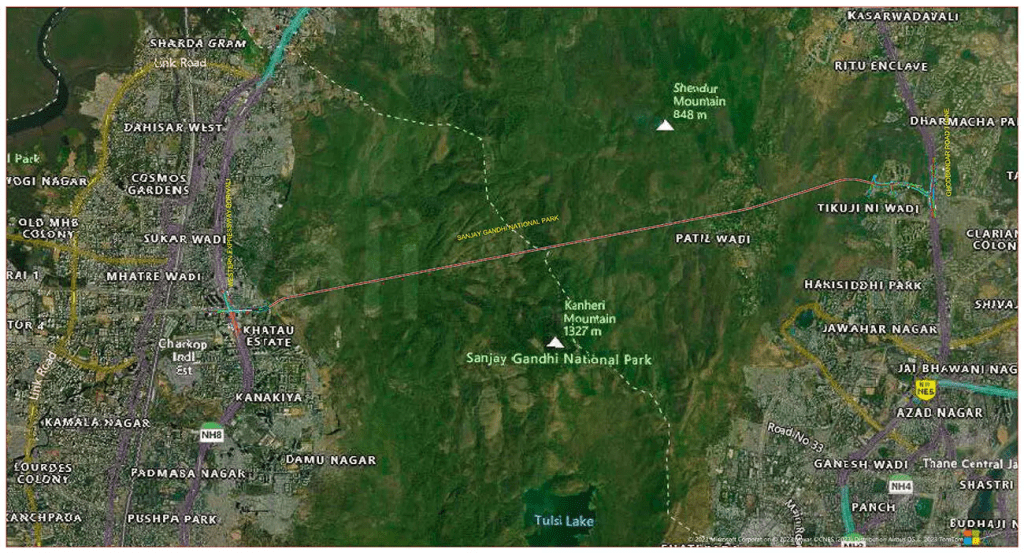
The tunnel project had been on paper for years, until it was given clearance by the state wildlife board in October 2023. Earlier this year, the NBWL greenlit the project too subject to a list of conditions, one of them being that “A cumulative study on the effect of construction of underground tunnel [on] the ecological, geological, hydrological and seismological aspects of the Sanjay Gandhi National Park (SGNP) from WII needs to be undertaken… before commencement of the project. Accordingly, the necessary precautions and safety measures… shall be incorporated in the project.”
Over the years, environmentalists have raised concerns over the proposed project and how it will affect the biodiversity, aquifers, ecology and other natural elements of SGNP. In the absence of an environment impact assessment, the study can bring to the fore crucial information on the same. However, the study will take at least two years to complete, whereas construction of the tunnel is slated to begin after the monsoon season, officials told us. https://www.indiaspend.com/infrastructure/thane-borivali-tunnel-a-shortcut-through-mumbais-green-heart-922107 (30 Aug. 2024)
Morbe Dam crosses overflow mark With the water level crossing the overflow mark of 88 metres in the early hours of Thursday (Aug. 29), Morbe Dam,the lifeline of Navi Mumbai, authorities have opened both gates to release excess water from the reservoir into the Dhavri River downstream to avert imminent flooding in the region. The catchment area has received impressive rainfall in the last few days. The dam supplies around 450 MLD of drinking water to the NMMC area, besides parts of Panvel City Municipal Corporation (PCMC) nodes and en route villages. Meanwhile, NMMC has withdrawn water cuts that were imposed in phases with diminishing water levels during summer.
Constructed on the foothills of Matheran near Chowk village of Raigad district, Morbe Dam is owned by Navi Mumbai Municipal Corporation (NMMC), the only civic body to have purchased its own dam after Independence. The maximum height at which water overflows in the dam is 88 metres. The dam has a total storage capacity of 190.89 million cubic metres (MCM). With impressive rainfall in catchment areas, the season’s total rainfall recorded at 3,374 mm, which stands as good as the average annual rainfall of 3,200 mm. https://timesofindia.indiatimes.com/city/navi-mumbai/morbe-dam-overflow-sparks-joy-in-navi-mumbai/articleshow/112935933.cms (31 Aug. 2024)
Pune 28 km tunnel from Khadakwasla dam to Phursungi approved The government on Sunday (Aug. 25) approved a proposal for a 28 km-long tunnel between Khadakwasla Dam and Phursungi. This project is expected to save around 2.8 TMC of water, which is sufficient for a two-month supply for the city. The project will also reduce water seepage and provide additional water for agriculture. The WRD plans to construct a ‘D’-shaped tunnel that will be 7.80 meters wide, 3.90 meters high, and 1.950 meters in circular height. This tunnel will increase the canal’s capacity to 1,510 cusecs, with water being carried by gravity to Phursungi. Earlier, a technical study for the project’s implementation was conducted. The technical committee from the state irrigation department subsequently cleared the detailed project report of the proposed water tunnel. https://www.freepressjournal.in/pune/pune-28-km-tunnel-from-khadakwasla-dam-to-phursungi-gets-approval (26 Aug. 2024)
Chandigarh Sewage mixing with drinking water supply People residing in flats at Chandigarh Housing Board (CHB) colonies for economically weaker sections (EWS) are forced to receive drinking water mixed with sewage even as the city Municipal Corporation is waiting to get Rs 15 crore sanction from the board to carry out sewerage upgrade. While occupants of these EWS colonies in Dhanas, Maloya, Ram Darbar, Vikas Nagar, and Sectors 56 and 38, have been paying ground rent/rent to the CHB, they continue to remain deprived of the basic facility of getting clean water in the “Smart City” of Chandigarh. https://www.tribuneindia.com/news/chandigarh/sewage-mixing-with-drinking-water-supply-at-chb-colonies/ (30 Aug. 2024)
Delhi environment minister Gopal Rai addressed concerns on Sunday (Sept. 01) about the construction of smog towers and the potential use of cloud seeding to combat air pollution in the city. https://timesofindia.indiatimes.com/city/delhi/ready-for-cloud-seeding-need-permissions-says-delhi-minister-gopal-rai-as-ncr-gears-up-for-winter-pollution/articleshow/112965242.cms (01 Sept. 2024)
JJM/ RURAL WATER SUPPLY
उत्तराखंड खोखले वादे और टूटे नल सरकारी वेबसाइट के अनुसार, अगस्त 2019 में उत्तराखंड में केवल 130,325 घरों में, जो 9 फीसदी से भी कम है, नल का जल कनेक्शन था। जुलाई 2023 तक सरकारी आंकड़ों के अनुसार, उत्तराखंड में 78.40 फीसदी घरों में नल का जल कनेक्शन था, और जुलाई 2024 तक यह अनुपात 95 फीसदी से अधिक हो गया। जल शक्ति मंत्रालय के आधिकारिक आंकड़े राज्य सरकार द्वारा बताए गए आंकड़ों पर आधारित हैं।
लेकिन इन्हें ग्राम पंचायतों (निर्वाचित ग्राम परिषदों) द्वारा प्रमाणित किया जाना चाहिए, जो अपने गांवों को ‘हर घर जल’ प्रमाणित घोषित करते हैं, जो दर्शाता है कि सभी घरों में सुरक्षित पानी की पहुंच है। उत्तराखंड के 14,884 गांवों में से 8,501 गांवों को 100 फीसदी कार्यात्मक घरेलू नल कनेक्शन गांव (एफएचटीसी) बताया गया है। हालांकि केवल 3,749 गांवों को ही ग्राम पंचायतों द्वारा इस तरह से प्रमाणित किया गया है। https://dialogue.earth/hi/10-hi/60045214/ (26 July 2024)
WATER
Study 4.4 billion people lack access to safe drinking water The research suggests that drinking water supplies are likely to be contaminated by fecal material or chemical contaminants in areas without access to water management services. But the report only examined access to clean water in low and middle-income countries, meaning the figure would likely be greater once poor access in higher income countries is accounted for. The numbers account two-thirds of those living in low and middle-income countries. “The information which we have points towards very high rates of contamination,” said lead researcher Esther Greenwood from ETH Zurich, Switzerland.
The analysis used E.coli bacteria as a proxy indicator for contamination. Water contaminated with E.coli caused a norovirus outbreak in Italy this summer, and caused several athletes to get sick after swimming in the River Seine during this year’s Olympic games. E.coli is not the only potential cause of water contamination. While not included in this study, arsenic and fluoride levels are also used to monitor chemical contamination in water.
Almost 500 million people worldwide collect water from unprotected wells, rivers, ponds, and lakes, the WHO estimated in 2022. Data also shows people living in towns and cities with low-incomes, or informal or illegal settlements, have less access to improved sources of drinking water compared to other residents. Improving water supply and management infrastructure will make drinking water safer according to the study. https://www.newindianexpress.com/ani/environment/2024/Aug/31/44-billion-people-lack-access-to-safe-drinking-water (31 Aug. 2024)
AGRICULTURE
Karnataka Soil is not in great condition: Data Soil Organic Carbon (SOC) is an indicator of soil health and quality. It is very low in most of Karnataka due to excessive use of chemical fertiliser and reduction in use of organic fertiliser. According to analysis of 23 lakh (including 7 lakh in last four years) soil samples by Agriculture department between 2017 and 2024, SOC. is less than required 0.5% in 50.41 % soils in Karnataka. Kolar & Dharwad dists are the worst performer while Uttar Kanada, Udupi and Dakshin Kannada are the top performers. The cattle population in the state has declined from 1.48 Cr in 2007 to 1.19 Cr in 2019. https://www.deccanherald.com/india/karnataka/karnatakas-soil-is-not-in-great-condition-shows-data-3165213 (27 Aug. 2024)
Report Use organic fertilisers: Agri Minister Union Minister (Aug. 31) Shivraj Singh Chouhan on Saturday urged farmers to switch to organic fertilisers to save the soil from turning infertile and also for the betterment of human health. The Union minister for agriculture and farmers welfare was interacting virtually with farmers and ‘Swayampurna Mitras’ (officials assigned to deliver government schemes) of Goa. https://www.business-standard.com/india-news/use-organic-fertilisers-to-ensure-soil-does-not-turn-infertile-chouhan-124083100383_1.html (31 Aug. 2024)
MONSOON 2024
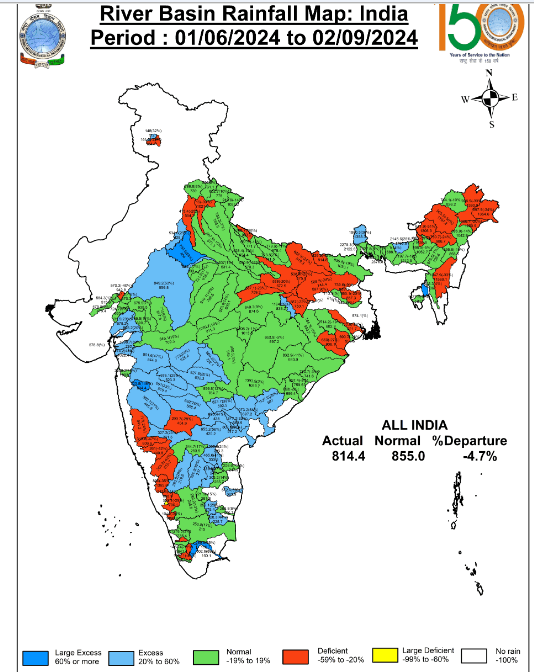
Report IMD’s upgrade is necessary While this EDIT in Indian Express on India Meteorological Department is welcome, such persistent critical attention is required in the forecasting by IMD as the stakes are getting higher with each passing day. IMD needs to graduate from general warning to specific actionable forecasts. Critical analysis is required the accuracy and timing of IMD forecasts done and not done. https://indianexpress.com/article/opinion/editorials/india-meteorological-department-climate-9536545/ (28 Aug. 2024)
Interview Weather forecasts alone won’t save lives. We need early warnings that tell us about the impacts whether it is a landslide or flashflood —and policies to safeguard lives and livelihoods over hazard zones. We have the capacity to do that: Vigyan Yuva awardee Dr. Roxy Mathew Koll a climate scientist from the Indian Institute of Tropical Meteorology (IITM), Pune https://www.youtube.com/watch?v=FLNiNyTU6Tw (29 Aug. 2024)
Met dept upgrade in pipeline Its shortcomings having been routinely exposed, particularly by extreme events, India’s weather department is set to get a massive upgrade of its forecasting capabilities that will enable it to make localised and extreme-weather predictions with far greater accuracy. A new mission to improve weather forecasting, with a budget of at least Rs 10,000 crore is expected to be launched soon, The Indian Express has learnt. It is likely to be several times bigger than Monsoon Mission, launched in 2012, that has resulted in a noticeable uplift in the capabilities of the IMD. https://indianexpress.com/article/india/india-meteorological-department-imd-new-mission-rain-weather-predictions-imd-capabilities-weather-forecasting-capabilities-9534713/ (27 Aug. 2024)
Indian monsoon moving westward? The traditional patterns of the Indian monsoon appear to be undergoing a significant transformation. The unexpected surge in rainfall across Gujarat, Maharashtra, and Rajasthan during August and September in the last few years challenges long-held expectations about regional rainfall distribution and hints at a potential directional change in the monsoon’s trajectory. While these western states typically experience moderate rainfall, the recent deluge has caught meteorologists and local authorities off guard, prompting discussions about the evolving nature of India’s monsoon system.
Typically, low-pressure systems formed in the Bay of Bengal would move northwest, bringing substantial rainfall to northern states like Bihar, Uttar Pradesh, Haryana, and Punjab. However, this year has seen a marked deviation from this pattern, with these systems moving east to west instead. This shift has resulted in above-normal rainfall in traditionally drier states such as Madhya Pradesh, Maharashtra, Rajasthan, and particularly Gujarat while leaving the northern plains comparatively drier. The westward shift is not an isolated incident but part of a trend observed over the past four to five years, further reinforcing the impact of climate change on monsoon patterns. This year alone, four low-pressure areas and two depressions emerged in the Bay of Bengal, almost all following a westward trajectory.
Dr Kasiapillai S. Kasiviswanathan, Associate Professor, Dept. of Water Resources Development and Management at the IIT Roorkee told IndiaToday.in that a few studies report a regional shift in monsoon patterns, leaving the northwest region of India with reduced rainfall, while the western and southwestern regions receive more. “This shift is partly attributed to extensive agriculture practices over northwest region, which alter local atmospheric conditions. Excess irrigation and increased aerosol content above central India are contributing to the decline in Walker circulation. Additionally, higher temperatures are driving a significant influx of moisture from the land over Western India, enhancing cloud formation and condensation in that region before the monsoon systems move northwards,” Dr Kasiapillai added. https://www.indiatoday.in/science/story/indian-monsoon-moving-westward-unusual-rain-spotlights-changing-weather-system-2590745-2024-08-30 (30 Aug. 2024)
Dry monsoon in Indo-Gangetic plains is a long-term trend The 2024 monsoon season – it officially runs from June to September – appears rainy enough by most accounts. Country-level rain in the season so far has registered a surplus and, even at the disaggregated level, only 23% of India’s total area has a deficit. However, there is one point of concern. The dry areas are mostly those where the monsoon is drying up long-term, where most of India’s rice is produced, and where workers are concentrated in the farming sector. While there is a low correlation between a dry or delayed monsoon and paddy sowing, long-term drying could create economic distress in these areas in the future. Here are four charts that explain this. https://www.hindustantimes.com/editors-pick/number-theory-dry-monsoon-in-the-indo-gangetic-plains-is-a-long-term-trend-101724725823295.html (27 Aug. 2024)
16% more than normal rainfall in August Continuing its August trend, the monsoon rainfall in most parts of the country in September is likely to be ‘above normal’ with certain states including Uttarakhand, Rajasthan, and parts of Himachal Pradesh and Punjab expecting extremely heavy rainfall activities leading to floods and landslides in certain areas, IMD said on Saturday (Aug. 31). India reported 16% more than normal rainfall in August which was fifth highest in the month since 2001 and 29th highest since 1901.
Good rains (287 mm) in August, however, could not bring down overall temperature during the month as it reported the highest average minimum temperature and fourth highest average mean temperature since 1901. It can be attributed to variation in spatial distribution of rainfall in the country where northwest India got 32% more than normal rainfall in August (second highest in the month since 2001) whereas the south Peninsula received merely around 1% more than normal rains in the month. Though the country as whole is likely to get ‘above normal rainfall in September, certain areas — north Bihar, northeast Uttar Pradesh, most parts of northeast India, extreme northwest India and many parts of south Peninsular India — may get ‘below normal’ rainfall. Overall, the four-month (June-Sept) monsoon season as predicted in mid-April will be logged out as ‘above normal’ rainfall activity. https://timesofindia.indiatimes.com/india/india-records-16-more-than-normal-rainfall-in-august-fifth-highest-in-the-month-since-2001-sept-may-get-above-normal-rains/articleshow/112954527.cms (31 Aug. 2024)
According to IMD, most parts of India are expected to receive above-normal rainfall in September. Addressing a virtual press conference, IMD director general Mrutyunjay Mohapatra said precipitation is expected to be more than 109% of the long-term average of 167.9 millimetres (6.6 inches).Heavy to very heavy rainfall is likely in the northwest region, including Uttarakhand, parts of Himachal Pradesh, Jammu and Kashmir, Rajasthan, and the adjoining areas of Madhya Pradesh. “There could be episodes of extremely heavy rainfall in these areas, potentially leading to floods. We should remain cautious of landslides, mudslides, and landslips,” Mohapatra said. “We anticipate a low-pressure system developing over the Bay of Bengal each week of the month, which will result in significant rainfall across the country,” he added. https://www.hindustantimes.com/india-news/india-braces-for-above-normal-september-rainfall-boost-to-crops-but-flood-risks-loom-101725123250326.html (31 Aug. 2024)
July-August rainfall hits 30-year high Rainfall recorded across India during July and August currently stands at 585 mm and is expected to surpass 595 mm within the next two days, which would be approximately 11 per cent above the long-period average of 535.4 mm. The significant rainfall in August follows a 9 per cent surplus in July, bringing the average rainfall across India in August to 16 per cent above normal as of August 29. The IMD had initially forecasted August rains to be within the normal range (94-106 per cent of the long-period average).
In a rare meteorological event, a deep depression currently situated over Saurashtra and Kutch is expected to move into the Arabian Sea and intensify into a cyclone by Friday (Aug. 30), according to the IMD. This would be the first cyclone to develop in the Arabian Sea in August since 1976. Although the storm is projected to move westward along the coasts of Pakistan and Iran, winds of up to 75 kmph are expected along the Gujarat coast from Thursday (Aug. 29) to Saturday (Aug. 31). Additionally, a low-pressure system in the Bay of Bengal is likely to intensify into a depression and head towards north Andhra Pradesh-south Odisha within the next two days. https://www.business-standard.com/india-news/india-s-july-august-rainfall-hits-30-year-high-la-nina-delayed-to-november-124083000490_1.html (30 Aug. 2024)
Monsoon rains likely to be prolonged The monsoon generally begins in June and starts to retreat by Sept. 17 from northwestern parts of the country, ending across the country by mid-October. Monsoon rainfall in September and October could be influenced by La Nina weather conditions, which are likely to develop from the next month, said another IMD official. In the past, when La Nina develops during the second half of the monsoon season, it has led to a delayed monsoon withdrawal, said the official, adding that “this year, we could see a similar pattern”.
The two sources shared their assessment ahead of the IMD’s monthly forecast for September rainfall and monsoon withdrawal, which is scheduled for this weekend. India has received 7 per cent more rainfall than average since the monsoon season began on June 1. However, some states have experienced as much as 66 per cent more rainfall than average, leading to flooding. https://www.business-standard.com/industry/agriculture/monsoon-rains-likely-to-be-prolonged-threatening-crop-harvesting-124082901093_1.html (29 Aug. 2024)
IMD has revealed that this year’s August was the warmest one since 1901, with the all-India average monthly minimum temperature rising to an all-time high of 24.29 degrees Celsius for the month. At least two regions, Southern Peninsular India and Central India, recorded their hottest August in 123 years, while east and northeast India and northwest India witnessed their fourth warmest August this year, IMD officials said. https://www.financialexpress.com/india-news/as-india-witnesses-warmest-august-in-123-years-imd-predicts-above-normal-rainfall-in-september-these-likely-to-see-rainfall-today/3597977/ (01 Sept. 2024)
Two low pressure systems to form over Bay of Bengal over the next few days and then move towards MP via WB, Odisha, Jharkhand. These could also bring lot of rains to Narmada valley, among others.
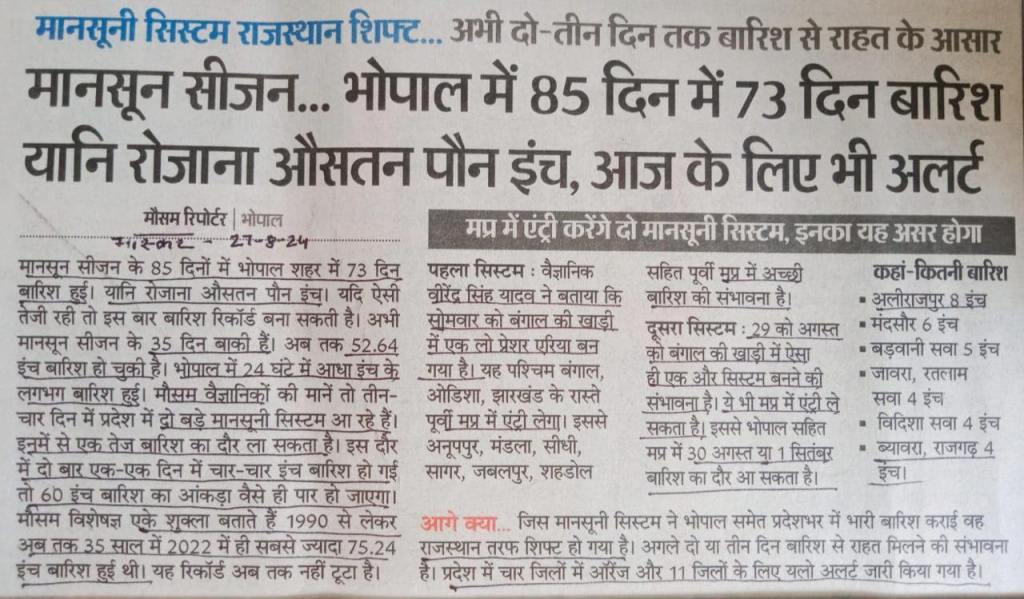
Govt to revive DAMUs The govt plans to revive district agrometeorological units (DAMUs) that provide weather-related information to farme₹Previously shut down on the IMD’s directive, these units will be restructured with permanent staff to improve forecast quality. Several politicians opposed their closure, citing their importance in aiding agricultural decision-making.
The government is set to revive the network of district agrometeorological units (DAMUs), which previously provided essential weather-related information to farme₹Operations were halted following a directive from the IMD earlier this year. Initially launched in 2015 under the Gramin Krishi Mausam Seva (GMSV) initiative, these units assist farmers with crop-specific advisories. https://www.devdiscourse.com/article/headlines/3066185-government-to-revive-district-agrometeorological-units-to-aid-farmers (28 Aug. 2024)
Delhi experienced its highest August rainfall in 12 years, with 378.5 mm recorded, according to the IMD. The IMD data indicates that the last time Delhi saw more rainfall in August was in 2010 when 455.1 mm was recorded. The second-highest was in 2012, with 378.8 mm. The record for the most August rainfall in Delhi is 583.3 mm, set in 1961. https://www.newindianexpress.com/cities/delhi/2024/Aug/30/378-mm-highest-august-rainfall-in-12-years-in-delhi (30 Aug. 2024)
FLOOD 2024
SANDRP Blog Will SSP AGAIN create avoidable flood disaster in Sept 2024? IMD has today given a flash flood warning for Narmada Basin districts of Madhya Pradesh, among others. In addition, its forecast says that Madhya Pradesh is likely to received some heavy to very heavy rainfall in the next few days.
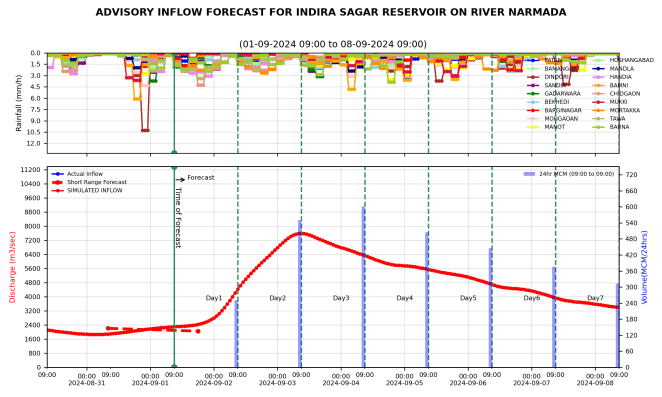
Considering the water storage situation at Sardar Sarovar, Indira Sagar, Omkareshwar, Bargi and Tawa dams, there is urgently need to release water now to create flood cushion for the likely inflows in next few days, to avoid creating a man made flood disaster. Particularly Sardar Sarovar dam needs to start increased releases considering the avoidable flood disasters it created including in 2019, 2020 and Sept 2023. Plz Read, Share. https://sandrp.in/2024/09/01/will-sardar-sarovar-again-create-avoidable-flood-disaster-in-sept-2024/ (01 Sept. 2024)
Aug 2024: Karchul Earthen Dam Breach in MP a wake up call On Aug 28, the earthen wall of Karchul Dam in Shahdol district in Madhya Pradesh breached, requiring midnight operation to shift people to safety. Local people have said that the dam was not maintained properly. Since most of India’s dams are earthen dam, and their maintenance and spillway capacity far from adequate, this is another wake up call for Dam Safety in India. https://sandrp.in/2024/09/01/aug-2024-karchul-earthen-dam-breach-in-shahdol-madhya-pradesh-a-wake-up-call/ (01 Sept. 2024)
Tripura Plan in advance to deal with floods: Experts Himanshu Thakkar, Coordinator, South Asia Network for Dams, Rivers and People (SANDRP), told DTE that such a heavy rainfall was bound to result in a havoc. “So, the planning and actions to prevent the crisis from worsening should have been taken well in advance. They [authorities] could have started releasing water from Dumbur dam much earlier in lesser volumes rather than releasing it in one go,” he said. “The release of water should have been done after alerting all the downstream areas. The Tripura Disaster Management Authority (TDMA) doesn’t have much information on their website and the Facebook page,” Thakkar pointed out. Regarding the impact of climate change on Tripura, Thakkar underlined India’s disaster management system at large needs an overhaul. “So, there was heavy rainfall upstream, which they did not care about and that created havoc. They are not updating their communication systems in a timely manner,” he remarked. “For example, the same was the case in Sardar Sarovar Dam (Gujarat) during last year’s heavy rainfall. They didn’t open the gates till water entered into the reservoir,” he reminded. https://www.downtoearth.org.in/natural-disasters/tripuras-floods-classic-example-of-climate-change-intensifying-extreme-weather-events-experts (27 Aug. 2024)
Lessons from devastating floods “As an upstream state it becomes India’s duty to alert both Indian and Bangladeshi authorities,” said Himanshu Thakkar, the founder and coordinator of SANDRP.
– At the same time, experts said dam authorities could have managed water release better. They pointed out that water from the Dumbur dam could have been released earlier than August 21, to avoid the sudden surge of water downstream. Action could have been taken “at least three days ago”, said Thakkar, when on August 18, the India Meteorological Department forecast “heavy to very heavy rainfall” for Tripura between August 18 and August 23. “To prepare for such heavy rainfall, the authorities could have made space in the reservoir by releasing the water earlier than August 21,” said Thakkar.
– An official from the Tripura State Electricity Corporation Limited, which operates the Dumbur dam, also said that the gates were not operated manually. “Excess water was released automatically after the reservoir was full,” said Manoj Debberma, additional general manager (generation) of Tripura State Electricity Corporation Limited. He added that till the water was below the danger level of 93.5 metres, “there is no need to release the water then.” Had they operated the gates manually, they could have lowered the water level by 1.5 metres, he said. “But why will we do so?” he said. “If we do, there will be water downstream.” Thakkar said this claim does not hold true. He noted that a decision to open the gates manually to a certain extent could have been made by assessing the carrying capacity of downstream catchment areas. https://scroll.in/article/1072470/behind-devastating-floods-in-tripura-and-bangladesh-record-rainfall-and-not-just-a-dam (27 Aug. 2024) त्रिपुरा में वनों की कटाई, भूमि उपयोग में बदलाव, प्राकृतिक जल निकासी पर अतिक्रमण, बाढ़ से निपटने के लिए बुनियादी ढांचे के रखरखाव की कमी और ऊबड़-खाबड़ भूभाग के कारण बाढ़ अधिक घातक बनाया https://hindi.downtoearth.org.in/climate-change/tripura-floods-are-a-classic-example-of-climate-change-experts (28 Aug. 2024)
Tripura deluge has exposed chinks in flood prevention mechanism The IMD categorised the 51.7 mm of rainfall in low-lying South Tripura districts as extremely heavy as early as 18 August. However, experts have argued that authorities did not take preventive action for the next three days. Himanshu Thakkar, coordinator of the SANDRP, said disaster management teams should have taken measures to reduce the damage on the morning of 19 August. “The extent of the damage could have been drastically reduced if the authorities had acted promptly, rather than waiting three days to respond.” Tripura Chief Minister Manik Saha only made an official announcement about the flooding in South Tripura on X on 20 August, two days after the heavy rainfall began. Experts believe the timely release of water from Tripura’s major Dumboor dam could also have given the state more time to prepare for the flooding. https://theprint.in/india/how-tripura-deluge-has-exposed-chinks-in-indias-flood-prevention-mechanism/2238684/ (26 Aug. 2024)
INDO BANGLADESH WATER SHARING: The authorities have opened all 109 sluice and spillway gates of Farakka Barrage in Murshidabad district in the Indian state of West Bengal as the water level in the Ganges river in Bihar has increased abnormally. A government source confirmed this to this correspondent that the water level has crossed the danger level of 72 feet. The water was flowing at 76 feet, the source added.
– The source in the Indian government told Prothom Alo Monday, “The meaning of controlled release here is that the gates have not been opened at equal height. Some of the gates have been opened at 10-12 feet height and some of them at 3-4 feet. As a result, water is not being released equally through all the gates.” This was done keeping in mind so that no flood-like situation appears anywhere, the source stated. India opened the gates on 24 August to release the Ganges water but no significant changes in the water level in the related rivers have been reported in the last two days, the source added. https://en.prothomalo.com/bangladesh/c01d95ncvw (26 Aug. 2024)
The foreign ministry spokesman, Randhir Jaiswal, clarified that the water release is a routine seasonal occurrence due to increased inflow from heavy rainfall in the Ganga river basin. Jaiswal emphasized that the Farakka Barrage is designed to divert 40,000 cusecs of water into the Farakka canal. The remaining water flows naturally downstream into the Ganga/Padma river, ensuring a balanced distribution. He highlighted that the barrage’s operation is a standard procedure during the monsoon season when water levels rise due to rainfall. He noted that all gates of the Farakka Barrage are typically kept open during the monsoon to manage the increased water flow effectively.
– Mohammed Abul Hossen, a Bangladeshi member of the India-Bangladesh Joint Rivers Commission, stated that the treaty governs water distribution from January to May, with the rest of the year managed through the barrage’s operational protocols. https://www.indiasentinels.com/air-force/bangladesh-floods-foreign-ministry-clarifies-farakka-water-release-amid-misinformation-6465 (26 Aug. 2024)
SK Sarkar, former secretary, Union Ministry of Water Resources on India-Bangladesh Teesta Water issue. https://www.thestatesman.com/bengal/resolve-teesta-1503335777.html (26 Aug. 2024)
छत्तीसगढ़ कोरबा जिले में पिछले पांच दिनों से हो रही बारिश से हसदेव बांगो बांध में पानी लबालब भर चुका है. बांध की कैपेसिटी और सुरक्षा को देखते हुए उसके 6 गेट खोले गए हैं. इसकी वजह से तेजी से 40 हजार क्यूसेक पानी नदी में छोड़ा जा रहा हैं. इसके साथ ही छत्तीसगढ़ विद्युत मंडल के हाईडल प्लांट से भी पानी नदी में आ रहा हैं, जिसके दबाव के चलते हसदेव दर्री बराज के तीन गेट खोले गए हैं और पानी छोड़ा जा रहा हैं.
इससे नदी किनारे बनी अवैध अतिक्रमित बस्तियों और निचले इलाके में बने हुए मकानों में पानी भर गया. कोरबा शहर में नदी किनारे बसी बस्तियों सीतामढ़ी और मोतीसागर पारा में बारिश के पानी का कहर देखने को मिला. नदी का जलस्तर बढ़ने से आधी रात में पानी लोगों के घरों में घुस गया और घर के सामान को भारी नुकसान हुआ. लोग रात में ही घर से बाहर निकल आए और परिवार के साथ रतजगा करने को मजबूर हो गए. इस इलाके के वार्ड पार्षद संतोष लांझेकर ने बताया कि रात में अचानक जलस्तर बढ़ने से वार्ड के 20 से अधिक मकान पानी के डुब गए. इन मकानों में रहने वाले लोगों को रात में ही राहत शिविर में लाया गया. https://mpcg.ndtv.in/chhattisgarh-news/heavy-rain-problem-in-district-of-korba-water-entered-the-village-due-to-rising-water-level-of-bango-dam-6428871 (27 Aug. 2024)
Gujarat 24 rivers, 140 reservoirs overflowing Several rivers and reservoirs in the state are overflowing and water from Ajwa Reservoir and Pratappura Reservoirs was released into Vishwamitri River leading to the inundation of several low-lying areas and causing water-logging at other places. As many as 140 reservoirs and dams, and 24 rivers in the state were flowing above the danger mark, according to an official release. Rains disrupted traffic movement, train services and flight operations in the state. The worst affected districts include Rajkot, Anand, Mahisagar, Kheda, Ahmedabad, Morbi, Junagadh and Bharuch. https://www.livemint.com/news/india/gujarat-floods-death-toll-dams-rivers-pm-modi-overflowing-waterlogging-search-and-rescue-efforts-bhupendrabhai-patel-11724891884435.html (29 Aug. 2024)
Morbi bears brunt of the onslaught, link to Kutch cut Morbi district has been the worst hit by the heavy rain in Saurashtra in the past three days. The Morbi district administration released 2.67 lakh cusecs from the Machhu dam, which forced the closure between Samakhiali and Maliya of National Highway 27, which connects Kutch and Ahmedabad. The Samakhiali-Maliya highway has turned into a river.
Ten of the nine dams in Morbi district are overflowing. The bridge on the Morsal dam at Habiyasar village in Chotila taluka of Surendranagar district collapsed, because of the heavy rate of water overflowing. There were people on either side of the bridge at the time, but no one was injured. https://timesofindia.indiatimes.com/city/rajkot/morbi-district-hit-by-heavy-rain-and-flooding/articleshow/112850033.cms (28 Aug. 2024)
Area around SoU submerged “According to TAD, out of 206 reservoirs in the state, 59 reservoirs are 100 per cent full. 72 reservoirs are on high alert, 22 are on alert, 9 are under flood warning and 7 rivers have overflowed. Sardar Sarovar Dam holds 88.74 per cent of total storage capacity i.e. 2,96,459 million cubic feet (MCFT) of water,” the release stated. https://www.timesnownews.com/city/ahmedabad/watch-heavy-gujarat-rain-submerges-area-around-sardar-sarovar-dam-and-statue-of-unity-article-112811858 (25 Aug. 2024) Parts of a road leading to the Statue of Unity in Gujarat has been washed away due to heavy rain and flooding in the state. https://thewire.in/environment/part-of-road-leading-to-statue-of-unity-washed-away-in-gujarat (31 Aug. 2024) Narmada river crossed the danger mark of 24 feet and went upto 27 feet at Golden Bridge on Aug 27, 2024. 280 people were evacuated from riverbank areas on Aug 26 2024. https://www.deccanherald.com/india/gujarat/narmada-river-crosses-danger-mark-at-golden-bridge-in-bharuch-low-lying-areas-flooded-3166099 (28 Aug. 2024)
Most of the reservoirs in the rain impacted region in the two states of Gujarat and Rajasthan were overflowing with state government officials saying that overflowing water from reservoirs could mean more flooding in the coming days. The state government said 96 reservoirs were flowing above danger levels, and a high alert was sounded for them. A warning was issued for 19 reservoirs flowing near their danger marks. https://www.hindustantimes.com/cities/jaipur-news/at-least-12-dead-11-missing-after-heavy-rainfall-in-gujarat-parts-of-rajasthan-101724766070379.html (27 Aug. 2024)
Rajkot: -206 talukas in Gujarat have received rainfall this Tuesday Aug 27 morning from 6 a.m. to 10 a.m. During these four hours, Rajkot taluka recorded the highest rainfall of up to 5.6 inches, followed by Lodhika, which received 4.9 inches, and Kotda Sangani, which got 3.6 inches. All three talukas are in Rajkot district. Meanwhile, Chotila in Surendranagar has recorded 3.4 inches of rain in these four hours.
-The Aji River has started flowing on both banks due to the overflowing of Aji Dam. More than 100 people have been rescued from riverside areas. The bridge near Chunarawad Chowk is waist-deep in water. In Surendranagar, Limbdi’s historic Dolatsagar Lake is overflowing. https://deshgujarat.com/2024/08/27/rajkot-receives-up-to-5-6-inches-of-rain-on-tuesday-morning-aji-1-dam-overflows/ (27 Aug 2024)
Vadodara In the Vadodara district, more than 3,000 people living in low-lying areas were shifted to safer places after the Vishwamitri River crossed the danger mark of 25 feet on Tuesday (Aug. 27) morning. More than 12,000 people were relocated on Tuesday (Aug. 27) in Vadodara (8,361) and Panchmahals (4,000)- the two worst affected states. So far, more than 23,870 people have been shifted to safe places and 1,696 rescued. Those evacuated in the last two days included 1,200 in Navsari, 800 in Valsad, 200 in Bharuch, 235 in Kheda and 200 in Botad districts. https://www.indiatoday.in/india/story/gujarat-floods-heavy-rain-vadodara-surat-ahmedabad-narmada-tapi-over-safety-mark-2589089-2024-08-28 (28 Aug. 2024)
Bharuch: -The Narmada River in the city is experiencing continuous inflow, with a discharge of nearly 4 lakh cusecs of water from the Sardar Sarovar Narmada Dam. The water level at the Golden Bridge, located between Bharuch and Ankleshwar over the Narmada River, crossed the danger mark of 24 feet at around 7 PM today Aug 26. As of 9 PM, the level is at 24.11 feet, compared to 17.38 feet on Sunday Aug 25 night at 11 PM. The warning level of 22 feet was crossed earlier today Aug 26. Typically, if the level reaches 30 feet, a few thousand people may need to be evacuated from Bharuch city and around a dozen villages. https://deshgujarat.com/2024/08/26/narmada-river-crosses-danger-mark-of-24ft-at-golden-bridge-in-bharuch/ (26 Aug 2024)
Respite from downpours is expected to be short-lived as Gujarat braces for another round of heavy rain from Sunday, even as the official death toll in the five days of torrential showers till Aug 29 hit 47. As per IMD, a depression formed in the Bay of Bengal is travelling towards Gujarat and Maharashtra. Heavy to extremely heavy rainfall is expected in Saurashtra, central Gujarat and south Gujarat regions till Sept 5. https://timesofindia.indiatimes.com/city/ahmedabad/gujarat-braces-for-another-spell-of-heavy-rain-death-toll-at-47/articleshow/112961119.cms (01 Sept. 2024) Deaths of at least 514 cattle were also reported in Saurahstra and Kutch during this period, officials said, even as the flood situation eased and the government made frantic efforts to restore electricity supply to 276 villages that continued to be in the dark till Saturday (Aug. 31) evening. https://indianexpress.com/article/cities/ahmedabad/27-dead-in-saurashtra-and-kutch-region-in-rain-related-incidents-toll-now-36-9543954/ (01 Sept. 2024) An official release said that as people started returning to their homes from shelter homes post the easing of the flood situation, 411 flood-affected people were paid Rs 2.94 lakh cash doles cumulatively by the government. https://indianexpress.com/article/cities/ahmedabad/gujarat-jamnagar-flash-floods-seven-killed-cattle-dead-9543273/ (31 Aug. 2024) Rain abates but several towns and villages continue to be flooded. https://indianexpress.com/article/cities/ahmedabad/rain-abates-but-several-towns-and-villages-continue-to-be-flooded-9542341/ (31 Aug. 2024)
The Union home ministry has constituted an inter-ministerial central team (IMCT) led by the executive director of the National Institute of Disaster Management (NIDM) to assess the damage caused by rainfall and floods in Gujarat. https://timesofindia.indiatimes.com/city/ahmedabad/central-team-to-assess-damage-caused-by-rainfall-and-floods-in-gujarat/articleshow/112977034.cms (02 Sept. 2024)
Telangana Water released to Nagarjuna Sagar The Srisailam reservoir on the Krishna river is currently experiencing substantial inflows, prompting the irrigation department to lift the radial crest gates up to 10 feet and release water to the downstream Nagarjuna Sagar Dam. As of the latest data, the inflows to Srisailam Reservoir stand at 2,13,624 cusecs, while the outflows are at 1,22,876 cusecs. The reservoir has a total storage capacity of 885 feet. The officials have also begun power generation at the left and right hydropower stations of the reservoir. https://www.siasat.com/srisailam-reservoir-experiences-high-inflows-water-released-to-nagarjuna-sagar-3086051/ (28 Aug. 2024)
At least 10 more people were killed as heavy rain battered Telangana and Andhra Pradesh for the second consecutive day on Sunday (Sept. 01), causing flooding and waterlogging in several areas, and disrupting road and rail traffic. In the worst affected Vijayawada district, Budameru, a rivulet on the outskirts of the district, overflowed at several points on Sunday, leading to flooding in many city localities. https://www.ndtv.com/india-news/andhra-pradesh-rain-telangana-floods-10-dead-in-rain-fury-in-andhra-telangana-over-100-trains-cancelled-6469913 (02 Sept. 2024)
Bihar Floods, erosion and the miserable existence in Danapur Diara The idiom ‘between the devil and the deep blue sea’ resonates well with the lives of the residents of Danapur Diara, located about 15 km from Patna. On one side is the fear of erosion, and on the other is the fear of floods. And this has been the case for the last 46 years. Things were no different this time when Danapur Diara came under the grip of floods on August 5, when 13,42,097 cusecs of water were released into River Son from Indrapuri barrage in Rohtas in a single day. As floodwaters entered the Ganga and submerged their fields, people anxiously watched through the night with a prayer on their lips. Pounding waters have eroded Diara’s land and displaced people from 15 villages so far, while fear of more villages submerging looms large https://101reporters.com/article/environment/Floods_erosion_and_the_miserable_existence_in_Danapur_Diara (27 Aug. 2024)
Uttar Pradesh Twin rivers rising unabatedly The water level of rivers Ganga and Yamuna on Wednesday (Aug. 28) continued to swell, giving sleepless nights to residents living in the low-lying areas of the city. The water level of the river Yamuna is rising rapidly compared to its Ganga. Officials of the flood control department admitted that the water level of Ganga at Chhatnag and Yamuna at Naini rose up to 16 and 26 cm in the past four hours only. While the water level of Ganga was rising at a slow pace at Phaphamau, it was increasing at an alarming pace at Chhatnag and Naini.
Officials, however, claimed that the rising trend of the twin rivers would not impose a major impact as the flood water was being released in both rivers in small amounts and phases. Officials also claimed that there was no need to worry for residents as the floodwater would pass through the city within two or three days. The residents of more than a dozen localities, including Ganga Nagar, Newada, Draupadi Ghat, Chota Baghara, and adjoining areas, are once again apprehensive and keeping a strict watch on the level. https://timesofindia.indiatimes.com/city/allahabad/rising-water-levels-of-ganga-and-yamuna-rivers-in-prayagraj/articleshow/112879046.cms (29 Aug. 2024)
Up & down trend of twin rivers continues After a brief lull, the water level of twin rivers Ganga and Yamuna has once again shown an increasing trend in the city on Tuesday (Aug. 20) morning. The up and down trend of twin rivers has left officials on flood department on their toes throughout the day who maintained a strict eye on water level. Officials of the flood control department, however, claimed that water level of both the rivers started rising after additional water was released into river Ganga and Yamuna from the dams. A senior official, meanwhile, told TOI, “Two days back, around 2 lakh cusec water was being released into Ganga from dams and as a result, there has been an increase of water level.” https://timesofindia.indiatimes.com/city/allahabad/twin-rivers-ganga-and-yamuna-water-levels-update/articleshow/112666210.cms (21 Aug. 2024)
BSP supremo Mayawati on Sunday (Sept. 1, 2024) alleged that state governments were unable to deal with the flood situation caused by heavy rains in the country and suggested them to pay attention to flood prevention. https://www.thehindu.com/news/national/uttar-pradesh/state-governments-should-pay-attention-to-flood-prevention-says-mayawati/article68592508.ece (01 Sept. 2024)
Madhya Pradesh A video showing several cows being thrown into a swollen river in Satna district, Madhya Pradesh, has gone viral on social media. Nagod police station in-charge Ashok Pandey said that the video surfaced on Tuesday (Aug. 27) evening, showing the cows being thrown into the Satna river from a railway bridge near Bamhor. Thepolice responded by sending a team to the location and subsequently registered a case. https://www.hindustantimes.com/india-news/madhya-pradesh-50-cows-thrown-into-swollen-river-20-dead-shocking-video-101724836402443.html (28 Aug. 2024)
Report The National Commission concluded that the policy’s coverage for flood and inundation would include losses caused by heavy rains. https://www.business-standard.com/opinion/columns/heavy-rain-damage-covered-under-policy-for-flood-and-inundation-124090100673_1.html (01 Sept. 2024)
HFL BREACH
Andhra Pradesh: -1 River Munneru at Polampalli site in Krishna district has crossed old HFL 70.78 meter dated 27.07.2023 at 12:00 hour on 01.09.2024. Present flood level is 71.36 meter at 15:00 hour on 01.09.2024 with rising trend. The previous HFL for the site is 70.21 meter dated 30.07.2010.
2 Munneru at Paleru site in Krishna district has crossed old HFL 77.01 meter dated 27.07.2023 at 14:00 hour on 01.09.2024. Present flood level is 79.54meter at 16:00 hour on 01.09.2024 with rising trend. The previous HFL for the site is 76.79 meter dated 10.08.2008.
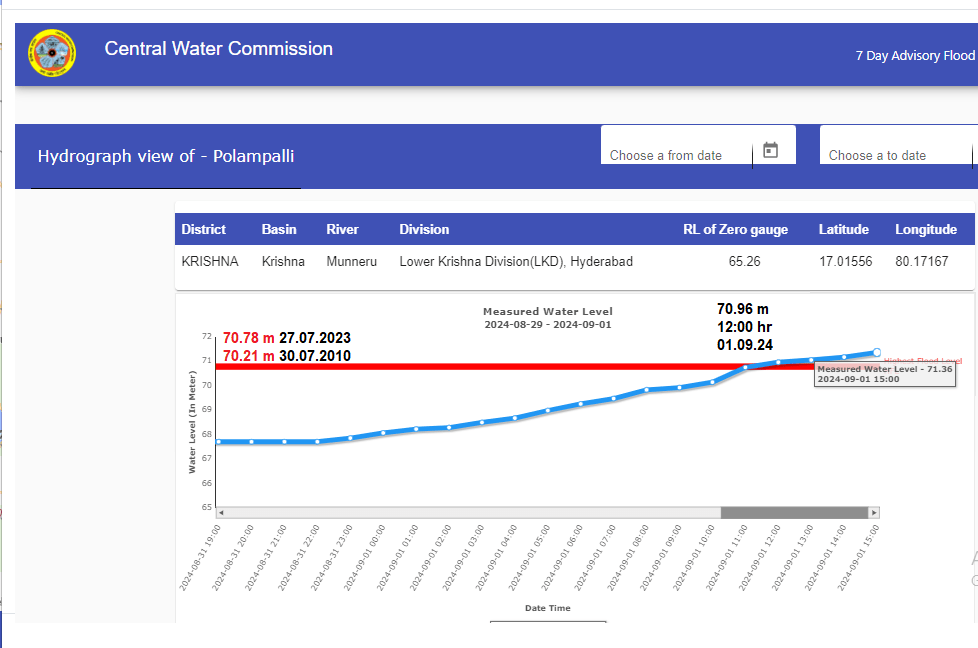
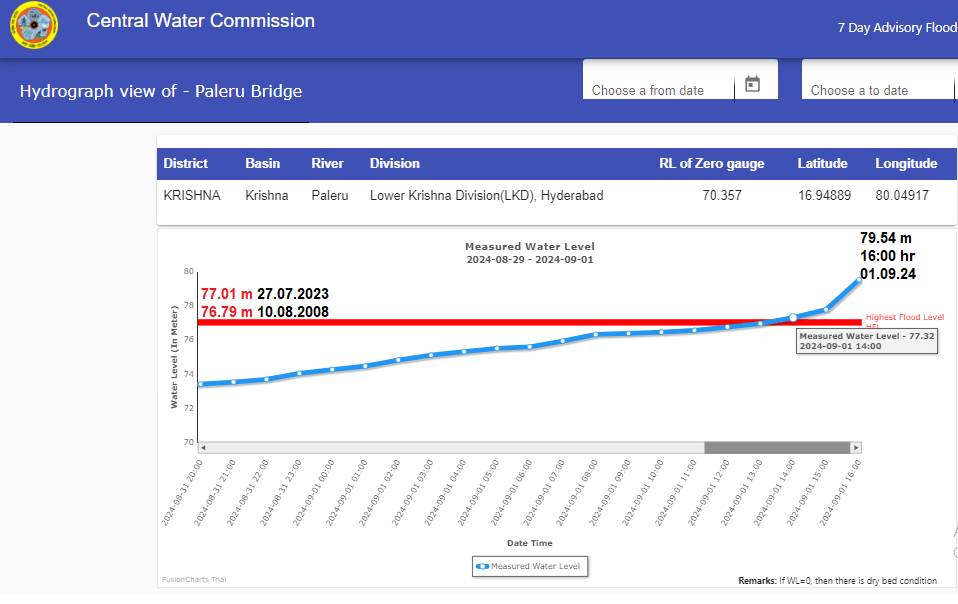
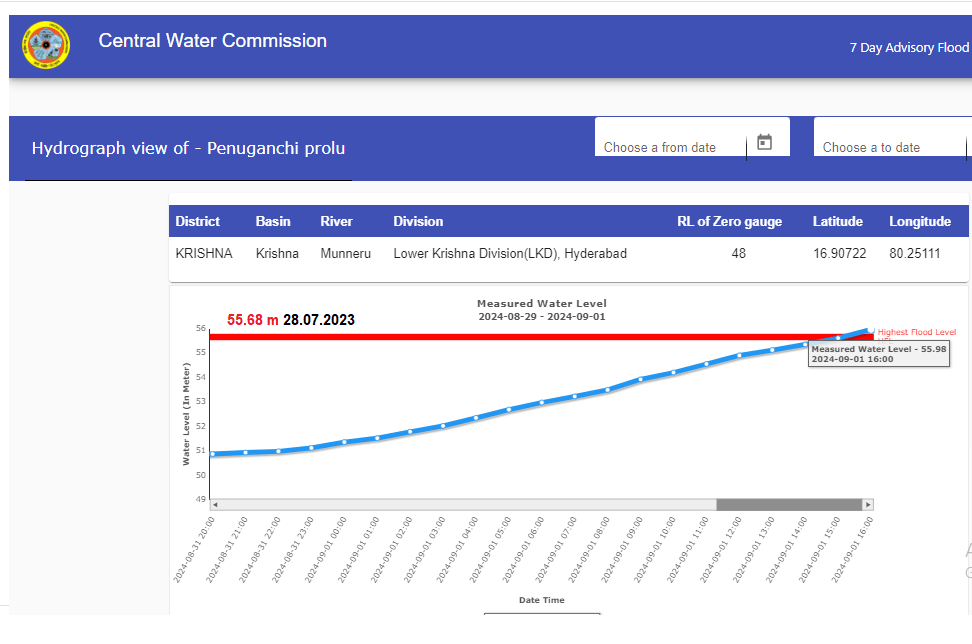
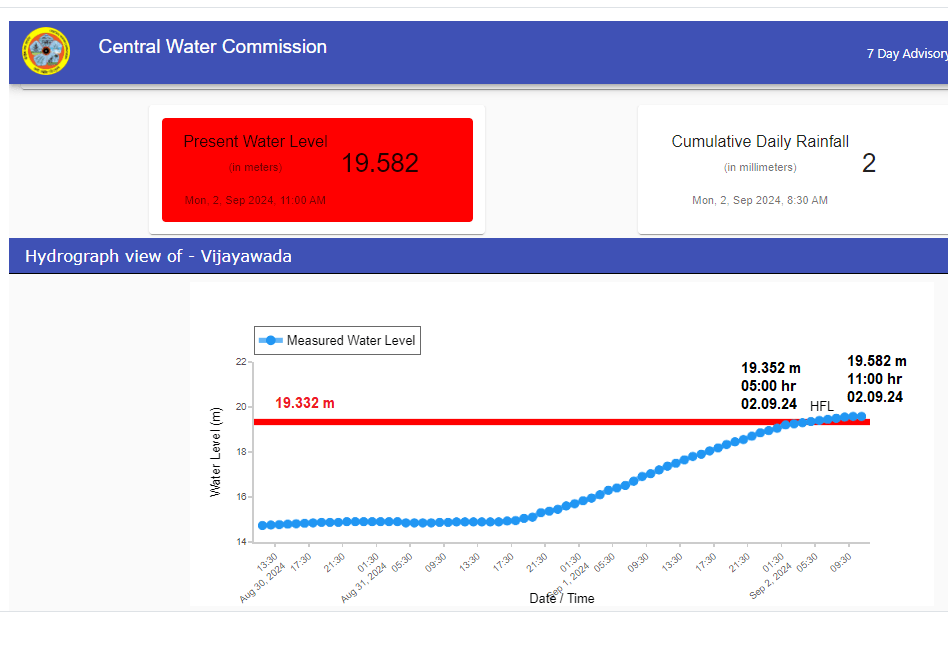
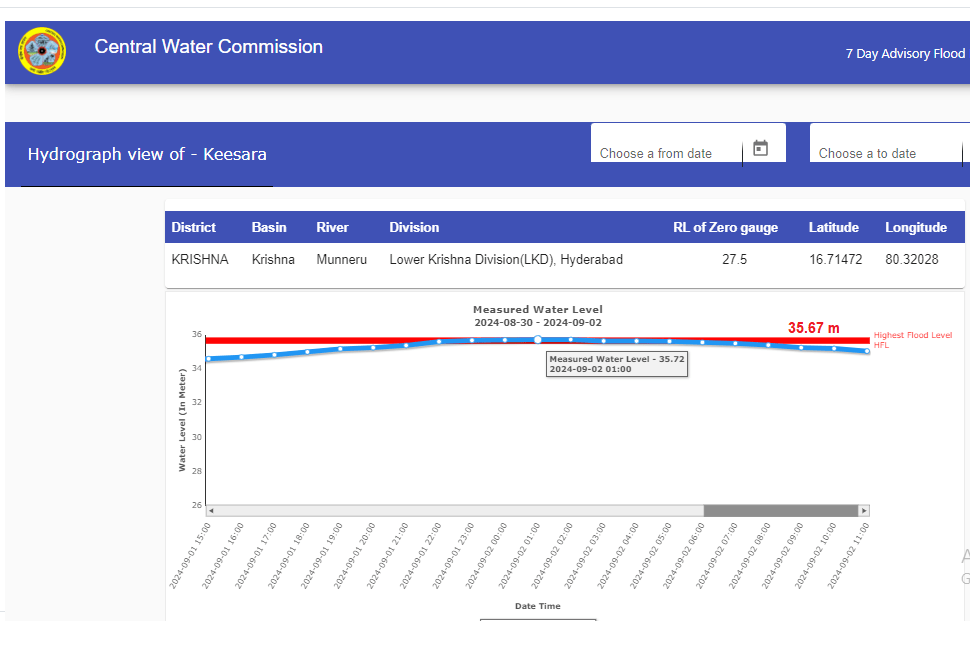
3 River Munneru at Penuganchi Prolu site in Krishna district has crossed old HFL 56.68 meter dated 27.07.2023 at 16:00 hour on 01.09.2024.
4 River Krishna at Vijaywada site in Krishna district has breached old HFL 19.332 meter date not mentioned by the CWC at 05:00 hour on 02.09.2024. Present water level is 19.582 meter at 11:00 hour on 02.09.2024.
5 River Munneru at Keesara station in Krishna district has crossed old HFL 35.67 meter date not mentioned by CWC at 23:00 hour on 01.09.2024 and has set 35.72 meter as new HFL at 01:00 hour on 02.09.2024.
URBAN FLOODS
Vadodara VMC opens Ajwa gates as Vishwamitri level reduces The Vadodara Municipal Corporation (VMC) started releasing water from the Ajwa reservoir again as the water level in the Vishwamitri river reduced significantly. The release, however, is not expected to lead to any flooding. VMC had taken a decision to raise the gates of the reservoir and store water to nearly 214 foot as the city was facing acute flooding. The water level in Vishwamitri peaked after this and then went down gradually as rain abated. The water level of the river on Saturday (Sept. 31) night was at 12.65 foot even as the Ajwa reservoir was still at 213.65 feet.
“We have decided to release the water to empty the reservoir and have buffer capacity for any situation. We will maintain it at 212.5 foot,” said VMC standing committee chairman Dr Sheetal Mistry. The level in the reservoir is to be maintained at 212.5 feet from Sept 2 as per its rule levels. According to officials, the reservoir was being emptied on a priority as more rains were expected in Vadodara and the reservoir’s catchment area next week. https://timesofindia.indiatimes.com/city/vadodara/vmc-opens-ajwa-gates-as-vishwamitri-level-reduces/articleshow/112960459.cms (01 Sept. 2024)
City still under water, Army called in “The Vishwamitri river crossed the danger mark of 25 feet on Tuesday (Aug. 27) morning, following heavy rain and the release of water from Ajwa dam,” Health Minister Rushikesh Patel told media persons after a review meeting with senior officials. “Water level of Ajwa Dam is 213.8 feet at present. We have closed the gates so that no additional water goes into Vishwamitri river. The river is currently flowing at 37 feet, well above the danger mark. Water has spilled into the city and many areas are flooded,” he added.
“The situation is alarming in Vadodara because many areas on both sides of the river are still under 10 to 12 feet of water. Some areas are under four to five feet of water,” Patel added. Siddharth Nagar, Akota, Harni-Sama road, Fatehgunj, Munjmahuda and Vadsar were among the worst-affected areas, said Patel, adding that more boats have been sent to expedite the relief and rescue work.
As a long-term solution, the government is considering a proposal to divert floodwaters into the Narmada canal instead of releasing it in Vishwamitri, he said. “Such a situation has arisen after nearly 20 yea₹The Vishwamitri gets water from Ajwa, Pratappura and three other non-gated reservoi₹As a long-term solution to flooding, we are considering diverting the dam water into Narmada canal instead of releasing it into Vishwamitri. The plan has been discussed with CM Bhupendra Patel,” he said. https://indianexpress.com/article/cities/ahmedabad/vadodara-city-still-under-water-army-called-in-9538580/ (29 Aug. 2024)
-With nearly 12 inches of rainfall on Monday Aug 26 and the water level of the Vishwamitri River flowing at 35 feet, well above the danger level of 26 feet, Vadodara city is experiencing severe waterlogging and flooding in many areas.
-Although the rain has paused today Aug 27 in Vadodara, water continues to be released from the upstream Ajwa Dam into the Vishwamitri River, keeping the river level at 35 feet. Residents living along the riverbanks are facing severe flood conditions. So far, around 3,000 people have been relocated within the city. https://deshgujarat.com/2024/08/27/vadodara-flooded-as-vishwamitri-flows-9-ft-above-danger-mark-waist-deep-water-in-several-areas/ (27 Aug 2024)
Ahmedabad City in deep water due to aging infra, faulty pumps Despite significant investment, including Rs 25 crore for stormwater lines, desilting, and wells, areas like Rajpath Rangoli Road in Bodakdev remain inundated. AMC sources revealed that following the July 2022 deluge, which left several areas like Jodhpur, Anandnagar and Vastrapur under water, the AMC spent Rs 40 crore to address waterlogging. This included the purchase of 10 Varun dewatering pumps for Rs 8.55 crore. Aging infrastructure complicates matters further. The 2200mm diameter line installed by Auda two decades ago, which channels water to the Vasna STP, struggles with increased flow, and outdated pumps at the STP fail to keep up.
Over the past two days, AMC deployed 25 powerful vehicle-mounted dewatering pumps across the city. Areas in need included Vatva’s Vadia Talav, Lambha’s Ganeshnagar, Ghodasar’s Daxini Society in the South Zone. Western Ahmedabad wasn’t spared, with pumps working overtime in Tulsi Society and IOC underpass in Chandkheda and Anand Party Plot in New Ranip. In the East Zone, Odhav GIDC, Dashama Talav in Vastral and Gopal Chowk and Manmohan Park in Nikol were points that required heavy dewatering. In the North West Zone, dewatering was required at Mahila Garden, Auda Flats in Gota, KK Nagar in Ghatlodia and Chandlodia. https://timesofindia.indiatimes.com/city/ahmedabad/ahmedabad-in-deep-water-due-to-aging-infra-faulty-pumps/articleshow/112853264.cms (28 Aug. 2024)
35 rescued from flooded underpass While exposing the city’s poorly planned civic infrastructure, rescue calls due to waterlogging from the torrential rain on Monday (Aug. 26) and Tuesday (Aug. 27) kept Ahmedabad Fire and Emergency Services (AFES) teams on their toes. On Monday, a fire brigade team came to the rescue of around 35 passengers stranded inside a private travels bus that got stuck in the heavily flooded Parimal underpass. https://timesofindia.indiatimes.com/city/ahmedabad/35-rescued-from-bus-in-waterlogged-parimal-underpass/articleshow/112840734.cms (27 Aug. 2024)
Nasik -Nine dams in Nashik district filled to the brim following incessant rains over the last three days, sending the Godavari river which flows through the city in spate, prompting the evacuation of some residents of areas located near its banks to safer places. https://indianexpress.com/article/cities/mumbai/godavari-river-in-spate-as-rains-lash-nashik-district-9534042/lite/ (26 Aug 2024)
Chennai Flooding unavoidable this monsoon: Commissioner “The thumb rule is when the city receives 10-12 cm of rain during the monsoon seasons, it’s considered safe, as it’s within the carrying-capacity of the stormwater drains (SWDs) and rive₹The moment it rises to 20 cm within 24 hours, and 40 cm in two days, we have no option but to go for a relief operation,” said GCC Commissioner J Kumaragurubaran. “Based on the reports in the last four floods – 2015, 2019, 2021 and 2023, at least 4,000 roads in all 15 zones have been identified as low-lying areas. There will be water stagnation on these roads though there are SWDs.”
The Corporation has planned to interlink with the existing SWDs or install additional motor pumps to pump out the stagnating water from these roads. Similarly, the commissioner stated that the SWD construction, taken on priority-basis in the city. Since, the southern part of the city is close to the coastal region, the construction is carried out in a phased manner. In the next 2-3 years, Chennai will become resilient,” he added. During the last two monsoon seasons, north Chennai was adversely affected. The GCC-head pointed out that the entire neighbourhood was in bad shape, and hence, measures would be intensified this year. “The restoration work of the Buckingham canal, maintained by the WRD, has been delayed due to financial crises. If it’s desilted and restored, it can prevent inundation in north Chennai in the future,” he stated. https://www.dtnext.in/news/chennai/flooding-inevitable-in-city-this-monsoon-800821 (24 Aug. 2024)
Residents complain of clogged SWDs Amidst claims of SWDs still being clogged across the city, the GCC initiated steps to float tenders to desilt the drains ward-wise. The GCC maintains a 3,040 km of stormwater drain network, comprising of 11,770 stormwater drain structures. “Previously, zone-wise desilting efforts were undertaken. Now, ward-wise steps are being taken to improve efficiency. Each ward will be assigned more than two workers for periodical cleaning. GCC expects 70 to 80 contractors to be involved in this work in all 200 wards. The estimation has been prepared for desilting and flood mitigation works in each ward by the respective Assistant Engineers and tenders will be floated soon,” a senior official in the SWD Department of the GCC said. Meanwhile, residents state work has not been undertaken in their areas. https://www.thehindu.com/news/cities/chennai/chennai-residents-expose-stormwater-desilting-flaws-corporation-promises-ward-wise-overhaul/article68577138.ece (29 Aug. 2024)
Pune ‘Urban planning tends to be driven by money’ Once known as a salubrious city with abundant green, Pune has transformed into a crowded and chaotic city grappling with rapid urbanisation, poor infrastructure, and depleting natural resources facing the brunt of extreme weather events. The failure to cope with heavy rainfall and flooding has made Pune unsustainable. Pointing out these issues, sustainability and climate change researcher Dr Priyadarshini Karve says that unless a large number of people demand sustainable growth of cities, policies cannot change. https://questionofcities.org/urban-planning-tends-to-be-driven-by-money-not-natural-ecosystem/ (23 Aug. 2024)
Hyderabad Encroachments in city lakes are one of the reasons for urban flooding, revealed a visit around those areas where many high-rise buildings have come up on FTL and buffer zones of lakes. Following incessant rains, 28 of the 185 lakes in GHMC limits have crossed the full tank level (FTL) and surplus water gushed into their connecting nalas and thereafter into colonies and onto roads. https://www.deccanchronicle.com/southern-states/telangana/encroachments-in-hyderabad-lakes-leading-to-urban-flooding-1820778 (02 Sept. 2024)
Delhi Joining dots of drainage debacle Could it be that the numerous underground constructions and rampant large scale paving over the last two decades are acting as underground dams, resulting in unprecedented flooding? (Narayan Moorthy, architect and principal at Kumar Moorthy & Associates, New Delhi) https://thewire.in/urban/a-city-undone-joining-the-dots-of-delhis-drainage-debacle (28 Aug. 2024)
Dainik Bhaskar, Aug 31, 2024.
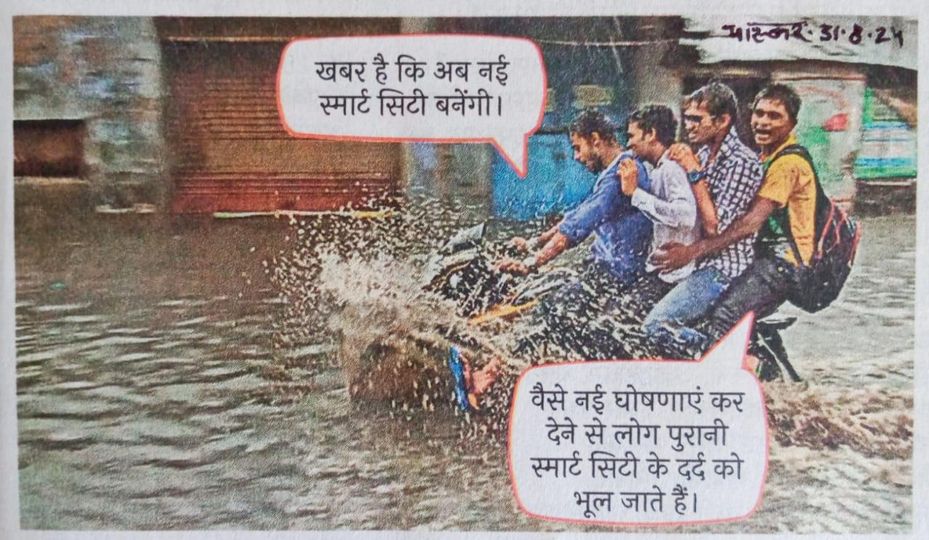
CLOUD BURSTS
Jammu & Kashmir Bodies of 2 cloudburst victims found, 5 still missing Two bodies, including that of a 12-year-old boy, were recovered on Tuesday (Aug. 27) as rescue operation continued in Jammu and Kashmir’s Ramban district to trace five other missing people following a cloudburst, officials said. The cloudburst occurred in Panchayats Kumate, Dhraman and Halla in Rajgarh tehsil late Monday (Aug. 26) afternoon, causing flash floods in Tanger and Dadi streams, they said. Seven people of three different families were reported missing in the flash floods, Tehsildar Rajgarh Major Singh said. https://www.dailyexcelsior.com/bodies-of-two-cloudburst-victims-recovered-in-jks-ramban-search-on-for-5-missing-persons/ (27 Aug. 2024) Mother-children trio feared washed away in Ramban cloudburst https://www.greaterkashmir.com/videos/mother-children-trio-feared-washed-away-in-ramban-cloudburst-rescue-ops-on-2/ (26 Aug. 2024)
Uttarakhand पौड़ी के यमकेश्वर विधानसभा क्षेत्र के अन्तर्गत आमसौड़ गांव के ऊपर बादल फटा है. बादल फटने के बाद आए सैलाब में कई घरों में मलवा भर गया है. कोटद्वार दुगड्डा राष्ट्रीय राजमार्ग 534 से लगे आमसौड़ गांव के समीप बादल फटने से देर रात से नेशनल हाईवे कोटद्वार मेरठ बंद पड़ा हुआ है. आमसौड़ निवासी योगेन्द्र जुयाल ने बताया कि गुरुवार (Aug. 22) देर रात्रि में भारी बारिश के साथ बादल फट गया. इससे आमसौड़ गांव के कई घर क्षतिग्रस्त हो गये. अनेक घरों में मलबा घुस गया है. https://www.etvbharat.com/hi/!state/cloud-burst-in-amsaud-village-of-yamkeshwar-assembly-constituency-in-pauri-uttarakhand-news-uts24082302957 (23 Aug. 2024)
टिहरी में बादल फटने से तबाही, 13 गांवों में भूस्खलन पहले से ही आपदा की मार झेल रहे टिहरी जिले के भिलंगना ब्लाक में मंगलवार (Aug. 20) रात भारी वर्षा आफत बनकर टूटी। भिलंग पट्टी में बादल फटने से 13 गांवों में भूस्खलन से तबाही मच गई। नदी नालों ने गांव का रुख किया तो घरों में मलबा और पानी घुस गया। देखते ही देखते गांव बोल्डर और मलबे से पट गए। दो मकान पूरी तरह और तीन आंशिक रूप से ध्वस्त हो गए। ग्रामीणों ने किसी तरह भागकर जान बचाई। पांच गोशालाओं के ध्वस्त होने से 14 मवेशी भी मलबे में दब गए। बिजली-पानी और संचार लाइनों के क्षतिग्रस्त होने से कई गांवों का संपर्क टूट गया है। राहत और बचाव कार्य के लिए प्रशासन की टीम गांवों में पहुंच गई है। भिलंगना ब्लाक के तिनगढ़, तोली और जखन्याली गांव के नौताड़ गांव में जुलाई अंतिम सप्ताह में आपदा ने कहर बरपाया था। आपदा प्रभावितों का अब तक विस्थापन नहीं हो पाया है। अब मंगलवार रात भिलंग पट्टी के कई गांवों में भूस्खलन और मलबा आने से तबाही मच गई। https://www.jagran.com/uttarakhand/tehri-garhwal-cloudburst-in-tehri-landslides-in-13-villages-five-houses-destroyed-23782412.html (22 Aug. 2024) इसके अलावा नैनीताल जिले के मेंदू, सिंदवाल, गवाना मल्ला, कंडार गांव, देवलिंग, सटियाला, बगर, चक्रगांव और हिंद कूड़ा में भी बादल फटने की खबर है। बादल फटने से इन इलाकों में कितना नुकसान हुआ है इसकी सूचना नहीं मिल पाई है। भारी बारिश के कारण नदी और नाले उफान पर हैं। https://www.livehindustan.com/uttarakhand/uttarakhand-mausam-latest-update-cloud-burst-in-tehri-yellow-alert-for-heavy-rain-in-uttarakhand-201724234741983.html (21 Aug. 2024)
केदारनाथ और टिहरी के नौताड़ में बादल फटा टिहरी के भिलंगना ब्लॉक क्षेत्र के नौताड़ तोक में देर शाम (July 31) भारी बारिश और बादल फटने से नुकसान हुआ है। यहां बादल फटने से एक होटल बह गया, जिसमें होटल स्वामी सहित तीन लोग लापता हो गए थे। इनमें से दो के शव बरामद हो गए हैं और युवक को घायल अवस्था में रेस्क्यू किया गया है। बादल फटने से भारी मात्रा में आए मलबे में कई पशुओं के बहने की भी आशंका है। गनीमत रही कि इस दौरान होटल में यात्री नहीं रुके हुए थे।
बताया जा रहा है किे वर्ष 2013 में नौताड़ में इसी जगह पर 31 जुलाई के दिन ही बादल फटा था। आज फिर से यहां पर बादल फटने और दो लोगों की मौत से लोग भी दहशत में आ गए हैं। घनसाली तिलवाड़ा मोटर मार्ग पर मुयाल गांव गदेरे पर बना एक मोटर पुल बह गया है। रात 9 बजे के लगभग गदेरा उफान पर आ गया था। इससे 8 किलोमीटर के समीप बना मोटर पुल इस गदेरे की भेंट चढ़ गया।
देर रात (July 31) केदारनाथ पैदल मार्ग पर जंगल चट्टी से भीमबली के बीच लिनचोली के पास बादल फटने से मंदाकिनी नदी का जलस्तर खतरे के निशान से ऊपर पहुंच गया। वहीं तप्त कुंड और केदारनाथ पैदल मार्ग का लगभग 25 मीटर का हिस्सा भी बह गया है। एहतियात जिला प्रशासन ने गौरीकुंड और सोनप्रयाग बाजार को खाली करवा दिया है। इसके साथ ही नदी किनारे के क्षेत्र को भी खाली कराया जा रहा है। एसडीएम रुद्रप्रयाग अनिल कुमार शुक्ला ने बताया कि जंगलचट्टी से भीमबली के बीच लिनचोली में तेज बारिश से बादल फटा है। सुरक्षा को देखते हुए लगभग 200 यात्रियों को भीमबली जीएमवीएन में रोका गया है। पैदल मार्ग पर जगह-जगह पहाड़ी से बोल्डर गिर गए हैं, जिसकी वजह से रास्ता बाधित हो गया है। रुद्रप्रयाग-गौरीकुंड हाईवे कई जगहों पर भूस्खलन और भूधंसाव होने से मार्ग अति संवेदनशील बना हुआ है। https://navbharattimes.indiatimes.com/state/uttarakhand/dehradun/cloud-burst-in-tehri-nautad-kedarnath-caused-devastation-hotel-washed-away-two-people-dead-uttarakhand-news/articleshow/112176352.cms (01 Aug. 2024)
उत्तराखंड में तीन जगहों टिहरी, केदारघाटी और जागेश्वर में बादल फटा है। टिहरी के घनसाली में बादल फटने से एक ही परिवार के 2 लोगों की मौत हो गई जबकि एक शख्स घायल है। केदारघाटी में भीमबली के बाद बादल फटने के बाद आए सैलाब से करीब 30 मीटर रास्ता टूट गया है। वहीं मंदाकिनी नदी उफान पर है, जिसका असर गौरीकुंड के पास गर्मकुंड पर भी पड़ा है। सोनप्रयाग में नदी के किनारे रह रहे लोगों को हटा लिया गया है। https://www.indiatv.in/india/national/uttarakhand-cloudburst-in-tehri-kedarghati-and-jageshwar-two-people-of-the-same-family-died-in-ghansali-2024-08-01-1064228 (01 Aug. 2024)
टिहरी में बादल फटने के बाद तबाही टिहरी जिले में बादल फटने, भूस्खलन और नदी-नालों के उफनाने की घटनाओं से व्यापक पैमाने पर क्षति हुई है। बूढ़ाकेदार के तोली और तिनगढ़ गांव में शुक्रवार (July 26) रात वर्षा आफत बनकर बरसी। तोली में बादल फटने से हुए भूस्खलन से मकान ध्वस्त हो गया। मलबे में दबकर मां-बेटी की जान चली गई। घर के तीन सदस्यों ने किसी तरह भागकर जान बचाई। तिनगढ़ गांव में शाम को भूस्खलन से यहां 15 मकान ध्वस्त हो गए। दोनों गांवों के लोग दहशत में हैं।
टिहरी जिले के झाला गांव में धर्मगंगा नदी के उफान में आने से झोपड़ी बह गई। इससे मां-बेटी लापता हो गईं। दो लोगों ने भागकर जान बचाई। बादल फटने से बालगंगा और धर्मगंगा नदियों का रौद्र रूप देख बूढ़ाकेदार घाटी के हजारों ग्रामीण रात भर जागते रहे। बालगंगा और धर्मगंगा नदियों के किनारे बने मोटर मार्ग बहने से लगभग 10 गांवों का संपर्क ब्लाक मुख्यालय से कट गया है। धर्मगंगा नदी किनारे बूढ़ाकेदार-पिंसवाड़ रोड का बड़ा हिस्सा बरसात में बह गया।
केदारनाथ यात्रा मार्ग पर भूस्खलन होने के कारण यात्रियों को नौ घंटे तक रोका गया। यहां करीब 2500 यात्री फंसे रहे। बदरीनाथ हाईवे कंचनगंगा के पास 12 घंटे से अधिक समय तक बंद रहा। उत्तरकाशी में गंगोत्री राष्ट्रीय राजमार्ग भी चार घंटे बाधित रहा। चमोली जिले के नारायणबगड़ के पावर स्टेशन पंती के पास रहने वाले 11 मजदूरों और पांच अन्य लोगों ने बोल्डर गिरने के कारण भागकर अन्यत्र रात गुजारी। पिथौरागढ़ के धारचूला में दोबाट के पास भारी भूस्खलन से चीन सीमा को जोड़ने वाला तवाघाट मार्ग अवरुद्ध हो गया है। कर्णप्रयाग-ग्वालदम राष्ट्रीय राजमार्ग मलबा आने से मार्ग बाधित हो गया। दस घंटे बाद नलगांव में वाहनों की आवाजाही शुरू कराई गई।
शुक्रवार (July 26) की रात और शनिवार (July 27) को भागीरथी ने रौद्र रूप ले लिया। इस कारण भगीरथ शिला से लेकर से लेकर घाट किनारे की दुकानें खाली करवानी करनी पड़ी। उफान के कारण गंगोत्री के निकट दिशानंद महाराज आश्रम में चार कुटिया बह गईं। एक साधु का रेस्क्यू किया गया। भागीरथी के दूसरी ओर एक गुफा में फंसे तीन साधुओं को भी रेस्क्यू किया गया। गंगोत्री धाम में सुबह से लेकर दोपहर तक अफरातफरी का माहौल रहा। गंगोत्री से पांच किलोमीटर गोमुख की ओर देवगाड़ में उफान आने से पुलिया पूरी तरह से बह गई। https://www.jagran.com/uttarakhand/tehri-garhwal-tehri-cloudburst-16-buildings-buried-mother-daughter-dead-mother-daughter-missing-23767078.html (28 July 2024)
चमोली: कर्णप्रयाग-ग्वालदम राष्ट्रीय राजमार्ग पर नलगांव और पंतीगांव में बादल फटने से तबाही मच गई. नलगांव में बादल फटने से करीब 200 मीटर में मलबा हाईवे पर आ गया. वहीं पंतीगांव में बादल फटने से मलबा विद्युत विभाग के सब स्टेशन में घुस गया. भले ही बादल फटने से कोई जनहानि नहीं हुई, लेकिन नलगांव, आमसौड़, पंतीगांव, हरमनी सभी स्थानों पर हाईवे बंद हो गया. वहीं भूस्खलन से गोपेश्वर के सुभाष नगर में दो गाड़ियां मलबे में दब गई. https://www.etvbharat.com/hi/!bharat/cloud-burst-due-to-heavy-rain-in-chamoli-uttarakhand-hindi-news-utn24072701051 (27 July 2024)
हिमाचल प्रदेश लाहौल-स्पीति में एक बार फिर बादल फटने की घटना सामने आई है। भारी बारिश से डांग और शिचिलिंग गांव में बाढ़ जैसे हालात पैदा हो गए हैं। आम जनजीवन अस्त-व्यस्त हो गया है। बादल फटने से लोगों के सामने कई सारी समस्या खड़ी हो गई हैं। रोजमर्रा की चीजों के लिए लोगों को संघर्ष करना पड़ रहा है। बादल फटने की वजह से कई सारी सड़कें बाधित हो गई हैं। राहगीर घंटों जाम में फंसे हुए नजर आ रहे हैं। https://www.patrika.com/special/live-updates-cloudburst-natures-fury-continues-in-himachal-cloud-burst-again-in-lahaul-spiti-flood-like-situation-18891728 (16 Aug. 2024)
DISASTERS
Manipur Disaster waste management plan urgently needed After any natural or human-made disaster, depending on the built environment where it occurred, residual “disaster waste” is produced. Debris and waste generated after floods, landslides, earthquakes, fires, etc., are thus termed disaster waste. Its presence affects every aspect of emergency response and recovery efforts. If not cleared promptly, it can become a breeding ground for vectors and poses a potential public health risk. The discourse on disaster waste management remains one of the most overlooked subjects. Handling disaster waste requires scientific management and technical expertise. Global experiences suggest that Disaster Waste Management Plans seldom exist. Similarly, Manipur, and India overall, lack such a plan. https://www.downtoearth.org.in/waste/disaster-waste-management-plan-urgently-needed-as-multiple-floods-submerge-manipur (28 Aug. 2024)
LANDSLIDES
Report Too much fossil fuel usage, irresponsible development models have resulted in topsoil erosion in Western Ghats: Kalkuli Vittal Hegde. https://www.downtoearth.org.in/natural-disasters/too-much-fossil-fuel-usage-irresponsible-development-models-has-resulted-in-topsoil-erosion-in-western-ghats-kalkuli-vittal-hegde (01 Sept. 2024)
ENVIRONMENT GOVERNANCE
Supreme Court Deadline for NCR states to fill PCB vacancies The Supreme Court on Tuesday (August 27) directed that all vacancies in the State Pollution Control Boards (PCBs) of National Capital Region (NCR) states must be filled by April 30, 2025.“We make it clear that all States have to endeavour to fill in the important posts urgently. Under no circumstances, we are going to grant them time for filling in all the vacancies beyond 30th April, 2025. https://www.livelaw.in/top-stories/supreme-court-sets-deadline-for-ncr-states-to-fill-pcb-vacancies-asks-caqm-about-steps-to-address-delhi-air-pollution-in-upcoming-winter-267954 (28 Aug. 2024)
Maharashtra MPCB’s track record raises more questions than answers The MPCB’s track record in recent years suggests a pattern of inconsistencies and, at times, a lack of decisive action. The surprise inspection at the Mercedes-Benz plant, followed by a PR blitz and the hasty deletion of social media posts, raises concerns about the board’s operational methods and its ability to enforce its regulations effectively.
The MPCB, despite being armed with considerable regulatory power, has often been perceived as reactive rather than proactive. There is a growing perception that the board is more focused on optics than on implementing long-term solutions. The watchdog has the power to prosecute noise, air and water norm violato₹However, it’s handling of noise pollution cases against Ganesh mandals or water and air pollution in industrial zones has frequently come under criticism.
The lack of transparency further complicates matte₹In the Mercedes-Benz case, the use of a private PR firm to publicize the inspection, followed by the sudden deletion of those posts, adds a layer of opacity that undermines public trust. If the violations at the plant are as serious as claimed, why the reluctance to provide a detailed, public account of the findings? And why involve external PR professionals in a matter that should be handled directly by the MPCB’s communication channels?
Additionally, the questions surrounding Kadam’s appointment as MPCB chairman—given his background and limited experience in environmental matters—cannot be ignored. The timing and circumstances of his appointment suggest that political considerations may have played a role, potentially at the expense of technical expertise. This raises broader concerns about whether the MPCB’s leadership is fully equipped to handle the complex environmental challenges facing the state. https://www.hindustantimes.com/cities/pune-news/monday-musings-mpcb-s-track-record-raises-more-questions-than-answers-101724648779929.html (26 Aug. 2024)
Karnataka ‘Kasturirangan report can’t be implemented fully’ Based on the suggestions made by the cabinet sub-committee in a meeting on Wednesday (Aug. 28), it was noted that the Karnataka government cannot implement the recommendations of the Kasturirangan Committee issued by the Union Government. Speaking to the media, Forest, Environment, and Ecology Minister Eshwar B Khandre, who is also the chairman of the cabinet sub- committee said that the recommendations of the committee to notify 20,668 sqkm an eco-sensitive zone cannot be done. The State Government has already notified and protected 16,632 sq km in various forms, like sanctuaries, national parks, and eco-sensitive zones. There are 1,533 homes, villages, and other residential habitats in the remaining area. The rights and livelihood of people need to be protected, he said. https://www.newindianexpress.com/states/karnataka/2024/Aug/29/kasturirangan-report-cant-be-implemented-fully-in-karnataka-eshwar-b-khandre (29 Aug. 2024)
Great Nicobar Project no longer in prohibited zone: NCSCM Ongoing resistance to develop Great Nicobar Island got impetus with India’s leading political opposition party calling for the project’s clearances to be suspended. Legal proceedings challenging the project’s environmental clearance revealed that National Centre for Sustainable Coastal Management (NCSCM) a key coastal authority said the project did not fall in fragile coastal zones where ports are prohibited. The rationale for the coastal authority’s conclusions and acceptance of these conclusions by a government committee, have not been made public. https://india.mongabay.com/2024/08/national-coastal-body-says-great-nicobar-project-no-longer-in-prohibited-zone-making-way-for-a-port/ (22 Aug. 2024) Author Pankaj Sekhsaria is among the few who has consistently written on the constant threats to the little group of islands in the eastern Indian Ocean for three decades. This book of essays curated by him, addresses a monstrous perversion of planning and infrastructure development for public purpose in the name of developing the Great Nicobar Island. https://thewire.in/books/a-monstrous-perversion-of-planning-the-story-of-the-great-nicobar-project (31 July 2024) After a port project was approved, it was concluded that the site, home to mangroves, turtles, corals and the endemic Nicobar megapode, should never have been a protected area. (Pankaj Sekhsaria) https://indianexpress.com/article/opinion/columns/wildlife-sanctuary-great-nicobar-island-9499941/ (14 Aug. 2024)
CLIMATE CHANGE
Report Can artificial barrier stop glacier melt? REMEDY WORSE THAN DISEASE? An early test of whether the world is prepared to enact massive geo-engineering efforts to ward off the worst effects of climate change…. There is no time to waste, argues the glaciologist orchestrating the call for action, John Moore of Lapland University, in northern Finland. Within two years, he and colleagues in Europe hope to be working in a Norwegian fjord, testing prototypes for a giant submarine curtain, up to 50 miles across, that could seal off the two glaciers from the remorseless Antarctic current… It highlighted a proposal for a series of giant overlapping plastic or fiber curtains tethered to concrete foundations. To hold the warm current at bay, the curtain would stretch for 50 miles across the entrance to the Amundsen Sea and extend upwards for much of the 2,000 feet from the sea floor to the surface… Moore puts the likely bill for erecting a curtain across the Amundsen Sea at up to $80 billion.
– Opponents of the plans, including many glaciologists, say such outlandish proposals are a dangerous diversion from the real task of mitigating climate change by curbing carbon emissions.
– Ice-sheet modeling last year by Kaitlin Naughten of the British Antarctic Survey concurred. “The opportunity to preserve the West Antarctic Ice Sheet in its present-day state has probably passed,” she concluded, “and policymakers should be prepared for several metres of sea level rise over the coming centuries.”
– “But curtains may just displace the heat elsewhere, melting other ice.” In any event, she says, sea-level rise would continue as a result of factors such as thermal warming of the oceans, land subsidence, and changes in ocean circulation, as well as the melting of other land ice, such as on Greenland. “So the question is whether this is the right place to put our resources, including limited research funding.” https://e360.yale.edu/features/thwaites-glacier-pine-glacier-antarctica-geoengineering (26 Aug. 2024)
SOUTH ASIA
Bhutan Nikachhu HEP earns nearly Nu 1 bn in 7 months In just seven months since its launch, the 118 MW Nikachhu Hydropower Project (NHP) has earned around Nu 973 million by selling about 266 million units of electricity. The project aims to generate 491 million units of electricity, earning about Nu 1.6 billion annually. By July, the project had reached about 50 percent of its energy generation goal and 61 percent of its revenue target. The NHP supplies electricity to three key buyers: 80 percent to the Power Trading Corporation of India (PTC) while 20 percent is distributed between the Bhutan Power Corporation (BPC) and the Indian Energy Exchange. The plant also supports the Mangdechhu Hydropower Project (MHP) with increased flow for energy generation. Nikachhu and Mangdechhu dams are located in the same river basin, with Nikachhu situated upstream and Mangdechhu downstream. Revenue from this arrangement is split equally between the two projects.
– Electricity tariffs are set at Nu 3.3 per unit for PTC, Nu 3.890 per unit for BPC, and to the highest bidder on the Indian Energy Exchange through competitive bids every 15 minutes. As of July, NHP had sold 155.674 million units to PTC, generating Nu 513.725 million; 37.437 million units to BPC, amounting to Nu 146.927 million; and 26.372 million units on the Indian Energy Exchange, bringing in Nu 144.149 million. The additional water supply to MHP contributed 46.326 million units with added revenue of Nu 168 million to NHP.
– The project generated 3.8, 12.2, 14.2, 18.3, 24.9, 52.9 and 93.4 MU from Jan to July. https://kuenselonline.com/nikachhu-rakes-in-nearly-nu-1-billion-in-seven-months/ (31 Aug 2024)
Nepal Another avalanche hits Mustang Another avalanche occurred at Manapathi Himal in the Dhaulagiri mountain range in Mustang district at 5:45 PM on Tuesday (Aug. 27) evening leading to blockage of Bokshikhola (Bokshi River). Earlier, an avalanche had struck at Mulkharka at Thasang rural municipality-2 in the district on August 23, said Gautam Sherchan, spokesperson of Thasang rural municipality. It may be noted that a massive avalanche struck Tukuche Himal at Kobang of Thasang rural municipality-2 on November 14, 2021 and March 5, 2022 which resulted in deaths of over 150 yaks. https://myrepublica.nagariknetwork.com/news/another-avalanche-hits-thasang-in-mustang-blocking-bokshikhola/ (28 Aug. 2024)
THE REST OF THE WORLD
Study Can dams meet future water & energy demands Research by Stanford University and Carnegie Science has been described as a first-of-its-kind global overview of the role dams and reservoirs play in providing water storage. There was a lack of available data to evaluate the multi-purpose role of existing dams and reservoirs. Rafael Schmitt from Stanford-University and Carnegie Science’s Lorenzo Rosa said that with future demands expected to increase, “Water storage is a critical and globally limited resource.” Schmitt said, “Our study shows that the solutions of the past are insufficient, and can be damaging to already overstretched freshwater ecosystems.” https://www.waterpowermagazine.com/analysis/can-dams-meet-future-water-and-energy-demands/ (28 Aug. 2024)
Sudan Dam collapse wipes out scores of villages At least 132 people have died in flooding caused by heavy rain this month in northern Sudan, authorities have said. The collapse of a dam this week in eastern Sudan unleashed flash floods that inundated and damaged scores of villages, adding to the death toll. On Monday (Aug. 26), the UN said at least 20 villages were wiped out and at least 30 people died when the Arbaat Dam, north of the city of Port Sudan on the Red Sea, collapsed under pressure from surging water, following heavy rains. Flooding adds to the woes of Sudan, which has been torn apart by civil war for the past 16 months. https://www.thenationalnews.com/news/mena/2024/08/27/sudan-flooding-kills-at-least-132-as-dam-collapse-wipes-out-scores-of-villages/ (27 Aug. 2024)
Arbaat dam in Sudan’s eastern Red Sea state collapsed on Aug 24 night due to heavy rains and sent water flooding over nearby homes, killing at least four people, the country’s health ministry said on Aug 25. Media reports said scores of people were missing. However, a local official told the Sudanese news site Al-Tagheer that he believed there to be at least 60 dead and the damage was extensive. The Sudanese news outlet Medameek, citing the country’s air force, reported more than 100 people were missing, and that many other villagers had climbed to rocky hilltops to avoid the rising waters. The dam with 25 Million Cubic Meters storage capacity, in a remote area 40 kilometers (25 miles) north of Port Sudan, supplied drinking water to the Red Sea city. https://www.hydroreview.com/dams-and-civil-structures/dam-safety/a-dam-collapses-in-eastern-sudan-after-heavy-rainfall-and-local-media-report-dozens-missing/ (26 Aug. 2024)
USA Dam swept away a family’s legacy In 2022, an investigation identified more than 3,000 U.S. dams in poor or unsatisfactory condition that are likely to destroy property or kill people if they fail. Another 7,000 dams had no condition rating, even though they’re in places where they endanger lives and structures. All of them are also predicted to face stress from increasingly severe rainfall. Upmanu Lall, a professor of Engineering at Columbia University and director of the Columbia Water Center, has raised concerns over dam safety in the U.S. According to Lall, approximately 500 dams have failed across the country since 2000. Often, worries boil down to the broad idea of climate change. “That’s become the bogeyman for everything,” Lall said. “The real issue here is we are not paying attention to these issues, not addressing them, and not putting the money in to address them.” https://www.usatoday.com/story/news/investigations/2024/08/28/rapidan-dam-minnesota-national-risks/74955664007/ (28 Aug. 2024)
FERC lays out role Tribes will play in HEPs environmental reviews Earlier this year, FERC granted Native American tribes more power to block hydropower projects on their land. Previously, FERC granted developers approval to move ahead with planning even if tribes objected. That practice came to an end in February. Now, a new commission policy allows tribes to quickly veto proposals, forcing businesses to cooperate with them if they want the federal government to grant exclusive rights to their hydropower projects.
– FERC recently rejected seven proposals for projects on the Navajo Nation, which stretches 27,000 square miles (69,000 square kilometers) across Arizona, New Mexico and Utah. When it issued those rejections, the commission also announced the policy change, handing tribes the same power as federal agencies to block projects.
– The Federal Energy Regulatory Commission (FERC) has released a new guide that explains its role in the environmental review process for energy infrastructure projects under the National Environmental Policy Act (NEPA) and highlights how federally recognized Indian Tribes may engage with and participate in FERC’s review. As part of the approval process for energy infrastructure projects including hydropower, and as required by NEPA, FERC prepares an environmental document: either an Environmental Assessment or an Environmental Impact Statement. For energy infrastructure projects requiring multiple federal permits, FERC generally serves as the lead agency for NEPA review.
– NEPA requires all federal agencies to assess the environmental effects of major proposed federal actions before making decisions. Under NEPA, FERC evaluates the environmental, social and economic effects of a proposed project. As participants in the NEPA process, FERC said Tribes can provide insight on various topics, including:
* Scope of environmental analysis, which includes the range of actions, alternatives and impacts to be considered;
* Quality of available information, such as the need for additional studies or information to fill data gaps;
* Purpose and need for the project;
* Reasonable alternatives that are technically and economically feasible and meet the purpose and need for the proposed action;
* Environmental resource impacts, which are effects on the natural and human environment that result directly, indirectly or as a cumulative effect from a proposed project; and
* Recommendations for potential protection or mitigation measures, such as ways to avoid, minimize, rectify, reduce or eliminate impacts to resources or communities that result from a proposed project.
– Tribes may participate in FERC proceedings by engaging in consultation, making on-the-record comments, intervening in the proceeding or participating in the preparation of the environmental document as a cooperating agency, FERC said.
– FERC also noted that Tribes should try to participate as early in the process as possible. Tribes wishing to participate should engage during the pre-filing process, if possible, to ensure that FERC staff are aware of the Tribe’s concerns and avoid ex parte restrictions and public notice requirements that could arise later.
– Additionally, Tribes may request consultation with FERC at any time. While FERC said it encourages Tribes to work with project proponents to voice their concerns, share information and shape the development of a project, Tribes also may contact FERC and request consultation meetings to discuss the project. https://www.hydroreview.com/world-regions/north-america/ferc-lays-out-role-tribes-will-play-in-hydropower-environmental-reviews/ (22 Aug. 2024)
Tribes celebrate as dams fall Workers on Aug 28 dismantled the final dams on a crucial section of the Klamath River, US. This action cleared the way for salmon to swim freely for the first time in a century. The removal is part of the largest dam removal project in US history. Yurok tribal member and attorney, Amy Bowers Cordalis, had tears in her eyes as she witnessed the return of the river: “It was surreal. It was so emotional. I felt so hopeful and so satisfied that we have restored this river,” she said. “And looking at it you could almost hear the river crying, ‘I am free, I am free'”. https://timesofindia.indiatimes.com/world/us/you-could-almost-hear-the-river-crying-i-am-free-tribes-celebrate-as-dams-fall-in-us-river-freeing-salmon-trapped-for-a-century/amp_articleshow/112940759.cms (31 Aug. 2024)
Salmon to swim freely after a century For the first time in more than a century, salmon will soon have free passage along the Klamath River and its tributaries — a major watershed near the California-Oregon border — as the largest dam removal project in U.S. history nears completion. Crews will use excavators this week to breach rock dams that have been diverting water upstream of two dams that were already almost completely removed, Iron Gate and Copco No. 1. The work will allow the river to flow freely in its historic channel, giving salmon a passageway to key swaths of habitat just in time for the fall Chinook, or king salmon, spawning season.
“Seeing the river being restored to its original channel and that dam gone, it’s a good omen for our future,” said Leaf Hillman, ceremonial leader of the Karuk Tribe, which has spent at least 25 years fighting for the removal of the Klamath dams. Salmon are culturally and spiritually significant to the tribe, along with others in the region. The demolition comes about a month before removal of four towering dams on the Klamath was set to be completed as part of a national movement to let rivers return to their natural flow and to restore ecosystems for fish and other wildlife. https://apnews.com/article/klamath-dam-removal-oregon-california-salmon-7fb51916375df492049670c6b2a61760 (28 Aug. 2024)
Solar-paneled canopies over canals catching on in Southwest To cut evaporation losses, a growing number of Western water managers in USA’s Colorado basin want to install solar-paneled canopies over canals and even flotillas of solar panels on reservoirs to turn the sun’s rays into electricity before they hit the water. “We believe this is the next step in the future of generating renewable energy,” said David DeJong, director of Arizona’s Pima-Maricopa Irrigation Project, which has partnered with the Gila River Indian Community to shade a half mile of the Casa Blanca Canal on tribal land. The pilot project, set for operation by mid-October, could reduce evaporation 50 to 70 percent, he said.
– Similar projects are advancing in the driest parts of the West. From central Oregon to Utah, Arizona and California’s San Joaquin Valley, solar canal installations are advancing with the help of tens of millions of dollars in state and federal funding. The technology is also catching on globally. India shaded a canal with solar panels a decade ago, and nations including New Zealand and several members of the European Union are reportedly studying the feasibility of developing similar systems.
– While the benefits of solar-shaded canals are clear in principle, some experts aren’t so sure the investment is worth the time and money. The U.S. Bureau of Reclamation arrived at this conclusion in a 2016 analysis of the Central Arizona Project’s (CAP) 336-mile aqueduct. “[T]he disadvantages outweigh the benefits of placing solar over the CAP canal,” the bureau concluded in a summary of the study.
– Other water supply experts are barely lukewarm to the idea. The Metropolitan Water District of Southern California has explored shading its Colorado River Aqueduct with solar panels at least three times since the 1990s, according to Kightlinger, who retired from the agency in 2021 and now works as a consultant on water and power. “It sounds good, but it usually doesn’t pencil out,” he said. Each time the issue came to the table, he recalled, the conclusion was the same: Returns on investment would not arrive for at least 20 years. “And that was just on the power side of the equation,” Kightlinger said. Evaporation losses were too small. https://www.watereducation.org/western-water/solar-paneled-canopies-over-canals-catching-southwest (22 Aug. 2024)
Brazil Worst drought in 4 decades First came wildfires that scorched sugar cane fields. Now, the worst drought in more than four decades is threatening coffee and soybean crops in Brazil. From May through August, some key agriculture areas faced the driest weather since 1981, according to natural disaster monitoring center Cemaden. And there is no relief in sight: there’s no rain in the forecast for at least two more weeks, a period when coffee trees usually flower and farmers start planting soy. The lack of rainfall poses risks for global crop supplies in a world that’s become increasingly dependent on Brazil for everything from sugar to coffee and soybeans. Losses could amplify financial stress for Brazilian farmers already contending with a steep decline in prices. https://www.livemint.com/companies/news/worst-drought-in-40-years-puts-brazil-s-major-crops-at-risk-11725037023649.html (30 Aug. 2024)
SANDRP
Also see: DRP 26 Aug 2024 & DRP 19 Aug 2024
Follow us on: www.facebook.com/sandrp.in; https://twitter.com/Indian_Rivers

 SANDRP