
(Feature Image: Late Manoj Misra speaking at India Rivers Week seminar in Delhi in Nov. 2018. Source: IRF)
As we mark the World Environment Day 2023; India has lost one of the staunch river crusader Manoj Misra, the convener of Yamuna Jiye Abhiyan (YJA). He has been driving force behind formation and functioning of India Rivers Forum (IRF) a platform dedicated for the rejuvenation and restoration of rivers in India. IRF work started in 2014 and 2023 is the tenth year of annual India Rivers Week meetings focused on rivers. Bhagirath Prayas Samman and Anupam Mishra Medal for exemplary media work on rivers are part of India Rivers Week.
He was hospitalized for over a month due to COVID & related complications and breathed his last on June 4, 2023 afternoon in Bhopal, Madhya Pradesh. His sudden demise is a great loss for all river lovers, experts, activists in the country. Down to Earth, resourceful, open-minded, academician, people’s rivers scientist are few words but not enough to describe the personality of Manoj Misra.
The retired IFS officer had passionately been championing the cause of River Yamuna and other rivers over past two decades. As a river scholar, he travelled along Yamuna studying and observing crucial elements impacting the river. At time when ‘pollution-cleaning’ plan heavily dominated the river related discussion, his research work thrived to make environmental flows as central focus for river rejuvenation policy and plans.
It is for his persistent advocacy and litigation work that finally resulted in safeguarding the floodplain of Yamuna in Delhi from brazen infrastructural and real estate projects planned by public, private agencies.
He has been friendly, accessible and encouraging to all the people he had interactions and meetings. His work for India’s rivers will continue to be guiding light and perennial source of inspiration for all of us and future generation of river conservation tribe. Salutes to Manoj ji!
Tributes:- Shashi Shekhar, Former Secretary, Ministry of Water Resources and Ganga Rejuvenation said, “I am not able to come to terms of his loss. After Kedarnath disaster, we became very close. His simplicity, passion and unblemished commitment inspired me to do internal activism while in service. Hardly a fortnight passed when we did not talk with each other. A pure hearted soul. His soul will indeed rest in complete peace and harmony with nature.”
Born on October 7, 1954, Misra was an Indian Forest Service officer from the 1979 batch, working in the forest department for 22 years, before seeking voluntary retirement in 2001. He founded PEACE — an NGO dedicated to promoting the cause of nature conservation — in 2002, and also headed TRAFFIC India, a division of WWF-India, publishing over 100 articles in various magazines, journals and newspapers.
His contributions to the Yamuna came from 2007 onwards, when he founded the YJA — a movement aimed at rejuvenating the river. Misra filed multiple petitions with the NGT, with a January 13, 2015 NGT judgement titled ‘Mailey se Nirmal Yamuna Revitalization Project 2017’ being the most notable, asking for timelines to be fixed to clean up the river, and action from both the state and the Centre.
Manu Bhatnagar, principal director of natural heritage division at INTACH, pointed to Misra’s voice against constructions on the floodplains, including of Akshardham and structures that came up ahead of the Commonwealth Games, including a bus depot: “One of his crowning achievements was taking the matter of the Yamuna to National Green Tribunal (NGT), which brought positive orders for the river. He was also a key part of the India Rivers Week… This year, he was planning the 10th conference.”
Congress leader and former Union environment minister Jairam Ramesh expressed sadness at Misra’s death and said, “Deeply distressed to learn of the passing away of Manoj Misra, an indefatigable environmentalist. He was particularly passionate about the protection of rivers and spent much of his time on the revival of the Yamuna. “He helped me in the drafting of the first set of rules for River Regulation Zone, much along the lines of the Coastal Regulation Zone rules. Sadly, we still don’t have enforceable RRZ rules.” Delhi Lt Governor VK Saxena, who heads the NGT’s high-level committee set up recently to monitor works to rejuvenate the Yamuna, also expressed his shock and pain at Misra’s “untimely demise”. https://www.ndtv.com/india-news/yamuna-jiye-abhiyan-founder-environmental-activist-manoj-misra-dies-at-68-4093359 (04 June 2023)
Advocate Rahul Choudhary, Misra’s lawyer in several cases including the petition before the NGT on the covering of drains, said, “Over the years, he guided us on issues of the Yamuna and its floodplains as well as other river-related cases. As of now, there is no good law regarding protection of the floodplains… we still rely on the judgments on his petitions for protection of the floodplains.”
CM Arvind Kejriwal issued messages of condolences following news of his demise. Delhi Water Minister Saurabh Bharadwaj tweeted that Misra “had been a guiding force for many governments and organisations for decades, including Delhi. https://indianexpress.com/article/cities/delhi/manoj-misra-relentless-crusader-against-pollution-in-yamuna-river-dies-at-68-8645702/ (05 June 2023)
Misra actively fought against deforestation, illegal mining and pollution using legal avenues to protect natural resources. https://www.thehindu.com/sci-tech/energy-and-environment/green-crusader-manoj-misra-dies-jairam-ramesh-hails-his-contribution/article66931470.ece (04 June 2023)
Obituary: Manoj Misra will always be remembered for his work on the Yamuna. https://www.downtoearth.org.in/news/water/obituary-manoj-misra-will-always-be-remembered-for-his-work-on-the-yamuna-89798 (04 June 2023)
Manoj Misra: ‘वह यमुना के बेटे थे… उनके विचार बहते रहेंगे’ पर्यावरण योद्धा मनोज मिश्र का निधन https://navbharattimes.indiatimes.com/india/yamuna-jiye-abhiyan-convenor-manoj-mishra-passed-away/articleshow/100743298.cms (04 June 2023) सेवनिवृत्त होने के बाद से वे यमुना जिए अभियान चलाने सहित देश भर की नदियों के संरक्षण के लिए कार्य कर रहे थे। https://www.jagran.com/delhi/new-delhi-city-ncr-yamuna-jiye-convenor-manoj-mishra-passed-away-lost-battle-of-life-to-corona-23431983.html (04 June 2023)
HYDRO POWER PROJECTS
Arunachal Pradesh Reject move for 2,880 MW hydro project, tribal rights group A New Delhi-based tribal rights group has asked the state govt to reject a move by the Ministry of Environment, Forest and Climate Change (MoEFCC) that paved the way for the 2,880 MW Dibang hydropower project. The project would not be in the interest of the indigenous communities of the State’s Lower Dibang Valley district, the Indigenous Rights Advocacy Centre (IRAC) said in a letter to Arunachal Pradesh Chief Minister Pema Khandu and Chief Secretary Dharmendra on Wednesday, May 31 2023. The IRAC urged them to “outrightly reject” the recommendation of the MoEFCC’s Forest Advisory Committee for establishing a community reserve on the right bank of the project’s proposed reservoir. https://www.thehindu.com/news/national/other-states/reject-move-for-2880-mw-hydro-project-tribal-rights-group-tells-arunachal-government/article66915801.ece (03 June 2023)
Govt scraps 44 hydro deals with private power players The withdrawn projects, with a total installed capacity of 32,415 megawatts, would be handed over to the Central PSUs through fresh agreements, the State’s Deputy CM, Chowna Mein told journalists in Namsai on Sunday (June 04). The government had signed 153 deals with various CPSUs and independent power producers for hydropower projects, with a combined capacity of 46,943 MW.
“Many projects did not proceed beyond the allotment due to various reasons. We terminated the agreements for 44 such projects as the private developers did not show any interest to execute despite several notices served,” Mr. Mein said. The terminated projects were offered to the CPSUs in view of their performance and reliability, he said. Fresh agreements for nine of the 44 projects, with an installed capacity of 1,300 MW, have already been signed. The deals for the rest would be processed soon, Mr. Mein said. Mr. Mein said the Centre had prepared an indicative list of 29 projects that were analysed and evaluated by CPSUs such as the NHPC and THDC Ltd. https://www.thehindu.com/news/national/other-states/arunachal-pradesh-terminates-44-moas-with-private-power-developers-deputy-cm/article66930291.ece (04 June 2023)
Subansiri Lower HEP further delayed: Now first unit to be commissioned only in Jan 2024. https://energy.economictimes.indiatimes.com/news/renewable/first-250mw-unit-of-nhpcs-subansiri-lower-project-to-be-operational-by-jan-official/100664012 (01 June 2023)
Uttarakhand Villagers protest against proposed hydropower project The villagers of Darma valley, under the banner of Darma Sangharsh Samiti, staged a dharna and demonstration at Dharkar on June 2, 2023 against the proposed 165MW Bokang Boling hydropower project on the Dhauliganga river in Darma valley of Dharchula, Pithoragarh. THDC, which is undertaking the project, is currently conducting a survey at Dharkar, the construction site. On Friday, the villagers gathered at Dharkar, where the THDC is surveying the land, shouting slogans — ‘Go back THDC’. They asked the THDC staff to remove their tents and stopped the survey work. They also said if the administration did not stop the work, they will start agitation at both places, Dharchula and Dharkar. The project is situated at 10,662 feet height. People have asked THDC to vacate the area in 15 days. The people have said that the landslide in the village is due to the THDC work. https://timesofindia.indiatimes.com/city/dehradun/villagers-protest-against-proposed-hydropower-project-in-pithoragarh/articleshow/100715798.cms (03 June 2023)
Himalayas are being crushed by ‘vikas’ bulldozer: Activist Environmental experts and activists have attributed the Joshimath crisis to heavy-duty construction for projects like the NTPC Tapovan Vishnugad Hydro Project and the widening of the all-weather Char Dham road that connects Kedarnath, Badrinath, Gangotri and Yamunotri shrines. Some researchers have also said the primary reason behind the sinking of land is the construction of a tunnel just below Joshimath. The tunnel will be used to draw water from the Alaknanda and Dhauliganga rivers for the NTPC hydropower project. https://www.telegraphindia.com/my-kolkata/news/himalayas-are-being-crushed-under-bulldozer-of-vikas-activist-from-the-subsidence-hit-joshimath/cid/1940606 (30 May 2023)
Meghalaya Govt to overhaul hydel projects The state government would be overhauling the hydropower projects in the state to ensure that these projects function according to their capacities and help in augmenting the state’s power generation capacity. The statement came from Power Minister Abu Taher Mondal at a time when there is no respite from load-shedding in the state for two months now.
“During this lean season, many hydropower projects in the state have failed to generate much power due to scanty rainfall,” Mondal said, insisting that the government does not want to extend the load-shedding. “The demand for power is increasing at a higher rate than the generation. The state needs 677 million units of power on an average day but is able to produce 1-1.5 million units from its own generating units and the remaining amount of power is coming from power purchase and banking,” he said.
Mondal also said that the bearings in the Umiam dam are not in good condition and orders have been issued to a company for manufacturing new ones. Concerns have been raised about the safety of the dam time and again. https://theshillongtimes.com/2023/06/03/govt-to-overhaul-hydel-projects/ (03 June 2023)
Jammu & Kashmir NGT panel has recommended banning civil construction in the land subsidence-hit area in Jammu and Kashmir’s Doda district and rehabilitating the affected families to a safer location. The authorities in February evacuated several families after their homes developed cracks and also declared unsafe a mosque and a religious school for girls in the Nai Basti hamlet of Thathri town. https://legal.economictimes.indiatimes.com/news/litigation/ngt-panel-suggests-banning-civil-construction-in-subsidence-hit-area-of-j-ks-doda/100591513 (29 May 2023)
DAMS
Rajasthan First centre for earthquake safety of dams Malviya National Institute of Technology (MNIT) in Jaipur has been identified as the National Centre for Earthquake Safety of Dams, the first centre of its kind in the country. The centre will develop indigenous capabilities in making the country self-reliant in handling technology issues related to structural and earthquake safety of dams.
MNIT Director Narayan Prasad Padhy said here that the centre would conduct a pilot study of select dams across the country to develop and revise safety standards, and review the Central Water Commission’s manuals related to the earthquake safety of dams. The institute will later enter into some international collaborations as well. The Ministry of Jal Shakti has approved a financial grant of ₹30 crore for establishing and running the centre for the next five years.
Union Jal Shakti Minister Gajendra Singh Shekhawat said at the Memorandum of Understanding (MoU) signing ceremony here that the Central government was working in a “mission mode” towards the safety and maintenance of dams. More than 25% of the country’s dams have completed over 50% of their lifespan, while several of them are a few hundred years old, he said. https://www.thehindu.com/news/national/jaipur-institute-identified-as-the-first-centre-for-earthquake-safety-of-dams/article66927952.ece (04 June 2023)
Polavaram Project Telangana urges joint survey submergence areas The Telangana government on Saturday (June 03) urged the Polavaram project authority (PPA) to ensure free flow of water without any impoundments, with all its 48 gates, including river sluices, open all through the monsoon to avoid flooding of Telangana region. The move assumes significance as the Bhadrachalam town witnessed floods during the last monsoon in July. The state government also requested the PPA to take up the joint survey of Polavaram submergence areas as per the supreme court directive issued in September 2021. https://timesofindia.indiatimes.com/city/hyderabad/telangana-urges-joint-survey-of-polavaram-submergence-areas/articleshow/100738986.cms (04 June 2023)
ECRF Dam Construction Set to Commence in July Water resources authorities are getting ready to take up ECRF Gap-1 works spread over about 560 metres in July. They are expecting to complete the works by December. Later, they will take up ECRF Gap-2 works spread over 1,400 metres in April/ May 2024 and are confident of completing them in a year.
– The total length of the ECRF dam will be nearly 1,960 metres with rock filling on either extreme sides. In the middle, black soil will be used to fill up the space. The base width of the dam will be 360 metres at plus 15 metres, and 240 metres at plus 20 metres. The top width of the dam will be 10 metres while it will come up at a height of 52.32 metres. At present, the authorities are taking up the strengthening works on scoured portions of the diaphragm wall by taking up sand filing and vibro compaction. They are expecting to complete these works by June so that they can take up the main dam works. https://www.deccanchronicle.com/nation/current-affairs/290523/polavaram-ecrf-dam-construction-set-to-commence-in-july.html (30 May 2023)
Maharashtra Nilwande dam cost up by 655 times CM will inaugurate the canal network of Nilwande dam on May 31 2023, 53 years after the project was conceived to mitigate water scarcity in parts of Ahmednagar and Nashik districts. The final cost of the project is now 5177 CR, 655 times of the original estimate due to this massive delay. The project was initially approved at Mhaladevi village in Ahmednagar in 1970 at an estimated cost of Rs7.9 crore. The dam was supposed to have a holding capacity of 11 TMC. Nine years on, in 1979, the project was relocated to Nilwande and the capacity was reduced to 8.5 TMC.
– The dam was completed and commissioned in 2014. But the canal networks were still under construction. The project is aimed at bringing around 68,000 ha under irrigation and provide drinking water to over 125 villages of Akole, Sangamner, Rahuri, Shrirampur, Kopargaon and Rahata talukas in Ahmednagar and Sinnar taluka in Nashik. The concrete lining of the 85-km-long left bank canal with 921 cusecs capacity is pending. https://timesofindia.indiatimes.com/india/maharashtra-53-years-on-project-to-be-opened-tomorrow-cost-up-655-times/articleshow/100603111.cms (30 May 2023)
Himachal Pradesh Samiti complains of muck dumping in Bhakra Dam The Fourlane Visthapit and Prabahavit Samiti (FVPS), an organisation that works for the people displaced by road-widening projects, has complained to the Bilaspur deputy commissioner that illegal muck-dumping in the Bhakra Dam reservoir continues in violation of the recent (May 22, 2023) orders of the Himachal Pradesh high court. The muck-dumping in the reservoir is taking place in areas falling under the Naina Devi and Jhanduta tehsils. The freshly-dumped muck at various spots has been sliding down into the reservoir in the absence of any retaining walls. At other spots, there are crate walls but their height is too low to stop the debris from spilling over into the reservoir. https://timesofindia.indiatimes.com/city/shimla/hp-outfit-complains-of-muck-dumping-in-bhakra-dam-urges-dc-to-act/articleshow/100753922.cms (05 June 2023)
Sardar Sarovar Project According to Gujarat Govt, out of over 18000 villages in the state, 10,040 villages have been receiving water through the Narmada project network and 4,420 villages get it from other surface sources. “The remaining villages are being covered by tubewells, handpumps and other means. Directions have been issued to dig new borewells where required. Water is being provided by tankers in parts of Devbhoomi Dwarka, Kutch, Bhavnagar, Gir Somnath, Rajkot, Jamnagar, Morbi, Surendranagar and Banaskantha districts, where water is not available because of reasons such as power failure, leaks in pipelines, lack of connectivity of schemes, and the like. https://timesofindia.indiatimes.com/city/ahmedabad/10k-villages-getting-narmada-water/articleshow/100561320.cms (28 May 2023)
Review From Its Adivasi Leaders, Insider Narratives of the NBA Harini Nagendra Since the 1980s, this iconic grassroots movement, led by a coalition of local Adivasis and farmers working with environmental and human rights activists, was widely spoken of. But the people of the Narmada valley who fought for their lives and livelihoods are less spoken of. And in the past decade or so, the story of the Narmada has received less public attention.
Nandini Oza’s new book, with narratives by Adivasi leaders Keshavbhau Vasave and Kevalsingh Vasave, attempts to remedy this imbalance. Their stories from within the mass movement offer insights into what it takes to harness the the power of a collective for the greater good of society. https://science.thewire.in/environment/narmada-bachao-andolan-keshavbhau-kevalsingh-vasave/ (22 June 2022)
उत्तराखंड क्यों हो रहा है टिहरी बांध के रिम क्षेत्र में बसे गांवों में भूधंसाव उत्तराखंड के टिहरी बांध के रिम क्षेत्र (परिधि) पर भूधंसाव जारी है। यूं तो इस क्षेत्र में भू-धंसाव तो साल 2010 से हो रहा है, लेकिन बीते 2022 में भू-धंसाव का सिलसिला और तेज हो गया है। खास बात यह है कि जनवरी 2023 के आखिरी सप्ताह व फरवरी के पहले सप्ताह में सरकार द्वारा गठित विशेषज्ञ समिति ने द्वारा किए गए सर्वेक्षण की रिपोर्ट जोशीमठ की तरह अब तक सार्वजनिक नहीं की गई है। https://www.downtoearth.org.in/hindistory/river/dam/uttarakhand-why-are-sinking-the-land-of-villages-situated-in-the-rim-area-of-tehri-dam-89624 (29 May 2023)
छत्तीसगढ़ बांध के पानी पर नहीं थम रही मनमानी छत्तीसगढ़ में मोबाइल फ़ोन ढूंढने के लिए बांध का पानी बहा देने के मामले में अभी कार्रवाई चल ही रही है, इस बीच राज्य के जशपुर और राजनांदगांव ज़िले में भी बांध का पानी बहा दिए जाने का मामला सामने आया है. जशपुर ज़िले में मछली पकड़ने के लिए बांध का पानी बहा दिया गया तो राजनांदगांव में रेत तस्करों ने रेत निकालने के लिए पानी बहा दिया. ये मामले ऐसे समय में सामने आए हैं, जब गरमी के कारण राज्य के अधिकांश हिस्से में पानी का संकट गहराया हुआ है. https://www.bbc.com/hindi/articles/cw0pe8q10k8o (01 June 2023)
INTERLINKING OF RIVERS
Ken-Betwa Linking Former Madhya Pradesh CM Uma Bharti, from Bundelkhand itself, says that Bundelkhand will become Switzerland with this project. However, it will be a matter to be seen whether Bundelkhand becomes Switzerland or Sudan. https://groundreport.in/will-the-ken-betwa-link-project-make-bundelkhand-switzerland-or-sudan/ (04 June 2023)
INTERSTATE WATER DISPUTES
Mahadayi Water Dispute Irrigation projects delayed Thanks for this very good piece in DH by Pavan Kumar H. We need many more such articles on this subject.
Key question is, why are politicians, engineers and contractors getting away with such projects that are not only not justified, but also where better, less impactful, cheaper options are available?
The article fails to mention:
– There is consensus among all political parties in pushing such projects.
– There is a political economy that is making this possible.
– Massive corruption is a key ingredient of this political economy.
– The reason the govt gets away with pushing such projects is that the governance of these projects and the water sector is so weak. There is very little democracy (read transparency, accountability or participation of people) in the water sector. It is these aspects that really need highlighting. https://www.deccanherald.com/specials/an-unending-thirst-irrigation-projects-delayed-1224605.html (03 June 2023)
Mekedatu Dam Irrigation department to prioritise Mekedatu project The Mekedatu project is back in the spotlight with Deputy CM D K Shivakumar, who holds the Water Resources portfolio, calling a meeting of the irrigation department on Tuesday (May 30). Officials said Mekedatu is expected to come up during the first meeting as Shivakumar is likely to give it high priority as he also holds the portfolio of Bengaluru development.
With the BBMP elections round the corner, the government is likely to push for an early approval. “The matter needs approval from CWMA, Supreme Court and the Union environment ministry. It’s a long-drawn process. However, considering that the water will be pumped for drinking purpose and not irrigation, we hope to convince the authorities at each level,” a senior official at Cauvery Neeravari Nigam Limited told DH. https://www.deccanherald.com/state/top-karnataka-stories/karnataka-with-dks-at-helm-irrigation-department-to-prioritise-mekedatu-project-1223282.html (30 May 2023)
After Karnataka Deputy CM D K Shivakumar expressed the resolve to build a dam and reservoir on the Cauvery at Mekedatu close to the state’s border with Tamil Nadu, DMK general secretary Durai Murugan issued a sharp response — pointing out that the Mekedatu project was not part of the awards of the Cauvery Water Disputes Tribunal (CWDT) or the ruling of the Supreme Court. Any unauthorised construction across the river could harm Tamil Nadu and violate both the 2007 final order of the CWDT and the 2018 verdict of the SC, Durai Murugan, who is water resources minister for the state, said. https://indianexpress.com/article/explained/explained-politics/mekedatu-dam-rises-between-friends-cong-and-dmk-long-running-dispute-8641254/ (02 June 2023)
Cauvery Water Disputes A record 667.24 tmcft of Kaveri water reaches Biligundlu 667.24 tmcft water has reached Biligundlu measuring station in TN at the end of the water year on May 31 2023. So far, this is the highest quantity of water that has reached this station. According to final verdict of the Cauvery Water Disputes Tribunal, Karnataka should ensure 177.25 tmcft water for a year. 278 tmcft reached in 2021-22, 211.34 tmcft in 2020-21 and 273 tmcft in 2019-20.
– During SW Monsoon 2022 (June to Sept), 463.85 tmcft water had flown to TN. At the end of NE Monsoon (Oct-Dec) 2022 639.007 tmcft had reached TN. https://www.deccanherald.com/state/top-karnataka-stories/a-record-66724-tmcft-of-kaveri-water-reaches-biligundlu-in-tamil-nadu-1224031.html (01 June 2023)
Karnataka-Maharashtra CM Siddaramaiah on Wednesday (May 31) wrote to his Maharashtra counterpart Eknath Shinde requesting him to release water from Warna/Koyna reservoir to Krishna river and from Ujjani reservoir to Bhima river to address the acute drinking water shortage in Belagavi, Vijayapura, Bagalkot, Kalaburagi, Yadagiri and Raichur districts due to severe summer. https://economictimes.indiatimes.com/news/politics-and-nation/siddaramaiah-requests-shinde-to-release-water-from-maharashtra-dams-to-meet-karnatakas-drinking-water-needs/articleshow/100654986.cms (31 May 2023)
SYL हरियाणा में पानी की कमी को लेकर अब सतलुज यमुना लिंक (SYL) नहर को लेकर मुख्यमंत्री मनोहर लाल हिमाचल प्रदेश के CM सुखविंदर सिंह सुक्खू के साथ मीटिंग करने जा रहे हैं। दोनों राज्यों के CM की यह मीटिंग में 5 जून को चंडीगढ़ में होगी। इस मीटिंग में केसाऊ बांध का निर्माण करना, दादुपुर से हमीदा हैड न्यू लिंक चैनल का निर्माण, सरस्वती नदी का कायाकल्प और हेरिटेज विकास परियोजना, बिजली पर सेस लगाने जैसे अहम मुद्दों पर विस्तार से चर्चा की जाएगी। https://www.bhaskar.com/local/haryana/news/cms-of-both-the-states-will-meet-on-june-5-instructions-for-making-irrigation-plan-for-drought-prone-areas-of-manohar-131349209.html (31 May 2023)
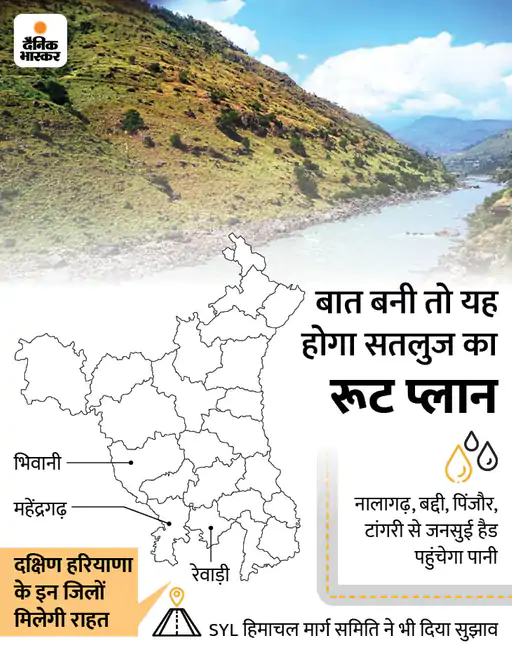
पंजाब से सतलुज यमुना लिंक (SYL) का पानी न मिलने से निराश हरियाणा ने अब नए विकल्पों पर विचार करना शुरू कर दिया है। उत्तर प्रदेश के बाद अब हरियाणा ने अपने पड़ोसी राज्य हिमाचल प्रदेश से सतलुज का पानी लेने का विकल्प तैयार किया है। इस विकल्प पर 67 किलोमीटर का रूट प्लान तैयार हो गया है। इस रूट पर नहर बनाने में 4200 करोड़ रुपए का खर्च आएगा। अब बात हिमाचल प्रदेश के मुनाफे को लेकर अटक गई है। इसको लेकर जल्द ही सुलझाने के लिए हिमाचल और हरियाणा के सचिव स्तर पर वार्ता की जाएगी। https://www.bhaskar.com/local/haryana/news/haryana-cm-manohar-lal-himachal-pradesh-cm-sukhvinder-singh-sukhu-controversy-sutlej-himachal-haryana-canal-update-131243107.html (03 May 2023)
IRRIGATION
Niti Aayog 52% of cultivated land has access to irrigation for first time Over half of India’s cultivated land now has access to assured irrigation led by an expansion in micro projects, official data for 2022-23 show. In 2022-23, of the 141 million hectares of gross sown area in the country, nearly 73 million hectares, or 52%, had irrigation access, up from 41% in 2016, according to updated data from Niti Aayog.
– The increase in irrigation cover since 2017-18 was driven by six programmes and projects, according to data seen by HT. These are the Pradhan Mantri Krishi Sinchai Yojana (PMKSY) and the Accelerated Irrigation Benefit Programme (AIBP), under which ₹11,505 crore was released between 2017-18 and 2021-23; Har Khet Ko Paani-Surface Minor Irrigation ( ₹4,000 crore); PMKSY-groundwater projects ( ₹787 crore); special package for Maharashtra ( ₹1,988 crore); Rajasthan and Srihind feeder ( ₹300 crore) and Shahpur-Kandi project ( ₹298 crore). In Madhya Pradesh, 21 prioritised irrigation projects have been identified under PMKSY-AIBP. Out these, 17 projects have been completed, increasing the state’s irrigation cover by 16%.
– Of the total irrigation-infrastructure expansion, micro irrigation facilities through sprinklers and drip systems were installed in 8 million hectares. Out of the total irrigated area in the country, 40% is currently watered through canal networks, while 60% through groundwater. https://www.hindustantimes.com/india-news/india-achieves-milestone-as-over-half-of-cultivated-land-gains-access-to-irrigation-mitigating-climate-change-impacts-101685299658339.html (29 May 2023)
URBAN RIVERS
Mutha; Pune ‘Metro work on riverbed in Deccan may cause floods’ The Maharashtra irrigation dept has warned that the ongoing Metro work in Pune may lead to floods in the monsoon as the carrying capacity of the narrowed riverbed has reduced. https://timesofindia.indiatimes.com/city/pune/metro-work-on-riverbed-in-deccan-may-cause-floods/articleshow/100665090.cms (01 June 2023)
RIVERS
SANDRP Blog केन नदी को जीवित रखते, झीरा, झीना, डबरा, डबरी, दहार पदयात्रा के अवलोकन से समझ आया कि क्यां (केन) ज्यादातर जगह अभी बारामास बहने वाली अवरिल नदी नहीं है। यह कहना मुश्किल है कि ऐसी स्थिति कब से है। फिर भी नदी के कुछ आरंभिक और अधिकांश मध्यम एवं निचले भागों में खूब पानी दिखता है।
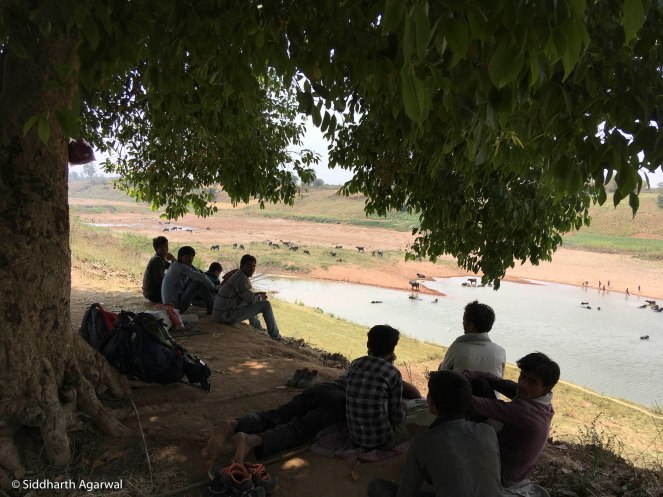
जिसका मुख्य श्रेय नदी की भौगोलिक स्थिति के कारण बने दहार, डबरा, डबरी जैसी प्राकृतिक संरचनाओं और झीरा, झीना आदि के रूप में नदी में मिलने वाले भूजल स्रोतों को जाता है। साथ में कुछ सहायक नदियाँ भी क्यां में जलापूर्ति करती हैं। काफी जगहों पर नदी सूखी है, जलकुण्डों के पानी में ठहराव अधिक और बहाव कम दिखा। https://shorturl.at/deNOZ (03 June 2023)
1 से 7 जून 2023 तक नदी बचाओ- पर्यावरण बचाओ संघर्ष सप्ताह का आह्वान. नदियों पर अनुसंधान के लिए एक संस्थान बनाने की मांग https://www.spsmedia.in/land-forest-and-water/save-river-from-1-to-7-june-2023-save-environment-struggle-week/ (30 May 2023)
Jammu & Kashmir NGT Dissatisfied with Govt in protecting Doodh Ganga NGT in its fresh order said that it was dissatisfied with the working of government vis-à-vis controlling pollution and illegal riverbed mining in Doodh Ganga. After May 30 hearing, the tribunal gave J&K government two-months’ time to implement its previous directions after the newly posted Principal Secretary Housing and Urban Development Department (HUDD) Prashat Goel gave personal assurance.
In its earlier hearing on May 24, 2023, the NGT observed that no substantial progress had been made and directed those effective and meaningful affidavits be filed in the context of remediation of existing dump sites, providing waste processing facilities and preventing discharge of sewage from dewatering pumping stations. The tribunal in its order said that there was no integrated and holistic approach on part of the government in putting the action plan into action. The matter is listed for hearing on August 16, 2023. https://www.greaterkashmir.com/todays-paper/kashmir-todays-paper/dissatisfied-with-govt-in-protecting-doodh-ganga-ngt (02 June 2023)
SUTLEJ Punjab Human lives poisoned by water pollution A small hamlet in Fazilka district, Burj Mohar, has 60-70 families but has seen more than its fair share of tragedies. Around 30 deaths due to cancer have been reported there over the last decade and mysterious illnesses affect people of all age groups — linked to industrial effluents polluting the residents’ water sources.
The high burden of cancers has been linked to water pollution. The villagers have access to two sources of water: Groundwater and canal water. Water from the Sutlej river enters the Abohar branch of the Sirhind canal, which reaches southwest Punjab, including the Fazilka district. The village earlier received water from Bhakra Nangal Dam, said Jagdeep Singh, who served as the village Sarpanch from 1998-2011. Jagdeep has developed issues in his spinal discs. “Around 50 years ago, we stopped receiving water from the dam. Our problems began when we became dependent on Sutlej water,” he noted.
The canal water is polluted due to Buddha nullah, a 40-kilometre-long stream that passes through Ludhiana city before merging with the Sutlej river in the Ludhiana district. Effluents from industries in the region and municipal waste gets dumped into the nullah, which has turned black and has a nauseating odour. Several studies have documented the presence of heavy metals in the stream. https://www.downtoearth.org.in/news/pollution/poisoned-punjab-mystery-illnesses-haunt-this-fazilka-hamlet-dependent-on-canal-water-89701 (01 June 2023)
Dharangwala village in Fazilka district in Punjab was once known as mini-California for its citrus orchards, according to its residents. But now, it is better known for its increasing disease burden in the last few years, which has not even spared the children. Ground visits by Down To Earth (DTE) have shown a high burden of diseases in several Punjab villages. Cancer cases, mystery illnesses and dental problems are familiar in numerous villages. Industry effluents and municipal water polluting water sources and air is their common thread. https://www.downtoearth.org.in/news/pollution/poisoned-punjab-children-with-intellectual-disabilities-severe-skin-allergies-are-common-in-this-village-89778 (02 June 2023)
GANGA River is far from clean Pointing out that the NMCG order mentions, “illegal mining should be stopped,” Ashok Kumar said, “It is the states that have to stop it. Moreover, we have also formed committees with district administration to monitor it.”
One of the major achievements that the government highlights is the e-flow notification of 2018, which ensures a certain ecological flow in the river at any given time despites dams in its upper reaches. But there are those who counter this claim. Himanshu Thakkar, of South Asia Network for Dams, River and People (SANDRP) said, “The government hasn’t taken any major step on this aspect except the 2018 e-flow notification. That, too, was not scientific, and it is not even implemented properly. The Central Water Commission was asked to prepare the monitoring report. It is not assessing it properly, so there is a failure in the manner in which water is released.” https://www.news9live.com/india/nine-years-after-launch-of-flagship-namami-gange-iconic-river-is-far-from-clean-2162516 (01 June 2023)
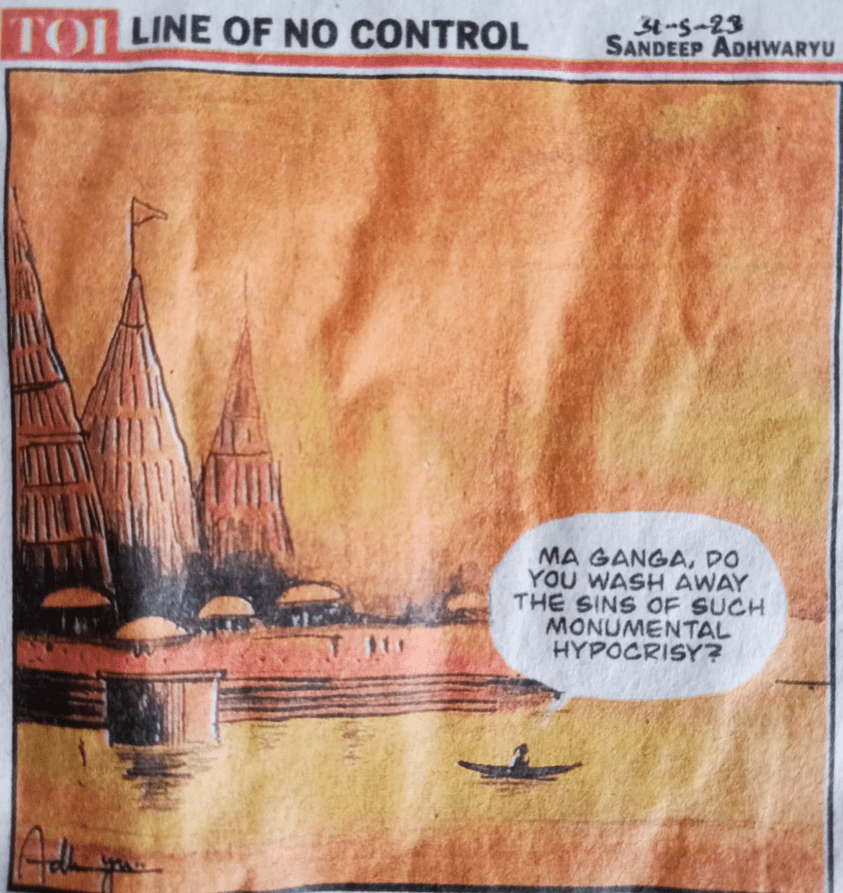
Cartoon on Ganga The Times of India, May 31, 2023
Uttarakhand बदरीनाथ में अलकनंदा नदी में गिरता रहा अनट्रीटेड सीवेज जल संस्थान के इंजीनियर संजय श्रीवास्तव सेबात की गई तो उन्होंने कहा कि बदरीनाथ मेंसीवेज ट्रीटमेंट प्लांट लगाए हैं. इनमेंसे एक 1MLD का, दूसरा 26KLD और तीसरा 10KLD का है. संजय श्रीवास्तव का कहना हैकि बदरीनाथ मास्टर प्लान के निर्माण कार्यों की वजह से 10KLD वाला एसटीपी प्लांट ऑपरेशनल नहीं है, लेकिन अन्य 2 एसटीपी ऑपरेशनल हैं. इनमेंसे एक एसटीपी पर 19 मई को मोटर खराब होनेकी वजह से ओवरफ्लो हो गया और कुछ देर तक अनट्रीटेड सीवेज नदी में चला गया था. हालांकि अधिकारियों का कहना हैकि इसे जल्दी ठीक कर दिया गया था. इसके अलावा जल संस्थान का कहना है कि चारधाम यात्रा के बाद अचानक धामों में लोगों के दबाव बढ़नेके बाद एसटीपी प्लांट पर भी दबाव बढ़ जाता है, जिसकी वजह से इस तरह की घटनाएं होती हैं. वहीं बदरीनाथ में चल रहे PWD के तमाम निर्माण कार्य के चलते कई जगहों पर सीवेज लाइन भी क्षतिग्रस्त हुई हैं और उनसे भी सीवेज सीधे नदी में जा रहा है. https://www.etvbharat.com/hindi/uttarakhand/state/dehradun/untreated-sewage-kept-falling-in-alaknanda-river-in-badrinath-dham/uttarakhand20230601125758090090272 (01 May 2023)
नमामि गंगे को उद्गम पर ही लग रहा पलीता नमामि गंगे परियोजना के तहत एक नहीं बल्कि तीन-तीन एसटीपी 19 करोड़ की लागत से बदरीनाथ पुरी में स्थापित किये गये थे। जल संस्थान के अधीक्षण अभियन्ता सुशील कुमार पूछने पर एक सप्ताह के अन्दर तीन दिन नदी में मलजल प्रवाहित करने का तो खण्डन करते हैं मगर एक दिन 19 मई को प्लांट में खराबी आ जाने के कारण सीवेज को अलकनन्दा में प्रवाहित किये जाने की पुष्टि अवश्य करते हैं। सुशील कुमार बताते हैं कि संयत्र में खराब मशीन को 19 मई को ही बदल दिया गया था और नदी में सीवेज के प्रवाह को रोक दिया गया था। अधीक्षण अभियन्ता यह भी बताते हैं कि मशीनरी का खराब हो जाना सामान्य बात है जिसे तत्काल ठीक करा दिया जाता है।
लेकिन इस एसटीपी से नदी में सीवेज को प्रवाहित करने के जो तीन वीडियो वायरल हुये हैं वे 19 से लेकर 24 मई के बीच तीन अलग-अलग दिनों के हैं। जाहिर है कि जितनी बार प्लांट में गड़बड़ी होगी उतनी बार सीवेज सीधे अलकनन्दा में जायेगा। इससे पहले 15 जून 2018 को चेतना भरद्वाज नाम की महिला की जनहित याचिका पर नैनीताल हाइकोर्ट की जस्टिस वी.के. बिष्ट और जस्टिस अलोक सिंह की खण्डपीठ ने इसी मुद्दे को लेकर केन्द्र और राज्य सरकार को नोटिस जारी किया था। यही नहीं सन् 2005 में भी हाइकोर्ट के समक्ष यह मुद्दा उठा था। https://uttarakhandhimalaya.in/holy-river-ganga-getting-dirty-in-holy-place-badrinath/ (01 June 2023)
रिवर फ्रंट डेवेलपमेंट के नाम पर बदरीनाथ मंदिर के चरणों से गुजर रही अलकनन्दा के तट को भारी मशीनों से खोदा जा रहा है। विशेषज्ञों के अनुसार मंदिर और बदरीनाथ पुरी के नीचे बहने वाली अलकनन्दा के तट पर जेसीबी मशीनों से की जा रही खुदाई के कारण ये जलधाराएं बन्द हुई हैं और अगर आगे भी इसी तरह काम होता रहा तो बदरीनाथ के गर्म पानी के तप्तकुण्ड भी एक दिन सूख जायेंगे। जल श्रोतों के नीचे खुदाई करने से अक्सर वे अपना भूमिगत मार्ग बदल देती है। अगर वहां शेषनेत्र झील के आसपास भी इसी तरह भारी मशीनों से खुदाई की गयी तो इस झील का सूखना भी अवश्यंभावी है। यही नहीं रिवर फ्रंट डेवेलपमेंट के नाम पर अलकनन्दा तट पर बड़े पैमाने पर हो रही खुदाई से बदरीनाथ पुरी का समूचा भूमिगत जलतंत्र अस्तव्यस्त होने की आशंका जताई जा रही है। अगर ये प्राकृतिक गर्म पानी के श्रोत भटक गये तो मंदिर में दर्शन से पहले तीर्थयात्रियों के लिये स्नान की समस्या खड़ी हो जायेगी। https://janchowk.com/pahlapanna/modis-dream-heavy-on-badrinath-baikunth-dham-turned-into-debris/ (24 May 2023)
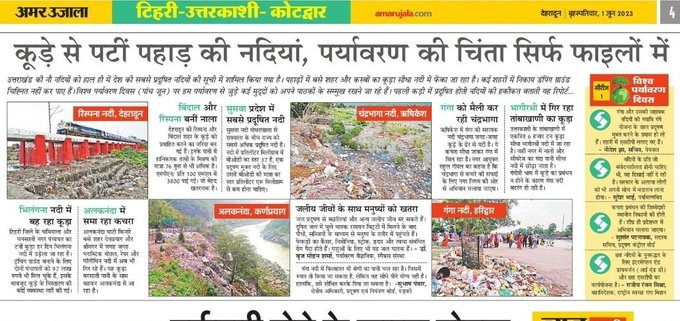
This has become a common practice across Uttarakhand where from market bodies to municipalities routinely dump solid waste along the water streams and rivers. (Amar Ujala, 01 June 2023)
YAMUNA Haryana Chemical streams flow into river Effluents discharged by around 100 dyeing units at Kundli in Sonepat reach the Yamuna all day. Despite a Punjab and Haryana high court order in 2015 to shift all dyeing units from residential areas of Sonipat, these remain operational at Piao Maniari and Friends Colony in the Kundli area, TOI found on Friday (June 05). Though the HSPCB has snapped the power supply to these units, that hasn’t made a difference.
Most of these dyeing units have no treatment plants and discharge effluents into two drains-Mugeshpur and number 6-that flow into the Yamuna. An overwhelming pungent smell hangs in the air around these drains, which people living in the vicinity say they have learnt to live with.
Delhi-based environment activist Varun Gulati, who recently filed a complaint, claimed the untreated water released by these dyeing units is high in ammonia and phosphates compounds that are toxic for aquatic life and also contaminate the groundwater. He said the pollution control board had not taken action against any of these illegal units. https://timesofindia.indiatimes.com/city/gurgaon/chemical-streams-flow-into-yamuna-in-sonipat/articleshow/100719454.cms (03 June 2023)
Untreated wastewater being pumped into Yamuna, Ghaggar rivers A monthly progress report by the Haryana government regarding the Ghaggar and Yamuna action plan to the NGT reveals that over 11 drains are discharging 540 MLD untreated effluent into the Yamuna as 25 STPs located in the Yamuna catchment area are non-compliant with the prescribed standards. In the Ghaggar catchment area, of total 62 STPs with a capacity of 535 MLD, 23 are not meeting the prescribed parameters. While, there are total 59 STPs installed in the Yamuna catchment area, with a capacity of 1,075 MLD, and 25 of them are not meeting the prescribed standard.
The estimated sewage generation in the Yamuna catchment area is 1,098 MLD, while the total sewage generation in the Ghaggar catchment area is 291.46 MLD. There is a gap of 240 MLD in the installed treatment capacity at present, in comparison to the required amount in some towns in the catchment area of Yamuna, including 144.5 MLD in Faridabad, 86 MLD in Gurugram and 9.3 MLD in Palwal. https://www.hindustantimes.com/cities/chandigarh-news/untreated-effluent-discharge-the-main-culprit-behind-toxic-yamuna-and-ghaggar-rivers-authorities-struggle-to-tackle-the-issue-101684782262172.html (23 May 2023)
Delhi Illegal dyeing units causing pollution During a recent meeting of the central monitoring committee, the authorities said that since these industries are existing in non-conforming areas, they are not allowed to operate and considered as illegal. “DG, NMCG, directed that pollution from any source to the river, whether from conforming or non-conforming industrial clusters, should be stopped,” according to the latest minutes of the meeting.
In May, NGT directed the monitoring committee appointed by the Supreme Court to look into the matter of illegal dyeing units operational in Delhi. A DPCC official said joint teams of departments concerned were conducting random inspections to close such units.
Varun Gulati, who has filed several complaints with DPCC and NGT on operation of illegal dyeing and washing units, said, “A large number of such units are operational in Delhi without a consent. Most of them are operational in Swaroop Nagar, Budhpur, Narela, Bindapur, Matiala, Ranhola, Khyala, Meethapur, Badarpur, Mukundpur and Kirari. Apart from Delhi, such polluting units are operational in many parts of the national capital region.” He added that these units cause frothing in the river and impact aquatic life.
Bhim Singh Rawat, a Yamuna activist, said, “These illegal dyeing and washing units don’t have any no-objection certificate to operate in residential areas. As they are not connected to common effluent treatment plants and don’t have effluent treatment plants, the discharge from these units enters the Yamuna through local drains. They use chemicals for dyeing and detergents for washing, which contain high ammonia and phosphate compounds.” https://timesofindia.indiatimes.com/city/delhi/illegal-dyeing-units-causing-pollution-in-yamuna-experts/articleshow/100735449.cms (04 June 2023)
22-km human chain to raise issue of pollution Delhi generates around 770 MGD of sewage. The 35 STPs located at 20 locations across the city can treat up to 630 MGD of sewage and have been utilising around 85 per cent of their capacity. The rest of the untreated sewage falls into the river directly. Government data shows that only 10 of the 35 operational STPs in the capital meet the prescribed standards for waste water. Together, they can treat 150 million gallons of waste water a day. According to the city government’s Outcome Budget, 29 per cent of the sewage generated in Delhi in 2021-22 fell into the Yamuna untreated. It was 28 per cent in 2019-20 and 26 per cent in 2020-21.
A study conducted by the National Institute of Hydrology, Roorkee had in 2019 recommended that 23 cubic metre per second (cumec) water (437 million gallons a day) be released in the river from the Hathnikund barrage in Haryana’s Yamuna Nagar district in the lean season for sustaining the downstream ecosystems. At present, only 10 cumecs (190 MGD) of water is released from the barrage. A gap of 13 cumecs (247 MGD) remains.
According to the ministry, the water sharing agreement of 1994 among the riparian states of Uttarakhand, Himachal Pradesh, Uttar Pradesh, Haryana, Rajasthan and Delhi is due for revision only in 2025. https://www.business-standard.com/india-news/22-km-human-chain-to-raise-issue-of-yamuna-pollution-in-delhi-on-jun-4-123060101203_1.html (01 June 2023)
Uttar Pradesh Devotees express anger over river’s pathetic state Ahead of Tuesday’s (May 30) popular river festival, Ganga Dussehra, devotees in Agra, Mathura, Vrindavan have expressed deep disgust and anger at the pathetic state of the Yamuna river, considered the lifeline and a centre of faith in the Braj mandal.
Normally the government agencies release 1000 cusecs extra water for the Dussehra, but this year this has not been done, and therefore there is a resentment among saints of Braj area. In Vrindavan, the Yamuna flows at least 30 metres away from the famous Keshi Ghat. In Mathura, the polluted effluents from hundreds of sari-dyeing units discharged in the river, has only compounded the problem. After the construction of the Gokul Barrage, the river has distanced itself from the historical Gokul ghats.
The Agra Heritage Lovers Group, in its memorandum sent to the PM has urged him to replicate the Sabarmati model in Agra and Mathura. https://telanganatoday.com/devotees-express-anger-over-yamuna-rivers-pathetic-state-ahead-of-ganga-dussehra (29 May 2023)
Pollution bleeds Hindon A stretch of the Hindon flowing through Bahlolpur has turned red, bleached by copious streams of chemicals that gush into the river from illegal dyeing units that continue to sprout despite several government and judicial interventions to clean up a river slow-poisoned by industrial pollution over the decades. The sight of red currents of dye discharge coursing into the river through deposits of garbage on its banks is neither new, nor unusual, for locals. It’s red on one day, yellow on another, jet black on some, depending on the dominant colour in the units dyeing clothes, like shirts, T-shirts, tops, etc.
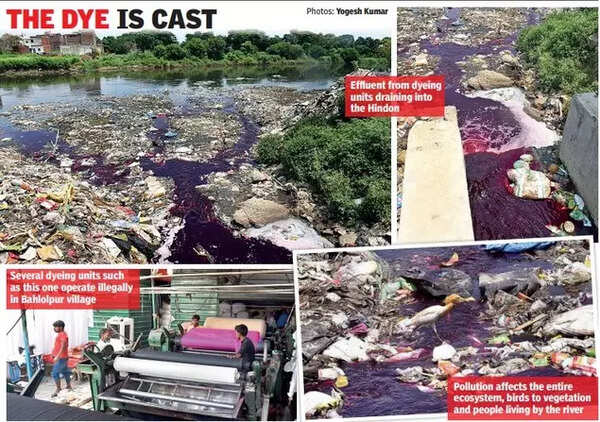
Around 30 dyeing units, big and small, operate in Bahlolpur despite the National Green Tribunal’s latest orders directing government departments to take remedial measures to clean up the river. Officials from the pollution department said they had asked for power connections to be switched off to these unauthorised units. The chemicals and dyes released by these units have contaminated the water table, villagers fear. Many have stopped using water sourced from the river and filtered, as well as groundwater, for drinking purposes. https://timesofindia.indiatimes.com/city/noida/a-river-turns-red-pollution-bleeds-hindon/articleshow/100634029.cms (31 May 2023)
16 illegal dyeing units, releasing untreated chemical effluents into the Hindon in Noida’s Bahlolpur, will be sealed on Thursday (June 01), said officials with the Noida Authority. Power connections to the units, meanwhile, were snapped on Wednesday (May 31) during a crackdown on the polluters by a joint team of UP Pollution Control Board and the electricity department. Mostly engaged in dyeing shirts, the units were operating without licence and pollution clearance certificates, officials said. https://timesofindia.indiatimes.com/city/noida/pollution-board-snaps-power-to-dyeing-units-releasing-chemicals-into-hindon/articleshow/100662544.cms (01 June 2023)
RIVERS BIODIVERSITY
Bihar 2 dolphins found dead in 3 days Residents informed the officials about the incident after sighting the carcass on May 29 evening. They claimed it was the second Gangetic dolphin found dead at Sangat Ghat (bank of river Ganga) near Aunta in Mokama, about 90 km from Patna.

Both Gangetic dolphins were killed due to the ongoing mechanised dredging to deepen the riverbed, according to them. Gopal Sharma, senior scientist and joint director of the Zoological Survey of India, Bihar and Jharkhand said Gangetic dolphins were either killed by dredging or after being trapped in a big fishing net. Both possibilities exist, Sharma said. https://www.downtoearth.org.in/news/wildlife-biodiversity/two-gangetic-dolphins-found-dead-in-bihar-in-the-last-3-days-89668 (30 May 2023)
Mongabay India The gharial attempts a second comeback Part of the Girwa river that runs through KWS has a large gharial population, estimated at more than 70 in 2022. They are restricted to a 20 kilometre stretch since the damming in 1976 (Girijapuri barrage). The barrage gates are opened annually for maintenance and during the monsoon. “It functions as a one-way exit for gharials, particularly juveniles, who are unable to return when the gates are closed,” says Vashistha. As a result, KWS has historically had low juvenile recruitment.
In 2010, however, a natural channel shift occurred in the upstream part of the Karnali river in Nepal. It reduced the water flow in the Girwa stretch where gharials nest. In response to the mainstream channel shift, a small resident freshwater dolphin population moved into the adjoining Kaudiyala channel where the flow was greater and the water deeper than in the Girwa. The gharials in the Girwa, however, did not shift.
The reduced flow also caused rapid vegetation growth on sandy substrates. To understand its impact on gharial nesting, a study was conducted at these sites from 2017 to 2019. In areas with sandbars – where the gharial basks, nests and lays eggs – had transitioned to woody cover, the number of nests had reduced by more than 40%. https://india.mongabay.com/2023/05/the-gharial-attempts-a-second-comeback-with-help-from-the-katarniaghat-wildlife-sanctuary/ (31 May 2023)
Western Ghats 62 plant species surviving without water Western Ghats, India’s biodiversity hotspot, is home to 62 Desiccation-Tolerant (DT) Vascular plant species — able to withstand extreme dehydration, losing up to 95% of their water content, and they revive themselves once water is available again — which could have applications in agriculture, particularly in areas with scarcity of water, the department of science (DST) has said. A recent study by scientists from Agharkar Research Institute (ARI) Pune, an autonomous institute of the DST, has identified 62 DT species in Western Ghats, many more than the earlier known nine species. 16 of them are Indian endemic and 12 are exclusive to the WG outcrops, highlighting the ghat’s importance as a global DT hotspot. https://timesofindia.indiatimes.com/india/62-plant-species-that-can-withstand-extreme-dehydration-discovered-in-western-ghats/articleshow/100696817.cms (02 June 2023)
FISH, FISHERIES, FISHERFOLKS
Uttar Pradesh बाँदा: केन नदी में मिली भारत में प्रतिबंधित मछली बाँदा ज़िले में दक्षिण अमेरिकी अमेजन नदी मे पाई जाने वाली कैटफिश प्रजाति की सुकरमाउथ मछली ने दस्तक दी है। बीते 3 जून को ज़िले के सदर तहसील की ग्रामपंचायत कहला रहवासी शिवनायक निषाद को यह दुर्लभ मछली प्राप्त हुई थी। वे बतलाते है रात्रि मे मछली के लिए डाले गए जाल मे इसका फंसना हुआ था। सुबह जब देखा तो इसकी प्रजाति का अनुमान न होने से क्षेत्र मे चर्चा फैल गई।

बताते चलें कि कैटफिश प्रजाति की सुकरमाउथ मछली जो सुनहरे चकत्तेदार होती है यह खाद्य पदार्थों को सक करके खाती है। नदी मे ज़मीन से चिपकी रहने वाली यह मछली बाँदा से हजारों किलोमीटर दूर दक्षिण अमेरिका के अमेजन नदी मे पाई जाती है। गतवर्ष बनारस और बिहार की गंगा नदी मे यह देखने को मिली थी। इसकी अनुमानित जनसंख्या भारतीय नदियों मे कितनी है यह आंकड़ा सरकारी महकमों में नहीं है। उल्लेखनीय है कि बुंदेलखंड के परिवेश और पर्यावरण जैवविविधता के विपरीत यह मछली यहां की नदीयों मसलन केन के पर्यावास हेतु अच्छे संकेत नहीं है।
जानकारों की मानें तो कैटफिश सुकरमाउथ जिस नदी में रहती है वहां दूसरी प्रजाति की छोटी मछलियों और उनके अंडों को खा लेती है। इससे नदी मे छोटे जलचरों की प्रजनन दर प्रभावित होती है। वहीं उनकी जनसंख्या कम होने लगती है। वैसे तो प्रकृति मे हर जीव एकदूसरे पर निर्भर है लेकिन हर जीव, वन्यजीव, सहचर और जलचर का अपना पर्यावास होता है। वह वहीं प्रगतिशील व प्रकृति सम्यक होता है। हर देश और प्रान्त की जलवायु एवं भगौलिक परिस्थिति भिन्न होती है। हजारों किलोमीटर दूर बाँदा की केन नदी मे इसका मौजूद होना अतिश्योक्ति पूर्ण नहीं लेकिन क्षेत्रीय नदियों के संदर्भ मे चिंता का विषय अवश्य है। https://dashanan.in/national-news/kane-river-in-banda-found-suckermouth-fish-today-live-6857/ (05 June 2023)
Gujarat Inland fisheries output dips While the state government has several schemes to incentivize inland fisheries, their output by value has fallen by 12.7% in the past decade, according to a report from the Union ministry of statistics and programme implementation (MoSPI). The value of inland fishing output in Gujarat fell from Rs 475.76 crore in 2011-12 to 415.17 crore in 2020-21. https://timesofindia.indiatimes.com/city/ahmedabad/gujarats-inland-fisheries-output-dips/articleshow/100636203.cms (31 May 2023)
Goa ‘Mussel farming is a profitable business’ “From cage culture of fish, people are slowly taking to mussel culture. This is a good trend. The farmers will be able to harvest the mussels within a period of five months,” said fisheries director Shamila Monteiro. A single rope of mussel seeds can generate about 1 to 1.5kg of fully grown mussels. The current price of the edible bivalve molluscs is Rs 400 per kg in Goa, thus making it a high value seafood species. The fisheries department, therefore, encouraged the attendees to avail of the scheme for setting up of the mussel culture/oyster farming unit in the state, and venture into fisheries entrepreneurship.
– “With 35 ropes of mussel seeds, farmers can harvest up to 50kg mussels. This is, therefore, a very profitable business for unemployed youth and farmers living near river areas,” Monteiro said. The salinity or amount of dissolved salts in water in rivers is usually expressed in parts per thousand (ppt). To be eligible for mussel cultivation in Goa, the river’s salinity should be above 27 ppt following which fish farmers in the vicinity can be encouraged to take up mussel farming. https://timesofindia.indiatimes.com/city/goa/mussel-farming-is-a-profitable-business/articleshow/100536851.cms (27 May 2023)
SAND MINING
MoEF Draft guidelines on extracting sand from sandbars released The MoEF&CC has sought comments from the Tamil Nadu state government on the draft guidelines on the extraction of sand from sandbars in intertidal areas by coastal communities. Under the draft guidelines sent to the state coastal zone management authority, the Centre has asked the state to utilise the expertise of premier scientific institutes or university departments in preparing a plan for sandbar extraction and monitoring.
– In each coastal district, the state has been authorised to form a seven to 10-member committee chaired by a magistrate or collector and consisting of representatives from scientific or technical institutes or university departments, district-level committees constituted under CRZ notification and two from local traditional coastal communities or fishermen. The guideline states that the district committee constituted will be responsible for approving extraction as per the approved plan. The committee shall specify a time period in a particular area and the quantity of sand that can be extracted. The committee shall also be responsible for monitoring the extraction process, which shall be done manually without using machinery.
– Various organisations opposed amendments to the CRZ notification, 2019, related to oil and gas exploration, sand extraction from sandbars and retaining shacks on beaches during the monsoon, stating that the proposed changes will spell disaster for the environment and local communities. Sandbars are formed naturally along intertidal areas. Fishermen have opposed sand extraction from sand bars as it functions as eco-barriers that prevent fishing hamlets from extreme events, besides maintaining the ecological balance. They added that clearing sandbars would lead to rapid coastal erosion and threaten the nesting of seashore birds and endangered turtles. https://www.newindianexpress.com/states/tamil-nadu/2023/jun/01/draft-guidelines-on-extracting-sand-from-sandbars-released-2580714.html (01 June 2023)
Haryana Rs 12.85 crore flood-control plan approved One of the arguments often given by govt officials behind allowing continuous sand mining in the river is protection against flood damages. Just last week villagers have raised fear of flooding during a public hearing for allowing mining in Yamuna river in Karnal. There are plans to allow 8 more sand mines in same district. Ironically, now govt plans to spent Rs. 12.87 crore on flood protection works in the same district which shows river bed mining does not solve flood threats, on the contrary the largescale mechanized ongoing river bed mining in the district have actually aggravated flood threats. https://www.tribuneindia.com/news/haryana/12-85-crore-flood-control-plan-approved-for-villages-near-yamuna-512446 (30 May 2023)
Editorial in The Tribune on illegal mining in Aravalli. “A viable option could be to set up a monitoring unit comprising local young men and women, dedicated to the protection of the vulnerable region. Train them, employ them and make them equal stakeholders. The local residents’ cooperation can make a difference.” https://www.tribuneindia.com/news/editorials/curbing-illegal-mining-512427 (30 May 2023)
Uttarakhand About illegal, mechanized riverbed mining in Nayaar river between Satpuli in Pauri and Beas ghat, Haridwar though govt rules allow only manual mining there. https://parvatjan.com/uttarakhand-news-live-11/ (31 May 2023)
Uttar Pradesh बांदा जिले में (June 02) एक हादसे में चार बहनें केन नदी में डूब गईं। दो की मौत हो गई। दो बहनों को बचा लिया गया। उठाने पहुंची तो परिजनों और ग्रामीणों ने हंगामा कर दिया। उनका आरोप था कि अवैध खनन के चलते नदी और किनारे गहरे गड्ढे हो गए हैं, यही हादसे की वजह है। पास की खदान संचालक इसके जिम्मेदार हैं। ग्रामीण और परिजन कार्रवाई की मांग कर रहे थे। उनका कहना था कि वरना पहले भी लोग वहीं से निकलते रहे हैं। देर रात अधिकारियों ने ग्रामीणों को शांत कर स्थिति को सामान्य किया। हंगामे के बाद शव उठाए जा सके।
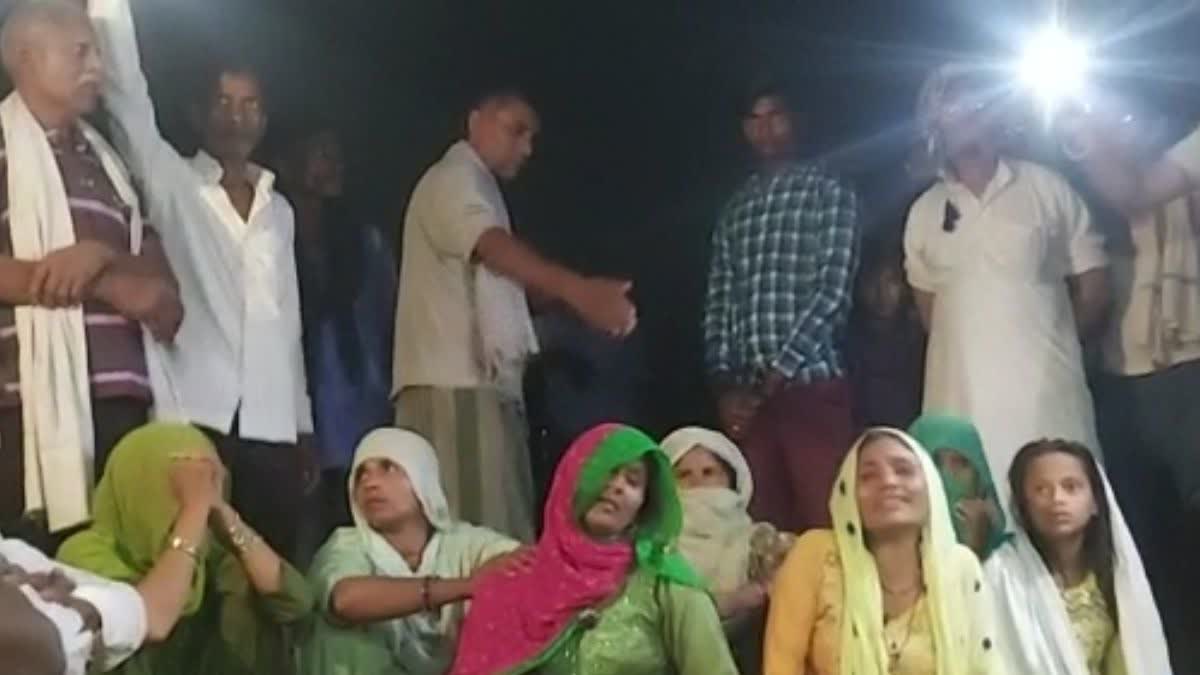
जानकारी के अनुसार पैलानी थाना क्षेत्र के खप्टिहाकलां के सिमरन डेरा में भंडारा था। शुक्रवार शाम खप्टिहाकला की रहने वाली चार चचेरी बहनें यासमीन (10) पुत्री बल्लू, उसकी चचेरी बहन शफीना (14) पुत्री सिराजुल, शबाना (13) पुत्री अनीस, रुकसार (10) पुत्री इंदू भंडारा खाने को निकलीं।लीं वहां से लौटते समय केन नदी पार करते समय चारों पैर फिसलने से गहराई में चली गईं। नाविक सुरेश ने दो बहनों शबाना और रुकशार को पानी से बाहर निकाल लिया। बाकी दोनों डूब गईं। https://samarneetinews.com/four-sisters-drowned-in-banda-two-died-is-illegal-mining-reason/; https://www.etvbharat.com/hindi/uttar-pradesh/state/banda/four-girls-drowned-in-river-in-banda-two-dead/up20230603163128273273631 (03 June 2023) हादसे के करीब छह घंटे बाद रात 12 बजे प्रशासन की ओर से दैवीय आपदा कोष से मुआवजा दिलाने की बात कही गई। https://www.amarujala.com/uttar-pradesh/banda/dead-body-raised-after-six-hours-on-assurance-of-compensation-banda-news-c-12-1-267576-2023-06-04 (04 June 2023)
खप्टिहाकला में केन नदी के खदान 100/3 के संचालक ने जमकर अवैध खनन किया और बीस से 25 फीट के मौत के गड्ढे बना दिए। नाव घाट के पास ऐसे ही एक गड्ढे में शनिवार (July 23, 2022) सुबह किसान डूब गया। नाविकों ने जबतक निकाला, तब तक उसकी मौत हो चुकी थी। ग्रामीण इंद्रपाल सिंह, रामनरेश, नाव चालक भूरा निषाद, चंद्र प्रकाश निषाद ने बताया कि खनन क्षेत्र के बाहर करीब 20 मीटर गहराई तक खोदाई कर मौरंग निकाली गई है। ऐसे दर्जनों गड्ढे नदी किनारे बने हैं, जो बाढ़ के समय मौत के यमदूत साबित होंगे। ग्रामीणों का आरोप है कि अवैध खनन की शिकायतों के बाद भी तहसील प्रशासन ने मौन साध रखा था। https://www.jagran.com/uttar-pradesh/kanpur-city-farmer-died-by-drowning-in-a-mine-pit-in-banda-22917593.html (23 July 2022) अवैध खनन से बने ऐसे ही गड्ढों में डूबकर पांच साल पहले नया डेरा निवासी भिन्ना निषाद की दो बेटियों की भी मौत हुई थी। https://www.jagran.com/uttar-pradesh/banda-death-22919108.html (24 July 2023)
Madhya Pradesh अवैध उत्खनन के चलते गोटेगांव थाना अंतर्गत ग्राम बेलखेड़ी के नजदीक नर्मदा के जालौन घाट पर एक ग्रामीण का शव संदिग्ध अवस्था में पाया गया है।
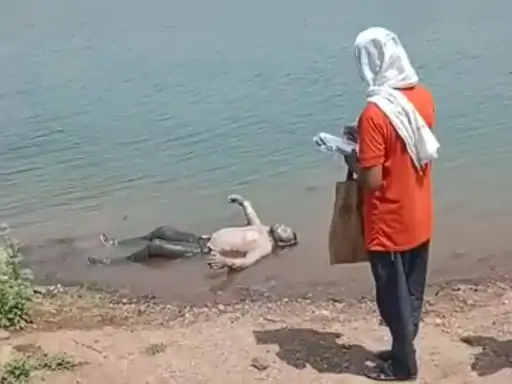
परिजनों का आरोप है कि बेलखेड़ी घाट पर लगातार अवैध उत्खनन हो रहा है, जिससे घाट पर गहरे गड्ढे हो चुके हैं। यही कारण है कि हरिराम ठाकुर नहाते समय गहरे गड्ढे में फंस गया। उसकी मौत हो गई। https://www.bhaskar.com/local/mp/narsinghpur/news/was-missing-for-two-days-the-family-said-death-by-drowning-in-pits-caused-by-illegal-sand-mining-131329676.html (26 May 2023) नर्मदा नदी में मिला युवक का शव: दो दिन से था लापता, परिजन बोले- रेत के अवैध खनन से हुए गड्ढों में डूबने मौत https://www.bhaskar.com/local/mp/narsinghpur/video/was-missing-for-two-days-the-family-said-death-by-drowning-in-pits-caused-by-illegal-sand-mining-131329676.html (26 May 2023)
Tamil Nadu DMK functionary arrested for attacking RI The Police on Sunday (May 28) arrested a DMK panchayat president and three others for allegedly assaulting a government official when he attempted to stop illegal red sand mining near Thuraiyur in Tiruchirappalli district. The party suspended V Maheshwaran, 48, from all posts and revoked his primary membership.
According to the police, after receiving various complaints of illegal red sand mining at Narasingapuram panchayat that falls under the Thuraiyur block, Revenue Inspector Prabhakaran headed to the spot on Saturday (May 27) night and found an excavator transporting the soil. https://indianexpress.com/article/cities/chennai/dmk-functionary-arrested-for-attacking-revenue-inspector-illegal-sand-mining-in-trichy-8634846/ (29 May 2023)
Farmers complain of rampant sand mining from rivers and tanks Rampant sand mining was taking place illegally in many riverbeds and tanks in Dindigul district, complained farmers at the monthly grievance meeting held on Tuesday (May 29). Collector M.N. Poongodi, who presided over the meeting, suggested the farmers to give their submissions in writing as it would enable them to get the response from the officials concerned.
The farmers claimed that as a result of the illegal mining, there were apprehensions that water conservation may turn out be a big challenge in future. Moreover, the water table may also fall drastically. When some of the farmers rose up and stated that some dipper lorries entered the tanks during odd hours and engaged in mining activities, the officials intervened and insisted on giving it in writing. https://www.thehindu.com/news/cities/Madurai/farmers-complain-of-rampant-sand-mining-from-rivers-and-tanks/article66912049.ece (30 May 2023)
WETLANDS, LAKES, WATER BODIES
Delhi Wetland authority to create water body health card State Wetland Authority plans to create health cards for all water bodies in the capital to assess their existing condition and the changes they undergo based on steps undertaken aimed at their rejuvenation. The body has sought expertise from individuals, NGOs and expert organisations to help create action plans and environment management plans for each water body. The health cards will include visual cues in the list of parameters for the health cards of these water bodies, along with readings collected from each water body. https://www.hindustantimes.com/cities/delhi-news/delhi-state-wetland-authority-to-create-health-cards-for-water-bodies-in-capital-seeks-experts-for-rejuvenation-and-restoration-101685472772772.html (31 May 2023)
Bhopal Master plan to save wetland & green cover Amendments to proposed Bhopal Development Plan (Draft)-2031 were announced on Friday (June 02). If the plan is adopted, it will make it binding on officials to act, the next time, a marriage garden or building is constructed along Upper Lake or a forest area. T&CP amendments have reversed a number of changes which were proposed in the Bhopal draft plan released in 2021. Marriage gardens along Bairagarh and other residential developments in the Upper Lake, have been deemed as harmful for Raja Bhoj’s lake. https://timesofindia.indiatimes.com/city/bhopal/finally-a-master-plan-to-save-bhopal-wetland-green-cover/articleshow/100717019.cms (03 June 2023)
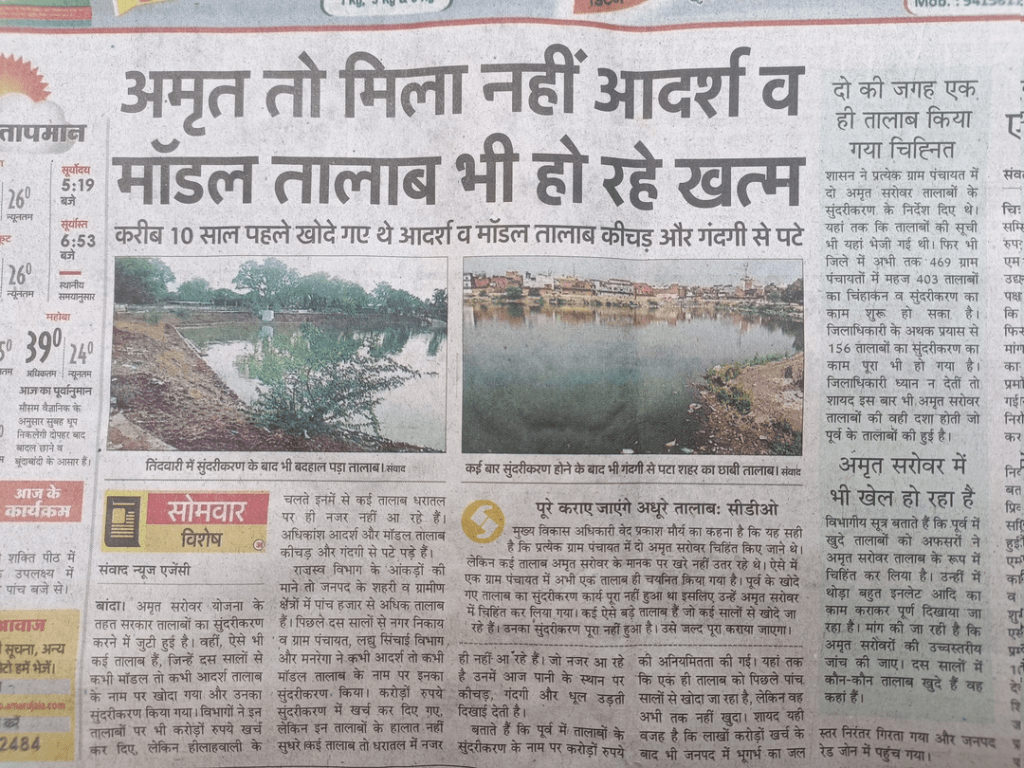
Uttar Pradesh Situation of village level ponds in Banda.
WATER OPTIONS
Jammu & Kashmir A centuries-old tradition of local communities taking a day off from work to weed and desilt the Panzath Nag in South Kashmir, keeps the water body vibrant and clean. It is believed the 500 springs lie within a radius of 1.5 kilometres from Panzath village where this annual festival is held. https://www.gaonconnection.com/lead-stories/kashmir-panzath-nag-annual-spring-festival-community-culture-environment-52148 (29 May 2023)
URBAN WATER
Bengaluru Bellandur lake restoration date extended to Dec. 2024 Karnataka Forest, Ecology and Environment Minister Eshwar Khandre on Wednesday (May 30) asked officials to explain the reason for the delay in stopping entry of sewage to Bellandur lake and warned against laxity in following the NGT order. The minister visited the lake, which hit national and international headlines after it caught fire in 2015 and 2017, to get a situation update. Expressing displeasure over the raw sewage from Koramangala in the diversion weir, he sought to know the reason for the delays. https://www.deccanherald.com/city/top-bengaluru-stories/karnataka-minister-sets-december-2024-deadline-for-restoration-of-bellandur-lake-1223566.html (31 May 2023)
Residents of around three villages in suburban pockets of Whitefield are forced to cough up around ₹10,000 a month to purchase water, as groundwater has depleted drastically. These residents are dependent on borewells. https://www.thehindu.com/news/cities/bangalore/residents-in-whitefield-spend-10000-per-month-on-water/article66924503.ece (02 June 2023)
In localities across Bengaluru, contamination is a disturbing daily threat. Trenches dug up for sewage lines that cut through water lines, flooded sewage drains overflowing or intruding into leaky Cauvery lines, old, worn-out pipes long past their expiry date. https://www.thehindu.com/news/cities/bangalore/question-mark-on-water-quality-as-contamination-threat-looms-over-bengaluru/article66911926.ece (31 May 2023)
Mysore “In future, MCC Zonal Officers will be held responsible for any danger caused by rain and wind. The concerned should send a proposal for want of more funds and works cannot be stopped for want of funds,” Mayor Shivakumar said. https://starofmysore.com/cleaning-of-raja-kaluves-big-drains-begin/ (29 May 2023) DC Dr. K.V. Rajendra has said: “It is intended to tap Corporate Social Responsibility (CSR) funds of University of Mysore (UoM), to prepare a Master Plan for the development of the lake and another plan for management and improvement of Micro Plants.” https://starofmysore.com/master-plan-to-develop-kukkarahalli-lake-using-csr-funds-dc/ (28 May 2023)
Mumbai Water woes to last for next 2 to 3 years Over the past decade, Mumbai has faced water cuts five times, including two year-long ones. It is bracing for water cut this year, too, with the stock down to 12 per cent. Two projects—Manori desalination plant and Gargai dam—that could have given the city 20 per cent more water are nowhere close to taking off even several years after being proposed. But, BMC officials are hoping the Manori plant will be ready in the next three years if all goes to plan. https://www.mid-day.com/mumbai/mumbai-news/article/mumbai-citys-water-woes-to-last-for-at-least-next-three-years-23290162 (03 Jan. 2023)
The residents from the Pydhonie’s Ghoghari Mohalla in south Mumbai have alleged that they have been receiving contaminated, muddy tap water forcing them to look for water tankers to get clean drinking water. https://www.mid-day.com/mumbai/mumbai-news/article/mumbai-pydhonie-residents-receive-stinky-dirty-drinking-water-23289874 (01 June 2023)
Noida Additional underground reservoirs to boost supply The Noida authority on Sunday (May 28) said that it has started work on connecting an additional supply in underground water reservoir of Sector 118 to improve the water supply to group housing societies in Sectors 74, 75, 76, and 77. The move aims to address the current water supply issues experienced by residents, particularly the high levels of TDS in the water, making it saline. Currently, the authority supplies water to at least a dozen group housing societies from the ground water and the Ganga water from Sector 72 water reservoirs. https://www.hindustantimes.com/cities/noida-news/noida-authority-to-improve-water-supply-by-connecting-additional-source-to-underground-reservoir-for-group-housing-societies-101685299716714.html (29 May 2023)
Gurugram 100 new STPs According to the GMDA, the city currently produces 412 MLD of sewage water, out of which 388 MLD gets treated. The remaining 24 MLD along with illegally discharged sewage constitutes 75 MLD of untreated waste, which eventually makes its way to the Yamuna. The records show that 125 MLD of treated water is currently being used for various purposes, including horticulture, in the city while 75 MLD is being sent to villages in Jhajjar for irrigation. The city currently has two major STPs, one in Dhanwapur and the other in Behrampur.
It was in December 2022 that the NGT observed that polluted wastewater was being discharged into the Najafgarh drain and directed that the problem be addressed on a war footing. It directed the SPCB and civic agencies in Gurugram to set up an independent mechanism for monitoring the pollution level in the Najafgarh drain. The drain is the old course of Sahibi river basin that originates in Jaipur district of Rajasthan and passes through Haryana before entering Delhi near Dhansa. It cuts and flows through Delhi for over 57km before emptying into the Yamuna at Wazirabad. https://www.tribuneindia.com/news/haryana/gurugram-to-get-100-new-stps-513052 (01 June 2023)
City to supply treated sewage water for farming The ambitious project aims at utilising 550 MLD treated waste water from Dhanwapur and Behrampur STPs for irrigating over 51,000 acres in 30 villages. These villages fall in Gurugram and Jhajjar districts and are currently dependent on groundwater and freshwater channels for irrigation. “It might have been tried on a pilot basis for a village or two, but for the first time, treated water of a cosmopolitan city is being used to resolve problems of villages,” said DC Nishant Yadav.
As per the plan, two STP channels will be connected to Jhajjar Drain 8. The water will be utilised for irrigating 51,445 acres. It is also planned to provide micro-irrigation on 10,700 acres at an estimated cost of about Rs 128 crore. The plan includes micro-irrigation on 1,700 acres in villages such as Dhankot, Gopalpur, Chandu, Garhi Harsaru. For this, a Rs 21.77-crore agreement has been executed. Micro-irrigation on 1,400 acres in villages such as Barsa, Jhajjar, Sultanpur and Jhanjrola of Gurugram district is also planned for which an agreement has been executed amounting to Rs 21.42 crore. https://www.tribuneindia.com/news/haryana/gurugram-to-supply-treated-sewage-water-for-farming-466855 (03 Jan. 2023)
GMDA targets a 50% increase in water supply by 2024 At present, the development authority supplies 300 MLD of treated water from Chandu Budhera WTP and 270 MLD from Basai WTP. And the GMDA is now planning to add an additional capacity of 290 MLD in both the WTPs. Along with this, the GMDA is also planning to expand the capacity of the Gurgaon Water Supply (GWS) canal from the current 100 cusecs to 200 cusecs. For this, the GMDA has agreed to deposit Rs 100 crore with the state irrigation department, officials said. https://timesofindia.indiatimes.com/city/gurgaon/in-two-years-gmda-targets-a-50-increase-in-water-supply-to-homes-in-gurugram/articleshow/96751072.cms (05 Jan. 2023)
WATER POLLUTION
Karnataka 15 devotees fall ill due to contaminated water More than 15 people, including women and children, fell ill after consuming contaminated water and food during their visit to Hazrat Ladle Mashaikh Ansari Dargah in Aland town on Friday (June 02). Meanwhile, social activist Thanaji Suryavanshi alleged that contaminated water is being supplied to the town and this has caused adverse effects on the health of the people. Stating that private water purification plants are mushrooming in the town due to the failure of the local body in supplying safe drinking water, he said and added that the indifferent attitude of the TMC has helped the local water supply mafia thrive. https://www.deccanherald.com/state/karnataka-districts/15-devotees-fall-ill-due-to-contaminated-water-in-karnataka-1224344.html (02 June 2023)
SPCB issues showcause notice to Raichur ZP CEO Following the death of a three-year-old boy at Relakmardi village in Deodurg taluk, and over 30 people taking ill in Rekalmardi and Gorebal village of Lingasugur taluk in Raichur district after consuming contaminated water last week, the Karnataka SPCB issued a showcause notice to Chief Executive Officer of Raichur Zilla Panchayat on Friday (June 02). https://www.thehindu.com/news/national/karnataka/pollution-control-board-issues-showcause-notice-to-raichur-zp-ceo/article66924647.ece (02 June 2023)
JJM/ RURAL WATER SUPPLY
Time to shift focus to groundwater With 45 percent of India’s households yet to get access to running water, the government is on overdrive to achieve its targets under the Jal Jeevan Mission by the end of 2024. But connections will be meaningless if these households have no groundwater to draw up to. This is because India’s water needs are largely met by groundwater.
– Yusuf Kabir, WASH Specialist, UNICEF, Maharashtra said, “80 percent of the water supply schemes are groundwater based. The groundwater being the source we need to work really on the source protection. That functionality part is very critical.” https://www.cnbctv18.com/environment/jal-jeevan-mission-shift-focus-to-groundwater-ensure-taps-dont-run-dry-16840041.htm (02 June 2023)
Gujarat Kids dig well with bare hands to quench thirst In Chhota Udepur district’s Dabba village, little children dig soil not as part of summer vacation fun, but as an existential routine to tap the daily quota of drinking water. These tribal kids have to wake up at the crack of dawn to go to a well dug up near their houses and start removing soil with their bare hands. The more they dig, the more are their chances of finding sufficient drinking water for the day. “Water is a priority for us. If we excavate more soil from the well, we get better-quality water. So, our children also join us in the digging exercise. Sometimes kids miss their school, and we can’t teach them at home too as a better part of daily routine is spent inside the well,” rued Meena Bhil, another resident.
Sitawala faliya has a borewell, but it doesn’t yield water. And another borewell is located more than two kilometres away from the village. “It’s not possible for us to trek 5km to and fro on kuccha roads through uneven hilly terrain every day. So, we have no option but to dig the well near our locality deeper,” Jayanti Bhil told TOI. The locals, most of them farm labourers, said that they don’t have piped water facilities despite their repeated requests to the government authorities concerned. While the kids and women dig the bottom of the 15ft-deep well, the men pull out vessels full of mud – an exercise that is practised for a few hours every day. https://timesofindia.indiatimes.com/city/vadodara/kids-dig-well-with-bare-hands-to-quench-thirst/articleshow/100662676.cms (01 June 2023)
छत्तीसगढ़ नल-जल योजना के बावजूद, इस गांव में, आज भी है, पीने के पानी की समस्या छत्तीसगढ़ में, नल-जल योजना के माध्यम से, अनेकों गांव के लोगों की पानी की समस्या दूर हो रही है। इस योजना के आने से, अब लोगों को गंदे पानी से छुटकारा मिल रहा है। लेकिन, कुछ गांव, आज भी ऐसे हैं, जहाँ पानी की समस्या लगातार बनी हुई है।

पीने के पानी के लिए, घंटो लाइन लगानी पड़ती है, तो वहीं कहीं-कहीं पर, पानी की गहराई इतनी ज्यादा होती है कि, हैंडपंपों से निकलने वाले पानी भी सूख जाते हैं। जिससे, लोग नदी-नाले या डबरी-तालाबों के पानी को पीने के लिए मजबूर हो जाते हैं। और ऐसी जगहों के पानी को पीने से, बीमार होने की संभावना भी अधिक हो जाती है। https://www.adivasilivesmatter.com/post/villagers-are-facing-water-scarcity-despite-the-nal-jal-scheme (26 April 2023)
AGRICULTURE
Govt unlikely to allow sugar exports next season The department of food and public distribution of the Govt of India is unlikely to allocate quota to sugar mills for export or allow Indian mills to export sugar in 2023-24 (October-September) to ensure domestic supply and keep prices in check. This comes in the backdrop of India’s sugar production in the ongoing season dipping to 32.4 million tonnes (mt) from the initial estimates of 36.5 mt, in turn driving the government’s decision of retaining export restrictions on the sugar. The government is also trying to improve its crop assessment process as last season sugar production was higher than estimated by the sugarcane commissioner and this year it was lower than estimated.
– Additionally, the department is focusing on achieving 20% ethanol blending in petrol (E20) by 2030, wherein as part of the plan, it will divert 5 mt sugar to ethanol production next season. https://www.livemint.com/economy/govt-unlikely-to-allow-sugar-exports-next-season-11685725752722.html (02 June 2023)
Maharashtra Study sounds alarm bells for agri productivity A new study by the department of geography at Vidya Pratishthan’s Arts, Science and Commerce College in Baramati has suggested that a combination of factors such as declining water table, rising temperatures and changing crop pattern are going to adversely impact agricultural productivity in the semi-arid region of the state. The study was based on analysis of data from seven of the state’s driest districts—Pune, Sangli, Osmanabad, Beed, Satara, Solapur and Ahmednagar—where the mean annual rainfall is under 700 mm. Published in the latest issue of Springer Nature’s journal ‘Regional Environmental Change’, the study warns of a “very likely” rise in human-induced drought along the Sina, Karha, Yerala, Man and Agrani river basins in southern Madhya Maharashtra, a phenomenon that has been trending upward since 2000. https://www.hindustantimes.com/cities/mumbai-news/new-study-warns-of-declining-agricultural-productivity-in-semi-arid-region-of-maharashtra-due-to-declining-water-table-and-rising-temperatures-101685301458506.html (29 May 2023)
MONSOON 2023
SANDRP Blog Pre-Monsoon 2023: District Wise Rainfall in India In the just concluded three month pre monsoon season (March 1 to May 31, 2023) India received 146.6 mm rainfall, 12% above the normal rainfall of 130.6 mm as per the India Meteorological Department (IMD).
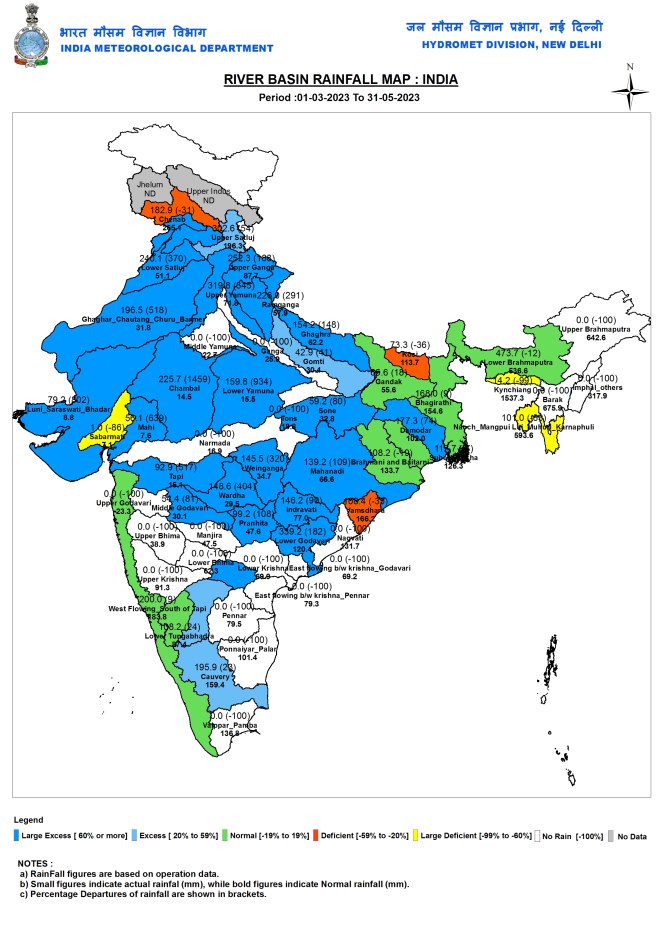
In 2020, 2021 and 2022 India received 158.5 mm, 155.2 mm and 130.6 or 20% above normal, 18% above normal and 1% below rainfall respectively. So this year, India has received much higher pre monsoon season rainfall in 2023 compared to that in 2022, but lower than that in 2021 and 2020. https://sandrp.in/2023/06/01/district-wise-rainfall-in-pre-monsoon-2023-season-in-india/ (01 June 2023)
June 1, 2023: High Rainfall Districts:50-100 mm: Dehradun (Uttarakhand); Solan (HP). (IMD Daily District wise rainfall figures of June 1 2023)
June 2, 2023: High Rainfall Districts: 50-100 mm: East Siang (Arunachal Pradesh). (IMD Daily District wise rainfall figures of June 2 2023)
Rajasthan 2nd wettest May in 120 years Rajasthan, otherwise a dry state, has experienced the second wettest May since the nationwide records commenced in 1901. The Indian Meteorological Department (IMD) on Wednesday (May 31) said Rajasthan received 62.4 mm rainfall this month. The wettest May of Rajasthan was in 1917 when the state recorded 71.9 mm of rain. The rainfall during the month as a whole was 458 per cent of the state’s long period average (LPA) based on data of 1971-2020. The rainfall received was large excess (departure plus 358 per cent of long period average). The LPA for Rajasthan in May is 13.66 mm.
In a statement, the IMD said a record-breaking rainfall of 72.8 mm in a day was observed in Bikaner on May 29. The previous highest rainfall observed in a day was 63.1 mm in 1999 in Bikaner. All 33 districts received large excess rainfall (departure plus 60 per cent or more). The development is another example of change in the rain pattern apparently owing to climate change. The IMD has already said there had been a shift of rainfall from northeast to west due to climate change. https://www.tribuneindia.com/news/nation/rajasthan-sees-second-wettest-may-in-120-yrs-513141 (01 June 2023)
Himachal Pradesh Wettest May since 2004 Against the normal rainfall of 63.3 mm in May, the state received 116.8 mm rainfall this month, recording a deviation of 84 per cent from normal. “As per the record available since 2004, the precipitation this May (116.8 mm) has been the highest so far. The previous highest was recorded in May 2010 (78.9 mm),” said Surender Paul, Director, Shimla Meteorological Centre.
Incidentally, it’s just the third time over the past 19 years that the state has received more than normal rainfall in May. The other two instances were in 2010 (78.9 mm) and 2016 (70.2 mm). Moreover, the pre-monsoon rainfall during this season was the second highest since 2004. The state has recorded 286.9 mm rainfall so far, against the normal of 240.7mm, a deviation of 19 per cent. The highest deviation in the pre-monsoon rainfall is 30 per cent since 2004 (recorded in 2015). The state also recorded snowfall through the month in higher reaches of some districts.
As per a report of the disaster management authority, the cumulative damage to agriculture and horticulture sectors in the pre-monsoon season is nearing Rs 150 crore. While the damage to horticultural crops is over Rs 90 crore, the agricultural crops have sustained damage worth over Rs 50 crore. https://www.tribuneindia.com/news/himachal/wettest-may-in-himachal-pradesh-since-2004-513193 (01 June 2023)
India has witnessed an unusually high number of western disturbances (WDs) in the last three months. There were six WDs in May, a surprisingly high number for the summer months. https://www.downtoearth.org.in/news/climate-change/unusual-western-disturbances-in-may-could-be-indicative-of-changing-climate-89738 (02 June 2023)
Report How climate scientists predict all important monsoon rains Researchers at the India Meteorological Department have spent more than a decade fine-tuning a new way to divine when, and how much, rain will fall each year. The National Monsoon Mission set out in 2012 to move the nation over to a system that relies less on historical patterns and more on real-time, on-the-ground data gathering. The rise in global temperatures has caused the Indian Ocean to warm faster than other oceans, decreasing the difference in temperature between the land and sea, says Rao, which means the monsoon could be delayed further in several years. “Predicting extremes at any scale is difficult,” he said. “Making accurate predictions in the changing climate will become more challenging.” https://www.bloomberg.com/news/articles/2023-06-02/how-climate-scientists-predict-india-s-all-important-monsoon-rains (02 June 2023)
Deforestation linked to less rainfall; El Niño could make it worse A new study shows links between deforestation and reduced precipitation in tropical regions, which can lead to reduced agricultural yields and food security issues. Researchers are concerned about the potential for another El Niño, which typically brings hotter, drier conditions to tropical regions and can compound the effects of deforestation and reduced rainfall.
– Callum Smith, the lead study author, notes that different things happen at different scales of forest loss. At small scales, the researchers think forest loss could actually contribute to an increase in precipitation. He says when forests are chopped down, the land becomes warmer and reflects more heat so it can drive cloud formations, pushing moist air upward and forming clouds. However, at large scales, there is a reduction in rainfall. The researchers point to reduction in evapotranspiration, the process of water evaporating from the soil and transpiring from a plant’s body, as the main driver of this decrease in precipitation. https://news.mongabay.com/2023/05/deforestation-linked-to-less-rainfall-study-shows-el-nino-could-make-it-worse/ (26 May 2023)
‘Climate crisis accelerating at faster pace than expected’: Scientist Roxy Koll The climate crisis could spell the end of the world for many underprivileged, who have low capacity to adapt to the changes. The fact that all climate indicators are in the red makes climate scientists like Roxy Mathew Koll anxious about sharing them. Climate meetings like the one that starts on Monday, June 5, 2023 in Germany’s Bonn put climate scientists and most of their recommendations in the back seat, said Koll, who is a climate scientist at the Indian Institute of Tropical Meteorology.
– El Nino can sometimes amplify the impacts of climate change. During El Niño events, the monsoon winds are slow to pick up, and are relatively weaker. An El Niño during the current monsoon season means a delayed onset and deficit rainfall. Forecasts from the India Meteorological Department already indicates dry conditions over northwest and central India. El Niño is becoming stronger as ocean temperatures rise. The relationship between El Niño and the monsoon is also changing with time, and we need to be watchful of these intricate interactions.
– The sub-surface ocean temperatures keep the cyclones intensifying because the strong winds churn up the ocean and take up that energy. However, most of the models deployed for cyclone forecasts generally use surface temperatures alone for forecasts. Hence, we need to incorporate sub-surface data also in the cyclone forecasting framework. For high-quality sub-surface data, we need to more investment in robust ocean monitoring systems.
– We need to redesign our cities to have open spaces and trees that help in releasing the excess heat quickly and also act as hubs for shade and cooling down. https://www.hindustantimes.com/india-news/climate-crisis-accelerating-at-faster-pace-than-expected-koll-101685904873135.html (05 June 2023)
FLOOD 2023
Bihar An angry river and a succumbing population This paper titled ‘Flood frequency and flood intensity changes in the post embankment period in the Kosi sub-basin India: Impact of location, caste, and class on the flood vulnerability of the marginal communities’ published in Frontiers in Water explores the underlying causes for increasing flood events and their impact on the livelihoods of communities residing in villages located in two highly vulnerable districts of North Bihar. https://www.indiawaterportal.org/articles/angry-river-and-succumbing-population (31 May 2023)
URBAN FLOOD

किताब समीक्षा डूबते-प्यासे शहरों की व्यथा by रोहित कौशिक. लेखक और पर्यावरणविद् पंकज चतुर्वेदीकी हाल में शहरों के जल संकट पर एक किताब आई है। https://shorturl.at/dtDW7 (29 May 2023)
Bengaluru Missing drainage networks drowning city that shouldn’t flood Hundreds of satellite images taken over half a century. Hundreds of hours spent studying them to understand topography, geology and hydrology. The main takeaway – Bengaluru’s topography is quite unique and advantageous as the terrain and drainage system are aligned for rainwater to naturally drain out of the BBMP area if left uninterrupted.
But that’s not quite the Bengaluru story. We’re drowning in a city which shouldn’t flood, finds a year-long study conducted by experts from National Institute of Advanced Studies (NIAS) in association with Greater Bengaluru Parisara Foundation, accessed exclusively by TOI. https://timesofindia.indiatimes.com/city/bengaluru/study-missing-drainage-networks-drowning-city-that-shouldnt-flood/articleshow/100690900.cms (02 June 2023)
बाढ़ बचाव के लिए 658 किमी क्षेत्र में और करनी होगी पानी निकासी व्यवस्था इंटरनेशनल प्रॉपर्टी कंसल्टेंसी फर्म नाइट फ्रैंक ने अपनी रिपोर्ट “बेंगलुरु अर्बन फ्लड” में दावा किया है कि बेंगलुरु को बार-बार आने वाली बाढ़ से बचाने के लिए शहर में बरसाती पानी के निकासी की व्यवस्था को दुरुस्त किए जाने की जरूरत है। इसके लिए बेंगलुरु में और 658 किलोमीटर में नए प्राथमिक और माध्यमिक बरसाती नालों के निर्माण की जरूरत है।
रिपोर्ट के मुताबिक इन नालों को बनाने पर करीब 2,800 करोड़ रुपए (33.9 करोड़ डॉलर) का खर्च आएगा। इसका करीब 80 फीसदी हिस्सा नए नालों के निर्माण पर खर्च होगा, जबकि शेष मौजूदा व्यवस्था को दुरुस्त और पुनर्जीवित करने के लिए जरूरी है। रिपोर्ट में मुंबई का उदाहरण देते हुए, स्थानीय अधिकारियों से बाढ़-प्रवण क्षेत्रों में जल-जमाव को कम करने और बारिश के पानी के मुक्त प्रवाह को सुनिश्चित करने के लिए एक मास्टर प्लान तैयार करने का आग्रह किया है। https://www.downtoearth.org.in/hindistory/natural-disasters/flood/bengaluru-faces-flood-threat-658-km-of-storm-water-drainage-needed-for-rescue-89703 (01 June 2023)
Rain brings Bengaluru to its knees…once again Many arterial roads, including parts of the Outer Ring Road (ORR), were flooded and jammed with traffic on Tuesday (May 30) after hours of torrential rains pounded Bengaluru. The downpour turned several underpasses into ponds. However, authorities were quick to place barricades to prevent a repeat of last week’s KR Circle tragedy. Vehicles passing through Bellandur were the worst affected as the entire road was filled with knee-deep water. https://www.deccanherald.com/city/top-bengaluru-stories/rain-brings-bengaluru-to-its-kneesonce-again-1223488.html (31 May 2023)
LANDSLIDES
Uttarakhand Rockslide damages big portion of Lipulekh-Tawaghat road trapping 300 tourists. https://brightpost.in/2023/05/31/traffic-stopped-here-due-to-cracking-of-the-rock-stranded-passengers/ (31 May 2023)
ENERGY OPTIONS
Centre weighs financial aid for nascent floating solar projects The government plans to introduce a viability gap funding (VGF) scheme to support capital-intensive floating solar projects. The scheme would be designed to meet the gap of 25-30% in the overall cost that developers find difficult to spend on such projects. The tariff of power generated from these projects (Rs 3.2-3.9 per unit) is also higher than that from terrestrial solar projects (Rs 2.3-2.9 per unit). It may be tough to find buyers for the power generated from floating solar projects due to the high tariffs. India currently has 300 MW of installed capacity in floating solar projects. https://www.livemint.com/economy/centre-weighs-financial-aid-for-nascent-floating-solar-projects-11685729001350.html (02 June 2023)
ENVIRONMENT GOVERNANCE
Opinion Biodiversity is us and we are biodiversity Kamal Bawa: It is biodiversity that will restore our degraded lands and polluted rivers and oceans and sustain our agriculture in the face of climate change. It is biodiversity that will form the basis of a new sustainable green economy. And it is biodiversity that will inspire our children to opt for a more humane, just, and hopeful future, which accords primacy to the living world. https://www.thehindu.com/opinion/op-ed/biodiversity-is-us-and-we-are-biodiversity/article66916822.ece (01 June 2023)
Karnataka Forest depat grants over 20 acres of ‘deemed forest’ area for quarrying in Hassan Illegal grant of forest land, which is different from encroachment, has led to loss of 60,000 acres of forest since the 1950s. The Forest Department has failed to take up the matter with the Revenue Department despite several complaints. https://www.deccanherald.com/state/karnataka-districts/forest-department-grants-over-20-acres-of-deemed-forest-area-for-quarrying-in-hassan-1222997.html (29 May 2023)
SOUTH ASIA
India-Nepal Dahal’s Delhi trip: Some hits, many misses Nepal was pushing for an umbrella trade agreement for 25 years to export its electricity. The two sides reached an agreement in principle at the prime minister’s level, but they are yet to sign an agreement and exchange letters towards this end. “The Indian side was against signing an agreement on the electricity deal till Wednesday (May 31) night. But the two sides reached an understanding on Thursday morning due to Nepal’s resolute stand on the Lower Arun and Phukot Karnali,” a high-level Nepali official accompanying Dahal on the trip told the Post. “As the Indian Council of Ministers is yet to approve the agreement, there could be no exchange of letters. Energy secretaries of the two countries signed a symbolic agreement. The goal is to exchange letters amid a function in the near future”. Currently, Nepal is allowed to sell 452.6MW of electricity generated by 10 hydropower projects in the Indian power markets. And, every year Nepal needs to renew the approval for a particular project to export power to India, which adds to the uncertainty.
– “The companies of Nepal and India can now directly sign medium- and long-term agreements on electricity import and export as per the umbrella agreement. So far, we had to renew the agreement every year to export electricity from a hydropower project in Nepal,” said Kulman Ghising, managing director of Nepal Electricity Authority. “Moving forward, we don’t have to do that. Now the new deal has paved the way for the buyers and sellers from the two countries to sign agreements for five to 25 years.”
– The Pancheshwar Multipurpose Project was Nepal’s third important agenda item of Dahal’s India visit. India, however, reiterated the same old commitment on the project. Even after 26 years after the signing of the controversial Mahakali Treaty between the two countries, even the DPR of the project has not been prepared. https://kathmandupost.com/national/2023/06/02/dahal-s-delhi-trip-some-hits-many-misses (02 June 2023)
India and Nepal have signed a MoU to develop the Phukot Karnali Hydro-Electric Project (480MW) in Nepal in the presence of Prime Minister Narendra Modi and his counterpart Pushpa Kamal Dahal in New Delhi on June 1, 2023. “NHPC Limited (A Govt. of India Enterprise) and Vidhyut Utpadan Company Limited (VUCL), Nepal signed an MoU (Memorandum of Understanding) in New Delhi today for the development of Phukot Karnali Hydro Electric Project (480MW) in Nepal,” the Ministry of Power said in an official statement.
– Among the key features of the project include a 109-m-high RCC dam and an underground powerhouse, to utilize minimum environmental release one Surface Power House of 6 MW capacity i.e. two machines of 3 MW each. https://www.firstpost.com/india/india-nepal-sign-mou-to-develop-phukot-karnali-hydro-electric-project-12679642.html (01 June 2023)
Bihar minister asks PMO to clarify on Kosi high dam In view of the visit of Nepal PM to India, Bihar’s Water Resource Development Minister Sanjay Jha on Friday (June 02) asked the PM Modi’s Office to clarify the status of Kosi high dam. “There is a treaty between India and Nepal over Kosi high dam. An office was also opened in Viratnagar where engineers of Bihar and Nepal are deployed but have not prepared the DPR (detailed project report) so far. Hence, we want to know whether the discussion on this point had happened between two leaders or not. If they have not discussed this issue, Bihar would take some steps to avoid the menace of flooding,” Jha said. https://www.daijiworld.com/news/newsDisplay?newsID=1085991 (02 June 2023)
Nepal approves second hydropower project to be developed by India Nepal decided to allow India’s Satluj Jal Vidyut Nigam (SJVN) Limited to develop a second hydropower project in the country. A meeting of the Investment Board Nepal (IBN) chaired by Prime Minister Pushpa Kamal Dahal Prachanda approved the draft project development agreement (PDA) to be signed with India’s state-owned SJVN to develop the 669-megawatt (MW) Lower Arun Hydropower project in eastern Nepal, an official statement said.
The development comes days before PM Prachanda’s visit to India starting Wednesday (June 01). The draft needs to be endorsed by the Council of Ministers before it gets implemented. The previous meeting of the IBN had approved Rs 92.68 billion investment for the development of the project. The development of this 669-MW transformative project will prove to be a milestone for the socio-economic development of the country, according to the statement by the IBN. https://www.moneycontrol.com/news/india/nepal-approves-second-hydropower-project-to-be-developed-by-india-10680901.html (29 May 2023)
ASIA
Report Iran-Taliban water conflict explained Afghanistan and Iran signed an agreement — the Helmand River Treaty — in 1973 to regulate the allocation of river water. But the accord was neither ratified nor fully implemented, causing disagreements and tensions to persist.
Iran has accused Afghanistan of violating its water rights for years, arguing that far less water than the amount agreed to in the 1973 treaty flows into Iran. Afghanistan has rejected Iran’s accusations, underlining that climatic factors like a shortage of rainfall, resulting in reduced river water volumes, are to blame for the situation.
A major source of concern for Iran is Afghanistan’s construction of dams, reservoirs and irrigation systems along the Helmand River. Tehran fears that these projects reduce water flow into Iran. But Kabul argues that it is within its rights to expand water storage and irrigation capacities within Afghanistan. https://indianexpress.com/article/explained/explained-global/what-is-the-iran-taliban-water-conflict-all-about-8642887/ (03 June 2023)
MEKONG
Environmental significance and threats particularly upstream dams on Mekong delta. https://www.youtube.com/watch?v=ZD0stQ7Mf38 (12 April 2023)
THE REST OF THE WORLD
USA First drought, then floods Climate change is not only making events like the 1862 catastrophe more likely to occur (by 300 to 400 percent, according to one estimate); it is also creating the conditions for storms that will make the 1862 flood look small. The two atmospheric rivers that led to a near catastrophe at Oroville, one study found, carried 11 to 15 percent more rain than would have been possible if humans had not altered the atmosphere. And the largest rivers of the future will be even bigger, last longer and carry water at a much higher density. They will also arrive more often. Future storms would be able to douse California with a load of water 45 percent greater than anything that has been possible under historical conditions. Because the precipitation is likely to fall quickly and be tilted toward rain instead of snow, peak runoff would mean between two and four times as much water racing across the landscape as during the largest floods of the past. https://www.nytimes.com/2023/05/31/magazine/california-floods-droughts.html (31 May 2023)
Story of how citizens in Toronto (Canada) rejuvenated Don river after 54 years. In 1969 the Canada govt declared it as a dead river.
SANDRP
Also see: DRP 29 May 2023 & DRP 22 May 2023
Follow us on: www.facebook.com/sandrp.in; https://twitter.com/Indian_Rivers

 SANDRP
Sad Loss!
LikeLike
Yes indeed. Huge loss.
LikeLike