In the just concluded month of Aug 2023, India received just 162.7 mm (263.8 mm in Aug 2022, 3.5% above the normal[i]) or 36.2% below normal rainfall against Aug normal rainfall of 254.9 mm as per India Meteorological department (IMD). In Aug 2021, the rainfall was 195.9 mm[ii], about 24.13% below normal and in Aug 2020, the rainfall was 327 mm[iii], or about 26.6% above normal.
Continue reading “June Aug 2023: District wise rainfall in in India’s SW Monsoon”Tag: IMD
DRP NB 140823: A year after Karam dam disaster: people suffer, engineer set free, contractor building more dams
(Feature Image: Breach in Karam dam, Madhya Pradesh. Source:- Social Media)
It was on Aug 13, 2022, a year ago when the Karam dam wall in Dhar district in Madhya Pradesh started leaking water. Two days later it collapsed. The people who suffered during the disaster continue to suffer. The engineers who were supposed to ensure proper construction of the dam, following all the norms, did not do that, were supposed to be suspended, but got reinstated elsewhere. They kept quiet in the courts. The black listed contractor continues to build more dams.
A clearer evidence of the nexus that supports unwanted, destructive, costly, corruption ridden and disastrous dams would be difficult to find. As the destruction due to dams and such other unaccountable infrastructure development plays out in Himachal Pradesh & elsewhere this year, the nexus that thrives on opaque, unaccountable and non-participatory governance continues to happily grow even as the changing rainfall patterns bring greater disasters before our eyes.
Continue reading “DRP NB 140823: A year after Karam dam disaster: people suffer, engineer set free, contractor building more dams “High Rainfall days in India’s districts in July 2023
For July 2023, an analysis in this article of the daily district wise rainfall data from India Meteorological Department (IMD) shows that there were 855 (809 in July 2022 and 717 in July 2021) instances when district rainfall of a day was above 50 mm. Such high rainfall instances included 660 (663 in July 2022) instances when rainfall was 50-100 mm, 149 (107 in July 2022) instances when it was 100-150 mm, 34 (28 in July 2022) times it was 150-200 mm and 12 (13 in July 2022) times above 200 mm. As noted in detailed article[i], the July 2023 rainfall all over India was 13.5% above normal.
Continue reading “High Rainfall days in India’s districts in July 2023”DRP NB 070823: Forests & Biodiversity amendments: Gap between intent & application
(Feature Image: Dense Dudhatoli forest range near Peethsain in Thalisain block of Pauri Garhwal. Feb. 2023/ SANDRP)
As editorial comments in two different national newspapers given below shows, the biodiversity and forest conservation amendment bills passed by the Parliament last week weaken the cause of biodiversity and forest conservation, when it is most pressingly required to strengthen them.
Both amendments pave the way for ease of doing business and reducing role of local communities, both in terms of legal norms and practical implications.
The need for conservation of these resources was never more urgent than now considering the impacts of climate change on them and their importance for not only livelihood security of vast millions, but also for hydrological implications, food security, protection against increasing frequency and intensity of disasters, but also for adaptation in the context of changing climate. We hope against hope that better sense will prevail sooner rather than later to ensure the amendments do not lead to destruction of forest and biodiversity resources.
Continue reading “DRP NB 070823: Forests & Biodiversity amendments: Gap between intent & application”June July 2023: District wise rainfall in in India’s SW Monsoon
In the month of July 2023, the second month of India’s South West 2022 monsoon, India received 318.4 mm (327.7 mm in July 2022[i]) rainfall, 13.5 % above (16.8% above normal in July 2022) the normal July rainfall of 280.5 mm as per India Meteorological department. In July 2021, the rainfall was 266.1 mm[ii], about 6.7% below normal and in July 2020, the rainfall was 257.1 mm[iii], or about 9.9% below normal.
Continue reading “June July 2023: District wise rainfall in in India’s SW Monsoon”DRP NB 240723: Urgently need parameters that will truly reflect rainfall pattern
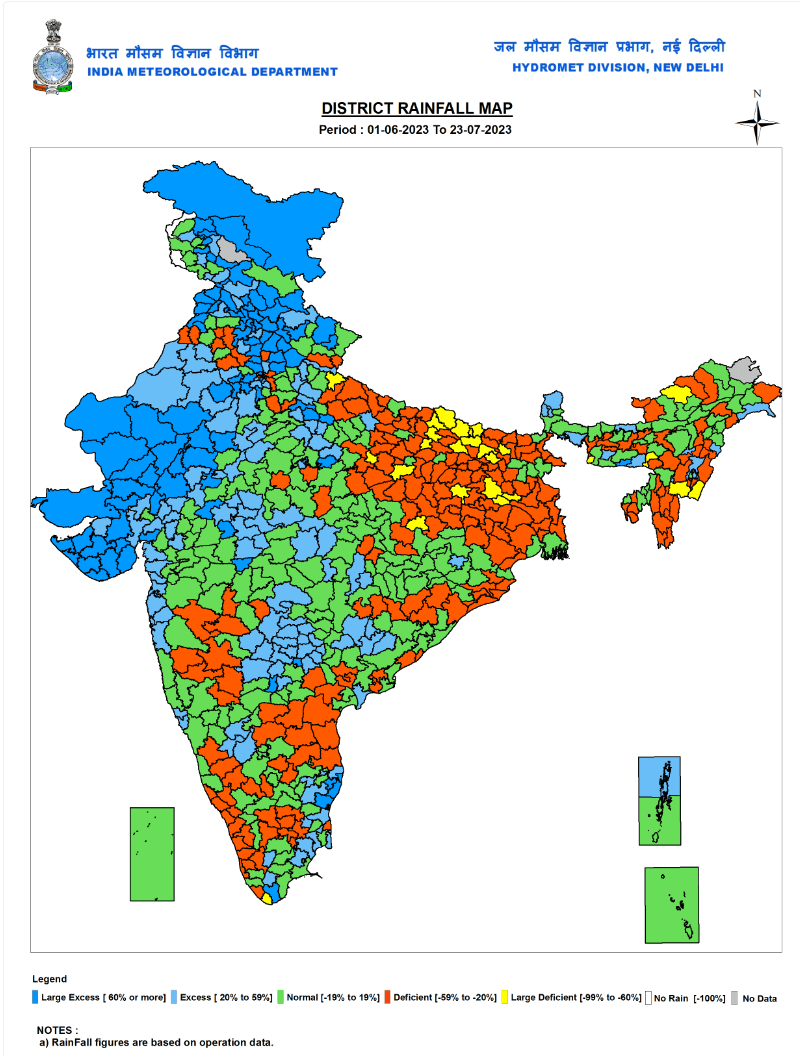
(Feature Image: – IMD’s District Wise Cumulative Rainfall Map for 01 June to 23 July 2023)
India received 389.2 mm rainfall till 0830 hrs on July 23, 2023 in SW monsoon. This being 5% above the normal rainfall till this date of 370.9 mm, India Meteorological Department and with it, the whole nation calls it Normal Monsoon. But anyone who is familiar with the rainfall pattern across India will not call it Normal.
We must urgently develop new parameters for describing the monsoon that also take into account spatial (across states, districts, Tehsils, blocks) and temporal variability. These parameters should take into account the departure from normal for each unit of space for each day and combine such departures to arrive at a figure that will better describe the monsoon for each unit of space. It can also take into consideration the high intensity rainfall events as also the longer dryer patches. This will help us understand not only the nature of monsoon rainfall, but also alert the farmers and everyone else but also help us understand how this pattern is changing over the years. This should not be so difficult for IMD to initiate and accomplish quickly. When aggregated at river basin level, this will also help us understand the actual rainfall pattern in each river basin but also how it is changing. Is this too much to ask?
Continue reading “DRP NB 240723: Urgently need parameters that will truly reflect rainfall pattern”July 2023 Delhi Floods: Why Unprecedented Yamuna Water Levels even at moderate releases?
(Feature Image: Cycles of fisherfolks by the Yamuna and ongoing construction of Metro Bridge downstream of Wazirabad Barrage two weeks before the July 2023 floods. Bhim Singh Rawat/SANDRP, June 28, 2023)
The national capital is witnessing one of the worst flood spells with water level at Railway Bridge breaching the highest recorded 207.49 m of Sept 6, 1978 by 1.17 m. The Yamuna seems eager to reclaim all its relict channel and encroached floodplain areas.
The River has set 208.66 meter as new HFL (Highest Flood Levels) for the site at 18:00 hours on 13 July 2023 which is 1.17 meter higher than the 1978’s HFL. The flood level is receding now.
Continue reading “July 2023 Delhi Floods: Why Unprecedented Yamuna Water Levels even at moderate releases?”June 2023: High Rainfall district days in India’s SW Monsoon
An analysis of the daily district wise rainfall data from India Meteorological Department (IMD) for the month of June 2023, the first month of India’s South West Monsoon 2022 shows that there were instances (462 in June 2022[i] and 442 in June 2021) when district rainfall of a day was above 50 mm. This is high considering that the rainfall of India in June 2023 was 148.6 mm[ii], the rainfall of India in June 2022 was 152.3 mm[iii], or daily average rainfall is about 5 mm. The high rainfall instances in June 2023 included 339 (339 and 371 in June 2022 and 2021) instances when rainfall was 50-100 mm, 68 instances (68 and 59 in June 2022 & 2021) when it was 100-150 mm, 26 (26 and 5 times in June 2022 & 2021) times it was 150-200 mm and 29 (29 & 7 times in June 2022 & 2021) times above 200 mm.
Continue reading “June 2023: High Rainfall district days in India’s SW Monsoon”June 2023: District wise rainfall in India’s SW Monsoon
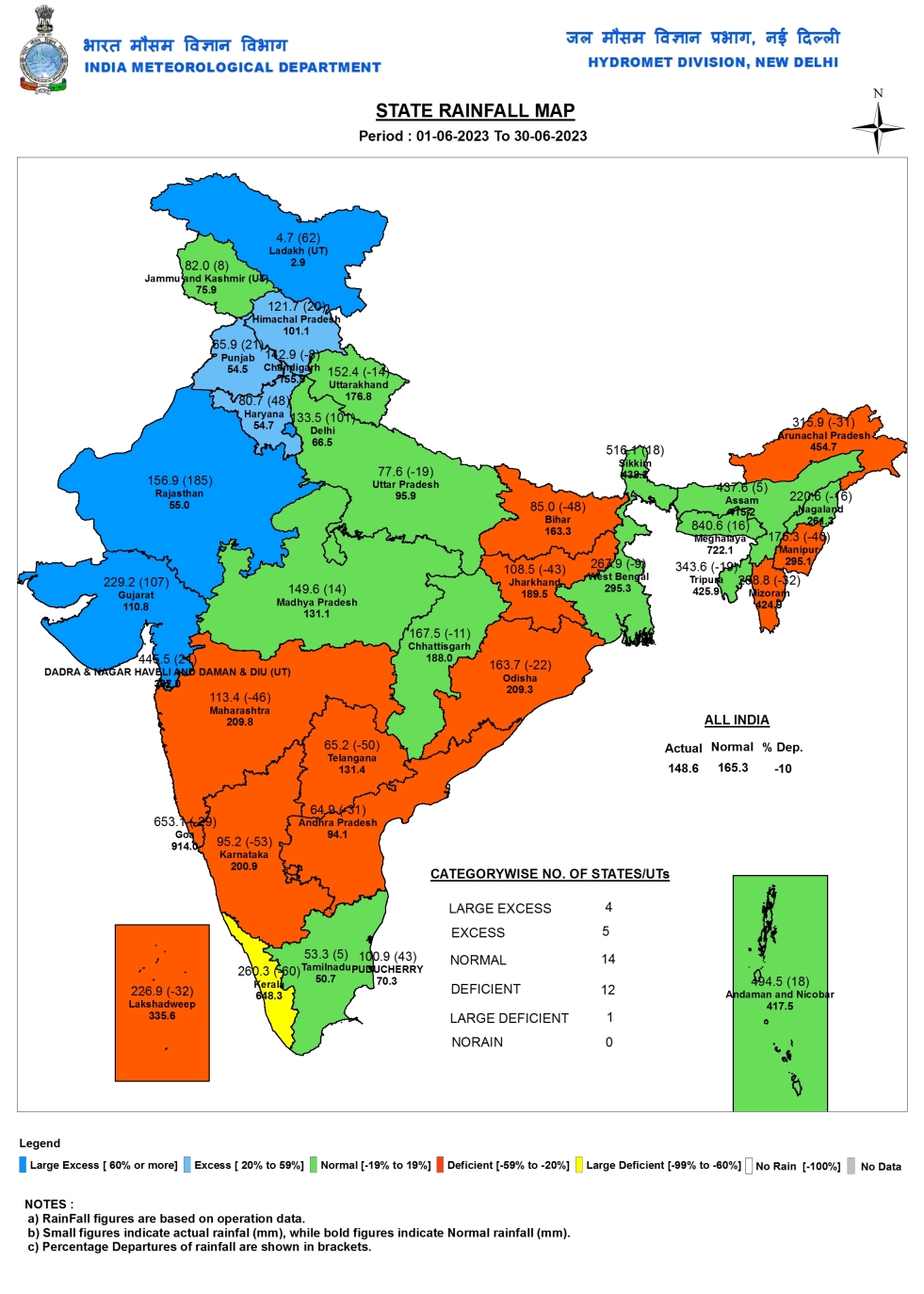
In the just concluded month June 2023, the first month of India’s South West 2023 monsoon, India received 148.6 mm rainfall, 10% below the normal June rainfall of 165.3 mm as per India Meteorological department. In June 2022, the rainfall was 152.3 mm, 8% below normal, in June 2021, the rainfall was 182.9 mm[i], about 11% above normal and in June 2020, the rainfall was 196.9 mm, or about 18% above normal and in June 2019 it was 33% below normal.
Continue reading “June 2023: District wise rainfall in India’s SW Monsoon”DRP NB 030723: Peak Hour Tariffs to be implemented from April 2024
(Feature Image: Vyasi HEP power station at Hathyari, Dehradun. SANDRP, June 2023)
This announcement by the government is indeed much belated but welcome step that India plans to increase peak hour power tariff compared to non-peak hour power tariff, beginning with commercial and industrial consumers from April 2024 a year later for others excluding agriculture consumers. The notification mentions it as daytime tariff (during solar hours) and night time power use, but this essentially also helps peak management.
This will not only put a premium on peak hour power consumption and hence generation, but also hopefully ensure that assessment of impacts of the peak hour power generation including at hydropower projects is done and done in a credible way, along with compensating those affected. It will also hopefully ensure that existing hydro capacity is used optimally for peak hour power generation before going for new hydro projects in the name of increasing peak our power generation.
One also hopes that it will lead to better peak hour power management and also considering all the options for such power generation rather than pushing hydro projects blindly in the name of peak hour power generation.
Continue reading “DRP NB 030723: Peak Hour Tariffs to be implemented from April 2024”