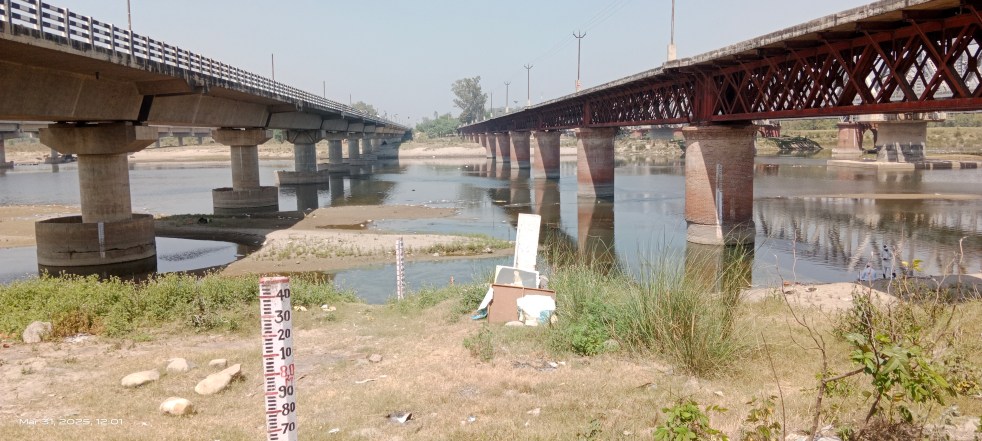
This is the summary report of Highest Flood Levels (HFL) breach incidents which we could document from CWC’s flood monitoring website during South West Monsoon Season 2025. The monthly reports for HFL breach incident for July 2025, August 2025 and September 2025 can be seen by clicking the hyperlinks and the detailed final report can be seen here. SANDRP’s previous reports on the subject can be seen here: HFL breach incidents in 2018, 2019, 2020, 2021 (I), 2021 (II), 2022 (I), 2022 (II), 2023, and 2024.
Continue reading “Rivers in Extreme Floods During SW Monsoon 2025”Tag: flow
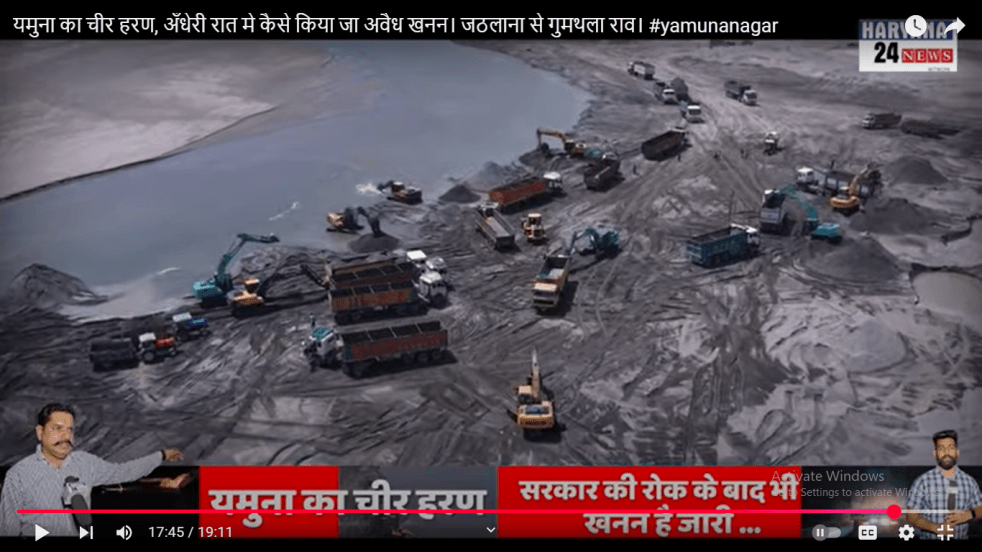
Advocate Waryam Singh Interview: मशीनी खनन से हो रही यमुना बर्बाद
(Feature Image: Screnshot of Haryana 24 News exclusive report on illegal mechanized sand mining in Yamuna river at Gumthala ghat near Yamuna Nagar-Karnal border of Haryana in May. 2024.)
हरियाणा राज्य के करनाल और यमुनानगर जिलों में वरयाम सिंह एक जाना-माना नाम है। आप पेशे से जिला न्यायालय और पंजाब एवं हरियाणा उच्च न्यायालय में अधिवक्ता हैं। आप यमुना नदी के किनारे स्थित गुमथला गांव में रहते हैं जहाँ आपके प्रयासों से इंक़लाब मंदिर स्थापित है जो देश के स्वतंत्रता सेनानियों को समर्पित है और राज्यस्तर पर प्रसिद्ध है। क्षेत्र में विकास कार्यों में पारदर्शिता एवं सरकारी विभागों के कार्यों में सुधार लाने के लिए आपने हरियाणा एंटी करप्शन सोसाइटी की स्थापना भी की है और आप इन उद्देश्यों के लिए जन सूचना अधिकार कानून का बखूबी इस्तेमाल करते हैं।
Continue reading “Advocate Waryam Singh Interview: मशीनी खनन से हो रही यमुना बर्बाद”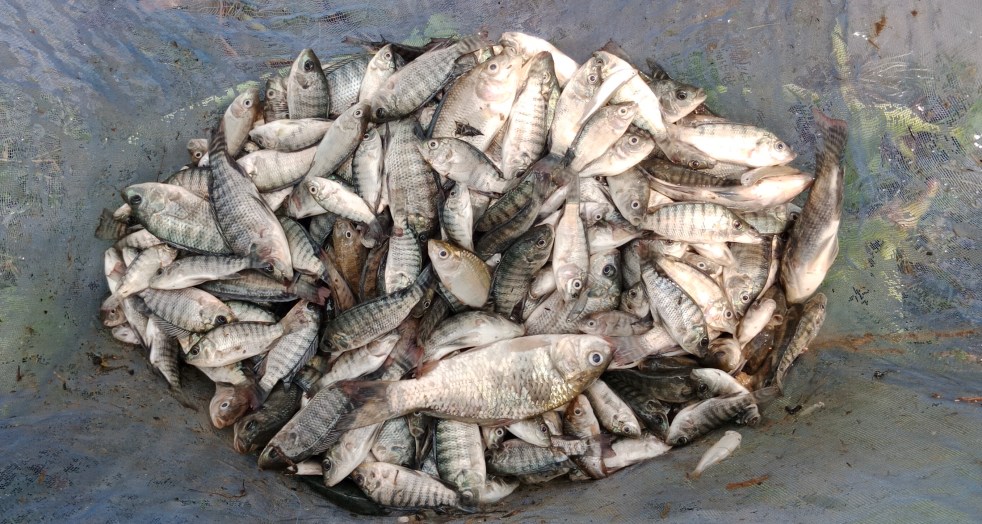
Yamuna Manthan 051224: Native River Fish Species Facing Extinction
(Feature Image: A fish catch comprised mostly of invasive Tilapia species downstream Wazairabad barrage in Delhi in June 2023. Bhim Singh Rawat/SANDRP)
A recent CIFRI (Central Inland Fisheries Research Institute) report submitted to NGT is an eye-opening official document about the fish diversity in Yamuna. The report says that overall native fish species have declined sharply in the river not only in number but in size also due to habitat degradation, pollution and increasing presence of invasive fish species.
The report admits that construction of Farakka barrage has led to complete elimination of Hilsa fish in lower segment of river since 2010. Among other recommendations the report has suggested maintenance of continuous flows in the river and addressing sources of pollution.
Indeed, the freshwater fish species are key indicator of health of a river eco-system and the fish diversity in Yamuna has been pushed to brink by the water abstraction, unsustainable riverbed mining activities and ever-increasing pollution of river waters besides other factors.
Continue reading “Yamuna Manthan 051224: Native River Fish Species Facing Extinction”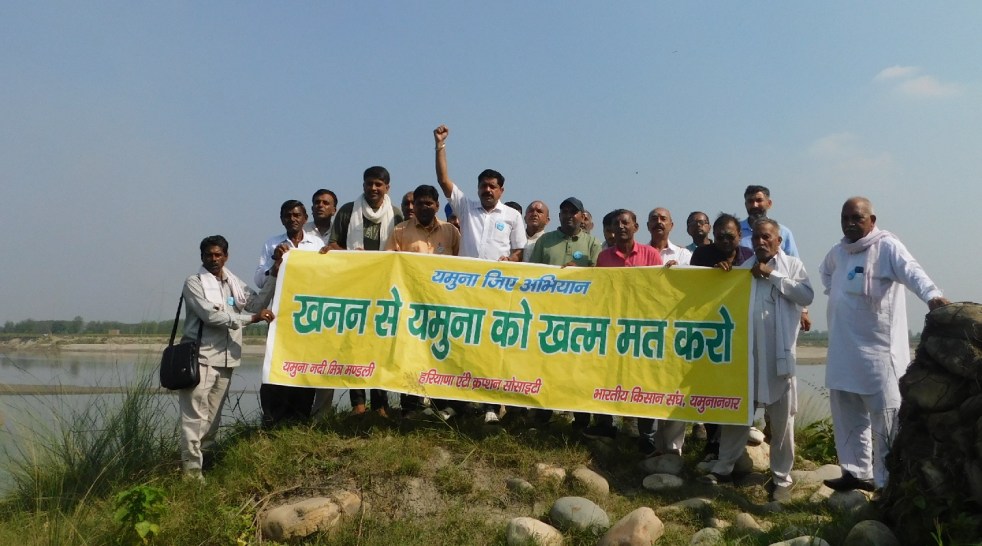
Yamuna Manthan 061124: Save River from ‘Illegal’ Sand Mining
(Feature: Members of Haryana Anti Corruption Society, Yamuna Nadi Mitra Mandli, Bhartiya Kisan Sangh, Yamuna Nagar raising concerns over unabated unsustainable riverbed mining in Yamuna in Gumthala Rao, Karnal on Oct 07, 2024.)
Large scale riverbed mining has become most underestimated and least discussed threat for Yamuna rivers. While increasing pollution has turned the river stretch between Delhi and Agra ecologically dead, the rampant sand mining has been severely damaging the Yamuna eco-system in upper and lower segments.
Presently, the mining menace is quite rampant in Paonta Sahib, Yamuna Nagar, Saharanpur, Karnal, Shamili, Panipat, Sonipat, Baghpat and Ghaziabad districts along the river in upper segment. Similarly, in lower segment the main stem of river as well as its key tributaries Chambal, Sind, Betwa, Ken have been bearing the burnt of unsustainable sand mining.
Continue reading “Yamuna Manthan 061124: Save River from ‘Illegal’ Sand Mining”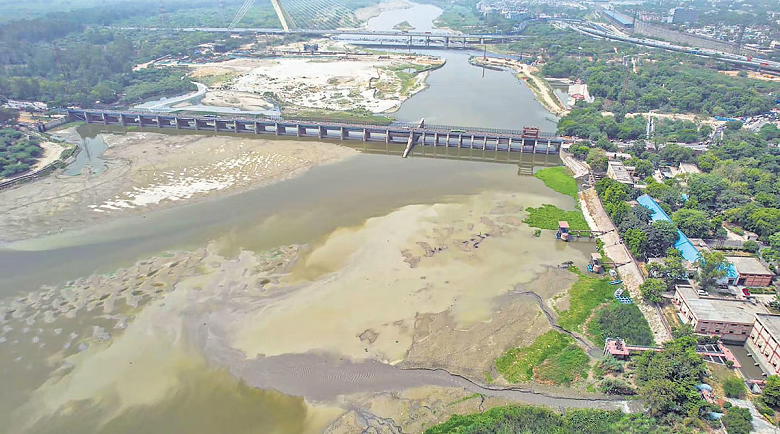
‘Let Yamuna Flow’: A River’s Appeal to Political Parties
(Feature Image: An aerial view of Wazirabad Barrage shows a drying up Yamuna in May 2022. Image Credit: PTI/TNIE)
In the wake of Lok Sabha election 2024 in Delhi on May 25, the civil societies and concerned citizens on behalf of River Yamuna appeal to the political parties to address the critical issue of absence of environmental flows adversely impacting the river health in the national capital.
Continue reading “‘Let Yamuna Flow’: A River’s Appeal to Political Parties”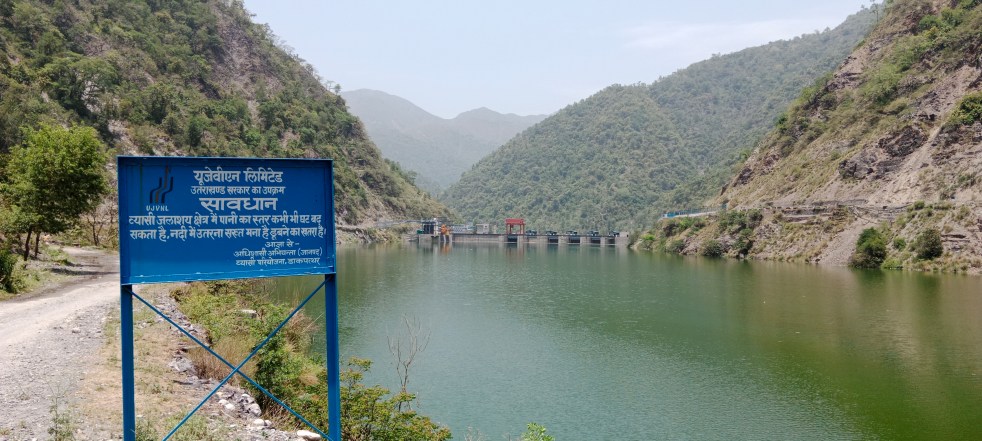
Photo Blog: Yamuna River A Year After Vyasi HEP
Vyasi HEP on Yamuna River is latest example of how the hydro power projects being pushed in the name of clean and green energy sources are failing on all fronts and proving a costly affair for the river, people and the nation.
The people who still think that the Run of the River (RoR) projects do not require a dam and cause no submergence of land; must visit the Vyasi HEP to witness the about 4 km long reservoir behind the 86-meter tall and 200-meter-long dam there.
Continue reading “Photo Blog: Yamuna River A Year After Vyasi HEP”
The Natural Water Systems that Make Ken a Living River
(Feature Image: Water pools (Dabras) formed in Ken (left) & Patne (right) rivers confluence in Pawai block, Panna district, MP. (Image taken during Ken River Yatra by SANDRP & Veditum)
This report is based on the experiences and understandings made during a thirty-three-day long walk along Ken River covered in three phases in June & October 2017 and in April 2018 by Bhim Singh Rawat, South Asia Network on Dams, Rivers and People (SANDRP), Delhi and Siddharth Agarwal, Veditam India Foundation, Calcutta.
The objective of the report is to share the observations with common public as we have done in past which can be seen here Part 1, Part, 2, & Part 3. In future also we would try to prepare similar reports to highlight the unexplored aspects and lesser-known stories of Ken river. The Hindi version of this report can also be seen here.
Continue reading “The Natural Water Systems that Make Ken a Living River”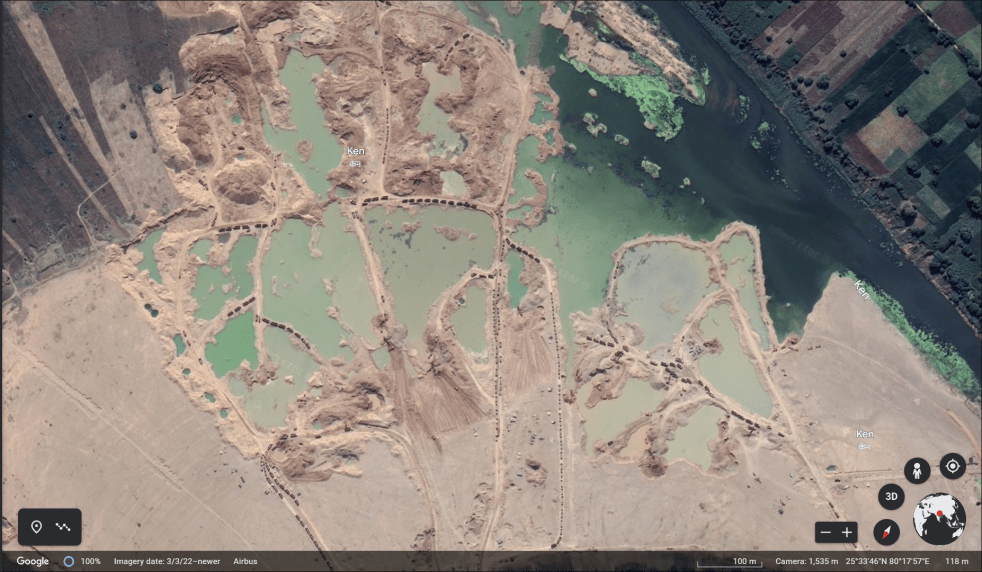
Uttar Pradesh: Ken River ravaged by Illegal Sand Miners in Banda
(Feature Image: March 2022 Google Earth image showing excessive mechanized mining in Ken river at Chatkan meander in Banda)
Ken river one of the important tributaries of Yamuna in lower segment has been witnessing industrial scale riverbed mining in Banda district of Uttar Pradesh. The Sentinel Hub satellite images reveal the mechanized mining of morrum (light orange colour sand) has been going on unabated at multiple locations in the district. Recent local media reports have also highlighted the illegalities and violations of the rules by the miners.
The information on Directorate of Mining & Geology website shows that there are 50 sand mine sites in Banda district of which 36 sites are closed. The complete list of 50 closed and active sand mine sites in Banda can be seen here.
Continue reading “Uttar Pradesh: Ken River ravaged by Illegal Sand Miners in Banda”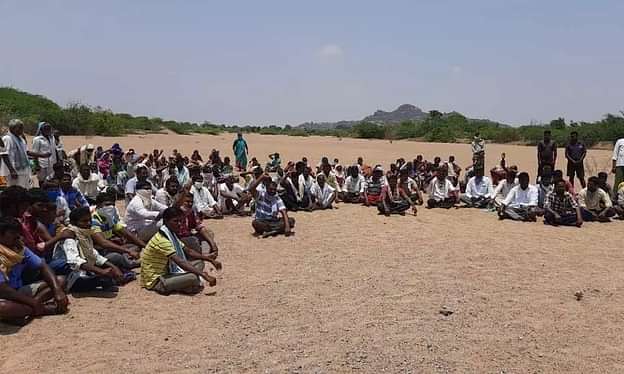
Telangana Riverbed Mining 2020: Tribals, Godavari robbed
In 2019 overview, we found at least three people had died in Telangana due to illegal sand mining related incidents amid growing number of cases of illicit excavation of riverbeds. The state govt was seen laying stress on technological solutions to curb illegal sand mining and even reportedly had taken significant steps towards manufacturing and use of M-sand as a viable alternative, while its viability and impacts on environment during production remain to be fully studied and understood. https://sandrp.in/2019/02/26/sand-mining-2018-telangana-and-andhra-pradesh/ Here we track the key developments in the state since then.
Continue reading “Telangana Riverbed Mining 2020: Tribals, Godavari robbed”

DRP: 1 June 2020: No escape from Dam floods as dam lobby continues to dominate
The report of the 10 member committee headed by Shri Nandkumar Vadnere, appointed by the Govt of Maharashtra in Aug 2019 was submitted on May 28, 2020. The report titled “A report on Floods 2019 (Krishna Sub-Basin): Experts Study Committee: Analysis, Causes, Remedies” from all accounts is a major let down as is apparent from the way one of the members felt so humiliated that he had to resign: he was not provided basic information to do justice to the Terms of Reference, his chapters were unilaterally removed from the draft report by the chairman, under pressure from higher ups. The report is actually an attempt to show, by hook or by crook that dams were not responsible for the Krishna basin floods of Aug 2019. Almost exactly the same way CWC came out with a shockingly unscientific, contradictory report about Aug 2018 Kerala floods to prove that dams had no role. The report did not even ask if the any of the dams followed the rule curve, though it made recommendation that rule curves should be followed! The story keeps repeating for each of the dozens of instances in recent years. The report of the Tiware dam disaster in Maharashtra in July 2019 has been submitted in Feb 2020, but is not yet in public domain. These few recent instances show how strong a strangle hold the dam lobby has over the official water institutions and governance in India. The Dam Safety bill now before the Parliament will not help as it has no provision to remove or even loosen this stranglehold, there is no place for independent oversight in the bill. Without an accountable reservoir operation policy, legal and institutional paradigm there is no possibility of freedom from dam induced floods.
Continue reading “DRP: 1 June 2020: No escape from Dam floods as dam lobby continues to dominate” SANDRP