Dams · DRP News Bulletin

DRP: 27 April 2020: For whom is this unviable Etalin project being pushed?

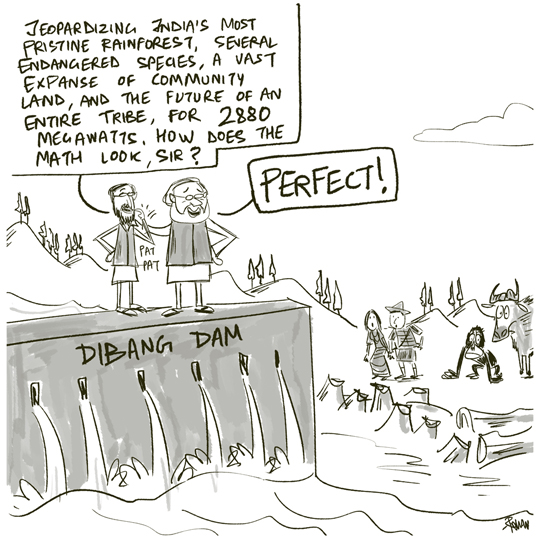
In the ongoing debate on forest clearance for the controversial Etalin Hydropower project in Dibang Valley in Arunachal Pradesh between the Forest Advisory Committee, The Hindustan Times’s consistent reporting and Sanctuary magazine launching a campaign along with others, one (of the many) key question that remains unanswered is: for whom this economically (in addition to socially, environmentally and from climate change perspective) unviable, massively expensive project being pushed in a power surplus country?

Electricity from hydropower projects is no longer economically viable, since cheaper options are available. Some misguided people are claiming virtue in hydropower project claiming it provides peaking power. The fact is India is today not only power surplus, the peak power deficit has been just around 1% or less for long time. This when there is no attempt to either monitor as to how much of the electricity produced from existing hydropower projects provides peaking power, nor is there any attempt to achieve optimisation of operation of existing hydro projects to produce maximum possible hydropower. Nor is there any attempt to even manage the peaks either through pricing or other policy measures. In such a situation there is clearly no justification for more hydro for peaking. Moreover, the storage option is becoming increasingly cost effective, reducing the peaking power needs. So then for whom this project whose cost won’t be less than Rs 30000 crores at most conservative estimates, being pushed? The contractors, the equipment suppliers, the hydro lobby, the consultants, the timber lobby, the dam lobby, or the kickbacks?

Continue reading “DRP: 27 April 2020: For whom is this unviable Etalin project being pushed?”
Dams · Sand Mining

J&K Riverbed Mining 2020: Rivers exposed to mechanized mining

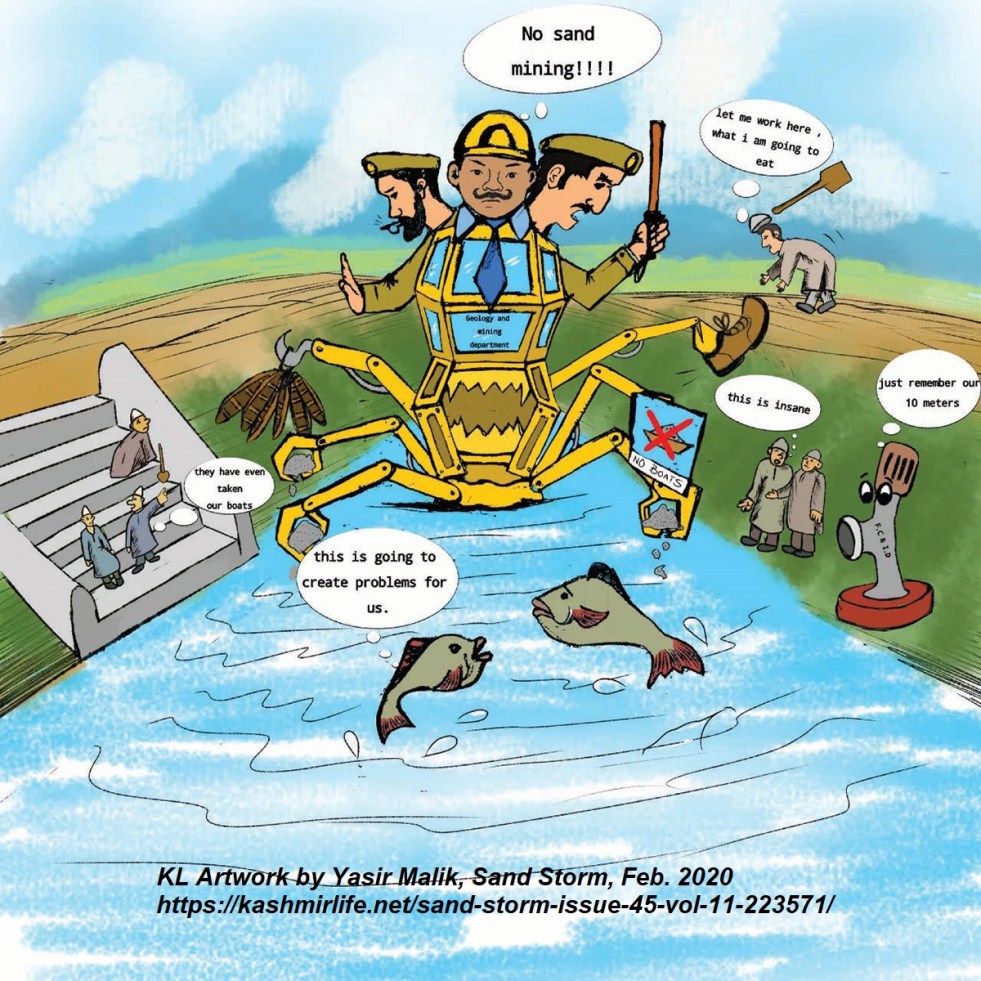
Unsustainable, unscientific excavation of riverbed minerals has been having significant impact on river eco-system and riparian communities for past several years. Since 2016, to develop better understanding and highlight the problems SANDRP has been preparing state wise annual overview of riverbed minerals (RBM) mining activities. Having putting together year end round up for Gujarat, Maharashtra, Goa, Rajasthan, Madhya Pradesh, Punjab, Haryana states, this compilation attempts to cover prevailing situation in Jammu & Kashmir (J&K) over the last one year. The link of 15 overviews in 2018 can be see here.

Continue reading “J&K Riverbed Mining 2020: Rivers exposed to mechanized mining”

Climate Change · Dams · Environment · Fish · Fish Sanctuaries · Fish, Fisheries, Fisherfolk · Free flowing rivers

Photoblog: Mangroves of the Aghanashini: Linking the River, Land and the Sea

This photoblog by Abhay Kanvinde takes us to mangroves of Aghanashini River Estuary in Kumta Taluk of Uttar Kannada, Karnataka. This is a special place as Aghanashini is a free flowing river with good forest cover in its entire catchment. This means that the mangroves get unhindered supply of freshwater as well as nutrients from the riverine system. This has resulted in the highest area under mangroves in Honnavar Forest Division at 169.4 hectares. Forest Department has also planted about 6 sq. kms of mangroves here, which are thriving. Continue reading “Photoblog: Mangroves of the Aghanashini: Linking the River, Land and the Sea”

Dams · DRP News Bulletin

DRP: 6 April 2020: Ganga-Yamuna-Cauvery flow cleaner in lockdown: What can we learn?

A number of reports have appeared that show that the state of a number of rivers of India, including Hindon, Yamuna, Ganga and Cauvery has improved during the current lockdown due to Covid 19 crisis. That is indeed great news. At Kanpur and Varanasi there are reports that suggest the dissolved oxygen level has gone above 8 ppm and BOD level has gone down below 3 ppm at a number of places. While lack of industrial effluents entering the rivers due to closure of industrial units is a major reason, there are other reasons that has led to this situation, including above average winter rainfall, high snowfall now melting with onset of summer, reduction of irrigation water demand and also stoppage of sand mining along the rivers. The reduction of cultural activities including puja, bathing and cremations have also contributed to this situation.

The biggest lesson we can learn from this cleaner rivers after so many decades is that if our pollution control boards at the state and central level were doing their duty to ensure that no untreated effluents from the industries and also urban sewage enter the rivers, it is not that difficult to achieve cleaner rivers. But unfortunately there is no political will to achieve this simple and legally enforceable objective.

Continue reading “DRP: 6 April 2020: Ganga-Yamuna-Cauvery flow cleaner in lockdown: What can we learn?”
Dams · DRP News Bulletin

DRP: 16 March 2020: Invitation to another Kedarnath floods tragedy?

This remarkable TOI report on March 14, 2020 (there was a Hindustan Times Report on March 9, 2020, we found out later: https://www.hindustantimes.com/india-news/scientist-flags-kedarnath-project-worries/story-1DoLBHLeMOmYLI3OPFOq1M.html) says that rampant redevelopments termed as “unabated unscientific work in the valley” around Kedarnath is likely to create dangerous situation leading to 2013 like catastrophe. We could not find report about such an important development in any other media.

But this detailed report, not contradicted by any of the quoted sources, seems sufficient reason to be alarmed by all concerned.

Experts of the Wildlife Institute of India, Wadia Institute of Himalayan Geology, Uttarakhand Space Application Centre (USAC) and even the Principle Science advisor to the Prime Minister K VIjay Raghavan and also the contractors, Woodstone Constructions along with other state and central govt officials were present where officials made some candid presentations. It seems there has been neither any impact assessment studies or clearances for the controversial interventions happening, including 9 km long approach road for Kedarnath on the left bank of Mandakini river, (left band has basically loose glacial sediments and hence is unstable and could get affected by avalanches and landslides) and a massive 50 ft deep and 100 m wide pit just 50 m behind Kedarnath for the Samadhi sthal. MPS Bisht, the Director of USAC in his presentation called the pit an extremely dangerous for future. He asked: “Why are we creating a situation for another disaster like the 2013 tragedy to take place again?” Scientists from the Wadia Institute are quoted saying: “The Road being built to Kedarnath is being made on the most vulnerable of Kedarnath Valley and may any day collapse under the pressure of so many glacier shoots which are directly opening on the road.” Raghavan called these revelations tipping points.

Continue reading “DRP: 16 March 2020: Invitation to another Kedarnath floods tragedy?”
Dams · Wetlands

India Ramsar Wetlands in Crisis in 2020

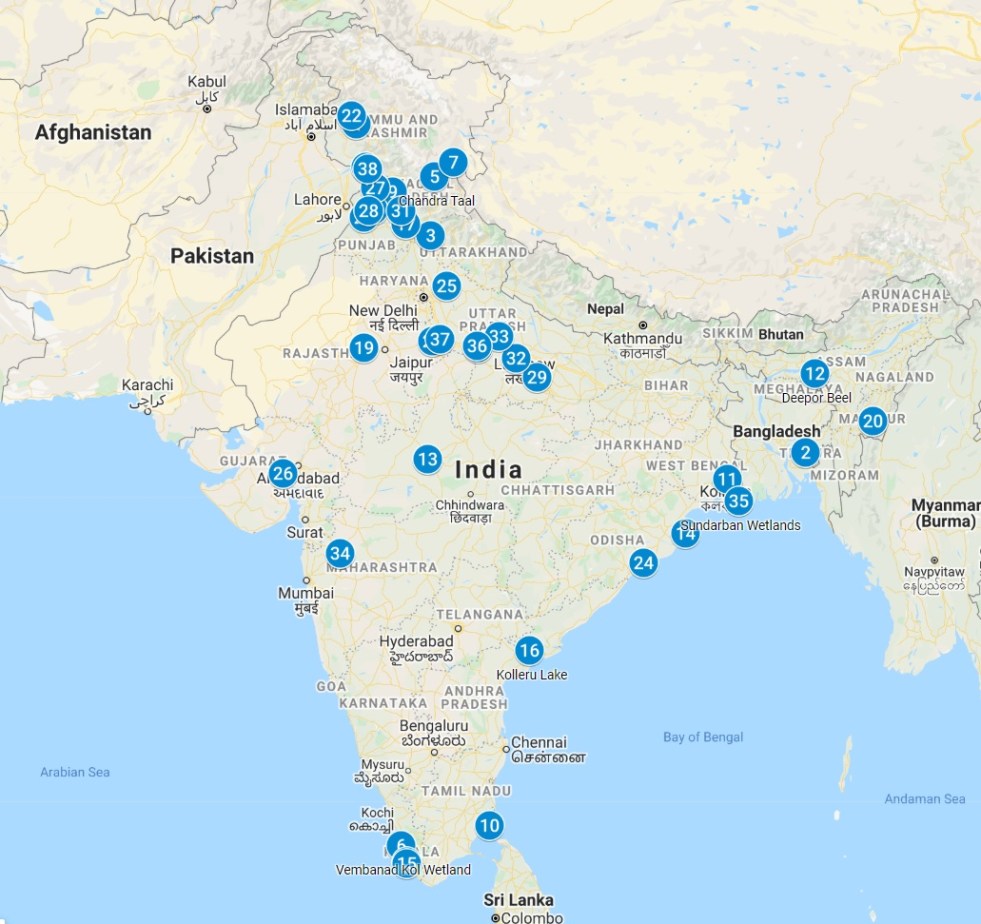
Ramsar wetlands in India require urgent intervention for central, state governments and Ramsar Convention as this 2020 report shows. The five regional reports from India in 2020 show that despite Ramsar tag, the fate of these wetlands has seen no marked improvement. This raises the question as to how helpful for wetlands in India is the Ramsar tag.

In 2019, India has added 10 more wetlands selected under Ramsar Convention taking total number of Ramsar wetlands in the country to 37 covering about 10,679.39 sq km area across 15 different Indian States and two Union Territories (UTs).  A description of each of India’s 37 Ramsar wetlands, as given on official Ramsar website is given in Annexure below. A decade after the first meeting at Ramsar in Iran for wetland protection in 1971, India got its first wetlands, Chilika lake (Odisha) and Keoladeo National Park (Rajasthan) registered as Ramsar wetland of global significance in Oct 1981.

Continue reading “India Ramsar Wetlands in Crisis in 2020”

Dams · Wetlands

Ramsar Wetlands in Crisis 2020: South India

Out of six states/ Union Territory in South India, three stares have five Ramsar wetlands sites which include one each in Andhra Pradesh and Tamil Nadu and three in Kerala. There are no Ramsar wetlands in Telangana, Karnataka and Puducherry. In order to understand and highlight the present day situation of Ramsar sites in India, SANDRP has compiled information on all 37 wetlands under North, West, North East and East zone. This account in the series describes the threats affecting the Ramsar sites in South Indian States.

Continue reading “Ramsar Wetlands in Crisis 2020: South India”

Dams · Wetlands

Ramsar Wetlands in Crisis 2020: East India

In East India there are four Ramsar wetlands: two each in W Bengal and Odisha states. There are no Ramsar wetland sites in Bihar, Jharkhand or Sikkim, the other East India states. Here we provide a status of these Ramsar sites of East India, along with the kind of risks and threats these Ramsar sites face. The objective is to ensure greater awareness about these issues and hope that this will help achieve better responses from Ramsar convention as also the governments at various levels.

Continue reading “Ramsar Wetlands in Crisis 2020: East India”

Dams · Wetlands

Ramsar Wetlands Crisis 2020: North East India

There are three Ramsar sites in eight states of north east India which includes Deepor Beel in Assam, Loktak lake in Manipur and Rudrasagar in Tripura. There are no Ramsar wetlands in remaining North East India states of Arunachal Pradesh, Nagaland, Mizoram, Meghalya, Sikkim. Here is an account of issues these Ramsar sites are facing.

Continue reading “Ramsar Wetlands Crisis 2020: North East India”

Dams · Wetlands

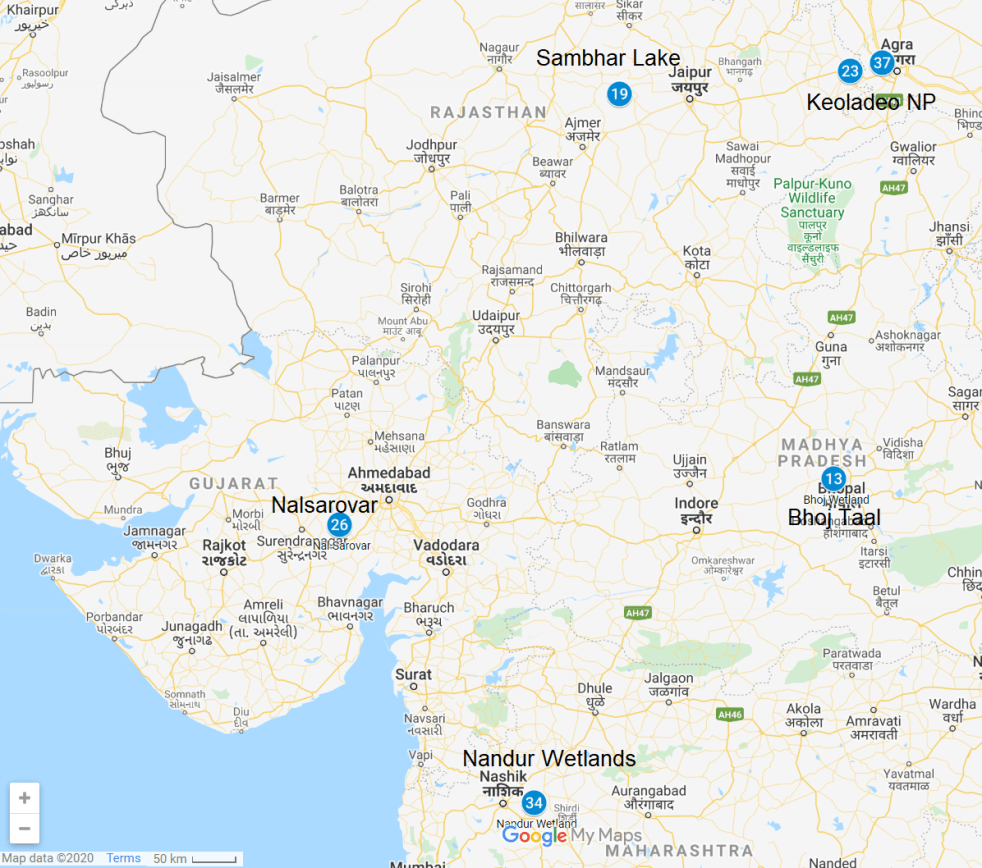
Ramsar Wetlands in crisis 2020: West India

The four state of West India have only five Ramsar sites of international importance. These includes Sambhar lake and Keoladeo NP in Rajasthan, Nalsarovar in Gujarat, Bhoj Taal in Madhya Pradesh and Nandur Madhmeshwar Wetlands in Maharashtra. There is no Ramsar site in Goa state.

Continue reading “Ramsar Wetlands in crisis 2020: West India”