Bhagirathi · Ganga · Uttarakhand

Walking along Ganga in Uttarakhand in 2017

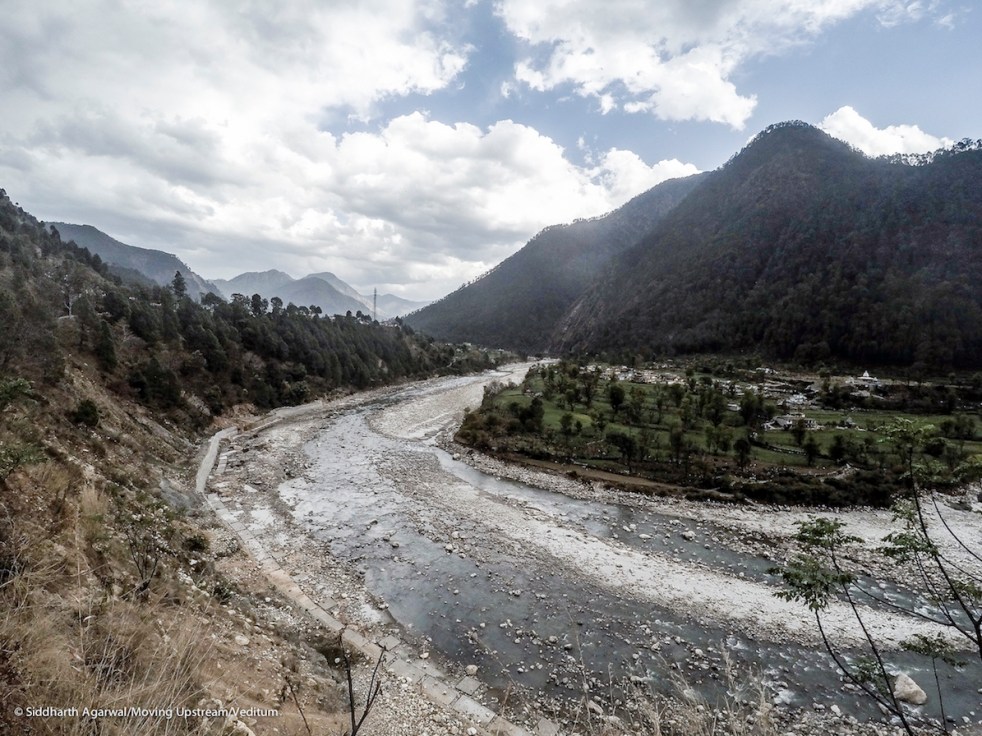
Above: The Bhagirathi valley has a lot of beautiful bends, comparable to the most popular scenic spots across the world. But we’re busy cutting down the mountain to make broader roads in these eco-sensitive areas. Image taken in March 2017. Photo credits: Siddharth Agarwal 

Guest Blog by Siddharth Agarwal

In the initial stages of planning the Moving Upstream project on the Ganga for Veditum, where we were going to walk along the whole length of the river, I had approached a lot of individuals to learn from their experiences about the river and the many connected stories around it. These learnings varied from science and activism to adventure and survival. Of all those who were approached, Himanshu Thakkar from SANDRP had been the most generous in extending knowledge resources and sharing contacts from the field. He even entertained a couple of my visits to their office and shared with me a copy of the SANDRP report prepared by Theo, called Headwater Extinctions (February 2014,  see: https://sandrp.wordpress.com/2014/12/16/new-publication-headwater-extinctions-impact-of-hydropower-projects-on-fish-and-river-ecosystems-in-upper-ganga-and-beas-basins/, it includes link to full report), along with a few other documents.

Headwater Extinctions looks at the role played by small and large hydropower projects in altering the fish biodiversity and river ecosystems in the Himalayan reaches of the Ganga and Beas basins. It also speaks about the perspective of local people and that of the authorities towards hydropower projects. Theo, who is an adventurer and ecologist, penned down the report with a scientific aptitude, while I will limit myself here in this revisit report to updated observations made on ground while walking along the Ganga in Uttarakhand (March 2017). This comparative observation will hopefully enable a conversation that requires continuity. Continue reading “Walking along Ganga in Uttarakhand in 2017”

Uttarakhand

Landslide Dam on Sonam River in Uttarkashi: Threat to people and structures in the downstream area

Above: Landslide Dam over Sonam River in Uttarkashi  Dist in Uttarakhand (Photo from Jagran.com)

A landslide on Sonam river (Bhagirathi basin) in Bhatwari block in Uttarakashi district in Uttarakhand has blocked the flow of the river and created a lake about 90 m long, 80 m wide and 1.5-3 m deep. The landslide dam in Nelong valley in Jadhganga river basin about 145 km from Uttarkashi town, apparently was formed due to landslide during cloud burst on July 27, 2016, but the information about it reached the administration only on Sept 4, 2016, 39 days later. The landslide dam, about 24 km from the India China border has created a threat to the downstream river bank communities, roads and bridges and other structures and also ecology. The reservoir has been formed at the confluence of Angar Nallah, a local stream, with Sonam River. A team of officials sent by the District Collector on Sept 5, 2016 has submitted a report, but the report is not yet in public domain. Continue reading “Landslide Dam on Sonam River in Uttarkashi: Threat to people and structures in the downstream area”

Floods · Interlinking of RIvers · Kosi · Narmada · Uttarakhand

CWPRS: A 100-year-old institute remains uni-dimensional; has no achievement to show

Jawaharlal Nehru who famously celebrated large dams as “temples of modern India” later termed them as “disease of giganticism”.[i] The fascination wore out after witnessing the huge sacrifice of the vulnerable and unfulfilled promises. Government of India however has continued with the worship of giant structures such as big dams, ports, hydropower projects etc. Even after nearly seven decades of independence, ‘engineering approach’ still dominates the idea of river planning which views river as an entity to be engineered and planned for irrigation, hydropower, industrial and urban water use rather than as a living eco-system. 17 study models that were displayed at Central Water and Power Research Station (CWPRS) open house day at Khadakwasla near Pune on June 14, 2016, its completion of 100 years of existence, stood testimony to this. Continue reading “CWPRS: A 100-year-old institute remains uni-dimensional; has no achievement to show”

Dams · Drought · Interlinking of RIvers · Jammu and Kashmir · Uttarakhand

India facing its worst water crisis ever: Himanshu Thakkar

Find below interview of SANDRP coordinator Himanshu Thakkar by Aditi Phadnis, Business Standard. The interview was published in Business Standard on the 14th May 2016 (http://www.business-standard.com/article/opinion/india-facing-its-worst-water-crisis-ever-himanshu-thakkar-116051400704_1.html)

~~

Environmental activist and water expert Himanshu Thakkar tells Aditi Phadnis that India needs a comprehensive water-use policy immediately.

You are quoted as saying that India is in the grip of its worst hydrological crisis ever. Isn’t that a bit drastic? After all, India has endured endemic in many parts of the country for several years now. What makes you so pessimistic?

I do not think it is statement of pessimism but possibly reflects a reality. What we are seeing this year is unprecedented in many respects: major perennial rivers like the Ganga, Godavari, and have dried up at several locations, which was unheard of earlier. Groundwater levels are at a record low. In many places hand pumps have dried up completely. The number ofimpacted, the intensity of the impact are huge. This is only the fourth time in a century that there has been a back-to-back drought, but on all previous occasions groundwater, an insurance in times of drought, had provided relief. That is no longer an available option in several places. Our rivers are in a much worse situation today than ever in the past, due to all the ill treatment we have meted out to them, including multiple and often unnecessary, unjustified damming. All this makes the situation this year much worse.

You are credited with making public a lot of information and anlysis about the circumstances of the current shortage of water in Maharashtra. What do your findings tell us about the issue of water in the state?

The first thing that strikes you about is that it has, by far, the highest number of big dams in India. According to the National Register of Large Dams of the Central Water Commission, of the total number of 5,100 big dams 1,845 are in Maharashtra. So about 35 to 36 per cent of all big dams in India are in the state. Yet Maharashtra is in the headlines for drought and water scarcity today. While nationally, 46 per cent of cropped area is irrigated, in Maharashtra the figure is hardly 18 per cent. There is a lot of evidence here that big dams have proved to be a failed water resources development model. The current chief minister did say in his famous Assembly speech on July 21, 2015, that farmers need irrigation, not dams, and dams are not the only means to achieve irrigation. Unfortunately, one of the major planks used by his party to achieve power in Maharashtra, the Rs 70,000-crore irrigation scam, seems to have been totally forgotten by the state government.

Parts of Maharashtra are facing multiple agrarian and hydrological crises this year. Rainfall deficits have been as high as 40 and 42 per cent in the last two years in Marathwada. In some districts and blocks the figure is even higher. So rain-fed kharif crops in many parts have failed for the last two years. The rabi crops were also hit by unprecedented hailstorms in 2014 and 2015. The 2016 rabi season has been hit by unusually dry conditions.

During the 2015 monsoon, we (my Pune-based colleague Parineeta Dandekar does most of our Maharashtra-related work) realised in mid-July that this year is going to be a crisis for most of Maharashtra, in addition to some other adjoining areas. So we wrote to the chief minister in August that the state needed to take certain measures urgently. This included stopping the diversion of about three billion cubic metres of water from the Bhima and Krishna basins to the high-rainfall Konkan area, stopping non-essential water-use activities, taking stock of available water and deploying it for priority needs, and so on.

The did not wake up to this situation then or at the end of the monsoon or even now. While the Jalyukt Shivar Abhiyaan, the flagship scheme of current Maharashtra government, is welcome, leaving aside some problematic work they are doing in terms of deepening, widening and straightening of rivers, it cannot be a fig leaf to hide its incompetence in handling this crisis.

In Marathwada and western Maharashtra (similarly, also northern Karnataka) sugar cane cultivation on about four to five per cent of cropped land takes up about 70 per cent of available irrigation water. We have been saying that considering the rainfall, weather situation and water availability, sugarcane is not a sustainable crop in these regions. However, even when 2014 and 2015 monsoon had major deficits in Maharashtra, the area under sugarcane remained at record levels. This was after the 2012 drought in Maharashtra, when the same issues had cropped up and the government, including the then Union agricuture minister Sharad Pawar promised intervention. We saw no implementation of those promises then. The situation is the same now.

Industry and agriculture are both responsible for the water crisis. But industries can’t be shut and farmers can’t be told to stop farming. So what is the answer?

I won’t say industry and agriculture are responsible. The kind of industries we set up and the kind of agriculture we do in any region has to keep in mind the various factors prevailing in the region, including water. When we conduct water-intensive activities in water-starved regions, that is an invitation to an inequitable, unsustainable, conflict-generating situation and sooner or later we will face the consequences. We have seen this happening in Maharashtra over the last decade most starkly.

Shouldn’t everyone be made to pay for water? Punjab has 98 per cent irrigation. It has spent money over the years, setting up irrigation channels, etc. Nobody has paid for those. Worse, the water running in those channels is not paid for either. By contrast, Maharashtra has barely 18 per cent irrigated land. What is the solution?

About 80 per cent of the water we use is supposed to be used by farmers, and I think there is national consensus that farmers in most places are not in a position to bear additional input costs in the current situation. Farmers need to be guaranteed much better returns on their produce than they are getting now. Say, if the Bharatiya Janata Party is able to implement the promise it made to farmers in its election manifesto that they should get 50 per cent return on investment, then maybe we can start talking about making farmers pay for the water, as that cost will then be included in the input cost calculations.

Moreover, a lot of users of water even in urban and industrial areas are not paying for the water they use or pollute. For example, a lot of groundwater gets used up by them, but there is no payment or regulation of this. Nor are they being made to pay for the pollution their effluents lead to.

We also need more participatory decision-making in water resources development before we can start asking farmers to pay for all the wrong decisions that are being taken now.

In the midst of all this gloom over lack of water, some states -Telangana and Maharashtra, for instance – have signed a pact to interlink rivers (ILR). Andhra Pradesh and Telanagana have already effected the interlinking of two rivers. Is this the way forward?

Today groundwater is India’s water lifeline, as most of our water comes from it and in every water sub-sector the dependence on groundwater is increasing with each passing year. So whether we like it or not, whether we want it or not, groundwater is our water lifeline. Our water policy, programmes and projects need to focus and prioritise how to sustain the groundwater lifeline. Will ILR help achieve that? The answer is no. In fact, we also need to prioritise optimisation of use of our existing water infrastructure; second, making rainwater harvesting the central focus as that can help sustain groundwater. ILR is costly, environmentally destructive, socially disruptive and a non-optimum option, particularly in view of the changing climate, in addition to other issues.

In hill regions like Uttarakhand and Kashmir, the frenzy of the floods can hardly be forgotten. What is happening there?

Yes, all across the Himalayas, the high disaster vulnerabilities (to earthquakes, floods, landslides, erosion and flashfloods) have deepened because of the changing climate and the kind of interventions we are doing there. Our disaster management infrastructure remains a rather weak link, as the Supreme Court order on on May 11, 2016 about the current drought pointed out. We seem to have learnt little from the Uttarakhand disaster of June 2013 and the Jammu and K ashmir floods of September 2014 and March 2015. As the Nepal earthquake of April-May 2015 showed, these regions are prone to major seismic shocks. All this demands urgent action and possibly course change.

Original link: http://www.business-standard.com/article/opinion/india-facing-its-worst-water-crisis-ever-himanshu-thakkar-116051400704_1.html

Climate Change · Dams · Ganga · Irrigation · Monsoon · Sand Mining · Uttarakhand

Dams, Rivers & People News Bulletin Oct 12, 2015

Arunachal:-  Siang People’s Forum writes to MoEF to not allow mega dam on Siang River, State Govt. supports the cause

Assam:- Locals, CM show stiff resistance to Lower Subansiri power project

Himachal:-Jispa Dam project faces opposition

Uttarakhand:- From 60 to 7000 patients in 3 years, Uttarakhand floods play havoc with mental health

Maharashtra:- Drought-Hit Maharashtra to generate 400 mw hydropower

Himalaya:- Dams, Hydro projects & other development works may wipe out many unknown species being discovered in Eastern Himalaya

Climate Change :- The Hydropower Methane Bomb No One Wants to Talk About

Continue reading “Dams, Rivers & People News Bulletin Oct 12, 2015”

Hydropower · Uttarakhand

Why Vishnuprayag and other Uttarakhand Hydro Projects continue to affect two years after the June 2013 disaster

In the last week of June 2015, there were widespread rains in Uttarakhand, accompanied by warning by the Dehradun Met Department. The pilgrimage to Kedarnath and Badrinath was affected with massive landslides damaging roads and bridges. But strangely there was little news about the hydropower projects. It was only when Vimalbhai informed me y’day that power generation at Vishnuprayag hydropower project has stopped that I decided to dig deeper into this issue. Continue reading “Why Vishnuprayag and other Uttarakhand Hydro Projects continue to affect two years after the June 2013 disaster”

Dams · Hydropower · Monsoon · Uttarakhand

Dams, Rivers & People News Bulletin, June 22, 2015

HYDROPOWER

HIMACHAL: Himachal Pradesh engineers blames untrained engineers and human errors responsible for growing numbers of hydro power project mishaps (15 June 2015) HP engineers say that the board was suffering these losses as they lacked the trained engineers. The limited staff is under pressure to perform technical duties and pressure mount on them as the government was not serious about filling the posts, said Lokesh Thakur, general secretary, HP Power Engineers’ Association, expressing anguish over the death of three engineers, two of whom worked in the HPSEBL.http://www.tribuneindia.com/news/himachal/lack-of-trained-engineers-to-blame/94204.html Continue reading “Dams, Rivers & People News Bulletin, June 22, 2015”

Alaknanda · Bhagirathi · Floods · Ganga · Mandakini · Ministry of Environment and Forests · Uttarakhand

Two years of Uttarakhand Flood Disaster of June 2013: Why is state & centre gambling with the Himalayas, the Ganga & lives of millions?

Its two years since Uttarakhand faced its worst ever flood disaster during June 15-17, 2013. We remember such tragedies to ensure that we learn the necessary lessons. So that in future such tragedies are not repeated or their dimensions are reduced. One of the enduring debates since that the Uttarakhand tragedy has been about the role of existing and under construction hydropower projects in increasing the proportions of the disaster.

A lot of water has flown down the Ganga in these two years, so let us revisit the important milestones of that debate. Within two months of the disaster, a bench led by Justice Radhakrishnan gave an order on Aug 13, 2013[1], asking the Union Ministry of Environment, Forests & Climate Change (MoEF&CC) to appoint an independent panel to assess the role played by existing and under construction hydropower projects in the disaster. Continue reading “Two years of Uttarakhand Flood Disaster of June 2013: Why is state & centre gambling with the Himalayas, the Ganga & lives of millions?”

Ganga · Himachal Pradesh · Himalayas · Hydropower · Uttarakhand

New Publication: Headwater Extinctions – Impacts of hydropower projects on fish and river ecosystems in Upper Ganga and Beas basins

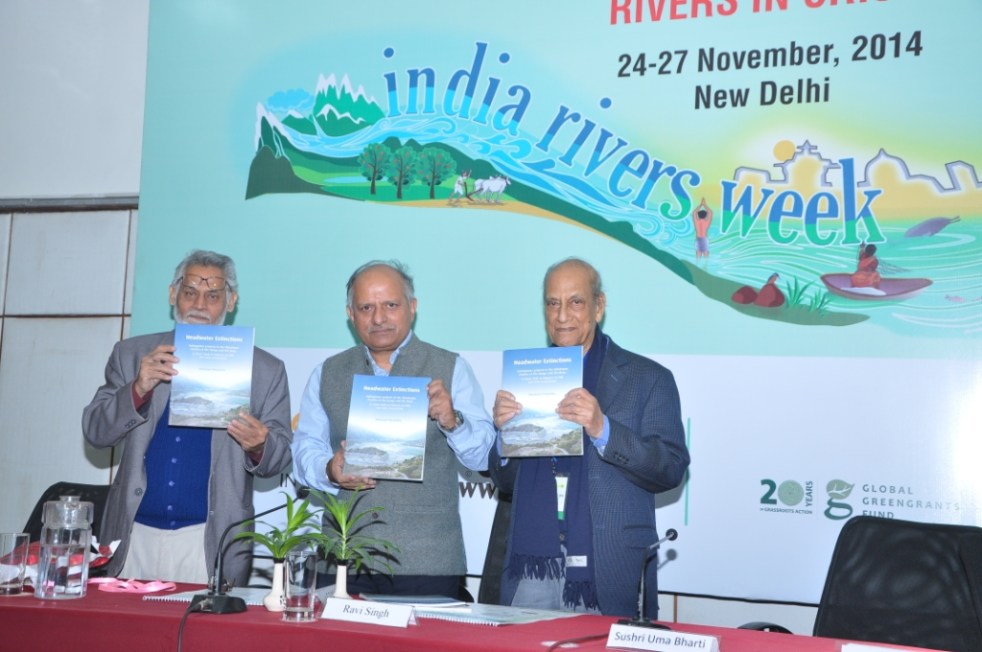
SANDRP has just published a new report: “Headwater Extinctions- Hydropower projects in the Himalayan reaches of the Ganga and the Beas: A closer look at impacts on fish and river ecosystems”, authored by Emmanuel Theophilus. The report[i] was released at the India Rivers Week held during Nov 24-27, 2014.

Front Cover of the report HEADWATER EXTINCTIONS

Headwater Extinctions deals with impacts of hydropower projects in Beas basin in Himachal Pradesh and Alaknanda-Bhagirathi basins in Uttarakhand on river ecosystem and its components, mainly fish. While the harrowing impacts of hydropower projects on local livelihoods and social systems are being realized gradually, we are yet unclear about the extent of impacts of these so-called green projects have on fish and aquatic biodiversity.

Environmental Impact Assessments of large hydropower projects (> 25 MW as per EIA Notification 2006[2]) are supposed to assess ecological impacts of such projects, but we are yet to come across any comprehensive effort in this direction from EIA reports that we have assessed so far.

The Expert Appraisal Committee (EAC) of Union Ministry of Environment, Forests and Climate Change (MoEF & CC) which is entrusted with appraising these projects and their EIAs has paid very little attention to this issue. Since over a decade, the EAC has had expert members from Wildlife Institute of India (WII) and Central Inland Fisheries Research Institute (CIFRI). Both these institutes are supposed to have expertise on fish and aquatic biodiversity. But sadly, their presence has not helped fill the serious lacunae in appraisal and EIAs of the hydropower projects.

SANDRP had been trying to highlight the impact of hydropower on fish and the long standing problems in the so-called mitigation measures being recommended by the EAC. We thought that it may be useful to bring out a first-hand report bring out ground realities of what is happening to our rivers. Emmanuel Theophilus, based in the Dhauliganga Valley and who is an avid mountaineer, storyteller, ecologist and our ally was commissioned by SANDRP to study the impacts of hydropower on fish and ecosystems, review the EIAs as well as mitigation measures recommended by EAC as a part of Environment Management Plans of hydropower projects. We are very glad to publish the report as a first of the hopefully many steps to be taken to understand and address this important issue.

Headwater Extinctions has been written in an eminently readable style that Theo is known for, as could be seen from the earlier blogs[3] he wrote for us! The report has a section on ‘Travelogue’ which records Theo’s travels and thoughts as he visits Bhagirathi and Alaknanda sub basins in Uttarakhand and Beas basin in Himachal Pradesh. The report also brings illuminating photos from these trips. The fact that the travels happened within months of the Uttarakhand disaster of June 2013 could be seen in his photos and travel reports. It further substantives the role hydropower projects played in increasing the proportions of the disaster.

Travelogue is followed by discussions in two parts: Discussions on the impact of hydropower projects on fish and aquatic habitats along the two sub-basins and the role of EIAs, EMPs, Fisheries Plan and the government approval process. The findings of this report are valid for all Himalayan states & rivers.

Back Cover of the report HEADWATER EXTINCTIONS

Headwater Extinctions ends with some striking insights. Sample this: We are in the midst of river extinctions in the Himalaya, but are surrounded by a tragic drama of double-speak and equivocation. And a horde of jostling brokers. Ranging from reputed universities, government departments, research institutions, everyday bureaucrats, and of course, politicians and contractors from within ‘the community’[4] along the developers and regulators. They not only write the script of this drama, they even play all the part”.

The inside covers of the report have detailed maps of the two basins with locations of hydropower projects, with annexures containing lists of hydropower projects in Upper Ganga and Beas basins and also list of fish found in Upper Ganga basin.

Theo has completed this report on a stringent timeline and budget, which meant that all the proposed and implemented fisheries management plans could not be assessed. We hope Headwater Extinctions provides sufficient material and compelling reasons to overhaul the way impacts of hydropower projects on fisheries and aquatic biodiversity are treated by EIAs, EMPs and government committees. We would also urge agencies like WII and CIFRI to do justice to their work inside EAC and beyond. That they are not doing that is apparent.

For EAC and MoEF&CC, we certainly would like them to ensure proper and full impact assessment of projects on aquatic biodiversity in the EIAs. The EAC also needs to stop approving completely ineffective fish hatcheries. They could initiate a credible independent study of the costs, benefits and performance of the fisheries development plans they have been approving in recent projects. It does not only smell fishy, but more like a scam! Here is a relevant quote from the report: “I can’t help see a few things here, as perhaps you do? Bluntly put, I see slush funds being dangled to a whole range of possible collaborators. The kindest term I can find for them is ‘brokers’.”

We look forward to your comments and suggestions on all aspects of Headwater Extinctions. If you would like a hard copy, please write to us.

SANDRP (ht.sandrp@gmail.com)

END NOTES:

[1] The full report is available on our web site, at: https://sandrp.in/Headwater_extinctions221114.pdf

[2] We have been saying this for long and this report helps substantiate our contention that the assumption that projects below 25 MW are benign and do not need EIA-EMP or environmental monitoring and public consultations is wrong.

[3] https://sandrp.wordpress.com/2014/02/02/fish-ladder-at-kurichhu-hydropower-project-bhutan-some-thoughts/ and https://sandrp.wordpress.com/2013/09/27/uttarakhand-floods-of-june-2013-curtain-raiser-on-the-events-at-nhpcs-280-mw-dhauliganga-hep/.

[4] Caveat, there are honest exceptions, but this is a generalization that describes the predominant phenomenon.

Ganga · Hydropower · Uttarakhand

Why is the IIT Consortium acting like a hydropower lobby?

In a shocking development, Consortium of Indian Institute of Technology (IITC) has submitted a report that is a shot in the arm for the hydropower lobby in Ganga basin in Uttarakhand. This IITC report is being used by the Union Ministry of Environment, Forests and Climate Change (MoEF&CC) to push ahead 24 Hydropower Projects in Uttarakhand which were recommended to be cancelled by two official expert reports, both commissioned on the orders of the Supreme Court of India. It seems the authors of the IITC report are jeopardizing the formidable reputation of the IITs and over a dozen other institutes which are a part of IITC, possibly for some short term gains.

Sounds ridiculous? Read on..

WII report The first expert report mentioned above is the report of the Wildlife Institute of India (WII), commissioned by the MoEF & CC to assess the cumulative impact of some 70 hydropower projects in Alaknanda-Bhagirathi basin in Uttarakhand. WII submitted the report to MoEF&CC in April 2012 and among other recommendations, said that 24 of these projects should be dropped due to their irreversible & long term impact on aquatic and terrestrial biodiversity. At the outset it should be mentioned that the WII (“an internationally acclaimed”, “autonomous institute of MoEF&CC”, see: http://www.wii.gov.in/) recommendation of dropping 24 projects was based on assessment of aquatic and terrestrial biodiversity impacts of the series of hydropower projects in Bhagirathi-Alaknanda basins in Uttarakhand. WII was commissioned to do this study by the MoEF&CC following an earlier SC order based on CEC (Central Empowered Committee) recommendation.

MoEF&CC, did not want to take the recommended action, so it sat on the recommendation of the WII report.

EB report following SC directions to Ministry to take stand on WII report On Aug 13, 2013, following the Uttarakhand disaster of June 2013, the Supreme Court directions, among other things included, “MoEF is directed to examine, as noticed by WII in its report, as to whether the proposed 24 projects are causing significant impact on the biodiversity of Alaknanda and Bhagirath River basins.” Again, MoEF&CC did not want to do any such examination on its own. Since MoEF&CC was setting up an expert body to examine the role of hydropower projects in the Uttarakhand disaster as per other directions of the same SC order of Aug 13, 2013, the ministry included such examination also in the Terms of Reference of the Expert Body (EB) under chairmanship of Dr Ravi Chopra.

The EB terms of reference were even wider than that of WII study and the expertise available with EB was also wider. With such expertise and terms of reference, the EB report (by 11 of the 13 members of EB) submitted to MoEF&CC in April 2014 came to the conclusion that 23 of the 24 projects in WII list should be dropped and even the 24th project, namely the Kotli Bhel 1A should go ahead only after significant modifications. Thus, essentially, EB too endorsed the WII recommendation.

It should be noted here that the WII recommendations were peer reviewed (during the work of Expert Body in 2013-14) by renowned biodiversity expert Dr Brij Gopal. Dr Brij Gopal too endorsed WII recommendation that the 24 projects should be dropped. The peer review was sought by the Central Water Commission representative at the 2nd EB Meeting. Despite objections from some EB members, the Chairman agreed to such a review and proposed the name of Dr. Brij Gopal which was promptly seconded by the Vice-Chairman, Dr. B.P. Das – a former Chief Engineer (Irr), Govt of Odisha and former Vice Chairman of the MOEF&CC’s Expert Appraisal Committee on River Valley Projects. In fact Dr. Brij Gopal suggested that more projects needed to be dropped.

MoEF&CC still did not want to take action on the 24 projects. So using the dissenting report by two government agencies which were largely toeing their official position in EB, the MoEF&CC suggested to the Supreme Court of India on May 7, 2014 that it wants to set up another committee. Seeing no validity in this, the Honorable SC rejected this suggestion and asked MoEF&CC to take a stand. SC has also since then put a stay on any further work on these 24 projects.

Still not ready to take a stand, MoEF&CC, used the reason that since IITC was already working on Ganga River Basin Management Plan (GRBMP) for the ministry since 2010 went ahead and gave the task of reconciling the two EB reports to IITC. In effect this is tantamount to violating the SC directions of not appointing another committee. However, unlike the picture it tried to give to SC, this task was not part of GRBMP work, but given to IITC through a fresh TOR.

Perturbed at not receiving any serious required response from MoEF&CC after repeated orders, the apex court judges of the Supreme Court rightly said the ministry was behaving like Kumbhakarna and Rip Van Winkle.

On Oct 9, 2014, the MoEF&CC submitted an affidavit to the SC, relying entirely on a report from IITC. And lo and behold, IITC had provided a report to the MoEF&CC, certifying that with some vaguely defined criteria, all the 24 projects can go ahead and there is no need to cancel any project! Serendipitously, this is exactly what the MoEF&CC & the hydropower lobby wanted!

It needs to be stated here that IITC had no mandate to submit such a report and the report is unprofessional, inadequate, unwarranted and inconsistent.

Let us see how.

Authors of the IITC report IITC report was authored by eight persons: Dr Vinod Tare (Civil Engineering Dept, IIT Kanpur, see: http://www.iitk.ac.in/ce/CIVIL/faculty.htm), Dr I M Mishra (Department of Chemical Engineering, IIT Roorkee, see: http://www.iitr.ac.in/departments/CH/pages/People+Faculty+imishfch.html#), Dr Purnendu Bose (Civil Engineering Department, IIT Kanpur, see: http://www.iitk.ac.in/ce/CIVIL/faculty.htm), Dr Ligy Philip (Civil Engineering Dept, IIT Madras, see: http://www.civil.iitm.ac.in/people/faculty/ligy/about.html), Dr B S Murty (Civil Engineering Dept, IIT Madras, see: http://www.civil.iitm.ac.in/?q=murty_edu), Dr R P Mathur (formerly Prof of Civil Engineering, University of Roorkee), Dr M Jawed (Dept of Civil Engineering, IIT Guwahati, see: http://www.iitg.ac.in/jawed/homepage/index.html) & Dr Gautam Roy (Consultant GRBMP and former student of Civil Engineering Department at IIT Kanpur). A perusal of the available information on professional background of these persons shows that none of them have expertise on the aquatic and terrestrial biodiversity of the Bhagirathi-Alaknanda basin, to decide on the appropriateness of the WII recommendations. Hence at the outset it seems inappropriate for IITC to sit on judgment over recommendation of an expert body, on subject matter of which IITC has no expertise.

The IITC team of 8 persons listed above, all with essentially engineering background have now also reviewed the EB report and made their own recommendations, again without having the expertise that was available at EB command. It is thus inappropriate for IITC to comment on the recommendations of the EB which had two biodiversity experts from FRI (Forest Research Institute) and WII, besides experts from Uttarakhand in various other disciplines. IITC is thus being unprofessional.

What does IITC report say The IITC report essentially says that ALL the 24 projects can go ahead if they satisfy three criteria: Aviral Dhara, Environmental flows and longitudinal connectivity. The first thing that strikes about these three terms is that they are all vaguely defined and can have flexible interpretations. They are also interconnected and not necessarily independent of each other. Most importantly, they do not take care of the issues based on which the two expert reports said that these 23 projects should be dropped and even the 24th Project, namely the Kotli Bhel 1A may be dropped or modified. But first let us understand these three vaguely defined, flexible and interconnected terms.

Aviral Dhara: According to the IITC report para 2.1 (see also: “Ganga River Basin Management Plan Extended Summary” of June 2014 available at: http://gangapedia.iitk.ac.in/sites/default/files/2014-06-12_GRBMP_Extended%20Summary.pdf): “Aviral Dhara in this context means that the flow of water, sediments and other natural constituents are continuous and adequate over the entire length of the river throughout the year.” There is no definition of what is adequate here, nor it is clarified as to adequacy is from what point of view. Here it should be noted that Aviral literally means uninterrupted, but neither IITC nor MOEF&CC provide this interpretation. According to MOEF&CC affidavit of Oct 9, 2014 (para 8(c)), Aviral means “to flow round the clock” or “continuous flow”.

Environment Flows: For Environmental flows, the “objective” of GRBMP is (see p 9 of the GRMBP Extended Summary) “Environmental Flows shall be maintained in all rivers and tributaries of Ganga River System to fulfill their geological, ecological, socio‐economic and cultural functions.” The E-flows thus would than depend on identifying functions of the river from geology, ecology, socio-economic and cultural perspectives, which can vary. The GRMBP extended summary does not provide clarity on e-flows for any of these aspects and how to go about arriving at required environment flow. It should be mentioned here that to arrive at environment flows, there are about 200 methodologies available globally. The IITC report attached with the MOEF&CC affidavit remains even vaguer as it says maintenance of E-flow should lead “to river stability and ecological balance in the downstream areas.”

Clarity on environmental flows is crucial as the affidavit from MOEF&CC itself agrees that MOEF&CC did not address the issue of eflows adequately while granting environmental clearances in Uttarakhand. One of the basic reasons behind this was lack of clarity on the issue and the same mistake is being repeated in the IITC Report.

Longitudinal Connectivity: In MOEF&CC affidavit of Oct 9, 2014, it is stated (para 6(b)/ 8(b)) that longitudinal connectivity is necessary to ensure “non-disruptive biota movement and silt transportation along the river course that are essential ingredients of a river ecology and its wholesomeness. Otherwise, a fragmented river stands to lose its basic character along with its native aquatic bio-diversity and ecological integrity.”

One of the two places where the term longitudinal connectivity appears in the GRMBP Extended Summary quoted earlier, says: “For dams and barrages, a precondition is essential that they cannot violate the longitudinal connectivity in River Ganga and her major tributaries. Besides they must allow E‐Flows (Environmental Flows) all along the river. A potential method for ensuring river connectivity through dams/ barrages has been suggested.”

The only other place in the GRBMP Extended Summary where the term longitudinal connectivity appears is interesting as it connects all the three terms that IITC has used: “Thus, while longitudinal connectivity in river network is an essential first step to maintain “Aviral Dhara”, having adequate river flows depends much on basin’s overall water status.” This statement is thus also making all three terms even more flexible, subjective and vague since they are dependent on “basin’s overall water status”. This leaves the door open to later reduce the quantum of E-Flows.

It is thus clear that the IITC report annexed by the MOEF&CC with their Oct 9, 2014 affidavit says that if these three vaguely defined terms that are flexible and prone to subjective interpretations are satisfied, then all the 24 projects can go ahead.

While these three, when clearly defined and properly implemented, are necessary conditions for any hydropower project, to say that they are sufficient condition is not only misleading, but also showing lack of understanding of the environmental issues related to hydropower projects. The MOEF&CC affidavit of Oct 9, 2014 relies exclusively on this IITC report and wants to allow all 24 project based on these three vaguely defined, flexible criteria from IITC report.

However, these three criteria are not sufficient to take a decision about these 24 projects as they exclude large number of criteria that the two expert reports considered, including: terrestrial biodiversity (completely absent in IITC report), cumulative impact (completely absent in IITC report it only looks at project specific issues), projects’ location in hazardous zone, projects increasing the disaster potential of the area, among many others.

The SC’s original direction was to examine if the 24 projects would have significant impact on the biodiversity. So the examination for these 24 projects must be done from the total biodiversity aspect and not on the basis of flow alone. The IITC itself has said in the GRBMP Interim Report of Sept 2013 that if biodiversity impact is significant then the project should be disallowed. It is clear IITC has again been inconsistent.

IITC is inconsistent It should be added here that in table 4.2 of their “Interim GRBMP” of Sept 2013 (see: https://nmcg.nic.in/writereaddata/fileupload/25_GRBMPInterim_Rep.pdf), IITC provides larger set of criteria for deciding permissibility of dams and barrages in the Ganga Basin, which include criteria like threat to terrestrial biodiversity, rare, endangered and threatened (RET) species, geological hazards, loss of historical, religious and cultural sites, among others. But these are no longer considered by the IITC in their current report under discussion. The IITC is also being inconsistent, besides being unprofessional and vague.

IITC report shows lack of understanding on basic environmental issues It is also disturbing to read the IITC report saying (section 2.1, last but one para), “However, projects on streams/ rivers with negligible biota may be allowed to proceed as per the environmental and other clearances already given to such projects provided that adequate provision is made to ensure the mandated E-flows. The adverse environmental impacts of such projects on the Ganga river system as a whole are expected to be negligible. Such projects may, therefore, be kept out of Cumulative Environmental Impact Assessment (CEIA) for their approval.”

Firstly, this shows that IITC is out-rightly overruling the recommendation of the WII and EB on criteria of terrestrial biodiversity, geological stability and so on. IITC is doing that too without providing any reasoning or basis. Significant number of the 24 projects have been recommended for rejection by WII and EB based on these criteria. Such baseless rejection of the recommendation by IITC not only shows their poor understanding of environmental and geological issues, but also shows their pro hydro bias.

Secondly, IITC makes the contention that the adverse environment impacts of such projects on Ganga river system is expected to be negligible, without providing any basis or scientific logic or reasoning.

Thirdly, suggesting that all such projects may be kept out of the CEIA seems to show poor understanding of the basics CEIA by the authors of IITC report. Large number of even so called low impact interventions can also cumulatively have big impacts and to exclude them is against the very spirit of CEIA. It also then raises doubts about competence of IITC to prepare GRBMP, since GRBMP is supposed to also look at the cumulative impact assessment and carrying capacity of major interventions in the Ganga Basin. IITC authors do not seem to understand that even aquatic biota gets affected by geological and other factors, that fish is not the only aquatic biota and that there is upstream downstream linkages in lifecycle of the aquatic biota and that there are linkages between aquatic and terrestrial biota life cycles, affected by hydrology.

The above stated issues raise serious doubts about the appropriateness of the IITC report and MOEF&CC’s attempts to push ahead with the 24 hydropower projects in fragile and disaster prone Bhagirathi-Alaknanda basin based on the inappropriate IITC report. Particularly when these projects were to be cancelled as per two expert reports, both commissioned following two separate apex court orders.

Issue of cumulative impacts cannot be taken care of through project specific actions Here it should be noted that the WII report has made its recommendation about dropping 24 HEPs based on cumulative impact assessment of all the operating, under construction and planned projects in the Bhagirathi-Alaknanda River basins. The same is true with respect to EB recommendation. The conclusions arrived at based on cumulative impact assessment by the WII and EB cannot and should not be sought to be addressed by looking at project specific steps or actions as MOEF&CC affidavit and IITC reports are doing.

Did Project Management Board allow IITC to do this report? The IITC task of GRBMP is being overseen by a Project Management Board (PMB) comprising of senior persons of all the seven IITs and some invited members. The IITC report dated July 21, 2014 mentions, “The PMB in its fifth meeting held on Tuesday, June 24, 2014 at IIT Delhi agreed to examine the two reports in the broader framework developed for GRMBP.”

While this is what IITC claims in its July 21, 2014 report, this claim is not supported by the Minutes of the relevant meeting of PMB, as we see below. From the reading of the minutes, it seems that the IITC had no mandate or clearance to do this report.

In the minutes of the fifth meeting of PMB held on June 24, 2014, para 7 seems to be the only relevant para in this context, which reads as follows: “Project Coordinator sought the directions from PMB about the modus operandi for follow-up actions after submission of the final draft of GRBMP – such as responding to queries and comments on GRBMP and dealing with requests for other inputs on Ganga Basin received from government and other agencies. He mentioned that IITC is obliged to respond to such requests based on the work done in preparing GRBMP, and the help of only active contributors of IITC would be needed rather than the existing mechanism of going through PICC and PMB. Professor Manna, Director, IIT Kanpur stated that IIT Kanpur is willing to take the responsibility on behalf of IITC of such matters and Project Coordinator may take the help and advice of concerned IIT Team members as and when needed. It was opined that each IIT may compile the list of new faculty members who may have joined after GRBMP project was started and communicate the same to the Project Coordinator. Professor Khakhar suggested that Directors of the 7 IITs may discuss the matter and communicate the decision to the Project Coordinator on modus operandi for submission of first version of GRBMP, and responding to queries and comments on GRBMP and dealing with requests for other inputs on Ganga Basin received from government and other agencies.”

The first thing that strikes about this para is that the Project Coordinator (Dr Vinod Tare) raised this in the context of “follow-up actions after submission of the final draft of GRBMP”, which is not the case with respect to current issue, since the final draft of the GRBMP is yet to be submitted. There is nothing in this para to support the contention quoted above from the preface of the IITC report that PMB “agreed to examine the two reports in the broader framework developed for GRMBP.”

If this is the only para that is relevant in the context of IITC report to MOEF&CC dated July 21, 2014 and if this para is not applicable at this stage since it is applicable only after submission of final draft of GRBMP, then the question arises, if the IITC had the permission from PMB to submit such a report and if the MOEF&CC should have submitted this report as authorized IITC report? These questions can be answered by only the IITC, its PMB and MOEF&CC, but they are relevant since it is this report purportedly from IITC that is sought to be used by MOEF&CC to ensure that all the 24 projects under discussion go ahead. In fact PMB and all concerned from IITC should quickly clarify that this report cannot be called IITC report, but only from the specific 8 persons listed above. The authors should be asked to remove the claim that this is IITC report.

IITR has poor track record and conflict of interest Here it is pertinent to note that of the four IITs involved in this report of IITC, IIT Roorkee (IITR) has already proven to have a poor and biased track record and should not have been involved in any case. The IITR was in fact commissioned in July 2010 by MOEF&CC to do cumulative impact assessment of the hydropower projects in Bhagirathi-Alaknanda basin. The report submitted by IITR was so pathetic that it was not accepted and it invited adverse comments from official agencies like the Expert Appraisal Committee on River Valley Projects, the Inter Ministerial Group on Ganga Basin Projects and also the Supreme Court of India in Aug 2013 order. (The report was also criticized by other organisations[1].)

Thus, IITR stands discredited on the precise issue of cumulative impacts of hydropower projects in Bhagirathi-Alaknanda basin. To include such an institute for another IITC report now on the same issue not only brings discredit to the whole effort, but raises the issue of conflict of interest.

While some issues are based on procedures and propriety, other issues relate to merit of IITC recommendations as they do not hold the experience or expertise to deal with serious problems related to cumulative impacts, terrestrial biodiversity and RET species, deforestation, and disaster potential of the region.

Thus, on both these counts (technical and merit based), the IITC Report is under cloud and does not hold enough ground to base further informed decisions.

Conclusion In view of the above, it is clear that IITC report is not adequate, reliable, or consistent to take a decision about 23 hydropower projects which have been recommended to be dropped and 24th project, namely the Kotli Bhel 1A project which has been recommended to be dropped/ modified by the WII and EB. IITC had neither the expertise nor the mandate to submit such a report. The MOEF&CC should not be relying on this report and rather coming out with its own position as directed by the Supreme Court of India repeatedly, keeping in mind the issues and merits of the two expert reports, both submitted following two separate apex court orders.

It is unfortunate that IITC has submitted a report that is obviously music to both hydropower developers and government. MoEF&CC has already offered more such work to IITC. We hope IITC will go beyond such short term interests and be more consistent, professional and work towards rejuvenation of the Ganga and other rivers.

This current work is discrediting their future work of GRBMP too.

-Himanshu Thakkar, SANDRP (Being an IIT Mumbai alumni myself, I am writing this with a sense of sadness)

[1] For example, see: http://www.sandrp.in/hydropower/Pathetic_Cumulative_Impact_Assessment_of_Ganga_Hydro_projects.pdf