
The coastline between Chavara and Alappad in Kollam district of Kerala, has a decades-long story of people’s battle for survival against mining companies. This stretch in Kerala is where the extensive mineral beach sand mining has been happening since the 1960s. The abandoned buildings are the remains of people’s failed agitations and indefinite strikes. One by one the villages in the area are vanishing from the map of Kerala.
Continue reading “DRP: 14 Jan 2019: Will the campaign of 17-yr old Alappad Girl Wake us up to the perils of unsustainable sand mining?”Category: DRP News Bulletin

DRP: 7 Jan 2019: NGT REJECTS FLAWED GROUNDWATER NOTIFICATION
Good to see NGT rejecting the flawed Groundwater notification dated Dec 12, 2018 from CGWA that was also critiqued by SANDRP: https://sandrp.in/2018/12/31/groundwater-governance-why-dec-12-2018-cgwa-notification-would-be-disastrous/. However, NGT should have asked an independent panel to formulate the policy for sustainable groundwater use, rather than a committee of the same government persons. Besides, there is also need for restructuring of currently totally ineffective CGWA and make it COMPLETELY INDEPENDENT of government.
Continue reading “DRP: 7 Jan 2019: NGT REJECTS FLAWED GROUNDWATER NOTIFICATION”
DRP: 31 Dec 2018: China Built Ecuador Dam, Advt For What Dam Can Do To River, Environment, Nation & Future
Best Advertisement of What Dam Building can do. Great Expose by NYT: “The dam sits under the glare of an active volcano, with columns of ash spewing toward the sky. Officials had warned against the dam for decades. Geologists said an earthquake could wipe it away. Now, only two years after opening, thousands of cracks are splintering the dam’s machinery. Its reservoir is clogged with silt, sand and trees.

DRP: 24 Dec 2018: MoEF & WII’s Compromises for Hydro Interests
In a shocking revelation, Jay Mazoomaar in this Indian Express report exposes how Wildlife Institute of India not only accepted consultancies from hydropower companies, but also diluted the mandate for the studies for given by statutory bodies like NGT, NBWL and FAC, but also provided compromised reports catering to the interests of the hydropower developers, thus trying to clear the way for the two controversial mega hydropower projects, one each in Dibang and Lohit river basins in Arunachal Pradesh. https://indianexpress.com/article/north-east-india/arunachal-pradesh/wildlife-institute-all-for-hydel-projects-in-arunachal-pradeshs-tiger-zone-5499656/
In case of the 3097 MW Etalin project being developed by Jindal and Arunachal Pradesh govt, the IE report says: “the WII was asked by the Ministry (MoEF) to assess the feasibility of the plan that requires 1,166 hectares of forestland in the valley. The Ministry’s move followed a recommendation from its Forest Advisory Committee (FAC) to conduct an environment impact assessment study. Instead, the WII initiated a study to find how the project’s impact on wildlife can be minimised”. Thus instead of doing the mandated scientific impact assessment, the WII initiated a study to minimise the project’s impact.
Continue reading “DRP: 24 Dec 2018: MoEF & WII’s Compromises for Hydro Interests”
DRP: 17 Dec 2018: Dam Safety Bill Introduced, TN, Odisha Oppose; Why No Role For Independent Experts?
On Dec 12, 2018, The government introduced the Dam Safety Bill amid din in the Lok Sabha on Wednesday even as Biju Janata Dal group leader Bhartruhari Mahtab questioned the legislative competence of the House on the matter.
The Bill provides for “surveillance, inspection, operation and maintenance of specified dams for prevention of dam failure related disasters and to provide for institutional mechanism to ensure their safe functioning”. There are over 5,200 large dams in the country and about 450 are under construction. There are also thousands of medium and small dams whose safety remains a matter of concern due to lack of legal and institutional safeguards. https://indianexpress.com/article/cities/delhi/parliament-winter-session-govt-introduces-dam-safety-bill-5490911/ (13Dec.2018)
Continue reading “DRP: 17 Dec 2018: Dam Safety Bill Introduced, TN, Odisha Oppose; Why No Role For Independent Experts?”
DRP: 10 Dec. 2018: Yamuna Pollution; Will NGT Panel Make Any Difference?
Feature image: A Hindu woman worships the sun god in the polluted waters of River Yamuna during Chhath Puja in New Delhi, on Nov. 14. (Image Source: Quartz India.)
In its latest report, the National Green Tribunal (NGT) appointed monitoring committee overseeing Yamuna River cleaning progress in Delhi says that the river is “fighting to stay alive” and it would not be possible to rejuvenate the Yamuna unless minimum environmental flow is provided as it is “virtually reduced to a trickle and remains dry in some stretches for almost nine months of the year”.
In the action plan, it is mentioned that “Although the Yamuna river flows only for 54 kilometres from Palla to Badarpur through Delhi, the 22 km stretch from Wazirabad to Okhla, which is less than 2 per cent of the river length of 1370 km from Yamunotri to Allahabad, accounts for about 76 per cent of the pollution level in the river”.
The committee has suggested that a team of scientists be formed from CPCB, DPCC and other institutions like IIT Delhi or NEERI to carry out inspections and submit reports to it for remedial action. The team can look into the risks and benefits of an alternative way of routing the same quantity of water which can help in reducing the pollution level, it said.
The monitoring committee also raised objection to the capacity utilisation of common effluent treatment plant (CETP) which is as low as 25 per cent. There are 28 industrial clusters in Delhi and 17 of these are connected to 13 CETPs. The remaining 11 clusters are not connected to any CETP. Another area of concern is the direct discharge of completely unregulated waste from industries and residences into the river.
Continue reading “DRP: 10 Dec. 2018: Yamuna Pollution; Will NGT Panel Make Any Difference? “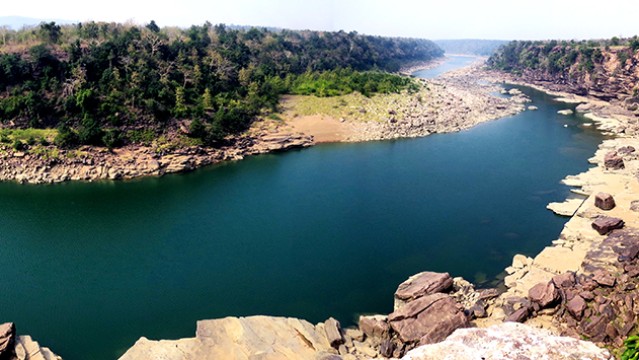
DRP: 3 Dec. 2018: Ken Betwa Link-Push to Dilute Forest Clearance Conditions
Ken Betwa river interlinking project is back to drawing board with Union water resources ministry approaching the ministry of environment and forest to relax conditions imposed as part of forest clearance accorded in May 2017 for diversion of forest in the Panna Tiger reserve (PTR).
Forest Advisory Committee (FAC) while according Stage-I clearance to the project had recommended that the project proponent and state govt should consider equivalent non-forest area (6,017 ha) adjoining to PTR from the revenue and private land and add to the PTR as a part of core/corridor (for tiger movement) with other areas or satellite core area. According to water resources ministry, they are unable to find land adjoining to PTR.
Will the forest department buckle under pressure to dilute the forest clearance conditions? http://www.newindianexpress.com/thesundaystandard/2018/nov/25/first-river-linking-project-coming-undone-1902890.html (25 Nov. 2018)
Continue reading “DRP: 3 Dec. 2018: Ken Betwa Link-Push to Dilute Forest Clearance Conditions”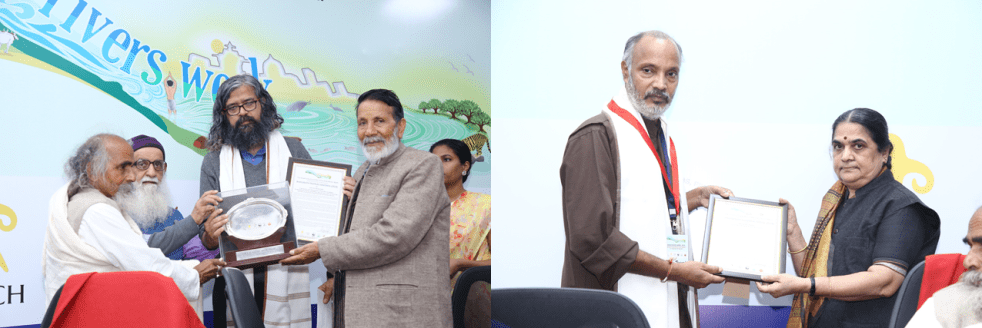
DRP: 26 Nov. 2018 (INDIA RIVERS WEEK 2018: BPS to Rainman Vishwanath; AMM to River Journalist Arun Tiwari)
At a well-attended function at India Rivers Week {IRW} 2018 at WWF-India in Delhi on Nov 25, 2018, the hall reverberated with resounding claps from the audience when suspense over who gets this years’ Bhagirath Prayas Samman (BPS) and Anupam Misra Medal (AMM) was broken. Vishwanath Srikantaiah, popular as Zen Rainman was the unanimous choice of the IRW Jury for the exemplary work on River conservation over the last 25 years.
The Anupam Misra Medal for path breaking media work on Rivers with focus on Ganga, the theme of IRW 2018, was given away to Shri Arun Tiwari by late Anupam ji’s life partner Manju Misra ji. Abhilash Khandekar, a well known journalist, also member of IRW organising committee and also member of BPS-AMM Jury, while interacting with the award laureates, called Arun Tiwari as INDIA’sRIVER JOURNALIST OF 2018.
Famous Chipko leader Shri Chandi Prasad Bhatt, giving the BPS award to Vishwanath, including Citation, Shawl and Plaque and, congratulated the six organisations that are in the organisation committee of IRW, said the India Rivers Week needs to be celebrated by every household and family.
Continue reading “DRP: 26 Nov. 2018 (INDIA RIVERS WEEK 2018: BPS to Rainman Vishwanath; AMM to River Journalist Arun Tiwari)”
DRP: 19 Nov 2018: India Rivers Week 2018 to focus on Ganga Rejuvenation
The India Rivers Week 2018, in fifth year, will be held at WWF, Delhi during Nov 24-26, 2018. The focus of the IRW this time is: “Can India Rejuvenate Ganga?“. Shri Rajiv Ranjan Mishra, Director General of the National Mission for Clean Ganga will address the inaugural session with Chief Guest Shri Jairam Ramesh, former Union Minister, in Chair. The meeting will see over 150 people from all over India participate to discuss state of India’s rivers at the only meeting in India focussing exclusively on rivers.
The Annual River Lecture will be given by Prof Rajiv Sinha of Indian Institute of Technology, Kanpur. The Bhagirath Prayas Samman award for the best work on River Conservation and the Anupam Mishra Medal for exemplary media work on River conservation will be given away by famous Chipco leader Shri Chandiprasad Bhatt.
Shri U P Singh, Secretary, Union Ministry of Water Resources has agreed to the chief guest at the concluding session on Nov 26, Monday. Started in 2014, the meeting is collectively organised by Yamuna Jiye Abhiyan, WWF-India, INTACH, Toxics Link, People’s Science Institute (Dehradun), Peace Institute and SANDRP.
For more information, please see: https://indiariversforum.org/2018/11/19/india-rivers-week-2018/. Follow IRW at: https://www.facebook.com/IndiaRiversWeek/ and https://twitter.com/IndiaRiversWeek
Continue reading “DRP: 19 Nov 2018: India Rivers Week 2018 to focus on Ganga Rejuvenation”
DRP: 12 Nov 2018: Waterways Deteriorate Ganga, But Gadkari And Modi are Oblivious
PM Modi inaugurated the first multi-modal terminal on the Ganga river in Varanasi on Nov. 12 under a project aimed at promoting inland waterways as a cheaper and more environment-friendly means of transport. The multi-modal terminals are being built as part of the central government’s Jal Marg Vikas Project that aims to develop the stretch of the river Ganga between Varanasi and Haldia for navigation of large vessels weighing up to 1,500-2,000 tonnes. https://www.ndtv.com/india-news/pm-modi-to-inaugurate-1st-multi-modal-terminal-on-ganga-river-in-varanasi-1944924 (9 Nov. 2018)
Explaining the negative impact of waterways projects on Ganga River, Shripad Dharmadhikary in Hindi report titled जलमार्ग परियोजना बदहाल नदियों पर एक हमला writes that the projects lack public consultation “गंभीर बात है कि जलमार्ग विकास से सबसे ज्यादा प्रभावित होने की सम्भावना स्थानीय जनता को है। इसके बावजूद जलमार्ग के विकास से संबंधित ज्यादातर कामों के आयोजन और क्रियान्वयन के लिए न तो इनकी सलाह ली गई है, और न ही इनके बारे में जनता को जानकारी दी गई है। कुल मिलाकर इन जलमार्गों के सामाजिक और पर्यावरणीय प्रभावों का ठीक से आकलन नहीं हुआ है, ऊपर से इन्हें पर्यावरणीय मंजूरी के दायरे से बाहर रखा गया है और सारी प्रक्रिया में लोगों की सहभागिता का भी पूरा अभाव है। ऐसे में जलमार्गों के रूप में इतना बड़ा हस्तक्षेप हमारी नदियों पर एक और बड़ा हमला है जो पहले से बुरी हालत में हैं। https://www.downtoearth.org.in/hindistory/%E0%A4%A8%E0%A4%A6%E0%A5%80%E0%A4%B9%E0%A4%82%E0%A4%A4%E0%A4%BE-%E0%A4%AA%E0%A5%8D%E0%A4%B0%E0%A4%AF%E0%A4%BE%E0%A4%B8-62034 (5 Nov. 2018)
Continue reading “DRP: 12 Nov 2018: Waterways Deteriorate Ganga, But Gadkari And Modi are Oblivious” SANDRP