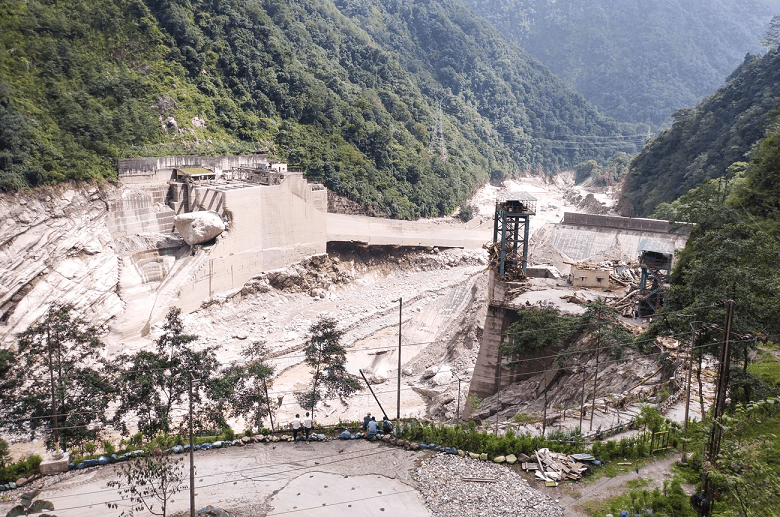
(Feature Image: Teesta III HEP dam was washed away on the intervening night of Oct. 3-4, 2023 on account of a GLOF. The flood in the downstream was magnified by the dam disaster. Photo: Mayalmit Lepcha/Source: Sanctuary Nature Foundation)
The decision of Union Ministry of Environment and Forests (MoEF)’s Expert Appraisal Committee (EAC) on River Valley Projects on Jan 10 2025 has understandably raised a stir and earlier the EAC and MoEF reviews and reverses this decision, better it will be. The decision is shocking on a number of counts. The EAC itself had raised a number of issues related to the project in its earlier meeting, but decided to clear the project without getting satisfactory resolution of the issues.
Secondly, the Central Water Commission and Central Electricity Authority have yet to clear the key design parameters of the project, including the Probable Maximum Flood, which will have bearing on the spillway capacity of the project. Thirdly, considering the change in height of the dam, change in dam type and its construction method, massive change in spillway capacity already (likely to go up further), changes in the upstream and downstream conditions, including glaciers, glacier lakes and their threats, the changes in rainfall pattern, etc., project needed a fresh Environment Impact Assessment & Environment Management Plan, fresh public consultation process, fresh appraisal and fresh monitoring and compliance. But the EAC and MoEF have allowed amendment to the fundamentally flawed Environment Clearance given way back in 2006. That clearance, including EIA-EMP & Appraisal have already proved flawed, as proved by the massive disaster the project faced on Oct 3 2023, when the full dam got washed away.
It is good to see that both BJP and Congress’s Sikkim state units have opposed the clearance, in addition to the opposition from Affected Citizens of Teesta and others. Even editorials in more than one national newspaper have questioned the hasty clearance. One only hopes better sense prevails and the project is asked to go through fresh EIA-EMP, Public hearing and Appraisal.
Sikkim Political stir after EAC’s approval to Teesta dam A centrally-appointed committee approved plans to rebuild the Teesta III Hydro Electric Project dam, 14 months after it was swept away due to a flood that originated in South Lhonak glacial lake. Political parties in Sikkim, including the state BJP cadre, are demanding approval to rebuild the dam be withheld till public hearings and further studies are completed. A recent study warns that the river remains highly susceptible to future GLOF events, including repeat triggers from northern lateral moraine failures.
– “Calculating the PMF is essential to determine a dam’s spillway capacity, which in turn affects dam safety. The PMF is calculated using rainfall data to make accurate projections about floods,” explained Himanshu Thakkar, coordinator of SANDRP.
– “In the revised plan, the PMF has stayed the same at 7,000 cumecs, which is a figure based on old data from 2006. Rainfall patterns have changed drastically in recent decades, and the PMF doesn’t appear to have taken this into account. This could have implications on dam safety,” said Thakkar. “It’s shocking the EAC approved the project for clearance without asking for more details about the PMF assessment. Given the scale and history of this project, a fresh clearance, with fresh impact assessments and fresh public hearings should have happened.”
– “If the spillway capacity for the Teesta III HEP is nearly 20,000 cumecs, that means the spillway capacities for dams further downstream, like the Teesta V and Teesta VI, must be enhanced too, so they can also withstand GLOF like events,” said Thakkar. https://india.mongabay.com/2025/02/political-stir-follows-expert-panels-approval-to-rebuild-teesta-dam-in-sikkim/ (06 Feb. 2025)
Need to pay loan: CM On Feb 5, following a legislative assembly session, CM Prem Singh Golay justified the decision to rebuild the Teesta Stage-III dam. Golay highlighted that the previous government had taken huge loans amounting to ₹3,200 crores to construct the Chungthang dam. However, the revenue generated from the project was insufficient to repay the loan. “When the GLOF occurred and the dam burst, we feared the project would be declared a non-performing asset, and the government’s 60.08% share in the project would have been lost,” Golay stated.
– The CM revealed that the state government had sought a loan waiver from the central govt, but the request was not supported. “We requested the Govt of India and two financial institutions to waive our loans, given the massive losses we suffered, and to provide subsidies. However, the Govt of India did not agree. They urged us to repay the loan, although they assured other forms of support under the National Disaster Management Authority,” Golay explained. The Chungthang dam has been awarded to Greenko, which was the second-largest shareholder in the previous Teesta Stage-III hydroelectric project. “This decision was made in the best interest of the state. Greenko was the second-largest shareholder, and it was the previous government that had entered into an agreement with them. If the government’s shares had to be transferred, they had to go to Greenko. After valuation, we handed over the project to them. Now, we are free from the burden of loans,” Golay stated. https://www.eastmojo.com/sikkim/2025/02/06/need-to-pay-loan-sikkim-cm-says-why-teesta-iii-dam-must-be-reconstructed/ (06 Feb. 2025)
BJP opposes nod to Teesta Dam To raise its pitch over safety concerns surrounding the clearance to build a dam for the Teesta III hydel project in place of a dam washed away in 2023’s glacial lake flood, the BJP will meet Union Environment Minister Bhupender Yadav later this month, the party’s Sikkim unit chief said on Feb 4. D R Thapa told The Indian Express that the BJP’s Sikkim unit would apprise the minister of the need for a fresh public hearing and comprehensive impact-assessment studies. Asked if the Sikkim BJP wants the project to be scrapped, he said, “We do not want the project to be scrapped. There should be comprehensive safety assessments and fresh impact studies. The past assessments were clearly bad. Hence the older dam was washed away.” https://indianexpress.com/article/india/teesta-iii-safety-concerns-bhupender-yadav-sikkim-bjp-9818022/ (05 Feb. 2025) Three days after the BJP Sikkim unit wrote to PM Narendra Modi expressing its concerns over the recent nod given by a central panel to resume construction of the Teesta-III hydropower project, Congress too on Wednesday (Feb. 05) opposed the approval, claiming the move was a “thoughtless clearance” as the threat of disaster continued to persist at the dam site. https://timesofindia.indiatimes.com/india/after-bjp-sikkim-unit-congress-raises-concerns-over-teesta-iii-hydro-project-opposes-it/articleshow/117956230.cms (05 Feb. 2025)
EDIT New dam, old warning Any infrastructure project in the region needs the highest level of scrutiny. That does not seem to have gone into the Teesta project, in spite of warnings and disastrous past experiences. https://www.deccanherald.com/opinion/editorial/new-dam-old-warnings-3393904 (07 Feb. 2025)
HYDRO POWER PROJECTS
MoEF HEPs expansion without changes in key design, exempted from CIA An office memorandum issued by the by the Impact Assessment Division of MoEFCC said that the ministry received representation from the ministry of power regarding exemption from impact assessment studies for expansion proposal of existing projects in a given river basin. “The matter has been examined in consultation with the expert appraisal committee (EAC), river valley and hydroelectric projects and accordingly it is clarified that expansion proposals of existing HEPs, which do not result in any change in reservoir capacity (Full Reservoir Level — FRL and Dam height), environmental flow and modification in key components like spillway, intake gates, may be carried out after joint appraisal of the EIA/EMP of existing HEPs as well as the EIA/EMP of the proposed expansion project rather than undertaking a fresh CIA/CSS study,” the office
Experts stressed that both fresh environmental assessment and cumulative impact assessment are critical in view of new threats from the climate crisis. “Take the example of Teesta III project in Sikkim. That project should have been appraised as a new project considering that the earlier environmental clearance came in close to two decades back and the project is now undergoing such huge changes and also there is change in situation in the river basin and also new upstream threats and climate change. Not doing fresh appraisal, fresh EIA, fresh public hearing etc does not make any environmental sense. Secondly, unfortunately, we not seen any credible CIA-CC study that really looks at the cumulative impacts in scientific, comprehensive way,” said Himanshu Thakkar, coordinator of South Asia Network on Dams, Rivers and People (SANDRP). https://www.hindustantimes.com/india-news/expansion-of-hydro-projects-without-changes-in-key-design-exempted-from-cumulative-impact-assessments-101739040481506.html (9 Feb 2025)
Assam NEEPCO’s dam repair under scrutiny The Ranganadi river has turned turbid in Lakhimpur district following the release of industrial waste from the dam of 405 Mw Panyor (Ranganadi) HEP of NEEPCO on its upstream at Yazali in Arunachal Pradesh. The river water has become black in the downstream areas of Lakhimpur district, affecting the riverine ecosystem and triggering alarm among the people living along its banks. The deterioration in the water quality with foul smell emanating from it has also caused death of fish and other aquatic species. Due to this development, people living along the riverbank have grown apprehensive about its impact on human health and aquatic ecosystem. People are blaming dam repair work carried out by NEEPCO for this phenomenon.
The PHEP issued a notice on December 26, 2024 at Yazali, informing the public that it will release water of the Ranganadi river through the radial gates of the dam due to maintenance work in the power house at Hoj from 7 am onwards from January 7 to March 15. It also warned that the released water may carry silt and will be unsuitable for drinking. NEEPCO, however, did not communicate the same to the Lakhimpur district administration. It was learnt that the district administration came to know about it much later. Cattle and other domestic animals are worst hit by this crisis as the river is their primary source of drinking water. There are apprehensions that pollution of the river may also contaminate ground water, which could have serious consequences for public health. This has also posed problems for picnickers as they were unable to use the river water for drinking, washing, or preparing food. https://assamtribune.com/assam/industrial-waste-chokes-ranganadi-in-lakhimpur-neepcos-dam-repair-under-scrutiny-1567516 (09 Feb. 2025)
Centre Rs 150 cr to reduce GLOF risks -The Centre has approved Rs 150 crore for a project to mitigate risk due to glacial lake outburst flood (GLOF) in Arunachal Pradesh, Himachal Pradesh, Sikkim and Uttarakhand. According to officials, the Centre’s share to the project is Rs 135 crore while states have to contribute Rs 15 crore. Sikkim has been allocated Rs 40 crore. https://www.newindianexpress.com/nation/2025/Feb/05/centre-okayed-rs-150-cr-to-reduce-glacial-lake-burst-risks (05 Feb. 2025)
Arunachal Pradesh GLOF risk needs study As the Centre greenlights the National Glacial Lake Outburst Flood Risk Mitigation Project (NGRMP) to tackle the threat of glacial lake outburst floods (GLOFs), experts highlight the need for extensive research and mapping in Arunachal Pradesh. Under the NGRMP, ₹45 crore has been earmarked for Arunachal Pradesh, with ₹40.50 crore coming from the National Disaster Mitigation Fund (NDMF). While the NGRMP aims to enhance early warning systems and disaster preparedness, experts warn that without extensive on-ground research, identifying and mitigating risks in the Eastern Himalayas will remain a significant challenge. Though remote sensing provides valuable insights, it cannot fully replace field studies in these high-risk areas. https://assamtribune.com/north-east/arunachals-glof-risk-needs-study-says-expert-amid-centres-new-mitigation-project-1567119 (05 Feb. 2025)
State lost 110 glaciers in 32 yrs: Study The researchers used remote sensing and geographic information systems to map glacier boundaries, even in debris-covered areas, from Tawang to Lohit districts of Arunachal Pradesh through West Kameng, Kurung Kumey, Upper Siang, and Upper Dibang Valley districts. They also used the Randolph Glacier Inventory of Global Land Ice Measurements from Space as a reference. The study found that the number of glaciers decreased from 756 to 646 during the 32-year-long (1988-2020) study period. The glacial cover during this period reduced by 309.85 sq. km from 585.23 sq. km, working out to a loss of a little more than 47%. The retreat exposed bedrock and created glacial lakes, threatening glacial lake outburst floods (GLOFs). Most of the glaciers studied lie at an elevation of 4,500-4,800 metres above mean sea level, are north-facing and confined between a slope of 15° and 35°.
Overall, the Himalayan glaciers are experiencing a rapid retreat rate compared to other glaciers globally and are facing a yearly average area loss of about 0.4% as a result of climate change, the study noted. Smaller glaciers below 5 sqkm in the Eastern Himalayas have shrunk the fastest. While rainfall patterns have been erratic, the study found no statistically significant trend in precipitation, emphasising the unpredictable nature of climate changes in the region. “The retreat of the glaciers will drastically impact freshwater availability, distribution, and ecosystem health. It also increases the risk of GLOFs and other hazards,” Dr. Hazarika said, highlighting the importance of understanding the impacts of climate change on frozen freshwater reserves. https://www.thehindu.com/sci-tech/energy-and-environment/arunachal-pradesh-lost-110-glaciers-in-32-years-study/article69176258.ece (05 Feb. 2025)
Meghalaya Land issues stall 85 Mw Wah Umiam III HEP According to Meghalaya Power Minister AT Mondal, Land issues have stalled the state’s 85 MW Wah Umiam III HEP. https://northeastlivetv.com/topnews/land-issues-stall-meghalayas-85-mw-wah-umiam-iii-hydropower-project-power-minister-at-mondal/ (05 Feb. 2025)
NTPC, NEEPCO plan 5 pump storage projects NEEPCO director (personnel), Major General (retd) Rakesh Kumar Jha said the proposal is in an advanced state with NEEPCO completing the detailed project report on two PSPs in the Wah Umiam area. He added that they are awaiting the no-objection certificate from the state government.“We should be able to kick-start the process as soon as we get the NOC,” he said, adding that the NTPC has also identified three PSPs. When asked about the Umiam Hydroelectric Project for which NEEPCO signed a memorandum of understanding with the Meghalaya government, he regretted the inability of the PSU to execute it since 1976 for various reasons. He said they are in talks with the state government officials, the deputy commissioners concerned, local groups, and Dorbar Shnongs. “About 80% of the land issues have been resolved. The remaining 20% will require patience to resolve,” he said. https://theshillongtimes.com/2025/02/07/ntpc-neepco-plan-5-pump-storage-projects/ (7 Feb 2025)
Jammu & Kashmir Stalled Hydropower Projects In the Rs 41,000 crore central assistance to the union territory in the 2025-26 Budget in Parliament, Union Finance Minister Nirmala Sitharaman announced no grants towards equity contribution for 624 Mw Kiru, 800 Mw Ratle, and 540 Mw Kwar hydro-projects. This has put the construction of these major power projects at risk as the J&K govt is financially struggling to construct hydropower projects on its own. “In 2024-25, the Govt of India had released Rs 171 crore for Kwar and Rs 476.44 crore for Ratle projects. In case the cost of construction escalates, the government can take loans from GoI for completing these projects,” a senior SPDC official said. https://www.etvbharat.com/en/!state/what-next-for-jammu-kashmirs-stalled-hydropower-projects-in-absence-of-central-funding-enn25020503599 (05 Feb. 2025)
NHPC Q3 profit slips 47% amid rising expenses -State-owned hydro power giant NHPC on Friday (Feb. 07) reported a 47 percent decline in consolidated net profit to Rs 330.13 crore in the December quarter, primarily due to higher expenses. https://www.moneycontrol.com/news/business/earnings/nhpc-q3-profit-slips-47-amid-rising-expenses-declares-rs-1-40-interim-dividend-12934070.html (07 Feb. 2025)
NHPC, CVPPL sign long-term PPA with DVC NHPC Limited and Chenab Valley Power Projects Limited (CVPPL) have signed a Power Purchase Agreement (PPA) with Damodar Valley Corporation (DVC) for the sale of power from multiple hydroelectric projects. The agreement was formalized in Kolkata on Friday (Feb. 07), ensuring a long-term power supply arrangement for a period of 40 years from the Commercial Operation Date (COD).
Under the terms of the PPA, DVC will procure power from NHPC’s 2,880 MW Dibang, 800 MW Parbati II, and 500 MW Teesta-VI Hydroelectric Projects, along with the 624 MW Kiru Hydroelectric Project of CVPPL. The agreement was signed by senior officials, including NHPC’s General Manager (Commercial), CVPPL’s General Manager (Planning), and DVC’s Chief General Manager (Commercial). The signing took place in the presence of the Chairman and Members of the DVC Board. https://psuwatch.com/newsupdates/nhpc-cvppl-sign-long-term-power-purchase-agreement-with-dvc (07 Feb. 2025)
Report Tata Power seeks hydro projects to ramp up clean energy bets “We have already identified two projects and work has started for the first project,” Praveer Sinha, chief executive officer at the Tata Group-controlled firm said in an interview with Bloomberg Television. Sinha said the first project will have 1 GW capacity and is expected to be operational by end of March, 2029. The second for 1.8 GW will be ready a year later. The company, with a total installed capacity of 14.45 GW of which renewables comprise nearly 40%, is also carrying out studies on two potential projects in its existing reservoirs. “Hopefully, by the end of this year, we’ll come up with another two set of projects,” Sinha said.
-On overseas projects, Sinha said his company has started work in Bhutan on a 600 MW hydropower plant and is looking for two more large projects. “By end of this year, at least one of them will start working,” Sinha said. https://economictimes.indiatimes.com/industry/renewables/tata-power-seeks-hydro-projects-to-ramp-up-clean-energy-bets/articleshow/117948149.cms (05 Feb. 2025)
MoEF Decisions of the EAC meeting held on Jan 29 2025: 1. Uri-I Stage-II Hydroelectric project of 240 MW in 102 ha in Sub Dist Uri, Boniyar, Kreeri, Baramullaand Rafiabad, District of Baramulla (Jammu and Kashmir) by NHPC Ltd– Environmental Clearance: APPROVED
2. Damanganga (Ekdare) – Godavari intrastate link project (CCA: 12998ha) in 213.46 ha at Village Ekdare, Tehsil Peint, Dist Nashik (Mah) by National Water Development Agency- Amendment in Terms of Reference: Withdrawn as project parameters to change.
3. Kamod Close Loop Pumped Storage Hydro Electric Project (2000 MW) in 458.23 Ha at Village Chaupale, Kamod, Kotkhamb and Nagziri, Sub District Sakri and Nawapur, District Nandurbar, Mah by Megha Engineering & infrastructures Ltd – Terms of Reference: Withdrawn as project parameters changed.
4. Ghosla Close Loop Pumped Storage Hydro Electric Project (2000 MW) in 350 Ha at Village Wadi, Tidka, Shewale etc, Sub District Pachora, Sillod and Soegaon, Dist Jalgaon and Aurangabad by Megha Engineering & infrastructures Ltd – Terms of Reference: APPROVED
5. Saidongar 1 – Karjat Open Loop Pumped Storage Project (3000 MW) in 377 Ha at Village Potal, Saidongar, Ambot, Dhak, Bhaliwadi, Sub Dist Karjat, Dist Raigarh, Mah by Torrent Psh 3 Pvt Ltd – Terms of Reference: APPROVED
6. Saidongar 2 – Maval Open Loop Pumped Storage Project (1200 MW) in 141.44 Ha at Village Dhak, Kusur, Pali T. Kothal Khalathi and Saidongar, Karjat, Dist Raigarh, Mah by Torrent Psh 4 Pvt Ltd – Terms of Reference: APPROVED https://parivesh.nic.in/utildoc/119458936_1738845706968.pdf
Agenda of EAC to be held on Feb 14, 2025: 1. Dharoi Open loop Pumped Storage Hydro Electric Project (500 MW) in 146.12 Ha at Village Jorapura, Umedpura and Vaghva-Mandva, Sub-Dist Danta and Satlasana, Dist Banas Kantha and Mahesana, by Gujarat State Electricity Corp Ltd – Terms of Reference
2. Sukhi Open loop Pumped Storage Project (500 MW) in 191.53 Ha at Village Bar, Dhanpur, Dungarvant, Raypur, Sub Dist Jetpur Pavi, Dist Chota Udaipur by Gujarat State Electricity Corp Ltd – Terms of Reference
3. Upper Bhavani Open loop Pumped Storage Project (1000 MW) in 167.85 Ha located at Village Mulligur, Sub District Kundah, Dist The Nilgiris, Tamil Nadu by NTPC Tamilnadu Energy Co Ltd– Terms of Reference
4. Pachnad Major Irrigation Scheme (CCA : 24,328 Ha) in 24328 Ha at village Sadhrapur, Sub-Dist and Dist Auraiya, Uttar Pradesh – Terms of References https://parivesh.nic.in/utildoc/119441233_1738826320642.pdf
Relevant decisions of FAC meeting held on Jan 27, 2025: – Diversion of 2250.05 ha (instead of 2272.05 ha) forest land for construction of Morand – Ganjal Irrigation Project in Hoshangabad, Betul, Harda & Khandwa Dists of MP of NVDA: Sub Com to visit the area. https://forestsclearance.nic.in/writereaddata/FAC_Minutes/11131124712151ApprovedMoMACParivesh1-0.pdf (Feb. 2025)
DAMS
Polavaram Project Telangana expands backwater study The irrigation department has begun sharpening its focus on analysing the impact of backwaters of Andhra Pradesh’s Polavaram irrigation project in Telangana, with more aspects being added to the study that the state government has asked IIT-Hyderabad to conduct. The irrigation department had on January 29 written to IIT-H to take up the study and submit its report in one month. The department is learnt to have held discussions with experts from IIT-H on Feb 6, following which they added a few more parameters for the study, including various backwater studies of the project by Central Water Commission, Central Soil and Materials Research Station, along with reports on the river’s flows by AP, Telangana and Odisha.
-Over the past three decades different studies had projected flood flows in the river ranging from 28 lakh cusecs to 58 lakh cusecs. According to officials, if a 50 lakh cusec flood occurs in the river, the backwaters from the project could extend up to 146 km behind the dam up to Dummugudem in Telangana.
-During the 2022 floods, Godavari, which recorded 24.5 lakh cusecs flow, reached a height of 71 feet resulting in submergence of 102 villages in Telangana impacting 16,000 houses. In view of these different figures, the department is learnt to have suggested that the new study in addition to examining the likely flood scenarios and impacts, also look into the submergence scenarios resulting from congestion of local natural drainage in the state. https://www.deccanchronicle.com/southern-states/telangana/scope-of-study-into-impact-of-polavaram-backwaters-expanded-1859793 (07 Feb. 2025)
Kaleshwaram Project NDSA report facing delays All the three barrages have been left non-operational for three crop seasons so far. The NDSA’s investigation into the construction and structural issues of the project barrages is facing delays. It has not yet reached a final conclusion in respect of its findings and recommendations to the State on the rehabilitation of the Medigadda barrage. Delays in the studies initiated for gathering geotechnical data has been a point of contention for the NDSA in the investigation. https://telanganatoday.com/kaleshwaram-unlikely-to-provide-water-for-next-two-crop-seasons (07 Feb. 2025)
120-km Godavari stretch turns bone dry The 120-km stretch of the Godavari River, once brimming with water due to the construction of three barrages — Medigadda, Annaram, and Sundilla — now lies bone dry. These barrages, which were intended to boost agriculture, pisciculture, and biodiversity, have been left non-functional under the pretext of structural issues.
-Larger stretches of the Godavari river above the three barrages have become heavily sediment-laden. The accumulation of sand and organic material has turned the riverbed into soil, providing ample scope for riverbank encroachment for agriculture. In some areas, Rabi crops are being grown, highlighting the extent of the sediment deposition.
-The Medigadda Barrage alone has accumulated over 90 lakh tonnes of sand, presenting a revenue potential through sand quarrying. The government has planned desilting operations for the barrage and the surrounding plain, but illegal quarrying has already commenced in certain areas. This inaction could prove costly for the State, as it misses out on potential revenue and faces the challenge of managing the sediment load. https://telanganatoday.com/telangana-120-km-godavari-stretch-once-brimming-with-water-turns-bone-dry (07 Feb. 2025)
Operator dies in accident in Goliwada pump house An operator, Sampath, died in an accident in the Parvathi pump-house (Goliwada pump-house), a component of the Kaleshwaram Lift Irrigation Project, in Anthergaon mandal. Sampath sustained a head injury when he was hit by an iron hook while attending to repair works of a motor in the pump house in the morning shift. Other staff immediately shifted him to the hospital. However, he died on his way to hospital. More details awaited. https://telanganatoday.com/peddapalli-operator-dies-in-accident-in-goliwada-pump-house (05 Feb. 2025)
Goa Work of new gates for Amthane dam tendered The Gates of the Amhane dam in Goa were found to be jammed on Jan 24 when they needed to be opened in emergency situation. Surprisingly, after the gates were jammed, the officials realised that they did not have the drawings of the gates, which could be used to repair the gates. In this scenario, the efforts of available divers proved futile and Navy’s divers had to be engaged to cut the gates open. https://timesofindia.indiatimes.com/city/goa/work-of-new-gates-for-amthane-dam-tendered-after-maintenance-fiasco/articleshowprint/117926287.cms (05 Feb. 2025)
Karnataka Farmers protest failure of Heeranjalu lift irrigation project Farmers highlighted several issues, including the unscientific construction of the dam and jackwell, lack of proper information provided to farmers, and the absence of a notice board about the project. They also pointed out that water from the dam has already seeped into low-lying areas, damaging crops. Despite this, no compensation has been provided to affected farmers. Additionally, incorrect information has been circulated, such as claims that 1,000 acres of land are used for paddy cultivation in the area. Farmers also criticized the lack of proper land acquisition, survey, and water management committee formation. They alleged that officials are carrying out the work unscientifically, leading to waterlogging in low-lying fields.
-S Prakashchandra Shetty strongly criticized the officials, demanding that no harm should come to farmers in the project area. He insisted that measures be taken to prevent water from seeping into paddy fields, compensation be provided for crop losses, and a written assurance be given that no cess will be imposed on paddy farmers in the command area. He also called for the jackwell to be relocated to a lower level and urged that work be halted until senior officials provide accurate information. https://daijiworld.com/news/newsDisplay (04 Feb. 2025)
Srisailam Dam Plunging water level causes concern The current water level in the dam stands at 852 tmc ft, significantly lower than its full capacity of 885 tmc ft. Inflows into the dam have come to a complete halt, leading to the closure of all gates, and no water is being released downstream. With summer already setting in, the demand for water, both for drinking and irrigation, is expected to rise sharply, exacerbating the situation for residents of Nandyal district. Adding to the crisis, the scorching summer heat will lead to increased evaporation, further depleting the already limited water reserves in the dam. https://www.thehansindia.com/andhra-pradesh/plunging-water-level-in-srisailam-dam-causes-concern-943716 (09 Feb. 2025)
Hirakud Dam DRIP-III for Hirakud dam gets cabinet nod The Odisha cabinet approved the Dam Rehabilitation & Improvement Project (DRIP)-III for the Hirakud dam at an estimated cost of Rs 1,066.38 crore. The project, to be executed over six years from 2025-26 to 2030-31, will receive funding from World Bank and Asian Infrastructure Investment Bank (AIIB). There are three major components of DRIP-III. The centrepiece of the project involves construction of an additional spillway on the dam’s left dyke to manage excess flood water more effectively.
A key feature of the project includes comprehensive underwater, ground, and aerial surveys to assess the dam’s current condition and implement necessary rehabilitation measures. The project will also introduce modern automation systems for both existing and new spillway gates using supervisory control and data acquisition (SCADA) technology. According to the govt statement, the implementation of SCADA will replace manual gate operations with a remote operation system. “The incorporation of state-of-the-art materials and modern machinery, combined with detailed videography of the rehabilitation process, will substantially extend the dam’s operational life and efficiency,” the chief minister said. https://timesofindia.indiatimes.com/city/bhubaneswar/drip-iii-for-hirakud-dam-gets-cabinet-nod/articleshowprint/118071233.cms (08 Feb. 2025)
Maharashtra Cabinet approves ₹315cr for Temghar dam’s repair The state cabinet on Tuesday approved Rs315.05 crore for the repair and strengthening of Temghar dam’s wall, two years after the proposal was sent for approval. The allotment of funds has paved the way to undertake the remaining works of plugging leakages and strengthening the dam’s wall. About 90% of the leakages were repaired in the first phase of the work, which ended over two years ago. The remaining work has been pending since then because of lack of funds. https://timesofindia.indiatimes.com/city/pune/cabinet-approves-rs315-crore-for-temghar-dams-repair/articleshowprint/117925339.cms (05 Feb. 2025)
Tamil Nadu 5 major dams to be rehabilitated soon under DRIP II The WRD would soon start work to rehabilitate Vaigai dam and carry out catchment area treatment works at a cost of nearly ₹20 crore. Similarly, tender is being finalised for works to repair the Bhavanisagar dam built across Bhavani river. The work would be executed at a cost of ₹19.89 crore. “We are also preparing proposals for dam rehabilitation project in Willington (Cuddalore district) and catchment area treatment works at Mettur dam,” said an official.
Officials noted many major dams were nearly five to seven decades old and needed to be rehabilitated for hydrological safety. Various components of the work would include repairing or replacing the shutters and adding more vents. These projects would be implemented based on the recommendations of the Dams Safety Review Panel. The department is awaiting World Bank’s nod to start renovation works in Anaikuttam dam in Virudhunagar district, Mirugandanadhi dam in Tiruvannamalai district and Amaravathy dam. The earthen bund in the upstream portion of Anaikuttam dam would also be strengthened along with works to improve the shutters, officials said.
The WRD has accelerated ongoing works in dams, including at Sathanur and Sholayar. While the ₹90 crore project in Sathanur dam is nearing completion, the department has so far finished nearly 80% of the works at Sholayar dam. Two other dams-Kelavarapalli and Upper Nirar have been renovated. Instrumentation has been finished for real time water level monitoring and measuring various weather parameters in 17 dams so far. The DRIP-II worth nearly ₹610.26 crore would be completed by December 2027. https://www.thehindu.com/news/cities/chennai/five-major-dams-in-tn-to-be-rehabilitated-soon-under-drip-ii/article69180331.ece (04 Feb. 2025)
BBMB Low water level in dams may hit power generation, irrigation needs The water level in dams in Punjab and Himachal Pradesh is significantly lower this year compared to the same period last year, as per the latest Central Water Commission (CWC) report of February 6. “The low water level in Ranjit Sagar Dam (RSD), Bhakra Dam and Pong Dam reservoirs in Himachal Pradesh and Punjab is a cause for concern as it may affect irrigation and power generation requirements for Punjab, Haryana and Rajasthan,” said a former Chief Engineer with the Punjab State Power Corporation Limited. “Punjab depends a lot on hydropower generation throughout the year, especially in summers,” he added.
The CWC report further states that the storage in the only reservoir in Punjab (Ranjit Sagar reservoir) is just 16 per cent of the “full reservoir level” (FRL) against last year’s storage level of 26 per cent and normal average of 38 per cent during the corresponding period. “At present, the discharge of water from reservoirs is more than the inflow. The situation is likely to improve in April-May after snow starts melting. Power generation at Bhakra and Ranjit Sagar dams may be affected due to low water level,” said a senior official. https://www.tribuneindia.com/news/punjab/low-water-level-in-dams-may-hit-power-generation-irrigation-needs/ (09 Feb. 2025)
INTERLINKING OF RIVERS
Ken-Betwa Link In the forthcoming Wednesdays.for.Water session on Feb 12th, 2025, at 5.00 PM IST, do join for a discussion on, ‘The decision-making process of the Ken-Betwa Link Project’. The joining Link is: https://tinyurl.com/y3kmsrnr . More info at www.wforw.in
Tapti River Diversion Decks cleared for world’s largest groundwater recharge?? During Friday’s (Feb. 07) Cabinet meeting, the Madya Pradesh CM directed officials to expedite the implementation of the Tapti Basin Mega Recharge and Kanhan Sub-Basin projects. The project aims to maximize water utilization by diverting the Tapti River into three streams, ensuring extensive irrigation across Madhya Pradesh and Maharashtra, and is part of Madhya Pradesh’s broader efforts to resolve long-standing interstate water-sharing disputes.
The project is meant to supply water to Maharashtra’s northern region and Madhya Pradesh’s southern areas. It is also aimed at addressing drinking water concerns in Nagpur, Maharashtra, and irrigation needs in Chhindwara, MP, officials from the state government said. A formal signing is expected soon, with the Union Minister of Jal Shakti and Maharashtra’s CM likely to visit Bhopal for the official proceedings, the officials said. According to the Madhya Pradesh government, once signed and implemented, it will be the world’s largest groundwater recharge.
The Tapti Mega Recharge Project will utilise 31.13 TMC of water, with 11.76 TMC allocated to Madhya Pradesh and 19.36 TMC to Maharashtra. The project will irrigate 1,23,082 hectares in Madhya Pradesh and 2,34,706 hectares in Maharashtra, particularly benefiting Burhanpur and Khandwa districts. Officials confirmed that no villages would be displaced, eliminating the need for a rehabilitation program.
Originally proposed to be a 66 TMC reservoir, concerns about land displacement and environmental impact — including effects on forest areas and tiger reserves — led to a shift towards a groundwater recharge model. The revised plan includes four key water structures. The Khariya Gutighat Low Diversion Weir, on the Madhya Pradesh-Maharashtra border, will store 8.31 TMC of water. A 221 km right bank canal, with 110 km in Madhya Pradesh, will irrigate 55,089 hectares. A 135.64 km left bank canal, including 100.42 km in Madhya Pradesh, will provide water for 44,993 hectares. Another left bank canal extension, stretching 123.97 km with a 14 km tunnel, will irrigate 80,000 hectares in Maharashtra. https://indianexpress.com/article/india/decks-cleared-in-madhya-pradesh-for-worlds-largest-groundwater-recharge-9823943/ (08 Feb. 2025)
MP is now focused on the Tapi-Kanhan River project in partnership with Mah, claiming it can irrigate 1.23 lakh ha in MP and 2.34 lakh ha in Mah. https://www.aninews.in/news/national/general-news/mp-cm-mohan-yadav-holds-meeting-with-senior-officials-regarding-the-tapi-kanhan-river-project20250207182812/ (07 Feb. 2025)
Odisha MP pushes for river linkage project to address water woes Local MP Pradeep Kumar Panigrahy has called on the central govt to expedite the implementation of the long-awaited river linkage project between Rushikulya and Mahanadi. In a recent letter to PM Narendra Modi, Panigrahy emphasised the crucial need for the project, which he believes will significantly benefit the districts of Ganjam, Nayagarh, and Khurda. Panigrahy said the linkage will not only enhance irrigation potential in these regions but also address the persistent drinking water shortages, particularly in the area under Berhampur Municipal Corporation (BeMC). https://timesofindia.indiatimes.com/city/bhubaneswar/berhampur-mp-pushes-for-river-linkage-project-to-address-water-woes/articleshowprint/117893402.cms (03 Feb. 2025)
URBAN RIVERS
Mula-Mutha; Pune Punekars Rally to Save City Rivers Over 5,000 citizens from Pune and Pimpri-Chinchwad participated in the Chipko Padyatra organized by Pune River Revival, demonstrating unprecedented public support for protecting riverside ecosystems. The peaceful march, which stretched from Kalmadi High School to the Ram-Mula confluence, saw participation from residents, citizens from various communities, river experts, senior citizens, a good number of school and college students, and special groups like the Parkinson’s support group of Pune. https://www.freepressjournal.in/pune/video-hundreds-of-punekars-take-to-streets-to-fight-to-save-city-rivers-sonam-wangchuk-sayaji-shinde-join (09 Feb. 2025) “Twinkle, twinkle, little star / river is our superstar” – This was just one of the slogans that rang out as hundreds gathered at the Kalmadi School in Baner for the Chipko River March on February 9. Improvised slogans, songs, chants, placards and face paints spelled out the message that the RFD of the Pune Municipal Corporation and the Pune Chinchwad Municipal Corporation did not have the support of a large number of citizens whom it is supposed to benefit. https://indianexpress.com/article/cities/pune/baner-protest-chipko-river-march-pune-rfd-project-9826888/ (09 Feb. 2025)
The padayatra (march on foot) witnessed hundreds of citizens embrace ancient trees along the riverbank — in the style of traditional ‘Chipko’ protests — symbolising their commitment to protecting these natural assets. Participants also wrote a few thousand letters on ‘Nadi ki Baat’ to PM Modi, urging immediate action to protect urban river ecosystems.
Pune River Revival members will also present their demands to the commissioners of PMC and PCMC as custodians of the rivers. They plan to urge them to revise the Local Area Plans to include measures like stopping sewage from entering rivers, halting constriction of flow, preventing dumping, protecting and conserving trees, devrais, and wetlands, safeguarding and sustaining existing groundwater sources, revising the RFD project to make them eco-friendly using site-specific, nature-based technologies, and actively consulting and involving citizens while maintaining transparency in decision-making. https://timesofindia.indiatimes.com/city/pune/massive-chipko-march-unites-residents-against-riverfront-development-projects/articleshow/118096680.cms (10 Feb. 2025) The march aimed to raise awareness about the critical role of riverside ecosystems. It aimed to help people understand the threats posed by non-sustainable development and climate change, including floods, declining groundwater levels, and the loss of vital natural resources. It sought to bring people together for rejuvenation efforts and to urge the authorities to protect these crucial areas when planning future development. https://www.hindustantimes.com/cities/pune-news/punekars-hold-chipko-march-for-preservation-of-riverside-ecosystems-101739129727998.html (10 Feb. 2025)
SANDRP stands in solidarity with Pune River Revival, Jeevit Nadi and citizens of Pune who will peacefully march today to protest against atrocious Riverfront Development Project which involves cutting trees, dumping debris inside the river, destroying ancient riverbanks.
Tryst with a River We, the citizens, deserve to know. Let there be open discussions, public hearings and transparent dialogue between the government and the people, for it is a question of ‘our’ rivers, our future. Meanwhile, we hold on to the ephemeral ideal in the present, which could soon be a thing of the past.
-The Ram-Mula confluence recently hosted the Pune Kabir Festival and the woods were alive with music, dance, dappled morning sunshine and a community basking in the riverside bounty. ‘Pal me parlay hovegi.. bahuri karega kab’ – Sant Kabir’s words could well be a call forcitizens action in the face of riverfront destruction. (Renu Deshpande Dhole) https://www.thebridgechronicle.com/news/tryst-with-a-river (06 Feb. 2025)
Mula river: A dying beauty This cinematic journey takes you through the breathtaking yet endangered Mula River and the Ramnadi confluence, a place where nature, wildlife, and human life have coexisted for centuries.
But now, reckless urban expansion by PCMC is shrinking the river’s space, disrupting migratory birds, endangering fish populations, and threatening the livelihoods of local fishermen. Concrete is replacing natural habitats, pushing this once-thriving ecosystem to the brink of destruction. https://www.youtube.com/watch?app=desktop&v=ANMSHPBQH8M (07 Feb. 2025)
River Song by Sayaji Shinde “The river begins as a playful brook, bubbling with joy. As it grows, it becomes calm and serene—until it reaches the city, where the most intelligent species on the planet mindlessly destroys it.” https://www.youtube.com/watch?v=3P7jQz-zuUU (09 Feb. 2025)
Activists demand clarity on trees to be cut for RFD Prajakta Mahajan, the environment activist, said she had filed an RTI with PCMC to seek information on the tree mapping and species of trees that are likely to be affected due to the Mula River Rejuvenation Project. However, the PCMC officials informed her that they do not have any such report with them. “The municipal corporation claimed that they transplant or plant more trees than the trees cut down while undertaking any project. However, they do not have any information on the number of trees or species that are likely to be affected for this project. They have already started the work; hence it is difficult to trust their claims,” she said. https://timesofindia.indiatimes.com/city/pune/activists-demand-clarity-on-trees-to-be-cut-for-mula-river-rejuvenation-project/articleshowprint/117958039.cms (06 Feb. 2025)
नदीकाठ सुशोभीकरणाच्या अट्टहासातून पुण्यातील शेकडो वृक्षांची कत्तल होतेय… River bank beautification project is going on in Pune at the cost of Rs. 4,700 crore. Thousands of trees are being cut in an area of 88 kilometers combining 44 kilometers i.e. both shores to create a shoreline and commercial site in the name of beautification. Currently, work has started on Sangvi section from Wakad. There riverside forest is now counting its final watches. The rest of the city’s lungs are also in danger. Hence, the citizens of Pune are preparing for Chipko Morcha to protect hundreds of years old trees. It’s time we consider what growth means and what is the definition of beauty. https://www.loksatta.com/sampadkiya/features/hundreds-of-trees-in-pune-are-being-cut-down-in-pursuit-of-riverside-beautification-mrj-95-4870459/ (05 Feb. 2025)
Resistance to RFD Marches are the most visible form of resistance, but the movement against the RFD also involves civil society members talking to the PMC. “Rather than protesting, we started discussions with the authorities about our reservations regarding the RFD. This was around 2018-19. Instead of saying no to the RFD, we said it could be implemented better on the river,” says Shailaja Deshpande of Jeevitnadi, a volunteer-based organisation involved in the protests.
Sarang Yadwadkar is among those who have taken the resistance to the courts. In January, he knocked on the doors of the NGT again, this time against the environmental clearance given by the State Environment Impact Assessment Authority to the RFD. “As far as the RFD is concerned, we need to understand the situation in Pune. It is very peculiar compared to any other city. Five rivers enter the city: Mula, Mutha, Pavana, Ramnadi and Devnadi. The last two are relatively smaller rivers but bring in water quickly. Flash floods occur in both rivers. We have seven dams upstream that are nearby. There are four dams on the Mutha and one each on Mutha and Pawana, apart from the Kasarsai Dam,” says Yadwadkar. https://indianexpress.com/article/cities/pune/how-resistance-to-riverfront-development-project-flows-through-pune-9820595/ (06 Feb. 2025) The project has been facing opposition from environmentalists and civil society who managed to raise the issue in the National Green Tribunal and Supreme Court citing the damage to ecology of the river and increasing chances of flood situation during monsoon. https://indianexpress.com/article/cities/pune/legal-hurdles-pune-riverfront-project-public-outcry-9818873/ (05 Feb. 2025)
Sabarmati; Ahmedabad The Ahmedabad Municipal Corporation (AMC) informed the Gujarat High Court on Feb 7 that it is using the process of bio-remediation–which employs microbial/bacterial consortia to treat raw sewage and partially treat the water before it is released into the Sabarmati river. The corporation informed that this method has also been used to treat river Ganga under the NMCG. https://www.livelaw.in/high-court/gujarat-high-court/gujarat-high-court-bio-remediation-bacteria-sabarmati-river-raw-sewage-treatment-283288 (07 Feb. 2025)
RFD to get a 16-story hotel, convention centre A new 16-story hotel with 300 rooms will soon be built at the Sabarmati Riverfront near Tagore Hall in Ahmedabad. The Sabarmati Riverfront Development Corporation Limited (SRFDCL) has announced that 4,790 square meters of land will be leased for 99 years for this new development. Alongside the hotel, a 9,640 square meter plot will be developed into a convention center. This is part of a larger plan to make the Sabarmati Riverfront a destination for business conferences, cultural events, and even destination weddings. The total cost of developing the convention center and related facilities is estimated at ₹750 crores, with ₹500 crores coming from the state government and ₹250 crores from the Amdavad Municipal Corporation (AMC). https://english.gujaratsamachar.com/news/gujarat/sabarmati-riverfront-to-get-a-16-story-hotel-convention-centre (09 Feb. 2025)
7-acre Savouries with underground tunnel Japan K Pathak, Ahmedabad: If all go as per the plans, Sabarmati Riverfront will see development of Riverside Savouries between Vivekanand bridge and Nehru bridge in near future. Sabarmati Riverfront Development Corporation Ltd (SRFDCL) has identified a land parcel of area about 27000 (Twenty-Seven Thousand) square meter with proposed Footprint admeasuring about 6300 (Six Thousand Three Hundred) square metres opposite to B J Park, along the West bank of riverfront to develop Riverside Savouries.
Spanning approximately 7 acres, the district will feature high-end food arcades showcasing Indian and global cuisines at signature restaurants with luxury indoor seating and expansive outdoor dining areas as shaded terraces overlooking Sabarmati river that offer views of the river. These details are mentioned in the Tender document. SRFDCL has invited bids for the project on Engineering Procurement Construction (EPC) basis. Bids will open in the second week of March 2025. https://deshgujarat.com/2025/02/07/sabarmati-riverfront-to-have-7-acre-riverside-savouries-with-underground-tunnel/ (07 Feb. 2025)
Ghaggar; Panchkula 6km stretch of riverbank to be tourist destination Plans are afoot to develop the riverbank from Majri Chowk to Sector 28, creating a picturesque spot with cafes, food courts, grocery stores and seating areas. The development plan includes lighting and other decorative elements to enhance the aesthetic appeal of the area. The project was to be undertaken by Haryana Shehri Vikas Pradhikaran (HSVP) but has now been entrusted to the Panchkula Metropolitan Development Authority (PMDA).
-“The process of hiring a consultant for this major project is on. Terms and conditions are being finalised. It will not only enhance the beauty of the area but will also attract tourists and locals alike,” said an official. Before the implementation of the project, waste will be removed from the riverbank and a major sanitation exercise will be undertaken. Stagnant water will be cleared, and the stream will be regulated.
-However, not everyone is optimistic about the project. Mohit Gupta, co-founder of the Save Ghaggar Campaign, said, “Wherever a riverfront has been developed, there is flowing water. Here in Ghaggar, the water quantity is less, how will they make it happen if there is no flowing water? A similar project in Pune became an environmental concern later. It would not be wise to carry out this project, which will be a waste of money. It would be better if this land is used for some other purpose, like a garden.”
-“Additionally, part of the Ghaggar drain is already converted. The Herbal Garden in Sector 26 is on a flood drain. Last time, the hut on the Golf Course was washed away during flooding. Authorities need to demarcate the flood drain area,” he added. https://timesofindia.indiatimes.com/city/chandigarh/6km-stretch-of-ghaggar-riverbank-to-be-tourist-destination/articleshowprint/117993272.cms (07 Feb. 2025)
River Ghaggar faces severe pollution threats right from its origin as several industrial units in Himachal discharge their effluents into the river. The scenario gets worse in Haryana, around Mansa, Chandigarh where the river has turned black and stinks unbearably. This river is a disputed one, as the states of Punjab and Haryana are blaming each other for causing pollution in the river. Cities of Dera Bassi and Patiala in Punjab are infamous for their soap factories. Meanwhile, in 2013, more than 40% of groundwater had been declared unfit for drinking and irrigation due to the high content of fluoride, arsenic, residual sodium carbonate (RSC). https://earth5r.org/ghaggar-river-choked-sewage-industrial-effluents/
RIVERS
Report Earth’s water cycle is off balance for the first time in human history “Decades of mismanagement of water resources, deforestation, and the fossil fuel-driven crisis of global warming have put “unprecedented stress” on the Earth’s water systems, according to a new report, and have thrown the world’s hydrological cycle out of balance “for the first time in human history.”
The Global Commission on the Economics of Water, affiliated with the Dutch government and comprised of global experts, published the study on Thursday (Feb. 07), warning that policymakers must urgently “reframe the hydrological cycle as a global common good,” recognizing that it is “deeply interlinked with the climate and biodiversity crises.”
The hydrological cycle, or water cycle, is the continuous circulation of water between the planet’s oceans, land, and atmosphere. The experts involved in the new report warn that rising temperatures and pollution—driven by continued fossil fuel emissions and other industrial impacts—are among the factors that are “undermining an equitable and sustainable future for all” in terms of water access.” https://climateandcapitalism.com/2025/02/09/earths-water-cycle-is-off-balance-for-the-first-time-in-human-history/ (09 Feb. 2025)
MoEF Budget sees 9% rise, CPCB share falls The 2025-26 budgetary allocation for MoEF&CC is Rs 3,412.82 cr, which is around Rs 287 crore more than last year’s revised budget. Last year’s budgetary allocation was Rs 3125.96 crore. The major increase in the budget of allocation in the department of Environment, Forestry and Wildlife (EFW). It has witnessed around 22% increase compared to the previous year. This year allocation is Rs 720 crore whereas it was Rs 590 crore as per revised estimate of 2024-25.
-Conservation of Aquatic Ecosystems received an allocation of Rs 35 crore, whereas it was Rs 23.50 crore last year. Even the flagship projects such as “The Project Tiger” and “The Project Elephant” have not received much attention. This budget collectively received Rs 290 crore, while last year’s budget allocation was Rs 245 crore. Even the cheetah project has yet to receive any special attention.
-There is a slight increase in National Coastal Mission but slight decrease in the allocation of control of pollution. Last year’s allocation to control pollution was Rs 858 crore which reduced to Rs 853.90 crore. https://www.newindianexpress.com/nation/2025/Feb/02/moefcc-budget-sees-9-rise-with-increased-allocation-for-forestry-wildlife (02 Feb. 2025)
Karnataka Water pollution hits paddy crops in ‘rice bowl’ Gangavathi is also known as the ‘rice bowl of Karnataka’. However, farmers here in the Tungabhadra catchment area are experiencing significant crop distress. Their paddy fields are turning yellow instead of showing a healthy green growth. The continuous cultivation of paddy over several decades has transformed from an asset into a liability for farmers. The soil has deteriorated, and the Tungabhadra reservoir waters have become contaminated due to farmers’ excessive application of chemical fertilisers and pesticides in pursuit of higher yields.
A study from the agriculture university in Raichur revealed several pressing challenges confronting the Tungabhadra dam basin. These challenges encompass industrial pollution, a reduction in reservoir capacity attributed to siltation from mining activities, land encroachment, unsuitable cropping methods, poor water management, and a decline in fish populations. The findings reveal that the Tungabhadra command area experiences the highest levels of fertiliser and pesticide usage in Asia. The impact now extends beyond Koppal, with extensive paddy field deterioration throughout the Tungabhadra command area due to excessive water usage and pollution. https://timesofindia.indiatimes.com/city/hubballi/water-pollution-hits-paddy-crops-in-karnatakas-rice-bowl/articleshow/118031262.cms (07 Feb. 2025)
Assam Pollutions chokes Kolong river, expert’s sound alarm The Kolong, a tributary of the Brahmaputra, stretches 250 km across Nagaon, Morigaon, and Kamrup districts, meeting streams like Diju and Misa along its course. Once a defining feature of Nagaon, it now tells a tragic tale of neglect and environmental apathy. The deteriorating water quality, caused by unchecked sewage, industrial waste, and reckless dumping, has put aquatic life in grave danger, raising serious environmental concerns. With no concrete intervention from the government, district authorities, or environmental bodies, the river’s future remains uncertain. https://assamtribune.com/assam/pollution-chokes-nagaons-kolong-river-experts-sound-alarm-1567222 (06 Feb. 2025)
NARMADA Madhya Pradesh नर्मदा नदी को नहर नहीं बनने देंगे: प्रहलाद सिंह पटेल Today is Narmada Jayanti. We are all extremely fortunate to have a direct darshan of Param Pawani Maa Narmada. There is a word for Bhagwati Narmada in Puranas, that is ‘Narmada Saritaan Vara’ – Narmada is the best among Saritaas. Mother Narmada is rich with countless characteristics. There are many holy rivers in India, but Purana is only in the name of Narmada ji (Narmada Purana). In which describes the most holy character of Mother Narmada and by observing that divine character, numerous creatures possess Bhagadham. (The author is Panchayat and Rural Development Minister in Madhya Pradesh government) https://www.amarujala.com/madhya-pradesh/bhopal/narmada-jayanti-2025-narmada-river-not-become-a-canal-prahlad-singh-patel-mp-news-in-hindi-2025-02-03 (04 Feb. 2025)
Jammu & Kashmir Youths lead the fight to save river -The youth of Muniward village of south Kashmir’s Anantnag district stepped out of their homes to clean the Sandran- a major tributary of the Jhelum River, cutting through their village. Once a pristine stream originating from Verinag, Sandran was known for its fresh, clean water. However, years of garbage, plastic, and polythene waste had polluted it, turning it into a source of contamination.
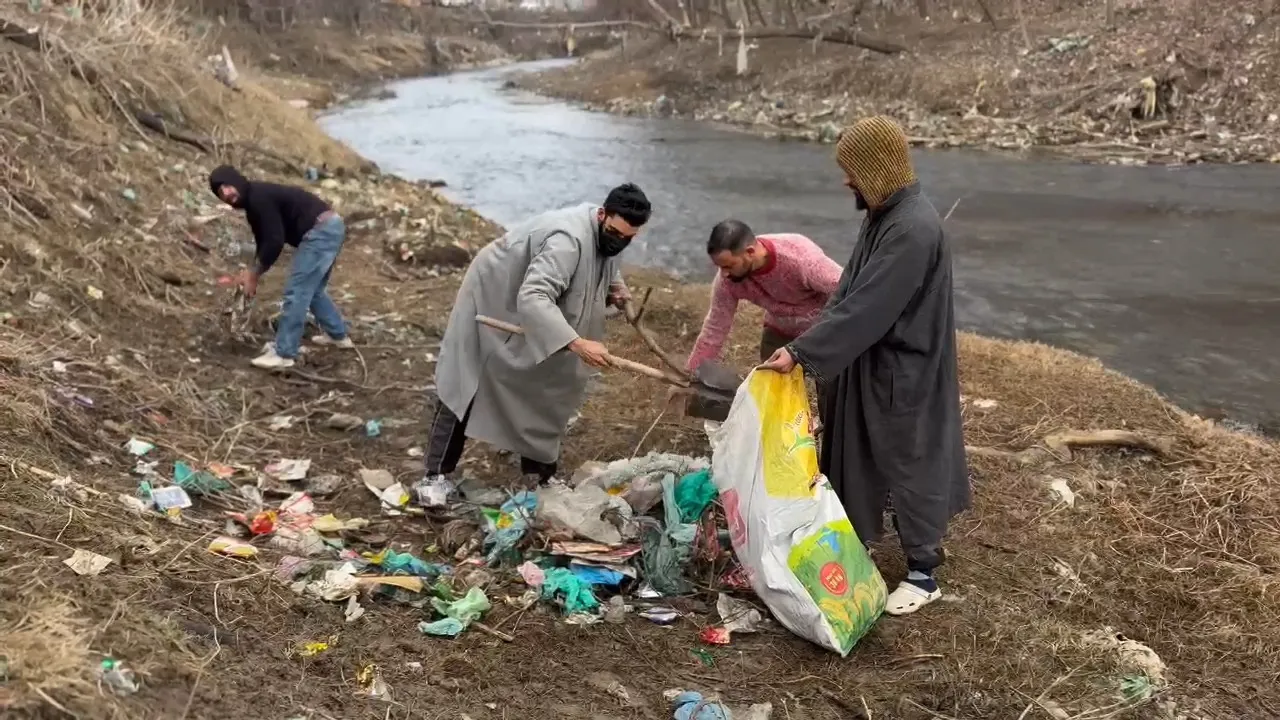
-Concerned about its deteriorating condition, a local volunteer group, Khidmat Khalaq Foundation Muniward, took the lead in mobilizing residents to restore the tributary to its past glory. The cleanup drive will be held every Sunday as part of a sustained effort. Local mosque preachers have also joined the cause, using their Friday sermons to urge villagers to keep the water body clean and avoid dumping waste into it. Resolute in safeguarding the environment, the youth vowed to continue their efforts. https://www.greaterkashmir.com/kashmir/youth-from-anantnag-village-lead-the-fight-to-save-water-bodies/ (03 Feb. 2025)
Snow deficit Heavy snow during winter helps in the glacier formation, which in turn charges up the Valley’s water bodies through summer. So increasing the frequency of dry winters signals trouble. Snowfall is more than just a picturesque backdrop in Kashmir; it is the valley’s water bank. When it melts in spring, it replenishes streams, irrigates orchards, and sustains crops. A weak winter means a dry summer, threatening apple growers and paddy farmers alike. Less snow today could mean parched fields and lower yields in the months to come. The shift in weather pattern is also impacting Kashmir’s horticulture, particularly the apple crop, a mainstay of the region’s economy. https://www.greaterkashmir.com/opinion/kashmirs-snow-deficit/ (02 Feb. 2025)
529 agrochemical samples collected In a major development in the ongoing investigation into the mysterious disease in Badhaal village, which has claimed 17 lives, dedicated teams under the direction of Deputy Commissioner Abhishek Sharma have collected 529 samples of insecticides, pesticides, herbicides, and fertilizers from across Rajouri district. https://www.greaterkashmir.com/latest-news/badhaal-mysterious-disease-529-agrochemical-samples-collected-in-ongoing-investigation/ (07 Feb. 2025)
SUTLEJ Himachal Pradesh Earthquake changes course of river Interesting to note the impact of 19 Jan 1975 earthquake of 7.5 magnitude in Kinnaur-Lahul-Spiti districts in Himachal Pradesh, here the report is about impact in Sutlej basin, including creation of landslide dam and changing course of river. https://www.thehindu.com/archives/from-the-hindu-february-5-1975-earthquake-changes-course-of-river-cracks-mountain/article69179925.ece (05 Feb. 2025)
Punjab Centre to have say in nominating PPCB chairman Nominating a Chairman of the Punjab Pollution Control Board (PPCB) will no longer be the sole discretion of the state government if a draft legislation in this regard is approved by the Cabinet and cleared by the state assembly. A Jt Secretary-rank officer of the Centre will be part of a four-member panel, headed by Punjab Chief Secretary, as per the provisions of the Water (Prevention and Control of Pollution) Amendment Act 2024. https://www.tribuneindia.com/news/punjab/centre-to-have-say-in-nominating-pollution-control-board-chairman/ (04 Feb. 2025)
YAMUNA ₹1,503 cr spent in past 6 yrs to clean Yamuna Centre has in past six years disbursed Rs 1503 Cr to UP, Haryana and Delhi for Yamuna cleaning, Delhi’s share being Rs 1091 Cr. CPCB is monitoring Water quality on monthly basis. https://www.tribuneindia.com/news/india/1503-cr-spent-in-past-6-yrs-to-clean-yamuna/ (05 Feb. 2025)
Delhi HC imposes cost on petitioners claiming floodplain land Recognising the sanctity of the Yamuna floodplain, Delhi High Court has begun imposing costs on petitioners staking claim to such land. In a series of orders passed on Monday (Feb. 03) and Tuesday (Feb. 04), the bench of Justice Dharmesh Sharma imposed a cost of Rs 5,000 on petitioners who claimed ownership of such land acquired by DDA for key projcts, including construction of the Delhi-Meerut RRTS Project and the eco-plantation drive to restore the riverbed.
The court cited land records to show that the area was described as sailaab, i.e., the rainwater that gets accumulated sideways around the banks of the Yamuna, where some or other cultivation is carried out by people, including the petitioner, to grow vegetables. The court also rejected the plea of the farmer to carry on cultivation, citing an NGT order banning any person from carrying out any edible crops/fodder cultivation on the floodplain. https://timesofindia.indiatimes.com/city/delhi/court-imposes-cost-on-petitioners-claiming-yamuna-floodplain-land/articleshow/117959924.cms (06 Feb. 2025) https://www.livelaw.in/high-court/delhi-high-court/dda-public-project-rail-transport-yamuna-river-banks-encroachment-282954 (04 Feb. 2025)
River Need Attention beyond Politics & Elections In Delhi, 900-1100 MLD sewage is being dumped in river and huge funds are being spent on pollution abatement infrastructure (STPs, CETPs) without ensuring that they operate to meet the desired objectives. In fact, sewage is a resource and can provide multiple benefits if treated properly. The STP treated water can be used for secondary purposes. The city also needs to seriously work on harvesting rainwater in a big way. At the same time, Delhi’s own water sources, the lakes, ponds, waterbodies and floodplain, green cover need protection and revival. For this, Delhi govt urgently requires a water policy which if enforced properly can hugely reduce pressure on river and groundwater resources and lead to considerable improvement in the river.
The key central government departments including Agricultural Ministry, MoEF, MoJS, MoUA, CWC, UYRB, CPCB, NMCG, DDA, along with the Agricultural, Irrigation, Water Supply, Mining departments and pollution control boards in basin states have huge role to play in keeping the river pollution free and flowing. One hopes that the central government will work sincerely with new Delhi government of whichever parties is elected in Delhi and also with other elected state governments in Yamuna basin to actually work for the revival of the river. https://sandrp.in/2025/02/05/yamuna-manthan-050225-river-need-attention-beyond-politics-elections/ (05 Feb. 2025)
How govt failed to deal with river pollution Himanshu Thakkar, coordinator of the SANDRP, told The Wire that “Much of the 2015 plan hasn’t been implemented.” “It’s true that untreated wastewater comes from Haryana and UP. This issue has even reached the courts. Industrial effluents from Haryana have also been found in Delhi’s waters,” he continued. “Still, until Wazirabad, the water remains relatively clean. If Delhi’s STPs (Sewage Treatment Plants) and CETPs (Common Effluent Treatment Plants) for industries functioned properly, Yamuna could improve. But most don’t work, and nobody knows about it. There is little transparency. Last week, the High Court reprimanded them for failing to install flow meters. Deadlines keep getting extended, and news of court orders keeps going viral.”
-No particular party can be held solely responsible, Thakkar said, and nor can the Delhi government alone fix the issue – the Union government too has a role to play. “The central government cannot simply wash its hands of the Yamuna. The CPCB (Central Pollution Control Board), Central Water Commission, Ministry of Environment, NMCG (National Mission for Clean Ganga), and DDA all fall under the central government,” he argued.
-“The Delhi government has failed to bring effective change. It has broken multiple promises – such as decentralising STPs, protecting lakes and ponds, and installing bulk water meters. Sewerage connectivity has improved to some extent, but it remains inadequate. The DJB (Delhi Jal Board) is no different from the government in its inefficiency. CETPs [controlled by Delhi government controlled DSIIDC] are in as poor a state as STPs.”
-The Yamuna is not alone in its polluted state, he added. “The BJP has also ruled Delhi, but its track record on the Yamuna – or any river in BJP-ruled states – is no better. The Ganga’s condition is equally poor. No river in this country can be considered clean. The problem is not a lack of funds; plenty is spent on infrastructure. The real issues are governance, transparency, and accountability. We need participatory management of STPs.” https://thewire.in/environment/aap-yamuna-clean-up-10-years/ (03 Feb. 2025)
Delhi’s lifeline isn’t what you think The hundreds of millions spent every year to clean up the Yamuna are a colossal waste of the taxpayer’s money. They will never clean up the Yamuna. The river does not produce any pollution, it is the tributaries that carry the filth into the river. If we are serious about cleaning the Yamuna, we need to clean up the tributaries and stop using the stormwater drains to flush the untreated sewage into the Yamuna. (Sohail Hashmi) https://indianexpress.com/article/opinion/columns/yamuna-pollution-myth-delhi-lifeline-9819108/ (05 Feb. 2025)
Politically driven as it may be, the attention being showered on the Yamuna is not undeserved, writes Vimlendu Jha. https://www.thequint.com/opinion/delhi-yamuna-river-a-neglected-polluted-lifeline (05 Feb. 2025)
PM promises to clean up Yamuna During his address, Modi promised to clean up the Yamuna and accused the AAP government of neglecting the river. “I had pledged during the election campaign that we will make Yamunaji the identity of Delhi. No matter how much time is spent or how much energy is used, we will make every effort to serve the Yamuna,” Modi said. https://www.newindianexpress.com/cities/delhi/2025/Feb/09/modi-promises-to-clean-up-yamuna (09 Feb. 2025)
Revamping riverfront top priority: Parvesh Verma BJP leader Parvesh Verma, who is one of the key contenders for the Delhi Chief Minister’s post, on Sunday (February 9, 2025) said that developing the Yamuna riverfront will be a key priority for his party. Talking to reporters after paying homage to his father and former chief minister Sahib Singh Verma in his native village in Mundka here, he said the previous Government had neglected rural areas of Delhi and the roads are in a bad condition. “Revamping the Yamuna riverfront will be one of our main priorities,” Mr. Verma said. https://www.thehindu.com/elections/delhi-assembly/revamping-yamuna-riverfront-top-priority-bjps-parvesh-verma/article69198795.ece (09 Feb. 2025)
How Yamuna controversy sank AAP After the Delhi victory, PM on Saturday (Feb. 08) addressed party workers with an invocation to Yamuna, noting how the revered river had been “insulted” by AAP. “Delhi has flourished in the lap of ‘Ma Yamuna’. The people of Delhi are pained by Yamuna ji’s plight but Delhi’s AAP-da hurt their faith… For their own failure, they levelled such a grave accusation against the people of Haryana. “I have pledged during the election campaign that we will make Yamuna ji the identity of Delhi. … No matter how much time it takes, no matter how much energy it requires, but if the resolve is strong, then blessings of Yamuna ji will remain with us. https://www.deccanherald.com/elections/delhi/delhi-assembly-polls-2025-how-yamuna-controversy-sank-aap-3397477 (09 Feb. 2025)
You lost due to the curse of Yamuna: LG to Atishi The warning about the “curse” has its roots in a standoff between Saxena and Kejriwal two years ago. Faced with high levels of pollution in Yamuna, in Jan 2023, the NGT had set up a high-level committee under LG to oversee rejuvenation of the river.As the panel went about its task, Kejriwal voiced his support and offered assistance. However, Delhi government subsequently challenged the NGT order in the SC, with senior advocate A M Singhvi arguing that a domain expert should lead the panel. The stay has remained in place for over two years now. “The beliefs of the people of Delhi were crushed under the feet of these people (AAP) and then they blatantly accused Haryana,” the PM said as he vowed to clean and beautify the river. He finished his speech by repeatedly chanting “Yamuna Maiya Ki Jai”. https://timesofindia.indiatimes.com/city/delhi/you-lost-due-to-curse-of-yamuna-lg-v-k-saxena-tells-atishi/articleshow/118100351.cms (10 Feb. 2025)
Many environmental concerns Though the Okhla landfill was decommissioned in 2018, a team from New Delhi-based Centre for Science and Environment observed fresh waste still being dumped at the site in 2023. Due to garbage continuing to be dumped in the Okhla landfill, water in the taps in the area contains sand and mud, Paswan alleged. With water from taps and borewells always polluted in the area, almost every household in VP Singh Camp relies on buying drinking water for their daily use, residents say.
-But it’s not just polluted air and land that Delhi’s residents have to contend with – there’s polluted water too. The frothing waters of the river Yamuna that flows by the city have consistently been grabbing headlines for years. A literature review of the state of the Yamuna published in 2024 found that 85% of the pollution in the Yamuna stems from “domestic sources”, or human activities, including industrial effluents, raw manure, waste and dead body disposal, idol worship, and contaminants from water used in streams. https://thewire.in/environment/delhi-assembly-polls-from-landfills-to-air-pollution-residents-have-many-environmental-concerns/ (04 Feb. 2025)
Uttar Pradesh CWC demarcates floodplain areas across 17 districts Central Water Commission (CWC) has officially demarcated floodplain areas of the Yamuna river across 17 districts in UP and Delhi. The move follows the NGT taking suo-motu cognizance of a TOI report and ordering the commission to submit a detailed report to the tribunal; an official notification has thus been issued in this regard.
In December, the commission finalised the flood zone report, detailing latitude and longitude coordinates for the designated areas in 17 districts, including Gautam Buddh Nagar, Mathura, Agra, Kanpur, and Prayagraj, along with Delhi. After completing physical verification, the report was submitted to NGT, and the commission formally issued the flood zone notification in January.
To determine the floodplain areas, the CWC engaged a Hyderabad-based remote sensing company. An 11-member committee, comprising officials from the commission and the irrigation department, participated in the process. The floodplain was mapped using Differential Global Positioning System (DGPS) technology. The final document consists of 456 pages, while the commission’s full report spans 521 pages. https://timesofindia.indiatimes.com/city/agra/after-ngt-order-cwc-demarcates-yamuna-floodplain-areas-across-17-up-dists-del/articleshow/117891607.cms (03 Feb. 2025)
Govt notifies Yamuna floodplain The government, on 22 January, issued a notification demarcating the Yamuna floodplain, following an order in this regard from the NGT, which had been hearing a petition from Agra environmentalist Dr Sharad Gupta. The contours of the Yamuna floodplain were determined scientifically, based on records of the past 100 years, according to the government. The government notification will affect areas in 17 districts of Uttar Pradesh, including Agra. It restricts any new constructions in the flood area, but the government is yet to clarify what will happen to the already-constructed buildings and those living in them.
-The notification declared a 5.09-kilometre stretch on the right bank of the Yamuna and a 2.55-km stretch on the left bank flood-prone. It banned new constructions in this zone with immediate effect and declared existing constructions illegal. The Yamuna flows for roughly 167 km within the border of Agra. In UP, its total length from Asgarpur to Naav is 1,056 km. Along the Yamuna, the government-demarcated flood area is 15,925 sqkm.
-Hearings over the demarcation of the flood area along the Yamuna have been ongoing in the NGT for the last three years. The NGT first sought information from the irrigation department on whether there was any demarcation of the flood area. On receiving a negative answer, the NGT constituted and directed a high-level committee to demarcate the flood area from Haryana to Prayagraj. The river coast in major cities, such as Delhi and Agra, was then divided into three categories for the study. https://theprint.in/india/over-5000-buildings-in-agra-face-risk-of-demolition-after-up-govt-demarcates-yamuna-floodplain/2478998/ (04 Feb. 2025)
NGT raps govt over Hindon pollution The NGT has again reprimanded the UP government for failing to control pollution in river Hindon and observed that no effective action was taken to control the discharge of industrial effluents, untreated sewage, and unprocessed solid waste into the Hindon and its tributaries, Kali West and Krishni. The case stems from a petition filed by Noida resident Abhisht Kusum Gupta in March 2022, drawing attention to the severe pollution in the river due to the continuous discharge of untreated waste and effluents. The plea highlighted that despite repeated directives, authorities had failed to take concrete pollution control measures, leading to significant environmental degradation.
The tribunal has now sought a fresh affidavit within six weeks, outlining a timebound action plan for implementing CPCB’s recommendations. The matter has now been listed for further hearing to May 6, 2025. https://www.hindustantimes.com/cities/noida-news/ngt-raps-uttar-pardesh-govt-over-hindon-pollution-seeks-fresh-affidavit-101738607881741-amp.html (04 Feb. 2025)
37 villages told to clear illegal constructions from floodplains The administration has made it clear that it will not be liable for any damages caused by flooding in these areas and will not provide compensation for losses incurred on account of illegal developments. Additionally, no flood protection measures will be undertaken in these areas. The administration also warned that any damages resulting from unauthorized structures will be recovered from those responsible for such constructions. Residents and encroachers have been urged to voluntarily remove illegal constructions. Officials informed that if the encroachments are not cleared voluntarily, strict legal action will be taken against violators.
The administration has also urged people not to buy or invest in land in the floodplain areas, as no construction will be permitted, and legal action will be taken against violators. The Gautam Budh Nagar administration had issued a similar directive in May 2024 as well, appealing to residents to raze or demolish their illegally build houses and establishments on the floodplains of the Yamuna and Hindon. The district administration has been issuing warnings against illegal establishments on the floodplains and issuing a fresh warning on Friday (Feb. 07), that if any illegal construction is being carried out in these areas, it must be removed immediately, citing government order dated 16.03.2010 and the NGT order dated 20.05.2013. The district administration has emphasized that no construction of any kind is permitted on these sites.https://www.hindustantimes.com/cities/noida-news/greater-noida-37-villages-told-to-clear-illegal-constructions-from-hindon-yamuna-floodplains-101738951883184.html (08 Feb. 2025)
Madhya Pradesh Project to rejuvenate Yamuna-Chambal In a mega initiative, WWF-India has launched a four-year multi-stakeholder initiative on the Chambal-Yamuna river system, along with Genpact, a global advanced technology services and solutions company. “Through this initiative, WWF-India will work with key stakeholders, including local communities, the Govts of UP, MP and Rajasthan and the NMCG, to enhance understanding of the river—its hydrology, morphology, ecology and governance to develop valuable insights and pave the way for long-term conservation of one of India’s important perennial rivers,” said Ravi Singh, Secretary General & CEO, WWF-India.
Over the next four years, the project will work towards enhancing the understanding of environmental flows (quantity, quality and timing of freshwater flows) in key rivers of the Chambal and Yamuna basin. The project, involving more than 50,000 farmers, will demonstrate models to enhance ows through improved agricultural water management in the Parbati-Sindh and Kali rivers, which are part of the Chambal-Yamuna-Ganga system in MP and UP. It will also empower Mitras (friends of rivers) for the conservation of habitats of Ganga river dolphins and gharials in an 80-km stretch of the Chambal-Yamuna rivers and work towards stabilising their populations. https://www.deccanherald.com/environment/wwf-launches-initiative-to-rejuvenate-chambal-yamuna-rivers-3381894 (31 Jan. 2025)
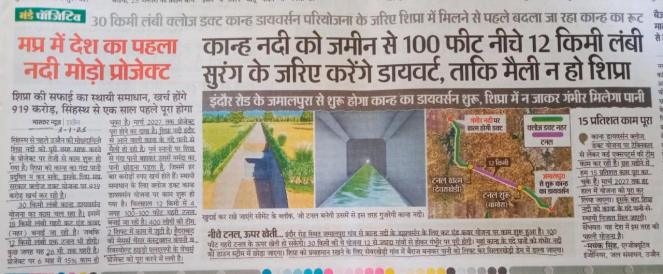
To avoid Kanh River (Bringing sewage from Indore) polluting Kshipra River in Ujjain on whose banks Kumbh is to happen next in 2028, a 30 km long aqua duct (including 18 km long covered diversion canal and 12 km long tunnel) is being constructed over Kanh River to take it directly downstream of Gambhir river, at a cost of Rs 919 Cr. This River Diversion projects seems to acknowledge complete failure of our pollution control mechanisms. https://www.etvbharat.com/hi/!state/mp-kanh-close-duct-project-will-clean-shipra-before-simhastha-2028-kanh-river-route-diverted-madhya-pradesh-news-mps25020303670 (03 Feb. 2025)
RIVERS BIODIVERSITY
Report A quarter of freshwater animals could soon become extinct! This first ever global assessment of freshwater animals has found that one quarter of the 23,496 freshwater species surveyed by the IUCN Red List of Threatened Species™ are under the threat of extinction. Western Ghats in India are one of the top hotspots showing the greatest threat.
– Thirty five percent of wetland area made up of peatlands, marshes, swamps, lakes, rivers and pools etc has been lost between 1970 and 2015, which is three times faster than that of forests, globally. Of the remaining wetland habitats, 65 percent are under moderate-to-high levels of threat and 37 percent of rivers over 1,000 km are no longer free-flowing over their full length. Freshwater supports over 1 percent of known species that include around one-third of vertebrates and one-half of fishes, while only covering less than 1 percent of the surface of the Earth. Freshwater diversity not only provides essential ecosystem services such as nutrient cycling, flood control and climate change mitigation, but also functions as an indicator of wetland quality, and supports the culture, economy and livelihoods of billions of people worldwide. https://www.indiawaterportal.org/rivers-and-lakes/a-quarter-of-freshwater-animals-could-soon-become-extinct (14 Jan. 2025)
Gujarat What happened to muggers relocated from SoU in 2019? On July 5, 2021, the range officer, Kevadia, Vadodara Wildlife Division, Gujarat Forest Dept, released a statement informing that 194 mugger crocodiles had been translocated from the SoU, Panchmuli Lake (Dyke 3), Sardar Sarovar Dam (Narmada) area. The translocation was done to make a seaplane lauchpad for ferrying tourists to the SoU. So, what became of those crocodiles? Where did they go?
-Last year, Vyas had published a paper titled Argument on translocation of marsh crocodiles (Crocodylus palustris) in Gujarat, India in the journal Species, where he discussed what happened to the translocated animals. Vyas, who is currently in the US, told DTE that the latest decision by the VMC has shades of déjà vu. “Where will these 150 animals be kept? Has nothing been learnt from the earlier instance? No details have been provided about where the animals will be housed, even if temporarily. The Kamatibaug Zoo in Vadodara is already full and has no further space,” he said. https://www.downtoearth.org.in/wildlife-biodiversity/as-vadodaras-local-body-seeks-to-temporarily-relocate-150-crocodiles-whatever-happened-to-those-relocated-from-the-statue-of-unity-in-2019 (28 Jan. 2025)
FISH, FISHERIES, FISHERFOLKS
Report NGT issues notice on use of invasive fish for mosquito control -The tribunal was hearing a plea about two fish species — Gambusia Affinis (Mosquitofish) and Poecilia Reticulata (Guppy) — being released in water bodies to control mosquitoes in various states. The states which stored and released Mosquitofish were Assam, Arunachal Pradesh, Gujarat, Karnataka, Maharashtra, Rajasthan, Tamil Nadu, Uttar Pradesh, Odisha, Punjab and Andhra Pradesh, while Guppy species had been released in Maharashtra, Karnataka, Punjab and Odisha, the plea said.
-It said the National Biodiversity Authority declared these two fish species as “invasive and alien” as they adversely impacted the local aquatic ecosystems by causing food scarcity for the indigenous fish species.
-“Issue notice to the respondents for filing their response/reply,” a bench comprising NGT chairperson Justice Prakash Shrivastava and expert member A Senthil Vel said in an order dated January 24. The respondents in the matter include the Union Ministry of Health and Family Welfare, the National Biodiversity Authority, and the National Centre for Vector Borne Diseases Control. The matter has been posted for further proceedings on May 6. https://www.business-standard.com/india-news/ngt-issues-notice-to-centre-on-use-of-invasive-fish-for-mosquito-control-125020200171_1.html (02 Feb. 2025)
IWP Fish deaths are sure indicators of deterioration in the water quality of the river indicating that the water is unsafe for use, consumption and even survival of aquatic animals living in it. https://www.indiawaterportal.org/water-quality-and-pollution/water-can-kill-2 (08 Jan. 2025)
SAND MINING
Andhra Pradesh SC hears illegal sand mining case Supreme Court heard the case related to illegal sand mining during the previous YSR Congress regime. A division bench comprising Justice Abhay S. Oka and Justice Ujjal Bhuyan heard the matter on Friday (Feb. 07) and posted the next hearing to April 7. During the course of the hearing, Jaya Prakash Ventures’ counsel submitted to the apex court that all illegal sand mining activities have now stopped. The court directed the AP government to submit an affidavit with details of steps initiated after stopping illegal sand mining and also the measures taken in the recent past. The Supreme Court further sought an affidavit with details of observations made by MoEF and the action taken report. https://www.deccanchronicle.com/southern-states/andhra-pradesh/sc-hears-aps-illegal-sand-mining-case-1859829 (08 Feb. 2025)
Telangana Govt. focuses attention on checking illegal sand mining The State government has focussed attention on checking the illegal sand mining in different parts of the State as it is resulting in huge losses to the exchequer. Though there has been steep rise in construction activity over the years, the revenue receipts for the government are not commensurate with the ever-growing demand for sand. This is in turn forcing the aspiring consumers to purchase sand at higher prices.
The CM, at a review meeting on Tuesday (Jan. 28), expressed his displeasure over the failure of the Mining department to recover dues pertaining to penalties imposed on major and minor minerals. He directed the officials concerned to conduct a detailed study on the major and minor mineral exploitation processes and submit a report within two weeks. He announced constitution of a high-power committee to study the modalities relating to supply of sand required for the construction of houses under Indiramma Indlu scheme. The committee was directed to submit its report along with comprehensive guidelines within a week. https://www.thehindu.com/news/national/telangana/govt-focuses-attention-on-checking-illegal-sand-mining/article69151728.ece (28 Jan 2025)
Jammu & Kashmir Springs drying up due to illegal riverbed mining The illegal Riverbed Mining has not only caused environmental disaster and huge loss to state exchequer across Jammu & Kashmir, it has also led to drying up of springs (naags). This is mainly due to deep mining which has receded water table around the streams and rivers. Even the bore wells and tube wells in many villages have dried up. The situation in coming months and years would be disastrous as we are already facing drought-like situations due to scarcity of snowfall and rainfall. The Government needs to consult experts to overcome this terrible situation and punish those Govt officers who played their role in destroying these water bodies. (Dr Raja Muzaffar Bhat) https://www.greaterkashmir.com/opinion/springs-in-kashmir-drying-up-due-to-illegal-riverbed-mining/ (04 Feb. 2025)
Punjab I-T dept raids premises of Rana Gurjeet Singh Rana Gurjeet Singh owns distilleries and sugar mills in Uttarakhand, Uttar Pradesh and Punjab. He is one of the richest MLAs of Punjab. His son, Rana Inder Partap Singh, is an Independent MLA from Sultanpur Lodhi. The family owns two ethanol plants in Punjab, including the one at Buttar village in Amritsar. Rana has been facing allegations of impropriety related to sand mining contracts in Punjab leading to his resignation from the cabinet in January 2018. https://www.newindianexpress.com/nation/2025/Feb/06/i-t-dept-raids-premises-of-punjab-congress-mla-rana-gurjeet-singh (06 Feb. 2025)
Mining minister Barinder Kumar Goyal said that the state govt has identified 104 more mining sites in the state and 27 desilting points in the rivers. https://timesofindia.indiatimes.com/city/chandigarh/significant-potash-reserves-discovered-in-punjab-exploration-and-auction-plans-underway/articleshowprint/117993448.cms (6 Feb 2025)
Haryana Yamunanagar divided into 5 zones to check illegal mining As per an order passed by Chandar Bhushan Tiwari, Assistant Mining Engineer, Yamunanagar district, there are 32 legal mining blocks (mining quarries) in the district. But at present, only five mining blocks are operational and the remaining are non-functional, as they are suspended or expired. Tiwari said they were facing a major problem in the Bailgarh area, therefore, they had decided to depute extra workforce to check illegal mining.
Sources said the Yamuna was a big source of illegal mining and most stone crushers and screening plants were situated in the area, including Devdhar, Ballewala, Doiwala, Bhud Majra and Belgarh villages. Besides, illegal mining was allegedly carried out in seasonal rivulets situated in other parts of the district, and in agricultural fields with the consent of landowners/farmers. https://www.tribuneindia.com/news/haryana/yamunanagar-dist-divided-into-5-zones-to-check-illegal-mining/ (06 Feb. 2025)
NGT serves notices to mining dept & SEIAA over Aravali land auction NGT has issued notices to State Environmental Impact Assessment Authority (SEIAA) and the mining department of Haryana in the wake of the auctioning of protected Aravali land for mining in Mahendergarh’s Rajawas. The SEIAA and the mining department of Haryana have been given a four-week deadline to submit their responses.
-The state govt on June 20, 2023, issued a notification designating 506 acres of Aravalis in Rajawas as ‘protected’ under the Forest (Conservation) Act. However, simultaneously, the mining department auctioned one-quarter of this protected land, prompting opposition from locals, who are now pursuing the area’s designation as a wildlife reserve. https://timesofindia.indiatimes.com/city/gurgaon/ngt-serves-notices-to-mining-dept-seiaa-over-aravali-land-auction/articleshowprint/117895372.cms (04 Feb. 2025)
WETLANDS, LAKES, WATER BODIES
SANDRP Overview WWD 2025: 10 Positive Stories from Urban India This compilation highlights ten positive efforts put in to protect the lakes, waterbodies and mangroves in urban India by individuals and environmental groups during 2024.
The top ten stories come from five metros: Delhi (3), Mumbai (2), Bengaluru (2), Chennai (2) and Kolkata (1). We are sure such positive actions also happened in other cities in 2024, but we could not find them. Let us know if you know any. https://sandrp.in/2025/02/04/world-wetlands-day-2025-ten-positive-stories-from-urban-india/ (4 Feb 2025)
Bihar HC seeks status report on conservation of 3 wetlands The Patna high court on Friday asked the member secretary of the State Wetlands Authority (SWA) to submit a report on the steps taken for the preservation and protection of three wetlands in Bihar that have been designated as Ramsar sites of international importance.
A division bench comprising acting chief justice Ashutosh Kumar and justice Partha Sarathi passed the order while hearing a suo motu public interest litigation (PIL) regarding the ecological protection of three lakes in Bihar — Kabar Taal (Begusarai), Nakti Dam and Nagi Bird Sanctuaries (both in Jamui) — which have been recognised as Ramsar sites. During the hearing, the court also directed the secretary of SWA to identify other wetlands in Bihar that provide habitats for migratory birds and various species of flora and fauna. The court ordered that ground-level reports on these wetlands be submitted within the next three weeks.
State counsel Amish informed the court that this PIL was instituted following a Supreme Court order issued on Dec 11 last year. The order had requested the chief justices of high courts across India to monitor the conditions of Ramsar sites within their respective jurisdictions to ensure their conservation. The matter is scheduled for its next hearing on March 7. https://timesofindia.indiatimes.com/city/patna/hc-seeks-status-report-on-conservation-of-3-wetlands/articleshow/118026795.cms (07 Feb. 2025)
Charting the decline of Kabartal wetland Among the threatened wetlands, Kabartal wetland in Bihar, holds special significance as Asia’s largest freshwater ox-bow lake and the first Ramsar-designated wetland of the state. Spanning an area of 2620 ha, it serves as a vital bird sanctuary supporting 166 bird species, including migratory species like the Siberian Crane and the Black-necked Stork. However, increasing encroachment, land-use changes, and declining water quality and quantity have raised concerns about its sustainability.
– This paper ‘Geospatial approach to identify the indicators of wetland change: A study for Kabartal (Ramsar Wetland), India’ (https://doi.org/10.1016/j.rineng.2024.102999) explores the findings of a comprehensive geospatial and physicochemical analysis of Kabartal wetland conducted over a timeline from 1989 to 2023 and highlights the key indicators of wetland change, driving forces of degradation, and necessary conservation measures. https://www.indiawaterportal.org/rivers-and-lakes/charting-the-decline-of-kabartal-wetland (26 Jan. 2025)
Uttar Pradesh Reviving an encroached bird haven According to the study, Saman Wetland Complex faces immense pressure from human activities. Agricultural encroachment during the dry seasons has led to substantial habitat loss, while the excessive use of chemical fertilisers and pesticides results in nutrient runoff. This has accelerated the spread of invasive species such as water hyacinth, which reduce open water surfaces and deplete dissolved oxygen levels, making the wetlands unsuitable for many waterbird species.
Eutrophication has particularly impacted wetlands such as Kurra jheel & Kuddaiyya marshland, where dense vegetation has replaced open water habitats. Other issues, including siltation, livestock grazing, lotus tuber collection & improper waste disposal, exacerbate habitat degradation. “Occasional poaching, disturbances from free-ranging dogs & community conflicts over land compensation create additional challenges,” says Joshi. “Moreover, infrastructure such as high-tension wires pose significant risks, especially for large birds like the sarus crane.” https://india.mongabay.com/2025/02/reviving-an-encroached-bird-haven/ (6 Feb 2025)
Madhya Pradesh Fascinating collective fishing by little cormorants in Bhopal lake.
Assam HC orders halt on Deepor Beel construction activities The Gauhati High Court has directed the state government to remove earth filling and stop construction activities in the Deepor Beel area. During a hearing on Thursday (Feb. 06), the counsel appearing for the Public Works Department submitted that earth filling or other construction activities are being carried out for the proposed elevated corridor project near Dharapur Tiniali. He submitted that since the project for which the earth filling and other construction activities are carried out is now cancelled, therefore, temporary earth filling and other activities will be stopped very soon. The counsel said that around 6-8 weeks will be required for removing the temporary earth filling and other construction activities. A division bench of Chief Justice Vijay Bishnoi and Justice Suman Shyam directed the PWD to file an affidavit to the effect that the earth filling and other construction activities will be removed by the next date of hearing of the case. The hearing was related to a PIL filed by Pramod Kalita in 2023. https://assamtribune.com/guwahati/gauhati-hc-orders-halt-on-deepor-beel-construction-activities-1567296 (07 Feb. 2025)
Encroachments block streams feeding Deepor Beel Expanding commercial and industrial spaces have blocked more than a dozen streams and rivulets originating from the Rani-Garbhanga hills, which feed Deepor Beel, seriously affecting the Ramsar Site wetland’s ecology. Ongoing large-scale encroachments have disrupted Deepor Beel’s link with these streams – something akin to cutting off the wetland’s oxygen supply. The situation has come to such a pass that a majority of the streams today stand completely blocked by indiscriminate earth-filling and construction of boundary walls right on the streams. The Kalmoni river, too, stands blocked in two places. Growing commercial spaces and changes in land use have been impacting Deepor Beel adversely, with the trend showing no sign of abatement.
“Agricultural land in Deepor Beel’s periphery, which has been sold by locals, is being used for commercial and industrial purposes. Land has been developed and filled up, resulting in growing siltation on the wetland. Mushrooming apartments close to the wetland in areas like Dharapur and Azara are also having disturbing impacts on the wetland. Huge quantities of garbage generated by these apartments are finding their way into the waterbody. Similarly, the waste including plastics generated by the eateries that have mushroomed right on the bank of the bird sanctuary in Chakardo and Pamohi has defiled the area,” Medhi said.
According to Koliya Ingti, a village elder of Chakardo, pollution in the Deepor Beel waters triggered by various factors including dumping of municipal solid waste and discharge of sewage has affected crops as well. “Earlier, we used to cultivate Sali, Boro and Ahu paddy, but cropping has come down drastically in recent years. The number of birds visiting the wetland, too, has dwindled because of pollution and disturbance,” he said. Ingti added that water hyacinth, too, was spreading to more and more areas of the wetland, with its adverse effects. “All these point to disturbing changes in the ecology of the wetland,” he said. https://assamtribune.com/guwahati/encroachments-block-streams-feeding-deepor-beel-threatening-ramsar-wetland-1567430 (08 Feb. 2025)
Manipur Farce behind govt’s smokescreen events on WWD –Is the state really making any effort to save Loktak and other wetlands from further destruction? Going beyond the once-a-year events to find the truth is important. Is the state actually making effort to restore and manage the wetlands it cannot be done individually or by small collectives such as an NGO who are being threatened regularly for not taking permission from LDA. Without the state’s efforts the wetlands cannot be restored and managed. But here we find the burden left to small collectives and NGOs, who too at times get threatened by the LDA for doing so ‘without permissions’.
-According to SWA, till date Brief Documents have been prepared for a total of 23 wetlands. And, yet none of these have been notified. What does it mean that no Wetlands have been notified? This means that as of today the state has no legally protected wetlands. As far as government records go, it implies there are no wetlands in Manipur! From 2017 the state has been delaying notification of our wetlands. If these wetlands were to be officially notified the government wouldn’t be able to destroy them with harmful projects, such as the large-scale tourism project they tried at Loktak under the funding of ADB.
-To imagine, even Loktak has not been notified as yet. Loktak has been under the watchful eye of the LDA since 1986. Since 2006 it has, at least on paper, got more teeth with the Loktak Protection Act. Yet till date it has neither finalised the ‘brief documents’, nor demarcated the boundary of the water body. It has not been able to identify the encroachers either. The LDA’s failure is shameful. Under the Wetland Guidelines of the Union government, the LDA should have been dissolved once the SWA was set up. But, in Manipur the latter authority seems to be suffering from lack of political support. In an RTI reply (dated 24th July 2024) to this author, the SWA said it did not even maintain the Brief Document of Loktak and I was asked to approach LDA to obtain it. (Ram Wangheirakpam ) https://imphalreviews.in/farce-behind-the-states-smokescreen-events-on-world-wetlands-day/ (08 Feb. 2025)
Haryana Unchecked cow dung dumping threatens ‘Amrit Sarovar’ project Despite crores of rupees being spent on these Sarovars, poor maintenance and villagers’ lack of cooperation are threatening their effectiveness. The wastewater treatment systems, designed to filter water for irrigation and other uses, are frequently choked by cow dung and other waste. According to sources, at least 20 villages in Karnal district —including Ramba, Chochra and Ballah — are facing severe issues due to cow dung disposal into drains.
In Karnal district, the government initially sanctioned 75 Sarovars, later expanding the plan to cover all water bodies under the Amrit Sarovar scheme. The cost of developing an Amrit Sarovar is approximately Rs 18 lakh per acre, while upgrading it to Amrit Plus costs around Rs 29-30 lakh per acre. However, village panchayats, responsible for maintenance, often lack funds and resources, leading to neglect.
The Panchayati Raj Department, along with the Irrigation Department and Micro Irrigation Command Area Development Authority (MICADA), oversees the project. The government has increased the number of sanctioned Sarovars to 205, with 20 Amrit Plus Sarovars completed and inaugurated, 15 awaiting inauguration and 35 more under development. The government has allocated Rs 170 crore for the project, of which Rs 35.86 crore has already been spent. However, despite regular cleaning efforts, ground reports highlight severe neglect and ongoing contamination. https://www.tribuneindia.com/news/haryana/unchecked-cow-dung-dumping-threatens-amrit-sarovar-water-rejuvenation-project-2/ (05 Feb. 2025)
Report Wetland restoration through rewilding A report by the Global Rewilding Alliance and partners reveals that the decline of key animal species disrupts wetlands’ ecological balance and ecosystem services they provide, including carbon sequestration, water purification, and flood regulation. The report highlights the need to “place wild animal species at the core of the ecological functional agenda of the Ramsar Convention.”
The report is titled, ‘Taking Animals into Account: The Critical Role of Wild Animals in Shaping Wetland Ecosystems and the Services they Provide.’ The report draws on an extensive literature review as well as eleven case studies form Asia, Europe, and Latin America that demonstrate real-world successes in rewilding wetlands. These case studies illustrate how reintroducing and protecting animal species can enhance wetland ecosystems and restore the ecosystem services they provide. https://sdg.iisd.org/news/global-report-calls-for-wetland-restoration-through-rewilding/ (05 Feb. 2025)
Unveiling microplastic menace in wetlands A recent paper ‘Source, fate, toxicity, and remediation of micro-plastic in wetlands: A critical review’ delves into the sources, ecological impacts, and potential remediation strategies for microplastics in wetland ecosystems, emphasising the urgent need for targeted research and mitigation efforts. The presence of microplastics in wetlands poses significant threats to aquatic organisms and plants. These impacts occur at various levels of the ecosystem and include physiological, behavioural, and ecological disruptions. https://www.indiawaterportal.org/rivers-and-lakes/unveiling-the-microplastic-menace-in-wetlands (25 Jan. 2025)
WATER OPTIONS
Centre “Watershed Yatra” launched Union Minister of Rural Development Shri Shivraj Singh Chouhan has on Feb 5 launched a national level mass outreach campaign “Watershed Yatra”, in Hybrid mode to generate people’s participation and create awareness about the Watershed Development activities carried out under Watershed Development Component of Pradhan Mantri Krishi Sinchayee Yojana (WDC-PMKSY 2.0) in project areas. Union Minister Shri Shivraj Singh Chouhan emphasized the importance of soil and water conservation for the present & future needs of the people and community participation in the effective & successful implementation of WDC PMKSY Projects across the country.
-On this occasion of launch of the Yatra, Shri Chouhan also announced ‘Watershed – Janbhagidari Pratiyogita’ under WDC-PMKSY 2.0 for the years 2025 & 2026. He also stated that it is a unique model based on the principles of community-led watershed management, incorporating ‘Public-Private-People Partnership (4Ps)’. Under this, the works done in the project areas through government funding and public participation will be evaluated at the state level and the projects doing excellent and remarkable work will be given an additional reward of Rs. 20 lakh per project. A total provision of Rs 70.80 crore has been made for this, which will benefit 177 projects every year. The evaluation of projects for this year’s competition will be done in the month of April.
-The Watershed Yatra will consist of Van movement for around 60-90 days across 805 projects, which cover 6673 GPs (13587 villages) in 26 States and 2 UTs. Under the activity of Watershed ki Panchayat, talk by experts about sustainable soil and water management practices will be organized and around 8,000 individuals having contributed in implementation of WDC-PMKSY works in different Project Areas will be honoured, which will further motivate watershed communities. https://www.pib.gov.in/PressReleasePage.aspx (05 Feb. 2025)
Bengaluru BBMP to dig 1,500 RWH wells in 306 parks Bengaluru’s annual rainwater harvesting capacity through recharge wells will reach 543 million litre per year by the end of October 2025. Between January and October, Bruhat Bengaluru Mahanagara Palike (BBMP) in association with non-profit organisation United Way Bengaluru plans to dig nearly 1,500 wells across 306 parks in the city. This will take the tally of total recharge wells dug by BBMP in its 510 parks in the city to 4,239.
According to United Way, every well being dug under this initiative since 2021 has a water conservation capacity of 1,28,100 litre per annum. “We have renewed our MoU with BBMP and as per the agreement, we are supposed to dig 1,632 percolation pits between January and October. We have dug 162 wells in 26 parks and the remaining will be completed by October,” said Radhakrishna Pradeep, lead, environment projects at United Way Bengaluru
While the initiative is a step in the right direction, Bengaluru still needs to ensure sufficient groundwater recharge through recharge wells. According to a rough estimate, the total demand for freshwater in Bengaluru is 2,632 million litre a day (MLD). Even if nearly 40% of this demand is met through groundwater, Bengaluru is extracting a little over 1,000 MLD. It shows that 4,239 recharge wells are a drop in the bucket. According to Shubha Ramachandran, water team lead at Biome Environmental Trust, Bengaluru requires at least 10 lakh recharge wells to meet its current demand for fresh groundwater. Biome has so far dug nearly 2.5 lakh recharge wells in the city. https://bangaloremirror.indiatimes.com/bangalore/civic/recharge-plan-bbmp-gears-to-catch-more-rain-in-pits/articleshow/117926926.cms (05 Feb. 2025)
Andhra Pradesh Mission to save indigenous seeds Pachari Devullu, an expert in tribal agriculture and founder of the Sanjeevani Rural Development Society, has committed his life to preserving indigenous seed varieties that are at risk of disappearing. Operating from Killoguda village in Dumbriguda, Alluri Seetharama Raju district, Devullu’s mission extends across areas like Visakhapatnam, Vizianagaram, Srikakulam, and parts of East and West Godavari. These regions are home to tribal communities that have cultivated a rich diversity of crops for generations.
Devullu’s seed bank is a testament to this agricultural heritage, housing over 300 varieties of desi seeds. His collection includes an impressive array of millets such as ragi, guli ragi, foxtail, jowar, and pearl millets. Devullu actively engages with tribal farmers throughout Andhra. He organizes seed festivals and workshops to raise awareness about the importance of traditional seed varieties. His extensive travels through remote villages allow him to share his expertise and absorb invaluable local knowledge. Devullu views his efforts as an act of cultural conservation.
In 2011, the state government honored him with a Biodiversity Award. The following year, the Union Government’s Department of Agriculture recognized his outstanding contributions with the Plant Genome Saviour Community Award and a cash prize. As we reflect on the importance of resilience and tradition in agriculture, Devullu’s work serves as a rallying cry for sustainable practices. His dedication reminds us that preserving native seed varieties is not only about protecting crops—it’s about nurturing a legacy that bridges the wisdom of our past with the promise of a sustainable future. https://www.thehansindia.com/andhra-pradesh/mission-to-save-indigenous-seeds-in-andhra-pradesh-942382 (05 Feb. 2025)
Haryana Water management at BSF campus The Border Security Force (BSF) campus in Bhondsi has emerged as a model for sustainable water management, with significant improvements in groundwater recharge and rainwater conservation through the Gurujal initiative, officials said. Spanning 216 acres, the campus has seen a four-foot rise in groundwater levels over the past two years, aided by rainwater harvesting, aquifer recharge, and wastewater treatment, officials claimed. The initiative, supported by corporate social responsibility (CSR), district and state funding, has also promoted afforestation and ecological restoration, they claimed.
Manisha Malik, program manager at Gurujal, highlighted the initiative’s achievements, stating that two large ponds have been revived—one for rainwater collection and another for wastewater treatment. Additionally, a 50 KLD (kilolitres per day) wastewater treatment plant has been installed, and a rainwater harvesting system under PepsiCo’s CSR initiative has added 18 kilolitres of daily recharge capacity, she said. https://www.hindustantimes.com/cities/gurugram-news/aravalli-revival-gains-pace-haryana-pushes-for-water-conservation-101738951463300.html (08 Feb. 2025)
Report ‘Aquapreneurs’ are turning the tide on water pollution Through a five-year collaboration, UpLink and HCL Group’s Aquapreneur Innovation Initiative, with support from the World Economic Forum’s Centre for Nature and Climate’s water initiatives, is unlocking the potential of early-stage innovation by creating an ecosystem to empower ‘Aquapreneurs’ to scale breakthrough technologies that can transform water management. By enabling partnerships, driving investment, enabling regulations and supporting these solutions, stakeholders can not only mitigate risks but also capitalize on water’s value as a motor of climate resilience, sustainable development, and economic progress.
As part of this initiative, UpLink ran the Tackling Water Pollution Challenge to raise awareness of the early-stage water innovation ecosystem and elevate the most scalable solutions across the sector. The challenge received 273 submissions globally and identified 10 high-potential start-ups, termed Top Innovators, or Aquapreneurs, selected to join the UpLink Innovation Ecosystem. The winners of the challenge have developed various solutions to tackle water pollution. To learn more about all 10 challenge winners, visit The UpLink challenge page. https://theprint.in/environment/aquapreneurs-are-turning-the-tide-on-water-pollution/2485392/ (8 Feb. 2025)
GROUNDWATER
Tamil Nadu CGWB readies Rs 3.5K-crore plan to recharge groundwater The plan will be implemented in a phased manner so that the blocks which are now categorised as semi-critical, critical and overexploited could be turned for inclusion in the safe category for groundwater extraction, said M Sivakumar, regional director (South Eastern Coastal Region)of the central board.
Addressing media on the sidelines of an interaction programme on ‘Sustainability of Groundwater Resources’ held at Tamil University, Thanjavur, on Friday (Feb. 07), Sivakumar said only 30% of the area in the state is categorised as safe for groundwater extraction while the remaining 70% falls under the semi-critical, critical and overexploited categories. Responding to a question, Sivakumar said Automated Digital Water Level Recorders with Telemetry has been installed at 1,000 vulnerable points across Tamil Nadu to transmit alerts in the event of the water turning saline. The same will be conveyed to the state government for remedial action, he added. https://www.newindianexpress.com/states/tamil-nadu/2025/Feb/08/central-authority-readies-rs-35k-crore-plan-to-recharge-groundwater-in-tamil-nadu (08 Feb. 2025)
Ladakh No groundwater to be used for construction work Adviser to the Ladakh L-G, Pawan Kotwal, chaired a comprehensive review meeting to assess the progress of key projects under the Public Health Engineering (PHE) and Irrigation & Flood Control (I&FC) Department. The meeting primarily focused on implementing 24×7 water supply schemes for Leh and Kargil towns, along with other initiatives related to water management in Ladakh.
During the meeting, a detailed discussion was held on groundwater management in Ladakh, covering aspects such as groundwater extraction levels, categorisation of both Leh and Kargil districts, and assessments conducted by the CGWB. Reports from the CGWA regarding groundwater availability and sustainability in the region were also analysed. Kotwal issued strict directives that no groundwater shall be used for construction purposes, emphasising the importance of conserving groundwater resources for drinking and essential needs. https://www.tribuneindia.com/news/j-k/no-groundwater-to-be-used-for-construction-work-in-ladakh-adviser/ (08 Feb. 2025)
Study Hydroclimatic extremes threaten groundwater quality & stability Abstract: -Heavy precipitation, drought, and other hydroclimatic extremes occur more frequently than in the past climate reference period (1961–1990). Given their strong effect on groundwater recharge dynamics, these phenomena increase the vulnerability of groundwater quantity and quality. Over the course of the past decade, we have documented changes in the composition of dissolved organic matter in groundwater. We show that fractions of ingressing surface-derived organic molecules increased significantly as groundwater levels declined, whereas concentrations of dissolved organic carbon remained constant. Molecular composition changeover was accelerated following 2018’s extreme summer drought.
These findings demonstrate that hydroclimatic extremes promote rapid transport between surface ecosystems and groundwaters, thereby enabling xenobiotic substances to evade microbial processing, accrue in greater abundance in groundwater, and potentially compromise the safe nature of these potable water sources. Groundwater quality is far more vulnerable to the impact of recent climate anomalies than is currently recognized, and the molecular composition of dissolved organic matter can be used as a comprehensive indicator for groundwater quality deterioration. https://www.nature.com/articles/s41467-025-55890-2 (16 Jan. 2025)
URBAN LAKES, WETLANDS
Bengaluru Where have all the birds gone? Birdwatchers and naturalists have observed a significant decline in the number of migratory birds visiting the city. While some have been observing the decline over the years some have noticed a significant drop in the past few months. The most probable reasons given are rapid urbanisation and climate change that could have contributed to the decline. Experts also blame increasing sewage pollution in lakes, decreasing greenry in lakes’ buffer zone, soup bowl design of lakes for decline in water bird population.
-“Due to reasonably good rains, sufficient water is seen in lakes and waterbodies. Despite that, why birds have not landed here is something that needs to be studied”, says an avid birder. “There has been a huge decline in water bird population, mainly due to high water level as most lakes are now interconnected (even some lakes away from Bengaluru like those in Chikkaballapur are connected to Bengaluru lakes, so the water level is always high). Water birds like ducks prefer shallow waters and others like waders prefer water edges which don’t exist now due to soup bowl-like design of lakes,” Munish Gowda H, another avid bird watcher said. https://bangaloremirror.indiatimes.com/bangalore/cover-story/where-have-all-the-birds-gone/articleshow/117958113.cms (06 Feb. 2025)
Hyderabad Hyderabad lakes cry for attention Several city lakes, which once thrived with life, have become a dire reection of ocial apathy, poor maintenance and pollution, and are now crying for attention. Some such lakes – Rangadhamuni near IDPL, Malkam Cheruvu and Film Nagar lake in the city – are infested with heavy growth of hyacinth and algae,
reecting the terrible condition of the water bodies. Such growth decreases the dissolved oxygen in the water bodies thereby aecting aquatic life.
-Making things worse, a large amount of plastic waste – bags and bottles – littered around the banks further polluting the lakes. The residents living around these lakes have called for urgent interventions from the civic authorities to restore the vital water bodies to their natural state before they go for the worst. https://telanganatoday.com/hyderabad-lakes-cry-for-attention (6 Feb 2025)
HYDRAA saves 15 acres of Tukkuguda lake from encroachment The sleuths of Hyderabad Disaster Response Assets Monitoring and Protection Agency (HYDRAA) demolished boundary walls constructed by encroachers at Suram Cheruvu (Suroni Cheruvu) in Tukkuguda municipality of Rangareddy district on Saturday, Feb. 8. Encroachers moved into the lake spread across 60 acres, and occupied 15 acres of land. They built boundary walls in the encroached land, out of which layouts were made to be sold. Drainage pipelines were also laid by the encroachers. On complaints from locals on the lake encroachment, HYDRAA commissioner AV Ranganath inspected the lake and spoke with the residents, after which demolition was ordered by him. https://www.siasat.com/hyderabad-hydraa-saves-15-acres-of-tukkuguda-lake-from-encroachment-3177492/ (08 Feb. 2025)
URBAN WATER
Bengaluru 30 fall sick after drinking filthy water, BWSSB unresponsive About half a dozen residents from Promenade Road in Pulikeshi Nagar ward, Bengaluru East, approached Bruhat Bengaluru Mahanagara Palike (BBMP) Chief Commissioner Tushar Girinath to seek help as residents have been ill for the past two weeks after consuming contaminated drinking water. The residents say that despite complaining to Bangalore Water Supply and Sewerage Board (BWSSB), there was no action, hence they approached the BBMP chief.
Upon suspicion that it could be due to water contamination, they collected water samples and handed them over to Dr BR Ambedkar Medical College Hospital at Kadugondanahalli in Bengaluru East. “Lab tests found dangerous bacteria like E. Coli and Klebsiella Pneumoniae,” said a doctor from the hospital. The residents approached the BWSSB AEE of the locality but the official allegedly failed to act. “The official should have first stopped water supply and checked for leakage and mixing of sewage. The delay by BWSSB in taking action could have led to serious health issues and outbreak of cholera, gastroenteritis and other diseases,” said a resident. https://www.newindianexpress.com/cities/bengaluru/2025/Feb/05/30-fall-sick-after-drinking-filthy-water-bwssb-unresponsive (05 Feb. 2025)
Summer water plan BWSSB Chairman Ram Prasat Manohar directed officials to keep plastic water tanks ready in parched areas and reserve 200 tankers to supply water. BWSSB also stated that it will regulate water rates for private tankers — Rs 600 to supply 6,000 litres in a radius of 5km, Rs 700 for 8,000 litres, and Rs 1,200 for 12,000 litres if supply is between 5km and 10km radius. For every kilolitre after the prescribed radius, the Board has fixed Rs 50 extra to be paid by the consumer. https://www.newindianexpress.com/cities/bengaluru/2025/Feb/08/bwssb-prepares-for-harsh-summer-fixes-water-rates (08 Feb. 2025)
Govt mandates Cauvery water connection for all apartments In order to curb commercial exploitation of the city’s groundwater table by the tanker mafia, the govt has made it mandatory for all apartments to obtain Cauvery water connection.
Reviewing the project status of Bengaluru’s civic bodies, deputy chief minister & Bengaluru development minister DK Shivakumar said directions have been issued to BWSSB for mandatory Cauvery water supply to all apartments within BBMP limits, they will be conveyed water rates. https://timesofindia.indiatimes.com/city/bengaluru/government-mandates-cauvery-water-connection-for-all-bengaluru-apartments/articleshowprint/117651927.cms (30 Jan 2025)
Demand for Cauvery water connections go up With good monsoons in 2024, Cauvery water supply to be unaffected, but those dependent on groundwater to feel the pinch. https://www.thehindu.com/news/cities/bangalore/as-summer-approaches-demand-for-cauvery-water-connections-go-up/article69187902.ece (07 Feb. 2025)
Mangaluru Jakribettu barrage begins water storage The Jakribettu barrage, constructed across the Netravati River near Bantwal, has started storing water for the first time since its completion. Built by the Minor Irrigation Department at a cost of approximately Rs 135 crore, the barrage, which includes a bridge, saw its gates closed recently, leading to water accumulation of up to 2.50 meters by February 8 evening. The Jakribettu bridge-cum-barrage, standing at 5.50 meters in height and spanning 351.25 meters in length, is equipped with 21 vents and vertical lift gates. Once fully operational, it is expected to store 166 million cubic feet (MCFT) of water, creating a backwater stretch of up to 5 kms. The structure also features two scouring sluice gates at a lower level to manage silt and emergency floodwater release.
This is the third such barrage on the Netravati River, following similar projects in Harekal and Biliyur, which began water storage in previous years. The Jakribettu project, initiated in November 2022 with a foundation stone laid by then minor irrigation minister J C Madhuswamy and local MLA Rajesh Naik, was completed last year and has now entered its operational phase. As of now, all gates of the Jakribettu barrage have been closed, and water has been stored up to 2.50 meters. However, due to low inflow, it may take a few more days for the barrage to reach its full capacity, according to an official from Minor Irrigation Department, Dakshina Kannada. https://www.daijiworld.com/news/newsDisplay?newsID=1270220 (09 Feb. 2025)
Mysuru Legacy waste catches fire at sewage farm The legacy waste or solid waste at Mysuru City Corporation’s (MCC) 22.4 acre dump site at Sewage Farm in Vidyaranyapuram of Mysuru has caught fire. Efforts to douse the re off are on. MCC Superintendenting Engineer K J Sindhu, who supervised the operation to extinguish the fire, told DH that the fire has spread upto 15 acres of the site. Around 40 to 50 staff members of the contractor company and more than 50 MCC staff are trying to extinguish the fire. They are pumping water from the nearby Sewage Treatment Plant, with jetting machines and other equipment and the operation to douse the fire is expected to continue overnight. According to sources, there was a minor fire three days ago as well but it was, reportedly, not scientifically managed. Later, the fire surfaced again on Saturday (Feb. 8) night. Slowly, by Sunday (Feb. 9) evening, it had spread to the entire site. https://www.deccanherald.com/india/karnataka/legacy-waste-catches-fire-spreads-over-15-acres-at-dump-site-at-mysurus-sewage-farm-3397641 (10 Feb. 2025)
Vadodara Experts stress integrating water efficiency in urban planning Talking about water-secure cities, D Thara, additional secretary and mission director of the Atal Mission for Rejuvenation and Urban Transformation (AMRUT), commonly known as Water Amrut under the Union urban affairs ministry, advocated for an integrated approach here. Thara was addressing a seminar organized by city-based SOCLEEN. “Education about water is needed,” she said, adding that better urban planning is necessary, incorporating deep gardens to hold water in case of excess rain and making efficient use of treated water in industry or gardening. “Water is a resource, and new methods of its management are to be discovered and utilized,” she said.
During the seminar, Professor Meera Mehta, emeritus professor from CEPT University, said it is time to have a water audit and plug leakages. Raising concerns about the declining green cover in Vadodara, she said lakes like the one in Bhayli have vanished. While Chirayu Pandit from MSU’s Polytechnic College talked about the floods in Vadodara, Biren Dalal, an expert in designing large structures, stressed that the capacity of ponds should be increased through recharging. https://timesofindia.indiatimes.com/city/vadodara/experts-stress-integrating-water-efficiency-in-urban-planning/articleshow/118073634.cms (08 Feb. 2025)
Pune GBS outbreaks may have been caused by large-scale water contamination Jessy Skaria, a doctor and independent researcher pointed out that even the reported burden of GBS cases and deaths from different states — West Bengal, Rajasthan, Assam, Telangana, Tamil Nadu, Jharkhand, Haryana and Delhi — in this same time span as the reported outbreak in Maharashtra, are enough to alert public health departments to look for a common source of contamination where Indians from all over the country have congregated — as at the Maha Kumbh.
-Skaria stressed that not all patients need to have travelled to the Kumbh Mela to have been exposed to the triggering infection. Any connection such as consuming ganga jal or prasad brought from the pilgrimage site or contact with anyone who caught the primary infection at the Mela, could be the cause of the triggering infection in these GBS patients.
-Skaria said that an initial outbreak in Pune also makes sense as a lot of residents from there have travelled to the Kumbh and may have returned with the primary infection — C. jejuni or norovirus or others like Escherichia coli — eventually spreading it to numerous contacts quickly, directly and indirectly.
-Studies show that organisms like C. jejuni are found in abundance even in relatively unpolluted rivers owing to contamination with faeces of wild birds and animals. With the addition of constant human contamination during the Mela and limited information on how the enormous waste and sewage generated at the festival are being handled, the presence of pathogenic organisms in the rivers at Prayagraj could be exceptionally high. https://www.downtoearth.org.in/health/gbs-outbreaks-across-india-may-have-been-caused-by-large-scale-water-contamination-as-seen-at-kumbh-mela (07 Feb. 2025)
After spurt in GBS cases, alarm over water supply in villages The water supply to Pune city is tested every day,” said Rohit Mate, who works at the office of his uncle, the former Khadakwasala sarpanch. He was referring to the water sent from the Khadakwasala dam on the Mutha river to Pune after purification. “But nothing is done for the drinking water supply to our villages,” he said.
-The Pune Municipal Corporation is allowed around 11.5 TMC, or thousand million cubic feet, of water from Khadakwasala dam annually. But it needs more than this and has been demanding a greater water allocation from the irrigation department.
-Residents from villages such as Kirkatwadi, Nanded gaon, Khadakwasala, which reported a high number of GBS cases, also complained that they had been receiving water without adequate chlorination and filtration.
-The source of water for the DSK Vishwa township and the three nearby villages that reported several GBS cases is a large well at Nanded Phata, along the Mutha river. State health minister Prakash Abitkar told the Hindustan Times that 80% of the reported cases of Guillain-Barré Syndrome are from areas around the well.
-Water from the well is not treated or purified before it is supplied to the nearby villages and residential areas. It is only chlorinated, civic water supply department head Nandkumar Jagtap told The Indian Express on January 27.
-DSK Vishwa, established around 22 years ago, has always received water from this Nanded well. The well was first managed by the gram panchayat and later transferred to the Pune Municipal Corporation. https://scroll.in/article/1078862/after-spurt-in-gbs-cases-alarm-over-water-supply-in-villages-around-pune (07 Feb. 2025)
Unregulated urban expansion has compounded the problem’ The primary concern here is the alarming state of water sanitation in newly incorporated municipal areas. Several villages near Khadakwasla Dam, now part of Pune Municipal Corporation, still lack access to properly treated drinking water. They depend on borewells and untreated wells, where the water is merely bleached rather than filtered, creating a high risk of bacterial and viral contamination. Recent water quality tests revealed that multiple sources were contaminated with Campylobacter jejuni and norovirus, both known to cause severe gastrointestinal infections. These infections can, in some cases, trigger an autoimmune response, leading to GBS.
-Beyond water contamination, unregulated urban expansion in Pimpri-Chinchwad and surrounding areas has further compounded the problem. As rapid development outpaces infrastructure improvements, basic amenities like water supply and sewage disposal are compromised. Many residential zones rely on borewells located dangerously close to septic tanks, increasing the likelihood of cross-contamination. Improper drainage and lack of regular water quality monitoring have made these areas hotspots for waterborne diseases. The combination of these factors has created an environment where dangerous pathogens thrive, potentially escalating the outbreak if left unchecked.
The situation needs rigorous surveillance, stricter hygiene regulations, and systematic water purification to prevent further escalation of the crisis.
-Pune is not an isolated case. Across India, many rapidly urbanising areas face similar challenges. Unchecked urban growth often leads to improper water management and sanitation infrastructure. Just recently, I documented instances in Pune where water supply pipelines were laid through sewage drains, leading to cross-contamination. Such instances are found in cities like Mumbai, Nagpur and Nashik as well. If these infrastructural gaps are not addressed, we might see similar outbreaks in multiple districts. (Dr Avinash Bhondwe, former IMA president and practicing doctor in Pune) https://indianexpress.com/article/cities/mumbai/gbs-outbreak-pune-water-contamination-unregulated-urban-expansion-problem-9814658/ (03 Feb. 2025)
PCMC orders immediate closure of illegal RO plants The Pimpri Chinchwad Municipal Corporation has ordered immediate closure of all unauthorised RO treatment and bottling plants within its jurisdiction amid growing concerns over contamination of drinking water because of Guillain-Barré Syndrome (GBS) cases in Pune city. The decision was taken during a meeting under municipal commissioner Shekhar Singh on Feb 5. It was revealed that several private RO water treatment plants were drawing water from borewells and open wells, potentially exposing residents to harmful contaminants. The said plants supply water in plastic bottles and cans. These were found operating without proper licences without meeting safety standards. https://timesofindia.indiatimes.com/city/pune/pcmc-orders-immediate-closure-of-illegal-ro-plants/articleshow/118034728.cms (08 Feb. 2025) The Pimpri Chinchwad Municipal Corporation (PCMC) on Saturday (Feb. 8) sealed ten reverse osmosis (RO) plants and seven water ATMs. The civic body has reported 26 suspected and confirmed Guillain-Barré Syndrome (GBS) cases, said officials. https://www.hindustantimes.com/cities/pune-news/pcmc-seals-10-ro-plants-7-water-atms-three-fresh-suspected-gbs-cases-reported-101739040597228.html (09 Feb. 2025)
Water samples from homes of 26 GBS patients found without any chlorine In a shocking revelation, the water samples collected from the homes of 26 Guillain-Barré Syndrome (GBS) patients were found to be without any percentage of chlorine present in them and hence unsafe for drinking purposes, members of the Rapid Response Team (RRT) said on Tuesday (Feb. 04). Those staying in and around Nandedgaon mostly get water from a nearby well which gets its supply from Khadakwasla. Some residents also rely on private water tankers and their own wells. https://www.hindustantimes.com/cities/pune-news/water-samples-from-homes-of-26-gbs-patients-found-without-any-chlorine-101738694436068.html (05 Feb. 2025) As many as 334 people have fallen ill after allegedly consuming contaminated water in three Greater Noida West high-rises, health officials said on Friday (Feb. 07). Medical Superintendent Sachindra Mishra from Bisrakh in Greater Noida West said, “On February 3, the (Gautam Buddh Nagar) district health department received information that around 40 people living in Supertech Eco Village 1 fell ill after drinking contaminated water.” https://indianexpress.com/article/cities/delhi/over-300-residents-of-three-high-rises-fall-ill-after-drinking-contaminated-water-in-greater-noida-west-9823976/ (08 Feb. 2025)
JJM/ RURAL WATER SUPPLY
Union Budget 2025 JJM extended until 2028 Finance Minister Nirmala Sitharaman, while presenting the eighth budget in Parliament on February 1, 2025, stated that the mission has been extended until 2028. A total provision of Rs 67,000 crore has been allocated for the Jal Jeevan Mission under the Union Budget for 2025-26. This provision is 195 per cent higher than the revised budget allocation of Rs 29,916.8 crore for the financial year 2024-25.
-However, it is four per cent less than the original budget provision of Rs 70,162.90 crore for the previous financial year. The budget data reveals that after making the provision, the government reduced the revised estimate by 67 per cent. Additionally, for the Rural Clean India Mission (Gramin Swachh Bharat Mission), Rs 7,192 crore has been allocated, which is the same as the previous year.
-The Finance Minister also announced the creation of an Urban Challenge Fund worth Rs 1 lakh crore to implement announcements made for the development of cities and water and sanitation in the budget. This fund is being provided for the first time under the Swachh Bharat Mission (Urban) of the Ministry of Housing and Urban Affairs. https://www.downtoearth.org.in/rural-water-and-sanitation/union-budget-2025-jal-jeevan-mission-and-sanitation (04 Feb. 2025) -Union minister Nirmala Sitharaman on Saturday announced an extension of the Jal Jeevan Mission (JJM) to 2028 with increased funding. https://timesofindia.indiatimes.com/city/chennai/centre-extends-jal-jeevan-till-2028-rural-tn-in-focus/articleshowprint/117866473.cms (03 Feb. 2025)
Meghalaya FIR over pending JJM work in SGH Revealing another instance of the failure of the JJM in Garo Hills, an FIR has been filed against a contractor for abandoning a project he was undertaking in South Garo Hills. The FIR was filed against contractor, Shahidur Rahman, at Gasuapara police station by the A’chik Dedicated Integrity Leaders (ADIL). According to the FIR, Rahman abandoned the JJM project meant for villages like Ramchenga, Konagittim Jatapara, Kolapara and Namchapara under Gasuapara Block in South Garo Hills. https://theshillongtimes.com/2025/02/05/fir-over-pending-jjm-work-in-sgh/ (05 Feb. 2025)
Rajasthan Border village celebrates for getting tap water for first time Akli, the last village in Barmer near the India-Pakistan border, witnessed jubilant celebrations, when for the first time, the villagers received tap water on Feb 1 under the Jal Jeevan Mission project. Women gathered at taps, singing in joy, marking the end of their struggle for drinking water. https://timesofindia.indiatimes.com/city/jaipur/barmers-border-village-celebrates-for-getting-tap-water-for-first-time/articleshowprint/117894916.cms (04 Feb. 2025)
FOREST FIRE 2025
Jammu & Kashmir Rise in forest fires amid prolonged dry spell For the past two months, over two dozen forest fire incidents were reported in different parts of J&K. Top forest officials acknowledged that less precipitation in the forests could trigger more forest fires in the coming weeks.For the last three weeks most of the weather stations are recording 6 to 8 degrees above normal temperature and in some forests, especially in north Kashmir, people have seen blooming of early spring flowers like ‘yemberzal’ – daffodil flower, ‘handh posh’ – dandelion flower and ‘tekebattein’ – wind flower (anemone).
Experts are attributing this to the impact of global warming. In the last three years, February has been usually witnessing higher day temperatures in J&K. Jalal Jeelani, an avid snow trekker and an environmentalist, said there is a 50% decline in the snow in forests and upper reaches of Kashmir. “In South Kashmir and Pir Panjal, it’s around 50% shortfall and in northern parts of Valley it’s 70%. This will have a drastic impact on everything especially agriculture and nomads, and shepherds who take their flocks in upper meadows will face a lot of problems related to water,” he said, adding that this phenomenon he is witnessing after seven years. https://www.hindustantimes.com/cities/chandigarh-news/rise-in-forest-fires-in-j-k-amid-prolonged-dry-spell-101738766736090.html (06 Feb. 2025)
URBAN FLOODS
Bengaluru SEIAA write to BMRDA for extending buffer zone rules about SWDs Environment authorities have written to the Bengaluru Metropolitan Region Development Authority (BMRDA) on the possibility of extending the buffer zone rules regarding the stormwater drains to the outlying areas of Bengaluru, pointing to the rapid urban expansion in the areas outside the limits of Bangalore Development Authority (BDA). The State Environment Impact Assessment Authority (SEIAA), which provides clearance to residential, commercial and industrial projects, took note of the high number of development projects in the peri-urban areas outside the land in BDA limits that are governed by the masterplan
During the recent meeting of the SEIAA, Chairman B Guruprasad raised the matter of BDA limits having nala SWD buffer zone for lakes, primary and other drains. The revised masterplan sets a 30- metre buffer zone around the lakes while the primary, secondary and tertiary SWDs have a buffer zone of 50m, 25m and 15m. “Considering the water scarcity issues and also flooding issues due to the recent adverse rainfall events around Bengaluru, it is resolved to write to the concerned authorities to ensure uniform/reasonable buffers in terms of larger interest of water sustainability and prevention of flooding in Bengaluru in future,” the chairman said. Guruprasad said the Principal Secretary, Environment Department, has been told to raise the issue with the BMRDA https://www.deccanherald.com/india/karnataka/bengaluru/uniform-buffer-zones-sought-for-lakes-primary-drains-3396972 (09 Feb. 2025)
Gurugram New drain to help avert flooding at Rajiv Chowk Fourteen months after the work was allotted in Oct 2023 for the construction of a 1.5km drain along Rajiv Chowk and Jail Land Complex, GMDA has finally begun work. The Rs 2.1 crore project faced prolonged delays due to pending clearance from the forest department. The project, which was planned in 2020, aims to tackle persistent waterlogging at the intersection — one of the busiest in the city, notorious for traffic snarls during heavy rains. Originally scheduled for completion within six months, GMDA plans to complete the construction before the arrival of monsoon this year.
As part of the project, a compensatory plantation of 950 trees is planned in Behlpa panchayat.The drainage network was planned in 2020 but faced repeated setbacks. Despite GMDA allotting the works to an agency in 2020, it stalled due to the Covid-19 pandemic. Later, the forest department raised objections to the project, which led to the contractor withdrawing from it. It was only in June 2023 that a fresh estimate was prepared, and administrative approval was secured. The contract was awarded again in Oct 2023. https://timesofindia.indiatimes.com/city/gurgaon/new-drain-to-help-avert-flooding-at-rajiv-chowk-in-gurgaon/articleshow/117895020.cms (04 Feb. 2025)
LANDSLIDES
Uttarakhand ONCE AGAIN dangerous sinking of 30 m stretch of Haldwani Almora Highway and falling of debris from landslides leads to stoppage of all vehicle movement during 10 pm to 6 am. https://timesofindia.indiatimes.com/city/dehradun/highway-continuously-sinking-night-traffic-banned-on-almora-haldwani-nh-amid-safety-concerns/articleshow/117839572.cms (02 Feb. 2025)
Study Significance of hill slopes in maintaining green cover In the recent paper titled ‘Monsoonal climate and asymmetric heating facilitate the slope-aspect to influence landscape-scale tree structure in the Western Ghats, India,’ IISER Pune researchers and collaborators examined vegetation in 25 protected areas along the Western Ghats and found a link between the direction of the slopes and tree cover, as well as canopy height.
-This research paper highlights the importance of considering slope direction when planning biodiversity assessments, protecting endemic species, or increasing tree cover in the Western Ghats. https://www.hindustantimes.com/cities/pune-news/iiser-study-highlighted-significance-of-hill-slopes-in-maintaining-green-cover-in-western-ghats-101738698212159.html (05 Feb. 2025)
ENERGY OPTIONS
Budget 2025 Big blow to wind sector as allocation drops by 37.5 per cent The Union Budget for 2025-26 has provided for a Budgetary allocation of Rs 500 crore for the wind energy sector, a 37.5 percent drop over the previous Rs 800 crore provided in the Expenditure Budget document for 2024-25. “The reduction in allocation to the wind sector in the FY26 Union Budget must be because of the reduction in requirement for generation-based incentive, which is paid out to wind power projects commissioned prior to April 1, 2017,” Vikram V, vice-president, co-group head – corporate ratings, ICRA, told ET Energy World. https://energy.economictimes.indiatimes.com/news/renewable/budget-2025-big-blow-to-wind-sector-as-allocation-drops-by-37-5-per-cent/117833497 (01 Feb. 2025)
Report Major hurdles facing ₹21K cr transmission project With work set to commence on a massive Rs 21,000 crore transmission project to evacuate power from one of the country’s largest planned renewable energy parks in Ladakh, there are three unprecedented challenges of the sort that no major project of this scale has had to tackle so far. One is a demand by the state-owned executing agency for ensuring round-the-clock security for site personnel, then there is the need for sourcing skilled labour into Ladakh from other states to meet the 1,200-odd workforce requirement, and lastly, the need for a mega road infrastructure upgradation plan to transport over-dimensional heavy equipment to the project site near the China border.
Beyond this, there is a larger question of the viability of the link envisaged from the upper reaches of avalanche-prone Ladakh all the way down to Haryana, given all of the additional costs that need to be padded in. Approved for around Rs 8,300 crore in Central government assistance in 2023 under the Ministry of New and Renewable Energy’s Green Energy Corridor (GEC) scheme, the strategic transmission link initially faced internal scrutiny over concerns around financial viability, documents obtained by The Indian Express reveal. Meanwhile, tendering for the 13 Gw solar and wind hybrid park, to be developed by private players, is yet to begin as officials try to address concerns around nomadic herders relying on the identified land for livestock grazing. https://indianexpress.com/article/business/security-logistics-labour-major-hurdles-facing-rs-21k-cr-transmission-project-linking-ladakh-to-haryana-9825490/ (09 Feb. 2025)
Karnataka Warmer winter drives up electricity demand to record high Months before summer sets in in Karnataka, the peak electricity demand in the State touched an all-time high on January 31 with 17,691 Megawatts (MW). This surpassed the earlier record of 17,220 MW recorded in February 2024. According to the data provided by the Power Company of Karnataka Ltd. (PCKL), in the month of January, 2024, the peak demand was 15,668 MW while the consumption was 294.01 Million Units (MU). This year, the consumption was 314.89 MU on January 31. https://www.thehindu.com/news/national/karnataka/warmer-winter-drives-up-electricity-demand-in-karnataka-to-record-high/article69172750.ece (02 Feb. 2025)
Study How changing environment affects solar-panel efficiency -In this podcast, Ghosh explains how changes in the climate and environment affect the generation of solar energy and what can be done to mitigate these effects. https://physicsworld.com/a/how-the-changing-environment-affects-solar-panel-efficiency-the-indian-perspective/ (06 Feb. 2025)
ENVIRONMENT GOVERNANCE
Supreme Court Don’t do anything that shrinks forests As amendments brought by Centre in the Forest (Conservation) Act has allegedly resulted in 1.97 lakh square km of land getting excluded from forest area, Supreme Court on Monday (Feb. 03) restrained central and state govts from doing anything which would lead to reduction of forest area in the country. It said even in cases in which some forest land is to be used for some urgent need, then alternative land must be provided for reforestation.
-The court was hearing a batch of petitions, including one filed by a group of retired Indian Forest Officers, which have challenged the amendment, alleging that it resulted in vast tracts of forests losing legal protection and becoming vulnerable to be used for non-forest purposes. Challenging the amendment, the petitioners said that the new definition of forest has left the most vulnerable forest areas of India unprotected and the 2023 Amendment removes protections provided earlier to vast tracts of forest land and restricts protections only to declared and notified forest under the Indian Forest Act. https://timesofindia.indiatimes.com/india/sc-to-government-dont-do-anything-that-shrinks-forests/articleshowprint/117898468.cms (04 Feb. 2025)
Report 60 Ex-Civil servants challenge MOEF’s forest survey “The projected increase of 156.41 sq km forest cover and 1445.81 sq Kms of total forest and tree cover appear to be an incorrect assessment. We observe with great alarm that while our forests are steadily deteriorating, with reports that India ranks second, globally, in deforestation, losing, in 10 years from 2013 to 2023, 1.49 million hectares of trees, the ISFR presents a rosy picture, lulling us into a state of complacency,” it states. The letter described the report’s methodology as “full of flaws”. https://thewire.in/environment/erroneous-misleading-60-ex-civil-servants-challenge-environment-ministrys-forest-report/ (04 Feb. 2025)
SOUTH ASIA
IWT Clouds over treaty Unlike the Ganga and Brahmaputra River systems, the Indus River system has the largest glaciated area and is mostly dependent on solid precipitation and glacier meltwater. However, current climate change is presenting challenges related to water availability and distribution in the basin. Given the risks of global warming, both India and Pakistan remain vulnerable to these changes. Therefore, while the Indus Water Treaty has been a diplomatic success and has withstood periods of heightened tensions between the two countries, “fundamental and unforeseen changes in circumstances”, reportedly highlighted by India in its September 2024 notification, necessitate a need to revisit the Treaty. https://indianexpress.com/article/upsc-current-affairs/upsc-essentials/indus-river-system-and-the-debate-on-indus-water-treaty-9819203/ (06 Feb. 2025)
Pakistan Plastic pollution wipes out Kabul river’s turtles and Sher Mahi fish Plastic pollution is destroying Kabul River’s ecosystem, endangering wildlife, and harming local livelihoods. https://tribune.com.pk/article/97909/plastic-pollution-wipes-out-kabul-rivers-turtles-and-sher-mahi-fish (30 Jan. 2025)
Nepal Pump water, story energy The price of electricity generated by what are called Variable Renewable Energy (VRE) sources, primarily solar photovoltaics (PV) and wind that are intermittent, have come down spectacularly, from 46¢ per unit (kWh) in 2010 to 4¢ for solar PV today. India’s energy think tank TERI estimates that it will drop to as low as 2.2¢ by 2030. In contrast, hydropower cost is at 6¢ and not expected to decrease much.
The article argues that NEPAL needs to go for pump storage projects. https://nepalitimes.com/here-now/pump-water-store-energy (08 Feb. 2025)
Bhutan MoENR launches Gamri-I and Bamukparongchhu The Minister for Energy and Natural Resources, Gyem Tshering, has inaugurated the 54MW Gamri-1 and Bamukparongchu Integrated Hydropower Project at Sakteng Gewog, Trashigang. The project is part of the second phase of Bhutan’s Small Hydropower Project Development initiative aimed at enhancing national energy security while contributing to socio-economic development. The second phase includes three projects: the 90MW Jomori Hydropower Project, the 54MW Gamri-1 and Bamukparongchu Integrated Hydropower Project, and the 26MW Druk Bindu 1 and 2 Project.
– The first phase, comprising 54MW Burgangchhu, 32MW Yungichu, and 18MW Sochu projects, is expected to be commissioned in 2025, generating 104MW of power. https://kuenselonline.com/moenr-launches-gamri-i-and-bamukparongchhu/ (08 Feb. 2025)
EUROPE
Study Overlooked impacts of freshwater scarcity on oceans Abstract This study reveals the consequences of decreased freshwater flow on marine ecosystems in the Mediterranean Sea due to climate change and escalating water demands. A 41% reduction in river flow may result in a 10% decline in marine primary productivity and a 6% decrease in biomass of commercial fish and invertebrate species. Regional reductions could be as high as 12% and 35%, disrupting coastal and marine ecosystems and their related socio-economic sectors. The findings emphasize the importance of considering nutrient load changes in water management strategies and incorporating marine ecosystem requirements into environmental flow requirements for freshwater bodies. Integrated, source-to-sink management approaches are crucial for sustainable water resource utilization. https://www.nature.com/articles/s41467-024-54979-4 (03 Feb. 2025) The low water in Europe’s rivers flowing into the Mediterranean would cause a ‘profound alteration’ of coastal ecosystems due to reduced freshwater and nutrients inputs that lead to a decrease in primary productivity of the system. This, in turn, would affect the whole food chain and ultimately impact the commercially exploited seafood species. https://www.downtoearth.org.in/climate-change/climate-change-means-41-less-river-water-flow-into-mediterranean-marine-life-fisheries-in-adriatic-aegean-to-be-impacted-most-study (6 Feb 2025)
THE REST OF THE WORLD
USA Tearing down small dams helping restore rivers More than 30,000 small dams currently block river tributaries from Maine to Maryland in NE USA, which is the nation’s most heavily dammed region. New initiatives to remove them are aimed at restoring natural flows, improving habitat for aquatic life, and reopening thousands of river miles to migratory fish, from shad to American eels. A range of government agencies, private landowners, and environmental groups have been collaborating to restore these populations — by removing the dams that block their passage. To date, 806 Northeastern dams have come down, with hundreds more in the pipeline. Across the country, 2023 was a watershed year, with a total of 80 dam removals. Says Andrew Fisk, Northeast regional director of the nonprofit American Rivers, “The increasing intensity and frequency of storm events, and the dramatically reduced sizes of our migratory fish populations, are accelerating our efforts.”
– From Maryland and Pennsylvania up to Maine, there are 31,213 inventoried dams, more than 4,000 of which sit within the 13,400-square-mile Hudson River watershed alone. American Rivers estimates that 85 percent of U.S. dams are unnecessary at best and pose risks to public safety at worst, should they collapse and flood downstream communities. The nonprofit has been involved with roughly 1,000 removals across the country, 38 of them since 2018. Pennsylvania alone has taken out more than 390 dams since 1912 — 107 of them between 2015 and 2023 — none higher than 16 ft high. https://e360.yale.edu/features/northeast-dam-removals (4 Feb 2025)
American Dream (Water Not Included) For most of human history, a simple axiom for survival seemed to prevail: Don’t build houses where there is too little water. Amid dangerous droughts, Arizona officials recently enshrined that precept by limiting development in one of the country’s fastest-growing cities — a potential turning point for water policy in a region acutely threatened by climate change.
But now real estate interests have launched a dark-money legal campaign to overturn the precedent-setting regulations. Their goal: promising rent-strapped locals the American Dream of affordable homeownership in areas where officials have found there is not enough groundwater to sustain new suburban development. https://www.levernews.com/the-american-dream-water-not-included/ (07 Feb. 2025)
Report Deforestation affecting global water cycles A growing body of evidence indicates that the continuing destruction of tropical forests is disrupting the movement of water in the atmosphere, causing major shifts in precipitation that could lead to drought in key agricultural areas in China, India, and the U.S. Midwest. https://e360.yale.edu/features/how-deforestation-affecting-global-water-cycles-climate-change (24 July 2018)
SANDRP
Also see: DRP 03 Feb. 2025 & DRP 27 Jan. 2025
Follow us on: www.facebook.com/sandrp.in; https://twitter.com/Indian_Rivers

 SANDRP