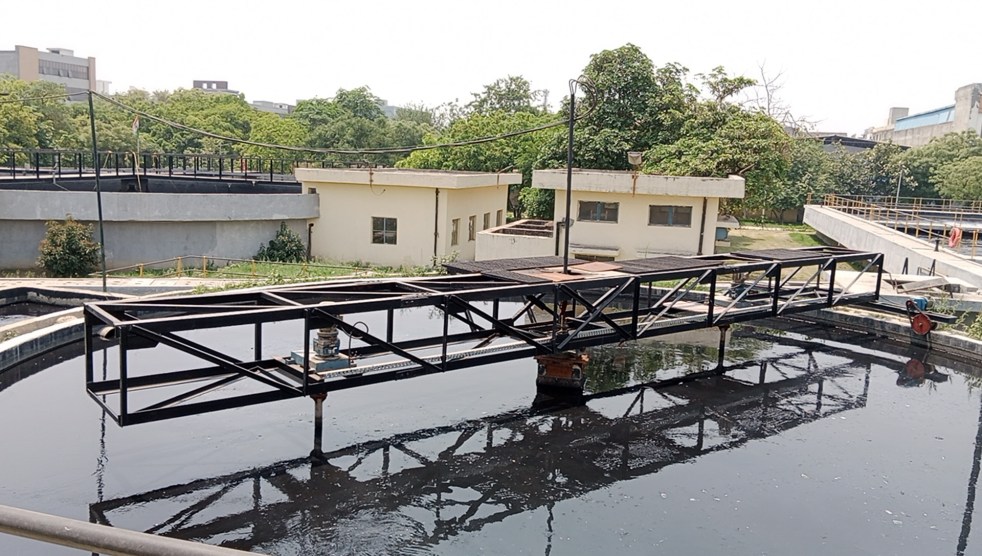
(Feature Image: 10 MLD Kundli CETP in Sonipat. BS Rawat/SANDRP/May 2023)
A detailed report in this week’s DRP News Bulletin below shows how India’s Sewage Treatment Plants (STPs), Govt’s main weapon against pollution of rivers in Urban areas, have been a failure for decades. It is pertinent to note that this is the golden jubilee year of Water Pollution Control Act of 1974, that led to the formation of Central, state Pollution Control Boards, and the whole water pollution control bureaucracy, institutions and legal architecture. There should be little doubt that whole architecture has abysmally failed in achieving basic objective for which it was created, including ensuring proper treatment of urban sewage.
India has spent thousands of crores of rupees on these STPs, mostly, mega, centralized projects. But there has been little effort to address governance of the STPs, to ensure that they function as required and provide the results that they have been set up for. Whether they function or not, qualitatively or quantitatively, year after year and decades after decades, there are no consequences! In fact, if treated properly, sewage can become a asset rather than nuisance that it now is. The Judiciary too, right up to the apex court, have badly failed in achieving any improvement in this eminently justiciable issue.
It is pity that there is neither a debate on this issue, nor any will to do anything about this in central or any of the state governments. Even when promise to address the rejuvenation of Ganga and its tributaries including Yamuna has come from the highest level of at least three Prime Ministers we see no discernible improvement in the state of these rivers. And there is no doubt that non-functional STPs are a major contributing factor for the state of our rivers.
Report Muddy waters: STPs stagnate Throughout India, wastewater is diverted from one point to another, drain to lake, lake to river and then to the sea. Even though surface water sources are increasingly scarce or polluted, treating wastewater is still not a priority. The value of treated water for non-potable use, in domestic, irrigation and industrial sectors has been outlined by many studies. However, treatment of wastewater is still slow to catch on with numerous cities dumping sewage into drains and rivers.
-The Supreme Court and the National Green Tribunal have tried to check the pollution of water bodies and improve wastewater treatment methodologies. More than 50 years after the Water (Prevention and Control of Pollution) Act of 1974 identified wastewater as a source of pollution, India continues to struggle with sewage treatment.
-The Supreme Court’s 2020 deadline for all states to treat 100% of wastewater has long passed. It has been five years since the Central Monitoring Committee (CMC), under the Union Ministry of Jal Shakti, began monitoring the progress of sewage treatment in the states. The committee was tasked with this role by the NGT after a CPCB study showed over 300 river stretches across India were polluted by sewage.
-Data from 27 states and Union territories shows as of June 2024, just about 29% of 45,000 mld of sewage generated is treated. Wastewater that could fill 13 lakh tankers of 10,000-litre capacity is being dumped into the environment today.
-Worryingly, no state has published sewage generation and treatment information in rural areas despite the NGT specifically seeking these details out five years ago. A review of data submitted shows that no state provides clear data on the quantity of freshwater used per day, the generation of waste, its treatment and the use of recycled water.
-In the September 2024 quarterly meeting, the CMC expressed concern over many states, including Delhi, Tamil Nadu and Karnataka, failing to adhere to their deadlines in the construction of STP. On their part, states submitted that they were struggling to fund projects as building underground drainage (UGD) networks and constructing STPs is proving to be costly.
-Meanwhile, in Bengaluru, Rs 2,744 crore is being spent on the K C Valley and H N Valley projects, which seek to pump treated wastewater into Kolar and Chikkaballapur districts. The state has also spent over Rs 5,000 crore on the Cauvery stage V and and has announced a budget of Rs 7,200 crore as a part of stage VI. A senior official agreed that reusing the treated water would reduce the capital involved in sourcing freshwater.
-Any push for the reuse of wastewater can happen only after states ensure that the quality of treated water meets the standards set by the CPCB. However, a review of data submitted by states shows otherwise. The national monitoring committee noted in September that of the 154 STPs in Maharashtra, 61 STPs, including a 757 mld plant at Worli and 797 mld plant at Bandra in Mumbai were non-compliant. The number of non-compliant STPs was 46 in Gujarat. It was followed by Himachal Pradesh (35), Punjab, Gujarat and many other states, even industrial effluent treatment plants failed to comply with the CPCB standards.
-Untreated wastewater in rural areas is a major concern in view of the direct impact it has on the health of people and cattle. Decentralised intervention is particularly relevant for villages situated in undulating terrain or those located in hilly regions. Some states have reported that they are focusing on decentralised treatment systems by building faecal sludge treatment plants. There is, however, no clarity on the treatment of grey water which will continue to pollute the water bodies.
-Less talked about is the matter of untreated sewage contributing to the silent disaster of invasive species, slowly destroying rich local biodiversity. The contamination compounds climate change, which makes survival difficult for local flora and fauna and creates a conducive situation for invasive plant and animal species to thrive. (Chiranjeevi Kulkarni) https://www.deccanherald.com/india/muddy-waters-sewage-treatment-plans-stagnate-3335100 (24 Dec. 2024)
HYDRO POWER PROJECTS
Report How dams weaponize climate change Himanshu Thakkar, coordinator of the South Asia Network on Dams, Rivers and People (SANDRP) talks of how the ‘…quantum of destruction increases when there is a dam.’ I would say, a dam can weaponize the flood.
-The Sikkim catastrophe should urgently draw attention to the fate of other communities living downstream of dams, unable to withstand the most extreme rainfall, which have their failure potential exacerbated through warming.
-Dams should be designed to withstand extreme overflow without failing, something that can be achieved with concrete dams, but as highlighted in Libya and Sikkim in 2023, this is more of a challenge with earth and rock embankment dams. This applies to mine tailings dams, dams built for water conservation or flood control.
-Catastrophe models are required to determine the number of properties destroyed, or casualties resulting from exacerbated dam failure from which it then becomes possible to produce downstream risk-cost, or loss of life, exceedance probabilities. https://www.preventionweb.net/news/how-dams-weaponize-climate-change (24 March 2024)
Aging dams, political instability, poor human decisions and climate change The findings highlight how various factors contributed to the Libya disaster and suggest that a holistic approach, encompassing regular infrastructure maintenance, political stability, and community engagement, is vital for mitigating future risks. Future research should continue to explore these connections, providing a more comprehensive understanding of how to enhance resilience and preparedness in vulnerable regions. Community engagement is a crucial component of effective disaster risk management, as it empowers local populations to take an active role in preparedness and response efforts. https://www.preventionweb.net/publication/aging-dams-political-instability-poor-human-decisions-and-climate-change-recipe-human (21 Jan. 2025)
Sikkim EAC clears Teesta III HEP dam despite its own concerns This, without a fresh public hearing and even as the design aspects of the dam are yet to be approved. Independent expert Himanshu Thakkar of the SANDRP questioned the “hurry” in clearing a project with a history of disaster, especially when the revised probable maximum flood studies were awaited. “This proposal should be treated as a fresh proposal in the context of changing rainfall patterns, the GLOF vulnerabilities. The EAC should have ordered for a fresh environmental impact assessment when the Central Electricity Authority and CWC are considering it in a fresh way. They are also using old data for floods by their own admission. There should be fresh calculations for peak flood levels based on recent data,” Thakkar said. https://indianexpress.com/article/india/environment-ministry-panel-clears-new-sikkim-dam-despite-its-own-concerns-9801048/ (27 Jan. 2025) The EAC has recommended a preliminary study of catchment area for implementation of early warning system and fixing of location of sensor stations. The Environmental Management Plan (EMP) has a proposed budget of ₹8,189.42 lakh, including a capital cost of ₹5,273.54 lakh and a recurring cost of ₹2,915.88 lakh. Additionally, ₹1,423 lakh has been allocated for Local Area Development. EAC has recommended that the project meet various environmental conditions including on muck management; disaster management; biodiversity conservation, among others. https://www.hindustantimes.com/india-news/teesta-hydro-project-devastated-in-glacier-disaster-to-reopen-101737916048598.html (27 Jan. 2025)
Arunachal Pradesh Advocating negotiation on Siang project: Rijiju “China is going to construct the largest dam in the world near the Great Bend on the Siang river. There is a convention that whoever uses river resources first will have the first right. If India constructs the dam first, then the Chinese government will have to consult India before tinkering with the flow of the Siang river,” said Rijiju. [There is no such legally binding convention. Even if there were one, which institution would one go to if China violates it? There is no such institute. China does not adhere to even ICJ.] https://arunachaltimes.in/index.php/2025/01/24/we-are-not-a-dictatorial-govt-says-rijiju-advocating-negotiation-on-siang-project/ (24 Jan. 2025)
Karnataka Sharavathi PSP may cause decline in LTM population: DCF The deputy conservator of Forest, Shivamogga Wildlife Division noted that the proposed project “may disturb the habitat and lead to decline in their population”. The formation of new roads, tunnels, power house and other works in the evergreen forests of the sanctuary will also require “felling of more than 15,000 trees, including rare, endangered and threatened species of trees,” he added as he listed some of the negative impacts.
-The officer flagged the disturbance during and after the construction work: “Drilling and blasting of sub surface rocks for the entire period during the formation of the tunnels, the regular movement of vehicles and personnel during construction phase of the project and during the entire life of the project for operation and maintenance of machineries and equipment. The seismic aberrations can potentially disturb the wildlife habitat and behaviour.”
The officer also listed the “positive” aspects of the project as argued by the Karnataka Power Corp Ltd & sent “in-principle recommendation” while leaving the decision making to the higher ups. https://www.deccanherald.com/india/karnataka/pumped-storage-project-in-sharavathi-valley-may-cause-decline-in-ltm-population-dcf-report-3364598 (20 Jan 2025)
Telangana Govt signs MoU with Sun Petrochemicals for 3,400 Mw PSPs The Government of Telangana has entered into a Memorandum of Understanding with Sun Petrochemicals, to develop three Pumped Storage Hydro Power projects in the districts of Nagarkurnool, Mancherial, and Mulugu.
-These projects will have a combined capacity of 3,400 MW and will be complemented by downstream integrated solar power plants with a capacity of 5,440 MW. With an estimated investment of ₹45,500 crore, it is expected to create over 7,000 jobs during the construction phase, a statement said. https://www.thehindubusinessline.com/news/national/telangana-signs-mou-with-sun-petrochemicals-for-3400-mw-pumped-hydro-projects/article69128883.ece/amp/ (19 Jan. 2025)
NHPC JV with APGENCO for PSPs -The new entity APGENCO NHPC Green Energy Limited has been incorporated on Janauary 23, NHPC said in an exchange filing. Initially five projects, namely Yaganti PSP (1000MW), Rajupalem PSP (800 MW), Gadikota PSP (1200 MW), Aravetipalli PSP (1320 MW), and Deenepalli PSP (750 MW), are considered for joint implementation and other projects subsequently identified shall be taken up as mutually agreed in future, the filing said. https://psuwatch.com/newsupdates/nhpc-forms-jv-with-power-producer-apgenco-for-renewable-energy-projects (23 Jan. 2025)
MoEF Decisions of EAC meeting for River Valley Projects held on Jan 10 2025: 1. Expansion of Tembhu Lift Irrigation Project Taluka Karad, Dist Satara, Mah FOR EC: PP Absent
2. Teesta-III (1200 MW) by SIKKIM URJA Ltd at NORTH DIST, SIKKIM for Amendment in EC: APPROVED
3. Balotra Pumped Storage Project by ADANI GREEN ENERGY LIMITED located at BARMER,RAJASTHAN for TOR: APPROVED
4. SUKHPURA OFF-STREAM CLOSED LOOP PUMPED STORAGE PROJECT-2560 MW by Greenko Energies Pvt Ltd, in Dist -Chittorgarh, Rajasthan at CHITTORGARH,RAJASTHAN: FOR Amendment in TOR: APPROVED
5. Site visit Report on Proposed Bhavali Pumped Storage Project (1500MW) at Village Jamunde, Tehsil lgatpuri, District Nashik and villages Kalbhonde and Kothale, Tehsil Shahpur Thane, Mah: Approved https://parivesh.nic.in/utildoc/118140978_1737529944123.pdf
Agenda of EAC meeting on River Valley Projects to be held on Jan 29 2025: 1. Uri-I Stage-II Hydroelectric project of 240 MW in 102 ha in Sub Dist Uri, Boniyar, Kreeri, Baramullaand Rafiabad, Dist of Baramulla (J & K) by NHPC Ltd – Environmental Clearances
2. Damanganga (Ekdare) – Godavari intrastate link project (CCA: 12998ha) in 213.46 ha at Village Ekdare, Tehsil Peint, Dist Nashik (Mah) by National Water Development Agency- Amendment in Terms of Reference
3. Kamod Close Loop Pumped Storage Hydro Electric Project (2000 MW) in 458.23 Ha at Village Chaupale, Kamod, Kotkhamb and Nagziri, Sub Dist Sakri and Nawapur, Dist Nandurbar, Mah by Megha Engineering & infrastructures Ltd – Terms of References
4. Ghosla Close Loop Pumped Storage Hydro Electric Project (2000 MW) in 350 Ha at Village Wadi, Tidka, Shewale etc, Sub Dist Pachora, Sillod & Soegaon, Dist Jalgaon & Aurangabad by Megha Engineering & infrastructures Ltd – Terms of References
5. Saidongar 1 – Karjat Open Loop Pumped Storage Project (3000 MW) in 377 Ha at Village Potal, Saidongar, Ambot, Dhak, Bhaliwadi, Sub Dist Karjat, Dist Raigarh, Mah by Torrent Psh 3 Pvt Ltd – Terms of References
6. Saidongar 2 – Maval Open Loop Pumped Storage Project (1200 MW) in 141.44 Ha at Village Dhak, Kusur, Pali T. Kothal Khalathi & Saidongar, Karjat, Dist Raigarh, Mah by Torrent Psh 4 Pvt Ltd – Terms of References https://parivesh.nic.in/utildoc/117984089_1737378074116.pdf
DAMS
SANDRP Blog 2024Dam safety This annual overview complies the remaining relevant reports from 2024 concerning safety of dam structures in India. The reports underline that while many dam projects in India have been facing damages to infrastructures and leakage problems increasing their disaster vulnerability, the maintenance and repair works are moving at snail’s pace. https://sandrp.in/2025/01/26/2024-dam-safety/ (26 Jan. 2025)
Polavaram Project CWC clears designs for D-wall After months-long deliberations and consultations, the Central Water Commission (CWC) has finally cleared the designs for the diaphragm wall (D-wall) of Polavaram project. The works are expected to start from Jan 18.
CWC has given the green signal to state irrigation dept to move ahead with usage of T5 plastic concrete mixture instead of T16 plastic concrete suggested by majority of members in the technical teams. The panel of experts (PoE) comprising international dam safety engineers also favoured the T16 mixture. Sources said the CWC decided to rely on the report of Central Soil and Material Research Station (CSMRS), which suggested to use T5 mixture.
In fact, the previous D-wall was also constructed with T5 mixture. The CSMRS is reported to have suggested T5 material in view of its nature of elasticity, which can protect the structure in the long run. Though T16 material is believed to be more solid and strong, T5 provides more cushion to the structure.
Former CWC chairman AB Pandya, who is also the chief of dam design review panel (DDRP), also defended the arguments of international experts on usage of T16 mixture. “We could have completed the D-wall and other works a year earlier had CWC finalised the designs. It unnecessarily dragged on the issue consulting different agencies and experts from across the globe which only resulted in waste of precious time and escalation of costs,” said a senior official. https://timesofindia.indiatimes.com/city/vijayawada/cwc-clears-designs-for-polavaram-d-wall-works-to-begin-today/articleshowprint/117339968.cms (17 Jan. 2025)
Project back in motion after Centre’s Rs 2,300 crore advance The Andhra Pradesh government last week resumed the construction of a new diaphragm wall of the Polavaram dam. The Union finance ministry releasing Rs 2,300 crore in advance in October 2024 has given a fresh impetus to the project in addition to reimbursement of Rs 400 Cr expenses in July 2024.
– The dam has been in the works for over 20 years, with roughly Rs 24,000 crore spent already. However, it is still only half-complete. Over the past several years, the Centre and the Andhra Pradesh government have been locking horns over the actual cost and funding of the dam. https://theprint.in/india/in-limbo-since-2019-aps-polavaram-dam-project-back-in-motion-after-centres-rs-2300-crore-advance/2454041/ (20 Jan. 2025)
New Diaphragm Wall works begin The new wall, costing ₹990 crore, will span 1.396 kilometres with a thickness of 1.5 metres. It is scheduled for completion by December 2025 using three cutters, with one currently operational. The earlier diaphragm wall, built during the Telugu Desam government’s tenure, was declared “damaged” under the previous YSRC govt, halting major works for three years. The alliance govt, led by CM N. Chandrababu Naidu, has resumed work, constructing the new wall 6 metres upstream of the old one. The CWC approved the wall design on January 13, and permissions for the T5 Mix were granted on January 16. The second cutter will begin by January-end, with a third by February-end, ensuring steady progress despite rainy seasons. https://www.deccanchronicle.com/southern-states/andhra-pradesh/polavaram-project-construction-of-new-diaphragm-wall-begins-1854928 (18 Jan. 2025)
Single diaphragm wall poses threat to project: Ex-MP This UNI report quotes former AP MP saying that the single diaphragm wall dam of the Polavaram project is not safe as the foundation has to be on firm rock 12.5-93 m deep. He said only a double diaphragm wall can withstand the pressures including the due to geology and seismology. https://www.uniindia.com/~/ap-single-diaphragm-wall-poses-threat-to-polavaram-project-ex-mp/States/news/3370714.html (18 Jan. 2025)
Deploy additional machinery to meet deadlines: Govt With an aim to fast track Polavaram project works, the state govt has directed the contractor agencies (main contract firm – Megha Engineering Infrastructure Limited (Meil), diaphragm wall contractor-Bauer Engineering and India Limited (BEIL)) to deploy additional machinery to complete the D-wall and other works as per the deadlines. The state govt is determined to complete all the works before June 2027.
-Curiously, CWC, which initially preferred T5 mixture for construction of D-wall has once again created dilemma by referring the matter to international experts. While international experts are in favour of T16 mixture, they have left the issue to the final call of CWC. It is believed that CWC is likely to make its final decision on Monday (Jan. 20). https://timesofindia.indiatimes.com/city/vijayawada/deploy-additional-machinery-to-meet-polavaram-deadlines-govt-to-contractors/articleshowprint/117378290.cms (19 Jan. 2025)
Kaleshwaram Project Ghose panel grills Special CS Finance Asked whether established norms and guidelines were followed in case of the KLIP designs, the senior bureaucrat informed the Commission that it was purely the subject handled by the Irrigation department. The Commission remarked that guidelines were not followed in several aspects as the project was hurried up. Replying to another question posed by the Commission, Mr. Ramakrishna Rao said he was not aware of the existence of records pertaining to the core committee meetings on the projects. The Commission noted that business rules were not followed in case of release of funds to KLIP and proper records too were not maintained and that there were no records to prove that the policy document on KLIP was tabled in the Assembly. Meanwhile, the representatives of the agencies which have constructed the three barrages of KLIP — Medigadda, Annaram and Sundialla — have been summoned to be present before the Commission for inquiry on Wednesday (Jan. 22). https://www.thehindu.com/news/national/telangana/justice-ghose-panel-grills-special-cs-finance-on-borrowings-budget-allocations-funds-release-for-klip/article69123851.ece (21 Jan. 2025)
Govt to restructure KLIS loans, informs Ghose panel Special Chief Secretary (Finance) K. Ramakrishna Rao informed the Kaleshwaram Commission of Inquiry on Tuesday (Jan. 21) that the state government was attempting to restructure the loans taken for the Kaleshwaram Lift Irrigation Scheme. Deposing before the commission, the senior IAS officer stated that the government had paid Rs 6,519 crore towards interest and Rs 7,382 crore towards the principal amount in this financial year on the loans taken for the irrigation project.
-When commission chairman Justice P.C. Ghose asked about the borrowings, Ramakrishna Rao stated that the rate of interest ranged from 9 to 10.5 per cent for the Kaleshwaram loans. That was why the government was trying to restructure the loans, he explained. https://www.newindianexpress.com/states/telangana/2025/Jan/22/telangana-govt-to-restructure-klis-loans-informs-ghose-panel (22 Jan. 2025)
KLIS bypassed Finance Dept: Key Revelations at Inquiry The finance department may have been kept out of the loop on several decisions taken by the then BRS government’s Cabinet with respect to the Kaleshwaram lift irrigation scheme (KLIS), particularly with reference to the funds used for the project. This aspect emerged during the cross examination of special chief secretary (finance) K. Ramakrishna Rao by the Justice P.C. Ghose-headed commission of inquiry into various aspects of the KLIS barrages. Ramakrishna Rao headed the department since 2014, the year the BRS took charge of the government.
-In a turnkey system, the government lays down its requirements and the contractor takes the responsibility for the investigations, planning, design, and construction of a project. In the case of the Kaleshwaram project, the government had followed a ‘piece rate’ system, with it taking the responsibility for investigations, planning, and design with the contractors merely executing the construction as per designs and specifications provided to them. https://www.deccanchronicle.com/southern-states/telangana/kaleshwaram-project-bypassed-finance-dept-key-revelations-at-inquiry-1855707 (21 Jan. 2025)
Repeated pleas for repair designs fell on deaf ears: L&T to panel Subsequently, all the gates were closed in November 2019 “after which we witnessed a lot of damage to the apron area and the washing away of flood dissipating CC blocks,” L&T offcial said to Justice Ghose Commission on Jan 24.
– The design was meant to tolerate 6 metres per second. When water was released during the floods, the speed reached 16 metres per second. Among the shortfalls found, which were also corroborated in model studies after October 2023, and other studies, were the need for a stilling basin, and design faults that led to the increased shooting velocities which started the damages that ultimately ended with the sinking of Block 7, he said. https://www.deccanchronicle.com/southern-states/telangana/repeated-pleas-for-repair-designs-fell-on-deaf-ears-lt-tells-klis-probe-commission-1856432 (24 Jan. 2025)
L&T points to design issues as cause of sinking piers at Medigadda Representatives from L&T have blamed design flaws, particularly the shooting velocities, for the sinking of piers in block 7 of the Medigadda barrage. They also informed the Justice PC Ghose Commission of Inquiry that the design issues led to damage of the cement concrete blocks and the wearing coat. Representatives of L&T, the company responsible for constructing the barrage, appeared before the commission on Jan 24 for cross-examination.
– L&T representatives explained that the damage to the barrage became evident during the first monsoon season, in Nov 2019, shortly after the Kaleshwaram Lift Irrigation Scheme (KLIS) was inaugurated in June of that year. They said that they had written to the irrigation department for three consecutive years before each monsoon, urging the officials to address the design and structural issues. Despite these requests, the irrigation department failed to take corrective action. In May 2020, L&T warned the department about the seriousness of the damages. “Had the govt acted promptly, the major problem of sinking piers could have been avoided,” they told the Ghose panel. https://timesofindia.indiatimes.com/city/hyderabad/lt-points-to-design-issues-as-cause-of-sinking-piers-at-medigadda/articleshowprint/117533274.cms (25 Jan. 2025)
Damaged portion of barrage needs to be built again: L&T engineer Block 7 of the Medigadda barrage of Kaleshwaram scheme which suffered extensive damage in the forms of deep and large cracks, as well as its partial sinking into the Godavari river bed, cannot be repaired, the Justice Pinaki Chandra Ghose commission of inquiry was informed on Jan 24. During-cross examination by Justice Ghose, when asked to express his view whether Block 7 can be repaired, Rajnish P. Chauhan, deputy general manager of L&T, said that in his view, the damaged block “cannot be recovered.” It would have to be rebuilt, or some other structures, both on the upstream and downstream sides of the barrage, need to be arranged to allow storing of water at the barrage, he said. Chauhan added these “arrangements” would be required to ensure no pressure from the water, if stored, is transmitted to the “stressed structure.” https://www.deccanchronicle.com/southern-states/telangana/damaged-portion-of-barrage-needs-to-be-built-again-lt-engineer-1856456 (25 Jan. 2025)
Navayuga explains Sundilla repair work to Panel Navayuga, the company responsible for constructing the Sundilla barrage as part of the Kaleshwaram Lift Irrigation Scheme, has informed the Justice PC Ghose Commission—investigating the sinking of Medigadda piers and damage to two other barrages, Annaram and Sundilla — that it carried out repairs to the Sundilla barrage three times, including grouting, after detecting damage in Dec 2021. The company said significant damages occurred in 2022 monsoon. https://timesofindia.indiatimes.com/city/hyderabad/navayuga-explains-sundilla-repair-work-to-ghose-panel/articleshow/117497886.cms (25 Jan. 2025)
Telangana Real-time flood forecasting mooted for dam safety Telangana has mooted real-time monitoring of rainfall and creation of advanced modelling and forecasting systems to improve flood forecasting and create gate operation protocols for dams on the Godavari and Krishna rivers. At a meeting of the State Dam Safety Organisation on Jan 22, officials proposed a committee comprising irrigation chief engineers from Telangana, Maharashtra, Karnataka and Andhra Pradesh to take the idea forward. Required studies could be done by IIT Hyd or IIT Roorkee.
– Gate operation protocols play a vital role in dam safety, especially during floods in rivers on which the dams are built, and if faulty or incorrect protocols are followed, can result in serious damage to structures. One of the many reasons that damages occurred to the Medigadda barrage of the Kaleshwaram project in Telangana, is believed to be absence of comprehensive flood forecasting and flood data and improper gate operation protocols.
– The SDSO meeting also discussed a study report on Gundlavadu dam in Khammam district which, the study found, needs to be rebuilt from the ground up. A study by the former director general of the Geological Survey of India M Raju found that the long-pending problems at the small dam, which serves an ayacut of around 3,000 acres in Wazeedu mandal of Khammam district, can only be solved if it is built afresh. https://www.deccanchronicle.com/southern-states/telangana/real-time-flood-forecasting-mooted-for-dam-safety-1855979 (22 Jan. 2025)
Mullaperiyar Dam SC asks govts which committee will be ‘more effective’ The Supreme Court on Monday (January 20, 2025) orally asked the States of Tamil Nadu and Kerala to address it on whether the supervisory committee formed by the court would be more effective in taking care of the 129-year-old Mullaperiyar dam or the job must be given to a statutory committee envisaged under the new Dam Safety Act of 2021. The court listed the case for hearing detailed submissions on February 19. https://www.thehindu.com/news/national/sc-asks-kerala-tamil-nadu-to-address-on-which-committee-will-be-more-effective-to-watch-over-mullaperiyar-dam/article69118964.ece (20 Jan. 2025)
Farmers to protest over including Kerala officials in panel Members of the Periyar Vaigai Irrigation Farmers Association have threatened to stage a protest at Kumuli on the Tamil Nadu-Kerala border on 25 January against the inclusion of Kerala officials in a new panel formed by the Ministry of Jal Shakti to oversee safety matters concerning the Mullaiperiyar dam.
-In a statement, association coordinator S Anvar Balasingam, also known as Pennycuick, said the Supreme Court, while hearing a petition related to the dam on 8 January, had questioned why there was no national-level committee to supervise safety matters. In response, the union government has now constituted a new supervisory committee under the National Dam Safety Act, 2021. The panel will be chaired by NDSA chairman Anil Jain.
-He condemned the formation of the new committee, which includes officials from Kerala, claiming that officials from the minor irrigation and forest department of Kerala had previously prevented Tamil Nadu PWD officials from carrying out maintenance work on the dam. He argued that including Kerala officials in the new committee would only encourage further interference in maintenance work. “Moreover, Tamil Nadu’s rights to the Mullaiperiyar dam are based on a 999-year settlement. Tamil Nadu pays the Kerala government for the use of water for irrigation, so there is no need to include Kerala officials in the committee,” he said. https://www.msn.com/en-in/public-safety-and-emergencies/health-and-safety-alerts/periyar-vaigai-irrigation-farmers-to-protest-over-including-kerala-officials-in-mullaiperiyar-panel/ar-AA1xp6Dz (19 Jan. 2025)
Centre forms new supervisory committee for safety The Centre has formed a new supervisory committee, chaired by the head of the National Dam Safety Authority (NDSA), to oversee safety matters concerning the Mullaperiyar Dam. With this, the existing supervisory committee for the dam remains dissolved, transferring all responsibilities for the dam’s safety to the NDSA. The newly formed panel consists of seven members, including the Additional Chief Secretaries of both Kerala and Tamil Nadu, besides the chairman of the Cauvery Cell in Tamil Nadu and his counterpart in Kerala’s Irrigation Department. https://www.onmanorama.com/news/kerala/2025/01/17/centre-forms-new-supervisory-committee-mullaperiyar-dam-safety.html (17 Jan. 2025)
Hirakud Dam Sambalpur to get additional spillways after decade-long delay under DRIP-III A decade after the Central Water Commission (CWC) recommended two additional spillways on the left and right dykes of Hirakud reservoir to protect the world’s longest earthen dam from further deterioration, none of them are yet to get off ground. The reason, delay in deciding whether the additional spillways would be built under World Bank (WB)-funded Dam Rehabilitation and Improvement Project (DRIP) or the state government would take up the project on its own. However, after the long delay, the government has finally decided to include the project under DRIP.
– One of the spillways was taken up by a joint venture (JV) of Tata Projects Limited and Turkey-based AGE Group at an estimated Rs 369 crore under DRIP-II in 2019, the state government cancelled the work contract after the JV backed out citing delay in resolution of displacement issues in 2020.
– A year later, the Odisha government decided to construct the additional spillway with its own funding through Odisha Construction Corporation (OCC). Accordingly, the project was re-estimated at `786 crore. But the project could not again take off due to procedural and approval delays. In May last year, the Water Resources department revised the estimate once again and decided to take up the additional spillway project with hydromechanical works on the left of Gandhi Hillock at Hirakud dam at a cost of around Rs 884.38 crore. But the project remained in the approval stage. https://www.newindianexpress.com/states/odisha/2025/Jan/22/hirakud-dam-in-odishas-sambalpur-to-get-additional-spillways-after-decade-long-delay-under-drip-iii (22 Jan. 2025)
Punjab HC asks MoEF to decide on Percha dam desilting plea in 45 days The Punjab and Haryana high court has directed the Union ministry of environment, forest and climate change to decide on an application submitted by the Punjab govt for permission to de-silt the Perch dam in Mohali district, located near Chandigarh.
The HC has set a deadline of 45 days for the ministry, so that the process of de-silting can be started and concluded well before monsoon. The check dam, located in the Shivalik foothills, has accumulated significant amount of silt, reducing its water-carrying capacity and leading to a dry bed. It has also witnessed the death of hundreds of wild animals on the dry bed. The dam had not been de-silted for several years. A division bench of the court passed these orders while disposing of a suo motu petition on the issue. The bench issued orders after it was informed by the state of Punjab that an application for permission to de-silt the dam was made by the state of Punjab as early as April 12, which is under consideration by the Union ministry.
– Earlier, the de-silting of dams was permitted without clearance from the ministry. However, based on the report of the environment advisory committee (EAC) as well as the directions by the National Green Tribunal (NGT), the Union ministry of environment, forest and climate change directed that the exemption from environment clearance (EC) provided via SO 1224(E) dated March 28, 2020, for dredging and desilting of dams, reservoirs, weirs, barrages, rivers, and canals shall be subject to environmental safeguards as proposed in the National Framework for Sediment Management issued by the Union ministry of jal shakti, department of water resources, river development and Ganga rejuvenation, as enclosed in this office memorandum. https://timesofindia.indiatimes.com/city/chandigarh/punjab-haryana-hc-asks-union-ministry-to-decide-on-plea-to-de-silt-percha-dam-in-mohali-in-45-days/articleshowprint/117361770.cms (19 Jan 2025)
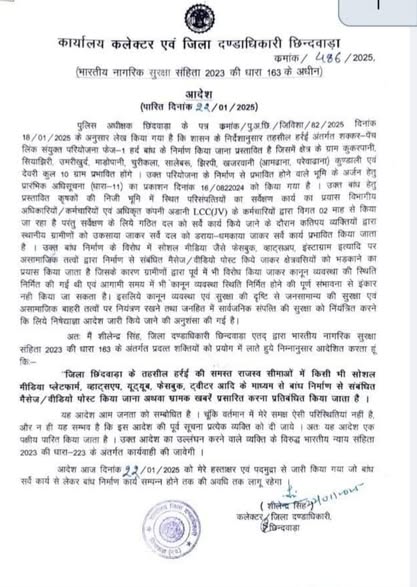
Madhya Pradesh Shockingly, Chhindwara district collector has brought out notification threatening police action against anyone posting messages critical to a proposed dam in the district. (22 Jan. 2025)
Gujarat State’s water storage capacity rose by 3,294.8 MCF in 2yrs The state govt on Monday said that the water storage capacity in Gujarat increased by 3,294.8 million cubic feet (MCF) in the past two years because of various projects undertaken under the Sujalam Sufalam scheme. The govt stated that in the last two years, 9,381 km of canals were cleaned, while 7,775 check dams were desilted and 1,914 check dams repaired. Providing details of water conservation activities done in the last two years, the govt statement said that in 2023, there was an increase in water storage capacity by 2,142.5 MCF, and in 2024 by 1,152.3 MCF, taking the total increase to 3,294.8 MCF over the last two years. https://timesofindia.indiatimes.com/city/ahmedabad/states-water-storage-capacity-rose-by-3294-8-mcf-in-two-years-govt/articleshowprint/117404512.cms (20 Jan. 2025)
INTERLINKING OF RIVERS
Ken-Betwa Linking प्रोजेक्ट का क्यों हो रहा है विरोध BBC ground report by Vishnukant Tiwari: -छत्तरपुर ज़िले के धौड़न गांव का अस्तित्व अब ख़त्म होने वाला है. यहां के लोगों ने बताया कि वो किन दिक्कतों से जूझ रहे हैं. गांव की रहने वाली लक्ष्मी आदिवासी बताती हैं कि उनके पैदा होने से पहले ही गांव में बिजली नहीं है. वो कहती हैं कि गांव में अस्पताल तक नहीं हैं. केन-बेतवा अब केवल नदी नहीं, बल्कि नदियों को जोड़ने की विकास परियोजना है, और धौड़न गांव इस केन-बेतवा रिवर लिंकिंग प्रोजेक्ट का केंद्र है. लोग इस परियोजना को लेकर विरोध भी जता रहे हैं. इससे करीब 21 गांव डूब जाएंगे. हालांकि सरकार के अलग दावे हैं. देखिए विष्णुकांत तिवारी की ये ग्राउंड रिपोर्ट. https://www.youtube.com/watch?v=WpO6JPVpHas (24 Jan. 2025)
Cauvery-Vagai-Gundar Linking SC declines to consider Karnataka’s plea Supreme Court declined to consider Karnataka’s plea for interim relief with regard to Cauvery-Vagai-Gundar link project, undertaken by Tamil Nadu as no permission for it has been granted by the central government. Karnataka layed its claim over surplus water which was purportedly sought to be utilised by Tamil Nadu government. The Cauvery-Vaigai-Gundar link project is a river linking project in Tamil Nadu that moves surplus water from the Cauvery to the southern parts of the state. The project included a barrage and a link canal. https://www.deccanherald.com/india/karnataka/supreme-court-declines-to-consider-karnatakas-plea-on-cauvery-vagai-gundar-linking-project-3364233 (20 Jan. 2025)
INTERSTATE WATER DISPUTES
Mahadayi Water Disputes ‘If Goa dies real estate projects won’t survive’ Q: Will the recent proposal to dam the Mhadei hasten the decline of Goa’s ecology? Abhijit Prabhudessai: Absolutely. I think it’s important this be stopped because once the diversion takes place, it will be difficult to reverse the process. The Mhadei sustains three wildlife sanctuaries. The loss of even a small amount of water would have severe implications in summer when there is lack of surface water for flagship species like the tiger. It also has implications for local communities living on farming and fisheries. The rich stock of fish is due to freshwater from the Mhadei mingling with salty water from the Mandovi river. It will reduce our fish catch.
It’s interesting that Karnataka says Mhadei diversion is for drinking water. On the ground they say the water will go to sugarcane farmers in Hubli-Dharwad. The Sagarmala programme shows, and part of it is already existing, steel plants in the same region which will consume 12 times the amount of water being diverted.
I would assume this water will not go to sugarcane farmers but to the steel and power plants which are consumers of the coal against which we are fighting in Goa. Of course, the government will never speak the truth. For every dam they say it’s for drinking water, for farmers but it actually goes to industries and five-star hotels.
– Rivers are under assault in several ways. The nationalization of rivers was a big setback because now the Inland Waterways of India is going to do its best to promote shipping which is what it is required by law to do.
Then you have the Ports Authority Act which allows MPT (Mormugao Port Trust) to plan for rivers; the Sagarmala programme which says 136 million tonnes of coal is going to be transported through Goa. After MPT takes over all the neighbouring fishing areas it can handle only 51 million tonnes. The remaining 86 million tonnes will be transported through Goa’s rivers. There is assault from tourism, casinos, iron ore industries and the barges. Rivers have been decimated by iron ore mining. Fisheries were in abundance but have been reduced to perhaps 10 percent of what they were. https://www.civilsocietyonline.com/past-and-present/if-goa-dies-real-estate-projects-wont-survive/ (25 Jan. 2025)
RIVERS AS NATIONAL WATERWAYS
Bihar गंगा से रेत निकालने में फंस गई धरती ड्रेजिंग, बिल का पेमेंट रुका, जांच भी शुरू -मालवाहक या यात्री जहाज के सफर को गंगा नदी में सुगम बनाने के लिए रेत निकालकर (ड्रेजिंग) रूट को गहरा और चौड़ा करने के काम में बिल बढ़ा-चढ़ाकर भुगतान का दावा करने का मामला सामने आया है। इसके लिए कंपनी को कारण बताओ नोटिस जारी हुआ है। भारतीय अंतर्देशीय जलमार्ग प्राधिकरण (IWAI) ने गंगा नदी में राष्ट्रीय जलमार्ग प्रथम (National Waterway 01) के 95 किलोमीटर लंबे दीघा-मझौआ खंड से बालू निकालने का काम 2024 में हैदराबाद की धरती ड्रेजिंग एण्ड इन्फ्रास्ट्रक्चर लिमिटिड नाम की कंपनी को दिया था। ड्रेजिंग से रेत निकालकर नदी को ढाई मीटर गहरा व 30 मीटर चौड़ा करना था, जिससे बड़े जहाज निकल सकें।
– ड्रेजिंग कंपनी द्वारा कारण बताओ नोटिस का जवाब देने में हीला-हवाली के बाद प्राधिकरण ने एक एक्सपर्ट टीम को जमीन पर काम का निरीक्षण करने के लिए पटना भेजा। जांच टीम ने जनवरी के दूसरे हफ्ते में स्थल निरीक्षण करके जरूरी डेटा जुटाए हैं। धरती ड्रेजिंग कंपनी का इतिहास पहले से दागदार रहा है। 2018-19 में इसे प्राधिकरण ने दो साल के लिए काली सूची में डाला था। तब इसने अग्रधन राशि (जमानत राशि) के बदले फर्जी बैंक गारंटी जमा किया था। बिहार सरकार ने भी 2015 में इसे ब्लैकलिस्ट करके इसका पेमेंट रोक लिया था जिसके खिलाफ कंपनी हाईकोर्ट चली गई थी। https://www.livehindustan.com/bihar/iwai-showcauses-dharti-dredging-for-raising-ganga-depth-and-width-for-manipulated-bills-201737537122408.amp.html (22 Jan. 2025)
URBAN RIVERS
Mula-Mutha; Pune Activist challenges environmental nod given to RFD Activist Sarang Yadwadkar has approached the NGT challenging the State Environment Impact Assessment Authority’s (SEIAA) environmental clearance granted to the Mula-Mutha riverfront development project. He claimed that the approval required submission of information by the project proponent, which was to be vetted by the state expert appraisal committee (SEAC) set up for this purpose. “SEAC should apply its mind, check the veracity of the information furnished, and decide on the suitability of the project from the point of environmental law. But in this case, none of this happened,” Yadwadkar said in his application.
Yadwadkar also said that SEAC did not consider if the project proponent had complied with the 18 conditions raised by the authority and in turn disregarded the issues that the project would create. NGT’s western bench in Pune on Jan 21 issued notices to the Union govt, SEIAA, Pune Municipal Corporation (PMC), Pimpri Chinchwad Municipal Corporation, Khadki Cantonment Board, and the Central Water and Power Research Station (CWPRS) seeking their response within four weeks. “False and misleading information was furnished by the project proponent to the effect that CWPRS examined hydraulic and hydrology reports. However, the CWPRS reply states that no such study was carried out by it. Further, appraisal of the project was done on the basis of incorrect information on flood levels in the rivers. The TERI report, ‘Maharashtra State Adaptation Action Plan on Climate Change’, was not taken into consideration. The project consultant and CWPRS did not consider the increase in projected rainfall in Pune and ignored the findings of the said report,” Yadwadkar said in the appeal. https://timesofindia.indiatimes.com/city/pune/activist-challenges-environmental-nod-given-to-riverfront-development-project/articleshow/117534039.cms (25 Jan. 2025)
MP flags issues in RFD, warns of ecological impact BJP leader and Rajya Sabha Member of Parliament (MP) Medha Kulkarni has raised concerns over Pune’s 44-km-long Mula-Mutha riverfront development project, a move seen as her defiance over the party line. Medha has flagged errors in the DPR and highlighted ecological issues such as shrinking riverbeds, debris dumping, and tree cutting. She has also lodged a complaint with Union Jal Shakti minister CR Patil. The senior BJP leader, accompanied by Pune municipal commissioner Rajendra Bhosale, environment department head Sanjay Shinde, environment officer Mangesh Dighe, project consultant team members, and Pune River Revival activists, including Shailaja Deshpande and Prajakta Mahajan, visited the riverfront project site Thursday (Jan. 23) morning.
During the site visit, Medha alleged that Pune and Pimpri-Chinchwad municipal corporations (PMC & PCMC) have dumped 300 truckloads of debris in Ram and Mula rivers at Aundh with illegal activity continuing in PCMC area. She urged authorities to widen the riverbed instead of shrinking it and to avoid cutting old trees. “I will arrange a meeting with divisional commissioner Mahesh Pulkundwarkar, Pune civic chief Bhosale and his Pimpri-Chinchwad counterpart Shekhar Singh, and citizens to address the issues related to the project,” she said, adding that altering the river’s natural course and dumping debris could lead to flood-like situations in the city. https://www.hindustantimes.com/cities/pune-news/medha-kulkarni-flags-issues-in-riverfront-project-in-pune-warns-of-ecological-impact-101737661007347.html (24 Jan. 2025) A meeting has been planned between Rajya Sabha MP Medha Kulkarni with the divisional commissioner and the commissioners of PCMC and PMC on January 29. “We will mainly discuss two issues, firstly, that the RFD is encroaching the riverbank and, secondly, the cutting of trees. We will also discuss whether the DPR has been sanctioned,” said Kulkarni from Delhi on Friday, a day after she spent more than two-and-a-half hours at the RFD site, seeing the Riparian zone, the wetland, the riverbed and the dumping of material, among others. PMC commissioner Rajendra Bhosale and municipal officers were among those present. https://indianexpress.com/article/cities/pune/mp-medha-kulkarni-to-hold-meeting-on-riverfront-development-project-on-jan-29-9797892/ (24 Jan. 2025)
Vishwamitri; Vadodara Key question as VMC gears up to desilt river One of the biggest challenges the Vadodara Municipal Corporation (VMC) is likely to face as the project to desilt and dredge the Vishwamitri river, which faced massive flooding last year, takes off, is the relocation of nearly 300 crocodiles that have made the water body their home. Among the 13-point priority list of flood-mitigation measures that the civic body will take up is the river-channel modification and straightening of the meanders in sections, the process for which is likely to coincide with the nesting period of the crocodiles.
-While officials say it is possible to carry out the work as the crocodiles are “hardy species” that are unlikely to be harmed “merely due to shifting”, experts stress on the need for a plan B, reasoning that the “disturbance” may leave the animals, including other reptiles like monitor lizards, “agitated”. Even as the VMC has received environmental clearance, it is awaiting response from the Wildlife Department to a proposal to allow the civic body to “shift crocodiles” from the Vishwamitri for the proposed activity.
-The VMC also plans to construct an additional spillway of Ajwa Dam with vertical gates on the downstream of the existing weir. Along with this, the crest level of Ajwa will be reduced from 214 feet to 206 feet. The civic body plans to conduct dredging along the periphery of Ajwa and Pratappura Sarovar when the water levels reduce during summer. Installation of flood-forecasting warning systems and piezometers along the length of Ajwa Dam as well as deep recharge by rainwater harvesting in the city has also been proposed.
-The civic body has proposed the construction of a new buffer pond with storage near Kotambi and Bhaniyara. The proposed works include increasing the capacity of three ponds by dredging in Dhanora, Vadadala and Haripura. The focus is also on the existing network of over 42 major and minor kaans (storm water drain) in the city, including the 2.5-kilometre Bhukhi kaans with a new channel diversion of three kilometres to divert the water along with a 5-kilometre channel diversion for the Ruparel kaans after dredging and resectioning to increase the carrying capacity. An additional kaans is proposed to be constructed in the Eastern part of NH-48 to prevent the water from flowing into the city that causes flooding. https://indianexpress.com/article/cities/ahmedabad/key-question-as-vmc-gears-up-to-desilt-vishwamitri-what-about-the-crocodiles-9794117/ (23 Jan. 2025)
SEIAA clears river dredging and desilting Nearly 40 per cent of Vadodara city was submerged for over three days in the last week of August 2024 by the floodwaters of the Vishwamitri River that cuts through the city, a study, which was accessed by the Indian Express, by an expert committee of the SEIAA has stated.
-In a first step to increasing the carrying capacity of Vishwamitri River, the SEIAA has given the green light to the Vadodara Municipal Corporation to go ahead with the rejuvenation project for the river, which includes desilting and dredging without harming the aquatic life in it.
-As per the minutes of the meeting of the Authority held on January 6, the SEIAA suggested following the recommendations of the SEAC. “The work requires removing debris and silt from the river… to be completed before August 2025. By this activity the carrying capacity of the river will increase up to 1,100 cumecs, significantly reducing flood reduction by 51%,” the SEIAA stated.
-The Authority has mandated that the work be carried out in compliance with the order of the NGT of May 2021 that had directed the demarcation of the floodplain zone and removal of all unauthorised structures from the river’s vicinity.
-Stating that the entire operation should be carried out in the presence of local forest department officials and staff and under technical guidance, the SEAC said that the VMC must ensure that “wild animals are not injured”.
-The SEAC has also stated that, if the need arises, the crocodiles and Indian softshell turtles should be safely rescued and released in the Vishwamitri River in coordination with the forest department.
-The SEAC has also stated that “excavated material generated from the re-sectioning, desilting and debris removal activities will be collected appropriately on either side of the river where non-productive government land is available and the same will be utilised for government purpose in ongoing government projects.” https://indianexpress.com/article/cities/ahmedabad/vadodara-vishwamitri-river-rejuvenation-ngt-order-9785836/ (18 Jan. 2025)
Arkavati; Bengaluru Study finds alarming levels of pollutants A report on pollution levels in the Arkavati has revealed alarming levels of physicochemical pollutants, pesticides, heavy metals, and hazardous organic compounds that exceed both Indian and international standards and guidelines. According to a report by Paani.Earth on ‘Uncovering the Hidden Pollution in the Arkavathi: Emerging Contaminants Impacting Bengaluru and Beyond’, samples were tested for 65 unique water and 20 unique sediment pollution parameters.
Paani.Earth, which conducted this study in collaboration with the International Centre for Clean Water in February and March 2024, evaluated dry season pollution samples from seven sites along the Arkavati and its tributary, the Vrishabhavati. This report then compared testing results to national and international standards and guidelines for freshwater and sediment pollution. The findings reveal alarming levels of physicochemical pollutants, pesticides, heavy metals, and hazardous organic compounds. It further added that with many pollutants exceeding national and international standards, it can cause severe risks to human and aquatic health, including cancer and hormone disruptions.
It also blamed inadequate monitoring practices for alarming levels of pollution by stating that water quality monitoring guidelines of the CPCB emphasise the importance of classifying sampling sites to identify and address pollutant sources effectively. “However, the SBCB’s monitoring programme under the National Water Quality Monitoring Programme (NWMP) falls short. It simplifies the process by assigning sites basic rankings (A, B, C, D, or E) based on limited parameters, failing to account for critical emerging contaminants,” it stated. https://www.thehindu.com/sci-tech/energy-and-environment/study-reveals-alarming-levels-of-physicochemical-pollutants-pesticides-and-heavy-metals-in-arkavati/article69117075.ece (21 Jan. 2025)
Industrial area planned in river catchment despite contamination concerns Despite studies showing heavy metal and chemical contamination in the Arkavathy river, the Karnataka Industrial Area Development Board (KIADB) is set to receive clearance to establish an industrial area near Thyamagondlu in Nelamangala taluk. Documents reviewed by DH reveal that the proposed industrial area, accommodating red, orange, and green category industries, will span 420.63 acres within the Zone-1 catchment area of the Thippagondanahalli Reservoir (TGR), which has been notified since 2003.
-The State Expert Appraisal Committee (SEAC) has recommended the project for environmental clearance, with conditions such as planting 44,850 trees, establishing buffer zones, and implementing disaster management measures. However, concerns remain about enforcement. A committee member acknowledged that similar restrictions had failed to prevent pollution in the Doddaballapura industrial area. “Our role is to scrutinise the proposed measures. Ensuring their implementation falls under the jurisdiction of the KSPCB,” the member added. https://www.deccanherald.com/india/karnataka/bengaluru/industrial-area-planned-in-river-catchment-in-bengaluru-despite-contamination-concerns-3363132 (20 Jan. 2025)
Mahanadi; Cuttack Project work for development of Mahanadi riverfront set to take off soon The ambitious Rs 220 Crore Mahanadi riverfront development project is set to begin soon in Cuttack City, following an approval from Odisha government of the DPR, sources said on Sunday (Jan. 19). In its initial phase, the development will span a 3.5-kilometre section along the riverbank, with a projected cost of around Rs 38 Crore, in the first phase. The Cuttack Development Authority (CDA) has confirmed that all aspects of the project will comply with the NGT and the National Disaster Management Authority (NDMA) regulations. https://odishatv.in/news/odisha/project-work-for-development-of-mahanadi-riverfront-set-to-take-off-soon-253925 (19 Jan. 2025)
Chandigarh Clear Dadu Majra dump by May or face contempt, court tells MC The Punjab and Haryana High Court today warned that contempt proceedings would be initiated against the authorities if they failed to clear the Dadu Majra garbage dump by May. During the hearing Municipal Corporation (MC) counsel Gaurav Mohunta reiterated that significant progress had been made. But petitioner-advocate Amit Sharma, appearing in person, contested the claims, arguing that similar assurances and deadlines had been given over the past decade.
-Sharma pointed out that the MC claimed clearing the previous dumps, but leachate continued to flow to date. He added the MC attempted to cover this up by using mud. He also presented drone footage recorded as recently as January 7, which showed ongoing seepage.
-Sharma also told the Bench that 486 fires had been recorded at the site, with 45 lakh litres of water used to douse some of them. These fires, which continued for weeks in certain cases, were only controlled after the High Court admitted the 2021 PIL and summoned the Municipal Commissioner, Sharma emphasised.
-Sharma further alleged that the MC had been misleading the court for years by falsely claiming compliance with Solid Waste Management Rules. He pointed out that the rules required the construction of a boundary wall and a leachate treatment plant — both of which the MC had claimed were in place. But the ground reality was different. Leachate continued to seep into nearby residential areas, and the boundary wall, constructed in 2022, collapsed in 2023.
-After hearing the arguments, the court directed the petitioner to submit a synopsis of his arguments on perjury by the next hearing. The matter has been adjourned to February 27. https://www.tribuneindia.com/news/chandigarh/clear-dadu-majra-dump-by-may-or-face-contempt-court-tells-mc/ (22 Jan. 2025)
RIVERS
Study Improving streamflow prediction Abstract Streamflow prediction is crucial for flood monitoring and early warning, which often hampered by bias and uncertainties arising from nonlinear processes, model parameterization, and errors in meteorological forecast. We examined the utility of multiple hydrological models (VIC, H08, CWatM, Noah-MP, and CLM) and machine learning (ML) methods to improve streamflow simulations and prediction. The hydrological models (HMs) were forced with observed meteorological data from the India Meteorological Department (IMD) and meteorological forecast from the Global Ensemble Forecast System (GEFS) to simulate flood peaks and flood inundation areas. We used Multiple Linear Regression, Random Forest (RF), Extreme Gradient Boosting (XGB), and Long Short-Term Memory (LSTM) for the post-processing of simulated streamflow from HMs. Considering the influence of dams is crucial for the effectiveness of HMs and ML methods for improving streamflow simulations and predictions. In addition, ML-based multi-model ensemble streamflow from HMs performs better than individual models, highlighting the need for multi-model-based streamflow forecast systems. The post-processing of streamflow simulated by the hydrological models using ML significantly improved overall streamflow simulations, with limited improvement in high-flow conditions. The combination of physics-based hydrological models, observed climate data, and ML methods improve streamflow predictions for flood magnitude, timing, and inundated area, which can be valuable for developing flood early warning systems in India. https://agupubs.onlinelibrary.wiley.com/doi/full/10.1029/2024WR038192 (17 Jan. 2025)
Controls on runoff efficiency in South Asian river basins Overall, this comprehensive study of the behavior of Runoff efficiency (RE) over the South Asian River basins, concludes that RE is influenced by both climatology and basin physiography. Monitoring changing RE has implications for water availability, flash floods, erosion, etc. Further, improving understanding of RE can enhance runoff prediction skills. The future scope of the study would be investigating the behavior of RE variability during hydrological extremes such as floods and droughts. https://www.sciencedirect.com/science/article/abs/pii/S0022169425000186 (20 Jan. 2025)
Kerala HC moots single, unified body to tackle Periyar pollution Justice Devan Ramachandran and Justice MB Snehalatha emphasised on the need for a comprehensive and centralised oversight for protecting the Periyar river from pollution and degradation. “It is viable to have an authority in charge of Periyar as a whole and not in units as now being practiced. It would bring viable changes, at least for the protection of its future flow,” the Bench said.
-The Court was hearing a batch of petitions filed by NGOs including Green Action Force, Periyar Malineekarana Virudha Samithi and others, highlighting the severe environmental degradation of the river. The petitions were filed following the death of fish and other marine animals in Periyar due to severe pollution caused by unchecked waste dumping from industries along its banks.
-The Court in its order highlighted submissions made by advocate Kuriakose Varghese, who drew parallels with the approach adopted by the Central government in establishing the National Ganga River Basin Authority (NGRBA). He said NGRBA has been effective as a monitoring body in coordinating with local government authorities to ensure that river Ganga is clean and sustainable.
-Varghese urged to the Court to adopt a similar framework for Periyar. The Court prima facie agreed and also said that the State government has a crucial role in developing a robust policy with adequate safeguards and protections to operationalise the proposed authority. The Bench then proceeded to direct the State government to prepare a comprehensive proposal, while referring to the report and propose suggestions by the next hearing. The matter will be heard again on January 29. https://www.barandbench.com/news/kerala-high-court-moots-single-unified-body-tackle-periyar-river-pollution (23 Jan. 2025)
Odisha Puri ‘diarrhoea’ outbreak: Contaminated Daya river add to woes The Puri district administration has ramped up efforts to supply clean drinking water while acknowledging the possibility of contaminated water in the Daya River leading to the recently reported outbreak of diarrhoea in the Kanas block. Additionally, bamboo barricades have been set up to discourage people from using the river water until the situation improves.
-On Sunday (Jan. 19), several people in Kanas faced severe uneasiness and medical issues arising out of a diarrhoea outbreak following a community feast in one of the villages. Subsequently, at least 71 cases surfaced from five surrounding villages along with one confirmed fatality. Locals alleged that polluted water from the Gangua Canal merged with the Daya River, rendering its water completely toxic. They also claimed that the severity of contamination was such that carcasses of animals and birds could be found floating in the river. https://odishatv.in/news/odisha/puri-diarrhoea-outbreak-insufficient-water-supply-contaminated-daya-river-254124 (22 Jan. 2025)
Jammu & Kashmir No ‘mystery’ disease behind Rajouri deaths, traces of pesticide found in nearby ‘baoli’ Days after 17 members of three families died under mysterious circumstances in a village in Rajouri district of Jammu and Kashmir, an initial investigation has revealed the presence of pesticide residues in a nearby “baoli” (water reservoir). It is suspected that the victims consumed water from this reservoir, sources told The Indian Express. However, local authorities, sources said, have not yet established a direct link between the contaminated water and the deaths, nor have they determined the cause of the contamination. Sources also confirmed that the local administration has passed an order to block and seal the baoli. “There is an apprehension that the tribal population of the village may collect the flowing water of this spring stealthily,” the order says. https://indianexpress.com/article/india/no-mystery-disease-behind-rajouri-deaths-experts-point-to-pesticide-9789900/ (21 Jan. 2024)
Haryana Reservoir found at Rakhigarhi giving clues on Saraswati “Rakhigarhi was excavated many times, but no information about a reservoir was found until now,” said Sanjay Manjul, joint director general of the Archaeological Survey of India (ASI) and excavation director at Rakhigarhi. “For the first time, a water storage area with a depth of about 3.5 to 4 feet has been revealed at Mound 3. The findings will help in understanding water management during the mature and late Harappan periods when rivers began drying, and people started storing water.”
-The reservoir also advances evolving research on the River Saraswati among geologists and archaeologists. During the mature and late Harappan periods, the Drishadvati River (also known as the Chautang River), the main channel of the Saraswati, started to dry around 3000 BCE. The reservoir was likely a response to the thinning river. Remote sensing data confirms the presence of paleochannels from the dried Drishadvati just 400 metres from the Rakhigarhi dig. https://theprint.in/ground-reports/massive-reservoir-found-at-rakhigarhi-is-giving-us-more-clues-on-saraswati-river/2447317/ (21 Jan. 2025)
GANGA Kumbh 2025 Can the Ganga Survive the Kumbh Mela? As millions of Indians flock to the Kumbh Mela in Allahabad (now Prayagraj), one needs to look at how the Ganga and Yamuna rivers are doing. Can the river ecosystem take the shock of about 40 million people living and bathing in it?
– The situation is so dire that the sight of dead fish floating in the Ganga and Yamuna is common now. One wonders what happened to the Rs 40,000 crore spent on the Namami Ganga programme in the past decade with Narendra Modi as prime minister. The public relations exercise has failed to clean the river. Far from cleaning the Ganga, the Modi government appears hell bent on further damaging it by allowing hydel projects on her tributaries, thus destroying her ecosystem.
– The answer is pretty straight forward, the Ganga will suffer another major blow to its ecosystem once the Kumbh Mela is over. The water of the Ganga is highly polluted and with no plans to reduce sewage and pollutants from entering the river, it will become more toxic. This will end up endangering plants, riverine communities and fishes. The city of Allahabad would have to suffer for months to come from the pollution and a diseased river system.
– Can the Ganga survive another Kumbh? It will, but her ecosystem will be destroyed for humans, plants and marine life alike. This could become a hot bed for infections and further pollute the river. I do not think the river will be able to heal or nourish anyone for very long afterwards. https://thewire.in/environment/can-the-ganga-survive-the-kumbh-mela/ (14 Jan. 2025)
India’s outcast toilet cleaners keeping Hindu festival going Millions of pilgrims hoping to cleanse their sins by ritual baths at India’s Kumbh Mela festival rely on key lavatory workers to clear up behind them — those born on the lowest rung of the Hindu caste system. Organisers expect a staggering 400 million pilgrims will bathe during the six-week-long festival in the confluences of the Ganges and Yamuna rivers, holy waters for Hindus. That creates a waste removal and public health challenge of epic proportions, with 150,000 temporary toilets installed across packed riverbank campsites covering an area greater than 2,000 football pitches. Critical to the festival’s running are the 5,000 workers hired just to clean the toilets — and nearly all of them belong to the lower rungs of an age-old rigid social hierarchy that divides Hindus by function and social standing.
– But latrine after latrine AFP visited, particularly in the toilets close to the bathing areas, overflowed with faeces. Covering their noses with scarves to avoid the stench, sanitation workers periodically spritzed water to clean the mess. With the relentless crowds, it seemed like a losing battle. “Big people come, shit, and we have to clean so that we can eat,” said 30-year-old Sangeeta Devi. “That is life.” https://www.yahoo.com/news/indias-outcast-toilet-cleaners-keeping-093453964.html (16 Jan. 2025)
NGT curious about disappearance of 1400,000 tonnes of legacy waste During the hearing on Jan. 20, the bench, dissatisfied with the responses from the Municipal Corporation, observed, “Six months ago, I personally saw piles of millions of tonnes of waste in Prayagraj, where has it suddenly gone?” The bench then told the corporation’s lawyer, “You claim to have disposed of 14 lakh tonnes of legacy waste in six months, if that’s true, then tell us how this massive amount of waste was managed in such a short time? Why not apply this method to clean up the waste in Delhi, which has been there for years?”
-The bench further remarked, “There are nearly 40 lakh permanent residents spread over 4,000 hectares of this waste-laden land. Waste is still being extracted from the banks of the Ganges daily—where are the records of that? The actual population of Prayagraj has not been provided, nor have you been able to explain how much waste is generated daily and where it goes after treatment?” The bench commented that the responses filed by the corporation regarding waste management were extremely vague. The NGT has requested clarification on all these queries from the corporation at the next hearing. https://www.downtoearth.org.in/waste/mahakumbh-2024-ngt-curious-about-sudden-disapperance-of-1400000-tonnes-of-prayagrajs-legacy-waste (22 Jan. 2025) -पीठ ने कहा कि कचरा प्रबंधन को लेकर निगम की ओर से दाखिल किए गए जवाब में बहुत ही असपष्टता है। एनजीटी ने अगली सुनवाई में इन सभी बिंदुओं पर निगम से सफाई मांगी है। https://hindi.downtoearth.org.in/river/mahakumbh-ngt-asked-where-did-14-lakh-tonnes-of-garbage-suddenly-disappear (21 Jan. 2025)
West Bengal Greens to assess condition of Ganga’s part An association of Kolkata-based environmental activists, under the name and style of Morning Walker’s Guild of Rabindra Sarobar, has outlined a unique initiative to observe and document the current state of the Heritage Ganga and its banks in the stretch from Outram to Dakshineswar-Belur in Kolkata.
The convenor of the association, Somendra Mohan Ghosh, said that the expedition will be conducted on February 9. He also said that the group will also share the findings of the expedition with common people along with video clips and still photographs of the event. “A comprehensive report will also be submitted to the appropriate authorities both under the Union and the West Bengal government so that the latter can adopt appropriate steps accordingly,” Ghosh added. The expedition has been poetically titled as ‘Kolkatar Ganga Ghater Golpo’ (The tale of Concrete River Banks of Ganges in Kolkata).
The initiative is being viewed as quite significant considering that the work for the restoration of Kolkata’s iconic ‘Adi Ganga’ also known as Gobindapur Creek and Tolly’s Canal is scheduled to start soon. The work for the restoration of Adi Ganga is the second biggest revival project under the Namami Gange Program. State government sources said that a total of Rs 753 crore had been earmarked for this particular project, which involves dredging for over 15.5 kms. https://assamtribune.com/national/environmentalists-body-in-bengal-to-assess-condition-of-river-gangas-part-flowing-through-kolkata-1565916 (25 Jan. 2025)
सरस्वती नदी के किनारों से हटाएं जाए अतिक्रमण, एनजीटी -न्यायमूर्ति बी अमित स्थालेकर की अध्यक्षता में एनजीटी की पूर्वी बेंच ने पश्चिम बंगाल के मुख्य सचिव को सरस्वती नदी के पूरे हिस्से से अतिक्रमण हटाने के संबंध में हलफनामा दायर करने को कहा है। 20 जनवरी, 2025 को दिए अपने आदेश में अदालत ने इसके लिए 15 मई, 2025 तक का समय दिया है। सुभाष दत्ता ने अपने आवेदन में आरोप लगाया है कि अधिकारी सरस्वती नदी में बढ़ते प्रदूषण और अतिक्रमण को रोकने में विफल रहे हैं। यह नदी पश्चिम बंगाल में हुगली और हावड़ा जिलों से होकर बहती है और आगे गंगा में मिल जाती है। आरोप है कि 50 किलोमीटर के क्षेत्र में साफ किए बिना सीवेज छोड़े जाने के कारण नदी की जल गुणवत्ता खराब हो गई है। इसके अलावा, नदी के किनारों पर अतिक्रमण के चलते नदी का प्रवाह अवरुद्ध हो रहा है। https://hindi.downtoearth.org.in/river/encroachment-should-be-removed-from-the-banks-of-saraswati-ngt-gave-instructions (23 Jan. 2025)
Uttarakhand Ancient tunnel system discovered near Gobradi village A tunnel system has been unearthed on a 400-meter-high cliff near the river, just one kilometer from Gobradi village in Pithoragarh district. The site, which features two distinct passages, has generated significant interest among historians, who are eager to explore its historical value. “Based on the discovery of tunnels and the remnants of buildings, there is a possibility that a fort once existed at the site. We will soon conduct an inspection of the tunnels found in Gobaradi, and only after a thorough on-site examination can we make any definitive statements, ” said Dr. Chandra Singh Chauhan, head of the Almora Archaeological Department.
-Locals speculate that one end of the blocked tunnel leads to a palace and Shiva temple, while the other might lead toward the river. The historical significance of the site is thought to be tied to the Katyuri dynasty, which ruled the Kumaon region from approximately 700 to 1200 CE. https://www.newindianexpress.com/nation/2025/Jan/23/unearthing-history-ancient-tunnel-system-discovered-near-uttarakhands-gobradi-village (23 Jan. 2025)
YAMUNA Delhi NGT asks DDA to deconcretise projects on floodplain After NGT took suo motu cognisance of a news report last year on the concretisation on the floodplain and sought a report, NMCG visited all six sites — Asita East, a casting yard in Baansera and another 2km from Signature Bridge, Millennium Bus Depot, Surghat, and Qudsia Ghat (now named Vasudev Ghat) — last Sept and recommended deconcretisation. CPCB also filed a report. In its order dated Jan 21, NGT mentioned its 2015 order when guidelines were issued for regulating construction on the Yamuna floodplain. It stated that no permanent structure or concretisation was allowed on the floodplain, barring exceptional cases. NGT directed DDA to comply with the remedial actions suggested by the NMCG team and the observations in the CPCB report “as expeditiously as possible without causing any unnecessary delay”.
The casting yard near Signature Bridge belongs to Delhi Metro Rail Corporation. “DDA must follow up with DMRC cast yard officials for compliance with its notices,” the report stated. At Millennium Bus Depot, the parking depot was constructed during Commonwealth Games 2010. “Four-lane parking stretches were observed. A test on fly-ash availability and material on site may be carried out to reach any conclusion before dismantling these parking tracks. Based on the outcome of this test, DDA may submit an action plan, in addition to Ecosystem Restoration and Rejuvenation Plan for the site for handling this demolition waste under the supervision of a competent regulatory authority,” said the report. https://timesofindia.indiatimes.com/city/delhi/ngt-asks-dda-to-deconcretise-projects-on-yamuna-floodplain/articleshow/117465460.cms (22 Jan. 2025) The NGT had last April taken suo motu cognisance of a news report which mentioned that DDA had failed to take action against illegal construction on the Yamuna floodplains. The report had mentioned these six projects, prompting the NGT to ask agencies such as the NMCG and the CPCB to look into the allegations.
In its January 21 order, NGT cited construction violations against the tribunal’s 2015 order in the matter of ‘Manoj Mishra vs. Union of India & Ors.’ wherein guidelines were issued for regulating the construction on the Yamuna floodplains. These guidelines had said that no permanent structures or concretisation are allowed in the floodplain, barring in exceptional cases. NGT further ordered DDA to comply with remedial actions suggested by NMCG, who had in October reported that all these projects have deconcretisation involved. https://www.hindustantimes.com/cities/delhi-news/deconcretise-yamuna-on-lines-of-clean-ganga-ngt-tells-dda-101737570852158.html (23 Jan. 2025) 21 जनवरी, 2025 को, एनजीटी ने डीडीए को यमुना बाढ़ क्षेत्र की बहाली का निर्देश दिया है। अदालत ने यह भी कहा है कि बहाली के लिए एनएमसीजी द्वारा गठित टीम और सीपीसीबी की रिपोर्ट के सुझावों का पालन किया जाना चाहिए। यह काम बिना किसी अनावश्यक देरी के, जितनी जल्दी हो सके, पूरा किया जाना चाहिए। https://hindi.downtoearth.org.in/river/ngt-directs-dda-to-restore-yamuna-flood-area-as-soon-as-possible (22 Jan. 2025)
Delhi दागदार Yamuna में एलजी VK Saxena की भूमिका जनवरी 2023 में एनजीटी ने अश्विनी यादव बनाम राष्ट्रीय राजधानी क्षेत्र की सरकार (गवर्नमेंट ऑफ एनसीटी) मामले में एक फैसला सुनाया. फैसले में एनजीटी ने यमुना के प्रदूषण को लेकर एक उच्च स्तरीय कमेटी का गठन किया. साथ ही दिल्ली के लेफ्टिनेंट गवर्नर यानि एलजी विनय कुमार सक्सेना को इसका चेयरपर्सन बनाया. जनवरी 2023 से लेकर अब तक इस कमेटी की बैठकें हो चुकी हैं. इसकी पहली बैठक जनवरी 2023 में और आखिरी अगस्त 2024 में हुई. न्यूज़लॉन्ड्री द्वारा दायर आरटीआई से पता चला कि एलजी सक्सेना इनमें से सिर्फ 5 बैठकों में शामिल हुए. कमेटी की पहली बैठक में यमुना की सफाई और कायाकल्प के लिए 7 (बिंदुओं) पॉइंट्स का एक्शन प्लान बनाया गया. इस रिपोर्ट में हम इन सात में से तीन बिंदुओं का रियलिटी चेक कर रहे हैं. जानने की कोशिश करेंगे कि आखिर एलजी के कमान संभालने के बाद यमुना की सफाई का काम कहां तक पहुंचा. https://www.youtube.com/watch (16 Jan. 2025)
Sabarmati RFD type revamp for Yamuna: Shah A Sabarmati River-front type redevelopment of the Yamuna and conversion of leasehold to freehold for properties given to partition refugees settled in the city were the highlights of BJP’s Manifesto Part-3 released by Home Minister Amit Shah on Saturday for Delhi Assembly election to be held on February 5. https://theshillongtimes.com/2025/01/25/sabarmati-river-front-type-revamp-for-yamuna-shah-promises-in-delhi-sankalp-patra-3/ (25 Jan. 2025)
Reasons behind pollution A significant portion of the pollution comes from untreated sewage. Delhi generates millions of liters of sewage every day, much of which ends up in Yamuna without proper treatment. Industrial waste, chemicals, and other hazardous materials also contribute to the river’s deterioration. Encroachments along the riverbanks, including illegal settlements and buildings, have further contributed to the pollution and blocked the natural flow of the river. https://www.youtube.com/watch?v=ZiVftw6isUo (30 Jan. 2025)
Haryana Rs 230 cr green damages not collected, NGT serves notice to govt The bench of judicial magistrate Sudhir Agarwal and expert member Dr A Senthil Vel on Dec 20 gave the state govt and Haryana State Pollution Control Board (HSPCB) a month to reply. The tribunal was hearing a plea filed by Delhi resident Varun Gulati, who argued that govt and HSPCB’s “inefficiency” in recovering environmental compensation was harming the environment by preventing restoration, remediation and rejuvenation efforts. Asked about the plea, an HSPCB official said the board was taking immediate steps to recover compensation from polluters. The tribunal scheduled the next hearing in the case for Feb 13. https://timesofindia.indiatimes.com/city/gurgaon/rs-230-cr-green-damages-not-collected-ngt-serves-notice-to-haryana/articleshow/116609567.cms (24 Dec. 2024)
“As per the records, which we managed to get through RTI queries, we could quantify the arrears of Rs 150 crore plus from pollution units from Gurugram and Faridabad only. Here we are talking about the environmental compensation slapped on the polluters across the state. Now we are waiting for the reply from the HSPCB and the state govt to have the exact figure,” said Gulati.
Over the last few years, the National Green Tribunal has slapped environmental compensation on various polluters across the state. Besides the builders and colonisers of Panipat and Sonipat, who have been accused of releasing untreated waste into the Yamuna river, there are examples of industrial discharge, especially from dyeing units and other polluting units, being released into the sewage without any treatment. The Tribunal had also imposed a huge environmental compensation on Panipat Thermal Power Station (PTPS), Indian Oil Refinery, and the municipal corporations of Gurugram and Faridabad for non-disposal of garbage dumps in Bandhwari. https://timesofindia.indiatimes.com/city/chandigarh/give-penalty-info-on-polluting-units-in-month-ngt-tells-hry/articleshow/116578667.cms (23 Dec. 2024)
Register FIR against depts failing to deposit Rs 20L green penalty: Vij to HSPCB The minister was responding to a complaint filed before him during the District Grievance Redressal Committee meeting here. As per the complaint, untreated sewage from colonies was being discharged in rainwater drains. The HSPCB has already imposed a fine of Rs 20 lakh as environmental compensation on five departments — Kaithal Municipal Council, Health, Public Health and Engineering, HSVP and Panchayat Department — for not taking steps to address the issue. Fuming over the delay in remedial steps being taken by some departments and non-payment of the environmental compensation, Vij directed the HSPCB to get an FIR registered against the erring departments. https://www.tribuneindia.com/news/haryana/register-fir-against-depts-failing-to-deposit-20l-green-penalty-vij-to-hspcb/ (14 Dec. 2024)
6 polluting units, 2 builders slapped with Rs 44.5cr fine in Panipat HSPCB Regional Officer (RO) Bhupinder Singh Chahal said six industrial units, including a liquor factory in Samalkha and the National Fertiliser Limited (NFL), and two builders had been slapped with an environmental compensation of Rs 36 crore and Rs 8.5 crore, respectively, for violating the pollution control norms. Following the complaint of Delhi-based environmentalist Varun Gulati, the HSPCB imposed a compensation of Rs 5.97 crore on TDI Infratech, a building company, in Panipat and Rs 3.48 crore on Ansal Infrastructure for non-compliance of pollution norms. https://www.tribuneindia.com/news/haryana/6-polluting-units-2-builders-slapped-with-44-5-cr-fine-in-panipat/ (12 Dec. 2024)
Rs 2.56 cr green compensation imposed on 16 polluting units All units were found either spreading air pollution or being operational without valid Consent to Establish and Consent to Operate. Some of them did not have an effluent treatment plant (ETP) to treat the effluent generated in the unit. “These units belonged to washing and dyeing of jeans, reprocessing of plastic being operated in Badsa, Badli, Dariyapur, Deverkhana, Barahi Road and the Rohad area of the district. All 16 units were sealed in the past two months and the environmental compensation has been recommended to the state authorities for further action,” said Shakti Singh, Regional Officer, HSPCB. https://www.tribuneindia.com/news/haryana/rs-2-56-cr-green-compensation-imposed-on-16-polluting-units/ 26 Nov. 2024)
NGT raps board for non-recovery of green compensation from Panipat builders The NGT has pulled up the HSPCB for the non-recovery of environmental compensation (EC) from builders Ansal and TDI here in a case regarding violation of pollution norms. The board sought four weeks to recover the compensation and for the compliance of the orders passed against the builders. A Delhi-based environmentalist, Varun Gulati, had filed a complaint against the builders before the NGT. The complainant alleged that Ansal and TDI had developed residential projects in Panipat, but the STP was not functional and resulted in discharge of sewage in the green belt or into the drain. He further alleged that the builders had not even obtained the consent to operate (CTO) and environmental clearance from the authorities.
The NGT had constituted a joint committee on February 21 to visit the sites and ascertain facts. The team submitted its report on May 28 after finding non-compliance of environmental norms. The tribunal directed Ansal and TDI to file objections to the report on August 12, but they had not filed any objection so far, the order reads. As per the record, the HSPCB had imposed a compensation of Rs 1.79 crore upon Ansal Infrastructure, which was later enhanced by Rs 1.69 crore more. It imposed Rs 5.97 crore compensation upon TDI Infratech. The HSPCB, during the hearing of the case on November 6, also admitted that no recovery of compensation had been made and assured the tribunal that steps for compliance of the orders would be taken within four weeks. https://www.tribuneindia.com/news/haryana/ngt-raps-board-for-non-recovery-of-green-compensation-from-panipat-builders/ (09 Nov. 2024)
A yr gone, ₹140cr green fines still not recovered HSPCB is yet to recover penalties amounting to Rs 140 crore imposed on polluting industrial and commercial units in the city as environmental compensation (EC) over the past 16 months. From Dec 1, 2022, to April 30 this year, a total of Rs 134 crore was imposed as EC in the north circle of Gurgaon, and Rs 6 crore in the south circle. But no recovery of fines has been made so far.
Experts suggest that the delay in penalty recovery could be a strategy to benefit the violators, as EC might be written off if the units are declared dismantled or non-functional. Delhi-based activist Varun Gulati, who filed an RTI on this issue, said, “It’s clear that HSPCB has failed to do its job, even though it has imposed EC. Instead of paying up the fines, many of the ‘sealed’ or ‘closed’ units just begin operations somewhere else in Gurgaon, Faridabad, Sonipat, or nearby places. The owners get away by saying the units have been dismantled or closed after the fines were imposed. This reveals the huge nexus between HSPCB staff and these polluters.” https://timesofindia.indiatimes.com/city/gurgaon/haryana-state-pollution-control-board-fails-to-recover-140-crore-green-fines/articleshow/111700047.cms (13 July 2024)
NGT reduces EC for Amazon from ₹13.12 lakhs to ₹6 lakhs for violation of STP norms In an appeal under Section 18(1) read with Section 16 of the NGT Act, 2010 (‘NGT Act’) against an order passed by the HSPCB, levying Environmental Compensation (EC) of Rs. 13,12,500/- on Amazon Seller Services Private Limited at Bilaspur for violation for the period of 70 days, Prakash Shrivastava, Chairperson and Dr. A. Senthil Vel, Expert Member, partly allowed the Amazon’s appeal and the number of days of violation was reduced from 70 days to 32 days. Accordingly, the EC was reduced to Rs. 6 lakhs as per the calculation of the RO, HSPCB. https://www.scconline.com/blog/post/2024/06/03/ngt-modifies-hspcb-order-levying-rs-13-lakhs-amazon-rs-6-lakhs/ (03 June 2024)
RIVERS BIODIVERSITY
Jharkhand Fresh proposal in the works for dolphin sanctuary in Sahibganj The Forest Department is preparing a fresh proposal for the state government to designate a stretch of the Ganga in Sahibganj district as a dolphin sanctuary, aiming to protect the national aquatic animal and promote eco-tourism, an official said. A team from the Wildlife Institute of India (WII) is scheduled to visit Sahibganj by the end of January or the first week of February to assess the dolphins’ habitat, he said. Dolphins, protected under Schedule 1 of the Wildlife (Protection) Act of 1972 and are found along the 80 km stretch of Ganga river in Sahibganj, Jharkhand. “It it will likely cover a 40-km portion, where most of the dolphins are found,” Prabal Garg, Divisional Forest Officer (DFO) of Sahibganj said. It will be along the lines of Vikramshila Dolphin Sanctuary in Bihar.
The Sahibganj division has submitted a proposal to Jharkhand state govt on this 4-5 years ago. “We plan to exclude the main shipping channel from the sanctuary, as dolphins prefer shallow waters and do not typically reside in deep water. Our strategy is to focus on the side channels and backwater areas for the sanctuary, allowing the main channel open for shipping”, Garg said. Presently there are estimated 120-140 dolphins in this stretch. In April 2022, the state forest department had also submitted a proposal to the Centre to create two stretches of the Ganga River in Sahibganj as a ‘dolphin safari.’ The department had identified Singhidalan in Rajmahal and Ojhatoli in Sahibganj as potential sites for the safari, but central govt approval for this is still pending. https://www.deccanherald.com/india/jharkhand/fresh-proposal-in-the-works-for-dolphin-sanctuary-in-jharkhands-sahibganj-3373567 (26 Jan. 2025)
Proposal Microplastics in aquatic ecosystems -This Collection welcomes original research on the impact of microplastics in aquatic ecosystems, from risk assessment to innovative tracking tools and strategies to mitigate its impact. https://www.nature.com/collections/hjfhefgdfd/how-to-submit (Jan. 2025)
FISH, FISHERIES, FISHERFOLKS
Arunachal Pradesh New species of cyprinid fish from Brahmaputra drainage Abstract: Garra magnarostrum sp. nov. is described from the Ranga River, Brahmaputra River drainage in Arunachal Pradesh, India. It is distinguished from congeners in the Indian sub-continent, Myanmar and China in having (vs. lacking) many small and budding tubercles on the ventral side of the transverse lobe of the snout. It further differs from congeners in having a combination of the following characters: a multilobed proboscis on the snout, a long head, a long snout, small eye, a deep caudal peduncle, a small gular disc, 14½ branched pectoral-fin rays, 33 lateral line scales, 11 predorsal scales, 13 circumpeduncular scales and presence of multicuspid tubercles on the snout. https://recordsofzsi.com/index.php/zsoi/article/view/172296 (15 Jan. 2025)
SAND MINING
Odisha NGT prohibits mining in Mayurbhanj without approved DSR The NGT, Eastern Zone Bench, Kolkata, has prohibited all sand mining activities in Mayurbhanj district without the preparation and approval of a proper District Survey Report (DSR). The order was delivered on Friday (Jan. 24) by a bench comprising Justice B. Amit Sthalekar (Judicial Member) and Dr. Arun Kumar Verma (Expert Member), which emphasized that mining operations can only proceed after the DSR is reviewed by the SEAC and approved by the SEIAA.
The tribunal also clarified that the existing interim DSR, which was being used to justify sand mining, was invalid as it had not been submitted to SEIAA for approval. An interim stay on sand mining, imposed by the tribunal on August 8, 2024, will remain in effect until a valid DSR is approved. The NGT also referred to similar judgments in other districts, such as Balasore, where sand mining was halted for the same reasons. Referring to the guidelines outlined in the Environmental Impact Assessment Notification, 2016, and the Sustainable Sand Mining Management Guidelines, 2016, the NGT stated that any mining activity in the absence of a valid DSR violates environmental laws. https://sambadenglish.com/latest-news/odisha-ngt-prohibits-sand-mining-in-mayurbhanj-without-approved-dsr-8652148 (25 Jan. 2025)
Goa DSR revised, environmental nod awaited The DSR prepared for sand mining in 10 zones in the Zuari river and the Mandovi river has been revised by the directorate of mines and geology (DM&G), after anomalies in the report were pointed out by the SEIAA. The SEIAA returned the survey report to the directorate and South Goa collector for corrections. The SEIAA has said that the report needs to be accurate to prevent conflicts in the future.
“The authority took cognisance of the fact that the DSR prepared by the district collector of South Goa has mentioned various zones that are identified for the extraction of sand. Apparently, the Zone 1, Zone 2, & Zone 3 of the Mandovi river which are located in North Goa, found a mention in the DSR of South Goa. So, some North Goa villages, like those of Zone 5, Zone 6, Zone 7, and Zone 8 of the Mandovi river which are located in North Goa, seem to be finding mention in the DSR prepared by the South Goa collector,” the SEIAA had pointed out.
The DM&G had sought prior environmental clearance (EC) for sand mining in ten zones in Zuari river and Mandovi river. The directorate officials informed the authority that the DSR had been revised after the queries raised by the authority. The revised DSR has been kept in the public domain for objections and suggestions for 21 days. The SEIAA has now decided to consider the revised report to grant EC for sand mining after the 21-day period. https://timesofindia.indiatimes.com/city/goa/sand-mining-report-revised-environmental-nod-awaited/articleshow/117379077.cms (20 Jan. 2025)
Telangana Villagers protest over illegal transportation in Nagarkurnool Vexed with official apathy in curbing illegal transportation of sand, residents of Nadigadda village under Telkapally mandal on Jan. 24 staged a protest and demanded that stern action should be initiated against those involved in illegal sand mining. Residents of Nadigadda have been complaining to the officials over illegal sand mining and transportation from River Dundhdhubhi. They have been saying that people from faroff places were loading sand from the riverbed and transporting it to other places. These transporters even claimed to have obtained permissions, the villagers alleged. https://telanganatoday.com/villagers-protest-over-illegal-sand-transportation-in-nagarkurnool (25 Jan. 2025)
Kerala Resentment growing over offshore sand mining Amid allegations of opening up the fisheries sector to corporates, the Union government’s move to allow offshore mining of construction sand has triggered resentment in Kerala. While various fishers’ unions have threatened to launch a united agitation, the state government has conveyed its disapproval, stating that it will affect the livelihood of the fisherfolk.
The decision to conduct sand mining in the Kollam sector has shocked the fishers as the region is a traditional fishing ground. The Kollam Parappu or Kollam Bank is one of the most productive fishing grounds on the southwest coast of India. The bank has a depth range of 275 to 375 metres. It extends to an area of 3,300 km2 off the coast of Kollam and Alappuzha districts. The region is rich in marine biological diversity, including pink perch, trevally, shrimp, lobster, pomfret, mackerel, oil sardine, Jewfish and Indian salmon. https://www.newindianexpress.com/states/kerala/2025/Jan/23/resentment-growing-in-kerala-over-offshore-sand-mining (23 Jan. 2025)
Centre pushes forward with offshore sand mining project near Kollam amid protests The decision involves mining in a 242 sq km area at three locations near the seashore, with an estimated 302 million tonnes of sand available for extraction. Tenders have been invited from interested companies to participate in the project. The government plans to undertake offshore sand mining through three ways and has established guidelines for the process. The first mining site is located 27 km from the Kollam seashore, the second 30 km away, and the third 33 km offshore. A total of 100 million tonnes of sand can be extracted from these three locations.
As per the amendment brought by the Centre in 2023, the right to sand mining from deep seas is confined to the Union government, and they will acquire 10% of the selling price. The course of action for tenders will commence by the 27th of next month. “Kollam Bank is one of India’s regions rich in aquatic life, primarily due to its 1.5 meters of deep mud, which supports biodiversity. However, the the mining process will remove the surface mud, potentially harming the fish,” said the president of Kerala forum of traditional fishermen. https://english.mathrubhumi.com/news/kerala/centre-moves-forward-with-plans-offshore-sand-mining-in-kerala-kollam-1.10284831 (25 Jan. 2025)
Latin Catholic forum seeks rollback of Centre’s sea mining plan The Kerala Region Latin Catholic Council (KRLCC) has joined several groups, including fishers’ unions, to demand rolling back the Union government’s plan to mine minerals from the sea off the Kerala coast, claiming that sea mining will destroy the coastal ecosystem and wipe out fishers’ livelihood opportunities. The KRLCC, representing the interests of coastal residents, including fishers, said 13 blocks had been put out by the government for sea mining. Three of the blocks are off the Kollam coast. The tender floated by the government on November 28 last year had said that 242 square km would be opened to sea mining. According to estimates, sand that can be used for building purposes can be mined off the coast. https://www.thehindu.com/news/national/kerala/krlcc-joins-fishers-unions-to-demand-rolling-back-sea-mining/article69112230.ece (18 Jan. 2025)
Panchayats seek nod for river sand mining Village panchayats in Ernakulam district have sought the permission of the Seventh Finance Commission to resume river sand mining process. The Association of Presidents of Village Panchayats said that this would help avoid environmental issues caused by crushing rocks to create sand and increase the revenue of panchayats. The demand was raised during a discussion led by Seventh Finance Commission chairman KN Harilal and chaired by the district panchayat president Manoj Moothedan on Friday (Jan. 24). River sand mining was banned in the state by the govt in 2016.
The association also said that a certain percentage of the revenue tax paid in villages should be allocated to the panchayats. The association representatives requested the commission to take steps to increase the revenue of local govt institutions. The royalty amount from the mining of natural resources such as soil is received by the geology department. The association is demanding that 50% of the royalty amount be given to the respective local govt institutions. https://timesofindia.indiatimes.com/city/kochi/panchayats-seek-nod-for-river-sand-mining/articleshow/117533755.cms (25 Jan. 2025)
425 illegal sand mining cases filed in FY24 Even though river bed sand mining has not been allowed in the state since 2016 for want of environmental clearance, illegal mining continues rampantly, shows govt data. As per govt records, 425 cases were registered in the state for illegal sand mining in 2023-24 financial year. The highest number of cases were registered in Malappuram with 222 cases, followed by Kasaragod with 91 cases, raising concerns about the threat to rivers in these districts. No cases have been registered in five districts — Thiruvananthapuram, Palakkad, Ernakulam, Alappuzha and Kottayam.
The report of the revenue department says that a fine of Rs 2.06 crore was collected during the period for illegal sand mining. A total of 327 vehicles were also seized for transporting illegally mined sand from rivers. The fine amount collected is remitted to the river management fund for ‘river restoration and conservation programmes’, said the report.
Despite experts raising concerns, state govt said that a sand audit in 32 rivers has been completed in 8 years till 2024, and the reports were approved. The audit reports recommend restricted sand mining permitted in 16 rivers subject to environmental clearance. However, as minable sand deposits are not available, mining has been banned for three years in 15 rivers, said the report. EJ James, former executive director of Centre for Water Resources Development and Management, said seizing illegally mined sand and auctioning it is not the right solution. “We need to conduct a study of whether sand is available in rivers. The problem is that even if permission is given for restricted sand mining, people often exploit it,” he said. https://timesofindia.indiatimes.com/city/kochi/rampant-illegal-sand-mining-425-cases-registered-in-kerala-fy24/articleshow/113790355.cms (29 Sept. 2024)
Tamil Nadu Social activist who opposed illegal mining in killed A social activist who has been waging a battle against illegal mining activities in Thirumayam in the district was done to death and four persons have been arrested in connection with the murder, police said on Monday (Jan. 20). The suspects, including a stone quarry owner, were arrested today and they were produced before a court which remanded them to judicial custody till February 3.
The victim K Jagbar Ali, a resident of Vengalur in Thirumayam taluk, was a social activist, who was known for his staunch opposition to illegal mining activities. Initially, police suspected it to be an accident but investigations later revealed that the incident was premeditated and carried out by some persons involved in the illegal stone quarrying. Police said Jagbar Ali was knocked down while returning home on his motorcycle after offering prayers at a mosque on January 17. He died instantly. https://www.deccanherald.com/india/tamil-nadu/social-activist-who-opposed-illegal-mining-in-tamil-nadu-killed-four-held-3364506 (21 Jan. 2025)
4 arrested for murder of anti-sand mining activist The Pudukkotai police have arrested four men for the murder of anti-sand mining activist and All India Anna Dravida Munnetra Kazhagam (AIADMK) member K Jagbar Ali. The arrested men include R Rasu, the owner of RR Sand Crushers quarry, S Muruganandhan, Kasinathan, and R Dinesh Kumar, according to reports. RR Sand Crushers’ co-owner Ramaiya, who is also a suspect in the case, is reportedly absconding. The four men have been booked under Sections 194(1), 191(2), 61(2), 3(5) of the Bharatiya Nagarik Suraksha Sanhita (BNSS) and remanded in judicial custody.
-Jayaram Venkatesan, convenor of Arappor Iyakkam, an anti-corruption NGO based in Chennai, said in a statement, “The government should bring the Whistleblowers Protection Act to protect the lives of government employees and activists who raise their voices against the irregularities and corruption within and outside the government in Tamil Nadu.” He demanded departmental and criminal action to be initiated against those who failed to take action against RR Sand Crushers, and further demanded that Durai Murugan, the state Minister for Water Resources, Irrigation, Legislative Assembly, Minerals & Mines, be removed from his post for reported inaction. https://www.thenewsminute.com/tamil-nadu/tn-four-including-quarry-owner-arrested-for-murder-of-anti-sand-mining-activist (21 Jan. 2025)
Police sources added that S.Ramaiya another owner of R.R.Sand crushers, who was the key conspirator in the case, is reported to be missing. https://www.newindianexpress.com/states/tamil-nadu/2025/Jan/20/tamil-nadu-social-activist-who-took-on-mining-mafia-was-murdered-say-police-4-held (20 Jan. 2025)
The murder case of K Jagabar Ali, a crusader against illegal sand mining in Pudukottai district, has been handed over to CB-CID on Wednesday (Jan. 22) based on the order of DGP Shankar Jiwal.
Members of the Tamizhaga Vazhvurimai Katchi (TVK) staged a protest in front of the district collectorate on Wednesday (Jan. 22) condemning Ali’s “murder” and demanded the state government to pay Rs 5 crore in compensation for the family members of the deceased. “Despite Jagabar Ali repeatedly filing complaints against illegal mining, no action was taken. The authorities concerned must be held accountable over their failure to act,” SP Udhayakumar, coordinator of TVK’s Pachai Tamilagam said. https://www.newindianexpress.com/states/tamil-nadu/2025/Jan/23/cb-cid-to-probe-activist-jagabar-alis-murder-case (23 Jan. 2025)
Govt slaps Rs 3.5K cr notice on six firms The govt through the Tirunelveli district collector has ordered beach sand mining firm VV Minerals to pay Rs 2,195 crore towards ‘royalties’ and ‘cost of minerals’ for the natural resources allegedly unlawfully mined and transported between 2002-03 and 2013-14 in the district. Demand orders have been sent to six firms in Tirunelveli and Kanniyakumari district for a total value of Rs 3,528.36 crore, sources said.
The 45-page demand order dated December 16, 2024, sent to VV Minerals states that the firm had unlawfully mined 27.06 lakh metric tonnes of Garnet, Ilmenite, Rutile, Zircon, Sillimanite and Leucoxene in the district during the period. For this, Rs 2,146.36 crore was to be paid as ‘price of mineral’ and Rs 48.82 crore as ‘royalties’ to the state government as per Section 21(5) of the Mines and Minerals (Development and Regulation) Act for causing loss to the exchequer. Mining of beach minerals has been banned in Tamil Nadu since November 2013, but these companies were engaged in illegal mining even after the ban.
As per the order, the mining firms can file an appeal against the order before an appropriate authority within a month. The HC on Tuesday (Jan. 21) heard oral arguments from all parties in the beach sand mining case including the Tamil Nadu government, VV Minerals and its owner S Vaikundarajan and the amicus curiae and directed the parties to file written arguments by January 27. https://www.newindianexpress.com/states/tamil-nadu/2025/Jan/22/illegal-mining-tamil-nadu-government-slaps-rs-35k-cr-notice-on-six-firms (22 Jan. 2025)
Officials rejected beach sand scam, later accepted it Even as the arguments into the 10-year-long suo motu PIL on illegal beach sand mining case have come to an end, an analysis of the affidavits and counters filed by the secretaries of various departments of both state and central governments reveals that the government authorities, who had urged the court to dismiss the case with exemplary cost, later admitted to the violations after the Satyabrata Sahoo committee’s and the amicus curiae’s comprehensive reports established unlawful mining. https://www.newindianexpress.com/states/tamil-nadu/2025/Jan/23/officials-rejected-beach-sand-scam-in-tamil-nadu-later-accepted-it (23 Jan. 2025)
Centre cancels tungsten mining auction A day after a group of farmers from Madurai district met Union Minister of Coal and Mines G Kishan Reddy on Wednesday (Jan. 22) in the presence of BJP leaders from Tamil Nadu, the Union government on Thursday (Jan. 23) announced its decision to annul the auction of the Nayakkarpatti Tungsten mineral block in Melur, Madurai.
-In a release, the government stated that the decision was taken after detailed deliberations, considering the importance of the biodiversity heritage site in the area and the Government of India’s commitment, under the leadership of Prime Minister Narendra Modi, to protecting traditional rights. The mining rights for the project had been auctioned to Hindustan Zinc Limited, a subsidiary of Vedanta Limited. https://www.newindianexpress.com/states/tamil-nadu/2025/Jan/23/centre-cancels-nayakkarpatti-tungsten-mining-auction-in-madurai-after-farmers-opposition (23 Jan. 2025)
Jammu & Kashmir NGT directs Budgam DC to appear before it in ‘illegal’ riverbed mining case The NGT has directed the deputy commissioner of Budgam district to appear before it in a case of “illegal and unscientific” river bed mining in the Sukhnag that “adversely affects” the river ecology. The green panel was hearing an application moved by activist Raja Muzaffar Bhat, alleging illegal and unscientific river bed mining in the Sukhnag in the central Kashmir district using excavators and cranes that adversely affected the river ecology. In its order dated January 15, the tribunal said the counsel for the applicant had pointed out that the DC was the primary respondent responsible for controlling the “illegal unregulated” mining in the area. Since neither he is represented nor the reply on his behalf has been filed, “we direct the deputy commissioner to appear virtually on the next date of hearing, which has been fixed on April 29”, the tribunal said. https://www.tribuneindia.com/news/j-k/ngt-directs-budgam-dc-to-appear-before-it-in-illegal-riverbed-mining-case/ (19 Jan. 2025)
Punjab Moga man arrested for illegal sand mining earned ₹1-2L profit daily: Cops The Moga resident arrested by the Jalandhar rural police for illegal sand mining and threatening toll plaza employees at gunpoint, used to earn a profit of ₹1.5-2 lakh a day by selling sand in the open market, police interrogation has revealed. Police had arrested Ravinder Singh of Moga’s Kokri Vaihiniwal village, on January 22 following a complaint by toll plaza manager Sonu Tomar, who reported repeated incidents of armed threats, barrier breaking, and forced toll evasion, leading to the loss of lakhs of rupees.
During his two-day remand, police interrogators found that the accused, projected himself as ‘Pushpa’, the South Indian movie character, and threatened toll plaza employees and sand mining contractors by boasting of his “political connections”. The accused has 16 criminal cases against him, including those of attempt-to-murder, theft, and illegal weapons possession. He had five tippers and 12 tractor-trailers, which were used for illegal mining along the Sutlej River. As per the police, the accused used to load at least 2-3 tippers of sand illegally and force toll plaza employees at gunpoint to give free passage to the vehicles every day. This had been happening for at least three years.
“When the contractors tried to approach the police, he used his political clout to pressure them,” a senior police official said, adding that he managed to evade arrest due patronage of some politicians from Moga and Dharamkot. His brazenness can be gauged from the fact that when a toll plaza manager filed a written complaint with the police, the accused openly abused the local SHO, who had summoned him to the police station. https://www.hindustantimes.com/cities/chandigarh-news/moga-man-arrested-for-illegal-sand-mining-earned-1-2l-profit-daily-cops-101737745874954.html (25 Jan. 2025)
Jharkhand Sand smugglers attack cops More than 50 people belonging to the sand mafia attacked cops with bricks and stones on Monday (Jan. 20) when Deoghar police swooped down on sand miners in Jharkhand, police said on Tuesday (Jan. 21). Officer in-charge of Kunda police station, Santosh Kumar Mandal, and a few others were injured trying to seize the tractors involved in the crime. The miscreants fled when a police patrol team reached the spot. They left behind tractors loaded with sand and four motorcycles. One Mahesh Mohli was arrested from the spot. Three others were held later and sent to jail. Deoghar SP Ajit Peter Dungdung said 25 named and 30 unknown persons have been booked. “All will be nabbed soon,” he said. https://timesofindia.indiatimes.com/india/sand-smugglers-attack-jharkhand-cops/articleshow/117437811.cms (22 Jan. 2025)
Rajasthan Cop chasing sand mafia tractor shot at, 3 arrested A police constable sustained bullet injuries after being shot at while chasing a tractor carrying illegally mined sand (bajri) in Rajakhera area of Dholpur district on Monday (Jan. 20) night. Sand mining is prohibited in the area, particularly around the crocodile sanctuary, as per SC orders. Responding to the attack, the district police mobilised 13 teams to identify and arrest the culprits. The operation extended through the night and the cops finally zeroed in on three suspects in the forested Chambal area on Tuesday morning.
Police confronting the suspects led to an exchange of fire. All three suspects were arrested after sustaining gunshot wounds during the encounter. Dholpur SP Sandeep Meharda said a police team on routine patrol had intercepted the sand-laden tractor and chased it when it didn’t stop, even recording a video of the same. “A youth escorting the tractor on a bike fired at the police vehicle near Silawat Mod, injuring constable Ramsahay in the shoulder,” the SP said. The injured constable was rushed to a hospital in Agra, where his condition is stable. https://timesofindia.indiatimes.com/india/rajasthan-cop-chasing-sand-mafia-tractor-shot-at-3-arrested/articleshow/117437810.cms (22 Jan. 2025)
Haryana Consent move for mining on Aravali land notified as forest Despite National Green Tribunal’s notices in Oct 2024 to various authorities, including the Union environment ministry and Haryana govt, on the auction of protected Aravali land for mining in Mahendergarh’s Rajawas, the official process to lease the land out has not been paused. The state director general of mines recently directed Mahendragarh’s deputy commissioner to obtain consent from Rajawas village’s gram panchayat through a formal resolution for mining operations in the area, which covers 119.55 acres, identified by khasra numbers 91, 96, 97, 98, 99, 102 and 103, which was classified as forest land on June 20, 2023. https://timesofindia.indiatimes.com/city/gurgaon/despite-ngt-notice-haryana-pushes-mining-in-aravalis/articleshowprint/117466955.cms (23 Jan. 2025)
Uttarakhand Centre rejects govt soapstone mining project NBWL has rejected the state govt’s proposal to begin soapstone mining near the Kedarnath Wildlife Sanctuary in Chamoli district, citing environmental concerns. The mining project was proposed to be 2.1 km away from the wildlife sanctuary on agricultural land. Notably, the Uttarakhand government did not fix the eco-sensitive zone (ESZ) around the forest and, as per Environment Ministry guidelines, if the state government doesn’t fix the zone, 10 km around the park is treated as an ESZ to safeguard the surrounding ecosystem.
-The proposal had previously been deferred during the 80th meeting of the Standing Committee, where it was decided that officials from the State Mining Department would need to be present for further deliberations. In February 2024, a Supreme Court order in the case of the State of Uttarakhand & Others vs. Nandan Singh Bora & Others also influenced the centre’s decision to cancel the mining proposal. The top court had mandated a complete prohibition of mining activities in areas classified as ESZs.
-The rejection of the Pokhani project comes amid growing concerns of unregulated soapstone mining in Uttarakhand, particularly in the Bageshwar district. With over 160 operational mines in the area, the Uttarakhand High Court had directed stricter norms and a ban on illegal mining activities. In Karmi village of Bageshwar, the approval of two large soapstone mines spanning 4.5 and 15 hectares had triggered widespread alarm among residents. The mines are situated within 15 km of the Himalayan range, raising fears of environmental destabilisation and long-term ecological damage. https://www.indiatoday.in/india/story/centre-rejects-uttarakhand-soapstone-mining-project-near-kedarnath-wildlife-sanctuary-2666794-2025-01-18 (18 Jan. 2025)
Madhya Pradesh NMDC to extract diamonds from mine near tiger reserve India’s state-run miner NMDC is expected to extract 6,500 carats of diamonds, worth $3.4 million, this fiscal year from ores in a mine near a tiger reserve, after receiving mining clearances last year, two sources said. The miner faced delays in securing environmental clearances and had to halt mining for over three years at the Panna mine in the central state of Madhya Pradesh due to its proximity to the tiger reserve.
-The Supreme Court later permitted NMDC (NMDC.NS), opens new tab to mine, subject to certain guidelines, paving the way for the company to resume operations. “We will start ore mining from the mines in two-three months, and in the meanwhile diamonds are processed through feeding of old stockpiles,” the company told Reuters in an e-mailed statement.
-Since resuming operations, the company has extracted diamonds worth 3,700 carats or $1.93 million from the ore, said the sources, who did not wish to named before NMDC publicly shared its diamond output data. The mine, covering an area of 275.96 hectares (681.91 acres), first began operations in the early 1970s and is the only mechanised diamond mine in the country.
-Global and domestic mining companies have also tried to mine diamonds at the Bunder project, near the Panna reserve in Madhya Pradesh, but with little success. Before exiting the Bunder project in 2016-17, Anglo-Australian mining giant Rio Tinto spent about $90 million over 14 years on the mine. Since Rio Tinto’s departure, mining has not started at the Bunder project, largely due to concerns over its location in a forested area home to tigers and other wildlife. https://www.reuters.com/world/india/indias-nmdc-extract-diamonds-worth-34-mln-mine-near-tiger-reserve-2025-01-20/ (20 Jan. 2025)
WATER OPTIONS
Punjab Farmers diversifying agriculture through horticulture Punjab farmers backed by the state horticulture department are leading a “silent revolution” in agriculture diversification, recording a 42 per cent increase in the area under horticulture in a decade from 278,583 hectares (6.88 lakh acres) in 2011-12 to 482,000 hectares (11.91 lakh acres) in 2023-24, despite the department operating with “just 25 per cent of its total sanctioned staff strength”. Emerged as a vital transformation to further diversify the predominantly paddy-wheat cropping system, horticulture occupies only 6.16 per cent of Punjab’s gross cropped area of 7.826 million hectares, yet its economic contribution is remarkable.
In 2023-24, the value of horticultural produce recorded a four-fold growth at Rs 26,580.38 crore from Rs 6,267.40 crore in 2011-12, accounting for 17.03 per cent of gross domestic product (GDP) in the agricultural sector, which stands at Rs 156,068.46 crore, from much less area under cultivation than other traditional crops, according to the horticulture department. Notably, the total production of horticultural crops during this period nearly doubled — from 5.223 million metric tons in 2011-12 to 9.527 million metric tons in 2023-24.
Moreover, the value of agricultural produce in Punjab doubled over the last decade from Rs 70425.17 in 2011-12 to Rs 1, 56,068.46 crore in 2023-24, while the horticultural produce recorded a four-fold growth of Rs 6,267.40 in 2011–2012 to Rs 26,580.38 crore in 2023-24, underscoring its economic potential for diversification into high-value crops such as fruits and vegetables.
The area under fruit cultivation increased from 76,592 hectares in 2013-14 to 103,287 hectares in 2023-24 and the area under vegetables saw a remarkable rise from 203,734 to 356,476 hectares in the same period. Additionally, around 20,000 hectares in Punjab are now dedicated to other horticultural crops such as flowers, seeds, mushrooms, medicinal plants, oilseeds, celery and turmeric.
Dr Daljit Singh, Deputy Director of the Horticulture Department, Jalandhar, however, stressed the need for more staff to implement government policies and new techniques effectively. The horticulture department is functioning with only 25 per cent of its sanctioned strength, with nearly 110 Horticulture Development Officer posts lying vacant. https://indianexpress.com/article/cities/chandigarh/punjab-farmers-silent-revolution-diverse-agriculture-horticulture-9798396/ (25 Jan. 2025)
Gujarat Bhuj historic water systems figures in 2025 WMW World Monuments Fund (WMF) has selected Bhuj historic water systems in Gujarat’s Kutch district to be among the list of 25 sites across the world for this year’s World Monuments Watch, highlighting the need for its immediate conservation. Bhuj historic water systems, which comprises Hamirsar Lake, was selected from over 200 nominations that underwent extensive internal and external review by an independent panel of international heritage experts. Amongst the criteria considered, the site’s cultural significance, the need for timely action, and the feasibility of the proposed approach were most significant.
– This provides a key opportunity to mobilise efforts to revitalise the Hamirsar Lake situated in the heart of Bhuj city and enhance its conservation through collaborative stakeholder engagement. Built in the 16th century during the reign of Rao Khengarji, Hamirsar Lake was designed to sustain Bhuj’s earliest development. https://indianexpress.com/article/cities/ahmedabad/bhuj-historic-water-systems-gujarat-2025-world-monuments-watch-9792564/ (22 Jan. 2025)
Research Scientists develop water-pollutant detecting device ‘AroTrack’ Scientists at the Indian Institute of Technology Bombay (IIT Bombay) have introduced AroTrack, an economical and portable device to accurately detect harmful pollutants such as phenol or benzene in water. Scientists claim that the device can be a game-changer given the increasing water pollution due to industrialisation, urbanisation, and unregulated effluent discharge.
The key component of the device is a biosensing module called MopR – a sensitive sensor for detecting phenol. MopR is both selective and stable, meaning it can detect pollutants even in complex environments with a high degree of precision. Researchers have further diversified the MopR biosensor to detect other pollutants from the benzene and xylenol groups by engineering mutations in the bacterial protein. Once interfaced with an in-house, multi-channel monitoring apparatus, the MopR-based sensor forms the core of the newly developed aromatics tracking device—AroTrack.
The overall cost of the device is a minimum of $ 50 [less than ₹5,000]. AroTrack can detect several aromatic contaminants, including phenol, benzene, and 2, 3 dimethylphenol, even when these pollutants are present in low concentrations – usually in the 10-200 parts per billion range. Tests in simulated wastewater and actual environmental samples have found that the AroTrack is highly reliable, offering a degree of accuracy and efficiency on par with modern spectrophotometers, which are currently used for detection. The device also reliably worked in water temperatures up to 50 degrees Celsius and completed the tests in under 30 minutes, the scientists said. https://www.thehindu.com/sci-tech/science/iit-bombay-scientists-develop-water-pollutant-detecting-device-arotrack/article68883355.ece (19 Nov. 2024)
GROUNDWATER
Report Groundwater exploitation rampant In 2023, the Jal Shakti ministry, in a written response to a question raised in Lok Sabha, said that there were a total of 2.19 crore groundwater structures in the country, of which 37 lakh were deep tubewells or borewells. Quoting the 6th Minor Irrigation census, the ministry said that there were a total of 2,19,32,799 groundwater structures in India which included 82,78,425 dugwells, 55,85,839 shallow tubewells, 43,18,275 medium tubewells and 37,50,260 were deep tubewells. “India, as the largest groundwater user globally, at an estimated 251 km³ per year abstracted, uses 89 per cent of its groundwater abstraction for irrigation,” a United Nations report stated. It said that an estimated 60 per cent of the irrigated area in India was served by groundwater, which was also instrumental in the success of the green revolution in India. However, the report cautions that this has led to a significant decline in groundwater. https://www.deccanherald.com/specials/exploitation-of-groundwater-rampant-in-asia-pacific-region-3373083 (26 Jan. 2025)
Kerala Not even a drop of GW will be extracted for brewery: Minister Excise Minister M.B. Rajesh on Jan 25, 2025 reiterated that not even a drop of groundwater would be extracted for the ethanol and liquor manufacturing facility in Palakkad. Addressing a press conference in Palakkad, the Minister said that the Opposition, aided by a section of the mainstream media, was continuing to run a propaganda on groundwater extraction, despite being aware of the truth.
“The proposal from Oasis Commercial Private Ltd. was cleared after ensuring that not a single drop of groundwater will be extracted for the project. The Kerala Industrial Infrastructure Development Corporation (KINFRA) is already providing one million litres of water for industrial purposes through rainwater harvesting. Oasis will also get a share just like other industries. If the Opposition was concerned about the people, it would not have spread such lies aimed at driving away investors from the State,” he said. https://www.thehindu.com/news/national/kerala/not-even-a-drop-of-groundwater-will-be-extracted-for-brewery-says-minister/article69140571.ece (26 Jan. 2025)
URBAN LAKES, WETLANDS
MoEF Udaipur, Indore get wetland cities accreditation Udaipur and Indore on Jan. 24 have become India’s first two cities to receive international accreditation as ‘Wetland Cities’ under Ramsar Convention. Globally, only 31 cities hold the prestigious title. https://timesofindia.indiatimes.com/india/udaipur-indore-crowned-indias-first-ramsar-wetland-cities/articleshow/117562518.cms (26 Jan. 2025)
GB Nagar NGT seeks response on delay in notification of Dhanauri Wetland The principal bench of the NGT on Wednesday (Jan. 23) directed the UP govt to place on record in four weeks the status of notifying the Dhanauri water body near Jewar airport as a wetland. It also sought to know why the state’s forest department had sought three months’ time for the issue when it had already decided to declare the site a wetland. It added that since the matter was previously heard before a bench with a different combination, further hearing was not possible, but it directed the UP government to place on record in four weeks the status of the wetland notification. The bench also reminded the UP government that notifying the wetland was one thing but ensuring that the birds roosting at the water body, including migratory birds, are not disturbed due to the Jewar airport’s operations is another task.
Petitioner Arya’s prayer is that the Dhanauri water body should be declared a Ramsar site and bird sanctuary. Arya has pointed out that the Jewar Airport was granted environmental clearance with the specific condition of conserving birds and other fauna. The conservation plan prepared as per the clearance conditions has recommended that Dhanauri should be declared as a bird sanctuary or a conservation reserve while the Union Environment Ministry had in 2019 sought a proposal to declare it as a Ramsar site. https://indianexpress.com/article/india/dhanauri-wetland-status-jewar-airport-ngt-9793272/ (23 Jan. 2025)
Bengaluru Citizen Matters 3 reports on city’s lakes Part 1 explores Bengaluru’s Lake system, highlighting its functions and features. Part 2 focuses on the assets of a lake, including core zone assets (ecological assets) and social zone assets (recreational assets). Part 3 examines the management and interconnection of these assets, emphasising how citizens can support lake sustainability through audits and tree censuses.
Kommaghatta Lake’s sewage woes getting drained Residents of Kommaghatta, SMV Layout and surrounding areas are expecting some relief and solutions to their problems after their elected representative’s visit to the ‘unhygienic’ Kommaghatta Lake on Saturday (Jan. 18). Yeshwanthapura MLA ST Somashekhar, along with residents, Bangalore Development Authority, Bangalore Water Supply and Sewerage Board & Bruhat Bengaluru Mahanagara Palike authorities, visited the lake and the idol immersion pond that have become a nuisance for the residents. Bangalore Mirror published a story–Sludge hammer–on January 15 narrating how the residents have been suffering to cope with bad odour emanating from stagnated sewage water from the lake. https://bangaloremirror.indiatimes.com/bangalore/civic/cries-heard-kommaghatta-lakes-sewage-woes-are-finally-getting-drained/articleshow/117405375.cms (21 Jan 2025)
Chennai Reviving Sembakkam Lake: A battle against govt neglect Once a vibrant water body, Sembakkam Lake is now a shadow of its original self. Residents push for restoration before it’s too late. Meanwhile, CMDA has allocated Rs 10 crore for the lakefront development of Sembakkam Lake. “We do not want any amphitheaters, parks or concrete pathways along the lake bunds. We want a clean lake in which rainwater can come naturally and flow to the next downstream lake without flooding the area,” says Ravi. Many issues get entangled in jurisdictional conflicts between different government departments, and Sembakkam Lake restoration is no exception. The WRD along with Tambaram and Pallavaram Municipal Corporations need to take proactive measures to stop the sewage inflow in the lake. As I spoke with Ravi, I realised that the vibrant lake ecosystem he once knew may never be experienced by my generation. The question remains: What will be left of this lake if we don’t act now? https://citizenmatters.in/sembakkam-lake-chennai-chitlapakkam-sewage-flood-encroachment-tambaram/ (22 Jan. 2025)
Hyderabad Exclusive police station for lakes, land, lung spaces In Hyderabad’s Buddha Bhavan, a new, one-of-its-kind police station, which will start its official functioning by the second week of February, will deal only with cases of government asset protection and disaster management. Meaning, a police station exclusively meant for the protection of lakes, parks, open lung spaces, government land and other assets in Hyderabad.
The functioning of the police station will come under direct supervision of CM A Revanth Reddy and Hyderabad Disaster Response and Asset Protection Agency (HYDRAA) Commissioner A V Ranganath. “Now all the cases, hundreds of them, that HYDRAA had lodged in different police stations will be transferred to this police station,” said HYDRAA Commissioner Ranganath, an IPS officer. According to an order issued by the state government on January 7, the police station will be headed by an officer of the rank of Assistant Commissioner of Police. “This will be a team of police officers who are committed to environmental protection because we are doing this for posterity — for our children,” Ranganath said.
The criticism against the HYDRAA police station’s operations, however, is that several people who have already been living in buildings built on encroached land have no option but to deal with demolitions which happen rather quickly. So far, Hyderabad has seen demolitions of an array of villas, convention centres and even individual houses, which were built on lake beds. Ranganath, however, said, “Those who have usurped the land are very influential people who can fill the lakebed and construct on top of that. The police station is going to be a headache for them”. https://indianexpress.com/article/cities/hyderabad/in-hyderabad-an-exclusive-police-station-for-lakes-land-lung-spaces-9789930/ (21 Jan. 2025)
URBAN WATER
Bengaluru Groundwater levels set to plummet Groundwater levels in Bengaluru are projected to decline sharply, with some areas facing a drop of up to 25 metres, according to a study by the Bangalore Water Supply and Sewerage Board (BWSSB) and the Indian Institute of Science (IISc). The report highlights that 80 wards, including 110 villages, are heavily reliant on groundwater and are at high risk of acute shortage during the upcoming summer. “This is the first time in India that a city-specific scientific study has been undertaken to address water scarcity. The findings have sparked off an urgent call for action to mitigate the looming crisis,” said V. Ram Prasath Manohar, Chairman, BWSSB.
The study for the first time quantifies the reliance on groundwater and pegs it at 800 MLD in the city. It flags concerning trends in Bengaluru’s groundwater levels and the city’s dependency on this resource. In Central Bengaluru, groundwater levels are projected to decline by up to 5 metres, while areas under the erstwhile CMCs (City Municipal Councils) could see a drop of 10 to 15 metres. The situation is even more alarming in peripheral villages, where groundwater levels may fall by 20 to 25 metres by mid-March, 2025. https://www.thehindu.com/news/cities/bangalore/groundwater-levels-in-bengaluru-set-to-plummet-especially-in-outer-zones/article69140330.ece (25 Jan. 2025)
Study finds decline in GW level ahead of summer Speaking to PTI, BWSSB chairman Ram Prasanth Manohar said, “We appeal to residents, particularly those living in high-risk wards, to transition from groundwater to Cauvery water connections,” said Manohar, a BWSSB official. “The Cauvery Phase 5 Project has boosted water supply, providing a more sustainable option for Bengaluru’s growing population.”
The findings also indicate a significant drop in groundwater levels across Bengaluru, which relies heavily on borewells for water, with an estimated daily extraction of 800 million liters. In central Bengaluru, the groundwater level is predicted to decline by 5 meters, while areas under city municipal corporations (CMC) may experience drops between 10 and 15 meters. In the 110 villages under Bengaluru’s jurisdiction, the decline could be as steep as 20 to 25 meters. https://www.hindustantimes.com/cities/bengaluru-news/water-crisis-likely-to-be-back-in-bengaluru-study-finds-decline-in-ground-water-level-ahead-of-summer-101737881376608.html (26 Jan. 2025)
BWSSB plans to draw 500 MLD water under Cauvery 6th phase Almost three months after commissioning the fifth phase of the Cauvery Water Supply Scheme (CWSS), BWSSB has completed the DPR for the sixth phase, which aims to supply an additional 500 MLD of water by 2028. The new proposal – which has been sent to the government for approval – is estimated to cost Rs 6,939 crore, including land acquisition.
-Over the last 50 years, the BWSSB has commissioned six CWSS, bringing a total of 2,275 MLD of water from the river Cauvery. While the first project, launched in 1974, brought about 150 MLD of water, the most recent project has a capacity of 775 MLD. Interestingly, the water board took about 10 years to launch each project. https://www.deccanherald.com/india/karnataka/bengaluru/bwssb-plans-to-draw-500-mld-water-under-cauvery-6th-phase-3364603 (21 Jan. 2025)
Whitefield residents’ wait for Cauvery just got longer Whitefield residents’ wait for piped water from Cauvery Stage 5 project got a bit longer as BWSSB is undertaking pipeline-clearance work after encountering leaks. An electric cable was allegedly drilled through a Cauvery pipeline and after BWSSB began releasing water into it, the leakage was noticed. https://timesofindia.indiatimes.com/city/bengaluru/whitefield-residents-wait-for-cauvery-just-got-longer/articleshow/117405465.cms (20 Jan. 2025)
Kochi Polluting water: Corp closes illegal fabric dyeing unit The corporation served notice and imposed a fine of Rs 25,000 on the fabric dyeing unit that was operating illegally at Brother Mavoor Road, on Monday (16 Dec. 2024). The wastewater from the unit polluted the drinking water supply on Karshaka Road on Friday (13 Dec. 2024), creating panic in the area. The corporation health staff also removed the materials from the unit.
Meanwhile, Kerala Water Authority (KWA) officials collected water samples again on Monday (16 Dec. 2024) from the houses and the main pipeline. They also directed consumers to use the water only after cleaning the tanks again. The samples collected earlier showed the presence of the dye in the pipe water being supplied in the area. According to officials, fabric dye-mixed wastewater from the unit had entered the pipeline when a consumer used a motor to draw excess water illegally from the pipeline.
Though the authorities claimed they would conduct an inspection in the area to find out who drew the excess water illegally, they have not constituted a squad for the purpose. People’s representatives in the area said they could not identify the consumer who used the motor illegally, as the consumer may have removed the motor from the connection following the contamination of the water. https://timesofindia.indiatimes.com/city/kochi/polluting-water-corp-closes-illegal-fabric-dyeing-unit/articleshow/116378854.cms (17 Dec. 2024)
Mumbai The Supreme Court has summoned the Principal Secretary of the Urban Development Department, Maharashtra, in connection with the State’s inability to clear two sewage treatment projects in Vasai-Virar Municipal Corporation area due to lack of funds. https://www.livelaw.in/top-stories/supreme-court-summons-principal-secretary-of-maharashtra-urban-development-dept-over-failure-to-fund-sewage-treatment-projects-281047 (15 Jan. 2025)
Leakage on Tansa pipeline affects multiple wards Water supply to civic wards S, which includes parts of Bhandup, Powai, K-East Ward (Andheri East, Jogeshwari, Vile Parle), G-North Ward (Dadar, Dharavi), and H-East Ward (Bandra East, Kalina, Santacruz), will be affected due to a major leakage observed early on Tuesday (Jan. 21) morning near the Jogeshwari-Vikhroli Link Road Bridge on the Tansa West Water Pipeline at Powai. As a result, the water supply from the Tansa pipeline was immediately stopped. Repair work on the pipeline was undertaken on an urgent basis but was expected to take approximately 24 hours to complete. https://timesofindia.indiatimes.com/city/mumbai/major-water-supply-disruption-in-mumbai-as-leakage-on-tansa-pipeline-affects-multiple-wards/articleshow/117437515.cms (22 Jan. 2025)
Gurugram Sewage flows back to flood Ardee City township Roads in Ardee City began flooding overnight and were under ankle-deep sewage by Monday (Jan. 20) morning, forcing thousands of families to remain confined to their homes. The situation became so severe that senior officials from MCG and GMDA rushed in to inspect the affected area, where streets had transformed into sewage-filled waterways and raised serious concerns about public health. The flooding, officials said, was caused by desilting work being carried out by GMDA in neighbouring Sector 52.
Officials said the development authority was conducting desilting operations on the master sewer line stretching from Kanhai Chowk to Sispal Vihar. During this process, the main sewer line was plugged, and the flow was redirected to an alternative manhole using pumps.
However, when the primary pump malfunctioned, a tractor-mounted pump was deployed as a backup. The situation deteriorated late on Sunday (Jan. 19) night when a group of people allegedly interfered with the tractor-mounted pump’s operation and forced it to stop. The interruption in flow caused sewage to back up and flood the neighbourhood’s streets. While GMDA dubbed them “miscreants”, sources said the protesters were a group of local residents who were objecting to the loud noise from the tractor-mounted pump. https://timesofindia.indiatimes.com/city/gurgaon/protest-stops-drain-work-sewage-flows-back-to-flood-ardee-city-township/articleshow/117406900.cms (21 Jan. 2025)
JJM/ RURAL WATER SUPPLY
Meghalaya BJP demands CBI probe into JJM scam On Monday (Jan. 20), BJP leader Bernard Marak claimed that official claims of widespread water access in Meghalaya are misleading, stating, “JJM is not being implemented as per the reports. Our findings reveal that in 90% of the surveyed villages, there are no functional water tanks, no intact water points, and no proper distribution systems.” This is not the first instance of scrutiny regarding JJM implementation in Meghalaya. Despite repeated allegations of shoddy implementation, the state government has consistently denied any wrongdoing. https://nenow.in/north-east-news/meghalaya/bjp-demands-cbi-probe-into-meghalayas-jjm-scam.html (21 Jan. 2025)
WATER
MoJS India open to global collaboration on water management: Minister India is ready to collaborate with other countries on water conservation efforts, Jal Shakti Minister C R Patil told the global leaders here during the World Economic Forum Annual Meeting. Participating in a discussion here during the five-day summit ending on Friday (Jan. 24), Patil also listed out the sustainable water management practices adopted by the government led by PM Narendra Modi. He also urged all nations to come forward for equitable water management.
He reiterated India’s commitment and readiness to promote global cooperation and initiate transformative discussions to ensure a water-secure future. Patil, the first Indian Water Resources Minister to participate in the WEF, said that PM Modi set a target of at least 75 Amrit lakes in every district, while today, over 60,000 lakes have been built or revived, contributing significantly to water resources and management efforts. https://www.business-standard.com/india-news/india-open-to-global-collaboration-on-water-management-jal-shakti-minister-125012400980_1.html (24 Jan. 2025)
Madhya Pradesh Water project turns up pot of ‘Mughal-era’ silver coins Labourers were digging for a water pipeline project in Gohad town in Bhind district on Jan. 23, when they found the earthen pot containing 113 silver coins. Archaeologists are examining the coins that have Urdu and Persian inscriptions. The house where the pot was found has been in the same family for generations. ‘Jalavardhan Yojana’ work was on near Kaliyakanth temple in Ward 11 of the town when a shovel struck an earthen pot. https://timesofindia.indiatimes.com/city/bhopal/water-project-turns-up-pot-of-mughal-era-silver-coins/articleshowprint/117533879.cms (25 Jan. 2025)
AGRICULTURE
Bundelkhand Predicament of marginal farmers Paramparagat Krishi Vikas Yojana and non-profit initiatives have introduced the Bundelkhand farmers to chemical-free cultivation, but lack of markets and costly organic certification pose a hindrance. https://www.newsclick.in/grow-organic-sell-non-organic-predicament-bundelkhands-marginal-farmers (22 Jan. 2025)
MONSOON
Interview Book explains longer monsoon seasons, forecast challenges More flash floods, landslides, untimely rain, and extended seasons — monsoon weather systems are changing in a warming globe. A new book, South Asian Summer Monsoon: Processes, Prediction and Societal Impacts by monsoon experts Madhavan Nair Rajeevan, Parthasarathi Mukhopadhyay and Arindam Chakraborty, explains the structure and dynamics of monsoon weather systems, rainfall variability within a day to many decades, and human impacts on monsoon. The book, to be published by Elsevier next month, on February 1, 2025 also discusses monsoon forecasting for farming, water resources, drought & flood control, disaster management, public health & energy.
-The lead author Rajeevan, one of the world’s leading climate scientists and Vice Chancellor of Atria University, Bengaluru, tells Mongabay India about the story of this dream project from his monsoon forecasting days at the India Meteorological Department (IMD), in this interview. Contributions from co-authors Mukhopadhyay, a numerical weather prediction expert (NWP) at the Indian Institute of Tropical Meteorology (IITM), and Chakraborty, a monsoon dynamics specialist at the Centre for Atmospheric and Oceanic Sciences (CAOS), Indian Institute of Science, make it a “comprehensive reference book”, he said. https://india.mongabay.com/2025/01/interview-climate-scientist-m-n-rajeevans-dream-book-explains-rainstorms-longer-monsoon-seasons-highlights-forecast-challenges/ (07 Jan. 2025)
DISASTERS
Assam Earthquake of magnitude 4.8 hits Myanmar An earthquake measuring 4.8 on the Richter scale struck Myanmar, with tremors being felt across various parts of Assam. The earthquake occurred at a depth of 106 kms, with its epicentre located at latitude 24.68° N and longitude 94.87° E. The seismic event was recorded at 00:53:35 IST. https://www.indiatodayne.in/assam/story/earthquake-of-magnitude-48-hits-myanmar-tremors-felt-across-assam-1159643-2025-01-24 (24 Jan. 2025)
Uttarakhand चार घंटे के भीतर तीन बार भूकंप आपदा प्रबंधन विभाग ने बताया कि पहले भूकंप की तीव्रता और केंद्र की जानकारी आईएमडी की साइड में नहीं मिल पा रही है. लेकिन दूसरे भूकंप की तीव्रता 3.5 बताई जा रही है और भूकंप का केंद्र भटवाड़ी तहसील मुख्यालय के जंगलों में जमीन से 5 किलोमीटर नीचे बताया जा रहा है. वहीं जिलाधिकारी डॉ मेहरबान सिंह बिष्ट ने सभी अधिकारियों को जनपद की सभी तहसीलों से जानकारी जुटाने के निर्देश दिए हैं. फिलहाल बताया जा रहा है कि जनपद में भूकंप से किसी भी जान माल के नुकसान की अभी तक कोई खबर नहीं है. इससे पहले पिछले साल 6 सितंबर 2024 को उत्तराखंड के उत्तरकाशी के मोरी में भूकंप के झटके महसूस किए गए. भूकंप का केंद्र बिंदु सिंगतुर वन क्षेत्र, उत्तरकाशी-हिमाचल बॉर्डर रहा. भूंकप की तीव्रता रिक्टर पैमाने पर 3 रही. जिसकी गहराई 5 किलोमीटर थी. जानकारी के अनुसार समस्त तहसील/थाना/चौकियों क्षेत्र में भूकंप के झटके महसूस नही हुये. https://zeenews.india.com/hindi/india/up-uttarakhand/dehradun/earthquake-tremors-felt-in-uttarkashi-district-uttarakhand-people-came-out-of-their-home/2614444 (24 Jan. 2025)
LANDSLIDES
Uttarakhand -क्वारब की पहाड़ी लोगों के लिए मुसीबत बनी हुई है। गुरुवार (Jan. 23) सुबह पहाड़ी के दरकने से अल्मोड़ा-हल्द्वानी एनएच पर आवाजाही बाधित हो गई। इससे लोगों अधर में फंस गए। बीते एक घंटे से लोग आवाजाही सुचारू हाने का इंतजार कर रहे हैं। अल्मोड़ा-हल्द्वानी राष्ट्रीय राजमार्ग में गुरुवार की सुबह साढ़े आठ बजे संवेदनशील क्वारब की पहाड़ी से मलबा गिरने से एनएच बंद हो गया। एनएच बंद होने से वाहनों की आवाजाही भी बंद हो गई। इस वजह से सड़क के दोनों ओर वाहनों की लंबी कतार लग गई। अल्मोड़ा, बागेश्वर, हल्द्वानी की तरफ जाने वाले यात्रियों को परेशानी का सामना करना पड़ा। पहाड़ी में दरारे पड़ने के साथ रुक-रुककर मलबा गिर रहा है। संकरे स्थान पर सड़क फिर टूटने से सड़क संकरी हो चुकी हैं। वहीं, प्रशासन की टीम मलबा हटाने में जुटी हुई है। https://www.livehindustan.com/uttarakhand/almora/story-landslide-disrupts-almora-haldwani-nh-traffic-due-to-quarab-hill-collapse-201737608281640.amp.html (23 Jan. 2025)
Almora-Haldwani NH opens after landslide The Almora-Haldwani National highway was reopened on Monday (Jan. 06) after being closed for over a week following a landslide near the Kwarab danger zone, offering relief to commuters and travellers in the Kumaon region. The highway was shut on Dec 27 after a massive landslide left only a 2m-wide stretch of the road intact, making it extremely hazardous for vehicles. The closure severely disrupted connectivity to key towns like Almora, Bageshwar, and Pithoragarh, causing significant inconvenience to residents and tourists alike. As per the joint inspection conducted by national highway officials and geologists, the hillside had become “dangerously unstable”. https://timesofindia.indiatimes.com/city/dehradun/almora-haldwani-highway-reopens-after-landslide-repairs-continue/articleshow/117002039.cms (06 Jan. 2025)
Landslide havoc on Almora-Haldwani NH Landslides continue to disrupt the Almora-Haldwani NH near Kwarab, posing challenges for travelers and affecting the region’s economy. On Saturday (Dec. 21, 2024), traffic was intermittently halted due to ongoing landslides, resulting in long jams and hours-long delays for passengers. Assistant Engineer (AE) Jagdish Papney from the National Highway Division said measures are being taken to maintain traffic flow and find a permanent solution. “Efforts to treat the crumbling hill are ongoing, and another alternative route will be finalised soon,” he said. https://timesofindia.indiatimes.com/city/dehradun/landslide-havoc-on-almora-haldwani-national-highway-continue/articleshow/116545879.cms (21 Dec. 2024)
DROUGHT
Report Three-quarters of the world’s land drying out Rapid expansion of the world’s drylands is “100 percent interconnected” with the coinciding surge in saltier soils, said Maria Konyushkova, a soil scientist at the Food and Agriculture Organization and lead author of the report the U.N. agency released December 11. The more arid an area is, the less freshwater is available. That requires farmers to rely upon brackish water, increasing soil salinity.
-Nature-based solutions like agroecology are among the slate of locally-deployed mitigation and adaptation tactics the two reports suggest, alongside improved crop and water management, technological solutions, and the development of water-efficient and salt-resistant varieties of crops. https://eos.org/articles/three-quarters-of-the-worlds-land-is-drying-out-redefining-life-on-earth (13 Jan. 2025)
-According to a recent report, seventy-seven percent of Earth’s land was affected by drier conditions in the thirty years leading up to 2020 compared to the previous thirty-year period, while dry lands grew around four million square kilometers, an area nearly one-third bigger than India. Around eight percent of global lands got pushed into aridity boundaries, an area larger than Canada.
-In another report, nearly 1.4 billion hectares of land, about 10 percent of the total global expanse, have been impacted by salinity in the past 50 years, including 10 percent of irrigated croplands and 10 percent of rained croplands. Nations such as Afghanistan, Argentina, Australia, China, Kazakhstan, the Russian Federation, the United States, Iran, Sudan, and Uzbekistan account for 70 percent of the world’s salt-affected soils.
-In another development, around 30 percent of the world’s ice-free land, about 4,000 hectares, experiences acidity, including 70 percent of the world’s possible arable land, with 38 percent of farmlands acidic in Southeast Asia, 20 percent in East Asia, and 56 percent of the cultivable land in Sub-Saharan Africa suffering from the same condition.
-From the above, it becomes clear that acidity, salinity, and aridity affect sizeable portions of land globally, with dangerous consequences for the planet’s inhabitants, especially as experts say dry lands or arid areas where water is hard to access now comprise more than 40 percent of the planet, excluding Antarctica.
-These developments make it clear that climate change plays an important role in the acidity, aridity, and salinity of land today, through increases in surface temperatures of both land and sea, saltwater intrusion through a rise in sea levels, and greenhouse gas emissions. https://dareakogun.com/aridity-acidity-and-salinity-how-greenhouse-gases-are-choking-our-soil/ (11 Jan. 2025)
ENVIRONMENT GOVERNANCE
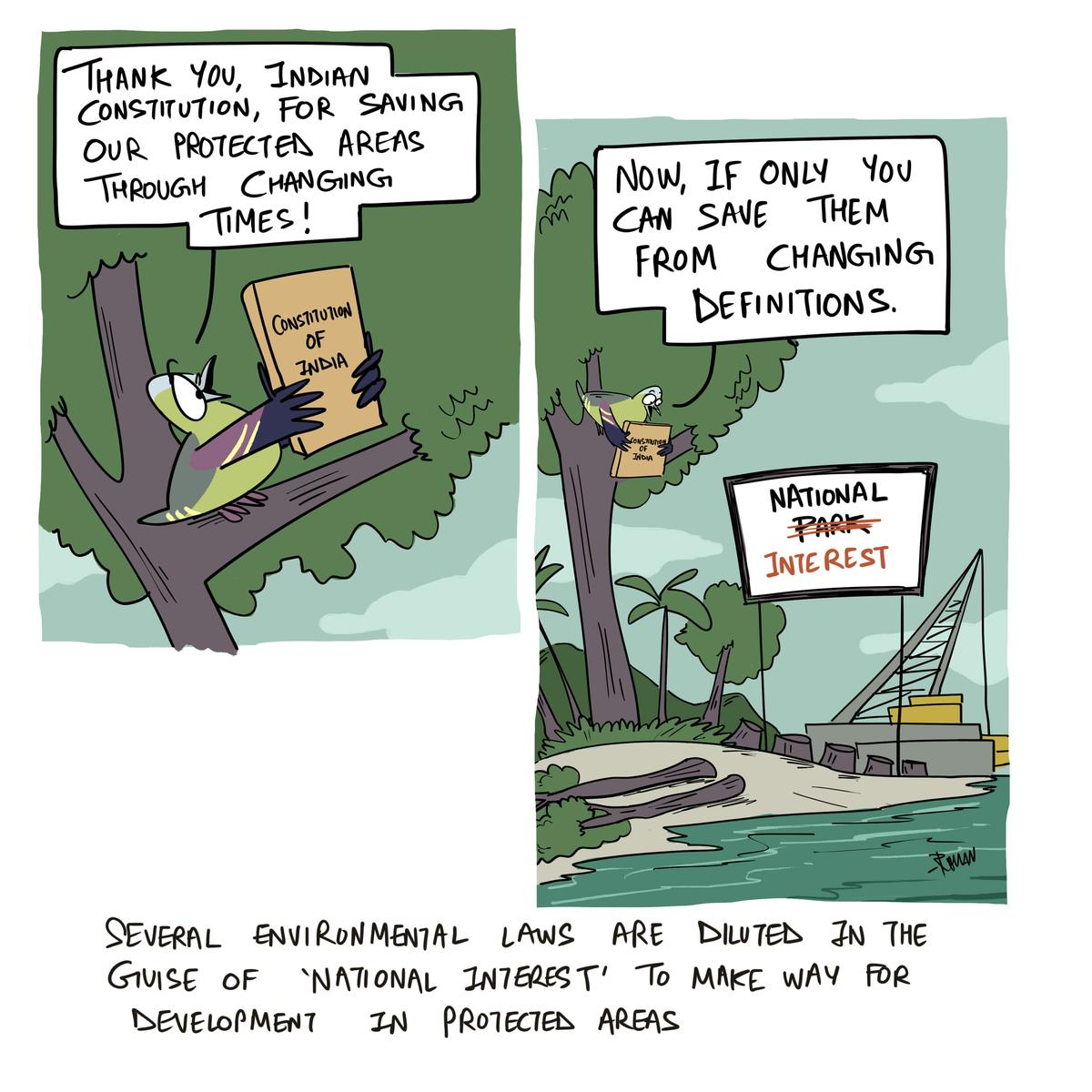
Green Humour by Rohan Chakravarty on the dilution of India’s environmental laws in ‘national interest’. https://www.thehindu.com/sci-tech/energy-and-environment/green-humour-rohan-chakravarty-india-environmental-laws-diluted-national-interest-protected-areas/article69123384.ece (23 Jan. 2025)
SOUTH ASIA
IWT विवाद कौन सुलझाएगा पर्यावरण विशेषज्ञ हिमांशु ठक्कर ने डीडब्ल्यू से बातचीत में बताया कि किशनगंगा बांध का मुद्दा पहले ही आर्बिट्रेशन अदालत में जा चुका था. उन्होंने कहा, “उस वक्त अदालत ने फैसला दिया कि भारत बांध तो बना सकता है लेकिन उसमें भी कई शर्तें मौजूद थीं जिन्हें ध्यान में रखते हुए भारत को बांध बनाना था.” ठक्कर ने कहा, “अब सालों बाद मसला यह है कि पाकिस्तान को लग रहा है कि अदालत द्वारा बताई गई शर्तें सही से लागू नहीं हो रही हैं. तो पाकिस्तान के नजरिये से अगर यह मुद्दा पहले ही अदालत में जा चुका था तो उसे वहीं से दोबारा उठाना चाहिए”.
– हिमांशु ठक्कर बताते हैं कि पूरे समझौते में ऐसा कहीं नहीं लिखा कि आप पहले न्यूट्रल एक्सपर्ट के पास जाएंगे और उसके बाद ही अदालत में. मीडिया रिपोर्टों के अनुसार पाकिस्तान का मानना है कि न्यूट्रल एक्सपर्ट से कोई फायदा नहीं होगा क्योंकि उनका फैसला बाध्यकारी नहीं होता. इस बात पर ठक्कर कहते हैं, “ऐसा नहीं है. न्यूट्रल एक्सपर्ट और अदालत, दोनों का ही फैसला बाध्यकारी होता है.” हिमांशु ने विश्व बैंक की नाकामी पर बात करते हुए बताया, “विश्व बैंक ने छह साल लगा दिए किशनगंगा बांध के मसले को सुलझाने में.” आज भी उन्ही मुद्दों पर दो देश फिर से भिड़ रहे हैं. 2022 में वर्ल्ड बैंक ने एक कोर्ट ऑफ आर्बिट्रेशन और एक न्यूट्रल एक्सपर्ट, दोनों ही नियुक्त कर दिए थे, लेकिन आगे यह भी कहा था कि इन दोनों के फैसले एक दूसरे से उलट भी हो सकते हैं. हिमांशु ठक्कर कहते हैं कि यह फैसला भी विश्व बैंक की नाकाम कोशिशों को दिखाता है. “जब आपने पहले ही बोल दिया है कि न्यूट्रल एक्सपर्ट और अदालत का फैसला एक दूसरे के उलट आ सकता है तो आप एक साथ सामान विवादों की चर्चा दोनों जगह क्यों कर रहे हैं?”
– ठक्कर कहते हैं कि इसका हल ये नहीं कि फैसला खारिज कर दिया जाये. वो आगे कहते हैं, “बल्कि आप दोनों जगह अपने तर्क रखें, उन्हें जीतें और मामला खत्म करें. यह एक अदालत है और बाकी अदालतों की तरह ही अगर आप इसमें सुनवाई पर नहीं आते हैं तो उससे मामला खत्म नहीं हो जाता.” https://www.dw.com/hi/explainer-what-is-indus-river-treaty-and-why-is-it-a-bone-of-contention-between-india-and-pakistan/a-71373089 (23 Jan. 2025)
Neutral expert backs India’s stand A World Bank-appointed neutral expert has backed New Delhi’s position on the framework to resolve certain disputes between India and Pakistan on Kishenganga and Ratle hydroelectric projects. While India has been pressing for resolution of the issues by the neutral expert as mandated under the Indus Water Treaty between the two countries, Pakistan has been backing the Permanent Court of Arbitration to resolve them. https://indianexpress.com/article/india/indus-water-treaty-india-pakistan-rift-9792009/ (22 Jan 2025)
Pakistan A Drought-like conditions emerge in Pakistan due to scarce rainfall Ary News on Jan. 22 cited Pakistan’s Met Office which stated that drought conditions emerged in the country as Pakistan received below-normal rainfall (-40 per cent) for the time period from September 1, 2024 to January 15, 2025. It was reported that Sindh received 52 per cent lesser rainfall during the period, the PMD said in its report about drought conditions.
-Notably, despite the recent rainfall spell in the country, the rains did not prove significant in the plain areas of Pakistan, thereby aggravating the drought conditions. After Sindh, Balochistan received 45 per cent and Pakistan’s Punjab 42 per cent lesser rainfall, PMD said.
-The PMD said that ongoing drought conditions are likely to aggravate further as no significant rainfall is expected in rain-fed areas of Punjab, Sindh and Balochistan, Ary News reported. As per Ary News, the Met department has also viewed the second half of this season, January to March, as dry compared to the first half, also the above normal temperatures forecast may favour the turning of mild drought conditions to moderate drought, especially in the rain-fed areas of country. https://www.tribuneindia.com/news/world/drought-like-conditions-emerge-in-pakistan-due-to-scarce-rainfall/ (22 Jan. 2025)
Damming Brahmaputra Mega dam in Tibet will not be at ‘expense of neighbours’: China Wang Lei, the charge d’affaires at the Chinese embassy in India, tried to address India’s concerns about the Great Bend Chinses hydropower project on Jan 23 in an article in Indian Express where he wrote that critics of the project were wrong to characterise it as a “Chinese weapon”. “China sticks to the policy of forging friendships and partnerships with its neighbours. It never pursues the maximisation of unilateral interests, let alone benefits for itself at the expense of its neighbours. China does not and will never seek ‘water hegemony’,” he said.
– He claimed that China had established over 50 water resource management agreements with neighbouring countries and created 10 cross-border institutions to promote cooperative river development and ecological protection. “China adheres to a responsible attitude towards cross-border river development and pursues a policy of balancing utilisation and protection,” Wang wrote. He said the project had undergone a rigorous assessment and would prioritise biodiversity and the protection of its ecosystem. He added that it would include a disaster prevention system.
– “As the project progresses, China will release more data and information in due course,” he wrote.Wang’s article also claimed the project would have “no negative impact on the lower reaches” of the river and “does not consume water”. https://www.scmp.com/news/china/diplomacy/article/3296327/china-tells-india-yarlung-tsangpo-mega-dam-tibet-will-not-be-expense-neighbours (26 Jan. 2025)
Upstream control, downstream impacts India-China on Brahmaputra: The MoUs did not have any provisions for joint monitoring or data validation and left the final decision regarding terms and timing of sharing to China. Failure to transit beyond data sharing, despite several MoUs since 2002, is also a cause of concern. The cooperation of China is still confined to sharing data for which agreements were made but with the complete denial to be a party to wider transboundary mechanisms of shared watercourses. This reflects a strategic aversion to genuine, fair engagements through binding contracts and a policy preference for sticking to control over water governance.
– UN general assembly resolution 62/68 2007 says that states must prevent transboundary harm with precautionary measures and environmental impact assessments (EIA). In case one causes such damage, the state has a liability to mitigate and provide compensation. https://www.newindianexpress.com/web-only/2025/Jan/18/chinas-mega-dam-strategy-upstream-control-downstream-impacts (18 Jan. 2025)
Trilateral cooperation for Chinese dam on Brahmaputra To address this challenge (of proposed China and India projects on Brahmaputra), Bangladesh must engage proactively with both China and India to secure commitments ensuring that its due share of Brahmaputra water is not compromised. While bilateral dialogues are essential, experts emphasise the need for trilateral cooperation as the most viable solution. Collaborative approaches can transform potential conflicts into opportunities for mutual benefit. One possibility is for Bangladesh to negotiate a stake in the Chinese dam project, leveraging the shared benefits of hydropower generation. The dam, projected to produce over 60 GW of electricity, could be an economic boon if power-sharing agreements are established among China, India, and Bangladesh. A tripartite investment model could ensure equitable access to the energy generated, aligning the interests of all three nations.
– To this end, Bangladesh must initiate efforts at diplomatic level to bring China and India to the negotiating table. It should also engage regional and international organizations to mediate and support the dialogue. A transparent, inclusive process will be the key to ensuring that the Brahmaputra remains a source of life and livelihood for all three nations. https://thefinancialexpress.com.bd/views/opinions/trilateral-cooperation-for-chinese-dam-on-brahmaputra (22 Jan. 2025)
India, China edge towards a Himalayan water war The fragility of the terrain adds to worries. “The damming of the river is fraught with several dangers,” said Deepak. About 15 percent of the great earthquakes – with a magnitude greater than 8.0 on the Richter Scale – in the 20th century occurred in the Himalayas. And that pattern of major earthquakes hitting Tibet has continued. On January 7, a 7.1-scale earthquake killed at least 126 people. At least five out of 14 hydro dams in the region examined by Chinese authorities after the earthquake had ominous signs of damage. The walls of one were tilting, while some others had cracks. Three dams were emptied, and several villages were evacuated.
But while India and China engage in a tug-of-war, experts say that the worst impact could be felt by millions of people in Bangladesh. Although only 8 percent of the 580,000-square-kilometre (224,000-square-mile) area of the Brahmaputra basin falls in Bangladesh, the river system annually provides over 65 percent of the country’s water. That’s why it is viewed as the “lifeline of Bangladesh”, said Sheikh Rokon, secretary-general of Riverine People, a Dhaka-based civil society organisation that focuses on water resources. “The ‘dam for a dam’ race between China and India will impact us most adversely,” Rokon told Al Jazeera.
Those fears have kept Malik Fida Khan, executive director at the Dhaka-based Center for Environmental and Geographic Information Services (CEGIS), on edge for a decade now. “We have access to no information. Not a feasibility report, or the details of the technology that will be used,” he said, his tone tense. “We need a shared, and detailed, feasibility study, environmental impact assessment, and then social and disaster impact assessment. But we have had nothing.”
The Brahmaputra also forms one of the world’s largest sediment deltas in Bangladesh, before entering the Bay of Bengal, and directly supports millions who live on its banks. “If there is any imbalance in the sediment flow, it will increase the riverbank erosion and any chances of potential land reclaiming will vanish,” Khan said. India’s dam, Khan lamented, could be particularly damaging to the part of the basin in Bangladesh. “You cannot counter a dam with another down,” he said. “It will have a huge and fatal impact on millions of us living downstream.”
Rokon agreed. “We need to get out of the ‘wait and see’ attitude regarding Chinese or Indian dams,” he said, reflecting upon the Bangladesh government’s current policy. “The discussion on the Brahmaputra river should not be a mere bilateral discussion between Bangladesh and India, or India and China; it should be a basin-wide discussion.”
Since the ouster of Bangladeshi PM Sheikh Hasina from Dhaka, whose government was backed by New Delhi, the new dispensation led by Nobel laureate Muhammad Yunus has maintained its distance from India. This also means that there is no joint effort, or a unified pushback, from the South Asian countries to counter China’s growing command over the Brahmaputra river, say analysts. Whereas Khan sees this water crisis as “a golden opportunity” for India and Bangladesh to forge ties, Kugelman of Wilson Center isn’t optimistic. “We’ve seen that China is not a country that is receptive to external pressure, whether it be from one country, or two, or even 10,” said Kugelman. “Even if India and Bangladesh were in a position to muster joint resistance toward these Chinese moves, it would not be sufficient to deter Beijing’s actions.” https://www.aljazeera.com/features/2025/1/24/dam-for-a-dam-india-china-edge-towards-a-himalayan-water-war (24 Jan. 2025)
High risks of large dam projects in Himalayas While India is well-justified in raising its concerns with China relating to the planned largest dam project , at the same time India must also show much greater caution regarding the risks and adverse impacts of large dams in the Himalayan region. The same holds true for other countries like Nepal, Bhutan and Pakistan. https://countercurrents.org/2025/01/high-risks-of-large-dam-projects-in-the-himalayas/ (25 Jan 2025)
Opinion Damming of the Brahmaputra Consultation between countries on the construction of dams on rivers that flow through them is part of the standard protocols of hydro-diplomacy because the flow of water, ecology, and other factors are involved. Even though Chinese Minister of Foreign Affairs Wang Yi and Indian National Security Advisor Ajit Doval met on December 18 and talked about “data sharing on trans-border rivers,” among other things, the knowledge if this included any conversations about the Yarlung Tsangpo dam is not forthcoming. China must be aware that arbitrary and unilateral actions go against the spirit of bilateral relations.
-A comprehensive study must be conducted on how the Chinese dam construction across the Brahmaputra is going to influence ecology, seismic activity, and water flow in northeast India and Bangladesh, especially during the dry season, given the fact that China is deliberately weaponising water. (Prasenjit Chowdhury) https://www.deccanherald.com/opinion/damming-of-the-brahmaputra-3370244 (24 Jan. 2025)
Bhutan Paying for a fault not ours 2025 will be the International Year of Glaciers’ Preservation, with March 21 to be observed as the World Day for Glaciers. It is an important international year considering where tiny Bhutan is located. In Bhutan where glaciers play an important role in our survival, experts are warning of clear and present dangers. Recent studies show that glaciers like Ganjula, Thana and Shodug are witnessing billions of litres of glacial water loss. For an ordinary Bhutanese carving out a livelihood from farming or a small business, melting glaciers is not a concern. However, with warnings supported by scientific studies, including on the glaciers in Bhutan, we should be concerned.
– According to the Bhutan Glacial Lake Inventory 2021, Bhutan records 567 glaciers covering 55.04Km square—Phochhu has the maximum. Of the glaciers, 17 are potentially dangerous—Punatsangchhu has 11, Mangdechhu has 3, Chamkhar chhu has two and one in Kurichhu. https://kuenselonline.com/paying-for-a-fault-not-ours/ (21 Jan. 2025)
Bangladesh River culture is rhythmic pulse of delta FASCINATING Reviving rivers in Bangladesh is not simply an ecological issue, but also a socio-cultural one, and an economic imperative. The government and the people must come together to protect and restore the rivers, not just for environmental sustainability and justice, but also to preserve the rich heritage and cultural identity associated with these waterways, a new op-ed argues.
– Bengal’s human culture is ingrained in the gratitude towards life-giving rivers. If rivers are dominated and disappear, then what would happen to the deltaic civilization in Bengal? What would be the source of identity for these people after washing the riverine civilization away?
– Bengalis’ unique repository of literacy and art – ‘river literature’ – melodiously touched every bit of joy, sorrow, and struggle of riparian communities. Poets, novelists, and singers, inspired by their love for rivers, transformed their inner spirit-led literacy into a treasure trove of riverine art.
– Debesh Roy, an influential Bengali-Indian writer and scholar, touched every aspect of riparian communities life on the bank of the Teesta River, in his two artistic novels, ‘Teesta Parer Brittanto’ (Description of the Bank of Teesta) and ‘Teesta Puran’ (Mythology of Teesta). He portrayed the Rajbangsi community, who obeyed the ever-changing landscapes of the river Teesta’s rules and utilized the resources of the Teesta residing on the edge of the forest and hills. They never defied the dominion of the mighty Teesta.
– Manik Bandopadhyay’s revolutionary novel ‘Padma Nadir Majhi’ (Padma River’s Boatman) painted an evocative picture of the lives of fishermen and boatmen on the Padma River, unearthing their resilience and adaptation to the turns and twists of the river Padma. While portraying the fisherfolk’s joys, sorrows, and struggles revolving around the river Titas, Adwaita Mallabarman also penned foreign cultures’ adverse impact on their culture and life, in his popular novel, ‘Titas Ekti Nodir Naam’ (A River Called Titas). Popular festivals like Jatrapala, Noika Baich (boat race), and folk songs like Murshida Baul songs, Puthi, Radha-Krishna Prem Lila (Radha-Krishna’s love story as drama) are further artistically articulated in this novel.
– All genres of Bengali folk songs notably explore the riverine lifestyle. Bhawaiya songs manifest all aspects of Rajbangsi life – from socio-political and economic settings to romantic expressions, often threatening the middle-class Brahman, patriarchal attitude against the expressive culture of the Rajbangsi women. Bhatiari and Sari songs remarkably preserve the plentiful fish culture and its significant role in shaping riparian lives. Another unique and mystical sect emerged in the heart of the Bengal Delta, where diverse cultures and religions converged – the Sahajiya tradition, embracing Vaisnavas and Buddhists, and Muslim Sufis. Sahajiya tantrics, Bauls, and Muslim fakis enriched the Murshidi, Marefati, Baul, and also Jari songs, as a form of prayer, connecting to the divine through nature.
– Riparian Muslims use river water before prayer to cleanse both body and soul, believing in the purifying power of the blessed waters. In the Aini-Akbari book, Abul Fazl recorded Mughal Emperor Akbar’s spiritual attachment with the Ganga, marking the emperor’s habit of drinking Ganga’s waters for blessings, at home and on travels.
– Another noteworthy festival is Bera Bhasan (sending out rafts), as it exceptionally links agrarian and riverine communities, and unites Muslims and Hindus. Arab traders introduced this ritual as an act of prayer for safety before embarking on trade journeys. Also, Hindu peasants observe sedo, a version of bera bhasan on the final day of Pous for a bountiful harvest. In 1690, Bengal’s Nawab Murshid Quli Khan started the festival in honor of Saint Khawja Khizir, known as ‘the Pir of water’. Various Muslim saints’ shrines situated on the mouth, and confluence of important rivers, further signifying the sacred status of rivers.
– Indigenous communities of the Chittagong Hill Tracts and North Bengal hilly regions also begin their ‘Boishabi’ (new year) celebration by sending flowers out upon rivers to release the past year’s disgraces and sorrows, and welcome the new year with good wishes.
– Ironically – though they present a testament to enduring faith, but also disconnection between relevance and responsibility – grand temples are still on the banks of the rivers, without considering the health of the rivers while contaminating the riverine life and culture. – BY UMME SAYEDA. https://news.mongabay.com/2025/01/riverine-culture-is-the-rhythmic-pulse-of-the-bengal-delta-commentary/ (17 Jan. 2025)
Agriculture, environment in peril as Teesta runs dry Teesta river in Bangladesh is drying up quickly creating negative impacts on agriculture, employment and the environment. Currently, the river has literally turned into a narrow channel (waterway) for silt coming from the upstream and not having water flow in it. Sources at the Bangladesh Water Development Board said the water level of the river started decreasing sharply in September 2024. https://today.thefinancialexpress.com.bd/country/agriculture-environment-in-peril-as-teesta-runs-dry-1737564144 (23 Jan. 202)
THE REST OF THE WORLD
USA The day Mississippi became frozen highway The frozen Mississippi River of 1899 remains a marvel of meteorological history, a chilling example of how extreme weather can transform the natural world. From its icy surface came stories of survival, ingenuity, and resilience, as Americans endured one of the coldest winters ever recorded. -While the sight of ice blocks floating into the Gulf of Mexico may never happen again, the memory of the Great Cold Wave—and its frozen river—continues to captivate and remind us of the unpredictable power of the elements. https://indiandefencereview.com/the-day-the-mississippi-river-became-a-frozen-highway-3800-kilometers-of-ice/ (19 Jan. 2025)
SANDRP
Also see: DRP 20 Jan. 2025 & DRP 13 Jan. 2025
Follow us on: www.facebook.com/sandrp.in; https://twitter.com/Indian_Rivers

 SANDRP