
(Feature Image: Resident in upper Siang protesting agaisnt SUMP on Dec. 15. Image source: Ebo Milli @Ebo_Mili_Linggi on X)
Hundreds of People of Siang, East Siang and Upper Siang Districts of Arunachal Pradesh came out in peaceful protests on Dec 14 2024. They opposed the govt effort to deploy armed central and state police forces for a pre-feasibility study for the 12500 MW hydropower project on Siang River, a tributary of Brahmaputra River.
Indeed, as remarkably articulate report by in Arunachal Times said, Siang needs dialogue not guns. In fact, the Chief Minister recently and even the Prime Minister and Union Home Minister had earlier promised to the people of the state that if they do not want big dams, such projects will not be taken without people’s consent as there were options for power and development.
This proposed, one of the largest capacity hydropower projects in the world has little merit, considering the inherent disaster potential of the biodiversity rich area, climate change induced acceleration of the disasters and the destruction that the proposed dam will impose in this area. Hydropower projects in any case are out dated and inappropriate here, also considering the options available. Hope better sense prevails and local people and the country gets democratic decision making process.
Siang Valley responds to State Govt’s coercion with major peaceful protest against Siang Project In a show of strong resistance, the people of Siang Valley have come together for a major peaceful protest against the proposed Siang upper multipurpose project (SUMP), even as the state government attempted to scuttle the protest through force and coercion. This protest follows the state government’s efforts to deploy hundreds of central and state armed police forces to oversee a pre-feasibility survey for the 12,500 mw hydropower project.
Representatives from villages in Siang, East Siang, and Upper Siang districts, where hundreds of central and state armed police forces were supposed to be stationed, gathered in Parong to protest the proposed deployment. Later, they submitted a petition to the state and central governments, strongly opposing the PFR survey and the construction of the SUMP under the guise of national security. They demanded the immediate withdrawal of the deployment order.
“We demand that any decision regarding the deployment of armed forces in the Siang region be made with the consent of the majority of project-affected families. We will not tolerate any attempts to coerce or force our consent regarding the dam. Therefore, we demand the immediate withdrawal of any paramilitary or military forces from the Siang region, as their presence is illegal and unconstitutional. We will not be intimidated or coerced into accepting a project that threatens our very way of life. We urge the government to respect our rights and the law, and to abandon the proposed project,” the petition stated.
The proposed deployment in Siang district included five companies: two companies in Begging, two in Parong village, and one in the Boleng NHPC office. One company of state police was supposed to be stationed in Boleng HQ, with a platoon each of women police to be posted at the NHPC office in Boleng, Boleng HQ, and Parong village, as well as in Pasighat in East Siang.
The government’s initial plans for the Lower Siang HEP (2,700 mw) and the Siang Upper HEP Stage-II (3,750 mw) had already faced resistance for over two decades. Amid growing fears and opposition, the capacity was expanded to 11,000 mw without new studies, triggering a wave of protests. In August 2024, the first survey was proposed, leading villagers to organise a series of protests in Dite Dime and Geku, led by the Siang Indigenous Farmers’ Forum. (https://arunachaltimes.in/index.php/2024/12/16/siang-valley-responds-to-state-govts-coercion-with-major-peaceful-protest-against-siang-project/ Dec 16 2024) Villagers oppose deployment of security for Siang dam project. https://timesofindia.indiatimes.com/city/guwahati/villagers-protest-deployment-of-security-for-siang-dam-project/articleshow/116343241.cms (15 Dec. 2024) ‘Won’t tolerate attempt to force our consent’: Arunachal dam protests intensify after decision to send central forces. https://indianexpress.com/article/india/wont-tolerate-attempt-to-force-our-consent-arunachal-dam-protests-intensify-after-decision-to-send-central-forces-9726828/ (16 Dec. 2024) Residents, activists hold protest against Siang mega dam project. https://www.telegraphindia.com/north-east/arunachal-pradesh-residents-activists-hold-protest-against-siang-mega-dam-project/cid/2070942 (16 Dec. 2024) Communities Up the Ante against the Siang Mega Hydro Power Project. https://www.etvbharat.com/en/!bharat/arunachal-pradesh-communities-up-ante-against-the-siang-mega-hydro-power-project-enn24121405501 (14 Dec. 2024)
Siang needs is dialogue A circular issued by the Siang district administration regarding the arrangement of accommodation for the Central Armed Police Forces (CAPF) at Riew village, in the context of the pre-feasibility report (PFR) of the Siang Upper Multipurpose Project (SUMP), has strongly provoked those opposed to the construction of the mega hydropower project on the revered Siang river. The aggressiveness with which the Pema Khandu government is pushing forward with the Siang dam is both frighteningly alarming and reckless.
– It has used every trick in the book to intimidate the villagers, including the leaders of Siang Indigenous Farmers’ Forum (SIFF). Anti-dam activist Ebo Mili and SIFF convener Dunge Apang were arrested in July while the union power minister was on a visit to Itanagar.
– The decade-long resistance in Dibang was brutally crushed by force and coercion, targeting not only student leaders but villagers as well. Is the government trying to apply the same tactics in Siang? It certainly seems so. The SIFF is not some fly-by-night anti-dam organisation; it has mobilised the masses as seen in previous protests in August. Therefore, the government must refrain from its aggressive and intimidating stance of sending central security forces.
– Such utter disregard for indigenous communities and the use of state brutality is not new in the state, but it is unacceptable. The government is on a confrontational path, unwilling to engage in meaningful dialogue. It just wants to crush any opposition. Instead of conducting a pre-feasibility study while the citizens are divided – with more opposing the dam than supporting it – the government should consider holding a gram sabha in all the villages, upstream and downstream, if it is genuinely serious about listening to the people. The first step should be addressing the fears and concerns of the people. How can the government even contemplate damming an entire river without first holding mass meetings?
– Not long ago, the Rajya Sabha was informed that local villagers had raised concerns over the Upper Siang Multipurpose Project. The power minister said that “these concerns are being addressed through confidence-building measures and outreach activities.” I fail to understand how confidence is built by bringing in trigger-happy security forces to a site where studies are being carried out to counter peaceful protests. It is a direct warning to the citizens to stay away from any form of protest. Siang needs to be handled with care, caution, and respect.
– Therefore, caution is needed – not armed central security forces. Provocation is not the answer. We are talking about a project that will have irreversible ecological impacts and long-term effects on local communities, including displacement, if at all it comes up. The Siang river has nourished the people, their culture, and their history for centuries. Do not incite a river with guns. Go slow. https://arunachaltimes.in/index.php/2024/12/11/not-guns-what-siang-needs-is-dialogue-on-the-11000-mw-hydropower-project/ (11 Dec. 2024)
Protest in Siang over CAPF deployment for dam project Hundreds of people on Sunday (Dec. 15) gathered at the gate of Parong village in Siang district, protesting against the proposed deployment of Central Armed Police Forces (CAPF) to conduct a study for preparing the pre-feasibility report of the 11,000 MW Siang Upper Multipurpose Project. The protestors voiced their opposition to the government, highlighting socio-environmental issues such as displacement, the loss of ancestral lands and threats to biodiversity. They alleged that the government had infringed upon the people’s rights, calling for the immediate withdrawal of security forces and a halt to the project. The protesters were primarily from the villages of Parong, Riew, Geku and Sitang in Siang and Upper Siang districts. https://nenow.in/north-east-news/arunachal-pradesh/arunachal-protest-in-siang-over-capf-deployment-for-dam-project.html (16 Dec. 2024)
NEHR opposes deployment of CAPF in Riew village The Northeast Human Rights (NEHR) wrote a letter to Chief Minister Pema Khandu and Deputy Chief Minister Chowna Mein, strongly opposing the deployment of the Central Armed Police Forces (CAPF) for conducting the pre-feasibility report (PFR) for the NHPC’s 11,000 mw Siang upper multipurpose project (SUMP).
-The NEHR cited the Article 32 (2) of the United Nations Declaration on the Rights of Indigenous Peoples (UNDRIP), and said that the indigenous people have the right to free, prior, and informed consent (FPIC) before approval of projects affecting their lands or territories.
-It cited the International Labour Organization (ILO) Convention 169, Article 15: “Indigenous people must actively participate in the planning and implementation of projects affecting their lands and resources.” The NEHR has demanded immediate withdrawal of the CAPF related to the SUMP PFS. It also demanded transparent communication with the affected communities, adhering to the principles of free, prior, and informed consent.
-It appealed for reconsideration of the SUMP in light of consistent opposition and legal obligations and sought public assurance from both the CM and the DCM to uphold the rights and sentiments of the indigenous communities of the state.
-Human Rights activist, advocate Ebo Mili has questioned the deployment of Central Armed Police Force. Addressing a press conference on Tuesday (Dec. 10) at the Arunachal Press Club, Mili said, “India, being a signatory to these international agreements, is obligated to uphold these principles. Forcing militarisation for the PFR without community consent directly contravenes these commitments.” https://arunachaltimes.in/index.php/2024/12/11/nehr-opposes-deployment-of-capf-in-riew-village/ (11 Dec. 2024)

Citizen groups protest deployment of military to anti-dam villages The deployment of military forces has ignited a larger debate on the ethical and legal implications of the dam, further intensifying opposition from local communities and rights groups.https://www.newindianexpress.com/nation/2024/Dec/11/citizen-groups-protest-deployment-of-military-to-anti-dam-villages-in-arunachal-pradesh (11 Dec. 2024)
Indigenous people refuse to give up fight against Siang dam Ever since the government risked the proposal for the construction of Siang Mega Dam and signed the MoU, the locals—to save the myth and mythological history related to mother Siang, flora and fauna to save environment, to avoid any natural catastrophe, to preserved the identity of Adi’s connected to Siang river in aspect agricultural and forest products etc.—have been resisting the issue of Siang Dam and committed to die for the cause of saving the mother Siang from any unnatural interference. https://www.eastmojo.com/news/aipp-eastmojo-fellowship-2024/2024/12/12/why-arunachals-indigenous-people-refuse-to-give-up-fight-against-siang-dam/ (12 Dec. 2024)
Need hospitals, not dams: Upper Siang residents The healthcare crisis, particularly in rural districts like Upper Siang, highlights the deep disparities in healthcare access across India. https://www.eastmojo.com/news/aipp-eastmojo-fellowship-2024/2024/12/13/arunachal-need-hospitals-not-dams-say-residents-of-upper-siang-district/ (14 Dec. 2024)
ADP criticizes govt for deployment of CAPF In a presser at the Arunachal Press Club (APC) here on Thursday (Dec. 11), Arunachal Democratic Party (ADP) president Tami Pangu underscored the importance of a peaceful resolution and expressed concern over the possible escalation of tensions in the region. Pangu called for constructive discussions involving all stakeholders to reach a mutually acceptable solution that would protect the interests of local communities and the environment.
-“We appeal to the state govt to constitute a high-level committee, comprising political leaders, community organizations, and affected families to resolve the matter,” he said. He further emphasized that the construction of the dam could not proceed without local consent. https://timesofindia.indiatimes.com/city/guwahati/adp-criticizes-govt-for-deployment-of-capf/articleshowprint/116262412.cms (12 Dec. 2024)
Preserve the heart of Upper Siang Valley Now is the time for solidarity with Ebo Mili and the indigenous peoples of Upper Siang who stand against the detrimental implications of the proposed dam. Their resistance resonates with the broader fight against unjust development practices not only in India but globally. The government must recognize that development without consent, dialogue, and understanding is not development but rather a step towards erasure. https://arunachaltimes.in/index.php/2024/12/12/standing-with-ebo-mili-preserve-the-heart-of-upper-siang-valley/ (12 Dec. 2024)
EDIT Standing with Ebo Mili, Preserve the Heart of Upper Siang Valley Now is the time for solidarity with Ebo Mili and the indigenous peoples of Upper Siang who stand against the detrimental implications of the proposed dam. Their resistance resonates with the broader fight against unjust development practices not only in India but globally. The government must recognize that development without consent, dialogue, and understanding is not development but rather a step towards erasure. https://arunachaltimes.in/index.php/2024/12/12/standing-with-ebo-mili-preserve-the-heart-of-upper-siang-valley/ (12 Dec. 2024)
Govt deploys central forces to counter dam protestors in Siang Valley The Arunachal Pradesh government has deployed a team of Central Armed Police Force (CAPF) close to the proposed site of the 12.5 GW Siang Upper Multipurpose Project (SUMP), touted to be India’s largest dam, according to an official document. The move, to conduct a survey for a pre-feasibility report (PFR) on SUMP, has angered locals opposed to the dam. Several women from villages close to the proposed site on the Siang river, the transboundary main channel of the Brahmaputra, continue to guard the site, opposing the dam and any survey over the river. According to a letter issued to the Circle Officer, Redo-Perging subdivision on December 6 by Deputy Commissioner (DC) of Siang district, PN Thungon, a team of CAPF is expected to be stationed in Riew village, in the purview of conduct of a PFR regarding the SUMP.
– Residents from Pareng and several other villages have been guarding a portion of the Siang, shouting slogans of ‘No Survey, No Dam’. Bhanu Tatak, legal advisor of the Siang Indigenous Farmers’ Forum (SIFF), told Down To Earth that the deployment of the CAPF goes against a Gauhati High Court order that cancelled proposed dams on the Siang. “The people of the Siang valley have been against dams on the river for over four decades. Our people have been peacefully protesting against the surveys by any government agency or a dam developer. People do have the right to protest against this decision in order to protect their homes and hearths,” Tatak, whose organisation represents the interests of farmers from Arunachal’s Adi community, added. https://www.downtoearth.org.in/dams/himalayas-arunachal-government-deploys-central-forces-to-counter-dam-protestors-in-siang-valley (10 Dec. 2024)
Amid opposition from the public, the state government has requisitioned armed police to be deployed for the implementation of the 11000 Mw Siang Upper Multipurpose Project. https://x.com/arunachaltimes_/status/1867475488735649961?fbclid (13 Dec. 2024)
Following the report of the proposed deployment of Central Armed Paramilitary Forces (CAPF) in Riew village in Siang district to quell anti-dam resistance, the village’s Head Gaon Bura (HGB) Tabeng Tamuk has lodged an FIR against Deputy Commissioner PN Thungon, accusing him of “misleading the villagers.” In the FIR, a copy of which has surfaced on social media, the HGB stated that the DC misled him in the matter of accommodating CAPF personnel at the defunct government primary school in Riew. https://arunachaltimes.in/index.php/2024/12/15/villagers-says-no-to-capf-deployment-fir-against-dc-for-misleading-villagers/ (15 Dec. 2024)
HYDRO POWER PROJECTS
Sikkim People left to choose between climate change & ‘development’ The combined impact of industrialization and climate change is destabilizing the delicate balance of this Himalayan region. Yet, the responsibility voiced to safeguard Sikkim’s fragile ecosystem largely falls on deaf ears. Why aren’t more voices joining this vital cause? The flood in 2023 highlighted the dangers of such infrastructure in fragile regions. When dams collapsed under the weight of floodwaters, they exacerbated the destruction instead of alleviating it. https://www.eastmojo.com/news/aipp-eastmojo-fellowship-2024/2024/12/12/a-hard-choice-sikkimese-left-to-choose-between-climate-change-development/ (12 De. 2024)
Himachal Pradesh Cabinet nod to revive 700 stalled HEPs The state cabinet on Dec 12 accepted the recommendations of revenue minister Jagat Singh Negi-led high-powered committee to assess and formulate a policy to revive nearly 700 stalled hydropower projects of up to 25 Mw, which have been showing no visible progress. https://timesofindia.indiatimes.com/city/shimla/hp-cabinet-nod-to-revive-700-stalled-hydropower-projects/articleshowprint/116267801.cms (13 Dec. 2024)
Parliament Sesson Incremental growth in electricity by small & large hydros Reflecting a growth of 4.6%. Small hydro projects saw a slight increase, from 4.99 GW in 2023 to 5.08 GW in 2024, with total capacity, including pipeline projects, reaching 5.54 GW. Large hydroelectric projects grew incrementally, with installed capacity rising from 46.88 GW in 2023 to 46.97 GW in 2024, and total capacity, including pipeline projects, increasing to 67.02 GW from 64.85 GW in the previous year. https://pib.gov.in/PressReleaseIframePage.aspx?PRID=2083317 (11 Dec. 2024)
Industry “45% of all ongoing HEPs in India are ours”: Patel Engineering “I’m proud to say that out of all the hydropower constructed in India, 25 per cent has been our contribution,” Kavita Shirvaikar, managing director of Patel Engineering said. “Currently, 45 per cent of all ongoing hydropower projects in India are ours.” PE has an order book of Rs 17,000 crore, Hydropower constitutes 60 per cent, followed by irrigation (21 per cent) and other sectors like tunneling. PE reported a turnover of INR 4,400 crore in 2023-24, with a projected 10 per cent growth for 2024-25. A selective bidding strategy, focused on high-margin projects in hydropower, underpins this success. https://www.entrepreneur.com/en-in/news-and-trends/45-of-all-ongoing-hydropower-projects-in-india-are-ours/484263 (13 Dec. 2024)
MoEF Decisions of EAC meeting on River Valley Projects held on Nov 30 2024:
1. Myntdu Leshka Hydro Electric Project Stage-II (3X70) MW in 85.229 Ha at Village Bataw, Amtra, Satpator, Kharkhana and Tarangblang, Sub-dist Khliehriat and Amlarem, Dist East Jaintia Hills and West Jaintia Hills, Meghalaya by Meghalaya Power Generation Corp Ltd – FOR Environmental Clearance: More Info Sought including TEC for DPR, comparative chart of info in 2020 and 2024, CIFRI study on fish pass, Cumulative Impact Assessment and detailed action plan in acidity in river water.
2. Chentikheda Major Irrigation Project (CCA: 15300 ha) in 1361.25 Ha at Villages Agra, Bijaipur, Devra, Garhi and etc., Sub-dist Vijaypur and Sabalgarh, Distr Sheopur and Morena, Madhya Pradesh by Water Resources Dept for TOR: Only Asstt Engr appeared at the meeting, who could not explain project. EAC asked the PP to be more serious. Deferred.
3. Hidising Irrigation Project (CCA: 2958 ha) in 386.91 Ha Village Kararasinga, Sub Dist Purunakot, Dist Anugul, Odisha – FOR Terms of References: Approved.
4. Teesta Hydroelectric Project Stage-III (1200 MW) in 213.8831 ha at Village Lingdong, Kazor, Barfok, Meyong etc Sub-dist Mangan and Chungthang, North District, Sikkim by Sikkim Urja Limited – Amendment in Environmental Clearance: EAC sub com to visit: The EAC expressed serious concerns regarding the dam’s design and stability; its ability to withstand potential natural disasters in the future. The committee emphasized the need for a thorough review of the proposed modifications to ensure the structural resilience and safety of the dam, particularly given the region’s susceptibility to extreme hydrological events. It was therefore recommended to get comments from the Central Electricity Authority (CEA) on the proposed modifications.
5. Warsgaon Warangi Pumped Storage Project (1500 MW) in 226.16 Ha at Village Khanu, Teckpole and Warangi, Sub Dist Velhe and Mahad, Dist Pune and Raigad, Mah by Adani Green Energy Ltd – Terms of Reference: PP requested deferment.
6. Sikaser Open loop Pumped Storage Hydro-electric Project (1200 MW) in 160 Ha at Village East Raipur PF, Sub-dist Bindranavagarh , Dist Gariyaband, Chhattisgarh by CG State Power Generation Company Ltd – Terms of Reference: Approved https://parivesh.nic.in/utildoc/114429141_1733834917785.pdf (Dec. 2024)
Agenda of EAC meeting on River Valley Projects to be held on Dec 19 2024:
1. Indirasagar – Omkareshwar on-stream Pumped Storage Project (640 MW) in 198 Ha at Village Narmada Nagar, Tahasil Punasa, Dist Khandwa, Madhya Pradesh by M/s NHDC Ltd – Terms of References
2. Musakhand Close Loop Pumped Storage Project (600 MW) in 313.70 ha at Village Mobarakpur and Jamsoti, Tehsil Chakia, Dist Chandauli, Uttar Pradesh by Acme Cleantech Solutions Pvt Ltd – Amendment in Terms of References. https://parivesh.nic.in/utildoc/114331992_1733749501849.pdf (Dec. 2024)
DAMS
Kaleshwaram Project The National Dam Safety Authority (NDSA) is likely to submit its final report on the Kaleshwaram Lift Irrigation Scheme (KLIS) by December end, excluding the aspect of conducting geo-technical tests. https://www.newindianexpress.com/states/telangana/2024/Dec/15/ndsa-likely-to-submit-final-report-on-kaleshwaram-lift-irrigation-scheme-by-december-end (15 Dec. 2024)
Polavaram Project Diaphragm wall works to begin in January Once CM N Chandrababu Naidu releases the work schedule for the Diaphragm Wall of the Polavaram Project on Dec 16, the construction of the D-Wall will commence in the first week of January. The 1,400-metre-long Rs 900 Cr D-Wall will be taken up in a phased manner as per the recommendation of the committee of experts. The new D-Wall designs were approved by the Central Water Commission in the last week of November. The new D-Wall will be constructed by MEIL, in collaboration with Bauer Group of Germany, and it is expected to be completed by March 2026, if not by December 2025. Incorporating the suggestions of the international committee of experts, the new D-Wall will be constructed some 6 metres upstream of the existing D-Wall, which was damaged during floods in 2019 and 2020.
– According to experts, the D-Wall will be a sub-surface construction going to 2 metres in depth beneath the rock strata below the riverbed. Rock strata is found at varying depths in the riverbed of Godavari at the location of the proposed D-Wall. The depth varies from 40 to 90 metres. The international experts’ team, which studied the scoured portions of the project, and other aspects, is likely to examine, and submit its recommendations to the CWC by February for its approval of the Earth Cum Rock Fill (ECRF) Dam. Works of the ECRF Dam Gap 1 are likely to be taken up in March next year, and Gap 2 in November. https://www.newindianexpress.com/states/andhra-pradesh/2024/Dec/10/polavaram-diaphragm-wall-works-to-begin-in-january (10 Dec. 2024)
Mekedatu Dam Alternative land identified in 3 districts Karnataka water resources department has identified alternative land across the districts of Ramanagara, Mandya and Chamarajanagara to compensate for the 5,000 acres of forest land that will be submerged due to the Mekedatu project. The initiative aims to provide an equivalent area to offset the ecological impact of constructing a balancing dam on the Cauvery River, Cauvery Neeravari Nigam Limited (CNNL) executive engineer Mohan Gowda said on Sunday (Dec. 08).
-Despite its potential benefits, the project has faced delays due to environmental clearances and concerns from various groups about the ecological and social impacts. Environmentalists have raised alarms over the submersion of forest areas in the Cauvery Wildlife Sanctuary, while local communities fear displacement and disruption of their livelihoods. Experts argue that the actual ecological situation is far graver. “At a time when we should be augmenting our forest ecosystem, we are depleting and plundering it. Ideally, 33% of the Indian landscape should be reserved for forests. But we barely have 20%,” wildlife activist Joseph Hoover said. https://www.hindustantimes.com/india-news/alternative-land-identified-for-mekedatu-project-in-3-districts-101733683332929-amp.html (09 Dec. 2024)
Govt set to acquire 5,000 ha forest land In a recent announcement, the government has selected protected forest areas, Cauvery zone forest areas, and alternative land for dam construction, according to a Thanthi TV report. The government has also plans to acquire 5,096.24 hectares of land from the Cauvery zone forest areas for the dam’s construction. In return, 7404.62 hectares of alternative land will be provided to those affected by the project. The plan also includes the provision of alternative land to support the 233 families from ve villages who will be displaced due to the land acquisition. https://www.dtnext.in/news/national/mekedatu-dam-project-karnataka-government-set-to-acquire-5000-hectares-of-forest-land-814201 (7 Dec 2024)
Mullaperiyar Dam Kerala grants permission for maintenance work The Kerala government’s forest department has permitted Tamil Nadu to undertake maintenance work at the Mullaiperiyar dam site and allowed the passage of lorries carrying construction material through the Vallakadavu check post and the Thekkady boat jetty, Theni district collector R V Shajeevana said. https://www.deccanchronicle.com/southern-states/tamil-nadu/kerala-grants-permission-for-maintenance-work-at-mullaiperiyar-dam-1846559 (13 Dec. 2024)
Telangana Govt plans 300 Mw floating solar plant at Lower Manair The state govt has chosen Lower Maniar dam to build 300 Mw floating solar power plant to generate 300 Mw at Lower Maniar dam. This will be state’s first floating solar project if all goes according to plans of Singareni Collieries Company Limited. Though the dam is spread around 80 km, the solar plant is likely to come up roughly over one-tenth of the dam area. The survey for setting up solar plants was done three years ago. The previous govt had not acted on the project report. The project is likely to cost around Rs.12,000 crore and once it is completed, it would be the largest solar power plant in the country. https://www.deccanchronicle.com/southern-states/telangana/telangana-government-plans-300-mw-floating-solar-plant-at-lower-manair-dam-1845274 (09 Dec. 2024)
Rajasthan BJP, Cong indifferent to our demands on Jawai dam water: Farmers Farmers of Jalore have been staging demonstration for over three weeks demanding their share of water from Jawai Dam through Jawai river in order to get the wells and borewells of their farms recharged. A year ago, during an assembly election rally in Sayla, the Union Home Minister Amit Shah had spoken about reviving the Jawai river. “However, even after a year, no solution has been implemented. This has forced us to sit on this protest. The protest will continue until our demands are met,” said Kheem Singh, regional vice-president of the Bharatiya Kisan Sangh. https://timesofindia.indiatimes.com/city/jaipur/bjp-cong-indifferent-to-our-demands-on-water-from-jawai-dam-jalore-farmers/articleshowprint/116298917.cms (13 Dec. 2024)
INTERLINKING OF RIVERS
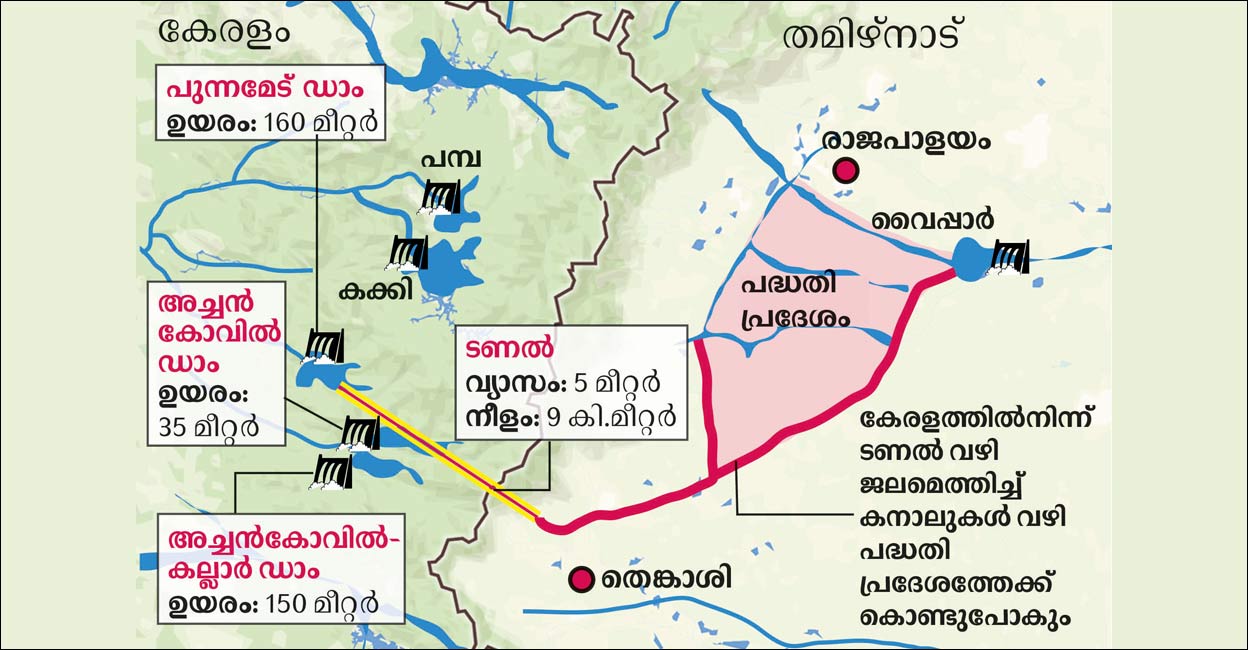
Pamba-Achankovil-Vaippar River Interlinking Kerala faces new battle as river interlinking project is revived -The Pamba-Achankovil-Vaippar River Interlinking Project is back on the agenda, despite strong opposition from Kerala. Tamil Nadu’s demand to divert Kerala’s river water for irrigation has sparked renewed debate over water rights and environmental impact.
RIVERS AS NATIONAL WATERWAYS
Karnataka Pact to develop tourism in rivers Kabini, Sharavathi Union Minister for Ports and Shipping Sarbananda Sonowal said that Inland Waterways Authority of India (IWAI), an autonomous organisation under Ministry of Ports, Shipping and Waterways has entered into a memorandum of understanding (MoU) with Department of Tourism, Karnataka for development of River Kabini and Sharavathi. The tender for EIA-EMP has been floated for taking up development of jetties and navigation aids. Karnataka has a total of 12 national waterways. https://www.deccanherald.com/india/karnataka/pact-with-central-agency-to-develop-tourism-in-rivers-kabini-sharavathi-3317199 (14 Dec. 2024)
URBAN RIVERS
Buddha Dariya; Ludhiana NGT hearing advanced to Dec 23 The NGT has advanced the hearing regarding the pollution caused by common effluent treatment plants (CETPs) in Buddha Nullah following concerns raised by activists from the Kale Pani Da Morcha. The hearing, originally scheduled for March 20, will now be heard on December 23 in response to the “blatant violations and misinterpretations” related to environmental norms. https://www.hindustantimes.com/cities/chandigarh-news/ludhiana-ngt-hearing-on-effluent-treatment-plants-advanced-to-dec-23-101733771379301.html (10 Dec. 2024)
No STP complies with norms Untreated sewage is flowing into the Buddha Nullah and no STP or CETP fully complies with the prescribed discharge standards, the Central Pollution Control Board (CPCB) has found. These are the findings of the federal environmental protection body after it monitored the STPs and CETPs during spot visits in July. https://www.tribuneindia.com/news/punjab/buddha-nullah-pollution-in-ludhiana-no-sewage-treatment-plant-complies-with-norms/ (10 Dec. 2024)
Clean-up continues to be a lost causen What used to be a freshwater rivulet in the 1980s has turned into a drain open to multiple sources of pollution, including industrial effluents that are toxic and carcinogenic. The Buddha Nullah is also made to “digest most of the waste from almost half of Ludhiana”, which has a population estimated at 40 lakh. Till date, nearly Rs 2,000 crore has been spent to clean the black spot of Ludhiana, but its water remains polluted and acidic. https://www.tribuneindia.com/news/in-depth/why-buddha-nullah-clean-up-continues-to-be-a-lost-cause/ (08 Dec. 2024)
Farmers protesting pollution Previously a freshwater stream known as ‘Buddha Dariya (old stream)’, Buddha Nullah originates in Ludhiana’s Koom Kalan village and runs for 47 km till Walipur Kalan, where it merges with River Sutlej. Sutlej in turn feeds water into Rajasthan’s Gang and Indira Gandhi canals.
-According to farmers, over 400 factories in Ludhiana, including dyeing, textile, and leather-making units, are responsible for discharging untreated waste into the Sutlej River. The pollution is said to have intensified since 2008, severely affecting public health. https://indianexpress.com/article/explained/toxic-buddha-nullah-farmers-protests-9715382/ (10 Dec. 2024)
Mula-Mutha; Pune PMC plans boundary walls to prevent future floods After record rainfall in the Khadakwasla Dam catchment area earlier this year, which led to significant water discharge and flooding in parts of Pune, the Municipal Corporation has initiated steps to prevent similar occurrences in the future. Municipal Commissioner Dr. Rajendra Bhosale has instructed the civic administration to draft a comprehensive plan within eight days, comprising both short-term and long-term flood mitigation measures. This decision follows a report submitted by a committee tasked with investigating the July flooding, which severely affected areas such as Ekta Nagri on Sinhagad Road, Deccan, and Patil Estate. https://www.punekarnews.in/pune-pmc-plans-riverfront-development-boundary-walls-to-prevent-future-floods/ (10 Dec. 2024)
Bengaluru A virtual trip to river Cauvery As a part of BLR Hubba, Chaarana Labs has put together an immersive experience focusing on Bengaluru and the Cauvery river. It is called ‘River Realms’. The immersive experience is divided into two parts — augmented reality (AR) and virtual reality (VR). The AR portion of the experience focuses on the relationship between river Cauvery and Bengaluru. https://www.deccanherald.com/india/karnataka/bengaluru/a-virtual-trip-to-river-cauvery-3312266 (11 Dec. 2024)
RIVERS
Study Rivers worldwide changing The nearly 3 million rivers that weave across the world are experiencing rapid and surprising changes, with potentially drastic implications for everything from drinking water supplies to flood risks, according to a new study. Scientists mapped the flow of water through every single river on the planet, every day over the past 35 years, using a combination of satellite data and computer modeling.
Nearly half of the world’s largest downstream rivers— 44% — saw a drop in the amount of water flowing through them each year, according to the research published Dec 12 in the journal Science. For the smallest upstream rivers, mostly in mountainous areas, it was a different story: 17% saw an increase in flow rate. While the study didn’t delve into the reasons behind the changes, the authors say the clear drivers are human activity & the fossil fuel-driven climate crisis, which is shifting rainfall patterns & accelerating snowmelt. https://edition.cnn.com/2024/12/12/climate/world-rivers-flow-mapped/index.html (12 Dec. 2024)
Unruly river & plantation logics Abstract In this contribution to the Plantationocene forum, we ask what and how the Plantationocene allows us to see. Considering the unruly Colorado, we think through how both the delimitation of time into epochs in the form of “cenes” and the search for plantation logics might limit what we can see and understand, by excluding the unruliness of both nature and people, and by insisting on a historical vision that maintains European agency, even if rendered as a problem. We turn to other theories of time and place to attend to the forms of life that confound settler colonial plantation logics and ask whether, despite scholars’ intentions to create a critical model of our entangled social and environmental planetary histories, the Plantationocene instead risks producing Native absence. https://www.tandfonline.com/doi/full/10.1080/24694452.2023.2266014 (08 Dec. 2024)
CWC Assessment of water resources 2024 The Central Water Commission (CWC) in its study ‘Assessment of Water Resources of India 2024’ estimated that India’s average annual water availability, between 1985 and 2023, stood at 2,115.95 billion cubic meters (BCM). The water availability has been assessed for all river basins in the country, excluding three western tributaries of the Indus (Indus, Jhelum, and Chenab).
-According to the CWC report, Brahmaputra (592.32 BCM), Ganga (581.75 BCM), and Godavari (129.17 BCM) were the top three basins with the highest water availability across the country, while Sabarmati (9.87 BCM), Pennar (10.42 BCM), and Mahi (13.03 BCM) were bottom three basins in terms of water availability.
The 2,115.95 BCM figure is higher than the previous estimate made in 2019, which calculated water availability from 1985 to 2015 to be at 1,999.2 BCM. About half a dozen such assessments, using various methodologies, had been carried out prior to 2019. All of these found water availability to be under 2,000 BCM, with the earliest estimate in 1901-03 giving a 1,443.2 BCM.
The current water availability figure higher than previous assessments primarily due to methodological factors. First, the new assessment takes into account Bhutan’s contribution to the Brahmaputra, which was not included in the assessment conducted in 2019. Second, while Nepal’s contribution to the Ganga was only partially taken into account in the 2019 assessment, the current study includes it fully.
According to the CWC, “The current study includes all trans-boundary water entering India in the Brahmaputra basin, in the Ganga basin and in the Indus basin (eastern rivers).”
The CWC’s numbers do not refer to water that is utilisable. For instance, in 2019, the average water resources availability was assessed at 1999.2 BCM, but the utilisable surface water resources were estimated to be 690 BCM. https://indianexpress.com/article/explained/water-india-available-central-water-commission-9720985/ (12 Dec. 2024)
West Bengal Irrigation dept to dredge Karala river According to sources in the department, it has been decided to dredge the entire stretch from near the Jalpaiguri Government Engineering College to the point where the Karala meets the Teesta river. “We have prepared a plan to dredge the Karla river. The cost of the work is yet to be calculated. Once the detailed project report is prepared, we will send it to our senior officials for approval,” said Krishnendu Bhowmik, chief engineer (northeast) of the state irrigation department.
-An official of the irrigation department said according to the plan, dredging of the riverbed will be taken up to a depth varying from 0.5 metres to 1.5 metres. “During dredging, around 90 per cent of the sand would be taken out of the riverbed while the remaining 10 per cent will be clay. Altogether, around 4.22 lakh tons of sand and clay will be removed from the riverbed,” he said.
-A section of residents pointed out that along with the dredging, the administration, the local civic body, and other authorities concerned should also ensure that the dumping of waste in the river stopped. “Also, sewerage lines from many municipal wards open to the river. This has to stop. Or else, the irrigation department should install sewerage treatment plants to prevent polluted water from flowing into the river,” said Jayanta Bhaumik, a resident. https://www.telegraphindia.com/west-bengal/bengal-irrigation-department-to-dredge-15km-long-stretch-of-karala-river-in-jalpaiguri/cid/2070255 (13 Dec. 2024)
GANGA Kanpur औद्योगिक प्रदूषण: लोगों के शरीर में मिला क्रोमियम, मर्करी का अंश कानपुर नगर और कानपुर देहात व आस-पास जिलों के औद्योगिक क्षेत्रों में जल और मिट्टी में भारी धातुओं का प्रदूषण लगातार जारी है। प्रदूषण की चपेट में आने वाले लोगों के शरीर में खतरनाक धातुओं के अंश मिल रहे हैं। वहीं, कई लोग गंभीर बीमारियों से जूझ रहे हैं। एनजीटी के आदेश के बाद औद्योगिक क्षेत्रों में किए गए एक स्वास्थ्य सर्वे में यह चौंकाने वाला तथ्य सामने आए हैं। एनजीटी में न्यायमित्र (एमिकस क्यूरी) की ओर से दाखिल अंतरिम रिपोर्ट में यह कहा गया है कि कानपुर नगर, कानपुर देहात और फतेहपुर जिलों के औद्योगिक क्षेत्र में “आपातकालीन स्थितियां” हैं।
-एमिकस क्यूरी ने ग्राउंड पर पाया कि कानपुर नगर, कानपुर देहात और फतेहपुर में क्रोमियम जैसे भारी धातुओं का अत्यधिक जमाव पाया गया है। कई जगहों पर बारिश के पानी से भरे गड्ढे जहरीले तालाब बन गए हैं। साथ ही यमुना नदी और उसकी सहायक नदियों में घरेलू और औद्योगिक कचरे का बहाव देखा गया है। स्थानीय निवासियों में त्वचा रोग, फेफड़ों की बीमारी, मानसिक स्वास्थ्य समस्याएं और अस्थमा के मामले बढ़ रहे हैं। कानपुर नगर के अटल घाट नवाब गंज और गोलाघाट नाले में प्रदूषण का स्तर अत्यधिक है। इसके अलावा जाजमऊ एसटीपी की खराब स्थिति और जुही बबूरिया में जाम सीवर लाइनों की समस्या है।
-एनजीटी ने उत्तर प्रदेश राज्य के मुख्य सचिव और अन्य संबंधित अधिकारियों को अगली सुनवाई में स्थिति रिपोर्ट पेश करने को कहा है। साथा ही सेंट्रल ग्राउंड वॉटर अथॉरिटी और नेशनल मिशन फॉर क्लीन गंगा से जल शोधन परियोजनाओं की स्थिति पर रिपोर्ट तलब की है। और सीपीसीबी और यूपीपीसीबी से टेनरियों और एसटीपी की स्थिति पर जवाब दाखिल करने को कहा है। मामले की अगली सुनवाई 20 जनवरी, 2025 को होगी। https://hindi.downtoearth.org.in/pollution/emergency-situations-in-kanpur-chromium-and-mercury-found-in-peoples-body-due-to-industrial-pollution (13 Dec. 2024)
Panel to analyse drains flowing into Ganga, Pandu The UPPCB officials identified several drains releasing contaminated water into the Ganga. The board’s findings indicate that untreated waste from Ranighat, Golaghat, Satti Chaura, Dhaba, Madarpur, and Kishanpur drains is contributing to Ganga pollution. Furthermore, partially tapped drains at Paramiya and Guptarghat are releasing sewage overflow into the river.
-The Pandu River faces contamination from six drains–three untreated ones (Pipauri, Arra, and Sagarpuri) and three partially treated ones (Halwakhada, Panki Thermal, and Ganda Nala). The district administration ordered bio-remediation procedures for all these drains. https://timesofindia.indiatimes.com/city/kanpur/panel-to-analyse-water-from-drains-flowing-into-ganga-pandu-rivers/articleshowprint/116298469.cms (13 Dec. 2024)
YAMUNA Delhi Record pollution in Nov in 4 years The Yamuna experienced its highest pollution levels this Nov since Dec 2020. While this continued a pattern seen in previous Novembers, the faecal pollution, which worsened throughout the year, was the highest in four years. https://timesofindia.indiatimes.com/city/delhi/yamuna-river-pollution-surges-faecal-coliform-count-hits-record-high/articleshowprint/116183271.cms (11 Dec. 2024)
RIVERS BIODIVERSITY
Report Tracking an elusive turtle with genetic clues from nature Batagur baska is an estuarine species which lives in rivers and chooses the sea shore only for laying eggs.
-Habitat loss is another detriment behind Batagur baska’s current unfortunate stature in India. “The construction of the Farakka barrage across the Ganga river has reduced the amount of freshwater flowing into the [Sundarbans] reserve. In the past ten years, the salinity of the rivers in the reserve doubled from 10 parts per thousand (ppt) to 20 ppt. This species can survive in waters with salinity up to 10 ppt,” Amirtha Balan from WII explains. Additionally, in the past two decades, tropical cyclones in the Sundarbans region have eroded the sandy beaches, which are the potential nesting sites of Batagur baska. https://india.mongabay.com/2024/12/tracking-an-elusive-turtle-with-genetic-clues-from-nature/ (12 Dec. 2024)
FISH, FISHERIES, FISHERFOLKS
West Bengal Quiet dies boat making craft – Thanks to Swarup Bhattacharya – In West Bengal’s Shyampur, 74-year-old master craftsman Panchanan Mandal represents a rare expertise – the art of building ‘chhot’ boats, high-speed wooden vessels that dominated Bengal’s waterways for centuries. This documentary captures the last active traditional boat maker and team as they navigate the end of their generational craft.
Frontline journalist Suhrid Sankar Chattopadhyay guides us through: Traditional boat-making techniques unique to Bengal, The environmental transformation of the Rupnarayan river, How changing river depths impacted maritime traditions, Expert insights from anthropologist Swarup Bhattacharyya, Documentation of the final chhot boat construction
The context: Chhot boats are traditional wooden vessels that were once the pride of Bengal’s rivers, especially around the Rupnarayan and Hooghly regions. Named after the Bengali word “to run,” these V-shaped boats were built to cut through deep waters with impressive speed, serving both fishermen and traders. For generations, skilled craftsmen like Panchanan Mandal constructed these boats using various types of wood, following time-honoured techniques and rituals that included praying to the wood before cutting it.
Today, these boats have almost disappeared from Bengal’s waters. The rivers have become too shallow, and motorised boats have taken over. The last traditional chhot boat was built about 30 years ago, until recently when Mandal and his sons constructed one final vessel as part of a heritage documentation project. While this boat was meant to be displayed in a maritime museum, it now sits unused – a symbol of a dying craft that once defined life along Bengal’s waterways.. https://www.youtube.com/watch?v=kYooJcDfCcg (12 Dec. 2024)
Chennai A fisher science view of Fengal’s flop show “Fengal was not a cyclone, if you ask me,” Palayam declared after the storm crossed land far south of Chennai bringing heavy rains to southern districts. A voice note recorded when he was standing at the mouth of the Adyar River on the morning of 1 December was tinged with disappointment:
-“The river is not running wide, Anna (brother). One shouldn’t lie about these things. If you’re in doubt, you can send someone to verify. No harm in that. But the river is not running wide. The rains have not been intense enough. I can say this with certainty. Far from running wide, the river mouth is being silted up by the sand [being brought in by sea currents], and there is not much of a discharge of waters from the river’s catchment. It is not as we had feared, not even like what we saw in 2023. It may be a fact that various places may have recorded 22 cm, 30 cm. . .or 13 cm in Meenambakkam leading to closure of airport. But come to the seashore and observe. There’s not much water discharge [from the river]. There is a reduction in salinity which I could sense when I tasted the sea water. There is a small difference in salinity between yesterday and today. It is now a little blander. One must see if this dilution may be a result of discharge from northern rivers pushed ashore by the Vanni karsala [northerly nearshore current]. Our river also may have drained a little freshwater into the sea. Because the current was still (Iruva) near the river mouth, when I tasted the water, it was a little bland.”
-Palayam’s rejection of the cyclone title accorded to Fengal is not a challenge to the World Meteorological Organisation’s carefully worked out system of naming and tracking tropical storms. Rather his statement is founded on another equally carefully worked out, though entirely different way of making sense of and attitude towards the seas. https://thewire.in/environment/no-rains-no-winds-no-cyclone-a-fisher-science-view-of-cyclone-fengals-flopshow/ (10 Dec. 2024)
Chennai kids express concern over ETPS expansion “Stalin mama (uncle), a plea from our hearts…” reads one of the many messages written on heart-shaped cards by children from Ennore, Tiruvottiyur, and other parts of the city, expressing their concerns about Tangedco’s proposed expansion of the Ennore Thermal Power Station (ETPS). Locals and environmental groups have raised concerns about the health and environmental risks of the project, for which a public hearing on December 20 has been announced. The children’s message to the CM was simple: think with your heart. Nearly 70 of them expressed their concerns with messages like “Stalin uncle, think with your heart. Stop ETPS!”.
Concerns primarily stem from the fly ash deposited in the Kosasthalaiyar backwaters and Ennore Creek, where fishing communities live. A Joint Expert Committee, set up by the NGT, said in 2022 that the environment around the Ennore power plant was in a dire state, requiring immediate remedial action. The Committee, headed by retired IAS officer Santha Sheela Nair, highlighted significant health risks, with cancer and non-cancer risks for residents being much higher than safe levels. In addition to the fugitive emissions from the fly ash pipeline, the Committee found that the stormwater run-off from the fly ash pond area also plays a major role in discharging fly ash into the backwaters. The fly ash sediment contains harmful heavy metals. Further, the EIA report for the expansion, submitted by Tangedco, supported the findings of the Joint Committee. It showed that air pollution levels were tested at 9 locations in Ennore, with 187 out of 216 samples exceeding PM10 limits and 74 samples exceeding PM2.5 limits. https://www.thehindu.com/news/cities/chennai/chennai-kids-express-concern-over-etps-expansion/article68989158.ece (15 Dec. 2024)
SAND MINING
Telangana Fish diversity at risk from sand mining & pollution: ZSI Telangana’s fish diversity, the highest among states in the Godavari River basin, is under significant threat due to sand mining, pollution, deforestation, and unscientific fishing practices, according to a survey by the Zoological Survey of India (ZSI). The ZSI survey identified sand mining as a major threat to breeding grounds of game fish species such as Labeo fimbriatus, Tor khudree, Pangasius pangasius, and Silonia childreni. These species rely on small streams and tributaries for spawning, but mining activities destroyed these habitats, leading to a sharp population decline, particularly in the upper Godavari region. Similarly, pollution from untreated sewage in cities like Nasik, Nanded, and Kopargaon and waste from paper industries in Bhadrachalam severely affected aquatic environment.
– The study on fishes particularly in Godavari river emphasised the need for immediate conservation efforts. Experts recommend the establishment of fish sanctuaries along critical stretches of Godavari, such as downstream of the Gangapur and Vishnupuri dams, Nanded, and its confluences. The study also warned of the impact of climate change on fish habitats, including reduced water flow during dry seasons and habitat loss due to variability in rainfall patterns. https://timesofindia.indiatimes.com/city/hyderabad/sand-mining-and-pollution-threaten-telanganas-fish-diversity/articleshowprint/116019814.cms (06 Dec. 2024)
Andhra Pradesh HC stays 1334 cr demand against JP -The High Court has halted a ₹1334 crore demand against Jaiprakash Power Ventures Ltd (JPV). The demand stemmed from alleged illegal sand mining. The court deemed the Department of Mines & Geology’s actions to be jurisdictional overreach. JPV stated that subcontractors were responsible for the contracts, a fact known to the govt. https://legal.economictimes.indiatimes.com/news/litigation/ap-hc-stays-1334-cr-demand-against-jaiprakash-power-in-sand-mining-case/116291076 (13 Dec 2024)
18 boats seized from Godavari river The WRD seized 18 boats on December 9 (Monday) when the workers allegedly hired by the boat owners were illegally excavating sand adjacent to four bridges across the Godavari river between Rajamahendravaram city and Kovvur town in East Godavari district. In Rajamahendravaram, sand excavation is manually done by the migrants hired by the local boat owners. The officials swung into action in the wake of a threat to the structural stability of the four bridges—Road-cum-Railway bridge, Havelock Bridge, Railway Bridge and Gammon Bridge—which all connect Rajamahendravaram with Kovvur town.
The boats were seized during a raid led by East Godavari Joint Collector S. Chinna Ramudu. The officials from the Dowleswaram Irrigation Circle, Mines and Geology Department were part of the raiding team. The officials seized eight boats at Dhobhi ghat and ten more at the Elinamma ghat on the Kovvur front while the workers were engaged in the illegal excavation of sand adjacent to the bridges.
“We have seized 18 boats to ensure that there will be no threat to the four bridges. Collection and excavation of sand between the Gammon and Road-cum-rail bridges is prohibited to conserve the four bridges,” said Mr. Chinna Ramudu.
The officials have recommended to register criminal cases against the boat operators. Mines and Geology Department Assistant Director D. Fanibhushan Reddy and Divisional Engineer K. Anand Babu are investigating the details of the boat owners and licences issued to collect sand from the river. https://www.thehindu.com/news/national/andhra-pradesh/18-boats-seized-during-raid-against-illegal-sand-excavations-from-godavari-river/article68965706.ece (10 Dec. 2024)
Jammu & Kashmir NGT issues notice in illegal riverbed mining case The petitioner, through his counsel Advocate Saurabh Sharma, raised concerns about the ongoing riverbed mining (RBM) in the Sasara nallah, a tributary of the Rambiara, located in the Bandzoo Bridge area, downstream between Bandzoo and Chatripora villages. The mining is reportedly being carried out by Ranbir Singh, who was granted an Environmental Clearance (EC) on April 5, 2022. However, Dr Bhat claims that the mining operations are in violation of specific conditions outlined in the clearance, particularly the prohibition on using heavy machinery such as JCBs.
-This case underscores the growing concerns over illegal mining activities in Jammu and Kashmir and the need for stricter enforcement of environmental regulations. The NGT’s involvement marks a crucial step in ensuring that mining operations in the region comply with legal and environmental standards to protect local ecosystems and communities. https://kashmirlife.net/jammu-and-kashmir-ngt-issues-notice-in-case-of-illegal-riverbed-mining-in-pulwama-375953/ (12 Dec. 2024)
Haryana Mining still goes unchecked in Aravalis, says panel report NGT also expressed concerns over the report, which merely referred to the patwari’s report identifying the land as ‘pahar’ under the ownership of ‘shamlat deh’. Observing that the committee failed to provide complete details of people or entities involved in illegal activities, the tribunal said, “Despite the directions and presence of vehicles, workers and electricity connections on the site, the committee could not identify those responsible. Furthermore, no immediate action was taken by Haryana and its instrumentalities despite clear environmental violations.”
-The committee is tasked with closing the site immediately and banning all illegal activities, including storage of construction materials at the site, restoration of the land by active plantation activities and submission an action-taken report in two weeks. The next hearing will be held on Jan 9, 2025. https://timesofindia.indiatimes.com/city/gurgaon/ngt-orders-immediate-action-against-illegal-mining-in-aravalis/articleshowprint/116225994.cms (12 Dec. 2024)
Govt to claim costs, plug gaps As per an estimate, mining contractors from Rajasthan have caused Haryana a loss of Rs 2,500 crore in the last two years by illegal mining in the Aravallis along Nuh border in the garb of “confusion over jurisdiction”. To curb the menace, the Haryana Government said it would go for remote sensing technique Lidar (light detection and ranging) and demarcate the boundary along the Aravalli hills using GPS. https://www.tribuneindia.com/news/haryana/raj-miners-eat-into-nuh-aravallis-haryana-to-claim-costs-plug-gaps (08 Dec. 2024)
Uttarakhand HC bars excavators in river mining The HC hearing a PIL, has prohibited use of heavy machinery like excavators for riverbed mining. State govt and others asked to submit affidavits in 4 weeks, next hearing on Jan 8. https://timesofindia.indiatimes.com/city/dehradun/hc-bars-excavators-in-river-mining-seeks-affidavit-from-govt/articleshow/116252748.cms (12 Dec. 2024)
हरिद्वार के सांसद और पूर्व मुख्यमंत्री त्रिवेंद्र सिंह रावत ने एक बार फिर गंगा समेत अन्य नदियों में हो रहे अवैध खनन का मुद्दा लोकसभा में उठाया. उन्होंने अवैज्ञानिक खनन पर गहरी चिंता व्यक्त करते हुए कहा कि माफिया नदियों को अंधाधुंध खोद रहे हैं, जिससे जलस्त्रोत और किसानों की आजीविका दोनों प्रभावित हो रहे हैं. सांसद ने सरकार से अवैध खनन पर सख्ती से रोक लगाने और प्रभावित क्षेत्रों में सुधारात्मक कार्रवाई की मांग की. https://www.abplive.com/states/up-uk/haridwar-mp-trivendra-singh-rawat-raised-issue-of-illegal-mining-in-ganga-river-in-parliament-ann-2842444 (14 Dec. 2024)
खड़िया खनन किसे करता है बर्बाद? -The sticks that come out by digging mountains in Uttarakhand is considered the best quality in the world. The miners earn millions of rupees but the real price is being paid by locals. https://www.youtube.com/watch?v=uVeMbZVtBA0 (12 Dec. 2024) Digging a disaster The Punghar river that flows through Bageshwar has become polluted because of soapstone mining in the district. Residents of villages on the riverbank say that the Punghar’s level has risen while water availability has reduced over the years. https://www.downtoearth.org.in/environment/digging-a-disaster (14 Dec. 2024)
WETLANDS, LAKES, WATER BODIES
Supreme Court Demarcate & protect wetlands The Supreme Court on Dec 11, in response to petitions by Anand Arya (NOIDA based birder), Advocate KG Balakrishnan and NGO Vanashakti ordered the protection of around 30,000 more wetlands over the 201,503 protected by a 2017 order, and, more importantly, asked states and Union Territories to ensure the demarcation and ground truthing them within three months — a significant step in the protection of habitats usually ignored by governments. The court order covers only wetlands that are more than 2.25 ha in size. Next hearing on March 25 2025.
– The bench, comprising justices Sudhanshu Dhulia and Ahsanuddin Amanullah further directed suo motu monitoring of 85 Ramsar sites. In April 2017, the top court passed a direction asking high courts where 59 Ramsar sites were identified to initiate suo motu proceedings to conserve these water bodies. The petitioners urged the court that an additional 26 sites also need to be monitored. According to the note submitted by the petitioners, there are around 5,55,557 wetlands which are less than 2.25 ha in area as identified in the National Wetland Inventory & Assessment (Space Application Centre, SAC) 2011, that also need to be notified and protected. The court is yet to consider this suggestion and is expected to take it up in March.
– The court’s order is in response to an affidavit submitted on November 11 by the union environment ministry which captures the status of wetlands in 31 states and UTs. The affidavit states that there are 2,31,195 wetlands in India as per satellite-based observation by SAC but that only 92 of those have been notified to be protected under Wetlands (Conservation and Management) Rules 2017. States have conducted ground truthing for 81, 649 wetlands during which they found an additional 110 wetlands but boundary demarcation has been conducted for only 784 wetlands, and brief documents created for only 1965 wetlands, the affidavit said. Of these 85 wetlands are Ramsar sites. The affidavit followed a court order on October 1 that sought a status report as to what steps have been taken by the states and UTs in conserving the wetlands in their respective jurisdiction. https://www.hindustantimes.com/india-news/demarcate-and-protectwetlands-sc-tells-states-101733943349942.html (12 Dec. 2024)
EDIT Nudging government to conserve wetlands The lack of State enthusiasm in protecting these, despite several policies, has allowed cities to encroach on them, and even swallow altogether them in places, which in turn has exacerbated problems of urban flooding and drainage. Elsewhere, much of it has been turned into agricultural fields or, in the worst case, garbage dumps. In our era defined by severe weather phenomena, the imperative to protect wetlands can’t be overstated. https://www.hindustantimes.com/editorials/nudging-government-to-conserve-wetlands-101734016879259.html (12 Dec. 2024)
Odisha Environmentalists oppose proposed NH over Chilika Environmentalists across Odisha have expressed serious concerns over the plans to construct a two-lane national highway (NH-516A) over Chilika Lake, as announced by the NHAI recently. They said the project will potentially damage the rich bio-diversity of Asia’s largest brackish water lake and leave a trail of destruction of the region’s fragile ecosystem. Secretary of Orissa Environmental Society, Jaya Krushna Panigrahi said that the construction of the highway would pose imminent threats to the livelihood of fishing communities, and would also endanger existence of migratory birds, who consider Chilika a safe haven during winter.
-Echoing similar concerns, NGT lawyer Sankar Prasad Pani said, “Even though the project was dropped off in 2018 following stiff opposition from the locals, it is absurd to conceive the thoughts about the project again. Despite Chilika being the first Ramsar site in India, the large-scale construction and frequent noise, arising from the movement of automobiles, would keep the birds away from the wetland”. Moreover, Pani added that it is futile to connect Satapada and Gopalpur since it does not serve any business interests. https://www.orissapost.com/environmentalists-oppose-proposed-nh-over-chilika/ (08 Dec. 2024)
Assam NGT rejects Baghjan victims’ compensation claims The NGT on December 13, 2024, rejected a petition by Baghjan blowout victims seeking interim compensation for an oil and gas disaster on a drilling site operated by Oil India Ltd (OIL), a government-operated hydrocarbon producer. The tribunal based its rejection on a set of ‘preliminary interim measures’ taken by an NGT-appointed committee in August 2020, months before the oil fire from the disputed oil rig was snubbed on November 15, 2020.
-The bench did not consider the submissions of the DC to widened categories and the inclination of the NGT-appointed committee’s recommendations. As these submissions and recommendations never crystalized into an order by the NGT, the bench did not consider them while delivering the verdict. NGT’s judgement has not gone down too well with the people from Baghjan village. https://www.downtoearth.org.in/environment/assam-ngt-rejects-baghjan-victims-compensation-claims (14 Dec. 2024)
Maguri-Motapung Beel now faces extinction Once a vibrant hub of biodiversity, the Maguri-Motapung beel near Dibru-Saikhowa National Park in Tinsukia district has seen a significant decline in its ecological health following the devastating Baghjan blowout. https://www.nenow.in/north-east-news/assam/once-a-birdwatchers-paradise-assams-maguri-motapung-beel-now-faces-extinction.html (10 Dec. 2024)
WATER OPTIONS
Chennai RWH helps resident stay water tanker-free year-round “Around 95% of the rain that falls in our house is saved, harvested, and used. We do not depend on private water tankers,” said Haris Sultan, a waterbody expert and resident of Korattur. “This is because we recharge rainwater from where we extract for daily use, throughout the year,” he added. Rainwater from his 600sqft terrace and 200sqft verandah finds its way via PVC pipes into his 30ft-deep, 3.5ft-wide open well. Before entering the well, it passes through a 3ft-high filter of gravel and sand separated by a filter net. He extracts water for his household from this open well. Earlier this week, his well was 80% full. “This will last us till the next monsoon,” he said.
In most cases, however, RWH structures are just a formality to get building plan approval from Greater Chennai Corporation or the Chennai Metropolitan Development Authority. Many houses only have pipelines from terraces inside recharge pits, and nobody desilts or checks if the pits recharge water or not. A handful of residents, however, have implemented it so well that they do not rely on private water tankers, especially in areas without water pipelines. “Our groundwater is bad. So, we have a large underground sump to save and store rainwater,” said Ramesh K from Perungudi. https://timesofindia.indiatimes.com/city/chennai/rainwater-harvesting-helps-resident-stay-water-tanker-free-year-round/articleshow/116325690.cms (15 Dec 2024)
GROUNDWATER
Gujarat 85% of state struggles with contaminated groundwater Recent findings shared in the Lok Sabha have revealed major groundwater quality concerns across Gujarat, with 28 out of 33 districts (85 per cent) impacted by salinity. According to data from the Central Ground Water Board’s (CGWB) 2022-23 report, 30 districts (91 per cent) are grappling with high fluoride levels, while an alarming 32 districts (97 per cent) are experiencing significant nitrate contamination. Gujarat is among six Indian states where more than 75 per cent of the districts are affected by all three types of contamination. The data was presented by Raj Bhushan Choudhary, the Minister of State for Jal Shakti. https://www.vibesofindia.com/85-of-gujarat-struggles-with-contaminated-groundwater-says-official-data/? (09 Dec. 2024)
Ladakh Heavy metal contamination in Leh’s sroundwater Dr. Arif Ansari, the lead researcher, highlighted that cancer-related deaths in Ladakh have increased by 27% over the last ten years, rising from 135 in 2013 to 171 in 2022. The study attributes this trend to the presence of toxic heavy metals in groundwater, marking the first such comprehensive analysis in the high-altitude region. https://www.freepressjournal.in/india/heavy-metal-contamination-in-lehs-groundwater-linked-to-rising-cancer-cases-reveals-bsip-study (02 Dec. 2024)
URBAN LAKES, WETLANDS
Delhi Steps to revive south Delhi lake underway The DPCC has informed the NGT that corrective action to revive Satpula Lake near Khirki village, south Delhi has been initiated by the DDA, months after it found that the water body was suffering from high algal bloom. In a report to the tribunal on December 13, DPCC said that DDA — the land-owning body — has manually removed the algae from the lake and operationsalised the adjacent STP. DDA has also carried out bioremediation by introducing carp fishes, it said. DPCC said that a freshwater sample of the lake has been collected and results are awaited.
NGT in April took suo motu cognizance of a news report that said sewage water was being pumped into the lake from a large drain from the neighbouring Khirki village and directed DPCC to furnish factual information. DPCC in May carried out an inspection and submitted a report in September saying that the lake was “highly eutrophic” and required attention. Diwan Singh, an activist who has worked on reviving water bodies in Dwarka, said sewage entering water bodies remains one of the biggest concerns in the Capital. “We have observed this in Dwarka, too. Until stormwater drains are protected and kept sewage free, we will not see water bodies staying clean. The fact that sewage is still not being trapped and sent to sewage treatment plants is also a key concern,” he said. https://www.hindustantimes.com/cities/delhi-news/steps-to-revive-south-delhi-lake-underway-dpcc-to-ngt-101734285501528.html (13 Dec. 2024)
DDA blames DJB for sewage entering Vasant Kunj pond DDA via an affidavit dated December 6 was responding to a NGT order dated November 22, in which the green court had criticised the authority and DJB for prioritising “financial disputes” over environmental protection, leaving residents of the city grappling with water pollution.
-DJB, prior to the hearing, had said it planned to create an additional STP in the area, but despite transferring ₹21.9 crore to DDA for land acquisition, DDA had demanded an additional ₹8.84 crore before transferring the land. https://www.hindustantimes.com/cities/delhi-news/ddablames-delhi-jal-board-for-sewer-water-entering-vasant-kunj-pond-101733681286321.html (09 Dec. 2024)
Bengaluru NEERI report on lakes in 2020 Objective of the study: -Study the causes of pollution of lakes in the city of Bengaluru. Ascertain the location of lakes which have disappeared with passage of time. Suggest short term and long term measures for the protection, restoration and rejuvenation of lakes. Preparation of master plan for rejuvenation and restoration of the existing lakes. https://data.opencity.in/dataset/neeri-report-on-lakes-in-bengaluru-2020 (Dec. 2024)
URBAN WATER
Gurugram Submit info on Manesar groundwater levels in 6 months: SC The Supreme Court on Dec. 03 directed Haryana govt to file an affidavit in six weeks, detailing the status of groundwater availability in Manesar and details of steps being taken by the authorities to ensure that norms are being followed to recharge this resource. The apex court also issued notices to Central Ground Water Board (CGWB) and National Capital Region Planning Board (NCRPB) to file their responses on the issue in the next four weeks.
-The bench of Chief Justice of India Sanjiv Khanna and Justice Sanjay Kumar gave the directive while hearing a special leave petition filed by NGO Fertile Land Protection Movement against rapid urbanisation, depleting groundwater and conserving fertile agricultural land.
-The area referred to in the petition is next to Industrial Model Township (IMT) Manesar, built over 4,600 acres of land that is surrounded by the Aravali hills in the north and east. The case goes back to 2008-2011, when Haryana State Industrial and Infrastructure Development Corporation (HSIIFC) acquired 3,000 acres of land in Kasan, Kukrola, Fazilwas, Kankrola, Kharkhari, Baslambi, Mokalwas, Sehrawan, and Farakpur villages for IMT Manesar’s expansion.
-In 2011, the NGO filed a PIL over haphazard development of the land acquired by HSIIDC. In 2019, the Punjab and Haryana high court dismissed the PIL after directing Haryana govt to form a committee to address petitioner’s grievances. In Sept 2023, HC dismissed these petitions.
-The Movement in Jan 2024 filed a special leave petition before the Supreme Court, which heard the first arguments this month. The plea will be taken up next on Mar 3, 2025. https://timesofindia.indiatimes.com/city/gurgaon/submit-info-on-manesar-groundwater-levels-in-6-months-sc-asks-haryana/articleshowprint/116300469.cms (14 Dec. 2024)
Noida NGT orders immediate halt on illegal constructions Finding merit in the petition, the tribunal has now directed the state authorities and the Uttar Pradesh Pollution Control Board to ensure that no project requiring environmental clearances is allowed to proceed without compliance until the next date of hearing on March 27, 2025. “Over 20,000 ha of fertile farmland in Greater Noida and a similar area in Noida have been usurped for illegal plotting and construction,” the petition said. These developments, the petition argued, violated the Air Act and Water Act and lack of clearances for groundwater extraction from the district ground water management council.
Advocate Akash Vashishtha, representing Tyagi, emphasised the scale of illegal activities: “Almost the whole of Greater Noida has been taken over by unauthorised constructions. Borewells are being dug without mandatory approval, and power connections are being facilitated by the discom to illegal colonies,” he said.
In July 2024, UPPCB Noida and Greater Noida submitted before the NGT that 47 villages of Greater Noida were found to have unauthorised constructions in the form of shops, residences, etc. In Noida, areas in Shahdara near Sector 141, Garhi Chowkhandi near Sector 121 and Behlolpur near Sector 65, which falls in the floodplain zone, were reeling under encroachments. https://www.hindustantimes.com/cities/noida-news/ngt-orders-immediate-halt-on-illegal-constructions-in-noida-greater-noida-101734114028908.html (14 Dec. 2024)
The Allahabad high court issued notices to the Noida authority and other government bodies concerned on Friday on a petition filed by apartment owners of the Gaur Sportswood housing project in Sector 79. The petitioners, comprising a group of 44 apartment owners, demanded the removal of a 2020 registry ban and execution of tripartite sub-lease deeds for their apartments under the Sports City group housing scheme. https://www.hindustantimes.com/cities/noida-news/allahabad-high-court-issues-notice-to-noida-authority-on-registry-ban-101734286582441.html (16 Dec. 2024)
Chennai Govt agencies withhold report on water analysis The crucial water analysis reports that can reveal what killed two people and left more than 50 residents of Pallavaram sick on Dec 4 have not been released, with the govt agencies concerned refusing to do so. https://timesofindia.indiatimes.com/city/chennai/govt-agencies-withhold-report-on-water-analysis/articleshowprint/116263527.cms (13 Dec. 2024)
Mysuru One girl has been confirmed with cholera among a total of 194 residents of Shanthinagar, Ghousianagar and Rajivnagar, who suffered from vomiting and diarrhoea due to polluted water. On Dec. 12 (yesterday), during the survey of an area with a population of 1,184 in 308 houses coming under Shanthinagar PHC limits, one more case of vomiting and diarrhoea was detected bringing the number of people suffering from illness to 194. The patient is being treated and five drinking water samples have been collected and sent to the District Laboratory for testing, according to sources in the Health Department. https://starofmysore.com/polluted-water-194-people-take-ill-in-mysuru/amp/ (13 Dec. 2024)
WATER POLLUTION
Report Polluting industries exempted from dual approvals Majorly polluting industries that have obtained environmental clearance can skip applying for consent to establish their plants with state pollution boards. Permits from state pollution boards obligate them to monitor compliance of polluting industries. The environment ministry has proposed integrating the state pollution control boards in the environmental clearance process.
-According to Rahul Chaudhary, founder member of the Legal Initiative for Forest and Environment, the exemption of industries from CTE could reduce the duplication of approvals, but a stronger regulatory mechanism should be introduced to ensure compliance by these industries. “For large projects, an Expert Appraisal Committee sitting in New Delhi vets projects for environmental clearance. When setting conditions for establishment, the central committee may not have an idea of local factors that should be factored into decision making. State pollution bodies have that knowledge,” he said, adding, “There should be a regulatory mechanism that ensures checks on these industries, to make sure they are complying with environmental norms.” https://india.mongabay.com/2024/12/polluting-industries-are-now-exempt-from-dual-approvals-before-setting-up-ops/ (11 Dec. 2024)
Centre New rules to manage solid waste with effect from Oct 1 next yr “All hotels, restaurants, resident welfare, market associations, and gated communities and institutions with more than 5,000 sqm area shall, within one year from the date of notification of these rules and in partnership with the local body, ensure segregation of waste at source by the generators as prescribed in these rules, facilitate collection of segregated waste in separate streams, hand over recyclable material to either the authorised waste pickers or the authorised recyclers,” said the draft rules, issued by the environment ministry on December 9.
The rules enlist the duties of all waste generators in detail and also formulate guidelines on how to use it in economic activities, including the ‘waste to energy’ process and product manufacturing through circularity. The ministry has invited stakeholders and experts to share their objections, if any, on the draft rules within the next sixty days. Their views/suggestions will be considered before issuing the final rules in the gazette. https://timesofindia.indiatimes.com/india/centre-proposes-new-rules-to-manage-solid-waste-across-the-country-with-effect-from-october-1-next-year/articleshow/116343031.cms (15 Dec. 2024)
Tamil Nadu Assembly adopts resolution against tungsten mining The Tamil Nadu government on Monday (December 9, 2024) adopted a resolution in the Legislative Assembly urging the Union government to immediately cancel the tungsten mining rights granted to Hindustan Zinc Limited in Nayakkarpatti village, Melur taluk, in Madurai district.
Water Resources Minister Duraimurugan, who moved the resolution, alleged that the Union govt had disregarded the objections by the State govt while proceeding with the auction of mining rights of critical and strategic minerals. “It is highly condemnable,” he said. The resolution pointed out that Arittapatti, the region where tungsten mining is to take place, was declared a biodiversity heritage site in 2022. https://www.thehindu.com/news/national/tamil-nadu/tn-assembly-adopts-resolution-against-tungsten-mining-in-madurai/article68964473.ece (9 Dec 2024)
Kerala The Kozhikode police in Kerala have registered a case against Hindustan Petroleum Corporation Limited (HPCL) in connection with the accidental leakage of diesel from its depot at Elathur on the outskirts of the city into an open drain last week. https://www.thehindu.com/news/national/kerala/hindustan-petroleum-corporation-limited-booked-over-diesel-leak-at-elathur-in-keralas-kozhikode/article68967854.ece (10 Dec. 2024)
JJM/ RURAL WATER SUPPLY
Madhya Pradesh MP Survey says that out of surveyed 1271 villages for Jal Jeevan Mission, over a sixth did not get Nal se Jal. https://www.bhaskar.com/local/mp/bhopal/news/major-irregularities-came-to-light-in-jal-jeevan-mission-134107787.html (12 Dec. 2024)
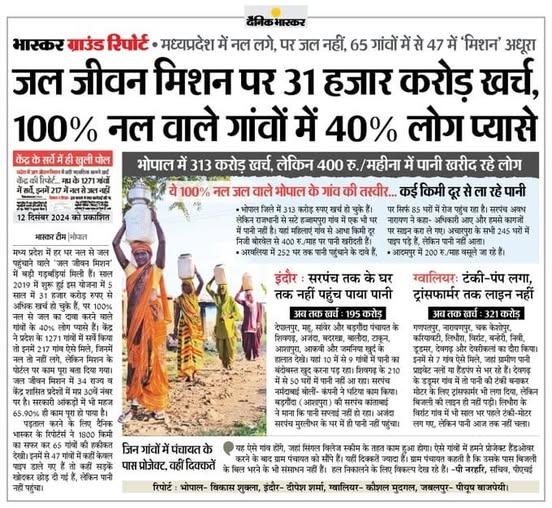
मप्र में जल जीवन मिशन के तहत मुख्यमंत्री के गृह जिले उज्जैन के 14 गांवों में भी गड़बड़ियां सामने आई हैं। केंद्र की हालिया रिपोर्ट कहती है कि उज्जैन जिले के इन गांवों में पानी के कैमिकल टेस्टिंग के सैंपल भी फेल हो गए हैं। https://www.bhaskar.com/local/mp/bhopal/news/water-samples-fail-in-the-home-districts-of-cm-and-phe-minister-134118223.html (14 Dec. 2024)
WATER
Study 45% of springs in Himalayas dry up in 4 decades Approximately 45% of the springs in the Himalayas have completely dried up due to rising temperatures and a decline in both rainfall and snowfall over the past four decades, says a recent study titled “Climatic Impacts on Spring Disappearance in the Indian Himalayas,”. This reduction will impact the rural communities’ drinking water, agriculture, and daily household needs. The study surveyed 276 spring sites in the western Himalayas, primarily in Himachal Pradesh. https://www.newindianexpress.com/nation/2024/Dec/16/45-of-springs-in-himalayas-dry-up-in-4-decades-rising-temp-key-factor-study (16 Dec. 2024)
AGRICULTURE
Study Scientists find how soil also contributes to climate change In a first-of-its-kind study, scientists revealed that soil-based emissions contribute to around 15 per cent of the global increase in climate warming. These emissions, primarily in the form of carbon dioxide (CO2), nitrous oxide (N2O) and methane (CH4), were largely driven by agricultural practices, land-use changes and the growing global demand for food.” https://www.downtoearth.org.in/climate-change/scientists-find-how-soil-a-sink-for-ghgs-also-contributes-to-climate-change (9 Dec 2024)
UN 5 reasons why soil health is declining worldwide Soil is a hot topic as countries gather in Riyadh, Saudi Arabia for the 16th Conference of the Parties (COP16) to the UN Convention to Combat Desertification (UNCCD). Negotiators are slated to discuss commitments that nations have made to stem the loss of soil and achieve land degradation neutrality by 2030.
“Soil degradation impacts food security, water systems, biodiversity & climate resilience,” said Bruno Pozzi, Deputy Director of the Ecosystems Division at the United Nations Environment Programme. “By addressing the root causes of soil degradation, we can restore soil health and create a more sustainable future for hundreds of millions of people.” https://www.unep.org/news-and-stories/story/five-reasons-why-soil-health-declining-worldwide (5 Dec 2024)
MONSOON 2024
Parliament Sesson EWS for natural disaster The National Climate Change Assessment report documenting the regional climate change projections has been released to benefit students, researchers, and policymakers. The report is available at https://link.springer.com/book/10.1007/978-981-15-4327-2
-Based on the available climate records, the report documents that the surface air temperature over India has risen by about 0.7 °C during 1901–2018, which is accompanied by an increase in atmospheric moisture content. The sea surface temperatures in the tropical Indian Ocean have also increased by about 1°C during 1951–2015. Clear signatures of human-induced changes in climate have emerged over the Indian region on account of anthropogenic GHG and aerosol forcing and changes in land use and land cover, which have contributed to an increase in the climatic extremes.
-The Union Cabinet has approved the central sector scheme ‘Mission Mausam’ at an outlay of INR 2,000 crores over two years. The main aim of the mission is to make Bharat weather-ready and climate-smart and provide early warning to all. Mission Mausam is envisaged to be a multi-faceted and transformative initiative to tremendously boost India’s weather and climate-related science, research, and services.
Mission Mausam will cater to the weather & climate-sensitive sectors like agriculture, power, irrigation, shipping, water resource management, health, aviation, transport sector, disaster management, off-shore oil management, public safety, etc., by mitigating the impact of climate change and extreme weather events and strengthen the resilience of the communities to severe weather events. This information was given by Union Minister of State (Independent Charge) for Science & Technology and Earth Sciences, Dr. Jitendra Singh in a written reply in the Lok Sabha on Dec 11. https://pib.gov.in/PressReleaseIframePage.aspx?PRID=2083269 (11 Dec 2024)
Expansion of weather radars network Currently, 39 Doppler Weather Radars (DWRs) are installed at various locations across the country. The S-band radar provides a radial coverage of 400 km, whereas C-band and X-band provide 250 km and 100 km, respectively. Mission Mausam was launched in September 2024 and planned to install 87 more DWRs by 2026. This information was given by Union Minister of State (Independent Charge) for Science & Technology and Earth Sciences, Dr. Jitendra Singh in a written reply in the Lok Sabha today (Dec. 11). https://pib.gov.in/PressReleasePage.aspx?PRID=2083271 (11 Dec. 2024)
Effect of El Nino on monsoon & rainfall In general, during the El Nino event, the Indian summer monsoon is weaker than normal, and the intensity of the event also decides the amount of impact on the monsoon. Since 1950, there have been 16 El Niño years, out of which 7 years had impacted Indian monsoon rainfall when rainfall was below normal. However, there is a stronger inverse relationship between El Niño and rainfall during the later half of the monsoon season (particularly with September rainfall). This information was given by Union Minister of State (Independent Charge) for Science & Technology and Earth Sciences, Dr. Jitendra Singh in a written reply in the Lok Sabha today (Dec. 11). https://pib.gov.in/PressReleasePage.aspx?PRID=2083268 (11 Dec. 2024)
Deaths due to extreme weather events have gone up Deaths due to extreme weather events in the country have increased, said Jitendra Singh, Union minister of state (independent charge) for science and technology and earth sciences to the Lok Sabha (https://sansad.in/getFile/loksabhaquestions/annex/183/AU2532_1PqEQM.pdf) in 2023, total 2,483 deaths reported due to disastrous weather events, followed by 2,767 deaths in 2022 and 1,944 deaths in 2021, the minister noted. https://www.downtoearth.org.in/climate-change/as-told-to-parliament-december-11-2024-deaths-due-to-extreme-weather-events-have-gone-up (12 Dec. 2024)
Effects of Climate Change -MoEF&CC has not conducted any specific study to monitor the effect of climate change on traditional forest dwellers. This information was given by Union Minister of State for Environment, Forest and Climate Change Shri Kirti Vardhan Singh in a written reply in the Lok Sabha today (Dec. 09). https://pib.gov.in/PressReleaseIframePage.aspx?PRID=2082530 (09 Dec. 2024)
Delhi Cloud seeding plan ‘not feasible’ The Union environment ministry on Thursday (Dec. 05) indicated that cloud seeding, as an emergency measure to improve Delhi’s air quality, may not be a feasible option. This is because the specific cloud conditions required for seeding are generally absent during the capital’s cold and dry winter months, and there are concerns about the “uncertainties, efficacy, and potential adverse effects of the chemicals”. https://timesofindia.indiatimes.com/city/delhi/delhis-cloud-seeding-plan-not-feasible-union-environment-ministry-to-rajya-sabha/articleshowprint/116027110.cms (06 Dec. 2024)
FLOOD 2024
Tamil Nadu Sathanur dam: Could floods have been avoided? Sathanur Dam in TN was already 95% even before the cyclone Fengal struck the area. https://www.thehindu.com/data/what-went-wrong-at-sathanur-dam/article68965271.ece (10 Dec. 2024)
Report Over 60% of India’s districts prone to floods and drought Over 60% of Indian districts are high climate risk zones prone to flood and drought, the two commonest natural hazards, says a new assessment report.
– The report identifies 91 districts as “very high” drought risk and 188 as “high” risk. Over 85% of such districts are in Bihar, Assam, Jharkhand, Odisha, Uttar Pradesh, West Bengal, Karnataka, Tamil Nadu, Chhattisgarh, Kerala, Maharashtra, Uttarakhand and Haryana.
– Similarly 51 districts are “very high” flood risk while 118 have been categorised as “high” risk. The vulnerable regions include Assam, Bihar, Uttar Pradesh, West Bengal, Gujarat, Odisha, and Jammu and Kashmir. Alarmingly, 11 districts including five from Assam and three from West Bengal along with Patna (Bihar), Alappuzha (Kerala), and Kendrapara (Odisha), are at “very high” risk for both floods and droughts, necessitating immediate interventions. Anamika Barua, a researcher from Indian Institute of Technology, Guwahati is one of the lead authors of the report. The assessment included 698 districts, of which 459 were found to be at risk. Supported by the Department of Science and Technology and Swiss Agency for Development and Cooperation, the report was prepared by researchers from IIT Guwahati, IIT Mandi and the Centre for Study of Science, Technology, and Policy, Bengaluru. It was released in Guwahati on Dec 13 2024. https://www.deccanherald.com/environment/over-60-of-indias-districts-prone-to-floods-and-drought-report-3317045 (13 Dec. 2024)
HFL BREACH
Tamil Nadu River Periyaodai at Venganur site in Cuddalore district has crossed old HFL 78.79 meter dated 10.10.2022 and has set 79.1 meter as new HFL at 08:00 hour on 13.12.2024 which is 0.31 meter higher than the old HFL. Present flood level is 78.92 meter at 11:00 hour with falling trend.
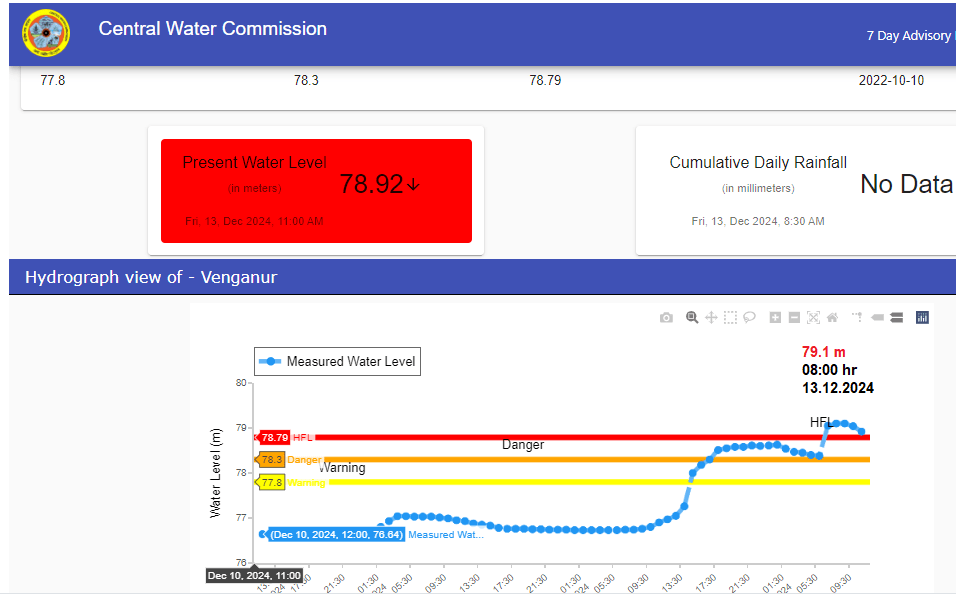
URBAN FLOODS
Chennai More water released from lakes WRD increased the discharge from Chembarambakkam reservoir from 4,500 cusecs to 6,000 cusecs as of Saturday (Dec. 14) noon, and from Puzhal lake from 500 to 1,000 cusecs. A senior WRD official told TNIE, “The storage in the six reservoirs supplying water to Chennai stands at 10.901 tmcft, which is 82.5% of their total capacity of 13.213 tmcft. Key reservoirs like Poondi, Chembarambakkam, and Puzhal are nearly full. As there is limited space to store water from the upcoming spell of rains, we have decided to release surplus water gradually.” The official also confirmed that the flood alert issued by the Kancheepuram and Tiruvallur district administrations remains in effect. https://www.newindianexpress.com/cities/chennai/2024/Dec/15/as-chennai-braces-for-new-rain-spell-more-water-released-from-lakes (15 Dec. 2024)
1,000 cusecs of water to be released from Chembarambakkam Lake About 1,000 cusecs of water will be released from Chembarambakkam Lake from 8 am on Friday (today), and a first-level flood warning was issued to families living closer to the Adyar River and the villages of Sirukalathur, Kavanur, Kundrathur, Thirumudivakkam, Vazhuthiyambedu, and Thiruneermalai surrounding the lake. As of 6 am, the water level of the lake stood at 23.29 feet, just 0.71 feet below its full capacity of 24 feet, with a total volume of 3,453 million cubic feet.
Given the rapidly rising inflow of 6,498 cubic feet per second, officials decided to release 1,000 cubic feet per second of water from the lake to begin with. Authorities warned that the quantum of release will be increased subsequently since the inflow is expected to continue rising due to persistent rainfall in the lake’s catchment areas. The release is intended to manage the surging water levels and prevent potential flooding along the Adyar River, said water resources dept authorities. https://timesofindia.indiatimes.com/city/chennai/flood-warning-issued-in-chennai-as-1000-cusecs-of-water-to-be-released-from-chembarambakkam-lake/articleshow/116270729.cms (13 Dec. 2024)
The floodgates of two more city reservoirs in Chembarambakkam and Red Hills were opened on Friday (December 13, 2024) in light of heavy inflow and intense rainfall. The Water Resources Department took the preemptive measure to release water from the water bodies that were critical sources for city’s drinking water needs.
Spread over 25.51 sq.km., the reservoir in Chembarambakkam is the largest among the five city reservoirs. The dept increased water discharge to about 4,500 cubic feet per second of water into Adyar river at 10.30 a.m. as the water level touched 23.59 feet, which is less than a foot of full level. Intense rainfall of 14 cm had rapidly filled the reservoir with an inflow of about 6,132 cusecs. https://www.thehindu.com/news/cities/chennai/floodgates-of-two-more-chennai-reservoirs-opened-on-friday-following-heavy-inflow-and-intense-rainfall/article68980359.ece (13 Dec 2024)
CLOUD BURSTS
Himachal Pradesh ‘Cloudburst’ Incidents in SW Monsoon 2024 We have been able to identify 27 reported incidents of ‘cloudburst’ in Himachal Pradesh during the SW monsoon 2024. The disaster has been reported from all geographical areas of the state spanning 8 districts throughout the season beginning with May 12 in Gharshu village of Kinnaur to September 26 from Paonta Sahib area of Sirmaur.
The maximum 18 of these incidents have occurred in areas close to glaciers or snow-clad mountains followed by 5 in middle segment of hills and 4 in Shivalik range of the state. River basin wise Sutlej river basin witnessed the maximum 12 ‘cloudburst’ induced flashflood spells followed by 5 in Chenab basin, 4 each in Beas and Yamuna basin and 1 each in Ravi and Ghaggar basin. https://sandrp.in/2024/12/14/himachal-pradesh-cloudburst-incidents-in-sw-monsoon-2024/ (14 Dec. 2024)
DISASTERS
The Amended Disaster Management Amendment (2024) Bill passed by the Lok Sabha on Dec 12 faces a number of criticisms. https://www.thehindu.com/news/national/lok-sabha-passes-bill-to-amend-the-disaster-management-act/article68978480.ece (12 Dec. 2024)
LANDSLIDES
Study Warning of rising landslide risks in Indian Himalayas An international study, ‘Landslide Hazard Is Projected to Increase Across High Mountain Asia,’ by US-based National Aeronautics and Space Administration (Nasa) researchers has highlighted an alarming trend of increasing landslide risks by over 30% by the end of century compared to 1990-2014 figures across High Mountain Asia (HMA), a region encompassing the Himalayas and the Tibetan Plateau. These risks, driven by extreme precipitation and climate change, are expected to intensify throughout the 21st century, with severe implications for countries like India.
The study was conducted by Nasa’s Goddard Space Flight Centre and the University of Maryland and published in Earth’s Future. The most at-risk countries located in HMA are China, India & Afghanistan, posing serious risks to infrastructure, ecosystems, and human lives. In Uttarakhand and other Himalayan areas, heightened landslide activity is anticipated due to extreme precipitation events, including intense daily rainfall, very wet days, and extended wet periods. “The area near Tehri Dam is particularly vulnerable, with landslide susceptibility projected to rise under all scenarios,” the study noted. The need of the hour is disaster risk reduction strategies. https://timesofindia.indiatimes.com/city/dehradun/nasa-reveals-alarming-landslide-risk-increase-in-indian-himalayas-due-to-climate-change/articleshowprint/116220936.cms (11 Dec 2024)
ENERGY OPTIONS
Andhra Pradesh Allegations on Adani solar deal: Why Jagan’s defences don’t hold up M Rajsekhar investigates the Andhra Govt buying the costly solar power from SECI via Adani and weak defense of the then state govt. The outrage here is not that a bribe was taken. The outrage here is the opportunity cost of that Rs 161,000 crore. And the outrage here is what we now learn about our RE sector. For a long while, we have known that our old energy systems – like coal, oil, gas and hydel – were in the grip of the country’s economic and political elite. We see now that the green energy system is no different. SECI floated a dodgy bid. There after, it and the Power Ministry doled out additional favours to the winners. State politicians took rents. State and central electricity regulators – not to mention the country’s investigative agencies — stayed quiet.
– The costs of these shenanigans run deep. Ours is a time when India is already struggling to keep its energy costs competitive. And yet, we are a country where, bucking a global trend where solar is now the cheapest electricity in history, solar tariffs are rising. One reason, as we know, is import substitution and protectionism. Another, as we see now, are transactions like this one. The costs are easy enough to imagine. Cash flows out of Indian factories and households to a handful of political and economic elite. https://www.thenewsminute.com/andhra-pradesh/allegations-on-adani-solar-deal-why-jagan-reddys-defences-dont-hold-up (16 Dec. 2024)
ENVIRONMENT GOVERNANCE
Western Ghats Gadgil named one of 6 ‘Champions of Earth’ by UNEP The annual Champions of the Earth award, the UN’s highest environmental honour, recognises trailblazers at the forefront of efforts to protect people and the planet. Since 2005, the award has recognised 122 laureates for outstanding and inspirational environmental leadership. This year’s champions include Madhav Gadgil who has been honoured in the “lifetime achievement” category. https://www.hindustantimes.com/india-news/ecologist-madhav-gadgil-named-one-of-six-champions-of-the-earth-by-unep-101733828756415.html (10 Dec. 2024) Madhav Gadgil – Lifetime Achievement https://www.unep.org/championsofearth/laureates/2024/madhav-gadgil Ecologist Madhav Gadgil says he ‘stood up for what’s right’ https://theprint.in/india/ecologist-madhav-gadgil-gets-uns-highest-environmental-honour-says-he-stood-up-for-whats-right/2396507/ (10 Dec. 2024) Political Will Responding Only to Money Man, it has to Respond to People: Ecologist Madhav Gadgil. https://thewire.in/environment/madhav-gadgil-money-man (11 Dec. 2024) Asked if fate of Western Ghats would have been different today if aspects of his report were implemented, Gadgil said: “The suggestions we made must immediately be taken on board. Had govt implemented them, the impact would have been substantially reduced. It may not have completely halted the possibility of landslides, but it would have been less.” https://timesofindia.indiatimes.com/city/pune/western-ghats-have-crossed-tipping-point-says-ecologist-madhav-gadgil/articleshowprint/116272471.cms (13 Dec. 2024)
Parliament Sesson Plastic waste in the country -In so far as, plastic waste generated in the country, based upon information provided by State Pollution Control Boards (SPCBs) / Pollution Control Committees (PCCs) to Central Pollution Control Board, the quantity of plastic waste generation during the period 2018-19 to 2022-23 is given below: Financial Year Plastic waste Generation (TPA)
2018-19 3360043.45;
2019-20 3469781.73
2020-21 4126808.44
2021-22 3901802.06
2022-23 4136188.83
This information was given by Union Minister of State for Environment, Forest and Climate Change Shri Kirti Vardhan Singh in a written reply in the Rajya Sabha today (Dec. 12). https://pib.gov.in/PressReleaseIframePage.aspx?PRID=2083801 (12 Dec. 2024)
CLIMATE CHANGE
Report Three-quarters of Earth has gotten permanently drier According to a just-released report (https://drive.google.com/file/d/1CsAn3qO5iD0E3F3eg6OSm84ddxK-C9Tv/view) by the United Nations Convention to Combat Desertification (UNCCD), human-driven climate change is leading to a permanent state of increased dryness on 77.6% of the Earth’s land masses, a steady desiccation that has been playing out over the 30-year period from 1990 to 2020. During those three decades, drylands expanded worldwide by 4.3 million sq. km, an area nearly a third larger than the nation of India. And when the UNCCD says dry, they mean for keeps.
– “Unlike droughts—temporary periods of low rainfall—aridity represents a permanent, unrelenting transformation,” said UNCCD executive secretary Ibrahim Thiaw in a statement that accompanied the release of the report—published as nations gather in Saudi Arabia for the 16th U.N. conference of the parties to combat desertification. “Droughts end. When an area’s climate becomes drier, however, the ability to return to previous conditions is lost. The drier climates now affecting vast lands across the globe will not return to how they were before and this is redefining life on Earth.” “Without concerted efforts, billions face a future marked by hunger, displacement, and economic decline,” said Nicole Barger, chair of the UNCCD’s science-policy interface in a statement. “Yet, by embracing innovative solutions and fostering global solidarity, humanity can rise to meet this challenge. The question is not whether we have the tools to respond—it is whether we have the will to act.”
– Drylands were defined as places in which annual potential evaporation and transpiration are 45% greater than average precipitation. Areas that meet that definition now cover 40.6% of all land on Earth, excluding Antarctica. https://time.com/7201214/three-quarters-of-the-earth-has-gotten-permanently-drier/ (10 Dec. 2024)
SOUTH ASIA
Nepal 3rd storage-type project expected to be completed by May 2026 The 140 MW Tanahu hydropower project in the Tanahun dist has achieved 63% physical progress, raising hopes of power production by its stipulated completion deadline of May 2026. Nepal has only two storage projects—Kulekhani I (60 MW) and Kulekhani II (32 MW). The project, which will be Nepal’s third storage type, is 150 km west of Kathmandu on the Seti river near Damauli in the Tanahun dist.
Tanahu Hydropower Limited, a subsidiary of Nepal Electricity Authority, has also advanced the development of the 126MW Lower Seti Hydropower project downstream of the Seti river. The Consultant, JV of WAPCOS Limited, India and Nippon Koei Co. Ltd, Japan, submitted the final Detailed Design Report in June 2024. https://kathmandupost.com/money/2024/12/12/nepal-s-third-storage-type-project-expected-to-be-completed-by-may-2026 (12 Dec. 2024)
Bangladesh Number of rivers The total number of rivers across Bangladesh stands at 1,156, according to a preliminary draft list released after verification by the Divisional Commissioner’s office. The Ministry of Shipping has announced that the final list of rivers and canals will be published on Pohela Baishakh. The Ministry of Shipping unveiled a draft list of rivers during an awareness seminar on river enumeration held at Pani Bhaban, Green Road, Dhaka, on Dec 10.
The actual number of rivers in Bangladesh has not been accurately calculated. Discrepancies exist between the River Research Institute’s data, the National River Commission’s records, and the Water Development Board’s reports. Recognizing the need for a definitive account, the interim government initiated efforts to prepare an accurate list of rivers within two months following August 5. https://www.dhakatribune.com/bangladesh/367724/rizwana-final-list-of-rivers-to-be-published-on (10 Dec. 2024)
THE REST OF THE WORLD
AMAZON How ‘Boiling River’ foreshadows a warmer world The Boiling River, also known as the Shanay-timpishka or La Bomba, is part of a tributary in east-central Peru that connects to the mighty Amazon River.
The hills in this area were scoured by fossil fuel companies looking for oil reserves in the 1930s but the secrets of the legendary Boiling River itself are only now being told in depth by Western scientists. Researchers have, for instance, determined that the river is heated by geothermal sources deep in the ground below. https://www.bbc.com/future/article/20241210-how-the-amazons-boiling-river-foreshadows-climate-change (11 Dec. 2024)
SANDRP
Also see: DRP 09 Dec. 2024 & DRP 02 Dec. 2024
Follow us on: www.facebook.com/sandrp.in; https://twitter.com/Indian_Rivers

 SANDRP