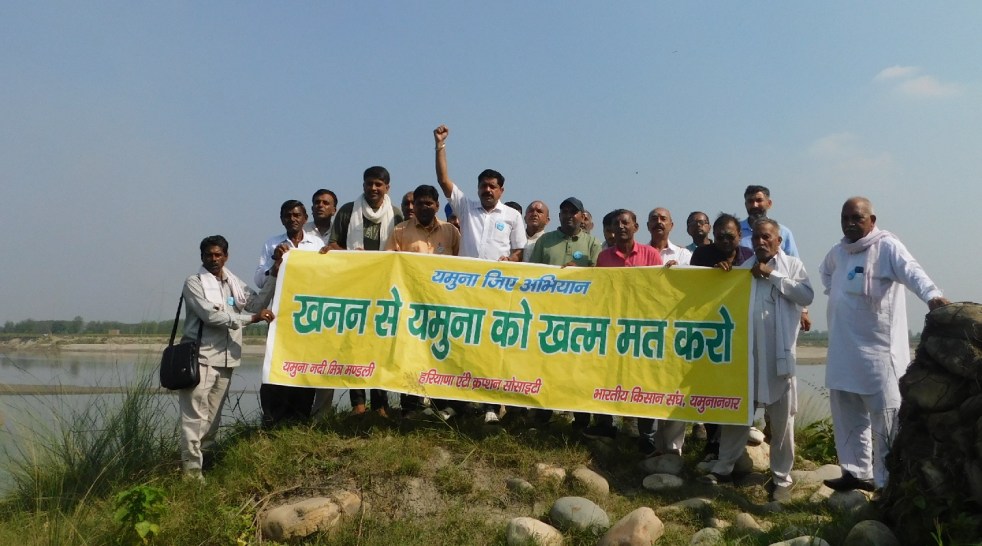
(Feature: Members of Haryana Anti Corruption Society, Yamuna Nadi Mitra Mandli, Bhartiya Kisan Sangh, Yamuna Nagar raising concerns over unabated unsustainable riverbed mining in Yamuna in Gumthala Rao, Karnal on Oct 07, 2024.)
Large scale riverbed mining has become most underestimated and least discussed threat for Yamuna rivers. While increasing pollution has turned the river stretch between Delhi and Agra ecologically dead, the rampant sand mining has been severely damaging the Yamuna eco-system in upper and lower segments.
Presently, the mining menace is quite rampant in Paonta Sahib, Yamuna Nagar, Saharanpur, Karnal, Shamili, Panipat, Sonipat, Baghpat and Ghaziabad districts along the river in upper segment. Similarly, in lower segment the main stem of river as well as its key tributaries Chambal, Sind, Betwa, Ken have been bearing the burnt of unsustainable sand mining.
As per Yamuna Nadi Mitra Mandli (YNMM) the riverbed level has decreased around 10 to 20 feet in Yamuna Nagar, Karnal and Panipat districts over past seven years in upper segment primarily due to industrial scale sand mining leading to decline in groundwater table, riverbank erosion and adverse impact on aquatic ecosystems. Similarly, mechanized sand mining is being attributed to the reason behind large scale erosion of Yamuna riverbanks in Hamirpur, Chitrakoot and Fatehpur districts.
Notably, the illegalities and violations are being mostly committed in government approved sand mines, where contractors showing no respect to norms deliberately indulge in obstruction of river flows, instream, mechanized mining even during night hours earning them ‘sand mafias’ tag. While they enjoy political patronage, the regulators including mine departments, pollution control boards in Yamuna basin states have been starved of resources thus proving inefficient to ensure compliance to norms.
There have been multiples pleas on the issue, however the judiciary system too seems dealing with the cases in tokenistic manner by limiting itself to issuing notices, seeking reports and in some cases imposing nominal fines.
MINING IN YAMUNA RIVERS
Yamuna Nagar Activists raise voice against illegal mining along Yamuna Several social organisations, including Haryana Anti-Corruption Society, Yamuna Nadi Mitra Mandal and SANDRP have raised voice against illegal and unscientific mining in Yamuna river in Yamunanagar district. These organisations have requested the govt to stop illegal and unscientific mining immediately alleging that it is posing a threat to the existence of the river.
BS Rawat, Associate Coordinator of SANDRP, said the Yamuna River was the largest and most important tributary of the national river Ganga. “The Yamuna River is the only living river of Haryana and the lifeline of the state. It irrigates a large area of agricultural land and it is the main source of drinking water for a large population in the state,” said BS Rawat.
President of Haryana Anti-Corruption Society Advocate Waryam Singh said several contractors were also carrying out mining in legal quarries along the river in an unscientific way in violation of norms of MoEF & the orders of the NGT. https://www.tribuneindia.com/news/haryana/activists-raise-voice-against-illegal-mining-along-yamuna-river/ (10 Oct. 2024)
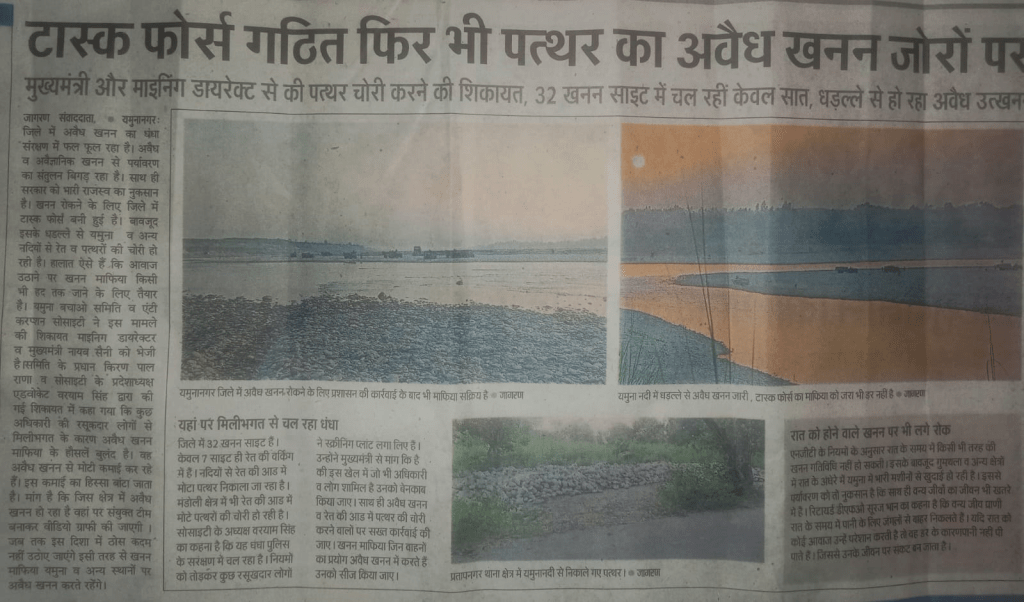
SANDRP के सह समन्वयक बीएस रावत ने कहा कि यमुना नदी राष्ट्रीय नदी गंगा की सबसे बड़ी व महत्वपूर्ण सहायक नदी है। यमुना नदी हरियाणा की एकमात्र जीवित नदी है तथा प्रदेश की जीवन रेखा है। बीएस रावत ने कहा कि यह नदी कृषि भूमि के बड़े क्षेत्र की सिंचाई करती है और यह राज्य की बड़ी आबादी के लिए पेयजल का मुख्य स्रोत है। हरियाणा भ्रष्टाचार निरोधक सोसायटी के अध्यक्ष एडवोकेट वरयाम सिंह ने कहा कि जिले में कई स्थानों पर यमुना नदी के किनारे बड़े पैमाने पर अवैध खनन कई वर्षों से किया जा रहा है। उन्होंने कहा कि कई ठेकेदार पर्यावरण मंत्रालय और राष्ट्रीय हरित अधिकरण के आदेशों का उल्लंघन करते हुए अवैज्ञानिक तरीके से नदी के किनारे वैध खदानों में भी खनन कर रहे हैं। नियमों का उल्लंघन करते हुए ठेकेदार नदी के बहाव क्षेत्र को अवरुद्ध कर स्वीकृत सीमा से अधिक गहराई पर भारी मशीनों का उपयोग कर खनन कर रहे हैं। जब हमने इन उल्लंघनों को संबंधित विभागों के अधिकारियों के संज्ञान में लाया तो उन्होंने कोई गंभीर कार्रवाई नहीं की। उन्होंने कहा कि सरकार को कम से कम पांच साल के लिए क्षेत्र में खनन पर तुरंत प्रतिबंध लगाना चाहिए ताकि नदी को खनिजों से भरकर अपने पारिस्थितिकी तंत्र को बहाल करने का समय मिल सके। https://jantaserishta.com/local/haryana/haryana-activists-raised-their-voice-against-illegal-mining-on-yamuna-river-3578406 (10 Oct. 2024)
यमुना नदी का सीना छलनी कर रहे Mining Mafia, अब ग्रामीणों ने उठाई आवाज https://www.youtube.com/watch?v=Z2qPeuHy56k (09 Oct. 2024)
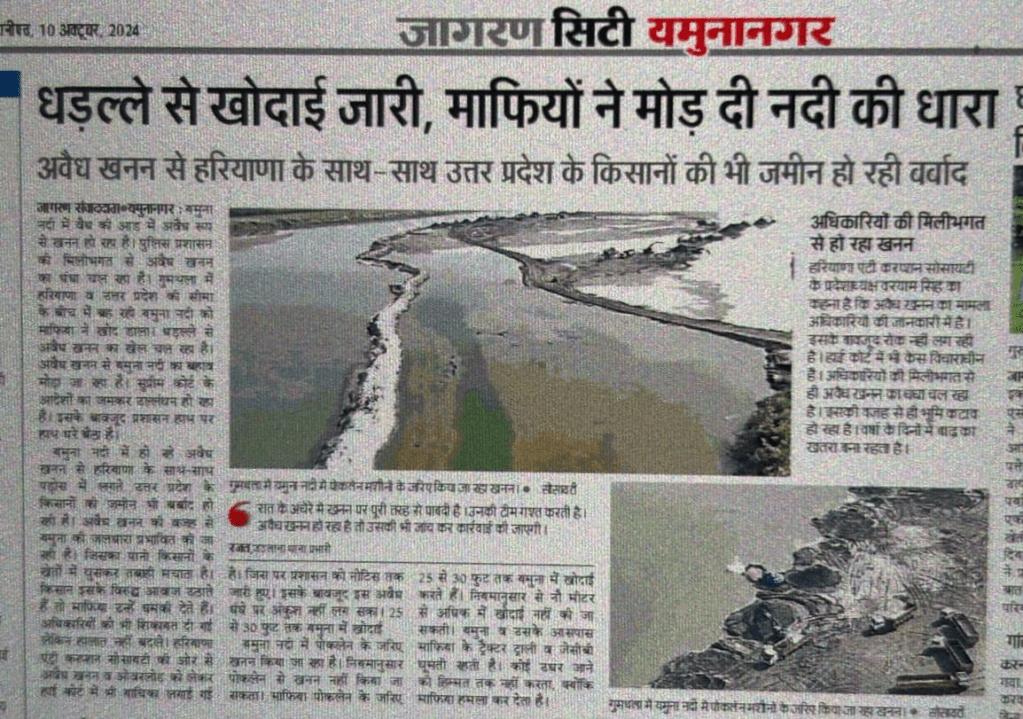

खनन एजेंसियों को शायद न एनजीटी के नियमों की परवाह है और न ही प्रशासनिक अधिकारियों का डर। क्योंकि यदि ऐसा होता तो नियमों को ताक पर रखकर बार-बार यमुना नदी की धारा को बाधित न किया जाता। जठलाना-गुमथला क्षेत्र में सरेआम ऐसा हो रहा है। अवैध खनन को लेकर न्यायालय में जनहित याचिका डाल चुके एडवोकेट वरयाम सिंह ने इसकी शिकायत सीएम मनोहर लाल, डीसी कैप्टन मनोज कुमार व एसपी गंगाराम पुनिया को भेजी है। उनका आरोप है कि यमुना नदी के नगली घाट पर दो राज्यों को जोड़ने वाले 84 करोड़ के बजट से निर्माणाधीन पुल के आसपास भी धड़ल्ले से अवैध खनन किया जाता है। https://www.jagran.com/haryana/yamunanagar-illegal-mining-is-going-on-indiscriminately-by-disrupting-the-flow-of-yamuna-river-23563677.html (23 Oct. 2023)
Focus on illegal sand mining in Yamuna Nagar In Haryana and, specifically, in Yamunanagar, mining on riverbeds, sometimes flouting the restrictions, picked up pace after the Haryana government introduced contracts through auction in November 2013. In 2019, Mahadevan documented that illegal sand miners made around Rs five lakh of profit daily in just one district. According to a survey report, prepared by the Yamunanagar district administration in October 2023, 30.71 million metric tonnes of sand were mined between financial years 2020-21 and 2022-23 while 2.46 million metric tonnes of boulder and gravel were mined during the same period. A mining official said the Haryana government levies Rs 50 on each tonne of sand mined. The report seen by ThePrint said the state government raked in nearly Rs 500 crore in royalties from sand mining in the Yamunanagar district between 2020 and 2023. https://theprint.in/politics/exploited-riverbeds-crores-in-play-quashed-arrest-of-ex-mla-puts-focus-on-yamunanagar-illegal-mining/2296881/ (04 Oct. 2024)
₹3.57-cr penalty over illegal mining The SPCB has imposed a fine of Rs 3.57 cr on 11 persons, who allegedly carried out illegal mining on panchayat land in Kohliwala and Mandewala villages of Yamunanagar district. The action was recently taken on the report of a joint committee formed on the order NGT. In his complaint to the NGT in 2022, Balwinder Kumar of Kohliwala village alleged that illegal mining was being carried out on a big portion of 156 acres of panchayat land in Kohliwala & Mandewala villages falling under Bhud Kalan gram panchayat of Yamunanagar district. He alleged that khair trees were being cut illegally from this land, and all this was happening in connivance with officials of the local administration.
The complainant further submitted that he made complaints to the authorities concerned, but no action had been taken on his complaint. He also alleged that instead of taking action against persons involved in illegal mining, false cases were registered against him. After getting complaint from Balwinder Kumar, the NGT formed a joint committee comprising the Director of Mines and Geology, Pollution Control Board; the District Forest Officer; and the Deputy Commissioner, Yamunanagar.
The committee undertook site visits and found out the factual position with the help of video recording. “Taking an action on the report of the joint committee, we have imposed an environmental compensation of Rs 3,57,84,180 on 11 persons belonging to Kohliwala and Mandewala villages for carrying out illegal mining on panchayat land of Bhud Kalan gram panchayat,” said Virender Punia, Regional Officer, HSPCB, Yamunanagar. He said more persons were being identified who were involved in the illegal mining case. https://www.tribuneindia.com/news/haryana/11-slapped-with-3-57-crore-penalty-over-illegal-mining-in-yamunanagar-villages/ (20 Oct. 2024)
उत्तर प्रदेश से लगते यमुनानगर के गांवों में अवैध खनन को लेकर दायर एक जनहित याचिका पर हाई कोर्ट ने हरियाणा सरकार से जवाब तलब किया है। कोर्ट ने सरकार से पिछले पांच साल में अवैध खनन करने वालों की जानकारी, जब्त संपति और कार्रवाई की पूरी जानकारी देने का सरकार को आदेश दिया है। सुनवाई के दौरान सरकार की तरफ से कोर्ट में पेश की गई रिपोर्ट में बताया गया कि यमुना नदी के दो ब्लाक पर अवैध खनन नहीं चल रहा। पिछली सुनवाई पर हाई कोर्ट ने प्रदेश में बढ़ते अवैध खनन पर चिंता जताई थी और कहा था कि इसे रोकने के लिए सरकार सख्त कदम उठाए। कोर्ट ने कहा कि अगर अवैध खनन नहीं रुका तो ऐसे में क्यों न इस याचिका का दायरा बढ़ाया जाए। याचिका दाखिल करते हुए एंटी करप्शन सोसाइटी की ओर से एडवोकेट अंकित अग्रवाल के माध्यम से बताया गया कि यमुना नदी के किनारे प्रदेश में अवैध खनन का कार्य चल रहा है। https://www.jagran.com/haryana/yamunanagar-what-action-was-taken-in-five-years-high-court-sought-answer-from-government-on-illegal-mining-in-yamunanagar-23764171.html (23 July 2024)
Illegal mining a big ‘threat’: Parliamentary panel The report discloses a staggering total of 3,792 cases of illegal mining reported in the five years across five districts in Haryana through which the Yamuna flows. Yamunanagar district, which has nearly a 100 km stretch of the river, tops the list with a shocking 2,599 cases, followed by Palwal with 559, Sonepat with 281, Karnal with 202, and Panipat with 151 reported cases in the five years. The extent of the problem becomes even clearer when considering the financial penalties imposed, with Yamunanagar alone accounting for the highest recovery of Rs 21.22 crore. https://www.tribuneindia.com/news/haryana/parliamentary-panel-illegal-mining-a-big-threat-to-yamuna-ecosystem-588438/ (8 Feb 2024)
NGT takes cognisance of auction for mining in protected Aravalli The NGT has taken suo motu cognisance of a news report regarding the auction of a portion of Aravalli forest land in Rajawas, Haryana, for mining purposes, shortly after its declaration as a ‘protected forest.’ The NGT has directed all these respondents to file their replies in the form of affidavits at least one week before the next hearing scheduled for January 28, 2025. https://www.barandbench.com/news/ngt-cognisance-auction-mining-aravali (04 Oct. 2024)
Shamli रेत से भरे डंपरों ने दो युवकों को मारी टक्कर, एक की मौत थानाभवन क्षेत्र में रेत से भरे ओवरलोड डंपर ने 24 घंटे के अंदर दो युवकों को कुचल दिया। इसमें एक युवक की मौत हो गई। जबकि दूसरा दस वर्षीय बालक गंभीर रूप से घायल हो गया। ओवरलोड रेत से भरे डंपर पर लगी नंबर प्लेट भी गायब है। संबंधित विभाग ओवरलोड रेत वाहनों पर लगाम लगाने में नाकाम साबित हो रहा है। शामली जिला रेत खनन को लेकर अक्सर चर्चाओं में रहता है। यहां एनजीटी के नियमों की अनदेखी कर खनन किया जा रहा है। सड़कों पर रेत से भरे ओवरलोड वाहन जहां सड़कों को नुकसान पहुंचा रहे हैं, वहीं आए दिन इनसे होने वाले हादसों में लोग अपनी जान भी गंवा रहे हैं। https://newstrack.com/uttar-pradesh/shamli/shamli-ki-taza-khabar-overloaded-dumper-crushed-two-youths-one-dead-one-critical-in-thana-bhawan-475387 (25 Oct. 2024)
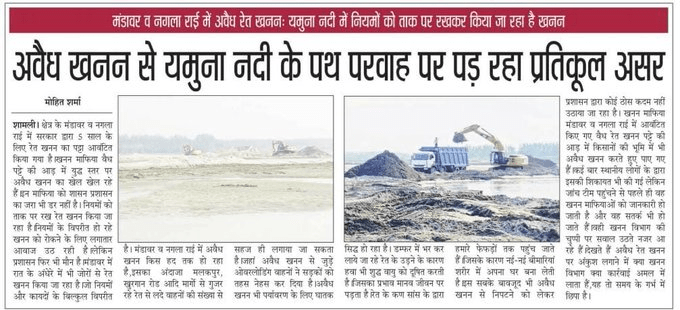
मंडावर में वैध पट्टे की आड़ में माफिया रात्रि में खनन कर यमुना नदी की जलधारा से खिलवाड़ कर रहे हैं। एनजीटी की गाइडलाइन को ठेंगे पर रखकर प्रतिबंधित मशीनों को बहती जलधारा में धड़ल्ले के साथ चलाया जा रहा है। गांव निवासी भाजपा नेता ने रात्रि में खनन की वीडियो वायरल करने के साथ ही जिलाधिकारी सहित उच्चाधिकारियों को शिकायती पत्र भेजकर कार्रवाई की मांग की है। https://www.rashtriyajungtimes.page/2024/10/blog-post_29.html?m=1 (29 Oct. 2024)
शामली के थाना भवन क्षेत्र में ओवरलोड डंपरों का आतंक बढ़ गया है। ये डंपर बिना नंबर प्लेट के सड़कों पर तेजी से दौड़ रहे हैं। जिससे स्थानीय लोगों को खतरा पैदा हो गया है। जब कोई डंपर की तस्वीर खींचने या उन्हें पकड़ने की कोशिश करता है, तो वे और भी तेजी से https://www.bhaskar.com/local/uttar-pradesh/shamli/news/dumpers-are-running-on-the-roads-without-number-plates-many-lives-lost-due-to-negligence-133861229.html (25 Oct. 2024)
जिले में रेत एवं मिट्टी खनन की जांच को लेकर लखनऊ से निदेशालय की टीम ने शामली में डेरा डाल दिया है। गुरुगुवार (Oct. 24) की रातभर टीम सड़कों पर रही और रेत से भरे वाहनों की जांच की। इस दौरान टीम ने जिले में विभिन्न स्थानों से पांच डपरों का ऑनलाइन चालान किया गया है। बताया जा रहा है कि टीम खनन प्वाइंटों का भी निरीक्षण करेगी और वहां हो रहे खनन के मानकों की भी जांच करेगी https://www.livehindustan.com/uttar-pradesh/shamli/story-mining-inspection-team-from-lucknow-conducts-rafting-checks-in-shamli-201729877385648.html?utm_source=microsoft-livehindustan (25 Oct. 2024)
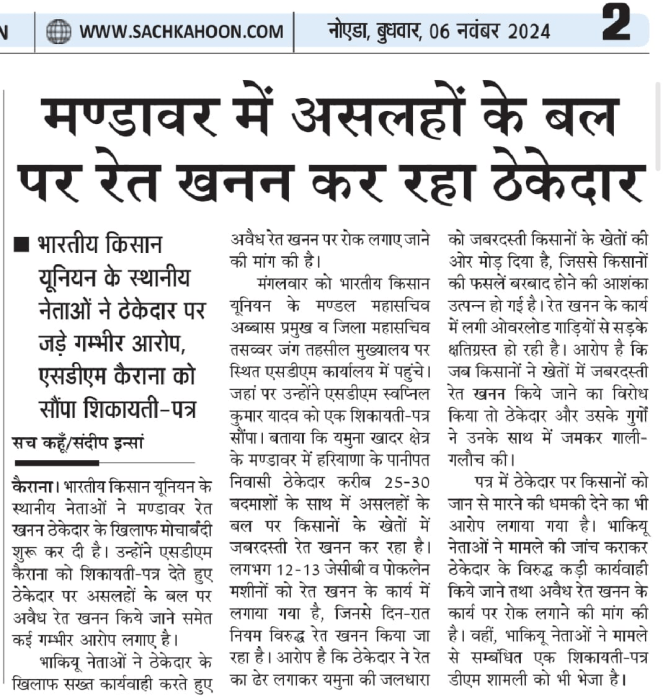
कैराना। गांव की आबादी के बीच से गुजरने वाले रेत से भरे ओवरलोड बिना नंबर प्लेट के वाहनों पर रोक लगाने की मांग। वहीं यमुना नदी में वैध पट्टे की आड़ में चल रहे अवैध रेत खनन पर भी अंकुश लगाए जाने की मांग की गई है। गाव ईस्सोपुर खुरगान, मलकपुर, मोहम्द राई, बसेडा निवासी ग्रामीणों ने डीएम अरविंद कुमार चौहान को शिकायती पत्र देते हुए बताया कि यमुना नदी में गांव मंडावर व नगलाराई में चल रहें रेत खनन पॉइंटो से दिन व रात के समय रेत से भरकर बिना नंबर प्लेट के ओवरलोड वाहन गांव की आबादी से होकर गुजरते है, जिससे आए दिन हादसे होने के साथ ही गांव की सड़के क्षतिग्रस्त हो रही है तथा उनसे उड़ने वाली धूल मिट्टी से वायुप्रदूषण फैल रहा है। जिससे ग्रामीण बेहद परेशान है। ग्रामीणों ने डीएम से ओवरलोड वाहनों का रूट डायवर्ट कराकर यमुना बंधे से ही वाहनों को गुजारने की मांग की है। https://www.livehindustan.com/uttar-pradesh/shamli/story-villagers-demand-action-against-overloaded-sand-vehicles-and-illegal-mining-in-yamuna-river-201729362514561.html (19 Oct. 2024)
खनन विभाग की टीम ने मंडावर खनन प्वाइंट पर छापेमारी की। इस दौरान जांच-पड़ताल करनेके साथ ही सीमांकन पिलर लगवाए गए हैं और ठेकेदार को मानकों के अनुरूप ही खनन की हिदायत दी गई है। https://www.livehindustan.com/uttar-pradesh/shamli/story-mining-department-raids-mandawar-point-guidelines-imposed-and-pillars-installed-201729707211509.html (23 Oct. 2024) शामली में रेत खनन ठेकेदारों द्वारा अवैध खनन करने की सूचना पर एसडीएम ने कार्रवाई की। जिला प्रशासन को नजरअंदाज करते हुए ठेकेदारों ने सरकारी पट्टे का गलत इस्तेमाल किया और अवैध तरीके से रेत खनन किया। इस पर एसडीएम ने दो खनन प्वाइंटों पर छापा मारा https://www.bhaskar.com/local/uttar-pradesh/shamli/news/sdm-raids-on-illegal-mining-133815238.html (16 Oct. 2024) An accident during night hours at Shakumbari mines in Shamli killed a sand mine worker. https://www.crimereview.co.in/painful-accident-while-mining-sand-in-shamli-laborer-died-due-to-machine-grip/131259/ (19 June 2023)
Baghpat अवैध रेत खनन के जरिए यमुना नदी का सीना चीर रहे खनन माफियाओं के लिए काठा रोड मुफीद बना हुआ है। वे अवैध खनन के रेत लदे वाहनों को इस मार्ग से निकाल रहेहैं। जिससे मार्ग भी गढ़ों में तब्दील हो चुका है। तहसील क्षेत्र में खनन माफिया जगह जगह अवैध रेत खनन के जरिए यमुना नदी का सीना चीरने में लगे हुए हैं। काठा गांव के आसपास तो रोजाना खुलेस्तर पर रेत खनन किया जा रहा हैं। खनन माफिया ट्रैक्टर ट्रालियों से खेकड़ा क्षेत्र में उसकी सप्लाई कर रहे हैं। रात ही नहीं दिन में भी वे काठा मार्ग से रेत लदे वाहनों को खेकड़ा क्षेत्र में ला रहे हैं और जरूरतमंदों को पांच से छह हजार रुपए प्रति ट्रॉली रेत बेच रहे हैं। ऐसा नहीं है कि इन खनन माफियाओं की भनक तहसील प्रशासन और पुलिस का ना हो सभी को इनकी जानकारी है। फिर भी वे आंखें बंद किए बैठे हैं। जिससेउनकी कार्यप्रणाली पर प्रश्नचिन्ह भी लग रहा है। अवैध रेत लदे वाहनों से तीन माह पहले बना काठा रोड फिर से गडढो में तब्दील हो चुका है। क्षेत्र वासियों को उसे पर आवागमन करते समय परेशानी उठानी पड़ रही है। https://www.livehindustan.com/uttar-pradesh/bagpat/story-illegal-sand-mining-thrives-on-katha-road-disrupting-yamuna-river-and-local-traffic-201728306329692.html (7 Oct 2024)
गाजियाबाद प्रशासनिक टीम के निरीक्षण के दौरान यमुना नदी में दो जेसीबी मशीनें, दो ट्रैक्टर और सात ट्रॉली मौके पर अवैध रूप से खनन करते हुए पाई गई. इस दौरान जैसे ही माफिया की नजर प्रशासनिक टीम पर पड़ी, एक मशीन चालक अपने साथ जेसीबी मशीन लेकर दिल्ली की ओर भाग गया. हालांकि दिल्ली की सीमा में प्रवेश करने के वक्त जेसीबी मशीन दलदल में फंस गई और मशीन चालक जेसीबी को छोड़कर फरार हो गया. इसके लिए दिल्ली पुलिस को सूचित कर दिया गया है. https://www.etvbharat.com/hi/!state/illegal-sand-mining-in-yamuna-river-ghaziabad-dls24051405476 (14 May 2024)
Noida यमुना में मंगलवार (Oct. 08) दोपहर डूबा आठ वर्षीय बुधवार को भी नहीं मिला। हालांकि, एनडीआरएफ की टीम ने नदी के दो किलोमीटर के दायरे में बच्चे को पूरेदिन तलाश किया। जहां बच्चा डूबा, वहां पर तीन बड़े-बड़े गड्ढे हैं। इसी में बच्चेके फंसने की संभावना है। पुलिस के मुताबिक पश्चिम बंगाल निवासी दंपति सेक्टर 125 में रहते हैं। दंपति मंगलवार को अपने दो बेटों के साथ यमुना में मछली पकड़ने गए थे। इसी बीच उनके दोनों बेटे नदी में नहाने लगे। कम पानी होने की वजह सेमाता-पिता ने बच्चों पर ध्यान नहीं दिया। इसी दौरान खेलते-खेलते दोनों बच्चे गहरे पानी में चले गए और डूबने लगे। बच्चों को डूबता देख परिजनों ने किसान से मदद की गुहार लगाई। किसान ने नदी में कूदकर एक बच्चे को निकाल लिया लेकिन उसका आठ वर्षीय भाई मंगल गायब हो गया। घटना के 36 घंटे बाद भी बच्चे को नहीं तलाशा जा सका है। https://www.livehindustan.com/ncr/noida/story-search-continues-for-missing-8-year-old-boy-in-yamuna-river-rescue-operation-launched-201728492401564.html (09 Oct. 2024)
हमीरपुर मौरंग के अवैध खनन की शिकायत मिलने के बाद मंगलवार की रात जांच करने पहुंचे खान निरीक्षक का माफिया के गुर्गों ने रास्ता रोक लिया और टीम को आगे नहीं बढ़ने दिया। सूचना पर ललपुरा पुलिस पहुंची, तब कहीं जाकर टीम आगे बढ़ सकी। टीम को बेतवा नदी किनारे अवैध खनन होने के साक्ष्य मिले हैं। टीम के आगे बढ़ते ही गुर्गों ने बैकहो लोडर से रास्ता खोद दिया। रास्ते की मरम्मत कर टीम को निकाला जा सका। खान निरीक्षक ने ग्राम प्रधान टीकापुर, इसके हिस्ट्रीशीटर भाई समेत चार लोगों के खिलाफ तहरीर दी है।
जनपद में मौरंग खनन पर रोक के बावजूद रात होते ही अवैध खनन का खेल शुरू हो जाता है। जहां-जहां मौरंग के डंप हैं, वहां अवैध खनन का ग्राफ और तेजी से बढ़ा है। नदी किनारे से खनन करके लाई जा रही मौरंग को इन्हीं डंपों में डाला जा रहा है। ताकि डंप की मौरंग बेचने के साथ-साथ चोरी से लाई जा रही मौरंग को भी ठिकाने लगाया जा सके। टीकापुर के आसपास लंबे समय से अवैध खनन का धंधा चल रहा है। यहां से अवैध रूप से सैकड़ों ट्रैक्टर मौरंग की निकासी होती रहती है। https://www.jagran.com/uttar-pradesh/hamirpur-up-team-arriving-to-investigate-illegal-mining-surrounded-case-registered-against-four-person-23769766.html (01 Aug. 2024)
Prayagraj Farmers stage Jal Satyagrah in Yamuna In a remarkable demonstration of dissent, hundreds of farmers, led by the Bhartiya Kisan Union (BKU), gathered at the Yamuna River near Madaripur Kanjasa village in Prayagraj to commence an indefinite Jal Satyagraha.
The primary issues raised by the BKU encompass: Lease of Sand Mining Rights: Granting sand mining leases at the Yamuna River ghats to the Nishads and Mallahs. Singh emphasized that the current restrictions on sand mining have severely impacted the livelihoods of workers from the Yamunapar area, pushing many to the brink of starvation and forcing youth to migrate to cities like Delhi and Mumbai for employment. https://en.themooknayak.com/livelihood/up-farmers-submerge-themselves-in-yamuna-river-temporarily-call-off-jal-satyagraha-after-official-assurance (25 June 2024)
Himachal Pradesh Despite warnings, illegal mining continues Despite multiple directives from the district administration and police officials, illegal sand and gravel mining along the Yamuna riverbed continues unabated even during the monsoon season. Illegal miners are not only flouting the law but also risking the lives of labourers who work under perilous conditions. The situation is particularly alarming near Yamuna Bridge, which connects Himachal Pradesh with Uttarakhand. The bridge is already in a deteriorating state, with funds allocated for its repair last year remaining unused. Despite the bridge’s fragile condition, illegal miners have continued their operations around the structure, digging so close to its foundational pillars that it is now at serious risk of collapsing. https://www.tribuneindia.com/news/himachal/despite-warnings-illegal-mining-continues-on-yamuna-riverbed/ (01 Aug. 2024)
यमुना पुल को बना खतरा उत्तराखंड-हिमाचल को जोड़ने वाले यमुना पुल की हालत पहले ही खस्ताहाल है। इसके लिए करीब सवा करोड़ बजट प्रावधान भी मरम्मत के लिए पिछले वर्ष पहुंचा था लेकिन मरम्मत का कार्य ही शुरू नहीं हो सका। पुल की मरम्मत तो छोड़िए ठीक इसके आसपास अवैध खननकारी काफी महीनों से सक्रिय रहे हैं। आलम ये हो चला है कि दशकों पुराने इस पुल के बुनियादी पीलरों तक खननकारी खोदते हुए पहुंच गए हैं। राष्ट्रीय संपत्ति एनएच प्राधिकरण का पुल खतरे के दायरे में आ गया है। मीडिया में खबरों के बाद एक दो दिन काम बंद रहता है। फिर बदस्तूर अवैध खननकारी पुल के आसपास खनन करते नजर आते हैं। https://www.google.com/amp/s/www.amarujala.com/amp/himachal-pradesh/sirmour/yamuna-bridge-in-dangerous-zone-due-to-illegale-minning-nahan-news-c-177-1-ssml1030-129245-2024-07-30 (30 July 2024)
DAMS & HYDRO POWER PROJECTS IN YAMUNA BASIN
MoEF Agenda of EAC meeting held on Nov 5 2024: Pachnad Major Irrigation Scheme (CCA: 24,328 Ha) in 24328 Ha at village Sadhrapur, Sub-District and District Auraiya, Uttar Pradesh – Terms of References. https://parivesh.nic.in/utildoc/110185600_1729685102781.pdf (Oct. 2024)
Himachal Pradesh Panel evaluates Renuka Ji dam project The Local Funds Accounts Committee of Himachal Pradesh, led by chairman, Sanjay Ratna and joined by members Satpal Satti, Keval Singh Pathania & Vivek Sharma conducted an inspection of the Renuka Ji Dam Project on the Giri river in Sirmaur district. The two-day tour included Nahan MLA Ajay Solanki and was part of efforts to evaluate the progress and address issues tied to this key project, designated as a National Project due to its potential to serve Himachal Pradesh & the National Capital Region (NCR). https://www.tribuneindia.com/news/himachal/panel-evaluates-renuka-ji-dam-project-in-sirmaur-dist/ (28 Oct. 2024)
YAMUNA RIVERS
Ghaziabad No water release to clean up ‘toxic’ river Chhath Puja is just days away, but a vast stretch of the Hindon remains coated with a thick layer of city’s sewage, industrial effluents and toxic dyes, its ghats strewn with plastic waste, garbage and slush. While the civic body claims it has started picking up waste from 60 points — ‘ghats’ where puja will be offered by lakhs of devotees — unlike past years, the irrigation department may not release water into the river to flush away pollutants before the festival this time.
Brahmanand, an official from UP irrigation department, told TOI that the annual de-siltation exercise of the Upper Ganga Canal was still underway, and it was unlikely that the work would be over by Nov 7-8, when devotees will take a dip in the river before offering ‘argh’ to the sun. “Water will be released into the river only if the department gets a govt order,” the official said. Even with a govt nod, time may run out.
Rakesh Tiwari, who performs Chatth puja with his family each year at a ghat near the Elevated Road, said it takes at least two days for water from the canal in Haridwar, about 185km away, to reach the city. “What is the use of a puja that puts our health at risk,” said another devotee. A report submitted in the NGT, during the hearing of Gupta’s petition, stated 55 drains across seven districts through which the river flows, empty 944 MLD of sewage into the river. Of this, 713 MLD are treated by 16 STPs. However, 231 MLD of untreated sewage still finds its way into the river. https://timesofindia.indiatimes.com/city/noida/up-water-release-uncertain-before-chhath-hindon-river-toxicity-concerns/articleshow/114891044.cms (02 Nov. 2024)
Nodia Authority ponders RFD on Hindon floodplains The Noida authority on Tuesday (July 30) said it is mulling over a proposal to develop a river front on the floodplains of river Hindon in Gautam Budh Nagar district. To that end, Noida authority chief executive officer Lokesh M has formed a committee to carry out a site inspection and a detailed study of the floodplains of Yamuna and Hindon. The committee will be headed by additional CEO Satish Pal and comprise five other members, including Abhisht Gupta, who was the petitioner in several cases filed before the NGT in the past demanding protection of floodplains and ecology.
Additional CEO Pal formed the committee after Gupta gave a presentation about the need to conserve floodplains in Noida. “As of now, the water flow and other conditions in the Hindon and Yamuna are not conducive for developing the river front project. But we are exploring measures to protect the floodplains that help in groundwater conservation and rainwater recycling,” said Lokesh M, chief executive officer, Noida authority.
Pal, in his letter on committee formation, said as per the Master Plan 2031, Noida is spread over 20,316 ha of which 5,036 ha form the floodplains of the two rivers. The authority has used 15,280 ha for urbanisation. The master plan says that 5,036 ha floodplains is meant for agricultural activities, floriculture, horticulture & recreational purposes, no permanent construction can be allowed on the floodplain. It raises concern about illegal construction on the flood plain. https://www.hindustantimes.com/cities/noida-news/noida-ponders-development-of-river-front-on-hindon-floodplains-101722366430357.html (31 Jul 2024)
NGT seeks report from chief secy on solid waste along Hindon The NGT has taken note of media reports on Hindon pollution and sought a report from the chief secretary. It has also directed the Noida Authority to crack the whip on waste generators or collection vehicles for dumping solid waste along the river. The tribunal’s order follows a March news report where the irrigation department had accused three men from Gadhi Chaukhandi village for dumping waste into the river. The case was heard by an NGT bench on July 11.
Earlier, an UPPCB report noted there were 358 industries along the Hindon across the seven districts — Saharanpur, Ghaziabad, Baghpat, Meerut, Shamli, GB Nagar and Muzaffarnagar — through which it flows. Of these, 81 units were dumping untreated effluents into the river. “The pollution department has issued notices to 51 of these non-compliant industries and also issued closure orders against 13 industries. Besides, Rs 156.26 lakh green compensation has been imposed on them,” the tribunal said. A CPCB report, dated July 9, also states an estimated 200 metric tonnes of solid waste, mostly construction and demolition debris, was regularly dumped along Hindon in Garhi Chaukhandi village.
The Authority and police were also told to take actions against waste generators or collection vehicles for illegally dumping waste near the riverbed. NGT also sought a report on action taken or proposed from the chief secretary a week before its next hearing on Oct 14. https://timesofindia.indiatimes.com/city/noida/ngt-seeks-report-on-solid-waste-dumped-in-hindon/articleshow/111819374.cms (18 July 2024)
YAMUNA FLOODPLAIN
Delhi Floodplain encroachment going on This News Laundry’s exclusive video report also featuring Himanshu Thakkar coordinator SANDRP and Bhim Singh Rawat associate coordinator SANDRP details the ongoing abuse and encroachments of Yamuna river floodplain in Delhi by various govt agencies including the DDA in the name of development and beautification in outright violation of High Court, NGT orders. https://www.youtube.com/watch?v=MzprJ2CzT-U (26 Oct 2024)
New timelines set for Yamuna revival Delhi govt has been given timelines by land-owning agencies to finish initiatives aimed at revitalising the Yamuna. By March 2025, the Kalindi Aviral Extension Project is expected to be finished, while the Hindon Sarovar, spread over 30 acres, will be completed by April 2025. Similarly, the Mayur Nature Park will take over a year to complete — its deadline is March 2026. Additionally, a 30-acre eco-tourism area is being planned according to details given by the landowning agency to Delhi govt. A senior official said that these projects will add vitality to Delhi’s green spaces & contribute to the rejuvenation of the Yamuna. https://timesofindia.indiatimes.com/city/delhi/yamuna-river-revival-new-timelines-unveiled-for-eco-friendly-projects-in-delhi/articleshow/113883903.cms (2 Oct. 2024)
हाई कोर्ट का फ्लडप्लेन पर बसी झुग्गी बस्ती को राहत देने से इनकार कोर्ट ने कहा, याचिकाकर्ता का 27 सितंबर, 2024 को मिले एविक्शन नोटिस पर रोक की मांग करने का कोई वैधानिक अधिकार नहीं है। उसे हाई कोर्ट की सिंगल बेंच द्वारा 8 जुलाई, 2024 को पारित निर्देशों पर अमल करना चाहिए। याचिकाकर्ता ने दशकों से श्रम विहार में बसे होने का दावा करते हुए कोर्ट से कहा कि संबंधित जमीन यमुना के फ्लडप्लेन या ‘O’ जोन में नहीं आती है। याचिकाकर्ता के वकील ने दावा किया कि बस्ती वालों ने कॉलोनी को अधिकृत करने के लिए संबंधित प्राधिकार को आवेदन दे रखा है। https://www.google.com/amp/s/navbharattimes.indiatimes.com/metro/delhi/other-news/delhi-high-court-said-no-one-wants-clean-yamuna-river-people-are-only-responsible-for-pollution/amp_articleshow/114061840.cms (09 Oct. 2024)
YAMUNA FLOWS
SANDRP Blog यमुना में पर्यावरणीय प्रवाह बढ़ाने के हों ठोस प्रयास पर्यावरणीय प्रवाह ही यमुना नदी को पुनर्जीवित करने का दीर्घकालिक समाधान है। चिंताजनक है दिल्ली से ऊपर यमुना नदी में 9 गैर मानसूनी महीनों के दौरान पर्यावरणीय प्रवाह का नितांत अभाव होता है। इस दिशा में सम्बंधित राज्य सरकारों एवं केंद्र सरकार के जल शक्ति मंत्रालय को मिलकर सुनियोजित तरीके से प्रभावी कदम उठाने की सख्त जरूरत है। अगले वर्ष यमुना जल बंटवारे संधि की समीक्षा के दौरान यमुना नदी हित में पर्यावरणीय प्रवाह बढ़ाना इस दिशा में पहला सार्थक कदम हो सकता है। https://shorturl.at/6uETR (31 Oct. 2024)
Article by Bhim Singh Rawat, Associate Coordinator SANDRP emphasing on significance of restoring environmental flows in Yamuna published in today’s Dainik Jagran, Delhi edition.

Agra To retain the structural integrity of the Taj Mahal, a free-flowing Yamuna in its original form is a must. A free-flowing, unpolluted Yamuna is also paramount to the welfare & health of millions dependent on it (C.P. Rajendran). https://www.etvbharat.com/en/!opinion/river-yamuna-in-delhi-urgent-need-to-restore-a-dying-river-enn24102303798 (23 Oct. 2024)
YAMUNA POLLUTION
Delhi River groans under neglect Bheem Singh Rawat, associate coordinator, South Asia Network on Dams, Rivers and People (SANDRP), said, “DDA’s claims of no wetlands encroachment and recovering 477.79 hectares of the floodplain are questionable and misleading. DDA itself has allotted several hectares of Yamuna floodplain to various construction companies and has not been able to restore the degraded floodplain to its original ecosystem, including about 60-hectare Millennium bus depot floodplain land.”
“The legacy construction waste of bridges is still scattered in floodplains and riverbeds. The rubble, concrete mixtures and solid waste are being dumped in floodplains along the eastern embankments between ITO and Wazirabad barrage. DDA has not even cleared the waste left behind following the removal of some illegal settlements in the floodplain,” he added. He also shared, “Presently, the Yamuna floodplain areas downstream, Delhi Noida, Greater Noida, Faridabad and Palwal have been undergoing large-scale encroachments in the form of farmhouses and unauthorised residential colonies. But the DoWR, RD & GR (Department of Water Resources, River Development and Ganga Rejuvenation) and the parliamentary committee report have turned a blind eye to this.”
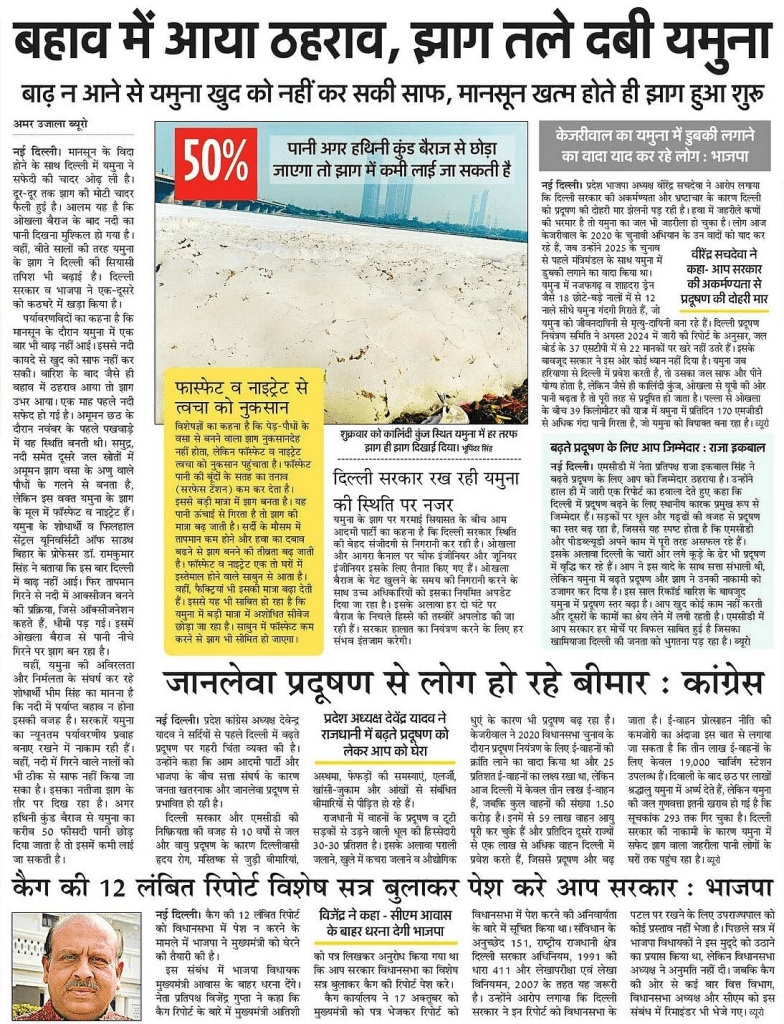
SANDRP, in its review report, had stated, “It is time for all the basin govts and decision makers to realise that unless at least 50 % of available water at Hathni Kund Barrage is not released in the Yamuna as environmental flows, the plans and projects to clean and protect the river will not achieve desired results.” https://www.newindianexpress.com/cities/delhi/2024/Oct/28/yamuna-pollution-a-river-groans-under-neglect-in-the-national-capital (28 Oct. 2024)
Let river flow to address frothing Bhim Singh Rawat, a Yamuna activist and member of the SANDRP said that all three states share responsibility for polluting the river. “The extreme levels of frothing clearly indicates that the ecological health of the river is very bad and it has no dissolved oxygen. In long term, sprinkling defoaming agents is not a solution. One measure could be release of more water from Hathnikund barrage to flush the river and ensure ecological flow. Right now, only 3000-10,000 cusecs of flow is being noticed.” https://www.hindustantimes.com/cities/delhi-news/aap-blames-neighbouring-states-for-yamuna-foam- (21 Oct. 2024)
Froth covers river The Yamuna in Delhi was seen covered with a thick layer of white froth on Oct 18, with experts saying this poses health hazards for people, especially as the festive season approaches. Videos circulating on social media show vast sections of the river frothing, resembling clouds over the water, which gradually dissipated later in the day.
Bhim Singh Rawat of SANDRP (quoted in several reports) told PTI that normally, the upper segment of the Yamuna experiences significant flood spells, but this year, there was no such spell during the just-concluded southwest monsoon. “This is unusual as the river generally witnesses at least a couple of low or medium flood spells in this segment every year,” Rawat said. He highlighted that the pollution in the river is a serious concern affecting human health and wildlife. While the river has some natural cleansing ability, the pollution levels are alarming, Rawat said, adding that the white froth that was seen during monsoon this year becomes more noticeable during festival times. https://www.deccanherald.com/india/delhi/froth-covers-yamuna-ahead-of-festive-season-posing-health-hazards-in-delhi-3239300, https://news.abplive.com/cities/delhi-s-yamuna-river-is-covered-in-white-foam-due-to-pollution-raising-health-concerns-, https://www.newindianexpress.com/cities/delhi/2024/Oct/19/toxic-foam-in-yamuna-river-poses-health-hazards-warn-, https://www.hindustantimes.com/india-news/yamuna-river-covered-in-toxic-froth-ahead-of-chhath-puja-netizens-react-101729326523940.html, https://www.thehindu.com/news/cities/Delhi/froth-covers-yamuna-river-in-delhi-ahead-of-festive-season-posing-health-hazards/article68772457.ece, https://english.jagran.com/india/delhi-yamuna-river-viral-video-covered-with-heavy-froth-ahead-of-chhath-puja-diwali-celebration-air-pollution-high-aqi-in-national-capital-bjp-manoj-tiwari-reacts-latest-updates-10195343 (18 Oct. 2024)
Detailed discussion on Yamuna froth issue. https://www.youtube.com/watch?v=nuSgxIn7K78 (21 Oct. 2024)
HC refuses permission to Chhath Puja on river bank A PIL seeking permission for Chhath Puja on the Yamuna’s banks was dismissed by the Delhi High Court due to severe pollution concerns. The court emphasized health risks and noted nearly 1,000 alternative locations for the ritual. The Delhi High Court (HC) has on November 6 dismmised a PIL seeking permission to conduct Chhath Puja rituals on the banks of the Yamuna River, according to an ANI report.
The PIL challenged the public ban on Chhath festivites on the banks of the Yamuna River, which petitioner Purvanchal Nav Nirman Sansthan said was first imposed during the COVID-19 pandemic and re-imposed now, it said. However, the Delhi HC refused to scrap the ban and citied severe pollution, contamination and toxic foam issues of the Yamuna River, the report added.
The court also directed the petitioner to around 1,000 other alternative locations that have been designated for Chhath Puja with arrangements made for the celebration. The bench further said that puja can be performed safely at the designated areas. https://www.livemint.com/news/india/chhath-puja-delhi-hc-denies-permission-rituals-yamuna-banks-pollution-concerns-alternate-location-toxic-foam-health-news-11730884415323.html (06 Nov. 2024)
“Please understand you will fall sick. The river itself is highly polluted; it isn’t as if you will pollute it. We can’t allow you (devotees) to go into the water. We have to be practical about it,” a bench of Chief Justice Manmohan and Justice Tushar Rao Gedela told the petitioner who challenged the ban on performing the puja on the banks of the river. “We can’t be discharging sewage into the river. Look at the unauthorised colonies, someone wants to build a banquet hall. The river is highly polluted. Cleaning it is a gigantic task, it cannot be done now. We can’t clean up the Yamuna in one day’s time,” the court said, observing the lack of consensus.
The court also referred to its recent order in another case in which judicial notice was taken about the fact that pollution in the Yamuna was at an all-time high. Delhi govt standing counsel Santosh Kumar Tripathi told the court that the Yamuna was highly polluted at this juncture and if the devotees were allowed to perform Chhath Puja on the river banks, they were likely to fall sick. https://timesofindia.indiatimes.com/city/delhi/delhi-high-court-denies-permission-for-chhath-puja-on-yamuna-river-banks-due-to-pollution/articleshow/115027318.cms (07 Nov. 2024)
The petitioner’s counsel argued for a reassessment of the complete ban on riverbed gatherings, suggesting that targeted clean-up efforts could make the area viable. The Chief Justice responded that effective river cleaning is an extensive endeavour, highlighting the persistent issue of untreated sewage flowing into the river from unauthorised settlements along its banks. He also expressed disappointment over the lack of political will to address the issue. https://www.newindianexpress.com/cities/delhi/2024/Nov/07/chhath-at-yamuna-can-harm-devotees-delhi-hc (07 Nov. 2024)
Health impacts of froth Contact with froth-laden water can trigger various immediate health issues. “The pollutants can cause skin irritation, rashes, and allergic reactions, as the chemicals strip the natural oils from the skin and cause inflammation,” says Dr Hiremath. More alarming is the risk of accidental ingestion or inhalation, which can lead to gastrointestinal problems, including vomiting, diarrhea, and stomach cramps. The respiratory consequences of exposure can be particularly severe. Dr Hiremath warns, “The froth is often rich in volatile organic compounds (VOCs), heavy metals, and microbial contaminants, which can irritate the mucous membranes in the nose, throat, and lungs.” Immediate symptoms may include coughing, throat irritation, and shortness of breath.
Skin-related problems are among the most visible effects of exposure. “Common skin problems include contact dermatitis, characterised by redness, itching, and inflammation, and bacterial or fungal infections that thrive in moist, contaminated environments,” Dr Hiremath explains. He recommends immediately rinsing the affected area with clean, running water if exposed. Topical antiseptics and anti-inflammatory creams can help alleviate symptoms, though severe reactions may require oral medications.
Perhaps most concerning are the long-term effects of repeated exposure. “Heavy metals like arsenic, cadmium, and lead, commonly found in polluted rivers, can accumulate in the body over time,” says Dr Hiremath, “potentially causing neurological disorders, kidney damage, and developmental issues in children.” He adds that prolonged exposure to microbial contaminants can weaken the immune system, making individuals more susceptible to infections and illnesses. Communities near polluted water bodies often report higher incidences of respiratory and skin diseases, highlighting the serious public health implications of water pollution. https://indianexpress.com/article/lifestyle/health/skin-respiration-overall-health-problems-polluted-toxic-river-froth-9654071/ (06 Nov. 2024)
DJB plans froth suppression Delhi Jal Board (DJB) will set up an in situ treatment for froth suppression with the help of automatic sprinklers under the Kalindi Kunj flyover to manage the problem of froth in the Yamuna throughout the year. “This year, an experiment was done by creating two foam-suppressing zones on the river’s surface where solution is being sprayed. We have installed water sprinklers under the flyover and large nets,” a DJB official said.
DJB has created two ‘reaction zones’ where the froth generated near the barrage gates is collected and then suppressed with the help of spraying a defoaming agent. Every year, Chhath brings the visible pollution of the Yamuna back into focus. Last year, DJB used a defoaming agent to manage the situation, and this year it is being repeated. However, officials said the problem of froth and pollution in the river is a year-long phenomenon. Hence, the idea is to set up a permanent mechanism in place to reduce the problem. https://timesofindia.indiatimes.com/city/delhi/delhi-jal-board-launches-froth-suppression-initiative-to-tackle-yamuna-pollution/articleshow/115027314.cms (06 Nov. 2024)

No step taken to tackle frothing According to DJB officials, the defoamer used last year was safe and was used after conducting several tests where it proved to be harmless to humans. From mid-month, DJB will deploy portable anti-surfactant sprinklers downstream of Okhla barrage before and during the Chhath Puja, claimed an official who participated in the meeting.
Two years ago, given the recurring nature of the problem, the NMCG constituted a joint committee comprising officials of DJB, irrigation and flood control (I&FC) department, DPCC and the Upper Yamuna River Board. This panel met on Sept 19 to chart out a plan for Chhath. https://timesofindia.indiatimes.com/city/delhi/djb-to-combat-yamuna-frothing-with-chemical-anti-frothing-measures/articleshow/114358341.cms (19 Oct. 2024)
Sprinkling of anti-foam agent begins – Delhi Jal Board (DJB) teams on Tuesday (Oct. 22) began sprinkling anti-foaming solutions to counter the build-up of the toxic froth around the Okhla barrage, officials with the water utility said. DJB officials said around 12-15 tonne of a diluted anti-foaming agent is expected to be used in the process, adding that the exercise will continue till Chhath, scheduled to be celebrated between November 6 and 8. https://www.hindustantimes.com/cities/others/sprinkling-of-anti-foam-agent-in-yamuna-begins-101729624336666.html (23 Oct. 2024)
Officials distorting pollution data Despite a recent report by the DPCC claiming that dissolved phosphate levels in the treated water entering the Yamuna River are within permissible limits, images of froth on the river’s surface ahead of Chhath Puja have caused alarm among residents of the national capital. Experts have expressed doubts, suggesting that the visible pollution contradicts the report’s findings. https://thepatriot.in/reports/foam-and-fear-are-officials-distorting-yamuna-pollution-data-59891 (24 Oct. 2024)
Opening of sluice gates adds to Yamuna woes The phased opening of the five sluice gates over the past week at the Okhla Barrage by the Uttar Pradesh irrigation department has sent more silt, sludge and froth cascading into the Yamuna at Kalindi Kunj. The silt and sludge have also created additional problems in the stretch immediately downstream of the barrage.
DJB set up a temporary lab there to monitor the water. Taking one other measure beside the usual spraying of chemicals from boats to prevent foam forming, DJB has also installed green nylon nets at Kalindi Kunj to stop the foam from accumulating near the riverbank.
“Seven anti-frothing automatic sprinklers have been installed under the bridge over the river. These spray the de-frothing liquid to suppress the foam and we have achieved the target of producing a clean water surface,” a DJB official claimed on Oct 24. According to officials, additional silt from the barrage has not only increased the pollution levels exponentially but also made it difficult for boats to move around for sprinkling the anti-froth chemicals.
The UP irrigation dept said that the sluice gates were opened to allow maintenance of the Agra Canal. “Between Dussehra and Diwali, we clear the silt from the canal and carry out repairs to ensure irrigation for the rest of the year. Since the canal is closed, the upstream water had to be released.” https://timesofindia.indiatimes.com/city/delhi/yamuna-river-pollution-crisis-ups-sluice-gates-open-environmental-impact-exposed/articleshow/114557535.cms (25 Oct. 2024)
Frothing river Except for Palla, fecal coliform bacteria were much higher than the maximum permissible limit at all seven locations in Delhi. However, none of the locations could meet the criteria for BOD. Ravi Agarwal, director, Toxics Link, a non-profit body, said: “Yamuna has basically two kinds of pollutants: chemicals and sewage, which is organic. The source of chemicals is industries and some domestic contribution in the form of oil, grease, and soap, while sewage comes from households. There is also water flowing back from the agricultural fields. It is a kind of polluted mass of things as all these pollutants interact with each other in Yamuna. Oil, grease and soap result in the formation of a sticky foam, which floats on the river. Some other pollutants sink to its bottom.” https://timesofindia.indiatimes.com/city/delhi/rituals-amidst-toxic-foam-yamunas-pollution-crisis-during-chhath-puja/articleshow/114918351.cms (03 Nov. 2024)
Toxic form raises health concerns Professor Sachchida Nand Tripathi, Dean of the Kotak School of Sustainability at the Indian Institute of Technology, Kanpur, explained that the froth is primarily caused by high concentrations of surfactants from soaps, detergents, and untreated wastewater being discharged into the river. These pollutants, which are not properly filtered out by existing wastewater systems, play a major role in the formation of this froth.
According to Professor Tripathi, “After the monsoon season, stable atmospheric conditions and increasing temperatures create the perfect setting for froth formation. By October, when the temperatures begin to drop, the froth stabilises further. This froth, however, contains harmful organic substances that release volatile gases directly into the atmosphere, contributing to air pollution. These gases can serve as precursors to the formation of secondary organic particulate matter, which is hazardous to both the environment and public health.” https://www.mid-day.com/news/india-news/article/toxic-froth-in-yamuna-river-raises-environmental-and-health-concerns-warn-experts-23414353 (20 Oct. 2024)

The white blanket of toxic foam in the Yamuna river in Delhi, which has been making headlines, has been captured on satellite from space. https://www.indiatoday.in/india/story/toxic-white-froth-yamuna-river-delhi-satellite-images-2620697-2024-10-21 (21 Oct. 2024)
Residents and political leaders in New Delhi have raised concerns about pollution after toxic foam was seen floating on the Yamuna River in the Kalindi Kunj area on Nov 1. The foam appeared ahead of Chhath Puja, leading authorities to spray chemical defoamers to address it. https://timesofindia.indiatimes.com/city/delhi/toxic-foam-in-yamuna-raises-pollution-concerns-in-delhi-ahead-of-chhath-puja/articleshow/114840945.cms (01 Nov. 2024)
Soaring pollution levels The faecal pollution levels in the Yamuna River, indicative of untreated sewage and significant contamination, reached a record high in Sep. This came despite some improvement in DO and BOD levels, attributed to the heavy rainfall in August. However, the rain had little effect on the faecal coliform levels, which soared to 4,900,000 MPN (most probable number)/100 ml. This figure is 1,959 times the standard of 2,500 units and nearly 9,800 times the desired limit of 500 units. It represents the worst faecal contamination since Feb 2022, when the level reached 6,300,000 units at the Agra Canal.
The DPCC measured the river’s faecal contamination in Sep, releasing its report last week. The report emerged amid growing concerns over pollution, with certain stretches of the river visibly frothing due to pollutants like surfactants and phosphates, which the DPCC did not specifically test. In August, the highest recorded faecal coliform level was 920,000 units, a sharp rise from July’s 160,000 units. Around 56 % of Delhi’s STPs failed to meet water quality standards in August, consistent with the failures in July and June. These plants were unable to meet standards for total suspended solids (TSS), BOD, COD, and faecal coliform, with treated sewage from STPs often entering the Yamuna or being used for horticulture purposes. https://www.business-standard.com/india-news/faecal-contamination-in-yamuna-soars-to-1-959x-over-safe-limit-in-sept-124100800580_1.html (8 Oct 2024)
Just ten days after the monsoon, Yamuna started stinking at Old Railway bridge in Delhi in the absence of flows. In the coming months the river will face an increase in pollution & the city will face potable water scarcity.
River pollution hits record high The faecal levels, depicting untreated sewage and high-level pollution in the river Yamuna, reached an all-time high in September. However, even the August rain couldn’t improve the levels of faecal coliform, which at its peak was a whopping 4,900,000 MPN (most probable number)/100 ml. This is 1,959 times higher than the standard of 2,500 units and 9,800 times the desired limit of 500 units. This was the worst pollution in the river, in terms of faecal coliform, since February 2022, when the faecal level at Agra Canal (one of the stations at the river stretch in the city) had reached 6,300,000 units.
The faecal level in the river was assessed by the DPCC for Sep, a report of which was released on October 4, with samples collected on September 4. The report comes at a time when certain stretches of the river are already showing heavy frothing, a visible proof of pollution when mixed pollutants like surfactants and phosphates are churned out to reveal their presence, even if the DPCC doesn’t test those parameters. “The source of high faecal coliform could be untreated or inadequately treated sewage from the STPs, sewage mixing through open drains coming from unauthorised colonies, intrusion or mixing of septage, faeces of animals, etc.,” stated a senior official involved with the cleaning of the Yamuna river.
Earlier in August, the highest faecal coliform level recorded was 920,000 units—a substantial increase from the 160,000 units observed in July. Media had earlier in Sept, referring to another DPCC report, stated that 56% of the sewage treatment plants in Delhi failed to meet the standards in Aug, the same as earlier in July & June. The STP mostly failed to meet the standards for TSS, BOD, COD, and faecal coliform. The sewage treated from STPs often makes its way to the river Yamuna or is often used for horticulture. https://timesofindia.indiatimes.com/city/delhi/yamuna-river-pollution-hits-record-high-in-delhi-faecal-coliform-levels-soar-in-september/articleshow/113981900.cms (06 Oct. 2024)
दिल्ली प्रदूषण नियंत्रण समिति के मुताबिक सितंबर महीने में यमुना नदी के पानी की जांच की गई. इसकी रिपोर्ट 4 अक्तूबर को जारी किए गए हैं. इस रिपोर्ट के मुताबिक नदी में फेकल कोलीफॉर्म का लेवल काफी ज्यादा बढ़ा है. 49,00,000 MPN/100 ml तक पहुंच गया है. यह लेवल मानक स्तर 2,500 यूनिट से 1,959 कई गुना ज्यादा है. फरवरी साल 2022 के बाद नदी में मल का लेवल बढ़ा ही है जिसके कारण यह एक खराब लेवल पर पहुंच गया है. फरवरी 2022 में आगरा नहर पर फेकल का लेवल 63,00,000 यूनिट तक पहुंच गया है. https://www.google.com/amp/s/www.abplive.com/lifestyle/health/toxic-foam-in-yamuna-river-cause-skin-and-respiratory-problems-chhath-puja-devotees-be-aware-2798787/amp (7 Oct 2024)
विचित्र है कि यमुना को स्वच्छ बनाने पर सबसे ज्यादा जोर दिल्ली में दिया जाता है, लेकिन यह सबसे ज्यादा इसी महानगर में प्रदूषित पाई जाती है। अन्य शहरों से गुजरते हुए भी यमुना का यही हाल हो जाता है। अलग-अलग शहरों में औद्योगिक अपशिष्ट से लेकर सीवर आदि की गंदगी इस नदी में बहाए जाने पर रोक लगाने को लेकर अब तक की घोषणाओं की हकीकत यह है कि इस वर्ष ज्यादा बारिश के बावजूद यमुना में प्रदूषण का स्तर सबसे ज्यादा पाया गया। https://www.google.com/amp/s/www.jansatta.com/editorial/yamuna-most-polluted-in-delhi-most-money-spend-for-cleaning-is-also-in-delhi/ (09 Oct. 2024)
Sonipat HC upholds ₹157cr fine on 24 units flouting pollution rules Punjab and Haryana high court has upheld imposition of an environmental compensation (EC) of Rs 157 crore on 24 factories in Sonipat. The fine was imposed on the units for violating environmental norms and illegally extracting groundwater. Haryana Water Resources Authority (HWRA) had imposed the EC in Jan, following a directive from NGT in response to a plea by Delhi-based activist Varun Gulati. Gulati had alleged that numerous units were unlawfully withdrawing groundwater while authorities failed to tackle the issue.
The affected units challenged the notices in court, but the HC dismissed their petitions, saying that the issuance of show-cause notices adhered to the principles of natural justice. The court instructed the competent authority to pass speaking orders — explaining the reason for the fine and why it was imposed — within one month after granting a hearing to the notices. It said no coercive actions would be taken against the petitioners during this period. The court refrained from commenting on the merits of the cases and urged the competent authority to decide the matter impartially. https://timesofindia.indiatimes.com/city/gurgaon/punjab-and-haryana-hc-upholds-massive-rs157-crore-fine-on-24-factories-for-groundwater-violations/articleshow/114438375.cms (22 Oct. 2024)
NGT directs DC to issue speaking order for Barhi units NGT has instructed the Deputy Commissioner of Sonepat to issue a speaking order to recover Environmental Compensation (EC) from industries in Barhi accused of violating pollution norms and illegally extracting groundwater. This directive comes after the Punjab and Haryana High Court recently dismissed a petition from 24 industrialists. The Haryana State Pollution Control Board (HSPCB) had initially imposed an EC of Rs 157 crore on 24 industries in the HSIIDC industrial zone for pollution violations, prompting the industrialists to approach the high court. Following a complaint, the NGT asked the HSPCB to submit a report. After review, the Deputy Commissioner reduced the EC from Rs 96 crore to Rs 24 lakh, leading the complainant to file an execution application with the NGT against the reduction.
In response, the NGT deemed the Deputy Commissioner’s decision unjustified and ordered restoration and recalculation of the EC based on norms established on Nov 29, 2022. Consequently, the EC was recalculated, increasing it from Rs 96 cr to Rs 157.19 cr, & show-cause notices were served on the industries. The industrialists then appealed to the Punjab and Haryana High Court, which disposed of their petition. Following the high court’s ruling, the NGT directed compliance with its previous order dated November 29, 2022. The NGT further instructed the Sonepat DC to pass a detailed speaking order within three months and address the pending execution application. https://www.tribuneindia.com/news/haryana/ngt-directs-sonepat-dc-to-issue-speaking-order-for-barhi-units/ (31 Oct. 2024)
Panipat NGT imposes ₹60 lakh eco fine on liquor factory in Samalkha The unit had already deposited Rs 27 lakh as interim environmental compensation to the Haryana State Pollution Control Board (HSPCB) on August 6. Ramesh Kumar, a farmer in Chulkana village, had filed a complaint to the HSPCB and NGT regarding discharge of effluents, chemical and gases by Haryana Organics Limited, a liquor manufacturing unit in Samalkha, which was destroying and adversely affecting his crops.
The NGT has directed the HSPCB to impose upon the liquor factory and recover from it an additional environmental compensation of Rs 33.6 lakh. It has also directed to give Rs 5 lakh out of Rs 27 lakh to the complainant, who is a farmer of Chulkana village. The environmental court directed the HSPCB to prepare and implement an action plan of Rs 22 lakh for protection and improvement of environment in the area. https://www.tribuneindia.com/news/haryana/ngt-imposes-60-lakh-eco-fine-on-liquor-factory-in-samalkha/ (27 Oct. 2024)
Gurugram Act against illegal dyeing units: NGT Taking suo motu cognizance of a TOI report that dyeing units were operating illegally in the city, the NGT last month directed SPCB to carry out a survey and take action accordingly. The bench also issued notices to MoEF, CPCB, SPCB and Gurgaon DC to submit their responses at least a week before the next hearing on Oct 16. “The HSPCB is now tasked with surveying and taking action against these illicit units. The afore mentioned news item indicates a violation of the provisions of the Water (Prevention and Control of Pollution) Act, 1974, and the Environment (Protection) Act, 1986,” it said. TOI reported on Aug 22 that several dyeing units were officially closed, but continued to operate, specifically in Sector 103, Basai and Sector 36. https://timesofindia.indiatimes.com/city/gurgaon/ngt-orders-action-against-illegal-dyeing-units-in-gurgaon-following-toxic-pollution-concerns/articleshow/113918038.cms (4 Oct 2024)
Noida Momnathal village between Yamuna and Hindon rivers in Noida bearing the brunt of pollution in both rivers. https://www.youtube.com/watch?v=AAN2GnYnsrg (23 Oct 2024)
Only citizens’ groups clean river banks The Yamuna has an 81.7km span in Noida, but there is no institutional mechanism to clean up its banks, parts of which are a toxic ferment of garbage that pollute not just the river – for whose cleaning thousands of crores have been spent – but also the floodplain where vegetables that find their way into mandis are grown.
A survey report submitted by the administration on Sept 12 shows the Yamuna flows through a shallow and fragmented channel — its average depth is 3 metres — as it crisscrosses 26 villages including Wajidpur, Raipur Bangar, Chak Basantpur, Nagli Bahrampur, Nagli Sabapur, Gulawali, Kondli Bangar, and Jhuppa. While there is no data on how much waste these villages generate daily, part of it finds its way into the river or is dumped along its banks.
Over the years, Noida Authority has not taken any significant steps in cleaning or desilting the banks as this requires coordination among multiple stakeholders from different districts. A proposal to develop a Yamuna riverfront has largely remained confined to drawing books. Earlier this year, the district administration directed the irrigation department and Noida Authority to conduct a feasibility study for the project. If conditions are found to be conducive, the study report will be tabled before the UP govt. But that could take months, if not more.
Officials also could not immediately share the funds received or work undertaken under the National Mission for Clean Ganga (NMCG), a 2016 central govt initiative to clean, conserve and rejuvenate the Ganga and its tributaries, including Yamuna, through a structured approach at national, state & dist levels. https://timesofindia.indiatimes.com/city/noida/citizens-take-charge-grassroots-movement-cleans-yamuna-river-banks/articleshow/114023606.cms (8 Oct 2024)
Agra SC tells civic body to pay Rs 58.4 cr Affirming that civic bodies could be penalised for river pollution, the Supreme Court on Nov 4 castigated Agra Nagar Nigam for “creating a hell” in Yamuna by allowing discharge of untreated sewage into the river and upheld National Green Tribunal’s April 24 order imposing Rs 58 crore environmental damage compensation. A bench of Chief Justice D Y Chandrachud, and Justices JB Pardiwala and Manoj Misra was anguished by the general lackadaisical approach of civic bodies across India to keep rivers pollution-free and said, “look at the way rivers are getting polluted everywhere, the municipal corporations are doing nothing.”
“Approximately 52 drains are pouring liquid waste directly into river Yamuna at Agra, just close to Taj Mahal, causing stagnation in river water as a result whereof fishes which used to check insect population by eating its larvae are dying and thereby disturbing the ecological balance,” it had said. NGT had also ordered the Mathura civic body to pay an environmental compensation of Rs 7.2crore.
SC had suo motu initiated proceedings in 1994 to clean the Yamuna. After nearly two decades of proceedings and after thousands of crores spent, proceedings were transferred to NGT. The river scarred by sewage and chemical discharges continues to froth, but neither NGT nor SC has ever hauled up the Municipal Corporation of Delhi for inaction or imposed any environmental cost on it. https://timesofindia.indiatimes.com/city/delhi/youve-made-yamuna-hell-sc-tells-agra-civic-body-to-pay-rs-58-4-crore/articleshow/114962197.cms (5 Nov. 2024)
Desilting river may affect stability of Taj IIT Roorkee in a report to the Supreme Court bench have said that removal of accumulated silt, sludge and debris in the vicinity of the Taj Mahal in Agra will have a number of detrimental impacts including on structural stability of various structures including Taj. The report has been submitted following UP Govt request. Next hearing on Nov 8 2024. https://www.hindustantimes.com/india-news/desilting-yamuna-may-affect-stability-of-taj-mahal-iit-experts-in-report-to-sc-101728389000487.html (08 Oct. 2024)
आगरा में यमुना आरती स्थल पर हुआ भव्य दीपोत्सव, 21 हजार दीपों की रोशनी जगमगा उठा घाट https://www.abplive.com/states/up-uk/agra-yamuna-river-arti-ghat-was-illuminated-with-the-light-of-21-thousand-lamps-ann-2813629 (30 Oct. 2024)
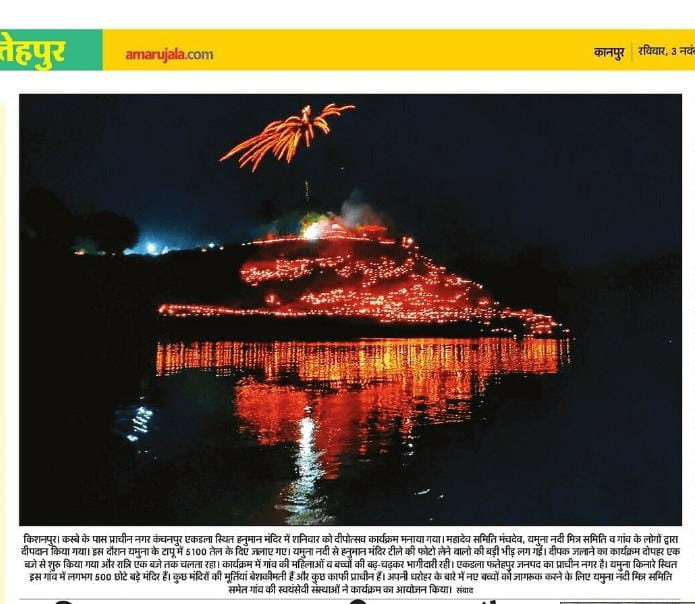
Fatehpur महावीर सेवा समिति एकडला द्वारा शनिवार (Nov. 02) कालिंदी के तट पर प्राचीन हनुमान मंदिर में दीपोत्सव का भव्य आयोजन किया गया। जहां गांव के प्रत्येक घर से शुद्ध सरसों का तेल इकट्ठा कर मिट्टी के दिवाली मेंगांव के पंचदेव मंदिर कलिका मंदिर शीतला मंदिर आदि सभी प्राचीन मंदिर तालाब व यमुना किनारेहनुमान मंदिर मेंकुल 5100 दीपक जलाए गए . https://www.livehindustan.com/uttar-pradesh/fatehpur/story-grand-deepotsav-celebration-at-ekdala-hanuman-temple-with-5100-diyas-201730563483890.html (02 Nov. 2024)
YAMUNA RIVERS BIODIVERSITY
Madhya Pradesh Mystery behind 2008 gharial death in Chambal After spending 16 years researching gharial habitats and behaviours, the Gharial Ecology Project found that the reptiles, most of them sub-adults, were exposed to toxins in a stretch of the Chambal itself – much higher upstream than initially thought. They came to this conclusion after discovering through their monitoring that sub-adult gharials were quite restricted in their movement. Therefore, the source of the toxins that killed them had to be within a 15-km range of where their bodies were later found. 100 gharial were found dead in Chambal 80 km upstream from its confluence from Yamuna in 2008. https://theprint.in/feature/around-town/chambals-gharial-deaths-were-a-mystery-for-india-in-2008-then-a-task-force-cracked-it/2075574/ (8 May 2024)
YAMUNA FISH, FISHERFOLKS
Delhi ‘Fish in Burari died of pollution’ The Delhi Pollution Control Committee (DPCC) has informed the NGT that a highly polluted drain originating from Haryana and mixing with the Yamuna River was responsible for the death of several hundred fish in Burari. Earlier, the NGT had taken suo motu (on its own) cognisance of a newspaper report regarding the death of several hundred fish in Yamuna, which sent a fetid stench in the residential areas of Burari in July this year. In its report submitted on Tuesday (Nov. 05), the DPCC said an inspection was carried out at the location on August 29, and water samples were collected. The report said that there was a drain from Haryana (called Drain No. 8) which mixed with the Yamuna near the site. The sample results of three sites revealed the drain had a high pollution load, which deteriorated the river’s water quality, leading to fish deaths, especially during the pre-monsoon season. The DPCC urged the SPCB and the state’s urban development authority to take urgent action to control pollution in Drain No. 08. https://www.millenniumpost.in/delhi/fish-in-burari-died-of-polluted-hry-drain-mixing-with-yamuna-585935 (07 Nov. 2024)
Uttar Pradesh NGT orders action against illegal farming of African catfish The green body was hearing a plea claiming two people were breeding the banned fish variety in the Shahpur Nij Morta village of Ghaziabad district. In a recent order, a bench of NGT Chairperson Justice Prakash Shrivastava noted a 2019 order of the tribunal, according to which, “Breeding of exotic magur (catfish) is not allowed without the approval of the national committee on exotic fishes and also the state government concerned because of its potential to cause ecological damage in our country.”
The bench said the matter concerning the breeding of exotic catfish or its hybrid Thai magur had been settled by the tribunal by banning it. “We dispose of the original application, directing the director, fisheries department, to duly consider the complaint and take necessary action following the (previous) order of the tribunal. The director will get the site inspection done and will find out if the allegation of the applicant is found to be correct, then necessary action will be taken by him,” the bench said. https://www.deccanherald.com/india/uttar-pradesh/ngt-orders-action-against-illegal-breeding-farming-of-african-catfish-in-uttar-pradesh-3260302 (03 Nov. 2024)
YAMUNA WETLANDS, LAKES, WATER BODIES
Yamuna Manthan 031024: Threatened River Wetlands There are reports of Uttar Pradesh govt’s plan to reduce ESZ of Keetham lake to zero. Similarly, the Uttar Pradesh govt departments have also been delaying process to notify Dhanauri wetlands as a Ramsar site in Greater Noida. In Gurugram, a report by has found several violations of ESZ norms by housing and infrastructure projects impacting Sultanpur National Park in Sahibi river basin. Likewise, in Delhi, NHAI was found damaging part of a protected pond in Goyla Khurd village by constructed road through the waterbody. https://sandrp.in/2024/10/03/yamuna-manthan-031024-threatened-river-wetlands/ (03 Oct. 2024)
Noida Lack of upkeep keeping winter birds away from wetlands? Okhla Bird sanctuary’s deteriorating condition is believed to be the reason behind the absence of these avian visitors. Similarly, Surajpur wetland has also experienced a lack of winter birds, with only five species observed as of last week against 15-20 species last year. Over the past few years, the sanctuary’s ecosystem has been negatively impacted by various factors, resulting in a diminished capacity to attract and support the wide array of migratory birds that previously frequented its waters.
Ecologist TK Roy told TOI, “Unfortunately, due to mismanagement and the destruction of wildlife and birdlife habitats, the sanctuary has been transformed into a highly disturbed entertainment park.” Roy added that unauthorised concrete structures have been erected on the grounds, which has further degraded the natural environment that once supported a thriving ecosystem. As a result of these detrimental changes, the resident water bird population has suffered a significant decline, with fewer than 15 species now present in the sanctuary — and their numbers have dwindled to alarmingly low levels. https://timesofindia.indiatimes.com/city/noida/winter-birds-absent-from-noida-wetlands-due-to-neglect/articleshow/114891924.cms (03 Nov. 2024)
Gurugram NBWL flags farmhouses, highrises built near Sultanpur park The standing committee of the National Board for Wildlife (NBWL) has directed Haryana govt to submit an action-taken report after a district panel flagged at least 70 violations, including illegal construction of housing societies and farmhouses, near the protected Sultanpur wetland. Construction and other non-forest activities are barred or restricted in a 5km radius around the Sultanpur National Park, which was designated a Ramsar site just last year. This perimeter, the eco-sensitive zone (ESZ), acts as a buffer to protect the wetland and the wildlife there.
Last month, the intergovernmental panel — comprising Gurgaon deputy commissioner, officials of the irrigation department, state wetland authority, chief wildlife warden, and experts from the Indian Institute of Roorkee — carried out an inspection of the area. The violations they spotted include encroachments on the Sultanpur Jheel, construction of an affordable housing colony in Garhi Harsaru, another multi-storey residential project in Dhorka village, and farmhouses in Farrukhnagar, the panel told SNBWL in a report submitted this July. https://timesofindia.indiatimes.com/city/gurgaon/wildlife-panel-flags-illegal-construction-near-sultanpur-wetland-urgent-action-required/articleshow/114598808.cms (26 Oct. 2024)
Bhopal Trees cut in Bhoj wetlands forest An incident of tree-cutting in Bhoj wetland area in Bhopal on intervening night of Friday-Saturday has come to the fore. Green activists have complained to collector and DFO. Trees were cut in Nathu Bharkheda village, which comes under Bhoj wetland project. As per complaint, the land from where the trees have been illegally felled and its adjoining plots are full of trees and look like a forest. The Google earth image and other photographs clearly show that the entire area is as good as forest qualifying the meaning of forest. https://www.freepressjournal.in/bhopal/madhya-pradesh-trees-cut-in-bhoj-wetland-forest-department-orders-probe (20 Oct. 2024)
WATER OPTIONS IN YAMUNA BASIN
Madhya Pradesh A dam the village built People of the Bilpura village in Panna district own roughly 80 acres of land that lies between the dam and their village. “Earlier there was a small naala [stream] and it was used in a few acres,” says Maharaj Singh. “Only after the dam came, have we all been able to plant in our fields.” Since the dam was rebuilt in 2016, he has not had to go – his earnings from farming are sustaining him and his family. Water from the dam now lasts through the year and it’s also used for cattle.
The move to rebuild the dam was the outcome of public meetings held by the People’s Science Institute. The state had built a dam on a pond near a grove of kaitha (wood apple) trees. It was built 3 times over 10 years. The last time it caved during a monsoon, state officials decided enough was enough and reduced the size of the dam. The small dam did not suffice: “water barely reached the fields, and it dried out well before summer so was of no use for our irrigation needs,” says Maharaj. “Only about 15 acres could be cultivated & only one crop.”
In 2016, people from the village decided to take matters into their own hands and offered their labour as donation to rebuild it. “We carried mud, dug, broke stones and placed them, and in one month we had finished the dam. All the people were from our village, mostly Adivasi and some Other Backward Class,” says Maharaj who also took part. The new dam is bigger in size and has not one but two weirs to allow the water to flow out evenly and prevent another break. https://ruralindiaonline.org/en/articles/the-dam-the-village-built/ (13 Oct. 2024)
Report Effective greywater management & its reuse potential in rural Punjab, Haryana As greywater generation increases due to the Jal Jeevan Mission (JJM) program with Functional Household Tap Connections (FHTCs) installed in rural India, exploring its potential for groundwater recharge and irrigation is crucial. To optimise the greywater value chain at the village level, a multifaceted strategy is necessary. This involves streamlining policy implementation, refining funding mechanisms, and strengthening community engagement.
1. Encouraging use of treated greywater for agricultural reuse – Enhancing agricultural practices through treated greywater, involving farmers in the process, and promoting sustainable farming could reduce groundwater extraction and boost agricultural productivity. Collaborative studies, pilot projects, and comprehensive training programs for farmers could accelerate the adoption of these practices.
2. Strengthening community involvement through VWSCs – Empowering local bodies with knowledge, resources, and decision-making authority, we can achieve more effective management of greywater treatment facilities and solid waste management at the village level. This approach leverages local expertise and encourages community-driven solutions.
3. Developing comprehensive water quality standards – Prioritise comprehensive water quality testing by VWSC members on a regular basis to ensure greywater safety, protect public health, and inform farmers about quality standards before irrigation.
4. Refining funding mechanisms – Developing alternative funding parameters beyond population size, such as considering existing infrastructure or water scarcity levels, could lead to a more equitable distribution of resources. This approach would benefit smaller villages that currently struggle to access adequate funds for greywater management. https://www.indiawaterportal.org/water-quality-and-pollution/waste-water-/effective-greywater-management-and-its-reuse-potential-in-rural-punjab-and-haryana (30 Sep. 2024)
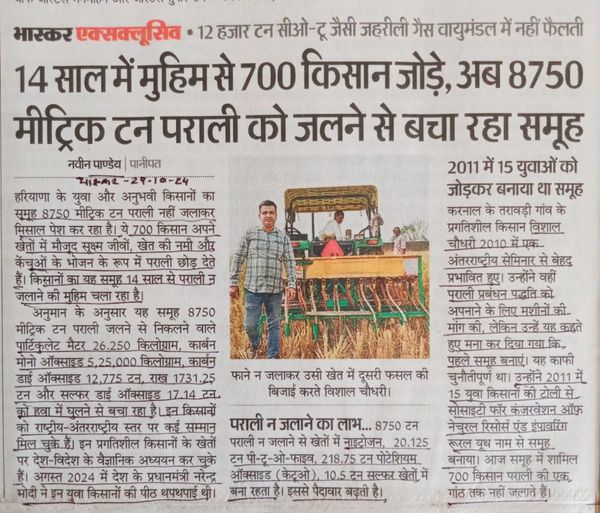
Haryana Interesting story of farmers of Tarawadi village in Karnal dist of Haryana who are not burning the crop residue. 700 farmers are mulching the 8750 tons of crop residue into the land since 2010-11, now for 14 years. The group led by Vishal Chaoudhary is called Society for conservation of natural resources and empowering Rural Youth.
GROUNDWATER IN YAMUNA BASIN
Study 64.6bn cubic metres of GW in Punjab & Haryana in 17 years Punjab and Haryana have lost a staggering 64.6 billion cubic metres of groundwater in the 17 years between 2003 to 2020, a study has found, underscoring the possible effect of urbanisation on this rapidly depleting resource, researchers from IIT-Delhi and Nasa’s Hydrological Sciences Laboratory estimate. The study, titled ‘Detection and Social Economic Attribution of Groundwater Depletion in India’, was published on Oct 14 in the Hydrogeology Journal.
The paper cited other research to note that “substantial groundwater depletion” was observed in Gurgaon and Faridabad, where water-intensive paddy cultivation is minimal — indicating that much of the resource in these areas was likely because of the urban sprawl. Data showed that groundwater level declined 8-10% in Punjab and Haryana from 2000 to 2015. In the two states, the growth rate of factories was 69% in FY 2004-2005 and this went up to 170% in FY 2018-2019. Similarly, urbanisation growth was 10% in 2001, and this went up to 20% by 2011. https://timesofindia.indiatimes.com/city/gurgaon/massive-groundwater-loss-punjab-haryana-deplete-646-billion-cubic-metres-in-17-years/articleshow/114662709.cms (28 Oct. 224)
Haryana Villagers challenge politicians to drink water Voters in Samaspur village, Charkhi Dadri constituency, have issued a challenge to all political candidates seeking their votes in the upcoming election: drink a glass of the water supplied to their village. Residents claim they have been forced to buy drinking water for the past decade, as the water supplied to their area is dirty, foul-smelling, and unfit even for animals, let alone humans. https://www.indiatoday.in/elections/assembly/video/villagers-challenge-politicians-to-drink-water-supplied-to-them-in-haryana-2609961-2024-10-02 (02 Oct. 2024)
Agra Water making villagers disabled In Patti Panchgai village, just 9 kilometers from Agra, drinking water is turning into a silent threat, leaving villagers disabled and putting their future at risk. High levels of fluoride and arsenic in the water have affected everyone—from children and youth to the elderly.
Watch this report to uncover the alarming impact of this toxic water crisis on the lives of the villagers. https://www.youtube.com/watch?v=GMmS52coJYE (06 Nov. 2024)
YAMUNA URBAN WATER
Delhi Water crisis amid river’s toxicity Water supplies in Lutyens’ Delhi have been significantly disrupted over the past few days due to rising pollution in the Yamuna River. At least 27 prime locations, including government headquarters, have been left with limited access to water. Water supply will not be available Sunday in these areas, according to an official statement. Toxic foam accumulation in the Yamuna has forced the shutdown of the Sonia Vihar Water Treatment Plant, impacting potable water availability in the areas managed by the New Delhi Municipal Council (NDMC) and the Delhi Jal Board.
The Sonia Vihar Water Treatment Plant, built in 2004, serves 3.5 million, processing water from both the Ganga and Yamuna rivers. With rising ammonia levels in the Yamuna, the raw water supply to the plant has been affected, causing widespread water shortages across NDMC zones. NDMC, which relies on 125 MLD (million litres per day) from the Wazirabad, Chandrawal and Sonia Vihar water treatment plants, has been struggling to maintain consistent supply. https://indianexpress.com/article/cities/delhi/no-water-supply-in-prime-locations-today-water-crisis-in-lutyens-delhi-amid-yamunas-toxicity-9640703/ (27 Oct 2024)
Delhi residents face potential water shortages due to maintenance work on the Upper Ganga Canal and high ammonia levels in the Yamuna River, reducing the operating capacity of key water treatment plants to 30%. The disruption could affect several regions until Nov 1, 2024. https://economictimes.indiatimes.com/news/india/delhi-jal-board-issues-alert-says-supply-to-be-affected-till-november-1/articleshow/114656018.cms (27 Oct. 2024)
Govt wants artificial rain to tackle worsening air pollution Cloud-seeding was considered to curb pollution in 2023 too but the plan did not materialise due to unfavourable weather conditions. “I appeal to the federal environment minister…now in Delhi and north India, the pollution has reached the border of 400,” Rai told reporters, referring to the air quality index (AQI) score on Tuesday (Nov. 05). “The next 10 days are quite crucial…help us get permission for artificial rain, call a meeting,” he said. https://www.reuters.com/world/india/toxic-smog-wreathes-indias-capital-winter-nears-2024-11-05/ (05 Nov. 2024)
Greater Noida NGT initiates suo motu case on water contamination NGT has taken suo motu cognisance of a news report highlighting the contamination of drinking water in Greater Noida’s Supertech Ecovillage 2 housing society. The news article, published in The Indian Express on September 13, 2024, reported that the water supply contained traces of E.coli bacteria and bleaching powder, leading to over 300 residents, including 170 children, falling ill. The residents suffered from symptoms like diarrhea, vomiting, stomach pain, and fever. Therefore, it issued notices to the Greater Noida authority, UPPCB), CPCB and the DM in Noida. The NGT has directed all these respondents to file their replies at least one week before the next hearing on Jan 28, 2025. https://www.barandbench.com/news/ngt-suo-motu-case-water-contamination-greater-noida-flats (04 Oct. 2024)
MONSOON IN YAMUNA BASIN
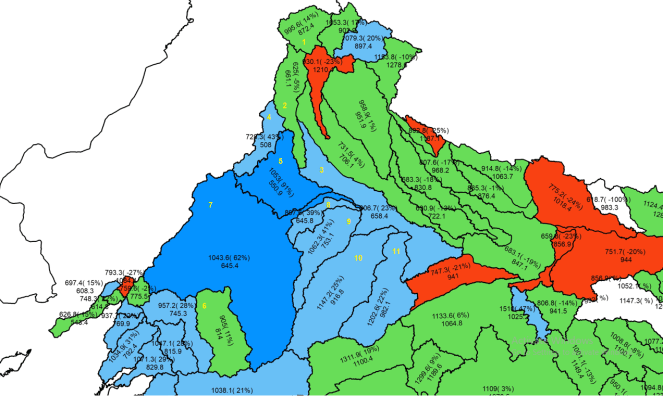
Yamuna SW Monsoon 2024: Upper Segment Misses Flood After remarkable deluge in 2023, the upper segment of Yamuna River has seen no significant flood spell all through the just concluded SW monsoon 2024. This is unusual as the river generally witnesses at least a couple of low or medium flood spells in this segment every year. This year the discharges from Hathnikund Barrage in Haryana did not cross 1 lakh cusec figure even once. The peak discharge from the barrage was 87,017 cusecs at 6 hr on Sep 26. https://sandrp.in/2024/10/02/yamuna-sw-monsoon-2024-upper-segment-misses-flood/ (2 Oct 2024)
Himachal Pradesh 3rd driest October since 1901 The state received the third lowest rain this October in the past 124 years. Against the normal rainfall of 25.1mm in October, the state received only 0.7 mm this year, which amounts to 97 per cent deficiency. Hamirpur, Bilaspur, Solan, Sirmaur, Kullu and Chamba districts have received no rainfall last month.
The two occasions when even lesser precipitation was recorded than this Oct, occurred in the past 10 years. While Oct 2017 saw 99 per cent deficiency, the rain in Oct 2020, was 98 % less than normal. Ever since 2010, Oct has received less than normal rainfall every year, barring three occasions. In Oct 2021, 107 % more than normal rainfall was recorded. The highest rainfall in Oct (413.5 mm) was in 1955. https://www.tribuneindia.com/news/himachal/himachal-witnesses-third-driest-october-since-1901/ (02 Nov. 2024)
Post-monsoon rain deficit reaches 97% The state received 0.7 mm of rain on average from Oct 1 to Oct 24, against a normal rainfall of 22.9 mm, a deficit of 97 per cent, the Meteorological department said. Bilaspur, Chamba, Hamirpur, Kullu, Sirmaur, and Solan districts did not see any rain in the period. There was a deficit was 99 per cent in Lahaul and Spiti and Shimla districts, 98 per cent in Kinnaur, and 94 per cent in Kangra district. Mandi and Una districts recorded rain deficits at 82 and 52 per cent. The dry spell is set to continue till October 31, the Met said. https://www.deccanherald.com/india/himachal-pradesh/post-monsoon-rain-deficit-reaches-97-in-himachal-high-temp-across-state-3247995 (25 Oct 2024)
In first post monsoon month Uttarakhand has received only 2.9 mm rainfall against the normal average of 31 mm thus facing 91% deficit. Similarly, against the normal average of 25.4 mm the Himachal Pradesh registered only 0.7 mm and is 97% rainfall deficit.

FLOOD IN YAMUNA BASIN
SANDRP Blog SW Monsoon 2024: Rivers Crossing HFL In 4 months June-Sep of SW monsoon 2024, there have been at least 64 incidents of HFL breach in 10 rivers basin of India comprising of 59 level monitoring and 05 level forecast sites. The maximum 39 of HFL breaches have taken place in Ganga basin including 16 in Yamuna basin.
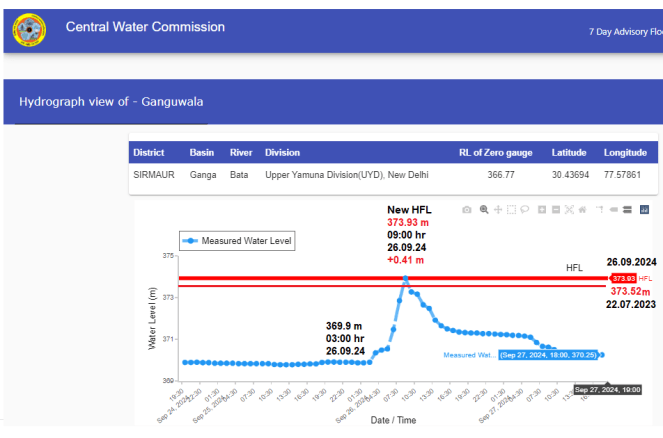
While rivers in Krishna basin have crossed old HFLs at 7 sites, the Brahmaputra rivers have seen HFL breaching at 5 sites. Narmada basin has witnessed HFL breach at 4 sites followed by 3 in Barak & other river basin, 2 sites in West Flowing rivers between Tapi and Tadari basin. The Indus, Godavari, Mahi & Tapi rivers have seen HFL breach incidents at single sites only. https://sandrp.in/2024/10/16/sw-monsoon-2024-rivers-crossing-highest-flood- (16 Oct 2024)
Study Land and Atmospheric Drivers of the 2023 Flood in India In Jul 2023, N India experienced a severe flood that caused significant damage to lives, agriculture, and infrastructure. However, the exact causes of this flood have yet to be examined. Using in situ, satellite, and reanalysis data, we examined the drivers of the flood. Favorable atmospheric and land conditions created a unique situation that led to a significant flood. For instance, extreme precipitation during 7–10 July enhanced antecedent soil moisture conditions in the hilly and plain regions. Anomalously high moisture transport caused intense rainfall, which, combined with high soil moisture, produced high runoff and streamflow conditions. Flood inundation caused damage to the Sutlaj and Yamuna river basins. Our findings show the need to monitor soil moisture & atmospheric processes for early warning of floods in hilly regions. https://agupubs.onlinelibrary.wiley.com/doi/10.1029/2024EA003750 (20 Oct. 2024)
Madhya Pradesh River Sonar a tributary of Ken river in lower Yamuna basin at Narsinghgarh site in Damoh district has crossed the old HFL 336.94 meter dated 12.09.2024 at 13:00 hour on 09.10.2024. Present flood level is 337.22 meter at 09:00 hour on 10.10.2024 with rising trend. This is at least the fourth time the river has breached old HFL 335.5 meter dated 16.09.2023 in southwest monsoon season 2024.
URBAN FLOODS
Gurugram GMDA plans ₹30 cr storm water drains The Gurugram Metropolitan Development Authority (GMDA) has prepared a detailed plan to build a stormwater drainage network to address persistent waterlogging issues in sectors 37C, 37D, and along Pataudi Road from Umang Bhardwaj Chowk to Gadoli village. The project, estimated to cost around ₹30 crore, aims to divert stormwater to the Badshahpur drain, reducing flooding during the monsoon, said officials. https://www.hindustantimes.com/cities/gurugram-news/gmda-plans-30-cr-storm-water-drains-for-sectors-37c-37d-101729661446479.html (30 Oct 2024)
Faridabad Deep cleaning of drains begins After launching a drive to clean the main sewer lines in the city, the Faridabad Metropolitan Development Authority (FMDA) has taken up the work to clean the major stormwater drains. Eight drains having a length of around 30 km will be cleaned. According to sources in the civic administration, though the total length of main drains in the city is around 138 km, it will be for the first time that deep cleaning work has been taken up at the most vulnerable areas. The network includes 37 major and minor drains (nullahs), and most of these remain choked round the year, resulting in filthy civic conditions. Last year, the government had announced a budget of Rs 977 crore for the rejuvenation of civic amenities in the city. https://www.tribuneindia.com/news/haryana/in-a-first-deep-cleaning-of-drains-begins-in-faridabad/ (26 Oct. 2024)
RELEVANT REPORTS
SANDRP Blog 2024: Dams, Mining, Construction Damaging Gangetic Dolphin Habitats Despite declaring Gangetic Dolphin a National Aquatic Animal in May 2010, launching of Project Dolphin in Aug 2020 and recognizing Oct 5 as National Dolphin Day since 2022, the key species indicating river health continues to face unnatural deaths and threats from various developmental activities. This overview highlights the incidents of suspicious death of precious mammal and looming threats on its habitat along with some noteworthy steps being taken by conservationists and governments to protect the endangered species. https://sandrp.in/2024/10/20/2024-dams-mining-construction-damaging-gangetic-dolphin- (20 Oct 2024)
Documentary First Ever CGI Footage of Ganges River Dolphin Witness the captivating story of the endangered Ganges River Dolphin like never before in ‘Tangled Fates’ by Soumen Bakshi.
This groundbreaking documentary features the first-ever CGI footage of the elusive Ganges River Dolphin, exploring its habitat, struggles, and the grave threat posed by bycatch from fishing practices. https://www.youtube.com/watch?v=8VdjWnewvvs (05 Oct. 2024)
Bihar Out of 13 NMCG funded STPs only 7 work Seven of 13 STPs in Bihar, constructed in the last decade with central funds, were operational, the NMCG has told the NGT. The state received Rs 3,914.53 crore for the plants that were built under the Namami Gange Programme, said the NMCG in an affidavit to the NGT. The NMCG listed the following reasons as to why six were not functional — one had been built but awaited a power connection, another had incomplete effluent pipeline work, while the state pollution control board was yet to start sampling in the remaining three. Even the seven operational ones had not complied with regard to the presence of faecal coliform in the river.
According to the NMCG, the Centre allocated over Rs 370 crore to Bihar under two phases of GAP for 14 sanctioned STP projects. While GAP concluded in 2000, the Narendra Modi government in 2014 launched the Namami Gange Programme, an initiative to clean the Ganga. Since then, it has transferred Rs 3,914.53 crore for STP-related works to Bihar. https://theprint.in/judiciary/centre-gave-bihar-rs-3900-cr-for-13-sewage-plants-on-ganga-only-7-work-faecal-matter-high-in-water/2314505/ (16 Oct. 2024)
Uttar Pradesh Demarcated Tedhi floodplain by Jan 15, 2025: NGT The NGT has termed the request of the authorities as “unreasonable” showing a “lethargic attitude” after it sought seven months to demarcate a river’s floodplain zone. A bench of Justice Sudhir Agarwal and expert member Afroz Ahmad instead asked the authorities concerned to complete the demarcation and identification of the floodplain zone of Tedhi River, a tributary of River Ganga, by Jan 15, 2025. “In our view, the request for seven months is unreasonable and shows a lethargic attitude on the part of authorities… the remaining work can be completed within less than half the time requested by the authorities concerned,” the tribunal said.
The 230 km long River Tedhi originates from Chitaurah Lake in Bahraich district; traverses through the Gonda district and merges with River Ghagra near Lolpur village in the Basti district. In its order passed on October 18, the tribunal said, “River Ghagra ultimately merges with River Ganga and therefore River Tedhi for all purposes is a tributary of River Ganga attracting provisions of River Ganga (Rejuvenation, Protection and Management) Authority’s order of 2016.” The matter would be further heard on January 17. https://timesofindia.indiatimes.com/india/ngt-says-lethargic-attitude-after-up-authorities-seek-7-months-to-demarcate-river-floodplain/articleshow/114853353.cms (01 Nov. 2024)
Mafia split Ganga into two to carry on illicit trade The bulldozer grunts on the shore of Ganga in UP’s Unnao, baring its teeth. There are trucks and tractors waiting to be loaded with sand, and more almost certainly on the way. This is how it is here, where the sand mining mafia built a road that cuts through Ganga at Sumerpur Ghat. This unauthorised road has split the sacred river into two streams, creating a pathway for transporting their illicit cargo under cover of night.
On another road of Unnao, shadows of a dark tragedy loom large over the Tripathi household. Shubham Mani Tripathi, a young journalist in his mid-20s, was gunned down in cold blood on June 19, 2020. His crime? Publishing a series of investigative articles exposing illegal activities of Kanhaiya Awasthi and his wife Divya Awasthi – known as “bhu mafia”. https://timesofindia.indiatimes.com/city/lucknow/how-mafia-split-a-sacred-river-into-two-to-carry-on-illicit-trade/articleshow/113174416.cms (09 Sept. 2024)
नालों से अपशिष्ट सीधा गंगा और उसकी सहायक नदियों में गिर रहा 13 सितंबर, 2024 के आदेश के बाद एनजीटी में दाखिल एक अनुपालन रिपोर्ट में सीपीसीबी ने 22 अक्तूबर, 2024 को बताया है कि उत्तर प्रदेश के गंगा किनारे बसे जिलों में 225 नाले ऐसे हैं जो अब भी सीवेज ट्रीटमेंट प्लांट से जुड़ नहीं पाए हैं। साथ ही इन नालों के जरिए सीवेज, औद्योगिक अपशिष्ट और सतही प्रवाह गंगा या उसकी सहायक नदियों में गिर रहा है। सीपीसीबी और यूपीपीसीबी ने 2023 में मानसून के बाद गंगा और उसकी सहायक नदियों में सीधे गिरने वाले 326 नालों की संयुक्त निगरानी के मुताबिक महज 101 नाले ही विभिन्न एसटीपी से जुड़े हैं, 188 नाले गंगा में और शेष 138 नाले सहायक नदियों में सीधा गिर रहे हैं। https://hindi.downtoearth.org.in/river/waste-from-drains-in-up-is-falling-directly-into-ganga-and-its-tributaries (24 Oct. 2024)
NGT issues notice over river pollution by meat units The NGT has sought a response from the UP govt and others in a matter regarding the alleged throwing of waste products by a meat processing company in a river in Sambhal district. The NGT was hearing a plea accusing India Frozen Foods Private Ltd of throwing industrial waste, including debris and blood of animals, into the Sot River, a tributary of the Ganga River. According to the complaint, the area near the factory had a fetid stench as its bio-filter unit was non-functional. The bench noted the submissions of the petitioner’s counsel, according to which, the company had the sanctioned capacity of slaughtering 350 cattle but it was slaughtering more than 700 cattle. The respondents are the state of Uttar Pradesh, its pollution control board, Indian Frozen Foods Pvt Ltd and the district magistrate concerned. The matter has been posted on January 14 for further proceedings. https://www.thehindu.com/news/national/uttar-pradesh/up-river-pollution-by-meat-processing-company-ngt-issues-notice/article68776194.ece (20 Oct. 2024)
Uttarakhand NGT seeks response on paper mill pollution The NGT has sought responses from the Union environment ministry and the SPCB regarding a petition alleging that Gangotri Paper Mills Pvt Ltd paper mill in Roorkee, Haridwar district, is polluting the surrounding water and air. Arvind Kumar, a Roorkee resident, had filed the plea. His counsel informed the court that the mill is discharging effluents that are flowing beyond its premises, contaminating the surrounding area. The next hearing in the matter is scheduled for Feb 19, 2025. https://timesofindia.indiatimes.com/city/dehradun/ngt-probes-polluting-paper-mill-in-roorkee-air-and-water-contamination-concerns/articleshow/114890338.cms (02 Nov. 2024)
Book Review Majhdhar Men Dhar is a Hindi book about river pollution in india written by senior reporter and environmentalist Pankaj Chaturvedi , published by Pravasi Prem Publishing , India .

This book covers a vast knowledge about the cause and effects of river pollution in India . It also suggests some ideas to clean the rivers . https://www.youtube.com/watch?v=zf4g1m5g9Ek (05 April 2024)
Book Is a river alive? At the heart of IS A RIVER ALIVE? is a single, transformative idea: that rivers are not mere matter for human use, but living beings – who should be recognized as such in both imagination and law. Macfarlane takes the reader on a mind-expanding global journey into the history, futures, people and places of this ancient, urgent concept. https://davidhigham.co.uk/books-dh/is-a-river-alive/
Compiled by Bhim Singh Rawat (bhim.sandrp@gmail.com)
Also see: Yamuna Manthan 03 Oct. 2024; Yamuna Manthan 05 Sept. 2024
Follow us on: www.facebook.com/sandrp.in; https://twitter.com/Indian_Rivers
In memory of Late Manoj Mishra, Convenor of Yamuna Jiye Abhiyan, SANDRP is publishing monthly Yamuna Manthan from Feb 2024. It’s a compilation of developments related to Yamuna River. This is Tenth such monthly report in the series and we will try to release same updates in the first week of every month. The main purpose of the exercise is to monitor, document and research all the issues affecting the Yamuna rivers and riverine people so that all concerned may get updated information on ground realities of the river and its people. All are requested to read, share and give suggestions to improve it.

 SANDRP
One thought on “Yamuna Manthan 061124: Save River from ‘Illegal’ Sand Mining”