
(Feature Image: Dolphin corpse found along Ganga in Sahibganj, Jharkhand in Feb. 2024. Image source: ETV Bharat)
Despite declaring Gangetic Dolphin a National Aquatic Animal in May 2010, launching of Project Dolphin in August 2020 and recognizing October 05 as National Dolphin Day since 2022, the key species indicating river health continues to face unnatural deaths and threats from various developmental activities. This overview highlights the incidents of suspicious death of precious mammal and looming threats on its habitat along with some noteworthy steps being taken by conservationists and governments to protect the endangered species.
Dolphin Death Incidents
Uttar Pradesh Dolphin carcass found in Gazipur Corpse of a baby dolphin was seen floating near the confluence of Ganga and Gomti river in Khanpur area of Gazipur by the fishermen. The fishermen took it out and informed the Forest Dept but by the time the officials reached the site, the corpse was immersed back in the river without any postmortem. As per the fishermen earlier dolphin carcass was destroyed by dogs in the area. Since dolphins in good numbers are seen at the location, govt had plans to build a dolphin conservation center there. Ganga Mitras expressed their concerns over delay in creation of the center and non-conduction of post-mortem of the dead dolphin to find out reason behind the death of the national aquatic animal. https://www.tv9hindi.com/state/uttar-pradesh/ghazipur-fishermen-saw-a-baby-dolphin-body-found-ganga-river-stwr-2849478.html (25 Sept. 2024)
5 booked for catching, eating Gangetic dolphin The Kaushambi police have lodged a case against five fishermen and arrested one of them for allegedly catching a dolphin from the Yamuna river and later feasting on it. The case pertains to Nasirpur village under Pipri police station of Kaushambi district and is supposed to have taken place on July 21. Later, when the video, showing these youths carrying the endangered dolphin went viral on the social media platform on Monday July 24, the forest department and police swung into action and an FIR was lodged. According to reports, the dolphin, weighing around 100kg got trapped in the net cast by five youths for fishing in Yamuna on Friday July 21.
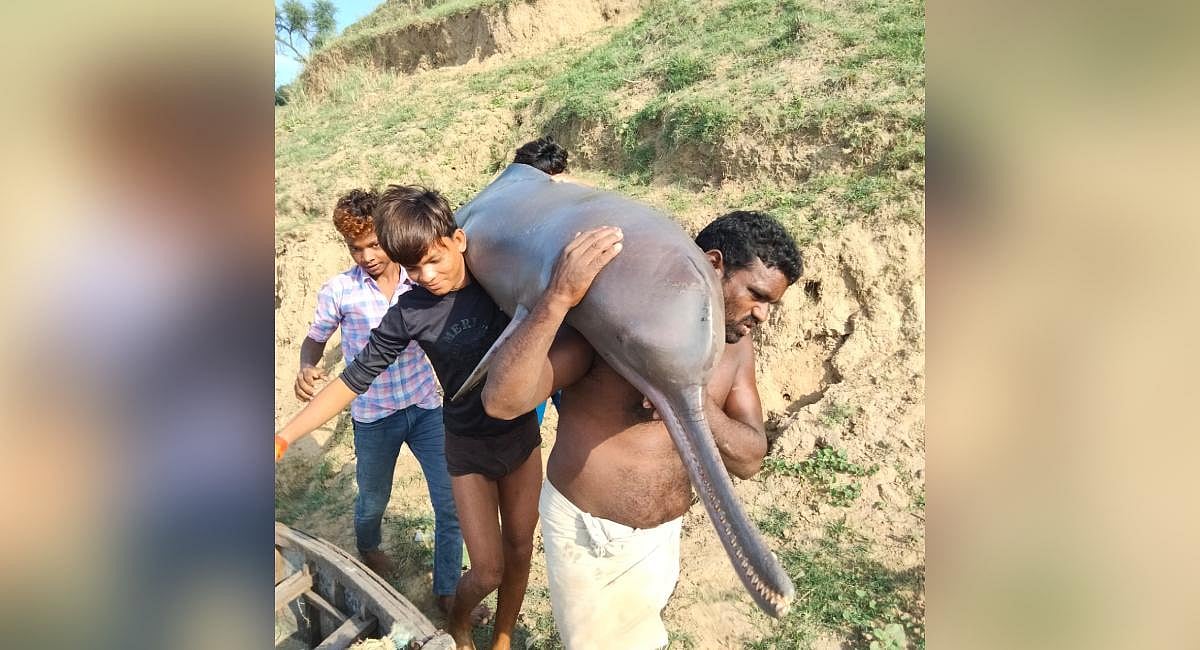
This is not the first time when the endangered species was caught in the region. A similar case was reported from Pratapgrah in January this year when some youths caught an 8-ft dolphin from one of the subsidiary canals of Sharda canal under Sangipur police station. Later, the villagers left the dolphin back in the water and a team of experts from Lucknow rescued it and released it in Ganga near Kalakankar of Kunda tehsil. Likewise, on December 31, 2021, a Gangetic dolphin was beaten to death by locals caught from Sharda canal in Pratapgarh. The Pratapgarh police later arrested three youths. https://timesofindia.indiatimes.com/city/allahabad/five-booked-for-catching-eating-gangetic-dolphin-in-kaushambi-village/articleshow/102121821.cms (26 July 2023)
Bihar 2 dolphins found dead in 3 days Residents informed the officials about the incident after sighting the carcass on May 29 evening. They claimed it was the second Gangetic dolphin found dead at Sangat Ghat (bank of river Ganga) near Aunta in Mokama, about 90 km from Patna. Both Gangetic dolphins were killed due to the ongoing mechanised dredging to deepen the riverbed, according to them. Gopal Sharma, senior scientist and joint director of the Zoological Survey of India, Bihar and Jharkhand said Gangetic dolphins were either killed by dredging or after being trapped in a big fishing net. Both possibilities exist. https://www.downtoearth.org.in/news/wildlife-biodiversity/two-gangetic-dolphins-found-dead-in-bihar-in-the-last-3-days-89668 (30 May 2023) Local people attribute illegal hunting and mechanized dredging as reasons behind the death of dolphins. Experts believe that the dolphins’ lives are also coming under stress due to noise pollution in the river. The increasing numbers of steamers and big ships are also resulting in rise in noise pollution and injuries to Gangetic dolphins. As per Dr. Sunil Chaudhary of Tilkamanjhi University, Bhagalpur most dolphins die by getting trapped in fishermen’s nets. He stated that decline in Ganga’s flows due to construction of dams or barrages has affected life cycle of creature. https://www.amarujala.com/bihar/patna/gangetic-river-dolphins-death-in-bihar-poaching-and-noise-pollution-in-water-big-threat-2023-06-03 (03 June 2023)
Jharkhand Dolphin found dead A dolphin has been found dead on the banks of the Ganga river at Kashi Tola Ghat in North Begamganj Panchayat of Udhwa in Sahibganj. After getting the information, the forest officials reached the site and took possession of the dolphin’s body. Expressing concern over death, DFO Manish Tiwari said that a post-mortem will be conducted, and forest personnel are investigating the matter. He said that strict action will be taken against whoever is found guilty under Schedule-I of the Indian Wildlife (Protection) Act, 1972. https://www.etvbharat.com/hi/!state/dolphin-dead-body-recovered-on-banks-of-ganga-at-kashi-tola-ghat-in-sahibganj-jhs24020208494 (02 Feb. 2024)
Assam Carcass of Gangetic dolphin found in Kulsi river A carcass of an endangered Gangetic river dolphin was found in Kulsi river under Kamrup district on June 12 morning. This marks the sixth death of this Schedule 1 species under the Wildlife Protection Act, 1972, within the West Kamrup Wildlife Division over the past five years. There is a growing demand for more surveys and enhanced conservation measures for the habitats of river dolphins, which attract numerous international tourists to the Kulsi River annually.
In the Kamrup West division, three dolphins died in 2021-22 in the riverine range, Nagarbera. In 2022-23, two more deaths in the Kulsi range sparked concern. “Flow diversion of the river, due to manmade causes or natural reasons, has affected the Kukurmara hotspot of river dolphin. From Kukurmara main channel of the river, the flow has been diverted to another connected river channel through Chhaygaon,” explained IUCN-recognised dolphin expert Abdul Wakid. He also mentioned that multiple bridge constructions over the years have hampered the flow of Kulsi. https://timesofindia.indiatimes.com/city/guwahati/carcass-of-gangetic-river-dolphin-found-in-kulsi-river/articleshow/110951628.cms (13 June 2024)
Dhubri: Carcass of River Dolphin found floating It was reported that the dolphin, which was spotted in the Majerchar area of Dhubri, was an adult one and had its lower jaw cut off by a fishing net snare. The dolphin numbers in this region, from Jogighopa, Goalpara to Sukhchar, Dhubri, are critically low, and stands below 100, informed Mehtab Uddin Ahmed, an environmentalist from Dhubri.
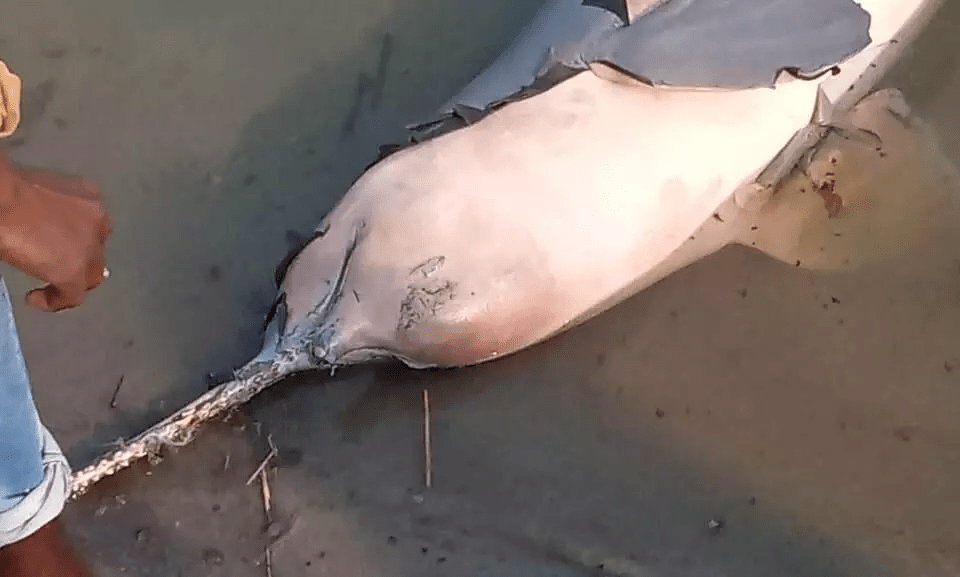
“The fishermen have to be more vigilant and respectful to protect the aquatic symbol of Guwahati and the nation,” Ahmed said while talking to this correspondent. “We could see many dolphins (Sisus) regularly a few years ago. But now, we barely see a dolphin (Sisu) around the town,” Ahmed added. He also said that a major shift in the Brahmaputra River might have also reduced dolphin sightings. https://assamtribune.com/assam/dhubri-carcass-of-river-dolphin-found-floating-with-lower-jaw-severed-1509914 (23 Dec. 2024)
Threats
Uttar Pradesh 10 dolphins stranded in Sharda canal At least ten Dolphins were found stuck in Sharada canal in Lakhimpur district. Extra water has been released for the Dolphins so that they swim to safety in rivers. https://www.hindustantimes.com/cities/lucknow-news/all-10-stranded-dolphins-in-safe-waters-now-101716746293397.html (27 May 2024) At one spot, the water is about five-feet deep and at the other spot, it is just over three feet in depth. The shallow water level makes it stagnant. With the temperature around 40 degrees Celsius, the stagnant water heats up fast and the evaporation will be fast. Experts said water level needed to be brought quickly to 9 feet depth for safety and survival of the dolphins. At this level, water will not get hot during the day and more time will be there to conduct rescue operation. In 2023, a few dolphins were rescued in Lakhimpur but then water was not so shallow. https://www.hindustantimes.com/cities/lucknow-news/plight-of-stranded-dolphins-makes-a-splash-spawns-rescue-op-101716659272612.html (26 May 2024) DFO, South Kheri forest officer Sanjay Biswal said that he had received reports on May 24 that a group of about 12 Gangetic dolphins were found stranded in the shallow waters of the Sharda canal, unable to swim safely due to insufficient water level. Four to five of these dolphins were stranded in 2.5 to 3 feet deep water in the canal and their condition was critical due to the presence of their calves with them and the high heat. Biswal said the gates at the Sharda barrage were opened, due to which the canal originating from it became dry. He said the irrigation dept was requested to release water in the canal until the dolphins were rescued. https://navbharatlive.com/state/12-dolphins-rescued-in-lakhimpur-kheri-914326.html (26 May 2024)
Dolphin trapped in Sharda canal for 10 days in March 2024 The dolphin was swept away by the strong current of the Saryu river and came into the Sharda Sahayak Canal located in the Dariyabad branch of Fatehpur range. Seeing the danger to the dolphin’s life due to low water in the canal, the forest dept teams launched a rescue operation & the dolphin was successfully rescued & released into Saryu river in Ramnagar. https://hindi.news18.com/news/uttar-pradesh/barabanki-forest-department-successfully-rescues-dolphin-stuck-in-canal-for-10-days-released-in-saryu-river-8186990.html (27 Mar 2024)
Dolphin pair strays into Sharda canal, rescued A pair of dolphins that strayed into the Sharda canal from the Sharda river was rescued in Barabanki district of UP after a 19 hour-long-rescue operation by a team of Turtle Survival Alliance (TSA), on Monday (May 22) evening. The male and female dolphins were later released safely in the Ghagra river in Bahraich. A TSA biologist, Arunima Singh, who played a key role in the rescue operation, said the male dolphin was about 10 years and five-and-a-half-feet long, while the female was aged about 8 years and six-and-a-half-feet long. https://timesofindia.indiatimes.com/city/bareilly/dolphin-pair-strays-into-sharda-canal-rescued/articleshow/100461733.cms (24 May 2023)
19 dolphins rescued from canals of Ganga-Ghagra basin in 7 years The publication titled ‘Rescuing Ganges river dolphins (Platanista gangetica) from irrigation canals in Uttar Pradesh, 2013–2020‘ not only highlights the capture and relocation methods but also describes the behavioural and demographic details of rescued animals and locations of these canals where the animals had been trapped. The paper points out that 24 rescue operations had been conducted from 2013 to 2020 and five dolphins had died.
The publication said dams and barrages had severely affected this habitat as dolphins moved into irrigation canals where they were at a risk of injury or death from a multiple factors, such as rapidly receding waters, heat stroke and human interferences. Over 70% of entrapments were reported either post monsoon or during peak winter. This suggests such incidents are directly related to the release of water into canals during or after the monsoon.
“The other 30% of dolphins were rescued during peak summer when water levels fall, and the minimum water flow is maintained. Among the rescued dolphins, females were found trapped during Sep-May with maximum occurrence during peak winter (Dec-Feb). In contrast, males were mostly trapped post monsoon and during the summer season, with least occurrence in peak winter,” the paper says. https://www.thehindu.com/sci-tech/energy-and-environment/19-dolphins-rescued-alive-from-canals-of-ganga-ghagra-basin-says-study/article67392753.ece (7 Oct. 2023)
NGT takes cognisance of threat to Dolphins in Ganga In two separate suo motu cases, the NGT has taken cognizance of the threat to dolphins in Ganga river and the decrease in the Indian fish population coupled with an increase in the foreign fish population in Yamuna river. Chairperson Justice Prakash Shrivastava, judicial member Justice Arun Kumar Tyagi and expert member Dr A Senthil Vel observed that both issues indicated violations of Water (Prevention and Control of Pollution) Act and the Environment Protection Act. In the matter related to threat to Gangetic dolphin, notice was issued to Wildlife Institute of India, National Mission for Clean Ganga and CPCB. Next hearing on Sept 24. https://www.barandbench.com/news/ngt-takes-cognisance-declining-indian-fish-population-yamuna-threat-dolphins-ganga (09 July 2024)
Bihar Illegal mining threatening dolphins Even during ongoing monsoon, when sand mining has been banned officially in compliance with the order of the NGT, rampant illegal sand mining is posing a danger to Gangetic dolphins in Ganga, and its tributaries Gandak, Ghaghra, Mahananda, Parman and Kosi. Large-scale illegal sand mining is damaging riverbeds and its ecology. It is also changing the morphology and natural flow of rivers, as huge volumes of sand is being extracted through machines. The damage to river biodiversity is badly affecting the habitat and staple food (fish, mainly small fish) of Gangetic dolphins.
“Our livelihood is affected by illegal sand mining because it badly hits river fish. We are poor and falsely targeted for disturbing dolphins in rivers, but the sand mafia are powerful and continue to operate in lucrative illegal sand mining, which is posing the real danger to dolphins”, Anil Shahni, a fisherman near Digha ghat in Patna, said.
According to a recent report by Nachiket Kelkar and Tarun Nair, associated with the Wildlife Conservation Trust, sand mining threatens the survival and persistence of endangered riverine species like the gharial crocodile, freshwater turtles, otters, river dolphins, and water birds, as it destroys their nesting and breeding habitats. Gopal Sharma, a senior scientist at the Zoological Survey of India, said, “More than any other activities, illegal sand mining is increasing the danger for Gangetic dolphins. The state govt should focus on checking illegal sand mining”. https://www.newsclick.in/bihar-rampant-illegal-sand-mining-threatens-gangetic-river-dolphins-ganga-tributaries (2 Sept. 2024)
Report Gangetic dolphins need new conservation plan A new study has assessed the distribution, numbers and habitat suitability of the Gangetic dolphin in the small rivers of the Ganga basin and proposed a basin-wide river conservation strategy for the species.
Nachiket Kelkar, head of the Riverine Ecosystems and Livelihoods programme at the Wildlife Conservation Trust suggests that in addition to building social trust and equity, conservation programs should include robust scientific monitoring of dolphin populations, hydrology, threats, and the impacts of different interventions; engaging with river water use and management policy, such as how to re-operate dams to provide more water for rivers, mitigation measures for existing infrastructure development projects, or avoiding projects that will cause irreversible damage. https://india.mongabay.com/2024/05/endangered-gangetic-dolphins-found-in-most-tributaries-of-ganges-prompting-urgent-conservation/ (20 May 2024)
Bridge debris proving a threat to dolphins The NGT has asked the officials to respond to the allegations that the debris of the bridge at the Aguani Ghat on Ganga river in of Sultanganj is a threat to dolphin. On Aug 12, 2024, the Eastern Branch of the Tribunal has directed to make the SPCB, DM Bhagalpur, NMCG, Bihar’s Dept of Environment, Forest & Climate Change, Regional Office of the MoEF&CC as parties. All of them have been asked to file their counter in four weeks.
According to the applicant Hemant Kumar, the under-construction bridge on the Ganga river at Aguani Ghat in Sultanganj was damaged on June 4, 2024. Although the reasons for this damage are still being investigated, but due to this the population of dolphin fish living in the river has come under threat. It has also been suggested that due to this damage, a huge amount of debris has been thrown into the Ganga river, causing serious damage to the dolphin habitat. https://hindi.downtoearth.org.in/wildlife-biodiversity/in-bihar-dolphins-remain-in-danger-the-debris-of-the-bridge-over-the-river-ganges (14 Aug. 2024)
W Bengal Gangetic dolphins fight for survival Pollution, both industrial and domestic wastewater, has overwhelmed the Hoogly river system. This, along with the heavy silt in the Ganges, makes the water murky and has, over time, rendered the dolphin blind. By using their highly sophisticated sonar, the dolphins are able to echolocate, but their movement is encumbered by traffic – steamers, barges, ferries, etc. Although a reduction in human activities during the Covid pandemic drew more dolphins to the city ghats, experts are certain that it has not boosted dolphin population in the long run. After the lockdowns ended, the number of ferries were increased, and industries opened up with an aim to compensate for the lockdown lull, driving the dolphins away.
Poachers account for dolphin deaths even though dolphin killing is punishable by law. Dolphin oil is said to be a remedy for arthritis, and it is also used to bait catfish. Dolphins get caught in fishing nets by accident; they either die of wounds caused by entanglement or are beaten to death to preserve the costly nets. Chatterjee of HEAL identifies a domino effect at play: “Sand mining on the banks of the Ganga not only causes damage to the environment, precipitating floods, but also takes away entire generations of fish hatchlings. Due to a depletion in their prey base, dolphins are driven to hunger and desperation, and they often swim deliberately into nets to catch fish.” https://www.telegraphindia.com/my-kolkata/lifestyle/wildlife-in-kolkata-wallow-in-citizens-fear-neglect-and-denial/cid/2004237 (02 March 2024)
Hooghly noise scan for dolphins A group of researchers will study the noise levels in the Hooghly to determine how habitable the river is for one of its most intelligent resident species. After the completion of the study, a report will be submitted to the transport secretary and a copy will be shared with the chief wildlife warden of Bengal. The Gangetic dolphin is the national aquatic animal of India. The duration of the Rs 3 cr project will be 30 months.
The Hooghly waterway is set for major development, said a senior official in the state transport department. “The infrastructure upgrade includes construction of new jetties and remodelling of old ones. We are building smart gates and passenger terminals along the riverbank. We want to strike a balance between development and ecological balance. Dolphin is a treasure of the Hooghly. We will do everything in our capacity for the conservation of the species. The study is a step towards that direction,” said the official. Gangetic dolphins already face a serious threat in Bengal from large-scale discharge of municipal waste, siltation and the countless brick kilns along the riverbanks. https://www.telegraphindia.com/west-bengal/hooghly-noise-scan-for-dolphins-study-on-whether-underwater-sound-impedes-navigation-of-aquatic-mammals/cid/2017920 (06 May 2024)
Rise in salinity threatens Gangetic river dolphin habitats A five-year study in the Sundarbans region has found that raising water salinity level is threatening the habitat of Gangetic river dolphins. The survey was conducted in the lower stretch of river Hooghly, covering 97 km stretch of the western, central and eastern Sundarbans in India, intermittently between 2013 and 2016 in different seasons. Simultaneously, researchers also measured salinity level of the water. Based on interaction with local fishing communities, study area was demarcated for boat-based and land-based surveys. Previous studies had recorded natural distribution of the Gangetic dolphin in the Sundarbans regions but no continuous surveys were done to assess population and habitat changes. https://www.downtoearth.org.in/water/rise-in-salinity-threatens-gangetic-river-dolphin-habitats-62728 (07 Jan. 2019)
Jharkhand Only 82 dolphins along 82 km long Ganga stretch in Sahibganj The findings of forest dept survey revealing presence of just 82 gangetic dolphins along 83 km stretch of river Ganga in Sahibganj is a cause of worry. The Sahibganj district administration needs to take effective steps because there have been several incidents of dolphins being found dead on the banks of river. The reason is that the poisonous substance released from the ships for washing stone chips illegally in the river is dissolving in the Ganga and this is directly affecting the aquatic life in the Ganga. https://www.etvbharat.com/hindi/jharkhand/state/sahibganj/only-82-dolphins-in-ganga-river-spread-over-83-km-in-saghiganj/jh20220418134148627627721 (18 April 2022)
Assam Construction, unregulated mining threats to dolphin sanctuary Residents and conservationists near Kukurmara alleged that uncontrolled sand extraction and bridge construction on the Kulsi River, a vital habitat of river dolphin and Brahmaputra tributary, are causing habitat destruction and deadly collisions with concrete structures. “Since it was a dolphin infant, which are usually playful, perhaps it was stuck in concrete structure of the under-construction railway bridge as water level of the Kulsi river has receded in last few days,” speculated Prasanna Kalita, a local conservation activist. He also noted the possibility of industrial pollution as the cause of death, alleging that nearby plants might be discharging toxic materials into the river.
There is growing demand for more surveys and enhanced conservation measures for the habitats of river dolphins, which attract numerous international tourists to the Kulsi River annually. “Flow diversion of the river, due to manmade causes or natural reasons, has affected the Kukurmara hotspot of river dolphin. From Kukurmara main channel of the river, the flow has been diverted to another connected river channel through Chhaygaon,” explained IUCN-recognized dolphin expert Abdul Wakid. He also mentioned that multiple bridge constructions over the years have hampered the river flow of Kulsi. https://timesofindia.indiatimes.com/city/guwahati/kulsi-river-dolphins-face-peril-construction-unregulated-sand-mining-threats-to-dolphin-sanctuary/articleshow/110947213.cms (12 Jun 2024)
Mining, construction damage dolphin habitat Such is the damaging extent of sand extraction from the riverbed at Kulsi Chowk Point, where the river bifurcates into two channels, that the water flow to the Kukurmara channel has almost stopped. “This has dealt a death blow to this once-thriving dolphin habitat along the Kukurmara stretch. Mechanised sand mining might have come down of late, but overall mining still remains largely unregulated. Sluice gates on the Batha/Jagaliya river—one of the major flow sources to Kulsi—have caused restrictions in water flow to Kulsi,” Rajesh Dutta Baruah, a conservationist, said.
A number of unscientifically constructed bridges, too, have altered the water flow regime of Kulsi, fragmenting the dolphin habitat and leaving the animals in almost stranded condition, especially during the winter. All this has also impacted the availability of fish, which constitutes the river dolphin’s major diet. “Livelihoods have been hit as the fish population in Kulsi has dwindled drastically in recent years. This is a fallout of unrestrained mining, pollution from untreated industrial effluents, and erosion of the river’s links with wetlands,” Debajit Choudhury, a local resident who has been trying to generate awareness on the issues, said. He said that time is running out fast for Kulsi, and only a mass movement can push govt into action. https://assamtribune.com/assam/sand-mining-anthropogenic-activities-altered-kulsis-river-dolphin-habitat-1540352 (16 June 2024)
Punjab Indus river dolphins in troubled waters The possibility of the small dolphin population in the Beas river reconnecting with populations in the Indus river is remote. Numerous barrages and dry rivers separate them, ensuring their complete isolation. They also face several challenges in their current range, including getting caught in fishing gear, water pollution from industrial waste and escaping downstream through the Harike Barrage.
It is not known which habitat features are important for the dolphins in the Beas River & why they persist only in certain stretches of the river. It is assumed that the dolphins, similar to elsewhere in their range, select pools with high volume, especially during the low water season. However, hydrological alterations affecting the upper reaches may be reducing available habitat & limiting their range. Understanding river hydrology and morphology would help identify why certain habitats are not used & what features are crucial for dolphin survival.
“Today the greatest threats to the Indus River dolphins in the Beas River are water availability & pollution. Upstream hydro projects cause frequent water fluctuations, creating an unstable habitat for these dolphins. The confluence of the Sutlej River with the Beas River at Harike marks the area where I first sighted Indus dolphins. This suggests their preference for this location due to stable water depth provided by the barrage. However, high levels of pollution are now causing them to avoid this stretch,” says Sandeep Behera, NMCG consultant. https://india.mongabay.com/2024/08/indus-river-dolphins-in-troubled-waters/ (15 Aug 2024)
Arunachal Pradesh Lower Demwe HEP threatens Ganges dolphin The dam is proposed in an eco-sensitive zone on the Lohit river, 50 metres from the Kamlang Wildlife Sanctuary. It will directly impact the Ganges river dolphin, at least two critically endangered bird species, the Bengal florican, and the white-bellied heron and also impact Parshuram Kund, a Hindu pilgrimage site. https://frontline.thehindu.com/environment/how-a-hydropower-project-threatens-the-wildlife-of-arunachal-pradesh/article67399135.ece (19 Oct. 2023)
Documentary First ever CGI footage of Ganges dolphin ‘Tangled Fates’ documentary by Soumen Bakshi features the first-ever CGI footage of the elusive Ganges River Dolphin, exploring its habitat, struggles, and the grave threat posed by bycatch from fishing practices. https://www.youtube.com/watch?v=8VdjWnewvvs (05 Oct. 2024)
Conservation Steps
Report India to sign global pact to protect endangered river dolphins Since the 1980s, the combined populations of river dolphin species have plummeted by 73%. With the Global Declaration for River Dolphins, 14 countries (six of them in Latin America) are expected to join forces to protect the six surviving species of this aquatic mammal that inhabit the world’s rivers and are under some category of threat. So far, nine of the governments involved have signed the declaration. The declaration comes at a critical moment for these animals. In September 2023, the death of more than 150 river dolphins in one of the most important lakes in Brazil raised international concern. https://india.mongabay.com/2024/01/india-one-of-the-nine-countries-to-sign-global-pact-to-protect-endangered-river-dolphins/ (23 Jan. 2023)
Clear picture on Ganges & Indus dolphins soon: Centre India will soon get a clear picture of its freshwater cetaceans, the Ganges (Platanista gangetica) and Indus (Platanista minor) dolphins respectively, as a result of an 8,000-km aquatic survey carried out by the Centre, state forest depts and the Wildlife Institute of India, Union Minister of MoEF&CC Bhupender Yadav said on Oct 14, 2024.The survey will be the world’s first comprehensive assessment of dolphin populations and will be considered as a baseline. https://www.downtoearth.org.in/wildlife-biodiversity/india-will-soon-get-a-clear-picture-of-its-ganges-and-indus-river-dolphins-centre (14 Oct. 2024)
Dolphin as mascots The publication “State Fishes and Aquatic Animals of India 2024”, piloted by the National Fisheries Development Board documents aquatic organisms’ habitat, distribution, IUCN red list status and conservation trends. It traces the conservation history of India’s national aquatic animal – the Ganges River Dolphin – to the 3rd century BCE and cites its listing as a protected species in the Edicts of King Asoka. The compendium — a treat for marine researchers — also details the Ganges River dolphin’s unique behaviour tactics.
Guwahati city recently declared the Ganges River dolphin as its mascot. Punjab’s official aquatic animal is the Indus river dolphin. The two dolphins are separated by the number of teeth they have. https://pib.gov.in/PressReleasePage.aspx?PRID=2053756 (11 Sept. 2024) Uttar Pradesh govt has declared the Gangetic Dolphin as the state aquatic animal. https://www.ndtv.com/india-news/uttar-pradesh-chief-minister-yogi-adityanath-declares-dolphin-as-state-aquatic-animal-4458124 (07 Oct. 2023)
Bihar 1st Dolphin Research Centre opened Forests and Chief Wildlife Warden PK Gupta said that the National Dolphin Research Centre (NDRC) is now operational and aims to assist scientists and researchers in studying Gangetic dolphins comprehensively. “The research will delve into various aspects such as changing behaviour, survival skills, food habits, causes of death, and more. The objective is to establish the NDRC as a centre of excellence,” he said. The centre will also provide training to fishermen on how to conserve and protect dolphins during fishing. https://www.downtoearth.org.in/news/wildlife-biodiversity/india-s-first-national-dolphin-research-centre-finally-a-reality-94790 (4 Mar 2024)
Boatman who knows dolphin intimately Fascinating: Peeyush Sekhsaria writes about Patna’s Ganga Dolphin boatman Rajendra Sahni An old hand, Rajendra Sahni, a fisherman, river patroller, diver, retriever of dead bodies and river dolphin specialist, pares your expectations down even before you set out on a boat ride with him in the hope of seeing the Ganges river dolphin: “They are wild animals. In the next 2-3 hours, I’ll try my best to help you spot one. But there’s no guarantee. I hope you understand.” We’re at Patna’s Gandhi Ghat and Sahni, I’m told, is one of the few tenuous links to this fast disappearing species. Confined to the Indus, Ganga-Brahmaputra-Meghna and the Karnaphuli-Sangu river systems, the Ganges river dolphin was categorised as ‘endangered’ two years ago by the IUCN. Bihar Tourism even initiated a dolphin-spotting package in end 2012 — but it has since been discontinued due to a “lack of response”. https://www.thehindubusinessline.com/blink/takeaway/The-boatman%E2%80%99s-calling/article20755295.ece (18 April 2014)
Uttar Pradesh Govt to sensitise people about dolphins State govt on Nov 5 directed the administration of districts located on the bank of Ganges river to make aware people living on the banks about the need for the conservation and safety of Gangetic dolphins in a bid to increase their numbers. https://www.thehindu.com/news/national/up-to-sensitise-people-living-on-banks-of-ganges-about-conservation-of-dolphins/article67501294.ece (6 Nov 2023)
Assam Gangetic Dolphin spotted after a quarter century The Gangetic Dolphin was spotted in the Charikadiya River in Dhakuakhana in Lakhimpur district, as stated by Dhruba Jyoti Chetia and Rajib Baruah of Pu N Fu Wild, a wild life protection group based in Dhakuakhana.
A team of the Pu N Fu Wild group consisting of Dhrubajyoti Nath and Manash Pratim Dutta along with Dhruba Jyoti Chetia and Rajib Baruah spotted the aquatic species while bird watching at Bolaighat on the river on Oct 14. Locally called the Sihu, the Gangetic Dolphin was last seen on the Charikadiya River twenty-five years ago, in 1998. Hunting by men, decreasing of its food like Neriya (GaruaBachcha) fish, shallowing of the river bed due to massive bank erosion have been blamed for their near extinction in the last few years. https://assamtribune.com/assam/gangetic-dolphin-spotted-in-charikadiya-river-after-a-quarter-century-1499869 (16 Oct. 2023)
Summary: Between May 2023 and October 2024, we have found media reports revealing suspicious deaths of at least 7 Gangetic dolphins taking place in Uttar Pradesh (2) Bihar (2), Jharkhand (1) and Assam (2). While dredging and hunting are claimed reasons behind deaths of 2 dolphins in Bihar, 1 each in Uttar Pradesh and Assam the exact cause in remaining 3 cases is unknown.
Regarding threats, the reports show dolphins are continuously getting trapped in Sharda canal due to questionable barrage operation in Uttar Pradesh. Similarly, the ongoing unsustainable sand mining, in Kulsi river Assam and Ganga rivers in Bihar have been adversely affecting the habitats of national aquatic animal. So is the case with dumping of bridge debris in Ganga in Sultanganj and construction of bridges on Kulsi river in Assam.
The low flows in Beas, Ganga or Kulsi due to diversion through dams and barrages have emerged a serious danger for dolphin populations and habitats. The species further faces survival threats from dredging being done for waterway projects and increase in river traffic. Experts have started demanding to adopt river basin wide conservation strategy to protect the species.
Since Jan 2020, SANDRP has been compiling available media reports on dolphin kill incidents. Our earlier 3 reports January 2021, April 2022 and May 2023 have documented deaths of at least 31 Gangetic dolphins in last four years.
Compiled by Bhim Singh Rawat (bhim.sandrp@gmail.com)


