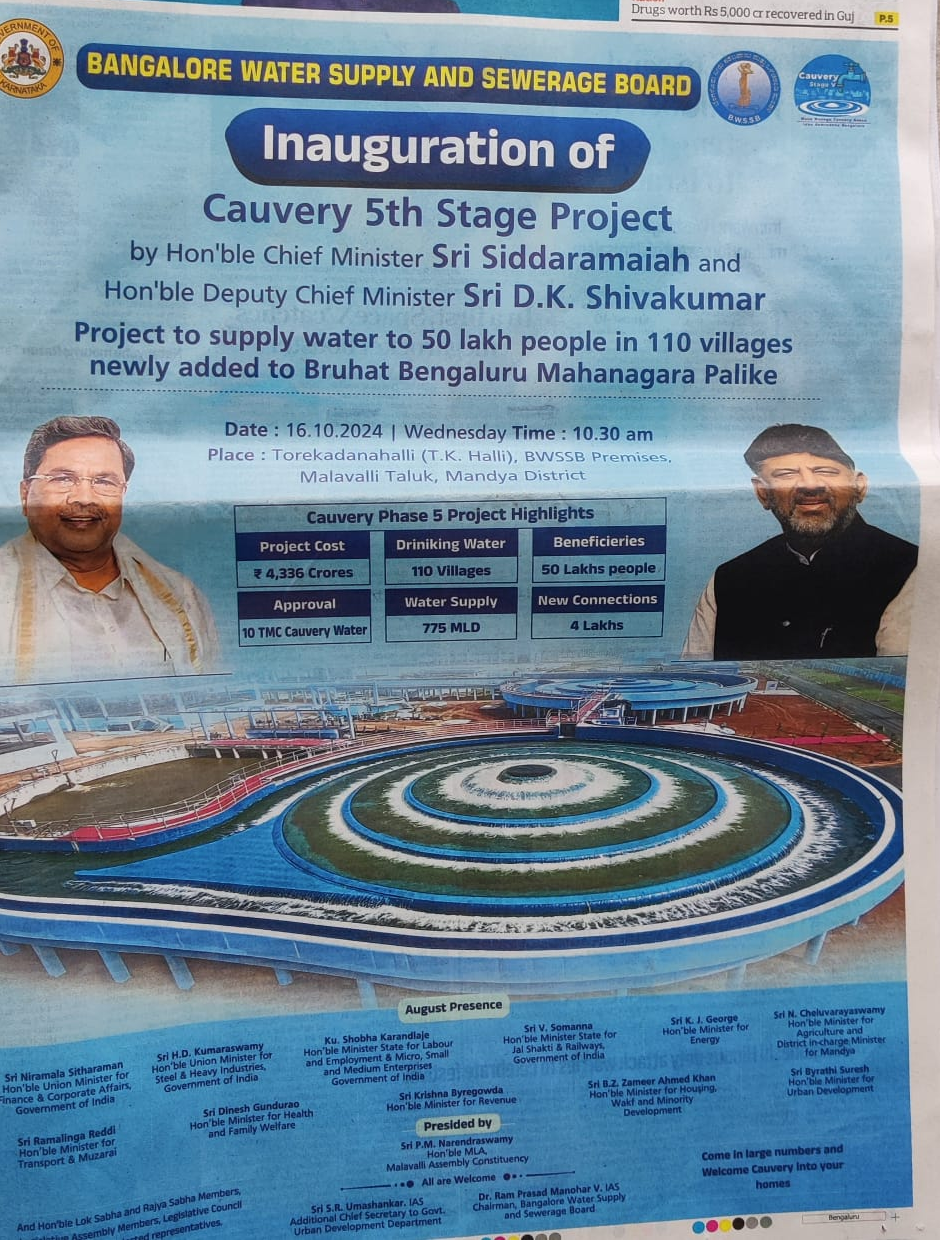
In a pointed article this week, Sachin Tiwale rightly writes that Mumbai does not need more dams, but needs to fix the distribution of more than enough water that it gets currently. Same is the case with highly capital and energy intensive 5th stage of Cauvery Water Supply being inaugurated on Oct 16 by the Karnataka Chief Minister and Deputy CM for Bangalore, advertised through full page advertisements today (Oct 14) in newspapers in Bangalore.
What the India’s cities need is to exhaust the potential of local water resources, including rain water, local water bodies including rivers, groundwater recharge, recycle and reuse of treated sewage and also demand side measures, including fixing the distribution and reducing transmission and distribution losses. All of this needs attention through a National Urban Water Policy that will also fix the Urban Water Governance.
Today there is no policy to guide increasing numbers and sizes of cities and complete ad-hocism prevails. In such a situation all the concerned including politicians and governments get away with high adverse impact, expensive, power intensive and corruption ridden projects with huge climate foot prints and most climate inappropriate projects.
All this is equally true for most urban cities including Ahmedabad, Bangalore, Chennai, Delhi, Ernakulam, Faridabad, Guwahati, Hyderabad, Kolkata, Mumbai, Vijaywada, and so on.
Mumbai Building new dams will not solve water crisis SO TRUE! The metropolitan region already receives enough water for its current needs with projections overestimating future requirements. By Sachin Tiwale. https://scroll.in/article/1072914/mumbais-water-problem-building-new-dams-will-not-solve-the-citys-poor-distribution-network (04 Oct. 2024)
HYDRO POWER PROJECTS
Uttarakhand Fresh green nod for damaged Phata Byung HEP The Sept 27 2024 meeting of MoEF’s Expert Appraisal Committee on River Valley Projects have asked for more information and action about the 76 MW Phata Byung HEP on Mandakini river in Rudraprayag dist in Uttarakhand, the project was severely damaged in June 2013 floods. https://indianexpress.com/article/india/fresh-green-nod-for-uttarakhand-hydro-project-damaged-in-2013-floods-9608454/ (07 Oct. 2024)
Karnataka Hesaraghatta grassland declared a conservation reserve In 2021, political considerations had led the board to reject the proposal for Greater Hesaraghatta Grassland Reserve, prompting environmentalists to approach the high court. “The high court had directed the Board to reconsider the proposal. The government is committed to protect the environment and ecology. As a result, the Board has declared the grassland as a reserve,” Forest, Ecology and Environment Minister Eshwar Khandre said.
On the flipside, the board approved the digging of more than 30 borewells in two protected areas of Someshwara and Mookambika wildlife sanctuaries as part of the exploratory work for the proposed 1500 MW Varahi Pumped Storage Project (PSP). Of the more than 40 borewells to be drilled for the project in Udupi and Shivamogga districts, 31 are in the protected areas, including 29 in Mookambika Wildlife Sanctuary and two in Someshwara wildlife sanctuary.
Activist Joseph Hoover noted that the EAC for River Valley and Hydroelectric Projects has decided to visit sites of the proposed PSP in view of the increasingly fragile ecology of the Western Ghats. “The state board should have referred to the expert committee decision and deferred the matter till they get an opinion,” he said. https://www.deccanherald.com/india/karnataka/bengaluru/state-board-of-wildlife-approves-proposal-to-declare-hesaraghatta-grassland-conservation-reserve-3223032 (07 Oct. 2024)
Experts also point to changes in land use patterns around the grassland and underline that the Hessarghatta lakebed area is critical to the water security of the city. It is an important watershed and protection of this area will also help the rejuvenation of the Arkavathy River basin. Since 2010, citizens, environmentalists, and scientists have been trying to persuade the government to set up a Conservation Reserve in the area. https://bangaloremirror.indiatimes.com/bangalore/others/ring-of-protection-around-hesaraghatta-grassland/articleshow/114056065.cms (09 Oct. 2024)
Govt rejects Kasturirangan report In a Cabinet decision on September 27, the Karnataka government rejected the report on the Western Ghats prepared by a 10-member High-Level Working Group led by space scientist K. Kasturirangan. Since the submission of the report in 2013, six draft notifications on the proposed declaration of Eco-Sensitive Areas (ESAs) have been issued by the Union Ministry of Environment, Forest and Climate Change, to States through which the Western Ghats run.
All six notifications, including the latest one, which was issued on July 31, a day after the devastating landslides in Wayanad occurred, have been rejected by Karnataka. The announcement was made by Law and Parliamentary Affairs Minister H.K. Patil, who said that the Cabinet decision was taken after considering opposition from legislators representing constituencies in 10 hilly districts of western Karnataka through which the Western Ghats pass.
Some however, are dismayed by the Karnataka cabinet’s decision to reject the Kasturirangan report. Akhilesh Chippali, a farmer and environmentalist who lives in a village close to Sagar said: “If the fragile environment of the Western Ghats must be protected for future generations, the government must take necessary steps. Several of us have been demanding that the recommendations of the Gadgil report should be implemented. Even though Kasturirangan watered down most concerns of Gadgil expressed, its implementation will at least be a start to preserve the pristine environment of this region that is already under threat from massive infrastructural projects.”
Chippali gave the example of the Sharavathi Pumped Storage Project, which envisages a hydroelectricity project on the Sharavathi river system in Shivamogga and Uttara Kannada districts. The project has been given the green flag by the Union government and the Central Electricity Authority, but many environmentalists contend that this will affect the forests of the Sharavathi Wildlife Sanctuary, home to the endangered lion-tailed macaque. “If the Kasturirangan report had been implemented, such large infrastructural projects could not have been permitted,” said Chippali. https://frontline.thehindu.com/environment/karnataka-kasturirangan-report-gadgil-committee-wayanad-landslides-environment-development-livelihood/article68732465.ece (09 Oct. 2024)
The Karnataka government wants to build dams and implement water projects in the Western Ghats to address the severe drought problem. It’s also planning resorts for tourists, and bridges, railway lines, and road expansions for faster connectivity. Even a power corporation township is on the cards. All these promises are meant to catapult Karnataka into an economic powerhouse. But they are in direct conflict with the UNESCO heritage tag.
Many of the projects have been in development since the Western Ghats received UNESCO heritage status. One such project that promises to improve Karnataka’s power generating capacity is the 2,000–megawatt Sharavathi Pumped Storage and Hydroelectric project in Shivamogga and Uttara Kannada districts. It will come at a cost of 30 acres of pristine forest land.
The Yettinahole project, for instance, was approved despite a 2016 report from the Indian Institute of Science, Bengaluru, questioning its impact on the region’s biodiversity.
“Chikkaballapur and Kolar districts have sufficient amounts of [water] yield, which meets the demands in the region,” scientist and researcher TV Ramachandra told ThePrint. Having led the study, he argued that only 9.5 TMC of water will be available even during the monsoon months, which is far less than the 24 TMC estimated by the government. He proposed sustainable, cost-effective solutions such as water harvesting, rejuvenation, and restoration of lakes and ponds to tackle the water shortage. These measures could be implemented within two years at a fraction of the cost of the project, he said, and could be done without sacrificing tree cover. https://theprint.in/ground-reports/karnataka-ignoring-western-ghats-unesco-tag-6-central-notices-to-build-build-build/2306890/ (11 Oct. 2024)
Report Govt expands budgetary support scheme for hydro projects Thegovt has announced modifications to the budgetary support scheme, earmarking ₹12,461 crore for enabling infrastructure over the 2024-25 to 2031-32 period. The revised scheme aims to support approximately 31 GW of hydropower capacity, including 15 GW from Pumped Storage Projects (PSPs), with the Union Cabinet approving these changes on 11 September 2024.
The modifications, detailed in a Ministry of Power notification dated 30th September, broaden the scope of the budgetary support. In addition to covering the construction of roads and bridges, it now includes transmission lines from powerhouses to pooling points, ropeways, railway sidings, and communication infrastructure. Furthermore, the strengthening of existing roads and bridges leading to project sites will also be eligible for central assistance under the updated scheme.
The scheme applies to all hydropower projects above 25 MW capacity, including private sector ventures, provided the projects were allotted on a transparent basis. Pumped Storage Projects (PSPs), both captive and merchant, are also covered. Projects that secure a Letter of Award for the first major package before 30th June 2028 will qualify for this assistance. The budgetary support is capped at ₹1 crore per MW for projects up to 200 MW and ₹200 crore plus ₹0.75 crore per MW for larger projects. In certain cases, the cap may be raised to ₹1.5 crore per MW, subject to the Ministry of Finance’s approval. https://energy.economictimes.indiatimes.com/news/power/india-expands-budgetary-support-scheme-for-hydropower-eyes-15-gw-from-pumped-storage-projects/114063524 (09 Oct. 2024)
Study GDW database info for large-scale applications Abstract: There are millions of river barriers worldwide, ranging from wooden locks to concrete dams, many of which form associated impoundments to store water in small ponds or large reservoirs. However, global datasets are often biased towards particular regions or specific applications, such as hydropower dams affecting fish migration, and are thus not globally consistent. This paper presents a new river barrier and reservoir database developed by the Global Dam Watch (GDW) consortium that integrates, harmonizes, and augments existing global datasets to support large-scale analyses.
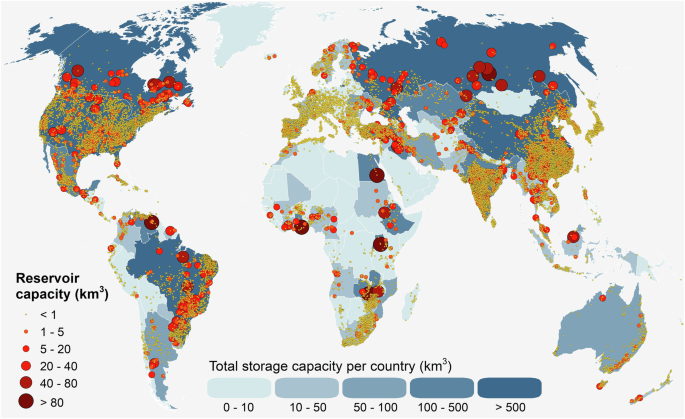
Data curation involved extensive quality control processes to create a single, globally consistent data repository of instream barriers and reservoirs that are co-registered to a digital river network. Version 1.0 of the GDW database contains 41,145 barrier locations and 35,295 associated reservoir polygons representing a cumulative storage capacity of 7,420 km3 and an artificial terrestrial surface water area of 304,600 km2. https://nature.com/articles/s41597-024-03752-9 (08 Oct. 2024)
IEA Wind, solar to surpass global hydro generation The 2024 edition of IEA’s annual Renewables market report says, by the end of 2024, solar and wind generation combined are expected to surpass hydropower. By 2029, solar generation is expected to surpass hydropower and become the largest renewable power source. By 2030, wind power is expected to also surpass hydropower. https://www.hydroreview.com/business-finance/business/wind-and-solar-combined-will-soon-surpass-global-hydro-generation-report-says/ (09 Oct. 2024)
World Hydropower Day 2024. Graphical Obituary? Electricity from newly built hydropower in 2023 was 30% more expensive than from photovoltaic solar power, while its construction is 3.7 times more expensive. It is also 70% more expensive than electricity from the onshore wind, while its construction is 2.5 times more expensive than for wind farms.
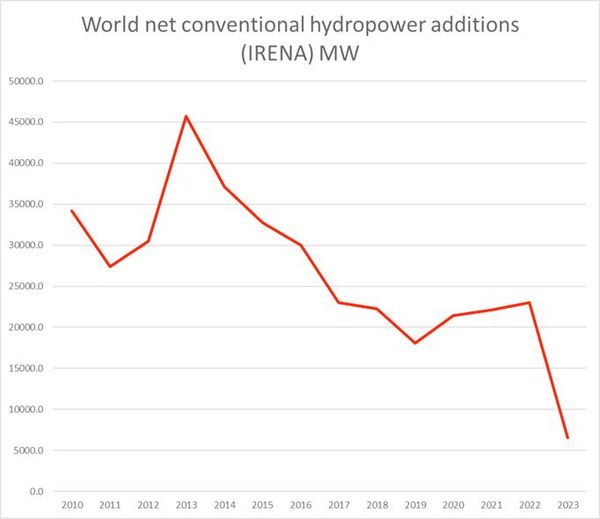
(Source: https://www.irena.org/Publications/2024/Sep/Renewable-Power-Generation-Costs-in-2023) https://www.transrivers.org/2024/3974/ (11 Oct. 2024)
DAMS
Polavaram Project Centre clears ad hoc grant of 2,800 cr to restart works The Centre has issued formal orders to release 2,800 crore as ad hoc grant to resume the stalled Polavaram project works, which is likely to start in November 2024. The works will resume with the construction of the diaphragm wall. Recently, the panel of experts (PoE) comprising international dam safety engineers gave the green signal for construction of a new diaphragm wall. A high-level workshop with experts from will be held at the project site in the last week of October to finalise the roadmap for revival of works. https://timesofindia.indiatimes.com/city/vijayawada/centre-approves-2800-crore-grant-to-restart-polavaram-project-works/articleshowprint/114093923.cms (09 Oct. 2024)
Kaleshwaram Project Irrigation dept. in quandary after company questions certificate cancellation Sources in the Telangana irrigation department said that the contracting agency L&T-PES JV, has responded to its September 18 letter cancelling the completion certificate issued to the agency for the Medigadda barrage. In its reply to the cancellation and surrender of the certificate order from the department, the agency informed that everything that was asked to be done by it was completed as per terms of the contract and that there were no violations of the terms of agreement.
– On Sept 18, the department informed L&T-PES JV that the completion certificate given by its officials was issued “illegally” and that it was not issued “in accordance with the terms and conditions of agreement.” The letter also said the company should surrender the completion certificate dated March 15, 2021. Any further steps on this matter were likely only after the Judicial Commission headed by Justice Pinaki Chandra Ghose on Medigadda barrage construction completes its inquiry and submits its report, since the issue of completion certificate too is part of the probe, and the government is likely to take any decision based on the findings, it is learnt. https://www.deccanchronicle.com/southern-states/telangana/medigadda-irrigation-dept-in-quandary-after-company-questions-certificate-cancellation-1828762 (07 Oct. 2024)
Govt plans to resume operations to save Rabi ayacut The Telangana State government is planning to operationalise at least two of the three key barrages under the Kaleshwaram Lift Irrigation Scheme (KLIS). Farmers, who have been deprived of Godavari water for two seasons, along with their elected representatives, are pressing for the resumption of pumping operations to utilize potential flows from the Pranahita river, a tributary of Godavari, the sole supporting source for the ayacut under KLIS. The State officials are meeting officials of the National Dam Safety Authority (NDSA) on October 11 in Delhi as part of the mission. The three barrages- Medigadda, Annaram, and Sundilla have remained idle since they were emptied for inspection and rehabilitation in April and May, leaving the Rabi ayacut without irrigation support. The Irrigation Department managed to supply water for the Kharif season by drawing from the Yellampalli reservoir at a reduced capacity of little over one TMC per day. https://telanganatoday.com/telangana-plans-to-resume-kaleshwaram-operations-to-save-rabi-ayacut (09 Oct. 2024)
Telangana Silt eats away 1/4 of water storage capacity In 14 projects, which have been surveyed over the past few years, sand, and other sediments, have slowly grabbed space that could have held 35.15 tmc ft (thousand million cubic feet) of water over the years. This figure represents 35 times the capacity of the Hussainsagar,and is more than the combined storage capacities of the Upper and Lower Manair Dam projects, along with Suddavagu, Mathadivagu, Dindi and Swarna projects to name a few.
According to the 2020 ‘Compendium on sedimentation of reservoirs in India’ by the Central Water Commission (CWC), Himayatsagar is among the waterbodies to have lost more than a quarter — 26.56 per cent to be exact — of its storage capacity. Siltation has also affected Osmansagar with official figures putting the lake’s water spread at 6,300 acres, down from its original 10,000 acres. The worst has occurred at Nizamsagar, with the CWC report putting the loss of storage at this historic reservoir at 60.47 per cent. The Nagarjunasagar reservoir capacity is down by 23.52 per cent and the Srisailam reservoir, 29.96 per cent of its storage due to siltation.
The problem is serious and definitely needs attention, as even at the dead storage levels of several reservoirs is being affected, according to an irrigation department official. For instance, the Singur project on Manjira river which saw its gross storage reduced from its original 29.917 tmc ft to 29.178 tmc ft, the dead storage fell steeply from 0.872 tmc ft to 0.279 tmc ft over the years. Similarly, the dead storage at Komaram Bheem project has halved from 1.785 TMC ft to 0.872 TMC ft. The department has started an exercise to identify the methods and process to revive at least part of the storages of the reservoirs and other waterbodies. The department official said that preparations are on for calling global tenders for desilting of reservoirs, but cautioned that the process was not a quick fix but would take a few years even to claw back a part of the lost waterholding capacities. https://www.deccanchronicle.com/southern-states/telangana/silt-eats-away-one-fourth-of-telanganas-water-storage-capacity-1828122 (04 Oct. 2024)
Report Funding awaited for testing strength of shutters dams surpassing 50 years lifetime Funding was awaited from the Centre for proposals to test the strength of shutters of four dams that are more than 50 years old in the Western region, under the World Bank-funded Dam Rehabilitation and Improvement Project (DRIP). The proposals for testing the shutters in Bhavani Sagar Dam (1955), Amaravathy Dam (1958), Thirumoorthy Dam (1967) and Aliyar Dam (1969), were made by the Water Resources Department in the aftermath of one of the three shutters of the Parambikulam reservoir getting washed away during Sept 2022. 6 tmc water had drained out of the dam. The shutter was replaced during Dec 2022. https://www.thehindu.com/news/cities/Coimbatore/funding-awaited-for-testing-strength-of-shutters-in-dams-that-have-surpassed-50-years-lifetime-in-western-region/article68741159.ece (10 Oct. 2024)
INDEF opposes naming of IAS officer as CWC chief The Indian Engineers Federation (INDEF) objected to the Union government’s decision to appoint an IAS officer, instead of an engineer, as the Central Water Commission (CWC) chairman. In a press statement issued on Oct 10, INDEF chairman S Ananth and secretary-general KMI Sayyad said that an engineer from the Central Water Engineering Service (CWES) should be posted as chairman of the CWC. The Department of Water Resources, River Development and Ganga Rejuvenation (DoWR, RD & GR) of Ministry of Jal Shakti recently assigned the additional charge of the post of chairman CWC to Additional Secretary, DoWR, RD & GR. https://www.newindianexpress.com/states/telangana/2024/Oct/11/telangana-indef-opposes-naming-of-ias-officer-as-central-water-commission-chief (11 Oct. 2024)
Bhakra Dam Road infra firm penalisedfor dumping muck illegally The Himachal Pradesh State Pollution Control Board (HPSPCB) has imposed a fine of Rs 1 lakh against a road infrastructure company for dumping muck “illegally and unscientifically” in the catchment area of Bhakra dam in Bilaspur district. According to an order issued by the HPSPCB regional officer, the company, hired by the Himachal Pradesh Roads and Infrastructure Development Corporation Ltd (HPRIDC), dumped muck unscientifically in the reservoir of the Bhakra dam without building any retaining wall. The muck is being generated during the ongoing construction of the 2.74km-long Raghunathpura-Mandi-Harpura-Bharari road in Bilaspur district. https://timesofindia.indiatimes.com/city/shimla/himachal-firm-fined-1-lakh-for-illegal-muck-dumping-at-bhakra-dam/articleshowprint/114026536.cms (08 Oct. 2024)
INTERLINKING OF RIVERS
Maharashtra Ceinsys Tech emerges as L1-bidder for Wainganga Nalganga river project Ceinsys Tech has emerged as the lowest bidder (L1) for Wainganga Nalganga river link project in Maharashtra. The scope covers detailed survey, investigation, hydrology study, design & estimation of main canal, feeder canal, LIS, pipeline, tunnels, PDN & other relevant structure, allied works required for preparation of a detailed project report (DPR) for the project in Nagpur, Wardha, Yavatmal, Amravati, Akola, Washim and Buldhana districts. Awarded by Water Resources Department, Maharashtra, the bid value for the work is Rs 385.15 crore. The project envisages bringing 4,13,750 ha under irrigation. https://www.projectstoday.com/News/Ceinsys-Tech-emerges-as-L1-bidder-for-Wainganga-Nalganga-river-project (10 Oct. 2024)
URBAN RIVERS
Musi; Hyderabad RFD project tenders turn murkier than river Doubts are now being raised that the tendering process was complicated deliberately to favour Meinhardt. It is also being alleged that all tender norms were violated due to political interference, which is said to have been the reason for the project estimate to shoot up from Rs 58000 cr to a staggering Rs.1.5 lakh cr. https://telanganatoday.com/musi-project-tenders-turn-murkier-than-musi-river (10 Oct 2024)
Govt awards RFD consultancy to controversial Meinhardt Despite mounting public outrage and criticism from the Opposition, the State government is moving forward with the Musi Riverfront Development Project and has awarded the consultancy contract to a consortium led by Meinhardt Singapore Private Limited. The selection of this firm, which has been embroiled in several controversies, has raised serious concerns about transparency and accountability in the execution of the Rs 1.5 lakh crore project. https://telanganatoday.com/telangana-govt-awards-musi-riverfront-consultancy-to-controversial-meinhardt (07 Oct. 2024)
Govt Sanctions ₹166.50 for RFD Designs Telangana government has sanctioned Rs 166.50 crore for consultancy services to create a detailed plan for the Musi Riverfront Development Project. The Municipal Administration and Urban Development (MA&UD) Department has awarded the contract to prepare the plan to a consortium led by Meinhardt Singapore, joined by Cushman & Wakefield India and RIOS Design Studios. This project has been in the works for several years, with the aim to restore the 55-kilometre stretch of the river.
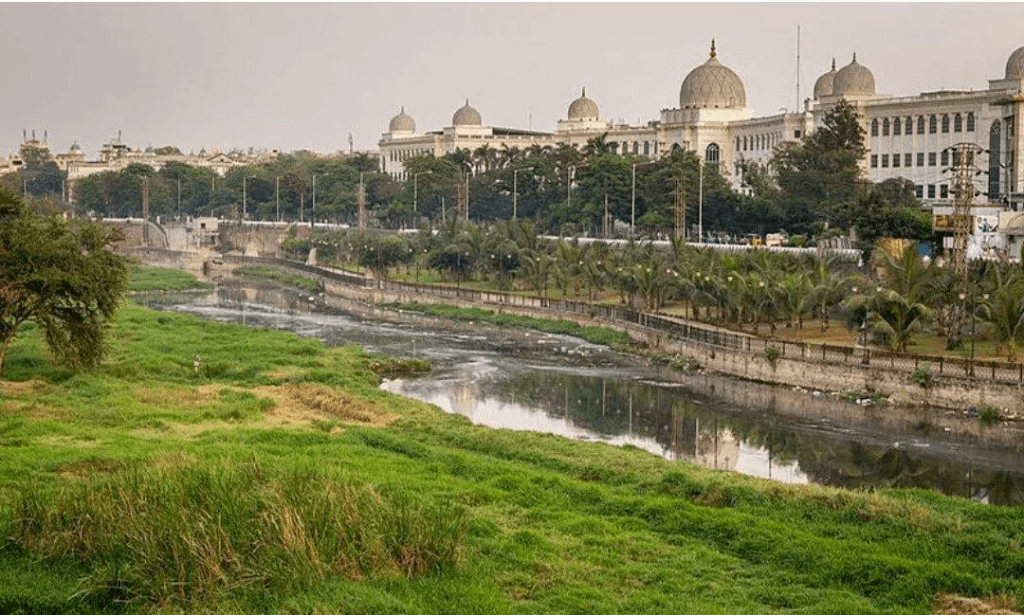
In February 2024, the Musi Riverfront Development Corporation had invited expressions of interest for this master plan from consultancy services aimed at creating an aggregate master plan for the ‘Musi Riverfront Development Project’. Key components of the ‘Musi Riverfront Development’ project, ‘river and water management’ entails the restoration of biodiversity, flood management, and making the riverfront a symbol of ecological and cultural revival. https://www.deccanchronicle.com/southern-states/telangana/telangana-government-sanctions-rs-16650-for-musi-riverfront-designs-1828722 (07 Oct. 2024)
An official delegation from Hyderabad will be heading to Seoul on October 19 as part of a study visit focused on the beautification of Musi river. Comprising government officials and public representatives, the team will spend four days studying the successful rejuvenation of Han River. https://www.deccanchronicle.com/southern-states/telangana/hyderabad-city-officials-head-to-seoul-for-first-hand-study-of-rejuvenation-of-han-river-1829327 (09 Oct. 2024)
Buddha Nullah; Ludhiana Centre, Punjab to jointly work on cleaning up Buddha For this, the Union Govt will constitute a multi-level team of experts and officers from both the Centre and the state. The team will conduct a spot visit of one of the most polluted water bodies before deliberating on cleaning it and plugging the sources of pollution flow in future. These decisions were taken at a high-level meeting chaired by Secretary, Department of Water Resources, River Development and Ganga Rejuvenation, Debashree Mukherjee in New Delhi on Oct 7 evening.
The Centre had called a meeting of all state and field-level officers involved in the Rs 840-cr Buddha Nullah rejuvenation project besides the functionaries from the Central ministries, depts concerned and the environmental enforcement agencies at the Centre & state. “The meeting, which lasted for over an hour, discussed the current scope and status of ongoing work to rejuvenate the Sutlej tributary, besides working out a permanent and long-lasting solution to the problem,” a senior official said. https://www.tribuneindia.com/news/ludhiana/centre-punjab-to-jointly-work-on-cleaning-up-buddha-nullah/ (08 Oct. 2024)
CM announces 3-phase plan to clean Buddha During the meeting, it was decided that phase 1 of the project would involve the installation of the ultrasonic water metering systems and the software modelling for the analysis of the sewage network to identify sampling points across Ludhiana. Phase 2 will focus on the identification of the problematic discharge points and the installation of small-scale effluent treatment systems to improve sewage quality. In the third phase, the thrust will be laid on the design and implementation of lining the Buddha Nallah. It was decided that Nebula Group and the state govt will work together for the implementation, maintenance and operation of the III phases and the operation of the treatment systems installed across Ludhiana. https://www.hindustantimes.com/cities/chandigarh-news/cm-mann-announces-three-phase-plan-to-clean-ludhiana-s-buddha-nullah-101726859578747-amp.html (21 Sep 2024)
‘Mark ED inquiry into rejuvenation project’ The Federation of Textile and Manufacturing Association has called for an inquiry into the crores of rupees spent on the Buddha Nullah rejuvenation project. Niranjan Singh, former deputy director of the Enforcement Directorate (ED), said that an ED inquiry could be conducted under the Environment Protection Act, 1986, and the Water (Prevention and Control of Pollution) Act, 1974, during his visit to the Buddha Nullah along with activists from the Naroa Punjab Manch and the Public Action Committee. https://www.hindustantimes.com/cities/chandigarh-news/buddha-nullah-mark-ed-inquiry-into-rejuvenation-project-101721497562327.html (21 July 2024)
28 years and crores of rupees later, Buddha still dirty Twenty-eight years after efforts were first made to clean it and crores of rupees spent on it over time, the Buddha Dariya continues to be a polluted drain filled with black-coloured water, one which is foul to smell, sore to the eyes, and a risk to the health of people living in its vicinity. Mostly importantly, it continues to feed canals used for irrigating fields in the state and pollute one of its most important rivers — Satluj. The plan to clean up the 48km water body, also known as Buddha Nullah, was first suggested in 1996, when STPs were installed even along it, so that polluted water does not enter the Satluj. https://timesofindia.indiatimes.com/city/ludhiana/efforts-to-clean-buddha-dariya-after-28-years-and-crores-of-rupees-spent/articleshow/111096822.cms (19 June 2024)
RIVERS
Report Growing shortfalls & stress in global water resources 2023 marked the driest year for global rivers in 33 years, according to a new report coordinated by the World Meteorological Organization, which signaled critical changes in water availability in an era of growing demand.
Key messages of the State of Global Water Resources-2023 (now in its third year) (https://wmo.int/publication-series/state-of-global-water-resources-2023): Glaciers suffer largest mass loss in 50 years, Climate change makes hydrological cycle become more erratic, Early Warnings for All must to tackle water-related hazards, call for better monitoring & data sharing. The last 5 consecutive years have recorded widespread below-normal conditions for river flows. “yet we are not taking the necessary urgent action,” said WMO Secretary-General Celeste Saulo.
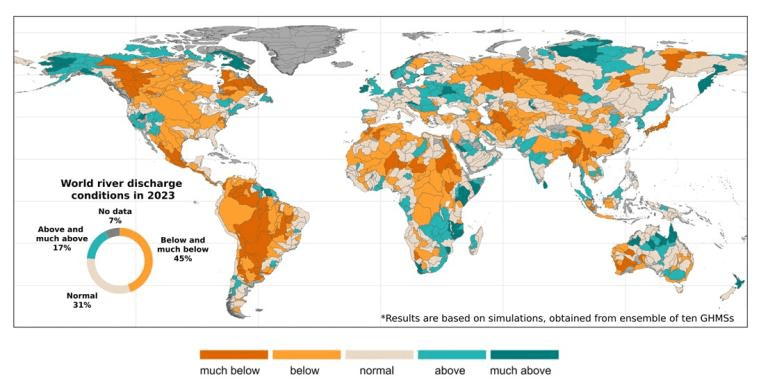
In Asia and Oceania, the large Ganges, Brahmaputra and Mekong River basins experienced lower-than-normal conditions almost over the entire basin territories in 2023. In South Africa, most wells showed above-normal groundwater levels, following above-average precipitation, as did India, Ireland, Australia, and Israel. Certain regions, including Alaska, northeast Canada, India, parts of Russia, parts of Australia and New Zealand experienced much above-normal soil moisture levels. https://wmo.int/news/media-centre/wmo-report-highlights-growing-shortfalls-and-stress-global-water-resources (7 Oct. 2024)
Study Arctic river erosion linked to permafrost thaw Permafrost, the thick layer of perennially frozen ground that covers much of the Arctic, slows down the migration of Arctic rivers, according to a new Caltech study. River migration is a common process in which a river’s path meanders over time due to erosion of the riverbanks. This rerouting, which can also occur in sudden floods, poses a threat for many communities that live along and depend on rivers. The findings also have implications for how the Arctic region will be impacted by a warming climate as permafrost thaws.
Led by graduate student Emily Geyman, the study focused on the Koyukuk River, a large tributary of the Yukon River that winds for hundreds of miles through interior Alaska. There was debate within the scientific community about whether the frozen soil along the riverbanks serves to fortify the banks against erosion or to promote it.
“Large rivers like the Yukon or the Amazon can move tens to hundreds of feet per year,” Geyman says. “Arctic rivers in particular differ from temperate rivers because they need to thaw the material of their banks before they can pick that material up and move it.”
Due to climate change, permafrost is slowly thawing over decades. But a river can experience drastic natural changes within a single year, with flow conditions changing from very cold and fast in early spring to warm and slow a few months later. Geyman and her collaborators leveraged these major changes that take place within a single season to gain a glimpse into how the rivers will behave in response to climate change decades or centuries into the future.
The research is part of a larger effort to understand the dynamics of rivers and how they transport carbon, nutrients, and other materials trapped in the soil.
“River migration has implications for local communities and infrastructure, and also for the Arctic environment,” Lamb says. “About 1,500 gigatons of carbon are stored in the frozen permafrost—about twice as much carbon as in the atmosphere, for comparison. There is also mercury frozen in the soil that could be liberated into rivers as permafrost thaws. We are, ultimately, trying to understand what happens to these elements in the context of river erosion.” https://phys.org/news/2024-10-arctic-river-erosion-linked-permafrost.html (9 Oct. 2024)
BRAHMAPUTRA A River Carried Me Here Rivers, small or big, carry stories. They are its memories. The difference lies is how we perceive them. One is as much likely to learn of them by staying put along its bank for a lifetime as one is by traversing the whole length of it. Both vastly different, both equally expansive. Fortunately, people have done both, and it is for an impatient mind like mine now to absorb it even as I wait to hear stories straight from the river. Patience is virtue when waiting to be carried in the sway of a river’s narrative. There are countless, always-changing turns on this braided river, every turn a turn in the pages of a book. And there are many pages to turn till I am caught in the river’s flow. (Aniruddha Dhamorikar) https://www.sahyadrica.com/2024/10/a-river-carried-me-here.html (12 Oct. 2024)
Meghalaya Env groups oppose new cement plant in Wahiajer Four env groups have come together to oppose a new cement factory in Wahiajer Narpuh, East Jaiñtia Hills.
The Hynñiewtrep National Youths Front, Hynñiewtrep Achik National Movement, Ri Jaiñtia Youth Federation and Hynñiewtrep National Youth Movement in a joint letter to the Meghalaya State Pollution Control Board today said the already existed cement factories in the area are posing a serious threat to the environment and health of the people. “Currently, there are already 10 cement factories operating within the Elaka Narpuh region of East Jaiñtia Hills District. These factories have contributed significantly to pollution, severely impacting local water bodies, such as the Lunar and Lukha rivers,” the groups said.
The area is home to ecologically sensitive zones, including the Narpuh Reserved Forest and nearby wildlife sanctuaries and the establishment of another factory will only worsen the situation, they said, adding, the noise and air pollution caused by the existing factories are a major health hazard, and the pollution of nearby rivers threatens both human and animal life. “We believe the govt is not taking adequate steps to safeguard these areas, and the unchecked growth of the cement industry could have devastating consequences for the region’s ecosystem,” they said. https://highlandpost.com/pressure-groups-oppose-new-cement-plant-in-wahiajer/ (5 Oct 2024)
Tamil Nadu 17th-century idols, sculptures found near Bhavani river 17 idols and sculptures – most of which date back to the 17th century – that were unearthed on the banks of Bhavani river at Nanjai Thuraiyampalayam village in Gobichettipalayam block earlier this year were handed over to the Govt Museum, Erode, on Oct 7, 2024. Inscriptions in a temple submerged by Bhavanisagar dam in Erode reveal a trade route. It may be recalled that in 1987, 10 idols and sculptures were found near the river at Kodiveri and were retrieved by revenue officials.
Curator B. Jency said that on April 8, 2024, a resident of the village, S. Mohanapriya Murugesan, found the idols and sculptures and alerted the revenue officials. Of the 17, 14 were idols of gods and goddesses, including Vishnu, Mariamman, Gajalakshmi, Dakshinamoorthy, Karuppasamy, Badrakali, and Sivanadiyar. Two were hero stones and their period is yet to be ascertained. https://www.thehindu.com/news/cities/Coimbatore/17th-century-idols-sculptures-found-near-bhavani-river-in-tn-handed-over-to-museum/article68731858.ece (08 Oct. 2024)
Maharashtra Direct influx of stormwater into Panchaganga The Panchaganga River has been getting a direct influx of stormwater from Jayanti Nullah for the last three months. A city-based social activist, Dilip Desai from Prajasattak Samajik Sanstha, has written to senior officials of the Maharashtra Pollution Control Board (MPCB) and the district administration and demanded criminal action against the KMC. The activist has also demanded that MPCB officials from the Kolhapur region should be sacked for their failure in controlling the pollution of the river.
“There has not been any improvement in the last 20 years even after hundreds of complaints regarding Panchaganga pollution along with proofs. During the monsoon, it was understandable. But now, even when the rainfall has receded, the stormwater is directly mixing into the river. It is serious. We have demanded a Panchnama of this and the MPCB higher authority should take criminal action against the KMC and should sack the regional officials here for their failure,” Desai said. In this regard, a KMC official said all 3 pumps installed to pump sewage from the Jayanti Nullah are operating and usually, 65 to 70 MLD of sewage water is being pumped. As the returning monsoon rainfall started a bit late, the nullahs in the city are still flowing and that is why the nullah water is getting mixed with the river. https://timesofindia.indiatimes.com/city/kolhapur/stormwater-pollution-crisis-activist-urges-action-against-kmc-for-river-contamination/articleshow/114097027.cms (10 Oct 2024)
GANGA Study India-UK Scientists Partner to Study 2021 Chamoli Disaster Scientists of India and United Kingdom (UK) have joined hands to study the Chamoli disaster of 2021 in Uttarakhand as reported in Eurasia Review. The Rs 110mn research project is funded by the Natural Env Research Council, a part of UK Research and Innovation. It will focus on the 150km stretch of the Ganga river covering the Rishiganga-Dhauliganga catchment area. The 3-yr project, named SUPERSLUG after the huge masses of debris created by such natural disasters, will use data gathered through drones and satellite images of the disaster to monitor the changes in the landscape and river basin. They will forecast the long-term impact of debris flow during such disasters. The research will be led by the UK’s University of Plymouth, along with experts from the universities of Exeter, Hull, Leeds, Newcastle and Staffordshire, Canada’s University of Calgary. Indian Institute of Technology), Roorkee and the Wadia Institute of Himalayan Geology, Dehradun from India will also participate in the study. It is set to start in Nov 2024 with visit of a team to the area. https://www.outlookbusiness.com/planet/sustainability/scientists-in-india-and-uk-partner-to-study-chamoli-disasterof-2021 (07 Oct. 2024)
Uttarakhand has demolished an illegal temple built by a self-styled godman on the Sunderdhunga Glacier, near the sacred Devi Kund pond. The unauthorised shrine at 16,500 feet had been built by Baba Yogi Chaitanya Akash. https://www.hindustantimes.com/india-news/glacier-baba-temple-built-near-sacred-lake-in-uttarakhand-demolished-101728448371695.html (9 Oct 2024)
Ramganga at Marchula last week. With monsoon season over, soil erosion has stopped in the catchment area & sediment loads have declined sharply reaching the river & muddying its waters.
YAMUNA Delhi Soaring pollution levels The faecal pollution levels in the Yamuna River, indicative of untreated sewage and significant contamination, reached a record high in Sepr. This came despite some improvement in DO and BOD levels, attributed to the heavy rainfall in August. However, the rain had little effect on the faecal coliform levels, which soared to 4,900,000 MPN (most probable number)/100 ml. This figure is 1,959 times the standard of 2,500 units and nearly 9,800 times the desired limit of 500 units. It represents the worst faecal contamination since Feb 2022, when the level reached 6,300,000 units at the Agra Canal, a key monitoring site.
The DPCC measured the river’s faecal contamination in Sep, releasing its report last week. The report emerged amid growing concerns over pollution, with certain stretches of the river visibly frothing due to pollutants like surfactants and phosphates, which the DPCC did not specifically test. In August, the highest recorded faecal coliform level was 920,000 units, a sharp rise from July’s 160,000 units. Around 56 per cent of Delhi’s STPs failed to meet water quality standards in August, consistent with the failures in July and June. These plants were unable to meet standards for total suspended solids (TSS), BOD, COD, and faecal coliform, with treated sewage from STPs often entering the Yamuna or being used for horticulture purposes. https://www.business-standard.com/india-news/faecal-contamination-in-yamuna-soars-to-1-959x-over-safe-limit-in-sept-124100800580_1.html (8 Oct 2024)
Just ten days after the monsoon, Yamuna started stinking at Old Railway bridge in Delhi in the absence of flows. In the coming months the river will face an increase in pollution & the city will face potable water scarcity.
कोर्ट ने कहा, याचिकाकर्ता का 27 सितंबर, 2024 को मिले एविक्शन नोटिस पर रोक की मांग करने का कोई वैधानिक अधिकार नहीं है। उसे हाई कोर्ट की सिंगल बेंच द्वारा 8 जुलाई, 2024 को पारित निर्देशों पर अमल करना चाहिए। याचिकाकर्ता ने दशकों से श्रम विहार में बसे होने का दावा करते हुए कोर्ट से कहा कि संबंधित जमीन यमुना के फ्लडप्लेन या ‘O’ जोन में नहीं आती है। याचिकाकर्ता के वकील ने दावा किया कि बस्ती वालों ने कॉलोनी को अधिकृत करने के लिए संबंधित प्राधिकार को आवेदन दे रखा है। https://www.google.com/amp/s/navbharattimes.indiatimes.com/metro/delhi/other-news/delhi-high-court-said-no-one-wants-clean-yamuna-river-people-are-only-responsible-for-pollution/amp_articleshow/114061840.cms (09 Oct. 2024)
दिल्ली प्रदूषण नियंत्रण समिति के मुताबिक सितंबर महीने में यमुना नदी के पानी की जांच की गई. इसकी रिपोर्ट 4 अक्तूबर को जारी किए गए हैं. इस रिपोर्ट के मुताबिक नदी में फेकल कोलीफॉर्म का लेवल काफी ज्यादा बढ़ा है. 49,00,000 MPN/100 ml तक पहुंच गया है. यह लेवल मानक स्तर 2,500 यूनिट से 1,959 कई गुना ज्यादा है. फरवरी साल 2022 के बाद नदी में मल का लेवल बढ़ा ही है जिसके कारण यह एक खराब लेवल पर पहुंच गया है. फरवरी 2022 में आगरा नहर पर फेकल का लेवल 63,00,000 यूनिट तक पहुंच गया है. https://www.google.com/amp/s/www.abplive.com/lifestyle/health/toxic-foam-in-yamuna-river-cause-skin-and-respiratory-problems-chhath-puja-devotees-be-aware-2798787/amp (7 Oct 2024)
विचित्र है कि यमुना को स्वच्छ बनाने पर सबसे ज्यादा जोर दिल्ली में दिया जाता है, लेकिन यह सबसे ज्यादा इसी महानगर में प्रदूषित पाई जाती है। अन्य शहरों से गुजरते हुए भी यमुना का यही हाल हो जाता है। अलग-अलग शहरों में औद्योगिक अपशिष्ट से लेकर सीवर आदि की गंदगी इस नदी में बहाए जाने पर रोक लगाने को लेकर अब तक की घोषणाओं की हकीकत यह है कि इस वर्ष ज्यादा बारिश के बावजूद यमुना में प्रदूषण का स्तर सबसे ज्यादा पाया गया। https://www.google.com/amp/s/www.jansatta.com/editorial/yamuna-most-polluted-in-delhi-most-money-spend-for-cleaning-is-also-in-delhi/ (09 Oct. 2024)
Noida Only ones to clean river banks are citizens’ groups The Yamuna has an 81.7km span in Noida, but there is no institutional mechanism to clean up its banks, parts of which are a toxic ferment of garbage that pollute not just the river – for whose cleaning thousands of crores have been spent – but also the floodplain where vegetables that find their way into mandis are grown.
A survey report submitted by the administration on Sept 12 shows the Yamuna flows through a shallow and fragmented channel — its average depth is 3 metres — as it crisscrosses 26 villages including Wajidpur, Raipur Bangar, Chak Basantpur, Nagli Bahrampur, Nagli Sabapur, Gulawali, Kondli Bangar, and Jhuppa. While there is no data on how much waste these villages generate daily, part of it finds its way into the river or is dumped along its banks.
Over the years, Noida Authority has not taken any significant steps in cleaning or desilting the banks as this requires coordination among multiple stakeholders from different districts. A proposal to develop a Yamuna riverfront has largely remained confined to drawing books. Earlier this year, the district administration directed the irrigation department and Noida Authority to conduct a feasibility study for the project. If conditions are found to be conducive, the study report will be tabled before the UP govt. But that could take months, if not more.
Officials also could not immediately share the funds received or work undertaken under the National Mission for Clean Ganga (NMCG), a 2016 central govt initiative to clean, conserve and rejuvenate the Ganga and its tributaries, including Yamuna, through a structured approach at national, state & dist levels. https://timesofindia.indiatimes.com/city/noida/citizens-take-charge-grassroots-movement-cleans-yamuna-river-banks/articleshow/114023606.cms (8 Oct 2024)
Agra Desilting river may affect stability of Taj IIT Roorkee in a report to the Supreme Court bench have said that removal of accumulated silt, sludge and debris in the vicinity of the Taj Mahal in Agra will have a number of detrimental impacts including on structural stability of various structures including Taj. The report has been submitted following UP Govt request. Next hearing on Nov 8 2024. https://www.hindustantimes.com/india-news/desilting-yamuna-may-affect-stability-of-taj-mahal-iit-experts-in-report-to-sc-101728389000487.html (08 Oct. 2024)
SAND MINING
Haryana Activists raise voice against illegal mining along Yamuna Several social organisations, including Haryana Anti-Corruption Society, Yamuna Nadi Mitra Mandal and SANDRP have raised voice against illegal and unscientific mining in Yamuna river in Yamunanagar district. These organisations have requested the govt to stop illegal and unscientific mining immediately alleging that it is posing a threat to the existence of the river.
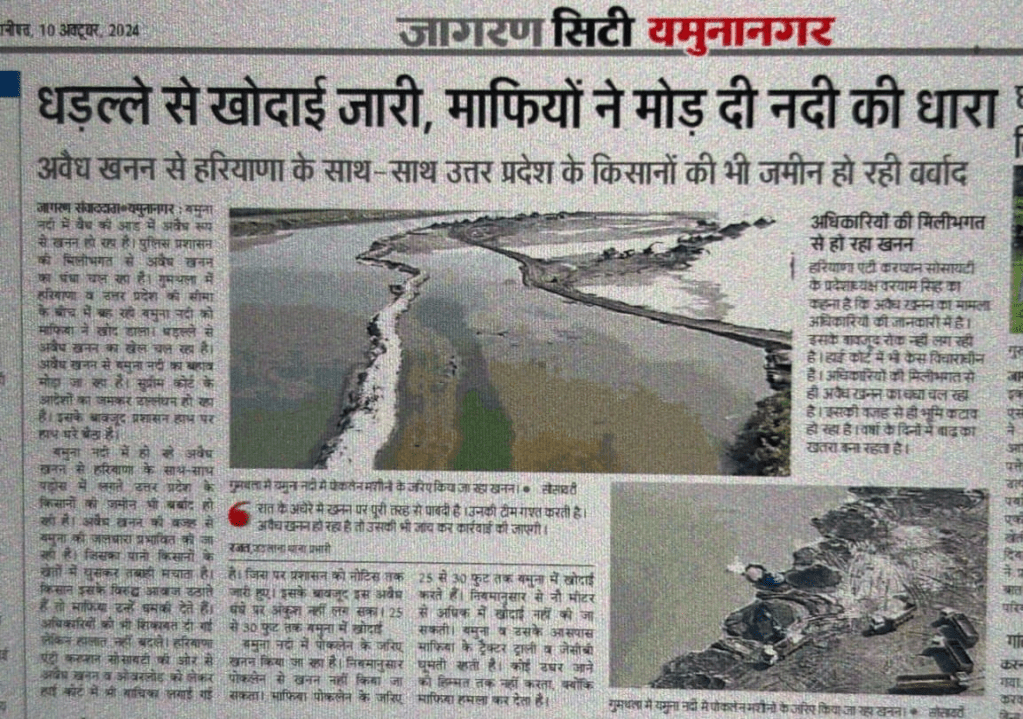
BS Rawat, Associate Coordinator of SANDRP, said the Yamuna river was the largest and most important tributary of the national river Ganga. “The Yamuna river is the only living river of Haryana and the lifeline of the state. It irrigates a large area of agricultural land and it is the main source of drinking water for a large population in the state,” said BS Rawat.
President of Haryana Anti Corruption Society Advocate Waryam Singh said several contractors were also carrying out mining in legal quarries along the river in an unscientific way in violation of norms of MoEF & the orders of the NGT. https://www.tribuneindia.com/news/haryana/activists-raise-voice-against-illegal-mining-along-yamuna-river/ (10 Oct. 2024)
SANDRP के सह समन्वयक बीएस रावत ने कहा कि यमुना नदी राष्ट्रीय नदी गंगा की सबसे बड़ी व महत्वपूर्ण सहायक नदी है। यमुना नदी हरियाणा की एकमात्र जीवित नदी है तथा प्रदेश की जीवन रेखा है। बीएस रावत ने कहा कि यह नदी कृषि भूमि के बड़े क्षेत्र की सिंचाई करती है और यह राज्य की बड़ी आबादी के लिए पेयजल का मुख्य स्रोत है। हरियाणा भ्रष्टाचार निरोधक सोसायटी के अध्यक्ष एडवोकेट वरयाम सिंह ने कहा कि जिले में कई स्थानों पर यमुना नदी के किनारे बड़े पैमाने पर अवैध खनन कई वर्षों से किया जा रहा है। उन्होंने कहा कि कई ठेकेदार पर्यावरण मंत्रालय और राष्ट्रीय हरित अधिकरण के आदेशों का उल्लंघन करते हुए अवैज्ञानिक तरीके से नदी के किनारे वैध खदानों में भी खनन कर रहे हैं। नियमों का उल्लंघन करते हुए ठेकेदार नदी के बहाव क्षेत्र को अवरुद्ध कर स्वीकृत सीमा से अधिक गहराई पर भारी मशीनों का उपयोग कर खनन कर रहे हैं। जब हमने इन उल्लंघनों को संबंधित विभागों के अधिकारियों के संज्ञान में लाया तो उन्होंने कोई गंभीर कार्रवाई नहीं की। उन्होंने कहा कि सरकार को कम से कम पांच साल के लिए क्षेत्र में खनन पर तुरंत प्रतिबंध लगाना चाहिए ताकि नदी को खनिजों से भरकर अपने पारिस्थितिकी तंत्र को बहाल करने का समय मिल सके। https://jantaserishta.com/local/haryana/haryana-activists-raised-their-voice-against-illegal-mining-on-yamuna-river-3578406 (10 Oct. 2024)
यमुना नदी का सीना छलनी कर रहे Mining Mafia, अब ग्रामीणों ने उठाई आवाज https://www.youtube.com/watch?v=Z2qPeuHy56k (09 Oct. 2024)
खनन एजेंसियों को शायद न एनजीटी के नियमों की परवाह है और न ही प्रशासनिक अधिकारियों का डर। क्योंकि यदि ऐसा होता तो नियमों को ताक पर रखकर बार-बार यमुना नदी की धारा को बाधित न किया जाता। जठलाना-गुमथला क्षेत्र में सरेआम ऐसा हो रहा है। अवैध खनन को लेकर न्यायालय में जनहित याचिका डाल चुके एडवोकेट वरयाम सिंह ने इसकी शिकायत सीएम मनोहर लाल, डीसी कैप्टन मनोज कुमार व एसपी गंगाराम पुनिया को भेजी है। उनका आरोप है कि यमुना नदी के नगली घाट पर दो राज्यों को जोड़ने वाले 84 करोड़ के बजट से निर्माणाधीन पुल के आसपास भी धड़ल्ले से अवैध खनन किया जाता है। https://www.jagran.com/haryana/yamunanagar-illegal-mining-is-going-on-indiscriminately-by-disrupting-the-flow-of-yamuna-river-23563677.html (23 Oct. 2023)
Baghpat अवैध रेत खनन के जरिए यमुना नदी का सीना चीर रहे खनन माफियाओं के लिए काठा रोड मुफीद बना हुआ है। वे अवैध खनन के रेत लदे वाहनों को इस मार्ग से निकाल रहेहैं। जिससे मार्ग भी गढ़ों में तब्दील हो चुका है। तहसील क्षेत्र में खनन माफिया जगह जगह अवैध रेत खनन के जरिए यमुना नदी का सीना चीरने में लगे हुए हैं। काठा गांव के आसपास तो रोजाना खुलेस्तर पर रेत खनन किया जा रहा हैं। खनन माफिया ट्रैक्टर ट्रालियों से खेकड़ा क्षेत्र में उसकी सप्लाई कर रहे हैं। रात ही नहीं दिन में भी वे काठा मार्ग से रेत लदे वाहनों को खेकड़ा क्षेत्र में ला रहे हैं और जरूरतमंदों को पांच से छह हजार रुपए प्रति ट्रॉली रेत बेच रहे हैं। ऐसा नहीं है कि इन खनन माफियाओं की भनक तहसील प्रशासन और पुलिस का ना हो सभी को इनकी जानकारी है। फिर भी वे आंखें बंद किए बैठे हैं। जिससेउनकी कार्यप्रणाली पर प्रश्नचिन्ह भी लग रहा है। अवैध रेत लदे वाहनों से तीन माह पहले बना काठा रोड फिर से गडढो में तब्दील हो चुका है। क्षेत्र वासियों को उसे पर आवागमन करते समय परेशानी उठानी पड़ रही है। https://www.livehindustan.com/uttar-pradesh/bagpat/story-illegal-sand-mining-thrives-on-katha-road-disrupting-yamuna-river-and-local-traffic-201728306329692.html (7 Oct 2024)
Noida यमुना में मंगलवार (Oct. 08) दोपहर डूबा आठ वर्षीय बुधवार को भी नहीं मिला। हालांकि, एनडीआरएफ की टीम ने नदी के दो किलोमीटर के दायरे में बच्चे को पूरेदिन तलाश किया। जहां बच्चा डूबा, वहां पर तीन बड़े-बड़े गड्ढे हैं। इसी में बच्चेके फंसने की संभावना है। पुलिस के मुताबिक पश्चिम बंगाल निवासी दंपति सेक्टर 125 में रहते हैं। दंपति मंगलवार को अपने दो बेटों के साथ यमुना में मछली पकड़ने गए थे। इसी बीच उनके दोनों बेटे नदी में नहाने लगे। कम पानी होने की वजह सेमाता-पिता ने बच्चों पर ध्यान नहीं दिया। इसी दौरान खेलते-खेलते दोनों बच्चे गहरे पानी में चले गए और डूबने लगे। बच्चों को डूबता देख परिजनों ने किसान से मदद की गुहार लगाई। किसान ने नदी में कूदकर एक बच्चे को निकाल लिया लेकिन उसका आठ वर्षीय भाई मंगल गायब हो गया। घटना के 36 घंटे बाद भी बच्चे को नहीं तलाशा जा सका है। https://www.livehindustan.com/ncr/noida/story-search-continues-for-missing-8-year-old-boy-in-yamuna-river-rescue-operation-launched-201728492401564.html (09 Oct. 2024)
गाजियाबाद प्रशासनिक टीम के निरीक्षण के दौरान यमुना नदी में दो जेसीबी मशीनें, दो ट्रैक्टर और सात ट्रॉली मौके पर अवैध रूप से खनन करते हुए पाई गई. इस दौरान जैसे ही माफिया की नजर प्रशासनिक टीम पर पड़ी, एक मशीन चालक अपने साथ जेसीबी मशीन लेकर दिल्ली की ओर भाग गया. हालांकि दिल्ली की सीमा में प्रवेश करने के वक्त जेसीबी मशीन दलदल में फंस गई और मशीन चालक जेसीबी को छोड़कर फरार हो गया. इसके लिए दिल्ली पुलिस को सूचित कर दिया गया है. https://www.etvbharat.com/hi/!state/illegal-sand-mining-in-yamuna-river-ghaziabad-dls24051405476 (14 May 2024)
Himachal Pradesh उत्तराखंड-हिमाचल को जोड़ने वाले यमुना पुल की हालत पहले ही खस्ताहाल है। इसके लिए करीब सवा करोड़ बजट प्रावधान भी मरम्मत के लिए पिछले वर्ष पहुंचा था लेकिन मरम्मत का कार्य ही शुरू नहीं हो सका। पुल की मरम्मत तो छोड़िए ठीक इसके आसपास अवैध खननकारी काफी महीनों से सक्रिय रहे हैं। आलम ये हो चला है कि दशकों पुराने इस पुल के बुनियादी पीलरों तक खननकारी खोदते हुए पहुंच गए हैं। राष्ट्रीय संपत्ति एनएच प्राधिकरण का पुल खतरे के दायरे में आ गया है। मीडिया में खबरों के बाद एक दो दिन काम बंद रहता है। फिर बदस्तूर अवैध खननकारी पुल के आसपास खनन करते नजर आते हैं। https://www.google.com/amp/s/www.amarujala.com/amp/himachal-pradesh/sirmour/yamuna-bridge-in-dangerous-zone-due-to-illegale-minning-nahan-news-c-177-1-ssml1030-129245-2024-07-30 (30 July 2024)
Bihar In past there have been several drowning deaths in Sone river, this however needs to be checked if the death were caused by illegal sand mining pits. रोहतास से एक बेहद दर्दनाक खबर सामने आई है, जहां सोन नदी में नहाने गए 8 बच्चों में से 7 की डूबने से मौत हो गई है. यह हृदय विदारक घटना रोहतास थाना क्षेत्र के तुंबा गांव में हुई. बताया जा रहा है कि सभी बच्चे एक ही परिवार के थे और नदी में नहाने के लिए गए थे. इस हादसे में केवल 12 वर्षीय धनजी कुमार एक अन्य के साथ अपनी जान बचाने में सफल रहा. धनजी किसी तरह गांव पहुंचा और इस दर्दनाक घटना की जानकारी ग्रामीणों को दी. https://hindi.news18.com/news/bihar/rohtas-7-children-drowned-while-bathing-in-son-river-local18-8752186.html (07 Oct. 2024)
Karnataka Sand extraction banned near Uliya Island Assistant commissioner (AC) Harshavardhan has issued an order prohibiting all forms of sand excavation within a two-kilometre radius of Uliya Island, effective immediately. The order states that, except for public transportation by boat, all other activities such as sand transportation by boat or machinery, as well as the stocking and distribution of sand on riverbanks, are banned within the designated area.
The restricted zone includes the area behind Sahyadri College in Adyar village, the Valacchil shore area of Adyar village, and the Pavoor shore area on the left side of Uliya Island. It may be recalled, the residents of Pavoor Uliya and many like-minded organisations had held several protests condemning the district administration’s inaction against illegal sand mining on the island. https://www.daijiworld.com/news/newsDisplay?newsID=1234057 (10 Oct. 2024)
WATER OPTIONS
Centre eyes 1 million sites to harvest rainwater by next monsoon Centre has decided to construct one million rainwater harvesting structures, including check dams, percolation tanks and recharge wells, under a new initiative to enhance groundwater replenishment across the country before the onset of next year’s monsoon. The new initiative – Jal Sanchay, Jan Bhagidari (JSJB) – will strengthen the existing ‘Catch the Rain – Where it Falls When it Falls’ campaign, launched in 1,592 blocks in 256 water stressed districts of the country in 2019.
“It is a community-led initiative which aims to enhance water recharge through rainwater harvesting, aquifer recharge, borewell recharge and recharge shafts with resource support from govt and non-govt resources like CSR funds, industrial houses, civic bodies and water sector enthusiasts who are collectively working towards ensuring a water secure future,” said a Jal Shakti ministry official. “The key objective of the JSJB initiative is to ensure that every drop of water is conserved through collective efforts, following a whole-of-society and whole-of-govt approach,” he said. https://timesofindia.indiatimes.com/india/centre-eyes-1-million-sites-to-harvest-rainwater-by-next-monsoon/articleshowprint/114178290.cms (13 Oct. 2024)
Surat At the function called ‘Karmabhumi thi Janmabumi’ held at Indoor Stadium in Surat, CM Patel said, “Industrialists who have made Surat their karmabhumi have resolved to contribute to set up 80,000 rain water harvesting structures in Gujarat. And there is a target of setting up 2 lakh structures. I congratulate them.” CM Patel hailed Prime Minister Narendra Modi for his initiatives like ‘Nal Se Jal’ and ‘Catch the Rain’, while saying that these are examples of the PM’s vision to address challenges before its arrival. https://indianexpress.com/article/cities/ahmedabad/gujarat-bhupendra-patel-rainwater-harvesting-9618841/ (14 Oct. 2024)
URBAN LAKES, WATERBODIES
Hyderabad 171 water bodies within ORR lost over 386 acres in 10 years The Telangana govt has revealed that 171 water bodies within the Outer Ring Road of the Hyderabad metropolitan region have been encroached upon between 2014 and 2023, during the previous BRS regime. Though the lakes were spread over 3,586.12 acres in 2014, when the new state was formed, squatters have encroached upon over 386 acres, worth several thousands of crores.
Telangana Remote Sensing Application Centre, which is part of the planning dept, has come up with a report on the encroachment of lakes by comparing satellite images of the water bodies between 2014 and 2023. The report was released by deputy chief minister Mallu Bhatti Vikramarka. All these encroachments are in the FTL, and if the buffer zones are considered, the extent could be more than double. https://timesofindia.indiatimes.com/city/hyderabad/over-386-acres-of-water-bodies-lost-to-encroachment-in-hyderabads-outer-ring-road-shocking-report/articleshowprint/114023481.cms (8 Oct 2024)
396 out of 920 water bodies encroached According to the presentation, Hyderabad had 920 water bodies of which 225 had been encroached over a period of time till 2014. In 2014, 695 water bodies remained, of which 499 were live (without encroachment) and 196 were partially encroached.
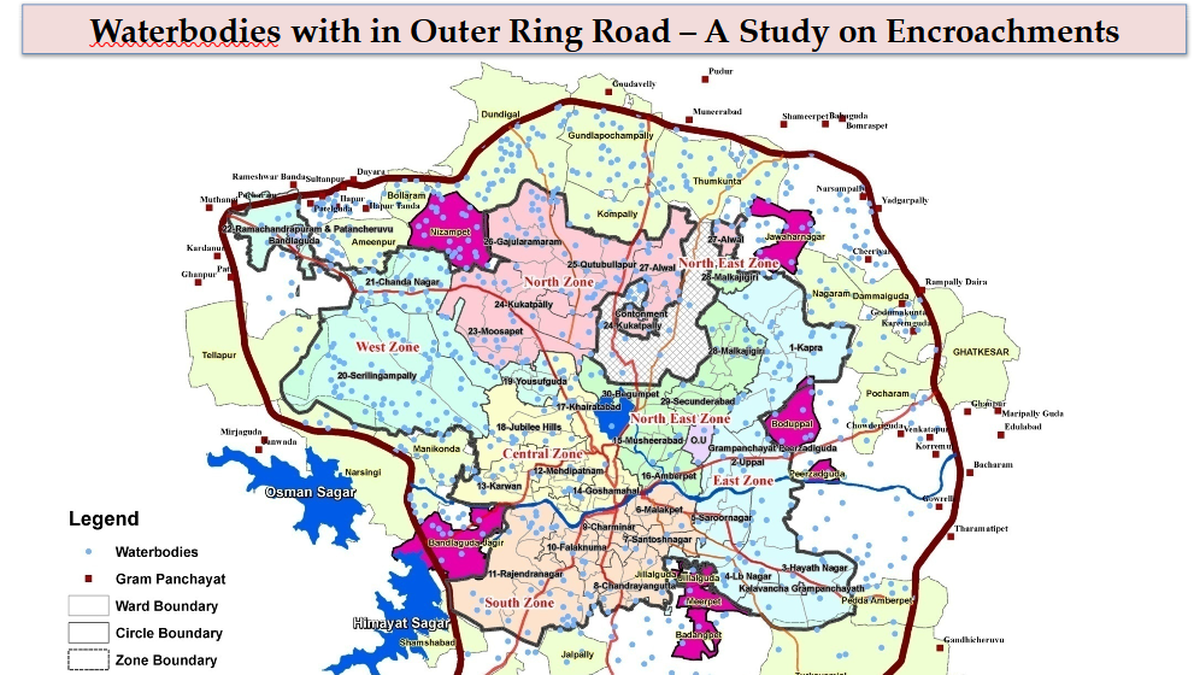
The situation, however, changed by 2023 when 20 of the live water bodies were encroached fully and another 57 partially. Among the 196 partially encroached water bodies, 24 were fully encroached in nine years and another 70 saw spurt in encroachments. The situation was so alarming that 171 of the remaining 695 water bodies were either fully or partially encroached. https://www.thehindu.com/news/cities/Hyderabad/396-out-of-920-water-bodies-in-hyderabad-encroached-dy-cm-says-decision-on-structures-in-buffer-zones-yet-to-be-taken/article68728347.ece (07 Oct. 2024)
HYDRAA Ropes in Lakeman In its bid to conserve lakes and ponds at a low cost, the HYDRAA is taking a cue from Bengaluru and invite Anand Malligavad, also known as India’s ‘lake man’, to join its efforts. Under the Bengaluru model, water will be filtered across stages before it reaches the lakes. One of the steps that will be taken up in Hyderabad is having a plantation on either side of nalas where sewage water flows. Initially four lakes — Sunnam cheruvu, Appa cheruvu, Errakunta and Kukatpally lake — will be revived. https://www.deccanchronicle.com/southern-states/telangana/hydraa-ropes-in-lakeman-1829595 (11 Oct. 2024)
HYDRA to launch app to curb lakes encroachments HYDRA Commissioner and Lake Protection Committee Chairman AV Ranganath chaired a meeting on Monday (Oct. 07) with representatives from various departments, including Irrigation, Revenue, the National Remote Sensing Agency (NRSA), the State Remote Sensing Application Centre, and the Survey of India. During the meeting, the focus was on strengthening efforts to protect water bodies and green spaces from illegal encroachments. Ranganath emphasized that HYDRA is also prioritizing the removal of debris following the demolition of illegal structures built on lake lands. In the first phase of the initiative, authorities will begin work on safeguarding lakes such as Sunnam Cheruvu, Appacheruvu, Errakunta, and Kukatpally Nallacheruvu.
The Full Tank Level (FTL) and maximum water spread area of ponds will be identified using data collected over the past 45 years. This historical information will be cross-checked with recent data from NRSA, the State Remote Sensing Application Centre, and the Irrigation Department to accurately determine the boundaries of these water bodies. Ranganath also stated that officials will review the 2018 Comptroller and Auditor General (CAG) report to ensure a thorough and accurate assessment of the lakes. This effort aims to ensure that encroachments are identified and addressed promptly, protecting Hyderabad’s natural resources for the future. https://www.siasat.com/hydra-to-launch-app-to-curb-encroachments-on-hyderabad-lakes-parks-3109310/ (08 Oct. 2024)
Real estate projects may face scrutiny for lake encroachment The report by the Telangana Remote Sensing Application Centre (TGRAC), indicates that several residential and commercial buildings in Hyderabad may have violated regulations concerning encroachment on water bodies, despite securing permissions for construction. https://siasat.com/real-estate-projects-in-hyderabad-may-face-scrutiny-for-lake-encroachment-3109714/ (08 Oct. 2024)
Bengaluru The complex process of restoring lakes The right way to approach restoration is to therefore set the right expectations with stakeholders. First, we need to identify the nature of the problem. Second, we need to prioritise the issues to be addressed with inputs from stakeholders. Third, we need to conduct comprehensive baseline assessments clearly stating the challenges. Fourth, based on available funds, we need to estimate the levels of improvement that are achievable. Finally, we need to set realistic expectations with the stakeholders and devise an exit strategy to ensure the sustainability of interventions throughout the design period.
The success of restoration efforts should not be assessed based on lakes meeting the potable water standards but by the tangible improvements in water quality, biodiversity, and the livelihoods of local communities. Lake restoration is a complex process. With proper planning, phased targets, and collaboration, we can make progress in rejuvenating lakes in urban landscapes — not necessarily to the point where they provide drinkable water, but where they become vibrant, healthy ecosystems that benefit the environment and the people. (Priyanka Jamwal, ATREE) https://www.thehindu.com/opinion/op-ed/the-complex-process-of-restoring-lakes/article68729044.ece (08 Oct. 2024)
NGT issues notice to BBMP on blockage of drains The NGT has sought a response from the chief commissioner of Bruhat Bengaluru Mahanagara Palike (BBMP) and other officials on a Lokayukta report on two lakes of the Karnataka capital that found blocked stormwater drains and encroachments as major issues. The NGT was hearing a matter where it had taken suo motu cognisance of a newspaper report regarding the Lokayukta’s probe that found several issues in Vibhutipura and Doddanekundi lakes in Bengaluru.
In a recent order, a bench of NGT Chairperson Justice Prakash Shrivastava said, “The news item states that in Vibhutipura Lake, officials found the entrance gate mutilated, fencing destroyed, and illegal structures within the premises.” “The lake’s water level was alarmingly low, even during the rainy season, due to a blocked outflow path. Encroachments and misuse of facilities were also noted. Furthermore, it was found that the Doddanekundi Lake faced similar issues,” he said. https://www.deccanherald.com/india/karnataka/bengaluru/ngt-issues-notice-to-bbmp-on-blockage-of-drains-encroachment-in-bengaluru-lakes-3230450 (13 Oct. 2024)
Mumbai Activist: Mangroves in Borivali destroyed for commercial centres A city-based environmentalist has sent a reminder to the forest department and state authorities about a complaint he had filed in Nov 2022 on the alleged destruction of mangroves in Borivali’s coastal regulation zone (CRZ) for the construction of 2 commercial convention centres and a go-karting track. Following the reminder by Reji Abraham of United Association for Social Education & Public Welfare Trust, members of the state-monitored mangroves protection committee will undertake a site visit at Eksar village, Borivali, to further inquire into the issue. https://timesofindia.indiatimes.com/city/mumbai/mangroves-in-borivali-under-threat-activist-claims-destruction-for-commercial-development/articleshow/114022434.cms (07 Oct. 2024)
URBAN WATER
Bengaluru 3 booked for digging borewell on road The Bruhat Bengaluru Mahanagara Palike (BBMP) has got three people booked by police for digging a borewell in the middle of a road in the Karnataka capital. Om Sai Main Road in Bengaluru’s Veerabhadreshwara Nagar area was dug up on October 3 and 4, according to the FIR registered at the Byadarahalli police station. https://indianexpress.com/article/cities/bangalore/bengaluru-three-people-booked-for-digging-borewell-in-the-middle-of-a-road-9608591/ (07 Oct. 2024)
MONSOON 2024
SANDRP Blog High Rainfall days in districts in Sept 2024 This article gives, based on IMD’s daily District Wise Rainfall figures for Sept 2024, the number of High Rainfall District days (number of days when any district had daily rainfall of 50-100 mm, 100-150 mm, 150-200 mm, 200-250 mm and above 250 mm) during that month for each state, each region of India along with comparison of regional numbers with those in previous three years.
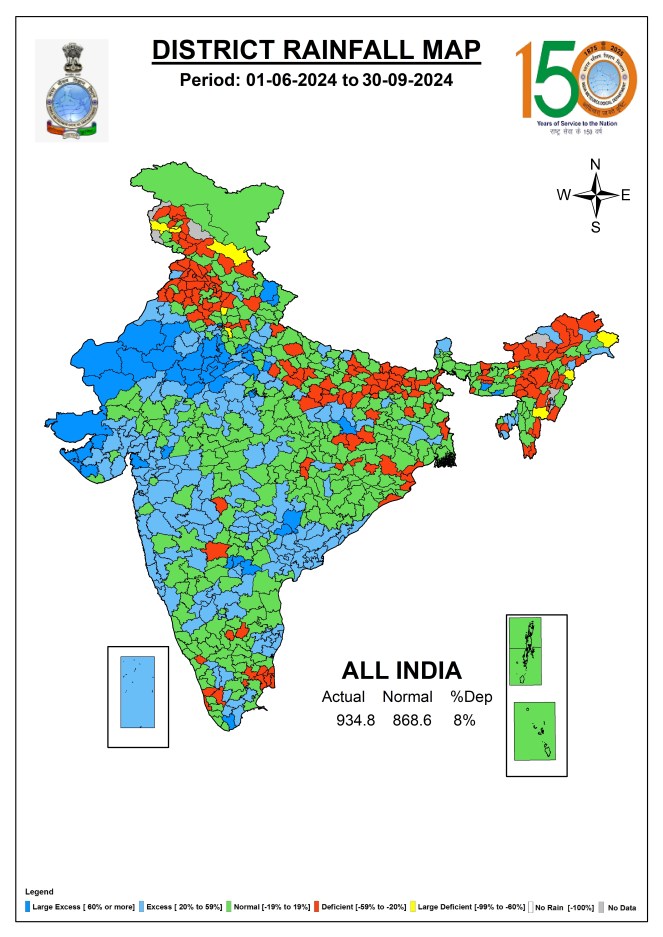
During Sept 2024, at all India level, the number of such instances were highest in last four years even though Sept 2024 rainfall was much below that in Sept 2021 and also below that in Sept 2023, main because East India had the highest number of high rainfall days during Sept 2024. This possibly is a signature of climate change. https://sandrp.in/2024/10/11/high-rainfall-days-in-indias-districts-in-sept-2024-highest-numbers-in-east-india/ (11 Oct. 2024)
FLOOD 2024
Bihar कोसी तटबंध के बीच टापुओं पर बसे गांवों में नहीं पहुंचती सरकारी राहत लोगों की शिकायत है कि तटबंध व अन्य संरचनात्मक निर्माण के कारण कोसी नदी की चौड़ाई कम हो गई है और नेपाल के पहाड़ों से 2आने वाली गाद के कारण नदी का तल ऊंचा हो गया है, जिससे बाढ़ का खतरा बढ़ गया है और पिछले डेढ़ दशक में उनकी खेती को सबसे अधिक नुकसान हुआ है। तटबंध के बीच टापूनुमा आकृति पर बसे गांवों के लोग डूब व कटाव के कारण विस्थापित होते हैं। सामान्यतः यह विस्थापन 300-400 मीटर से दो से तीन किमी तक के दायरे में देखने को मिलता है। इस जलवायु विस्थापन से सबसे अधिक महिलाएं और बच्चे प्रभावित होते हैं। https://hindi.mongabay.com/2024/10/09/flood-hit-villages-on-kosi-river-islands-left-without-government-relief/ (09 Oct. 2024)
HFL BREACH
Madhya Pradesh River Sonar a tributary of Ken river in lower Yamuna basin at Narsinghgarh site in Damoh district has crossed the old HFL 336.94 meter dated 12.09.2024 at 13:00 hour on 09.10.2024. Present flood level is 337.22 meter at 09:00 hour on 10.10.2024 with rising trend. This is at least the fourth time the river has breached old HFL 335.5 meter dated 16.09.2023 in southwest monsoon season 2024.
West Bengal Unprecedented Ichamati flowing in EXTREME FLOODS at 4 sites of Tarinipur, Kuthibari, Bangaon, Bajitpur in North 24 Parganas, West Bengal for past 3 weeks. Though flood level at Kuthibari, Bangaon, Bajitpur sites has not come down old HFL, CWC has upgraded Sept 2024 HFL at these respective sites which is against the SoP.
URBAN FLOODS
Chennai Buckingham canal clogged with garbage, debris Mylapore, Mandaveli and Santhome are facing a severe risk of floods as a 150-metre stretch of the Buckingham Canal is choked with garbage, including plastic, wood, rubber and other solid waste. Behind the DGP’s office, nearly 500 huts, encroaching on the canal, continue to dump waste directly into the waterway, blocking nearly 80% of the canal.
These illegal settlements are outside the reach of the Greater Chennai Corporation’s (GCC) garbage collection routes, leading to unchecked dumping of waste. The corporation typically collects waste only from areas registered under its jurisdiction, leaving private and illegal roads neglected. Compounding the problem, the curve in the canal near the DGP’s office causes waste from other parts of the canal to accumulate there. https://timesofindia.indiatimes.com/city/chennai/mylapore-faces-flood-risk-as-buckingham-canal-runs-full-of-garbage-and-debris/articleshow/114095979.cms (10 Oct. 2024)
Buckingham Canal remains choked with garbage, sewage Not having learnt a lesson from the floods in Dec, Buckingham canal continues to be clogged with plastic waste and sewage flowing in from stormwater drains. A bed of waste, including plastic, thermocol, rubber, and wrapper, blocks the channel for a stretch of 100 metres near Chepauk MRTS station. The original depth of the canal should be 6 feet below sea level, but due to silt and sewage piling up, it is now 3 feet above sea level.
Residents said this leads to swelling of the canal after a spell of rain. “This has ended up flooding interior areas of Triplicane and Chepauk during Cyclone Michaung. Water did not recede for nearly 12 hours after rains stopped,” said K Balamukundhan of Triplicane. There are about five macro-storm water drain outlets into the canal from Chepauk to Triplicane. https://timesofindia.indiatimes.com/city/chennai/buckingham-canal-choked-with-garbage-and-sewage/articleshow/107805223.cms (19 Feb. 2024)
Flood-wary residents are ‘lifting’ houses D. Bhuvanesh and his family of six lost the fear of the monsoon in 2020 when they had their independent house at Telephone Nagar in Perungudi lifted by 5.75 feet. Before they had that improvement carried out, flood waters would wade into their rooms during heavy downpours. “The years 2016 to 2018 were the worst,” recalls Bhuvanesh, a resident of Perungudi for over two decades.
Much of the problem began when Greater Chennai Corporation started blacktopping interior roads without proper milling. “Our house sunk 1.5 feet below the road level,” says Bhuvanesh, a software professional. During the monsoon, the family would shift all their belongings from the ground to the first floor. “We would return after the rains, a practice we followed for at least four years,” he says.
After hearing about “house lifting technique”, they found a service provider who charged them ₹3 lakh for the first three feet and ₹50,000 for every additional feet. “The work was pretty simple and fast. It was completed in one month. We just had to remove all our things from the ground floor for the labourers to undertake work on raising and filling with sand,” says Bhuvanesh. As homework, he had visited a few projects in Nehru Nagar and a building (housing a bank) where this technology had already been adopted. https://www.thehindu.com/news/cities/chennai/why-are-chennai-residents-lifting-houses/article68746019.ece (14 Oct. 2024)
CLOUD BURSTS
Himachal Pradesh 54 cloudbursts, 47 landslides took 65 lives Sixty-five people were killed in 54 cloudburst events and 47 landslides in Himachal Pradesh during this year’s monsoon from June 27 to Oct 2, according to data made public by State Disaster Management Authority (SDMA) on Oct 9. The state lost an estimated Rs 1,363 crore in damage caused by inclement weather, according to SDMA. The damage was this heavy despite state receiving rainfall which was 18% deficient. In July, the state recorded 180mm rain against the normal of 255mm. In Aug, the state received 243mm rain against a normal of 256mm.
– As per SDMA, maximum damage occurred on July 31 night when cloudbursts struck areas in Kullu, Mandi and Shimla, killing 55 people in the three districts. Of the 55 deceased, 33 were from Samej village in Shimla district. According to SDMA, satellite data revealed a flash flood occurred due to a cloudburst in the upper catchment of Samej khad at an elevation of around 5,434 metres and around 2km from Shrikhand Mahadev’s summit. According to Himachal Pradesh chief secretary Prabodh Saxena, there is a need to conduct in-depth studies of cloudburst events. “The state suffers human and financial loss every year. There is an urgent need to have in-depth studies to understand cloudbursts, so that we can save precious lives and property,” said Saxena. https://timesofindia.indiatimes.com/city/shimla/65-lives-lost-in-himachal-pradesh-due-to-54-cloudbursts-and-47-landslides-during-monsoon/articleshowprint/114099098.cms (10 Oct. 2024)
ENVIRONMENT GOVERNANCE
Assam Commando camp in reserved Geleky forest violated law: MoEF The construction of a police battalion camp in Assam’s Geleky reserved forest was prime facie done without prior approvals of the central government in contravention of the Van (Sanrakshan Evam Samvardhan) Adhiniyam, 1980, the MoEF has submitted to the NGT’s eastern bench in an October 1 affidavit. The ministry also directed its regional office in Shillong to initiate action in the matter under sections 3A and 3B of the Adhiniyam. These sections relate to penalties for contravention of provisions of the forest conservation law and offences by authorities and government departments. Under the Adhiniyam, non-forest work on forest land requires prior approvals. https://indianexpress.com/article/india/action-against-top-assam-forest-officer-for-violations-centre-tells-ngt-9616966/ (13 Oct. 2024)
NGT asks committee to probe setting up of industries inside sanctuary The present case deals with a complaint filed by several people in October 2023 alleging the setting up of an industrial zone inside two blocks of the PWS. It was alleged that attempts were also being made to set up cement factories and stone quarries in the area.
The joint committee was formed in August 2024 “to collect relevant information after visiting the site and submit a factual report within a month” but the committee failed to comply with the order. NGT has now asked officials to submit the report before November 5, the next date of hearing. https://www.hindustantimes.com/cities/others/ngt-asks-committee-to-probe-setting-up-of-industries-inside-assam-sanctuary-101728459455586.html (09 Oct. 2024)
CLIMATE CHANGE
Report Africa drought linked to massive ocean bloom near Madagascar -Researchers have discovered that dust from drought-stricken Southern Africa caused an exceptional phytoplankton bloom off Madagascar’s coast, demonstrating a novel link between climate change, terrestrial drought, and ocean productivity. https://scienceblog.com/548174/climate-change-links-drought-in-africa-to-massive-ocean-bloom-near-madagascar/ (01 Oct. 2024)
SOUTH ASIA
Nepal Hydropower ambitions at crossroads of climate shocks Several devastating floods and landslides hit Nepal during 2024 monsoon. The most recent occurred in late September, causing considerable destruction of infrastructure, including ravaging 26 hydropower projects with a total loss of over 1,500 MW. In the face of climate-related water shocks, Nepal faces a unique challenge to its hydropower ambitions, which are further amplified by the country’s specific hydrological landscape.
– Nepal’s susceptibility to climate shocks is worsened by its natural geological and hydrological landscapes. Its approach to water resources development magnifies the impacts. It is crucial to reconsider its water resources development strategy, moving away from colonial era heavy infrastructure development models that aimed to control nature.
– Nepal has an exceptionally steep gradient. In a narrow 93-155 mile strip, Nepal’s altitude spans from the highest point of almost 9,000 (Mount Everest) to the lowest point at 59 meters in the southern Terai region. The drastic changes in altitude shape three geographical regions: Himal, Hilly, and Terai. Himal covers 16 percent of Nepal’s total land area and is where most larger rivers originate. Due to the higher altitude and steep descent, rivers in this region flow with great force and carry a significant amount of alluvium – rocks, sandy silt, and other elements. The young age of the Himalayan rocks, combined with the seismic activity in the Himalayan earthquake belt, contributes to the significant discharge of large amounts of alluvium into rivers in this region, turning the rivers flow fuller, turbulent, and rapid.
– The Hilly (Pahar) region, which represents 65 percent of the total land area, receives ample rainfall during the monsoon season, contributing to the volatility of rivers and adding more alluvium from mountains and hills into the water course. From the Hilly region, rivers flow into Nepal’s low-lying plain region of Terai, which covers 17 percent of Nepal’s land. As rivers meander gently through the plains, they swiftly deposit alluvium carried from the Himalayas and Hilly regions onto their banks and beds. This causes Nepali rivers to rapidly alter their course from the elevated riverbeds to the lower-lying surrounding areas.
– Approximately 60-90 percent of Nepal’s annual precipitation of 1,530 mm occurs during the four-month monsoon season from June to September, with 55-80 percent of the total 225 billion cubic meters of run-off happening within this period. https://thediplomat.com/2024/10/nepals-hydropower-ambitions-at-the-crossroads-of-climate-shocks/ (08 Oct. 2024)
‘We must revisit our infra designs after recent weather event’ We require an engineering paradigm shift in building infrastructures. The extreme weather patterns have made the data we used to refer to in the past while building infrastructures irrelevant. The data on water levels that were referred to while making a bridge in a river now need to be updated as water levels in our rivers have been rising in recent years. The existing infrastructures can’t withstand that volume of water. We witnessed record rainfalls last week. This can be a reference data for some years. Also, the sedimentation pattern has changed because of human settlements built upstream.
There is a single road construction method across the country, whether the place is in a high himalayan range, Mahabharat, Shivalik hills or plains. We have to make specific rules for specific places based on the geological and soil structures. The parameters of road construction should be redefined. We are improving the weather forecasting system but now we also need impact-based forecasting to inform the public not only about the volume of likely rainfall but also its likely impact. (Basanta Raj Adhikari, director at the Centre for Disaster Studies, Institute of Engineering at Tribhuvan University) https://kathmandupost.com/interviews/2024/10/07/we-must-revisit-our-infrastructure-designs-after-recent-weather-event (07 Oct. 2024)
India-Bhutan Resuming construction of mega dam Punatsangchu I HEP work likely to be restarted. According to an article published in Nature Journal in 2020, several slope failures affected the site since 2013, probably as a consequence of the undercutting of a previously unrecognised active landslide. “Our results indicate that downslope displacement, likely related to the natural instability, was already visible in 2007 on various sectors of the entire valley flank,” the subtract of the article written by Benedetta Dini, Andrea Manconi, Simon Loew and Jamyang Chophel states. “Moreover, the area with active displacements impinging on the dam site has continuously increased in size since 2007 and into 2018, even though stabilisation measures have been implemented since 2013.”
– According to the article, stabilisation measures currently only focus on a small portion of the slope, however, the unstable area is larger than previously evaluated. Highly damaged rock is present across many areas of the entire valley flank, indicating that the volumes involved may be orders of magnitude higher than the area on which stabilisation efforts have been concentrated after the 2013 failure. Though several rectification measures were taken since the landslide in 2013, these failed again in 2016 and 2019, further delaying the project. There were differences in geological interpretations between the two governments that led to disagreements about the necessary stabilisation measures. Now, the Central Water Commission (CWC) of India has prepared the design for the right bank stabilisation measures and submitted it to the Bhutanese government.
– “The CWC’s proposal is still under technical review,” the Kuensel report quoted Bhutan’s Energy and Natural Resources Minister Gem Tshering as saying. “We will evaluate if it meets our requirements, and only then will we discuss with the Indian counterparts the adequacy of the stabilisation measures, based on the geological profile of the hill slope.” Though a consensus has been reached to resume construction of the dam, actual work can only start after rectification work is carried out on the right bank. Though initially estimated at around Rs 35 billion, the project’s cost has more than doubled due to unforeseen geological issues and an extended construction timeline and is now estimated to be nearly Rs 100 billion. https://www.etvbharat.com/en/!opinion/explained-the-importance-of-resuming-construction-of-india-funded-mega-dam-in-bhutan-enn24100505961 (05 Oct. 2024)
Pakistan Planning world’s largest riparian developement This desiccated (RAVI) river (passing through Lahore) has become the unlikely locale for a massive riparian development that is planned for over 40 km along its banks and is being labeled the world’s largest riparian development scheme. Promenades and riverfront condominiums are planned in narrowed channels of the river with several real-estate investors putting their weight behind the development in one of the fastest growing urban centers in South Asia. The Ravi Urban Development Authority (RUDA) has been tasked with managing the development in 3 phases with wide planning powers. Pakistan’s environmental movement has taken notice of the project’s scale and also launched legal challenges on the lack of consultation and assessment therein.
A lot of uncertainty regarding riparian flows due to climate change as well as the lack of trust with the upstream riparian, India, is also complicating matters. The Ravi development is perhaps an opportune motivation to renegotiate the Indus Waters treaty. India has sent a request to renegotiate the treaty to Pakistan last month as well, prompted by domestic pressure to get a larger share of the water of the other rivers that were allocated to Pakistan. A convergence of “bottom-up” riparian activism on the Ravi, economic incentives for sustainable riparian development, and geopolitical pressure to have more climate-resilient agreements may create the right incentives for a better deal for both India and Pakistan. https://www.forbes.com/sites/saleemali/2024/10/06/planning-the-worlds-largest-riparian-development-in-pakistan/ (06 Oct. (2024)
ASIA
Adani Group plans 10 Gw overseas HEPs India’s Adani Group plans to build 10 gigawatts of overseas hydroelectric projects over the next few years. The group is exploring building hydroelectric projects in countries such as Nepal, Bhutan, Kenya, Tanzania, the Philippines, and Vietnam. While the group is mostly focussed on building pumped hydro storage in India, it is drawn to countries that have favourable topography and demand for hydropower.
– In June, Gautam Adani announced that the group had signed an agreement with Bhutan’s government for the 570 MW hydro power plant in the Chhukha province. It is also evaluating constructing a 700 MW project at Chamkarchu in Bhutan, where the work can start immediately as required approvals are in place. https://www.reuters.com/business/energy/indias-adani-group-plans-10-gw-overseas-hydroelectric-projects-sources-say-2024-10-10/ (10 Oct. 2024)
THE REST OF THE WORLD
USA Salmon migrating u/s removed Klamath dam after 100 years
With the removal project that started in July 2023 completed on 2 October 2024, scientists with the non-profit California Trout captured images of a 2.5-ft-long Chinook salmon migrating upstream for the first time in more than 100 years the very next day. Yet, scientists stress that it will take many more years to fully restore the ecosystems affected by the dams. https://www.theguardian.com/us-news/2024/oct/08/klamath-river-dam-removal-before-after-photos (08 Oct. 2024)
Utility company to completely deconstruct century-old dam A subsidiary of American Water, the largest regulated water and wastewater utility company in the United States, has recently announced its plans to demolish a dam on the White River in Indiana. The Rockford Dam on the East Fork of the White River was built in the 1800s near Indiana American Water’s water treatment facility to ensure adequate water levels were available to supply surface water to the facility.
– Now that the company uses groundwater as its water source, the dam is no longer needed. In a press release the company announced that it has secured the necessary permits to begin its removal. The removal of the dam, which is expected to start toward the end of 2024, will improve safety for river users by eliminating dangerous recirculating currents associated with low-head dams. Recirculating currents can create strong forces that can pull and trap people underwater. Between 2010 and May 2020, there were 25 deaths at or near low-head dams reported in Indiana. https://www.thecooldown.com/outdoors/rockford-dam-indiana-american-water/ (09 Oct. 2024)
Chile Recognizing rights of Biobío river The Biobío River was Chile’s first major river protection campaign. The Biobío is a lifeline, a cultural icon, and a symbol of resilience for its communities. The recent Declaration of Rights of the Biobío River launched this week in Concepción was born from collaboration between Indigenous Peoples, scientists, civil organizations, and local authorities. The Declaration asserts that the river, along with its tributaries and basin, possesses inherent rights that must be recognized and protected. It is not just a document; it is a moral commitment to restore and safeguard the Biobío River. https://www.internationalrivers.org/news/recognizing-the-rights-of-the-biobio-river-a-new-era-of-environmental-stewardship/ (25 Sep. 2024)
AMAZON Brazil Changing climate scorching world’s biggest river As a punishing drought dries up stretches of the Amazon River, Brazil is resorting to dredging to try to keep food, medicine and people flowing along the watery superhighway. Water levels along several sections of the Amazon River, which winds nearly 4,000 miles across South America, fell last month to their lowest level on record, according to figures from the Brazilian Geological Service. In one stretch in the Brazilian state of Amazonas, the river was 25 feet below the average for this time of year, according to the agency, which began collecting data in 1967. Parts of three of the Amazon River’s most important tributaries — major rivers in their own right, each spanning over 1,000 miles — have also fallen to historical lows.
– “Here, the rivers are our streets,” said one resident, Maria de Fátima Servalho Celestino, 34. “And with the drought, we can’t get to town to buy water or medicine. We can’t fish, the fish is all gone. Everything is dry.” https://www.nytimes.com/2024/10/06/world/americas/amazon-river-climate-change-brazil.html (06 Oct. 2024)
Africa River in flood-hit Chad’s capital surges to record level The Logone river in Chad’s capital has risen to its highest level in 30-40 years, the authorities said on Wednesday (Oct. 09), threatening further turmoil to a country that has been battling devastating nationwide floods for weeks. West and Central Africa’s annual monsoon has swept parts of the region with above-average downpours this rainy season, triggering widespread floods. Chad is the worst-hit with 1.9 million people affected across much of the country as of Oct. 5, according to the U.N. humanitarian agency OCHA. https://www.reuters.com/world/africa/river-flood-hit-chads-capital-surges-record-level-2024-10-09/ (10 Oct. 2024)
SANDRP
Also see: DRP 07 Oct. 2024 & DRP 30 Sept. 2024
Follow us on: www.facebook.com/sandrp.in; https://twitter.com/Indian_Rivers

 SANDRP