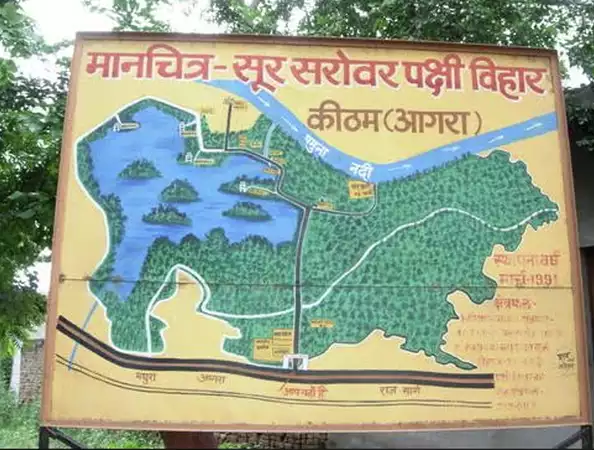
(Feature Image: Soor Sarovar Bird Sanctuary, along with the river Yamuna, is considered to be green lung of the Agra city. Source: ToI report Six-member committee to probe development of Agra Trade Centre in Soor Sarovar eco-zone. Nov. 01, 2018)
The waterbodies, lakes, wetlands in Yamuna basin continue to face damages and threats from many quarters, including concerned govt departments. In latest examples of this, there are reports of Uttar Pradesh govt’s plan to reduce the eco-sensitive zone (ESZ) of Keetham lake to zero. The wetlands also known as Sur Sarovar is a large ox bow lake formed by Yamuna River in Agra. It is a protected bird sanctuary and has been designated a Ramsar site in August 2020. In Sept. 2022, the Supreme Court had directed the govt to increase lake’s ESZ to 799 ha from 403 ha.
Similarly, the Uttar Pradesh govt departments have also been delaying process to notify Dhanauri wetlands as a Ramsar site in Greater Noida. The case is going on in NGT (National Green Tribunal) for the past many years. In the recent hearing held on Sept. 26, the NGT asked govt department to explain reasons behind delay in notifying the wetlands apart from directing it to remove water hyacinth chocking the wetlands. The next hearing will be held on Jan. 27, 2025.
In Gurugram, a report by NBWL (National Board of Wild Life) has found several violations of ESZ norms by housing and infrastructure projects impacting Sultanpur National Park in Sahibi river basin. The shallow lake with marshy land was declared a Ramsar site in May 2021. Likewise, in Delhi, NHAI was found damaging part of a protected pond in Goyla Khurd village by constructed road through the waterbody.
YAMUNA WETLANDS, LAKES, WATER BODIES
Agra ईको सेंसिटिव जोन शून्य करना कीठम के लिए घातक मुख्यमंत्री की अध्यक्षता वाली उत्तर प्रदेश राज्य वन्य जीव परिषद द्वारा सूर सरोवर पक्षी विहार (कीठम) के ईको सेंसिटिव जोन को शून्य किमी घोषित करने के निर्णय का विरोध शहर में शुरू हो गया है. पर्यावरण प्रेमियों ने रविवार (Sept. 15) शाम यमुना किनारा रोड स्थित यमुना आरती स्थल पर प्रदर्शन करते हुए इस निर्णय को पक्षी विहार के लिए घातक बताया.
सूर सरोवर पक्षी विहार के क्षेत्रफल के पुनर्निर्धारण से संबंधित पर्यावरण कार्यकर्ता डॉ। शरद गुप्ता की याचिका राष्ट्रीय हरित अधिकरण (एनजीटी) में विचाराधीन है। इसकी अधिसूचना को राज्य सरकार ने समय मांगा है। पक्षी विहार के क्षेत्रफल की अधिसूचना होने के बाद ही ईको सेंसिटिव जोन का निर्धारण हो सकता है। मामले में अगली सुनवाई जनवरी में प्रस्तावित है। डॉ। शरद की याचिका पर सुप्रीम कोर्ट ने राज्य सरकार को पक्षी विहार का क्षेत्रफल 403 हेक्टेयर से बढ़ाकर 799 हेक्टेयर करने के निर्देश दिए थे। राज्य सरकार द्वारा कोई कदम नहीं उठाए जाने पर उन्होंने एनजीटी में अवमानना याचिका दायर की थी। https://www.inextlive.com/uttar-pradesh/agra/agra-news-zeroing-the-eco-sensitive-zone-is-fatal-for-keetham-1726423311 (16 Sept. 2024) https://www.youtube.com/watch?v=j9vxpUFbhD8 (15 Sept. 2024)
सीईसी की सिफारिशों के खिलाफ जिला प्रशासन, एसडीएम ने किया विरोध आगरा के ताज ट्रेपेजियम जोन के लिए फेफड़ों का काम करने वाले सूर सरोवर पक्षी विहार की सीमा 403 हेक्टेयर से बढ़ाकर 799 हेक्टेयर करने पर सेंट्रल इम्पावर्ड कमेटी ने सुप्रीम कोर्ट में सिफारिशें दीं हैं। वहीं जिला प्रशासन ने इसका विरोध किया है। नेशनल ग्रीन ट्रिब्यूनल में हुई सुनवाई में पर्यावरण एवं वन विभाग के अपर मुख्य सचिव मनोज सिंह ने स्टेटस रिपोर्ट दाखिल की। तहसीलदार किरावली और एसडीएम की रिपोर्ट सूर सरोवर पक्षी विहार के सीमा विस्तार के खिलाफ है। दोनों ने सीमा विस्तार से विकास योजनाओं पर असर पड़ने की रिपोर्ट दी है। https://www.amarujala.com/uttar-pradesh/agra/sur-sarovar-bird-sanctuary-district-administration-sdm-protest-against-cec-recommendations-2024-08-11 (11 Aug. 2024)
कीठम का एक माह में दायरा बढ़ाकर तय हो ईको सेंसिटिव जोन : एनजीटी राष्ट्रीय चंबल सेंक्चुरी प्रोजेक्ट के तहत 24 अप्रैल 2018 को पर्यावरण, वन एवं जलवायु परिवर्तन मंत्रालय ने 799 हेक्टेयर के सूर सरोवर पक्षी विहार के ईको सेंसिटिव जोन के संबंध में प्री-गजट नोटिफिकेशन जारी किया था। लेकिन, 10 अक्तूबर-2019 को जारी फाइनल गजट में ये दायरा घटाकर 403 हेक्टेयर कर दिया गया। पर्यावरणविद डॉ. शरण गुप्ता ने इस पर अपनी आपत्ति दर्ज कराई। https://www.livehindustan.com/uttar-pradesh/agra/story-ngt-directs-ministry-to-expand-keetham-bird-sanctuary-area-and-set-eco-sensitive-zone-201723219909097.html (9 Aug 2024)
आगरा के कीठम स्थित सूर सरोवर पक्षी विहार का दायरा 403 हेक्टेयर से बढ़कर 800 हेक्टेयर कर दिया गया है। सुप्रीम कोर्ट ने पर्यावरणविद् डॉ. शरद गुप्ता की याचिका पर यह आदेश जारी किया है। सेंट्रल एंपावर्ड कमेटी (सीईसी) ने इस संबंध में सिफारिश की थी। प्रदेश सरकार ने मामले में बार-बार रुख बदला, लेकिन सीईसी की सिफारिश के बाद शपथ पत्र देकर सहमति जता दी। कीठम स्थित सेंक्चुअरी की अब नई सीमाएं तय की जाएंगी और 800 हेक्टेयर दायरे के मुताबिक ही ईको सेंसिटिव जोन तय किया जाएगा। https://www.amarujala.com/photo-gallery/uttar-pradesh/agra/supreme-court-orders-to-increase-the-area-of-sur-sarovar-bird-sanctuary-in-agra (27 Sept. 2022) पर्यावरण एक्टिविस्ट डॉ। देवाशीष भट्टाचार्य ने बताया कि सुप्रीम कोर्ट ने दो महीने पहले ही सूर सरोवर पक्षी विहार का क्षेत्रफल निर्धारण कर दिया था। भारत सरकार एवं उप्र सरकार को निर्देश दिया था कि नया क्षेत्रफल लागू करते हुए नए ईको सेंसिटिव जोन का निर्धारण किया जाए। नया क्षेत्रफल और सेंसिटिव जोन लागू हो जाता है तो अवैध निर्माण पर पूरी तरह अंकुश लग जाएगा। इसके साथ ही वन्य जीवों को शिकारियों का खतरा भी दूर हो सकेगा। वनों के किए जा रहे अवैध कटान पर भी रोक लग जाती। लेकिन, ऐसा हुआ नहीं। इससे काफी नुकसान हो रहा है। https://www.inextlive.com/uttar-pradesh/agra/keetham-lake-joke-in-the-name-of-eco-sensitive-zone-illegal-construction-will-curb-deforestation-1670780590 (12 Dec. 2022) आगरा के सूर सरोवर पक्षी विहार का दायरा बढ़ सकता है। कीठम झील के इर्दगिर्द 403 हेक्टेयर में फैले सूर सरोवर पक्षी विहार का दायरा बढ़ाकर 800 हेक्टेयर करने की सिफारिश सेंट्रल एंपावर्ड कमेटी ने की है। इस मामले में राज्य सरकार भी पक्षी विहार का दायरा बढ़ाने पर सहमत है। अगर सबकुछ ठीक रहा तो इसका क्षेत्रफल दोगुना हो जाएगा। राष्ट्रीय चंबल सेंक्चुरी प्रोजेक्ट ने चार साल पहले 24 अप्रैल 2018 को सूर सरोवर पक्षी विहार का क्षेत्रफल 800 हेक्टेयर करने का प्री-गजट भी जारी कराया गया था, जिस पर लोगों से आपत्तियां मांगी गई थीं। बाद में प्रदेश सरकार ने इसे वापस ले लिया। https://www.amarujala.com/photo-gallery/uttar-pradesh/agra/recommendation-to-declare-soor-sarovar-bird-sanctuary-in-800-hectares-in-agra (10 April 2022) सूर सरोवर पक्षी विहार (कीठम) के ईको सेंसिटिव जोन के निर्धारण में नया पेच फंस गया है। सेंट्रल इंपावर्ड कमेटी (सीईसी) ईको सेंसिटिव जोन से पहले कीठम के ही क्षेत्र का निर्धारण वर्ष 1991 के गजट नोटिफिकेशन के आधार कराने पर विचार कर रही है। सीईसी संबंधित दस्तावेज, नक्शे और राजस्व रिकार्ड पुन: संकलित करने के साथ नेशनल ग्रीन ट्रिब्यूनल द्वारा दिए गए निर्देशों और विभिन्न समितियों की रिपोर्ट को भी इसका आधार बनाएगी। https://www.jagran.com/uttar-pradesh/agra-city-there-is-a-new-suspense-in-the-determination-of-eco-sensitive-zone-of-soor-sarovar-bird-sanctuary-21985412.html (02 Sept. 2021) आगरा के सूर सरोवर पक्षी विहार के लिए पहली बार पारिस्थितिकीय संवेदनशील क्षेत्र (ईको सेंसिटिव जोन) का मास्टर प्लान बनेगा। सरोवर की प्रतिबंधित सीमा के बाहर संवेदनशील क्षेत्र का निर्धारण किया जाएगा। जिलाधिकारी की अध्यक्षता में वन एवं पर्यावरण, प्रदूषण समेत 10 विभागों की कमेटी प्रस्ताव तैयार करेगी। https://www.amarujala.com/photo-gallery/uttar-pradesh/agra/master-plan-of-eco-sensitive-zone-will-be-made-for-sur-sarovar-bird-sanctuary-agra (06 Feb. 2021) एनजीटी में सूर सरोवर पक्षी विहार के ईको सेंसिटिव जोन में हिंदुस्तान और आनंद काॅलेज के निर्माण से संबंधित याचिका पर सुनवाई हुई है। पर्यावरण, वन एवं जलवायु परिवर्तन मंत्रालय ने एफीडेबिट दाखिल कर ईको सेंसिटिव जोन का दायरा तय नहीं होने के लिए उप्र सरकार को जिम्मेदार ठहराया है। एनजीटी ने समिति गठित करने व तीन माह में रिपोर्ट दाखिल करने के निर्देश दिए हैं। https://www.jagran.com/uttar-pradesh/agra-city-committee-to-investigate-the-eco-sensitive-zone-of-soor-sarovar-bird-sanctuary-agra-20768269.html (19 Sept. 2020)
G Noida Why proposal to notify Dhanauri not sent to Centre: NGT The NGT principal bench on Sep 26 ordered the Uttar Pradesh govt to clear water hyacinth from the Dhanauri wetlands and sought to know why the state authorities have not yet sent a proposal to notify the wetland as a Ramsar site.
The bench headed by chairperson Justice Prakash Shrivastava asked the UP govt to be prepared by the next hearing (Jan. 07, 2025) with answers on why Dhanauri’s Ramsar site proposal is yet to be forwarded to the MoEF. The bench made the observations and passed directions while hearing an ongoing petition seeking notification of Dhanauri wetlands as a Ramsar site, by Greater Noida resident and bird-watcher Anand Arya. The petition had also pointed out that notification of the wetland as a Ramsar site was laid down as a condition in the environmental clearance granted to Jewar Airport site, which is located under 20 kms distance from the wetland. https://indianexpress.com/article/india/dhanauri-wetland-ramsar-site-ngt-up-govt-9587636/ (26 Sept. 2024)
Gurugram Infra projects around Sultanpur NP a threat to its ecosystem & wildlife The Sultanpur National Park is under threat due to violations of the eco-sensitive zone (ESZ) zonal plan and notification, stated by a panel set up by the standing committee of National Board for Wildlife (NBWL) for evaluating the impact of construction activities going on in the areas around the Ramsar site on its fragile ecosystem. The committee’s report, submitted at the end of July, provided evidence of stresses affecting the national park, which include shrinking of Sultanpur Jheel and dependence on the Gurgaon canal for maintaining water levels.
“The ESZ notification and zonal plan are vital regulatory and management instruments to harmonise regional development with the park’s ecology. The committee recommended enforcing existing regulations, monitoring ESZ notification compliance, establishing interagency coordination mechanisms, preserving no-construction areas, rectifying deficiencies in the ESZ zonal plan notification, removing farmhouses, preventing alteration of hydrological pathways, compensating increased built-up areas with green cover, augmenting human resources for park and ESZ management, formulating an integrated management plan and fostering community sensitisation,” the report stated.
The committee also reviewed measures for conservation of wetlands and Ramsar sites in Haryana and examined water flow from Sultanpur to Najafgarh. The assessment was initiated by a directive from the standing committee on Feb 28 to appraise the impact of infrastructure projects in the area, particularly a proposal to utilise nearly 3.7ha of land for an affordable group housing colony at Garhi Harsaru in Sector 95B, which is 4km from the national park’s boundary within its eco-sensitive zone. https://timesofindia.indiatimes.com/city/gurgaon/housing-infra-projects-around-sultanpur-park-a-threat-to-its-ecosystem-wildlife-says-panel/articleshow/113009273.cms (3 Sep 2024)
Delhi Dwindling waterbodies, floods: NGT seeks report NGT has sought information from various authorities in Delhi regarding the measures being taken to safeguard the city’s dwindling water bodies and mitigate urban flooding. Delhi Pollution Control Committee, Delhi State Wetland Authority, Central Pollution Control Board and the Union jal shakti ministry have been asked to submit their replies a week prior to the next hearing, which is scheduled for Dec 11. The NGT’s principal bench, chaired by Justice Prakash Shrivastava, took suo motu cognizance of some media reports and, in an order dated Aug 30, linked the increase in urban flooding to the disappearance of water bodies in Delhi. https://timesofindia.indiatimes.com/city/delhi/dwindling-waterbodies-floods-ngt-seeks-report/articleshow/113103664.cms (05 Sept. 2024)
NHAI has made highway at protected pond site: Activists A pond in a village in Delhi’s southwest district that is listed among natural wetlands to be recognised and protected has now been nearly consumed by a highway built by National Highway Authority of India (NHAI). NHAI built the Urban Extension Road-II over the pond in Goyla Khurd village, which was among the list of over 1,000 ponds to be protected. According to activists who brought the matter to light, it is a violation of orders of the Supreme Court and high court, as well as the wetland rules. A reply by NHAI in the matter, however, stated that they had all required permissions for the project.
According to CYCLE India, an NGO, the elevated road passing through the village also passes through a village pond that has shrunk in area since construction began. Paras Tyagi of the NGO said the construction of the road over the waterbody is itself illegal. Sharing details of the pond and construction, Tyagi pointed out that the satellite images show that the construction over pond land was done in 2022 after the land was acquired in 2009. https://timesofindia.indiatimes.com/city/delhi/activists-accuse-nhai-of-illegal-highway-construction-over-protected-pond-in-delhi/articleshow/113791994.cms (30 Sept. 2024)
DAMS & HYDRO POWER PROJECTS IN YAMUNA BASIN
Himachal Pradesh Dams affected continue to struggle Bharat Dogra on injustice to dam displaced: – On September 3/4, the evictees of Renuka dam, under the banner of their struggle commit or Jan Sangharsh Samiti (JSS) held a meeting and a protest march at Renukaji. “As many as 25 panchayats, comprising 41 villages and 7,000 people, will be affected by the project, while 346 families have been rendered homeless.” People have demanded that those living very close to the danger mark and on forest land should also get the recognition of displaced families for proper compensation.
Renuka dam proposes to meet water supply needs of a distant Delhi, but so much can be done within Delhi to increase water harvesting, revive water bodies, preventing wastage of water. Why endanger Himalayan ecology when solutions closer home are available. https://countercurrents.org/2024/09/from-renuka-to-pong-to-bhakra-dam-evictees-and-dam-affected-people-in-himachal-pradesh-have-been-struggling-for-justice/ (8 Sep 2024)
Uttarakhand Lakhwar dam affected farmers plan to resume protest if UJVNL fails to take steps towards fulfilling their 11 point demand charter already submitted to and agreed upon by the govt about a year back. (Dainik Jagran 22 Sept. 2024)

Madhya Pradesh Rising above waters with melon The Gandhisagar dam’s backwater submerges farmland for most of the year, making cultivation possible only from March to June. Farmers in the dam’s backwater submergence area have adapted to seasonal flooding by cultivating musk melon, which thrives in the limited summer months and provides high revenue from seed sales. Local authorities and experts are considering establishing a processing unit here to reduce transportation costs and increase farmers’ profits from musk melon seeds. https://india.mongabay.com/2024/06/rising-above-the-waters-with-musk-melon/ (4 Jun 2024)
INTERLINKING OF YAMUNA RIVERS
Ken-Betwa Linking Changing parametes need fresh appraisal? The controversial Ken-Betwa Interlinking project is undergoing several changes being proposed by central & state governments of UP and MP. All these changes are not part of the original plans and renders environment, forest and wildlife clearance and manipulated appraisal void. These changes are set to increase the project impacts, costs and benefits hugely and makes it necessary that project must undergo fresh forest, environmental and other clearance processes including preparation of fresh EIA report and conduction of fresh public hearings. https://sandrp.in/2024/09/05/yamuna-manthan-050924-changing-parameters-of-ken-betwa-project-needs-fresh-appraisal/ (5 Sep 2024)
YAMUNA FLOOD
SANDRP Blog Yamuna SW Monsoon 2024: Upper Segment Misses Flood After remarkable deluge in 2023, the upper segment of Yamuna river has seen no significant flood spell all through the just concluded southwest monsoon 2024. This is unusual as the river generally witnesses at least a couple of low or medium flood spells in this segment every year. However, this year the discharges from Hathnikund Barrage (HKB) in Haryana did not cross 1 lakh cusec figure even a single time. The peak discharge from the barrage was 87,017 cusecs at 06:00 hour on 26.09.2024.
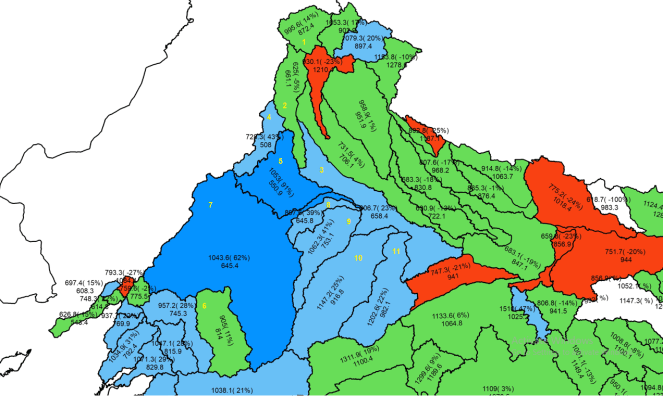
Good flood spells in upper segment of Yamuna used to restore flows in the river for about three to four months. Lack of floods in upper segment this year will result in decrease in lean season flows and put more pressure on river to cater to irrigation, industrial and potable water demands. This will also affect the remaining aquatic life and riverine eco-system dependent on the river. At the same time, the pollution level in Delhi stretch of Yamuna is bound to worsen in coming months. https://sandrp.in/2024/10/02/yamuna-sw-monsoon-2024-upper-segment-misses-flood/ (02 Oct. 2024)
Delhi Govt to study impact of barriers, preventive steps for flood The scope of the study comprises nine points – three pertaining to embankments – and the rest on study of islands formed in river and corrective measures; assessment of location and extent for clearing the mud and sand mining in river bed between Wazirabad and Okhla to increase the river’s carrying capacity; corrective actions in solid approach roads of various bridges; review of danger and warning levels at Old Railway Bridge, and strengthening and raising of existing regulators and pumphouses.
The Delhi government will undertake a five-month study to analyse the impact of obstructions like bridges, embankments, weirs, and river islands on the flow of Yamuna, officials familiar with the matter said on Monday, adding that the report will also suggest measures to prevent flooding in the river that inundated the Capital in July last year. The Delhi government’s Irrigation and Flood Control Dept has joined hands with the Central Water and Power Research Station – an organisation under the Ministry of Jal Shakti – for the study, which will also assess the proposals by MLAs, MP and the I&FC department to create new embankments and retaining walls on the banks of the river. The study is estimated to cost ₹42.43 lakh. These include construction of another embankment (or bund) on the left bank of Yamuna from Wazirabad to Shastri Park parallel to the existing bund in continuity of left forward embankment up to the LM embankment near Shastri Nagar. https://www.hindustantimes.com/cities/delhi-news/delhi-govt-to-study-impact-of-barriers-preventive-steps-for-yamuna-flood-101727113675190.html (24 Sep 2024)
Madhya Pradesh August 2024: Tonga Dam Breach floods villages A breach in earthen Tonga dam has flooded half a dozen villages in Sabalgarh tehsil of Morena district in Madhya Pradesh. The breach occurred in intervening night of Aug 12-13, 2024. According to ETV Bharat, it was built in 1889 by the royal Scindia family & the 135-year-old dam has 193 MCM reservoir capacity. It has about 450-m-long main concrete wall and two long earthen embankments. The dam was filled upto about 80 percent at the time of the breach. However, National Register of Large Dams should have listed such a dam, but there is no dam by the name of Tonga dam (neither in NRLD 2019, nor in in 2023 edition), nor does NRLD list any MP dam commissioned in 1889, the earliest commissioned large dam listed is in 1895. The reservoir capacity listed above seems too high for it not to be listed in NRLD. https://sandrp.in/2024/09/11/august-2024-tonga-dam-breach-floods-madhya-pradesh-villages/ (11 Sept. 2024)
FLOODPLAIN
Delhi No steps taken on ground to demarcate floodplain: NGT The NGT on Thursday (Sept. 19) observed that “not even a single effective step has been taken at the ground level for demarcation of the Yamuna floodplain on the 22-km stretch” from Wazirabad to Palla. According to a status report submitted on Tuesday (Sept. 17) by Delhi’s special secretary (Environment) in compliance with the NGT’s July order — in which the GNCTD and Delhi Development Authority (DDA) were directed to submit a fresh report disclosing the steps taken for demarcation of the Yamuna floodplain — the tribunal-appointed high-level committee headed by the Delhi chief secretary took several actions.
The committee, as per the report, said that the Delhi Irrigation and Flood Control Department (IFCD) assigned Central Water and Power Research Station, Pune, to undertake a “scientific assessment of the impact on the flood-prone area for Delhi region and to suggest the measures”. However, the study could not be conducted because of non-payment of funds. The NGT objected to the status report, observing that the terms of reference submitted by the IFCD “indicates that the emphasis is on the bund constructed on both sides of Yamuna instead of being the demarcation of the floodplain”.
It observed, “We are interested in what has been done. Show us if you have taken a single step on this direction. Nothing has been done. You cannot identify the encroachment unless you have identified the floodplains. What will the drone survey do if you have not demarcated the floodplain?… Since the (Ganga) rejuvenation order was issued in 2016, eight years have passed. In eight years, you have not taken a single step. This is total defiance of the court order, total defiance of the statutory order… This is such a simple exercise.”
The IFCD chief engineer, Anil Kumar, said that the necessary action required to prepare a map marking the floodplains will be undertaken by the department. The NGT observed that the map will be submitted by the IFCD in six months and fixed a cut-off date of March 31, 2025, for this. It directed the DDA, IFCD and GNCTD to “furnish the progress report” before the next hearing on January 16, 2025. https://indianexpress.com/article/cities/delhi/no-steps-taken-on-ground-to-demarcate-yamuna-floodplain-says-ngt-9577835/ (20 Sept. 2024)
Floodplain farmers’ woes fall on deaf ears With cultivation not allowed and loans on their head, they seek policies for their rehabilitation. Meanwhile, environmentalists have said that (organic) farming in limited stretches do not threaten the region’s ecology. According to Bheem Singh Rawat, associate coordinator of the South Asia Network on Dams, Rivers and People (SANDRP), there is nothing wrong with floodplain cultivation using natural methods and organic manure in limited stretches. “Urban farming can improve the city’s food security and keep it green.” At the same time, the DDA has recently been criticised for violating NGT guidelines and constructing permanent structures on the banks of Yamuna in the name of ‘restoration’. “It is unfortunate that a land development agency has control over the floodplains. The DDA has no interest in developing (protecting) the floodplain land naturally. Instead, it is concretising the area and planting non-native trees under the guise of Beautification,” said Rawat. “The management of the floodplains should be handed over to an independent body of experts including Hydrologists and ecologist,” he added. https://www.newindianexpress.com/cities/delhi/2024/Sep/07/yamuna-farmers-woes-fall-on-deaf-ears (07 Sept. 2024)
New timelines set for Yamuna revival Delhi govt has been given timelines by DDA to finish initiatives aimed at revitalising the Yamuna. By March 2025, the Kalindi Aviral Extension Project is expected to be finished, while the Hindon Sarovar, spread over 30 acres, will be completed by April 2025. Similarly, the Mayur Nature Park will take over a year to complete — its deadline is March 2026. Additionally, a 30-acre eco-tourism area is being planned according to details given by the landowning agency to Delhi govt. A senior official said that these projects will infuse vitality into Delhi’s green spaces and contribute to the rejuvenation of the Yamuna. https://timesofindia.indiatimes.com/city/delhi/yamuna-river-revival-new-timelines-unveiled-for-eco-friendly-projects-in-delhi/articleshow/113883903.cms (02 Oct. 2024)
Noida Township ‘flouts rules’, NGT serves notices to Centre and forest dept In a recent order, a bench headed by NGT Chairperson Justice Prakash Shrivastava took note of the allegations about the township being located on the Yamuna riverbed, around 2 km from the river, under the Okhla Bird Sanctuary. The bench took note of the claims about the realtor felling trees illegally and raising commercial construction in a green area. Next hearing on Nov 23, 2024. The respondents or parties in the case are the Centre, the Noida Development Authority, the UPPCB, the state forest & environment dept & sector 126 SHO. https://timesofindia.indiatimes.com/city/noida/township-flouts-rules-ngt-serves-notices-to-centre-and-forest-dept/articleshow/113468912.cms (19 Sept. 2024)
YAMUNA FLOWS
Opinion बाढ़, फैलाव और अविरलता से ही निर्मल होगी दिल्ली में यमुना (Pankaj Chaturvedi) https://indiaclimatechange.com/yamuna-in-delhi-will-be-purified-only-by-flood-expansion-and-continuity/ (10 Sept. 2024)
YAMUNA POLLUTION
Delhi DPCC invites proposals for study on impact of enhanced STP capacity The study, according to the DPCC’s call for proposals, will examine how effectively the Delhi Jal Board’s sewage treatment plants (STPs) are functioning with increased capacity and whether this has led to tangible improvements in the river’s pollution levels. The committee has invited government institutions that specialise in environmental research to submit detailed proposals, including methodologies and estimated costs, within the next 15 days. Proposals are to be sent via email to the DPCC’s member secretary. The study will also look into whether other pollution sources are affecting the Yamuna’s water quality beyond the capacity of the STPs. At present, Delhi generates 792 million gallons per day (MGD) of sewage while its STPs have a capacity of 712 MGD. However, only 550-600 MGD of sewage is treated, according to officials. https://theprint.in/india/dpcc-invites-proposals-for-study-on-impact-of-enhanced-stp-capacity-on-yamuna-water-quality/2287773/ (27 Sept. 2024)
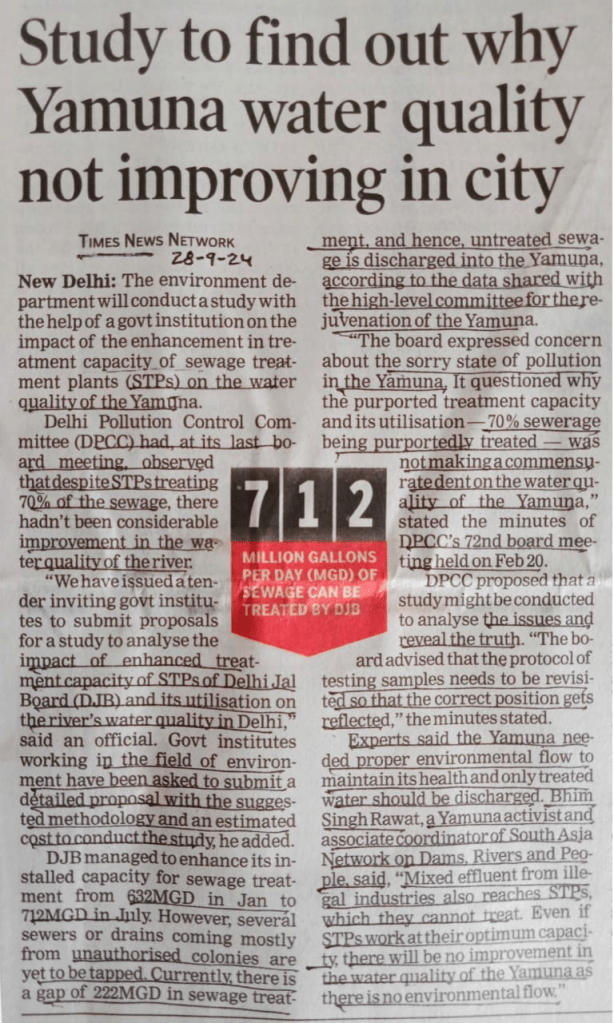
21 of 37 STPs don’t meet standards: DPCC A report by the Delhi Pollution Control Committee (DPCC) said the 37 STPs were analysed on the basis of faecal coliform, BOD, TSS, oil & grease and dissolved phosphates in treated water, and 56% failed to match up to standards. According to the report, STPs that failed to match parameters of faecal coliform are at Keshopur, Nilothi, Najafgarh, Papuan Kalan, Rohini, Narela, Yamuna Vihar, Mehrauli, Vasant Kunj, Molarband, Okhla and Ghitorni. The water from the STPs goes to the drains and through them ends up in the river. In Jan it was reported that most of the STPs – about 75% – did not have ways to treat faecal coliform due to the absence of a facility for bacterial disinfection through either chlorination, UV treatment, or ozonation, despite a previous NGT order. https://timesofindia.indiatimes.com/city/delhi/21-of-37-sewage-treatment-plants-dont-meet-standards-in-delhi-report/articleshow/113507294.cms (20 Sept. 2024)
Pollution in drains rises despite rain According to reports of DPCC, chemical oxygen demand (COD) and biochemical oxygen demand (BOD) have spiked in several drains. According to the report, the Najafgarh drain, one of the main polluters, recorded a BOD level of 54mg/l, against the minimum standard of 30 mg/l. Last year in Aug, the same drain had recorded lesser BOD at 42 mg/ litres. That was then (Aug 2023) the lowest since Feb 2021. Apart from the Najafgarh drain, the Maharani Bagh Drain and SEN Nursing Home Drain had a BOD of 70mg/l; Sarita Vihar and Sahibabad drain had a BOD of 90mg/l, while Shahdara drain had a BOD level of whooping 105 mg/l.
The report on samples collected on Aug 6 showed that apart from BOD, some drains failed to comply with norms related to total suspended solids and COD. As most drains did not meet water quality parameters, the report suggested that more effort need to be made to control the flow of sewage into these drains. Only one drain – Magazine Road drain – had compliant readings for BOD in Aug. Earlier this month, another DPCC assessment of river quality too found that the Yamuna did not show any significant progress in its overall state, despite the presence of rain. The report rather showed that at certain sections had become more contaminated compared to the previous months. https://timesofindia.indiatimes.com/city/delhi/pollution-in-drains-rises-despite-rain/articleshow/113269394.cms (11 Sept. 2024)
CBI seizes ₹2.3cr cash from DPCC official’s home CBI on Sep 9 raided the residence of Mohammad Arif, a senior environmental engineer at the Delhi Pollution Control Committee (DPCC), and seized Rs 2.39 crore cash. Arif and Kishlaya Sharan Singh, the son of a middleman, were arrested for exchanging a bribe of Rs 91,500. The CBI registered the case on September 8 against Arif and four others, including a middleman, his son, a private firm proprietor, along with other unknown persons. The FIR alleged that Arif was involved in corrupt practices, accepting bribes in exchange for renewing DPCC approvals for private firms. The middleman facilitated these bribes, collecting money from firms and delivering it to Arif regularly. https://www.indiatoday.in/india/story/cbi-seizes-crore-corruption-case-involving-delhi-pollution-board-senior-engineer-2596539-2024-09-09 (09 Sept. 2024)
Govt to hire agency to stop idol immersion in river The Delhi government will be hiring an agency for erecting barricades and deploying labourers to prevent the immersion of Ganesha idols in the Yamuna River. The Irrigation and Flood Control Department has floated a tender to hire an agency for the purpose. “The agency will be responsible for barricading of all entry points to river Yamuna with mild steel pipes and curtains and deployment of labour in three shifts for watch and ward of barricading,” the official added. https://www.deccanherald.com/india/delhi/delhi-govt-to-hire-agency-to-prevent-ganesha-idols-immersion-in-yamuna-river-3185116 (10 Sept. 2024)
Walkathon highlights urgent need for river revival In a bid to revive the Yamuna River, over 500 National Cadet Corps (NCC), officers and citizens participated in the ‘Hamari Yamuna Walkathon’ on Sunday (Sept. 29), highlighting the urgent need to restore the polluted river that was once the lifeline of the Capital. Organised with the slogan ‘Bring Alive Yamuna,’ the walkathon aimed to inspire collective action toward saving the river. https://www.tribuneindia.com/news/delhi/hamari-yamuna-walkathon-highlights-urgent-need-for-river-revival/ (02 Oct. 2024)
Noida Despite ban idols still immersed in Hindon,Yamuna Several residents immersed idols in the Yamuna on Wednesday as a stretch of the riverbank in Sector 94 was left unsecured. In Ghaziabad, too, devotees broke barricades to immerse idols in the Hindon river. A 2015 NGT order prohibits throwing any puja material, including idols, flowers, havan samagri, food grain and oil, into the Yamuna, except at the designated sites. People flouting the directive can be fined Rs 5,000. This, however, did not stop devotees.
Previously, Noida Authority has set up two makeshift ponds in sectors 116 and 120, with five more in the works, for such purposes. Similarly, in Ghaziabad, makeshift ponds have been made in Ganganagar Ghat in Sahibabad, and in Muradnagar. Noida DM Manish Kumar Verma said, “Makeshift ponds arrangements have been made by the authority as idol immersion in Yamuna is strictly not allowed. I have asked the official to check the location and take necessary action on the people who are doing so.” https://timesofindia.indiatimes.com/city/noida/ngt-ban-since-2015-but-idols-still-immersed-in-hindon-and-yamuna/articleshow/113302580.cms (13 Sept. 2024)
Haryana जीवनदायिनी यमुना की किसी को चिन्ता नहीं दर असल यमुना को प्रदूषण मुक्त किये जाने की दिशा में सीवेज ट्रीटमेंट की क्षमता में बढ़ोतरी किये जाने, नालों के पानी को सीधे नदी में गिरने से रोकने, शहरी और जे जे कलस्टर में सीवर नेटवर्क निर्माण, शोधित पानी के पुनर्उपयोग, यमुना कछार में चलने वाली और जिलों से गाद निकालने से जुड़ी परियोजनाओं में हीला-हवाली कहें या नाकामी पूरी तरह जिम्मेदार है। इसका खुलासा दिल्ली प्रदूषण नियंत्रण समिति की बीते माह जारी रिपोर्ट में हुआ है। इन हालात में यमुना का नाले के रूप में बहना उसकी नियति बन चुकी है। ऐसे में उसकी शुद्धि की आशा बेमानी है। हरिद्वार और वाराणसी की तर्ज पर यमुना घाटों का सौंदर्यीकरण कर पर्यटक स्थल बना और वहां आरती का कार्यक्रम आयोजित करने से यमुना की बदहाली छिप जायेगी, यह जनता को धोखे में रखने के सिवाय कुछ नहीं। इस सच्चाई को झुठलाया नहीं जा सकता। (ज्ञानेन्द्र रावत) https://globalbihari.com/yamun-ke-pradushan-ke-babat-haryana-chunaav-mein-kyon-chup-hain-rajnitik-dal/ (23 Sept. 2024)
उत्तरकाशी यमुनोत्री धाम में गंगा विचार मंच और तीर्थ पुरोहितों, स्थानीय लोगों ने यमुना नदी में स्वच्छता अभियान चलाया। इस दौरान नदी में बहाए जाने वाले वस्त्रों के करीब 100 बोरे एकत्रित कर उनको निस्तारण के लिए भेजा गया। साथ ही यात्रियों को भी नदी स्वच्छता के लिए जागरूक किया गया। https://www.amarujala.com/uttarakhand/uttarkashi/100-bags-of-clothes-thrown-in-yamuna-river-were-collected-uttarkashi-news-c-54-1-uki1003-108777-2024-09-30 (30 Sep 2024)
YAMUNA RIVERS
Delhi Using satellite imagery, INTACH has successfully traced the flow of the Sahibi river which is now classified as ephemeral. https://www.downtoearth.org.in/water/in-a-first-satellite-imagery-maps-long-lost-sahibi-river (26 Sept. 2024)
Rajasthan चंबल के लिए खतरा बना खनन व औद्योगिक प्रदूषण एनजीटी ने राजस्थान राज्य प्रदूषण नियंत्रण बोर्ड (आरएसपीसीबी) से चंबल के किनारे मौजूद उद्योगों पर एक रिपोर्ट प्रस्तुत करने को कहा है। कोर्ट के निर्देशानुसार रिपोर्ट में इस बात का ब्यौरा शामिल होना चाहिए कि क्या कोई उद्योग पर्यावरण नियमों का उल्लंघन कर रहा है और क्या नदी में दूषित पानी छोड़ा जा रहा है। साथ ही 18 सितंबर, 2024 को दिए इस आदेश में राजस्थान राज्य प्रदूषण नियंत्रण बोर्ड से भी इन मुद्दों को हल करने के लिए आवश्यक कदम उठाने को कहा गया है। प्रदूषण नियंत्रण बोर्ड को 22 अक्टूबर, 2024 तक ट्रिब्यूनल के समक्ष उनके द्वारा की गई कार्रवाइयों के बारे में अपडेट प्रस्तुत करना होगा।
आवेदक के वकील ने कोर्ट को जानकारी दी है कि संयुक्त समिति ने भी अपनी रिपोर्ट में चंबल में हो रहे अनियंत्रित रेत खनन और बहुत ज्यादा मात्रा में होते मछलियों के शिकार को लेकर सजग किया था। इसकी वजह से संकट ग्रस्त घड़ियाल और गंगा नदी में पाई जाने वाली डॉल्फिन जैसी दुर्लभ प्रजातियों के लिए खतरा पैदा हो गया है। कोटा में हर दिन 31.2 करोड़ लीटर गंदा पानी पैदा हो रहा है, लेकिन उसमें से केवल पांच करोड़ लीटर ही यहां मौजूद दो सीवेज ट्रीटमेंट प्लांट की मदद से साफ हो पा रहा है। ऐसे में राजस्थान राज्य प्रदूषण नियंत्रण बोर्ड ने जल प्रदूषण अधिनियम के तहत कोटा नगर निगम को नोटिस जारी कर चंबल में दूषित सीवेज छोड़ने से रोकने को कहा है। हालांकि, अधिकारियों ने इस पर अब तक कोई कार्रवाई नहीं की है। ऐसे में एनजीटी की सेंट्रल बेंच ने कोटा नगर निगम को इस मुद्दे पर जवाब देने का आदेश दिया है। https://hindi.downtoearth.org.in/river/mining-and-industrial-pollution-are-posing-a-threat-to-chambal-creatures-like-gharial-and-dolphin-are-in-danger (21 Sep 2024)
YAMUNA FISH, FISHERFOLKS
Uttar Pradesh आगरा: कीठम झील में अचानक मरने लगीं मछलियां वर्ल्ड वेटलैंड डे पर शहर के एकमात्र वेटलैंड सूर सरोवर पक्षी अभ्यारण्य कीठम में सैकड़ों मछलियां मरी पाई गईं। इसकी वजह प्रदूषण को माना जा रहा है। वन विभाग ने प्रकरण में सिंचाई विभाग और प्रदूषण नियंत्रण विभाग को पत्र लिखा है।
कीठम झील में आगरा नहर और लोअर कैनाल की ओर सिंचाई विभाग ने सेल्यूस गेट लगा रखे हैं। ये गेट कीठम झील में पानी का स्तर स्थिर रखने के लिए प्रयोग किए जाते हैं। कीठम में पक्षियों की रिहाइश के लिए 18 फुट पानी का स्तर निर्धारित है। इससे अधिक पानी होने पर ये टापू डूब जाते हैं। बीते दिनों नहर की ओर वाले गेट टूट गए, पानी का स्तर बरकरार रखने के लिए सिंचाई विभाग ने बोरे डालकर कामचलाऊ इंतजाम कर दिया। जिसके चलते प्रदूषित पानी लगातार कीठम में आ रहा है। विभाग ने इसकी लिखित सूचना सिंचाई विभाग को दी लेकिन अब तक कोई ठोस इंतजाम नहीं किए गए। नतीजा शुक्रवार को मछलियों के मरने के रूप में सामने आया। यमुना का प्रदूषित पानी आने से झील के पानी में प्रदूषण का स्तर बढ़ गया। जिससे सैकड़ों मछलियां मर गईं। शुक्रवार (Feb. 02) को मछलियों की मौत के बाद विभागीय वार्डन और रेंजर लगातार नजर बनाए हैं। https://www.amarujala.com/uttar-pradesh/agra/agra-fish-suddenly-started-dying-in-keetham-lake-this-is-the-reason-given-2024-02-03 (03 Feb. 2024) इस पूरे मामले पर डीएफओ आगरा आरुषि मिश्रा ने बताया करीब 15 दिन पहले हमने देखा कि कीठम में पानी बहुत गंदा आ रहा था. जिसमें झाग उठा रहा था, जिस नहर से हमारे पास पानी आता है उस नहर को देखा गया तो उस नहर में छाग उठ रहे थे. इतना कि अगल-बगल के जो उसके पेड़ थे वह भी झुलसे हुए थे, तो साफ तोर से पता चला कि गंदा पानी आ रहा है जिससे मछलियों की मौत हुई. https://www.abplive.com/states/up-uk/agra-keetham-lake-hundreds-of-fish-died-due-polluted-water-pollution-control-board-took-water-samples-ann-2604301 (05 Feb. 2024)
MINING IN YAMUNA RIVERS
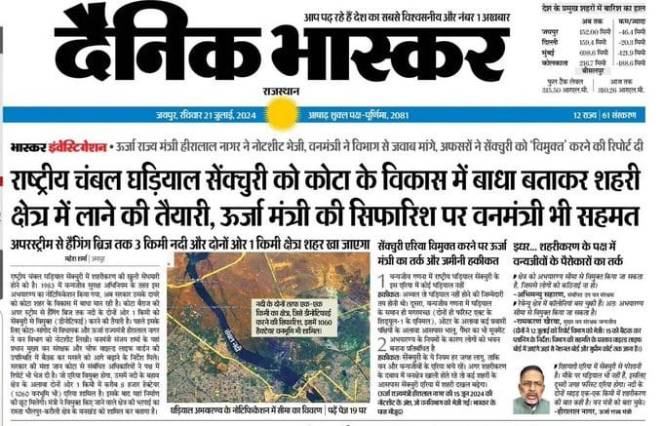
Rajasthan राष्ट्रीय चंबल घड़ियाल सेंक्चुरी को कोटा के विकास में बाधा बताकर शहरी क्षेत्र में लाने की तैयारी, ऊर्जा मंत्री की सिफारिश पर वनमंत्री भी सहमत
Uttar Pradesh आगरा के खेरागढ़ में एक बार फिर खनन माफिया व उसके गुर्गों ने दुस्साहस दिखाया। बालू से भरे ट्रैक्टर-ट्रॉली को पकड़ने गई पुलिस टीम पर हमला बोल दिया। थाने के सिपाही अजय कुमार को गोली मार दी। वह गंभीर घायल हैं। घेराबंदी करने पर फायरिंग करते भाग निकले। आधा घंटे बाद घायल सिपाही को अस्पताल लेकर जा रहे इंस्पेक्टर की गाड़ी में टक्कर मार दी। घबराए पुलिसकर्मी हमलावरों का पीछा तक नहीं कर सके। जान बचाकर थाने की तरफ भाग आए। देर रात पुलिस ने 4 आरोपियों को गिरफ्तार किया है। https://www.amarujala.com/uttar-pradesh/agra/mining-mafia-operatives-chased-the-police-shot-constable-in-agra-2024-09-07 (07 Sept. 2024)
YAMUNA URBAN WATER
Delhi HC to take up PIL on sewer overflow, water contamination A PIL has been filed before the High Court, highlighting a year-long issue of sewer overflows in various areas of the capital, often leading to water contamination and the spread of waterborne diseases. It is set to be heard on Friday (Sept. 13). The petition, filed by NGO Social Jurist, criticises the authorities for failing failure to desilt major sewer lines, inadequate cleaning of branch sewers, reduced manpower and machinery for sewer maintenance, and outdated sewer systems that need urgent replacement. It attributes the delays to internal disputes within the Delhi government. https://www.newindianexpress.com/amp/story/cities/delhi/2024/Sep/13/delhi-hc-to-take-up-pil-on-sewer-overflow-water-contamination (13 Sept. 2024)
Groundwater has very high salt content Delhi’s groundwater is high in salt content, according to a report by the Central Ground Water Authority. One out of four groundwater samples taken from the capital city had very high electric conductivity (EC), and more than 25% of water samples analysed in Delhi are saline. This is second only to Rajasthan, where 30% of the samples were found to be saline. The national electric conductivity average is 6%, representing conductivity higher than 3,000 micro siemens per centimetre. The permissible range of electric conductivity for groundwater is between 750 and 3,000 units at 25 degrees C. When the EC is more than 3,000 units, then it becomes unsuitable for drinking, causing several diseases, including kidney-related problems. https://www.indiatoday.in/health/story/delhi-groundwater-very-high-salt-content-saline-kidneys-problems-report-2601805-2024-09-18 (18 Sep 2024)
Noida Coliform bacteria found in water samples Days after hundreds of residents of Supertech Ecovillage 2, Greater Noida West, fell ill after consuming water, the Greater Noida Industrial Development Authority (GNIDA) on Saturday confirmed the presence of “Coliform bacteria” and “excessive amounts of bleaching powder” in water samples collected from the society. Gautam Budh Nagar administration, meanwhile, said it has set up a committee, headed by Atul Kumar, ADM (Finance and Revenue), to thoroughly probe the Supertech Ecovillage 2 incident. Residents alleged that the society’s water tanks had undergone cleaning exercise taken up by the society’s management, HT had reported. Post the incident, GNIDA clarified that the authority was responsible for supplying water to the reservoir of the group housing society, while the water supply to residents’ homes was managed by the builder or apartment owners’ association (AOA). https://www.hindustantimes.com/cities/noida-news/coliform-bacteria-found-in-water-samples-of-supertech-ecovillage-2-gnida-report-101726338823381.html (15 Sept. 2024)
Ghaziabad After nearly 20 residents of KW Srishti housing society fell sick after consuming contaminated water, the health department confirmed on Wednesday (Sept. 25), i.e., September 25, the presence of coliform bacteria in water samples, Times of India reported. https://www.dnaindia.com/delhi-ncr/report-ecoli-bacteria-presence-confirmed-in-water-samples-from-ghaziabad-society-after-20-fell-ill-delhi-ncr-3109528 (25 Sept. 2024)
Gurugram Bandhwari waste plant is set to lose its green NOC The wildlife department on Friday (Sept. 13) initiated the process to withdraw the no-objection certificate (NOC) it issued for the Bandhwari waste treatment plant. MCG has been given 10 days’ notice before the department proceeds with the withdrawal of the NOC, which was initially granted to ensure the plant operated without causing any harm to the surrounding Aravali forest area. In the notice, the department also said there was non-adherence to directives such as orders by Supreme Court and NGT at the Bandhwari site, as well as infringements of legislations like the Indian Forest Act (IFA), 1927; Wildlife Protection Act (WLPA), 1972; and Forest Conservation Act (FCA), 1980.
A recent survey conducted by the dept found that the revenue rasta, a road utilised for water filling and patrolling in the Aravalis, is being obstructed by solid waste from the landfill, hindering officials from accessing the forest. Moreover, leachate from the landfill is seeping into the forest and accumulating in waterbodies and low-lying areas, contaminating groundwater & posing a threat to the wildlife, officials said. Based on these findings, Gurgaon divisional wildlife officer Rajesh Chahal wrote to the chief conservator of forest and wildlife (south Haryana) AP Pandey, recommending that the NOC for the Bandhwari plant be revoked unless the issues are resolved. Subsequently, the process to revoke the NOC was initiated. https://timesofindia.indiatimes.com/city/gurgaon/leachate-harming-aravalis-bandhwari-waste-plant-is-set-to-lose-its-green-noc/articleshow/113334218.cms (14 Sep 2024)
Leachate polluting groundwater? CPCB to probe The NGT asked CPCB to carry out an investigation of groundwater quality around the Bandhwari landfill waste treatment plant, which has been severely contaminated by leachate.
This order was issued in response to a plea by a resident of the area Poonam Yadav and environmentalists Vivek Kamboj and Vaishali Rana during a hearing on Tuesday (Sept. 03). The petitioners alleged excessive leachate seepage during monsoons from the landfill site to surrounding areas, including the adjacent road. The order was uploaded on Thursday (Sept. 05). The tribunal also directed HSPCB to implement suitable punitive actions and furnish a comprehensive report, at least one week before the next hearing date, which is Dec 17. https://timesofindia.indiatimes.com/city/gurgaon/leachate-polluting-groundwater-cpcb-to-probe/articleshow/113104752.cms (06 Sept. 2024)
HFL BREACH
Lower Yamuna Basin: 11 Rivers Crossed old HFLs in just 2 days in Sep 2024 It is interesting to see that at least 11 rivers at as many flood monitoring sites of Central Water Commission (CWC) located in Bundelkhand region (4 sites) and lower Yamuna basin (7 sites) have crossed old Highest Flood Level (HFL) just in 2 days on September 12-13, 2024. These sites are in 3 different states of Madhya Pradesh (7 sites), Uttar Pradesh (3 sites) and Rajasthan (1 site). It is noteworthy here that this is happening even as Upper Narmada basin adjacent to these areas is also facing floods due to simultaneous high rainfall on both sides of the ridge. https://sandrp.in/2024/09/14/lower-yamuna-basin-11-rivers-crossed-old-hfls-in-just-3-days-in-sept-2024/ (14 Sept. 2024)
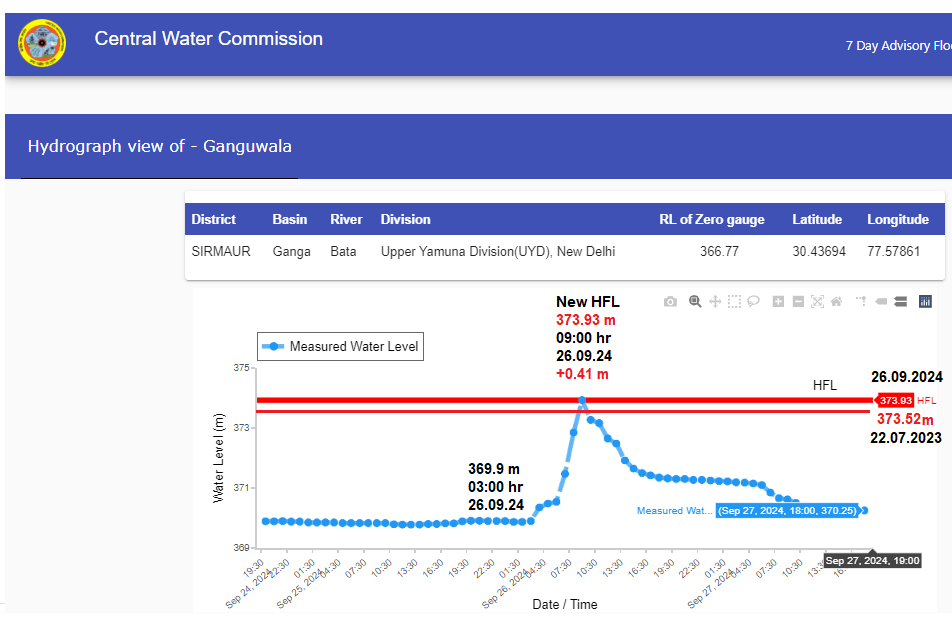
Himachal Pradesh River Bata in Yamuna basin at Ganguwala site in Sirmaur district has crossed HFL 373.52 meter dated 22.07.2023. Present flood level is 373.93 meter at 09:00 hour on 26.09.2024 with rising trend.
URBAN FLOODS
Delhi CPWD to upgrade SWD around old Parliament building The Central Public Works Department (CPWD) plans to augment the stormwater drainage system in and around the old Parliament House, a month after the complex witnessed waterlogging this monsoon, The Indian Express has learnt. On July 31, while Parliament was in session, water collected on the driveway between the new and old Parliament buildings during heavy rainfall, leading some MPs to raise the issue on social media and inside the House. An official aware of the development, however, said the project was routine. https://indianexpress.com/article/india/cpwd-stormwater-drains-old-parliament-building-leakage-rain-9568773/ (16 Sept. 2024)
LANDSLIDES
Uttarakhand 289 sqkm of Doon valley in ‘high to very high hazard landslide zone’ A key study on the ‘landslide hazard zonation’ mapping of Dehradun shows that nearly 16.6% (approx 289.8 sq km) of the Doon valley (1741.6 sq km), including some popular tourist spots, falls under “high to very high hazard zone of landslides”. The peer-reviewed study by researchers from Amity University and Wildlife Institute of India (WII), published by Springer recently, says, “Increasing population and uncontrolled tourism in the valley is contributing to occurrence of landslides by placing additional pressure on vulnerable landscapes and altering natural terrain.”
It adds, “Landslides are more likely to occur near and above the ‘main boundary thrust’. The Doon valley rivers’ upper segments are more susceptible to landslides than their lower segments.” It is largely due to the area’s inherent geology and factors like slope, soil type, elevation etc, but external factors are also adding to the area’s susceptibility to landslides, the study points out. Places of tourist interest such as Maldevta, Bhatta Falls, Kimadi, Surkanda Devi temple, Digu waterfalls, George Everest Peak, Dhanaulti, Jharipani, Mussoorie and Bhadraj temple are under the 16.6% ambit, according to Ashish Mani, the lead author of the study, which is titled ‘Landslide hazard zonation (LHZ) mapping of Doon Valley using multi-criteria analysis method based on remote sensing and GIS techniques’. https://timesofindia.indiatimes.com/city/dehradun/289sqkm-of-doon-valley-in-high-to-very-high-hazard-landslide-zone-study/articleshow/113723652.cms (27 Sept. 2024)
RELEVANT REPORTS
Report Nearly half of all posts in SPCBs vacant As per Central Pollution Control Board (CPCB) affidavit submitted to NGT on Sept 6, of the total 11,562 sanctioned posts in all SPCBs and PCCs, 5,671 (49.04%) posts have been left unfilled. Setting a deadline, the NGT, on September 11, directed all states and UTs to fill the vacancies by April 30 next year. This, however, does not include Punjab, Delhi and the states with areas in the NCR — Haryana, Uttar Pradesh and Rajasthan. Vacancies in SPCBs in these states and PCC in Delhi are already the subject of an ongoing case in the Supreme Court. According to the latest data, over half the sanctioned posts (53.68%) at the SPCBs and PCC in the NCR are lying vacant – 1,253 of the 2,334 sanctioned posts. In Rajasthan and Haryana, the vacancies go up to over 60%. The Supreme Court is set to hear the case again on September 27. https://indianexpress.com/article/india/nearly-half-of-all-posts-in-pollution-boards-vacant-some-for-decades-9584609/ (24 Sept. 2024)
EDIT The problem does not stem from a lack of laws. Effective monitoring and implementation have been the Achilles heel in the battle against pollution. Environmental regulation has rarely kept pace with the demands of the post-liberalisation economy. The SPCBs haven’t just failed to fill up their sanctioned strength. They have also not done justice to their mandate by failing to rope in an adequate number of independent scientists in pollution control exercises. The autonomy of these agencies on technical issues is often compromised because civil servants and officials with a background in government, and not experts, hold most of the top posts. https://indianexpress.com/article/opinion/editorials/vacancies-in-pollution-control-boards-a-deeper-malaise-9586372/ (25 Sept. 2024)
Focus on River Studies Rivers are the most important ecosystems (eco here includes ecology and economy) and yet possibly least studied entities. Some news in DRP NB 300924 about some river studies brings the focus on need to take up many more river related studies. Most important aspect of river related studies is the need for credible, independent studies, not influenced by the needs of the governments. Otherwise, the government is likely to not only influence the study, but also decide not to make it public as they did in case of the studies related to Joshimath town and role of Chamoli disaster. https://sandrp.in/2024/09/30/drp-nb-300924-focus-on-river-studies/ (30 Sept. 2024)
Opinion Restoring river vital to ensuring economic stability India’s secure environmental and economic future remains jeopardised without concerted efforts to protect and restore river ecosystems. The threats to river basin degradation demand an address on many fronts. On the one hand, they call for more rigorous regulation in urban development and land-use laws to forestall encroachment into natural drainage systems. On the other hand, they contemplate restoring and rehabilitating degraded river ecosystems through reforestation of riverbanks, establishing protected areas in critical watersheds, and using sustainable water management practices. https://www.business-standard.com/opinion/columns/restoring-river-ecosystems-vital-to-ensuring-economic-stability-in-india-124091801544_1.html (19 Sept. 2024)
Study Understanding river flow dynamics A new study, published in the ‘Journal of Remote Sensing’, explores the use of satellite data to enhance the understanding of AHG by incorporating remote sensing technology. The researchers aimed to overcome the limitations of field-based studies by using satellite imagery to track river changes globally.
The researchers identified 18 variables linked to AHG, which they grouped into six categories: hydrology, physiography, climate, land cover, geology, and human influences. They also considered how different river patterns – such as meandering, braided, or straight – affect AHG.
The study found that a 1% increase in river discharge typically leads to a 0.2% increase in river width, though this relationship is affected by factors such as soil composition, forest coverage, and human activities. For instance, rivers with cohesive soil and high forest cover showed less variation in width in response to discharge changes. https://www.spacedaily.com/reports/Using_Satellite_Data_to_Expand_Understanding_of_River_Flow_Dynamics_999.html (30 Sept. 2024)
Report Changing river led people to form first govts In summary, the researchers consistently found this sequence in the archaeological and geologic records: first, following an avulsion event, the river abandoned a region. Then, the abandoned region’s city began to construct buildings associated with government along with canals that stretched from the new river location to the region’s croplands. (Jeff Opperman) https://www.forbes.com/sites/jeffopperman/2024/09/19/how-a-river-changing-course-led-people-to-form-the-first-governments/ (19 Sep 2024)
Restoring rivers’ meander can prevent flooding A healthy river should be sinuous, free flowing and replete with wildlife. In Britain, however, 97% of rivers are fragmented by artificial barriers like weirs. Now, there is at least one artificial barrier for every 1.5km of stream in the country. And for centuries rivers have been slowly canalised – or artificially straightened – to stop water from flooding and spilling onto farmland and houses.
But removing a river’s natural meanders has, in fact, achieved the opposite effect. Instead, it’s disrupted the flow of rivers and degraded aquatic habitats, water quality and heightened flood risk. As the poor health of Europe’s rivers and streams continues to make news – due to dwindling wildlife, sewage pollution and agricultural runoff – communities are turning towards natural solutions to restore their rivers. https://www.bbc.com/future/article/20240918-how-restoring-rivers-natural-curves-can-prevent-flooding (19 Sept. 2024)
Video Why we need to stop straightening rivers.
https://www.youtube.com/watch?v=ATtHne5NKE8 (06 Sept. 2024)
Compiled by Bhim Singh Rawat (bhim.sandrp@gmail.com)
Also see: Yamuna Manthan 05 Sept. 2024; Yamuna Manthan 08 Aug. 2024
Follow us on: www.facebook.com/sandrp.in; https://twitter.com/Indian_Rivers
In memory of Late Manoj Mishra, Convenor of Yamuna Jiye Abhiyan, SANDRP is publishing monthly Yamuna Manthan from Feb 2024. It’s a compilation of developments related to Yamuna River. This is Ninth such monthly report in the series and we will try to release same updates in the first week of every month. The main purpose of the exercise is to monitor, document and research all the issues affecting the Yamuna rivers and riverine people so that all concerned may get updated information on ground realities of the river and its people. All are requested to read, share and give suggestions to improve it.

 SANDRP