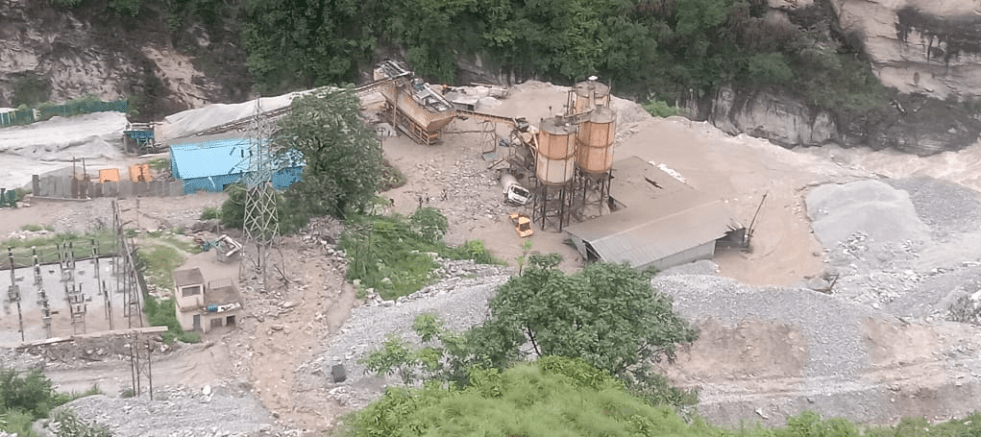
(Flash flood ravaged HCC’s batching plant along Alaknanda river at under construction Vishnugad Pipalkoti HEP site in Chamoli district. Image source: Social Media)
As we saw in stories in last week (e.g., Luhri HEP in Himachal Pradesh) and see this week (Vishnugad Pipalkoti in Uttarakhand and Dibang HEP in Arunachal Pradesh), a number of under construction projects regularly face disaster, which includes deaths and destruction on large scale. We have been narrating stories related to disaster at such projects regularly in the past too.
Normal safety norms suggests that no work should be happening at such projects during the vulnerable monsoon season, but such norms do not seem to exist and in any case seem to be violated.
And yet these projects and disasters related to them are excluded from the dam safety regime and also, it seems from the Disaster Management Authorities’ work. This is clearly major lacunae and needs to be urgently addressed.
HYDRO POWER PROJECTS
SANDRP Blog USDMA Clueless on Flashflood Disaster at Vishnugad Pipalkoti HEP The entire USDMA system at state and district level have no information and report flash flood damages at Vishnugad Pipalkoti HEP site. Moreover, the responses of USDMA and DDMA officials indicate serious flaws in information collection process. The incident also reveals glaring gaps in DDMA’s disaster monitoring mechanism. Further, USDMA has no policy or guidelines in place for disaster monitoring and mitigation related to the under construction HEP projects. As usual THDCL has so far not put any official information about the incident in public domain. https://sandrp.in/2024/07/18/july-2024-usdma-clueless-on-flashflood-disaster-at-vishnugad-pipalkoti-hep/ (18 July 2024)
July 2024: Worker killed at DMP site In the absence of any official information from the project officials of NHPC, the reason behind the worker’s death is not confirmed. Similarly, the amount of financial compensation to the deceased family through insurance and compensation if any is unknown. Sadly, this is the fate of scores of workers building HEP and dam projects in the country. Broadly, it is very concerning issue that the developers of hydroelectric power (HEP) and dam projects though claim that they work in public interest using public resources but never share any official information about disasters and accidents impacting the projects and workers at project sites with the public. https://sandrp.in/2024/07/21/july-2024-a-worker-killed-at-dibang-multipurpose-project-in-arunachal-pradesh/ (21 July 2024) A tragic incident took place in Arunachal Pradesh where a person died after a CCVT tunnel collapsed. The incident occurred in Arunachal Pradesh’s Lower Dibang Valley district when the National Hydroelectric Power Corporation (NHPC) river dam project was going on. As per sources, the person identified as Parimal Uday was working in a tunnel model; during the process, the tunnel collapsed, leading to his untimely demise. The incident took place during the wee hours of July 16 morning. https://assamtribune.com/north-east/arunachal-pradesh-man-dies-in-nhpc-river-dam-tunnel-collapse-1544196 (16 July 2024)
Damages at Luhri-I HEP Reveals Loopholes in Dam Safety Act The floods & land sinking incidents affecting Luhri-I HEP work exposes loopholes in DSA 2021 apart from revealing shortcomings in SJVNL monitoring plan & SDMA’s disaster management policy as all of them lack clear directions to address safety threats impacting under construction dams & hydro projects. There is absence of inter project coordination within SJVNL & doubt arises if SJVNL has EWS for Nathpa Jakhri and Rampur HEPs. The SJVNL & SDMA must also put all information related to EWS, Disaster Management and safety measures promptly in the public domain. https://sandrp.in/2024/07/13/himachal-pradesh-damages-at-luhri-i-hep-reveals-loopholes-in-dam-safety-act/ (13 July 2024)
Western Ghat Experts slam impacts of Adani’s PSHPs Campaigners in south-western India are defending mountain habitats from a string of reservoirs being built by an Adani company. They say these ‘pumped hydro storage’ projects will damage the biodiversity of the Western Ghat range. A tiger reserve and a wildlife sanctuary are adjacent to the proposed dams, which occur inside a sensitive seismic zone. Experts say that the environmental-impact study for parts of the project flagrantly ignores the environmental importance of this globally significant hotspot for biodiversity. A stretch of 150 hectares of the Ghats will be lost to pumped storage projects (PSPs) being developed by Adani Green Energy Limited.
– On 28 June 2022, the Maharashtra government inked a Memorandum of Understanding (MoU) with Adani Enterprises for five PSPs whose cost will be Rs. 60,000 crore ($7.2 billion) to be established in the Western Ghats. These were spread across the Tarali, Patgaon, Warasgaon, Malsej Ghat and Koyna regions. Three out of the five proposed projects are located in village precincts in the districts of Pune, Kolhapur and Satara and have received preliminary approvals from the central government, despite opposition from experts and locals, including the submission of over 3000 letters of objection pertaining to the Satara project. The 1500 MW Tarali project, which is currently at an advanced stage with its Environmental Impact Assessment (EIA) completed and a legally mandated public hearing conducted. https://www.adaniwatch.org/pumped_hydro_adani_s_2_billion_pumped_hydro_projects_to_impact_biodiversity_hotspot (18 July 2024)
Report Hydro power is facing a deepening dry spell The hydropower has been going through a dry patch. In 5 years between 2018 and 2023, hydropower generation rose by just 52 TWhrs. Hydropower is dependent on the building of costly and time-consuming projects to move forward, and shows little sign of reducing its costs. Compounding the problems, a two-year drought connected to the La Niña climate cycle during 2022 and 2023 caused a collapse of generation in China, home to about a third of the world’s hydro dams. The US study found that 80% hydro plants saw declines in capacity factor of 40% between 1980 and 2022, with the cumulative fall representing nearly 25% of generation.
Why should this be happening? One well-known factor is that climate change itself may be reducing the availability of the fresh water on which hydro dams feed. In the Alps, hotter, drier summers are likely to lead to thinner snow cover in the coming decades. In the Himalayas, glaciers that currently provide vast natural batteries trickling water into the catchments of hydro reservoirs from China to Pakistan are receding.
The most worrying fact about the US study is that it doesn’t even depend much on this effect. Water shortage explained the measured decline at only a fifth of the plants studied. A substantial share of the shortfall, in fact, appears to derive from a change in the way dams are put to use. Non-energy considerations — such as river ecology, flood management, boating and fishing, and the supply of water for irrigation, industry, and homes — appear to be growing in importance in recent years. Hydro is probably the most controversial form of renewable power. https://energy.economictimes.indiatimes.com/amp/news/renewable/hydro-power-is-facing-a-deepening-dry-spell/111748369 (15 July 2024)
Local people, environment suffer from HEPs projects India’s policies on renewable energy, especially its push for large hydropower projects, have been criticised by experts on account of a lack of consideration for communities residing on these lands, as well as for financial and scientific reasons. Large hydropower projects often ignore the complexity and risk of construction on the local terrain, geology, hydrology and ecology. This negligence impacts local communities significantly during or after construction. “Far from being cost-effective, these have ended up causing distress to people, especially communities living around river basins,” said Shripad Dharmadhikary of Manthan Adhyayan Kendra, a Pune-based centre that monitors and analyses water and energy issues. “There is no cumulative impact assessment of these projects, though some of them are in very close proximity, becoming the reason for environmental disasters.” https://idronline.org/article/climate-emergency/whats-missing-from-indias-climate-action-plans/ (16 July 2024)
MoEF rule may make clearances smoother raising fresh concerns Until now, development projects proposed in protected areas, like wildlife sanctuaries or national parks, could seek forest and wildlife clearances simultaneously. But henceforth, they will have to follow a sequence: first, they will have to obtain a wildlife clearance and only then can they seek a forest clearance. The decision was announced by the environment ministry through a letter on July 8, 2024. Wildlife clearances are issued by the standing committee of the National Board of Wildlife, which is responsible for guiding the government’s decisions on matters related to wildlife conservation. Forest clearances, which must be procured by projects in protected areas, as well as those in areas that are not protected but are forested, are issued by the forest appraisal committee in a separate process.
In Jan 2024, during a discussion about the construction of a road in the Rajaji Tiger Reserve in Uttarakhand, the standing committee of the National Board of Wildlife suggested that “unless a project proposal receives forest clearance, the same should not be placed before the Standing Committee for its consideration”. At the end of this discussion, the committee suggested that the environment ministry should “issue policy guidelines” on this matter. In response, in March, the ministry issued a letter implementing this suggestion – it directed that all proposals that required a clearance from the wildlife board’s standing committee should first procure a forest clearance. With the Jul 8 letter, the sequence stands reversed. Experts are not sure why this change was made. https://scroll.in/article/1070822/a-new-environment-ministry-rule-may-make-clearances-smoother-but-raises-fresh-concerns (22 July 2024)
Himachal Pradesh Year after flood; dams yet to install EWS Having taken few lessons from last year’s monsoon mayhem that killed at least 509 in the state last year, the hydel power dams in Himachal are still reluctant to install an early warning system (EWS). However, the BBMB management is still reluctant to install an early warning system. “We have asked all the dams, even the BBMB management dams to install the early warning system, all will have to comply with the state government orders or action will be initiated against them,” said additional chief secretary Onkar Sharma, who is also the Jal Shakti Vibhag additional chief secretary. “They have sought some time from us. Last year, the monsoon had left a trail of destruction across Himachal, with Mandi being one of the worst-affected regions – where roads were washed away, while houses, bridges and shops,” he added.
Mandi deputy commissioner Apoorv Devgan said they are in constant communication with BBMB to have an early warning system at Pandoh Dam. “The process is underway and we have been issuing notices to them. However, they have undertaken a few steps including announcement vehicles whenever a large amount of water is discharged. The requirements for the warning system under the Dam Safety Act are under process,” he said. The cutting of mountains for any kind of private development and construction activities is completely banned except the disaster mitigation works and reconstruction of affected buildings and roads. https://www.hindustantimes.com/cities/chandigarh-news/year-after-monsoon-mayhem-himachal-dams-yet-to-install-early-warning-system-101721238425189.html (18 July 2024)
How hydro projects sold dubious carbon credits A recent report found that several of these projects had offset no carbon dioxide or less than the amount they were supposed to offset. In Apr, a German non-profit, CORRECTIV, published a report that analysed 65 projects across the world registered in a popular registry named Verra, a privately run not-for-profit headquartered in Washington, DC. These projects, which included Karcham Wangtoo and Baspa II, had sold credits to German oil & gas companies, such as RheinEnergie Trading GmbH & Stadtwerke Duisburg AG.
CORRECTIV found that over 10 million credits issued for these projects had offset either no carbon dioxide or less than the amount they were supposed to offset. Fifteen of the projects were in India, where 3.8 million credits were found to have offset no carbon or less than the amount they were supposed to have offset. An overwhelming 76% of these credits were from four hydro projects – Karcham Wangtoo, Baspa II, Allain Duhangan and Malana, all in Himachal Pradesh. https://scroll.in/article/1070568/how-hydropower-projects-in-himachal-sold-dubious-carbon-credits (16 July 2024)
HC rejects Adani claim for refund of Rs 280 cr premium A division bench of the High Court on July 18 overturned a single bench decision to return the premium amount of Rs 280 crore to Adani Power Ltd in connection with the 969 MW hydropower Jangi Thopan Power Project in Kinnaur district, stating “the Adani Group is not entitled to it”. The division bench of Justices Vivek Singh Thakur and Bipin Chandra Negi delivered the judgment hearing a petition filed by the government against the single-bench decision in 2022.
– “In its judgment, the division bench commented that wrong facts were produced before the state government for procuring the project. The judgment says the Adani Group invested in the project through the back door, which was against the terms of the project agreement. Therefore, the premium amount will not be refunded to the Adani Group. The government had signed the project agreement (MOU) with Brakel Company, but the company fraudulently obtained the project with fake documents, which was found to be against the agreement. Subsequently, without the government’s consent, Brakel Company made the Adani Group a member of the project. Thus, Brakel Company is also not entitled to the premium amount,” HP AG Anup Kumar Rattan said. https://indianexpress.com/article/cities/chandigarh/adani-claim-refund-280-crore-premium-himachal-hc-overturns-order-9462569/ (19 July 2024) https://www.livelaw.in/high-court/himachal-pradesh-high-court/himachal-pradesh-high-court-denies-280-crore-refund-to-adani-power-in-hydro-electric-projects-dispute-263986 (20 July 2024)
Uttarakhand CM seeks Centre’s support to clear 21 HEPs CM Pushkar Singh Dhami on Monday (July 15) at a meeting with Union Minister of Power Manohar Lal Khattar sought the clearance of 21 new hydel power projects with a capacity of 2123 MW for the state from the Centre. Khattar is on a visit to the state to review the progress of Tehri Hydro Power Complex and various urban development projects in the state. The Union minister assured Dhami that a meeting will soon be held with the officials of the Power and Jal Shakti ministries in Delhi in the presence of the chief minister to take a call on the matter. energy, electricity. https://www.business-standard.com/india-news/uttarakhand-cm-seeks-centre-s-clearance-for-21-new-hydel-power-projects-124071501223_1.html (16 July 2024)
Jammu & Kashmir HEPs in Kishtwar Union Minister for state (Independent Charge) Dr Jitendra Singh highlighted that the Pakal Dul project with a capacity of 1000 MW is expected to be completed by 2025. Kiru Hydroelectric project with a capacity of 624 MW may also be complete by 2025. 850 MW Ratle project has been revived as a joint venture between the Centre and UT of J&K. In addition, Dulhasti II Hydroelectric project will have a capacity of 260 MW. https://pib.gov.in/PressReleaseIframePage.aspx?PRID=2034497 (19 July 2024)
North East Budget 2024: Govt to fast-track hydropower? Ahead of Budget 2024, there is buzz of support being extended by the Modi govt to fund the north-eastern govts’ investment in hydropower. The plan, aimed at providing financial assistance to the states, will be executed through assistance to state governments in purchasing equity in such projects. The Centre could fund 24% of the equity investment, subject to a cap of Rs 750 crore per project, under “A new scheme,” according to a source, which, “focused on the northeast, is under consideration.” https://timesofindia.indiatimes.com/business/india-business/budget-2024-how-modi-government-may-fast-track-hydropower-capacity-creation-in-north-eastern-states/articleshow/111829992.cms (18 July 2024)
Arunachal Pradesh No Dam, No Survey on Siang River says Farmer’s Forum The Siang Indigenous Farmer’s Forum ( SIFF ) has made it clear that it is firmly against any move to build a dam on Siang. SIFF held a talk with Deputy Chief Minister Chowna Mein, which ended on an inconclusive note. As per the forum members, Deputy Chief Minister Chowna Mein has proposed a pre-feasibility report and survey of the proposed 11,000 MW Siang multipurpose storage project. The SIFF declined Deputy Chief Minister Chowna Mein’s proposal while stating that no dam should be built on the Siang River. The organisation also said that if the dam is built, it will lead to displacement of over 1.5 lakh people in the Adi belt of Siang and Upper Siang. Talking to media persons, SIFF president Gegong Jijong said that the proposed dam is threatening the existence of the Adi community, because the construction of the dam will submerge the two districts, thereby wiping out the Adi culture and tradition completely. And “If the government goes ahead with the dam project, and we are uprooted from the land, then it will be like the Chakma Hajong refugees. This is the kind of scenario we want to avoid” SIFF members said. https://arunachal24.in/arunachal-no-dam-no-survey-on-siang-river-says-farmers-forum/ (17 Jul 2024)
पनबिजली परियोजनाओं का विरोध अरुणाचल में बनने वाली मेगा पनबिजली परियोजनाएं हमेशा विवाद के केंद्र में रही हैं. स्थानीय लोग और पर्यावरण कार्यकर्ता इसका विरोध करते रहे हैं. “राज्य में पहले से ही दर्जनों बांध और बिजली परियोजनाएं हैं. स्थानीय आदिवासियों को इसका भारी खामियाजा भुगतना पड़ा है. अब यह परियोजना कई गांवों के सैकड़ों परिवारों को उनके पुरखों की जमीन से बेघर कर देगी. सरकार हमें बांध के फायदे तो गिना रही है. लेकिन इससे स्थानीय लोगों को होने वाली दिक्कतों की ओर उसका कोई ध्यान नहीं है. हमें बांध नहीं, अपनी जमीन चाहिए,” पूर्वोत्तर राज्य अरुणाचल प्रदेश में प्रस्तावित 11 हजार मेगावाट क्षमता वाली अपर सियांग मल्टीपरपज स्टोरेज प्रोजेक्ट के विरोध में आंदोलन करने वाले पारोंग गांव के मुखिया तारोक सीराम डीडब्ल्यू से यह बात कहते हैं. https://www.dw.com/hi/proposed-hydropower-stations-in-indias-arunachal-pradesh-face-residents-protest/a-69680226 (16 July 2024)
MLA raises concern over China’s under-construction mega dam This is strange, there is no proof this claim of 60000 MW under construction hydropower project by China. And yet, Arunachal MLA talks about it, assembly debates, and ET publishes this. https://economictimes.indiatimes.com/news/politics-and-nation/bjp-mla-raises-concern-over-chinas-under-construction-mega-dam-near-arunachal/articleshow/111864498.cms (19 Jul 2024)
Sikkim Living territory of Lachung We are at Chu Chowa, a sacred natural site of about 6 sq km in the Lachung village in north Sikkim. For the Lachungpas (also known as the Bhutia tribe), the inhabitants of the Lachung village, Chu Chowa is a guardian deity. A community conserved area, Chu Chowa boasts of silver birch, temperate silver fir, Rhododendron, and a hemlock forest with many species of birds, wild vegetables, fruits, and medicinal plants. It is also home to mammal species like red panda and musk deer. The Lachungpas and their model of governance is an example of inclusive tribal self-rule. The Talung river flowed along the valley, gushing over boulders and between rocky ridges, lacing the mountainsides. Cascading down, Talung meets the mighty Teesta River. Nestled in the north Sikkim district bordering Tibet, at a height of about 9,600 feet, Lachung village is at the confluence of tributaries of river Teesta — Lachung chu and Lachen chu.
After three years of agitation, in 2009, Dzumsa of Lachung decided to ban any hydropower projects on their rivers. They have in fact criminalised discussing or proposing dams in any public spaces in Lachung. https://india.mongabay.com/2024/07/commentary-living-territory-of-lachungs/ (16 July 2024)
MoEF Decisions of EAC meeting on River Valley Projects held on June 27, 2024:
1. Maa Ratangarh Multipurpose Project erstwhile Sindh (Seondha) Barrage project (CCA: 78,484 ha and 9 MW) in an area of 3337.63 Ha near village Dangdiroli, Tehsil Seondha, District Datia, Madhya Pradesh by WRD, Madhya Pradesh for Environmental Clearance: More Info sought.
2. 1800 MW Pedakota Open Loop Pumped Storage Project in 202.11 ha at Tehsil Anathagiri Taluka, Dist Alluri Seetharama Raju, (Andhra Pradesh) by Adani Green Energy Ltd For TOR: Approved
3. Musakhand Pumped Storage Project (600 MW) by ACME CLEANTECH SOLUTIONS PRIVATE LIMITED at CHANDAULI, UTTAR PRADESH: Project Withdrawn
4. 1720 MW Kamala Hydro Electric Project in 4001.67 ha at Village Amperi, Baktap, Rabam etc, SubDist Kamporijo Circle, Dist Kamle, Arunachal Pradesh by NHPC for TOR: Approved
5. Khadakwasala Fursungi Tunnel Project Substitute to New Mutha Right Bank Canal KM 1 to Km 34 in an area of 23.8364 Ha located at Village Akole, Rui etc, Sub-dist Indapur, Haveli, Pune City, MAH for TOR: More Info Sought
6. 1000 MW Naying Hydro Electric Project on river Siyom, in 470.8 ha at Village Yapik, Hone, Lipo, Row etc, Sub Dist Payum Circle and tato, Dist Shi Yomi & Siang, Arunachal Pradesh by North Eastern Electric Power Corp Ltd for TOR: Approved
7. 1200 MW Kalai II Hydro Electric Project in 1100 Ha at Village Kamdi, Tehsil Hawai Town, Dist Anjaw, Arunachal Pradesh by THDC India Ltd for TOR: Approved
8. Conventional barrage across the River Tapi in 36.03 ha. at Tehsil – Surat City, Dist – Surat, Gujarat by Surat Municipal Corp For Clarification: Advisory steps suggested by EAC.
9. Site Visit report in reference of proposal of Terms of Reference to 1000 MW Bilaspur Closed Loop Pumped Storage Project in 301.5 Ha in Village Manjurpah & Karichhaper, Dist Bilaspur, Chhattisgarh by Jindal Renewable Power Pvt Ltd: Site Visit Report approved. https://parivesh.nic.in/utildoc/84807985_1721133419174.pdf (16 July 2024)
DAMS
Kaleshwaram Project MoJS advisor deposes before PC Ghose panel Union Jal Shakti ministry advisor Vedire Sriram alleged that the previous govt had failed in all aspects of the construction of Kaleshwaram Lift Irrigation Scheme (KLIS) including the planning, design, investigation, modeling, quality control, operation and maintenance. On July 16, he made a power-point presentation before the PC Ghose Commission of inquiry into the project, including its three barrages. He said that Rs 12,000 crore spent on the infrastructure created for the originally designed Pranahitha-Chevella project was not used in the redesigned KLIS, rendering the people’s money wasted. He said that the responsibility of the Central Water Commission (CWC) was only related to the availability of water and any inter-state dispute that could arise.
“Without finishing the modeling the design was prepared. Without any design construction was taken up, and after the construction the detailed project report was updated. The quality control was not proper. These were the observations made in the National Dam Safety Authority’s (NDSA) report,” he pointed out. He also informed the Commission that by changing the location for drawing water from Tummidihatti to Medigadda, the project’s cost shot up by Rs 80,000 crore, but there was hardly an increase in the ayacut of the project by 2 lakh acres. From 16.4 lakh ayacut in the originally designed Pranahitha-Chevella project, he said that the DPR of the redesigned KLIS showed that the ayacut was 18.25 lakh acres. He also said that the maintenance cost of the project for drawing water was coming to around Rs 11,000 crore per annum. https://www.siasat.com/telangana-jal-shakti-ministry-advisor-deposes-before-pc-ghose-panel-on-klis-3062989/ (16 July 2024)
“Building barrages without DPRs biggest blunder” Constructing Kaleshwaram Lift Irrigation Scheme (KLIS) at Medigadda instead of Tummidihatti has been seen as a huge blunder, and constructing the three barrages of the project even before the detailed project report (DPR) was prepared, was said to be the reason for the damage to the barrages and pump houses, according to electricity department engineer K Raghu, who deposed before the PC Ghosh Commission inquiring the causes for the damage to Medigadda and other barrages.
-PC Ghosh Commission focused its inquiry on the policy decision taken, the methodology followed in implementing the project, construction, quality and other aspects related to KLIS. In his power-point presentation, Raghu explained that due to redesigning the project, there was a loss of two lakh acres in ayacut under the originally designed project, and thousands of acres have been getting submerged due to the back-water effect of the three barrages.
-He told the Commission that due to the pump houses of Medigadda and Annaram built much lower than the sea-level, the two pump houses got submerged. He alleged that certain payments were made to the contracting companies while violating the guidelines.
-He opined that lack of maintenance of the three barrages since they were built in 2019, has resulted in the damage to the barrages. He said that making the wrong estimates, shortcomings in the design, wrong choice of locations for the barrages, faulty construction, and not giving enough time to the engineers so that the project could be constructed soon, have all added up to the project’s present condition. https://www.siasat.com/building-klis-barrage-at-medigadda-instead-of-tummidihatti-biggest-blunder-expert-3062265/ (16 July 2024)
CM A Revanth Reddy held a review on Medigadda barrage repairs and also the PC Ghose Inquiry Commission on Kaleshwaram in New Delhi on Sunday (July 21). Irrigation Minister N Uttam Kumar Reddy, Irrigation Secretary Rahul Bojja, adviser Aditya Nath Das and others were present at the meeting. https://www.newindianexpress.com/states/telangana/2024/Jul/22/telangana-cm-revanth-reddy-conducts-review-on-medigadda-repairs-in-new-delhi (22 July 2024)
Polavaram Project Probe initiated into seepage of water from upper cofferdam The AP Water Resources department has begun an inquiry into the reasons for seepage of Godavari floodwater from the upper cofferdam of Polavaram irrigation project in Eluru district. The probe is being done on the basis of recommendations of the international experts committee that recently visited the project site. “We are trying to stop seepage of water from both the cofferdams located upstream and downstream of the river, with the diaphragm wall and the ECRF coming up in between the two cofferdams,” they said. The authorities have dug up nearly 17 holes along the upper cofferdam and are going to fix piezo meters in five to six holes to gauge the pressure, the depth of the water etc. Once they identify the reasons for the seepage, this would help prepare designs to further strengthen the cofferdam and check the problem of water seepage. This would help construction of the proposed D-wall across the river, officials said.

The authorities are also facing seepage issue from the lower cofferdam downstream of the river mainly due to the backwaters. They plan to do an investigation to identify the reasons for seepage and address it. Polavaram project chief engineer in-charge Narasimha Murthy said, “The panel of international experts has recommended some steps to identify the reasons for seepage from the upper cofferdam, so that designs will be developed accordingly. We are expecting the interim report from the committee by the end of July.” https://www.deccanchronicle.com/southern-states/andhra-pradesh/polavaram-project-probe-initiated-into-seepage-of-water-from-upper-cofferdam-1811060 (18 July 2024)
Maharashtra Over 400 evacuated from dam near Digha The Navi Mumbai Municipal Corporation (NMMC) on Sunday (July 21) evacuated over 400 tourists from the Moghliche dam near Digha following sudden inspection by senior administrative officials. The sight of tourists risking their lives by swimming in the dam and scaling the walls to enjoy the waterfall prompted the officials to take preventive action. The unkempt dam, constructed in 1912, belongs to the railways while the land is owned by the forest department. The dam was used earlier for washing steam driven wagons but has not been cleaned or desilted in a long time. https://www.hindustantimes.com/cities/mumbai-news/over-400-evacuated-from-dam-near-digha-101721589920369.html (22 July 2024)
INTERLINKING OF RIVERS
Ken-Betwa Linking The PIB PR on 6th meeting of KBLP mentions many things including incomplete DPRs. https://pib.gov.in/PressReleaseIframePage.aspx?PRID=2034528&fbclid (19 Jul 2024)
INTERSTATE WATER DISPUTES
Godavari Water Disputes Divert waters from Sammakka barrage, not Icchampally: Telangana to NWDA Telangana on July 15 opposed the proposal to divert Godavari waters from Icchampally for Godavari-Cauvery link project and suggested that the water be diverted from Sammakka barrage. Telangana Engr in Chief G Anil Kumar was attending the 73rd governing body meeting of National Water Development Agency (NWDA) virtually from Hyderabad. He said that if Godavari water is diverted from Icchampally, then Telangana would face backwater issues. It was proposed to divert 148 tmcft of Godavari water to Cauvery. Telangana wanted 50 per cent share in it. https://www.newindianexpress.com/states/telangana/2024/Jul/16/divert-godavari-waters-from-sammakka-barrage-not-icchampally-telangana-to-nwda (16 July 2024)
Telangana govt has asked NWDA to allocate 50% of Godavari water for the requirements of the state as part of linking of the Godavari-Cauvery, which will be taken up as a part of the National River Linking project. It also asked the Centre not to consider Nagarjunasagar as a balance reservoir till the Krishna Water Disputes Tribunal II finalises water allocation to the state. The governing body of NWDA met on Jul 15. https://timesofindia.indiatimes.com/city/hyderabad/telangana-government-requests-50-of-godavari-water-allocation-from-nwda-for-river-linking-project/articleshow/111766728.cms (16 Jul 2024)
IRRIGATION
Karnataka Govt to introduce law to control theft of irrigation water Describing water theft from irrigation canals a “major problem”, Karnataka Deputy CM D K Shivakumar on July 16 said that the government will introduce a new law in this regard in a week. “In districts with irrigation projects like Mandya, Hassan, Bagalkote, Vijayapura, Kalaburagi among others – this is a major problem. Water is not reaching the tail-end regions,” Shivakumar said. https://www.hindustantimes.com/cities/bengaluru-news/karnataka-government-to-introduce-law-to-control-theft-of-irrigation-water-101721195309503.html (17 July 2024)
URBAN RIVERS
Cooum; Chennai GCC will study feasibility of restoring Cooum: Mayor The Greater Chennai Corporation (GCC) will launch a study to check the feasibility of the eco-restoration of the Cooum based on the San Antonio restoration model, said Mayor R. Priya on Jul 18. Launching the study tour of 206 school students, she said the GCC would also launch the second phase of the drain desilting project in August to improve monsoon preparedness in the city.
“The Kosasthalaiyar basin integrated storm-water drain project in north Chennai will be completed in September 2024. Over 60% of the first phase and 40% of the second phase of the project in the Kovalam basin is complete. The work order for the third phase has been issued. The first phase of desilting started in June. Each zone received an allocation of ₹50 lakh,” she said.
Stressing the need to ensure free water flow in the Cooum, the Mayor said coordination between agencies that implement infrastructure projects would be improved to prevent water stagnation. “The Mambalam canal will be widened to ease the flow of water. The mouths of Cooum, Adyar, and Kosasthalaiyar rivers and the backwaters in Muttukadu will remain clear during the rain. We are taking up extensive work to prepare for the monsoon. But we may not be able to predict the damage caused to infrastructure during the rain,” Ms. Priya added. https://www.thehindu.com/news/cities/chennai/gcc-will-study-feasibility-of-restore-cooum-based-on-the-san-antonio-model-says-mayor/article68417909.ece (18 July 2024)
Musi; Hyderabad CM A Revanth Reddy on July 20 announced that the state government will spend Rs 1.5 lakh crore in five years for Musi rejuvenation and development of the riverfront. https://www.siasat.com/rs-1-5-lakh-crore-will-be-spent-for-musi-riverfront-development-in-5-years-revanth-3065011/ (20 July 2024)
RIVERS
River song by Murari Sharan, Sung by Chandan Tiwari.
https://www.youtube.com/watch?v=boABtCCmNfQ (05 June 2015)
Arunachal Pradesh Doctors clean Siang riverfront A cleanliness drive was conducted by the East Siang branch of Arunachal Pradesh Doctors Association (APDA) at Komlighat, at the Siang riverfront here on Sunday (July 21). The drive was led by APDA-ES president Dr. Talung Tali and general secretary Dr. Keni Lego and included volunteers from member doctors from the district and members of Mirmir Bulls, a local NGO, who together collected a total of three tons of wastes. https://arunachaltimes.in/index.php/2024/07/22/doctors-clean-siang-riverfront/ (22 July 2024)
Kerala Kallai the most polluted river: CPCB The river pushed Karamanayar in Thiruvananthapuram, which was the most polluted river in the 2022 report, to the 2nd position in 2023.
Attempts to de-silt the river and restore water flow by both the State government and the Kozhikode Corporation have been unsuccessful. The State government had allocated ₹4.5 crore to de-silt the river around 20 years ago, with no action taken. Similarly, Kozhikode Corporation set aside ₹7.5 crore nearly 10 years ago for the same purpose, yet no progress has been made. The Department of Irrigation floated several tenders for the work, but there were few takers. Given the higher cost involved, the Corporation recently sanctioned an additional ₹5.9 crore, thus making the total allocation of fund above ₹13 crore. https://www.thehindu.com/news/cities/kozhikode/kallai-is-the-most-polluted-river-in-state-cpcb-report/article68389957.ece (13 July 2024)
Maharashtra Pune region gets 7 out of 20 notices for sugar industries pollution As per the MPCB data, the highest number of notices (20) has been issued for the Pune region including Pune, Satara and Solapur. Maximum notices have been issued for water pollution caused by industries followed by notices for the air pollution caused by them. The proposed directions highlight that the industries have either not installed the required systems for treatment of wastewater or prevention of air pollution or have been releasing untreated discharge into nearby nullahs thus causing river (water) pollution. Of the three industries issued closure directions, one is from Chandrapur while the remaining two are from Aurangabad. https://www.hindustantimes.com/cities/pune-news/7-out-of-20-notices-for-sugar-industries-in-maha-issued-for-pune-region-101720985119635.html (15 July 2024)
Punjab Campaign against poisoned rivers The growing activism against contamination of surface waters has started taking shape in Punjab as activists from diverse fields are coming forward while feeling that freely flowing water is losing its music and capacity to feed the people. Buddha Darya, a stream flowing near and inside the municipal limits of Ludhiana is being seen as one of the sources of the polluting water of Satluj. The activists are continuing with holding meetings to find solutions as to how to force the authorities in containing the toxicity in Buddha Darya before it merges on Satluj at village Walipur, further contaminating the river which flows to border districts of Fazilka, Ferozepur before entering Pakistan.
Kale Pani da Morcha, started nearly a fortnight ago by pro-environment organisations Naroya Punjab Manch, PAC Mattewara, Punjab Vatavarn Chetna Lehar and individuals is now getting more takers. A number of activists mainly noted sufi singer Kanwar Grewal, food policy expert Devinder Sharma, filmmaker Amitoj Mann, activist and journalist Hamir Singh, environmentalists Jaskirat Singh, Mandhir Singh, Paramjit Singh, Prof Manjit Singh, Mahinderpal Loomba got together at the confluence of Budda Dariya and Sutlej on Sunday (July 14) and decided to hold ‘freedom from pollution’ protest march at Ludhiana on August 15. https://timesofindia.indiatimes.com/city/chandigarh/activism-against-water-contamination-growing-say-punjabs-poisoned-rivers-need-relief/articleshow/111823652.cms (18 July 2024)
GANGA NGT suggests measures to prevent throwing of offerings in Ganga Yamuna It said that according to the Ganga Rejuvenation Order of 2016, it was the responsibility of the District Ganga Committees to ensure that no person directly or indirectly discharged any pollutant into river Ganga or its tributaries or at their banks. “Hence, each of the District Magistrates as heads of the District Ganga Committees in respect of the districts abetting river Ganga and Yamuna, especially in respect of Garhmukteshwar, Kanpur, Bithur, Prayagraj and Varanasi on Ganga and Agra, Mathura and Prayagraj on river Yamuna is required to ensure that the earlier directions and guidelines to protect the rivers are compiled with,” the tribunal said.
It directed the district magistrates to mark spots, stretches and sites that were prone to throwing of worship material and immersion of offerings and idols, and carry out monthly monitoring of the spots by deploying ground-level staff. It said each ghat could have a “distinct plan” regarding idol immersion, collection and processing of flowers, coconut and other offerings along with controlling and preventing direct or indirect disposal of offerings into the rivers from bridges, drains and other places. “Collection and composting arrangements for treating the organic waste such as flowers, fruits, leaves, food material etc. should be established at identified locations to prevent open decomposition along the ghats or river stretches,” the tribunal said.
The tribunal also asked them to organise awareness camps and take all possible steps to make the general people aware of pollution. “Mass awareness at the school level be encouraged about the impact of religious offerings on rivers and attempt be made to restrict religious offerings 100 metres away from the edge of the river and along the bank to protect the river flood plain,” the tribunal said. It said the authorities concerned could identify suitable locations for developing a dedicated ghat for holding ceremonies, rituals and immersion of idols and offerings. “These ghats should have all arrangements for the said purposes. Routine monitoring should be undertaken to ensure that religious offerings are properly managed without hurting religious feelings and sentiments,” the tribunal said.https://www.theweek.in/wire-updates/national/2024/07/18/lgd25-green-ganga-yamuna–pollution.html (18 July 2024)
Uttarakhand Dream project damaging Alaknanda मंदिर के पुजारियों ने बताया कि बद्रीनाथ मास्टर प्लान के तहत चल रही खुदाई के परिणामस्वरूप अलकनंदा का जलस्तर अचानक बढ़ने से उसके किनारों पर जमा मलबा बह गया. तीर्थ-पुरोहित संघ के अध्यक्ष प्रवीण ध्यानी ने फोन पर बताया- हम लंबे समय से स्थानीय प्रशासन से मास्टर प्लान के तहत चल रहे निर्माण कार्य के कारण बद्रीनाथ मंदिर और खासकर तप्तकुंड को संभावित खतरे के बारे में अनुरोध कर रहे थे. मैंने व्यक्तिगत रूप से जिला मजिस्ट्रेट से इस खतरे के बारे में कुछ करने के लिए दो बार अनुरोध किया है, लेकिन इस पर कभी ध्यान नहीं दिया गया.
खुदाई से निकलने वाले मलबे को अलकनंदा में डाला जा रहा है, जिससे नदी का प्रवाह क्षेत्र कम हो गया है. ध्यानी ने बताया कि सोमवार शाम को जलस्तर बढ़ने से पवित्र माने जाने वाले ब्रह्मकपाल की चार चट्टानें भी कुछ देर के लिए अलकनंदा में डूब गईं. ऐसा पहली बार हुआ है. बद्रीनाथ मंदिर से कुछ मीटर नीचे ब्रह्मकपाल और तप्तकुंड तक अलकनंदा का पानी पहुंचना मंदिर के लिए खतरे का संकेत है.
उन्होंने बताया कि पीएम के ड्रीम प्रोजेक्ट बद्रीनाथ आध्यात्मिक नगर मास्टर प्लान कार्यक्रम के तहत पिछले तीन साल से पूरे इलाके में बुलडोजर चल रहे हैं. ध्यानी के मुताबिक, अलकनंदा के किनारों पर खुदाई चल रही है, जिससे नदी के किनारों पर खुदाई चल रही है, जिससे नदी के किनारों पर मलबे के ढेर जमा हो रहे हैं.
दो साल पहले बद्रीनाथ धाम में मास्टर प्लान के तहत किए जा रहे ‘बिना सोचे-समझे’ निर्माण के संभावित खतरों के बारे में प्रधानमंत्री को पत्र लिखने वाले प्रसिद्ध पर्यावरणविद चंडी प्रसाद भट्ट ने कहा बद्रीनाथ आध्यात्मिक नगरी के मास्टर प्लान के निर्माण के तहत कोई भी कार्यक्रम शुरू करने से पहले नदियों के चरित्र, भूगोल और मौसम के प्रभावों का विस्तृत विश्लेषण किया जाना चाहिए. https://www.aajtak.in/india/uttarakhand/story/alaknanda-fierce-form-in-badrinath-dham-water-crossed-danger-mark-reached-taptkund-near-temple-alert-issued-lclam-1976768-2024-07-02 (02 July 2024)
Chamoli At least three people were killed while eight others sustained injuries after a landslide in Chidwasa on the Kedarnath Yatra route, on Sunday (July 21) morning. The SDRF team arrived at the scene and took immediate action, evacuating 8 injured individuals and transporting them to the hospital. https://timesofindia.indiatimes.com/city/dehradun/3-killed-8-injured-after-landslide-on-the-kedarnath-yatra-route/articleshow/111898366.cms (21 July 2024)
Rudraprayag Signature bridge collapsed again An under-construction signature bridge in Rudraprayag collapsed on Jul 18, marking the second time it has fallen within a year. No injuries have been reported so far. The Rs 65 Cr 110-meter-long bridge first collapsed in July 2022. The incident resulted in the death of 2 labourers and injuries to eight others. After the first collapse, a new design was created. However, the bridge has now collapsed again. The project was tendered by the National Highway Authority of India & awarded to RCC Infraventures Ltd. https://www.indiatoday.in/india/story/under-construction-bridge-uttarakhand-rudraprayag-collapses-injuries-2568762-2024-07-18 (18 July 2024)
Bihar 15th bridge collapse in a month Yet another bridge collapsed in Bihar on Jul 16, 15th such incident in a span of four weeks. The latest bridge, situated on Parman river at Amhara village in Araria district’s Forbesganj block, was swept away due to heavy pressure of floodwaters in the river, an official said. Araria district magistrate Enayat Khan said that the said bridge was constructed by rural works department (RWD) in FY 2008-09, and that it was damaged during 2017 floods, after which it was declared closed for road traffic. Executive engineer (RWD) of Araria division, Prabin Kumar, said the bridge was declared unfit for use in 2017. “But it was repaired and renovated in FY 2020-21. Our office has sent a check list of this bridge to the higher officials in the department,” he said. https://timesofindia.indiatimes.com/city/patna/bihar-sees-another-bridge-collapses-in-araria-15th-in-a-month/articleshow/111822622.cms (18 July 2024)
YAMUNA Delhi 400ha encroachments at floodplains cleared in 2 years: DDA to NGT Bhim Singh Rawat of SANDRP said though removing such encroachments was a welcome move, DDA was still overlooking other obvious encroachments on the floodplains. “We have recently seen a casting yard come up along the floodplains at Sarai Kale Khan. Similarly, despite directions to restore the floodplain land of the Millenium bus depot, as per Delhi high court and Supreme Court orders, little work has been done there. It is easy to remove farmers from the floodplains, but DDA needs to ensure other projects, particularly dumping of waste and debris, along the floodplains is stopped,” said Rawat. https://www.hindustantimes.com/cities/delhi-news/400ha-encroachments-at-floodplains-cleared-in-2-years-dda-to-ngt-101721067758563.html (16 July 2024)
Yamuna panel yet to meet after Feb When the NGT constituted the high-level committee (HLC) on the Yamuna to oversee its cleaning, it suggested the committee meet once a week for at least six months “to achieve tangible results”. LG VK Saxena had been appointed head of HLC and promised a visibly cleaner river by June 2023. But he was removed last June by the Supreme Court on Delhi govt’s request and the panel is now headed by the chief secretary. HLC has held nine meetings, but so far this year, only two in Jan and on Feb 20. It isn’t very surprising then that the initial improvement in the condition of the river has begun to deteriorate as HLC’s enthusiasm has waned. Officials, however, insisted that various govt departments are holding their own meetings regularly and that HLC will meet soon.
“The issues regarding the Yamuna’s rejuvenation, including a boost to sewage treatment, expanding the sewerage network, restoration of floodplain and desilting of drains/sewers have been regularly reviewed in meetings convened on March 18 and 19, April 15, May 7, June 28, July 5,, 6 and 15 with Delhi Jal Board, Delhi Development Authority, irrigation & flood control department, and other stakeholders,” claimed a Delhi govt official. “The next HLC meeting is scheduled for July 23.” https://timesofindia.indiatimes.com/city/delhi/yamuna-panel-failures-lead-to-deterioration-of-river-condition/articleshow/111793023.cms (17 July 2024)
‘Effective steps not taken to demarcate floodplain’ The NGT has observed that effective steps have not yet been taken to demarcate Yamuna’s floodplain zone in accordance with the provisions of its 2016 order. The tribunal has asked Delhi govt and DDA to file a report with a timeline for the demarcation of the floodplains. Last year, NGT took suo motu cognizance of a TOI report titled “Why flooding has forced DDA’s master plan rethink”. The original application raised the issue of the demarcation of the floodplain zone of the Yamuna within Delhi. A stretch of 22 km is in the urban area from Wazirabad to Okhla Barrage, and the full stretch of 56 km is from Palla to Jaitpur.
The tribunal observed that a status report on behalf of Delhi govt by the special secretary of the environment department stated that an exercise was undertaken to define the floodplains of the Yamuna in the stretch under consideration, taking into account the highest flood level to be once in 25 years. However, it also noted that in terms of clause 3 (l) of the River Ganga (Rejuvenation, Protection, and Management) Authorities Order, 2016, the floodplain of the river Ganga or its tributaries is required to be defined corresponding to its greatest flow or to a flood frequency of once in 100 years. https://timesofindia.indiatimes.com/city/delhi/effective-steps-not-taken-to-demarcate-yamuna-floodplain/articleshow/111589274.cms (09 July 2024)
No illegal structure, religious or not, allowed on floodplain: HC Underlining that Yamuna floodplain, an eco-sensitive zone, has to be zealously protected from encroachment and no structure, religious or otherwise, can be permitted there, Delhi High Court has said these must be “necessarily removed”. A bench of Acting Chief Justice Manmohan and Justice Tushar Rao Gedela, in a recent order, refused to stay the demolition of a ‘Prachin Shiv Mandir’—which was built near the river in Geeta Colony area, noting that the appellant, ‘Prachin Shiv Mandir Avam Akhada Samiti,’ did not have even a “single scrap of a document” to prove its legitimacy. https://timesofindia.indiatimes.com/city/delhi/delhi-high-court-orders-demolition-of-illegal-temple-on-yamuna-floodplain/articleshow/111872699.cms (20 July 2024) “There is not even a single scrap of a document placed on record by the appellant/society to show any kind of legitimacy it exercises, either over the land or the illegal structure built thereon. Thus, this argument is noted only to be rejected,” the court stated. “Looked at in any which way, the construction of temple over the said land was not only unauthorized but also the DDA had proper authority to remove any such unauthorized construction or pre existing structures,” the court said.
On May 29, the single judge had refused to set aside the order for demolition of ‘Pracheen Shiv Mandir’, while also refusing to make the deity a party to the petition. The court had said that Lord Shiva did not need anyone’s protection and would be happier if the Yamuna river bed and flood plains areas were cleared of all encroachments and unauthorised construction. https://www.telegraphindia.com/india/no-unauthorised-structure-religious-or-otherwise-permitted-on-yamuna-floodplain-hc/cid/2034831 (19 July 2024)
Slow progress of ISP Planned nearly three decades ago, the interceptor sewers project (ISP) to cut off the sewage flowing into the Yamuna and treat it before it entered the river and seen to be more feasible than building STPs on the drains carrying sewage to the river, the project is yet to become fully operational due to problems such as lack of coordination among agencies, difficulty in obtaining approvals and slow project execution. Delhi govt has spent an estimated Rs 2,454 crore in implementing the project in six packages, including the cost of operation and maintenance of the interceptors for 10 years.

-“Cleaning of the Yamuna has now become a business for govt agencies. Project after project is announced, but old ones are lying incomplete,” alleged SA Naqvi, convener of NGO Citizens for Water Democracy. “The problem with the interceptor project is that while DJB has laid the sewer lines, the upgradation of STPs to treat the increased sewage began much later. So, whatever is being intercepted is still ending up back in the drains and eventually the river. No one has been held responsible for this mismanagement.” https://timesofindia.indiatimes.com/city/delhi/delhis-interceptor-sewers-project-a-3-decade-wait-to-clean-yamuna-river/articleshow/111893362.cms (21 July 2024)
Govt mulls penalising STP engineers for pollution The capital missed the December 2023 deadline to treat all the sewage generated to the prescribed standards. The DJB received a six-month extension but failed to meet the goal, according to monthly progress reports on the Yamuna river’s rejuvenation sent to the Jal Shakti Ministry.
In March this year, Delhi set a target to increase its sewage treatment capacity to 814 million gallons a day, but this too was not achieved. Now, the DJB aims to reach a sewage treatment capacity of 922 MGD by December 2024 and 964.5 MGD by March 2025, according to the latest monthly progress report submitted to the Jal Shakti Ministry.
Any further delays could make it very difficult for the government to fulfil its promise of cleaning the Yamuna to bathing standards by February 2025. “It is almost certain that the 2025 deadline will also be missed, given the abysmal pace of rehabilitation and upgradation of the existing STPs to meet the standards and the construction of new ones,” a former DJB official told PTI.
Delhi generates 792 MGD. The 37 STPs in the capital have a combined capacity of 667 MGD. Currently, these STPs utilise only 71% of their installed capacity, treating 565 MGD of the 792 MGD of sewage, with the rest flowing untreated into the Yamuna river. Only 10 STPs, with a combined capacity of 185 MGD, meet the prescribed standards. https://www.cnbctv18.com/india/delhi-govt-mulls-penalising-sewage-treatment-plant-engineers-for-pollution-in-yamuna-19444195.htm (16 July 2024)
The story of Barapullah drain The nullah is clogged with sewage and construction waste, thanks to lack of desilting and treatment of sewage, making it capable of extensive damage even with a short spell of rainfall. Historically, the nullah was a tributary of the Yamuna River, receiving water from the ridge and other streams before flowing into the Yamuna. Author and historian Swapna Liddle said, “The name ‘Barapullah’ dates back to the era of Jahangir, when a bridge with twelve pillars was constructed over it, leading to its name (with ‘Barapullah’ translating to ‘twelve pillars’).”
For 23 years, the Nizamuddin Residents Welfare Association (RWA) has been fighting a legal battle for its upkeep, initially in the Supreme Court and before the National Green Tribunal (NGT) for the past nine years. Despite the NGT’s efforts to appoint high-powered committees and issue directives, the authorities—chiefly the state government, DJB, and DDA—have brazenly flouted court orders, they said. https://indianexpress.com/article/cities/delhi/from-yamuna-tributary-to-monsoon-bane-the-story-of-barapullah-drain-9445811/ (11 July 2024)
FISH, FISHERIES, FISHERFOLKS
Kerala Fishermen seek immediate compensation for fish kill in Periyar Fishermen under the aegis of traditional inland fishermen’s right protection forum — Paramparagatha Ulnadan Matsya Thozhilali Avakasa Samrakshana Samithi — have demanded that the government pay compensation immediately to fish farmers who lost stocks due to the heavy pollution of the Periyar on May 20 and 21 near the Eloor-Pathalam bund-cum-regulator area. https://www.thehindu.com/news/national/kerala/fishermen-seek-immediate-compensation-for-fish-kill-in-periyar/article68400139.ece (13 July 2024)
NGT takes suo motu cognizance of Periyar river fish kill report -The Petition is registered suo-moto on the basis of the news item dated 07.06.2024. As per the article, this mass fish kill in the Periyar River is the ninth such incident in 2024. The article highlights that the incident has brought to light uncontrolled pollution of the river and the misery it heaps on the fish farmers who depend on this lifeline for sustenance. https://www.indialegallive.com/constitutional-law-news%20/ngt-periyar-river-fish-kill-notices-authorities-pollution-crisis (15 July 2024)
Chhattisgarh शिवनाथ नदी में मर गईं मछलियां सरगांव थाना क्षेत्र के धूमा के पास से गुजरने वाली शिवनाथ नदी में बढ़ी संख्या में मछलियां मर गई है। समीपस्थ शराब फैक्ट्री का दूषित पानी नदी में छोड़ने से मौत की आशंका जताई जा रही है। वहीं दूषित अपशिष्ट पदार्थ से नदी का जल मटमैला हो गया है। उल्लेखनीय है कि कुछ महीने पहले पथरिया एसडीएम भरोसा राम ठाकुर ने भाटिया शराब फैक्ट्री मर्चेंट के प्रबधंक को नोटिस जारी किया था। एसडीएम ने शराब फैक्ट्री के दूषित पानी को नदी में छोड़ने से जलीय जीव जंतु के खतरे को लेकर आशंका जताई थी। पथरिया एसडीएम बीआर ठाकुर ने कहा धूमा के पास शिवनाथ नदी में मछलियों की मौत के मामले में पर्यावरण बोर्ड को पत्र लिखे हैं। जांच रिपोर्ट आ जाने के बाद कार्रवाई करेंगे।
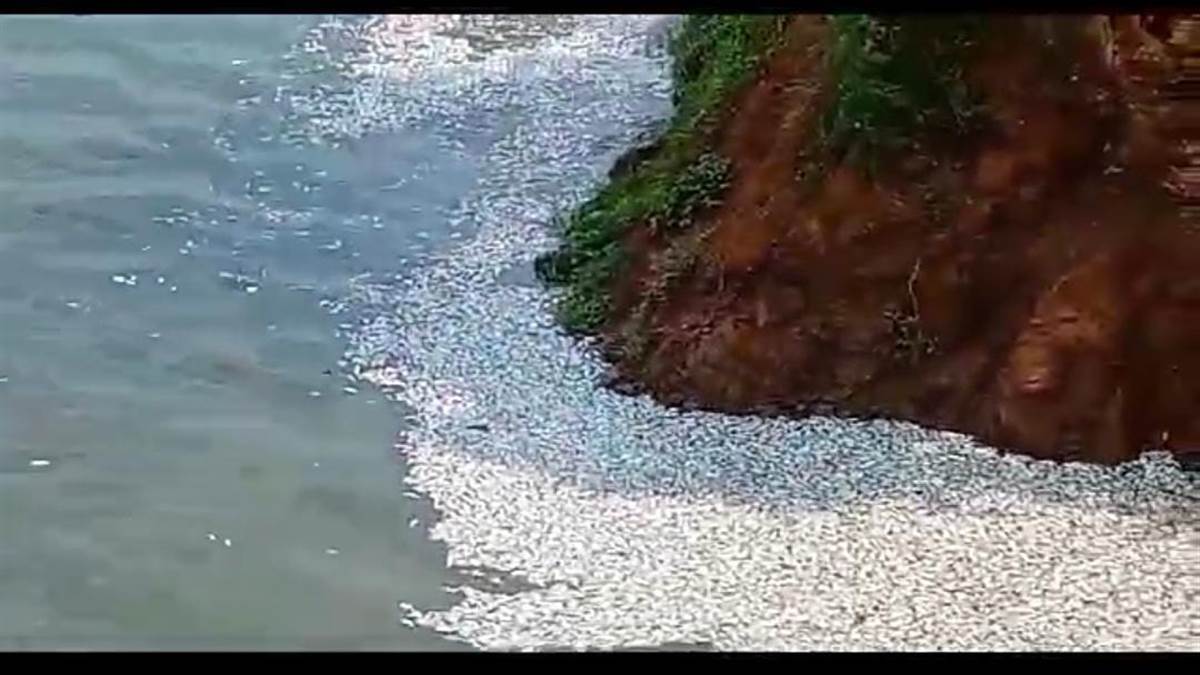
पथरिया विकासखंड के अंतर्गत ग्राम धूमा में शराब फेक्ट्री है। इससे निकलने वाली अपशिष्ट पदार्थों और केमिकल युक्त पानी से आसपास की कृषि भूमि के बंजर होने और नदी के जल दूषित होने पर कार्रवाई की गई थी। मामले में पथरिया एसडीएम के द्वारा फेक्ट्री को नोटिस दिया गया था। लोगों ने इसकी शिकायत एसडीएम से की थी कि आसपास की भूमि दूषित होने के कारण किसानों को कम पैदावार होने की बात कही थी। नदी में पानी के ऊपर केमिकल के कारण बदबू से पर्यावरण प्रदूषित हो रहा है वहीं पानी पशु पक्षी के पीने योग्य नहीं है। मामले में एसडीएम ने इसे गंभीरता से लिया है उन्होंने फेक्ट्री को नोटिस जारी किया था । https://www.naidunia.com/chhattisgarh/mungeli-fishes-died-in-shivnath-river-fear-of-death-due-to-release-of-contaminated-water-from-liquor-factory-8334595 (18 July 2024)
SAND MINING
Report SC seeks response from 4 states The Supreme Court on Tuesday (July 16) sought responses from Tamil Nadu, Madhya Pradesh, Maharashtra and Andhra Pradesh within six weeks on a plea seeking investigation into illegal sand mining cases and the termination of leases of entities involved in it. A bench of Justices Sanjiv Khanna and Sanjay Kumar said a fine of Rs 20,000 will be imposed if the states don’t file counter affidavits in six weeks. The bench listed the matter for November.
Advocate Prashant Bhushan, appearing for petitioner M Alagarsamy, submitted that the petition dates back to 2018 and said the four states had not filed affidavits on the status of illegal sand mining despite notices being issued to them. Bhushan, assisted by advocate Pranav Sachdeva, said massive illegal sand mining is going on. This is damaging the environment and till now only the Punjab government has filed its response. He said the petitioner has filed a short note on the matter about Tamil Nadu and the state should reply to the averments. After taking note of the submission, the bench asked Tamil Nadu to reply to the assertions made.
On January 24, 2019, the top court had issued notices and directed the Centre, CBI and five states to respond to the plea. The plea, which highlighted the issue of illegal sand mining in rivers and beaches across the country, has alleged that there has been “environmental havoc” and authorities concerned have allowed entities to operate without the mandatory environmental plan and clearance. “Due to the lack of implementation of guidelines by the states, various sand mining scams have taken place across different parts of the country,” the plea alleged. https://www.business-standard.com/india-news/illegal-sand-mining-sc-seeks-response-from-4-states-warns-of-rs-20-k-fine-124071600558_1.html ; https://www.livelaw.in/top-stories/supreme-court-illegal-sand-mining-case-affidavits-called-from-states-costs-if-delayed-263576 16 July 2024)
Assam Letter to SC flags rampant sand mining in Karbi Anglong area There is widespread sand mining and stone quarrying with heavy machinery in the Deithor and Rangsali rivers in Assam, said the complaint. There is widespread sand mining and stone quarrying with heavy machinery in the Deithor and Rangsali rivers in Assam, in violation of Supreme Court’s orders, a complaint sent to the Supreme Court’s Central Empowered Committee has flagged. These rivers play a vital role in maintaining the ecosystem of the region adjoining the rivers: Kaziranga National Park and Tiger Reserve and Kaziranga – Karbi Anglong Elephant Reserve.
But in a letter to CEC, environmentalist, Mukrang Engleng wrote on July 3: “The impact of sand mining through machinery in the Deithor and Rangsali rivers has led to habitat destruction, erosion of river banks, alteration of river flow patterns, and disruption of aquatic ecosystems. It has also resulted in loss of biodiversity, the fish populations have also declined drastically, and degradation of water quality has also increased drastically posing health risk to both human and animal lives. Furthermore, sand mining has exacerbated flooding, as it alters the natural sediment balance of the river. Socially and economically, it has affected communities that rely on rivers for livelihoods, such as fishing and agriculture”.
“These rivers and rivulets are used by indigenous people. They are sacred to us and we want access to our clean rivers. That is why I have decided to highlight the problem. Everyone in this region is very scared to speak up against mining,” said Mukrang Engleng, engineer by profession and environmentalist. https://www.hindustantimes.com/india-news/letter-to-supreme-court-flags-rampant-sand-mining-in-karbi-anglong-area-101721244190590.html (18 July 2024)
Tamil Nadu Sand mining: HC questions ED proceedings Possession of unaccounted property or illegal money per se cannot be a reason for the Enforcement Directorate (ED) to initiate proceedings under the Prevention of Money Laundering Act (PMLA), 2002 unless there are materials to believe that the ill-gotten wealth is the proceeds of a crime related to a scheduled offence under the Act, the Madras High Court has held.
A Division Bench of Justices M.S. Ramesh and Sunder Mohan said, the ED “cannot put the cart before the horse” by initiating PMLA proceedings even before the jurisdictional police registers a case for any of the criminal offences listed in a schedule appended to the PMLA. The judges also made it clear that the ED could not take action on the basis of assumptions and presumptions. The verdict was delivered on a batch of 24 writ petitions filed by individuals and companies who were probed as part of the ED’s action against alleged illegal sand mining activities in Tamil Nadu. The petitioners, included P. Karikalan, S. Ramachandran, K. Rethinam, A. Rajkumar and K. Govindaraj. All of them had challenged the Enforcement Case Information Report (ECIR) itself. https://www.thehindu.com/news/national/tamil-nadu/possession-of-unaccounted-property-per-se-cannot-be-a-reason-for-ed-to-invoke-pmla-rules-madras-high-court/article68414448.ece (17 July 2024) https://www.livelaw.in/high-court/madras-high-court/madras-high-court-quashes-ed-proceedings-contractors-sand-mining-money-laundering-case-263691
The HC has quashed the case registered by the Enforcement Directorate (ED) against a group of sand mining contractors in Tamil Nadu, holding that the agency had stepped outside its jurisdiction since mining is not covered under the scheduled list of offences under the Prevention of Money Laundering Act (PMLA). https://www.barandbench.com/news/ed-overstepped-powers-pmla-probing-illegal-sand-mining-madras-high-court (17 July 2024)
Uttarakhand Govt ‘Helping Private Parties Profit’ The Haridwar district administration told The Wire that the controversial tender put out on June 24 for dredging the Ganga was ‘invited only after obtaining due legal opinion.’ But there are serious contradictions and dangers in the government’s latest proposal for the fragile Himalayan eco-zone. https://thewire.in/government/uttarakhand-bjp-govt-ganga-dredging-disaster-management (20 July 2024)
Bihar बांका में गड्ढे में डूबने से युवक की मौत, ग्रामीणों ने बालू माफिया के कई वाहनों को फूंका -बांका में अवैध खनन के गड्ढे में डूबने से एक युवक की मौत हो गई. इससे गुस्साए ग्रामीणों ने नदी में खड़े खनन कार्य में लगे वाहनों को फूंक दिया. मौत के बाद से राणाडीह गांव में तनाव की स्थिति बनी हुई है. ग्रामीणों के मुताबिक शिकायत के बाद भी बेतरतीब तरीके से खनन होता रहा, जिसका खामियाजा एक युवक को जान देकर चुकानी पड़ी. https://www.etvbharat.com/hi/!state/uproar-in-banka-over-death-due-to-drowning-in-banka-brs24040405672 (04 April 2024)
Vicky Kaushal said that the coal smuggling shown in the movie was real. It seems the team went to capture visuals of illegal sand mining. They were shocked to see the normalcy around it like it is regular business. He said there were 500 trucks stationed there. Vicky Kaushal and one member of the crew were secretly filming some visuals. There were in a crowd of 500 people. The camera attendant called up the unit to say that they were caught up with this, and hence the camera was not available on the actual set. It seems one of the mafia men thought they were about to complain and slapped the cameraman. They threatened to break the camera as well. Vicky Kaushal and he just made a narrow escape from there. https://www.indiaforums.com/article/vicky-kaushal-recalls-how-he-got-into-trouble-with-sand-mining-mafia-during-shoot-of-gangs-of-wassey_209082 (21 July 2024)
WETLANDS, LAKES, WATER BODIES
Madhya Pradesh Bhoj wetland being delisted as Ramsar site The country will have to take a plea of “urgent national interests” in its response to the Ramsar Convention secretariat that sought clarification from it on the matter. India’s claim will then be scrutinised with a reality check on the ground by the Secretariat that designated the Bhoj wetland as a Ramsar site in August, 2002. TOI last week reported that Bhoj wetland faces the risk of being delisted from the prestigious global list due to possible damage to its ecological character.
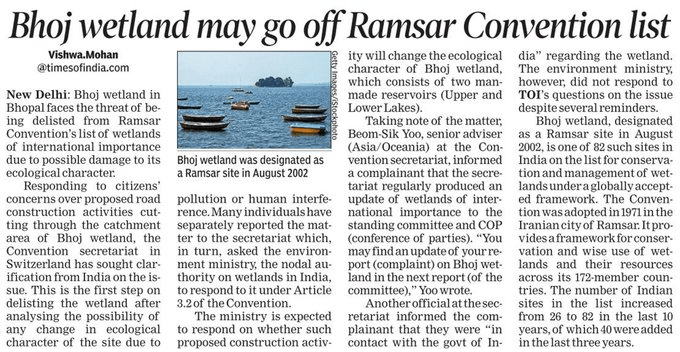
Concerned citizens reported the matter to the Ramsar Convention secretariat, flagging how the proposed road project cutting through the catchment area will threaten not only the wetland but also the wildlife and other water bodies. The Switzerland-based secretariat in response to a question told TOI this week that it’s still waiting for a response from the Indian govt on this matter.
“Based on a third party report, the secretariat has informed the National Focal Point a concern for possible change in the ecological character of Bhoj wetland and we are waiting for a response from the Govt of India on this matter in accordance with Article 2.5 and Article 3.2 of the Convention,” said Beom-Sik Yoo, senior advisor (Asia/Oceania), secretariat of the Convention on Wetlands, in his email response.
Experts at the secretariat will examine India’s clarification and send its report to a standing committee. Delisting will happen only if India fails to convince the Committee based on the ground report. It is learnt that the issue may also impact Bhopal’s proposed nomination for ‘Wetland City Accreditation’ under the Ramsar Convention. https://timesofindia.indiatimes.com/india/india-faces-uphill-task-to-save-bhoj-wetland-from-being-delisted-as-ramsar-site/articleshow/111890045.cms (20 July 2024)
Bihar NGT committee to look into encroachment at Karbatal wetland The NGT has directed that “four member committee shall inspect the site in question and submit its report within four weeks on affidavit with regard to the allegations made”. The allegations of encroachment and degradation of the Ramsar Site were made by environmental activist Subhas Dutta who approached the NGT. The wetland is stated to contain a cluster of 16-17 waterbodies in total and is a catchment area for rainwater but the same has been encroached over a period of time and it has been alleged that this area has been allowed to be reduced. Environmental experts had expressed concerns that encroachment and drying of the lake has badly affected birds who have lost their habitat. The waterbody was declared a Ramsar site in 2020 and it is Asia largest freshwater oxbow lake.
“Considering the allegations made, we deem it appropriate to constitute a Committee comprising of the following Members: (i) Senior Scientist, Bihar State Pollution Control Board, (ii) Senior Officer, Bihar State Wetland Authority, (iii) Divisional Forest Officer, Begusarai, and (iv) District Magistrate, Begusarai, or his representative not below the rank of Additional District Magistrate,” the order by the NGT Eastern Zone bench earlier this month said. https://www.thehindu.com/news/national/bihar/ngt-sets-up-committee-to-look-into-encroachment-at-bihars-karbatal-wetland/article68406110.ece (15 July 2024)
Odisha NGT directs removal of all constructions from Tampara lake The NGT has directed for removal of all constructions of permanent nature inside the Tampara lake waters and its conservation area. Tampara is one of the major freshwater lakes in the state. Located near Chatrapur town in Ganjam district the wetland that spreads across over 800 acres lies within the Rushikulya river basin. The NGT’s east zone bench in Kolkata issued the direction after taking note of a supplementary affidavit filed by the Wildlife Society of Orissa (WSO) along with photographs showing concrete structures within Tampara lake and affidavit of collector and district magistrate (Ganjam) on July 16.
The tribunal order said the affidavit of the collector and district magistrate, stated that further construction works have been stopped. It is also stated that the collector and district magistrate, Ganjam had constituted a committee and its members visited the site on Sept 22, 2023 and the committee members opined that a detailed analysis on conservation/integrated management plan of Tampara Lake for maintaining its water quality and ecology is required. Initially, secretary of WSO Biswajit Mohanty filed the petition on Aug 2, 2023 seeking intervention against the huge construction activities that had already taken place. https://timesofindia.indiatimes.com/city/cuttack/ngt-directs-removal-of-constructions-from-tampara-lake/articleshowprint/111874104.cms (20 July 2024)
Puducherry Attempts to encroach mangroves thwarted An attempt to encroach an irrigation channel that runs through the ecologically sensitive mangroves at Thengaithittu coastal hamlet has been thwarted due to the intervention of the NGT and the District Administration. Following a complaint filed by retired IFS Officer P. Devaraj to the NGT Grievance Redressal Cell in May this year, the NGT directed the District Collector to constitute a committee to look into the complaint of huge destruction of mangroves by “some private entrepreneurs in connivance with the Forest Department.”
Mr. Devaraj had based his complaint on an article that appeared in Hindu Tamil Thisai in May this year about the large-scale destruction of mangroves due to the encroachments on an irrigation channel. After the NGT direction, the District Collector constituted a committee under Sub-Collector (North) to investigate the matter. The committee had members from Municipality, Public Works Department, Revenue and Coastal Management Authority, said an official.
“The committee has found that a 300 metre long channel having a width of 4.2 meters was encroached upon by dumping gravel inside the drain and cutting around 50 mangroves. A gate was also constructed near the channel. We have served notice to the persons who have encroached in the area and two days ago we restored the channel to its original condition. A detailed report will be submitted to NGT soon,” a senior official told The Hindu. Inquires revealed that the land on either side of the irrigation channel belonged to the family of an influential politician in Puducherry. They were served notice before restoration of the irrigation channel, sources said.
According to an environmental activist, the intention of the encroachers was to destroy the mangroves by cutting the water channel. “In certain parts near the mangroves, an effort was made to appear that the land belonged to the Forest Department by painting the fencing green. The entire area should be surveyed,” he said. The entire stretch comes under the Coastal Regulation Zone-1, he said, adding that allowing construction activity to take place in the mangrove site was in itself a grave violation. “These are all serious violations. A detailed probe should be done to bring the entire facts to the public domain,” he added. https://www.thehindu.com/news/cities/puducherry/attempts-to-encroach-mangroves-thwarted-in-puducherry/article68426352.ece (20 July 2024)
WATER OPTIONS
Bengaluru BWSSB plans community RWH program After urging residents to set up rainwater harvesting (RWH) systems and planning initiatives to implement it in public spaces such as schools and colleges, the Bengaluru Water Supply and Sewerage Board (BWSSB) is now preparing for a community rainwater harvesting. In the first phase, the board plans to utilise areas in apartment complexes excluded from previous RWH systems. The community RWH systems will divert the collected rainwater to nearby lakes, helping recharge groundwater levels in the area. https://www.deccanherald.com/india/karnataka/bengaluru/bengaluru-water-supply-and-sewerage-board-plans-community-rainwater-harvesting-programme-3109958 (18 July 2024)
GROUNDWATER
Rajasthan Seeking central nod for GW use to be mandatory for industry The state govt plans to make it mandatory for the district administrations to obtain a no-objection certificate from Central Ground Water Authority (CGWA) to extract groundwater for industrial and commercial use. The move, set to come into force by the month end, aims at checking the overexploitation of groundwater in the state. The draft notification of the Ground Water Department (GWD) cites Section 5 of Environmental (Protection) Act, 1989, which makes it mandatory to get an NOC from CGWA to extract groundwater for industrial and commercial use. “This notification will empower district collectors to implement the provision and act against errant consumers,” a GWD official said. Under the notification, all new and existing industries, industries seeking expansion, all types of infrastructure projects, mining projects, and urban water supply schemes must obtain this NOC. Domestic consumers, residential complexes and housing societies, Rural water supply schemes, agricultural activities, and armed forces’ establishments have been exempted. https://timesofindia.indiatimes.com/city/jaipur/rajasthan-seeking-central-nod-for-groundwater-use-to-be-mandatory-for-industry/articleshow/111822975.cms (18 Jul 2024)
Himachal Pradesh Baddi GW pollution: HC makes SPCB party in PIL The HP High Court has impleaded Regional Director, Central Ground Water Board, State Ground Water Authority and Central Pollution Control Board, Hydrological Department, I&PH and Secretary, Department of Environment, as party respondents in the PIL pertaining to issue of groundwater pollution in Baddi-Barotiwala-Nalagarh.
A division Bench comprising Chief Justice MS Ramachandra Rao and Justice Satyen Vaidya passed this order after perusing the status report filed by the State Pollution Control Board wherein it has suggested that to combat the problem of ground water contamination it is desirable to implead them as party in this PIL. While impleading them as party, the court further directed the Chief Secretary to coordinate with the said parties and take appropriate steps. It further directed him to request the IIT Mandi to provide technical expertise to the HP State Pollution Control Board. https://www.tribuneindia.com/news/himachal/baddi-groundwater-high-court-makes-pollution-board-party-in-pil-640888 (18 July 2024)
Study Majority of global river flow sustained by groundwater Abstract: –Groundwater-sustained baseflow is a vital source of river flow, especially during dry seasons. The proportion of river flow sustained by baseflow—the baseflow index—is essential for assessing fluvial nutrient cycling and contaminant transport. However, the global baseflow index remains highly uncertain, with current Earth system model simulations ranging from 12% to 94%. Here we estimate the global baseflow index to be 59% ± 7% based on an emergent constraint approach, which integrates 50 Earth system models with baseflow indices derived from streamflow observations in 15,567 basins.
Our observational constraint indicates that at least 21% ± 3% of precipitation recharges groundwater, which is approximately double the figure reported in the Sixth Assessment Report of the United Nations Intergovernmental Panel on Climate Change. Thus, our research suggests a more active role of groundwater in the global water cycle than most Earth system models currently simulate. We present evidence that the considerable disagreement in simulated baseflow stems from unrealistic and varied model representations of infiltration, aquifer structure and groundwater dynamics. These processes should be prioritized so that models can capture active groundwater–river connections. https://www.nature.com/articles/s41561-024-01483-5 (19 July 2024)
URBAN LAKES, WETLANDS
Bengaluru Solar panels on lakes? Activists skeptical Bangalore Lake activists and ecologists are sceptical about the government’s decision to install floating solar panels on 40 lakes across Karnataka. The move was announced last week by Minor Irrigation Minister N S Boseraju. The minister is likely to meet with a team of experts in early August to discuss its feasibility. Of the 40 lakes, four are in Bengaluru. They include Bagalur lake (Yelahanka), Singanayakanahalli lake (Yelahanka), Jigani Doddakere (Anekal) and Muttanallur Amanikere (Anekal). “The lakes have been chosen based on the area they cover. Most of them cover an average area of least 100 acres,” Boseraju shared. The project will help reduce the cost of electricity spent monthly on the lift irrigation system. The government currently spends Rs 10-11 crore monthly, he revealed.
One must first look at the purpose of the lakes, states Veena Srinivasan executive director of Water, Environment, Land and Livelihoods (WELL) Labs. “Is it for fishing, or flood control, or storage? As far as I know, most lakes serve a recreational purpose. These are the last remaining green spaces in the city. In that case, why spoil the beauty of the lake? It could also interfere with their ecological function as they will cut off sunlight,” she says. Shouldn’t we be doing this on one lake to see its effect on ecology and then take a decision on whether it can be extended to other lakes? Why are we doing this on 40 lakes at one go,” asks Harini Nagendra, ecologist and author. https://www.deccanherald.com/india/karnataka/bengaluru/solar-panels-on-lakes-activists-sceptical-3108440 (17 July 2024)
Chennai Fecal bacteria found in water supplied in Tambaram Scores of Tambaram residents have complained they are getting water contaminated with fecal coliform bacteria, violating the Central Pollution Control Board’s (CPCB) standards that mandate no presence of fecal coliform in drinking water. Till Feb 2024, 3,300 households in Chitlapakkam, Sembakkam and Madambakkam received around 1.6 million litres a day (MLD) from Madambakkam lake, which had 13 illegal sewage inlets, according to corporation data. Water was extracted from five wells in the lake bed, then filtered, chlorinated and supplied by the local body.
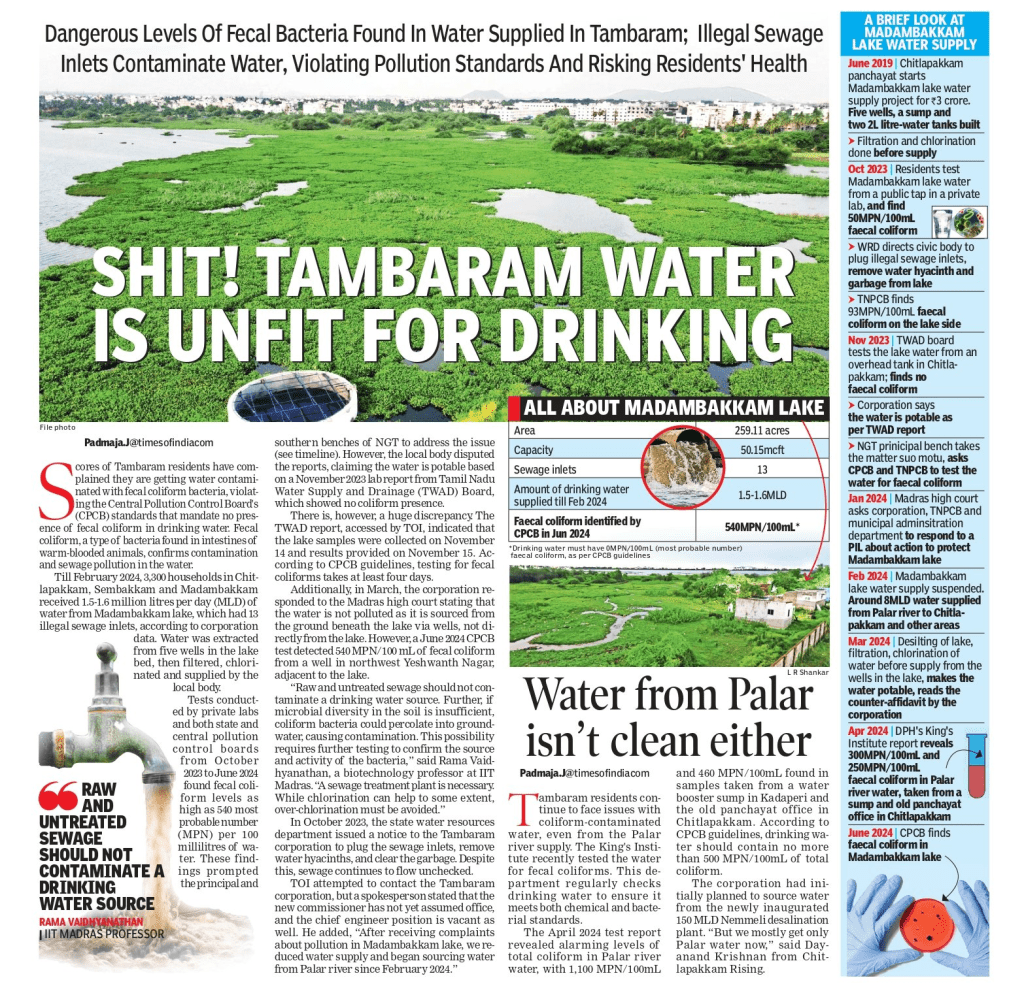
Tests conducted by private labs and both state and CPCB from Oct 2023 to June 2024 found fecal coliform levels as high as 540 most probable number (MPN) per 100 millilitres of water. These findings prompted the principal and southern benches of NGT to address the issue. However, the local body disputed the reports, claiming the water is potable based on a Nov 2023 lab report from Tamil Nadu Water Supply and Drainage (TWAD) Board, which showed no coliform presence.
There is, however, a huge discrepancy. The TWAD report, accessed by TOI, indicated that the lake samples were collected on Nov 14 and results provided on Nov 15. According to CPCB guidelines, testing for fecal coliform takes at least four days. Additionally, in March, the corporation responded to the Madras high court stating that the water is not polluted as it is sourced from the ground beneath the lake via wells, not directly from the lake. However, a June 2024 CPCB test detected 540 MPN/100 mL of faecal coliform from a well in northwest Yeshwanth Nagar, adjacent to the lake.
In Oct 2023, the state water resources department issued a notice to the Tambaram corporation to plug the sewage inlets, remove water hyacinth, and clear the garbage. Despite this, sewage continues to flow unchecked. https://timesofindia.indiatimes.com/city/chennai/shit-tambaram-water-is-unfit-for-drinking/articleshow/111844221.cms (19 July 2024)
Perimeter wall to protect Pallikaranai marshland Construction work on the perimeter walls of the eco-sensitive Pallikaranai marshland is advancing swiftly, with the project divided into two key phases. In the first phase, the wall will extend from the rear of National Institute of Ocean Technology campus to Oggiyam Maduvu, and from Elcot, Perumbakkam campus to River View Colony in Karappakkam.
The second phase will see a similar wall over 10km covering Mettukkuppam, VGP Mahalakshmi Nagar, and parts of Perumbakkam. The primary aim of these walls is to prevent encroachments. More than three years ago, a 2.5km perimeter wall was erected along the Velachery-Tambaram High Road.
The NGT has ordered govt to take action to evict IT parks, govt buildings and private apartments occupying the Pallikaranai marshland if they lack rightful ownership or title. The tribunal, following a TOI report in Jan 2022 that highlighted debris dumping in Pallikaranai, instructed the govt to survey the marshland, and remove encroachments. Two years later, a Differential Global Positioning System survey conducted by the land survey department identified the occupants of the marshland, which spans 1,206 hectares. https://timesofindia.indiatimes.com/city/chennai/perimeter-wall-construction-at-pallikaranai-marshland-in-chennai/articleshow/111911104.cms (22 July 2024)
Vizag Unplanned development damaging water bodies -According to the toposheet of the Survey of India, the Greater Visakhapatnam Municipal Corporation (GVMC) encompasses 179 water bodies. Out of these, 115 have an updated status, with 40 requiring immediate restoration. Visakhapatnam has a total of 25 irrigation tanks, 154 ponds, 15 springs and two temple tanks.
-Lokesh Sinram, senior project executive from the Centre for Urban Water Resources at the Dhan Foundation, highlighted the adverse impact of unplanned urbanisation of these water bodies. “Urban water bodies and their drains have fallen victim to unplanned urbanisation, facing threats such as encroachment, sewage disposal, groundwater decline, lack of administrative framework, and insufficient community participation,” Lokesh said.
-“In Vizag, many urban water bodies have suffered from poor maintenance and neglect. This includes inadequate waste management, especially construction and demolition waste around water bodies, and insufficient efforts to control pollution and invasive species. Land reclamation for development and construction has reduced the size of water bodies, and altered their natural flow patterns,” he explained.
-Visakhapatnam is losing its unique features, including springs in the hills of Simhachalam, Kambalakonda and Yarada. The GVMC covers these hill ranges, which host several types of springs, forming springsheds. However, activities like stone quarrying, sand mining, deforestation, and changes in land use due to erratic rainfall have limited rainwater infiltration, drying up springs and reducing stream flows.
-Once, there were over 14 springs in the Simhachalam Hills, but now locals can name only a few, such as Gangadhara, Naagadhara and Saagidhara, which are nearly perennial. https://www.newindianexpress.com/states/andhra-pradesh/2024/Jul/15/unplanned-urbanisation-takes-toll-on-water-bodies-in-vizag (15 July 2024)
URBAN WATER
Greater Noida 1% of project cost to be imposed as fine on builders extracting GW: CGWA -The Central Ground Water Authority (CGWA) has told the NGT that 1% of the total project cost will be imposed as ‘environmental compensation’ on developers engaged in illegal groundwater extraction in Greater Noida West. The NGT is currently hearing a petition by resident Pradeep Dahaliya in 2022 alleging that builders were engaged in indiscriminate groundwater extraction for construction purposes since a long time.
-As many as 33 group housing societies were found to be allegedly extracting groundwater illegally in 2023 in Greater Noida West. An environmental compensation of ₹306 crore was also levied by the committee on the errant developers. The departments, however, failed to provide the quantum or period of groundwater extraction by builders.
-“1% amount of the total project cost is a very small amount to be imposed as penalty as these developers have been engaging in the violation for so long. Minimum 5% of the total project cost should be levied on them,” said petitioner Pradeep Dahaliya. NGT has been seeking response from the developers/builders who are allegedly involved in the illegal groundwater extraction in Greater Noida. Clarifying about the delay in their response in NGT, some of the counsel for builders told the tribunal in April that the notice was served at closed sites and the redirected notices were received late. The case will now be heard for further proceedings on October 15, 2024. https://www.hindustantimes.com/cities/noida-news/1-of-project-cost-to-be-imposed-as-fine-on-builders-extracting-groundwater-ngt-told-101721155597763.html (17 July 2024)
Noida Checks for GW level must for basement digging now The district administration has directed the three industrial authorities — Noida, Greater Noida and Yamuna —to check the groundwater level for each land parcel before giving approval for digging basements to developers. The height of basements for each project will be determined on the basis of the groundwater study report, a letter issued by the administration said. If permission for a basement was issued in the past, but work was yet to start, then the development authority concerned will have to undertake a groundwater level study and make changes in the approval plan accordingly, it stated.
The letter comes after the groundwater department imposed on Tuesday (July 16) a cumulative penalty of Rs 35 lakh on six builders —Uniexcel Developers, Montree Attire, Jam Vision Tech, King Pace Information, Vextec Condominium and Motherson Sumi Infotech & Design Ltd — for illegally dewatering plots, allotted by the Noida Authority in sectors 153, 154 and 129, using pumps. De-watering has been noted in several projects across the district. It means water, oozing out of the ground during digging for basements, is bailed out using mechanised pumps. https://timesofindia.indiatimes.com/city/noida/new-regulations-for-basement-digging-in-noida-require-groundwater-level-checks/articleshowprint/111846940.cms (19 July 2024)
Gurugram MCG forms 10 teams to clear blocked RWH pits The Municipal Corporation of Gurugram (MCG) has formed 10 dedicated teams to check and clear blocked rainwater harvesting pits across the city to address water scarcity and improve urban sanitation, officials said on Sunday (July 14), adding that the initiative is part of a broader strategy to conserve water and enhance waste management efficiency. On Saturday (July 13), MCG Commissioner Dr Narhari Singh Bangar inaugurated a rainwater harvesting project at a park in Rosewood City in Sector 49. The project, a collaboration between a company, MCG, and the Grand Mansion Resident Welfare Association (GMRWA), aims to conserve 60 million litres of water annually. It will involve the construction of at least five or six mega pits designed for effective water conservation. https://www.hindustantimes.com/cities/gurugram-news/mcg-forms-10-teams-to-clear-blocked-rainwater-harvesting-pits-in-gurugram-101720979779632.html (15 July 2024)
Baltora Absent septic tanks, open drains and textile dyes paint a dirty picture To ensure safely managed sanitation, Balotra, as a first step, needs to make the STP function properly, besides tapping the major open drains. Second, monitoring of effluent coming from industries should be made stringent and proper enforcement protocols must be in place for any violations.
Third, modalities for reuse of treated water that is free from dyes and chemicals should be included in the city-level policy, plan and practice. Lastly, groundwater recharge through recharge wells and rainwater harvesting structures should be promoted as a best practice. https://www.downtoearth.org.in/water/absent-septic-tanks-open-drains-and-textile-dyes-paint-a-dirty-picture-in-rajasthans-balotra-2?456456546546 (19 July 2024)
AGRICULTURE
Report Give Rs 35k per hectare for shift away from paddy A paper (titled ‘Saving Punjab and Haryana from Ecological Disaster: Re-aligning Agri-Food Policies) by ICRIER economists led by Ashok Gulati has suggested a transfer of Rs 35,000 a hectare to farmers who shift from paddy to pulses, oilseeds, millets, and maize during the kharif season along with procurement of these crops at the minimum support price for five years. It has proposed that the cost be split 50:50 between the state and the Centre. “Haryana is already giving Rs 17,500 a hectare and the Centre needs to double it. Interestingly, there is hardly any additional expenditure involved. It is the savings on power, canal waters, and fertiliser subsidies that need to be given back to farmers in a different form. If this is done, India can save the most fertile plains of Punjab-Haryana from potential desertification,” it said.
– “Taking Punjab as an example, the combined subsidies from the govt of Punjab and the govt of India amounted to a staggering Rs 38,973 per hectare during 2023-24. When considering additional subsidies for managing crop residues both in the field and after harvest, the financial support for paddy cultivation would easily go beyond Rs 40,000 per hectare,” it said. With subsidies contributing to nearly one-third of the profitability for paddy, the gains from the crop are far higher than others grown during the season – as much as Rs 68,849 a hectare when compared with bajra. What has encouraged the cultivation of paddy is assured procurement at the minimum support price, something that is not available to other crops grown during the season.
– The paper has proposed diversification of 12-14 lakh hectare from paddy cultivation in Punjab and Haryana with govt offering upfront incentive of Rs 30,000-40,000 a hectare by repurposing power subsidy, offered by the state, and fertiliser subsidy, given by the Centre. There are other recommendations such as public-private partnership for carbon credits for diversifying away from paddy, which emits five tonnes of carbon dioxide per hectare. https://timesofindia.indiatimes.com/india/think-tank-give-rs-35k-per-hectare-for-shift-away-from-paddy/articleshowprint/111763930.cms?val=3728 (16 July 2024)
Increasing nitrogen pollution in soil affecting farm sector -In a report, ‘Nitrogen Pollution in India’s Agriculture Sector: A Looming Crisis’, released recently, the researchers noted that nitrogen pollution is yet to receive the attention it needs. “Increasing presence of nitrogen is leading to soil degradation. Undissolved nitrogen fertilizers can acidify the soil, reduce its fertility and lead to long-term damage. The presence of nitrous oxide is also a reason for greenhouse gas emission. Nitrous oxide, a potent greenhouse gas, is 300 times more effective than carbon dioxide at trapping heat, and when released from fertilizers contributes to climate change,” said Ananya Vyas, content and communications strategist, Firefly Life Sciences.
-In India, nitrogen emission has increased and is mainly driven by the use of fertilizers (most notably urea), the report noted. Researchers said agricultural soil contributed over 70% of nitrogen dioxide emission in India. Of which, chemical fertilisation accounted for 77%. They also listed the major repercussions of nitrogen pollution, including water contamination. Nitrates in drinking water are posing health risks. https://www.newindianexpress.com/states/karnataka/2024/Jul/18/increasing-nitrogen-pollution-in-soil-affecting-farm-sector-says-report (18 July 2024)
MONSOON 2024
Report UN models may be underestimating climate change effect on rainfall in India The most advanced set of climate models used in the Intergovernmental Panel on Climate Change Assessment Reports could be underestimating the impacts of climate change on rainfall over India, a new analysis (https://www.nature.com/articles/s41598-024-63417-w) has found. While the CMIP6 (The sixth Coupled Model Intercomparison Projects is a leading group of models) is able to provide insights at a global level, it is likely to falter at a more regional level. A new study (by the researchers from the Indian Institute of Tropical Meteorology and the National Institute of Technology, Rourkela), correcting and downscaling the CMIP6’s projections, finds that at a regional scale over India, the CMIP6 is underestimating the magnitude of long and short duration extreme rainfall events in the future.
The baseline period for models and observations used are India Meteorological Department data from 1980 to 2014. While most other downscaled models include only the precipitation component, this study is among the first few to also include sea surface temperature in its projections, which is an important determinant of the Indian summer monsoon’s progress. The researchers were able to tell that the CMIP6 simulations “strongly underestimate the intensity and spatial distribution of rainfall associated with the extreme rainfall events” because downscaling and bias correction resulted in projections improving by 96 % – meaning they were closer to actual observed outcomes by 96%.
It is also found that, before 2060, the number of short duration extreme rainfall events is high compared to the long duration extreme rainfall events. After 2060, this trend switches, “which is a two-fold increase of long duration extreme rainfall events compared to the short duration extreme rainfall events over the monsoon core region”, says the study. “Long duration extreme rainfall events last from several days. Typically, these events result in a large total accumulation of rainfall over larger geographic areas, often leading to sustained high water levels in rivers and reservoirs. Short duration extreme rainfall events last from several hours to a few days. They are characterised by very high rainfall rates, leading to rapid accumulation of water in a short period. They are usually localised, affecting smaller geographic areas,” said Gopi Nadh Konda, lead author of the study. https://scroll.in/article/1070192/un-models-may-be-underestimating-climate-change-effect-on-rainfall-in-india (17 July 2024)
Climate change is making the monsoon more dangerous Mr Yogesh Patil of Skymet hopes better data will help. His company draws information from 5,500 sensors around the country; the government maintains another 1,500. The agriculture ministry is now championing a plan to make land available for companies, such as Skymet, to set up tens of thousands more. The northern state of Uttar Pradesh, for example, could end up hosting some 50,000 rain sensors. Other states may follow suit. “Once they have collected data for three years or so, our local models should improve a lot,” reckons Mr Patil. He also hopes for better co-operation between different govt bureaucracies, such as the agriculture ministry and the disaster-management authorities. https://www.economist.com/asia/2024/07/18/climate-change-is-making-the-monsoon-more-dangerous (18 July 2024)
1/3 India sees deficit monsoon Uttar Pradesh saw deficient monsoon in 29 districts; Chhattisgarh in 21; Odisha 20; Gujarat 19; Madhya Pradesh, West Bengal and Jharkhand 16; Bihar 15, and Punjab 14. About 33% of the total 729 districts registered deficient monsoon (when deficient rainfall is in a category -59% to -20% of the long-period average), while 5% of districts recorded large deficient rainfall (-99% to -60% category). Currently, the deficient rainfall districts fall in 11 sub-meteorological divisions constituting 31% of the country’s area. 18 sub-meteorological divisions covering 53% of the country are under average category rainfall. https://www.newindianexpress.com/nation/2024/Jul/15/one-third-of-india-sees-deficit-rainfall-over-a-month-after-monsoon-arrival (15 July 2024)
In July, the rains have so far been deficient by 33 per cent in Punjab, 32 per cent in Himachal and 27 per cent in Haryana. From July 1 till the morning of July 19, Punjab received 64.0 mm rain against the long period average of 95.9 mm for this period. Himachal received 99 mm against the normal of 146 mm, whereas Haryana received 64.1 mm against the normal of 87.6 mm during the aforementioned period, according to IMD data. https://www.tribuneindia.com/news/himachal/as-rains-falter-dams-witness-sharp-dip-in-water-level-641357 (19 July 2024)
The southwest monsoon is likely to be in a lull phase in the Kerala State for the next few days after a week-long vigorous spell in north and central Kerala. The State received a total of 267.7 mm of rainfall in the last week (from July 14 to 21) alone due to the intense spell triggered by an offshore trough along the west coast and low pressure area over the Bay of Bengal. https://www.thehindu.com/news/national/kerala/after-a-week-long-intense-spell-monsoon-slips-into-a-lull-phase/article68429669.ece (21 July 2024)
Monsoon expected to enter break phase in early Aug: Experts Dr D S Pai, head of the Environment Monitoring and Research Centre, IMD, New Delhi, told TOI, “The monsoon system exhibits a natural variability. We anticipate the monsoon to remain active throughout July. The monsoon trough is expected to gradually shift northward towards the Himalayas in Aug, potentially leading to a break phase lasting a few days.” Such breaks are, however, a normal part of the monsoon cycle. “Climatologically, the first 10 days of Aug are prone to monsoon break periods. These breaks are a natural occurrence and can be beneficial for agriculture, allowing a balance between wet and dry spells,” he said.
Though many places like Gujarat and Konkan have received good rain in this spell, Jharkhand, Odisha and Bihar still have 20-49% rainfall shortfall. In some parts of the northeast, it is a shortfall of almost about 26% to over 40%. Punjab, Haryana, Jammu and Himachal have a shortfall of about 35-45%. https://timesofindia.indiatimes.com/city/pune/monsoon-break-phase-in-early-august-what-to-expect/articleshow/111895325.cms (21 July 2024)
Gujarat At 399 mm in 8 hours, Surat’s Umarpada gets record rain With Umarpada taluka in Surat recording very heavy rainfall of 399 mm within eight hours, until Monday (July 15) noon — highest this season so far — the India Meteorological Department (IMD) issued a ‘red’ alert for districts of Chhota Udepur, Narmada, Bharuch, Surat, Navsari and Valsad on Monday and Tuesday. As two rivers — Mohan and Veera in the taluka — overflowed amidst heavy rainfall from 4.00 am to 12.00 pm on Monday July 15, at least 17 villages have been affected. Between 6 am and 12 noon on Monday; Netrang in Bharuch recorded 188 mm rainfall, with Narmada district’s Garudeshwar (145 mm), Nandod (130 mm) and Tilakwada (89 mm) in the ‘heavy rain’ category. https://indianexpress.com/article/cities/ahmedabad/surats-umarpada-gets-record-rain-red-alert-from-imd-for-south-gujarat-9454356/ (16 July 2024)
Umarpada taluka of Surat was battered by 354mm of rainfall in just four hours from 6am. Mohan river flows North to merge into Karjan reservoir. Netrang got 133 mm during 8-10 am on Monday. https://timesofindia.indiatimes.com/city/surat/heavy-rainfall-in-south-gujarat-causes-flood-like-situation-in-umarpada/articleshow/111766663.cms (16 July 2024)
FLOOD 2024
Chhattisgarh दंतेवाड़ा में भारी बारिश से पहाड़ी पर बना डैम टूटा दंतेवाड़ा में किरंदुल क्षेत्र में पहाड़ी पर बना बांध टूटने से करीब 200 घर इसके चपेट में आ गए। डैम के छतिग्रस्त होने से तेज गति से पानी और मलबा रास्तों और लोगों के घरों में घुसने लगा, जिससे वहां चीख पुकार मच गई। इसके बाद जिला प्रशासन ने तत्काल राहत कार्य करते हुए लोगों को सुरक्षित स्थान पहुंचाया।

जिले के किरंदुल क्षेत्र में पहाड़ी के एन-1 बी डैम एनएमडीसी के द्वारा निर्माण किया गया था। जिले में अत्यधिक बारिश होने के कारण पहाड़ी में निर्मित एन-1 बी डैम रविवार (July 21) की शाम लगभग 4 बजे क्षतिग्रस्त हो गया है। जिसके चलते 150 से 200 घर बाढ़ के चपेट में आकर क्षतिग्रस्त हो गए हैं। https://www.naidunia.com/chhattisgarh/dantewada-dantewada-dam-broke-due-to-heavy-rain-water-and-debris-entered-many-houses-in-lower-settlement-8335636 (21 July 2024)
Telangana Komaram Bheem project faces flood threats due to cracks The Komaram Bheem project, which had developed cracks on the right side of its spillway in 2022, is facing flood threats following rains in the upper catchment areas and the project receiving fresh inflows, in Asifabad district. The authorities have failed to make repairs to the project to keep it intact. Surprisingly, the irrigation officials covered the cracks by covering it with tarpaulin. Villagers in downstream areas are fearing possible discharge of flood water. Last year, the irrigation department had discharged flood water downstream to save the project.
This year too, the dept is trying to ensure that the water storage does not reach the bund level and they maintain this by discharging flood water downstream. While the storage capacity of the project is 10.6 TMC, the irrigation department tries to maintain that there is no more than 5 TMC of water in the project. Asifabad MLA Kova Laxmi said the project is facing a threat from possible floods following rain since the department has failed to carry out repairs to the cracks in the bund.
It is said that the dept did not get adequate funds from the state govt when BRS was in power and the same situation continues now. The Komaram Bheem project has become a monument of neglect with no operations and water supply after its inauguration. The project aims to irrigate 30,000 acres through its right canal and an additional ayacut of 15,000 acres were added to it. The project cost was increased to Rs 367 cr.
The project was officially inaugurated in 2011 by former Chief Minister N Kiran Kumar Reddy. The left canal was intended to irrigate 20,000 acres in Sirpur (T) and Kagaznagar mandals and 4,500 acres under the right canal in Asifabad mandal. The proposed left canal was not completed due to lack of forest clearance. The left canal is proposed to irrigate lands in Wankidi, Kagaznagar and Sirpur (T) mandals. At present, the project supplies its seepage water to only 1,000 acres. https://www.deccanchronicle.com/southern-states/telangana/telangana-komaram-bheem-project-faces-flood-threats-due-to-cracks-1810616 (16 July 2024)
Telangana-Andhra Pradesh Breach in Peddavagu project inundates villages The breach occurred near near Gummadivalli. The AP villages submerged are in Eluru dist. Three villages in Telangana and 15 villages in Andhra Pradesh were affected by the breach, which emptied the water in the project. People spent the night on the roofs. National Disaster Response Force (NDRF) personnel rescued 28 people trapped in flood waters with the help of two helicopters. https://www.thenewsminute.com/news/breach-in-peddavagu-project-inundates-villages-in-telangana-andhra-pradesh (19 July 2024)
Bund of Peddavagu Project breached; flood water inundates several villages The bund of Peddavagu Project at Narayanapuram of Ashwaraopet mandal in Bhadadri-Kothagudem dist of Telangana was breached due to heavy inflow into it. In view of heavy inflow, the irrigation officials have lifted two gates, but failed operate third gate, which was not lifted since its installation due to the technical problem. With this, it has not become possible to maintain balance between inflow and outflow, resulting in the breach of the bund. The bund was breached for 40 meters long at right canal at mid-night. Several houses at Gummadavalli and Kothuru were submerged in the floods. The people of these villages have been already evacuated and shifted to a shelter in a government residential school near the villages. According to the information reaching here, about 10 villages in Andhra Pradesh were surrounded by the flood water. It was expecting that the crops in over 100 acres have been damaged and nearly 100 cattle were washed away in the floods. https://www.deccanchronicle.com/southern-states/telangana/bund-of-peddavagu-project-breached-flood-water-reaching-several-villages-1811130 (19 July 2024)
Telangana 12 gates of Jurala project opened Twelve gates of Priyadarshini Jurala Project (PJP) in erstwhile Mahbubnagar district were opened on July 20 to release flood water downstream to reach Srisailam dam. The officials of Irrigation department are releasing as many as 86,679 cusecs of water from the project and it water release might further increase by July 21 as the gates of Narayanpur reservoir in the upstream areas in Karnataka were already opened. At 6 pm on Saturday, the PJP was receiving 83,000 inflows from Narayanpur, which is likely to increase to 1 lakh cusecs on Sunday. https://www.deccanchronicle.com/southern-states/telangana/12-gates-of-jurala-project-opened-to-release-86679-cusecs-downstream-1811321 (20 July 2024)
All major irrigation projects including Yellampalli, Kadam, Sathnala and Komaram Bheem received large inflows of water following heavy rains in upstream areas. People in downstream and low-lying areas were put on alert on Sunday (July 21). https://www.deccanchronicle.com/southern-states/telangana/heavy-rains-flood-major-irrigation-projects-in-telangana-1811544 (21 July 2024)
Tamil Nadu govt wants Kerala to keep the water level at FRL in Siruvani dam for benefits to Coimbatore city, even as monsoon is less than half way through.” https://timesofindia.indiatimes.com/city/coimbatore/maintain-storage-in-siruvani-dam-at-full-reservoir-level-for-coimbatores-benefit-organisations-demand/articleshow/111865116.cms (19 Jul 2024)
Kerala Historic floods of July 1924 Triggered by a devastating cyclone that raged for three days and nights from July 16 to July 18, 1924, the unprecedented rainfall and consequent flooding wrought widespread and numbing havoc. into ravines, destroying everything in their way. Floodwaters overflowed bridges, washing several away. https://www.deccanherald.com/opinion/the-day-of-the-deadly-deluge-3108458 (7 July 2024)
URBAN FLOODS
Nagpur Overflowing sewage lines contaminate underground tanks The heavy rains in the last 24 hours have not only inundated the entire city but have also caused severe water woes for the residents in several affected areas. The situation is particularly alarming in the Nandanvan and other affected areas, where numerous flat schemes are located. The incessant rainfall has led to water accumulation in the parking lots of these residential complexes, which has later entered the water tanks meant for storing drinking water and water used for regular use.
One of the major crises on Sunday (July 21) for the citizens was the water stuck up in basements of several buildings across the city. However, another crises came to the fore after basement water was cleared as underground water tanks were filled with drain water. The residents claimed that now cleaning these water tanks and getting usable and drinking water is a hard task ahead.
Residents of Nandanvan and other affected areas are left with no choice but to rely on filtered water for their daily needs. The sudden surge in demand for canned water has led to a shortage in supply, causing further inconvenience to the people. Apart from this, the many flat schemes were flooded after the draining system started throwing filthy water back after it was over flooded which also caused water logging in basements.
Citizens claimed that the situation has exposed the inadequacies of city’s drainage and water supply infrastructure. They criticized NMC for their lack of preparedness in dealing with such emergencies. The residents have demanded immediate action from the authorities to address water contamination and ensure a steady supply of drinking water. https://timesofindia.indiatimes.com/city/nagpur/water-crisis-in-nagpur-due-to-sewage-contamination/articleshow/111911535.cms (22 July 2024)
Pune PMC, Metro given flood alert The state irrigation department has issued alert to the Metro and Pune municipal authorities of possible water release from the Khadakwasla dam as its stock reached 70% of its 1.97 TMC capacity on Wednesday (July 17). “Khadakwasla is a smaller dam and its stock has already hit 1.4 TMC (70% of capacity). Its stock may climb to 90% or even 100% with two days of continued heavy rainfall. So, an alert has been issued to the Metro, civic and district authorities to avoid any mishaps or last-minute rush,” an official from the irrigation department said. https://timesofindia.indiatimes.com/city/pune/irrigation-department-issues-alert-to-maha-metro-pmc-as-khadakwasla-dam-stock-reaches-70/articleshow/111821094.cms (17 Jul 2024) In Pune too, rainfall activity has increased significantly in the last 48 hours especially in the ghat areas and in many places, over 200 mm of rainfall has been recorded in the past 24 hours. https://www.hindustantimes.com/cities/pune-news/over-200-mm-of-rainfall-in-last-48-hours-water-storage-in-pune-dams-increases-101720985479656.html (15 Jul 2024)
Delhi The World Heritage Committee meeting to be held in Delhi starting from July 21. Delegates from 142 countries to participate. Satish Upadhyay, vice-chairman of New Delhi Municipal Council (NDMC), conducted an inspection on Saturday (July 20) to assess the beautification efforts undertaken by the civic body in preparation for the upcoming 46th World Heritage Committee Meeting. India is hosting this meeting for the first time. It will take place from July 21 to 31 at Bharat Mandapam. Considering the monsoon season, NDMC is also taking several measures to tackle any potential waterlogging problems that may arise during this time. https://timesofindia.indiatimes.com/city/delhi/ndmcs-preparations-for-world-heritage-committee-meeting/articleshow/111893270.cms (21 July 2024)
Delhi’s flood-like situation was because of heavy rains. But questions were also raised on the city’s drainage system. So how does the Delhi drainage system work? Is it efficient to handle heavy rain? https://www.newslaundry.com/2024/07/16/delhi-drowns-in-rain-is-its-four-decade-old-drainage-system-to-blame (16 July 2024)
CLOUD BURSTS
Himachal Pradesh Rs 329 cr loss, 40 killed in rain-related incidents As many as 40 persons died in rain-related incidents since the onset of monsoon on June 27 till July 20 and the state has suffered losses to the tune of Rs 329 crore, according to the state emergency operation centre. One person was washed away as a cloudburst incident took place in Raitua village in Anj Bhoj area under Paonta subdivision in Sirmaur district late Friday (July 19) night. Confirming the incident, Paonta SDM Gunjeet Cheema said that immediately after getting the information of a cloudburst in Raitua village, a team of Puruwala police station with the help of local residents launched a search operation in the five km long area where the Raitua Nullah flows to join the Tons River. https://www.business-standard.com/india-news/monsoon-himachal-faces-rs-329-cr-loss-40-killed-in-rain-related-incidents-124072000609_1.html (20 July 2024)
Uttarakhand शुक्रवार (July 12) की सायं धारचूला क्षेत्र में बादल फट गया है। बादल फटने से धारचूला से लगभग 8 किमी दूर बहने वाला विशाल कूलागाड़ का नाला उफान पर आ गया। नाले पर टनकपुर- पिथौरागढ़-तवाघाट हाईवे का मोटर पुल बह गया है। नाले में आए मलबे ने काली नदी का प्रवाह रोक दिया है। काली नदी में झील बन चुकी है। कूलागाड़ से नीचे काली नदी का जलस्तर घट गया है। झील के फटने पर नदी से नदी किनारे की बस्तियों के लिए खतरा पैदा हो गया है।नदी किनारे बस्तियों में दहशत व्याप्त है। कूलागाड़ मोटर पुल बहने से धारचूला से आठ किमी आगे से चीन सीमा का संपर्क भंग हो चुका है। https://www.jagran.com/uttarakhand/pithoragarh-uttarakhand-weather-update-heavy-rain-alert-in-uttarakhand-cloud-burst-in-dharchula-haldwani-kalsia-nala-become-dangerous-23757582.html (13 July 2024)
धारचूला में बादल फटने से नदी उफान पर आ गई है, जिसके चलते पिथौरागढ़-तवाघाट मार्ग बंद हो गया है। इसके अलावा कुलागाड़ में आए मलबे की वजह से काली नदी का प्रवाह प्रभावित हुआ है। पिथौरागढ़ जिला आपदा कंट्रोल रूम से मिली जानकारी के मुताबिक, 12 जुलाई की शाम धारचूला क्षेत्र में भारी बारिश के कारण करीब 8 किमी दूर बहने वाला कुलागाड़ का नाला उफान पर आ गया, पानी टनकपुर-पिथौरागढ़-तवाघाट हाईवे पर बने मोटर पुल तक पहुंच गया है। पहले बताया जा रहा था कि पुल भी टूटा है, लेकिन बाद में प्रशासन की तरफ ऐसी किसी घटना से इंकार किया है। पुल सुरक्षित है, लेकिन पुल के आस पास मलबा आया है। https://www.newsheight.com/big-breaking-due-to-cloud-burst-in-dharchula-of-pithoragarh-district-of-uttarakhand-the-river-has-come-in-spate-due-to-which-pithoragarh-tawaghat-road-has-been-closed/ (13 July 2024)
भारत का मौसम विभाग फ्लैश फ्लड की मॉनिटरिंग के लिए यूएस नेशनल वेदर सर्विस, यूएस हाइड्रोलॉजिक रिसर्च सेंटर, यूएसएड और ओएफडीए के साथ मिलकर काम कर रहा है. इन संस्थानों ने मिलकर फ्लैश फ्लड गाइडेंस सिस्टम (FFGS) लगा रखा है. यह सिस्टम अक्तूबर 2020 से काम कर रहा है.
उत्तराखंड में अगर बादलों के फटने की घटना देखें तो 2020 से 2021 के बीच मध्यम ऊंचाई वाले पहाड़ों पर ही ज्यादा बादल फटे हैं. यानी 1000 मीटर से 2500 मीटर की ऊंचाई तक. कम या ज्यादा ऊंचाई वाले इलाकों में बादल फटने की घटनाएं कम होती हैं. यानी पहाड़ों की ऊंचाई और बादलों के फटने का आपसी संबंध है.
2020 से 21 के बीच उत्तराखंड में 30 बार बादल फटे. 17 घटनाएं 2021 में हुई. सबसे ज्यादा बादल फटने की घटना उत्तरकाशी (7), फिर चमोली में पांच, देहरादून और पिथौराग ढ़ में चार-चार घटनाएं. रुद्रप्रयाग में तीन और टिहरी, अल्मोड़ा और बागेश्वर में एक-एक घटनाएं हुईं. ज्यादा ऊंचाई वाले इलाकों में बादल फटने की वजह से फ्लैश फ्लड की घटनाएं भी ज्यादा हुईं. https://www.aajtak.in/science/story/is-himalayan-region-of-india-ready-for-cloud-burst-and-flash-flood-again-case-study-of-uttarakhand-1974376-2024-06-28 (28 June 2024)
LANDSLIDES
EDIT Landslide response should be way better Key aspect: Ironically, Karnataka, the second driest state after Rajasthan, experiences extreme shortage of water just a few months after it receives heavy rains, which is a sad commentary on its water management policy. There is thus a need to recharge aquifers and construct check dams and small reservoirs to conserve water during the rains so that farmers are not left high and dry during summer. Considering that areas prone to drought and flood are usually known by the patterns of the past, the government should take precautionary measures well in advance, instead of scrambling to provide relief and rehabilitation after disaster strikes. https://www.deccanherald.com/opinion/editorial/landslide-response-should-be-way-better-3111512 (19 July 2024)
SOUTH ASIA
IWT Kishenganga, Ratle HEPs: Court of Arbitration concludes first phase on merits The Permanent Court of Arbitration (CoA), in an arbitration pursuant to Article IX and Annexure G of the Indus Waters Treaty, concluded its proceeding’s first phase on the merits in The Hague on July 16, 2024. The court is hearing the case taken up by Pakistan regarding the 330MW Kishnganga and 850MW Ratle hydropower projects. In accordance with the Court’s Procedural Order No. 6 dated July 6, 2023, in this phase of the proceeding, the Court is addressing certain questions concerning the overall interpretation and application of the Treaty’s provisions on hydroelectric project design and operation, as well as the legal effect of past decisions of dispute resolution bodies under the Treaty. https://www.thenews.com.pk/print/1211468-kishenganga-ratle-hydropower-projects-court-of-arbitration-concludes-first-phase-on-merits (20 July 2024)
India-Bangladesh Would prefer India to implement Teesta project: Bangladesh PM Bangladesh PM Sheikh Hasina indicated that if the project is implemented by India, it will have to ensure adequate flow of water in the Teesta as the upper riparian state. “This is diplomacy, there is nothing to hide. China is ready but I want India to do the project because if they do it, India will keep giving what is needed for the project,” she said. https://www.hindustantimes.com/india-news/would-prefer-india-to-implement-teesta-project-bangladesh-pm-sheikh-hasina-101721027251895.html (16 July 2024)
Nepal Rivers be dammed The compensation and resettlement plan for the Kulekhani displaced was ‘deeply flawed’ as per a report by researcher Jagdish Chandra Pokharel. Kulekhani’s history is being repeated in Tanahu by the banks of the Seti River in the village of Badarkuna.
– The Tanahu project has affected 560 households but 41 households are fighting for land compensation. How the Tanahu project compensates them will set a precedent for other even bigger reservoir projects being planned, like Budi Gandaki which will displace 3,560 households and Sun Kosi II which will affect 15,000 people. https://nepalitimes.com/multimedia/rivers-be-dammed (20 July 2024)
Bhutan PHPA-II operations expected by August 15 With 97 percent of the 1,020MW Punatsangchhu-II Hydroelectric Project Authority (PHPA-II) completed, the plant is likely to begin operations by August 15 this year. “If everything goes according to plan, we aim to commission two units of 170 MW each within August and the remaining four units by the end of this year,” according to officials from the Bhutan Ministry of Energy and Natural Resources.
– The construction of PHPA-II began in 2010 and was supposed to be completed in 2017. However, a massive landslide struck the powerhouse in 2016. As for revenue generation, a ministry official said that the tariff discussion with the govt of India was underway. The cost of completion is expected to be Nu 94.46 billion. The official said that the financial progress of the project as of now was around 90 percent. PHPA-II was constructed with the financial modality of 30 percent grant and 70 percent loan from the Government of India. https://kuenselonline.com/phpa-ii-operations-expected-by-august-15/ (20 July 2024)
Pakistan PM livid over negligence in construction of key HEPs PM Shehbaz Sharif on July 14 formed a committee to reactivate the Neelum-Jhelum hydropower project, directing the relevant officials to complete investigation into its recent closure and identify those responsible for the defects in its design. While chairing a meeting during which a preliminary investigation report was presented, the PM ordered immediate completion of the probe and strict action against those found responsible for it. “Experts pointed out that there were defects in the design, concrete lining was not done,” Mr Sharif said, while questioning why a detailed geological survey had not been conducted for the project. He remarked that ‘criminal negligence’ was committed by not conducting a third party validation of the project.
– Mr Sharif was informed that the place where the current fault occurred was the rock burst zone. The meeting was apprised that a significant decrease in power generation was seen due to an abnormal drop in pressure in the headrace tunnel in 2021 as well, but the abnormal change in the pressure had been ignored and not even reported. “The matter was deliberately suppressed,” the PM was told. The PM was informed that defects developed in the hydropower project in 2021 were also being made part of the investigation report. Also, due to a fault in the tailrace tunnel, power generation was suspended in 2022. Besides, geophysical and seismic factors were ignored in the construction of Neelum-Jhelum hydropower project and adequate concrete lining of the headrace tunnel was not carried out. https://www.dawn.com/news/1845817 (15 July 2024)
THE REST OF THE WORLD
USA A dam fails in Illinois after heavy rains THIS ANOTHER CASE WHERE A DAM FAILURE WAS IMMINENT IN USA THIS YEAR: A dam near the town of Nashville in southern Illinois (near the Nashville City Reservoir, about 88 kilometers southeast of St. Louis) was in imminent danger of failure July 16 after heavy rain, officials said. Some 300 of Nashville’s 3,000 residents were evacuating, according to a Facebook post from the Washington County Emergency Management Agency. “Attention The Failure of the Nashville dam is imminent,” a post from the agency read. “Please evacuate your home at this time. If you are in the grey box, you need evacuate now!” The National Weather Service said 5-7 inches (12.7-27.8 centimeters) of rain fell over an eight-hour period Tuesday, causing flash flooding. Additional heavy rain was in the forecast. https://thenationaldesk.com/news/the-national-weather-desk/a-dam-is-near-failure-in-illinois-after-heavy-rains-and-tornadoes-sweep-the-midwest (16 July 2024)
SANDRP
Also see: DRP 15 July 2024 & DRP 08 July 2024
Follow us on: www.facebook.com/sandrp.in; https://twitter.com/Indian_Rivers

 SANDRP