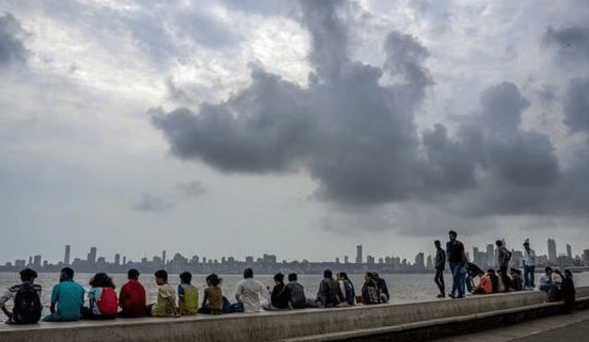
(Feature Image: People visit the seaside as dark clouds hover over the city, in Mumbai, Monday June 03. Image Credit: PTI/ Source: TNIE)
It is rather rare when we find anything in media about celebrating our monsoons. We find this week more than one piece about such celebration in various ways including through creating works like Bollywood songs and poetry in various languages of India.
In a detailed article famous Bollywood related author Jerry Pinto writes about the fascinating Bollywood songs related to monsoon and their picturization. He writes that the great tradition seems to be fading out, but hopefully that will not be the case. Incidentally the article should have mentioned the name of one of the best lyricist, author and film maker, Gulzar, who has shown more love for monsoon that possibly anyone else in Bollywood.
The collection of monsoon related poetry from various languages in India along with their English translation also makes fascinating reading. Thanks, https://questionofcities.org! One hopes this celebration continues and grows among all the media.
Incidentally there is also a rather touching poem in Hindi (along with English translation and rendition in both languages) this week from PARI (People’s Archives of Rural India) about the impact of warming climate on farmers.
Bollywood rain songs FASCINATING For decades, mainstream Hindi cinema romanced the rain with songs. From the quintessential Pyar hua ikraar hua and semi-classical Barkha bahar aaye to numbers with coy heroines, suggestive frames, the mischief of Kishore Kumar in Ek Ladki Bheegi Bhaagi si, and Ghanana ghanana, rain songs became a part of our interior landscape, antaraakaash. The city was often the backdrop; Rhimjhim gire saawan casually showed south Mumbai’s landmarks. Love and rain gave us the chance to re-enter the magic but today’s cinema has little use for rain songs, perhaps all for the better, as millions struggle without water. https://questionofcities.org/saavan-ka-kya-thikana-bollywood-rain-songs-fade-out/ (12 July 2024)
Monsoon’s many languages The monsoon lends itself to poetry and rhyme. But how to capture its majesty, its melancholy, its morbidity in a few lines? Which language captures the different rhythms of rain, from the gentle and soothing needed in overheated cities to the crescendo of a rumble and roar? In this curation, not an exhaustive list, Question of Cities invited poets to write and reached out to litterateurs, translators and others to share their work or selections. https://questionofcities.org/verse-on-water-monsoons-many-languages/ (12 July 2024)
EDIT What city can do to avoid monsoon mayhem Time was when the monsoon brought a lot of joy and exhilaration in cities. The season was a part of the rhythm of life and monsoon troubles were fewer before it evoked that sinking feeling, anxiety, and, for a few, death too. Monsoon in cities forces us to struggle with flooded roads, landslides, disruptions, lack of credible information and protocols, leaving us with no will or space to find joy and exhilaration but, as climate change intensifies rain over shorter periods of time, governments will be forced to pay attention to how cities are built to accommodate it so that we can reclaim some of the monsoon magic. https://questionofcities.org/from-monsoon-magic-to-mayhem-and-what-cities-can-do-about-it/ (12 July 2024)
PARI From the drought land A poet (Seraj Mirajuddin) writes about the farmers across central India dealing with extreme weather conditions as strong heat wave sweeps through the northern part of the country this year. https://ruralindiaonline.org/en/articles/from-the-drought-land/
HYDRO POWER PROJECTS
SANDRP Blog Damages at Luhri-I HEP Reveals Loopholes in Dam Safety Act The floods & land sinking incidents affecting Luhri-I HEP work exposes loopholes in DSA 2021 apart from revealing shortcomings in SJVNL monitoring plan & SDMA’s disaster management policy as all of them lack clear directions to address safety threats impacting under construction dams & hydro projects.

There is absence of inter project coordination within SJVNL & doubt arises if SJVNL has EWS for Nathpa Jakhri and Rampur HEPs. The SJVNL & SDMA must also put all information related to EWS, Disaster Management and safety measures promptly in the public domain. https://sandrp.in/2024/07/13/himachal-pradesh-damages-at-luhri-i-hep-reveals-loopholes-in-dam-safety-act/ (13 July 2024)
Sujata Ism on FB post Comment: -Seems, I don’t understand why our government is stressing on HEPs in such a way that construction of back to back hydro projects on the fragile ecology of Himalayas, coupled with irregular pattern of rain and snowfall along with human interference like dumping garbage into the river, all of these have a cumulative effect on the river, amount of energy output and also sustainability of the projects. Why are these projects being pushed so hard ignoring all concerned opinions and expertise?
Himachal Pradesh CS seeks exemption to push SHEP A special consultation meet of stakeholders was organised on July 12 to deliberate upon the draft National Small Hydropower Policy, 2024. Secretary, ministry of new and renewable energy, Bhupinder S Bhalla said it was the preliminary meeting held to discuss the bottlenecks and take views of and deliberate with the independent power producers (IPPs) and representatives of the ministry of forests and climate change for setting up the small hydro projects – 5 MW to 25 MW – in the country. He said the ministry of new and renewable energy was working towards achieving 500 GW of installed electric capacity from non-fossil sources by 2030. So far, a total of 201.8 Giga Watt of non-fossil capacity has been installed in the country, Bhalla added.
– Himachal Pradesh chief secretary Prabodh Saxena said the state had made a remarkable advancement in hydel generation. The small hydro projects need to be given a boost, he said. Saxena mentioned that hydro projects up to 10 MW were exempted from the catchment area treatment plan and this limit needed to be enhanced up to 25 MW. He said the identified potential of small hydro projects so far was 3850 MW and the state had allotted 880 small hydro projects of 2,950-MW capacity. Out of these, 150 projects with a combined capacity of 783 MW have been commissioned, said the chief secretary. Additionally, 43 projects with a capacity of 120 MW are under construction, whereas 189 projects totaling 1,005 MW were at various stages of clearance. https://timesofindia.indiatimes.com/city/shimla/push-for-small-hydro-power-projects-cs-seeks-exemption/articleshow/111701856.cms (13 July 2024)
Inspect hydro projects twice a month: DC Shimla Deputy Commissioner Anupam Kashyap here today directed Subdivisional Magistrates (SDMs) to mandatorily inspect the hydro projects operating in their respective areas twice a month and ensure that a monthly report was sent to his office. He said this during a review meeting held at Bachat Bhawan regarding the safety standards of the hydro projects operating in the district. Kashyap said it was crucial to comply with the safety standards in all the operational hydro projects in the district. https://www.tribuneindia.com/news/himachal/inspect-hydro-projects-twice-a-month-dc-637975 (09 July 2024)
Arunachal Pradesh Why residents oppose surveys for a mega dam On June 22, the Upper Siang district administration convened a meeting with panchayat members and headmen of 12 villages. All of the villages stand to be affected by a proposed hydroelectric power project on the river Siang, which has been fiercely resisted by residents of the area for years now. The meeting was meant to “generate awareness” about the benefits of the NHPC’s 10,000 MW Upper Siang Multipurpose Storage Project and the administration’s decision to take up pre-feasibility surveys to prepare the ground for the project. Deputy commissioner Hage Lailang appealed to the village representatives to cooperate with the government and district administration and allow a pre-feasibility survey for “national interest” and “area development”. However, representatives from the project-affected villages vehemently expressed their opposition to the dam. “The deputy commissioner of Siang asked us not to oppose the dam,” Tarok Siram, the headman of Parong village. “I told him to take the opinion of 116 families in my village. I pointed out that the homes of 43 families will be under water if the dam is built here. The remaining families will have to be relocated.”
– The report said the proposed dam will act as a “flood cushion” in case of sudden release of flood due to any breach in storage in China. However, activists remain sceptical about such a claim. “Governments always make tall claims about future projects,” said Himanshu Thakkar of the South Asia Network on Dams, Rivers and People (SANDRP). “How true the claims are depend on a large number of factors, including how the project is operated. Their track record is abysmal.” https://scroll.in/article/1070339/why-arunachal-pradesh-residents-are-stalling-surveys-for-a-mega-dam (09 July 2024)
Orgs write to Centre, opposing 11,000 Mw project on Siang The Siang Indigenous Farmers Forum, the Dibang Resistance, and the North East Human Rights in a representation to the minister said that, instead of mega projects, the Indian government should explore alternative energy solutions that align with the state’s unique ecological context.
The organisations reminded the government that the Teesta dam breakage in Sikkim on 4 October, 2023 serves as a stark reminder of the potential risks associated with large-scale hydroelectric projects. They also reminded the government of the negligence of the National Hydroelectric Power Corporation.
While calling for a dialogue, the organisations said that they are “deeply concerned about the 11,000 MW Upper Siang multipurpose storage project as being considered of national importance that could imply that none of the environmental concerns matters to the government of India.” https://arunachaltimes.in/index.php/2024/07/09/orgs-write-to-centre-opposing-11000-mw-project-on-siang/ (08 July 2024)
Breaking ice on Siang project Opposition to the proposed 11,000 megawatt Siang multipurpose storage project by several organisations in Arunachal Pradesh has revived the issue of the downstream impact of mega dams in the state. Ecological concern over the mega dam project in ecologically fragile Arunachal Pradesh is real and cannot be overlooked. Heavy landslides triggered by heavy monsoon rain disrupting surface communications in seven districts of the state, including Siang, East Siang, West Siang, and Upper Siang, show that such concern is legitimate. https://www.sentinelassam.com/more-news/editorial/breaking-the-ice-on-siang-project (10 Jul 2024)
Activists raise concerns over major dam push The Union power ministry needs to reconsider its stance on pushing for more dams on rivers and boosting hydropower capacity in Arunachal Pradesh, civil society groups such as Siang Indigenous Farmers Forum, Dibang Resistance and North East Human Rights urged on Monday (July 08). They expressed concern about the 11,000 MW Upper Siang Multipurpose Storage project in the light of its possible adverse environmental repercussions. Anti-dam activist and lawyer Ebo Mili was detained on Monday (July 08) in view of power minister ML Khattar’s visit to Itanagar, some alleged, declining to be named. https://www.hindustantimes.com/india-news/activists-raise-concerns-over-major-dam-push-in-arunachal-pradesh-101720462820359.html (09 July 2024)
Arrest of activists a violation of tribal rights The day-long detainment of two anti-dam activists on Monday, July 8, in Itanagar, was equivalent to harassment and a violation of the democratic rights of indigenous communities, said several environmental and human rights organisations. The state police arrested lawyer and anti-dam activist Ebo Mili and convenor of the Siang Indigenous Farmers’ Forum Dugge Apang on July 8, claiming that they were likely to cause a “public order issue”. The two activists were later released on the same day after signing a bond that they would not participate in activities for the next year that might ‘breach the peace’.
The activists, incidentally, were hoping to organise a peaceful demonstration in the city on July 8 and meet Union power minister Manohar Lal Khattar in person and hand over a memorandum at the Itanagar secretariat, for which they were in the process of taking necessary permissions from the deputy commissioner. Khattar was in the city to review hydropower projects with state government officials, including the controversial 11,000-megawatt Upper Siang multipurpose power project. https://thewire.in/rights/arrest-of-anti-dam-activists-in-arunachal-a-violation-of-rights-of-indigenous-communities (09 July 2024)
Two anti-mega dam activists, Ebo Mili and Dungge Apang, were detained on July 8, ahead of Union Power Minister Manohar Lal Khattar’s visit to the Northeastern state. The duo were supposed to hand over a memorandum to Khattar at the Itanagar Secretariat, according to the Siang Indigenous Farmer’s Forum (SIFF). However, before that meeting, Itanagar Police summoned them to a police station in the state capital and detained them. https://www.downtoearth.org.in/dams/arunachal-anti-dam-activists-detained-ahead-of-union-ministers-visit (08 July 2024)
Study Estimation of bed material transport in gravel-bed streams This study focuses on evaluating the sediment mobility and transport patterns in two Himalayan rivers (Aglar and Paligad Rivers) during monsoon and non-monsoon flows. The findings are particularly relevant for efficient river management as the region houses several hydropower plants and is highly vulnerable to climate change. https://onlinelibrary.wiley.com/doi/abs/10.1002/esp.5910 (23 June 2024)
MoEF NBWL to take 1st call on clearance to projects in protected area -In a shift from a decision in March, to consider projects requiring a wildlife nod only after the project has received a forest clearance, the Union ministry of environment , forests and climate change (MoEFCC) has issued a new sequence of priority: a nod from the standing committee of the National Board for Wildlife (SC-NBWL) is a pre-requisite for considering projects in protected areas further for a forest clearance.
To be sure, all project proponents can apply for all environmental clearances, including forest and wildlife simultaneously, on Union environment ministry’s Parivesh 2.0 website. Parivesh 2.0 is also integrated with the National Single Window System (NSWS) through which investors can apply for all relevant approvals.
The sequence of priority is only for decision making by officials on a particular project. The updated guideline was issued earlier this month. SC-NBWL is headed by the union environment minister, Bhupender Yadav.
“Almost all decisions of the Standing Committee to clear projects are not in compliance with Section 29 and Section 35(6) of Wildlife Protection Act which specifies that there shall be no destruction unless it is for the improvement and better management of wildlife. The grant of “in-principle” approval under the Adhiniyam for projects within and outside protected areas under the new guidelines issued, is a clear green flag for projects and thus renders the recommendation of the SC-NBWL a mere formality,” said Praveen Bhargav, Trustee – Wildlife First, Former Member – National Board for Wildlife adding that “NBWL has shockingly not convened since 2014.” Only its standing committee has met. https://www.hindustantimes.com/environment/wildlife-board-will-now-take-1st-call-on-clearance-to-projects-in-protected-area-moefcc-101720670979435.html (11 July 2024)
DAMS
Sardar Sarovar Project SSP backwater level is altered Himanshu Thakkar of SANDRP and an expert on dam management and rivers, says, “Neither is anybody’s responsibility fixed in this regard nor is there any regulation. Since there had been a lot of rain before the flood, action should have been taken accordingly. If the decision to release water was taken at the right time, the downstream could also have been saved from floods. Narmada was flooded due to the same reason in 2019 and again in 2023. Such a disaster could have been avoided.”
Thakkar told Mongabay India, “When a dam is built, it is said that it will manage floods, but this theory can be successful in practice only if it is managed keeping this objective in mind.”
Thakkar believes that the dam can be filled completely only when the monsoon season is coming to an end. They say that the end of September is considered the end of monsoon, but over the years it has been observed that there has been a change in the monsoon pattern. It rains till mid-October and sometimes even after that. Therefore, this change will have to be taken into account in the management of dams.
He explains that every dam has a rule curve which decides how much water will be filled in the dam on which date. The rule curve should be reviewed in three to five years and the inflow pattern of the dam should be changed accordingly. They also emphasise that every year, there should be an integrated rule curve of the river basin as silt gets accumulated in the dams. This is especially important given that new dams are being built in the basin. However, at present, the rule curve is not being followed by any dam, and neither is it being operated accordingly.
On the question of determining the backwater level, Thakkar says: “There are very few independent technical experts in our country and their arguments are not accepted even by the courts and most of the academic research institutes here are either directly funded by the government or in some way supported by them. I feel that because of this, nothing could be done regarding the questions raised on the change in backwater level.” https://india.mongabay.com/2024/07/lives-of-thousands-of-families-hang-in-the-balance-as-the-water-level-of-sardar-sarovar-dam-is-altered/ (09 July 2024)
The Villages That Were Submerged Due to PM Modi’s Birthday. https://www.youtube.com/watch?v=uYysHwsCSs0 (13 July 2024)
Pay for canal land in 6 monhs: HC A bench of the Gujarat High Court, comprising chief justice Sunita Agrawal and justice Pranav Trivedi, has ordered the state government to pay compensation to the land owners whose land was acquired in 2011 for Narmada Canal in Kutch, Banaskantha and Patan districts. https://www.ahmedabadmirror.com/pay-for-canal-land-in-six-months-hc/81871153.html#goog_rewarded (11 July 2024)
Kaleshwaram Project Medigadda permanent repairs likely to be done after Jan 2025 After carrying out minor repairs by removing crest gates of Medigadda barrage as temporary measures to allow water flow, the investigations and permanent measures may take several months from now. The investigations have to be carried out to find out the exact reasons for sinking of piers of piers of Medigadda by various central agencies. Unless reasons for sinking of piers are known, the irrigation department cannot go ahead with the repair works.
Core cutting and other investigations have hit hurdles due to various factors like water inflows, drilling has become a problem due to sand settling and water from the ground and also issues in secant piles. Sources in the govt said they have asked the investigating agencies to give interim reports on the reasons and also on the quality of the construction, but the repairs can be taken up only if water recedes in the barrages, that means, permanent repairs can be taken up only after January next year. https://timesofindia.indiatimes.com/city/hyderabad/medigadda-barrage-repairs-delayed-until-january-2025/articleshow/111700887.cms (13 July 2024)
Polavaram Project Return of villages a betrayal: Experts -During the talks held between the Chief Ministers of AP and Telangana in Hyderabad on Jul 6 to resolve the long-pending bifurcation issues between the two sibling States, Chief Minister N Chandrababu Naidu is said to have agreed in principle to the proposal for re-merger of five villages near Bhadrachalam with Telangana. They include Yetapaka, Gundala, Pichukalapadu, Kannaigudem and Purushothapatnam.
“It is a foolish and unwise decision, if it is true as there is a possibility of creating hurdles to the Polavaram Irrigation Project on the pretext of submergence of these five villages in the future,” opined the irrigation experts. https://www.newindianexpress.com/states/andhra-pradesh/2024/Jul/08/return-of-villages-a-betrayal-of-polavaram-experts (08 July 2024)
Hirakud Dam Activists wants statutory national commission to hear grievances of displaced people Civil society members and activists met Odisha Governor Raghubar Das here on July 12 and urged him to take steps for setting up a statutory national commission to hear the grievances of displaced people. “Starting from the Hirakud dam project until today, around 45 per cent of displaced people have been rehabilitated or compensated. The remaining are still struggling to get their dues,” said activist Prafulla Samantara.
– A four-member delegation submitted a report on ‘Displacement and Human Rights Violations- The Odisha Story’ before the governor. It was prepared by the jury members headed by Manoranjan Mohanty, a retired professor of Delhi University, after conducting regional public hearings with displaced people of Odisha. In the recommendation part of the report, the jury members suggested forming a statutory body like the National Human Rights Commission (NHRC) to hear the grievances of displaced people. It can be called the National Commission on the Rights of Displaced People. https://timesofindia.indiatimes.com/city/bhubaneswar/activists-wants-statutory-national-commission-to-hear-grievances-of-displaced-people/articleshow/111696354.cms (12 July 2024)
Nod given to clear 1,524.17 ha of forest land for irrigation project MoEF has approved the diversion of 1,524.17 hectare of forest land for the construction of Brutanga irrigation project in Nayagarh district, officials said on Tuesday (July 09). As per the conditions set by the MoEF for the approval, the legal status of the diverted forest land shall remain unchanged. https://www.business-standard.com/india-news/odisha-gets-nod-to-clear-1-524-17-ha-of-forest-land-for-irrigation-project-124070900442_1.html (10 July 2024)
Karnataka Belagavi drinking water project raises MoEF’s eyebrows -In 2020, the state government sought permission to divert 575 hectares of forest land with 75,581 trees. More than 90 per cent of the forest land will be submerged under the backwaters of a reservoir of the proposed Ghatti Basavanna Drinking Water Project. The project seeks to draw 6 TMC water from Markandeya river for the benefit of about 7 lakh people in four towns and 131 villages. The deciduous forest hosts 66 species of trees and 16 species of fauna. The project site is located within 3 km distance from the eco-sensitive zone of the Ghataprabha Bird Sanctuary and 3.1 km from the boundary of the sanctuary.
-Looking into the Karnataka Neeravari Nigam Limited’s (KNNL) proposal, the MoEF&CC on June 10 flagged that many encroachments have been found in the area proposed for CA. “As per the discussions with field functionaries, about 100 hectares in is under encroachment,” it said in a letter last month, directing the state government to provide the balance area to take the application forward. But even before the project received approval, officials have taken up planting of saplings in the land proposed for CA.
-The Union ministry has also asked for clarification on how the government calls it a drinking water project as the project component includes drawing 0.50 TMC of water for industrial use. Further, the government has been asked to get approvals from the Central Water Commission and submit a rehabilitation plan for families affected by the project. Belagavi is characterised by extreme weather events, with half the district seeing drought while parts of Gokak get flooded during heavy rains. The dam is proposed as an answer to the problem of drought. https://www.deccanherald.com/india/karnataka/belagavi-drinking-water-project-raises-centre-s-eyebrows-3096156 (08 July 2024)
Meghalaya Umiam bridge retrofitting faces prolonged delays The Umiam bridge, a critical link for Meghalaya and the primary gateway to Shillong city, continues to face prolonged delays in its retrofitting and maintenance work. Initiated on December 14, 2023, based on recommendations from the Indian Institute of Technology-Guwahati, the repair efforts were initially slated for completion within 4-5 months. However, as of the first week of July, the project remains far from finished.
Originally targeted for completion by April 8, 2024, subsequent updates by Sanjay Goyal, CMD of MeECL, suggested a revised timeline extending possibly into May. Despite these adjustments, ongoing construction activities indicate a further delay, with no definitive confirmation of completion by the end of July. https://www.indiatodayne.in/meghalaya/story/meghalaya-umiam-bridge-retrofitting-faces-prolonged-delays-despite-initial-4-5-month-completion-target-1045231-2024-07-08 (08 July 2024)
INTERSTATE WATER DISPUTES
Cauvery Water Dispute Karnataka to release 8,000 cusecs of water daily to T.N. Karnataka on Sunday (July 13) decided to release Cauvery water at the rate of 8,000 cusecs daily to Tamil Nadu following a direction from the Cauvery Water Regulation Committee (CWRC); the panel had directed that the State release 1 tmcft (11,500 cusecs) of water. The State also decided to go on an appeal to the Cauvery Water Management Authority (CWMA) against the CWRC order.
“After a discussion at the all-party meeting and based on legal advice by advocates, it has been decided that water as per the [CWRC] direction can be released only after good rains. Otherwise, we will release only 8,000 cusecs. Besides, we will appeal against the CWRC order,” CM Siddaramaiah told presspersons here after chairing an all-party meeting that had been convened to decide the State’s next course of action. He insisted that the government’s decision should not be seen as “adamancy” on the part of Karnataka.
While Karnataka had appealed to the CWRC to wait till July 25 before deciding on water release, the committee had on July 11 directed Karnataka to ensure flow of 11,500 cusecs of water at Biligundlu daily from July 12 to July 31. The total outflow to Tamil Nadu should be 20 tmcft. of water in this period, the panel had said.
The CM said: “There is an indication from the Met department that the State will receive good rainfall between July 17 and July 24. In case there is more rainfall, we will release what has to be released and in case rainfall is reduced, we can cut down the water flow,” he added. Mr. Siddaramaiah also said that the July 12 meeting of Ministers and legislators from Cauvery basin had decided to not release water and convene an all-party meeting. https://www.thehindu.com/news/national/karnataka/state-to-release-8000-cusecs-of-water-daily-to-tn/article68403726.ece (14 July 2024)
Farmers stage demonstration in Thanjavur Members of various farmers’ associations staged demonstrations in Thanjavur on Saturday (July 13) condemning the Karnataka government for not releasing the Tamil Nadu’s due share of water in the Cauvery.
While members of the Farmers’ Association for Linking South Indian Rivers, led by their State President P. Ayyakannu, staged a demonstration near the District Collectorate on the Nagapattinam-Tiruchi Highway on the outskirts of Thanjavur town, members of various farmers’ associations took part in the demonstration organised by the Tamil Nadu Vivasayigal Sangam affiliated to the Communist Party of India (Marxist) near the “Aathupalam” junction in the town. https://www.thehindu.com/news/cities/Tiruchirapalli/farmers-stage-demonstration-in-thanjavur-demanding-cauvery-water/article68399767.ece (13 July 2024)
–Mahadayi Water Dispute A team from the Mahadayi River’s central authority, the Progressive River Authority for Water and Harmony (PRAWAH), visited Belagavi district on July 7, 2024, as part of a tour of the three states through which the river flows: Goa, Karnataka and Maharashtra. The visit has reopened conversations on a four-decade-old dispute between Karnataka and Goa about sharing the river. https://www.downtoearth.org.in/water/goa-karnataka-at-loggerheads-again-over-kalasa-banduri-project-as-central-body-inspects-mahadayi-basin (08 July 2024)
IRRIGATION
Madhya Pradesh 55 लाख का स्टॉपडैम मेंटेनेंस, 5 लाख भी खर्च नहीं-खंडवा के भंडारिया गांव में सिंचाई के हिसाब से सालों पहले आबना नदी पर स्टॉप डैम बनाया गया था। यह अब क्षतिग्रस्त होने की कगार पर आ गया। ऊंचाई कम होने से गर्मी के समय पानी भी नहीं रहता। आरईएस विभाग ने इस काम के लिए 55 लाख रुपए स्वीकृत कर दिए। बगैर टेंडर के यह काम विधायक के करीबी को दे दिया, जिसने भ्रष्टाचार करने में कोई कसर नहीं छोड़ी। भाजपा विधायक कंचन तनवे के करीबी ठेकेदार बलदेवसिंह मौर्य ने इस काम पर बमुश्किल 2-3 लाख रुपए खर्च किए होंगे।
पथरीले रास्तों पर नहाल्दा ग्राम पंचायत के भंडारिया गांव स्थित आबना नदी पर करीब 40 साल पुराना स्टॉप डैम बना हुआ है। कुछ समय पहले ही यहां सुधार कार्य किया गया था,। लेकिन, डैम पूरी तरह लीकेज हो रहा है। पत्थर की दीवार के नीचे से पानी बहकर निचले इलाके की तरफ बह रहा है। ग्रामीणों ने बताया कि यहां सिर्फ दो ट्रॉली मटेरियल और 20 बोरी सीमेंट में पूरा काम कर दिया गया है, जबकि मेंटेनेंस के लिए आरईएस विभाग ने 55 लाख 38 हजार रुपए की राशि स्वीकृत की थी। मौके पर देखा तो पता चला कि ठेकेदार ने 1% काम भी नहीं किया। https://www.bhaskar.com/local/mp/khandwa/news/stopdam-maintenance-of-55-lakhs-not-even-5-lakhs-spent-133304347.html (12 July 2024)
URBAN RIVERS
Sabarmati; Ahmedabad HC pulls up AMC over false records about STPs The Gujarat high court on July 8 lambasted the Ahmedabad Municipal Commission (AMC) over putting false records about STPs in its affidavit and observed that the court is doing the work that the AMC commissioner is supposed to do. Acting on a suo motu PIL, the division bench of chief Justice Sunita Agrawal and Justice Vaibhavi Nanavati expressed its displeasure over the AMC’s work on Sabarmati pollution issue. Amicus curie of the case Hemang Raval said that AMC had filed a false affidavit claiming 100% compliance of STPs which was exposed by a report of the Gujarat Pollution Control Board (GPCB).
– Citing the GPCB report, the court observed that it showed that two STPs of Vasna and Pirana were in extremely poor condition and most of the STPs were non-compliant. “You did not mention anything about STPs in your affidavit, you are silent on this issue,” observed the court for the AMC commissioner. Sewage water should go to STPs but is being bypassed directly into the river, observed the court. The court, while reprimanding the AMC commissioner, said, “You are giving false figures, stop misleading the court, accept your mistake. Give us performance, not assurances. We have to take your class every time.”
– On the poor conditions of the STP, the court said that those STPs are not in good condition, which is why the civic body is bypassing the sewage water in the river. “How will you stop the bypassing of sewage water? If you stop, your STPs are not in good condition, so what will you do,” asked the court, adding that there will be sewage water flooding Ahmedabad streets, waterlogging occurs even with one day of heavy rain. Next hearing on Aug 8. https://timesofindia.indiatimes.com/city/ahmedabad/gujarat-high-court-slams-amc-for-false-stp-records/articleshow/111589845.cms (09 July 2024)
AMC to lease RFD land with & without development right The Sabarmati Riverfront Development Corporation Ltd (SRFDCL) has identified land on both the west and east banks for the purpose. Initially, Expressions of Interest (EoI) for three land parcels will be invited within a week. The vision is to promote development of commercial highrises along the riverfront. Notably, the 10.5-km stretch of the Ashram Road, a major portion of which runs along the riverfront, has already been declared a Central Business District with higher FSI norms. The state government has approved the Sabarmati Riverfront Land Disposal Policy 2024. As per the policy, seven value zones have been identified on the Riverfront, and the lease and development prices have been finalised accordingly. https://www.ahmedabadmirror.com/sabarmati-riverfront-land-disposal-policy-2024/81871142.html (10 July 2024)
Mutha; Pune Geological Gems: Discovering Potholes of River’s Bed -The 20 sqmt section of the Mutha’s riverbed showcases shallow depressions, a testament to the force with which the river once flowed. Geomorphologists explain that these potholes are formed over decades as fast-flowing water scours basalt bedrock, carving out circular erosional features. Similar formations are found in nearby rivers like the Indrayani, but the Mutha’s are particularly pronounced. https://www.mypunepulse.com/punes-geological-gems-discovering-potholes-of-mutha-rivers-bed/ (05 July 2024)
Hyderabad ‘High antimicrobial resistance in city sewage’ A recent study by city-based Indian Institute of Chemical Technology (IICT) has uncovered alarming levels of antimicrobial resistance (AMR) in sewage in Hyderabad, particularly in winter. The study, which was conducted in Tarnaka, Habsiguda and Lalaguda areas, has highlighted serious health implications. The random consumption of antibiotics and discharge of untreated wastewater into environment were key factors in proliferation of antibiotic resistance genes (ARGs). https://timesofindia.indiatimes.com/city/hyderabad/high-antimicrobial-resistance-in-city-sewage-study-reveals-alarming-levels/articleshow/111617876.cms (10 July 2024)
RIVERS
Rajasthan The joy and tragedies of River Luni This article is written by Saurav Vaishnav & Vandita Sariya, based on their experiences from walking along River Luni as part of our Moving Upstream: Luni Fellowship program.

The Luni is a dry, sandy, non-perennial river. To appreciate its beauty, significance and influence, one has to be truly observant. Walking provides this opportunity. Even now, it seems like if we were to do the same walk again, in the same stretch, we’d find wholly new things. https://veditum.org/2024/07/11/the-joy-and-tragedies-of-river-luni-samdhari-pichiyak/ (11 July 2024)
Meghalaya Villagers protest new landfill site in Nonghali At least 15 villages near the Umkhen River are opposing the state government’s plan to set up a new landfill site at Lumsohlait in Nonghali, East Khasi Hills district. They fear the landfill will pollute the river, which is a vital source of water for the communities.
-A public meeting organized by the Synjuk Nongsynshar Shnong Par Umkhen (SNSPU) on Saturday (July 06) saw residents from all three affected districts – East Khasi Hills, Ri Bhoi, and West Jaintia Hills – come together. The group plans to send petitions to the Deputy Chief Minister, who is also the Urban Affairs Minister, and the Khasi Hills Autonomous District Council.
-They aimed to express their opposition to the project and request proper consultation before any decisions are made. The villagers are prepared to take more drastic steps if the government pushes forward with the plan without addressing their concerns. The residents worry that the landfill will be similar to the existing one at Wahumkhrah, which has caused significant pollution. They are demanding the government consider alternative solutions. https://nenow.in/north-east-news/meghalaya/meghalaya-villagers-protest-new-landfill-site-in-nonghali.html (08 July 2024)
Arunachal Pradesh Over 25K kgs of garbage cleared from river On July 13 over 25,000 kilograms of garbage were removed from the Pane Korong River in Banskota area here in East Siang district in a massive cleanup drive. The initiative was spearheaded by the Youth Mission for Clean River (YMCR) and the Rengging Baane Yameng Kebang (RBYK), and saw active participation of over 150 volunteers. https://arunachaltimes.in/index.php/2024/07/14/over-25000-kgs-of-garbage-cleared-from-river/ (14 July 2024)
SUTLEJ Himachal Pradesh Construction of dams has turned river into rivulet: SC Judge -Speaking at the launch of a book titled “Climate Change: The Policy, Law and Practice” by lawyer Jatinder (Jay) Cheema on Friday (July 12), Supreme Court judge Justice Sanjay Karol said the construction of dams on the Sutlej has turned the trans-Himalayan river into a rivulet, altering the entire ecosystem and eco chain.
-Justice Karol said successive governments have spent Rs 30,000 crore on cleaning the Ganga. “We know the current state. We have all seen it. A lot more needs to be done on this issue. The famous Gangetic River dolphins, unfortunately, are nowhere to be seen.” He added that farming has suffered due to the erosion of climate stability over the years. https://www.telegraphindia.com/india/construction-of-dams-have-turned-sutlej-into-rivulet-supreme-court-judge-justice-sanjay-karol/cid/2033472 (13 July 2024)
Snow cover four river basins declines by 12.7% There has been an average decline of 12.72 per cent in the snow cover in the river basins of the Chenab, Ravi, Beas and the Sutlej in the Himalayas during 2023-24 as compared to a decline of 14.05 per cent during the last winter. The findings are based on the satellite imagery studies undertaken by the State Centre on Climate Change under the aegis of the HP Council for Science Technology and Environment (HIMCOSTE). As per the studies to assess the winter precipitation in the form of snow, the maximum decline of 15.39 per cent this winter was witnessed in the Chenab basin, followed by 12.45 per cent in the Sutlej basin, 9.89 per cent in the Ravi basin and 7.65 % in the Beas basin.
What is worrisome is the highest decline in the snow cover in January; the dip was 67 per cent in the Sutlej basin, 64 per cent in the Ravi basin, 43 per cent in the Beas basin and 42 per cent in the Chenab basin, as compared to the previous year’s winter. The snow cover in February and March showed a positive trend in all basins.
About one third of the total geographical area of Himachal remains under a thick snow cover during the winter season and the major rivers like the Chenab, Beas, Parvati, Baspa, Spiti, Ravi, Sutlej and its perennial tributaries originating from the Himalayas depend upon the seasonal snow cover for their discharge dependability. https://www.tribuneindia.com/news/himachal/snow-cover-in-himachals-four-river-basins-declines-by-12-7-638990 (12 July 2024)
GANGA Uttarakhand Desecrating Himalayas in name of ‘Spiritual Tourism’ ‘Spiritual’ tourism is a dangerous oxymoron. ‘Spiritual’ tourists dump an estimated 10,000 kilograms of garbage every day in each of the dhaams; ‘spiritual’ tourists defecate along the road and the Ganga banks; ‘spiritual’ tourists throw whisky bottles and styrofoam plates out of moving cars; and they also deem it their right to blare loud music and undress for selfies with the mountains and shrines as backdrop. And it is ‘spiritual’ tourists who blare pressure horns and race, raising a whirlwind of dust, amidst the pine, the silver oak and the stunned animals of the mountains. What is spiritual in this desecration and selling out of the Himalaya? https://thewire.in/environment/chardhaam-spiritual-tourism-himalayas (13 July 2024)
Landslide blocks Badrinath NH, over 200 roads closed A major landslide occurred along the Badrinath National Highway in Chamoli district on Jul 9, blocking the crucial route. It happened just 1km before Joshimath town which had previously been affected by subsidence issues. The landslide has made Badrinath inaccessible to pilgrims, as this is the only road leading to the Himalayan shrine, located approximately 45km away. This incident follows the death of two pilgrims from Hyderabad in a landslide on Jul 5, as they were crushed under falling boulders near Karnaprayag in Chamoli dist. https://timesofindia.indiatimes.com/city/dehradun/landslide-blocks-badrinath-highway-over-200-roads-closed/articleshow/111619358.cms (10 July 2024)
Landslides block highways to Adi Kailash, Badrinath & Yamunotri Heavy rainfall continued to cause widespread disruption across Uttarakhand, particularly in hill areas where landslides had blocked multiple highways. On Wednesday (July 03), a massive landslide at Raongti Nala on the Dharchula-Lipulekh highway cut off 30 villages in the Darma, Chaudas, and Byas valleys from the rest of the state. The same highway also leads to Adi Kailash and the landslide cut off the way to the peak. In Pithoragarh, 21 roads remained blocked due to rain-triggered landslides, according to the district’s disaster emergency operation centre. The Badrinath and Yamunotri highways were blocked by landslides at Pagal Nala near Lambagad in Chamoli and near Dabarkot in Uttarkashi, respectively. One person was killed and another injured after the bike they were riding was hit by a landslide near Nandkesari in Chamoli district on Wednesday (July 03). https://timesofindia.indiatimes.com/city/dehradun/landslides-block-highways-to-adi-kailash-badrinath-yamunotri/articleshow/111475154.cms (04 July 2024)
Bihar Bridge Collapse: NHAI team of design experts set up The National Highways Authority of India (NHAI) has constituted a team of experts to review of all decisions related to blueprints. The possibilities to form a ‘design division’ were discussed during the executive committee meeting held last month after which the agency initiated the hiring process. The team of 9 experts will have a bridge or structural engineer, hydrology experts, geologist and quantity surveyor.
Dam on Nepal border: Union minister of state for Jal Shakti Raj Bhsuhan Choudhary said that a high dam would be built on India-Nepal border to check flood situation in Bihar. “North Bihar region witnesses floods due to heavy discharge of water from Nepal,” he said. https://www.newindianexpress.com/nation/2024/Jul/10/amid-bridge-collapses-in-bihar-nhai-team-of-design-experts-set-up (10 July 2024)
Govt rolls out bridge maintenance policy The collapse of 18 bridges in the last two years — 12 of them in the last 20 days — has prompted the Bihar govt to roll out its bridge maintenance policy, in the works for the last 10 years. https://indianexpress.com/article/cities/lucknow/bihar-bridge-collapse-maintenance-policy-9441416/ (09 July 2024)
13th bridge collapsed in 3 weeks -Bihar witnessed another bridge collapse on Wednesday (July 10), making it the 13th such incident in the state in a span of three weeks, an official said. The bridge collapsed at Mahishi village in Saharsa district earlier in the day, he said. It might be a small bridge or causeway. District officials have left for the spot. We are trying to gather more information about the incident, Additional Collector (Saharsa), Jyoti Kumar, said. https://www.business-standard.com/india-news/another-bridge-collapses-in-bihar-13th-such-mishap-in-three-weeks-124071000599_1.html (10 July 2024)
अब सहरसा में गिरी पुलिया -बलिया सिमर के पास पुलिया बनायी गई थी। यह पुलिया कोसी नदी का तेज बहाव नहीं झेल पाई। गनीमत रही कि इस दौरान पुलिया से कोई आवागमन नहीं कर रहा था नहीं तो किसी बड़े हादसे से इनकार नहीं किया जा सकता था। पुलिया के ध्वस्त होने से ग्रामीणों का मुख्य सम्पर्क टूटू गया है। इससे लोगों को भारी परेशानी का सामना करना पड़ रहा है। पुलिया के ध्वस्त होने के बाद अधिकरियों की टीम मौके पर पहुंच कर जायजा ले रही है। लोगों ने बताया कि महिषी प्रखंड क्षेत्र और नवहट्टा प्रखंड क्षेत्र के बांध के अंदर का दुरूह क्षेत्र जाने का यह मुख्य मार्ग था। इसके ध्वस्त होने से लोगो का जनजीवन प्रभावित हो गया है। https://www.amarujala.com/bihar/bihar-news-another-bihar-bridge-collapsed-in-bihar-saharsa-mahishi-small-bridge-collapse-in-bihar-2024-07-10 (10 July 2024)
Another bridge reportedly collapsed in Gaya on Monday, July 15, which was built over Gulskari River. This bridge provided a crucial link between Bhagwati village and Sharma village, connecting the two. Its collapse left the villagers disappointed. They mentioned that students used the bridge to commute to their schools. https://www.livemint.com/news/bihar-bridge-collapse-gulskari-river-in-gaya-built-over-gulskari-river-bhagwati-village-sharma-village-nitish-kumar-11721026098145.html (15 July 2024)
Factors contributing to these premature collapses include substandard materials, lack of skilled labor, desilting of rivers, corruption, and inadequate project management. The consequences of such failures are profound, leading to financial losses, delays in crucial connectivity projects, and, most importantly, potential loss of life. Addressing this issue requires stringent regulatory measures, transparent auditing processes, and a commitment to enhancing the overall standards of construction to ensure the safety and reliability of Bihar’s infrastructure. https://www.financialexpress.com/india-news/a-brief-history-of-bihar-bridge-collapses/3549514/ (10 July 2024)
At least three major factors are visible. First, the Government and its bureaucratic structures do not have adequate domain expertise on contract management and, therefore, gets a peripheral treatment in their priorities. Second, there is hardly any institution of repute in India that attempt to bridge the knowledge gap on contract management. Some IIMs do have capsule courses for Government officers but they do not cater to day-to-day problems faced in contract management. Third, the project monitoring committees (PMCs) are largely paper tigers, particularly in states. The PMCs are vital in keeping a regular control over the project progression. Yet, they seldom meet and when they do, they are mostly protocol-conscious with little space for free discussion.
Issues like structural audit of the roads and bridges need to be done at every stage of the contract but they remain neglected. While the investigations into the recent collapses may take time, it seems that in most cases, bridge collapses may have taken place due to sub-standard materials. In some cases, faulty designs may have been responsible. These issues can easily be rectified through vigilant and continuous contract monitoring. https://www.moneycontrol.com/news/opinion/bihar-bridge-collapses-call-to-improve-contract-management-for-infrastructure-projects-12767429.html (12 July 2024)
YAMUNA Agra NGT fines MoJS, CWC for floodplain oversight The NGT has fined the ministry of jal shakti and the Central Water Commission (CWC) Rs 50,000 each for neglecting the demarcation of the Yamuna floodplain in Agra. The bodies have been directed to pay the penalty before the next hearing on Aug 6. This action stems from the NGT taking suo motu cognisance of a TOI report. The hearing, held on Jul 11, was overseen by NGT bench members Justice Sudhir Agarwal and expert member Afroz Ahmad. Dr Sharad Gupta raised the issue of extensive illegal mining destroying sand dunes and ravines near the Taj Mahal and within the restricted floodplain zone of the Yamuna through a letter suo moto petition. This was based on a TOI report on Mar 6, 2022. https://timesofindia.indiatimes.com/city/agra/ngt-fines-jal-shakti-ministry-cwc-for-yamuna-floodplain-oversight-in-agra/articleshow/111723187.cms (14 July 202)
मुजफ्फरनगर:- यूपीपीसीबी ने हिंडन नदी को प्रदूषित करने वाली पश्चिम यूपी की 55 और जिले की नौ फैक्टरियों पर शिकंजा कसा है। प्रदूषण फैला रहे उद्योगों के खिलाफ लखनऊ के स्पेशल ज्यूडिशियल मजिस्ट्रेट कोर्ट में वाद दायर किया गया है। क्षेत्रीय प्रदूषण नियंत्रण अधिकारी अंकित सिंह ने बताया कि संबंधित इकाइयों ने नियमों का उल्लंघन किया है।
प्रदूषण फैलाने के मामले में एनजीटी में सुनवाई चल रही है। जिन उद्योगों पर वाद दायर कराया गया है, उनमें चौधरी क्रिएशंस शेरनगर, एडब्ल्यूएफ कलेक्शन शेरनगर, भोपा रोड की सिल्वरटेन पेपर मिल, बिंदलास पेपर मिल, अल्पना पेपर मिल, सिल्वर टेन पेपर, जीनियर पेपर, जानसठ रोड स्थित गुलशन फैक्टरी, त्रिवेणी इंजीनियरिंग शामिल है। इन उद्योगों से बिना शोधित किए गंदे पानी को हिंडन नदी में प्रवाहित किया जा रहा था। नगर निकाय और उद्योग अपने यहां का गंदा पानी उचित ढंग से बिना शोधित किए हिंडन नदी में छोड़ रहे हैं। क्षेत्रीय प्रदूषण नियंत्रण अधिकारी अंकित सिंह ने बताया कि उद्योगों को नोटिस जारी किए गए थे। https://www.amarujala.com/uttar-pradesh/muzaffarnagar/lawsuit-against-55-industries-of-western-up-polluting-hindon-muzaffarnagar-news-c-29-1-mng1001-126020-2024-07-13 (13 July 2024)
Delhi A year of 2023 floods Activists, meanwhile, say it is important that the Yamuna and its floodplains get protection. “People may ask for embankments, but it is the floodplains that need protection first. The more floodplains get occupied, the greater the chances of floods impacting settlements. Over time, due to constructions and encroachments, the path of the river has become narrow and when it floods, it reclaims its original path, where these settlements have come up,” said Bhim Singh Rawat, who is a member of the SANDRP. https://www.hindustantimes.com/cities/delhi-news/a-year-on-memories-of-2023-floods-linger-101720807666995.html (14 July 2024)
Noida Residents remember 2023 floods The flood displaced around 3,700 people from 18 villages and damaged nearly 1,590 hectares of land along the Hindon and Yamuna floodplains. A year later, villagers still remember how the floodwaters caught them unawares around midnight and destroyed almost all their possessions. But with scant rainfall in their catchment areas since the onset of monsoon this year, the two rivers look little more than a stream now. https://timesofindia.indiatimes.com/city/noida/year-after-monsoon-floods-villagers-in-noida-still-fear-recurrence/articleshow/111721403.cms (13 July 2024)
RIVERS BIODIVERSITY
Uttar Pradesh NGT takes cognisance of declining fish in Yamuna, threat to Dolphins in Ganga In two separate suo motu cases, the NGT has taken cognizance of the threat to dolphins in Ganga river and the decrease in the Indian fish population coupled with an increase in the foreign fish population in Yamuna river. Chairperson Justice Prakash Shrivastava, judicial member Justice Arun Kumar Tyagi and expert member Dr A Senthil Vel observed that both issues indicated violations of Water (Prevention and Control of Pollution) Act and the Environment Protection Act.
-Accordingly, it issued notice to the Central Pollution Control Board (CPCB), MoEFCC, CIFRI and the District Collector of Agra in the matter related to fish population in Yamuna, which will be heard further on September 20. In the matter related to threat to Gangetic dolphin, notice was issued to Wildlife Institute of India (WII), National Mission for Clean Ganga (NMCG) and CPCB. The matter will be heard next on September 24. https://www.barandbench.com/news/ngt-takes-cognisance-declining-indian-fish-population-yamuna-threat-dolphins-ganga (09 July 2024)
FISH, FISHERIES, FISHERFOLKS
Kerala Mass fish kill in Periyar attributed to industrial pollution Kerala: -The Periyar river witnessed a severe fish mortality event in May, due to which fishers and cage fish farmers incurred heavy financial losses. The fish mortality was caused by the opening of the gates at the Pathalam regulator-bridge upstream, leading to the release of polluted water. The discharged water contained toxic substances which reduced oxygen levels in the water, leading to a significant number of fish dying downstream. https://india.mongabay.com/2024/07/massive-fish-kill-in-periyar-river-attributed-to-industrial-pollution/ (11 July 2024)
SAND MINING
Arunachal Pradesh Villagers demand ban on quarrying in Siku riverbed The Mebo Dolung Yameng Kebang (MDYK) on Monday (July 08) staged a protest in front of the East Siang DC office here, demanding a complete ban on quarrying activities in Siku riverbed in Mebo reserve forest. The protesters said that collection of boulders and minor minerals from the Siku riverbed has been responsible for frequent change of the river’s course, causing massive soil erosion on its right bank every year. They said that the local villagers had donated their lands for creation of the reserve forest to protect environmental degradation. https://arunachaltimes.in/index.php/2024/07/10/villagers-demand-ban-on-quarrying-in-siku-riverbed (10 July 2024)
Odisha NGT seeks govt reply on plea against auction of sand bed The NGT on Jul 8 sought the state govt’s response on a plea seeking intervention against an auction notice issued for 5-year lease of a sand bed in the Budhabalang river in Mayurbhanj dist. NGT was hearing a plea which underlined that the district survey report (DSR) is mandatory before granting any mining lease or issuing tender & in their absence, the auction notice issued on Jun 20 is not sustainable.
Budhabalang sand bed-1 in Belonapura, Madhunanda and Demphouda of Betonati tehsil, spread over 4.98 hectares, has 56,809 cubic metres of sand. One Bibekananda Pattnaik filed the petition. The bench of B Amit Sthalekar (judicial member) and Arun Kumar Verma (expert member) said the “matter requires consideration” and issued notice to state respondents to reply within four weeks. The respondents directed to file counter affidavits include the Odisha State Pollution Control Board (OSPCB) and State Environmental Impact Assessment Authority (SEIAA). https://timesofindia.indiatimes.com/city/cuttack/ngt-seeks-govt-reply-on-plea-against-auction-of-sand-bed/articleshow/111618326.cms (10 July 2024)
WETLANDS, LAKES, WATER BODIES
Haryana ‘No error’ in judgment: NGT rejects NHAI’s review plea against ₹45cr green compensation The case goes back to Dec 2022, when a Gurgaon resident filed a plea alleging that the National Highways Authority of India (NHAI) had used up the catchment area of a pond in Kiranj village of Nuh to build the six-lane expressway. NGT formed a committee, which found in its report that the expressway cut through a panchayat land in Gurgaon’s Hajipur, leaving a 3.3 acre-area completely inaccessible to locals in the absence of a service road. The committee also found that NHAI had encroached on two irrigation channels in Hajipur, and it did not acquire land in Kiranj before carrying out construction. Separately, the Authority had cut hundreds of trees on private farmlands in Kiranj without taking necessary permissions. https://timesofindia.indiatimes.com/city/gurgaon/ngt-rejects-nhais-review-plea-against-45cr-green-compensation/articleshow/111589214.cms (09 July 2024)
WATER OPTIONS
APCNF, Indian soil scientist win esteemed Gulbenkian Prize Two Indian entities have been awarded the prestigious 2024 Gulbenkian Prize for Humanity for their pioneering work in sustainable agriculture, the Calouste Gulbenkian Foundation announced on Jul 12. The Andhra Pradesh Community Managed Natural Farming (APCNF) programme and Dr. Rattan Lal, a renowned soil scientist of Indian origin, share the 1 million euro prize with an Egyptian organization, the Portuguese philanthropic institution said.
APCNF, implemented by Rythu Sadhikara Samstha (RySS), is recognized as the world’s largest agroecology programme, benefiting over a million smallholder farmers across 5,00,000 ha in Andhra Pradesh. Vijay Kumar Thallam, Executive Vice Chairman of RySS, said, “The APCNF programme empowers small farmers by enabling them to switch to natural farming methods. It has immense benefits to both farmers and the soil they rely on.” The programme supports farmers in transitioning from chemically intensive agriculture to ‘natural farming’ methods, including organic residue use and crop diversification.
Dr Rattan Lal, honoured for his soil-centric approach to agriculture, said, “Soil health and sustainable agriculture are crucial to resolve the challenges of food security and fight climate change across the world.” The jury, chaired by former Chancellor of Germany Angela Merkel, selected the winners from 181 nominations spanning 117 nationalities.
António Feijó, President of the Board of Trustees of the Calouste Gulbenkian Foundation, said: “We believe their stories will inspire others to apply similar approaches in other regions and help us build a sustainable future for all.” “Climate change and the resulting global warming have led to an increase in extreme weather events and are endangering food security around the world. …This year’s winners have demonstrated in an exemplary fashion how climate-resilient and sustainable food systems can be developed and put into practice,” Merkel said.
The prize is an initiative of the Calouste Gulbenkian Foundation, rewarding individuals and organisations who are leading society’s efforts to tackle the biggest challenges facing humanity today: climate change and nature loss. The recognition comes as climate change continues to disrupt food systems globally, highlighting the importance of sustainable farming methods. Both Indian winners expressed hope that the prize would help scale their efforts and inspire similar initiatives worldwide. https://indianexpress.com/article/india/andhra-natural-farming-gulbenkian-prize-9449138/ (12 July 2024)
The APCNF is a Statewide programme supporting smallholder farmers to switch from chemically intensive agriculture to ‘natural farming’, through practices such as using organic residues and minimising tillage to improve soil health, reintroducing indigenous seeds and diversifying crops, including trees. The initiative was launched in 2016 by the Government of Andhra Pradesh to find a sustainable solution to farmers’ distress caused by economic crises in agriculture and climate change. Andhra Pradesh is also supporting 12 other States in the country and this year (2024-25) the State plans to send its farmers to five different countries to take this seeding of natural farming to farmers there. “The Andhra Pradesh government has decided to use this prize money for seeding the program in other countries,” said Mr. Vijay Kumar. https://www.thehindu.com/news/national/andhra-pradesh/andhra-pradeshs-natural-farming-model-wins-gulbenkian-prize/article68395631.ece (12 July 2024)
A PAU spokesman said that Professor Lal is also the founder and director of the Carbon Management and Sequestration Centre at Ohio State University. His work focuses on soil carbon sequestration and climate change, soil health and global food security, soil degradation and restoration, soil quality and sustainable agriculture. He has advanced understanding of sustainable agriculture and climate resilience by promoting research and education in sustainable soil management. A recipient of several awards, Professor Lal was also the “lead author for the IPCC” (1998-2000) and was awarded the Nobel Peace Prize Certificate by the IPCC (2007). https://timesofindia.indiatimes.com/city/ludhiana/pau-alumnus-wins-gulbenkian-prize-for-humanity-in-sustainable-agriculture/articleshow/111740156.cms (15 July 2024)
Bengaluru Unified approach key to solving water crisis: Expert S Vishwanath: “For any city there are six taps: surface water, rainwater, ground water, piped water, treated water and demand management. All of them must be managed under a single institution or a coordinated series of institutions with a clear goal.”
The panelists unanimously agreed on the crucial role of communities in water conservation. “Community involvement can be a game-changer. The government must collaborate with citizens, who are willing to support water conservation efforts. This is everyone’s responsibility to respect the water we receive,” said Usha Rajagopalan, a lake conservationist. https://www.deccanherald.com/india/karnataka/bengaluru/unified-approach-key-to-solving-bengalurus-water-crisis-say-rwh-expert-3103990 (13 July 2024)
Visakhapatnam Citizens adopt injection borewells to meet growing water needs Citizens have initiated advanced infrastructural measures to tap rainwater to overcome water scarcity, given the potential demand due to rapid expansion and population growth in Visakhapatnam city. Abdul Rajaac, president of Sai Oak Dale Owners’ Welfare Association of PM Palem Gayatrinagar said: “We have recently built an injection borewell for our apartment as the existing borewells are not adequate for the summer. A typical borewell costs around ₹3 lakh, whereas an injection borewell costs around ₹4.5 lakh.”
D Lakshmana Rao, an officer of the Ground Water Department, said: “An injection borewell would give the desired results if the borewell is productive and the borewell point is not in a rocky area. Rainwater harvesting is done in two days: one is recharging and pumping water into the ground like the injection borewells. Second, storing rainwater in sumps or tanks and reusing it for watering plants, surface cleaning, drinking and bathing. Rainwater harvesting is essential as our average rainy days last 52 days or 100 hours in a year.” Some advantages are that recharge is possible even after the rainy season, groundwater recharge is less expensive than surface water, reduces soil erosion and increases groundwater levels. There would also be no water or electricity loss. https://www.thehindu.com/news/cities/Visakhapatnam/citizens-adopt-injection-borewells-to-meet-growing-water-needs-of-visakhapatnam/article68400019.ece (13 July 2024)
GROUNDWATER
Ladakh Rapid urbanisation & climate change threaten GW resources Rapid urbanisation, population growth, and unplanned development have led to land use and land cover changes in Ladakh, adding stress on groundwater resources in the region, says a new study. Groundwater exploitation by drilling more wells has further accelerated the decline in groundwater levels and reserves in Ladakh. Loss of ice and glaciers due to climate change has significantly reduced water availability and infiltration processes, impacting aquifer health in the region. Sustainable management strategies and monitoring groundwater resources are crucial to adapting to these changes and ensuring water availability for various needs in the Ladakh Himalayas. https://india.mongabay.com/2024/07/rapid-urbanisation-and-climate-change-threaten-groundwater-resources-in-ladakh-says-study/ (11 July 2024)
URBAN LAKES, WETLANDS
NCR Why can’t the Najafgarh Jheel be restored? The fate of the Najafgarh Jheel, a lake that once spanned 220 square kilometres on the Delhi-Haryana border and is still home to thousands of wetland birds, and the Aravallis Hills, one of the world’s oldest mountain ranges that are described as the ‘green lungs’ of the National Capital Region (NCR), will be sealed on July 30 and 31, 2024, respectively. Both these ecosystems are vital for people living in the National Capital Region. They play a crucial role in rejuvenating the area’s rapidly declining and heavily-extracted groundwater resources. The value of these ecosystems is hard to miss, and yet, their future now hangs by a thread. Or two court cases, rather. On these dates, the National Green Tribunal India’s (apex green court) and the Supreme Court will hear cases that will have enormous consequences for the recognition, protection and conservation of these two ecosystems. https://thewire.in/environment/najafgarh-jheel-aravalli-hills-gurgaon-ncr (11 July 2024)
Hyderabad SPCB criticised for inaction against polluting industries The SPCB has been very negligent when it to taking stern action against industries responsible for leaving the water bodies in Hyderabad in a vulnerable condition. While the board is responsible for imposing penalties on industries that have not been following conventional environmental norms, it has not been actively involved in imposing any such penalties.
The Telangana High Court had on March 19 expressed dismay at the grim condition of 13 lakes across the state after a detailed report of the same was presented by a committee of two advocates, who prepared the report. During the report’s hearing in the High Court, it was also noted that some people had to use contaminated water to grow vegetables as the Nalla Cheruvu in Uppal was totally polluted. The loss of habitat due to polluted water bodies across the state was a ‘matter of concern’ for the bench, which had then ordered immediate action. However, the water bodies still remain polluted. https://www.deccanchronicle.com/news/hyderabad-water-crisis-tgpcb-criticised-for-inaction-against-polluting-industries-1810113 (13 July 2024)
Chennai Perumbakkam wetlands: NGT impleads real estate developer The Bench, comprising Justice Pushpa Sathyanarayana and expert member Satyagopal Korlapati, was informed by the government pleader on Friday (July 12) that although the building constructed by Casagrand in Perumbakkam was on a private patta land, the access road, which was created by dumping construction materials and sand, was on the wetland. As the Perumbakkam wetland is contiguous to the Ramsar-designated Pallikaranai marshland, the Bench had earlier directed the Chennai Metropolitan Development Authority (CMDA) to file a report on whether any changes had been made in the Second Master Plan for the Chennai Metropolitan Area (CMA) after taking the eco-sensitive wetlands in and around the region into consideration.
The Bench also remarked that in the case of Casagrand’s construction in Perumbakkam, the CMDA ought not to have granted the building permit as there was no access. Subsequently, in its status report, the CMDA stated that without details on the survey numbers within the Ramsar site, the width of the influence zone around the Pallikaranai marshland, and the guidelines for granting development permits, it would be unable to make any modifications to the Second Master Plan. However, since the CMDA is currently preparing the Third Master Plan, it will take steps to include suitable guidelines and the influence zone around the Pallikaranai marshland area in consultation with the Tamil Nadu State Wetland Authority, the report stated. https://www.thehindu.com/news/cities/chennai/ngt-impleads-real-estate-developer-in-case-against-construction-of-road-on-perumbakkam-wetland/article68396912.ece (12 July 2024)
Ooty Lake must be protected under Wetland Rules, 2017: SWA The State Wetland Authority (SWA) has informed the NGT that the Ooty lake had to be protected under the Wetlands (Conservation and Management) Rules, 2017. The Nilgiris district administration had earlier contended before the Bench that the lake was ‘man-made’ and could not be considered as a wetland. However, a status report that was recently filed by G. Kiran, Deputy Conservator of Forests (Wetland), State Wetland Authority, as part of a suo motu petition against construction of facilities for development of tourism, has pointed out that the lake — spanning over 2.25 hectares — was covered under the National Wetland Inventory and Assessment Report, 2011.
Consequently, it has to be protected under Rule 4 of the 2017 Rules in accordance with a direction of the Supreme Court. According to a report submitted before the Bench by the Tamil Nadu Tourism Development Corporation Limited and the Nilgiris Collector, construction of infrastructure for adventure activities had been carried out without getting a No-Objection Certificate. Mr. Kiran had pointed out in his report that though the constructed structures were of temporary nature, built above the ground level, the basements were of permanent nature, constructed with concrete and cement. https://www.thehindu.com/news/national/tamil-nadu/ooty-lake-must-be-protected-under-wetland-rules-2017-ngt-told/article68393151.ece (11 July 2024)
URBAN WATER
Noida 6 developers fined ₹5 lakh each for illegal GW use The Groundwater department has fined six major developers ₹5 lakh each for allegedly engaging in the illegal extraction of groundwater for construction purposes in areas under the ambit of Noida authority, officials said on Jul 10. The Noida authority filed a complaint against the developers for extracting groundwater and a case was registered under the Uttar Pradesh Groundwater (Management and Regulation) Act, 2019, said officials. The sites where developers were identified to be extracting groundwater illegally are located in sectors 153, 154 and 156.
Local environment activists, however, are of the view that merely imposing a penalty of ₹5 lakh will not deter the rampant extraction of groundwater. “Just imposing penalties will not serve as a deterrent. The Noida authority has the right to cancel allocations of builders who continue to exploit groundwater. The authority must file a petition against the erring builders if they do not stop dewatering activities. A high-level committee involving all stakeholders and environment activists should be convened, in the presence of CEO and DM, to address the issue,” said VIkrant Tongad, founder, Social Action for Forest and Environment (SAFE). https://www.hindustantimes.com/cities/noida-news/noida-six-developers-fined-5-lakh-each-for-illegal-groundwater-use-101720636109264.html (11 July 2024)
कानपुर में 50 करोड़ का भ्रष्टाचार…9 साल में 900 लीकेज:बनाने में लग गए 10 करोड़; वाटर सप्लाई के पहले दिन 30 जगह फूटे थे पाइप https://www.bhaskar.com/local/uttar-pradesh/kanpur/news/every-month-there-is-a-leak-in-the-water-line-of-corruption-133316742.html (14 July 2024)
Trichy Frequent water contamination leaves residents worried Frequent incidents of sewage mixing with drinking water and cases of diarrhoea have triggered health concerns among residents in Tiruchi. A few weeks ago, residents in Thennur and Thillainagar areas complained of a spurt in diarrhoea cases in their locality because of poor quality of drinking water. “There have been cases of mild fever, vomiting, and stomach discomfort in children and senior citizens. Some of the affected persons availed treatment at the nearby clinics,” said T. Prasanth, a resident of Thennur. https://www.thehindu.com/news/cities/Tiruchirapalli/frequent-water-contamination-leaves-residents-worried-in-tiruchi/article68403144.ece (13 July 2024)
AGRICULTURE
Chhattisgarh धान के बढ़ते समर्थन मूल्य के कारण हाशिये पर दलहन, तिलहन धान का कटोरा कहे जाने वाले छत्तीसगढ़ में समर्थन मूल्य से कहीं अधिक क़ीमत पर धान ख़रीदी के कारण किसानों का पूरा ध्यान धान उगाने पर है और दलहन-तिलहन का रकबा और उत्पादन घटता जा रहा है। वैज्ञानिकों का कहना है कि इससे भोजन की थाली में पोषण के सवाल तो हैं ही, धान में पानी की खपत के कारण आने वाले दिनों में जल संकट और गहरा सकता है। राज्य में धान उगाने को प्रोत्साहित किया जा रहा है लेकिन दूसरी फसलों के उत्पादन को लेकर कोई सुनियोजित नीति नहीं है। https://hindi.mongabay.com/2024/07/11/paddy-dominates-pushing-pulses-and-oilseeds-to-the-margins/ (11 July 2024)
MONSOON 2024
As of July 14, twelve states received deficient rainfall and another eight faced excess and large excess rainfall. India’s rainfall deficit stood at 2.14 percent on July 14, compared with 2.1 percent on the previous day. https://www.moneycontrol.com/news/trends/weather/mc-daily-monsoon-tracker-these-seven-states-face-rainfall-deficit-of-over-30-percent-12769023.html (15 July 2024)
Jharkhand State staring at 3rd consecutive year of drought? With only 135 mm of rainfall till July 8, 2024 (as compared to a normal 265 mm), the eastern state could well be looking at a third consecutive year of drought if it does not rain soon, farmers have told Down To Earth (DTE).https://www.downtoearth.org.in/agriculture/ground-report-with-hardly-any-rain-till-now-is-jharkhand-staring-at-a-3rd-consecutive-year-of-drought (10 July 2024)
Kerala State at 26% deficit -According to the IMD, five of the total 36 subdivisions – Gangetic West Bengal (-51%), Jharkhand (-47%), Chhattisgarh (-24%), Odisha (-26%) as well as Kerala (-26%) — have the highest rainfall deficit so far. https://www.news18.com/india/kerala-at-26-deficit-even-as-active-monsoon-brings-rain-along-west-coast-8959900.html (19 July 2024)
Delhi महज 12 किलोमीटर की दूरी पर दिल्ली के दो जिलों में एक में कम सूखा तो दूसरे में बाढ़

Pune No rain prompts Punekars to question IMD alert While the district administration declared a holiday for all schools in Pune district on Tuesday, July 9, after the India Meteorological Department (IMD) issued a red (heavy rain) alert for the Pune and Satara districts, there was no rain in Pune district throughout the day on Tuesday leading many people to question the alert issued by the IMD. Although the IMD clarified that the heavy rain alert was only meant for the ghat and not city areas, many people still questioned the generalisation of the warning as per administrative divisions rather than geographical areas. https://www.hindustantimes.com/cities/pune-news/no-rain-on-tuesday-prompts-punekars-to-question-imd-alert-101720549652411.html (10 July 2024)
IMD says forecast misread amid downpour of memes -Responding to the flood of jokes in the virtual world, a senior IMD official told TOI, “We had no special communication with the district collector. We specifically issued a forecast indicating a red alert for isolated extremely heavy rainfall in Pune district’s ghat areas, while for the city and eastern part of Pune district, we had only predicted light to moderate rainfall.” https://timesofindia.indiatimes.com/city/pune/imd-forecast-controversy-sparks-memes-amid-pune-rain/articleshow/111619201.cms (10 July 2024)
Report Monsoon makes up for shortfall, but brings deluge of problems -Baheri in Bareilly recorded 460 mm of rainfall on Sunday (July 07); Banbasa in Uttarakhand’s Champawat recorded 430 mm, Chorgalia in Nainital recorded 310 mm; Panjim in Goa logged 360 mm; Tala in Raigad 290 mm; and Mumbai’s Santacruz recorded 270 mm in 24 hours between Sunday (July 07)and Monday (July 08)morning.
-On the other extreme, eastern regions like Gangetic West Bengal continued to record 52% deficiency since June 1; Jharkhand 49%; Chhattisgarh 25% and Odisha 27%. Kerala also has a 26% deficiency. https://www.hindustantimes.com/india-news/monsoon-makes-up-for-shortfall-but-brings-deluge-of-problems-101720548994488.html (10 July 2024)
La Nina may emerge after August: BoM La Nina may emerge after August, says Australian Met agency-La Nina weather, which results in heavy rainfall and floods in Asia particularly India, will likely emerge after August only, the Australian Bureau of Meteorology (BoM) indicated today (July 09).
-The Indian Ocean Dipole (IOD) is currently neutral. The latest model outlooks indicate that the IOD will remain neutral until at least early spring, beyond which IOD predictability is low, it said. The India Meteorological Department (IMD), too, said La Nina could set in during the south-west monsoon. https://www.thehindubusinessline.com/economy/agri-business/la-nina-may-emerge-after-august-says-australian-met-agency/article68384475.ece/amp/ (09 July 2024)
FLOOD 2024
Gujarat Heavy rain causes water level rise in dam, floods NH The water level in Madhuban dam increased due to heavy rains in Valsad on Saturday (July 13), according to the Disaster Management Authority. The India Meteorological Department (IMD) has predicted heavy to very heavy rainfall in the district on Jul 14.
Disaster Management Officer Naseem Sheikh said, “Due to heavy rain in Valsad dist, many low-lying areas have been inundated, and the national highway was also flooded. Teams from disaster cells were deployed to drain the water from these areas. Additionally, the heavy rains caused the water level in Madhuban Dam to rise.” Sheikh further explained that water was released from the dam in response to the rising levels. “In the morning, 10,000 cusecs of water were released from the dam, and in the evening, 50,000 cusecs were released. Due to overtopping, 48 streets across the district were closed, and the police control room was notified to restrict movement in those areas.” https://www.business-standard.com/india-news/heavy-rain-causes-water-level-rise-in-gujarat-dam-floods-national-highway-124071400032_1.html (14 July 2024)
Uttara Pradesh Flood water enters over 300 houses, hosps in Shahjahanpur Floodwaters have inundated over 300 houses on the outskirts of Shahjahanpur city following the discharge of water into the Khannaut and Garrah rivers. The situation has led to power outages in several localities, and schools have been closed until further notice. The flood has significantly affected rural areas, where the NDRF and local police have conducted multiple rescue operations. Thousands of people have been impacted, with Shahjahanpur city experiencing its worst flooding in 15 years, according to officials.
On Thursday (July 11 morning, rising water levels in the Garrah river caused a flood at the district hospital. District magistrate Umesh Pratap Singh deployed rescue teams, relocating over 250 patients to Bhawalkhera community health centre and a private medical college in Banthra. Residents of the Lodhipur locality, near the Khannaut river, allege that a large pond was encroached upon last year by a land mafia. A resident, requesting anonymity, said, “Whenever the water level rose in the Khannaut, it would accumulate in the pond. But now, with no pond, the water is entering our houses. We are suffering while the mafia profits from selling the encroached land. The district administration is also responsible for this devastation.” https://timesofindia.indiatimes.com/city/bareilly/flood-water-enters-over-300-houses-in-shahjahanpur/articleshow/111673623.cms (12 July 2024)
शाहजहांपुर में गर्रा नदी की बाढ़ से हालात भयावह हो गए हैं। शहर की तरफ आने वाले अधिकतर मार्गों पर बाढ़ का पानी भर गया। लखनऊ-दिल्ली हाईव पर शुक्रवार सुबह पांच फीट तक पानी बह रहा था, जिससे दूसरे दिन भी यातायात ठप रहा। आवागमन बंद होने से लोगों को दिक्कतों को सामना करना पड़ रहा है। इधर, बाढ़ की चपेट में आने से शहर के कई मोहल्ले प्रभावित हो रहे हैं। घरों में बाढ़ का पानी है। लोगों ने छतों पर रात गुजारी। जिला प्रशासन की टीमें नावों से रेस्क्यू कर रही हैं। शहर की आवास विकास कॉलोनी बाढ़ के पानी से घिरी हुई है। कई घरों में चार से पांच फीट तक पानी भर गया। यहां के करीब 10 हजार लोगों ने मकान खाली किए हैं। इन लोगों को नावों के जरिए सुरक्षित स्थानों पर पहुंचाया गया। https://www.amarujala.com/photo-gallery/uttar-pradesh/bareilly/ten-thousand-people-vacated-their-houses-due-to-flood-in-shahjahanpur-2024-07-12 (12 July 2024)
शाहजहांपुर में बाढ़ ने तबाही मचा रखी है. सहर की सड़को पर चारों तरफ पानी ही पानी दिखाई दे रहा है. यहां नदी का जल इस्तर खतरें के निशान से 1 मीटर ऊपर है.
https://www.youtube.com/watch?v=2UTGzCP2jFA (13 July 2024)
हरदोई: गर्रा नदी में आई भीषण बाढ़ के चलते शाहाबाद और सवायजपुर इलाके के कई गांव तबाही की मार झेल रहे है। नदी का जलस्तर इतना बढ़ गया कि पाली शाहाबाद मार्ग पर परेली के पास पानी चलने लगा। परेली और आगमपुर के बीच मौजूद पुलिया पूरी तरह से धंस गई है, और यहां पर सड़क का एक बड़ा हिस्सा पूरी तरह कट चुका है। जिससे पाली-शाहबाद मार्ग पर पूरी तरह से आवागमन बंद कर दिया गया। पीलीभीत के दियूनी बैराज से छोड़े गए पानी ने गर्रा नदी को प्रलयंकारी बना दिया है। गर्रा के तटवर्ती गांव इस समय भीषण तबाही झेल रहे हैं। पाली-शाहाबाद मार्ग पर परेली और आगमपुर के बीच स्थित पुलिया धंस गई है और यहां पर सड़क का एक बड़ा हिस्सा कट चुका है, जिससे आवागमन पूरी तरह से अवरुद्ध हो गया है। फिलहाल अब पाली-शाहाबाद मार्ग पर आवागमन पूरी तरह से बंद हो चुका है। हरदोई के शाहाबाद में 132 केवीए विद्युत सब स्टेशन में पानी भर गया है। जिससे 82 हजारों घरों की बत्ती गुल हो गई है और 4 लाख लोग प्रभावित हुए है। इस भीषण गर्मी में विद्यु त व्यवस्था ध्वस्त होने से लोगों में हायतौबा मची हुई है। https://citiupdate.com/news/detailNews/90967 ; https://www.timesnowhindi.com/cities/flood-water-filled-in-hundreds-of-villages-in-hardoi-article-111740593 (14 July 2024)
Bihar Houses inundated in Muzaffarpur as Bagmati river swells Hundreds of houses in Barri and Basghatta Panchayat of Muzaffarpur flooded due to a rapid rise in the water level of the Bagmati River. The visuals from Muzaffarpur showed people were bound to live in misery as water entered their houses. Children were going to school wading through knee-deep waterlogged streets, the visuals showed. The situation was critical in East Champaran, Gopalganj and West Champaran districts as several rivers, including Gandak and Burhi Gandak, were either flowing above their danger levels or nearing the danger mark in certain places, officials said.
Rain in the past few days raised the water level of the Gandak, Kosi, Ganga, Burhi Gandak, Mahananda and Kamla rivers in the state. “Keeping the gravity of the situation in mind, the authorities in Bihar lifted some gates at Valmikinagar barrage on the Gandak river. This caused the rapid discharge of water, which reached a peak of 2.33 lakh cusec during the day. Similarly, from Kosi Birpur barrage, 1.73 lakh cusec of water was discharged till 2 pm,” another official said. https://www.indiatvnews.com/bihar/news-bihar-flood-houses-inundated-in-muzaffarpur-as-bagmati-river-swells-2024-07-14-941701 (14 July 2024)
Dinesh Mishra on state of lakhs of people staying within in Kosi Embankments in Supaul, Madhubani, Saharsha and Darbhanga district of Bihar. (Source: Dainik Hindustan)

North-East How bad are the floods? Parts of all northeastern states have been affected by floods this monsoon season. But how bad is the situation? Assessing the extent of floods is a long and complicated exercise.
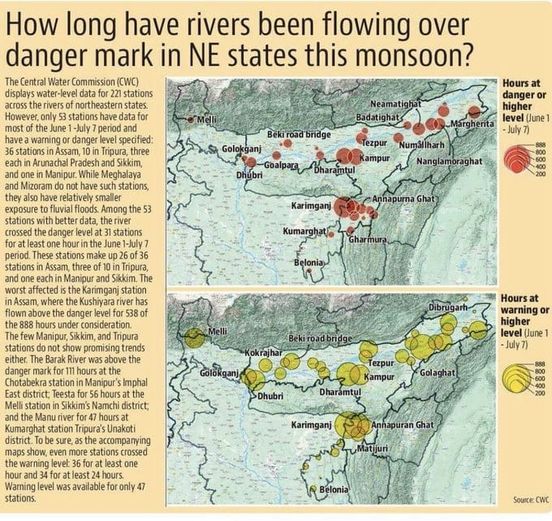
However, a part of this problem can be simplified for the North-East since large parts of the populated region in these states are exposed to floods because of overflowing rivers, or fluvial floods. This is different from pluvial floods, which are caused by poor drainage of rainwater. Therefore, the water level in rivers can be a reasonable indicator of the severity of the hazard. Here is what the data shows. https://www.hindustantimes.com/editors-pick/number-theory-how-bad-are-the-floods-in-northeastern-states-101720671219426.html (11 July 2024)
In Chanaka, Satibheti, Barhoitari-Hiloikhunda, and Gobardhan villages of Morigaon district, and Balisatra and Simolua of Kamrup district, the floods are a harbinger of fertility. The annual inundation of the paddy fields is not a cause for alarm but rather a welcomed event as the floodwaters deposit a rich layer of silt, replenishing the soil with essential nutrients and ensuring a bountiful yield for the Boro rice varieties cultivated during the winter months.
The farmers in these villages mainly cultivate Boro rice varieties. Cultivation of Boro rice varieties is done in winter, and the crops are harvested before the monsoon. Dhiren Sharma, a farmer in Gobardhan village, said most of the families are engaged in cultivation in the village and they do Boro rice cultivation as the paddy fields are low-lying and therefore inundated easily by the floodwaters caused by the Brahmaputra river during every monsoon.
Standing on a road beside a submerged paddy field, Sharma said, “You can only go for Boro rice cultivation in low-lying areas. We cultivate mainly two Boro rice varieties – Ranjit and Bahadur. Moreover, few farmers do vegetable cultivation. The soil fertility increased by the floods helps in production as these farmers do not have to rely on chemical fertilizers.”
While the floods may disrupt communication and pose challenges during emergencies, the villagers have adapted their settlements to coexist with this natural phenomenon. Homes are strategically built on higher ground or at the foothills of Gobardhan hill, ensuring that the rising waters do not encroach upon their dwellings.
Meanwhile, Diganta Kumar, a villager of Balisatra, said that floodwaters from the Baralia river engulf their paddy cultivation fields every year but it increases the soil fertility. He said the floodwaters do not affect the villagers like they do in other parts of the state.
“The farmers here do Sali rice cultivation (which is done during monsoon and harvested in winter) but most of the farmers prefer Boro rice cultivation as they get more benefits in Boro rice cultivation. Boro rice cultivation requires almost or less than half of the time required for Sali rice cultivation. Production quantity of Boro rice cultivation is higher than Sali rice cultivation,” Kumar said.
However, the delicate balance between the floods and agricultural prosperity is not without its challenges. Kumar laments the impact of reduced rainfall in the previous year, which resulted in less floodwater entering the cultivation fields, hampering the natural fertilization process. “In this situation, there must be a proper irrigation system in the fields, which is absent in our village,” he adds, highlighting the need for adaptation and infrastructure to sustain this unique symbiosis. https://timesofindia.indiatimes.com/city/guwahati/floods-boost-soil-fertility-and-crop-yield-in-morigaon-kamrup/articleshow/111619100.cms (10 July 2024)
Green Humour by Rohan Chakravarty on the Assam floods.
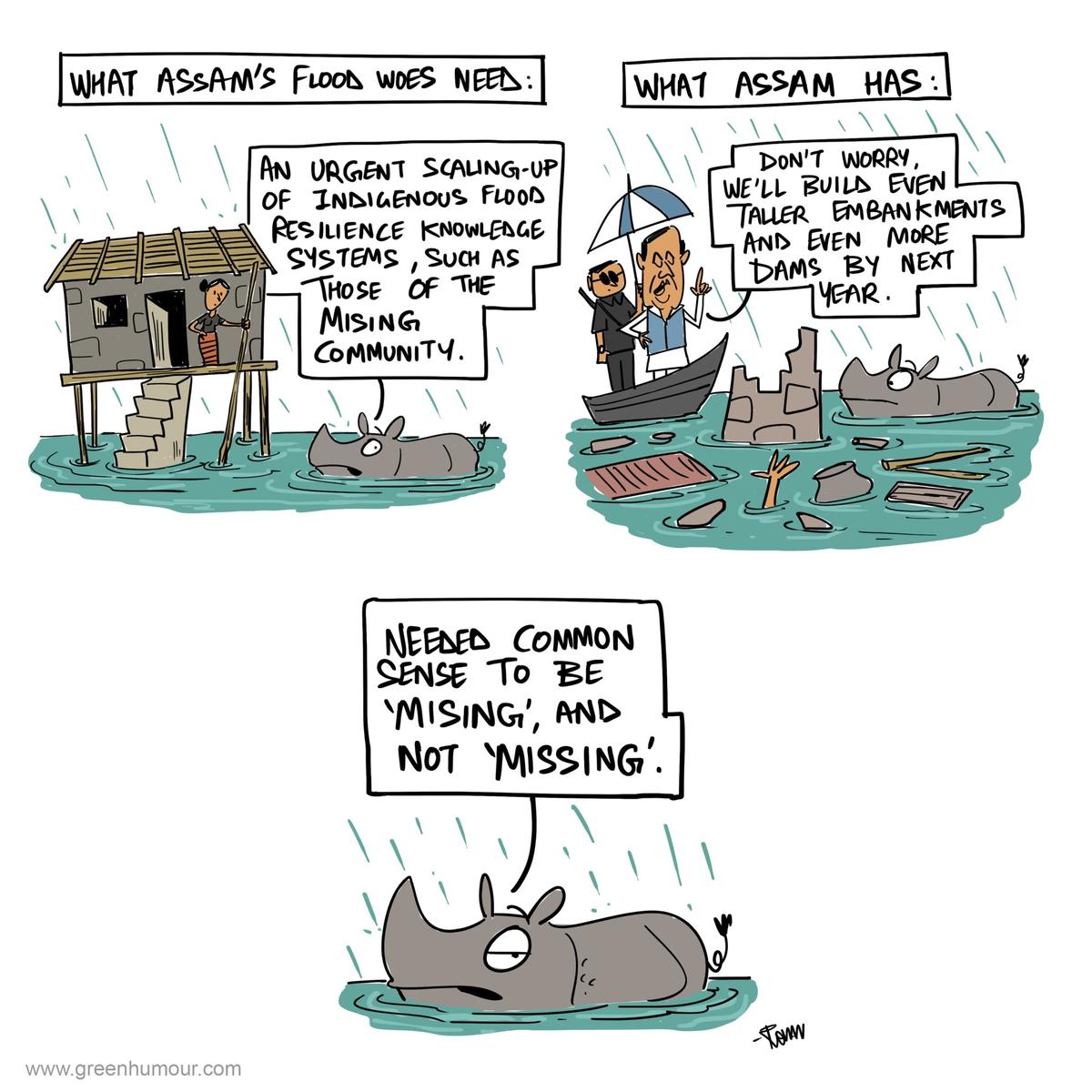
https://www.thehindu.com/society/green-humour-rohan-chakravarty-assam-floods/article68384080.ece (11 July 2024)
Karnataka Bhadra dam leakage plugged The water leaking from the sleeves gate of Bhadra Dam has been completely stopped for past 48 hours. About 2500 to 3000 cusecs of water was flowing into the river from Sleeves Gate. Alarmed by this, the farmers of the Achukattu area held a meeting with the irrigation officials in the presence of the forest president two days ago and expressed their outrage. https://kannada.oneindia.com/news/shivamogga/bhadra-dam-water-leakage-from-last-one-week-farmer-sparks-outrage-365201.html (05 July 2024)Tirthahalli-based GPS Construction Company has been awarded the contract for erecting the Danna Gate. It has been learned that the reason for this is that the officials and contractors installed the gate without technical experience. https://kannada.oneindia.com/news/shivamogga/bhadra-dam-water-leakage-from-last-one-week-farmer-sparks-outrage-365201.html (05 July 2024)
Andhra Pradesh Godavari witnessed the highest floods with discharge of nearly 36 lakh cusecs of water from the barrage in 1986. The discharge had been about 25 lakh cusecs in 2022. https://www.deccanchronicle.com/news/andhra-pradesh-godavari-rising-steadily-80000-cusecs-of-water-going-into-sea-1810094 (13 July 2024)
Efforts intensified to plug water leak from KORGR The Water Resource Department is making every effort to stop the leakage of water from the Kandula Obula Reddy Gundlakamma Reservoir (KORGR) project where the second crest gate was damaged and a part of it was washed away due to the increased inflows on Friday (Dec. 08, 2023) night. Project Chief Engineer Muralinadh Reddy, along with SE Abu Talim and other officials, is stationed at the project to supervise the execution of temporary stop-lock arrangement at the damaged gate. “A team of technical experts from Vijayawada arrived today and they are on the job to fix the stop-lock apparatus. Leakage is expected to be stopped by midnight,” he said.
The 3.86 TMC storage capacity KORGR project has about 2.4 TMC water at that time, the second crest gate was washed away, and by Saturday (Dec. 09, 2023) evening, water in the project leaked at a discharge rate of 1,600 cusecs downstream. The project staff tried to control the leakage and succeeded to some extent to arrange the stop-lock shield on the second crest gate. However, there is still some gap and efforts are on to cover the same. By evening, the discharge rate was brought down to 1,000 cuesecs and to avoid any untoward incidents, people living downstream along the Gundlakamma river were put on alert. https://www.newindianexpress.com/states/andhra-pradesh/2023/Dec/10/efforts-intensified-to-plug-water-leak-from-gundlakamma-reservoirproject-2640250.html (10 Dec. 2023) Flash floods triggered by cyclone Michaung has caused significant damage to the second crest gate at the Kandula Obula Reddy Gundlakamma reservoir in Prakasam district. Late on December 8 (Friday), one-third of the gate was washed away, and officials attributed it to rusting of bolts. It is the second such incident at the reservoir, the first being in August 2022. https://www.thehindu.com/news/national/andhra-pradesh/official-attributes-damage-to-second-crest-gate-at-gundlakamma-to-rusting-of-bolts/article67621614.ece (09 Dec. 2023) Over ₹600 crore has been pumped into the Obul Reddy Gundlakamma project with a view to bringing under irrigation 1.42 lakh acres in drought-prone Prakasam district. Yet, the farmers in Ongole, S.N.Padu and Addanki Assembly constitutencies are unable to fully reap the benefits of the project envisaged to store 3.86 tmcft of water in view of non-completion of the canal network and field channels thanks to cost and time overruns. Undue delay in rehabilitation of the oustee farmers in the tail-end Duddukuru village has hampered the implementation of the project. https://www.thehindu.com/news/national/andhra-pradesh/600-cr-goes-into-gundlakamma-but-water-yet-to-reach-ongole-farms/article21558803.ece (13 Dec. 2017)
HFL BREACH
Madhya Pradesh River Vesli in Lower Yamuna basin at Gata site in Bhind district has set 141.39 meter as new HFL at 04:00 hour on 08.07.2024 which is 1.8 meter higher than the old HFL 139.59 meter dated 09.08.2023. The river remained in extreme flood situation for about 136 hours. The present flood level is 138.88 meter at 12:00 hour on 15.07.2024.
River Pana in Lower Yamuna basin at Sarva site in Bhind district has set 161.36 meter at 18:00 hour on 08.07.2024 which is 0.24 meter higher than old HFL 161.12 meter dated 12.10.2022. The river remained in extreme flood situation for about 156 hours. Present flood level is 160.87 meter at 12:00 hour on 15.07.2024.
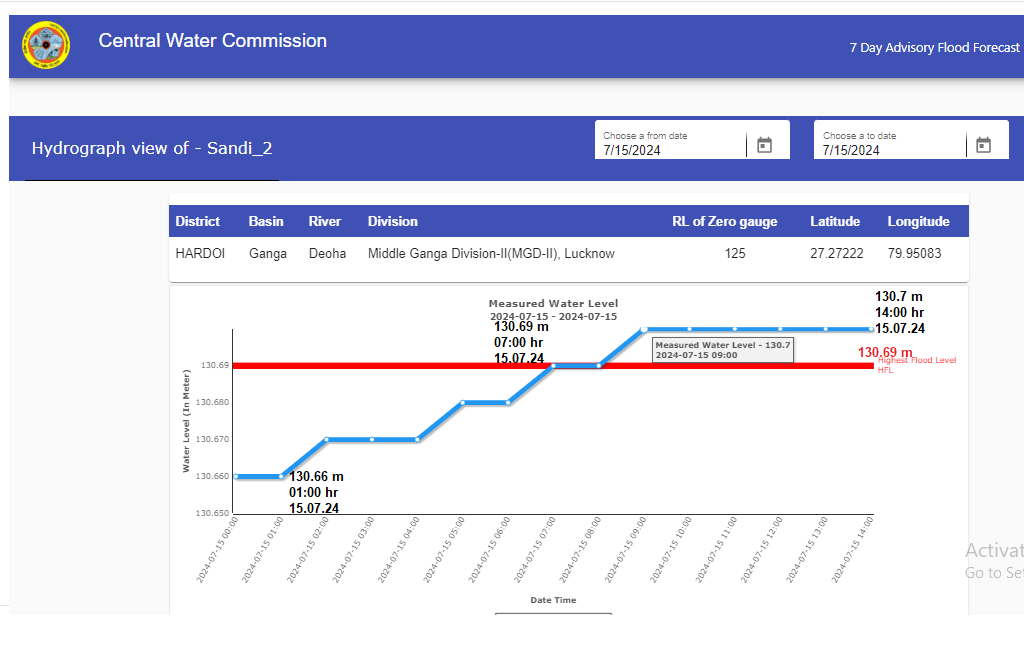


Bihar -River Gandak in Ganga basin at Bagaha site in Paschim Champaran district has set new HFL 90.48 meter at 24:00 hour on 07.07.2024 which is 0.18 meter higher than old HFL 90.3 meter attained on 07.10.2022. The river remained in extreme flood for about 28 hours. Present flood level is 88.88 meter at 08:00 hour on 10.07.2024.
Uttar Pradesh -River Gandak in Ganga basin at Chhitaunighat in Kushi Nagar district has set new HFL 93.2 meter at 05:00 hour on 07.07.2024 which is 0.15 meter higher than the old HFL 93.05 meter attained on 16.06.2021. The river remained in extreme flood situation for about 21 hours. Present flood level is 91.94 meter at 08:00 hour on 10.07.2024.
River Deoha in Ganga basin at Shahjahanpur site in Shahjahanpur district has breached old HFL 144.95 meter date not mentioned by CWC and has set 146.55 meter as new HFL at 06:00 hour on 12.07.2024 which is 1.6 meter higher than old HFL. The river remained in extreme flood situation for about 115 hours. The Present flood level is 144.54 meter at 14:00 hour on 15.07.24.
River Deoha in Ganga basin at Sandi 2 site in Hardoi district has crossed old HFl 130.69 meter (date not mentioned by CWC) at 07:00 hour on 15.07.2024. Present flood level is 130.70 meter at 14:00 hour on 15.07.2024 with stable trend.
Uttarakhand: -River Deoha in Ganga basin at Sitarganj site in Udham Singh Nagar district has crossed old HFL 223.49 meter attained on 11.09.2022 and set new HFL 223.71 meter at 12:00 hour on 08.07.2024 which 0.22 meter higher than old HFL. The river remained in extreme flood situation for about 5 hours. Present flood level is 222.97 meter at 08:00 hour on 10.07.2024.
URBAN FLOODS
Dainik Bhaskar cartoons 13 & 15 July 2024.


Delhi Bawana flooded after Yamuna canal breach A breach in the Munak canal, which channels water from Haryana to Delhi, led to severe waterlogging in north-west Delhi’s Bawana, leaving residents stranded in their homes. Early Thursday (July 11), water from the canal’s barrage inundated the J, K, and L blocks of the colony, forcing residents to wade through waist-deep water. https://www.newindianexpress.com/cities/delhi/2024/Jul/12/bawana-flooded-after-yamuna-canal-breach (12 July 2024)
-गुरुवार (July 11) देर रात Delhi के Bawana में Munak नहर का बांध टूटने से बवाना की जेजे कॉलोनी के केके, एल, एम और एन ब्लॉक में बाढ़ जैसी स्थिति हो गई. जिसका नतीजा यह हुआ कि यहां के करीब 1300 घरों में पानी घुस गया और लोग अपने घरों को छोड़कर सड़क पर रात बिताने को मजबूर हो गए. इस घटना के दौरान 70 वर्षीय कौशल्या देवी की मौत हो गई. स्थानीय लोगों का दावा है कि 15 दिन पहले ही उन्होंने नहर से पानी के रिसाव की सूचना दी थी. लेकिन इसे नजरअंदाज कर दिया गया.
-दिल्ली सरकार में मंत्री आतिशि सिंह ने कहा है कि मूनक नहर के मरम्मत की जिम्मेदारी हरियाणा सरकार के सिंचाई विभाग के पास होती है. दिल्ली सरकार के पास नहीं. नहर के बांध को फिर से ठीक करने के लिए दिल्ली सरकार पूरी तरह से हरियाणा सिंचाई विभाग की मदद कर रही है और 13 जुलाई की दोपहर तक मरम्मत का कार्य पूरा होने की उम्मीद है. उन्होंने यह भी बताया की नहर के टूटने से दिल्ली के कई इलाकों में पानी की सप्लाई प्रभावित हो सकती है. https://www.youtube.com/watch?v=wihhXTGJL2A (12 July 2024)
Mumbai Bridge work led to flooding of Bhandup tracks Central Railway’s investigation into Jul 8 flooding of tracks on the Bhandup-Nahur stretch has identified construction work for two bridges, one over a nullah, as the primary reason for it. The construction slowed the flow of water, leading to submergence of the tracks. Over 200 services were cancelled on the Main line because of nine inches of water on the tracks between Bhandup and Nahur on Jul 8. As Bhandup and Nahur are not prone to flooding, no heavy-duty water pumps had been stationed on the stretch. https://timesofindia.indiatimes.com/city/mumbai/bridge-work-led-to-flooding-of-bhandup-tracks-cancellation-of-200-services-central-railways/articleshow/111620134.cms (10 July 2024)
Urban forests under attack in cities The searing intense heat has a message – do not cut trees. But, unfortunately, lakhs of trees have been axed, and many more will be, for ‘development’ projects. Planning and building cities without recognising the role of urban treescapes is an invitation to climate disasters such as heat waves, floods and air pollution. The spate of construction and concretisation disregarding natural wealth – primarily tree cover — is unsustainable. https://questionofcities.org/trees-and-urban-forests-under-attack-in-cities-and-what-to-do-about-it/ (28 June 2024)
DISASTERS
Govt to launch survey to assess vulnerability of GLOF after monsoon – “Himachal Pradesh, Uttarakhand, Sikkim, Arunachal Pradesh and the Union Territory of Jammu and Kashmir are setting up survey teams and identifying routes to the glacial lakes. The teams will include officials and experts from agencies, such as the National Remote Sensing Centre, the Indian Army and the Geological Survey of India,” an official from the National Disaster Management Authority said.
The survey, set to launch after the monsoon season, will target select glacial lakes based on their risk profiles. “It is humanly not possible to cover all the glacial lakes,” the official said. Most of these lakes are situated at altitudes of 5,000 metres or higher.
The officials said that the current understanding of glacial lakes is primarily based on remote sensing, which is insufficient to determine their vulnerability comprehensively. Conducting ground surveys is essential but challenging due to the remote, high-altitude locations of these lakes. https://indianexpress.com/article/india/govt-to-launch-survey-to-assess-vulnerability-of-glacial-lakes-after-monsoon-9443235/lite/ (09 July 2024)
LANDSLIDES
Himachal Pradesh Land cracks disrupt farming in Lahaul-Spiti Land subsidence has led to the formation of cracks in the ground in Lindur village in Lahaul and Spiti district. Compared to last year, the increase in cracks this year is obstructing farming activities. A year ago, a landslide had also resulted in the blockage of NH-505 in the same district. https://economictimes.indiatimes.com/news/india/flood-irrigation-land-cracks-disrupt-farming-in-lahaul-spiti-himachal-pradesh/videoshow/111565043.cms (08 July 2024) Fresh cracks have appeared in 14 houses and farmland in Lindur village. The cracks has scared the local villagers who say, they fear the hill on which they live may collapse due to land subsidence. https://www.ndtv.com/video/lahaul-spiti-villagers-scared-as-large-cracks-appear-in-houses-and-farmland-813272 (11 July 2024)
ENVIRONMENT GOVERNANCE
Report What is People’s Biodiversity Register? The People’s Biodiversity Register catalogues local flora, fauna, and traditional knowledge, ensuring ecological treasures are not forgotten. The objective of the PBR, beyond conservation of biological diversity, is sustainable use of its components and equitable sharing of the benefits from the use of biological resources and knowledge. Despite its potential, the PBR’s effectiveness is hindered by verification issues, lack of awareness, and insufficient funding. https://india.mongabay.com/2024/07/explainer-what-is-a-peoples-biodiversity-register/ (09 July 2024)
Gurugram Citizens’ group makes ‘green manifesto’ before polls With Haryana assembly elections just months away, a group of citizens has come up with a ‘green manifesto’ that advocates for the state to protect the Aravalis and increase forest cover apart from adopting environment friendly policies. A key demand is coming up with a four-year plan to increase Haryana’s forest cover to 21%, in line with the national target. The group proposes involving local communities in the creation of sacred forests or banis in every village and declaring the Aravalis as a biodiversity heritage site. https://timesofindia.indiatimes.com/city/gurgaon/protect-aravalis-raise-forest-cover-citizens-group-makes-green-manifesto-before-polls/articleshow/111589123.cms (09 July 2024)
Opinion The environment vs development debate Campaigns against the setting up of a nuclear power plant in Kudankulam and the Sterlite Copper plant in Thoothukudi in Tamil Nadu, against the Narmada Valley project, and the Chipko movement in Uttarakhand have indicated that protection of trees and forests, of soil, of rivers, of wildlife and biodiversity is essential for sustenance of human life. These movements show that the government’s approach to development must be reconsidered. (M N Panini) https://indianexpress.com/article/opinion/columns/environment-development-debate-hypocrisy-9440799/ (08 July 2024)
SOUTH ASIA
Bhutan Lessons from Puna-I Hydropower Project Some of the mega hydropower projects that were kickstarted as part of this ambitious plan have suffered unprecedented delays and cost overruns. A classic example of this is Punatsangchu-I Hydropower Project. The Puna-I project commenced construction in November 2008. The project suffered serious setbacks when a major slide occurred on the right-bank of the dam construction site, leading to an indefinite deferral. This project, which has taken 16 years and still counting, has turned into a massive national liability. The initial project cost of Nu 35 billion has ballooned to a staggering Nu 100 billion. In fact, the unforeseen geological challenges – which caused the delays and cost overruns – should have been identified and addressed during the pre-feasibility study phase. There has been a total lack of accountability… it is crucial that we do not repeat the same mistakes from the Puna-I project. We must learn from our mistakes and realign our hydropower strategy… https://kuenselonline.com/lessons-from-puna-i-hydropower-project/ (10 July 2024)
What does contributions of different water sources to Mochhu mean? The National Centre for Hydrology and Meteorology (NCHM) is conducting a study to assess the contributions of different water sources to the Mochhu. This research aims to enhance understanding of the hydrological processes that govern river flow within these basins. This study is the third of its kind, following similar research on the Chamkharchhu and Pachhu. Mochhu is the western branch of Punatsangchhu, consisting of two tributaries, one originating from Masang Gang region in the east and the other from Gangchen Tag region in the west. This sub basin consists of 66 glacial lakes covering an area of 4.25 square kilometres. Mochhu is also one of the three major sub basins for Punatsangchhu.
– A study on the Chamkharchhu, conducted by lecturers from Sherubtse College between 2014 and 2017, found that glacier ice meltwater contributes 23 percent and snowmelt contributes 39 percent to the Chamkharchhu during the pre-monsoon season. “The Pachhu survey also reports similar results, indicating that glaciers and snow dominate the water source in rivers, which is significant,” Karma said. “Imagine the condition of rivers under the same climatic conditions when glaciers are the majority contributors to these rivers.” In the Pachhu, glacier ice melt and groundwater were dominant contributors to river flow in all sampling seasons, with an average contribution of 49.6 percent. https://kuenselonline.com/what-does-contributions-of-different-water-sources-to-mochhu-mean/ (10 July 2024)
Nepal Indrawati III HEP suffers damage Floods in Yangri and Indrawati rivers have damaged the Indrawati III hydropower project. Chair of Panchpokhari Thangpal Rural Municipality Tashi Lama said the dam in Tipeni of Panchpokhari of the 7.5 MW project has been filled with sand and the substation and powerhouse have suffered damages due to the floods on last night.As a result, the power supply in most parts of constituency number 2 of the district has been interrupted.
Also, the road from Khaldekhola to Tipeni has been blocked. Local resident Galbo Samden said that the bridge connecting Chinde Jatan along with Yangri bridge was also swept away by the flood. The Yangri and Indrawati rivers have washed away the agricultural land in the coastal areas. The bailey bridge built last year in Melamchi, which connects Melamchi, Indrawati, and Panchpokhari, is also at risk. Similarly, the newly constructed bus park, playground, and covered hall under construction in Melamchi are also said to be at risk of flooding. https://english.nepalviews.com/2024/07/15/indrawati-iii-hydropower-project-suffers-damage/ (15 July 2024)
Search for missing after landslide sweeps buses suspended Rescuers have suspended their search for 51 passengers who are missing after a landslide swept the buses in which they were travelling into swollen Trishuli River in Chitwan district, authorities said. At least three passengers survived with minor injures by jumping off the buses before the mass of rocks and mud came down the slopes, according to authorities. But efforts by hundreds of security personnel and more than two dozen divers yielded no signs of the buses or their passengers.
-A total of seven Indian nationals were among the missing passengers, said Antim Sinjali, a district official. Landslides and floods triggered by torrential monsoon rains have killed at least 91 people in Nepal since mid-June. About 17 people died across the country in lightning strikes and floods and landslides triggered by the rain over the preceding 24 hours, police said on Friday (July 12) evening. https://www.reuters.com/business/environment/nepal-landslides-sweep-two-buses-into-river-65-passengers-missing-2024-07-12/ (12 July 2024)
The 12 July 2024 landslide at Simaltal (Dave Petley) Nepal has been suffering from the effects of intense monsoonal rainfall for the last few days. For example, there are reports of multiple landslides in Kaski District, including seven fatalities in Tallakot in Pokhara Metropolitan City Ward 19, three fatalities in a landslide in Chainpur in Pokhara Ward 19 and one fatality in Madi Rural Municipality Ward 11. I have recorded 13 other fatal landslides in Nepal since the start of July. Whilst this is the peak of the landslide season in the Himalayas, this is a high rate of events. https://eos.org/thelandslideblog/simaltal-1 (12 July 2024)
THE REST OF THE WORLD
USA Aging dams a catastrophe waiting to happen Minnesota’s century-old Rapidan Dam captured the national spotlight last week when its partial failure destroyed a home and prompted county officials to demolish an adjacent store. Yet it’s just one of hundreds of dams across the Upper Midwest in similar or worse condition, according to an analysis of federal data by Inside Climate News.
– State and federal officials have warned for years that the nation’s nearly 92,000 dams—many of them built in the early 1900s—are growing increasingly taxed by extreme weather, especially in the Midwest. The Fifth National Climate Assessment, released last year, found that annual precipitation increased by 5 to 15 percent across much of the Midwest in the decade leading up to 2021, compared to the previous decade. Some 30 dam failures or near failures have occurred across the Midwest since 2018, the assessment said.
– Most of America’s dams are more than 60 years old, leading to complications like sediment build up. That was the case with the Rapidan Dam, roughly 90 miles southwest of the Twin Cities. Too much sediment caused the water to flow around the dam’s west side, eroding much of the land. Inside Climate News’ analysis of that database found that nearly 4,100 dams nationwide are in poor or unsatisfactory condition while also posing a potential threat to human life or property. In Minnesota, Wisconsin, and Michigan, nearly 200 dams are in poor condition, and 13 are in poor condition while also posing a “high” hazard risk if any of them fail.
– Michigan’s Department of Natural Resources alerted federal authorities that it planned to decommission and remove the Trowbridge Dam in Allegan 40 years ago. The former hydroelectric dam was no longer useful and its polluted reservoir posed a serious health risk to wildlife downstream and anyone who might get exposed to the toxins should the dam fail. But to this day, that project has yet to reach the construction phase, said Mark Mills, regional manager for the state DNR’s Wildlife Division. “EPA told us we couldn’t because the dam impoundment contains contaminated waste—PCBs,” Mills said, referring to a group of highly carcinogenic chemicals known as polychlorinated biphenyls. “So we have been Band-Aiding this thing since 1984 as we wait for the cleanup to occur.” https://www.wired.com/story/climate-change-failing-aging-dams-us-america-catastrophe/ (13 July 2024)
In drought-prone Oaxaca, indigenous women are reviving ancient techniques to preserve water. https://www.bbc.com/future/article/20240708-the-women-fighting-drought-in-mexico (08 July 2024)
NILE Africa Lessons from the Nile about rivers & society The Holocene flooding and sedimentation history of the Nile illustrates how fluvial geomorphology has long influenced human society. History shows how the evolution of river systems shaped human civilizations as the climate shifted through the Holocene — both positively and negatively. With climate warming and the anthropogenic influence on rivers increasing, it is critical we understand the interactions and feedbacks between societies and the rivers that sustain them. https://www.nature.com/articles/s41561-024-01499-x (12 July 2024)
SANDRP
Also see: DRP 08 July 2024 & DRP 01 July 2024
Follow us on: www.facebook.com/sandrp.in; https://twitter.com/Indian_Rivers

 SANDRP