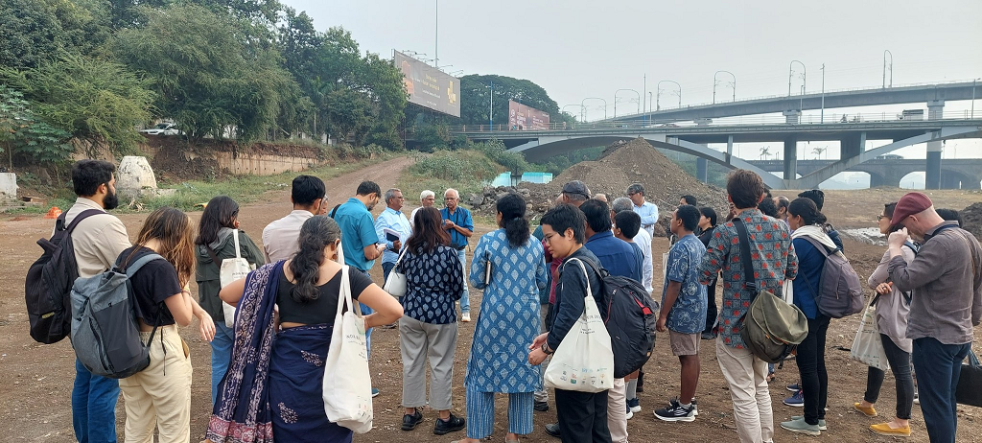
(IRW 2023 organizers, participants visiting Pun RFD project on Nov. 26, 2023. Image Source: India Rivers Forum)
The Tenth India River Week function was organized at BAIF, Pune on Nov 25-26, 2023, with participation of over a hundred people. The focus of the event was on Pune River Front Development (RFD), being pushed by Pune Municipal Corporation, and RFD in other cities around India, and it was strongly critiqued and opposed at the meeting, including by Bhagirath Prayas Samman winners Sarang Yadwadkar and Jeevit Nadi. A field visit of the participants was also organized to the proposed site of the work of the project. (Also see: https://timesofindia.indiatimes.com/city/pune/greens-criticize-approval-rfd-project-pune/articleshow/105523479.cms)
The Annual Bhagirath Prayas Samman Award and the Anupam Mishra Meal for media work on rivers were given away by well-known ecologist Prof Madhav Gadgil. He also addressed the audience. For details related to the BPS and AMM awards 2023, see here. Also see: https://arunachaltimes.in/index.php/2023/11/26/bhanu-tatak-dibang-resistance-receive-bhagirath-prayas-samman-award-in-field-of-river-conservation/
Some other highlights of the meeting included:
– Shri Vijay Paranjpe was the Chief Guest at the inaugural session.
– The river researchers from Wageningen University & Research from Germany and other countries also participated in the event. They presented their work on Riverhood, River Commons, Counter Mapping among other issues.
– Two books on Ganga were released on the occation.
– Review of last ten years work of the India Rivers Week from inaugural year 2014 to today.
– A statement on Pune River Front Development was adopted.

Bhanu Tatak, Dibang Resistance receive BPS award “Mega hydropower dams are the biggest threat to the rivers and peoples of the Northeast. For decades, Dibang Resistance and other groups have been steadfastly opposing dams proposed on the Dibang river, a major tributary of Brahmaputra.
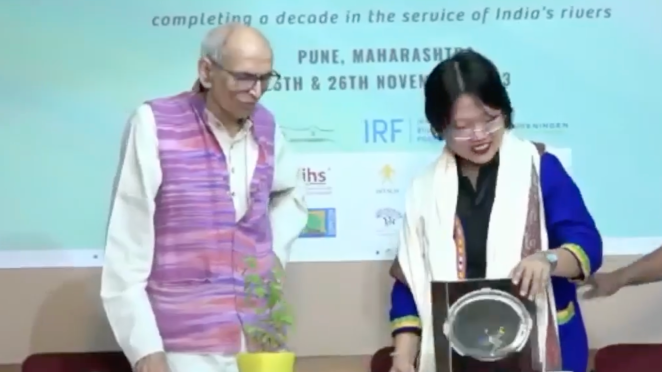
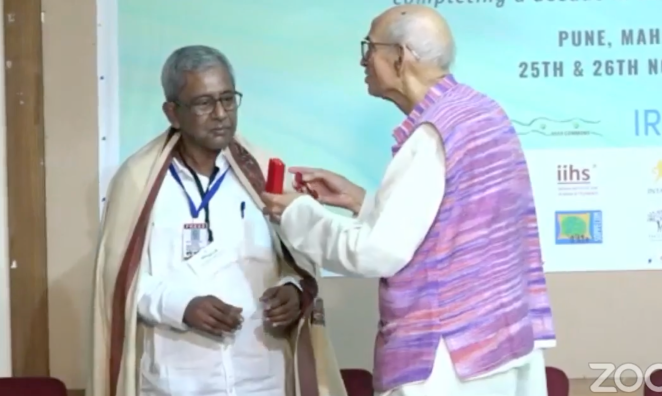
By raising awareness, bringing people together in nonviolent protest, and using the law, Dibang Resistance has shown an exemplary dedication to democratic decision-making on an issue that is vital not only to the local communities in the Northeast, but to the ecological security of the entire eastern Himalaya. In this struggle, Bhanu Tatak has emerged as the voice of Dibang” the citation read. https://arunachaltimes.in/index.php/2023/11/26/bhanu-tatak-dibang-resistance-receive-bhagirath-prayas-samman-award-in-field-of-river-conservation/ (26 Nov. 2023)
Greens slam approval of report under RFD project at city event City-based experts criticized the approval of the hydraulics and hydrology report of the project, submitted in June this year. “The discussion took place during the India Rivers Week 2023 by India Rivers Forum, held at the Bharatiya Agro Industries Foundation (BAIF) in Warje this weekend. The annual event was held in Pune for the first time.” At the forum, experts concluded that development always takes precedence over conservation, after discussing pros and cons of RFD projects across the country.
Experts argued that there was tampering seen in the detailed project report of the RFD project. Yadwadkar said that in Surve’s speech at a G20 meet, the latter said that RFD projects, embankments using artificial material and any construction on the blue line increases flood risks. “If he knows the risks of such projects, approvals are a little strange,” added Yadwadkar. https://timesofindia.indiatimes.com/city/pune/greens-criticize-approval-rfd-project-pune/articleshow/105523479.cms (27 Nov. 2023)
A closer look revealed that the RFD project is faulty on many counts. Yadwadkar points out that the project is technically flawed. It will, in fact, throttle the river, flood the city during the monsoon and actually not clean up the river. https://civilsocietyonline.com/cities/riverfront-makeover-in-pune-is-underway-with-many-concerns/ (20 Nov. 2023)
India Rivers Week 2023 was organized on 25th and 26th November 2023, in Pune. This year’s conference featured a series of engaging dialogues that reflect on the past ten years of our work, focus on the challenges of Riverfront Development Projects in India, and introduced innovative perspectives on riverhood and river commons in collaboration with Wageningen University & Research (WUR). http://facebook.com/indiariversForum/ Also see recording of IRF 2023 Day 1. https://www.facebook.com/IndiaRiversForum/videos/5592589814198779 & Recording of IRF 2023 Day 2 https://www.facebook.com/share/p/AVZtfWfL7nw9iEzo/?mibextid=WC7FNe
HYDRO POWER PROJECTS
Sikkim Authorities lost time in acting on rising Teesta news – NDSA A preliminary report of the National Dam Safety Authority (NDSA) on the “flash flood in Teesta basin” in Sikkim has said dam authorities lost crucial time in taking preparatory action, such as opening spillway gates and reducing water in the reservoir, after they were informed by the Indo Tibetan Border Police (ITBP) that water level in the river was rising.
– The NDSA has said in its preliminary report that between the period the ITBP informed the dam authorities that water in the Teesta river was rising and the deluge reached Chungthang town, the dam authorities had enough time to take measures such as emptying or at least reducing water in the dam’s reservoir.
– “The NDSA had said in its report that the dam authorities, instead of acting on the ITBP’s communication, lost crucial time in confirming the news. By the time the water actually reached Chungthang dam, it was too late to do anything. A team of dam staff had at the last moment gone to open the gates but was swept away,” one of the central government sources said.
– The NDSA has shared the preliminary report with the Union Jal Shakti ministry, the Sikkim government, State Dam Safety Organisations of Sikkim and West Bengal, and the Union power ministry in mid-October. A final report will be submitted in three months’ time. https://theprint.in/india/sikkim-authorities-lost-time-in-acting-on-rising-teesta-news-national-dam-safety-authority-report/1857028/ (24 Nov. 2023)
Karnataka Lives of villagers drowned in big power projects The construction of the Madenur dam (Hirebhaskar dam) and Linganmakki dam across the Sharavathi river to generate electricity inundated many villages, forcing thousands of people like Sharadamma to move to different places. However, the backwaters that submerged physical structures failed to erase the memory of the people who underwent the agony of displacement. Those who were forced to relocate still struggle to access basic facilities, while those who remained in their homes lead a life detached from the outside world. The Linganmakki dam created an island for the people of villages in Barangi and Karuru hoblis, cutting off road connectivity to their taluk headquarters, Sagar.
The disappointing fact is that the families who gave up their land and faced displacement to brighten the State with electricity continue to remain in darkness. More than 20,000 residents in the villages of the two hoblis are dependent on ferries to cross the backwaters. “If you call Cauvery Jeeva Nadi, Sharavathi river deserves the title Shakti Nadi. It has been providing power for industries and houses across the State,” Sathyanarayana G.T. of Karuru, a village on the Linganmakki backwaters. But he is disappointed by the fact that the State, which has benefited from the power generation, has neglected the people who sacrificed their land for the project.https://www.thehindu.com/news/national/karnataka/how-lives-of-simple-villagers-were-drowned-in-big-power-projects-in-karnataka/article67531288.ece (24 Dec. 2023)
Report Hydro in electricity generation down to 9% Even according to this Pro Hydro report, the contribution of hydro in electricity generation is down to 9% and likely to decline. It also admits that developing new hydro is beset with challenges including geological issues, India’s NE being one of the six top seismic active spots in the world,
– It says: “While experts appraise the seismic elements related to the construction area, and the dams are designed based on the seismic criteria for “maximum credible earthquake” and “design basic earthquake”, a lack of proper historical cataloguing of earthquakes, a lack of knowledge of post earthquake ground motion, and acceleration specific variation can lead to incorrect assessments. Geological issues like the slope failure are the second largest threats to hydropower plants and dams. The Himalayas are a developing “folded mountains” in an active tectonic zone where slope failure is a common occurrence, especially when the delicate rock layers are disturbed by development. Apart from these, issues in the eastern part of country, such as the existence of soft rocks behind faults, the highly weathered and decomposed rocks under high gneissic rocks, and the existence of buried channels, also poses a major challenge.” https://energy.economictimes.indiatimes.com/news/power/why-india-must-ramp-up-focus-on-hydro-power-a-perspective/105420136 (22 Nov. 2023)
According to the International Energy Agency, the jobs in the hydropower sector are likely to remain flat till 2030. The report emphasizes that environmental concerns, public opinion, and lengthy construction schedules are likely impediments in the sector’s growth. There is some scope in small run of river projects and in Pump Storage projects. https://energy.economictimes.indiatimes.com/news/power/hydropower-jobs-surge-in-asia-india-emerges-as-key-player-report/105247559 (16 Nov. 2023)
MoEF Committee to frame SoPs for small hydro projects With large hydel power projects being blamed for the disasters in the fragile zones of Himalayas and Northeastern States, the Govt is working on a strategy to make the Small Hydro Power (SHP) Projects– those plants which have a generating capacity of below 25 MW more environment-friendly. To begin with, the Union Environment Ministry may soon set up a committee for framing Standard Operational Procedure (SOP) for development of the SHPs in an eco-friendly manner. The committee, as recommended by the EAC for River Valley Projects will comprise members from Ministries from Environment, Jal Shakti, Power besides State Governments and expert institutions. https://www.dailypioneer.com/2023/india/government-working-on-strategy-to-make-environment-friendly-hydel-projects.html (24 Nov. 2023)
Decisions of EAC meeting on River Valley Projects held on Nov 11 2023:
1. 1400 MW Karauli Pumped Storage Project by TORRENT POWER LIMITED located at KARAULI,RAJASTHAN for TOR: Asked PP to justify the project location considering high Forest land requirement.
2. 1760 MW Sashnai Pumped Storage Project (1760 MW) by TORRENT POWER LIMITED at SONBHADRA,UTTAR PRADESH for TOR: APPROVED
3. 1800 MW Dholpur Pumped Storage Project (1800 MW) by TORRENT POWER Ltd at DHOLPUR,RAJASTHAN for TOR: Justify the project among alternative locations considering high forest land required.
4. Greenko UP01 Off-Stream Closed Loop Pumped Storage Project by GREENKO ENERGIES Pvt Ltd at SONBHADRA,UTTAR PRADESH: WITHDRAWN THE PROJECT
5. 1800 MW Pedakota Pumped Storage Project (1800 MW) by ADANI GREEN ENERGY Ltd at ALLURI SITHARAMA RAJU, ANDHRA PRADESH for TOR: More info sought.
6. Upper Indravati Pumped Storage Project by ODISHA HYDRO POWER CORPORATION Ltd at KALAHANDI, ODISHA: TOR already issued. https://parivesh.nic.in/utildoc/26617887_1700822666696.pdf
Relevant agenda of FACmeeting on Nov 29 2023:
– DIVERSION OF 73.94 HA FOREST LAND FOR KAREGHAT MINOR IRRIGATION TANK AT KAREGHAT, TAL. NAWAPUR, DISTRICT NANDURBAR IN MAHARASHTRA
– USE OF 211.8427 HA. OF FOREST LAND FOR 500 MW DUGAR HYRDO ELECTRIC PROJECT OF NHPC LTD. UNDER PANGI FOREST DIVISION AND CHAMBA DISTRICT OF HIMACHAL PRADESH OF 211.8427 HA. OF FOREST LAND FOR 500 MW DUGAR HYRDO ELECTRIC PROJECT OF NHPC LTD. UNDER PANGI FOREST DIVISION AND CHAMBA DIST OF HIMACHAL PRADESH OF 211.8427 HA. OF FOREST LAND FOR 500 MW DUGAR HYRDO ELECTRIC PROJECT OF NHPC LTD. UNDER PANGI FOREST DIVISION AND CHAMBA DISTRICT OF HIMACHAL PRADESH OF 211.8427 HA. OF FOREST LAND FOR 500 MW DUGAR HYRDO ELECTRIC PROJECT OF NHPC LTD. UNDER PANGI FOREST DIVISION AND CHAMBA DIST OF HIMACHAL PRADESH
– NON-FORESTRY USE OF 150 HA OF FOREST LAND OF UTTARAKHAND VAN VIKAS NIGAM, KHANAN PRABHAG, RAMNAGAR FOR MINING OF MINOR MINERALS (RBM) FROM KOSI-DABKA PART 2 RIVERS FALLING IN TARAI WEST, RAMNAGAR FOREST DIVISION AND DIST UDHAM SINGH NAGAR, UTTARAKHAND. https://forestsclearance.nic.in/AgendaDetail.aspx?id=29
Relevant decisions of the FAC meeting held on Nov 14 2023: – Diversion of 2250.05 ha (instead of 2272.05 ha) forest land for NVDA’s Morand – Ganjal Irrigation Project in Hoshangabad, Betul, Harda and Khandwa Districts, MP: More Info, DOcuments sought. https://forestsclearance.nic.in/writereaddata/FAC_Minutes/111124125512151ApprovedMoMofAcmeetingdated14112023.pdf
DAMS
Polavaram Project AP to Raise Funding and Other Issues With Centre on Dec 5 The Union ministry of Jal Shakti called a meeting in New Delhi on December 5, to be presided over by the Jal Shakti secretary and attended by officials from the central water commission, the Polavaram Project Authority and the AP water resources department. The AP officials are preparing a list of issues to be raised at the meeting. They would press for release of nearly Rs 31,500 crore to provide relief and rehabilitation to the Polavaram project affected people at the 41.15 metre contour level. This has been pending for a long time, even as the revised cost estimates committee had approved it.
– Similarly, the Centre has to agree for construction of a parallel diaphragm wall as the existing D-wall suffered damages at four places. The authorities are unwilling to take any risk of carrying out repairs and instead want to construct a new wall. This could cost Rs 400 crore and another Rs 800 crore to construct the new parallel wall.
– The AP authorities also intend to sound out the Centre on how to go about with the seepage of the upstream cofferdam. Due to the seepage, a huge quantity of water is entering the construction area of Polavaram dam, resulting in further delay in the works. This is more so when the river is flooded during the rainy season.
– Meanwhile, the authorities are invoking vibro compaction technology to solidify the sand on both sides, where the D-wall will be coming up. The idea is to make the wall firm and make it sustain the high pressure of water, following the successful completion of the dewatering works in the project’s work area. https://www.deccanchronicle.com/nation/current-affairs/241123/ap-to-raise-polavaram-funding-and-other-issues-with-centre-on-on-dec-5.html (24 Nov. 2023)
Rajasthan NGT bars desilting mineral extraction at Bisalpur Dam without EC NGT has prohibited Eastern Rajasthan Canal Project Corporation Limited (ERCPCL) from proceeding with desilting, dredging, mineral extraction and disposal at the Bisalpur Dam in Tonk district without obtaining environmental clearance. In an order on Friday (Nov. 24), the central zonal bench of the tribunal in Bhopal also directed the SPCB to take necessary preventive, prohibitory, punitive and remedial measures in case of violations of environmental laws. The order came on a petition file by Jodhpur-resident Dinesh Bothra challenging the tender for the contract of sand mining at the Bisalpur Dam for a period of 20 years.
In its order, the tribunal has barred all activities under the project involving dredging, desilting, extraction of silt or sand or gravel from the dam until the required environmental clearance is obtained as mandated by the Environment Impact Assessment Notification of 2006. Additionally, the NGT directed ERCPCL to comply with all environmental laws, obtain required consents, NOCs, clearances, etc. before proceeding with desilting in the dam. The NGT stated that desilting or dredging activities under the guise of mineral extraction through mining operations cannot proceed without adherence to environmental laws.
The petitioner’s counsel Sanjeet Purohit submitted that the bid did not align with the Sustainable Sand Mining Management Guidelines of 2016 and the Enforcement and Monitoring Guidelines for Sand Mining of 2020. He said the state authorities proposed sand removal without preparing the district survey report and classifying it as desilting, a move contrary to established guidelines and the Supreme Court’s directive on DSR provisions. https://www.theweek.in/wire-updates/national/2023/11/26/des22-rj-ngt-ercpcl.html (26 Nov. 2023)
INTERSTATE WATER DISPUTES
Cauvery Water Disputes Release 7.35 tmcft water to TN in Dec: CWRD -According to the final CWDT award, Karnataka should release 7.35 tmcft water for the whole December month, at interstate connecting point Biligundulu on an average daily flow of 2744 cubic metre per second. For the whole November, the cumulative monthly flows should be maintained at 13.78 TMC.
-In the 90th meeting of the CWRC under the chairmanship of Vineet Gupta, Chairman, CWRC, has taken a decision based on storage position, inflows and outflows of eight designated reservoirs and hydrometeorological condition in the Cauvery basin.
-The next meeting is scheduled on Dec 19. Since Oct 1, the daily average flow realised at Billigundulu and Mettur Dam of TN was around 4000 cusec. However, the daily release of water from Karnataka’s KRS and Kabini reservoirs were ranging between 1500-3200 cusecs only. https://www.newindianexpress.com/states/tamil-nadu/2023/nov/24/release-735-tmcft-cauvery-water-to-tn-in-december-cauvery-water-panel-2635707.html (24 Nov. 2023)
-Water levels in the four major reservoirs of the Cauvery basin — Harangi, Krishna Raja Sagar (KRS), Kabini and Hemavathi — have fallen to less than half of their total gross capacity.
-Marked deficit rainfall in Kodagu, Mysuru and Hassan regions have contributed to the lower storage levels in the four dams of the Cauvery basin. From June 1 to Sept. 30 (Southwest Monsoon), the South Interior Karnataka got 271 mm of rainfall as against a normal rainfall of 369 mm, marking a deficit of 26 percent.
-From Oct. 1 to Nov. 22 (Northeast Monsoon), the South Interior Karnataka got 124 mm rainfall as against a normal rainfall of 182 mm, resulting in a deficit of 32 percent. From Jan. 1, 2023, to Nov. 22, the South Interior Karnataka received 558 mm rainfall as against a normal rainfall of 694 mm resulting in a deficit of 20 percent.
-From June 1, 2023, to Nov. 22, the region received 395 mm as against a normal rainfall of 551 mm resulting in a 28 percent deficit. https://starofmysore.com/storage-in-cauvery-basin-dams-dips-below-half-gross-capacity/ (23 Nov. 2023)
SYL Dispute Punjab has no water for SYL While the riparian principle dictates that a river’s water belongs to the states and countries through which it flows, the water reality of Punjab, known as the granary of India, paints a grim picture of scarcity, as it relies on groundwater extraction for over 50% of its water demand.
Experts estimate that Punjab needs approximately 48 to 52 billion cubic meters (BCM) of water to irrigate its rice crop alone, which is cultivated from June to October. Apart from paddy, the state also grows wheat (on 35 lakh hectares in the Rabi season), sugarcane, maize, cotton, and other horticultural crops. To meet its irrigation, domestic, and industrial demands, Punjab depends on three primary sources of water—river, rainwater, and groundwater. https://indianexpress.com/article/cities/chandigarh/no-river-water-punjab-groundwater-level-8983555/ (15 Oct. 2023)
IRRIGATION
Maharashtra Activists fume as Sangli’s water quota from Koyna dam reduced The activists fumed over the decision and blamed the state government for allowing the irrigation department’s plan for the utilisation of water from the Koyna dam located in Satara district. Sarjerao Patil, the convenor of Sangli-based Krishna Mahapur Niyantran Nagri Kruti Samiti, a forum of the activists formed over the issue of Krishna river floods, said, “The govt has approved the cut down in the water allocated from Koyna dam to Sangli district from 37.5 TMC to 35 TMC. The water available in the dam is sufficient for the irrigation and drinking needs of both the Sangli and Satara districts. We have also learnt that the power stock with the government is quite sufficient even if Koyna’s power generation is reduced. The water quota for Sangli district is decided by the tribunal. The water stock allocated for Sangli district should not be altered.” https://timesofindia.indiatimes.com/city/kolhapur/activists-fume-as-sanglis-water-quota-from-koyna-dam-reduced-by-2/articleshow/105487459.cms (25 Nov. 2023)
Release of water for Jayakwadi dam from upstream areas has finally begun after almost three-and-a-half weeks. Water rights activist Narhari Shivpure said all groups of dams must simultaneously release water at an increased speed to ensure the effective release of discharge water up to Jayakwadi dam. GMIDC executive engineer P B Jadhav said, “The local authorities have been told to ensure obstacle-free release of water towards Jayakwadi dam. Measures are expected to be in place to avoid illegal lifting of water on its way to Jayakwadi dam,” he said. https://timesofindia.indiatimes.com/city/aurangabad/water-rights-activists-increased-flow-jayakwadi-chhatrapati-sambhajinagar/articleshow/105506741.cms (26 Nov. 2023)
URBAN RIVERS
Pune The BMC’s S Ward office conducted the demolition of approximately 166 structures at Powai, Moraraji Nagar, along the Mithi River in Mumbai on Wednesday (Nov. 22). The step was part of BMC’s Mithi River project, which aims to clear these structures to facilitate the construction of a service road, spanning approximately 350 meters along the Mithi River by BMC’s Storm Water Drain department. https://timesofindia.indiatimes.com/city/mumbai/bmc-demolishes-166-structures-along-mithi-river-for-key-infrastructure-project/articleshow/105424130.cms (22 Nov. 2023)
Untreated sewage continues to be discharged in Ramnadi In an effort to curb pollution of the Ramnadi River and prevent future deterioration, the Pune Municipal Corporation (PMC) drafted a letter to Bhugaon Grampanchyat on Wednesday (Nov. 22) asking them to stop discharging untreated household and sewage water into the river. The civic authority has also requested that the Grampanchayat adopt preventive steps and submit a report on the matter.
Untreated sewage water, according to officials, is being discharged in Ramnadi near the Cocorico Hotel in Bavdhan. The water is released from two main sewage pipes belonging to the Bhugaon Grampanchayat and the Pune Zilla Parishad. The Ramnadi River is under PMC jurisdiction, and the Pune Metropolitan Development Authority (PMRDA) is the area’s development authority. However, the Grampanchayt has been unable to get land to set up a STP to treat this sewage water. https://www.hindustantimes.com/cities/pune-news/untreated-sewage-continues-to-be-discharged-in-ramnadi-101700757261380.html (23 Nov. 2023)
Unclean Indrayani river sparks concern Members of Dnyaneshwar Maharaj Temple Trust and the Warkari (pilgrim sect) organisations have expressed concern over the poor state of the Indrayani river ahead of the annual Kartiki Ekadashi event on December 5 in the temple town of Alandi, about 25km from Pune. Apart from hyacinth covering a sizable portion of the river surface, a thick layer of toxic foam has caused alarm. The river water has also turned black.
An AMC engineering department official who did not wish to be named said, “The Indrayani waater at Alandi often gets polluted due to the release of untreated industrial effluents and waste water from housing societies in Moshi and Kudalwadi areas in the PCMC limit. Unless the sewage treatment plants start functioning, the pollution will remain.” https://timesofindia.indiatimes.com/city/pune/ahead-of-kartiki-ekadashi/articleshow/105523572.cms (27 Nov. 2023)
Arkavathi; Bengaluru Little improvement in water quality The water quality of the Arkavathi River stretch at TG Halli reservoir has failed to improve over the last five years. According to the latest water quality analysis report by the SPCB, not only has there been no improvement in river water quality, but it has further deteriorated. https://bangaloremirror.indiatimes.com/bangalore/civic/little-improvement-in-arkavathi-water-quality/articleshow/105482461.cms (25 Nov. 2023)
Chandigarh Effluent discharge in rivulets unabated Despite directives from the NGT, the issue of sewage/wastewater discharge into N-Choe, a seasonal rivulet of Chandigarh, remains unresolved. The rivulet, which carries storm water into the Ghaggar river, continues to face contamination, raising environmental concerns.
Despite previous efforts to address the issue, the recent inspections present a disheartening picture. On N-Choe, of 17 points subjected to monitoring, wastewater was being discharged at two locations. Similarly, wastewater discharge was observed at six, out of 15 points put under monitoring, along Sukhna Choe. https://www.tribuneindia.com/news/chandigarh/effluent-discharge-in-rivulets-unabated-565692 (25 Nov. 2023)
RIVERS
West Bengal Great to see a literary award for a book in Bengali on Rivers, “Naidjibir Notebook” by Supratim Karmakar. This author has written about five books so far on Rivers. https://www.pressreader.com/…/20231120/281943137619610 (20 Nov. 2023)
Gujarat Barriers in Protecting and Restoring Seasonal Rivers : A Planning Perspective All the aforementioned woes can be alleviated if our society, particularly the decision-makers to begin with, understand the river as a dynamic system of a land-water continuum. https://egov.eletsonline.com/2023/11/barriers-in-protecting-and-restoring-seasonal-rivers-in-gujarat-a-planning-perspective/ (22 Nov. 2023)
Report Our sacred rivers are avatars of divine beings Haridwar is where the Ganga descends from the hills into the plains, Prayag is where it meets the Yamuna and the Saraswati, Nashik is on the banks of Godavari and Ujjain lies on the Shipra River (Gaurav Yadav). https://www.newindianexpress.com/lifestyle/spirituality/2023/nov/26/our-sacred-riversare-avatars-of-divine-beings–2635599.html (26 Nov. 2023)
Report NGT pulls up States, Centre for failing to clean up rivers The NGT has ordered issuing notices to Chief Secretaries of all States and the Secretary of the Ministry of Jal Shakti (MoJS), pointing out that a 2021 order of the Green Court on cleaning polluted river stretches has not been implemented till now. In the 2021 order, the Green Court directed that all States and UTs may address gaps in the generation and treatment of sewage or effluents by ensuring the setting up of the requisite number of functional ETPs, CETPs and STPs, as directed by the Supreme Court. The order had also said that the MoJS may devise an appropriate mechanism for more effective monitoring of steps for control of pollution and rejuvenation of all polluted river stretches in the country.
In an order dated October 9, 2023, the NGT said, “The material pointed out by the applicants indicate that the order of the Tribunal has not been implemented by all the States in true letter and spirit till now. Hence, we issue notice to Chief Secretaries of all the States and Secretary MoJS with the direction to submit the report in respect of compliance of above order of the Tribunal.”
The green court was hearing an execution application by applicants seeking execution of the earlier order of the NGT. The applicants pointed out that different states including Assam, Bihar and Tripura are not treating all sewage generated. The matter is now listed for Dec 13. https://www.thehindu.com/sci-tech/energy-and-environment/order-on-cleaning-rivers-not-followed-ngt-issues-notice-to-chief-secretaries-of-all-states-ministry-of-jal-shakti/article67409327.ece (12 Oct. 2023) https://www.barandbench.com/news/ngt-jal-shakti-ministry-state-governments-river-pollution (14 Oct. 2023)
GANGA Silkyarat Tunnel Collapse: At what point will we wake up to the Himalayan disasters? Article by SANDRP Coordinator: Uttarkashi Tunnel Collapse: At what point will we wake up to the Himalayan disasters? https://www.moneycontrol.com/news/opinion/uttarkashi-tunnel-collapse-at-what-point-will-we-wake-up-to-the-himalayan-disasters-11793081.html (23 Nov. 2023)
The kind of support and monitoring of tunneling that this report talks about clearly does not exist, nor is there any credible regulation in place. https://indianexpress.com/article/explained/experts-on-uttarakhand-tunnel-collapse-in-building-himalayan-tunnels-support-and-monitoring-key-9035350/ (21 Nov. 2023)
In this excellent article, M Rajshekhar shows how lax environmental governance has played a major role in the Silkyara Tunnel disaster and expects more of them. https://thewire.in/environment/uttarakhand-tunnel-collapse-warning-environment-development (23 Nov. 2023)
Priyadarshini Patel: It is in this decade that the Himalayas have been tunnelled, blasted, cut, gouged, turned to rubble and concretised as never before in the range’s 50 million years of existence. Hydel projects, rail tracks at heights of 1,000 mtrs in narrow valleys, and road construction, all require tunnels. https://timesofindia.indiatimes.com/blogs/voices/no-rethink-at-the-end-of-the-tunnel/ (22 Nov. 2023)
– Preliminary findings indicated the collapse may have been caused by a geological fault, known as a “shear zone”, a member of the govt probe panel told Reuters, speaking on condition of anonymity as he is not authorised to talk to the media. https://www.reuters.com/world/india/collapsed-indian-tunnel-had-no-safety-exit-was-built-through-geological-fault-2023-11-24/ (24 Nov. 2023)
As per an Indian Express report, the reason behind the collapse could be attributed to a concealed weak patch of rock, which would not have been evident during construction. This patch may have consisted of a fractured or fragile rock with numerous joints, rendering it structurally vulnerable.
Another reason could be attributed to water seepage through a loose patch of rock. Over time, water erosion of loose rock particles can create an unseen void on the tunnel’s top. It’s important to note that these explanations are general principles, and a thorough investigation is necessary to determine the specific factors behind this collapse. https://www.financialexpress.com/business/infrastructure-char-dham-project-disaster-what-led-uttarkashis-silkyara-tunnel-to-collapse-examining-causes-addressing-safety-gaps-and-methods-to-prevent-this-tragedy-in-future-3313583/ (22 Nov. 2023)
Massive waste dump near tunnel “very dangerous”: Expert Next to high-tech machines and rescue teams working overtime to save 41 workers trapped in an Uttarakhand tunnel is a waste mountain. This waste has been generated during the construction of the tunnel that is part of the ambitious Char Dham project. This massive block of waste sits on the mountainside, and there is no protective wall to stop it from turning into sludge and moving towards residential areas downhill in the event of heavy rain.
– Dr SP Sati, a geologist and professor of environmental science at Uttarakhand University of Horticulture and Forestry, explained why this waste dump is a disaster in waiting. “The absence of a protective wall at the bottom of the dump is very dangerous, especially in view of the rainy season. This waste can move downstream and increase the density of water flowing downhill,” he said. “Just by seeing this, I can say guidelines have not been followed,” he said, adding that the waste dump will flow downhill if the area witnessed a flood. A downhill movement of construction waste with water can be potentially disastrous for settlements downhill. https://www.ndtv.com/india-news/uttarakhand-tunnel-char-dham-project-uttarkashi-tunnel-massive-waste-dump-near-uttarakhand-tunnel-site-very-dangerous-expert-4607504 (26 Nov. 2023)
The Uttarkashi tunnel collapse has thrown light on the major flaws in the infrastructure development in the Indian Himalayan Region (Tikender S Panwar). https://www.thehindu.com/opinion/op-ed/moulding-the-himalayas-needs-caution/article67576291.ece (27 Nov. 2023)
This Bhaskar report of Nov 21, nine days after the disaster, is narrating a new incident about how the disaster started. It says in the 200-260 m stretch from Silkyara side of the tunnel, the debris were already falling several days before Nov 12. Due to that, the contractor had put a girder. On Nov 12, when a dumper was coming out with the debris from inside the tunnel, its back portion hit the girder, and seeing that one of the labourers in the dumper on non driver side, jumped out and ran away. When he looked back, he saw that the tunnel was already full of debris already. He is not even sure if the driver could jump out or not. Strangely, there is no word about this from the contractor, the developer, NHAI or Union Minister or State CM as yet.
A platform of 10 Central Trade Unions and the Construction Workers Federation of India, have said in a statement on Nov 22 2023 that the disasters like the Silkyara Tunnel collapse shows the lack of stringent labour safety laws and violations of the existing laws. They have urged the Centre to ratify that ILO convention on health and safety. They have demanded a thorough inquiry into all stages of the tunnel work from planning, tendering to execution. CWFI has said that the law enforcement has completely failed. https://www.thehindu.com/news/national/uttarkashi-ratify-ilo-conventions-on-health-safety-ctus-urge-centre/article67562159.ece (23 Nov. 2023)
The National Highways Authority of India (NHAI) will undertake a safety audit of all 29 under-construction tunnels across the country to ensure safety and adherence to highest quality standards, an official statement said on Nov 22 2023. The statement by the Ministry of Road Transport and Highways (MoRTH) comes in the backdrop of collapse of under-construction Silkyara Tunnel in Uttarkashi on November 12.
– “NHAI officials, along with a team of experts from Delhi Metro Rail Corporation (DMRC) as well as other tunnel experts, will inspect the ongoing tunnel projects and will submit a report within seven days,” the statement said. With a total length of about 79 km, the 29 under-construction tunnels are spread across the country with 12 tunnels in Himachal Pradesh, six in Jammu and Kashmir, two each in Maharashtra, Odisha, Rajasthan, and one each in Madhya Pradesh, Karnataka, Chhattisgarh, Uttarakhand, and Delhi.
– NHAI also signed a memorandum of understanding with Konkan Railway Corporation Limited (KRCL). As part of the agreement, KRCL review design, drawing, and safety aspects related to tunnel construction and slope stabilisation of NHAI projects. https://www.ndtv.com/india-news/all-29-under-construction-tunnels-across-india-to-be-checked-for-safety-after-uttarakhand-incident-4597289 (22 Nov. 2023)
The authorities working round the clock to evacuate 41 workers trapped in a partially collapsed tunnel in Uttarkashi, brought out the damaged Auger machine on Saturday (Nov. 25) morning. The rest of the rescue operation — which entered its 14th day today — will be completed through manual drilling. https://www.hindustantimes.com/india-news/uttarakhand-tunnel-collapse-manual-drilling-to-be-employed-official-explains-delay-101700895908130.html (25 Nov. 2023)
3 Snags In 3 Days, Changing Timelines https://www.ndtv.com/india-news/3-snags-in-3-days-changing-timelines-the-tunnel-rescue-operation-so-far-4606061 (25 Nov. 2023)
YAMUNA Delhi Cleanup Going Nowhere Experts aren’t too happy with the extended deadlines. Yamuna activist Diwan Singh said, “It’s high time the court gave a timeline and the Delhi and central governments stuck to the deadlines.” Bhim Singh Rawat, associate coordinator, SANDRP, added, “While the focus of the high-level committee has been treating pollution, which is an unending process, the July floods were due to encroachments and constructions on the floodplain. The committee must also focus on ensuring environment flow in the river, protect its floodplain and involve independent experts and civil society.” https://timesofindia.indiatimes.com/city/delhi/sold-down-the-river-cleanup-going-nowhere/articleshow/105399910.cms (22 Nov. 2023)
Toxic foam floating in holy river https://www.dw.com/en/pollution-in-delhi-toxic-foam-on-indias-yamuna-river/g-67532674 (23 Nov. 2023)
RIVERS BIODIVERSITY
Arunachal Pradesh New species of music frog discovered -A team of biologists from Dehradun (Uttarakhand)-based Wildlife Institute of India and UK-based University of Wolverhampton, in collaboration with the state’s forest department, has discovered a new species of music frog in the Namdapha-Kamlang landscape. This species was recorded from near Gandhigram, close to the Namdapha Tiger Reserve. It has been named after the gorgeous Noa-Dihing river as Noa-Dihing music frog (Nidirana noadihing).
-“This newly discovered frog grows up to six centimetres, and is characterised by a pale cream-coloured line on the mid body, and with a unique call pattern consisting of two-three notes. Initially we first heard the call from a marsh near the Noa-Dihing river, which is quite similar to wild duck species, like “quack… quack… quack,” which we never heard before,” the team informed in a release. Subsequently, the species was also discovered in the surrounding marshy habitat of Glaw Lake in the Kamlang Tiger Reserve in 2022.
-This new finding marks the third consecutive discovery of new species of amphibians from the extraordinarily biodiverse easternmost tiger reserve of India this year. These novel findings are also significant for the fact that all these discoveries represent new generic record for the country. All these findings have been published in international peer-reviewed journals from Germany, London, and New Zealand. https://arunachaltimes.in/index.php/2023/11/22/new-species-of-music-frog-discovered-in-arunachal/ (22 Nov. 2023)
River and its gharials–rich biodiversity of National Chambal Sanctuary https://timesofindia.indiatimes.com/travel/destinations/river-and-its-gharialsrich-biodiversity-of-national-chambal-sanctuary/articleshow/105491962.cms (25 Nov. 2023)
Study Meta-analysis reveals less sensitivity of non-native animals than natives to extreme weather worldwide Abstract:- Extreme weather events (EWEs; for example, heatwaves, cold spells, storms, floods and droughts) and non-native species invasions are two major threats to global biodiversity and are increasing in both frequency and consequences. Here we synthesize 443 studies and apply multilevel mixed-effects metaregression analyses to compare the responses of 187 non-native and 1,852 native animal species across terrestrial, freshwater and marine ecosystems to different types of EWE. Our results show that marine animals, regardless of whether they are non-native or native, are overall insensitive to EWEs, except for negative effects of heatwaves on native mollusks, corals and anemone.
By contrast, terrestrial and freshwater non-native animals are only adversely affected by heatwaves and storms, respectively, whereas native animals negatively respond to heatwaves, cold spells and droughts in terrestrial ecosystems and are vulnerable to most EWEs except cold spells in freshwater ecosystems. On average, non-native animals displayed low abundance in terrestrial ecosystems, and decreased body condition and life history traits in freshwater ecosystems, whereas native animals displayed declines in body condition, life history traits, abundance, distribution and recovery in terrestrial ecosystems, and community structure in freshwater ecosystems. https://www.nature.com/articles/s41559-023-02235-1 (06 Nov. 2023)
The scientists noted that though there are both ‘winners’ and ‘losers’ across native and non-native species ecosystems, the non-natives surpassed the native in positive responses to extreme weather events. There are several possible explanations for why non-native animals show less sensitivity to extreme weather events compared to native species belonging to the same taxonomic class, suggested the researchers.
“Severe drought vents deceased native invertebrates and fishes by increasing water salinity, facilitating the establishment of non-native salt-tolerant counterparts,” they said. Another reason is that the non-native or invasive species have higher growth rates, higher phenotypic plasticity, stronger competitive abilities, quicker recovery and proliferation and broader tolerance of disturbance compared to the native species. https://www.downtoearth.org.in/news/world/extreme-weather-events-may-be-driving-replacement-of-native-species-with-exotic-ones-92857 (17 Nov. 2023)
Other outside researchers praised the study, but sounded notes of caution around its conclusions. While an important research step, said Laura Meyerson, an editor in chief for the journal Biological Invasions, it also highlights some important research biases, since most of the studies that the team examined came from North America or Western Europe, leaving ecological impacts across the rest of the globe understudied. “Results might change if it were possible to include more data from those missing regions and make this more of an evenly distributed global study in terms of the nonnative and native species included,” Dr. Meyerson said. “I would suggest that the results of this paper be interpreted with those gaps in mind.”
Jeff Diez, an ecologist at the University of Oregon who was not involved in the paper, also sounded a note of caution about drawing firm long-range conclusions. While not all change is benign or natural, he said, ecosystems constantly shift, and natural disasters often help keep abundant species in check and allow other species to persist. “Were the measured responses in the underlying studies long enough to capture meaningful new changes to the system, or just transient dynamics following a disturbance, a common phenomenon in nature?” Dr. Diez said. “We don’t know.” https://www.nytimes.com/2023/11/07/climate/extreme-weather-invasive-species.html (07 Nov. 2023)
FISH, FISHERIES, FISHERFOLKS
SANDRP Blog WFD 2023: 10 Positive Reports from India Marking the WFD 2023 while highlighting the significance of freshwater fish species, inland fisherfolks and fisheries sector in general, SANDRP here presents ten positive reports on fish, fisherfolks and fisheries from India in 2023. https://sandrp.in/2023/11/20/world-fisheries-day-2023-ten-positive-reports-from-india-fish-fisherfolks-fisheries/ (20 Nov. 2023)
Resistance & Struggles of Fisherfolks On occasion of World Fisheries Days 2023, this compilation of important developments from 2023 highlighting the ongoing resistance and struggles of inland as well as coastal fisherfolks in India whose lives and livelihoods have been significantly affected by destructive developmental projects including dams & hydro power projects, increasing pollution and encroachments of water bodies, mechanized mining of sand from rivers & coastal areas, unsustainable fishing and invasive fish species. https://sandrp.in/2023/11/21/world-fisheries-day-2023-resistance-and-struggles-of-fisherfolks/ (21 Nov. 2023)
Untreated Effluents Killing Fish En-Masse On occasion of World Fisheries Day 2023, incidents of mass fish death in rivers and water bodies in India during past one year are compiled here. The report highlights how untreated effluents from industrial and domestic sources with non-existent regulation have been primarily responsible for most of the en masse fish kill incidents across the country. https://sandrp.in/2023/11/21/wfd-2023-untreated-effluents-with-non-existent-regulation-killing-inland-fish-en-masse/ (21 Nov. 2023)
Report Gambusia fish remain popular to beat mosquitoes -These species of mosquitofish originated in the U.S. but today have become global inhabitants. They are notorious for their detrimental ecological impact, including displacing and preying on native fauna, leading to the extinction of native fish, amphibians, and various freshwater communities. As such, Gambusia stands out as some of the most widely dispersed freshwater fish, aided by their robust adaptability and high tolerance for fluctuating environmental conditions.
-For these reasons, the World Health Organisation stopped recommending Gambusia as a mosquito control agent in 1982. In 2018, the National Biodiversity Authority of the Government of India also designated G. affinis and G. holbrooki as invasive alien species. But both government and non-governmental organizations in India have continued to introduce these species for mosquito-control.
-At this time, more stringent enforcement measures are crucial to prevent the species from continuing to be introduced to freshwater ecosystems and to manage the consequences of past introductions. Both also include the task of safeguarding our indigenous aquatic biodiversity and the well-being of native species. (M. Nobinraja, Ravikanth G, ATREE) https://www.thehindu.com/sci-tech/science/gambusia-mosquitofish-mosquito-control-invasive-species-india/article67550819.ece (21 Nov. 2023)
Gujarat ‘Ghol’ declared state fish The state govt on Tuesday (Nov. 22) named the ‘ghol’ species the state fish of Gujarat at the inauguration of the Global Fisheries Conference India 2023. The ghol or blackspotted croaker (Protonibea diacanthus) is a prized catch because of the high value of its swim bladder, which is rich in collagen and is used in the making of cosmetics. The ghol is also prized as a delicacy and for claimed medicinal properties. The catch from Gujarat is mainly exported, particularly its bladder.
– The length of an adult ghol is about 1.5m. It commands a premium price with the value of a fish increasing with size. In one instance, a fisherman named Chandrakant Tare from Palghar in Maharashtra netted 157 ghol fish which fetched him an astonishing Rs 1.33 crore. Another fisherman, Bhikha Puna from Saiyad Rajpra village in Una taluka, had a similar stroke of luck. He netted 1,500-odd ghol in 2021, worth between Rs 1.5 crore and Rs 2 crore. https://timesofindia.indiatimes.com/city/ahmedabad/ghol-named-state-fish-gujarat-global-fisheries-conference-india-2023/articleshow/105400471.cms (22 Nov. 2023)
Thousands of fish have died in Rangamati river in Dared of Jamnagar. According to the information available, it is being speculated that the fish died due to the release of chemical water in the river. https://tv9gujarati.com/videos/gujarat-videos/jamnagar-video-thousands-fish-die-rangamati-river-dared-water-samples-taken-gpcb-officials-894331.html (08 Nov. 2023)
Odisha Scientists have discovered a new species of fish in Mahanadi It was named ‘Awos Motala’. The discovery was made in a research project during which a group of scientists found that edible freshwater fish being sold in the markets is actually an unregistered species.. Professor Jai Kishore Seth, principal investigator of the Biology Department of Berhampur University, said that this fish is being sold in the markets of Western Odisha. Fishermen sell fresh fish at Rs 600 per kg and dried fish at Rs 800 per kg. Description of the new species was published in the online edition of the Journal of Fish Biology. https://www.patrika.com/national-news/researchers-found-new-freshwater-fish-in-mahanadi-river-of-odisha-8569249/ (02 Nov. 2023)
Maharashtra Mass fish death in Kundalika river -Several fishes died recently due to water pollution in Kundalika river, Roha taluka, Raigad. The water pollution is suspected to have been caused due to release of chemicals or washing of chemical tankers in the river. Seeing the dead fish floating in the river water, the villagers of Udadavane, Roth Khurd and Roth Budruk complained to the MPCB officials, who reached the spot a day later. Five different types of fishes like mackerel were found dead. The villagers have demanded filing a complaint against those who release the chemicals into the river. They also checked open chambers, overflow and possible leakages in MIDC pipeline discharging the industrial effluent from the industrial belt. https://timesofindia.indiatimes.com/city/navi-mumbai/dead-fish-spotted-in-raigads-kundalika-river-release-of-chemicals-suspected/articleshow/105303886.cms (18 Nov. 2023)
Ujjain Fish die en masse in Kshipra -Fish in large number killed in Kshipra river on Nov. 21 reportedly due to lack of oxygen. The report also mentions water discharges into river from a stop dam upstream has been stopped and downstream stop dam is opened to make space for Tata company for some construction activity. As a result, the water level in the river has dropped causing the mass fish kill incident. In past too fish in large number have died in Kshipra river there due to water stagnation and discharge of pollution. https://www.bhaskar.com/local/mp/ujjain/news/hundreds-of-fish-died-in-shipra-river-video-132178371.html (22 Nov. 2023)
Bengaluru Dead fish raise concerns While Bengaluru boasts many lakes, the majority of them lack proper maintenance. However, when inquiring about well-maintained lakes in the city, only a handful stand out, and Sankey Lake is one among them. Despite its seemingly well-maintained exterior, Sankey Lake is not without issues, as recently witnessed by visitors who were shocked to observe dead fish floating on its surface. According to a few experts, the presence of dead fish in the lake suggests the inflow of sewage water. One potential cause could be untreated sewage making its way into the lake. https://bangaloremirror.indiatimes.com/bangalore/others/malleswaram-mirror-special-sankey-lakes-fishy-business/articleshow/105482908.cms (25 Nov. 2023)
SAND MINING
Punjab Illegal mining poses grave threat to 1-km Anandpur Sahib bridge This report says illegal sand mining is posing grave threat to a km long Ropar Bridge over Sutlej River. A kilometre-long bridge on the Sutlej providing connectivity to Anandpur Sahib with Doaba is on the verge of collapse, courtesy the mining mafia. Even though a team of experts found its 14 piers exposed by erosion last year and PWD officials sought over Rs 44 crore for the restoration work, nothing has been done till now.
The 7.5-metre-wide bridge near Agampur village was constructed at a cost of Rs 70 crore in 1986. Over the past decade, the rampant illegal mining downstream near the bridge has lowered the riverbed, leading to increased flow of river water. As a result, the earth around the piers (the main support of the bridge upon which the structure rests) has eroded. The bridge got further damaged after a guide bund near it was washed away in floods in August. A guide bund guides the flow of water in a given cross section and in particular alignment and also prevents the river cutting into the bridge approaches.
Experts, who inspected the bridge in August last year, found that the well foundation of 14 piers was exposed to 14 metres from 6 metres earlier due to scouring (lowering of top bed soil). The foundation of the bridge has now become so weak that vehicles crossing it produce vibrations. “We have sought Rs 33.52 crore and Rs 10.62 crore to restore the well foundation and the guide bund, respectively. The work will start as soon as the funds are released,” said Davinder Kumar, Xen, Ropar Public Works Department. https://www.tribuneindia.com/news/punjab/illegal-mining-poses-grave-threat-to-1-km-anandpur-sahib-bridge-564242 (21 Nov. 2023)
IIT-Ropar researchers discover rare metal in Sutlej After the experiments by Dr Sebastian’s team were conducted in July 2021, a research paper was published in January this year. The findings, confirming the presence of tantalum, figure in a proposal prepared by IIT-Ropar for the Punjab government on socio-environmental sustainability for river sand mining.
-The proposal has been prepared by a team led by Dr Reet Kamal Tiwari, also an assistant professor at the institute’s Civil Engineering Department. The team, which includes Dr Sebastian, has proposed collection of Sutlej river samples from at least 125 locations to identify rare components. “Collecting samples from 125 sites is a tentative number. More than 300 sites which have been mapped by the Punjab government can be explored,” said Dr Reet Kamal Tiwari, also an assistant professor at the institute’s Civil Engineering Department.
-Although the source of tantalum in Sutlej is not clear yet, Dr Sebastian said it could be due to movement of tectonic plates in the Himalayan region that is likely to contain the rare metal. Dr Tiwari said, “Without investigations we cannot comment on that [the source]. It cannot come from industry, because we found that there is no such industry upstream Ropar. It may be coming from China, who knows, because 80 per cent of the catchment area of Sutlej is in China, in Tibet. Without investigation we cannot comment on its source.” https://indianexpress.com/article/india/iit-ropar-researchers-discover-rare-metal-in-sutlej-9035393/ (21 Nov. 2023)
The IIT, Ropar, has proposed a Centre of Excellence on socio-environmental sustainability for river sand mining in Punjab as the ruling AAP government in the state mulls a collaboration with the premiere institute of the Centre government on hot potato issue of sand mining, and alleged illegalities over it, in the State. The research based centre is proposed to be set up at IIT Ropar department of civil engineering and is aimed at environmental preservation, water resource management, infrastructure protection, revenue generation and “improved public image of the government”, among other potential “benefits”. https://indianexpress.com/article/cities/chandigarh/iit-ropar-proposes-centre-excellence-sand-mining-punjab-9034134/ (20 Nov. 2023)
HC stays royalty on sand from other states The Punjab and Haryana high court on Friday (Sept. 22, 2022) stayed the collection of royalty and penalty by the government from the vehicles coming from other states carrying extracted material like sand, ‘bajri’, and stone chips. “The collection of the royalty and penalty from the vehicles at the time of entry into the state of Punjab from the other states, where the requisite documents have been produced by the driver of the vehicles, shall remain stayed till the next date of hearing,” HC has ordered.
Division bench comprising Justice Augustine George Masih and Justice Alok Jain of the HC has passed these orders while hearing a petition filed by M/s Stone Crusher and others. The matter’s been fixed for October 18 for further hearing. According to the petitioners, to ensure no illegal mining takes place in Punjab, certain additional measures were taken by the state government including the posting of officers and check post who would verify the documents being carried by the vehicles and in case it was found that it was illegally extracted material, the requisite royalty and penalty would be charged. https://timesofindia.indiatimes.com/city/chandigarh/hc-stays-royalty-on-sand-from-other-states/articleshow/94109221.cms (10 Sept. 2022)
Bihar Bhojpur builds a ‘fence’ under a bridge to stop sand mining boats In Bihar on Patna Bhojpur border, to protect a bridge and stop illegal sand mining in Sone river, the authorities have constructed a fence on both sides of bridge in the river bed! Also shows how poor is our regulatory systems.
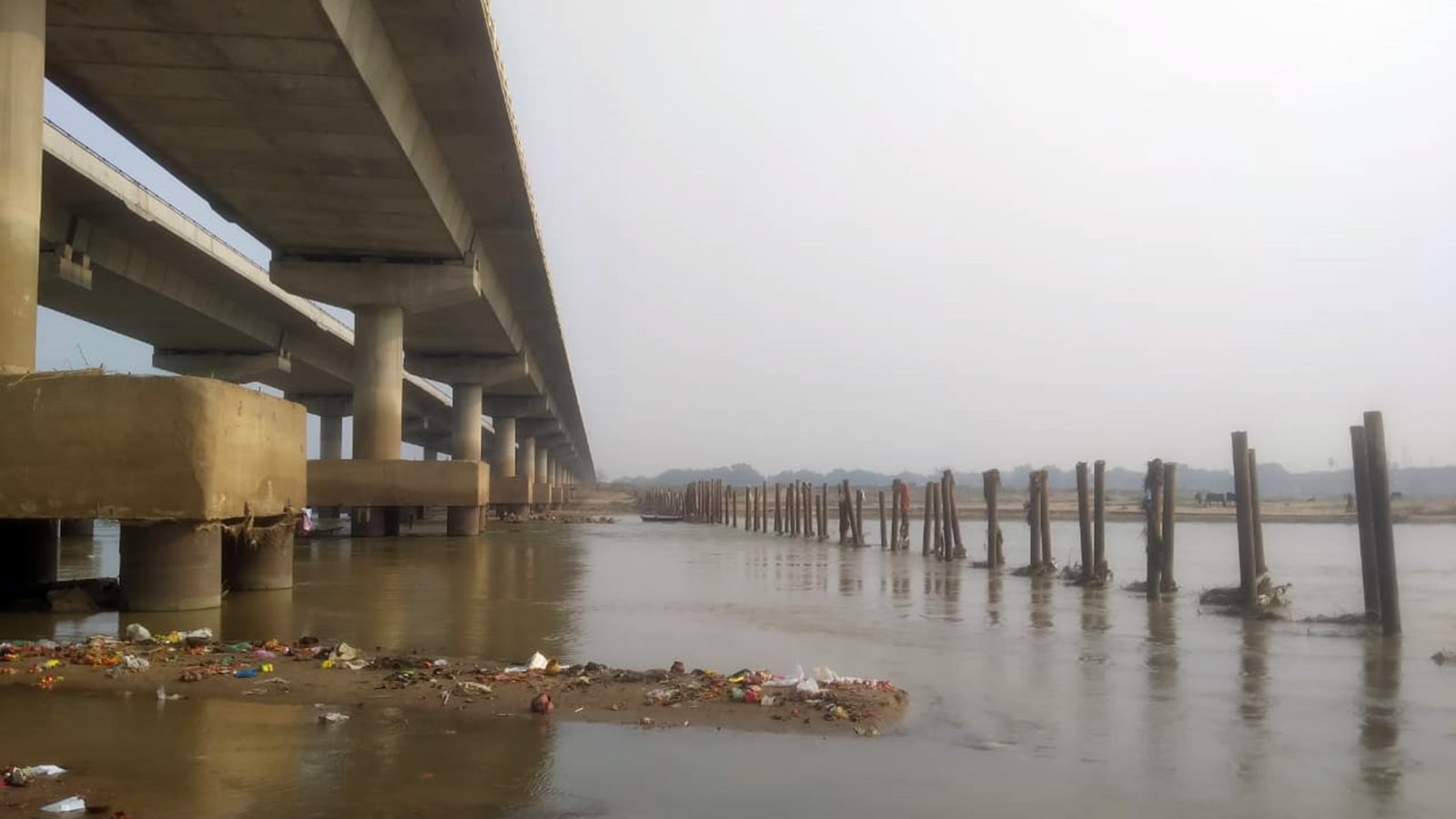
Bhojpur and Patna have reported the highest number of illegal sand mining cases in Bihar, and it is estimated to cost Rs 7,000 crore in annual losses to the state exchequer. Boats are a major means of transporting illegally mined sand, and the pillars in Sone river stop even small boats from crossing under the bridge from either side, officials said. The pillars were built over the past three-four months. Stopping the transportation of sand via road, however, remains a challenge, officials said.
Bhojpur District Magistrate Raj Kumar said, “Miners have been found using excavating machines to load sand into boats. A boat can carry three-four truckloads of sand,” he said. The pillars were made using iron pipes filled with concrete, he said. “We have put these pillars in a zig-zag manner so that even a small boat can’t cross to another side. Our challenge and task is now to stop sand mining via vehicles from the Sahar area,” he said. https://indianexpress.com/article/india/bhojpur-builds-a-fence-under-a-bridge-to-stop-sand-mining-boats-9035437/ (21 Nov. 2023)
Madhya Pradesh Revenue official crushed to death In the Shahdol district, a local revenue department official, known as a patwari, lost his life after being run over by a tractor-trolley engaged in the illegal transportation of sand. The incident occurred around midnight on Saturday (Nov. 25) when a patrolling team, including patwari Prasann Singh, intercepted the unauthorized sand-laden vehicle near the Son River in the Gopalpur area.As Singh attempted to halt the tractor-trolley, the driver deliberately ran him over, resulting in Singh’s immediate death. https://timesofindia.indiatimes.com/city/bhopal/madhya-pradesh-revenue-official-crushed-to-death-by-tractor-trolley-used-for-illegal-sand-mining-one-held/articleshow/105512325.cms (26 Nov. 2023)
A patrolling team of government employees, including patwari Prasann Singh, intercepted the tractor-trolley transporting illegally mined sand near Son River in the Gopalpur area, Deolond police station in-charge Rajkumar Mishra said. On reaching the river, Singh, posted as patwari in Khadda of Bohari tehsil, saw a tractor-trolley carrying sand and tried to stop it, but the driver ran over him, he said. Singh was killed on the spot, while the accused driver fled with the vehicle, the official said. https://www.hindustantimes.com/india-news/illegal-sand-miners-kill-revenue-official-in-madhya-pradesh-101700990006727.html (26 Nov. 2023)
Uttarakhand ‘Illegal mining: rivers dotted with potholes’ Court commissioner Alok Mehra, appointed by the Uttarakhand HC to conduct site inspections and submit a report on the adverse impact of illegal mining on rivers in the state, told the court on Friday that “huge pits have been formed, causing serious damage to the ecology of several rivers”, reports Pankul Sharma. The HC directed the government to file an affidavit and submit a proper plan to stop illegal mining in the rivers by December 6, after which the court can consider modifying its previous order banning dredging. The government had moved an application on Thursday to allow dredging, saying the state is not only incurring a loss of Rs 500 crore annually, but infrastructure-related development work is getting disrupted. https://timesofindia.indiatimes.com/city/dehradun/potholes-in-uttarakhand-rivers-due-to-illegal-mining-hc-told/articleshow/105483536.cms (25 Nov. 2023)
Jammu & Kashmir Admin sanctions Rs 32 cr for river restoration after NGT rap “There are serious lapses on the part of the administration in waste management and in failing to control illegal mining which has resulted in huge damage to the environment and public health,” the NGT had said in an order while hearing an application moved by activist Raja Muzaffar Bhat. https://theprint.in/india/jk-admin-sanctions-rs-32-cr-for-restoration-of-doodh-ganga-mamath-kull-streams-after-ngt-rap/1859091/ (25 Nov. 2023)
Uttar Pradesh NGT issues notice to CPCB, SPCB over illegal mining in Balia The NGT has issued a notice to the central and state pollution control boards in a case regarding the alleged illegal sand mining on the riverbeds of Saryu and Ghaghra in Balia district. The green tribunal also directed the DM to file the action taken report on or before the next date of hearing. The NGT was hearing the matter where it had taken suo motu cognisance of a media report which claimed there was large scale illegal sand mining on the riverbeds in Sikandarpur town of the district. A bench of NGT Chairperson Justice Prakash Shrivastava and expert member A Senthil Vel said, A substantial issue relating to compliance of environmental norms is involved in the matter. The matter has been posted on November 24 for further proceedings. https://www.moneycontrol.com/news/environment/illegal-sand-mining-in-ups-balia-ngt-issues-notice-to-central-state-pollution-boards-11801441.html (23 Nov. 2023)
Meghalaya Govt explores ways to protect drinking water supply sources The State Govt may look at the option of prohibiting sand mining and quarrying near the water source of Umkhen Water Supply scheme at Wahkdait in Laitkor. CM Conrad Sangma on Tuesday (Nov. 21) held a meeting with Water Resources, PHE and Forest Departments to discuss coordination in measures to be undertaken for protection of water sources and catchment areas in the state. Discussions were held for the protection of drinking water source at Wahkdait, Laitkor through protection of the Umkhen river which is the drinking water source for the people of South Shillong.
Water conservation Minister Marcuise Marak said that an inspection was done at the source by the one of the Cabinet Ministers and it was found that the water source has been disturbed by sand mining and quarrying. During the meeting, it was decided that stakeholders will be called for meeting at the level of Deputy Commissioner to sort out the matter. When asked if the Government is looking at prohibiting sand mining and quarrying in the area, the Minister said that the Government will check all options as it needs to protect the water sources or else the state will face difficult time in future. https://theshillongtimes.com/2023/11/21/govt-explores-ways-to-protect-drinking-water-supply-sources-in-meghalaya/ (21 Nov. 2023)
WETLANDS, LAKES, WATER BODIES
J&K, Ladakh HC seeks status of 7 wetlands declared Ramsar sites The High Court Monday (Nov. 20) granted a final opportunity to the Jammu and Kashmir government to file the report indicating the status of seven wetlands recognised to be of international importance and declared Ramsar Sites in J&K and Ladakh. Observing the failure of the government to file the status report as a “serious lapse”, a division bench of Chief Justice N Kotiswar Singh and Justice M A Chowdhary while hearing a suo moto PIL noted that despite the order passed by the court on September 9 last year, J&K government has not yet filed the report. https://www.greaterkashmir.com/front-page-2/high-court-seeks-status-of-7-wetlands-declared-ramsar-sites-in-jk-ladakh/ (21 Nov. 2023)
Goa Brimming Bondvol lake found emptied, villagers shaken The Calapur comunidade office-bearers and Santa Cruz villagers found the filled-to-capacity Bondvol lake drained of all its water on Friday (Nov. 24). The earthen dam built just over a century ago during the Portuguese era at Vhoddlem Bhat had been notified as a wetland by Goa State Wetland Authority (GSWA) a few years ago.
“The water of the lake had been stored without being released for the past five years, but nothing of this sort had happened,” said Peter Gonsalves, the special attorney of Calapur comunidade. He added, “This is a very serious matter and we are in the process of filing a complaint with police and other authorities, demanding strict action against the miscreants.” The office-bearers of the comunidade informed GSWA and the water resources department about the emptying of the lake by miscreants even as the legal aspects are being looked into.
The 22-metre hilltop dam irrigated 120 hectares of agricultural land below it and villagers would raise two crops and vegetables during the days of glory a few decades ago. The local community had to fight hard to save the lake and high court of Bombay at Goa had directed the government to constitute a task force to prepare a road map for its conservation. https://timesofindia.indiatimes.com/city/goa/brimming-bondvol-lake-found-emptied-villagers-shaken-up/articleshow/105482747.cms (25 Nov. 2023)
West Bengal ‘EKW is our pride & we must conserve it’: Bypass boards Encroachments, illegal constructions and even buying and selling of land are threats to the wetlands, said officials in the state environment department. All such activities are banned in the East Calcutta Wetlands. The boards and the accompanying maps, the officials said, are being put up to alert people so they do not take part in any illegal activity inside the wetlands. People who have been found to have purchased land inside the protected area have told officials from the environment department, when they were questioned, that they did so unaware of the fact that it was a protected area. Brokers often dupe people into buying land, said an official.
The wetlands have been classified into three parts — settlements, where human habitations are allowed; agricultural land; and water body. An official of the environment department told this newspaper that there are over 500 pending FIRs filed by the department for encroachments on land and water bodies at the protected site. An official said they hoped that before buying land, people would verify whether it is in any of the mouzas that form the wetlands. The whole of 30 mouzas and parts of seven mouzas constitute the wetlands.
The environment department has asked the Calcutta Municipal Corporation to put up 72 boards with the message and the map along EM Bypass and neighbourhoods off the Bypass, which serve as gateways to the East Calcutta Wetlands. “The state public works department will put up more such boards,” said an official. A part of the wetlands is under the Calcutta Municipal Corporation and the rest is under the Bidhannagar Municipal Corporation. An official said the problems of encroachment, illegal construction and filling of water bodies are more prominent in areas close to the city. Some of mouzas under threat are Pashchim Chowbhaga, Jagatipota, Aatghara, Mukundapur and Nonadanga. https://www.telegraphindia.com/my-kolkata/news/it-is-our-pride-and-we-must-conserve-it-em-bypass-boards-for-wetlands-awareness/cid/1982421 (25 Nov. 2023)
GROUNDWATER
Punjab Farmers are struggling as groundwater levels plummet Farmers want canal water for irrigation, while the government backs crop diversification. Both initiatives have seen limited success. (Sanskriti Talwar) https://scroll.in/article/1059144/punjabs-farmers-are-struggling-as-groundwater-levels-plummet-with-few-solutions-in-sight (21 Nov. 2023)
A PIL petition has been filed before the Punjab and Haryana High Court challenging guidelines issued in January 2023 on the extraction and conservation of groundwater in Punjab. The petition filed by a lawyer, Dhruv Chawla (petitioner), contends that the Punjab Groundwater Extraction and Conservation Directions of 2023 fails in achieving its stated object of conserving water and that it falls afoul of the Punjab Water Resources Management and Regulation Act. https://www.barandbench.com/news/punjab-and-haryana-high-court-pil-challenges-punjab-guidelines-groundwater-extraction (25 Nov. 2023)
Tamil Nadu Groundwater is turning saline on ECR: Study Touted to have the best-quality groundwater, the east coast of the city is facing water salinity due to gradual seawater intrusion, according to a 2023 study titled ‘Investigating underground water salinity in the east coastline of Tamil Nadu, India and improving its quality through solar assisted desalination’ published in ‘Urban Climate’ journal, done by a group of researchers from various universities in the city.
This is because more built-up areas are coming up and there is excessive borewell water usage, said V Kanchana, one of the authors of the study and chemistry professor at Sree Sastha Institute of Engineering and Technology. “Many water-intensive multi-storeyed buildings are coming up on ECR, reducing natural recharge and increasing indiscriminate pumping of groundwater,” she added. https://timesofindia.indiatimes.com/city/chennai/groundwater-is-turning-saline-on-ecr-study-researchers-design-solar-distillation-system/articleshow/105505308.cms (26 Nov. 2023)
URBAN WATER
Bengaluru How can a mega city like ours handle the unpredictability of a climate change era monsoon, where we experience searing heat one month and flooded streets the next? The solution is to be as self-sufficient as possible, say hydrologists and urban water researchers, Rashmi Kulranjan and Shashank Palur. Although this sounds like a pipe dream, the researchers tell me how the city could be both drought-proof and flood-proof. https://bengaluru.citizenmatters.in/water-rashmi-kulranjan-shashank-palur-cauvery-waste-water-bwssb-bbmp-kspcb-bbmp-lakes-stormwater-drains-128162 (16 Oct. 2023)
This 1,200-year-old lake is an ideal example of neglect The Hebbal Lake receives water inflow from its catchments that covers localities of Yeshwanthpur, Mathikere, RMV, BEL and HMT colonies, Nagavara, Narsipura and other layouts. The water of the Hebbal Lake had earlier been used for drinking purposes. Due to the change in the urban setup and the piped water supply by Bangalore Water Supply and Sewerage Board (BWSSB), the lake was later not used for drinking water purposes.
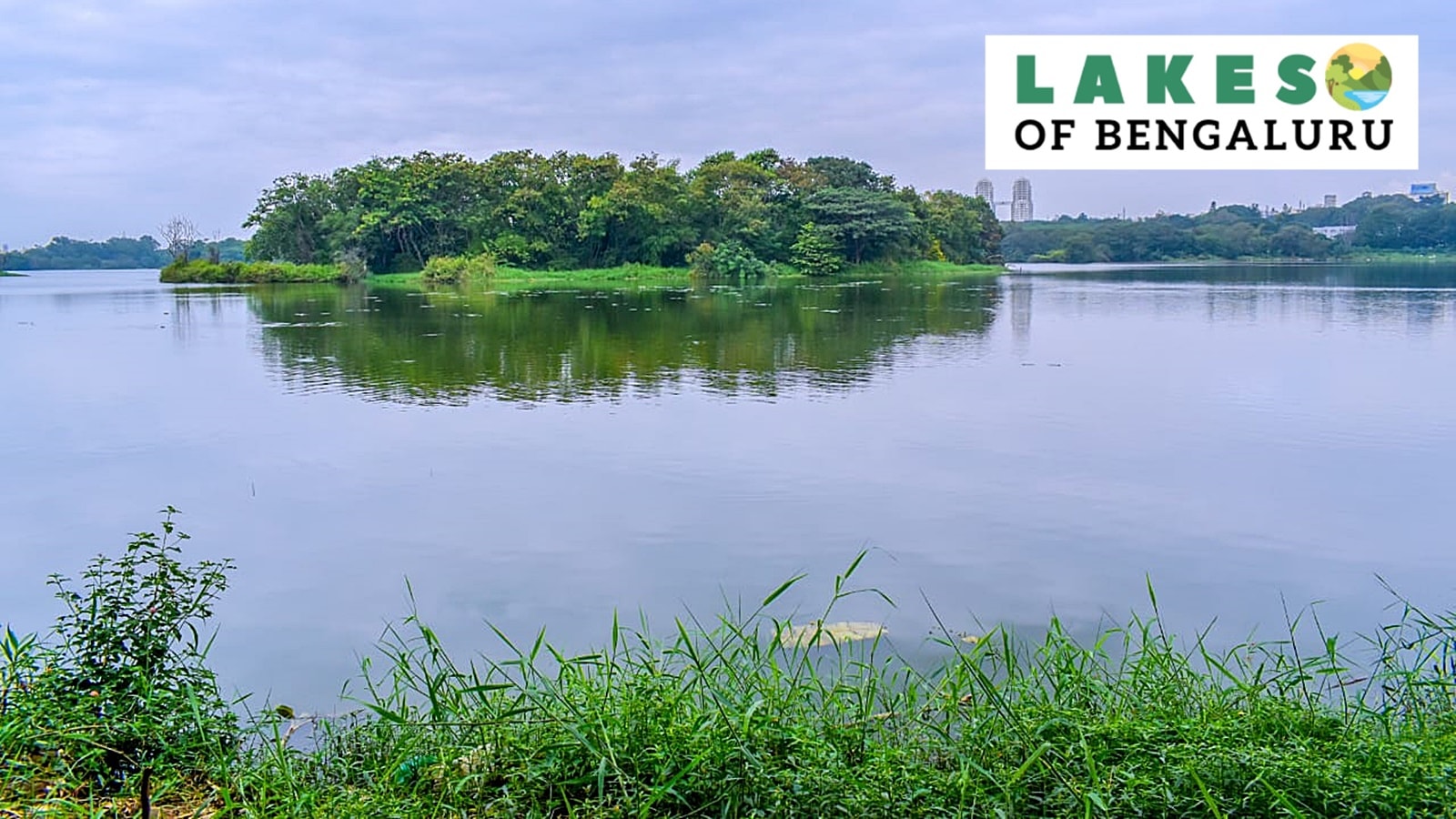
Despite the lake’s restoration in 2002, untreated sewage continued to enter the lake. Two years down the line in 2004, the lake was filled with weeds. The lake was used as a place to bathe cattle and immerse idols. Along with the Indo-Norwegian Environment programme, the Karnataka forest department restored the Hebbal Lake in 2002. However, due to paucity of funds, the government could not maintain the lakes and decided to lease out the waterbodies to private hotels. https://indianexpress.com/article/cities/bangalore/lakes-of-bengaluru-this-1200-year-old-lake-is-an-ideal-example-of-neglect-9042291/ (26 Nov. 2023)
Ludhiana Activists raise concern over water pollution While the city is all set to celebrate Chhath puja, the green activists have expressed concern about Sidhwan Canal pollution. They have sought a permanent solution to the issue as the water body becomes more polluted following immersion of idols and other religious material. They said the authorities should create a designated space for the immersion of religious material so that it could be collected from there.
They also claimed that the MC had carried out a cleanliness drive on the banks of and inside the canal in the beginning of this year and a penalty of Rs 5,000 was to be imposed on those caught throwing anything into the water body . The environmentalists are concerned that the devotees who will perform rituals at the banks of the canal during the Chhath puja will leave trash behind. https://timesofindia.indiatimes.com/city/ludhiana/activists-raise-concern-over-water-pollution/articleshow/105276548.cms (17 Nov. 2023)
Chandigarh Water leak leaves home with collapsed wall, cave-in The courtyard of a Sector-15 house caved-in, while its boundary wall collapsed completely due to a leak in the water supply pipe, officials said. Bhavneet Goyal, explained that there were no visible signs of dampness or the leak. However, the water silently eroded the foundations of the yard, pavement, and the area in front of the house. The cave-in occurred when the house owner’s driver stepped onto the pavement, which gave way. https://www.hindustantimes.com/cities/chandigarh-news/water-leak-leaves-chandigarh-s-sector-15-home-with-collapsed-wall-cavein-101700947980298.html (26 Nov. 2023)
Delhi DJB facing fund crisis: Atishi Water Minister Atishi Tuesday (Nov. 21) claimed the city was staring at a “man-made water crisis” due to the stoppage of funds to the Delhi Jal Board by the finance department and demanded Lt Governor V K Saxena’s immediate intervention in the matter. According to government sources, the minister in her letter to the L-G alleged that Finance Secretary Ashish C Verma, on the chief secretary’s advice, has stopped all funds of the Delhi Jal Board (DJB) since August.She demanded that appropriate action be taken against Verma.
However, sources in the planning department said that Rs 1,598 crore was released to the DJB in June. More funds will be released “based on evidence of the progress of works and geotagging for ensuring that public funds are not being misappropriated”, a source said. According to sources in the finance department, the government does not give funds to the DJB for salaries or repairs and maintenance. “These are to be met from the DJB’s own revenues. Also, running water and sewage treatment plants is the DJB’s responsibility. So it is wrong to say that water supply or sewage treatment will stop,” a source claimed. https://www.business-standard.com/india-news/delhi-may-face-severe-water-shortage-over-jal-board-fund-crisis-atishi-123112100677_1.html (21 Nov. 2023)
Alleging non-payment of dues since February this year, a section of contractors working for the Delhi Jal Board has said they will stop ongoing projects from November 27. DJB Vice Chairman Somnath Bharti claimed despite repeated directions from the finance minister, the finance department has not released funds for the last three months and he will reach out to the Lieutenant Governor seeking his intervention. https://www.business-standard.com/india-news/delhi-jal-board-contractors-threaten-to-stall-work-over-non-payment-of-dues-123112600724_1.html (27 Nov. 2023)
MONSOON 2023
Gujarat 14 people killed due to unseasonal rains Many parts of South Gujarat, Saurashtra and North Gujarat witnessed rain and winds. More than 155 talukas were impacted. “Three deaths were recorded in Dahod district, two in Bharuch, and one each in Amreli, Surendranagar, Mehsana, Botad, Panchamahals, Kheda, Sabarkantha, Surat, and Ahmedabad. All human deaths can be attributed to lightning,” an SEOC official told HT. He also said that more data is being collected and the death toll can go up. At least 40 animals also perished due to the unseasonal rainfall. https://www.livemint.com/news/india/gujarat-witness-unseasonal-rainfall-hailstones-11700989932868.html (26 Nov. 2023)
Study Middle east warming in spring enhances summer rainfall over Pakistan Abstract: -Here, we show that the Middle East is undergoing an increase in land heating during spring, which is responsible for 46% of the intensified rainfall over Pakistan and northwestern India during 1979–2022. This springtime land warming causes a decline in sea level pressure (SLP), which strengthens the meridional SLP gradient between the Middle East and the southern Arabian Sea and drives the changes of low-level jet (LLJ) subsequently. The impact persists into summer and results in a northward shift of the monsoonal LLJ, accompanied by strong positive vorticity in the atmosphere and enhanced moisture supply to Pakistan. Consequently, the transition region between the summer monsoon in South Asia and the desert climate in West Asia is shifted northwestward, posing significantly enhanced risk of floods over Pakistan and northwestern India. https://www.nature.com/articles/s41467-023-43463-0 (22 Nov. 2023)
FLOOD 2023
Coimbatore Noyyal overflows at several places As per an official source, Mettupalayam, Periyanaickenpalayam and the foothills of Siruvani received heavy showers, even as the district recorded 113cm rainfall for the 24 hours that ended at 8am on Thursday (Nov. 23). https://timesofindia.indiatimes.com/city/coimbatore/coimbatore-rain-river-noyyal-overflows-in-many-places/articleshow/105452068.cms (23 Nov. 2023)
HFL BREACH
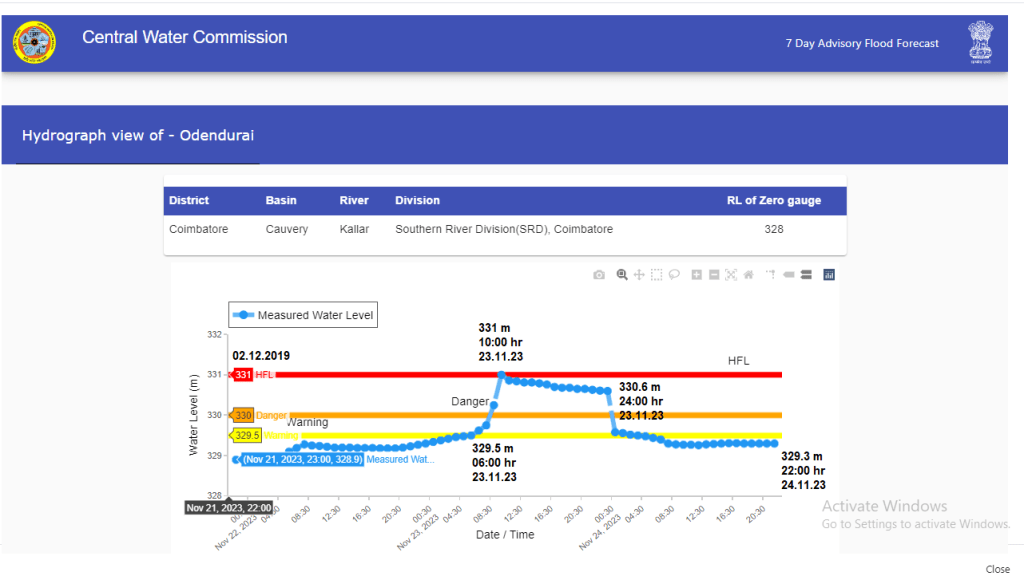
Tamil Nadu River Kallar part of Cauvery basin at Odendurai site in Coimbatore has touched old HFL 331 m dated 02.12.2019 at 10:00 hour on 23.11.2023.
URBAN FLOODS
Pune Centre approves 286cr for flood mitigation measures The Centre has approved funding of Rs 286 crore for the civic body to implement measures that will mitigate flooding and waterlogging during the monsoon. The funds will be utilized by Pune Municipal Corporation for the upgrade of storm water drains and the construction of box drains at 65 locations across the city.
The aim is to restrict waterlogging, construction of gabion walls at various locations along nullahs, deepening and cleaning of nullahs and water bodies, and construction of recharge shafts. The city has been witnessing frequent instances of waterlogging for the last few years after rains. Citizens have been demanding that the administration implement long-term sustainable measures to prevent hardships. https://timesofindia.indiatimes.com/city/pune/centre-approves-286cr-for-pmc-to-plan-flood-mitigation-measures/articleshow/105401457.cms (22 Nov. 2023)
Bengaluru Motorists are waylaid by constant flooding on Outer Ring Road with even moderate showers. They are now raising questions on the effectiveness of the Bruhat Bengaluru Mahanagara Palike’s maintenance work along the stretch in the aftermath of rain. BBMP officials however said that ‘natural’ flash floods cannot be stopped by them. https://bangaloremirror.indiatimes.com/bangalore/others/the-floody-business/articleshow/105454303.cms (24 Nov. 2023)
CLOUD BURSTS
SANDRP Blog 2023: ‘Cloudburst’ Incidents in J&K, Ladakh & North East This article is about ‘cloudburst’ incidents that have taken place in Jammu & Kashmir, Ladakah in North West Himalayan states and in Arunachal Pradesh and Sikkim in North East Himalayan states during south west monsoon 2023. https://sandrp.in/2023/11/24/2023-cloudburst-incidents-in-jk-ladakh-north-east/ (24 Nov. 2023)
DISASTERS
हिमाचल प्रदेश जनजातीय जिले लाहौल के लिंडूर गांव में भी पिछले चार माह में भारी भू घंसाव देखा जा रहा है। लिंडूर गांव में अभी तक 16 घरों में दरारें आ चुकी हैं जिनमें 9 भवनों को भारी नुकसान पहुंच चुका है। वहीं दरारें बढ़ने का सिलसिला लगातार जारी है जिससे ग्रामीणों में भय का माहौल बन गया है। पिछले दो तीन वर्षों सें लाहौल स्पीति जिले में भारी बारिश और प्राकृतिक आपदाओं की घटनाएं अधिक देखने को मिली हैं, जिससे ग्रामीण और विशेषज्ञ भू-धंसाव की इस घटना को जलवायु परिवर्तन से भी जोड़कर देख रहे हैं।
गौर रहे कि इस साल जुलाई माह में लाहौल-स्पीति जिले में बारिश से 72 सालों का रिकार्ड टूटा था। जिले में नौ जुलाई 2023 को 112.2 मिली मीटर बारिश हुई, जबकि सामान्य बारिश की अगर बात करें तो इस दिन केवल 3 मिमी बारिश होनी चाहिए थी। यानी कि एक दिन में 3640 प्रतिशत अधिक बारिश रिकॉर्ड की गई। आम तौर पर जुलाई महीने में इस जिले में 131.5 मिमी बारिश होती है। इसका मतलब है कि नौ जुलाई को यहां महीने भर के बराबर बारिश हो चुकी है। इससे पहले लाहौल स्पीति में 1951 में लाहौल स्पीति में 24 घंटों में 73 मिमी बारिश दर्ज की गई थी। https://www.downtoearth.org.in/hindistory/climate-change/climate-crisis/like-joshimath-massive-land-subsidence-in-lindur-village-of-himachal-change-in-weather-is-the-major-reason-92889 (20 Nov. 2023)
LANDSLIDES
Maharashtra Around 1.8% land ‘very highly’ susceptible to landslides: Study -In Maharashtra, roughly 1.8% of the land falls under the “very highly” susceptible category and 3.1% is “highly susceptible” to landslides, according to a study carried out by the researchers at the Hydrosense Lab, department of civil engineering, Indian Institute of Technology (IIT), Delhi.
-The vulnerable areas in the state are located at Sahyadri mountain ranges part of the Western Ghats. Rainfall-induced landslides are more common in districts like Ratnagiri, Raigad, Sindhudurga, Satara, Sangali, and part of Pune district.
-India accounts for 8% of global landslide fatalities. From 2001 to 2021, India’s average annual landslide deaths stood at 847, and the average financial losses amounted to more than ₹2,000 crore. https://www.hindustantimes.com/cities/pune-news/around-1-8-land-in-maharashtra-very-highly-susceptible-to-landslides-study-101700759122488.html (23 Nov. 2023)
DROUGHT
Andhra Pradesh Paddy cultivation suspended in NTR district In light of the district’s severe water shortage, the Agriculture Department has advised farmers to refrain from cultivating paddy during the upcoming rabi season. The decision was made following a meeting of the Irrigation Advisory Board (IAB), which concluded that no water would be released to the canals during the rabi season. https://www.deccanchronicle.com/nation/current-affairs/261123/paddy-cultivation-suspended-in-ntr-district-due-to-water-scarcity.html (26 Nov. 2023)
ENVIRONMENT GOVERNANCE
Meghalaya Rs 100 cr fund for environment restoration yet to be utilised The Rs 100 crore fund has been allocated under the Meghalaya Environmental Protection and Restoration Fund (MERPF). The non-utilisation of the Rs 100 crore fund was revealed in the 18th interim report submitted by justice (retd) BP Katakey. The report focused on a PIL filed against illegal coal mining in Meghalaya. It highlighted that the funds spent from the MEPRF are pending an audit. https://nenow.in/north-east-news/meghalaya/rs-100-crore-fund-environment-restoration-meghalaya-yet-to-be-utilised.html (25 Nov. 2023)
Jharkhand To compensate for mining projects, Adivasi land is being taken over for afforestation New forests are coming up in areas traditionally used by locals for cultivation, for accessing forest produce, for grazing livestock and even burying the dead. https://scroll.in/article/1059255/to-compensate-for-mining-projects-adivasi-land-in-jharkhand-is-being-taken-over-for-afforestation (26 Nov. 2023)
CLIMATE CHANGE
Opinion Is water sector’s ‘uncomfortable knowledge’ missing at COP28? Dipak Gyawali: Without a strong voice for the water sector – raised by a vibrant and diverse civil society participation – international conferences like COP28 are failing to deal with the climate crisis. A year ago, in the final declaration from COP27 in Sharm El Sheikh, the global climate community finally started to address the fact that climate change impacts society primarily through the water sector. Given the dominance of corporate and fossil fuel interests at COP28, critical voices (especially from civic groups) that have previously offered honest assessments rather than painting pretty pictures will be ignored or sidelined.
– On COP28’s implications for the water sector, one can safely say that neither the COP28 presidency nor the global water community have done sufficient homework, nor challenged business-as-usual institutions, to expect any significant outcome beyond pathetically obvious platitudes. https://www.thethirdpole.net/en/climate/opinion-is-water-sectors-uncomfortable-knowledge-missing-at-cop28/ (24 Nov. 2023)
SANDRP
Also see: DRP 20 Nov. 2023 & DRP 13 Nov. 2023
Follow us on: www.facebook.com/sandrp.in; https://twitter.com/Indian_Rivers

 SANDRP