
(Feature Image: Landslide warning board at Lakhwar dam site on Yamuna river. SANDRP, June 2015)
India need to relook the Dam Safety Act Experts say the Sikkim incident exemplifies blind spots in both legislation and implementation. The DSA does not promote risk-based decision-making and fails to incentivise transparency. Himanshu Thakkar, an environmental activist and coordinator of South Asia Network on Dams, Rivers and People, says that the frequency and scale of such disasters reveal a pattern of neglect: “It keeps happening regularly, people face disastrous consequences and we call these ‘natural disasters’. But there’s nothing natural about them.”
A robust DSA should allow different stakeholders to access information easily, but India’s framework falls short. “Dam safety is a public purpose function. Everything about dam safety, functions of all the institutions and committees and authorities, their reports, decisions minutes and agendas, everything should be promptly available to the public,” says Mr. Thakkar. “But nothing is in the public domain.” He adds that transparency is further obstructed when national and State bodies comprise government employees and engineers who worked on these projects, compromising objective decision making and lacking “people with a proven track record of taking independent decisions.”
Dam safety is a function of many parts: designing and constructing dams that adhere to safety margins, maintaining and operating them per guidelines, recording data in real-time in an accessible format, forecasting hazardous events and instituting emergency plans, to name a few. The Sikkim GLOF reveals poor compliance at all levels, from the dam’s design to the spillway capacity (which controls the release of water from a reservoir).
Hazard profiling and regular assessment are also mandated by the Act. Hazard risk fluctuates at the slightest touch, responding to climate change, urbanisation, and the way people/companies use water or where they are located. Periodic reviews are expected to bring forth fresh inundation maps and new rule curves (which determine the capacity of dam reservoirs), all of which contribute towards the safety of the downstream areas.
Spillway capacity and other metrics should be reviewed every five years or so, but Mr. Thakkar says periodic reviews are often not conducted or if they are, their findings are not easily available in the public domain. The Act requires dam builders to conduct comprehensive dam safety evaluations, but “there is no standardisation of how the failure is analysed and reported,” Mr. Damle stated. The Himachal Pradesh government recently served notices to 21 hydroelectric projects, finding them guilty of non-compliance with the DSA during the July-August floods. https://www.thehindu.com/sci-tech/energy-and-environment/does-india-need-to-relook-the-dam-safety-act-explained/article67447034.ece (22 Oct. 2023)
Similarly, we need to be a little more serious about flood forecasting and not see as an academic exercise that seems to be the case. The flood forecasting is highly inadequate, but there is no system in place to evaluate its efficacy and hold the forecasters accountable. For example, no readings were available from Lachen and other flood forecasting sights after 10 pm on Oct 3, 2023, when the disaster started at 10.30 pm. In Case of the avoidable flood disaster at Sardar Sarovar, CWC failed to provide adequate and timely estimates of floods around Sept 16-18 that would reach Sardar Sarovar Project, even based on the rainfall that had already occurred in the catchment. Its estimate of inflow forecast was about a third of actual inflows. Again no questions are being asked.
We have no clue if the Safety audits of functioning of spillway gates of Teesta 3 or Teesta V, since gates of neither of the projects could be opened during floods.
Similarly, even after ITBP alerted the Sikkim administration at around 10.40 pm on Oct 3 2023 about the incoming floods, apparently, the gates of Teesta 3 could not be opened even after an hour and those of Teesta V dam even after over two hours. So would an early warning system really help if we do not have clearly defined, effective and functioning Disaster Management Information channels in place that will ensure that all concerned are promptly alerted? This lacunae was seen even during June 2013 Uttarakhand flood disaster and even during Feb 2021 Chamoli disasters, but we are clearly not doing anything to correct this.
Clearly we need to be much more serious regarding Dam Safety norms, flood forecasting and disaster management systems. We are NOT as of now.
HYDRO POWER PROJECTS
Arunachal Pradesh Large dams spell doom While people have vociferously protested against big dams—most recently against the proposed 3,097-MW Etalin Hydroelectric Project in Dibang Valley—go-aheads have been given on the basis of botched-up reports in favour of the projects.
Clearances were given to the projects chiefly on the basis of the Cumulative Impact Assessment Report of the Lohit basin conducted by WAPCOS Ltd, which, significantly, is a public sector enterprise under the Ministry of Jal Shakti. A study of the report by the South Asia Network on Dams, Rivers and People (SANDRP) pointed out various loopholes in it, concluding, “Considering these issues, the WAPCOS’ Lohit Basin Study Report should be rejected and a fresh study by an independent, credible agency should be initiated.”
The SANDRP assessment underlined how the river would be severely fragmented by the six dams, thus damaging the ecology. “All the migratory routes and spawning grounds of endangered fish like Trouts and Golden Mahseer… will be destroyed,” it said. https://frontline.thehindu.com/environment/why-large-dams-spell-doom-for-arunachal-pradesh/article67399432.ece (19 Oct. 2023)
Lower Demwe HEP threatens the wildlife In 2012, the 1,750-megawatt Lower Demwe hydroelectric project received a highly contentious wildlife clearance. Jayanthi Natarajan, the then Environment Minister who was also the chairperson of the NBWL, gave the go-ahead disregarding the concerns of other members of the board on the impact the project would have on wildlife. Natarajan had also said wildlife studies could be conducted concurrently with construction. These studies were supposed to be carried out by IIT Roorkee.
The dam is proposed in an eco-sensitive zone on the Lohit river, 50 metres from the Kamlang Wildlife Sanctuary. It will directly impact the Ganges river dolphin, at least two critically endangered bird species, the Bengal florican, and the white-bellied heron and also impact Parshuram Kund, a Hindu pilgrimage site. https://frontline.thehindu.com/environment/how-a-hydropower-project-threatens-the-wildlife-of-arunachal-pradesh/article67399135.ece (19 Oct. 2023)
Sikkim GLOF warnings ignored Himanshu Thakkar, coordinator of the SANDRP, an advocacy group, said that large hydro projects were “unfit” for the fragile Himalayan region and were financially unviable, as reporting has borne out. “That large hydro projects are becoming economically unviable can be seen from the trend that private players are pulling out of large hydro projects and public sector units are taking them over,” said Thakkar. “In Sikkim, both Teesta Stage III and Stage VI were to be developed by private players but public sector units subsequently took them over to rescue the projects.”
– “Government agencies did not learn from the 2021 Chamoli disaster in Uttarakhand,” said Thakkar. “The NDMA is speaking of installing an early warning system only after the disaster has happened. Teesta Stage III should not have been allowed without adequate spillway capacity, proper dam safety mechanism and an early warning system put in place.” If the dam was unviable, it should never have been built in the first place, he said. https://article-14.com/post/disaster-on-the-teesta-ignoring-warnings-of-melting-glacier-sikkim-hoped-large-dams-would-earn-money–6531e7e374f75 (20 Oct. 2023)
A disaster foretold Participating in a webinar on ‘Dams, Development and the Teesta Floods’, organised by the advocacy group Centre for Financial Accountability (CFA) in Delhi, experts and activists have asserted that the recent Sikkim floods were actually a “disaster foretold.” https://www.counterview.net/2023/10/sikkim-floods-teesta-was-dammed-beyond.html (14 Oct. 2023)
The lesson for India is clear: it should refrain from its plan of saturating the upper Teesta Valley in Sikkim with dams. A review of the global experience with dams – presented in my recent book Rivers and Sustainable Development – shows clearly that treating rivers as commercial resources, while ignoring their ecological function, is not sustainable. It is necessary to switch to an ecological approach, as some developed countries have already begun doing. (S Nazrul Islam) https://www.thedailystar.net/opinion/views/news/lessons-we-can-learn-the-recent-teesta-disaster-3448041 (20 Oct. 2023)
Govt to start monitoring high-risk glacial lakes next year India aims to install the first part of an early warning system at some high-risk glacial lakes in the Himalayas next year, a senior official said on Monday (Oct 16 2023). There are 56 at-risk glacial lakes in India. If the EWS systems had been installed, they could have given 90 minutes warning before floods from South Lohnak lake engulfed on Oct 3. Krishna Vatsa of NDMA said authorities will aim to set up some of these systems by next year to monitor the weather and environment at the lakes as a first component of an early warning system. The full system would be installed later based on the outcome of monitoring. These will be unmanned systems running on solar or battery power.
– More than 200 such lakes now pose a high hazard to Himalayan communities in India, Pakistan, China, Nepal and Bhutan, according to 2022 research (https://www.sciencedirect.com/science/article/pii/S0048969721055194), and India currently lags behind its South Asian neighbours in deploying glacial flood early warning systems. The Economic Times reported on Monday that top officials from multiple ministries will meet on Wednesday to formulate a plan for early warning systems. https://www.reuters.com/world/india/india-start-monitoring-high-risk-glacial-lakes-next-year-2023-10-16/ (16 Oct. 2023)
(Col KS Dhami (Retd)) To get a true and broad view of the state of the Himalayan snow cover, glaciers and glacial lakes, there is a need for high-resolution remote-sensing satellite system, drones, ground-based monitoring stations and most importantly, ground observations.
– The source of the Indus, the Himalayas’ oldest river, is not a glacier but moss-covered earth named ‘Senge Khabab’ (lion’s mouth) by the Tibetans.
– In the entire Himalayas, Bhutan stands out as the country where forests are being preserved and potentially dangerous glacial lakes identified for taking protective and preventive measures. Nepal has also been proactive. A decade ago, Nepal had a network of 49 weather monitoring stations at selected locations. More have come up to collect ground-based data on glaciers/glacial lakes. Bhutan has set up a highly motivated, trained labour force for inaccessible places to empty glacial lakes through controlled bursting and help preserve some for their scenic beauty through stabilising works.
– A practical warning system, without modern gadgets, saved a town over 300 years ago. On November 10, 1762, an earthquake caused a shoulder of a mountain to fall into the Sutlej upstream of Seoni (Himachal Pradesh), where the river flows through a narrow gorge. The dammed water rose to 400ft above the normal flow level and when it burst, a huge wave washed away the lower half of Bilaspur town. However, due to an efficient warning system based on firing matchlocks and beating drums, no lives were lost (sound travels far in the silence of the mountains).
– On the intervening night of July 31 and August 1, 2000, a massive wall of water — a Himalayan tsunami — 40-70ft high at the highest flow level, thundered along the Sutlej river from Tibet across the Great Himalayas. Overnight, it washed away roads, bridges, habitations and commercial establishments and threatened the Nathpa Jhakri Hydel Project.
– The bursting of the Parechu lake formed on the Parechu river on the Chinese side of the border in Spiti in June 2005 is another example of the devastation GLOF can cause in the absence of reliable surveillance and warning systems and disaster management.
– Fully aware of the non-feasibility of this ILR project, I wrote to the CJI and other members of the Bench: “Inter-linking rivers at the national level with channels cutting across the grain of the country and the natural flow of water, that too against the muddied monsoon sea of water, will not only be an ecological disaster but a financial quagmire.”
– Basically, unlike Bhutan, there is no spirit or motivation to perform. There is no accountability nor anyone to ensure it as the chair-borne advisers are too afraid to go out in the field. https://www.tribuneindia.com/news/comment/himalayas-heading-towards-a-point-beyond-redemption-554847 (20 Oct. 2023)
Corruption in Teesta-III HEP construction Like a magic act, money taken as government-guaranteed loans for developing the 1200 Mw Teesta-III HEP was deftly transferred by the project promoters from its “left pocket to the right pocket” during the murky construction phase. Details of alleged unregulated sanctions, financial irregularities and technical compromises by the Teesta Urja Ltd (now Sikkim Urja Ltd) from inception to completion of the nearly Rs. 14,000 crore Teesta-III HEP were presented by Chief Minister PS Golay on Monday (Oct. 16) afternoon at a media conference. https://sikkimexpress.com/news-details/how-teesta-iii-hep-construction-money-went-from-left-pocket-to-right-pocket-of-same-group (18 Oct. 2023)
GTA threatens to stop work at two hydel power projects The Gorkhaland Territorial Administration (GTA), a semi-autonomous body which governs the Darjeeling and Kalimpong hills in north Bengal, has threatened to stop two hydel power projects over the Teesta River in Kalimpong after a flash flood killed more than 90 people in Sikkim last week.
Teesta Low Dam Project (TLDP) III at Reang. “We will not allow the 132 MW Teesta Low Dam Project (TLDP) III at Reang and 160 MW TLDP-IV at Kalijhora to function unless the National Hydroelectric Power Corporation (NHPC) addresses local concerns, including building up of embankments,” said Anit Thapa, chief executive of GTA.
– “Teesta River’s height has gone up in Kalimpong and Darjeeling district due to the sand accumulated due to flood. This has posed a bigger threat and the NHPC must build embankments. Till they address the problems, we will not allow the two projects to function,” Thapa said.
– “We will try to do whatever is possible within our purview. Multiple agencies are working to restore normalcy. In the hills, vulnerable points keep on developing and we undertake regular surveys. Our team is on the job. Only two of the four units at TLDP-IV are operational at present. All four units of TLDP-III have been kept shut due to silt brought in by the flood waters,” said LK Tripathi, executive director (Siliguri-region) of NHPC. https://www.hindustantimes.com/cities/others/gta-threatens-to-stop-work-at-two-hydel-power-projects-over-teesta-after-floods-101697355107107.html (15 Oct. 2023)
Sikkim Bhutia Lepcha Apex Committee (SIBLAC), Sikkim’s apex tribal body, is demanding a comprehensive Central Bureau of Investigation (CBI) inquiry into the controversial Teesta Dam project. https://www.indiatodayne.in/sikkim/story/sikkims-apex-tribal-body-calls-for-cbi-inquiry-into-teesta-dam-project-disaster-demands-accountability-698993-2023-10-23 (23 Oct. 2023)
NHPC suffered expected loss of Rs 233.56cr NHPC on Wednesday (Oct. 18) said it suffered an expected loss of Rs 233.56 crore due to flash floods in its Teesta-VI hydro power project in Sikkim. “Teesta-VI Hydro Electric Project, Sikkim (500 MW) being executed by Lanco Teesta Hydro Power Ltd, a wholly-owned subsidiary of NHPC Ltd, which was affected due to flash flood in Teesta Basin on October 4, 2023,” the company said in a regulatory filing. The company further said that all assets/ works of Teesta-VI HE project are insured under the Construction All Risk (CAR) Policy, subject to excess clause and loss limit. It is anticipated that there will be a time delay of at least six months and consequent cost-overrun of the project. https://www.business-standard.com/companies/news/nhpc-suffered-expected-loss-of-rs-233-56-cr-due-to-flash-floods-in-sikkim-123101800596_1.html (18 Oct. 2023)
According to this report, power generation at the Independent Power Project Dikchu HEP (96 MW) is also stalled since Oct 4, 2023. The report does not say how it is damaged and how long the station will be down. It also does not mention any impact to small hydro projects (e.g. Kundan Project at Lachen). https://theprint.in/india/governance/power-surplus-state-no-longer-sikkim-braces-for-winter-after-3-hydropower-plants-damaged-in-floods/1810301/ (19 Oct. 2023)
Himachal Pradesh Central team visits Pandoh A team from Central Govt visited Pandoh dam of BBMB in Himachal Pradesh, on Beas river to investigate the sudden water release from the dam causing huge damages in the downstream area. However, the team has no independent members, former govt officials cannot be called independent. https://www.tribuneindia.com/news/himachal/central-team-visits-pandoh-to-probe-flooding-charge-554819 (20 Oct. 2023)
Opinion IHR needs its own EIA -Despite all levels of government being acutely aware of the special needs of the Indian Himalayan Region (IHR), the region’s vulnerabilities and fragility have not been considered separately. While some industries mentioned in the schedule to the notification cannot be set up in the IHR States due to the industrial policies of the respective States, other industries and projects have to meet the same threshold in the rest of the country. Even the draft 2020 notification which was floated for public discussion does not treat the IHR differently than the rest of the country and is not cognisant of the special developmental needs of IHR.
-In many cases, the EIA is done in a ‘box ticking approach’ manner, as a mere formality that needs to be done for EC before a project can be started. The consequences of all these limitations are amplified in the IHR as on top of the inherent limitations of the process, the EIA process is not at all cognisant of the special needs of the IHR. Policymakers would do well to explore other tools such as the strategic environmental assessment which takes into account the cumulative impact of development in an area to address the needs of the IHR as a fundamental policy. (Archana Vaidya & Vikram Hegde) https://www.thehindu.com/opinion/lead/the-indian-himalayan-region-needs-its-own-eia/article67427658.ece (17 Oct. 2023)
Involve the local population and grass-roots bodies in determining the carrying capacity of the IHR writes Tikender S Panwar. https://www.thehindu.com/opinion/op-ed/restoring-the-ecological-health-of-the-himalayas/article67450260.ece (23 Oct. 2023)
Report Developing EWS for cascading disasters Composed in the autumn of 2022, this report provides an overview of the geomorphological factors and hydrometeorological conditions that cause cascading disasters in the Himalayan region and examines possibilities for designing new approaches, tools, and partnerships for monitoring and early warning systems. https://www.stimson.org/2023/developing-an-early-warning-system-for-debris-floods-and-extreme-flow-events-in-nepal/ (18 Oct. 2023)
Cascading disasters & vulnerable infra Cascading disasters triggered by climate volatility and exacerbated by human activity are causing intensive loss and damage across the Himalayan region, and better policy is needed to protect communities and infrastructure. https://www.youtube.com/watch?v=6rm9yJTkGPs (19 Oct. 2023)
Power Ministry Investigating EWS at Teesta III: RK Singh Interesting statements from Union Power Minister: Almost two weeks after the Sikkim disaster of Oct 3-4, the Power Minister still does not know if the Teesta 3 project, washed away by the GLOF, had an early warning system or not. They are still “looking into this”. Similarly, while claiming early warning systems have been installed at some hydropower projects, it is not clear which are these, there is no list forthcoming. This report also mentions that DRDO has been roped in, in Dec 2022 to put early warning systems, but not clear what is the progress. https://www.moneycontrol.com/news/business/sikkim-flash-flood-power-ministry-investigating-early-warning-system-at-teesta-urja-hydropower-project-rk-singh-11557411.html (18 Oct. 2023)
Will not slow hydropower plans: R.K. Singh “We didn’t have an early warning system in place that would have allowed the dam’s gates to be opened. We are looking into this. However, hydropower is necessary especially when we need baseload power and a source of electricity that can be quickly ramped up or down. Many countries derive 70%-80% of their power from hydropower… The Green Revolution in India was partly due to the Bhakra Nangal (power project), so we are not going to write off hydropower as yet,” he said at a meeting on Wednesday (Oct. 18).
The NDMA had in September installed automated weather stations at the South Lhonak lake (which burst) in September but these systems were not designed to warn of a sudden discharge and were only equipped to monitor weather. India has about 100 large hydropower plants, defined as those with over 25 MW capacity, but their share in the country’s overall electricity mix has been falling and now accounts for around 12%. https://www.thehindu.com/news/national/sikkim-dam-collapse-will-not-slow-indias-hydropower-plans-rk-singh/article67439239.ece (20 Oct. 2023)
MoJS केंद्र ने 10 वर्षों में हिमालयी राज्यों के साथ प्राकृतिक आपदाओं पर कोई डेटा साझा नहीं किया : पार्ल पैनल रिपोर्ट केंद्रीय जलशक्ति मंत्रालय ने जल संसाधनों पर एक लोकसभा संसदीय पैनल को “देश में ग्लेशियर प्रबंधन – हिमालयी क्षेत्र में अचानक बाढ़ के लिए अग्रणी हिमनद झील के विस्फोट सहित ग्लेशियरों और झीलों की निगरानी” नामक एक रिपोर्ट में यह जानकारी दी। रिपोर्ट में कहा गया है, “यह पूछे जाने पर कि क्या पिछले दशक के दौरान हिमालय क्षेत्र में हिमस्खलन, बादल फटने और भूस्खलन के संबंध में राज्य सरकारों या स्थानीय अधिकारियों को कोई डेटा उपलब्ध कराया गया है और इसकी प्रत्याशा में केंद्रीय जल आयोग (सीडब्ल्यूसी) द्वारा बाढ़ के संबंध में सलाह जारी की गई है, विभाग ने नकारात्मक उत्तर दिया।”
यह पूछे जाने पर कि क्या भारत के पास हिमालय-काराकोरम देशों के साथ कोई डेटा साझा करने की नीति है, ताकि भविष्य के ग्लेशियर और अपवाह विकास का बड़े पैमाने पर मॉडलिंग बेहतर सटीकता के साथ किया जा सके। मंत्रालय ने समिति को सूचित किया कि “जहां तक डेटा साझा करने की नीति का सवाल है, हिमालय-काराकोरम देशों का संबंध है, डेटा साझाकरण नीति के संबंध में कोई विशेष जानकारी उपलब्ध नहीं है, ताकि भविष्य के ग्लेशियर और अपवाह विकास के बड़े पैमाने पर मॉडलिंग को बेहतर सटीकता के साथ किया जा सके। https://hi.investing.com/news/general/article-97974 (18 Oct. 2023)
MoEF Agenda of the EAC meeting on River Valley Projects to be held on Oct 26 2023.
1. Gandikota Pumped Storage Hydro-electric Project (1000MW), in 190 ha at village Kondapuram village, Tehsil Muddanur, Dist Kadapa, Andhra Pradesh by New and Renewable Energy Development Corp of AP Ltd. FOR EC
2. Sharavathy Pumped Storage Project (2000 MW), in 153 ha at village Begodi, Tehsil Honavar, District Uttara Kannada, Karnataka by Karnataka Power Corp Ltd – FOR TOR
3. Discussion on requirement of CIA/CSS for small hydro power projects https://parivesh.nic.in/utildoc/18577036_1697877475578.pdf
Relevant agenda of FAC meeting on Oct 20 2023:
1. DIVERSION OF 7.3722 HA OF ADDITIONAL FOREST LAND IN ALREADY APPROVED DIVERSION IN FAVOUR OF SHONGTONG KARCHHAM HYDRO ELECTRIC PROJECT, HPPCL DISTT. KINNAUR, HIMACHAL PRADESH
2. 406.79 HA. OF FOREST LAND IN FAVOUR OF HPPCL FOR THE THANA PLAUN HYDRO-ELECTRIC PROJECT (191 MW), IN MANDI & JOGINDERNAGAR FOREST DIVISIONS, DISTRICT MANDI, HIMACHAL PRADESH
3. DIVERSION OF 12.8042 HA (PREVIOUS PROPOSED AREA 13.1959 HA) OF PROTECTED FOREST LAND IN SIRMOUR IN REWA DIVISION FOR HYDRO POWER PROJECT OF MARSHAL SMALL HYDRO POWER PRIVATE LIMITED, IN REWA DISTRICT OF MADHYA PRADESH
4. DIVERSION OF 530.85 HA (INSTEAD OF 505.5 HA) OF FOREST LAND FOR BANDA IRRIGATION PROJECT OF WATER RESOURCES DEPT IN SAGAR DIST, MADHYA PRADESH
5. DIVERSION OF 1305.142 HA (INSTEAD OF 1248.821 HA) FOREST LAND FOR MAA RATANGARH MULTIPURPOSE PROJECT at DABRA, DATIA & GWALIOR DIST, MADHYA PRADESH https://forestsclearance.nic.in/AgendaDetail.aspx?id=292!dis1&fbclid
DAMS
Kaleshwaram Project Pillars sinking incident: L&T, Govt begin probe at Medigadda Infrastructure major L&T and Telangana government have launched a probe into an incident where a few pillars of the Medigadda barrage, which is 260 km away from Hyderabad, sank in by a few feet, threatening the structure. The officials are emptying the reservoir which has about 10 tmc of water at present. The reservoir, which is part of the multi-reservoir Kaleshwaram project, has a total capacity of 16 tmc. “We have built the 1.63-km long Lakshmi barrage (Medigadda) with 86 piers for the State government in 2019. It withstood for the last five flood seasons, including the recent 2023 floods,” an L&T spokesperson said.
“Yesterday evening, a portion of the bridge is found to be sagging at Block-7 of the Barrage after a loud noise. “Last year, this barrage experienced the highest recorded flood of 28.70 lakh cusecs against design discharge of 28.25 lakh cusecs. The design of barrage was given by the State authorities. The barrage continued to operate safely and withstood even in unprecedented floods of July 2022,” he said in a statement on Sunday (Oct. 22). https://www.thehindubusinessline.com/news/national/pillars-sinking-incident-lt-telangana-govt-begins-probe-at-medigadda/article67449711.ece (22 Oct. 2023)
According to engineers of the Irrigation department 15 to 20 pillars from sixth to eight block of the barrage had sunk with huge sounds from the gate near the blocks late on Saturday (Oct. 21) evening. But the information was kept under wraps till past midnight. Officials said since it was very dark they could not estimate the extent of damage and which gates were damaged. The loud noise is stated to have been heard somewhere near the 20th pillar on the Maharashtra side.
The barrage the government had claimed was constructed with gigantic concrete piers that are 110 m in length, 4 m/6 m in width and 25m height. The L&T which constructed these pillars claimed that the construction involved concrete used that was equivalent to build 7 Burj Khalifas, steel used to equivalent to building 15 Eiffel Towers and earth excavated fo 6 pyramids of Giza. Further they claimed the team set a world record by pouring 25.584 cum concrete in 72 hours.
This is the first barrage under Klis, connecting Telangana and Maharashtra, at Sironcha, and has storage capacity of 10.87 tmc ft. The change in alignment of the road was first noticed by motorists around 8pm who informed the irrigation department and police. https://www.thehansindia.com/news/cities/hyderabad/prestigious-medigadda-barrage-pillars-under-kaleshwaram-project-sunk-reasons-not-known-831672 (22 Oct. 2023)
Though it is over 16 hours since the pillars of Medigadda barrage sunk, there is no official version of the incident and no official is available to make any statement and at least give the preliminary information about the possible cause for the sinking of the pillars. Even the major construction company L&T and its officials are not responding to phone calls. The Irrigation officials are tight lipped over the incident. Instructions have been given to all not to speak about it and this further increases the suspicion over the reasons for the pillar getting sunk.
One of the senior most officials in Irrigation department reluctantly said, “Officials suspects ” Bearings blast” behind Pillar damage at Medigadda. What is bearing blast? Well the officials say that perhaps the bearings installed under the pillar could not bear the weight of the pillar and they got broken? It may be mentioned here that the project was inaugurated in June 2019 amidst much fanfare and all kinds of first about the quality and quantum of material used was announced in a detailed presentation. https://www.thehansindia.com/telangana/why-did-medigadda-barrage-pillar-sink-mystery-continues-officials-tight-lipped-831719 (22 Oct. 2023)
Kerala LiDAR survey launched for Kadamanthodu dam The Water Resources department launched a Light, Detection and Ranging (LiDAR) survey on Tuesday (Oct. 17) as part of a proposal to construct a dam across the Kadamanthodu river, a tributary of the Kabani, at Pulpally in Wayanad, even as local residents and environmental organisations are putting up stiff resistance against the project. https://www.thehindu.com/news/national/kerala/lidar-survey-launched-for-kadamanthodu-reservoir-project-in-wayanad/article67430940.ece (18 Oct. 2023)
Opinion This article about Bhakra Dam as symbol of Nehru’s temples of Modern India could have provided what lessons we need to learn for modern India in era of climate change. https://www.tribuneindia.com/news/comment/towering-temple-of-resurgent-india-warts-and-all-554842 (20 Oct. 2023)
INTERLINKING OF RIVERS
Study -Climate scientists in India have found that the river interlinking project will have drastic changes in the Indian summer monsoon, causing uninteded dryness and floods in various parts of the country. https://www.youtube.com/watch?v=muaLSBZYKJI (09 Oct. 2023)
INTERSTATE WATER DISPUTES
Krishna Water Disputes The Andhra Pradesh’s continuing dispute with Telangana over sharing Krishna River water gives farmers sleepless nights, particularly in regions already struggling with a severe deficit. The Central government’s recent decision authorising a fresh review of the sharing has added to the uncertainty, and raised concerns of political motives and potential losses in the State’s agriculture sector, reports G.V.R. Subba Rao. https://www.thehindu.com/news/national/andhra-pradesh/andhra-pradeshs-rice-bowl-reputation-at-stake-as-the-water-war-heats-up/article67438340.ece (20 Oct. 2023)
RIVERS AS NATIONAL WATERWAYS
Study Waterways can disrupt riverine ecosystems This paper titled ‘Impact assessment of barge trafficking on phytoplankton abundance and Chl a concentration, in River Ganga, India’ published in 2019 in PLOS ONE informs that barge trafficking and navigation through water ways can cause deleterious impacts on chemical and biological components of the river ecosystem along with hydrodynamic alterations, habitat destruction, changes in water quality, reduction of fish catch and loss of production of larval and adult fish. https://www.indiawaterportal.org/articles/waterways-can-disrupt-riverine-ecosystems (16 Oct. 2023)
URBAN RIVERS

Vishwamitri; Vadodara Good report by a student of Azim Premji University about how the dumping of Construction Waste into the water bodies in Vadodara (Gujarat) is destroying the Vishwamitri river there. https://epp-apu.medium.com/story-of-the-vishwamitri-and-c-d-2979e6fc4a64 (22 Oct. 2023)
Pune Webinar Know Your Rivers: The Fascinating Life on the Banks of Pune Rivers happening on Oct. 26, 2023 at 07:00 pm. Registration Link: https://kisan.zoom.us/webinar/register/WN_NUZmNz27T82QczzgNzyUDA
RIVERS
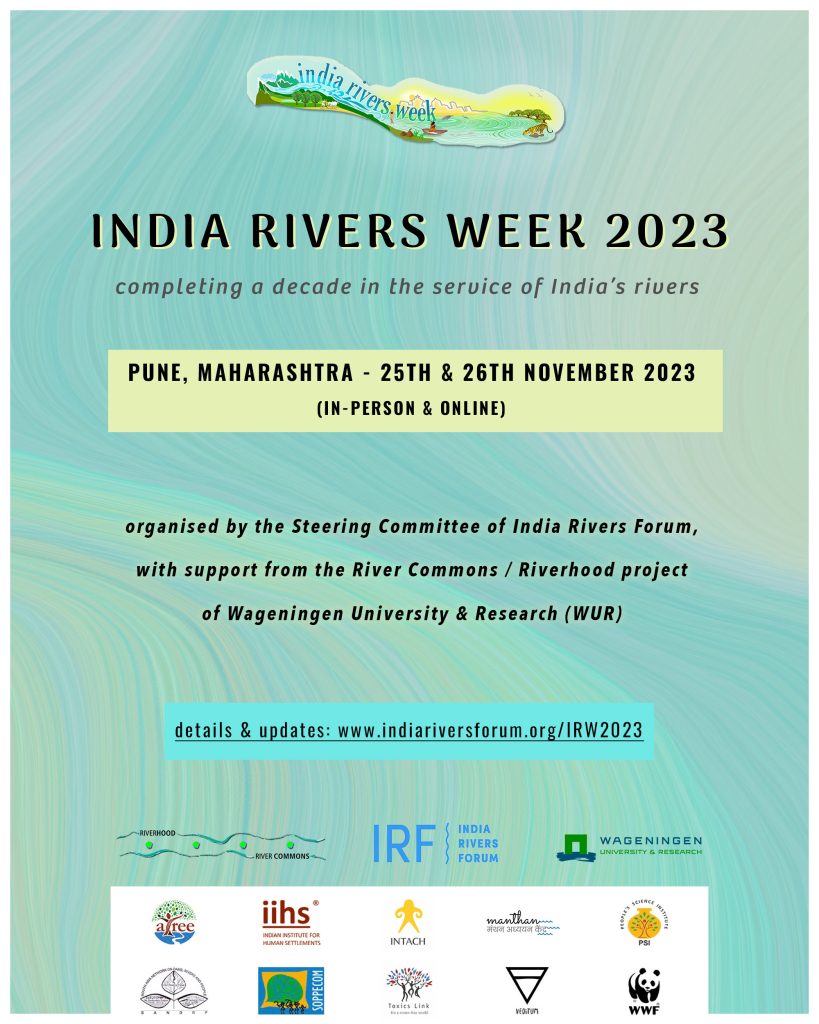
IRW 2023 Completing a decade in the service of India’s rivers The India Rivers Week conferences started in November 2014. Join us in commemorating a decade of dedicated service to India’s rivers at India Rivers Week 2023. This year’s conference will feature a series of engaging dialogues that reflect on the past ten years of our work, focus on the challenges of Riverfront Development Projects in India, and introduce innovative perspectives on riverhood and river commons in collaboration with Wageningen University & Research (WUR). These discussions will take place in a hybrid format (in-person and online). https://indiariversforum.org/indiariversweek2023/ For registration kindly visit the link: https://docs.google.com/forms/d/e/1FAIpQLSdM1L2qOLl2wf-85da5N08-Ow8ytw1qO3hd_h_ROsx_MegZBw/viewform?pli=1
Study Reconstructing model-based streamflow for Indian rivers Abstract: –Streamflow is a vital component of the global water cycle. Long-term streamflow observations are required for water resources planning and management, hydroclimatic extremes analysis, and ecological assessment. However, long-term streamflow observations for the Indian-Subcontinental (ISC) river basins are lacking. Using meteorological observations, state-of-the-art hydrological model, and river routing model, we developed hydrological model-simulated monthly streamflow from 1951–2021 for the ISC river basins. We used high-resolution vector-based routing model (mizuRoute) to generate streamflow at 9579 stream reaches in the sub-continental river basins.
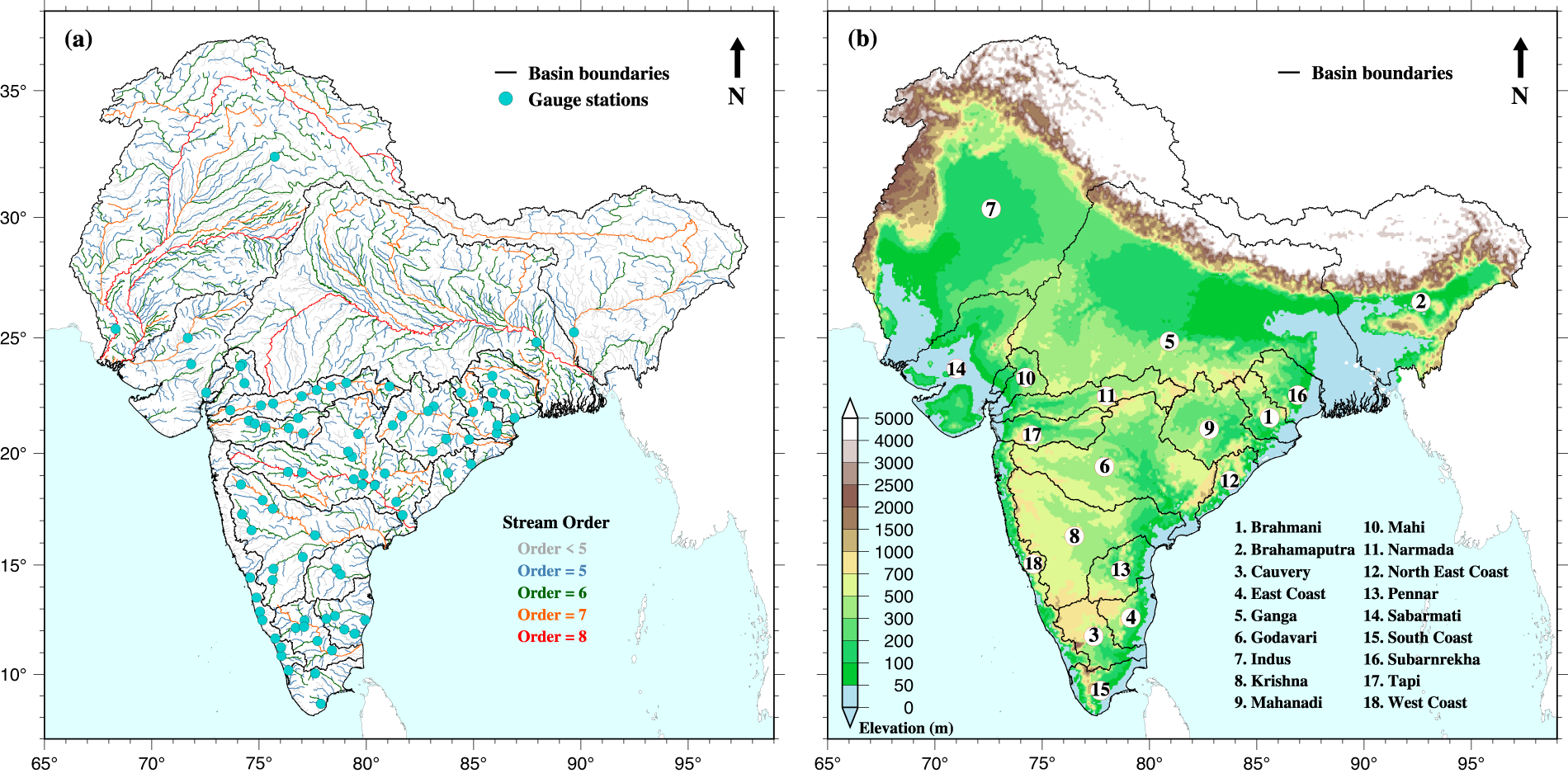
The model-simulated streamflow showed good performance against the observed flow with coefficient of determination (R2) and Nash-Sutcliffe efficiency (NSE) above 0.70 for more than 60% of the gauge stations. The dataset was used to examine the variability in low, average, and high flow across the streams. Long-term changes in streamflow showed a significant decline in flow in the Ganga basin while an increase in the semi-arid western India and Indus basin. Long-term streamflow can be used for planning water management and climate change adaptation in the Indian sub-continent. (Dipesh Singh Chuphal & Vimal Mishra) https://www.nature.com/articles/s41597-023-02618-w (18 Oct. 2023)
Arunachal Pradesh Yagamso river cleanup drive More than 100 undergraduate students actively participated in the Yagamso River clean-up drive near the APEDA office here, removing over 550 bags of waste from the river. The cleanup drive was conducted by the NGOs — Youth Mission for Clean River and Abralow Memorial Multipurpose in collaboration with the department of political science, Dera Natung Government College to mark the observance of World Dignity Day on Wednesday (Oct. 18). The drive is also a part of the Yagamso River Rejuvenation Project (YRRP), which is supported by the Itanagar Smart City Development Corporation. https://arunachaltimes.in/index.php/2023/10/19/yagamso-river-cleanup-drive-conducted-to-mark-world-dignity-day/ (19 Oct. 2023)
Odisha Public hearing for Vedanta’s mining ends abruptly The public hearing for grant of environmental clearance for Vedanta’s proposed bauxite mining in Sijimali area of Koraput district ended abruptly on Monday (Oct. 16) with most of the villagers opposing the project, alleging that it would destroy the sources of water.
Karthika Naik, a villager from Bontej, one of the 18 villages likely to be affected by the mining, said mining would not only affect the source of water to their agricultural fields, but lead to water pollution. “We depend on agriculture and the water comes from the streams of the Sijimali. Our entire livelihood depends on millets, paddy and other crops. Sijimali is our Goddess and we worship the mountains as per our local tradition. Our lives, livelihood and religion will be completely destroyed if the mining project starts there. Once Vedanta starts mining the bauxite reserve, we fear water will dry up from the streams. Sijimali is ours, not the property of any company,” he said.
The hearing, however, stopped within two hours of its start as affected villagers of Kantamal, Bundel and Sirambai vehemently opposed the project. Apart from the public hearing, Vedanta needs several more clearance including forest diversion clearance as the mining lease area includes 699.7 hectares of forest land. It also has to prepare a plan for wildlife conservation since two villages affected by the project fall within the notified eco-sensitive zone of the Karlapat Wildlife sanctuary. Since the mining project is likely to displace 100 families from 18 villages and also affect livelihoods of an additional 500 families, Vedanta has to prepare a rehabilitation and resettlement plan for them. https://www.hindustantimes.com/cities/others/public-hearing-for-vedanta-s-mining-ends-abruptly-amid-opposition-by-villagers-101697471759822.html (16 Oct. 2023)
CAUVERY Karnataka The plight of the sensitive ecosystem of Kodagu, which is the main catchment area as well as place of origin of the Cauvery river, is yet to get due attention. https://www.thehindu.com/news/national/karnataka/ecosystem-in-cauverys-birthplace-cries-for-attention-amidst-42-deficit-in-southwest-monsoon-rainfall/article67448685.ece (22 Oct. 2023)
Himachal Pradesh Effluent waste cause of Water pollution in Baddi Water pollution is a major issue in Baddi. The water bodies in the area can be seen filled with black-coloured contaminated water. Despite the rising water pollution, industrial houses in the area continue to dump effluents in the drains. The industrial houses and authorities concerned have failed to address the issue. Raman, Baddi. https://www.tribuneindia.com/news/himachal/effluent-waste-cause-of-water-pollution-in-baddi-553984 (17 Oct. 2023)
GANGA Study Indo-Gangetic plains to undergo varied rainfall patters The study by the by Mahamana Centre of Excellence in Climate Change Research under the department of science and technology, which projected the behaviour of rainfall patterns across the Indo-Gangetic Plains, shows that in the period spanning 2041-60, the mean monsoon rainfall recoded in June and July will reduce by around 40-70% compared with the average between 1986 and 2005.
The projections also show glaring alterations in pre- and post-monsoon rainfall trends. In the pre-monsoon season, spanning March to May, rainfall is expected to reduce by around 10-20%, the projections show. The post-monsoon season, however, is likely to increase drastically. There is expected to be an increase of around 80-170% in the October-December period by 2080-99.
“The capacity of air to hold moisture for a longer time has increased due to constant rise in land and sea temperatures. This, in turn, has influenced the intensity of monsoon rains,” said Roxy Mathew Koll, climate scientist at the Indian Institute of Tropical Meteorology in Pune. “For instance, the Arabian Sea has warmed since January, infusing more moisture over northern and northwestern India. This continuous supply of moisture fed to the weather systems leads to increased rains, which also results in extreme weather events.” https://www.hindustantimes.com/india-news/indogangetic-plains-to-undergo-varied-rainfall-patters-in-future-study-101697570814883.html (18 Oct. 2023)
YAMUNA Delhi NGT forms high-level committee for demarcation of floodplain The bench said the Yamuna floodplain is required to be identified, demarcated and notified in the light of the River Ganga (Rejuvenation, Protection and Management) Authorities Order. “We deem it proper to form a high-level committee headed by the chief secretary, Delhi and comprising nominees from the DDA, the secretary, Environment Department, Delhi Govt., secretary, Ministry of Jal Shakti (MoJS), executive director, NMCG and commissioner, MCD,” it said.
The tribunal said the secretary of the Delhi govt’s environment department will act as the nodal agency for coordination and compliance. “The joint committee will get the spot inspection done and ensure demarcation of the floodplain of the Yamuna in the area concerned and suggest measures to prevent and remove the encroachments and unauthorised constructions falling within the floodplain,” the tribunal said. “Let the aforesaid exercise be completed by the joint committee within a period of three months and the report be filed before the next date of hearing (January 30, 2024),” it added. https://www.business-standard.com/india-news/ngt-forms-high-level-committee-for-demarcation-of-yamuna-floodplain-123102100903_1.html (21 Oct. 2023)
NGT has observed the cleaning of Yamuna is far from satisfactory. The NGT also observed that the reports filed by agencies, including the DJB, the Delhi government and others, were deficient on various issues, including not providing the details of the drains being discharged in the river, monitoring the functioning of the STPs and restoration of the river’s floodplains and wetlands. The matter has been posted on December 7 for further hearing. https://www.business-standard.com/india-news/yamuna-cleaning-far-from-satisfactory-ngt-on-report-filed-by-agencies-123102100709_1.html (21 Oct. 2023)
NGT committee has found that untreated effluent from Ghazipur’s slaughterhouse was being discharged into river Yamuna. The tribunal has granted four weeks’ time to Municipal Corporation of Delhi to meet environmental norms, while it has asked the committee to inspect the abattoir again after a month. https://timesofindia.indiatimes.com/city/delhi/ghazipur-abattoir-discharging-untreated-effluent-into-yamuna/articleshow/104639424.cms (23 Oct. 2023)
Haryana CM Manohar Lal Khattar, presiding over a peace committee meeting at the Nuh district secretariat last evening, said the Kotla Lake, spanning 108 acres in the Mewat region, would be developed and a special pipeline would be laid along the KMP Expressway to provide Yamuna waters to the district. https://www.tribuneindia.com/news/haryana/cm-nuh-to-get-yamuna-waters-through-pipeline-along-kmp-555433 (22 Oct. 2023)
Noida The Noida authority on Monday (Oct. 16) said it has demolished at least 50 farmhouses on Yamuna riverbed that were built illegally, without permission from the urban town planning department. This is the first demolition drive after the Yamuna flooding in July this year damaged farmhouses and other structures built on the Yamuna riverbed and floodplains. Following the flooding in the Yamuna, all farmhouse occupants had to vacate their houses and take shelter in other areas. They could return to these farmhouses only after a month when the water receded and the river went back to normal. https://www.hindustantimes.com/cities/noida-news/noida-authority-demolishes-farmhouses-on-yamuna-floodplains-101697482196040.html (17 Oct. 2023)
Agra Insects breeding on dry polluted riverbed Even as a new tourist season has just picked momentum, an alarm has again been sounded on the growth of insect/bacterial colonies on the white marble surface of the Taj Mahal, the 17th-century monument of love, designated as a world heritage site. As in previous years, the dry and polluted riverbed has enabled the proliferation of mosquitoes, insects, and bacteria that settle on the surface of the Taj facing the river. “These green patches are periodically cleaned by the ASI staff, but the stink and”visually-unfriendly” spots reappear at a regular frequency,” according to tourist guide, Ved Gautam. https://www.daijiworld.com/index.php/news/newsDisplay?newsID=1132782 (22 Oct. 2023)
RIVERS BIODIVERSITY
Assam Gangetic Dolphin spotted after a quarter century An endangered aquatic mammal, the Gangetic Dolphin (Platanista gangetica), was spotted in the Charikadiya River in Dhakuakhana in Lakhimpur district. This has been stated by Dhruba Jyoti Chetia and Rajib Baruah of Pu N Fu Wild, a wild life protection group based in Dhakuakhana.
A team of the Pu N Fu Wild group consisting of Dhrubajyoti Nath and Manash Pratim Dutta along with Dhruba Jyoti Chetia and Rajib Baruah spotted the aquatic species while bird watching at Bolaighat on the river on Saturday (Oct. 14). Locally called the Sihu, the Gangetic Dolphin was last seen on the Charikadiya River twenty-five years ago, in 1998. Hunting by men, decreasing of its food like Neriya (Garua Bachcha) fish, shallowing of the river bed due to massive bank erosion have been blamed for the near extinction of this aquatic species in the last few years. https://assamtribune.com/assam/gangetic-dolphin-spotted-in-charikadiya-river-after-a-quarter-century-1499869 (16 Oct. 2023)
Ladakh Rare coral reef fossils found at 18K feet Renowned geologist Ritesh Arya has unearthed coral reef fossils at 18,000 feet above sea level in the Eastern Ladakh Himalayas at Burtse. While talking to The Tribune, Arya said, “Coral reefs, often associated with tropical, shallow waters, may be the last thing one expects to find in the Himalayan region of Ladakh, known for its rugged mountains and high-altitude terrain. However, the recent discovery of the coral reef fossils in Burtse challenges conventional wisdom and offers insight into the region’s geological history.”
“These fossils, which include intricate structures of coral colonies, provide a glimpse into an ancient underwater world. They serve as a vivid testament to the incredible biodiversity that once thrived here. This finding is not only a geological marvel, but also an opportunity to delve into the earth’s remarkable past,” Arya said. He added that the presence of these fossils at 18,000 feet above sea level challenges all preconceived notions of geological history. “The Himalayas, famous for their towering peaks, were once thought to have been formed through the collision of the Indian plate with the Eurasian plate. The discovery of coral reefs suggests an entirely different past for the region, where marine life once thrived,” the geologist said. Coral reefs are not only geological wonders, but also repositories of the earth’s climate secrets. https://www.tribuneindia.com/news/himachal/rare-coral-reef-fossils-found-at-18k-feet-in-ladakh-554512 (19 Oct. 2023)
FISH, FISHERIES, FISHERFOLKS
Bengaluru Fish kill in Varthur Lake raises concerns Varthur lake, which had been showing promising signs of rejuvenation, witnessed a grim spectacle on Tuesday (Oct. 17), as thousands of lifeless fish floated on its surface.
While rejuvenation efforts were still underway, the Bangalore Development Authority (BDA) had allowed the inflow of rainwater into the lake. “Rainwater has been collecting in the lake for the last 8-10 days, and the lake was getting rejuvenated naturally as well. However, owing to the breach of the diversion channel which carries sewage, the lake is now contaminated, resulting in fish kill,” said Jagadish Reddy of Varthur Rising. Disheartened activists acknowledge that the contamination threatens to undermine years of hard work put into the rejuvenation process. Reddy emphasised the necessity of restarting the rejuvenation efforts in light of the lake’s compromised condition. “All the progress achieved over the years has been tarnished,” he added.
Concerns regarding the cause of the breach have arisen among those who visited the site. Speculations point to either the water tanker mafia or encroachers responsible for illegal construction in the buffer zone as potential culprits behind the breach. Reports indicate that the BDA, which had been overseeing the rejuvenation efforts, has promptly filed a complaint with the police in response to the incident. A major operation was launched on Wednesday (Oct. 18) to remove approximately 25,000 dead fish from the lake’s surface, with many more lifeless specimens still afloat. https://www.deccanherald.com/india/karnataka/bengaluru/fish-kill-in-varthur-lake-raises-concerns-2732930 (19 Oct. 2023)
SAND MINING
Uttarakhand 10 more rivers in forest areas may see mining The Forest Corporation of Uttarakhand plans to include 10 more river stretches in its mining areas. Currently, 10 river stretches that pass through forest areas witness mining in Uttarakhand. The corporation earned Rs 150 crore between October 2022 and September 2023 through mining in rivers of forest areas. Notably, this year, the mining department has set an ambitious target of Rs 875 crore revenue. The corporation which generated around Rs 500 crore the previous year, primarily by logging (Rs 300 crore) and mining works, aims to diversify its activities. From October 1, mining has been initiated in 6 river stretches passing through forest areas of Dehradun, Haridwar and Kumaon. Meanwhile, Kosi, Gola, Sharda and Dabka are yet to see mining as per sources due to legalities of forest corporation authorities. https://timesofindia.indiatimes.com/city/dehradun/10-more-rivers-in-forest-areas-may-see-mining/articleshow/104483966.cms (17 Oct. 2023)
Himachal Pradesh Illegal mining in Beas claims labourer’s life A migrant labourer engaged by the mining mafia for illegal mining in the Beas was buried under a tractor trailer while extracting sand and stone last night (Oct. 19). The deceased has been identified as Mohan Sahani, resident of Darbhanga, Bihar. Since mining is banned in Beas river by the state government and the NGT, the mafia is active at night with the help of JCB machines. Information gathered revealed that the owner of the tractor trailer which crushed the migrant labourer failed to produce the registration certificate of the vehicle and insurance documents. Another migrant labourer Suraj who was driving the tractor trailer had no driving license. https://www.tribuneindia.com/news/himachal/illegal-mining-in-beas-claims-labourers-life-554893 (20 Oct. 2023)
Bihar Man killed by sand smugglers in Patna One Lal Babu Rai (40) was allegedly killed by sand smugglers at Patlapur under the Shahpur police station area in Patna district on Saturday (Oct. 14) night. His body was recovered by the police on Sunday (Oct. 15). Lal Babu was allegedly shot dead during a clash between two groups of sand smugglers. He was a resident of Sonepur. According to police sources, Lal Babu and those who killed him were also engaged in collecting extortion from the boat owners involved in illegal sand mining. https://timesofindia.indiatimes.com/city/patna/man-killed-by-sand-smugglers-in-patna/articleshow/104453316.cms (16 Oct. 2023)
Uttar Pradesh Mining mafia tries to kill kanungo, held A mining mafia and his aides allegedly tried to mow down a kanungo (revenue clerk) under an SUV, in Maharajpur area of the Kanpur district, late Saturday (Oct. 14) night. On the complaint of the kanungo, a case was registered against Rajendra Paswan alias Contractor, resident of Maharajpur, under sections of the Mining Act and attempt to murder. On the basis of complaint, police swung into action and arrested Paswan and three others and sent them to jail. A former district panchayat member, Rajendra Paswan alias Contractor, has been into illegal mining work for the last several years, said district official sources. https://timesofindia.indiatimes.com/city/kanpur/mining-mafia-tries-to-kill-kanungo-held/articleshow/104452281.cms (16 Oct. 2023)
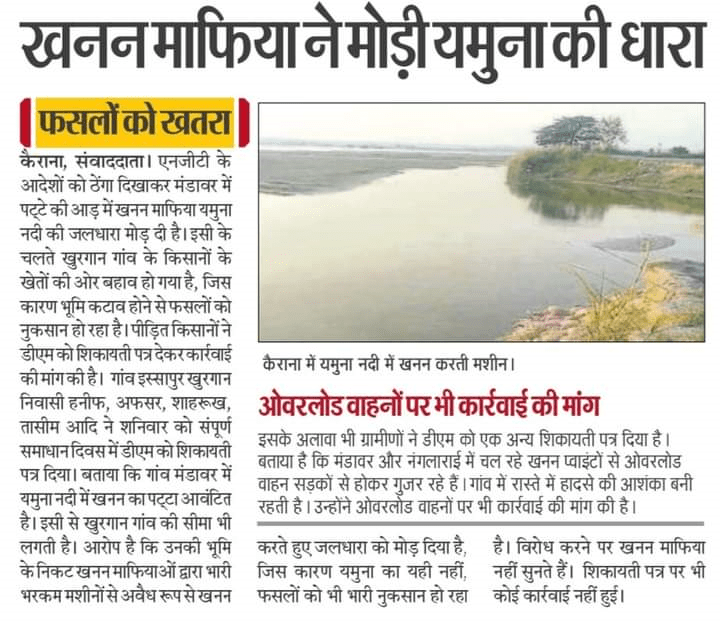
As the monsoon season is over and Yamuna flows have declined powerful sand mafias have started damaging river eco-system by building cross sectional bunds, diverting its natural course, conducting instream mining in upper segment. The stretch in Kairana block of Shamli is particularly affected where diversion of river flows is eroding riverbank farms and impacting farmers. The villagers also complaint of increase in heavy vehicle traffic carrying sand through village roads and making them accident prone. https://www.livehindustan.com/uttar-pradesh/shamli/story-mining-mafia-diverted-the-water-stream-of-yamuna-8881254.html (21 Oct. 2023)
Haryana Quarry leaseholders ‘issuing’ fake e-transit passes The misuse of registration number of heavy vehicles for issuing fake e-transit passes (e-ravanas) has come to the fore, indicating illegal mining activities and transportation of mining minerals. The leaseholders of a quarry of Yamunanagar district have allegedly issued fake e-transit passes on the registration number of a truck of Charkhi Dadri district. When this case of fraud came to the notice of Rajesh Sangwan, Assistant Mining Engineer of Charkhi Dadri district, he intimated the higher authorities of the department in Panchkula and the Mining Officer, Yamunanagar, on October 17. In his letter, he advised the Mining Officer to investigate the case and get an FIR registered against the leaseholders/contractors. https://www.tribuneindia.com/news/haryana/quarry-leaseholders-issuing-fake-e-transit-passes-in-yamunanagar-554863 (20 Oct. 2023)
As many as 28 stone crushers in the district are under the scanner for allegedly using bogus e-transit passes (e-rawanas), procured from a shut screening plant, to pass off illegally mined mineral as legal. https://www.tribuneindia.com/news/haryana/28-stone-crushers-under-lens-for-using-fake-passes-554166 (18 Oct. 2023)
Fake e-transit passes (e-rawanas) are allegedly being prepared by screening plant owners and stone crushers in Yamunanagar district to transport mining minerals, including sand, stone, stone dust, core-sand and bajri. This document is reportedly being forged by owners of several stone crushers and screening plants allegedly to hide their involvement in illegal mining and evade sales tax and royalty amount to the government. https://www.tribuneindia.com/news/haryana/drive-to-detect-fake-e-transit-passes-intensified-in-ynagar-514284 (05 June 2023)
Kerala District Police Chief (Ernakulam Rural) Vivek Kumar has suspended seven police officers for their alleged links with the sand mining mafia. https://www.thehindu.com/news/cities/Kochi/seven-police-officers-suspended-for-alleged-links-with-sand-mining-mafia/article67435607.ece (19 Oct. 2023)
Report Sand mining is turning into an environmental crisis. https://www.weforum.org/agenda/2023/09/global-sand-mining-demand-impacting-environment/ (21 Sept. 2023) Sand Mining Regulation. https://www.onmanorama.com/news/world/2023/09/12/effects-of-illegal-sand-mining.html (12 Sept. 2023)
WETLANDS, LAKES, WATER BODIES
Maharashtra RTI reveals no CRZ clearance for temple in Ulwe B N Kumar, Director of NatConnect Foundation, sought information regarding CRZ clearance for the temple’s 10-acre plot. In response, MOEFCC stated that they have no records of such clearance. Dr S Prabhu, Central Public Information Officer (Impact Assessment) at MOEFCC, explained in the RTI reply that the project falls under the jurisdiction of the SEIAA in Maharashtra. Furthermore, a comparison with the 2018 Google Earth map reveals that the entire area was originally covered by mangroves or intertidal wetlands, on which a 20-hectare temporary casting yard for the Mumbai Trans Harbour Link (MTHL) was constructed in 2019.
B N Kumar stated, “If MOEFCC has no information, it implies that no clearance was granted. This strengthens our case for the NGT.” He further emphasized that the layout of the plot encroaches upon CRZ1, as indicated in maps prepared by the Institute of Remote Sensing (IRS) at Anna University. The IRS document was submitted to the Maharashtra Coastal Zone Management Authority (MCZMA) in the pursuit of CRZ clearance for the temple project. https://www.freepressjournal.in/mumbai/navi-mumbai-greens-to-approach-ngt-after-rti-reveals-non-clearance-of-crz-for-balaji-temple-plot-in-ulwe (19 Oct. 2023)
Residents came together to protect wetlands Recognising the impending environmental crisis, these concerned residents turned to a stalwart ally, the Navi Mumbai Environmental Preservation Society (NMEPS), which had plans to legally contest the auction process. NMEPS had earned a reputation as a fearless advocate for safeguarding the local environment. Their track record included a relentless six-year legal battle through a Public Interest Litigation (PIL) in the High Court of Mumbai. This notable battle had culminated in the cancellation of plans for a golf course in the city’s precious wetlands. Furthermore, the court, recognising the necessity of sustained wetland protection, mandated the creation of a mechanism to ensure such preservation. https://mumbai.citizenmatters.in/navi-mumbai-wetlands-civic-action-58097 (20 Oct. 2023)
Kerala 4 wetlands proposed for Ramsar tag Four wetlands of Kerala, Vellayani and Akkulam-Veli in Thiruvananthapuram, Kottooli in Kozhikode and the Kattampally-Valapattanam-Kuppam wetland complex in Kannur, are vying for the Ramsar site tag.
The technical committee of the State Wetland Authority, Kerala, (SWAK), on Monday (Oct. 16) cleared the draft proposal for nominating these wetlands as Ramsar sites of international importance. The proposals will be placed before the SWAK and later submitted to the Union Ministry for Environment, Forests and Climate Change. https://www.thehindu.com/news/cities/Kochi/four-wetlands-of-kerala-vying-for-ramsar-site-designation/article67427291.ece (16 Oct. 2023)
Punjab Kanjli Wetland deteriorating The Punjab Chapter of the INTACH has sounded an alarm over the deteriorating condition of the Kanjli Wetland, situated near the town of Kapurthala and spanning over approximately 183 hectares. INTACH underscored the significance of the Kanjli Wetland, reminiscing about a time when it thrived with biodiversity and played a crucial role in providing essential ecological services. However, it now stands at a critical juncture, demanding immediate attention and comprehensive restoration efforts. https://www.tribuneindia.com/news/punjab/kanjli-wetland-deteriorating-says-intach-549512 (02 Oct. 2023)
Jammu & Kashmir Asia’s one of the largest freshwater lakes, Wular is fast losing its grandeur to extensive pollution, siltation and encroachments coupled with lack of sustained scientific conservation measures. https://www.greaterkashmir.com/todays-paper/editorial-page/save-wular-lake (23 Oct. 2023)
Report Dragonflies: The face of wetlands In cities across India, a number of organisations and individuals have embarked on a journey to document the dragonflies and damselflies during the Dragonfly Festival. https://www.thehindu.com/sci-tech/energy-and-environment/dragonfly-the-faces-of-wetlands-in-india/article67383106.ece (12 Oct. 2023)
WATER OPTIONS
Report Can stepwells solve water crisis? Of the 3,000 stepwells documented by experts in India, only around 400–500 are in usable condition. But the long-overlooked architectural wonders are making a comeback, as a growing number of conservation architects, historians and urban planners fight to restore them to their original state. Their aim is to preserve the stepwells’ architecture and history — and provide a solution to India’s growing water crisis. https://www.dw.com/en/can-indias-ancient-stepwells-solve-its-water-crisis/a-67091265 (13 Oct. 2023)
GROUNDWATER
Punjab 78% gw unfit for consumption in Bathinda A recent study, titled “Assessment of fluoride exposure and associated health risks from different sources of drinking water to various age groups in Bathinda city”, has highlighted that 78.2 per cent of groundwater in the city is unfit for human consumption. The team analysed 296 water samples wherein significant proportion of the tested water had high fluoride 78.4 per cent of groundwater, 72.1 per cent of municipal RO water pre-monsoon, 14.3 per cent of public water supply, 37.5 per cent of bottled water and 25 per cent of private RO water. The findings reveal potential health hazards, including risk of skeleton, and dental fluorosis casting a showdown over the region’s overall well-being. However, the concentration of fluoride in all samples of surface water and rainwater were well below the permissible limit. https://www.tribuneindia.com/news/punjab/78-groundwater-unfit-for-human-consumption-in-bathinda-study-555664 (23 Oct. 2023)
Uttar Pradesh government has decided to construct “groundwater charging stations” in 13 districts of the state. The project worth Rs 8 crore has been cleared by the government and will be undertaken by the state Minor Irrigation Department. The 13 districts chosen under the project are Hathras, Badaun, Moradabad, Sambhal, Prayagraj, Kaushambi, Fatehpur, Pratapgarh, Sonbhadra, Lalitpur, Jalaun, Hamirpur and Chitrakoot. https://indianexpress.com/article/cities/lucknow/govt-to-construct-groundwater-charging-stations-in-13-districts-8897562/ (18 Aug. 2023)
URBAN WATER
Bengaluru Wastewater management could help solve water crisis If the thought of using sewage water to garden your plants or flush your toilet makes you shudder, you are probably not alone. “There is a term called the yuck factor, and the term is there globally,” says Dr. Veena Srinivasan, the executive director of WELL Labs, a Bengaluru-based research and innovation centre for water management.
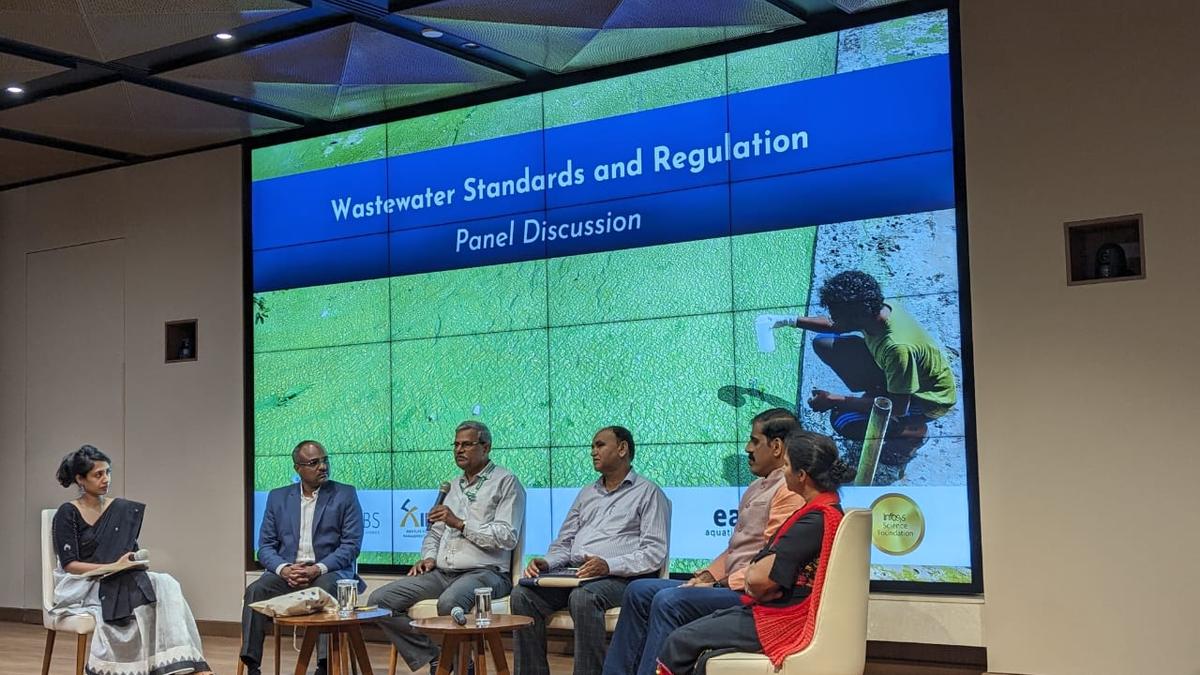
And yet, getting over this yuck factor is an important aspect of creating more sustainable water systems, as the recently concluded conference titled Building Water-Resilient Cities: Strategies for Wastewater Reuse in Urban India reiterated. https://www.thehindu.com/news/cities/bangalore/why-better-wastewater-management-could-help-solve-bengalurus-water-crisis/article67432949.ece (19 Oct. 2023)
With close to 2,644 decentralized STP, Bengaluru is one of the top cities that has the highest number of decentralized STPs in the world and the city could stand as a role model to the world in the use of treated water, experts suggested.
However Christian Binz, added that there were a few challenges ahead and the stakeholders should work together on handling them. “There are six main factors that have to be addressed for Bengaluru to succeed in making the best use of wastewater through decentralized STPs. They are: planning an industry and market structure; financial arrangement; knowledge, skill, and capacity building; legal and regulatory framework; legitimacy– acceptance from users; sustainable and equitable plan,” Binz said. https://www.deccanherald.com/india/karnataka/bengaluru/b-luru-has-highest-number-of-decentralised-stps-in-the-world-2731112 (19 Oct. 2023)
-In part three of this series, Citizen Matters spoke to urban hydrologists and researchers, Rashmi Kulranjan and Shashank Palur, about how Bengaluru can reduce dependence on external water sources, like Cauvery, and become water resilient. https://bengaluru.citizenmatters.in/water-balance-rashmi-kulranjan-shashank-palur-well-labs-cauvery-bwssb-129349 (17 Oct. 2023)
Kenchanahalli Lake is currently in the custody of the BBMP, has never been restored. Owing to the entry of untreated sewage, weeds have mushroomed across the waterbody. https://indianexpress.com/article/cities/bangalore/lakes-of-bengaluru-kenchanahalli-lake-rr-nagar-zone-open-drain-8983138/ (15 Oct. 2023)
Spread in 200 acres, Anekal Dodda Kere Lake dating back to 1,000 years during Cholas reign, the lake has been in a state of neglect for the past 25 years. Engulfed with thick vegetation, the passersby would never know that there was ever a lake. But today the fate of the waterbody, located a few kilometers away from the Anekal panchayat office, has changed for the better and is brimming with water. https://indianexpress.com/article/cities/bangalore/25-years-of-neglect-1000-year-old-anekal-dodda-kere-lake-brims-water-8993905/ (22 Oct. 2023)
Chennai CMDA to prepare new town dev. plan The Chennai Metropolitan Development Authority is developing a new town plan for Mamallapuram that focuses on preserving heritage sites, waterbodies, and green cover. The plan also aims to promote tourism and boost local economic activities. The town plan will include the shore temple and 25 surrounding villages. https://timesofindia.indiatimes.com/city/gurgaon/untreated-sewage-hry-pollution-board-fines-builder-3-4cr/articleshow/104540526.cms (19 Oct. 2023)
Thiruvananthapuram DPR for decentralized sewage system submitted The Kerala Water Authority (KWA) has submitted a detailed project report (DPR) on a proposed decentralized sewage-water management system in Thiruvananthapuram. The city will be divided into 10 clusters, with the DPR for four clusters already submitted. The remaining clusters will be presented once the initial DPR is approved. The project includes connecting areas to the Muttathara sewage plant with pipelines, as well as the construction of a new sewage treatment plant. The total cost of the project is estimated at Rs 65 crore. The existing sewerage system in the city is outdated and covers only 43 out of 100 wards. https://timesofindia.indiatimes.com/city/gurgaon/untreated-sewage-hry-pollution-board-fines-builder-3-4cr/articleshow/104540526.cms (19 Oct. 2023)
Ludhiana Interesting that NGT has rejected CPCB report to probe the Giaspura gas leak tragedy and asked for a fresh independent inquiry. A rare occurrence. https://www.tribuneindia.com/news/punjab/not-convincing-ngt-rejects-ppcbs-giaspura-probe-orders-fresh-inquiry-554161 (18 Oct. 2023)
Prayagraj HC summons officials for water woes Taking a serious note of water scarcity in Allahpur area of Prayagraj, the Allahabad high court directed the district magistrate, Prayagraj, executive engineer, Purvanchal Vidyut Vitran Nigam Ltd, Prayagraj and the managing director, Jalkal Vibhag, Nagar Nigam Prayagraj, to remain present before the court tomorrow (on October 19), on Wednesday (Oct. 18).
Hearing a PIL filed by one Dev Raj Singh and four others, a division bench comprising chief justice Pritinker Diwaker and justice Ashutosh Srivastava observed, “Respective submissions made by the counsel for the respondents make it clear that they have made a mockery of the system and none of the officer is serious to look into the basic problems being faced by the public at large”.
In the PIL, the petitioners alleged that the residents of Tilak Nagar locality (in Allahpur area) of Prayagraj have faced a scarcity of water since 2021, where about 10,000 houses are situated. The counsel representing Jalkal Vibhag, Prayagraj Nagar Nigam, submitted that though there is enough water with this department but on account of removal of transformer by the electricity department, the water crisis has deepened. https://www.hindustantimes.com/cities/others/water-scarcity-in-prayagraj-s-allahpur-hc-summons-dist-admn-officials-101697648871732.html (18 Oct. 2023)
Gurugram Untreated sewage: SPCB fines builder Rs 3.4 cr The SPCB on Tuesday (Oct. 17) imposed environmental compensation of Rs 3.4 crore on the developer of a Sector 67 condominium for discharging untreated sewage into vacant plots near residential areas. The board said it will also prosecute the developer of Ansal Esencia. Action was announced after HSPCB and the district administration, on the directions of the NGT, formed a committee to inspect the 242-acre housing society and submit a factual report on the allegations.
In April, the society’s RWA had approached NGT, alleging that the STPs had not been constructed in violation of the terms of environmental clearance granted to the developer. Ansal Properties and Infrastructure could not be reached for comment till Wednesday evening. After the inspection on August 22, the joint committee of SPCB officials, district magistrate and members of the CPCB concluded in their report that the two STPs at the housing complex were lying abandoned. This, it said, violated the environmental clearance granted to the developer on August 20, 2018. https://timesofindia.indiatimes.com/city/gurgaon/untreated-sewage-hry-pollution-board-fines-builder-3-4cr/articleshow/104540526.cms (19 Oct. 2023)
Every third house in Bandhwari in Gurugram district has or had cancer. The leachate releasing from the garbage mountain, visible from the Faridabad-Gurugram highway, has made way to fresh water sources in the region. https://www.news18.com/india/gurugram-cancer-mountain-how-bandhwari-village-dies-a-slow-death-as-groundwater-turns-into-poison-8629999.html (23 Oct. 2023)
Delhi 60% STPs fail to meet quality parameters Despite a committee’s mandate to ensure proper sewage treatment in Delhi, over 60% of STPs in the city still fail to meet water quality standards. The monthly analysis report by the Delhi Pollution Control Committee revealed that out of the 38 assessed STPs, 23 failed the water quality tests for September. The city generates 792 MGD of sewage, but only 550MGD is being treated, leaving 242 MGD untreated. Experts point out flaws in the operation of STPs and poor monitoring as reasons for the failure to meet standards. https://timesofindia.indiatimes.com/city/gurgaon/untreated-sewage-hry-pollution-board-fines-builder-3-4cr/articleshow/104540526.cms (19 Oct. 2023)
Unravelling causes of land subsidence
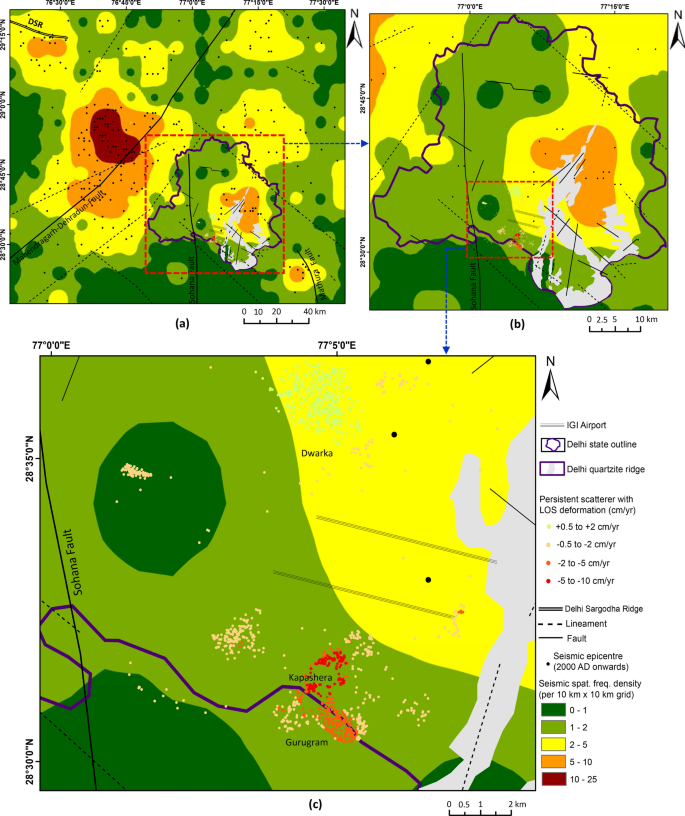
Abstract This paper identified severe groundwater depletion and land subsidence in parts of the National Capital Territory of Delhi (NCT Delhi), India, by long-term groundwater level (GWL) data analysis and spaceborne geodetic observations. https://link.springer.com/article/10.1007/s10064-023-03399-7 (13 Oct. 2023)
NGT has directed the Delhi Pollution Control Committee (DPCC) to submit a report regarding groundwater contamination in rainwater harvesting systems installed across housing societies in Dwarka here. A bench of NGT Chairperson Justice Prakash Shrivastava noted that in pursuance of the tribunal’s earlier directions, the Delhi government had filed a report, as per which, eight of the 54 housing societies in Dwarka refused entry to the inspection teams.
The report does not specifically cover the aforesaid issues, though there was a clear direction in this regard, the tribunal said. We deem it proper to issue a direction for filing two separate reports, one relating to the factual situation found on the spot and the other relating to the remedial action. Let these reports be filed by the DPCC within eight weeks, the tribunal said. It directed that the DPCC officials along with other authorities concerned will have police protection for inspecting the remaining eight societies. The matter has been listed on January 5 for further proceedings. https://www.moneycontrol.com/news/business/wire-news/groundwater-contamination-in-dwarka-ngt-asks-dpcc-to-submit-report-11580831.html (22 Oct. 2023)
WATER POLLUTION
Study Plastic turfs as widespread pollutants This is the first study focusing on the presence, concentration levels and properties of artificial turf fibers in river and sea surface waters. It contributes to increasing knowledge that artificial turfs not only contribute to other known impacts, such as climate change, chemical leaching or local biodiversity loss, but is also is a major source of plastic pollution in the aquatic environment. Concentrations peaked nearshore and near populated areas, and especially during the rainy season when release to aquatic environment may be higher.
Furthermore, the properties of artificial turf fibers are described in detail for further studies to identify and monitor their presence in aquatic environments. Indeed, how many AT fibers can further accumulate on riverbanks, beaches, seabed and riverbed sediments is still completely unknown. We anticipate that this study will inspire future efforts to reduce the release and impacts of artificial turfs in the environment. https://www.sciencedirect.com/science/article/pii/S0269749123010965 (01 Oct. 2023)
शोध से पता चला पर्यावरणीय प्रभाव, कई और बहुत गंभीर हैं, क्योंकि वे पर्यावरण पर इस सामग्री के प्रभाव को और बढ़ाते हैं। अध्ययन में इस बात का भी पता लगाया गया कि, शहरी जैव विविधता को कम करने, अपवाह को कम करने, अधिक गर्मी और बड़ी मात्रा में हानिकारक रासायनिक यौगिकों से युक्त जो इसे स्थायित्व प्रदान करते हैं, कृत्रिम टर्फ सतहें प्लास्टिक के टुकड़े जलीय वातावरण में छोड़ती हैं। https://www.downtoearth.org.in/hindistory/pollution/plastic/artificial-turf-made-of-plastic-is-badly-polluting-water-study-92386 (19 Oct. 2023)
WATER
Commentary The interdependence between surface water and groundwater is a missing piece that must factored in for more effective water management. (Veena Srinivasan and Partik Kumar) https://india.mongabay.com/2023/10/commentary-the-atal-bhujal-yojana-is-missing-a-key-part-of-water-flows/ (20 October 2023)
FLOOD 2023
Sikkim The toll from flash floods climbed to 40 after four more bodies were found on Tuesday (Oct. 17), reported PTI. 76 people have been missing since October 4. The disaster has disrupted the lives of nearly 88,000 people. The SDMA said that 20 relief camps are sheltering 2,080 people. https://scroll.in/latest/1057796/sikkim-flash-floods-toll-rises-to-40-over-70-still-missing (18 Oct. 2023)
The Bengal government has decided to rehabilitate over 550 families who became homeless in Kalimpong district because of the devastating flash flood in the Teesta on October 4. “Out of these, 155 houses in the Rangpo and the Teesta Bazar areas were completely damaged and 855 persons became homeless. They are staying in relief camps now,” said a source.
“The river has caused extensive damage in some areas. We saw places where the river has left silt deposits as high as 20 feet. The repairs and restoration work have started. The government is at the same time providing land to homeless people,” said Yeasmin, the minister of state for irrigation and waterways and north Bengal development. https://www.telegraphindia.com/west-bengal/bengal-government-to-rehabilitate-over-550-families-rendered-homeless-after-teesta-flood/cid/1974273 (19 Oct. 2023)
The Insurance Regulatory and Development Authority of India (IRDAI) has advised general insurers and standalone health insurance companies to expedite survey of all claims related to the recent devastating floods in Sikkim as well as disburse the payments. “It needs to be ensured that all claims are surveyed immediately and claim payments/on account payments are disbursed at the earliest,” the regulator said. https://www.thehindu.com/business/Industry/expedite-survey-claim-settlement-related-to-sikkim-floods-irdai-urges-general-insurers/article67437297.ece (19 Oct. 2023)
Madhya Pradesh Election code woes haunt flood affected villagers Anger is simmering among residents of 400 villages where flash floods caused loss of crop and cattle and destroyed farmland in five sub-divisions of Khargone and Barwani districts on September 16 2023. The local administration assessed damage and decided on handing over a compensation of Rs 14 crore, but the election code of conduct put in place impeded the distribution. Villagers say that the ‘man-made’ flood was caused by opening of dam gates on Narmada river without any intimation to low-lying areas downstream the two districts. Houses and fields on the banks of Narmada in Mandleshwar, Kasrawad and Barwaha subdivisions of Khargone district of West Nimar were damaged. The same flood water caused devastation in Barwani and Rajpur sub-divisions of Barwani district.
– Entire extent of damage could not be surveyed due to strike of patwaris. Nevertheless, after conducting a survey, a compensation of about Rs 10 crore has been fixed for 9,022 affected people in 343 villages of 11 tehsils of three sub-divisions of Khargone district. https://timesofindia.indiatimes.com/city/bhopal/crops-destroyed-losses-unpaid-now-code-woes-haunt-villagers/articleshow/104485694.cms (17 Oct. 2023)
CLOUD BURSTS
SANDRP Blog Uttarakhand: Cloudbursts in SW Monsoon 2023 In the remote hill areas of Uttarakhand, the ‘cloudburst’ disaster is proving a double whammy for the local people who first suffer from the deluge and then from the delay in administration aid and restoration works turning their lives miserable by depriving them of food supply, health and education services for days.
The plight of urban poor is equally worse who in absence of properly planned housing facilities are settling closer to waterways thus ending up encroaching them and then finding their lives and properties in danger during flashflood events as happened this year in Kotdwar and Kathgodam. https://sandrp.in/2023/10/18/uttarakhand-cloudbursts-in-sw-monsoon-2023/ (18 Oct. 2023)
LANDSLIDES
Uttarakhand Landslide blocks route to Adi Kailash A chunk of the mountain near Tawaghat in Pithoragarh district broke off a couple of days ago, impacting the route which connects Lipulekh and Dharchula. The route is the one taken by pilgrims going to Parvati Tal and Adi Kailash. PM Modi had also visited the area last week. Officials said that road widening on the stretch might have been responsible for the rockfall. Rahul Negi, geologist and mining officer based in Pithoragarh, said, “Rocks get destabilised after being cut to widen the roads, causing frequent landslides. It takes some years for the mountains to stabilise once again.”
District disaster management officer, Bhupendra Singh Mahar meanwhile said that “while the road widening work can sometimes cause landslides, another possible reason could be that rain followed by adequate sunshine led to expansion of rocks resulting in breakages and fractures”. Incidentally, many vehicles stopped just minutes before the massive rock broke free. Meanwhile, ecologists expressed concern that increased tourism activity in the area may cause more trouble for the fragile region in future. https://timesofindia.indiatimes.com/city/dehradun/pithoragarh-landslide-blocks-route-to-adi-kailash/articleshow/104566975.cms (20 Oct. 2023)
DROUGHT 2023
Tamil Nadu Kuruvai gone, farmers hope to salvage samba The fate of farmers in the fertile Cauvery delta region hangs in balance as the region did not receive the expected amount of water from the river for irrigation this year. The discharge of water from the dam, from where it usually flows till December, was stopped on October 9, adding to woes of the farmers.
Tamil Nadu’s realisation of Cauvery water this southwest monsoon is just 45.16 tmcft as against 123.06 tmcft, due to rainfall deficit. Government data shows samba coverage in the delta is down by 1.5 lakh acres as on September 25, 2023, when compared to the same period last year. The government has formally declared compensation for 40,000 acres of land where kuruvai crops have withered due to less availability of water.
“A majority of the farmers are in two minds on raising samba crop this year as there is no guarantee of water because they have already suffered enough in kuruvai crop season,” ‘Cauvery’ S Dhanapalan, general secretary, Cauvery Farmers’ Protection Association, told DH. Farmers in the delta had “good crop years” from 2017 to 2022 after several years as Mettur dam brimmed with water thanks to heavy rain in Cauvery catchment areas of Karnataka. https://www.deccanherald.com/india/tamil-nadu/much-of-kuruvai-crop-gone-tamil-nadu-farmers-hope-to-salvage-at-least-samba-2724462 (13 Oct. 2023)
Karnataka Grim situation for crops, fodder Water from the KRS, Kabini and Hemavathi reservoirs is integral to agriculture in Mandya, Mysuru and Hassan districts. While there have been efforts in the past to supplement this dependence on the Cauvery river and its tributaries, through the construction of farm ponds and by filling up village lakes through lift irrigation, the survival of these efforts depends on the regularity of monsoons. “Some farmers have a little water left in these ponds. They are preserving it for the livestock,” says Ratnamma, an agricultural labourer in Allapatna. Ratnamma explains that there are several things hinging on the supply of consistent water, apart from the survival of crops. Lined along the crop fields is grass, particularly cultivated for cattle. “This grass will dry up in a month or two. After which, even our cattle will not have food,” she says. https://www.deccanherald.com/india/karnataka/karnataka-not-just-crops-situation-grim-for-cattle-fodder-too-2724470 (13 Oct. 2023)
ENVIRONMENT GOVERNANCE
Report NBWL changed after 2014 The body is tasked with protecting the country’s most fragile areas. But an analysis of its meetings reveals troubling patterns reveals a detailed report by Vaishnavi Rathore. https://scroll.in/article/1057612/fewer-discussions-faster-clearances-how-indias-wildlife-board-changed-since-2014 (18 Oct. 2023)
NGT asks CZMAs to integrate expert panel recommendations The NGT has decided to issue notices to the Coastal Zone Management Authorities (CZMAs) in the coastal States and Union Territories asking it to consider including the recommendations made by an expert panel on the issue of dangers of sea level rise and submergence of low-lying lands into the Integrated Island Management Plans (IIMPs). The Principal Bench of the tribunal led by its chairperson Prakash Shrivastava issued an order dated October 13 stating that the suggestions incorporated in the panel report dated October 10 need to be looked into for preparation/amendment of the IIMPs. https://www.thehindu.com/news/national/sinking-islands-ngt-asks-coastal-zone-authorities-to-integrate-expert-panel-recommendations-into-island-management-plans/article67426213.ece (16 Oct. 2023)
Haryana SPCB told to appoint staffers in 3 months The NGT last week told the Haryana government to fill all vacancies with the state pollution control board—– which comes to two-thirds of the total posts — in the next three months. There are 481 positions sanctioned with the SPCB, of which 178 (37%) have been appointed and the remaining (303) are vacant. NGT’s direction, made on October 12, comes at a time farm fires to clear tracts of land for the next round of crops have already begun, adding to pollution that has already started rising across northwest India as winter sets in. https://timesofindia.indiatimes.com/city/gurgaon/63-posts-vacant-pollution-board-told-to-appoint-staffers-in-3-months/articleshow/104453085.cms (16 Oct. 2023)
THE REST OF THE WORLD
Global River Discharge Database This site contains a compilation of monthly mean river discharge data for over 3,500 sites worldwide.
The data sources are RivDis2.0, the United States Geological Survey, Brazilian National Department of Water and Electrical Energy, and HYDAT-Environment Canada. The period of record for each station is variable, from 3 years to greater than 100. All data is in m3/s. https://sage.nelson.wisc.edu/riverdata/index.php
Opinion Importance of freshwater connectivity The importance of connectivity for river ecosystems and services is the subject of a review paper just published in Environmental Reviews (the paper was led by colleague at WWF-US, Michele Thieme, and I was one of the co-authors). This is the first in a three-part series that summarizes that paper, including why connectivity is so important to freshwater ecosystems and the values they provide to people, threats to connectivity, and solutions to protect or restore connectivity. (Jeff Opperman) https://www.forbes.com/sites/jeffopperman/2023/10/19/connections-matter-the-importance-of-freshwater-connectivity/ (19 Oct. 2023)
UK Water bills boycott is growing For 13 years, Mike Deacon monitored pollution levels in the river Ouse in Sussex, gathering data as a volunteer to help the Environment Agency take action. As a lifelong angler who grew up close to the river, its waters were precious to him. Now he is taking Southern Water to court, counter-suing the company for “loss of amenity” after it began legal action over his unpaid bills. Since 2021 Deacon has refused to pay more than £1 a month because he blames Southern Water for river pollution. “That’s all they deserve,” he said. “I won’t pay them for polluting my local river. Their contribution to pollution in the river system and the seas has led to a reduction in fish stocks. I can’t swim in the river any more. I can’t go kayaking there any more.” https://www.theguardian.com/environment/2023/oct/14/i-wont-pay-for-them-to-pollute-my-river-why-a-uk-water-bills-boycott-is-growing (14 Oct. 2023)
Brazil Amazon port records lowest water level in 120 years The river port in the most populated city of Brazil’s Amazon rainforest recorded its lowest water level on Monday since 1902 when record keeping started amid a drought that has left boats stranded on the Amazon river and cut off food and water supply to villages, all while damaging the world’s most diverse ecosystem. https://www.forbes.com/sites/maryroeloffs/2023/10/16/amazon-river-port-records-lowest-water-level-in-120-years-as-more-of-the-world-falls-into-drought/ (16 Oct. 2023)
SANDRP
Also see: DRP 16 Oct. 2023 & DRP 09 Oct. 2023
Follow us on: www.facebook.com/sandrp.in; https://twitter.com/Indian_Rivers

 SANDRP