This proposition clearly sounds simplistic and seems devoid of science or logic. But the case studies of the epidemics since 1980 and loss of forests, biodiversity and sustainability shows that this is not to be dismissed that easily. In fact the following interview with Dr Aaron Bernstein makes a powerful case to show why this indeed has a lot of science and logic behind it. It also hence makes a case that yesterday (our “normal”), is no longer a good model for better tomorrow.
Continue reading “DRP: 20 April 2020: Solutions to Covid 19 & Climate change are same?”Tag: Pollution
DRP: 13 April 2020: Check dams revival in Dakshina Kannada
Zilla man, students revive check dams For the first time in decades this February, Sundara Gowda, a 55-year-old farmer in the Dakshina Kannada district, doesn’t have to spend Rs 6,000 to mine water. In the past he has had to hire an earthmover to do the digging because the rivulet that runs by his farm would dry up. This year, to his surprise, the rivulet, a tributary of the Phalguni river, didn’t dry up. Miraculously, it had plenty of water. A check dam had been built upstream at Paldyaru.
The check dam was one of many such structures built by Paljal Dharanendra Kumar, a zilla parishad member from Venoor village, with the help of student volunteers. The check dams have resulted in water in the river rising six feet for a distance of 2.5 km. The river now has 90 million litres of water and rivulets which used to run dry have come back to life. Dharanendra and his student volunteers have been zealously building check dams, called kattas, from December to February. The dams have been built at absolutely no cost to the exchequer. https://www.civilsocietyonline.com/environment/zilla-man-students-revive-check-dams/ (24 March 2020)
Continue reading “DRP: 13 April 2020: Check dams revival in Dakshina Kannada”Singrauli Fly Ash Dam Breach: Who regulates these dams in India?
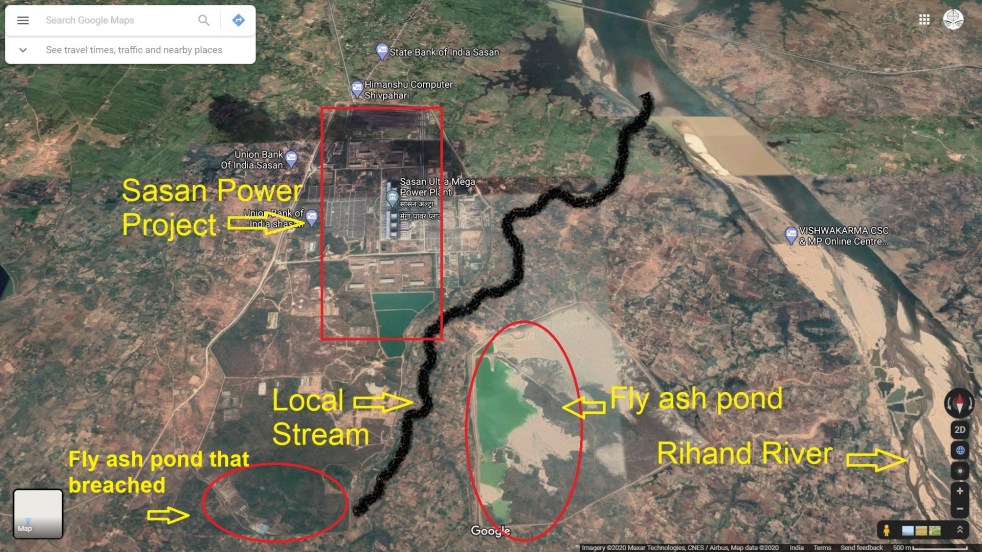
A fly ash Dam of Sasan Ultra Mega Power Project of Reliance Company has breached[i] in the evening of April 10, 2020, near village Harrahva in Singrauli district of Madhya Pradesh, killing six people and destroying downstream river and fields. Following the breach there was massive flash flood of coal ash mixed sludge reportedly affecting hundreds of villages and destroying crops on thousands of acres.
Of the six people feared to have been killed in the flash floods, dead bodies of two have been found in faraway areas, while four are still missing. Two women injured in the aftermath are reported to be in stable condition in local hospital. Reports also suggest that many people could be trapped in their homes because of the poisonous sludge.
Continue reading “Singrauli Fly Ash Dam Breach: Who regulates these dams in India?”
Cleaner rivers in lockdown: Lessons we can learn
Within a week of 21-day long lockdown in India that started at midnight on March 24, 2020, several reports in print, electronic and social media have been doing rounds showing remarkable improvements in water quality in many rivers in the country. Most of these are on the basis of naked eye observations in the form of pictures and videos by people.
Some of the reports quote pollution control boards’ officials and experts with some analytical data. People generally believe that the shutting down of industrial units has led to reduction in discharge of industrial effluents in the rivers, breathing fresh life in pollution laden streams. It’s right that there is halt in industrial belts and there is less industrial pollution reaching the rivers. However there are other factors contributing to the change in the scenario.
Continue reading “Cleaner rivers in lockdown: Lessons we can learn”
DRP: 30 March 2020: Chilika has fishing cat & otters, but why we know so little about aquatic biodiversity?
There is some good news this week. A survey has found existence of fishing cat and two otter species in Chilika lake – this was not known so far. However, this also underlines how little we know about India’s aquatic biodiversity in our rivers, lakes and deltas. Its high time we have authentic baseline survey across India, hopefully in participation with the local communities who would already know so much about this. And may be rather urgently, once we are through with the current Covid-19 Crisis.
Continue reading “DRP: 30 March 2020: Chilika has fishing cat & otters, but why we know so little about aquatic biodiversity?”International Day of Action for Rivers 2020: Positive River Stories from India
On the occasion of International day of action for rivers which is annually celebrated on March 14, SANDRP put together some positive citizens and community led actions taken in last one year to protect and revive the rivers in different parts of India.
Continue reading “International Day of Action for Rivers 2020: Positive River Stories from India”
परिक्रमावासियों से नर्मदा मैया को प्लास्टिक कचरा मुक्त बनाने की अपील
Guest Blog by Jubin Mehta
मैंने और मेरे साथी ने 25 नवंबर 2019 से 25 फरवरी 2020 का समय नर्मदा परिक्रमा के दौरान नदी किनारे यात्रा करते हुए व्यतीत किया। करीब 90 दिनों तक चली इस परिक्रमा में हमने कुछ 2500 किमी की पदयात्रा और शेष लगभग 1000 किमी का सफर गाड़ी से किया। बड़ा ही सुन्दर अनुभव रहा- किनारे पर बसे हुए लोगों का भाव, मंदिर और आश्रमों की सेवा और नर्मदा मैया के चमत्कार ने ह्रदय को निर्मल कर दिया और मन को भी एक अद्भुत सी शान्ति से मिली।
Continue reading “परिक्रमावासियों से नर्मदा मैया को प्लास्टिक कचरा मुक्त बनाने की अपील “
India Ramsar Wetlands in Crisis in 2020
Ramsar wetlands in India require urgent intervention for central, state governments and Ramsar Convention as this 2020 report shows. The five regional reports from India in 2020 show that despite Ramsar tag, the fate of these wetlands has seen no marked improvement. This raises the question as to how helpful for wetlands in India is the Ramsar tag.
In 2019, India has added 10 more wetlands selected under Ramsar Convention taking total number of Ramsar wetlands in the country to 37 covering about 10,679.39 sq km area across 15 different Indian States and two Union Territories (UTs). A description of each of India’s 37 Ramsar wetlands, as given on official Ramsar website is given in Annexure below. A decade after the first meeting at Ramsar in Iran for wetland protection in 1971, India got its first wetlands, Chilika lake (Odisha) and Keoladeo National Park (Rajasthan) registered as Ramsar wetland of global significance in Oct 1981.
Ramsar Wetlands in Crisis 2020: South India
Out of six states/ Union Territory in South India, three stares have five Ramsar wetlands sites which include one each in Andhra Pradesh and Tamil Nadu and three in Kerala. There are no Ramsar wetlands in Telangana, Karnataka and Puducherry. In order to understand and highlight the present day situation of Ramsar sites in India, SANDRP has compiled information on all 37 wetlands under North, West, North East and East zone. This account in the series describes the threats affecting the Ramsar sites in South Indian States.
Continue reading “Ramsar Wetlands in Crisis 2020: South India”
Ramsar Wetlands in Crisis 2020: East India
In East India there are four Ramsar wetlands: two each in W Bengal and Odisha states. There are no Ramsar wetland sites in Bihar, Jharkhand or Sikkim, the other East India states. Here we provide a status of these Ramsar sites of East India, along with the kind of risks and threats these Ramsar sites face. The objective is to ensure greater awareness about these issues and hope that this will help achieve better responses from Ramsar convention as also the governments at various levels.
Continue reading “Ramsar Wetlands in Crisis 2020: East India”