
An analysis of the daily district wise rainfall data from India Meteorological Department (IMD) for the month of September 2023, the last month of India’s South West Monsoon 2023 shows that there were 406 (417 in Sept 2022[i] and 489 in Sept 2021[ii]) instances when district rainfall of a day was above 50 mm. Such high rainfall instances included 330 (365 and 374 in Sept 2022 and 2021 respectively) instances when rainfall was 50-100 mm, 64 (47 and 84 in Sept 2022 and 2021) instances when it was 100-150 mm, 10 (3 and 20 in Sept 2022 and 2021) times when it was 150-200 mm and twice (two and eleven in Sept 2022 and 2021 respectively) when rainfall in a day was above 200 mm.
Continue reading “High Rainfall days in India’s districts in Sept 2023”Tag: IMD

DRP NB 091023: MoEF Panel concerned about impacts of Small Hydro
(Gangani SHP on Yamuna river in Uttarkashi affected by June 2013 flash flood. Image: Yamuna Jiye Abhiyan/July 2013)
The Forest Advisory Committee of Union Ministry of Environment and Forests (MoEF) have rightly raised concerns about the impacts of so called small hydropower projects, that is hydropower projects with capacity below 25 MW. The MoEF assumes, following such unknown science or logic, that such projects have no environment and social impacts, they do not need environment and social impact assessments or management plan, they do not need any public consultation process, they do not need any monitoring or compliance and most significantly, they do not even need any clearances! A more unscientific thinking of the govt of India’s top environmental body would be difficult to find.
Continue reading “DRP NB 091023: MoEF Panel concerned about impacts of Small Hydro”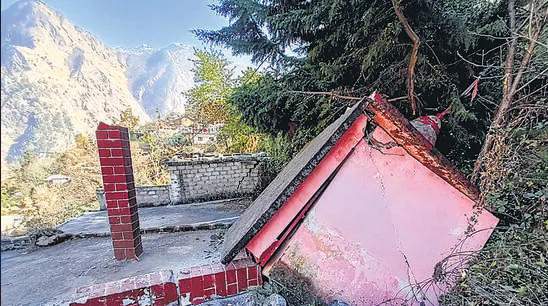
DRP NB 021023: Why this culture of opaque governance around Joshimath?
(Feature Image: A temple collapses after the gradual ‘sinking’ of Joshimath in Chamoli district, on Jan. 08, 2023. PTI/HT)
It is clear that the Union and the Uttarakhand government did not want the reports prepared by different national institutes related to Joshimath Sinking, to be made public and the state High Court had to order it to do so. The government’s view of the report is clear from that. It took the judiciary so many months to finally order the report to be made public. What is it that the government wanted to hide? Why? From whom? Why is there this culture of opaque governance even in disaster management related issues? Is it growth fundamentalism that is driving the government as the single most factor? Or is it the arrogance and adamant attitude of the governance, not wanting to consider any questions raised against their decisions? Why is there so little faith in the people, society and transparent, accountable governance? Why is the judiciary allowing such a culture to prevail generally?
These are some of the key questions that arise from this and other such episodes.
Continue reading “DRP NB 021023: Why this culture of opaque governance around Joshimath?”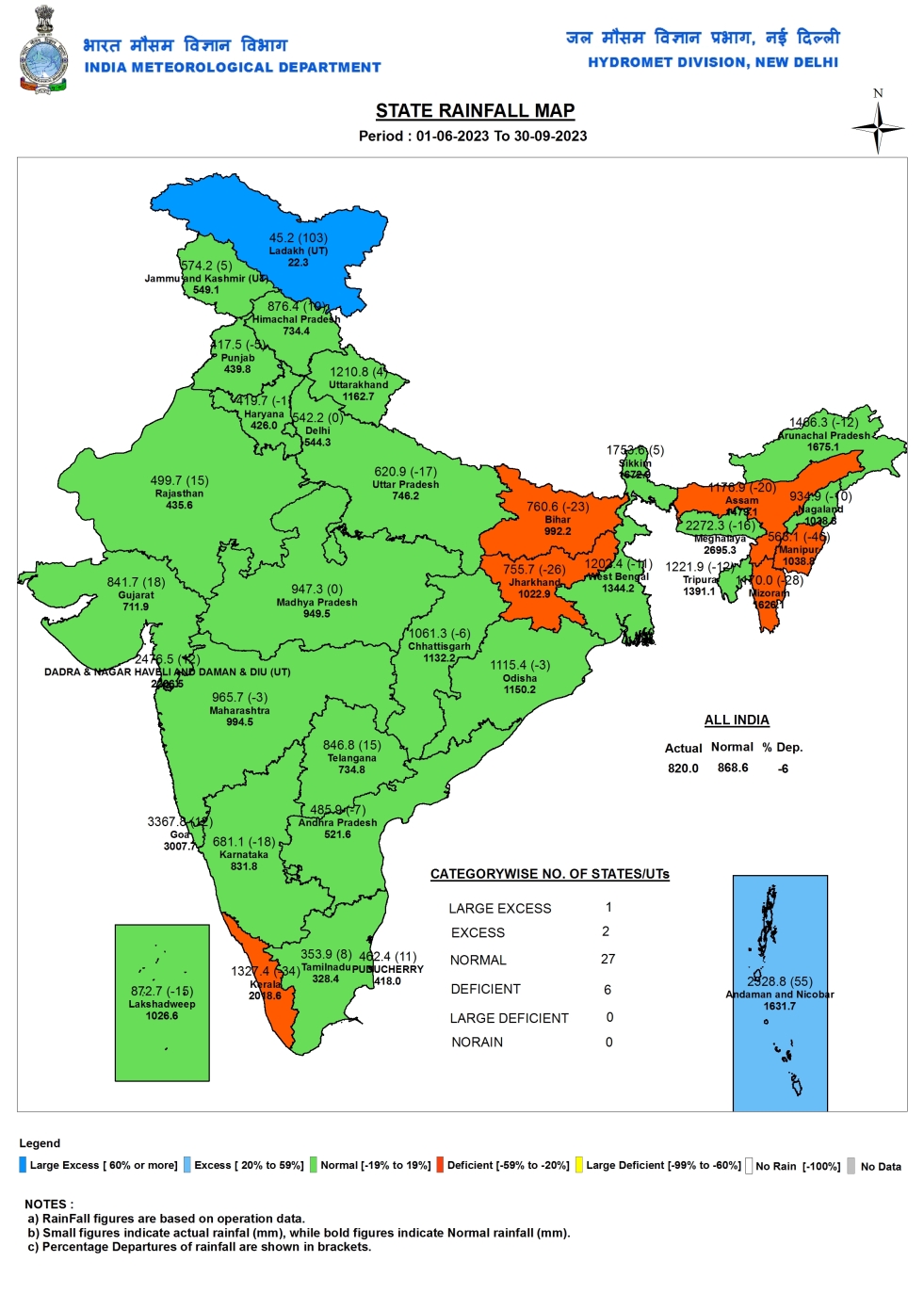
SW Monsoon 2023: District wise rainfall in India
In the just concluded South West Monsoon 2023, India received 820 mm (925 mm in SW Monsoon 2022[i]) rainfall, about 94.45 % (106.5% in 2022) of the Normal SW Monsoon rainfall of 868.6 mm or 5.55% (6.5% above normal in 2022) below normal SW Monsoon rainfall as per India Meteorological Department (IMD). This rainfall will now be categorised as below normal rainfall though the distribution has been unprecedented, both temporally and spatially.
Continue reading “SW Monsoon 2023: District wise rainfall in India”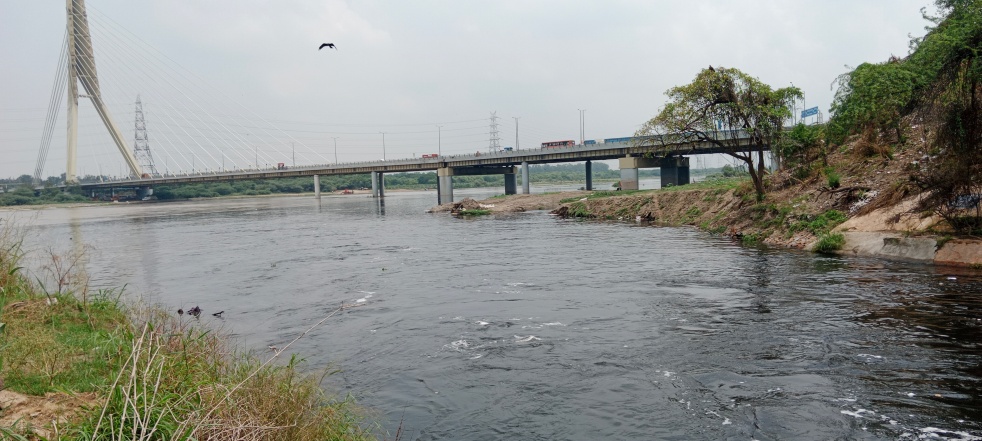
DRP NB 250923: World Rivers vs Indian Rivers on Rivers Day 2023
(Feature Image: Najafgarh drain loaded with polluted water joining River Yamuna downstream Wazirabad barrage in National Capital in June 2023: SANDRP)
Sept 24 is celebrated as the World Rivers day since 2005, the tradition started by river advocate Mark Angelo, who used to celebrate BC (British Columbia in Canada) Rivers day since 1980. There is some good news for rivers across the world in terms of decommissioning of dams, improving environment flows, movements to clean rivers, improve fish migration, protection of flood plains, room for the river, decommissioning of channelisation projects, among others.
Continue reading “DRP NB 250923: World Rivers vs Indian Rivers on Rivers Day 2023”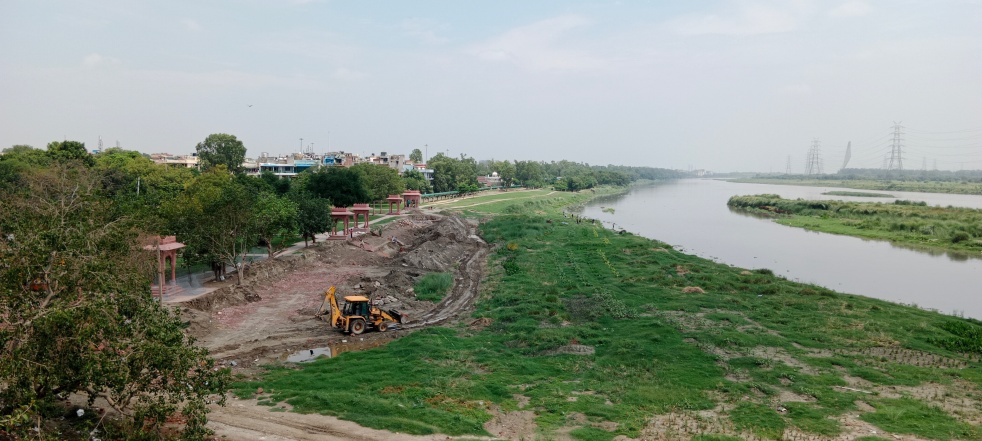
DRP NB 180923: Floodplain loss, the biggest in Asia, disaster in the making
(Feature Image: Ongoing ghat work along Yamuna at Qudsia ghat, ISBT Dellhi. SANDRP, June 2023)
A floodplain, according to the US Federal Emergency Management Agency, is “any land area susceptible to being inundated by floodwaters from any source”. According to the report “Human alterations of the global floodplains 1992–2019”, over 460,000 sqkms of floodplain area was lost to agriculture, while another 140,000 sqkms was redeveloped to new areas over the existing floodplain. Continent-wise, Asia lost the biggest area of floodplains — a little over 200,000 sqkms — among all the continents. It was followed by South America (92,000 sqkms) and Africa (73,000 sqkms).
Continue reading “DRP NB 180923: Floodplain loss, the biggest in Asia, disaster in the making”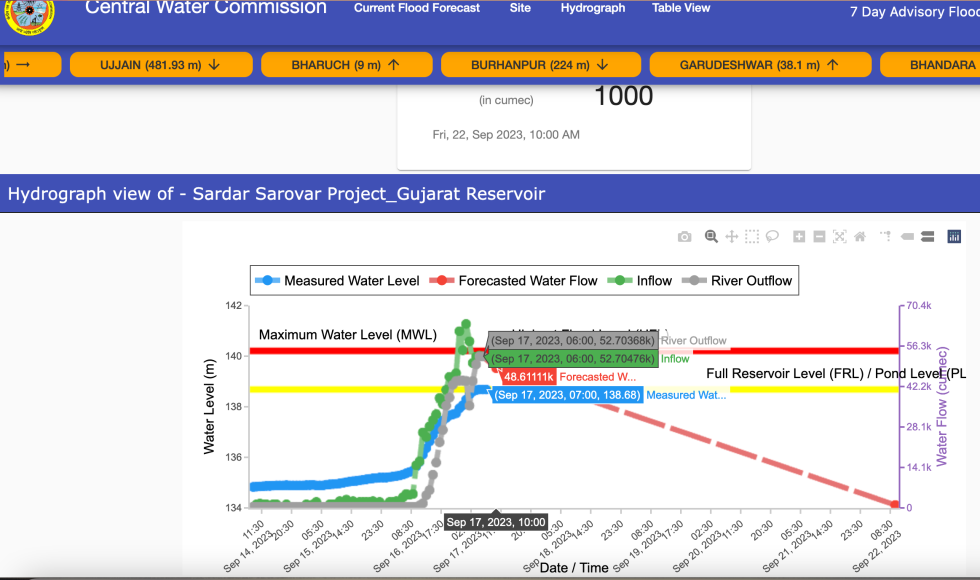
Unaccountable Sardar Sarovar operators again bring avoidable floods in downstream Gujarat
Late, lethargic and unaccountable actions of Sardar Sarovar Project (SSP) Dam operators have once again contributed to huge and largely avoidable downstream floods in Gujarat. The water level at Golden Bridge in Bharuch is approaching HFL (Highest Flood Level) today on Sept 17, 2023, but these floods could have been significantly lower and much less disastrous both for SSP upstream and downstream areas if SSP authorities had taken action earlier based on actionable information available and based on sound reservoir operation principles of following a rule curve.
Continue reading “Unaccountable Sardar Sarovar operators again bring avoidable floods in downstream Gujarat”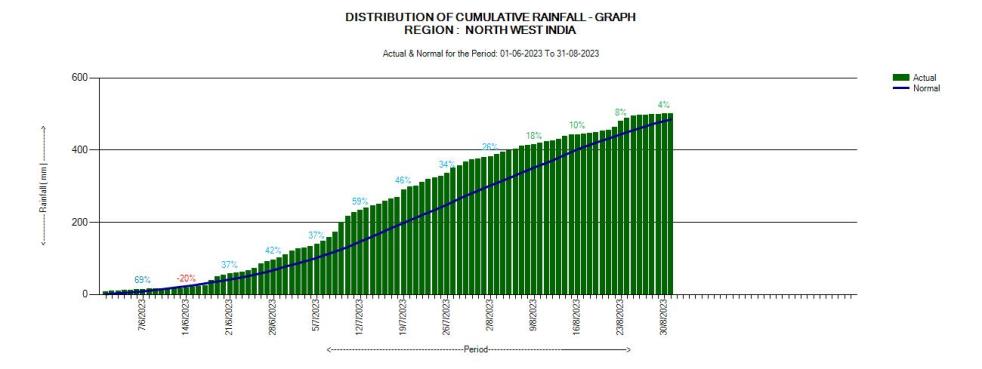
High Rainfall days in India’s districts in August 2023
An analysis of the daily district wise rainfall data from India Meteorological Department (IMD) for the month of Aug 2023, shows that there were 500 (667 in Aug 2022[i] and 431 in Aug 2021) instances when district rainfall of a day in a district was above 50 mm. Such high rainfall instances included 424 (553 in Aug 2022 and 371 in Aug 2021) instances when rainfall was 50-100 mm, 67 (98 in Aug 2022 and 48 in Aug 2021) instances when it was 100-150 mm, 5 (13 in Aug 2022 and 11 in Aug 2021) times it was 150-200 mm and 4 (3 in Aug 2022 and 1 in Aug 2021) above 200 mm. Interestingly, in June 2023[ii] and July 2023[iii] there were 451 and 855 instances when rainfall was above 50 mm, while in June 2022[iv] and July 2022[v] there were 462 and 809 instances when rainfall in a district was above 50 mm. The July 2023[vi] and June 2023[vii] rainfall over India was 13.1% above normal and 10.1% below normal respectively, while the July 2022[viii] and June 2022[ix] rainfall all over India was 16.8% above normal and 8% below normal respectively.
Continue reading “High Rainfall days in India’s districts in August 2023”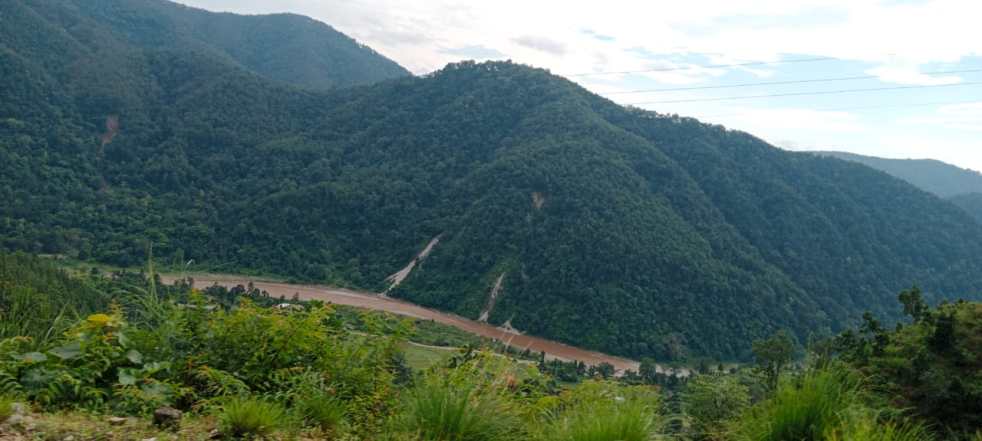
DRP NB 110923: Another independent institution-CEC destroyed
(Feature Image: Ramganga River near Marchula. SANDRP 08 Sept. 2023)
The Govt of India’s Sept 5 2023 notification reconstituting the Central Empowered Committee completely destroys the independent nature of this institution of accountability and course correction. This institution, set up by the Supreme Court in 2002 and reconstituted in 2008, worked as eyes and ears of the Supreme Court on environmental issues. The new committee has no independent members, it will be constituted by the MoEF, MoEF itself has such an abysmally poor track record.
The notification, reports said, diluted the CEC’s autonomy on four key counts: the committee will report to the ministry, instead of the SC; the ministry will pick all the members and the SC will have no role in the process; the ministry, and not the court, will fund the committee; the provision of having two NGOs in the committee has been done away with.
Continue reading “DRP NB 110923: Another independent institution-CEC destroyed”
DRP NB 04092023: Will National Ganga Mission too fail to clean up Ganga?
(Feature Image: Untreated industrial effluents being dumped in Drain No. 6, Sonipat in May 2023.)
More than 7 years have passed since the central government launched Rs. 20, 000 crores Namami Gange Programme in May 2015 replacing Ganga Action Plan (GAP) and created National Mission for Clean Ganga (NMCG) a nodal agency to implement the programme.
The NMCG has already missed the target of cleaning the Ganga by 2019 and then by 2020 due to improper planning and Detailed Project Reports (DPRs) as accepted by G. Asok Kumar, Director General (DG), NMCG in an interview to The Week in January 2023 further extending the target to 2026.
Though Namami Gange aimed to adopt a basin wise approach with focus on e-flows, afforestation, revival of tributaries, biodiversity conservation in participatory manner; so far it has extensively worked on creation of sewage treatment infrastructures in the states along the main stem of the river.
Despite that the ground situation is far from improving as shown in the The Hindu report below which reveals that about 80 percent of the overall budget is being spent on sewage infrastructure creation and by 2026, the treatment plants capacity would be able to treat at the most 60 percent of sewage generated only along the main stem of the Ganga river.
Continue reading “DRP NB 04092023: Will National Ganga Mission too fail to clean up Ganga?” SANDRP