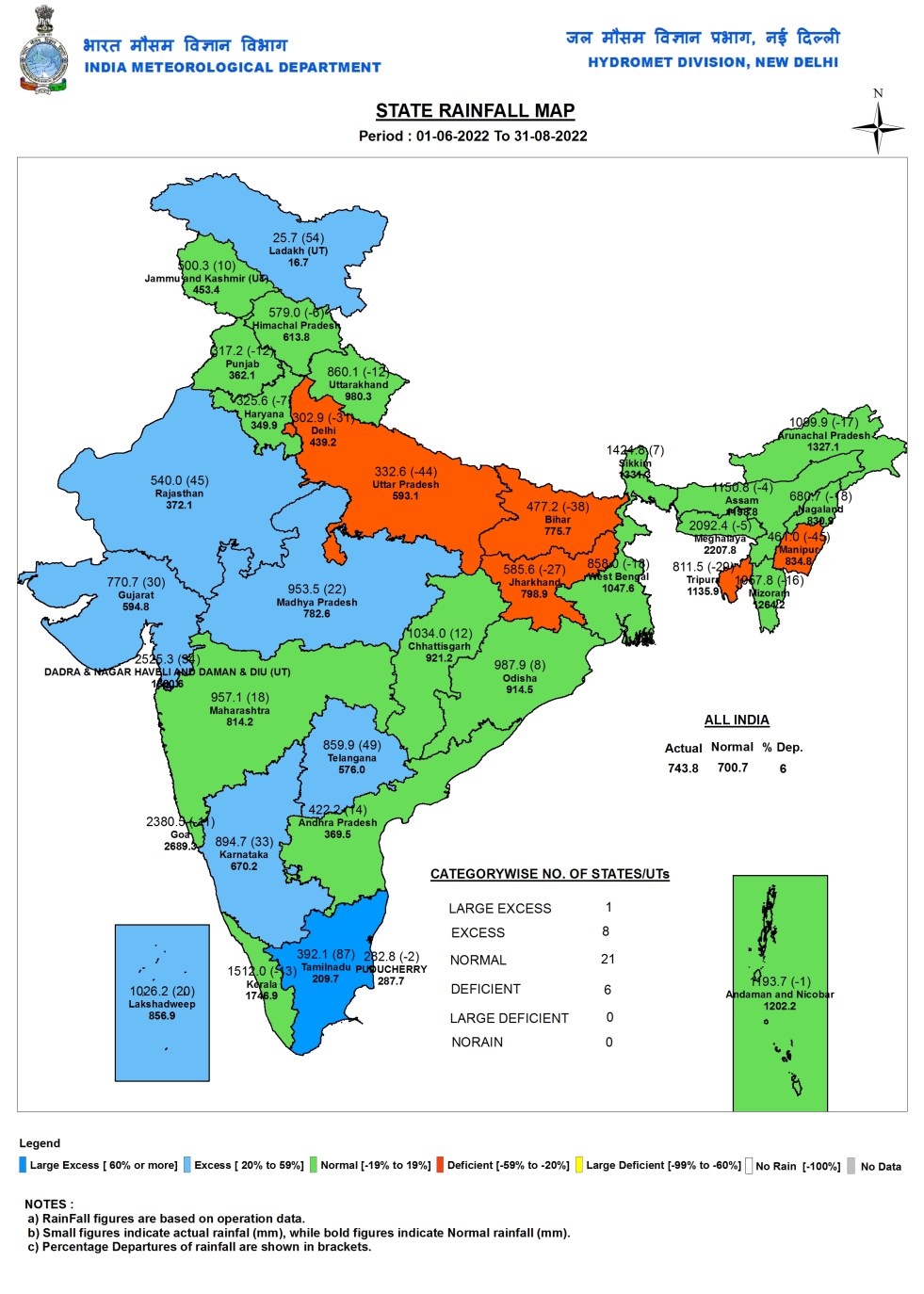
In the just concluded month of Aug 2022, the third month of India’s South West 2022 monsoon, India received 263.8 mm rainfall, 3.5% above the normal Aug rainfall of 254.9 mm as per India Meteorological department (IMD). In Aug 2021, the rainfall was 195.9 mm[i], about 24.13% below normal and in Aug 2020, the rainfall was 327 mm[ii], or about 26.6% above normal.
Continue reading “June Aug 2022: District wise rainfall in India’s SW Monsoon”Tag: IMD

June July 2022: District wise rainfall in India’s SW Monsoon
In the just concluded month of July 2022, the second month of India’s South West 2022 monsoon, India received 327.7 mm rainfall, 16.8% above the normal July rainfall of 280.5 mm as per India Meteorological department. In July 2021, the rainfall was 266.1 mm[i], about 6.7% below normal and in July 2020, the rainfall was 257.1 mm[ii], or about 9.9% below normal.
Continue reading “June July 2022: District wise rainfall in India’s SW Monsoon”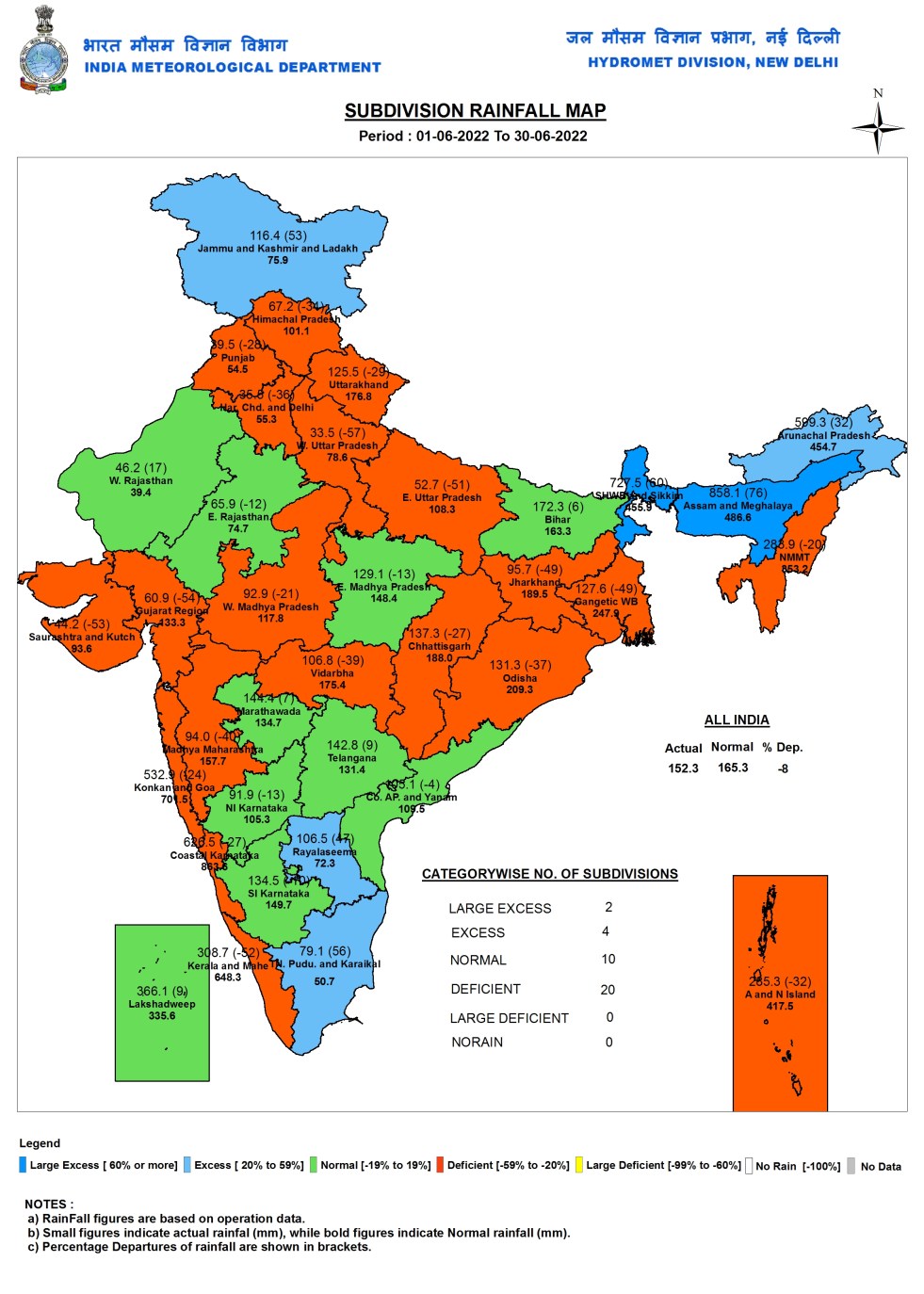
June 2022: High Rainfall district days in India’s SW Monsoon
An analysis of the daily district wise rainfall data from India Meteorological Department (IMD) for the month of June 2022, the first month of India’s South West Monsoon 2022 shows that there were 462 instances (442 in June 2021) when district rainfall of a day was above 50 mm. This is high considering that the rainfall of India in June 2022 was 152.3 mm[i], or daily average rainfall is about 5 mm. The high rainfall instances in June 2022 included 339 (371 in June 2021) instances when rainfall was 50-100 mm, 68 instances (59 in June 2021) when it was 100-150 mm, 26 (5 times in June 2021) times it was 150-200 mm and 29 (7 times in June 2021) times above 200 mm.
Continue reading “June 2022: High Rainfall district days in India’s SW Monsoon”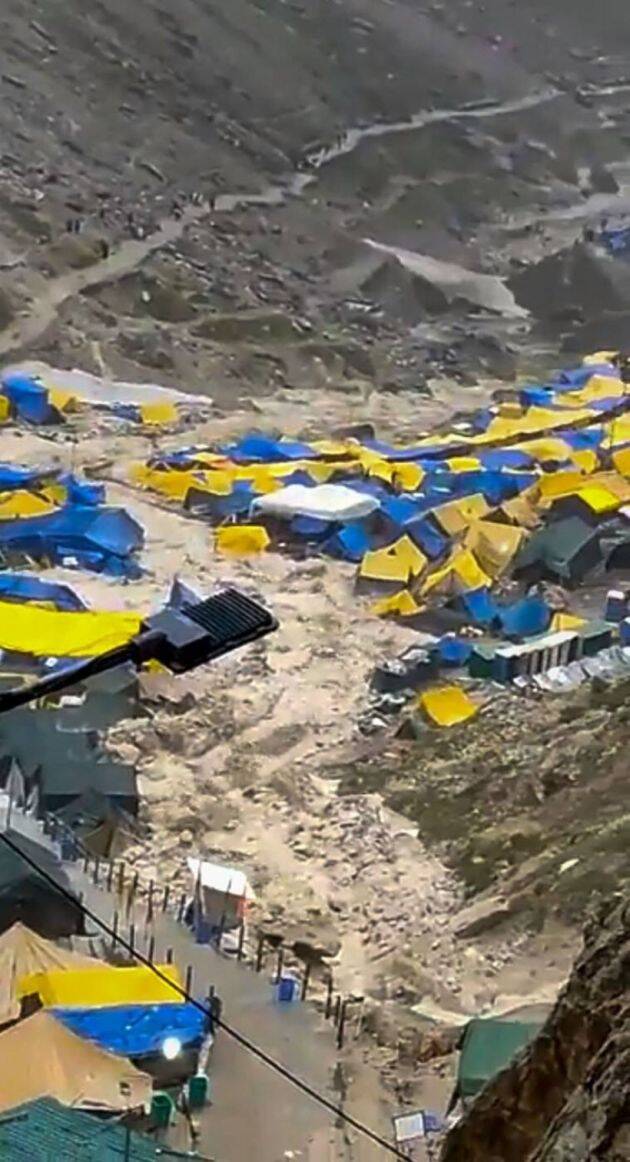
DRP 110722: Govt failure on cloudburst monitoring, forecasting, managing
(Feature Image: On July 8, a flash flood triggered by a cloudburst hit a camp near the Amarnath cave shrine in J&K’s Ganderbal district. The Indian Express)
Just in first few weeks of this South West Monsoon in India and particularly in last two weeks there have been numerous cloudburst incidents leading to large number of deaths and destruction of human and natural infrastructure. Most of the time, the government just calls these disasters cloud burst and points finger at climate change, implying its helplessness, but happy that they have rescued the affected people. In reality, a lot can be done in terms of monitoring, forecasting and managing cloudbursts that is clearly not happening and is not part of government’s disaster management plans or actions.
Firstly there are some known places where the flash floods from cloud burst could lead to disaster, they need to be identified and habitations near and at risk at such locations need to be mapped and monitored to minimize the risks. The locations next to streams are clearly such hazardous locations and how can there be camps located right next to such streams as happened during the recent Amarnath caves?
Continue reading “DRP 110722: Govt failure on cloudburst monitoring, forecasting, managing”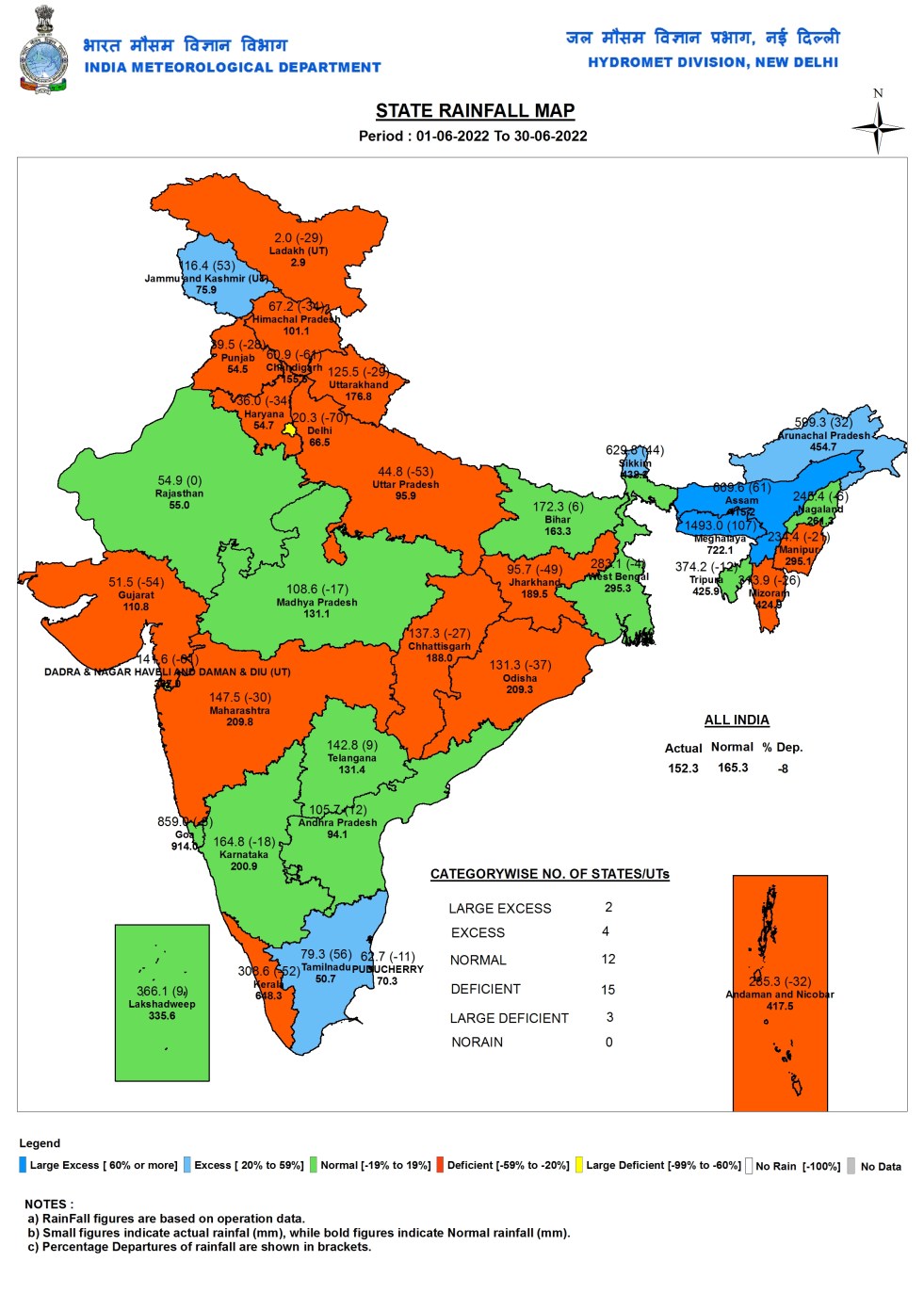
June 2022: District wise rainfall in India’s SW Monsoon
In the just concluded month June 2022, the first month of India’s South West 2022 monsoon, India received 152.3 mm rainfall, 8% below the normal June rainfall of 165.3 mm as per India Meteorological department. In June 2021, the rainfall was 182.9 mm[i], about 11% above normal and in June 2020, the rainfall was 196.9 mm, or about 18% above normal and in June 2019 it was 33% below normal.
Continue reading “June 2022: District wise rainfall in India’s SW Monsoon”
DRP 13 June 2022: Down in Dumps, MoEF becomes more opaque
(Feature image: Union Environment Minister Bhupender Yadav with PM Narendra Modi before taking oath on July 7, 2021 PTI/HT.)
While the news that India has achieved the worst ever ranking of 180, at the bottom of 180 country index in terms of Environment Performance Index was shocking, it should not surprise too many people considering the way environment is treated by the current central government, particularly the Union Ministry of Environment and Forests (MoEF). As expected, MoEF questioned the methodology of the assessment, and the criticism has been responded to and rejected by the authors of the EPI report.
Now with a dictate of the MoEF (dated Apr 8, 2022, preceding the EPI news) coming to light, the trajectory of the MoEF should leave no one in doubt. Through this dictate, the MoEF has asked the Wildlife Institute of India (WII), a supposedly autonomous institute of the Ministry, to seek the ministry’s approval before it publishes any document, that too with retrospective effect! WII in any case, was towing the ministry’s line in many of the cases as is evident from its performance in regulatory committees like the Forest Advisory Committee, National Board of Wild Life and Expert Appraisal Committee (on River Valley Projects, possibly among others). And yet the Ministry has come out with this dictate, without giving any reasons, possibly since some of WII reports have been problematic for the govt in judicial proceedings in some cases. But the MoEF move to stop WII from publishing (and hence doing) any credible studies only shows the paranoia of the ministry. Its performance index would not improve this way, it would only get worse.
Continue reading “DRP 13 June 2022: Down in Dumps, MoEF becomes more opaque”
Pre Monsoon 2022: District wise rainfall in India
In the just concluded three month pre monsoon season (March 1 to May 31, 2022) India received 130.6 mm rainfall, 1% below the normal rainfall of 131.7 mm as per the India Meteorological Department (IMD). In 2020[i] and 2021[ii] India received 158.5 mm and 155.2 mm or 20% and 18% above normal rainfall respectively. So this year, India has received much lower pre monsoon season rainfall compared to previous two years.
Continue reading “Pre Monsoon 2022: District wise rainfall in India”
Normal Rains Forecast for India’s SW Monsoon 2022
India Meteorological Department (IMD) has in their first forecast for India’s crucial South West Monsoon (June-Sept) 2022 has forecast[i] that India will receive 99% of Long Period Average (LPA) rain with a model error of +/- 5%. This means that IMD has forecast on April 14, 2022 that India is likely to get normal rainfall (96% to 104% of LPA) rains for the fourth consecutive year. IMD says that currently La Nina conditions are prevailing and are likely to continue during the monsoon.
Continue reading “Normal Rains Forecast for India’s SW Monsoon 2022”
District wise Winter 2022 Rainfall in India
In the just concluded Winter Season 2022 (Jan 1 2022 to Feb 28 2022), as per India Meteorological Department (IMD), India received 44% above Normal Rainfall (it was 32% below normal rainfall in winter 2021[i]. This is coming on top of almost normal (99.32% of normal rainfall) in SW Monsoon 2021[ii] and 43.54% above normal rainfall in Post Monsoon season 2021[iii].
Continue reading “District wise Winter 2022 Rainfall in India”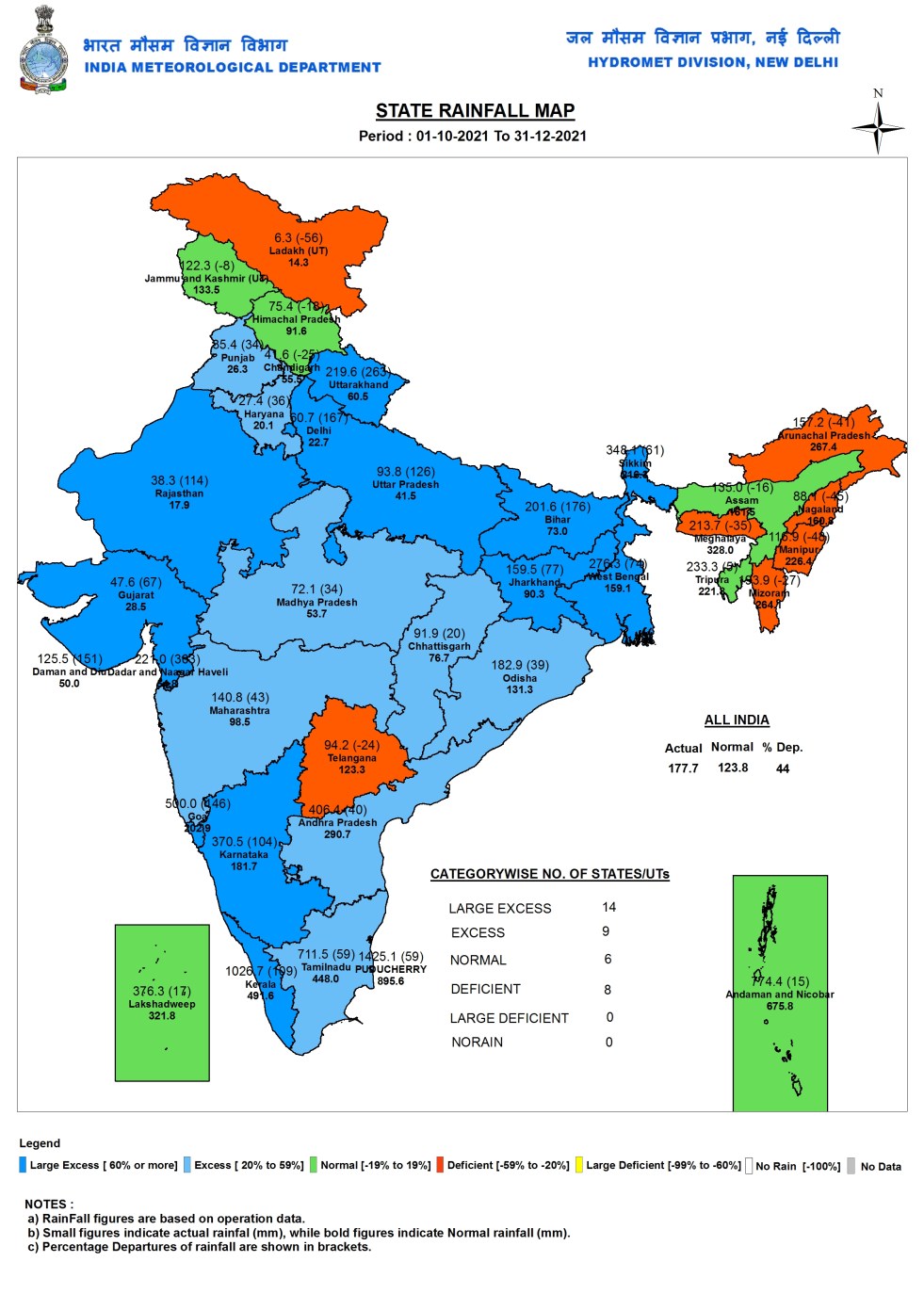
Post Monsoon 2021: District wise Rainfall in India
According to India Meteorological Department (IMD), during the just concluded Post Monsoon Rainfall for 2021, that included rainfall during Oct-Dec months, India received 177.7 mm rainfall, 43.54% above normal rainfall of 123.8 mm. In the same period last year, India received 124.6 mm rainfall, 0.64% above the normal rainfall. As per IMD[i] definition, the rainfall was in surplus category.
Continue reading “Post Monsoon 2021: District wise Rainfall in India” SANDRP