Sand Mining

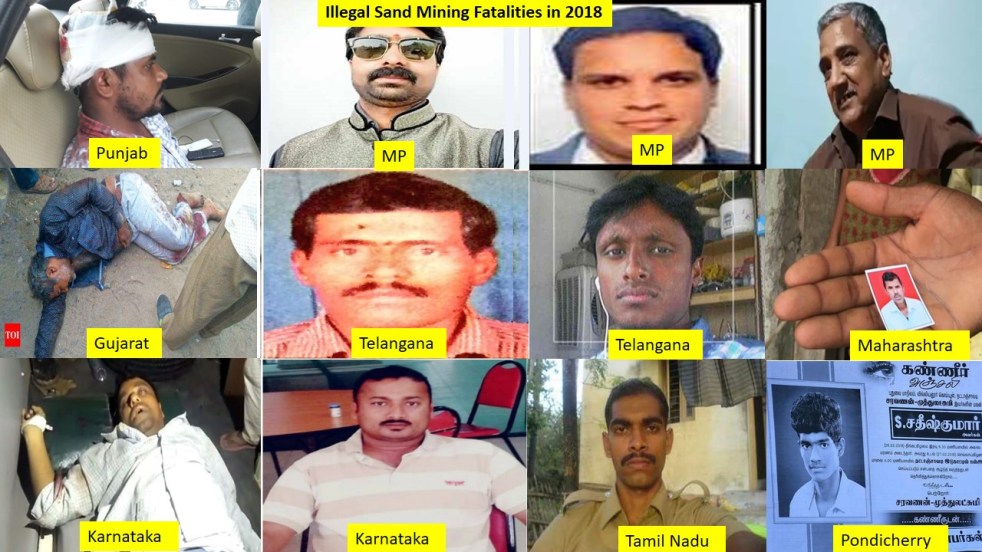
Illegal Sand Mining Violence 2018: at least 28 People died across India

Across the country, many government officials were killed while taking action against illegal sand extraction in 2018. So were the lethal attacks on reporters and citizens for exposing illegalities and objecting to illegal mining activities. Many innocent people lost lives in accidents related to illegal sand mining related incidents which could have been avoided. This compilation of sand mining related incidents also highlights how illegal sand mining was damaging the infrastructure providing essential services.

NORTH INDIA

Uttrakhand A 115 years old British era bridge on Tons river in Birpur, Dehradun collapsed on Dec. 28 reportedly due to overloaded sand trucks. Two people were killed[1] in the accident. The single lane bridge was damaged during 2013 floods and opened for public after repair. 

Continue reading “Illegal Sand Mining Violence 2018: at least 28 People died across India”

DRP News Bulletin

DRP: 18 Feb 2019: Salutes to the Mithi River Clean up Effort

As this report narrates, a great volunteer effort is underway in Mumbai to clean up Mithi river. What they have achieved is just about 350 m of clean river, after labouring over weekends for several months. But this is such a daunting task to even venture to start. They have not only started, but made visible progress. Let us hope it will achieve all its objectives.

Continue reading “DRP: 18 Feb 2019: Salutes to the Mithi River Clean up Effort”
Sand Mining

Tamil Nadu Sand Mining 2018: Story of Nexus exposed by a brave Journalists

Brave Journalists exposes the Nexus supporting illegal sand mining in Tamil Nadu

Reporter honoured for exposing illegal mining On January 4, 2019, Sandhya Ravishankar was conferred Ramnath Goenka Excellence in Journalism Award for her reportage on illegal beach sand mining in Tamil Nadu. https://www.thenewsminute.com/article/news18-editor-m-gunasekaran-becomes-1st-tamil-journalist-bag-ramnath-goenka-award-94522 (5 Jan. 2019)

Journalist stalked after reports on sand mafia Sandhya Ravishankar, Chennai-based journalist alleges multiple attempts to stalk and intimidate her in the recent past after she wrote a series of reports on the sand mafia. She is also fighting defamation cases. https://www.firstpost.com/india/chennai-based-journalist-sandhya-ravishankar-alleges-stalking-intimidation-after-reports-on-sand-mining-mafia-5295131.html  (1 Oct. 2018)

Explosive reports on illegal beach sand mining in Tamil Nadu by Sandhya Ravi Shankar: Her report first person singular on Jan 31, 2017 provides blow by blow account of how the nexus involved in illegal sand mining was exposed. (https://thewire.in/culture/beach-sand-cartel, https://thewire.in/tag/beach-sand-mining)

Continue reading “Tamil Nadu Sand Mining 2018: Story of Nexus exposed by a brave Journalists”

DRP News Bulletin

DRP: 7 Jan 2019: NGT REJECTS FLAWED GROUNDWATER NOTIFICATION

Good to see NGT rejecting the flawed Groundwater notification dated Dec 12, 2018 from CGWA that was also critiqued by SANDRP: https://sandrp.in/2018/12/31/groundwater-governance-why-dec-12-2018-cgwa-notification-would-be-disastrous/. However, NGT should have asked an independent panel to formulate the policy for sustainable groundwater use, rather than a committee of the same government persons. Besides, there is also need for restructuring of currently totally ineffective CGWA and make it COMPLETELY INDEPENDENT of government.

Continue reading “DRP: 7 Jan 2019: NGT REJECTS FLAWED GROUNDWATER NOTIFICATION”
DRP News Bulletin

DRP: 17 Dec 2018: Dam Safety Bill Introduced, TN, Odisha Oppose; Why No Role For Independent Experts?

On Dec 12, 2018, The government introduced the Dam Safety Bill amid din in the Lok Sabha on Wednesday even as Biju Janata Dal group leader Bhartruhari Mahtab questioned the legislative competence of the House on the matter.

The Bill provides for “surveillance, inspection, operation and maintenance of specified dams for prevention of dam failure related disasters and to provide for institutional mechanism to ensure their safe functioning”. There are over 5,200 large dams in the country and about 450 are under construction. There are also thousands of medium and small dams whose safety remains a matter of concern due to lack of legal and institutional safeguards. https://indianexpress.com/article/cities/delhi/parliament-winter-session-govt-introduces-dam-safety-bill-5490911/   (13Dec.2018)

Continue reading “DRP: 17 Dec 2018: Dam Safety Bill Introduced, TN, Odisha Oppose; Why No Role For Independent Experts?”
Dams · Monsoon

Uttarakhand Monsoon 2018 Overview: Rainfall Normal, Distribution Abnormal

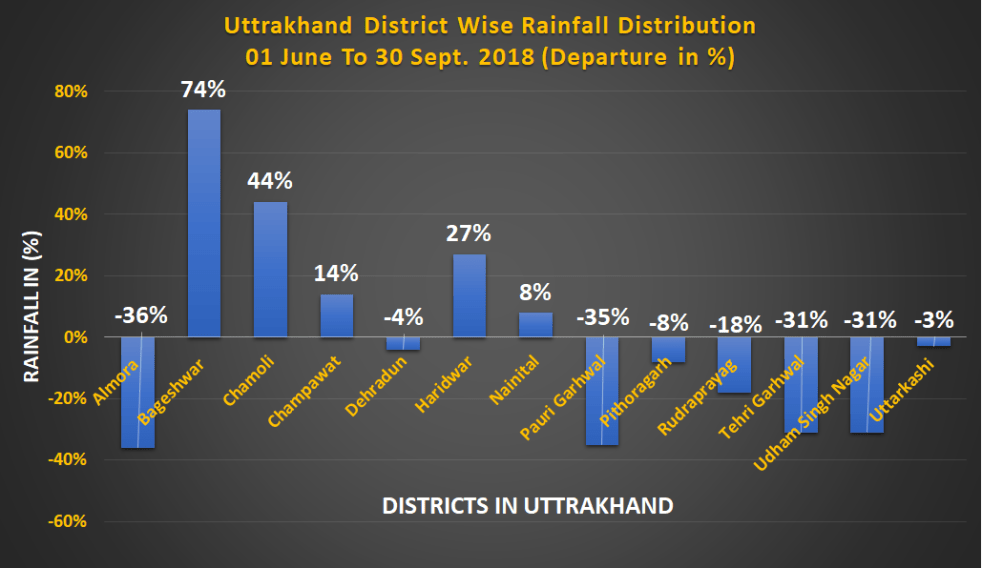
Uttrakhand has received 3% below normal rainfall during South West Monsoon 2018. Though the figure falls in normal category, however district level rainfall data paints a very different picture. Out of total 13 districts in the Himalayan state, four districts namely Almora, Pauri Garhwal, Tehri Garhwal and Udham Singh Nagar have received deficit rains, whereas three districts which includes Bageshwar, Chamoli and Haridwar have got rainfall in excess. Out of the rest six districts four are on marginally positive side and two are on marginally negative side.

Continue reading “Uttarakhand Monsoon 2018 Overview: Rainfall Normal, Distribution Abnormal”

Dams · DRP News Bulletin

DRP: 15 Oct 2018: Reuters Corroborates that Dams Played Major Role in Kerala Floods

International news agency, after independent research, have corroborated what SANDRP has been saying: Mismanagement of dams played big role in worsening Kerala floods.

-“The release could have started earlier so that by Aug. 9 there would have been left-over capacities in the reservoirs to store the water,” said Biswajit Mukhopadhyay, director of water resources at U.S-based engineering firm IEA, who analysed some of the publicly available data at the request of Reuters.

– Still, dozens of flood victims interviewed by Reuters, who live in villages dotting the banks of Kerala’s biggest river, the ‎244 km Periyar, say they faced no floods despite torrential rain in late July and early August. All of them said waters only rose overnight on Aug. 15. That was when more intense rainfall forced KSEB to rapidly ramp-up releases of water from Idukki and Idamalayar reservoirs, which feed into the Periyar.

– Kerala’s revenue secretary and head of disaster management, P.H. Kurien, told Reuters he has twice written to KSEB requesting EAPs and has yet to receive them. KSEB’s Pillai said EAPs and dam operation manuals were still being prepared. CWC said it was working with Kerala’s government to speed this up. The Kerala Chief Minister’s office did not respond to requests for comment. https://widerimage.reuters.com/story/did-dams-make-indias-once-in-century-floods-worse  (11 Oct. 2018)

And this fantastic infographic: https://fingfx.thomsonreuters.com/gfx/rngs/INDIA-FLOOD/010080MF18N/index.html  (11 Oct. 2018)

Continue reading “DRP: 15 Oct 2018: Reuters Corroborates that Dams Played Major Role in Kerala Floods”
Dams · DRP News Bulletin

DRP: 2 July 2018: Punjab Cabinet Meets To Discuss Water crisis

In a rare event, Punjab Cabinet met to discuss water crisis on June 26, 2018. The reports before the meeting seemed to give hope that may be Punjab will look at the water crisis in a fundamental, holistic way. https://indianexpress.com/article/cities/chandigarh/punjab-government-to-firm-up-water-conservation-plan-5233826/ (June 26, 2018)

But the cabinet ended up setting up a committee to assess the ground water situation in the state and submit a detailed proposal for water conservation.

– Punjab has the highest rate of groundwater exploitation and had on average withdrawn 28.2 million acre feet (MAF) water yearly during 2008-2013. However, the yearly average replenishment of water was only 18.9 MAF.

– 73% of Punjab’s irrigated area uses groundwater for irrigation, while only 27% uses surface water. The number of tubewells had gone up exponentially from 2 lakh in 1971 to 12.50 lakh in 2015-16, with 41% of these have water availability beyond the depth of 60 metres. https://timesofindia.indiatimes.com/city/chandigarh/5-member-committee-to-assess-punjab-ground-water/articleshow/64770186.cms  (28 June 2018)

Continue reading “DRP: 2 July 2018: Punjab Cabinet Meets To Discuss Water crisis”
Dams · DRP News Bulletin

DRP: 28 May 2018 (Survival of Biodiversity Habitats, Must for Ganga River Rejuvenation)  

On occasion of International Day for Biodiversity May 22, 2018, the Union Minister for Water Resources, River Development and Ganga Rejuvenation Nitin Gadkari released the report on “Status of Conservation of Select Aquatic Species” in river Ganga in New Delhi . The celebrations have been organised to mark the 25 years of coming into force of the Convention on Biological Diversity. He also inaugurated a day-long workshop organized by World Wildlife Fund (WWF) on the theme “Ganga and its Biodiversity: Developing a Road Map for Habitat and Species Conservation”.

A database of Ganga Praharis’, a self-motivated cadre, being created by Wildlife Institute of India (WII) was also launched by the Minister. Shri U.P. Singh, Secretary, Ministry of Water Resources, River Development and Ganga Rejuvenation said: “Ganga still has about 2,000 aquatic species.” He also pointed out that both aviralta and nirmalta of river Ganga are important and the government is committed to achieve both.

Continue reading “DRP: 28 May 2018 (Survival of Biodiversity Habitats, Must for Ganga River Rejuvenation)  “
Dams

WORLD WATER DAY 2018: INDIA’S POSITIVE WATER STORIES

On occasion of World Water Day 2018, SANDRP put together reports of remarkable water conservation work done by individuals, villager community and organizations across the country.

Good that UN report this WWD says[i]: “The efforts by local communities in India to improve water availability have been lauded in a UN report that highlights the importance of finding nature-based solutions to meet global water challenges…. The report notes that reservoirs, irrigation canals and water treatment plants are not the only water management instruments at disposal. It also cited the example of China’s Sponge City which aims to recycle 70 per cent of rainwater.”

Image result for un wwd 2018 nature based water solution report

But the UN report[ii] does not mention that local options should be the top priority and should be exhausted before going for large projects. Unfortunately, Indian water resources establishment’s priority is Large dams and river linking. The UN report also does not say that local systems are bound to be neglected and destroyed in the shadow of large projects and where the governance is top down, unaccountable, non transparent and non participatory.

Continue reading “WORLD WATER DAY 2018: INDIA’S POSITIVE WATER STORIES”