
This proposition clearly sounds simplistic and seems devoid of science or logic. But the case studies of the epidemics since 1980 and loss of forests, biodiversity and sustainability shows that this is not to be dismissed that easily. In fact the following interview with Dr Aaron Bernstein makes a powerful case to show why this indeed has a lot of science and logic behind it. It also hence makes a case that yesterday (our “normal”), is no longer a good model for better tomorrow.
Continue reading “DRP: 20 April 2020: Solutions to Covid 19 & Climate change are same?”Tag: biodiversity
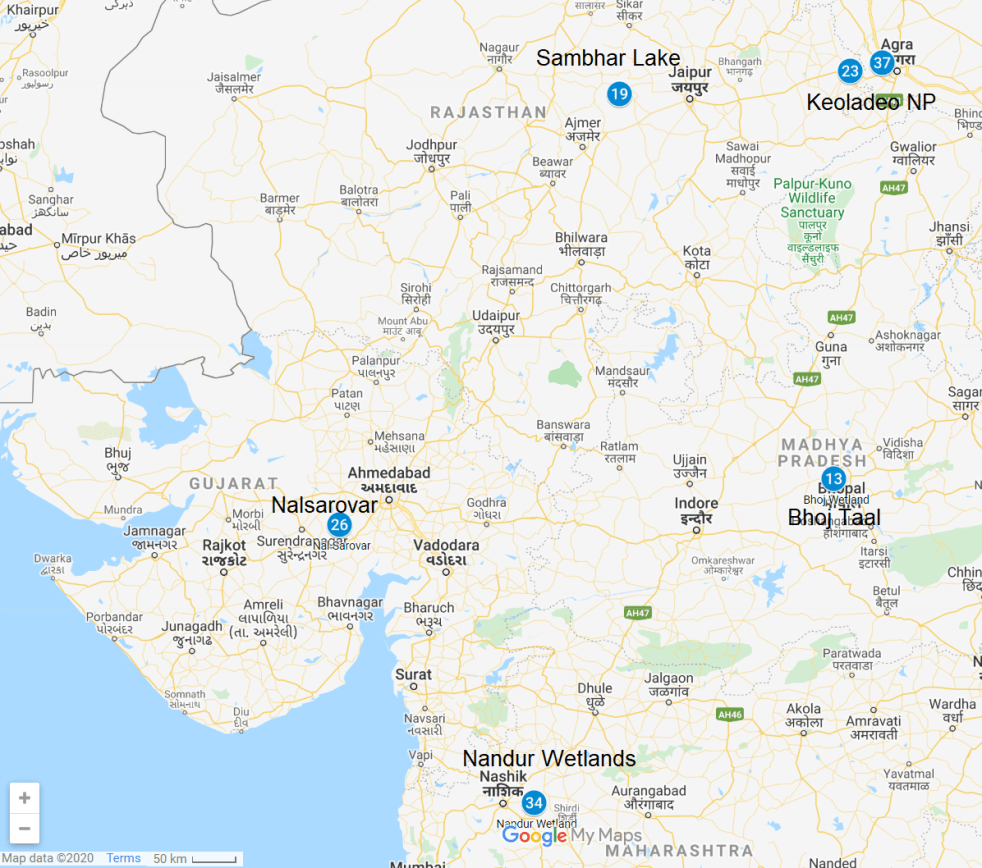
Ramsar Wetlands in crisis 2020: West India
The four state of West India have only five Ramsar sites of international importance. These includes Sambhar lake and Keoladeo NP in Rajasthan, Nalsarovar in Gujarat, Bhoj Taal in Madhya Pradesh and Nandur Madhmeshwar Wetlands in Maharashtra. There is no Ramsar site in Goa state.
Continue reading “Ramsar Wetlands in crisis 2020: West India”

World Wetlands Day 2020: Positive Stories from India
On February 2, the World Wetlands Day is celebrated globally. The theme of 2020 is Wetlands and Biodiversity to emphasize the critical roles the wetlands plays for wildlife, aquatic life, and native vegetation. They also play crucial role in harvesting rainwater, recharging groundwater, providing livelihoods, acting as carbon sinks and providing cushion against flash floods thus they hold immense significance in changing climate.
This compilation puts together some of the positive developments related to wetlands that took place in 2019. It also includes few individual initiatives of lakes and water bodies cleaning from greater Noida, Chennai and Udaipur. There have been some fruitful efforts by citizen and community groups in Maharashtra, Goa and Kerala.
Continue reading “World Wetlands Day 2020: Positive Stories from India”

Punjab Wetlands Overview 2019: More Ramsar Tags no guarantee for Wetlands protection
Punjab government has been successful in getting three more wetlands declared as Ramsar sites of international importance. The state already has three wetlands with Ramsar tags namely Harike, Kanjli and Ropar wetlands. The government in October 2019 had proposed a total of five sites including Ranjit Sagar conservation reserve and Hussainiwala wetland for Ramsar tags. The new wetlands selected for the tag are Keshopur-Miani community reserve, the Beas conservation reserve and Nangal wildlife sanctuary. So now six wetlands in the state are covered under Ramsar convention.
The state forest department and WWF team were working in this direction over past couple of years. In the year 2019, the government has also taken some remarkable decisions regarding conservation of wetlands in the state. However, by the year end, there has not been any significant progress on the issue from the government.

DRP: 5 Aug 2019: Why Dam Safety Bill and ISWD Amendment won’t help
India urgently needs a lot of effective work on Dam Safety, but the bill before the Parliament makes CWC (Central Water Commission) as focal point of Dam Safety, but CWC has conflict of interest and poor track record. The Bill does not provide any real independent oversight, nor clearly defined norms of complete transparency in the dam safety matters, and there is no role of the vulnerable communities, the most important stake holders. The Bill also tends to centralise the power with the Union govt, and states legitimately suspects this. https://www.indiatoday.in/india/story/dam-safety-bill-2019-why-evokes-opposition-stakeholders-1576391-2019-08-02 (Aug 2, 2019)
The Interstate Amendment Water Disputes Amendment Bill before the Parliament is basically tinkering with the existing system, which will not change anything fundamentally. It needs to be understood that disputes arise when an upper riparian state (or a country) build a large dam or diverts the massive amount of water, leading to lower availability of water for the lower riparian state (or country). When it comes to resolution, the tribunals look at a river as a channel of water and its distribution, ignoring that it is a complete ecosystem and that water in a river depends on the state of its basin and catchment area. It also depends on the extraction of groundwater. These aspects are ignored by the tribunals. Moreover, a state does not represent a river basin or all its stakeholders (the people using river water), which is why the Narmada tribunal’ award created a conflict between the states and their people. The central government’s impartiality is suspect and would have a great bearing on the resolution process. https://www.indiatoday.in/india/story/interstate-river-water-disputes-bill-2019-1575531-2019-07-31 (1 Aug. 2019)
Continue reading “DRP: 5 Aug 2019: Why Dam Safety Bill and ISWD Amendment won’t help”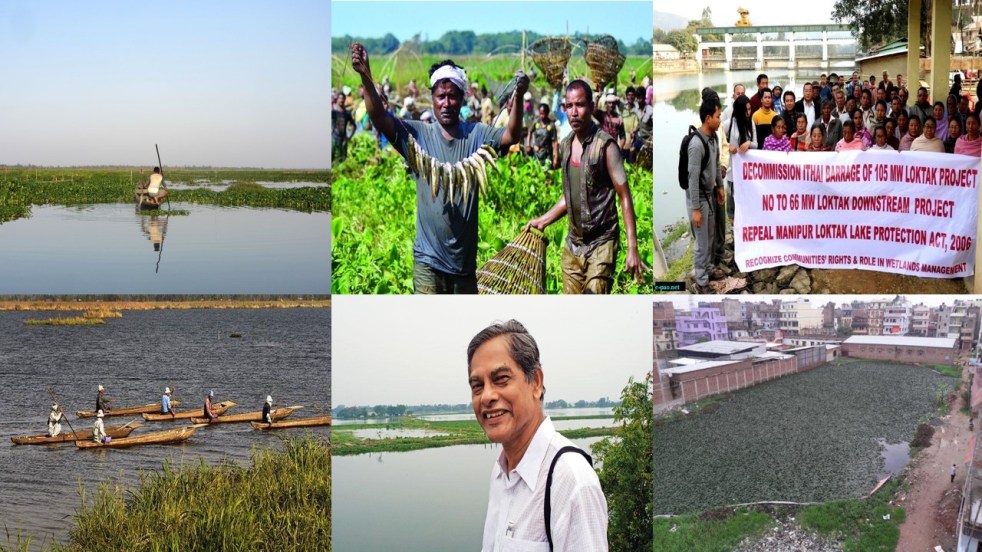
Wetlands Review 2019: East & North East India
ODISHA
HC asked govt to start demolishing illegal prawn gheries in wetlands In a remarkable order the Odisha High Court on Jan. 21, 2019 directed the govt to start the demolition process of illegal prawn farms in Bhitarkanika National Park and the Chilika Lake under the supervision of the committee formed for the purpose. The high court has set March 18 as the date for taking stock of the work. It has also directed the govt to lodge criminal proceedings against the offenders.
The Supreme Court had on April 3, 2017, asked the chief justice of high courts in 15 states to take up the issue of conservation of important wetlands. Of the 26 major wetlands in 15 states, two are in Odisha. The high court had taken up the issue by suo motu registering a PIL in Sept 2017 for restoration of two wetlands – Bhitarkanika in Kendrapada district and the Chilika Lake, encompassing areas in Puri, Ganjam and Khurda districts.
Continue reading “Wetlands Review 2019: East & North East India”

DRP: 15 Apr 2019: Bundelkhand villages demand ponds, not Ken Betwa Link
A pond dug a few years ago in Jignanda village of Hamirpur district still holds plenty of water despite scanty rainfall (Photo by Soumya Sarkar)
In a remarkable campaign during the ongoing general elections, Bundelkhand villages have demanded PONDs for Votes. This is exactly what is required for Bundelkhand, and not the destructive, costly and contractor driven Ken Betwa link that BJP has been trying to push here. Congratulations to the Bundelkhand people and People’s Science Institute that has led this campaign.
Continue reading “DRP: 15 Apr 2019: Bundelkhand villages demand ponds, not Ken Betwa Link”
Can floods lead to drought? After the flood, severe drought looming over Kerala
Guest blog by: Madhusoodhanan C.G. and Sreeja K.G
The state of Kerala experienced extreme precipitation events during the 2018 South West monsoon period with multiple episodes culminating in devastating floods across the state during 14th-18th August 2018. This year, with an early onset of monsoons that dovetailed with strong summer showers, the state received about 41% excess rainfall (2394 mm against the normal of 1700 mm) during the period June 1st to August 22nd [1]. Almost all of its reservoirs were near full storage by mid-July.
The heavy downpour and the uncontrolled opening of the spillway gates of almost all reservoirs that inundated huge stretches of river banks and floodplains, along with massive landslides across the Western Ghats affected more than 1.5 million people, with close to 500 human casualties, immense losses to property, livelihoods and resource security apart from the extensive damage to forests, wildlife and biodiversity. Maximum destruction was observed along the rivers of Periyar, Chalakudy and Pamba, all having multiple dams on their tributaries. The debate is still on as to the various reasons, both manmade and natural, behind the floods and the resultant wide-ranging casualties [2,3,4,5,6]. Meanwhile things have taken a rather unexpected turn in the flood ravaged state.
Continue reading “Can floods lead to drought? After the flood, severe drought looming over Kerala”

DRP: 30 July 2018: Laos Dam DISASTER: Yet Another Wake Up Call?
The various aspects of tragic Dam Disaster in Mekong Basin in Laos are still unfolding. But it is clear from many accounts that it was an avoidable, man-made disaster due to neglect of contractors, decision makers, consultants and supervising agencies. There is a lot we can learn from this if we want to avoid such disasters in India. We still do not have credible Dam Safety Law or institution, CWC is clearly not the right agency considering the conflict of interest with the various other roles of CWC. But for now let us look at the reports of Laos Dam Disaster.
Reminding the world of one of the worst dam disasters, the under construction dam Xepian Xe Nam Noy Hydro power project breached releasing 5 billion cubic metres of water in Southern Laos on July 23.
The gushing water current swept the surrounding leading to death of about 26 people and displacing about 6600 residents. As per report hundreds of people are still missing from neighbouring villages of Yai Thae, Hinlad, Mai, Thasengchan, Tha Hin, and Samong, which bore the brunt of flooding. The deluge has reportedly destroyed thousands of homes.
Continue reading “DRP: 30 July 2018: Laos Dam DISASTER: Yet Another Wake Up Call?”
DRP: 20 Nov 2017 (GLOBAL SLOW DOWN IN HYDRO POWER PROJECTS)
It is getting increasingly clear that days of large hydro power projects are coming to an end. While in India large numbers of big hydro power projects are stalled, this week there was news from Meghalaya, Arunachal Pradesh, Sikkim and rest of North East India of cancellation or stoppage of hydro power projects. http://www.sentinelassam.com/story/main-news/0/subansiri-project-not-to-see-light-for-4-years/2017-11-12/1/325720#.WgpysVuCzIV
Pancheshwar project on India Nepal border continues to face opposition. https://timesofindia.indiatimes.com/city/dehradun/traders-oppose-pancheshwar-dam/articleshow/61705308.cms
Nepal this week cancelled the agreement for 1200 MW Budhi Gandaki hydropower project. In Bhutan, the Prime Minister declared that they are in no hurry to go ahead with new hydropower projects. http://kathmandupost.ekantipur.com/news/2017-11-13/govt-scraps-budhigandaki-project-with-chinese-company.html
In Pakistan, the agreement for the massive 4500 MW Diamer Bhasha hydropower company with China has fallen through. https://economictimes.indiatimes.com/news/defence/chinas-strict-conditions-force-pakistan-not-to-include-diamer-bhasha-dam-in-cpec-officials/articleshow/61660935.cms
In Mynmar, too the agreement with China for massive hydropower project stands cancelled. http://www.reuters.com/article/us-china-myanmar-energy/china-says-will-keep-talking-to-myanmar-over-stalled-dam-scheme-idUSKBN1D80X4?il=0
This is further reinforced by study by Dr. Luke Gibson, Honorary Assistant Professor of the School of Biological Sciences at the University of Hong Kong, which concludes that among so called green energy sources, hydropower is most dangerous. https://phys.org/news/2017-10-green-energy-hydropower-dangerous.html#jCp
Continue reading “DRP: 20 Nov 2017 (GLOBAL SLOW DOWN IN HYDRO POWER PROJECTS)” SANDRP