CentreEAC defers clearance to Yadadri Power project The Expert Appraisal Committee (EAC) under the Ministry of Environment has deferred its decision for granting environmental clearance for the 8,000 MW Yadadri Thermal Power Station in Telangana by TSGENCO due to a “lackadaisical” approach in preparing documentation. The EAC said the Environmental Impact Assessment (EIA) report was incomplete and there was lack of clarity on many issues raised by the Committee earlier. EAC on Thermal Power Companies has in its minutes meeting held on 29-30 2016 held the EIA consultants guilty of cut & paste jobswhich can be found here. At some places, it is mentioned that coal will be transported from two ports and in some other places, four ports are mentioned. Hence, complete and specific details regarding coal import ports and coal transportation routes were not given. Further it is also observed that two important sections of the EIA report- “risk assessment” and “disaster management plan”- are almost entirely generic and contain hardly any site or project specific aspects.
Hydro power projects impact riverine fisheriesThe bleak future of fisheries is reflected in the “Vision and Perspective Plan” released by the Department of Fisheries earlier this week. The department is keeping its fingers crossed to even maintain the production of 5,393 tonnes in 2014-15 as it feels that with the commissioning of 294 hydro power projects in the recent years, the downward trend will be difficult to arrest.
It says that the expansion of the hydro power sector has resulted in the shrinking of rivers and streams and high silt levels. Rampant sand mining and indiscriminate use of pesticides have further aggravated the problem.
The fish production from the rivers and streams is falling drastically each year and the multi-pronged environmental assault is proving to be too damaging for the fisheries promotion. The state has some precious mahseer reserves. Though the power policy stipulates a minimum discharge of 15% ecological flow of rivers, the failure of the regulatory authority to check this has converted riverbeds into sandy deserts. That’s how the department perceives the threat from hydro power generation. As a further blow to the riverine fisheries, under the revised hydro-power policy, there is no requirement for micro hydel project developers to prepare environmental and social impact reports.
The vision document reflects that the coming up of hundreds of micro-hydel projects has drastically affected the streams environmental flow in Kangra, Kullu and Chamba. The picture is so grim that the project commissioned on the Sujan Nullah is virtually threatening the hatchery of the prestigious Indo-Norwegian trout project which is the lifeline of the entire trout farming programme of the state.Perceived as one of the major threats, the commissioning of 92 power projects, in the last few years has altered the river hydrology and blocked migratory routes exterminating spawning and feeding grounds of fish.Adding to the already bad situation is the array of pesticides and insecticides being used by farmers and fruit growers.
Above: Landslide Dam over Sonam River in Uttarkashi Dist in Uttarakhand (Photo from Jagran.com)
A landslide on Sonam river (Bhagirathi basin) in Bhatwari block in Uttarakashi district in Uttarakhand has blocked the flow of the river and created a lake about 90 m long, 80 m wide and 1.5-3 m deep. The landslide dam in Nelong valley in Jadhganga river basin about 145 km from Uttarkashi town, apparently was formed due to landslide during cloud burst on July 27, 2016, but the information about it reached the administration only on Sept 4, 2016, 39 days later. The landslide dam, about 24 km from the India China border has created a threat to the downstream river bank communities, roads and bridges and other structures and also ecology. The reservoir has been formed at the confluence of Angar Nallah, a local stream, with Sonam River. A team of officials sent by the District Collector on Sept 5, 2016 has submitted a report, but the report is not yet in public domain. Continue reading “Landslide Dam on Sonam River in Uttarkashi: Threat to people and structures in the downstream area”→
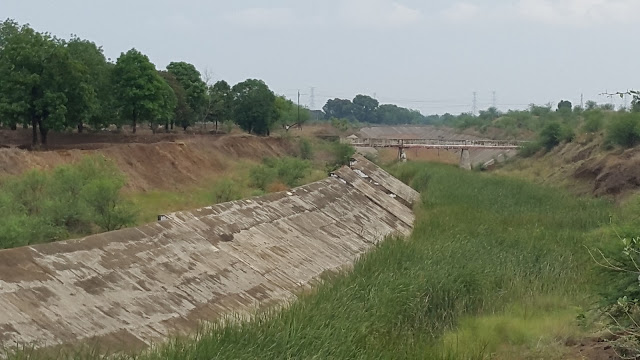
Right Bank Canal of Gosikhurd Dam (Photo: Jan Manch)
Controversial irrigation projects of Maharashtra continue to make headlines after massive irrigation scam that was unveiled in 2012. Following an inquiry in the scam, the state cabinet has recently scrapped 94 tenders of 14 irrigation projects worth Rs 9,196 Crore.[i] Around 52 of these tenders have been under the scanner of anti-corruption bureau (ACB), with first information reports (FIRs) filed in four of them. Continue reading “Public Audits of corruption ridden irrigation projects in Vidarbha: Sinchan Shodh Yatra”→
Is there hope for India’s Environment from Mr Anil Dave? Most shocking statements from India’s environment Minister. He says let us do Ken Betwa link when the project has NONE of the statutory clearances from his own ministries. The independent committees are yet to appraise the project and yet he is saying: “This Ken-Betwa river link we should do it and have an impact assessment after five years. If it is good, then great, if not they don’t go for other linkages.” Is there any hope for India’s environment? As he says, YE SAB CHALTA HAI!!
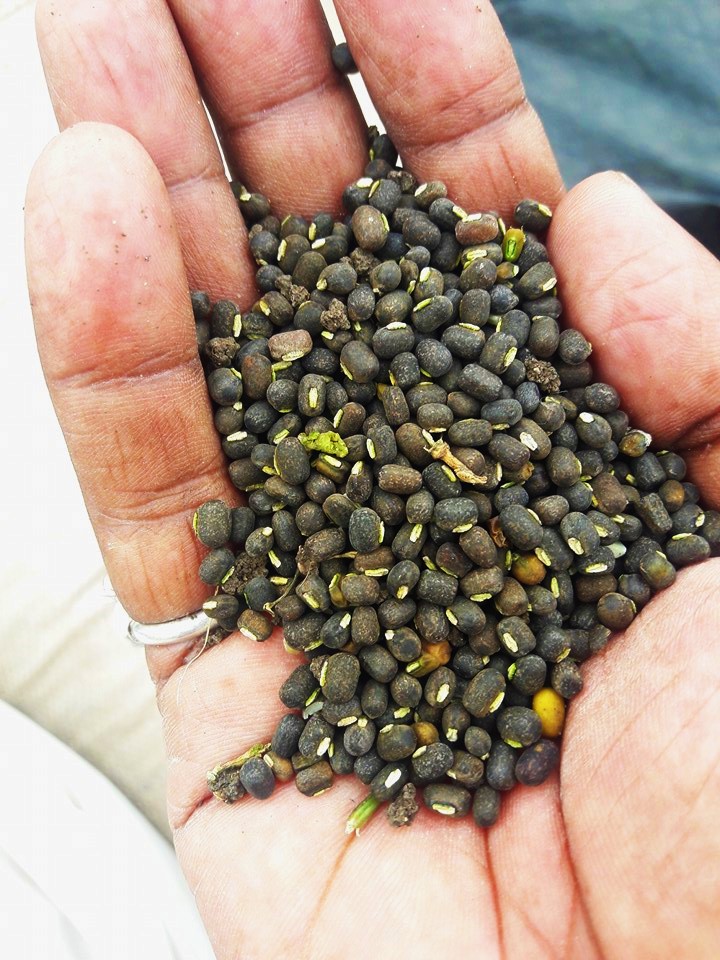
“I have harvested Moong (green gram) from my farm, now I’m harvesting Udad (black gram). Their price is crashing each day…I may not get even the Minimum Support Price (MSP)…But I’m not supposed to care about the price… its solely the farmer’s responsibility to reduce inflation and make India a superpower.”
…says Ashok Bhau, a dry land farmer dependent on rainfall and groundwater in the heart of Marathwada: Osmanabad.
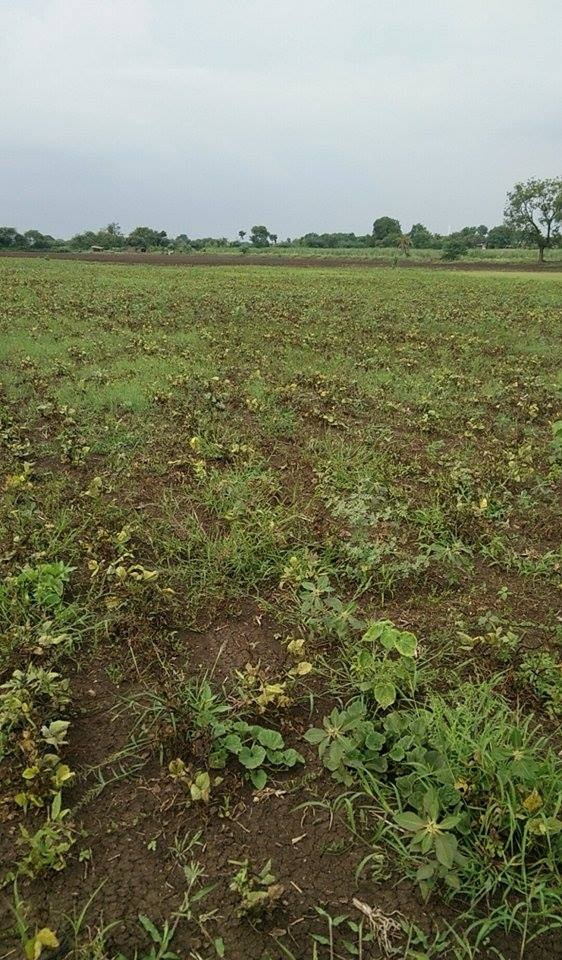
Last year his Moong failed completely, there was no seed development and although his Tur (Pegion Pea/Arhar) fetched a very good price, it did not mean anything for the family as the productivity was dismally low following three droughts and dry wells[i]. Like many farmers in Marathwada, he burned his sugarcane on 4 acres after watering it for many months… finally there was no water to sustain it. We had written about soaring pulses last year.Continue reading “This is the time to protect Pulse Farmers in Marathwada”→
Like almost all urban areas, Pune’s seage management has been dismal. In a recent Public Interest Litigation (PIL) filed against Pune Municipal Corporation (PMC) in National Green Tribunal (NGT) for failing to control water pollution in Mula Mutha Rivers it was revealed that several crucial details regarding sewage generation and disposal in Pune city remain unknown even to PMC. PMC failed to furnish even the basic details like present and future generation of domestic sewage (from 2022- 2025), present handling capacity and performance of STPs for six months.[i]
Japan International Cooperation Agency (JICA) has recently agreed to extend a loan of 1000 Cr. to PMC under project ‘pollution abatement of River Mula-Mutha’.[ii] Utilizing this funding PMC has proposed to build 11 new sewage treatment plants (STPs) with treatment capacity of 396 MLD (Million Litres per Day). It is hard to imagine that PMC who celebrated the signing of the loan agreement in January 2016 was not in position to furnish even the basic details about sewage generation and treatment in May 2016.
Currently in Pune there are total ten STPs with installed capacity of 567 MLD. Five of them have been funded by PMC while the other five have been funded by JNNURM (Jawaharlal Nehru National Urban Renewal Mission) Phase I. Operation & Maintenance (O&M) of these plants has been outsourced by PMC to various contractors. Treated effluent is being discharged in the rivers Mula, Mutha Rivers. PMC recently admitted in the print media that though the installed capacity of its existing STPs was to treat 567 MLD, only 290 MLD was being treated at present.[iii] The balance – almost 50% of the sewage – is going into the river untreated. Pune’s Rivers are some of the most polluted in the country. Continue reading “My visits to Pune’s Sewage Treatment Plants: Citizens Not Allowed!”→
Above: Children trying to understand why their River Mutha is so polluted Photo: Parineeta Dandekar
Treating even 50% of its sewage is a dream that has been eluding Pune for decades. Mula, Mutha, Pavna and Indrayani Rivers crisscrossing Pune have routinely made headlines for pouring Pune’s sewage into Ujani Dam in the downstream, which supplies drinking water to several towns and villages, including the city of Solapur. All these rivers are classified as one of the 35 most polluted river stretches of India by Central Pollution Control Board (CPCB).[1]
Japan International Cooperation Agency (JICA) has recently agreed to extend a loan of 1000 Cr. under project ‘pollution abatement of River Mula-Mutha’.[2] Utilizing this funding PMC has proposed to build 11 new sewage treatment plants (STPs) with treatment capacity of 396 MLD. It is one of the star projects under Smart City programme and engineers of water supply department are gearing up for the construction of new STPs. As stated in the PMC newsletter of Feb 2016, the 11 new STPs will increase treatment capacity of Pune from current 477 MLD (Million Liters a Day) to 873 MLD which, it is claimed, will be sufficient to cater to sewage generation till year 2027.[3]Continue reading “Pune plans more STPs while existing plants under perform and there is no attempt to fix them”→
The dam induced flood disaster could only increase since we refuse to learn any lessons:
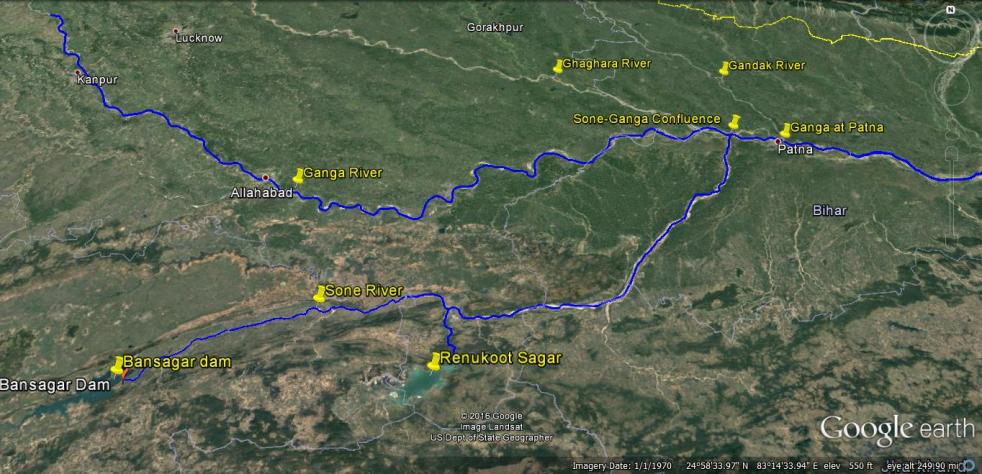
SANDRP Blog A tale of two dams: Is Bihar’s unprecedented flood an avoidable man-made disaster?Is the unprecedented water levels of Ganga that has flooded Bihar and UP an avoidable flood disaster? What role did the water releases from Bansagar dam in the upstream and Farakka Dam in the downstream play in this? SANDRP analysis of this developing situation. Feed back is welcome, Please help us disseminate this.Kindlyd also see the Hindi version of this blog here दो बाॅधों की कहानीः क्या बिहार की अप्रत्याशित बाढ़ एक टाली जा सकने वाली मानव जनित त्रासदी है?PRABHAT KHABAR newspaper of Ranchi carries “in-depth” articles by Parineeta Dandekar and Himanshu Thakkar of SANDRP in the context of Bihar floods and demand to decommission Farakka barrage. Flood expert Dinesh Misra explaining role of dams behind unprecedented Ganga flood. In Part I of a separate report he narrates about Bihar/ Patna floods due to Ganga and Sone. Also see, बिना नदियों के उफान के ही पटना डूब गयाBBC Hindi website has published this based on a radio discussion they carried earlier on the issue of Bihar floods and role of Bansagar and Farakka dam.
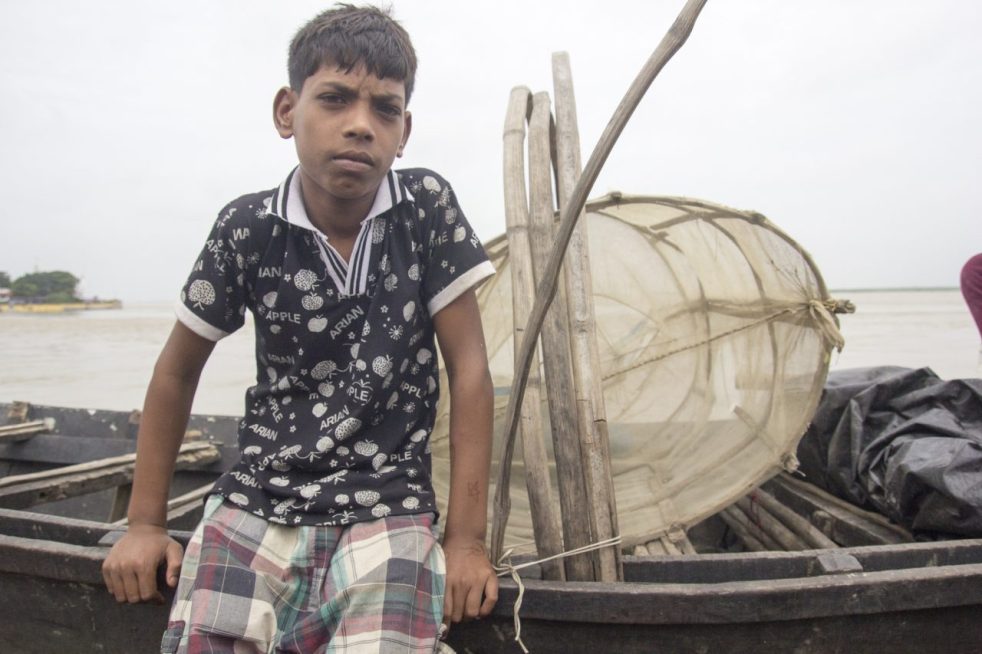
Above: Young kid from a fishing family in Kahalgaon, even the most informed communities (Ganga Mukti Andolan) are clueless about the government’s intentions (Photo by Veditum)
GUEST BLOG BY: Siddharth Agarwal
As the Ganga rises and fills streets and alleys with it’s water all along it’s course, I spend a time out at home, partially because of personal reasons and in some parts due to the rising levels of the river hindering all sorts of movement around it. Currently on a walk along the Ganga for Veditum India Foundation’s ‘Moving Upstream’ project, I’ve been able to walk a distance of about 1000 kms alongside it’s banks from Ganga Sagar till Varanasi in 50 days’ time. Some places saw me walking right next to the river while others had me maintaining my distance since it just wasn’t possible to peruse a course anywhere in the vicinity of the flooded banks.
The rising levels of the river are no surprise, an annual occurrence with variation only in ferocity. We’re surprisingly still caught off guard, every single year, with this news about floods in cities like Patna, Allahabad and Varanasi making it to national television on an almost daily basis. But what of all the places between Patna, Allahabad and Varanasi? What of all the places that are not cities and of all the people who are not urban dwellers? The major focus as I walk along the river are the people of the river and their lives, those who inhabit this space known to all as the vastly fertile Indo-Gangetic plains but unknown as a place extremely vulnerable to the forces of nature and shaky towards those man-made.
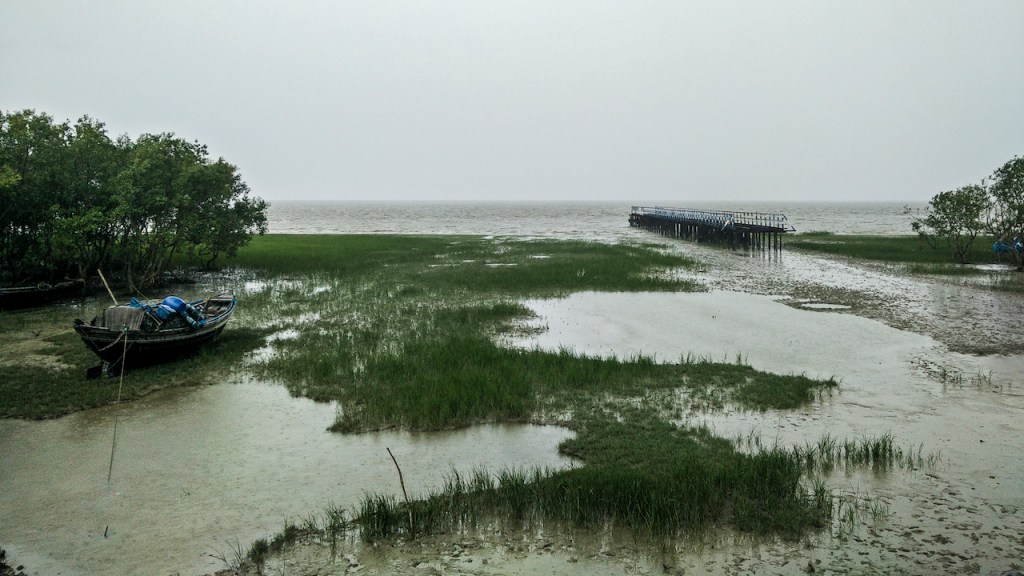
What will happen to a river that already has no fish and is way too salty. The barrages will mean doom for even the few fish that are left (Photo by Veditum)
I had been informed in advance of the situation of our fishermen by minds already working in the field of environment and rivers in our country, often mentioning that these communities were severely under-represented and very much neglected even when it came to discussions relating to them. Non-inclusiveness of communities while making decisions is not a new theme in India, but given the extent of impact that some upcoming government decisions/policies was going to have on these people, I decided to ask them a few questions as I proceeded upstream from Ganga Sagar, starting early June 2016.
Anywhere downstream of the Farakka barrage, the mention of the word barrage has a stunning effect on the people and 1975 is a year that fisher folks remember as a year of doom. For most readers and even for me before I started upon this trip, this would makes sense if one tries to put in a little effort in imagining how a barrage or dam might affect a river. But unlike how logic would dictate, this effect doesn’t exist just downstream of the barrage and similar reactions continued even further upstream, in Jharkhand and Bihar.
In places along the feeder canal from the Farakka Barrage, an increased frequency of ships to the Thermal Power Plants has resulted in rapid soil erosion (Photo by Veditum)
The National Mission for Clean Ganga and The National Waterways programme have been in the limelight for making grand promises of :
1.) Cleaning and maintenance of the river
2.) Economic Development and Cheaper Transportation.
Now, this is not a commentary on the efficiency and feasibility of making such proposals, simply an attempt to understand the impact of such programmes. EIA (Environmental Impact Assessment) and SIA (Social Impact Assessment) are the terms you might be looking for, something that ideally the governing authority should be taking care of. But why is any of this important or relevant to this article? It is because whatever happens in these places between Patna, Allahabad and Varanasi is very much relevant and important to discuss. These are not uninhabited spaces, but pretty well populated areas with a lot of lives at risk.
Coming back to the point of the two government programmes, firstly, the NMCG letting the Waterways programme run through protected areas and non-protected ecologically sensitive areas goes very much against the whole agenda why this mission was set up. Secondly, the waterways programme in a bid to decrease ‘transportation’ costs and utilise our river potential recently ran tests with large vessels on the Ganga.
Small country boats near Farakka. Wonder what large waves from huge vessels will do to these (Photo by Veditum)
What is surprising (or rather not) is that these test runs were without any warnings to fishermen and boatmen in said test sections, the few who were on the waters at the time of passing of these vessels had to face high waves, enough to topple a less experienced or unaware boatman. The news of these tests were flashed all over the main stream media, but failed to make it to those for whom it mattered. Not an uncommon occurrence at all, but till when will this go un-noticed? On asking these fishermen if they have any clue why this is happening, most of them responded in the negative while a few said they’ve learnt about the government’s plans to run large vessels on the river.
As this conversation extends and questions follow, it is gradually revealed that the picture is not clear and conversations have somehow trickled down in a very muzzled form. Though most fishermen laugh off the prospect of this being a constant activity because of the extreme reduction in water level that the river has seen these past years, often mentioning how large excavators and multiple tugboats have been needed anytime a large vessel has traversed these stretches in lean seasons. There’s talk of loss of fishing nets and reduced catch, difficulty in controlling small country boats in high waves, chances of accidents when transporting villagers to small ‘diars’ for agricultural work, loss of land where there’s no embankments and so on, but this also brings us to the most important part of this article.
The dark clouds often linger over the heads of those not involved, not informed (Photo by Veditum)
The Water Highway programme on the Ganga has been proposed on a 1500 km stretch from Allahabad to Haldia, with barrages at about every 100 kms. Now, an avid news reader would have knowledge of this as a great policy step but the fisherman who directly depends on the river for his livelihood does not. This holds true for maybe 15-20 different fishing communities that i’ve had the chance to interact with in the first 50 days and even the mention of new barrages was way too shocking for those who have had to bear the burden of Farakka’s impacts. There are even places where locals have signed their wishfulness of a barrage near their villages without understanding consequences and only having been shown the shiny side like we see everyday in the papers, called ‘development’.
The ‘Moving Upstream’ project intends to understand and present a narrative of the river and it’s people, hoping this will lead to more meaningful conversation and inclusive action by the government. In a recent announcement by Sushri Uma Bharti Ji – Union Cabinet Minister of Water Resources, River Development & Ganga Rejuvenation, she said she will march down the length of the river to take stock of the status of various projects commissioned by her. I’m glad that cues are possibly being taken from the Moving Upstream project, but like every other government project, when will our habit of assessment (if at all) after execution stop and preparedness & understanding before implementation materialise? I hope she does her Ganga yatra before approving any projects, I hope for inclusiveness.