Dams

Kerala Rivers Profile

About Kerala Rivers                                                                                                            

Of Kerala‘s 44 rivers, 41 flow westwards and the rest towards east. The basin area of major rivers is located within the Western Ghats, a global biodiversity hotspot, while some other northern rivers originate in laterite hills. The short length of the rivers coupled with very high population density (over 30 million people living in a land area of 38,000 sq km) creates high dependency on water and the rivers‘ susceptibility towards environmental onslaughts.

In the six major rivers featured in the Status Report, we discuss biodiversity in riparian upper catchments and low lying wetlands. Overall, the southern Western Ghats region with catchments including many of the major riers of Kerala, Karnataka and Tamil Nadu has the highest freshwater species richness (260–312 species) and endemism (103–129 species), with particularly unique diversity of fish in Chalakudy and Periyar rivers. In rivers like Bharatapuzha, of the 6000 odd sq km catchment, a mere 100 sq km has intact forests in the catchment of Kunthipuzha, the lifeline of the river‘s summer flows. The Vembanad-Kol wetland, the largest estuarine system in India, is fed by 10 rivers. It supports diverse livelihoods – below sea level paddy farming, fishing, coir retting, to name a few. The wetlands offer flood protection for thickly-populated coastal areas and contributes to groundwater recharge.

Continue reading “Kerala Rivers Profile”

Dams · Ganga

The Sad State Of These Persons Called Ganga & Yamuna – Can State Protect Them?

Guest Blog by: Chicu Lokgariwar

It’s a girl! And another girl!

On March 20 2017, the High Court of Uttarakhand in an unforeseen move, bestowed ‘legal personhood’ on the Ganga and the Yamuna. Ten days later, as people were still trying to understand the implications of this order, the Court declared  the glaciers, lakes, and wetlands of these basins as legal persons. What does this mean exactly?

The decree: As per an order passed on 20th March 2017, while ruling on a public interest litigation filed by Mohammed Salim against the State of Uttarakhand, the High Court has declared the entire length of the Ganga and the Yamuna, including their tributaries to be juristic persons.

The order states, ‘..the Rivers Ganga and Yamuna, all their tributaries, streams, every natural water flowing with flow continuously or intermittently of these rivers, are declared as juristic/legal persons/living entities having the status of a legal person with all corresponding rights, duties and liabilities of a living person in order to preserve and conserve river Ganga and Yamuna.’

Continue reading “The Sad State Of These Persons Called Ganga & Yamuna – Can State Protect Them?”

Dams · DRP News Bulletin

DRP: 10 April 2017 (Activists from 40 countries & all continents meet for RIVER GATHERING in Georgia)

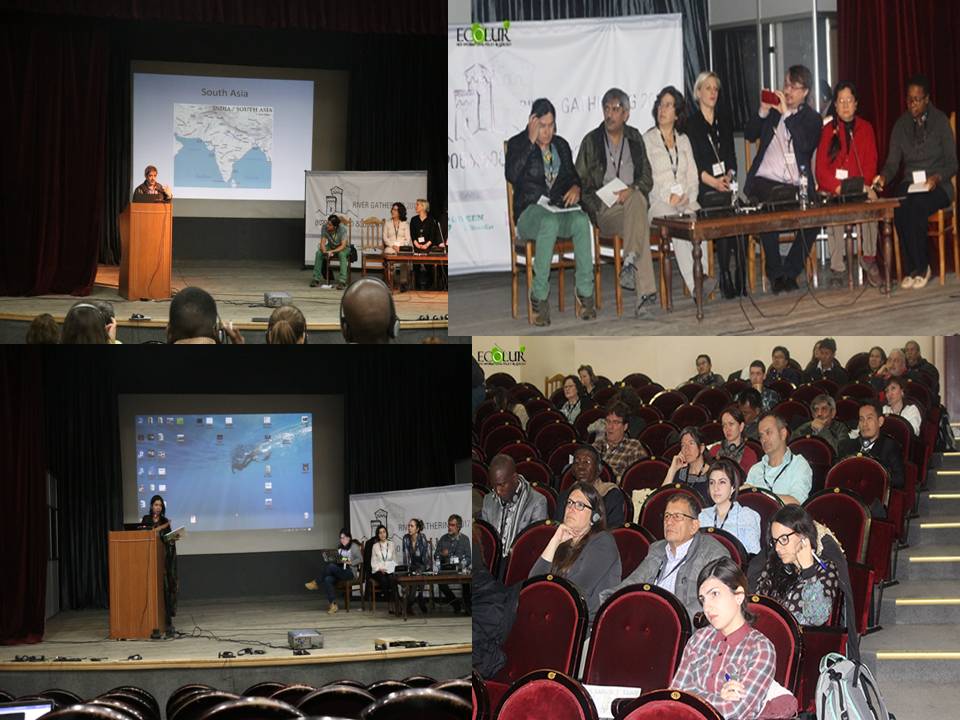
In a most significant event, some 85 river and dam activists from 40 countries and all continents gathered in Tbilisi, Georgia (on border between Asia and Europe, between Black and Caspian Sea) during March 27-31, 2017 to share experiences about their efforts to protect the world’s rivers and join their struggles against destructive hydropower projects. The meeting was organized by CEE BankWatch Network (active in 12 countries in Eastern and Central Europe) and International Rivers.

dahlich

Eight persons from South Asia, including those from India, Pakistan, Nepal and Bangladesh joined the meeting to share experiences from the region. Indian participant included SANDRP coordinator (who was also in steering committee of the meeting) and Associate Coordinator Parineeta Dandekar. A number of participants from neighboring and nearby countries like China, Myanmar, Thailand, Cambodia, Mongolia and Russia also participated. Issues related to trans-boundary rivers, small hydropower projects and multiple projects on the same rivers, decommissioning of the dams, how to achieve free flowing rivers and importance of rivers in changing climate were some of the key issues discussed at the meeting.

Continue reading “DRP: 10 April 2017 (Activists from 40 countries & all continents meet for RIVER GATHERING in Georgia)”
Dams · Ganga

Varanasi, God’s Own Land

Guest Blog by Nandini Oza

My recent visit to Varanasi in March 2017 was with a lot of expectations for more than one reason. Varanasi is situated on the majestic Ganga and located between the two rivers Varuna and Asi with Gomti – Ganga sangam (confluence) not far away. Naturally Varanasi would be of interest to any person interested in rivers and water. The Government has also announced the ambitious Namami Gange program which is essentially a national mission for cleaning of the river Ganga. The Government has also declared building of waterways through more than hundred rivers across the country and all the three rivers of Varanasi, the Ganga, Varuna and Asi are a part of this project. Besides, Varanasi being Prime Minister Mr. Narendra Modi’s constituency for three years now, he takes personal interest in its development through several programmes like Swatch Bharat Abhiyan, Namami Gange and so on.  This visit was therefore to familiarise myself with the ground situation, issues and recent developments and I share my impressions here. I also share some of the discussions I had with local groups and individuals of the holy city of Banaras.

Continue reading “Varanasi, God’s Own Land”

Dams

Himachal Pradesh Rivers Profile


About Himachal Pradesh  

5 river basins; Total Area: 55,000 square kms.; Total Population: 68.65 lakhs; Total Catchment Area of 5 rivers; Total Catchment Area: 53311 sq.kms

Himachal is a relatively small state and in 2011 its population stood at 68.65 lakhs. It is only 9% urbanised and most of Himachal lives in its villages. Of the total land geographical area only 10% is under agriculture while close to 70% in under the category of ‘Forest land’. And yet agriculture is the main source of livelihood in Himachal with over 93% of the population dependent on it. As in most mountain areas agriculture and forest dependence is interwoven.

Agriculture is made possible due to the irrigation from river channels or natural springs. The health of the forests directly determines the health of the surface and ground water systems which in turn determines the viability of agriculture and horticulture. Horticulture and cash based agriculture was pushed by the government in the late 70s and 80s. Today the state has massive apple cultivation, apart from commercial vegetable cultivation, which is an important source of income for the farmers.

Continue reading “Himachal Pradesh Rivers Profile”

Dams

Uttarakhand Rivers Profile

About Uttarakhand 

Geographical Location- North India largely mountainous with two plains and two partly mountain districts in  the south; Area- 53483 sqkm; Population- 10.12 million; River basins- 4 River basins (R. Ganga‘s basin is subdivided in the map below into R. Bhagirathi, R, Alaknanda and R. Ganga sub-basins); Districts-13; Climate- Sub-tropical to tundra 

About Uttarakhand Rivers

Uttarakhand_Drainage_map

The water quality of Uttarakhand‘s rivers is basically good, especially in the upper reaches. Downstream of some large settlements and in the lower reaches in the Himalayan foot hills the water quality suffers due to the release of untreated sewage and industrial effluents. But the state‘s ambitious program to build 450 hydro power projects threatens the survival of the river ecosystems and the lives and livelihoods of people who live  in these river valleys.

Continue reading “Uttarakhand Rivers Profile”

Dams

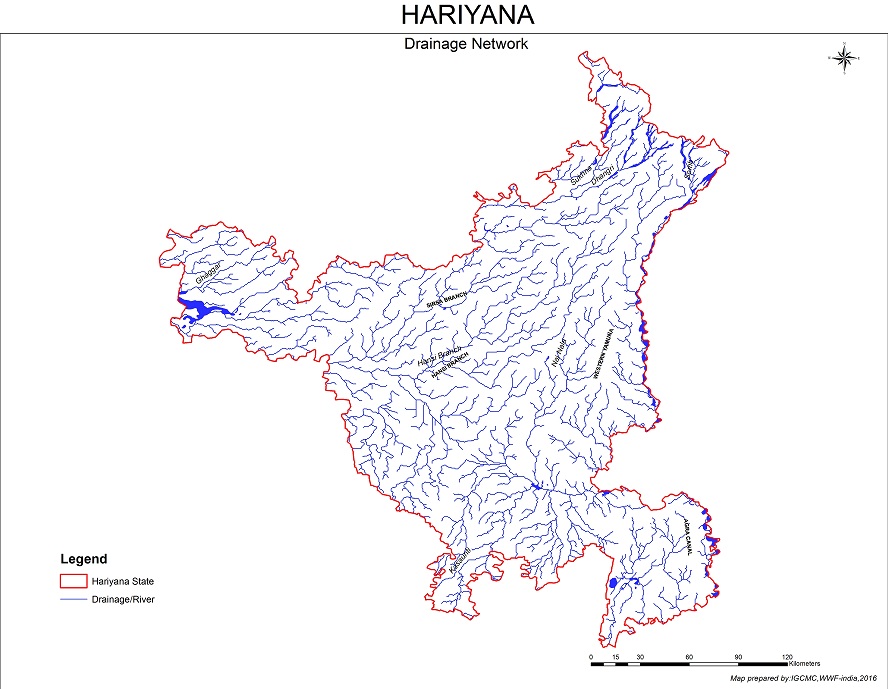
Haryana Rivers Profile

Summary of Rivers in Haryana                                                                              

About Haryana

Location: Northwest India, Carved out of Punjab in 1st November 1966; Area: 44212 sq km. Mostly Gangetic/ Trans-Gangetic Plains; Population: 253.53 lakhs (2011); 4 River Basins, 21 Districts; Climate- Arid to semi-arid with average rainfall

Rivers in Haryana fall mainly within Indus and Ganga basins. River Ghaggar sub basin and its tributaries in the west of the state caters to the Indus basin, while river Yamuna and its tributaries in the east make up the portion of the Ganga basin. 

Continue reading “Haryana Rivers Profile”

Dams · DRP News Bulletin

DRP: 3 April 2017 (India: Power Surplus & Exporter, Record Solar-Wind Growth, Need Not Push Destructive Hydro)

Power surplus, power exporter India, with record solar& wind wind generation trend, why push more destructive hydro projects According to power ministry statement on March 29, 2017, India for the first time became NET EXPORTER OF ELECTRICITY during 2016-17, it exported 4% more power during last 11 months (April-Feb), that what it imported from Bhutan. At the same time, power plants, on a national average, are opera ting at roughly 60%, down from nearly 65% in 2014-15.

Meanwhile, the Cabinet Committee on Economic Affairs has approved the amendments in the Mega Power Policy to push 31 GW stuck projects entailing an investment of Rs 1.5 lakh crore. The stuck projects in mega power policy include hydro projects of above 350 Mw in designated states (J&K and eight NE states) and above 500 Mw in other states.

Amid this, New and Renewable Energy Ministry has added over 5400 Mw wind energy capacity in 2016-17 against the target of 4000 Mw. This year’s achievement surpassed the previous higher capacity addition of 3.423 Mw achieved in the previous year. The leading States in the wind power capacity addition during 2016-17 are Andhra 2190 Mw, followed by Gujarat 1275 Mw and Karnataka 882 Mw.

In the last couple of years, India has not only seen record low tariffs for solar power but wind power too has seen a significant drop in tariffs. The onshore wind power potential alone is about 302 Gw. Preliminary estimates show the Gujarat coastline has the potential to generate around 106,000 Mw of offshore wind energy and Tamil Nadu about 60,000 Mw.

Continue reading “DRP: 3 April 2017 (India: Power Surplus & Exporter, Record Solar-Wind Growth, Need Not Push Destructive Hydro)”
Dams

Maharashtra Rivers Profile

Above: Major River Basins of Maharashtra Source: MWRRA

Major Issues faced by Rivers of Maharashtra include complete lack of governance geared towards protecting rivers as ecological systems, unjustifiable dam projects blocking most of the rivers of the state without even comparable benefits, increasing water conflicts, depleting groundwater levels which affect base flow of the rivers, catchment degradation, climate change induced changes in river hydrology, repeated droughts and increasing levels of pollution.

Continue reading “Maharashtra Rivers Profile”

Dams · India Rivers Week

North-East India (Excluding-Brahmputra) Rivers Profile

The River system in North East, other than the Brahmaputra, can be classified as the Barak River system and minor Rivers flowing to Bangladesh and Burma. The Barak River, Gumti River, Myntdu River etc are some of the major Rivers flowing to Bangladesh, while the Kaladan River, the Manipur River, Tizu River etc flowing  in the States of Mizoram, Manipur and Nagaland are main Rivers flowing to Burma.

The Barak River basin covers parts of India, Bangladesh and Myanmar. In India it spreads over states of Meghalaya, Manipur, Mizoram, Assam, Tripura and Nagaland having an area of 41,723 Sq.km.

The Barak River originates from the Manipur hills, from Liyai Village in Senapati district in Manipur at an elevation of 2,331 m and flows through Assam and further down to Bangladesh, where it is known by the  name of the Surma and the Kushiyara and later called the Meghna before receiving the combined flow of the Ganga and the Brahmaputra. The principal tributaries of Barak joining from north bank are the Jiri, the Chiri, the Modhura, the Jatinga, the Harang, the Kalain and the Gumra whereas the Dhaleswari, the Singla, the Longai, the Sonai and the Katakhal joins from south bank. The Barak sub-basin lies in the States  of Meghalaya, Manipur, Mizoram, Assam, Tripura and Nagaland.

Continue reading “North-East India (Excluding-Brahmputra) Rivers Profile”