Arunachal Pradesh · Assam · brahmaputra

Brahmaputra – The Beautiful River or The Battleground?

Capture 3

The Brahmaputra River, geologically is the youngest among the major rivers in the world yet it is known as a moving ocean. The river Brahmaputra travels 2880 km from its origin in the young Himalayan range through the Tibet and India and finally merges with the sea in Bangladesh by opening its streams like the roots of a large Banyan tree. While traversing through India the river is astonishingly wide at some areas. In Upper Assam near Dibrugarh the river is 16 km wide where as in lower Assam at Pandu, near Guwahati the river is 1.2 km wide but in the immediate downstream it is nearly 18 km wide. Brahmaputra which is mainly a glacier fed river has also the distinction of being the river with highest sediment yield 852.4 t/km2/y in the world and second highest water yield at delta, next only to Amazon.[1]

Origin and Path

The BrahmaputraRiver originates in the Chemayungdung mountain ranges which nearly sixty miles south-east of Mansarovar lake in the MountKailash range in Southern Tibet at an elevation of 5300 m.A spring called Tamchok Khambab spills from the glaciers which later gather breath and volume to become the Tsangpo, the highest river in world.

A Buddhist shrine called a stupa overlooks the Brahmaputra River in southern Tibet. Source: http://kids.britannica.com/comptons/art-67000/A-Buddhist-shrine-called-a-stupa-overlooks-the-Brahmaputra-River
A Buddhist shrine called a stupa overlooks the Brahmaputra River in southern Tibet.
Source: http://kids.britannica.com/comptons/art-67000/A-Buddhist-shrine-called-a-stupa-overlooks-the-Brahmaputra-River

Out of its total length of 2,880 km the Brahmaputra covers a major part of its journey in Tibet as Tsangpo. Tsangpo or the BrahmaputraRiver flows 1625 km in Tibet parallel to the main range of Himalayas before entering India through Arunachal Pradesh.

Apart from the name Tsangpo, the Brahmaputra is also known by its Chinese name, Yarlung Zangbo in Tibet.  There are several tributaries of Tsangpo in Tibet. According to Encyclopedia Britannica,  Raka Zangbo (Raka Tsangpo), Lhasa (Kyi) and Nyang Qu (Gyamda) are prominent north bank tributaries where as Nyang Qu (Nyang Chu) is a tributary on the south bank. The Raka Zangbo (Raka Tsangpo) joins Tsangpo in the west of Xigazê (Shigatse) and Nyang Qu (Gyamda) River joins the river from the north at Zela (Tsela Dzong). The Lhasa (Kyi) river flows past the Tibetan capital of Lhasa and joins the Tsangpo at Qüxü.  The right bank tributary Nyang Qu (Nyang Chu) meets the Tsangpo at Xigazê.

Before entering India, the river passes Pi (Pe) in Tibet and suddenly turns to the north and northeast and cuts a course through a succession of great narrow gorges between the mountain Gyala Peri and Namjabarwa (Namcha Barwa) in a series of rapids and cascades.

The Great Bend of Tsangpo where China planning to build world’s biggest hydropower project Source: http://greenbuzzz.net/nature/the-biggest-canyons-in-the-world/
The Great Bend of Tsangpo where China planning to build world’s biggest hydropower project
Source: http://greenbuzzz.net/nature/the-biggest-canyons-in-the-world/

The river then turns south and southwest and flows through a deep gorge across the eastern extremity of the Himalayas with canyon walls that extends upward for 16,500 feet (5,000 meters) and more on each side. This is the celebrated great bend where China has plans to build the world’s biggest hydropower project of 40 000 MW capacity and also divert water from here to the North China, though China is currently denying any such plans.

Siang River Source: https://www.facebook.com/lovely.arunachal/media_set?set=a.117543018322855.21150.100002014725686&type=3
Siang River
Source: https://www.facebook.com/lovely.arunachal/media

The river enters Arunachal Pradesh near Gelling where it is known as the Siang or Dihang. The total length of Siang River is 294.5 km till its point  of confluence  with Dibang and Lohit River. The elevation of Siang river catchment area ranges from 90 m to around 5800 m. In India the total catchment of Siang river up to its confluence with Dibang is 14965.30 sq km.[2]

The SiangRiver meets two other major tributaries of Brahmaputra, Dibang and Lohit in the west of Sadiya, at a place named Kobo. From this confluence point, the river is known as the Brahmaputra till it enters Bangladesh. In India the journey of the river Brahmaputra is 918 km long.

A recent study has shown that Kobo used to be confluence point in 1915.  By 1975 the confluence shifted to a place called Laikaghat which is 16 km downstream of the earlier point of confluence. In 2005 through satellite images it was observed that the confluence point has shifted “19 km farther downstream”.[3]

The river crosses Assam below Dhubri and enters Bangladesh where the river is known as Jamuna and it flows for 337 km. Regarding Brahmaputra’s role in Bangladesh a study writes “The Jamuna is the local name given to the river for its entire length in Bangladesh to the Ganges junction.

Jamuna River in Bangladesh Source: http://www.trekearth.com/gallery/Asia/India/North/Uttar_Pradesh/Agra/photo322311.htm
Jamuna River in Bangladesh
Source: http://www.trekearth.com/gallery/Asia/India/North/Uttar_Pradesh/Agra/photo322311.htm

The Brahmaputra-Jamuna has one principal tributary input, the TeestaRiver in the north-west, and two major offtakes on the left bank that are the Old Brahmaputra and the Dhaleswari. The Brahmaputra/Jamuna River contributes ~51% of the water discharge and 38% of the sediment yield to the Padma (Schumm and Winkley, 1994), with the sediment yield being estimated at 590 MT/ yr and the sand fraction contributing 34% of this total (Sarker, 1996).”[4] The Jamuna joins the Ganges at Goalundo Ghat and from here the combined flows of these two mighty rivers are known as Padma which joins Meghna in the downstream. The united stream thereafter known as the Meghna and with this name the river Brahmaputra ends its journey, entering the Bay of Bengal.

Bhutan forms an integral part of the Brahmaputra river basin even though it does not come in the path of the river. In our subsequent blogs we will bring a detail account of Bhutan’s role in Brahmaputra river basin.

 The Brahmaputra River Basin

The Brahmaputra river is an international river and its river basin is spread over four countries Bhutan, Tibet , India and Bangladesh with a total basin area of 5,80,000 sq. km. Out of this total catchment area 50.5% lies in Tibet, 33.6% in India, 8.1% in Bangladesh and 7.8% in Bhutan. For geologist and environmentalist the Brahmaputra is a very unique river because “drains such diverse environments as the cold dry plateau of Tibet, the rain-drenched Himalayan slopes, the landlocked alluvial plains of Assam and the vast deltaic lowlands of Bangladesh.”[5]

Map of Brahmaputra Basin from its origin to its confluence Source: http://en.wikipedia.org/wiki/Brahmaputra_River

In India the total basin area of BrahmaputraRiver is 197 316 sq. km. which 5.9% of the total geographic area of the country. In India the river is spread over states of Arunachal Pradesh, Assam, West Bengal, Meghalaya, Nagaland and Sikkim.

In India state-wise the drainage area of the BrahmaputraRiver is as follows:

State

Drainage area (sq. km)

% of state area in Brahmaputra basin

Arunachal Pradesh 83 740 100%
Assam 71 216 90.79%
West Bengal 12 585 14.18%
Meghalaya 11 780 52.52%
Nagaland 10 895 65.71%
Sikkim 7 100 100%
Total 197 316

Source: ‘Intregrated Water Resource Development: A Plan for Action’, MoWR, Govt. of India, September, 1999

The Arunachal Pradesh and Nagaland portion of the Brahmaputra river basin is mainly covered by mountain ranges and narrow valleys. Meghalaya part of the basin is majorly covered by hills where as Assam and West Bengal are mostly plain areas.

Politically in India the basin is spread over 22 parliamentary constituencies (2009) comprising 12 in Assam, 4 in West Bengal, 2 in Arunachal Pradesh, 2 in Meghalaya, 1 in Sikkim and 1 in Nagaland.

Projected Water Use for Diverse Purposes in the Brahmaputra Basin

Catchment Area 197 316 km2
Population (1991 census) 29.1 million
Surface-Water Potential (Av Annual) 629 km3/year
Utilisable Surface Water 24 km3/year
Total Replenishable Ground Water (Av. Annual) 26.55 km3/year
Natural Groundwater Recharge from Rainfall 25.72 km3/year
Estimated Utilisable Flow excluding Ground Water 21 km3/year

Source: ‘Integrated Water Resource Development: A Plan for Action’, MoWR, Govt. of India, September, 1999

Tributaries of Brahmaputra

Sub-basin map of Siang River Source: Environment Assessment Report Siang Basin In Arunachal Pradesh, Interim Report June 2012
Sub-basin map of Siang River
Source: Environment Assessment Report Siang Basin In Arunachal Pradesh, Interim Report June 2012

Studies have stated that the Brahmaputra river in its entire course receive water from a large number of tributaries. A study called “Study of Brahmaputra River Erosion and Its Control” done by IIT Roorkee[6] stated “the Brahmaputra receives as many as 22 major tributaries in Tibet, 33 in India and three in Bangladesh.” However this study did not mention anything about the river in Arunachal. We have already mentioned about the few of the tributaries Tibet. In Arunachal the major tributaries of Siang River are Ringong Asi, Yang Sang Chhu, Sigong/ Sirapateng, Niyikgong, Angong, Simang, Yamne, Siyom, Yargyap, Hirit Korong.[7]

In the course of journey through Assam from east to west, some of the important tributaries of the BrahmaputraRiver which join the river on the north bank are Lohit, Dibang, Subansiri, Jiabharali, Barnadi, Puthimari, Pagladia, Beki, Manas, Ai, Gabhoru, Chompawati, Sankosh, Raidhak, Torsa, Teesta etc. Burhidihing, Desang, Dikhow, Jamji, Bhogdoi, Kakdonga, Dhansiri, Kopili, Kolong, Sonai, Digaru, Bharalu, Krishnai, Dudhnoi are the major tributaries on the left bank. The actual number of rivers and rivulets which joins the mighty river is much larger than this list. In subsequent blogs we will try to go into details of some of the tributaries of the river Brahmaputra.

Hydrology of Brahmaputra

For the river Brahmaputra the average annual flow (water discharge) throughout Assam vary from 8500 to 17000 cubic meters per second. At Pandu Ghat near SaraighatBridge the average annual floods recorded was 16,000 cubic meters per second. During floods water discharge reaches its peak and the yearly average peak flow recorded was approximately 51,000 cubic meters per second.[8] At its mouth in Bangladesh, the average annual discharge of the river is 19,830 cubic meters per second. This is the fourth highest average annual discharge in the world. For the river Brahmaputra the highest daily discharge was recorded in August 1962 at Pandu which was 72,726 cubic meters per second. The lowest daily discharge at the same place was 1757 cubic meters per second in February 1968.[9]

Satellite image of the river Brahmaputra (2008) just downstream of Guwahati city indicating intense braiding. width of the river at pandu is 1.2 km but donstream is about 18km. Source: ‘Riverbank erosion: a perspective” a presentation by Dr. Bipul Talukdar, Assam Engineering College
Satellite image of the river Brahmaputra (2008) just downstream of Guwahati city indicating intense braiding
Source: ‘Riverbank erosion: a perspective” presentation by Dr. Bipul Talukdar, Assam Engineering College

Though the Brahmaputra has been described as a braided river, recent studies have shown that the river does not fit into the conventional definition of braided river. A recent study states “In the study reach of the upper Assam area, the Brahmaputra appears to be a multichannel and multi-pattern river that has a tendency to very frequently generate ananabranching[10] (Latrubesse, 2008) pattern in decadal scale.” [11]

The Brahmaputra has been widening its (riverbed) size continuously from the last century. Reports from Water Resource Department showed that in Assam the river Brahmaputra was spread over for 4000 sq km in 1920 but in 2008 this has increased to 6000 sq km.[12]

The Brahmaputra along with several of its major tributaries like Subansiri, Jia Bharali, Manas had very high water yields[13]  which are higher than most of the major rivers in the world. The reason behind such high water yield for Dr. D.C. Goswami, one of the renowned environmental scientist from Assam is “High monsoon rainfall in the upper catchments and their steep gradients are considered to be the major factors responsible for the high rates of unit discharge which in turn help generate the high sediment yield from the basin and contribute significantly towards causing drainage congestion in the valley.”[14]

Seismicity and Brahmaputra Basin

The Brahmaputra river basin and its adjoining hill ranges are seismically very unstable because it is located in the Eurasian (Chinese) and Indian tectonic plates. The most severe earthquakes with Richter magnitude 8.7 was recorded twice in the valley, in 1897 and 1950. The latter one particularly had severe impacts on the river Brahmaputra. As a result of this earthquake river bed was raised at least by three meters at Dibrugarh which had increased the flood and erosion intensity of the river. In the opinion of geomorphologists “the region’s active seismicity has a significant impact on the hydro-geomorphic regime of the Brahmaputra system of rivers, causing landslides that result in the natural damming of rivers, flash floods due to the bursting of landslide-induced temporary dams, raising of riverbeds by siltation, fissuring and sand venting, elevation of existing river and lake bottoms and margins, creation of new water bodies and waterfalls due to faulting.”[15]

Climate Regime

The Brahmaputra in its path from snow covered mountains of Himalaya to the deltaic flood plains of Bangladesh covers different climatic regimes. The mean annual rainfall in the Brahmaputra basin excluding the Tibetan portion is 2300 mm.  The distribution of rainfall is different at different parts of the basin. In the southern slopes of Himalaya the rainfall is over 6000 mm but in parts of Nagaland this is 1200 mm. The monsoon rainfall (June to September) contribute 60-70% to the annual rainfall of the basin.[16]

In this basin, areas which are above or equal to the elevation of 1500 m experience snowfall. In the Indian part of Brahmaputra basin there are 610 glaciers which covers an area of 928.91 sq km and the volume of these glaciers are 49.57 cubic km. Out of these 449 glaciers are in Teesta basin and 161 glaciers are in Arunachal.[17]  In the Brahmaputra basin, Himalayan snow and glacial melt waters play a very significant role in water availability and climate change will have severe impacts on this. Climate change will also impact the rainfall and snowfall pattern in the Brahmaputra basin. This issue needs more serious attention and we will come up with more detailed blogs on this.

Bio-Diversity in the Brahmaputra Basin

The Lohit flooplains, immediately dowsntream of Lower Demwe HEP, constitute an Important Bird Area as per international criteria and is also a potential Ramsar site Photo: Neeraj Vagholikar
The Lohit flooplains, immediately dowsntream of Lower Demwe HEP, constitute an Important Bird Area as per international criteria and is also a potential Ramsar site
Photo: Neeraj Vagholikar

The Brahmaputra river basin hosts very rich and unique bio-diversity. The whole of northeastern region is a globally recognized bio-diversity hot spot.  In the Indian territory the total forest cover of the Brahmaputra basin is 1,14,894 sq. km. which is 54% of the total basin area. In the distribution of forest cover among 6 states in Brahmaputra basin, Arunachal Pradesh tops the list with 82.8% forest cover but it is sad that the highest number of hydro-electric dams are planned in this state inviting disastrous impacts for the biodiversity, forests, people and environment. The tally of rest of the five states is as follows – Nagaland (68.9%), Meghalaya (63.5%), Sikkim (38.1%), West Bengal (21.4 %) and Assam (20.6 %).

Besides, the aquatic bio-diversity of the Brahmaputra and its tributaries is also very rich. Here we should also take the case of ‘beel’ or wetlands in the Brahmaputra flood plains which according to experts work as ”ecotonal zones” and ”play an important role in the dynamics of the Brahmaputra ecosystem, as these are natural feeding and breeding grounds for a number of fish species and other aquatic fauna.”[18]

Flood and Erosion

Brahmaputra river basin is known to be very prone to flood and erosion and these two hazards have led to many problems in the basin. In India, out of the eight northeastern states, Assam faces the most severe brunt of flood and erosion. Both flood erosion has been severely affecting the economy as well political, social and cultural milieu of Assam.

Experts opine that natural as well anthropogenic factors lead to devastating floods in northeastern region. “The unique geo-environmental  setting of the region vis-à-vis the eastern Himalayas, the highly potent monsoon regime, weak geological formation, active seismicity, accelerated erosion, rapid channel  aggradations, massive deforestation, intense land use pressure and high population growth especially in the floodplain belt, and ad hoc type temporary flood control measures are some of the dominant factors that cause and/or intensify floods in the Brahmaputra and the Barak basins (Goswami, 1998).”[19] The Brahmaputra river basin is also prone to flash floods and some of the worst flash floods have occurred in the valley in the new millennium.

Along with floods, erosion is also threatening the lives of the people in the state of Assam as it leads to permanent loss of land.  Here we can take the case of the river island Majuli, which had been one of the worst sufferers of the erosion done by Brahmaputra. In 1853 the total area of Majuli was 1129 sq km but it has now reduced to 3.55 sq km.[20]

Ilish fishing, Dauladia, Bangladesh, 2001 Source: http://www.npr.org/blogs/pictureshow/2011/11/14/142219164/capturing-the-unseen-side-of-bangladesh
Ilish fishing, Dauladia, Bangladesh, 2001
Source: http://www.npr.org/blogs/pictureshow/2011/11/14/142219164/capturing-the-unseen-side-of-bangladesh

In Bangladesh the Brahmaputra river which known as Jamuna is also infamous for severe floods and erosion. The river carries huge water and sediment discharge in this deltaic region. Because of its geographical setting, Bangladesh is very much dependent on its river for fertile fields and diverse flora and aqua culture but rivers also brings several hazards in the form of floods and erosion. Bangladesh has witnessed severe annual floods but the floods in 1987, 1988, 1998 and 2004 were the most severe ones in recent decades. But studies have shown that, “The people of Bangladesh have adapted their lifestyle for centuries to live with river flooding – frequently moving their temporary bank-side homes, planting on newly emergent river bars, and sometimes raising their homesteads above water level in flood periods (Paul, 1997). However, a growing population, coupled with the expansion of infrastructure and economic development, has resulted in an increase in the intensity of flood damage (FPCO, 1995; Paul, 1997; CPD, 2004). The lives of many millions of Bangladeshi citizens is thus reliant on these rivers, with up to 600,000 people living on the riverine islands and bars alone (Sarker et al., 2003).”[21]

In order to protect people from the fury of floods and erosion the main measure taken in India as well in Bangladesh is the construction of embankments. In Assam the total length of embankment is 4,473.83 km constructed on a total of 130 small and big rivers. But recent reports say that out this, 3376 km embankments are in a vulnerable condition and need immediate strengthening and repair.[22] As a deltaic region Bangladesh too has put its thrust on increasing length of embankments. In 1989 Bangladesh launched an elaborate flood control programme through construction of embankments which was named as ‘Flood Action Plan’. But this plan was vehemently criticized both at national and international level.
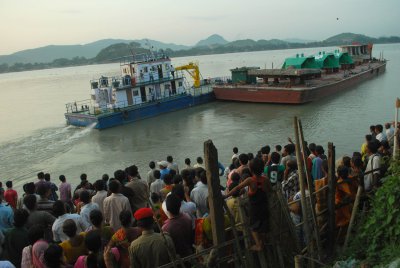
Protest against big dams – KMSS (Krishak Mukti Sangram Samiti) members protesting in Pandu Ghat in Guwahati against the ship carrying the turbines for the Lower Subansiri project. Source: http://peakwater.org/wp-content/uploads/2011/07/Lower-Subansiri-turbines-protest.preview.jpg
Protest against big dams – KMSS (Krishak Mukti Sangram Samiti) members protesting in Pandu Ghat in Guwahati against the ship carrying the turbines for the Lower Subansiri project.
Source: http://peakwater.org/wp-content/uploads/2011/07/Lower-Subansiri-turbines-protest.preview.jpg

In order to control the floods in Brahmaputra valley one of the proposed solution is construction of multi-purpose dams. In fact flood control was one of the pretexts for hydro-development in the northeastern region. But the idea that multipurpose dams can lead to flood control along with hydro-power generation is actually contradictory and unviable as seen from experience of such projects. Studies done on some of the biggest multi-purpose river valley projects of independent India, e.g. ‘Unravelling Bhakra’ by Shripad Dharmadhikary, ‘Drown and Dammed’ done on Hirakud by Prof Rohan D’Souza, “One Valley and a Thousand: Dams, Nationalism, and Development, Studies in Social Ecology & Environmental History” on Damodar Valley dams by Daniel Klingensmith have shown how unviable this proposition is. A number of these dams have actually created avoidable flood disasters in the downstream areas due to wrong operation of the dams[23]. In case of the mightly Brahmaputra river, this is likely to prove even greater disastrous considering its characteristics described above.

Today Brahmaputra valley is witnessing severe opposition against hydro-power dams.  The struggle against the Lower Subansiri hydro-electric project can be regarded as milestone. In the Brahmaputra valley the hydropower projects have been opposed also because of the impacts which it will going to have in the downstream as well as on the biodiversity, seismicity, society and culture of one of the most ecological sensitive areas. .

Institutional Mechanism over Brahmaputra in India

The Brahmaputra Board is the foremost body on Brahmaputra established by Government of India under an Act of Parliament i.e. The Brahmaputra Board Act, 1980 (46 of 1980) under the Ministry of Irrigation which now renamed as Ministry of Water Resources. The main task entrusted on Brahmaputra Board is ‘planning and integrated implementation of measures for the control of floods and bank erosion in the BrahmaputraValley and for matters connected therewith.’ Both Brahmaputra and Barak valleys are under the jurisdiction of Brahmaputra Board. Even though this independent board was established to better manage the flood and erosion problem of the two river basins, but its activities have come under severe public criticism. Besides Brahmaputra Board, the State Water Resource Department and Central Water Commission also looks after water issues in the river basin. Recently international funding agency Asian Development Bank (ADB) has come to be associated with flood and erosion control in the Assam but from the experiences of Bangladesh, the advent such agencies must be dealt with precaution.

Brahmaputra Valley as the Point of Confluence for People and Cultures

The Brahmaputra is a dynamic river whose dynamism is not only limited to its physical characters or features of the river, but immersed in social, political, economic and cultural aspects. The Brahmaputra valley has been the space of assimilation for people from different races and the one can find large variety of languages and dialects being spoken in this valley. The northeastern region falls under the Brahmaputra and Barak River basin[24] which is home for more than 166 separate tribes, 160 scheduled tribes and over 400 other tribal and sub-tribal communities and groups, speaking a wide range of languages (Climate Change in India: A 4×4 Assessment, 2010). The northeastern region can also be considered as an ‘ethnological transition zone’ between India and the neighbouring countries of Bhutan, Tibet, Burma and Bangladesh. In this region one can find 220 languages belonging to three language families – Indo-Aryan, Sino-Tibetan and Austric.[25]

Relevance of Brahmaputra for Assam

For Assam, the state located at the center of the northeastern region, the river Brahmaputra paves its way through this state like the lifeline of the state. The river ‘Brahmaputra’ literally means ‘Son of Brahma’. It is also one of the few rivers in India which is regarded as a ‘male’ river. There are several myths and legends about the Brahmaputra’s origin and we will bring those together in our coming blogs.

Bogibeel, the fourth bridge on Brahmaputra is under construction between Dhemaji and Dibrugarh district. Photo – Parag Jyoti Saikia

In Assam Brahmaputra River is also known by several other names  i.e. ‘Luit’, ‘Siri Luit’, ‘Bor Luit’ ‘Bor Noi’. For the people of Assam, the Brahmaputra is a symbol of great pride due to its ‘moving ocean’ size but this also ignites fear when it rises to its strength during floods. People of Assam have faced difficult times when the river has come to its full strength. Famous singer Jayanta Hazarika wrote, when he formed ‘Xur bahini’ to gather relief for flood victims “Luitor Bolia baan, toloi koloi nu dhapoli meliso, hir hir sowode kal roop dhori loi kaak nu bare bare khediso (Oh the maddening floods of Luit, where are you heading this time. Whom are you chasing again with frightening sound of your waves)”.

But this river is also the source of strength for the people of Assam. Time and again, they have expressed their unity as ‘Luitporia’ or ‘people from the banks of Luit’. The famous cultural icon of Assam, Jyoti Prasad Agarwala wrote in 1942 during Indian Freedom movement “Luitor parore ami deka lora, moriboloi bhoi nai (we are the youth from the banks of Luit and we don’t have any fear of death)”.  For another legendary cultural icon, Dr. Bhupen Hazarika  who is known as the bard of Brahmaputra, the river’s power of destruction was the source which will awaken the people. In his famous song “Bistirno parore” he asked the river – “Sahasro barishar, unmadonar, avigyotare, pangu manobok sawal songrami aru agrogami kori nutula kiyo (with your maddening experience of thousand monsoons, why don’t you arouse the disabled human beings for struggle and progress)”.

This blog is a small step to document the various aspects of the river Brahmaputra. It is the need of the hour since a flood of dams are proposed to submerge the Brahmaputra valley. Chinese plans of dam construction is not very much in the public domain but the impacts of dam construction of in the upstream Tibet will have severe impacts on the Brahmaputra river. Besides, the bogey of Chinese threat to divert the waters of Siang is used by the Indian government to push for rapid dam construction sidelining all the social, environmental, safety, sustainability, climate change concerns and impacts on the river ecosystem. The government very shamelessly has also put aside all the democratic processes to push for rapid dam construction. Though there is no proposal for a dam on the Brahmaputra in Assam, there are proposals to dam its major upstream tributaries.  This upsurge of dams, if they do get constructed will have huge impacts on the Brahmaputra River which are yet not known due to lack of credible projects specific or cumulative impacts assessment studies. These studies should include issues like  the river ecosystem, river bio-diversity, forests and wildlife, climate change, floods and erosion and economic and socio-cultural impacts. However, we are hopeful that the ongoing struggles against such unjustifiable projects will succeed and all these projects won’t come up. Through a series of blogs we will also try to bring together all these different streams of concerns.

Himanshu Thakkar, Parag Jyoti Saikia

South Asia Network on Dams, Rivers & People (www.sandrp.in)
Email: ht.sandrp@gmail.com, meandering1800@gmail.com


[1] Lahiri, S.K., Sinha, R., Tectonic controls on the morphodynamics of the Brahmaputra River system in the upper As-sam valley, India, Geomorphology (2012)

[2]EnvironmentAssessmentReport  SiangBasin In Arunachal Pradesh, Interim Report June 2012, Prepared for Central Water Commission(CWC

[3] Lahiri, S.K., Sinha, R., Tectonic controls on the morphodynamics of the Brahmaputra River system in the upper As-sam valley, India, Geomorphology (2012)

[5]GoswamiD.C., “Managing the Wealth and Woes of the River Brahmaputra” available at http://www.indianfolklore.org/journals/index.php/Ish/article/view/449/514

[7]EnvironmentAssessmentReport  SiangBasin In Arunachal Pradesh, Interim Report June 2012, Prepared for Central Water Commission(CWC)

[9] Goswami D.C., “Managing the Wealth and Woes of the River Brahmaputra” available at  http://www.indianfolklore.org/journals/index.php/Ish/article/view/449/514

[10] An anabranch is a section of a river or stream that diverts from the main channel or stem of the watercourse and rejoins the main stem downstream.

[11] Lahiri, S.K., Sinha, R., Tectonic controls on the morphodynamics of the Brahmaputra River system in the upper As-sam valley, India, Geomorphology (2012)

[13] Water yield means volume of water drained by unit area of the basin.

[14] “The Brahmaputra River”, India  by D.C. Goswami and P. J. Das in The Ecologist Asia Vol. 11 No 1 January- March 2003

[15] ibid

[16] ibid

[17] “Water Sector Options for India in a Changing Climate” by Himanshu Thakkar, SANDRP, New Delhi, March 2012

[18] ‘Stemming the Flood, Killing Biodiversity’ by Dr. Sanchita Boruah and Dr. S.P. Biswas in The Ecologist Asia Vol. 11 No 1 January- March 2003

[19] Goswami D.C., “Managing the Wealth and Woes of the River Brahmaputra” available at  http://www.indianfolklore.org/journals/index.php/Ish/article/view/449/514

[24]Barak River is located in south Assam and also an international river but smaller than the Brahmaputra.

Beas · Hydropower

Hydropower Generation Performance in Beas River Basin

The BeasRiver Basin is the major part of IndusRiver Basin. It rises near the Rohtang Pass in Kullu and flows through a gorge from Larji to Talwara and then enters the Punjab plains to meet the Sutlej at Harike. Its total length is 460 km and catchment area is 20,303 sq km.

The project wise generation data of large hydro with installed capacity of the basin in the latest year 2012-13.

SN Projects

State

Inst Capacity  (MW)

Generation (MU)

MU/MW

1 Bassi

Himachal Pradesh

60

246

4.1

2 Dehar

Himachal Pradesh

990

3221

3.25

3 Larji

Himachal Pradesh

126

652

5.17

4 Malana

Himachal Pradesh

86

333

3.87

5 Mukerian

Punjab

207

1420

6.86

6 Pong

Himachal Pradesh

396

1824

4.61

7 Shanan

Punjab

110

436

3.96

8 Allain Duhangan*

Himachal Pradesh

192

681

3.55

9 Malana-II**

Himachal Pradesh

100

312

3.12

  Total

2267

9125

4.03

* The Generation figure of Allain Duhangan is available for two year as it commissioned in the year 2010.

** The Generation figure of Malana-II is available for one year only as it commissioned in the year 2011.

 Beas_table

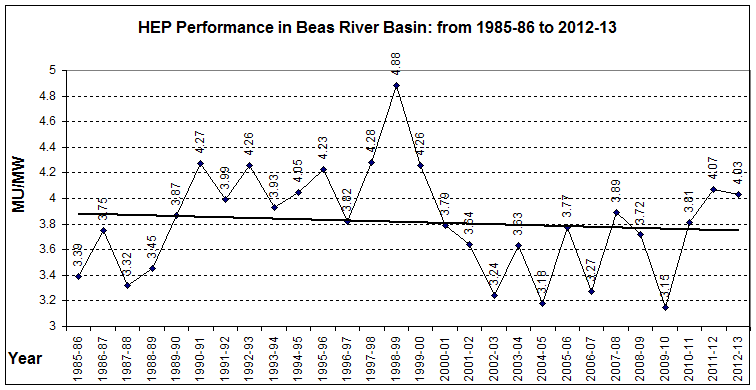
  • The above graph shows the trend line of power generation of Big Hydropower projects for last 28 years in the basin, the trend-line shows diminishing generation from existing hydro power projects of Beas River Basin.
  • It shows that the per MW generation in 2012-13 (4.03) has dropped by a huge 17.52% from the highest per MW generation (4.88) achieved in the year 1998-99.
  • All generation figures have been taken from official data of Central Electricity Authority (CEA).

List of other projects (up to 25 MW) under operation (for which latest generation figures not available):

SN Project

Ins Cap (MW)

State

1

Binwa

6

Himachal Pradesh

2

Gaj

10.50

Himachal Pradesh

3

Baner

12

Himachal Pradesh

4

Khauli

12

Himachal Pradesh

5

Dehar

5.00

Himachal Pradesh

6

Maujhi

4.50

Himachal Pradesh

7

Raskat

0.80

Himachal Pradesh

8

Baragran

3.00

Himachal Pradesh

9

Aleo

3.00

Himachal Pradesh

10

Marthi

5.00

Himachal Pradesh


Total

61.8

Source: http://www.hpseb.com/hydro_potential.htm

List of proposed and under construction projects in the basin:

  Project

Ins Cap (MW)

State

Status

1 Uhl-III

100

Himachal Pradesh

Under Construction

2 Sainj

100

Himachal Pradesh

Under Construction

3 Khauli-II

6.60

Himachal Pradesh

Under Construction

4 Parbati-II

800

Himachal Pradesh

Under Construction

5 Parbati-III

520

Himachal Pradesh

Under Construction

6 Patikari

16

Himachal Pradesh

Under Construction

7 Neogal

15

Himachal Pradesh

Under Construction

8 Lambadug

25

Himachal Pradesh

Under Construction

9 Baragaon

11

Himachal Pradesh

Under Construction

10 Fozal

9

Himachal Pradesh

Under Construction

11 Baner-II

6

Himachal Pradesh

Under Construction

12 Parbati-I

750

Himachal Pradesh

Under Construction

13 Kilhi-Balh

7.50

Himachal Pradesh

Under Construction

14 Dhaula-Sidh

66

Himachal Pradesh

Under Construction

15 Thana-Plaun HEP

141

Himachal Pradesh

EAC TOR Approved

16 Triveni Mahadev

78

Himachal Pradesh

EAC TOR Approved

17 Nakthan HEP

520

Himachal Pradesh

EAC TOR Approved

18 Gharopa

99

Himachal Pradesh

Proposed

  Total

3270.1

EAC: Expert Appraisal Committee of MoEF

Source: http://www.hpseb.com/hydro_potential.htm ; http://envfor.nic.in

Map of Hydroelectric Projects in Beas River Basin available at:

https://sandrp.in/basin_maps/Hydropower_Projects_in_Beas_Basin.pdf

South Asia Network on Dams, Rivers & People (www.sandrp.in)                                           June 2013

ht.sandrp@gmail.com


Chenab · Hydropower

Hydropower Generation Performance in Chenab River Basin

The Chenab River Basin is the major part of IndusRiver Basin. This river is formed by the Chandra and Bhaga, which rises in Lahul. It flows through Himachal Pradesh and Kashmir and is known as Chandra-Bhaga or Chenab. It then Traverses 330 km to Akhnur where it enters Pakistan. It flows 644 km more to Panjnad, joins the Sutlej after receiving the eaters from Jhelum at Trimmu and the Ravi lower down, its catchment area up to the Indo-akistan border is 26,155 sq km.

 The project wise generation data of large hydro with installed capacity of the basin in the latest year 2012-13.

Chenab

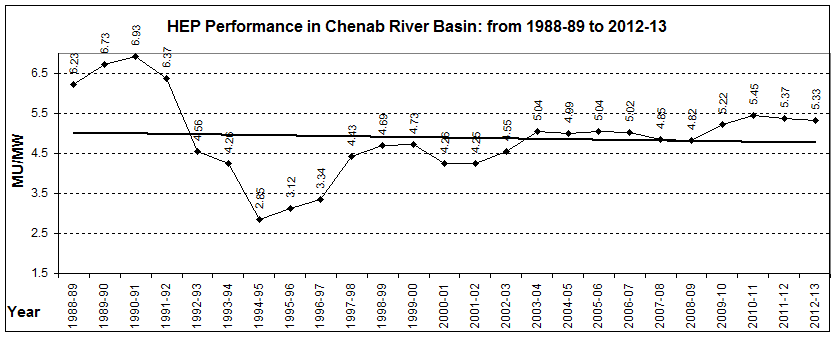
  • The above graph shows the trend line of power generation of Big Hydropower projects for last 25 years in the basin. the trend-line shows diminishing generation from existing hydro power projects of Chenab River Basin.
  • It shows that the per MW generation in 2012-13 (5.33) has dropped by a huge 23.09% from the highest per MW generation (6.93) achieved in the year 1990-91.
  • All generation figures have been taken from official data of Central Electricity Authority (CEA).
SN Projects

State

Inst Capacity  (MW)

Generation (MU)

MU/MW

1 Baglihar

Jammu & Kashmir

450

2839

6.31

2 Dulhasti

Jammu & Kashmir

390

2043

5.24

3 Salal

Jammu & Kashmir

690

3277

4.75

  Total


1530

8159

5.33

 List of other projects (up to 25 MW) under operation (for which latest generation figures not available):

SN Project

Ins Cap (MW)

State

1 Chenani-I

23.30

Jammu & Kashmir

2 Chennai-II

2

Jammu & Kashmir

3 Chenani-III

7.5

Jammu & Kashmir

4 Bhaderwah

1

Jammu & Kashmir

  Total

33.8

List of proposed and under construction projects in the basin:

  Project

Ins Cap (MW)

State

Status

  Bhaderwah Unit-III

0.5

Jammu & Kashmir Under Construction
  Pakul Dul

1000

Jammu & Kashmir Under Construction
  Baglihar-II

450

Jammu & Kashmir Under Construction
  Bardang

126

Himachal Pradesh Proposed
  Chattru

108

Himachal Pradesh Proposed
  Miyar

90

Himachal Pradesh Proposed
  Tinget

81

Himachal Pradesh Proposed
  Teling

69

Himachal Pradesh Proposed
  Tandi

104

Himachal Pradesh Proposed
  Rashil

102

Himachal Pradesh Proposed
  Gondhala

144

Himachal Pradesh Proposed
  Khoksar

90

Himachal Pradesh Proposed
  Patam

60

Himachal Pradesh Proposed
  Seli

454

Himachal Pradesh Proposed
  Dugar

236

Himachal Pradesh Proposed
  Gyspa

170

Himachal Pradesh Proposed
  Sach-Khas

149

Himachal Pradesh Proposed
  Reoli/Dugli

268

Himachal Pradesh Proposed
  Ratle

850

Jammu & Kashmir Proposed
  Bursar

1020

Jammu & Kashmir Proposed
  Kwar

520

Jammu & Kashmir Proposed
  Sawalkote I&II

1200

Jammu & Kashmir Proposed
  Lower Kalnai

50

Jammu & Kashmir Proposed
  Kirthai-I

240

Jammu & Kashmir Proposed
  Kiru

600

Jammu & Kashmir Proposed
  Ranjala Dunadi

15

Jammu & Kashmir IPP Projects
  Hanswar Paddar

6

Jammu & Kashmir IPP Projects
  Gulabgarh

6.5

Jammu & Kashmir IPP Projects
  Chenani IV

7

Jammu & Kashmir IPP Projects
  Chingus-I

3

Jammu & Kashmir IPP Projects
  Chingus-II

3

Jammu & Kashmir IPP Projects
  Upper Ans

3

Jammu & Kashmir IPP Projects
  Total

8225

EAC: Expert Appraisal Committee of MoEF; FAC: Forest Advisory Committee of MoEF

Source: http://www.hpseb.com/hydro_potential.htm; http://envfor.nic.in

http://jkspdc.nic.in/exist.htm

Map of Hydroelectric Projects in Chenab River Basin available at:

https://sandrp.in/basin_maps/Hydro_%20Electric_Projects_in_Chenab_River_Basin.pdf

South Asia Network on Dams, Rivers & People (www.sandrp.in)                                           June 2013

ht.sandrp@gmail.com

Arunachal Pradesh · Assam · brahmaputra · Floods

2012 Floods Displaced 6.9 Million in Northeast-IDMC: Staggering but Highly Exaggerated

According to a new report, the largest climate induced displacement in the world for the year 2012 happened

Cover of the IDMC Report on Disaster Induced Displacement

in two states of Northeast India, Assam and Arunachal Pradesh in June 2012 due to the monsoon floods which displaced 6.9 million people, constituting about 21.2% of the population of the two states[1]. This staggering fact was revealed in the report named “Global Estimates 2012 – People Displaced by Disasters” published by The Internal Displacement Monitoring Centre (IDMC) based in Geneva, Switzerland in May 2013. More people were displaced in India by natural disasters last year than in any other country, says the report. A closer scrutiny shows that the figure seems highly exaggerated, raising question mark over the accuracy of the work of IDMC and Norwegian Refugee Council (NRC), who jointly published the report.

IDMC is an international body monitoring internal displacement worldwide. This was established in 1998 by the NRC. IDMC defines displacement as a non volunteer nature of movement. People who are compelled to evacuate their homes in order to avoid the impacts or the threat of a disaster will come under this definition. But from this definition it is also clear that those people who are affected by any disaster but have not evacuated their place living will not be defined as displaced. IDMC states that majority of people who face displacement are internally displaced people (IDPs).[2]

Displacement by type of related hazard, 2012 and 2008-2012

Total displaced

Type of hazard

2012

2008-12

Flood

22,010,000

89,181,000

Storm/ Typhoon

9,603,100[3]

29,051,000

Earthquake(Seismic activity)

637,000

23,604,000

Extreme Cold

2,000

923,000

Landslide(wet)

47,000

577,000

Volcano

40,000

472,000

Wildfire

59,000

103,000

Landslide (dry)

200

3,200

Extreme Heat

1,700

1,700

TOTAL

32 400 000

143 900 000

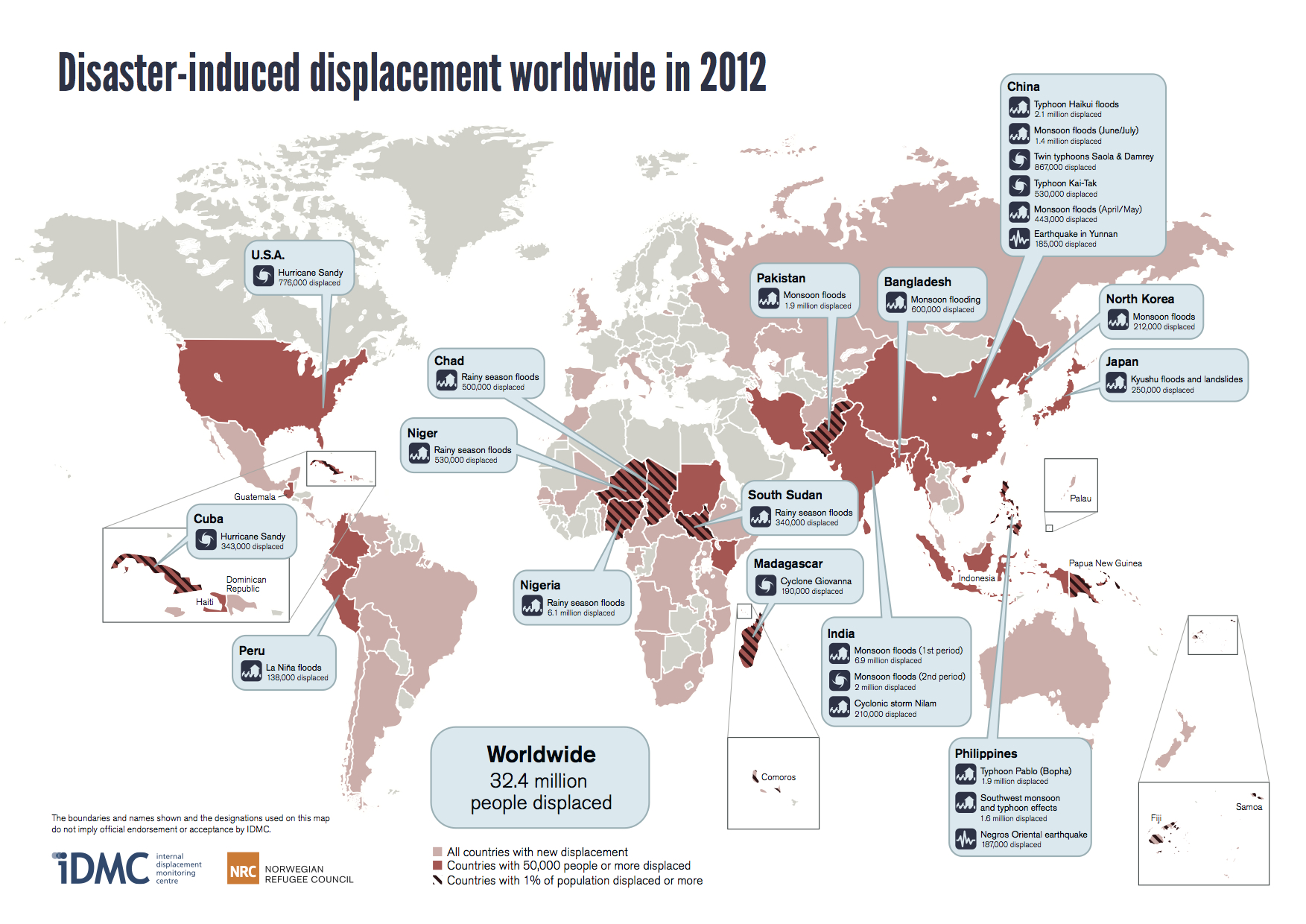
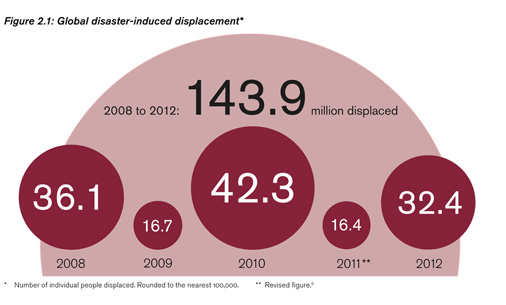
This report states that in 2012, an estimated 32.4 million people in 82 countries were newly displaced by disasters associated with natural hazard events. Over five years from 2008 to 2012, around 144 million people were forced from their homes in 125 countries. The majority of this displacement (98% in 2012 and 83% over five years) occurred due to climate and weather related hazards which include floods, storm, etc.

Disaster-induced Displacement Worldwide in 2012  Source: http://idmcnrc.files.wordpress.com/2013/05/world-map-global-estimates-2012.jpg
Disaster-induced Displacement Worldwide in 2012
Source: http://idmcnrc.files.wordpress.com/2013/05/world-map-global-estimates-2012.jpg

In the year 2012, twenty disaster-induced displacement events were recorded, which were induced by flood and storm related disasters.  Out of these, fourteen happened in Asia which includes the mass displacement in India, China and Philippines. Large scale flood displacements also happened in African countries of Nigeria, Chad, Niger and South Sudan. In fact the Nigerian floods also displaced over six million people.  Hurricane Sandy brought the disaster for the west which rendered 775,000 people homeless in America and 343,000 people in Cuba.

Why Disaster Induced Displacements are Increasing The report says that related and interconnected global changes like population growth, rapid urbanisation and the exposure of vulnerable communities, homes and livelihoods to hazards will increase the risk of global disasters. Even though increasing use of life saving drugs have brought down mortality rate related with weather related hazards, number of disaster survivors getting displaced will not decrease.

Global Disaster-Induced Displacement  Source: http://www.nrc.no/?did=9675023
Global Disaster-Induced Displacement
Source: http://www.nrc.no/?did=9675023

The analysis done in the report shows that disaster induced displacement takes a toll on both high income and low income countries.  However, it is the middle and low income countries where majority of the people were displaced.  The report states that for the year 2012, 96.09% of disaster induced displacement happened in the middle and low income countries, whereas for the period of 2008-2012 it was 98.27%.  The report also identifies that the South Asia region had the highest disaster related displacement (36.4%) for the year 2012. From 2008 to 2012, the highest disaster induced displacements have happened in China (49,782,000) which is followed by India (23,775,000) and Pakistan (14,991,000).

Risk of the Unseen – Climate Change The impact of climate change on disaster induced displacement has been emphasized in the report. The report states that climate change is an important concern which will impact extreme weather events which could lead to more displacement. Intergovernmental Panel on Climate Change (IPCC) published a report in March 2012, Managing the Risks of Extreme Events and Disasters to Advance Climate Change Adaptation (SREX) in which relationship between extreme weather or climate events (“climate extremes”) and displacement has been acknowledged, “Although data on climate change-forced displacement is incomplete, it is clear that the many outcomes of climate change processes will be seen and felt as disasters by the affected populations. For people affected by disasters, subsequent displacement and resettlement often constitute a second disaster in their lives.”[4] Evidence suggests that climate extremes are becoming more and more unpredictable due to the impact of climate change which has changed the frequency and magnitude of these climate extremes. This could be very serious issue considering the impact climate extremes can have on displacement. The report however fails to point out that while high income countries have been responsible for the climate change to the greatest extent, the impacts of their emissions are being felt by the poorest people in the low income countries and middle income countries.

Displacement in Northeast The report says that that around 900,000 people were evacuated in Arunachal Pradesh in June-July 2012; two thirds of the state’s population. In Assam, the report says, quoting Central Water Commission that as many as six million, 20 per cent of the state’s population, were forced to flee by rising waters. It says, officials claimed the 2012 floods were the worst since 2004 when eight times more houses were recorded as damaged than in an average year.

Rainfall in June 2012 does not corroborate IDMC claims – Monsoon rain is the reason for the floods in June 2012. The table below presents the rainfall figures of Assam and Arunachal Pradesh during June 2012.

1-13 June 14-20 June 21-27 June 28 June – 4 July
Arunachal Pradesh 191.6 (+1%) 64.1 (-47.1%) 249 (+78%) 66.2 (-51%)
Assam & Meghalaya 189.4 (-3.5%) 123.7 (-9%) 251.8 (+105%) 65.2 (-51%)

Note: Rainfall in mm, figures in bracket indicate the % departure from Normal, all figures from weekly and seasonal rainfall maps of India Meteorological department.

It is clear from the above table that rainfall in June 2012 in Assam and Arunachal Pradesh was normal or below normal in all weeks except during June 21-27, 2012. Even the excess rain in this period is not too high to cause unprecedented flood displacement. This raises some doubt about the figures in the IDMC report.

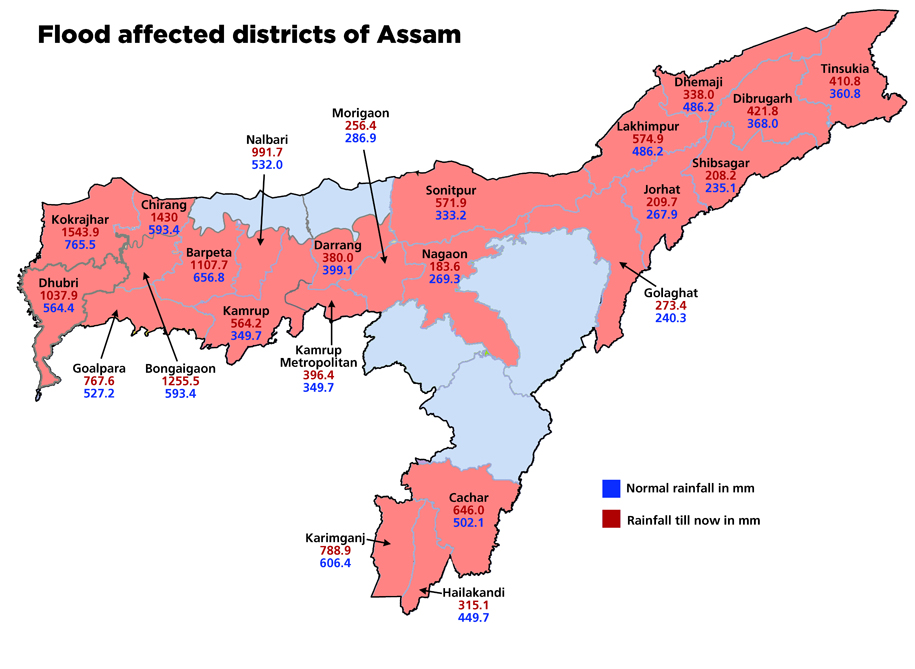
Flood Effected Districts in Assam in 2012 Source: http://www.downtoearth.org.in/content/assam-arunachal-pradesh-face-worst-ever-floods-recorded-june
Flood Effected Districts in Assam in 2012
Source: http://www.downtoearth.org.in/content/assam-arunachal-pradesh-face-worst-ever-floods-recorded-june

Assam suffers annually from flood disasters. The havoc of floods paralyses the state for several months every year.  International recognition of this problem is very important for the state. However, that seems to be some significant exaggeration in the figure of displacement in NE India due to floods in June 2012.

The total population Arunachal Pradesh is 1,382,611 according to 2011 census[5] and displacement of 900,000 people would mean displacement of massive 65% population of the state. But we could not find any report or news confirming displacement of this huge extent. There was news about floods in several districts in Arunachal Pradesh in June and July 2012, but none corroborated the displacement figure of 900,000. In fact displacement of 65% population of Arunachal Pradesh due to floods have never been heard of for even the worst ever floods in the state.

For Assam, the flood in June 2012 was recorded as the worst floods in last ten years. The flood in June 2012 was termed as unprecedented by Dr. Partha Jyoti Das, a senior researcher working on flood and environment related issues in Assam. He said that the flood occurred quite earlier than the previous years, i.e. in the first few weeks of June.[6]  However we found it difficult to find any document corroborating the displacement figure of six million in Assam due to floods in June 2012.

On the National Disaster Management website of Government of India (http://ndmindia.nic.in/flood-2012/floods2012.htm) the highest number of people affected during the month of June and July was 1,992,727 (reported on 2nd July 2012). The highest number of people evacuated during this time was 383,421 (reported on 4th July 2012). The highest number of people found in the relief camps was 484,555 (reported on 15th July 2012). The Assam State Disaster Management Authority also corroborated this figure as the highest number of people reported in the relief camps during that period. Two tables providing extent of damage (cumulative figures) and rescue and relief (provisional) are given in Annexure1 and Annexure 2.

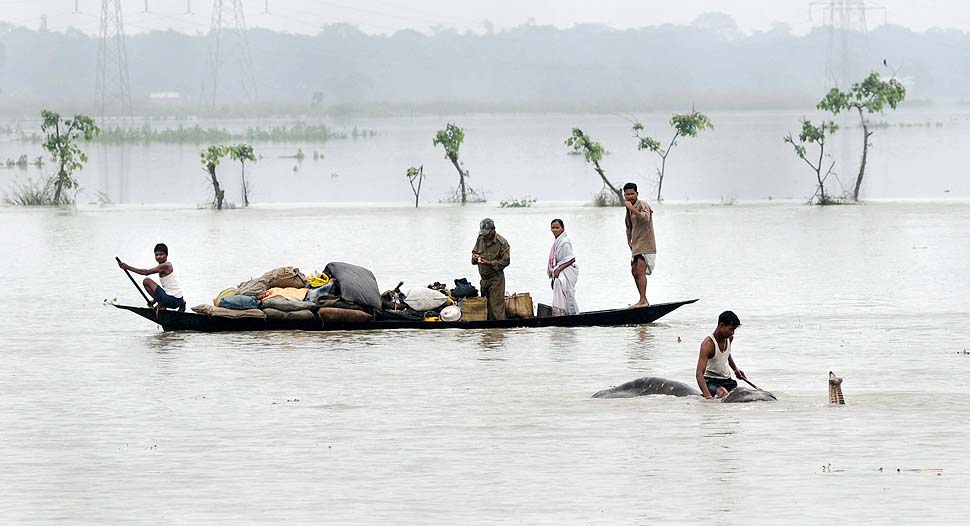
A mahout moves an elephant to higher ground as villagers paddle with their belongings through flood waters in the Pobitora Wildlife Sanctuary, some 55 km from Guwahati, the capital city of Assam, India on June 28, 2012. Source: http://photoblog.nbcnews.com/_news/2012/06/29/12478381-india-floods-displace-more-than-850000?lite
A mahout moves an elephant to higher ground as villagers paddle with their belongings through flood waters in the Pobitora Wildlife Sanctuary, some 55 km from Guwahati, the capital city of Assam, India on June 28, 2012.  Source: http://photoblog.nbcnews.com/_news/2012/06/29/12478381-india-floods-displace-more-than-850000?lite

Figures from Oxfam India, one of the leading organizations providing flood relief in the state also validated the fact that the flood in June 2012 was unprecedented early flood and worst in last ten years. They maintained that due to this flood nearly 2.4 million people have been affected and half a million people have been displaced.[7] The IDMC report also refers to the information gathered from Sphere India and Inter Agency Group (IAG). We found that in a Joint Assessment Report of IAG Assam on Assam Flood 2012 (published on 6th July, 2012) the number of affected people was stated as 2,391,369 in 4,540 villages. In the same report 383,421 inmates were reported to be staying in 650 relief camps in 15 districts of the state.

We had written to IDMC (at the email address idmc@nrc.ch as provided in the document for any further information and referred documents) on June 13, 2013, for copies of the documents referred in end note 11 and in table A2.1, and also request to “provide any other report that provides details and support for the figure of 6.9 million people displaced by flood disaster in North East India in June July 2012”. Our email remains unanswered as we write this.

Dr. Arupjyoti Saikia, an environment historian working on northeast after seeing the report said that “I have no accurate estimate of the people being displaced. But equally the estimate provided by the IDMC seems little awkward. The numbers of people affected in AP is surely less for very natural reasons. Often IDMC reports are criticized for their over-reaction. Official figures matter a lot as this numbers help in procuring relief from the GOI as well as other agencies. I presume GOA reports will come closer to the truth.” Dr. Dulal Chandra Goswami, another senior scholar from northeast, said that the displacement figures for northeast, quoted in the report appear to be highly exaggerated. Dr. Partha Jyoti Das also expressed similar opinions saying that the figures mentioned in the IDMC report for northeast are overestimated. Many reporters may accept the figures in such reports uncritically and report them, which lead to spreading of wrong information. This was evident from the reports published in Down to Earth[8] and Thomson Reuters Foundation[9].

Moreover, displacement in Assam is not only induced by floods but also by erosion. The report does mention “Shelter needs were a primary humanitarian concern as the authorities encouraged IDPs to leave relief camps and return to water-logged villages, destroyed houses and eroded land”.  But this is not completely correct as erosion leads to permanent displacement of people from their original land. Floods lead to inundation of a certain area for a period of time displacing people temporarily from their homes. But erosion displaces people permanently from their land. In displacements induced by floods the displaced people have the option of going back to their houses. Erosion leaves no option for that. People who get affected by erosion have to shift their homes before the actual erosion happens. In 2007 it was stated in the State Assembly that in 15 out of 23 districts in the state 40,414.98 bighas of land was lost due to erosion.  10,075 families have lost their houses due to erosion in that year. Many people who get displaced due to erosion opt to live on the side of the embankments in poor living conditions for years due to their inability to buy new land. They might not come to relief camp during floods which may result in their non-recognition in official displacement figures.

Such kind of reports also need to recognise clearly that among the disaster induced displacement, it is the poor people who are most at risk even in a fast growing country like India and climate change is making them even more vulnerable. Hence there is an urgent need to ensure that the climate action plans address the vulnerabilities of the poor. Unfortunately, Indian government’s National Action Plan on Climate Change (NAPCC) does not even recognise the vulnerable classes of people. In fact NAPCC increases the vulnerability of the poor, since it basically follows the business as usual development path.

This report by IDMC is an important initiative to document the plight of the people who face displacement due to the disasters. Recording and documentation of displacement is very important for policy formulation as well as for all related discussions and debates. The numbers presented are shocking but are clearly unsubstantiated and exaggerated. However exaggerated facts will also not lead to healthy policy formulation. Besides, factual inaccuracies may lead to questioning the credibility of such reports. We hope that IDMC will acknowledge these errors and bring more factual accuracy in their future reports. Such reports also need to highlight the issue of climate justice.

Parag Jyoti Saikia and Himanshu Thakkar
South Asia Network on Dams, Rivers & People (www.sandrp.in)

Email: ht.sandrp@gmail.com / meandering1800@gmail.com


Annexure 1: Extent of Damage (cumulative figures) (Provisional)

Name of States/

UTs

Date when updated

Population affected


No. of

human lives lost

No. of districts affected

No. of villages affected

No. of cattle/

Live- stock lost

Cropped area affected

(in ha)

No. of houses damaged

Fully Partially
15.06.12 13.06.2012 7 13 326
18.06.12 17.06.2012 66915 11 10 11783 07 02
28.06.12 27.06.2012 386762 14 19 23134.15 141 6592
02.07.12 01.07.2012 1992727 81 27 1564 657558.07
03.07.12 02.07.2012 1233970 95 27 1543 657558.07
04.07.12 03.07.2012 916801 104 27 1281 U/ Assesment
15.07.12 14.07.2012 2391369 125 30 4540 2.55
19.07.12 18.07.2012 2391369 126 30 4540 2.55 awaited awaited
24.07.12 23.07.2012 2391369 126 30 4540 2.55
31.07.12 23.07.2012 2391369 126 30 4540 0 2.55 0 0

Source: Flood Situation Report for June and July, 2012 available at http://ndmindia.nic.in/flood-2012/floods2012.htm


Annexure 2: Rescue and Relief (Provisional) 

Name of States/ UTs

Date when updated

No. of persons evacuated

No. of relief camps opened

No. of persons accommodated in the relief camps

15.06.2012

18.06.2012

17.06.2012

245

27

14100

28.06.2012

27.06.2012

24647

187

175750

02.07.2012

01.07.2012

370265

622

439548

03.07.2012

02.07.2012

370265

551

255677

04.07.2012

03.07.2012

383421

650

255677

15.07.2012

14.07.2012

383421

622

484555

24.07.2012

23.07.2012

383421

622

484555

31.07.2012

23.07.2012

383421

622

484555

Source: Flood Situation Report for June and July, 2012 available at http://ndmindia.nic.in/flood-2012/floods2012.htm


[2] As defined by the 1998  Guiding Principles on Internal Displacement, internally displaced people (IDPs) are individuals or groups of people “who have been forced or obliged to flee or to leave their homes or places of

habitual residence […] and who have not crossed an internationally recognised state border.”

[3] This figure is clearly gross error. The total Disaster induced displacement in 2012 by all types of hazards is 32.4 million, so storm related disaster cannot displace 95.7 million people. We have used a corrected figure in the table here, based on total displacement subtracted by displacement by other (than storm) factors.

[4] SREX, p.80. Citing Oliver-Smith, 2009

Assam · brahmaputra · Embankments · Floods

NDMA Commissioned IIT Roorkee Study on Brahmaputra River Erosion: A Biased and Structural Solution Oriented Report?


Image

Pic:  1  Erosion in Rohmoria in the Upstream of Dibrugarh. Source: The Assam Tribune

The National Disaster Management Authority (NDMA) has recently published a report named “Study of Brahmaputra River Erosion and Its Control”. NDMA had commissioned this study to the Department of Water Resources Development and Management of IIT Roorkee. NDMA is an apex body constituted under the Disaster Management Act, 2005 to prepare the country to face natural and human-made disasters. NDMA is headed by the Prime Minster of India. Under the natural disasters category it includes earthquake, flood, tsunami, land slide and avalanches while nuclear, chemical or biological disasters have been categorized as human-made disasters. This report provides a lot of information and data on the Brahmaputra and its tributaries. The information about erosion is also very much detailed and descriptive. The report can be found at http://ndma.gov.in/ndma/latestdisasterupdates/NDMA%20Final%20Report%20Brahmaputra%20River.pdf

Image

Pic:  2 Recent News Reports of Erosion in Subansiri River, One of the Largest Tributaries of Brahmaputra on the North Bank. Source: Dainik Janambhumi

ImagePic:  3 Houses on the side of the Old Embankment in Matmora. Source: Parag Jyoti Saikia

This reports deals with a very serious issue of erosion in the Brahmaputra river basin in Assam. Erosion should not be confused with floods even though both are annual phenomena in the Brahmaputra river basin. Erosion can be seen to have a more severe impact than floods because erosion leads to permanent loss of land and property. During floods land and houses are submerged for a period of time. But erosion displaces people from their land and property for good. Erosion inflicts severe damage to agriculture, economy and cultural relations of people. Erosion compels people to migrate to different places. Villages get eroded one after another and people living in those villages have to move to another location with their belongings. But this may not be possible and affordable for all those who lost their land in erosion. So for many of them, living on the side of embankments in very poor living conditions remains as the only option. Erosion also leads to migration of rural youths to urban areas in search of jobs. In the last few decades erosion has posed as a greater threat to the people of Assam than floods. The severity of erosion can be seen from the Table 7 of the report in which Satellite Based Estimation and Comparison of Area Eroded In Brahmaputra during the Period 1990 to 2007-08 and 1997 to 2007-08 have been presented.

Image

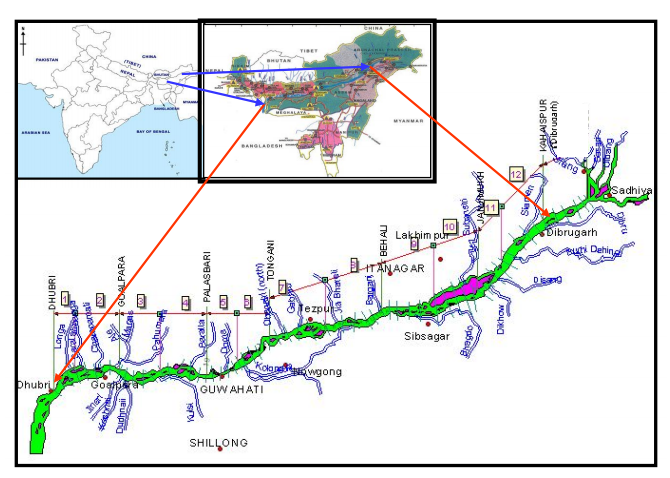
Map of the Study Area from the Report

The study divides the river length into twelve segments from Dhubri to Dibrugarh and that is why there are 12 reaches mentioned in the table.  It is clear from this table that the while the erosion prone length of the river is 10% higher along the South Bank of Brahmaputra compared to the same along North Bank. Areas facing erosion is 123% higher in South bank during the last decade (1998-2008) of the study period. The highest erosion area/per km of erosion prone bank is upstream of Dibrugarh, where the river enters the plains from the hills.

Areawise division into 12 reaches in the river

North Bank

South Bank

Total Erosion Length

(in km)

1990 to 2007 – 08 (in sq. km)

1997 to 2007-08 (in sq. km)

Total Erosion Length

(in km)

1990 to 2007 – 08 (in sq. km)

1997 to 2007-08 (in sq. km)

1. Dhubri

40.19

124.461

94.129

7.05

194.983

10.791

2. Goalpara

39.5

79.046

40.902

4.85

17.816

5.052

3. Palasbari

54.87

48.668

42.914

14.02

23.006

15.859

4. Guwahati

21.02

7.92

1.654

24.38

5.385

12.079

5. Morigaon – Mangaldai

6

35.606

2.138

47.91

96.979

103.7

6. Morigaon – Dihing

24.86

29.057

7.275

47.8

10.795

56.72

7. Tezpur

8.58

38.758

4.733

52.95

16.628

44.774

8. Tezpur-Gohpur

8.85

31.187

5.794

44.16

26.098

71.227

9. Majuli-Bessamora

24.69

25.562

12.327

47.17

32.788

28.998

10. Majuli Sibsagar

16.93

60.657

16.878

54.95

44.018

42.118

11. Dibrugarh

37.86

37.506

43.529

43.89

46.595

6.066

12. U/s Dibrugarh

70.5

20.376

55.454

57.54

399.529

333.416

Total

353.85

538.805

327.726

389.13

914.62

730.8


The Study Report:
There have been a lot of studies done on the river, to find a solution to the issue. But what comes as a surprise is the attempt to shy away with some of the crucial issues of the riverine eco-system in the northeast. But before going into crucial issues, a brief note about the report is provided.

The March 2012 study is divided into two phases. The first phase is named as ‘Sattelite Data Based Assessment of Stream Bank Erosion of Main Stem Brahmaputra and Its Major Tributaries’. In the second phase processing and analysis of the hydrological data of the Brahmaputra and its tributaries has been done.

In the first phase of the study information and data of 18 years (1990 to 2008) has been put together. The study pertains to a reach of 620 km on the main stem of Brahmaputra River, i.e., its entire course in Assam from upstream of Dibrugarh up to the town Dhubri near Bangladesh border.  23 major tributaries (13 northern and 10 southern) within India have also been considered. The data for this whole area was collected using an integrated mechanism of Remote Sensing and Geographical Information System.

In the second phase of the study a new method of analysis called Artificial Neural Networks (ANNs) has been used. The data processed through this analysis has been used for modeling the rainfall-runoff process and runoff-sediment process for the study area.

The report identifies inherent ‘sediment overloading’ of the river fluvial system as the main cause for river bank erosion vis-à-vis channel instability in Brahmaputra. The report recommends by proposing river training works for two pilot areas on Brahmaputra River. The first site is in Bhuragaon of Morigaon district and second one is near the Guwahati airport.

Critical issues:

The team of investigators for this study was led by Prof Nayan Sharma of the Department of Water Resources Development and Management at IIT Roorkee. This is a very descriptive report from the point of information and data about the river Brahmaputra and its tributaries. But even then there are several things that the report does not mention at all.

The report mentioned that inherent ‘sediment overloading’ as the prime cause for erosion in the river Brahmaputra. But another study named “River Bank Erosion and Restoration in the Brahmaputra River in India” has identified several other factors responsible for bank erosion.[1] That study states “The salient hydraulic and bank material factors responsible for bank erosion of the Brahmaputra system are i) rate of rise and fall of river water level, ii) number and position of major channel active during flood stage, iii) angle at which the thalweg approaches the bank line, iv) amount of scour and deposition that occurs during flood, v) variability of cohesive soil in bank material composition, vi) formation and movement of large bed forms, vii) intensity of bank slumping, and viii) progression of abandoned river courses to present-day channel.”

Identifying only ‘sediment overloading’ as the main reason for a dynamic river system like Brahmaputra seems an over simplification that overlooks the critical issues.

 Image

Pic:  4  A view of the Balijan Tea Estate Eroded by the Brahmaputra in Rohmoria in Dibrugarh district of Assam. Source: The Hindu

Even though the report identifies sediment overload as the prime cause of erosion, it has provided insufficient analysis as to why the sediment load is actually increasing in Brahmaputra. The report rightly states “Accelerated erosion has occurred in this region due to intensive deforestation, large – scale road construction, mining and cultivation on steep slopes.”

Pro Hydro Bias: Here the report completely ignores case of hydropower development in Arunachal Pradesh and its impact on Brahmaputra and its tributaries. The report nowhere mentions about the proposals for 168 hydroelectric dams in Arunachal Pradesh and its impact in the rivers in Assam. In the recent times, the state has witnessed mass protest against hydropower development in Arunachal Pradesh. In fact the report shows a pro-hydro bias when it laments that “less than 5% of the existing hydropower potential” have been put to use so far. At a time when people are demanding for cumulative impact assessment of dams on the rivers of Assam, reports like this attempt to create confusion among people. It is to be noted that when Assam was witnessing the mass protest against big dams, it was Dr. Nayan Sharma who appeared in the electronic media advocating for big dams.

Image

Pic:  5  Erosion protection work at Nimatighat on the Brahmaputra in Jorhat District on May 5th 2013.       Source: http://www.prokerala.com[2]  

Bias for Structural Intervention: This report advocates for structural intervention for flood protection and reiterates the need for more embankments. Lots of analysis has been done on the ill effects and poor performance of embankments. Embankments essentially transfer the problems to the downstream. There are ample examples of how structural interventions made for erosion protection have failed. We can take the example of Rohmoria, located in the upstream of Dibrugarh town in this regard. There were a series of structural interventions made to control erosion but it failed.[3]

The embankments proposed in this report for the two pilot-study areas are proposed to be constructed using geo synthetic bags. The geo-synthetic bags will be put inside polymer rope gabions[4] and installed in the critical toe of the bank line. The efficacy of controlling erosion through geo-tube embankments still not established, but even then geo-tubes have become the buzz-word for flood protection in Assam. The Asian Development Bank has offered a loan of $12 million for erosion protection through construction of geo-tube embankments. But Assam government engineers working on Brahmaputra and its tributaries are critical of ADB’s programme of erosion control through geo-tube. In a report published in regional news paper on March 2010, it was stated that revetments like geo-bags cannot be successful in Brahmaputra because it creates a permanent deep channel along the existing river bank.[5] The report also stated that geo-synthetic bags which were installed for bank protection in Palashbari-Gumi area were washed away by Brahmaputra. This area is in the downstream of Saraighat Bridge and close to Guwahati airport area where one of the pilot projects has been proposed.

Impact of Structural Interventions Ignored: The report provides structural solution for erosion control but ignores erosions which were a result of structural interventions in the river. Studies on Brahmaputra basin have shown that during and after the construction of bridges in the river Brahmputra erosion and floods have increased in the downstream areas.[6] In the case of Saraighat Bridge, unprecedented flood and erosion was witnessed in Palasbari and Gumi area. Morigaona and Nagaon districts suffered the same after the construction of Koliabhomora Bridge. Construction of Naranarayan Setu, led to flood and erosion in Dakshin Salmara, Pancharatna and Mancachar.

Similar fears have been expressed for the fourth bridge on Brahmaputra which is under construction between Bogibeel of Dibrugarh district and Kareng Chapori of Dhemaji district. The river is nearly 9 km wide at this point. But for the construction of this bridge, the river had been shrunk to almost 5 km through the boulder spurs. This is posing a great threat of flood and erosion for the downstream areas which include famous river island Majuli and Matmora, where India’s first geo-tube embankment was constructed. Engineers who are involved in the construction of the dykes of the fourth bridge had been reported saying that Matmora area would come under severe threat due to the increased river pressure in the area. The report completely ignores all these facts and shows ‘sediment overloading’ as the cause of erosion.

Besides, the study gives a feeling that erosion in the river Brahmaputra operates in ceteris paribus[7]. The report made no mention about climate change and how it is going to impact a river like Brahmaputra which is flowing right from the Himalayan mountain range. At a time when impacts of climate change are taken into account for every possible environment related matters, ignoring this is another major lacuna of this report.

These critical lacunas put a question mark over the usefulness of the otherwise informative study. Credibility of IIT Roorkee reports have been questioned in the past too.[8] NDMA may keep this in mind and focus on more basic issues. For starters as monsoon sets in and rounds of floods start along Brahmaputra, NDMA’s flood forecasting links have stopped functioning for five days as we publish this in the 1st week of June 2013.

 Parag Jyoti Saikia 

South Asia Network on Dams, Rivers & People (www.sandrp.in)

Email: meandering1800@gmail.com


[4] Gabions are sausages made of Polymer ropes that are appropriately woven by a special process to fabricate the Gabions in various sizes. Gabions are generally available in a prefabricated collapsible form. Images of polymer rope gabions can be found here – http://www.garwareropes.com/polymer_rope_pro_g.htm

[6] Mahanta, C; Mahanta, A., ‘Bridge over The Brahmaputra’ Economic and Political Weekly, pp 579-581, 2006

[7] Ceteris paribus is a Latin phrase which can be literally translated as “holding other things constant” and usually rendered in English as “all other things being equal”