When I talk with Manshi, a friend and co-traveler from Himdhara Collective about Bhagirathh Prayas Samman that the collective received during the India Rivers Week 2016, she is modest, even slightly hesitant. She simply says, “We love the mountains, we want to protect them and help mountain communities fight the unequal battle against unplanned hydropower. That is one motivation of our work. But the other is recognition of the fact that we are privileged… privileged to be able to speak English, to work on a computer, to understand the bureaucratic procedures that alienate a tribal or forest dweller from her land. That understanding also drives us.”
Citation of Bhagirath Prayas Samman given to Himdhara Collective states: “Himdhara’s strength is its engagement with communities, movements and organisations. It has created an effective discourse around issues of resource distribution and their ownership and the resultant impacts on ecological spaces of mountain communities, especially vulnerable groups like indigenous people, dalits and women. It is an honor to recognize and celebrate Himdhara Environment Research and Action Collective’s extraordinary Bhagirath efforts in maintaining the integrity of rivers in Himachal Pradesh.”
In their own words, “Himdhara is an autnomous and informal non registered environment research and action collective, extending solidarity and support, in research and action, to people and organisations asserting their rights over their natural resources and agitating against corporatisation of these resources for destructive development in the state.”
Face of Hydropower in Kinnaur Photo: Himdhara
A collective of young, passionate and questioning minds, Himdhara has been working with communities in far flung areas of Himachal Pradesh include Lahaul and Spiti and Kinnaur in their fight against the onslaught of ill-planned and bumper to bumper hydropower projects in Himachal, amongst other issues.Continue reading “Bhagirath Prayas Samman: Himdhara Collective: Relentless Questioning and Doing”→
In the midst of a serious meeting pontificating on water issues, suddenly one hears an evocative sher in impeccable Urdu, followed by laughter and rounds of Irshad. The sher captures a lot in a few lines.
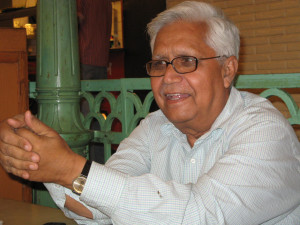
For an MTech Engineer from IIT and a Ph D Structural Engineer, Dr Dinesh Kumar Mishra, Mishra ji, is a colourful personality.
Mishraji, a light moment Photo: kdasgupta2007.wordpress.com
His erudition on rivers and floods in Bihar is tempered by folklore, songs, myths and shayari. A polyglot, Mishraji speaks and writes with eloquence in not only in Hindi and English, but in Bengali, Odiya and Urdu with equal ease. He holds a doctorate from the University of South Gujarat and has been an Ashoka Fellow. Mishraji is an institution in himself when it comes to rivers and floods of North Bihar and has single-handedly contributed to a gradually changing perception of flooding rivers as a catastrophe or “something to be tamed”.
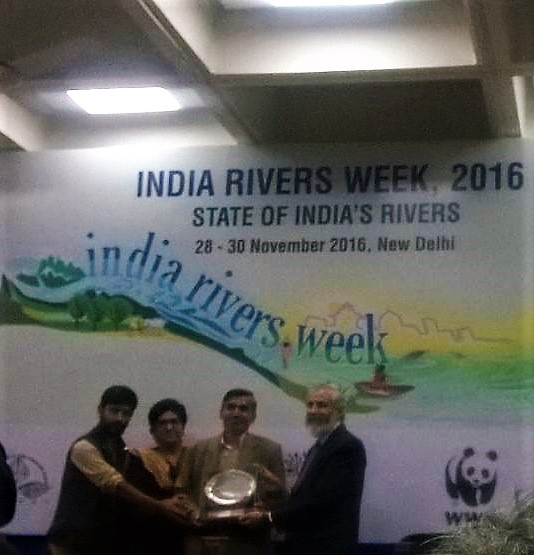
And hence, it gives us great pleasure to share that Mishraji was honored with the Bhagirath Parayas Samman at the India Rivers Week held in New Delhi on the 29th November 2016. India Rivers Week is being organized since November 2014 by a consortium of NGOs including WWF India, INTACH, SANDRP, Toxics Link and PEACE Institute Charitable Trust. More than 100 River experts, planners, researchers, artists, enthusiasts and activists from different parts of the country have been coming together to celebrate India Rivers Week in Delhi in last week of November to discuss, deliberate and exchange their experiences and ideas aimed at the conserving, rejuvenation, restoration of rivers in the country.
Citation of Bhagirtah Prayas Samman states “Dinesh Mishra, an engineer from IIT Kharagpur, has laid the foundation for an extensive knowledge base on floods in rivers.Through his writings, lectures, advocacy and public interactions he has inspired many individuals and organisations to record local knowledge about floods and generate information that creates awareness among communities. All this has become part of a larger social movement… It is an honour to recognize and celebrate Dr Dinesh Mishra’s extraordinary Bhagirath efforts in institutionalizing traditional ways of living with floods.”
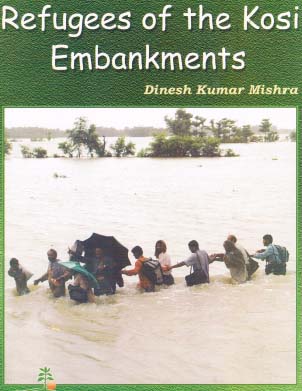
Born just prior to independence in a village in Utter Pradesh, Mishraji has dedicated his life in telling us about destruction wrought by infrastructure centric-flood control measures on rivers… especially rivers of the Ganga basin in North Bihar. Since 1984, Mirshraji is engaged in the study of floods, water-logging and irrigation and has slowly nurtured a diverse army which is able to see a lot more in floods than only destruction. He has helped us see the impact of flood control infrastructure like embankments.
Mishraji believes that India’s flood control policy revolves mainly around embankments resulting in severe environmental problems. The maintenance of such structures is in the hands of “indifferent technocracy” which does not take cognizance of the fact that investment in the flood control sector is doing more harm than good. Rising flood prone area of the country is a pointer to that. There are a wide range of aspects that need to be looked into afresh like agriculture, non-farm employment, migration, health, education, and access to civic amenities etc. He finds it intriguing that reciprocal inaccessibility of the flooded areas during the peak season and prolonged water-logging during the peace-time has not attracted the imagination of most of the responsible people. He is trying to learn from the people, their perception of the problem and take it up with those in power while keeping in touch with the people about the probable official intervention. These bridges are rare and much-needed in India. He has raised the issue of floods and water-logging and the links with infrastructure in state, national and international levels.
He has highlighted the futility of embankments as a flood control measures in rivers like Kosi and its tributaries. Through his persistent efforts of over more than three decades, Mishraji has helped change the way river floods are understood and managed. Using an approach which respects the natural cycle of floods, founded on local knowledge, he has robustly challenged the main stream flood control approach. For him, the long-term sustenance of rivers as well as their natural processes is the key, supported by meticulous research into the historical and cultural aspects of rivers.
Mishraji’s narration of how people used to come out in boats to enjoy flooded areas at full moon nights in Bihar is not only poignant, it also reminds us of the paradigm shift that came into our water management when we discarded age-old wisdom and adopted measures which were out of sync for our rivers.
Mishraji’s work is a confluence of solid grass root level contacts, extensive knowledge of local traditions, topography, geography and hydrology, robust field research and unique analysis. His writings including articles, books and films have made a deep impact on current understanding and thinking about floods in rivers and how best to deal with them. Through all this, he has made notable contributions towards developing a new policy dialogue on India’s flood control system, and the impact they have had on livelihood practices.
Mishraji is also the convener of an informal group of flood activists called Barh Mukti Abhiyan, an effective informal group with wide acceptance and vast contacts. He is currently engaged in writing about river Gandak and Ghaghara and thus shall complete the entire landscape of rivers of north Bihar.
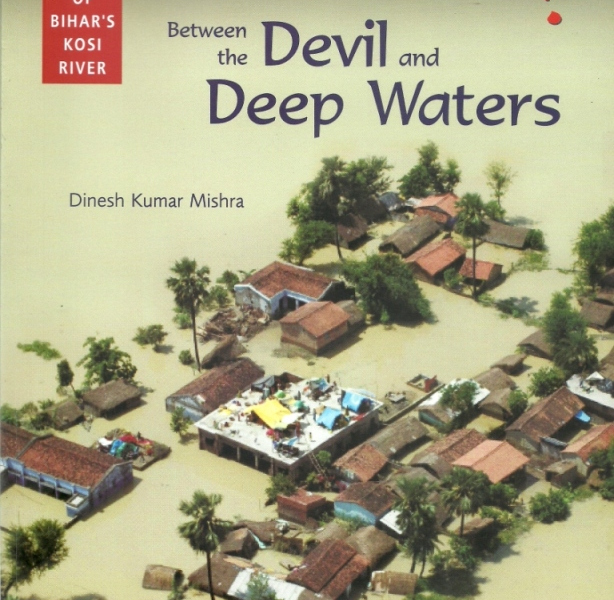
He has over hundreds of Notable among his large number of publications, are “Trapped! Between the Devil and Deep Waters: The Story of Bihar’s Kosi River” and “River Bagmati: Bounties Become a Curse”. His book “Boya Per Babool Ka’ was chosen as one of the best books written over the subject of environment by the Ministry of Forest and Environment, Government of India in 2002. This was later translated into English and published titled, ‘Living with Politics of Floods’ in 2002.
He was a member of the Dams and Development Forum of UNEP and represented Project Affected People there during 2003-07. He was also a member of the Working Group on Flood Control and Water Logging of the Planning Commission of India to review the progress made in eleventh Five Year Plan and make recommendations for the Twelfth.
He has encouraged many organizations to take up the issue of floods and water-logging in their respective river basins, in Bihar and other states as well, and they are carrying on their works. He has encouraged many groups to take up drainage works of small chaurs (land depressions) and resume agriculture on the land that emerges out of water. He provides them with basic technical details and help them executing the work. This has shown very encouraging results as compared to heavily budgeted drainage schemes taken up by the Irrigation Departments.
He has published a book on the River Mahananda (titled Bandini Mahananda in Hindi), a boundary river between Bihar and Bengal, in 1994 followed by a bi-lingual (Hindi and English) book on the Bhutahi Balan (2004) (Bhutahi Nadi aur Takniki Jhar Phoonk / Story of a Ghost River and Engineering Witchcraft) and on the Kamla River (2005) titled Baghawat Par Majboor Mithila Ki Kamala Nadi/ The Kamla-River and People on Collision Course.
His book on the River Kosi titled ‘Dui Paatan Ke Beech Mein – Kosi Nadi Ki Kahaani’ was published in Hindi in 2006. Its updated English version titled “Trapped! Between the Devil and Deep Waters – Story of Bihar’s Kosi River”, co-published by SANDRP, came out in 2008 just before the famous breach of the Kosi embankment at Kusaha in Nepal. Book on Bagmati was published in 2010, titled Bagmati Ki Sadgati. Its English version is also co-published by SANDRP titled “River Bagmati: Bounties Become a Curse” in August 2012. He has now started working on the major river of North Bihar, the Gandak and that will complete detailing the major rivers of north Bihar. This book will touch the Ghaghara and the Burhi Gandak too that flow almost parallel to the Gandak.
Mishraji’s crusade to highlight the wisdom behind age-old methods to “live with the floods”, his fight to expose the utterly destructive impacts of embankments and their role in amplifying flood misery, coupled with his sensitive and scholarly love of folklore and literature make his work accessible and engaging. We need more people like Mishraji who can tell us the stories of our rivers.
We congratulate him for the Bhagirath Prayas Samman and thank him, on behalf of our rivers, for his Bhagirath efforts.
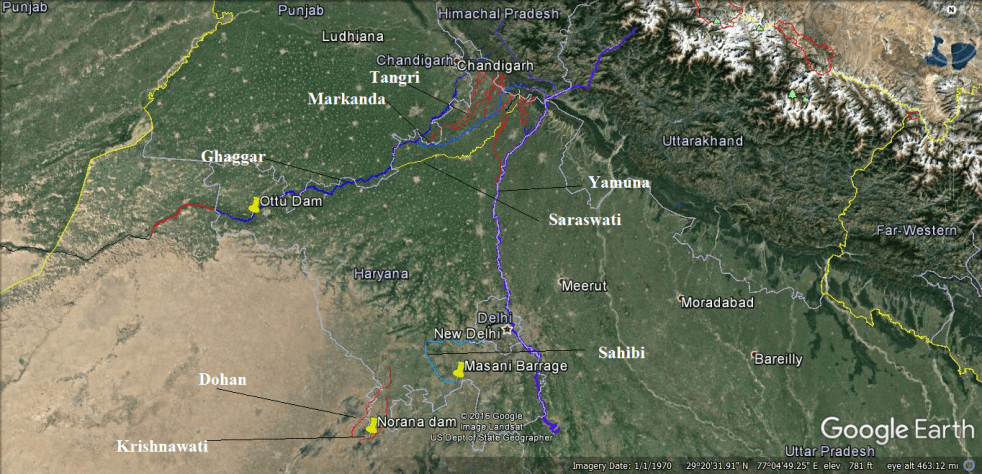
India is a land of several great rivers[1]. Haryana[2]the 20th Indian state has also been enriched by numbers of rivers, streams and rivulets. These rivers only strike public discourses during monsoon when they flood human habitations although pollution and sand mining incidents are routinely covered. Moreover there is no Government Department in the State which is in control or possession of complete information on the rivers of the State, as the various State Government Agencies in limited manner deal with specific issues affecting the rivers and there are Government Agencies also whose plans or projects impact the rivers in adverse manner. This two part blog report from SANDRP strives to present a picture on the rivers of Haryana. The State is broadly divided by two basins: Indus and Ganga. This first part of the blog mainly focuses on rives which are part of Indus basin. The second part will bring information of other rivers in the State which join the Ganga basin. Apart from putting together the basic facts, the blog series also highlights the key issues and present day status of these river systems.
Dear S/Shri Lavasa/ Shashi Shekhar/ Jha and Dr Agarwal,
Subject: Financial improprieties and illegalities in the execution of Indirasagar (Polavaram) Project & Pattiseema Lift Irrigation Project in AP- Central government agencies conniving with the State public functionaries in committing serious irregularities- Demand an independent investigation
I refer to my previous letters dated 20-12-2015 & 7-10-2016 addressed to you on the subject.
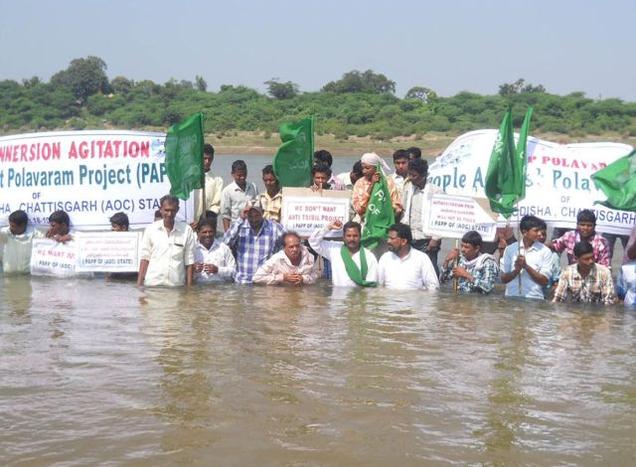
In my correspondence with you, I had pointed out to you the injustice meted out by the Centre and the State to lakhs of adivasis whose lands are getting submerged under the Polavaram project. There have been serious statutory violations in terms of an outright infringement of both PESA and FRA, as well as bypassing of the requirements of the Environment (Protection) Act. In addition, the State has violated its assurance that each adivasi family displaced in Polavaram should be given an equivalent extent of ayacut land as a precondition to the clearance of the project. Continue reading “Open Letter to Govt: Is there any justification for Polavaram dam? Will Govt probe the irregularities in the project?”→
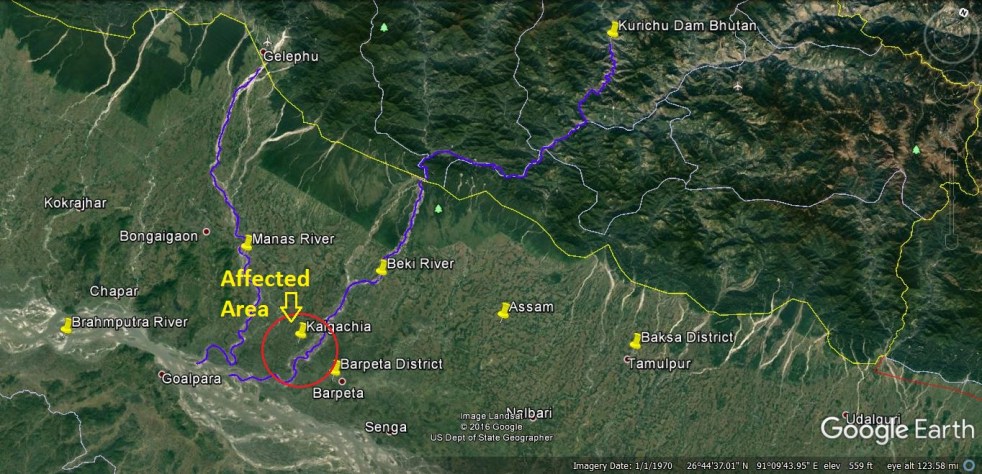
Above: Google Map showing relevant locations (Map by Bhim Singh Rawat of SANDRP)
Several media reports have alleged that sudden water releases from Kurichu Dam in Bhutan has led to floods in Beki and Manas rivers in Assam on Oct 13, 2016 (Thursday), affecting thousands of people in Barpeta district & also reportedly Baksa district. This is not the first time that Kurichu water releases have led to this kind of situation, it has happened in the past including in 2004, 2007, 2008, 2009 (150 villages affected[i]), among other instances. The Indo Bhutan joint mechanism, established in 2004-05, following the July 2004 floods, has clearly failed to effectively address this issue. Continue reading “Bhutan’s Kurichu Dam releases floods Assam, again in 2016”→
Diplomatic and military strategies, by definition, are not decided through public debates. So the jingoism around Indus treaty with Pakistan seems more like an attempt at sending threatening signals. But it will have multiple serious ramifications in any case, so it is worth deliberating about.
The 1960 Indus treaty has allocated rights of development on three eastern tributaries (Sutlej, Beas & Ravi) to India, and we have exhausted that entitlement almost fully. Attempts to use the occasional remaining flow will mean a huge impact in Indian Punjab, which is unlikely to resonate well with the people of Punjab. The treaty gave Pakistan dominant right of development of the three western tributaries (Chenab, Jhelum and Indus), India has limitations about water use (both in terms of quantity and manner of use) in case of the western rivers. India has not yet exhausted the entitlement in this case.
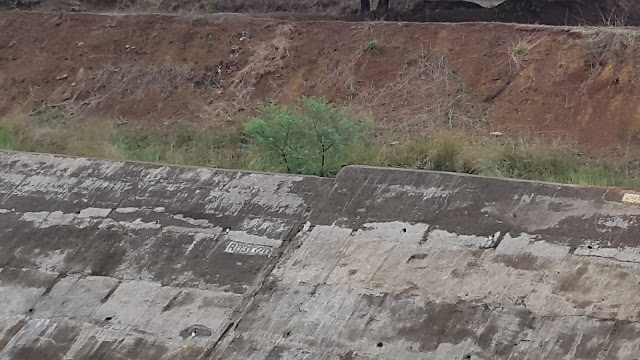
Above: Retaining wall of Gosikhurd RBC slid down from its location Photo: Jan Manch
Aftermath of the irrigation scam exposed in 2012 in Maharashtra still continues. Roots of the scam were pointed out time and again by Comptroller & Auditor General of India (CAG) and also by several other committees set up by the Government. The scam was finally unveiled in May 2012 with a combined effort of several whistle blowers from inside & outside the government as civil society groups including SANDRP. Unjustified cost overruns, forged tenders, tweaking the norms of tendering process, incomplete projects laden with inferior quality work were brought to light and the unholy nexus of corrupt leaders, government officials and contractors became visible like never before. Continue reading “Tracing the Maharashtra Irrigation Scam: From 2012 to 2016”→
Above: Irrigation official confronting the angry farmer from Asolamendha village in Chandrapur District of Maharashtra Photo: Amruta Pradhan
“Farmers are dying… but your procedures have to be complete…”
Sight of an angry farmer saying this to an irrigation official has stayed with me long after I returned from visit to Gosikhurd Right Bank Canal (RBC). More often than not, I, like many others have read and written about mighty Gosikhurd- that multi thousand crore irrigation project languishing incomplete for last 32 years. I was now seeing personification of the havoc wrecked by this poorly planned and even more poorly implemented project.
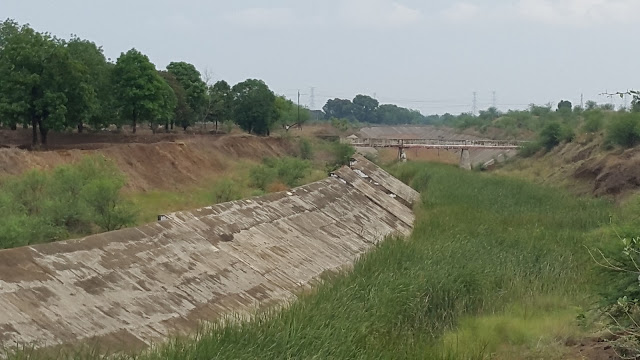
I was at the Asolamendha dam, tail end of Gosikhurd RBC. 30-40 farmers from nearby villages suffering because of the shoddy work of RBC had gathered with complaints at tip of their tongue. Nature of complaints was serious. This incomplete canal running a total length of 99.53 km from Gosikhurd Dam in Pauni Tehsil of Bhandara District to Asolamendha Dam in Nagbhid tehsil of Chandrapur District has not only failed to provide irrigation but is also destroying the catchment of the local water sources.
I was visiting Gosikhurd RBC as a part of Sinchan Shodh Yatra- a series of fact finding tours started since May 2015 by Jan Manch– a voluntary organization from Nagpur to uncover the shocking ground reality of corruption laden incomplete irrigation projects of Vidarbha region. The yatra that has visited 18 projects so far is being joined by more and more farmers who have suffered due to the poorly implemented, half done irrigation projects. It is becoming a platform for affected people to raise their voices and slowly emerging as a pressure group on irrigation officials. (Read more about Sinchan Shodh Yatra at https://sandrp.wordpress.com/2016/09/06/public-audits-of-corruption-ridden-irrigation-projects-in-vidarbha-sinchan-shodh-yatra/#more-15917)
Shodh yatra consisting of about 70 people had taken an inspection tour of Gosikhurd RBC which was proposed to irrigate command area of 64,362 Ha but has been incomplete since last decade. During its journey of 50 km length of RBC (from 45 km from Gosikhurd dam to Asolamendha)Shodh yatra witnessed stalled work of the main canal which has not resumed for past more than three years, farmers agitating over host of issues from incomplete branch canals to crop damage caused by breach of canals and irrigation officials offering more and more excuses. Continue reading “Sinchan Shodh Yatra finds Gosikhurd Right Bank Canal incomplete even after a decade of construction”→
Right Bank Canal of Gosikhurd Dam (Photo: Jan Manch)
Controversial irrigation projects of Maharashtra continue to make headlines after massive irrigation scam that was unveiled in 2012. Following an inquiry in the scam, the state cabinet has recently scrapped 94 tenders of 14 irrigation projects worth Rs 9,196 Crore.[i] Around 52 of these tenders have been under the scanner of anti-corruption bureau (ACB), with first information reports (FIRs) filed in four of them. Continue reading “Public Audits of corruption ridden irrigation projects in Vidarbha: Sinchan Shodh Yatra”→





 SANDRP