The year has seen many news reports about national and global water bottling brands abstracting groundwater without valid licenses. In the wake of severe drought, thermal power plants have been criticized for aggravating the water crisis. Reports have suggested that many new thermal power plants are proposed to be built in already water scarce regions. This brief report also covers some judicial orders on this subject.
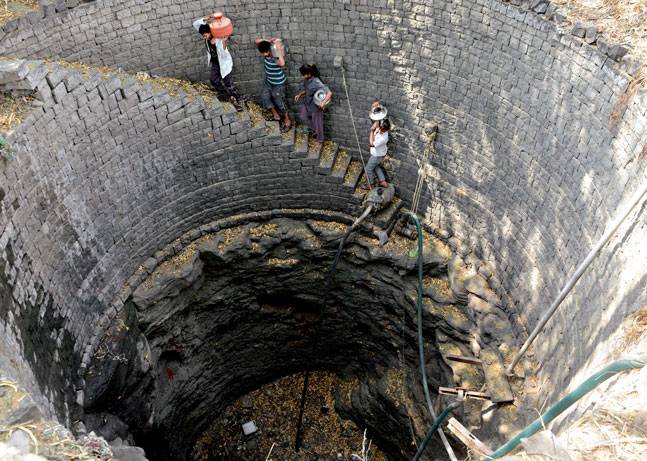
SANDRP BlogFarm ponds in Maharashtra Causing Groundwater Decline Farm ponds recognized as a drought proofing measure have received a great push from the central Govt recently. On the flip side however serious concerns are being raised over implementation of the farm ponds and more importantly –their use. Civil society organizations like Watershed Organization Trust and also SANDRP have been pointing out that the use of farm ponds has long drifted from its objective of storing rainwater for protective irrigation. Most of the farm ponds are instead being used as storage tanks for pumped out groundwater exposing this underground resource to losses through evaporation, etc. In the process they are accelerating the rate of groundwater exploitation multi fold.
Subject: Submission related to Chenab River and Lahaul Valley in context of EC for 430 MW Reoli Dugli project
Dear Chairperson,
We have read reports that the expert appraisal committee (EAC) on river valley and hydel projects of the Ministry of Environment has decided “not to take any cognizance of representations” received by its members since such representations are ‘anti-development’. The article appearing in Indian Express on January 14, 2017 stated, “In its December 30 meeting, the committee concluded that once a project proposal reaches the EAC for appraisal, it has crossed the stage of public consultation and “the EAC should not go back in time, and should not reopen it, by entertaining unsubstantiated representations received from the people”.Continue reading “Lahaul people write to Environment Committee not to clear Reoli Dugli Hydro project”→
DURING FEB 25-26, 2017, A LANDMARK MEETING HAPPENED IN PATNA, ORGANISED BY BIHAR GOVERNMENT, UNDER THE LEADERSHIP OF CHIEF MINISTER SHRI NITISH KUMAR. THE MEETING WAS ON INCESSANT GANGA WITH SUBTITLE “CAN WE ACHIEVE CLEAN GANGA WITHOUT INCESSANT GANGA?”. THIS NATIONAL-INTERNATIONAL CONFERENCE WAS LANDMARK MEETING FOR A NUMBER OF REASONS, BUT MOST IMPORTANTLY, SINCE A STATE GOVERNMENT WAS TAKING THE LEADERSHIP FOR THE CAUSE OF THE RIVER GANGA. WHILE THE CONFERENCE WAS FOCUSSED ON ACHIEVING A REJUVENATED GANGA, I WAS TO SPEAK ON THE WAY FORWARD ABOUT THE FARAKKA BARRAGE, A KEY OBSTACLE IN THE PATH OF REJUVENATED GANGA. FOLLOWING IS MY LETTER TO BIHAR CHIEF MINISTER, FOLLOWING THE CONFERENCE, WHICH CONTAINS MY RECOMMENDATIONS TO THE BIHAR GOVERNMENT. THESE RECOMMENDATIONS WERE APPARENTLY ACCEPTED IN THE FINAL SESSION.
March 2, 21017
To
Shri Nitish Kumar,
Chief Minister of Bihar,
Patna, Bihar
Respected Sir,
Firstly, I would like to thank you and Water Resources Department of Bihar for inviting me to the Patna Conference on Incessant Ganga on Feb 25-26, 2017. This shows great vision and foresight on your behalf, to raise such crucial issues that is not only necessary for the Ganga, people of Bihar, environment of Bihar and future of Bihar, but also for the whole nation. We hope you will continue to lead the nation on this issue, and I am sure you will get huge support, including from me. Continue reading “Landmark Ganga Conference in Patna: What Bihar needs to urgently do”→
Farm ponds dotting the agricultural fields immediately grab your attention as you enter Hiwargaon Pawasa – a small village of about 1500 population in Sangamner Taluka of Ahmadnagar District. The village is located just off NH-50, the national highway connecting Pune and Nashik. Farm ponds start to appear as soon as you turn east from NH-50 (which broadly runs North South) to head towards Hiwargaon. Nearly every farm, small or big, has a plastic lined farm pond. Hiwargaon Pawasa village alone has some 300 odd farm ponds.
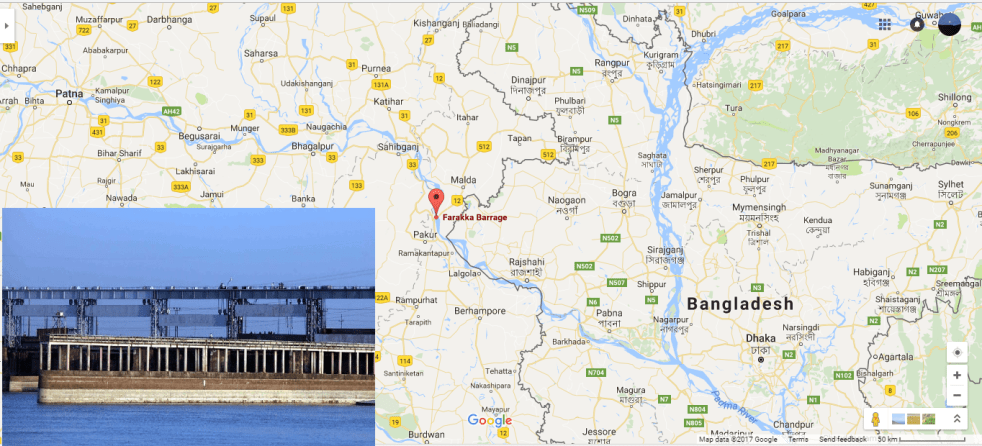
During a global seminar held on Feb. 25-26, 2017 in Patna experts from across the country have advocated an “urgent review” and comprehensive studyof the Farakka dam to revive the Ganga river. The experts were discussing various concerns facing River Ganga and the possible solutions for them. The seminar titled as “Incessant Ganga” was organisedby Bihar’s Water Resources Department, almost week after, Bihar CM Nitish Kumar has openly termed the barrage as genesis of floods in the State. Speaking in the program, the CM again expressed deep concerns behind receding water flow in the Ganga and increasing silt deposit due to Farakka dam.
Speaking during the seminar, environment expert Himanshu Thakkar the coordinator of SANDRP advocated urgent need for review of Farakka barrage claiming that it has failed to fulfill any of the purpose – irrigation, hydro electric power, water supply – of the barrage for which it was built. As per, Himanshu Thakkar the dam was built to maintain the navigability of Kolkata port.
Thakkar also suggested that the gates of Farakka be openedduring monsoon to mitigate the intensity of floods in Bihar. As per Thakkar there was an urgent need for a comprehensive study of the Farakka barrage to find out its achievements or whether the barrage fulfilled its objectives. The committee constituted for study must include the Centre, Bihar, West Bengal and all states having Ganga, he said adding that a study should be made on the social and livelihood impact of the barrage, how it affected people’s lives, whether its existence was justified and cost-benefit assessment among other issues.
GUEST BLOG by Muhammad Ali Shah, Dr. Aly Ercelan & Roshan Bhatti
Sindh Peoples Caravan March 1-14, 2017 Protect Our Rivers and Delta
Across the world the greed of capitalism has created water crises. Asia in general and South Asia in particular is no exception. This region is marred with complex and multidimensional aspects of water crises. Not only the brute availability of water has declined, but also the health of water bodies has been badly affected. A deep probe into the issue reveals that water crisis has been created by weak and deliberate mal-governance. Both wrong incentives and lack of penalties have led to major ecological disasters. These include deforestation, destruction of wetlands, dumping of industrial waste into waterways, construction of dams, overexploitation of the major river systems, corporate control on water resources and unplanned urbanization due to increasing population pressure.
Reduced fresh water flow in River Indus (Source: Google)
All these issues pose serious threats to life and health of people and water systems of South Asian River Systems, including Indus river system. Our analysis reveals that anti-human and anti-environment policies have been applied and imposed in South Asia with the same rapacity as colonial powers did to impose control over citizens. Post-independence, growth policies have become excuses for privatization and in favor of corporate monopolies rather than protection of the commons for public welfare. Among regions around the world, South Asia is the second number in the construction of large dams. Pursuing neo-colonial control over natural resources, the ecological consequences have become hazardous to life and livelihood.
Bihar wants Farakka barrage to be decommissionedThe Nitish Kumar govt has held the Farakka barrage in West Bengal responsible for heavy floods in Bihar and asked the Centre to decommission it to de-silt the heavily loaded upstream of Ganga River. The state has made the recommendation, observing that the dam is the “genesis of severe” flood consequences and responsible for “alarming” silt increase in the river’s upstream. According to sources, Nitish Kumar dispensation has made the demand before an experts’ committee formed by the Centre to work out guidelines for de-silting Ganga following last year’s devastating floods.
As per the statement, decommissioning the barrage will help automatically de-silt the heavily loaded upstream, allowing silt to move to deltas before the sea thus helping in restoration of deltas and its eco-system which is also getting adversely affected due to this barrage. To buttress its point, the state government has referred to Kolkata Port Trust’s data, which suggests that silt dredging at the port has increased from 6.40 million cubic metres annually from pre-Farakka days to four times, i.e. at 21.88 MCM annually, during 2003. The state government has also recommended the panel to come up with ‘National Silt Policy’ to address the problem. Bihar faced one of its worst floods as Ganga swelled in August last year, claiming lives of over 20 persons and affecting 20 lakh people.
Bihar Government has rightly asked for decommissioning of Farakka barrage and held it as the genesis of severe, destructive and prolonged floods that Bihar and other regions upstream from Farakka face year after year. Good to see that Bihar government has officially demanded decommissioning of the Farakka barrage before an expert committee of Ministry of Water Resources. Hope this starts the ball rolling to remove this unnecessary and giant dam on Ganga, which will also help the cause of fisheries (including Hilsa), downstream Bengal and also the river in general. The road cum rail line on the barrage can continue to exist.
Finally the Oroville Dam spillway damage has turned into a disaster. Report at this time (01:00pm, Feb. 13, 2017) finds dam level rising about 1 feet above the danger level. Water currents have started pouring out all over and around the emergency spillway which has never been put in use for last half a century. Meanwhile, more water is gushing in the dam reservoirs due to recent heavy rainfall in catchment areas upstream.
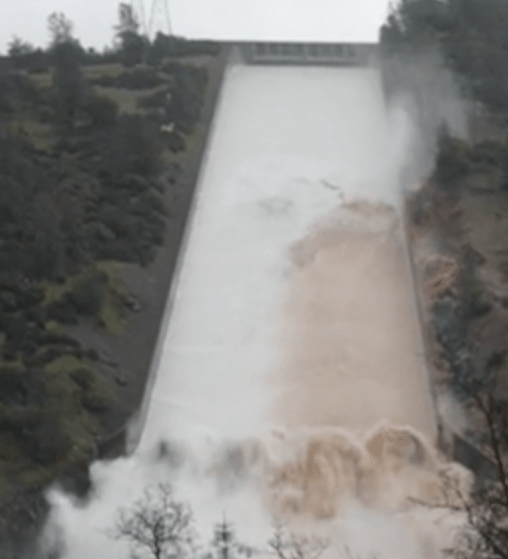
Oroville Dam, the tallest Dam in USA was found to have suffered severe damage to its spillway on Feb 7, 2017. A crater of about 180 feet width, 250 feet length and 30 feet depth was found in lower portion of the 3000 ft long spillway on Tuesday when 55000 cusecs (cubic feet of water) was flowing down the spillway.
That water release down the damaged spillway was stopped the same day. But the water level in the Oroville dam was than already over 80%, fast climbing to over 90% by the evening of Feb 9, 2017 and with inflow of 128000 cusecs on Feb 7, rising to 191000 cusecs on Feb 9, the officials of Department of Water Resources (DWR) of California decided to first test the damaged spillway by releasing 20000 cusecs twice on Feb 8, 2017. This further damaged the spillway, increasing the depth of the crater to upto 300 ft as per some reports and not only increasing the length and width, but also eroding the adjoining hills. Continue reading “Oroville Dam Spillway Damage in USA: Worst is yet to come”→