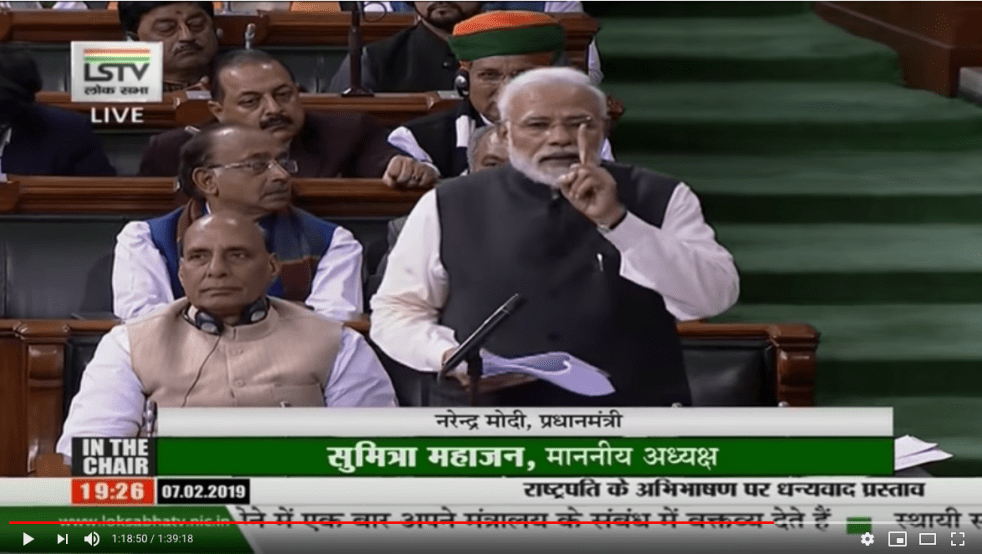
In his reply to the debate on President of India’s address to the joint session of Parliament, Mr Narendra Modi, Prime Minister of India told the Parliament on Feb 7, 2019[i]:
Screen shot from official Parliament Debate where PM spoke on Feb 7, 2019, p 530
Even as India’s General Elections 2019 are underway, by now the manifestos of most major parties[i] are out now. The latest one to come out was from AAP on April 25, 2019. Here we have tried to capture the key aspects of the manifestos of main political parties, particularly on aspects that we work on. While looking at the promises in the manifestos, we also look at the track record of the outgoing government, since that is the most relevant and current experience. We try and see how the parties try to come to grips with the massive water and environment crisis that India faces and how the poorest are the first and many times the only victims of the crisis. Continue reading “Election Manifestos of 2019: Which party shows faith in people, rights & democracy?”→
Field Observation Report, 20-21 April 2019 at Lakhwar Multipurpose Dam Project, Lohari and Vyasi Hydro Electric Project, Juddo. This author, also an applicant in NGT petition, visited the Lakhwar and Vyasi project area before the sub committee of MoEF’s Expert Appraisal Committee (EAC) for River Valley Projects visited the site on Apr 22, 2019.
The proposed site of Multipurpose Lakhwar dam project was seen affected with multiple landslides. One such fresh landslide was seen right at the site where the 204 meter high dam is supposed to be built. Locals revealed that many of the landslides in and around the location have become perennial.
Following death of Swami Gyan Swaroop Sanand (Prof G D Agarwal) while on fast unto death on Oct 11, 2018 and disappearance of Swami Gopal Das ji from AIIMS-Delhi, Swami Aatmabodhanand ji has been on fast unto death at Matri Sadan, Haridwar since Oct 24, 2019. In a letter to the Prime Minister on April 19, 2019 he has said that if the government does respond by April 25, 2019 to the four demands for which the fast undo death is undertaken, he will leave water from April 27, 2019. The four demands are well known:
Cancel all under construction and proposed dams on Bhagirathi, Alaknanda and their tributaries.
Prohibit all mining and tree cutting in the Ganga flood plains, particularly in Haridwar
Enact Ganga Act for the preservation of River Ganga, the draft of which has been sent to the govt.
In January 2019, the NGT rejected the Centre Groundwater Guidelines for a variety of reasons. It cited several shortcomings, several of which had already been pointed out on this blog, such as the fact that the water conservation fee would give those who had paid it carte blanche to withdraw excessive amounts of water and the lack of monitoring of pollution of groundwater. In addition to the shortcomings cited by the NGT, do the guidelines take into account the special needs of the Himalayan states? SANDRP spoke with people who have been working on groundwater in the Indian Himalayas to understand what the region’s needs are. Continue reading “Himalaya-friendly groundwater governance”→
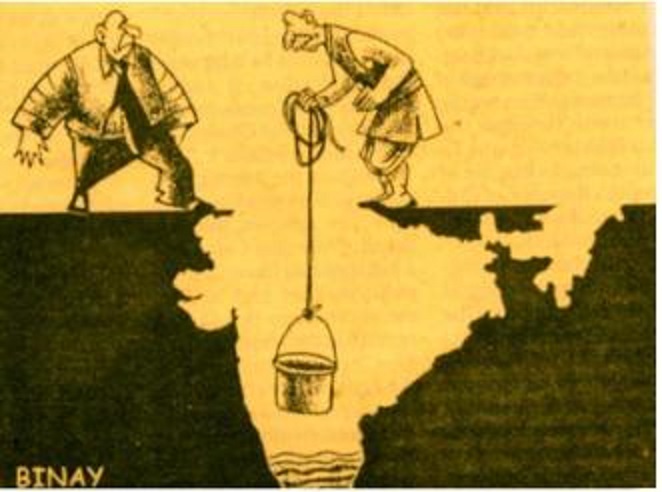
As even NITI Aayog report acknowledged in June 2018[i], there is consensus that India is facing dire water crisis, which will only get worse. This was also predicted by the World Bank way back in their 2006 report called “India’s Turbulent Water Future”. But do we have the institutions that are capable of taking us out of this crisis? Remember the current institutes are at the root of our water crisis.
Imagine you have to forecast flood using a mathematical model run on a Pentium processor; or manage your office with typewriters instead of a desktop! How frustrating isn’t it, to manage an office with the near obsolete typewriter or run a flood forecasting model using outdated Pentium processor? Continue reading “Can Outdated Water Institutes steer India out of dire crisis?”→
It’s a strange situation in Gujarat. While everyone is talking about unprecedented drought and the drought hit are suffering due to lack of water for irrigation and even water supply, the Sardar Sarovar Dam today (April 16) is at 119.14 m, and has 1095 Million Cubic Meters (MCM) in Live storage, in addition to about 3700 MCM of water in what is called dead storage. The Dam has received much more water this year compared to last year. SSP Water level on April 16, 2019 is up from 115.55 m, the lowest level it reached this water year[i] on March 3, 2019, since 2018 monsoon.
A pond dug a few years ago in Jignanda village of Hamirpur district still holds plenty of water despite scanty rainfall (Photo by Soumya Sarkar)
In a remarkable campaign during the ongoing general elections, Bundelkhand villages have demanded PONDs for Votes. This is exactly what is required for Bundelkhand, and not the destructive, costly and contractor driven Ken Betwa link that BJP has been trying to push here. Congratulations to the Bundelkhand people and People’s Science Institute that has led this campaign.
SYNOPSIS: Everyone concerned agrees that India is facing unprecedented and worsening water crisis. Some of the key aspects of water sector challenges include: Lack of reliable water information, need for restructuring of institutions, groundwater lifeline in distress, politicians and institutions pushing more large dams when evidence shows they do not work, the need for attention to maintenance of massive water infrastructure, the increasing footprint of Urban water sector, State of our rivers in general and Ganga in particular, water management for agriculture, governance and changing climate, among others. Unfortunately, these challenges do not seem to get reflected as electoral issues and all parties are equally to be blamed for this. The current Union government has very poor report card on almost every one of the water sector challenges, and its seems like a series of missed opportunities.
(Feature image by Nishant Panwar, Vikas Nagar, shows Yamuna River in upper reaches in Jan. 2019)
On April 11, 2019, is the birthday of Yamuna river. The Yamuna Jayanti comes every year on the sixth day of ‘Chaitra’ (summer) Navratra. The Kapat (door) of famous Yamnotri shrine would be opened this year on May 7 for Char Dham Yatra.
In April-May 2019 India will vote to elect 17th Lok Sabha or Parliament. On April 11, the 1st of the 7 polling days, the home state of Yamuna river, Uttrakhand and the districts of Western Uttar Pradesh through which Yamuna river flows, will vote.
The two other states heavily dependent and Yamuna river, Haryana and Delhi will see voting on May 12. The district Mathura, Agra, Etawa, Kanpur, Hamirpur, Fatehpur and Allahabad of Uttar Pradesh located along Yamuna river will witness voting from second (April 18) to sixth phase on May 12.
Yamuna river at different locations between 8 to 11 April 2019. (Image Source: Yamuna Nadi Mitra Mandalis)
The NDA government come to power in May 2014 promising clean Ganga and Yamuna. The thousands of devotees of Mathura and residents of Agra were especially convinced of a promise of clean flowing Yamuna river. People were also hopeful that the government of the same party, BJP, in centre and in key basin states of Yamuna (Uttarakhand, Haryana and Uttar Pradesh) would bring a change in the situation. But over the five years, things have only deteriorated further. In fact, under the present government apart from dams and pollution a illegal sand mining has emerged as equally dangerous threat for the Yamuna rivers from upper reaches through middle and lower stretches.
On the occasion of Yamuna Jayanti, the Yamuna Nadi Mitra Mandli (YNMM) a voluntary group of villagers and concerned; established along the length of Yamuna by Yamuna Jiye Abhiyan is highlighting the issues affecting the Yamuna river and riparian communities which have remained unaddressed during past five years and none of the political parties even now have remotely focused on these. They also warn that ignoring the problems of Yamuna and dependent community will soon affect every state and dependent people in a significant way apart from endangering the river itself.






 SANDRP