
A detailed report this week based on extensive field visit and interview of the concerned persons shows once again why there is no justification for Ken Betwa Link starting from lack of hydrological justification: There is no credible evidence or are not credible figures proving that Ken has surplus water and Betwa is deficit. The project will actually facilitate export of water from drought prone Bundelkhand in addition to bringing massive adverse impacts and as a former Panna collector said, will keep the upstream Ken Basin area permanently backward. This was also proved during the SANDRP initiated Ken Yatra from Ken Yamuna confluence upstream to the origin of the river.
The whole exercise of getting clearances for the project has been an exercise in manipulations at each step of the way, including EIA, Public Hearings, EAC process, Environment Clearance, Forest Clearance, Wildlife clearance and gram sabha clearances. This is also true as this report shows, for the people to be displaced by the project. The scathing CEC (Central Empowered Committee appointed by the Supreme Court) report on its wildlife related issue has not even been considered by the Supreme Court. We hope the Supreme Court will soon consider this and put a stop to the mindless project.
The forest clearance is in fact on conditions that changes the basic parameters of the project, requiring fresh cost benefit analysis, EIA and EC. The hydrological figures need urgent independent scrutiny, particularly considering the additional reason for changing climate. One only hopes that better sense will prevail and this massive costly, contract driven project will not go forward.

Ken-Betwa Linking Adivasis in Panna tiger park: dammed futures The project has been widely criticised. “There is no justification for the project, not even hydrological justification,” says scientist Himanshu Thakkar who has been involved in the water sector for 35 years. “To begin with, the Ken does not have surplus water. There has been no credible assessment or objective study, only pre-determined conclusions,” he adds.
– Thakkar is Coordinator of the South Asia Network on Dams, Rivers and People (SANDRP). He was a member of the expert committee set up around 2004 by the Ministry of Water Resources (now Jal Shakti) on interlinking of rivers. He says the very basis of the project is shocking: “River linking will have huge environmental and consequent social impacts on forest, river, biodiversity and will impoverish people here as well as in Bundelkhand and far beyond.”
– Panna Tiger Reserve (PTR) has 79 of the great cats and when the dam drowns a large part of core forest area… What will be the hydrological implication of cutting down some 46 lakh trees (as per assessment given in Forest Advisory Committee meeting in 2017) from natural forest has not even been assessed. Tigers are not the only hapless wild residents. One of India’s only three ghariyal (crocodile) sanctuaries is a few kilometres downstream of the proposed dam. The area is also an important nesting site for the Indian vulture – on the IUCN Red List for Critically Endangered birds. Besides there are many large herbivores and carnivores who will lose habitat.
– In October 2023 when the final sanctions for the Ken-Betwa River Linking Project (KBRLP) came through, it was welcomed with cheers by then BJP Chief Minister Shivraj Singh Chouhan. He called it a “fortunate day for the people of Bundelkhand who had lagged behind.” He made no mention of the thousands of farmers, herders, forest dwellers and their families in his state that it would deprive. Nor did he see that the forest clearance was awarded on the basis that power generation would be outside the PTR, but now it is inside.
– The notion that the Ken has surplus water needs to be questioned, says Dr. Nachiket Kelkar. The dams that already exist on the Ken– Bariyarpur barrage, Gangau dam and one at Pawai – should have provided for irrigation. “When I visited Banda and surroundings along the Ken some years back, I regularly heard that irrigation water was not available,” adds this ecologist at the Wildlife Conservation Trust. Researchers from SANDRP who walked the length of the river in 2017 wrote in a report , “…the Ken is now not a perennial river everywhere…For a longer part, the river runs flowless and waterless.” Ken itself has an irrigation deficit, so what it can give to Betwa will compromise its own command area. A point echoed by Nilesh Tiwari who has lived all his life in Panna. He says there is a lot of anger about the dam as it will permanently deprive people of Madhya Pradesh while seeming to benefit neighbouring Uttar Pradesh.
– As a result of the lies and opacity behind state action, in every village that PARI visited, no one knew when and where they would go, or the exact amount / rate of compensation for houses, land, cattle and trees. People of 22 villages seem to be living in a state of suspended animation.
– “Not many people talk about climate change in central India, but it is here that we are witnessing rapid increase in extreme rain events as well as droughts, both indicative of climate change impacts,” points out ecologist Kelkar. “Most rivers in central India are seeing accelerated flows caused by climate change, but they won’t last. These flows may be feeding the notion of surplus now, but under climate change projections, it is evident that they would be short-term.” He warns that if these short-term changes are encashed to link rivers, the possibility of the region facing far more serious drought in the future cannot be ruled out. Thakkar also warns that the hydrological impact of destruction of a huge area of natural forest, is a monumental mistake. “The report of the Central Empowered Committee of the Supreme Court has thrown light on this, but that report has not even been considered by the SC.”
– Whatever data has been used by the National Water Development Agency (NWDA) under whose aegis the project exists, is not being shared with scientists, citing national security concerns, adds Himanshu Thakkar. In 2015, when the dam began to look like a real possibility, Thakkar and others in SANDRP had wrote many letters to the Environment Assessment Committee (EAC). One such titled ‘Flawed Ken Betwa EIA & violations in Public Hearing’ said, “the EIA of the project is fundamentally flawed, incomplete and its public hearings involved numerous violations. Any clearance to the project with such inadequate studies would not only be wrong, but also legally untenable.” https://ruralindiaonline.org/en/articles/adivasis-in-panna-tiger-park-dammed- (28 Nov. 2024)
टीकमगढ़ जिले में अभी चार दशक पहले तक हजार तालाब हुआ करते थे। यहां का कोई गांव ऐसा नहीं था जहां कम से कम एक बड़ा सा सरोवर नहीं था, जो वहां की प्यास, सिंचाई सभी जरूरतें पूरी करता था। आधुनिकता की आंधी में एक चौथाई तालाब चौरस हो गए और जो बचे तो वे रखरखाव के अभाव में बेकार हो गए।
जामनी नदी बेतवा की सहायक नदी है और यह सागर जिले से निकल कर कोई 201 किलोमीटर का सफर तय कर टीकमगढ जिले में ओरछा में बेतवा से मिलती है। आमतौर पर इसमें सालभर पानी रहता है, लेकिन बारिश में यह ज्यादा उफनती है। योजना तो यह थी कि यदि बम्होरी बराना के चंदेलकालीन तालाब को नदी के हरपुरा बांध के पास से एक नहर द्वारा जोड़ने से तालाब में सालभर लबालब पानी रहे। इससे 18 गावों के 1800 हैक्टर खेत सींचे जाएंगें। यही नहीं नहर के किनारे कोई 100 कुएं बनाने की भी बात थी, जिससे इलाके का भूगर्भ स्तर बना रहता। अब इस येजना पर व्यय है महज कुछ करोड़। इससे जंगल-जमीन को नुकसान कुछ नहीं है, विस्थापन एक व्यक्ति का भी नहीं है। इसको पूरा करने में समय कम लगता। इसके विपरीत नदी जोड़ने में हजारों लोगों का विस्थापन, घने जंगलों व सिंचित खेतों का व्यापक नुकसान, साथ ही कम से कम से 10 साल का काल लग रहा है।

समूचे बुंदेलखंड मे पारंपरिक तालाबों का जाल है। आमतौर पर ये तालाब एकदूसरे से जुड़े हुए भी थे, यानी एक के भरने पर उससे निकले पानी से दूसरा भरेगा, फिर तीसरा। यही नहीं बहुत से स्थानों पर तालाब स्थानीय छोटी नदियों से भी जुड़े हुए थे, जिनसे पानी का आदान-प्रदान चलता था। इस तरह बारिश की हर बूंद सहेजी जाती थी। बुंदेलखंड में जामनी की ही तरह केल, जमडार, पहुज, शहजाद, टौंस, गरारा, बघैन, पाईसुमी, धसान, बघैन जैसी आधा सैंकडा निदयां है जो बारिश में तो उफनती है, लेकिन फिर यमुना, बेतवा आदि में मिल कर गुम हो जाती है। यदि छोटी-छोटी नहरों से इन तालाबों को जोड़ा जाए तो तालाब आबाद हो जाएगे। इससे पानी के अलावा मछली, सिंघाड़ा कमल गट्टा मिलेगा। इसकी गाद से बेहतरीन खाद मिलेगी। केन-बेतवा जोड़ का दस फीसद यानी एक हजार करोड़ ही ऐसी योजनाओं पर ईमानदारी से खर्च हो जाए तो 20 हजार हेक्टेयर खेत की सिंचाई व भूजल का स्तर बनाए रखना बहुत ही सरल होगा। (पंकज चतुर्वेदी) http://m.samaylive.com/editorial/521143/who-does-not-want-river-pond-linking.html (30 Nov. 2024)
NCC gets contract to build ₹3,389.49 cr Daudhan dam Infrastructure Company NCC Ltd on Nov. 29 has received a contract valued at Rs 3,389.49 crore to execute the Daudhan Dam under the Ken-Betwa Link Project. The contract involves planning, design, engineering, and hydro-mechanical works on an EPC basis. The project is to be completed over a 72-month period. The company received the Letter of Acceptance on November 28. https://economictimes.indiatimes.com/industry/indl-goods/svs/construction/ncc-gets-rs-3389-49-crore-ken-betwa-link-project-authority/articleshow/115801984.cms (29 Nov. 2024)
HYDRO POWER PROJECTS
SANDRP Blog Letter to EAC: No justification for Adani Dams in Western Ghats Parineeta Dandekar writes to MoEF’s expert Appraisal Committee on River Valley Projects about the re-submission of Adani’s 1500 MW Warasgaon Warangi Pump Storage Projects near Pune in Western Ghats of Maharashtra for clearance for Terms of Reference for the EAC meeting being held on Nov 30 2024, showing why the project should not be cleared. https://sandrp.in/2024/11/29/letter-to-the-eac-no-justification-for-adani-dams-in-the-western-ghats/ (29 Nov. 2024)
Rajasthan Baran officials stand against forest clearance for hydro plant In the meeting of Baran (Rajasthan) District Development Coordination and Monitoring Committee (Disha) held under the chairmanship of MP Dushyant Singh, voices emerged against the construction of Greenko Energy’s proposed hydro power plant in Shahabad area. In the meeting, MLAs present including MP Dushyant Singh said that we do not want electricity in exchange for cutting 1.5 lakh trees. In the meeting held in the Mini Secretariat on Sunday, discussions were going on about providing water to the proposed Greenko hydro plant. Dushyant Singh said that on one hand Cheetahs are being settled in Kuno and on the other, there is talk of cutting down dense forests with rare trees. All public representatives unanimously opposed the Greenco Project. https://firstindia.co.in/news/india/baran-officials-stand-against-forest-clearance-for-hydro-plant (25 Nov 2024)
Uttarakhand Panel clears 5 HEPs on Ganga Observing that the benefits outweigh the potential drawbacks, a Supreme Court-appointed panel has backed setting up five HEPs on the Ganga and its tributaries in Uttarakhand — even as the MoEF and Jal Shakti Ministry opposed the projects. The ministries had raised apprehensions ranging from impact on rivers not being taken into account to the projects falling in landslide or seismic zones.
On August 8 this year, the Supreme Court asked the Centre why it had allowed only seven projects. It also formed a high-level committee, headed by Cabinet Secretary T V Somanathan, to revisit the B P Das committee report and decide the fate of the other 21 HEPs. This panel, in a report submitted to the court on November 8, gave a go-ahead to five projects — Bowala Nandprayag (300 MW on Alaknanda river), Devasri (252 MW on Pinder river), Bhyundar Ganga (24.3 MW), Jhalakoti (12.5 MW) and Urgam-II (7.5 MW). Apart from Somanathan, this panel had four others — secretaries of the Environment, Power and Jal Shakti ministries, and the Chief Secretary of Uttarakhand.
The panel took into account concerns raised by the Environment and Jal Shakti ministries but concluded that there is no clear-cut evidence to establish affinity between HEP structures and landslides. It noted that there might be some adverse impacts of the five projects proposed for recommendation, but added that their benefits outweigh the drawbacks and it serves the national interest to give them a nod. The Jal Shakti ministry’s key criticism was that the BP Das committee did not account for the cumulative impact of the projects on Alaknanda, Bhilangana and Dhauliganga rivers. The environment ministry was of the view that issues such as landslides, flash floods, glacial lake outburst floods and seismic activities had not been considered by the committee even as they had a significant impact on the region’s fragile ecology. The ministry highlighted that most of the 28 projects recommended were in vulnerable landslide zones and fell under seismic zone IV or V. It also pointed out that recent disasters such as Joshimath flash floods, Chamoli earthquake and Joshimath land subsidence occurred around project sites.
While it gave its go-ahead for five projects, the Somanathan committee was not in favour of the remaining 15. It ruled out seven because they fell in the path of areas vulnerable to glacial lake outburst floods. The other eight were ruled due to their impact on aquatic and terrestrial ecosystems. In the November 13 hearing, the Centre sought and was granted eight weeks to “place the final decision” before the top court after examining the BP Das committee’s report. https://indianexpress.com/article/india/moef-jal-shakti-said-no-but-panel-tells-sc-5-hydro-projects-on-ganga-are-good-to-go- (30 Nov. 2024)
UJVNL to use AI in operations to enhance efficiency Uttarakhand Jal Vidyut Nigam Ltd, will soon implement artificial intelligence to enhance efficiency and save time, said its managing director, Sandeep Singhal. https://timesofindia.indiatimes.com/city/dehradun/uttarakhands-hydropower-body-to-revolutionize-operations-with-artificial-intelligence/articleshowprint/115632707.cms (24 Nov 2024)
NGT notice to Centre, state, hydel cos over golden mahaseer habitat NGT has sought responses from the Centre (the union ministries of MoEF; fisheries, animal husbandry & dairying), state authorities (the fisheries departments of Uttarakhand & Himachal Pradesh), & private hydroelectric companies (including Birahi Ganga Hydro Power Project Ltd & Alaknanda Hydro Power Corp Ltd) about measures to conserve the habitat of the golden mahaseer, a protected fish species facing threats from ecological damage. The tribunal issued notices to all parties on Nov 19, before the next hearing on Mar 10. In its order, NGT called the petition’s concerns “substantial issues” involving compliance with environmental regulations. https://timesofindia.indiatimes.com/city/dehradun/ngt-takes-action-to-protect-golden-mahaseer-habitat-from-ecological-threats/articleshowprint/115703808.cms (26 Nov 2024)
Arunachal Pradesh Group seeks free power & 2% LADF for affected people A group of likeminded people headed by advocate Tai Shiva on Tuesday (Nov. 26) demanded the GoAP to implement 2% Local Area Development Funds (LADF) of Hydro-Power Policy 2008. The GoAP, as per the policy, is entitled to get 12% free power generated by power projects, but the department concerned has failed to provide details if the mentioned free power has been received or not, Adv. Shiva said while addressing media persons at APC here.
According to the MoU, additional 1% of free power of the project should have been provided for LADF by the developers. But no free power supply has been given to the affected people, he claimed. It was learnt through Right to Information that GoAP has been receiving 12% free power either in energy or monetary from the projects since 2008, but he claimed that neither free power nor 2% LADF was given to the people though the GoAP had notified on 06.06.22 to implement the LADF. Shiva urged the GoAP and developers of Pare, Ranganadi and Kameng Hydro Projects to provide the facilities to the affected residents as per the policy otherwise the group would be forced to resort to legal battle. https://arunachalobserver.org/2024/11/27/group-seeks-free-power-2-ladf-for-affected-people-threatens-legal- (26 Nov. 2024)
Mili raises indigenous people’s land rights issue at UN forum Addressing the 13th annual United Nations Forum on Business and Human Rights (UNBHR) here in Switzerland, human rights and conservation activist, advocate Ebo Mili “highlighted the ongoing struggle of the indigenous communities to protect their ancestral lands amid increasing pressure from state governments and local representatives (MLAs), who have often become advocates for dam developers,” the North East Human Rights informed in a release.
He emphasised the violation of free, prior, and informed consent principle, citing the longstanding resistance against the Dibang multipurpose dam project. “Despite decades of opposition, the project proceeded, resulting in the loss of land, forests, and rivers for compensation that amounted to approximately 40% of the actual value,” Mili said. He pointed out the failure of local leaders and the administration to adequately support the families affected by the project. He also shed light on the continuous pressure from the state government for the Siang upper multipurpose project. Mili criticised the use of strategic defence narratives, concerns over Chinese dams and nationalistic rhetoric to justify the project. https://arunachaltimes.in/index.php/2024/12/01/mili-raises-indigenous-peoples-land-rights-issue-at-un-forum/ (01 Dec. 2024)
Centre approves 2 HEPs worth ₹3,689cr The Cabinet Committee on Economic Affairs (CCEA) on Nov 25 approved two hydropower projects with an investment of Rs 3,689 cr. After the Cabinet meeting, Union minister Ashwini Vaishnaw said that the CCEA approved an investment of Rs 1,750 cr for the 186 Mw Tato-I & Rs 1,939 cr for 240 Mw Heo hydroelectric project in Shi Yomi district of Arunachal. The projects will be implemented through joint venture companies between Northeastern Electric Power Corp Ltd and the Govt of Arunachal.
For Tato-I project, the Centre will extend Rs 77.37 cr as budgetary support for the roads, bridges & transmission lines besides central financial assistance of Rs 120.43 cr towards equity share of the state. For Heo project, the Govt of India shall extend Rs 127.28 cr as budgetary support for roads, bridges & transmission lines besides central assistance of Rs. 130.43 cr towards equity share of the state. https://pib.gov.in/PressReleasePage.aspx?PRID=2077111 (25 Nov. 2024)
Lower Subansiri HEP 3 units to start power generation by March 2025 NHPC here claims three units of 2000 MW Lower Subansiri HEP will start generating power by Mach 2025. Many earlier such claims have come and gone without fulfillment. About 3,000 workers are functioning round the clock and it is likely to be fully commissioned by May 2026, project head Rajendra Prasad said. “The project is 95-96 per cent complete,” Prasad said.
“Due to the eight-year delay, the project cost increased from Rs. 6,285 cr in 2005 to about Rs. 26,000 cr presently. A total of Rs. 22,000 cr has been spent and the project is in its final phase. Prasad said that a DPR of two more projects of 1650 Mw and 1710 Mw to be built on the other banks of Subansiri river is being prepared. https://arunachaltimes.in/index.php/2024/11/26/3-units-of-2000-mw-subansiri-project-to-start-power-generation/ (26 Nov. 2024)
Hydrogeological survey for spring rejuvenation The GB Pant National Institute of Himalayan Environment (GBPNIHE) and the International Centre for Integrated Mountain Development conducted a field survey here in Lower Subansiri district from 23 to 28 November, focusing on identifying recharge zones using hydrogeological assessments. The initiative, aimed at rejuvenating and conserving the Siya Piro spring, was a step towards addressing water security and enhancing ecosystem resilience in the Indian Himalayan region.
The survey was part of the HI-REAP programme under the project titled ‘Scaling ecosystem-based approaches in the Indian Himalayan region for climate adaptation and biodiversity resilience’. It was led by GBPNIHE-NERC Scientist C Tridipa Biswas, and supported by a multidisciplinary team. The findings from this survey will contribute to the springshed rejuvenation and conservation framework, ensuring sustainable water supply for local communities while strengthening biodiversity resilience. https://arunachaltimes.in/index.php/2024/11/30/hydrogeological-survey-for-spring-rejuvenation/ (30 Nov. 2024)
Himachal Pradesh ठेके के अनुबंधों के मुताबिक 18% फ्री बिजली देने से मुकर जाने पर सुक्खू सरकार की ओर से जेएसडब्ल्यू को 1200 मेगावाट के कड़छम वांगतू पावर प्रोजेक्ट को लेकर हुए समझौते को रदद करने के भेजे नोटिस पर अमली जामा पहनाने पर सुप्रीम कोर्ट ने रोक लगा दी है। निदेशक ने नोटिस में ये भी कहा था कि अगर वो 18% फ्री बिजली देने में नाकाम रहा तो प्रदेश सरकार इस प्रोजेक्ट को टेक ओवर करने की प्रक्रिया शुरू कर देगी। https://reporterseye.com/sc-stayed-takeover-proceeding-of-1200-mw-karchhme-wangtoo- (1 Dec 2024)
Dry spell hits power generation in Kangra As per Himachal Pradesh State Electricity Board, power generation from 66 MW Bassi hydro power plant in Kangra district was down to just 13 MW. In 6 MW Binwa generation was down to 1.5 MW, in 12 MW Baner generation was down to 1 MW, 12 MW Khauli down to 1 MW and 10.5 MW Gaj down to 1.3 MW. The micro hydel projects have been hit the hardest due to dry spell and decrease in water flow in river emanating from Dhauladhar mountain ranges in Kangra district.
SE Generation HPSEB (Ltd), Deeraj Dhiman when asked, said the overall power generation in Palampur region was down to 15 per cent of the installed capacity. Reduced inflows in rivers was also hitting the farmers of Kangra region who are dependent for irrigation on them. https://www.tribuneindia.com/news/himachal/dry-spell-hits-power-generation-in-hydro-power-projects-in-kangra/ (29 Nov. 2024)
Tripura NHPC to conduct study for renovation of Dumbur HEP The NHPC will visit Tripura to study for the renovation and modernisation of the Dumbur HEP in Gomati district. The NHPC has constituted an expert panel for the study. The project remains shut since Sept 2024 floods due to extensive damages. https://www.indiatodayne.in/tripura/story/tripura-nhpc-to-conduct-study-for-renovation-of-dumbur-hydroelectric-project-1127541-2024-11- (26 Nov. 2024)
Ladakh Union power minister visits 45 Mw Nimoo Bazgo HEP Union minister of power Manohar Lal visited the 45 MW NHPC Nimoo Bazgo Power Station in Leh district to review its operations and assess renewable energy initiatives in the region. Accompanied by NHPC CMD R.K. Chaudhary, the minister examined various aspects of the power station’s operations and its contribution to Ladakh’s energy infrastructure. The project utilizes the Indus River. https://energy.economictimes.indiatimes.com/news/power/union-power-minister-visits-45-mw-nhpc-nimoo-bazgo-power-station-reviews-renewable-energy-efforts/115586093 (23 Nov 2024)
NGRI discovers geothermal reservoir linked to springs A potential new geothermal reservoir has been uncovered in eastern Ladakh by scientists from the National Geophysical Research Institute (NGRI). This discovery opens up the possibility of harnessing geothermal energy. The research revealed that a sizeable conductive zone exists approximately 4 km beneath the surface, which is connected to deeper conductive layers extending from southern Tibet to Ladakh. These layers, representing partially molten material, are believed to be the source of geothermal energy observed at the surface. https://timesofindia.indiatimes.com/city/hyderabad/new-geothermal-reservoir-discovered-in-ladakh-by-ngri-ushering-in-sustainable-energy-potential/articleshow/115633156.cms (26 Nov 2024)
Sikkim Act fast to mitigate disaster in Teesta ValleySave the Hills (Kalimpong) and Darjeeling Himalaya Initiative have written to the PM and CMs of Sikkim and W Bengal regarding the threats that the Teesta River poses since the Oct 2023 GLOF. They have asked for a landscape level interventions covering both states and beyond, a multi disciplinary task force urgently so that steps can be taken before the next monsoon. https://www.thehindu.com/sci-tech/energy-and-environment/teesta-valley-disaster-glof-2023-sikkim-west-bengal-act/article68885161.ece (20 Nov. 2024)
Govt building defences to stop GLOF According to officials, the three survey expeditions made this year found 16 lakes to be most vulnerable. Now, a “comprehensive test” on these 16 vulnerable lakes is underway in collaboration with the National Disaster Management Authority and the Swiss Agency for Development and Cooperation. The multiple options under consideration to reduce the water volume in the lakes include siphoning, pumping and creating a channel. The plan is to tap natural channels, if available, or even tunnel through the rock if the lake structure is strong. As a second line of defense, the possibility of building check-dams in the valleys below is being explored. https://www.indiatoday.in/india-today-insight/story/how-sikkim-is-building-defences-to-stop-glacial-lakes-from-breaking-free-2641722-2024-11-28 (28 Nov 2024)
Report NGT issues notice over rapid expansion of Himalayan glacial lakes The NGT has issued notice to the Centre and its agencies regarding the rapid expansion of the Himalayan glacial lakes, raising concerns over the increasing risk of natural disasters. NGT took a suo motu proceeding over a media report. The report indicated the expansion of Himalayan glacial lakes by 11 % in over a decade, raising serious flood threat concerns & called for urgent action.
In an order on Nov 19, the bench headed by the NGT chairperson Justice Prakash Shrivastava and expert member A Senthil Vel said, “The report notes that the surface area of glacial lakes in India has increased by 33.7 per cent from 2011 to 2024.” The tribunal stressed the urgent need for enhanced monitoring, early warning systems, and improved flood management strategies to mitigate the potential damage. The NGT issued notice to the MoEF&CC, GB Pant Institute of Himalayan Environment, and CPCB. Next hearing on March 10 2025. https://www.newindianexpress.com/nation/2024/Nov/27/ngt-issues-notice-to-govt-agencies-over-rapid-expansion-of-himalayan-glacial-lakes (27 Nov. 2024)
Himalayan river basins under climate change threat: MoJS The Union Ministry of Jalshakti has urged the need for climate mitigation to prevent a severe reduction in snow cover due to climate change. It also urged to save water resources in major river basins including the Ganges, Indus and Brahmaputra. The ministry filed an affidavit in response to the NGT notice. The NGT had previously issued a notice to the ministry regarding the accelerated melting of snow and glaciers that would impact different Himalayan river basins. https://www.newindianexpress.com/nation/2024/Nov/27/himalayan-river-basins-under-climate-change-threat-urgent-action-needed-jal-shakti-ministry (27 Nov. 2024)
Dr Ravi Chopra advocates majority community representation in decision making bodies related to Himalayas. https://civilsocietyonline.com/interviews/himalayas-on-the-verge-of-a-crisis-now-says-ravi-chopra/ (28 Nov. 2024)
ICRA Renewable energy capacity to touch 250 Gw mark by March 2026 Icra on Nov. 19 said it expects the installed renewable energy capacity, including large hydro projects, in India to increase to about 250 Gw by March 2026 from the level of 201 Gw as of Sept 2024. ICRA expects the energy storage capacity requirement at 50 Gw by 2030, which will be met through a mix of battery energy storage systems (BESS) and pumped storage hydro projects (PSP). India’s target is having 500 Gw renewable energy capacity by 2030. https://economictimes.indiatimes.com/industry/renewables/indias-renewable-energy-capacity-to-touch-250-gw-mark-by-march-2026-icra/articleshow/115451893.cms (19 Nov. 2024)
CEA New hydro tech offers renewable energy at ₹2-3 per unit The Hydrokinetic Turbine (SHKT) technology generates electricity by utilizing the kinetic energy of flowing water without requiring civil infrastructure like dams or barrages. It provides an alternative to conventional hydropower units and is designed to support the power sector’s demand for base-load, round-the-clock renewable energy, particularly in areas with limited grid access. SHKT projects can also be canals and hydropower tailrace channels. The technology is scalable to GW levels. https://energy.economictimes.indiatimes.com/news/power/new-hydro-tech-offers-renewable-energy-at-2-3-per-unit-cea/115714775 (27 Nov. 2024)
NHPC CMD gets additional charge of SJVNL CMD NHPC said that its CMD Raj Kumar Chaudhary has been given the additional charge of the post of SJVN Ltd Chairman and Managing Director. Chaudhary is currently, since Aug 7 2024 serving as NHPC Chairman and Managing Director. He joined NHPC in 1989 as a Probationary Executive (Civil) at Koel Karo HE Project, Jharkhand. Chaudhary steadily rose to various positions in NHPC, including the post of Director (Technical), NHPC. He played an active role in the commissioning of the Teesta-V HE Project (510 MW) in Sikkim & the Mangdechhu HE Project (720 MW) in Bhutan. https://www.theweek.in/wire-updates/business/2024/11/28/dcm37-biz-nhpc-cmd-sjvn.html (28 Nov 2024)
DAMS
Kaleshwaram Project MoJS advisor blames govt for NDSA report delay The National Dam Safety Authority (NDSA) may take more time to submit its final report on the three barrages, which are part of the Kaleshwaram lift irrigation scheme (KLIS). Reason: Despite repeated requests to the state by NDSA, the govt failed to submit data and other material required for the authority to proceed with its final report. The Authority last wrote to the state on Oct 11, asking it to submit details by Oct 31. “The state govt has not sent the requested reports. Without them, NDSA cannot come up with a conclusion and prepare a report,” Union jal shakti ministry advisor Sriram Vedire said after meeting the Ghose commission on Nov 27 2024. The state govt has commissioned reports from some national agencies for this, which are likely to come by Dec.
Sriram blamed the govt for damaging a portion of the affected block at Medigadda by taking up restoration works such as grouting. He said NDSA was supposed to conduct both geo-technical and geo-physical tests at the barrages to know the reason for the damage, but these were not done by the govt.
“Instead, the govt did grouting both upstream and downstream of Medigadda. As a result, important geo-technical data and evidence were lost. Now, only geo-physical investigations can be done,” Sriram said. In its letter to the state govt in Oct, NDSA said, “Prima facie we (NDSA) are of the opinion that precious time was lost by irrigation department due to delayed starting of the studies and investigation works after receipt of panel recommendations. The irrigation department, on the advice of another expert committee, significantly interfered with NDSA panel recommendations. This included grouting underneath plinth slab at the upstream and downstream, thereby altering the ground conditions at secant pile and the parametric joint of Medigadda barrage, the conditions of which were to be assessed in its original state…” https://timesofindia.indiatimes.com/city/hyderabad/jal-shakti-advisor-blames-telangana-for-delays-in-ndsa-report-on-kaleshwaram- (28 Nov. 2024)
‘Quality control files of barrages missing’ Justice PC Ghose Commission, which has taken over all the files and correspondence on the construction of the three barrages—Medigadda, Annaram, and Sundilla—from the field-level engineers on Nov 25, found some files pertaining to the quality check have gone missing. Justice Ghose Commission resumed its inquiry and summoned 52 field-level engineers, ranging from assistant engineers to executive engineers and other top-level officers, in a phased manner. Eighteen assistant executive engineers and deputy engineers were called and were examined about the works taken up during their tenure and the recording of the works on a day-to-day basis. https://timesofindia.indiatimes.com/city/hyderabad/missing-quality-control-files-spark-inquiry-into-barrages-construction-quality/articleshowprint/115669280.cms (25 Nov. 2024)
Engineers warned against ‘conflicting & misleading’ info Most of the engineers who deposed on Nov 26 were taken aback after the Commission warned them of serious consequences following their conflicting and ‘misleading’ information. Expressing anger and dissatisfaction over the approach of the engineers, the Commission told the engineers not to mislead it while deposing personally as the Commission already had plenty of documents and information collected from the department and other sources for finding the truth.
The Commission sought to know from them as to how they could give conflicting information. The Commission was aghast to get incoherent answers from some engineers in the matter of construction a block (2A) in Sundilla Barrage and what designs they had followed. Most of them told the Commission that they had followed instructions from the then Engineer-in-Chief of the project and executed the block based on the designs of the adjacent blocks. Officials later took the signatures of the engineers on placement and measurement registers of Sundilla Barrage and seized them. https://www.thehindu.com/news/national/telangana/ghose-panel-warns-kaleshwaram-engineers-against-giving-conflicting-and-misleading-information/article68915278.ece (26 Nov. 2024)
Sundilla barrage built without final designs In a startling revelation, engineers of central designs organisation (CDO) of the irrigation department have revealed that block 2A of Sundilla barrage was constructed without any final designs and that the barrage work was also completed. The CDO engineers told the Justice PC Ghose Commission that the barrage was constructed on the instructions of then chief engineer of Ramagundam circle, Nalla Venkateshwarlu.
Shifting the focus to the Sundilla barrage construction, the Ghose Commission questioned 16 engineers, including assistant engineers and deputy executive engineers, on Nov 26. Of the 52 engineers who were summoned. https://timesofindia.indiatimes.com/city/hyderabad/sundilla-barrage-construction-shrouded-in-controversy-engineers-confirm-lack-of-final-designs/articleshow/115708342.cms (26 Nov. 2024)
Engineers testify to missing designs It may be recalled that the original location of Sundilla barrage was changed, along with that of the barrage at Annaram, as part of the then BRS government’s plans to impound water at the required levels to enable pumping. During previous hearings, Venkateswarulu, under questioning, had testified that all work related to investigations at the changed locations was given to the contracted agencies, Afcons for Annaram, and Navayuga at Sundilla. Justice Ghose is expected to summon all the three agencies that built the barrages, including L&T PES-JV which built the Medigadda barrage for questioning soon.
On Nov 25, the commission had questioned officials involved with Medigadda barrage, and on Wednesday (Nov. 27), it is expected to question another 18 officials involved with construction of the Annaram barrage. https://www.deccanchronicle.com/southern-states/telangana/sundilla-barrage-leaks-engineers-testify-to-missing-designs-1841563 (26 Nov. 2024)
18 engineers depose before PC Ghose Commission Bheemaraju said that as the inquiry is still on, he is not in a position to reveal the exact reasons. However, the DyEE added that when he noticed bailing out of water from Medigadda, he immediately wrote two letters to the Executive Engineer. Later, the piers if the barrage sank on October 21, 2023.
In the presence of the Commission, the officials endorsed the logbooks, which they signed during the construction of the barrage. As all of them are lower-level officials, the Commission asked only one or two questions. https://www.newindianexpress.com/states/telangana/2024/Nov/26/18-engineers-depose-before-pc-ghose-commission (26 Nov. 2024)
Medigadda barrage dysfunction revives hope for Sironcha farmers Around 20,000 people from 25 villages in Sironcha taluka in Mah’s Gadchiroli district are rejoicing the failure of the Kaleshwaram scheme as their fortunes have been revived by the Medigadda barrage’s dysfunction. Sironcha taluka on the banks of Godavari River is famed for its chilli & cotton crops. Besides inundating large area of farm land, water in the Medigadda barrage spilled over to their fields in the monsoon. https://www.deccanchronicle.com/southern-states/telangana/medigadda-barrage-dysfunction-revives-hope-for-sironcha-farmers- (1 Dec 2024)
Telangana ACB uncovers ₹100 cr assets of suspended irrigation dept official Six months after the Anti-Corruption Bureau (ACB) trapped an assistant executive engineer in the irrigation dept, the agency’s sleuths conducted simultaneous searches on 20 places including his residence & properties of persons linked to him. They unearthed properties worth Rs 18 cr (govt value). Its market value could be about Rs 100 cr. The accused Herur Nikesh Kumar is suspended.
ACB officials said 20 different places, including his residence at Gandipet & those of his relatives, were searched. “Property documents pertaining to five plots, 6.5 acres of agricultural land, six flats and two commercial spaces were found,” an official said adding the searches discovered that the accused officer acquired movable & immovable properties worth 17.73 crore. https://timesofindia.indiatimes.com/city/hyderabad/big-fish-in-net-telangana-acb-uncovers-rs-100-crore-worth-assets-of-suspended-irrigation-dept-official/articleshow/115857666.cms (1 Dec 2024)
The ACB nabbed assistant engineer Vomakaram Narsinga Rao of the irrigation department on Monday (Nov. 25) for allegedly accepting a bribe of Rs 20,000 from a contractor in Peddapalli district. Rao, who served under the deputy executive engineer of the irrigation department, reportedly demanded Rs 20,000 from the contractor for clearing official bills. Suspicious of the misconduct, the contractor filed a complaint with ACB officials. https://www.deccanchronicle.com/southern-states/telangana/telangana-irrigation-dept-engineer-held-for-taking-rs-20k-bribe-1841200 (25 Nov. 2024)
Polavaram Project Height set by Andhra govt in 2021 amid blame game The Polavaram Project Authority (PPA) has made it clear that the Phase-1 concept emerged from the State government’s proposal, and the Centre approved it at a review meeting held on April 10, 2023 that the focus should be on achieving benefits at the specific water level of +41.15 metres. In reply to a query posed by RTI activist Inaganti Ravi Kumar of Bapatla, the PPA informed that the Andhra Pradesh government in its sixth meeting of Monitoring Committee for strengthening the process mechanism for Rehabilitation and Resettlement (R&R) of the Polavaram Irrigation Project (PIP) oustees held on July 29, 2021 mentioned that R&R works and shifting of Project Displaced Families (PDFs) would be taken up as per contour levels i.e up to +41.15 metres and +45.72 metres respectively, and focused to complete the R&R works up to +41.15 metres. https://www.newindianexpress.com/states/andhra-pradesh/2024/Nov/25/rti-reveals-polavaram-height-set-by-andhra-pradesh-govt-in-2021-amid-blame- (25 Nov. 2024)
Mullaperiyar dam Safety audit is dam owners’ responsibility: Centre In a major setback for Kerala as the Union govt confirmed that the National Dam Safety Authority (NDSA), established under the Dam Safety Act of 2021, does not have the authority to conduct safety audits of dams. Instead, the responsibility for comprehensive safety audits rests solely with dam owners. This clarification by the Union govt is expected to have far-reaching consequences, particularly regarding issues between Kerala and Tamil Nadu over the 125-year-old Mullaperiyar Dam. https://www.theweek.in/news/india/2024/11/29/mullaperiyar-dam-dispute-setback-for-kerala-as-centre-says-safety-audit-is-dam-owners-responsibility.html (29 Nov. 2024)
Maharashtra Dams, irrigation projects have not brought respite Farmers from hundreds of villages that fall in the command area of the Jayakwadi Dam have not had water for irrigation or decades. Technically, the dam’s command area spreads across five districts in Marathwada–Parbani, Aurangabad, Ahmednagar, Nanded and Beed. Built on the Godavari river starting 1965, the dam has an irrigation potential of 1,83,322 her Though the govt has built canals from the dams to many villages in the command area, these canals are now silted over and filled with vegetation since there is no regular flow of water, and no proper maintenance.
Jayakwadi is not the only dam that has failed to irrigate the planned command area. By Aug 2023, Maharashtra had 2,117 dams. In September 2020, IndiaSpend reported that government data showed the total drinking water requirement for Marathwada was 590 mm3 annually, and the average water consumption of sugarcane was 6,159 mm3–more than 10 times the drinking water requirement. If 50% of sugarcane area were brought under drip irrigation, the presentation said, it would save 3,080 mm3 of water, which is more than the storage of Jayakwadi Dam. Sugarcane is the only crop in Maharashtra which is wholly irrigated. Irrigation water is available for no more than 9% of pulses and 4% of oilseeds.
– While developing the Ujani Dam, farmers in Barshi taluka of Solapur district were told that they would get two TMC of water every year (57 billion litres). “But since then, we have never got the assured water,” Tanaji Nimbalkar, of Shendri village in Barshi taluka, said. “The government has put canals/pipelines through our farms, but they are dry, and do not bring any water.
– Maharashtra accounts for nearly 12% of India’s net sown area and contributes around 8% of India’s agricultural gross value added (GVA). About 74% of Marathwada’s population depends on agriculture and allied activities.
– A less-noticed issue is that large dams can, during monsoons, aggravate flooding, which in turn causes soil erosion. https://www.indiaspend.com/agriculture/dams-and-irrigation-projects-have-not-brought-respite-to-farmers-in-marathwada- https://www.indiaspend.com/agriculture/dams-and-irrigation-projects-have-not-brought-respite-to-farmers-in-marathwada-931690 (19 Nov. 2024)
Madhya Pradesh किसानों के बेटों को मुआवजा देने पर निर्णय ले सरकार: ओंकारेश्वर बांध प्रभावितों पर हाईकोर्ट का फैसला; नर्मदा बचाओ आंदोलन ने दायर की याचिका https://www.bhaskar.com/local/mp/jabalpur/news/high-courts-decision-on-omkareshwar-dam-affected-people- (30 Nov. 2024)
Karnataka Iggaluru dam is everyone’s favourite Iggaluru dam in Channapatna, was inaugurated in 1996. It was built across the Shimsha river, a tributary of the Cauvery. Lakes in and around the taluk are getting water from this reservoir under the lift irrigation, and farmers are growing ragi, paddy and even sugarcane. https://www.newindianexpress.com/states/karnataka/2024/Nov/08/karnataka-this-poll-season-iggaluru-dam-is-everyones-favourite (08 Nov. 2024)
Himachal Pradesh BBMB cautions member states With the region experiencing deficient post-monsoon rain and snow cover in catchment areas of major dams, the Bhakra Beas Management Board has said. “We have asked our member states to exercise caution in projecting their demand for water in the coming months given that the current storage as well as inflows are below normal for this time of the year,” a senior BBMB functionary said. Punjab, Haryana, Himachal Pradesh, Delhi and Rajasthan are BBMB member states that draw water from Bhakra and Pong dams.
Snowfall in the catchment areas of dams has also been below par. The Western Himalayas have not experienced any significant snowfall so far this season. “The region used to start getting snow by mid-October. There was a forecast of a western disturbance in mid-November, but it did not materialise. The present snow cover is estimated to be about one billion cubic metres, which is about 30 per cent less than what it should be,” the official said.
According to BBMB officials, no long-term forecasts for snowfall are issued and hence it is not feasible to determine future inflows. “Since water levels were already deficient at the end of the filling season, which ended in Sept, we have no choice, he said. https://www.tribuneindia.com/news/punjab/water-level-low-in-dams-bbmb-cautions-member-states/ (21 Nov. 2024)
INTERSTATE WATER DISPUTES
Pennaiyar Water Dispute SC seeks report on dispute between Tamil Nadu, Karnataka The Supreme Court on Tuesday (November 26, 2024) asked the Union government to place on record the report prepared by a committee negotiating a dispute between Tamil Nadu and Karnataka over the sharing of the Pennaiyar river water. The States had moved into the negotiation mode after Karnataka took the initiative, after the formation of the new government in the State in May 2023, to try and resolve the dispute through talks. The court had in January 2024 directed the Union govt to constitute a new negotiation committee under Section 4 of the Inter-State River Water Disputes Act of 1956 to make a serious endeavour for a resolution between the two States.
– In 2018, Tamil Nadu moved the court against Karnataka’s work on check dams and diversions’ structures on the river. The State had told the Supreme Court that Karnataka had no right to utilise the waters of Pennaiyar river to the detriment of the people of Tamil Nadu. The flowing water of an Inter-State river is a national asset and no single State can claim exclusive ownership of its water, Tamil Nadu had argued. Tamil Nadu had argued that an 1892 agreement over the river water was “valid and binding” on the party States. It had said a river even included the stream, tributaries and other streams contributing water directly or indirectly into it. https://www.thehindu.com/news/national/sc-seeks-report-on-dispute-between-tamil-nadu-karnataka-over-sharing-of-pennaiyar-river- (26 Nov. 2024)
RIVERS AS NATIONAL WATERWAYS
Delhi Water taxi project still in works The Delhi government’s irrigation and flood control (I&FC) department has informed the NGT that the plan to operate a water taxi in the Yamuna is still in the works, adding that it is yet to receive an affidavit and an indemnity bond from the Inland Waterways Authority of India (IWAI), nearly five years after it gave its nod to the Central agency to use a shank at Sonia Vihar for project. The I&FC department’s statement came in the form of an affidavit submitted before NGT on November 23, informing the green court about the status of the project.
The Centre in 2018 had announced a water taxi project for the Delhi stretch of the Yamuna. Initially, the plan was that the project would cover a 16-km stretch of the river from Wazirabad to Fatehpur Jat. A year earlier, the NGT was approached for environmental clearance, but the green court referred the matter to a principal committee, and the panel in May 2017 said the project proponent needed to relook the proposal, taking into account the environmental impact of the proposed activities in the drinking water reservoir.
Meanwhile, experts have raised concerns about the project, noting that a water taxi service will require constant dredging of the river as well as a significant flow through the year. “This project has been in the works for several years now, but the problem remains the same — there is not enough flow in the Yamuna to sustain ferries. We also need to look at the aim behind this, as running a small loop has no purpose and it will not connect people to other transport hubs,” said Bhim Singh Rawat, a Yamuna activist and member of the South Asia Network on Dams, Rivers and People (SANDRP). “Instead of focusing on constant dredging, our goal first should be to improve the river’s water quality and improve the flow,” he added. https://www.hindustantimes.com/cities/delhi-news/yet-to-receive-indemnity-bond-for-yamuna-water-taxi-from-centre-delhi-govt-tells-ngt-101732645777121.html (27 Nov. 2024)
MoU signed for boat taxi rides on 7km stretch, govt tells NGT According to the expression of interest, the ferry ride is to start at Sonia Vihar and make its way to the Hanuman temple near Wazirabad barrage before returning to Sonia Vihar, a route of around 7km. I&FC has given permission for the use of the river bank there through its letter of March 15, 2019. The affidavit submitted to NGT adds, “However, IWAI asked for a security deposit of Rs 20 lakh to be waived off. For this, it agreed to submit the requisite documents, i.e., an indemnity bond and an affidavit.” I&FC said reminders were sent to IWAI in 2021 and more recently, on Oct 23.
In Sept, IWAI called for expressions of interest in operating the boat service. The plan is to initially have two electric or solar hybrid boats, each capable of seating 20-30 passengers. “The speed should be 5-7 knots, with a maximum draft of 1.2 metres,” the EOI states. Other infrastructure support that will be provided by IWAI and DDA, supported by DJB and I&FC, include polyethylene floating jetties, navigational aids and a shore facility providing e-charging.
The latest plan, as per the EOI, shows only a 4km stretch upstream of Wazirabad will be involved. Here, the water quality is comparatively better than in other stretches. In 2023, the Indian Navy, using INS Barasingha, carried out a navigability assessment that found the river depth varied from 0.9 metres to 4 metres between ISBT Kashmere Gate and ITO. https://timesofindia.indiatimes.com/city/delhi/delhi-government-signs-mou-for-eco-friendly-boat-taxi-service-on-yamuna-river/articleshow/115707186.cms (26 Nov. 2024)
IRRIGATION
Karnataka Task force to monitor illegal lifting of canal water Deputy CM D K Shivakumar on Monday (Nov. 25) announced that the govt would soon form a task force of irrigation and energy departments to stop illegal lifting of water from canals. Shivakumar, who holds the water resources portfolio, said this at a workshop for engineers on Karnataka Irrigation (Amendment) Act 2024 at Vikasa Soudha here. https://www.deccanherald.com/india/karnataka/task-force-to-monitor-illegal-lifting-of-canal-water-in-karnataka-3291556 (26 Nov. 2024)
Punjab Canals dried up for cleaning, Muktsar, Fazilka farmers edgy For the past about two weeks, Muktsar minor, Barkandi minor and Rupana minor, all falling in Muktsar district, have been running dry. Further, the Abohar division of the Department of Water Resources has now issued a schedule for the closure of Abohar branch, Malukpura minor, Panjawa minor, Daulatpura minor and Ramsara minor in Fazilka district from December 2 to 17 for their cleaning. The odd timing of the closure of canals for cleaning has left farmers worried in Muktsar and Fazilka districts. At this juncture, they need water to irrigate the early sown wheat crop. Besides, kinnow growers need water to maintain the moisture level of the soil as the weatherman has forecast frost for the next few days. https://www.tribuneindia.com/news/punjab/canals-dried-up-for-cleaning-muktsar-fazilka-farmers-edgy/ (01 Dec. 2024)
Water supply in Abohar branch canal, Malukpura distributary, Daulatpura minor (sub-canal), Ramsara minor and Panjawa distributary will be closed from December 2 to 17 for cleaning of these channels. The closure of water supply is likely to affect farmers who were yet to sow wheat. Agriculture experts said the ideal time for sowing wheat in the state was from November 1 to 15. https://www.tribuneindia.com/news/punjab/water-supply-to-abohar-channels-shuts-tomorrow/ (01 Dec. 2024)
URBAN RIVERS
Musi; Hyderabad HC clears HYDRAA’s path to raze illegal constructions The Telangana High Court has cleared the path of HYDRAA, along with revenue and municipal departments, to remove unauthorized constructions and structures within the full tank level (FTL) or riverbed zone of the Musi River. This marks a significant step toward the preservation of Hyderabad’s water bodies. The court emphasized that the state government has full authority to form HYDRAA and take necessary actions to protect and rejuvenate water bodies like the Musi.
Justice C.V. Bhaskar Reddy ruled that the state government, under Section 4 of the Telangana Irrigation Act, 1357 Fasli, possesses the legal power to establish and delegate functions to HYDRAA. The court rejected claims questioning the legality of the authority’s formation, asserting that rivers and tanks are community assets to be protected and managed for public benefit.
The judgment further clarified that land classified as patta or shikam patta within FTL or riverbed zones can only be acquired by the authorities after paying fair compensation. Moreover, unauthorized land allotments in such areas do not confer valid ownership rights. To ensure fairness, the High Court issued specific guidelines to be followed by HYDRAA and other authorities before removing encroachments: The Telangana High Court’s decision underscores the importance of safeguarding Hyderabad’s natural resources while ensuring justice and fair treatment for affected residents. https://www.siasat.com/hydraa-path-to-raze-illegal-constructions-in-hyderabad-musi-riverbed-cleared-3138256/ (27 Nov. 2024)
French delegation visits STPs A delegation from France visited the STPs constructed by the HMWS&SB in Attapur as part of an international workshop focused on the development of the Musi River. Board general manager Sathyanarayana briefed the delegation on the working of STPs and the role of what is called the ‘sequential batch reactor (SBR)’. Two STPs are operational in Attapur, with capacities of 51 and 23 MLD, while the construction of two more with capacities of 64 and 40 MLD. https://www.deccanchronicle.com/southern-states/telangana/french-delegation-visits-sewage-treatment-plants-in-hyderabad-1841313 (26 Nov. 2024)
Buddha Dariya; Ludhiana Farmers gear up for protest on Dec 3 To make the December 3 ‘Ludhiana Chalo’ programme a success, farmers organisations in Sriganganagar district have stepped up mobilisation in rural areas.
Under the ‘Zehar se Mukti’ campaign, farmers associations had got support from Beopar Mandal and other social organisations. Now, the Bar Associations in Sriganganagar and Abohar have also decided to support it. Both have sent memorandums to the Punjab CM through local administration demanding decisive action to end the menace of river water pollution.“Our demand is clear that the industrial units which are polluting the Sutlej should be closed,” BKU leaders Ravinder Tarkhan said. https://www.tribuneindia.com/news/punjab/farmers-gear-up-for-ludhiana-chalo-protest-on-december-3/ (01 Dec. 2024)
Kale Pani Da Morcha activists outlined their plans for closure of common effluent treatment plants of dyeing units at Tajpur Road on Dec 3. During a press conference held on Thursday (Nov. 28), they described the pollution caused by dyeing units as an emergency situation for Punjabis. Saying that such pollution had increased the incidence of cancer in the state, they exhorted residents to be part of the drive. One of the activists, Amitoj Mann, claimed that the treatment plants were operational despite court orders to close their outlets. https://timesofindia.indiatimes.com/city/ludhiana/activists-vs-dyeing-units-high-stakes-pollution-battle-in-punjab/articleshow/115784857.cms (29 Nov. 2024)
Deputy Commissioner Jitendra Jorwal has said any kind of violation on December 3 will be dealt with strictly. The administration has asked the Municipal Corporation and the police department to monitor the issue and no violation will be allowed on that day. At the same time, many farmer organisations have extended full support to the campaign of ‘Kale Pani Da Morcha’ and stated that they would reach Ludhiana to be with the activists who are trying to save the Buddha Nullah from pollution.
“The dyeing units claimed that the NGT has provided relief, but it’s misinformed. The fact is that NGT passed the order, subject to environment clearance, which was never given. We are fighting the battle for the masses and there has been no vested interests. We will stop discharge from CETPs on December 3,” said Khaira.
At the same time, the Dyeing Association has termed the morcha activists as ‘blackmailers’ and said nobody could take law in their hands. Dyeing unit owners said the campaign was aimed at extracting money from the dyeing factory owners for vested interests, which would not be allowed. https://www.tribuneindia.com/news/ludhiana/any-violation-will-be-dealt-with-strictly-says-dc/ (02 Dec. 2024)
After Punjab Dyers’ Association members met the deputy commissioner to voice their concern about Kale Pani Da Morcha activists’ plan to close CETPs at Tajpur Road on Dec 3, police personnel visited them at Tajpur Road on Saturday (Nov. 30). During the meeting, police assured them that they would not allow any damage to property or industrial infrastructure.
After announcing their plan to close dyeing units’ CETPs at Tajpur Road on Dec 3, activists exhorted people from across Punjab to bring sand to close the CETP outlets. Police have been instructed to arrest anyone trying to create disturbance at the site. Police force has been deployed at the site to prevent any untoward incident.
Amid the ongoing tussle between activists and dyeing unit owners, former member of state task force for Buddha Dariya Rejuvenation project, Col Jasjit Singh Gill, wrote to Punjab CM Bhagwant Mann on Saturday (Nov. 30) and sought his personal intervention in the matter. He also called for an emergency meeting with activists leading the Kale Pani Da Morcha, who want pollution-free water for people of Punjab and seven districts of Rajasthan. https://timesofindia.indiatimes.com/city/ludhiana/police-and-activists-clash-over-pollution-cetps-at-risk-of-closure-on-dec-3/articleshow/115854444.cms (01 Dec. 2024)
Activists under the banner of Kale Pani da Morcha, a campaign initiated to clean the Buddha Nullah by social organisations, on Thursday (Nov. 28) held an interaction with the media and stated that despite orders by law-enforcing agencies to shut CETPs in Ludhiana, the plants were running unabated. On the one hand, the activists threatened to block polluted water flow from CETPs on December 3 and on the other, dyeing units labelled the NGOs as “blackmailers” and said they would not let it happen. https://www.tribuneindia.com/news/ludhiana/activists-dyeing-units-at-loggerheads-over-buddha-nullah-pollution/ (29 Nov. 2024)
The waters of the Sutlej run black The ‘Kale Pani Da Morcha’ saw thousands of people turn out in Ludhiana to protest the state’s apathy, and call attention to the continuing pollution in the Buddha nala which empties into the Sutlej, once a source of potable water for drinking and irrigation.
https://ruralindiaonline.org/en/articles/the-waters-of-the-sutlej-run-black/ (26 Nov 2024)
Centre raises questions over Rs 840-cr rejuvenation project The water quality of the Buddha Nullah and the Sutlej has deteriorated more in 2024 as compared to 2022, the CPCB has said. The Union Government has expressed serious concern over the issue and has raised questions over the outcome of the Buddha Nullah rejuvenation project involving an expenditure of Rs 840 crore. The project launched in December 2020 to rejuvenate the nullah turned out to be a futile exercise.
Debashree Mukherjee, Secretary, MoJS, recently held a meeting with senior officials of the Centre and state government, besides experts from various agencies. Ludhiana MC Commissioner Aaditya Dachalwal said against the expected norm for using discharged water for irrigation, all CETPs were discharging treated wastewater into the Buddha Nullah in violation. There was also a proposal to release 200 cusecs of fresh water from the Sirhind canal into the nullah but it has not been consistent. At least two CETPs of 40 MLD and 15 MLD capacity were not complying with the prescribed discharge standards. The CPCB had also found that all effluent treatment plants were not meeting the prescribed discharge standards and issued directions for compliance on August 12. https://www.tribuneindia.com/news/ludhiana/centre-raises-questions-over-840-cr-buddha-nullah-rejuvenation-project/ (30 Nov. 2024)
Centre moots plan to clean Buddha Nullah Centre has come out with an action plan to clean and preserve one of the most polluted tributaries of Sutlej passing through Ludhiana before it confluences with the river and enters Rajasthan. The time-bound action plan, launched in collaboration with the state government, entails diagnosis of the issues concerning Buddha Nullah pollution, evaluation of the existing pollution abatement infrastructure to ensure optimization and corrective actions in order of priority, a senior officer told The Tribune on Tuesday (Nov. 26). She said the MoJS has formed a high-level joint group of experts and senior officers from both the Centre and Punjab to carry out the plan. The group has been asked to complete the task and submit its report within one month. https://www.tribuneindia.com/news/punjab/centre-moots-plan-to-clean-buddha-nullah/ (17 Nov. 2024)
Plans afoot to shift pump station MC commissioner Aaditya Dachalwal conducted a review meeting regarding the Buddha Nullah rejuvenation project at the Zone D office on Friday (Nov. 29). During the meeting, officials explored options to change the location of Gaushala intermediate pumping station. The pumping station could not be constructed as of now due to a pending court case regarding the ownership of the land where it is presently being constructed. Dachalwal said the other components of Buddha Nullah rejuvenation project have been completed and only the construction of Gaushala intermediate pumping station is pending due to a pending court case regarding the ownership of the land. Options are also being explored to change its location for expediting the project. https://www.hindustantimes.com/cities/chandigarh-news/ludhianas-buddha-nullah-rejuvenation-project-plans-afoot-to-shift-pump-station-101732904922223.html (30 Nov. 2024)
Mula-Mutha; Pune Activists condemn fresh EC to RFD The Pune Municipal Corp (PMC) has received the environmental clearance (EC) for the River Rejuvenation Project (RRP) of Mula, Mutha and Mula-Mutha rivers from the State Environment Impact Assessment Authority (SEIAA).
Earlier, the civic body had submitted a proposal to rejuvenate the rivers. However, SEIAA has denied permission for the project and asked the civic body to resubmit the proposal after getting permission from the Central Water and Power Research Station (CWPRS). After the proposal was resubmitted, SEIAA gave EC for the project. Meanwhile, the approval of the project is being slammed by many activists and residents. On the other hand, the PMC is asserting that this project will not cause flooding and will bring life back to these rivers which are under pressure through high rate of urbanisation and lack of care. https://www.freepressjournal.in/pune/pune-river-rejuvenation-project-receives-environmental-clearance-activists-condemn-it (26 Nov. 2024)
पुणे की एक करोड़ साल पुरानी नदियों पर संकट Aditi Deodhar https://hindi.downtoearth.org.in/river/punes-10-million-year-old-rivers-are-in-danger (27 Nov 2024)
RIVERS
Arunachal Pradesh Centre approves ₹28,229cr for 1,637km highway The Centre has sanctioned ₹28,229 crore for constructing the 1,637 km Arunachal Frontier Highway connecting 12 districts of the state along the Line of Actual Control (LAC) on the India-China international border, a top official said. The ambitious project to be built at an estimated cost of ₹ 40,000 crore is seen as a move to counter China’s aggression in Arunachal Pradesh, besides contributing to the socio-economic development of the border state. The highway is being constructed along the ‘India-Tibet-China-Myanmar’ border and the road project will be as close as 20 km from the LAC and international borders. It will start from Bomdila and pass through Nafra, Huri and Monigong towns, which are closer to the LAC or the McMahon Line and conclude in Vijaynagar near the India-Myanmar border. https://www.ndtv.com/india-news/centre-approves-rs-28-229-crore-for-1-637-km-arunachal-highway-along-lac-7121910 (28 Nov. 2024)
Meghalaya ‘Prohibit construction materials from being deposited along river’ Meghalaya HC has asked the state govt to issue an appropriate administrative order prohibiting any construction-generated materials from being deposited along Myntdu river in Jaintia Hills, mandating their disposal at administration-designated locations. The directive was issued by a bench of Chief Justice IP Mukerji and Justice W Diengdoh while permitting the state govt to proceed with construction works adjacent to the river.
The court was hearing a PIL Tuesday (Nov. 19) concerning grievances over govt permission for riverside construction work, resulting in debris being discharged into the riverbed. The petitioner, Registrar General of Meghalaya HC, additionally contended that the state govt’s insufficient measures to prevent river erosion led to silt accumulation in the riverbed. “The combined effect is choking up of the river, impeding adequate water flow for cultivation, drinking, and other purposes,” it stated. https://timesofindia.indiatimes.com/city/guwahati/meghalaya-high-court-orders-ban-on-construction-waste-dumping-into-myntdu-river/articleshow/115543257.cms (22 Nov. 2024) The court directed the government to continue its efforts to prevent soil erosion and remove debris. Additionally, the government must issue an administrative order prohibiting construction materials from being deposited into the river; instead, they should be transported to designated areas. Construction near the riverbank should be regulated, maintaining a fair distance and volume. The Amicus Curiae is required to submit a report by February 28, 2025. The government must file a report detailing actions taken by March 13, 2025. The court also granted the Amicus Curiae further ad hoc remuneration, to be paid by the State, equal to what was ordered on October 29, 2024. The PIL will be listed again on March 24, 2025. https://indialegallive.com/constitutional-law-news/courts-news/meghalaya-high-court-directs-state-govt-to-clear-myntdu-river-of-debris/ (20 Nov. 2024)
Onslaught on Myntdu river By K L Tariang As the careless road construction has critically affected the river, the questions that need to be asked are – why an alternative route—one reportedly surveyed earlier- farther from the river have not been chosen for the Dawki highway instead of the present one which is precariously close to the river. Questions also arise as to why an existing road diverging from the Shillong-Jowai route near Umulong village and already connected to the Jowai-Dawki road not far from Jowai is not instead upgraded into a highway for the same intended purpose. Moreover, with another parallel road already present along the opposite hillock, any flawed maintenance or expansion plans on these roads could further endanger the river’s health.
The ongoing road construction has increased siltation in the river, adding to sediment that already settled in the riverbed earlier because of sediments from unregulated quarrying upstream some years ago. These fresh sediments could affect fish habitats in pools developed by a local fishing association along the river course near Jowai thus undoing the association successful efforts. The sediment could potentially fill up the Jowai Water Supply Scheme’s reservoir as well which reportedly already requires frequent desilting.
Further siltation could reduce the reservoir’s lifespan, jeopardizing the entire Jowai water supply scheme. The sediments could also impact the irrigation systems, making agriculture less viable. Many Jowai residents have expressed dissatisfaction with the way the road construction proceeded and of its adverse effects on the river. Therefore, this undermines the government’s commitment to water resource protection as often proclaimed and it could appear hypocritical for it to invite public participation, at least in Jowai, for such commitments in future. https://theshillongtimes.com/2024/11/29/onslaught-on-the-myntdu-river/ (29 Nov. 2024)
Assam Industrial pollution sparks health concerns in Mornoi A letter addressed to the Pollution Control Board (PCB), Bamunimaidam, Guwahati by the principal of Sainik School, Goalpara, and local organisations reported severe air and water pollution allegedly caused by two industrial units- Gulshan Polyols Ltd., and Seas Biotech Pvt. Ltd.,- operating at the growth centre Mornoi. The alleged absence of effective effluent treatment plants has resulted in industrial runoff contaminating underground water sources, affecting potable water availability and raising health risks for cadets, staff, and residents. Turbidity and chemical residues allegedly have also been observed in local water bodies, further exacerbating the situation.
The pollution has also caused a disruption to local elephant corridors, a critical issue in a region where human- elephant conflict is already prevalent. Social activist Nani Kr Das has highlighted that Dahikota Reserve Forest serves as a vital corridor for elephant herds from Pancharatna, Borjhar, and Konyakuchi. These herds traverse the corridor in search of food and water, crossing SH 46 near Sainik School to reach Padum Pukhuri, a 150-bigha water body. However, they have stopped using this route due to water contamination in Padum Pukhuri, which is linked to the Krishnai and Dudhnoi rivers and allegedly affected by effluents discharged from Gulshan Polyols Ltd., and Seas Biotech Pvt. Ltd. Das noted that polluted water from Padum Pukhuri contaminates the Krishnai and Dudhnoi rivers, worsening the situation. https://assamtribune.com/assam/industrial-pollution-sparks-health-concerns-in-goalparas-mornoi-1559368 (28 Nov. 2024)
Karnataka Govt nixes Centre’s plan to mine iron in Sandur forest The state govt on Friday (Nov. 29) halted the Centre’s move to allow Kudremukh Iron Ore Company Limited (KIOCL) to explore iron and manganese ore by rejecting its proposal to drill six boreholes in the Haddinapade Iron Ore Block in Swamymalai forest block of Sandur taluk in Ballari district. The state cited threats to biodiversity, including medicinal plants, in the 434.7-hectare forest area as the reason for spiking the exploration.
The DCF (Ballari), inspected the proposed site on June 12, 2024, and noted that the proposed area of 434 hectares was untouched. “This virgin forest, along with forests on adjoining ranges, forms a water catchment area for seasonal streams flowing south and perennial streams that drain into Narihalla catchment on the north. The exploration work proposed felling around five trees in the forest area. Also, as many as 5.5 hectares would be affected,” officials said in their report. The principal chief conservator of forests rejected the proposal. https://timesofindia.indiatimes.com/city/bengaluru/karnataka-nixes-centres-plan-to-mine-iron-in-sandur-forest/articleshow/115843871.cms (30 Nov. 2024)
Tamil Nadu Vaigai needs a thorough revival As pointed out by an expert from Dhan Foundation, the river is seasonal. The flowing period can be said to be about four months in a year and this too depends on climatic conditions and rainfall in the catchment areas. After Vaigai dam was built and the parallel Periyar canal was established, the flow of water has been diverted to the canal thus resulting in less flow in the river. This creates a unique problem, especially when one considers the pollution level in the river as sewage stagnation is more during most of the months when there is nil flow.
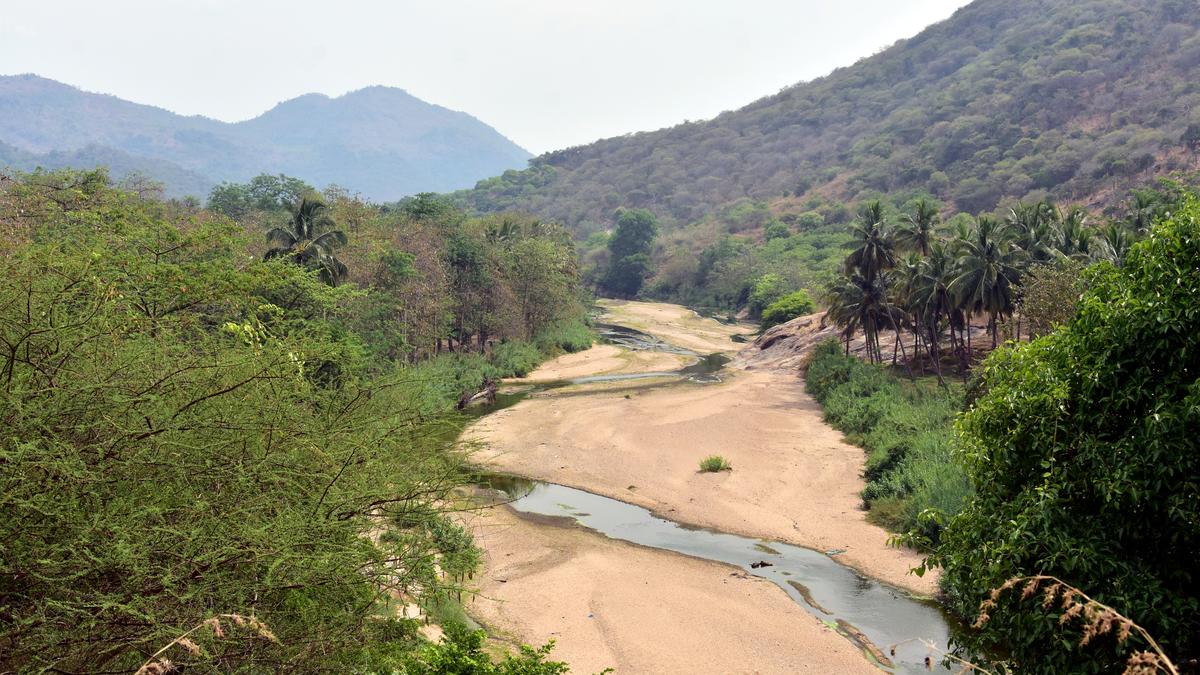
As the amount of sand in the river has decreased with increase in accumulation of mud and waste, the number of fish has also decreased. This has resulted in sightings of low numbers of piscivorous bird species like Kingfishers, terns and egrets while those eating worms and snails like open-billed storks, ibis and waterfowl were found in large numbers. https://www.thehindu.com/news/cities/Madurai/vaigai-needs-a-thorough-cleaning-from-the-hills-to-the-sea/article68905155.ece (25 Nov. 2024)
Telangana Musi: A stream of toxic elements Once considered a lifeline, the Musi River in Telangana has now turned into a stream of toxic liquids and effluents. Historically linked with the lives of the people of these districts, the river’s water was pristinely clear till about four decades back. But now, the water is toxic. A study found that the water, soil, and air samples from the river contained several different pollutants. The pollution of the Musi River has negatively impacted on the health of people and ecology in the area. The pollution of the river has forced the washer folk community to leave the area.
The main cause for this froth, is excessive chemical waste, as several factories let out their waste directly into the river, without treating them for impurities. In the 1990s, the city saw great growth in the pharma sector, as the number of manufacturing units were set up. According to activists, the froth is a result of decades of unchecked pollution that has steadily killed the river. Many activists have been raising concern regarding companies violating the rules and releasing untreated effluents directly into water bodies like the Musi and Hussain Sagar. https://www.thehansindia.com/telangana/musi-going-yamuna-river-way-now-a-stream-of-toxic-elements-musi-in-need-of-urgent-attention-919262 (05 Nov. 2024)
Punjab Roots and Rivers: Navigating Environmental Crossroads https://www.youtube.com/watch?v=gHD1NLV9E3w (19 Nov. 2024)
Rajasthan बीमारियों का कारण बनी जोधपुर की जोजरी नदी जोजरी लूणी नदी की सहायक नदी है और बालोतरा के पास तिलवाड़ा में लूणी नदी में मिलती है। अब लंबे समय से नदी में पानी और बहाव नहीं होने से लोगों ने इसे कभी लूणी में मिलते नहीं देखा है। यह रास्ते में ही धवा गांव के पास रेगिस्तान में लुप्त हो जाती है। वन्य जीव विशेषज्ञ सुमित डुकिया के अनुसार जोधपुर शहर से गुजरते समय इतनी बड़ी मात्रा में घरेलू और इंडस्ट्रियल अपशिष्ट छोड़ा जाता है, जिससे नदी में बहाव शुरू हो जाता है। लंबे समय तक अपशिष्ट छोड़ने से अपने बहाव क्षेत्र को छोड़कर तीन किलोमीटर पूर्व में बहने लगी। जिससे आसपास के गांवों में इसका पानी भरना शुरू हो गया। इस विषैले पानी की वजह से जल स्रोत, कुआं-तालाब, स्कूल, अस्पताल, देवस्थान भी दूषित हो गए हैं। https://hindi.downtoearth.org.in/river/jodhpurs-jojri-river-became-the-cause-of-diseases (29 Nov 2024)
NARMADA Madhya Pradesh MPPCB fines urban local bodies The Madhya Pradesh Pollution Control Board (MPPCB) imposed an environmental compensation (EC) of Rs 17.22 cr on 12 urban local bodies for failing to prevent waste discharge into the Narmada River. This action, detailed in the MPPCB’s report on November 29, 2024, was in compliance with a NGT order from September 10, 2024. https://www.downtoearth.org.in/governance/daily-court-digest-major-environment-orders-november-29-2024 (29 Nov. 2024) https://hindi.downtoearth.org.in/pollution/more-than-17-crore-rupees-fine-imposed-for-failure-to-stop-waste-going-into-narmada (30 Nov. 2024)
GANGA Bihar 70% of untreated sewage flowing into Ganga Bihar generates 1,100 MLD sewage, but currently, only 343 million litres of sewage can be treated. Around 750 MLD of untreated sewage is flowing directly into the Ganga. Furthermore, six out of the 8 STPs in the state are not functioning according to required standards. The NGT has directed NMCG to use its powers to formulate a concrete action plan for pollution control and present it by 18 March 2025. Additionally, considering the seriousness of the matter, the NGT has made the Principal Secretary of the Bihar Department of Environment a party to the case and instructed them to file a response before the next hearing. https://www.downtoearth.org.in/water/bihar-with-70-of-untreated-sewage-flowing-into-ganga-ngt-reminds-nmcg-of-its-powers-and-responsibilities (29 Nov. 2024) https://hindi.downtoearth.org.in/river/bihar-nearly-70-percent-sewage-continues-to-fall-directly-into-ganga-ngt-reminds-nmcg-of-its-powers (28 Nov. 2024)
Gomti नाले में तब्दील हुईं गोमती व सहायक नदियां अब तक, गोमती नदी को पुनर्जीवित करने पर 2,500 करोड़ रुपए से अधिक खर्च किए जा चुके हैं। लेकिन अफसोस पानी की गुणवत्ता की स्थिति में कोई सुधार होता नहीं दिख रहा है। रिवरफ्रंट जैसी अत्याधुनिक योजनाओं की भेंट चढ़कर गोमती अपने पुरातन स्वरूप से वंचित हो गई है। लखनऊ शहर के बीच गोमती का दम घुट रहा है। (
Venkatesh Dutta) https://hindi.downtoearth.org.in/river/gomti-and-its-tributaries-have-turned-into-sewage-drains (26 Nov. 2024)
Kanpur नहर नहीं, जहर से खेती कर रहे हैं किसान जाजमऊ में सैकड़ों टैनरीज का औद्योगिक प्रवाह और सीवेज दरअसल 1994 में यूपी जल निगम द्वारा स्थापित 36 एमएलडी क्षमता वाले सीईटीपी में जाता था। हालांकि, वह अभी काम नहीं कर रहा और यहां पहुंचने वाले टैनरीज के औद्योगिक प्रवाह को जाजमऊ में नए आधुनिक 20 एमएलडी क्षमता वाले सीईटीपी की तरफ डायवर्ट कर दिया गया है। चौंकाने वाली बात यह है कि करीब सात वर्षों से जाजमऊ में बन रहा यह सीईटीपी अभी पूरी तरह चालू नहीं है।
सीईटीपी न चलने के अलावा जाजमऊ स्थित एसटीपी भी उपचार में अच्छा प्रदर्शन नहीं कर रहे। 9 अक्टूबर, 2024 की अपडेट के मुताबिक इसमें मौजूद एसटीपी की जानकारी बताती है कि 36 एमएलडी वाले पुराने सीईटीपी के पास कोई औद्योगिक प्रवाह नहीं है। इसके अलावा 130 एमएलडी क्षमता वाला जाजमऊ का एसटीपी और 43 एमएलडी क्षमता वाला एसटीपी मानकों के मुताबिक नहीं चल रहे हैं। यानी उनसे होने वाला डिस्चार्ज काफी प्रदूषित है। https://hindi.downtoearth.org.in/river/ganga-pollution-farmers-are-farming-using-poison-instead-of-canal (25 Nov. 2024)
Ganga bridge collapses A large part of the old bridge over the Ganga, between Kanpur and Unnao, collapsed and fell into the river on Nov 26. The bridge, constructed in 1874 by engineers of the East India Company, had been sealed in 2021 during the pandemic after cracks were found in its pillars, and it was declared unsafe. The bridge was originally made of iron, and a road was later laid above it, raising its height to facilitate the movement of vehicular traffic. The entire structure was built on 27 full-gauge brick pillars, which had a life expectancy of 100 years. After the road was laid, the iron bridge was not maintained, causing the metal to rust, sources said.
Historians say the East India Company commissioned the bridge in 1866, following the First War of Independence. The British had been using pontoon bridges to enter Kanpur, which became redundant during floods, making the movement of troops and goods towards Lucknow extremely difficult, said historian Manoj Kapoor. The East India Company engineers completed the bridge in 1874, in seven years and seven months. A parallel bridge for the movement of trains on a narrow-gauge line was built in 1910. “This bridge is a part of history and played a crucial role in the economic rise of Kanpur. It was a gateway to Awadh. I hope the government will restore this crucial piece of history,” said Kapoor. https://www.hindustantimes.com/cities/others/ganga-bridge-in-kanpur-collapses-a-crucial-piece-of-history-falls-101732633957859.html (26 Nov 2024)
Prayagraj District magistrate Raviendra Kumar on Sunday (Dec. 01) in reference of the state govt letter dated Nov 25 and under the section 2 (t) of UP Prayagraj Mela Authority , Prayagraj Act 2017, announced Maha Kumbh Mela district for organising world biggest religuous and spiritual congregration. This includes four tehsils and 67 villages. https://timesofindia.indiatimes.com/city/allahabad/uttar-pradesh-declares-maha-kumbh-area-new-district/articleshow/115881073.cms (02 Dec. 2024) Hoping to attract more than 40 crore devotees from across the globe, UP govt and Union ministry of culture and tourism have joined hands to make ‘Maha Kumbh 2025’ in Prayagraj a showcase of the rich diversity of Indian culture. https://timesofindia.indiatimes.com/india/prayagraj-set-to-welcome-40-crore-for-maha-kumbh-25/articleshow/115875604.cms (02 Dec. 2024)
YAMUNA From sacred glory to silent despair The Yamuna river holds deep religious significance in India. Ancient texts and paintings depict her as a goddess and celebrate her association with Krishna. Miniature paintings, particularly the ‘Palam Bhagavata’ series, vividly portray the river and the legend of Krishna overcoming the venomous serpent Kaliya. Sadly, the Yamuna is now heavily polluted. https://economictimes.indiatimes.com/opinion/et-commentary/yamuna-and-her-twin-tales-from-sacred-glory-to-silent-despair/articleshow/115606314.cms (23 Nov. 2024)
RIVERS BIODIVERSITY
NMCG Special Dolphin ambulance to be launched Under the ambitious project approved for conservation of the Ganga River Dolphin, a specialised vehicle will be developed to assist dolphins in distress. The project titled ‘Advancing Rescue System for the Protection of Stranded Ganges River Dolphins’ has an estimated budget of Rs 1 crore. The project will focus on raising awareness for dolphin conservation and community capacity building through training.
The NMCG during its board meeting also approved “an innovative and highly significant” Rs 78.09 Lakh project for the conservation of endangered turtles in the Ganga basin in Uttar Pradesh. “The objective of this initiative is not only to rehabilitate endangered turtle species but also to reintroduce three highly threatened species, alongside establishing a spatial monitoring and reporting tool at the National Chambal Sanctuary,” an official statement said.
Among the other projects approved include: a project for assessing the environmental flow of the Chambal, Son, Damodar and Tons rivers. With an estimated budget of Rs 11 crore, the objective of this project is not only to evaluate the environmental flow of these rivers but also to prepare hydrological and hydrodynamic models that allow scientific evaluation of flow systems. https://www.theweek.in/news/india/2024/11/14/clean-ganga-mission-to-start-special-dolphin-ambulance.html (14 Nov. 2024)
FISH, FISHERIES, FISHERFOLKS
W Bengal Fishermen embark on month-long boat rally for river rights Small fishermen have embarked on a month-long boat rally from Fraserganj in South 24-Parganas to Farakka in Murshidabad to press for the rights to fish in rivers and the protection of fishing zones that are increasingly threatened by the growing use for navigation. The movement, spearheaded by the Dakshinbanga Matsyajibi Forum (DMF), is part of a larger campaign to protect rivers, aquatic life and the livelihoods of approximately a few lakh marginal fishermen in Bengal.
– The fishermen have demanded community land rights (pattas) to stretches of riverbanks used for pre-and post-fishing activities such as cleaning, sorting, and drying catches. They also demanded the demarcation of fishing zones along inland waterways to prevent conflicts with navigation. Among other demands are a ban on destructive fishing practices, such as bottom trawling and the use of mosquito nets, which harm fish populations, including prized species like Hilsa, and mitigation of pollution in rivers caused by industrial and transboundary waste. The organisation placed the 12-point charter of demands before the central and state governments.
– In Nadia district, the Mathabhanga and Churni rivers are severely polluted by industrial waste from a Bangladeshi sugar factory. Despite a Green Bench directive to address the issue diplomatically, no substantial progress has been made. “Polluted water kills fish, and without fish, fishermen cannot survive,” said Swapan Bhowmik, a fisherman from Majhdia. https://www.telegraphindia.com/west-bengal/fishermen-embark-on-month-long-boat-rally-from-fraserganj-to-farakka-for-river-rights/cid/2066844 (29 Nov. 2024)
SAND MINING
Uttar Pradesh Sand miners laid road across Yamuna The area is across Panchayara village (Pachera to locals) in Ghaziabad. On the other side is Alipur, the outskirts of north Delhi. Over decades, under the guise of leases, sand miners have operated with abandon on the Yamuna floodplains to meet a huge appetite for construction. The river’s banks have also been plundered by the sand mafia, damaging its ecology and making it prone to large-scale encroachment.
The building of a road, for excavators to make their way across the Yamuna and dredge sand, is an example of brazen violations the protected floodplains see. There’s an official lease that’s been given for these parts for mining, but no lease allows excavators on the river’s banks, let alone building a road across it.
Locals in Pachera said it’s not the first time the Yamuna was being “bridged” like this. This is, according to them, a post-monsoon ritual for years. A road is laid and it lasts from winter till the rains arrive, after which the river swells & it gets washed away. Once the river recedes, about now, back come the men to build the road. The excavators follow.
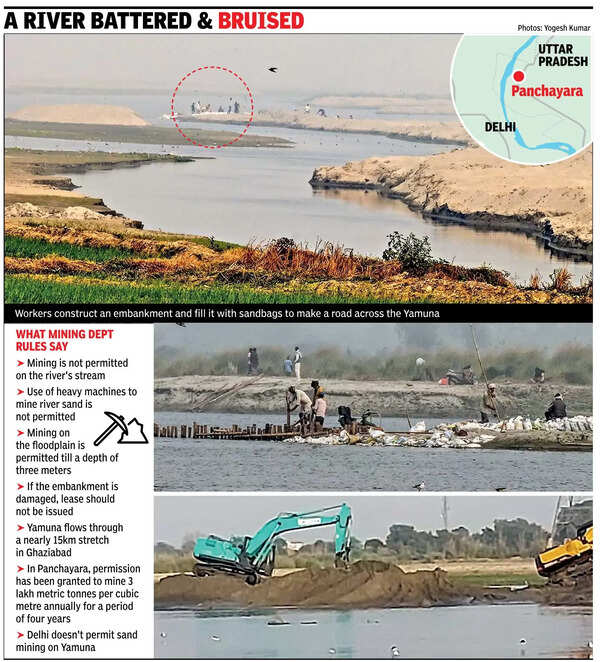
Pradeep Tyagi, who owns an agricultural patch on the Delhi side of the Yamuna, said trucks laden with mined river sand roll in and out daily, almost in an ant-like procession. “I have been seeing this since 2020. This year, it began a week ago,” he said. Ravindra, another villager, said earthmovers don’t stop even at night. “The miners are not scared of anyone. They do as they please,” he said. https://timesofindia.indiatimes.com/city/ghaziabad/sand-miners-lay-road-across-yamuna-illegal-mining-ravages-floodplains-endangers-ecosystem/articleshow/115827733.cms (30 Nov. 2024)
Silica mining: NGT asks CPCB to prepare pan-India guidelines NGT on Friday (Nov. 29) directed the CPCB to prepare detailed pan-India guidelines for silica sand mining and silica washing plants within three months. A silica sand washing plant is used to remove impurities and contaminants from silica sand. Both mining and washing pose health risks to people working in the plants or residing nearby. They also cause silicosis, an occupational lung disease caused by prolonged inhalation of silica dust. The green court also imposed penalties on various private companies engaged in mining-related activities. The green court was hearing a petition on illegal silica sand mining in Uttar Pradesh.
Pulling up the authorities, the court said, “In the operation of silica sand mines, a lot of irregularities have been found, and even the attitude and performance of the concerned authorities does not fulfil the requirement of law.” “Similarly, in respect to the washing plants of silica sand, regular records are not maintained, and statutory regulators also do not pay much heed in respect to compliance or requirements of law,” the court observed. https://www.thehindu.com/news/national/uttar-pradesh/silica-mining-ngt-asks-cpcb-to-prepare-pan-india-guidelines/article68928948.ece (30 Nov. 2024)
Tamil Nadu Check illegal sand mining or will order CBI probe: HC The Madras High Court on Wednesday (Nov. 27) warned of ordering a probe by the CBI if the state government authorities fail to act tough on the looting of the natural resources in the forest villages of Coimbatore district. A special division bench of Justices N Sathish Kumar and D Bharatha Chakravarthy, while hearing a batch of petitions on unauthorised operation of brick kilns and illegal sand mining in certain villages in Perur taluk, also blamed the authorities concerned of colluding with the ‘sand mafia’.
“The report of the district judge shows sand excavated up to a depth of a staggering 16 feet adjoining the reserve forests; still there is no action,” the bench remarked. Expressing anguish over the lack of action by authorities concerned, the bench remarked that it was like the ‘fence eating the crop’.
The bench granted time till December 12, 2024, as sought by special government pleader T Seenivasan, to file a comprehensive report on the action taken and proposal for checking future looting. The court ordered the commissioner of Geology and Mines, superintendent of police and the district forest officer to be present in the court on the next date of hearing. https://www.newindianexpress.com/states/tamil-nadu/2024/Nov/30/wont-allow-tungsten-mining-centre-must-retract-nod-cm-stalin-to-pm-modi (28 Nov. 2024)
Karnataka NGT takes suo moto action on illegal sand mining at Pavoor Uliya The NGT has filed a suo moto case against illegal sand mining on Pavoor Uliya Island, located between Pavoor and Adyar along the Netravati river on the outskirts of the city. The case is directed against the Pollution Control Board. An initial inquiry was conducted on Monday (Nov. 25), with the next hearing scheduled for January 2025. The case has been transferred to the South Zone.
The MoEF issued an order in 2020 outlining monitoring and enforcement guidelines for sand mining. The state mining department is required to follow these guidelines and operate within legal frameworks. However, repeated violations have led to the Uliya case being brought before the NGT. Locals have alleged that the district administration and police department have failed to act against the illegal sand mining mafia, which is reportedly excavating the island’s land. The NGT has now intervened to address these concerns. https://daijiworld.com/news/newsDisplay?newsID=1248753 (29 Nov. 2024)
Jharkhand Crack down on rampant sand mining: CM CM Hemant Soren on Nov 30 directed the Bokaro deputy commissioner to take immediate action against illegal sand mining after social media posts showed tractors openly transporting illegally mined sand on city roads. The social media post highlighted that tractors are ferrying illegally mined sand daily and raised questions on the effectiveness of the district mining office’s claims of strict enforcement of illegal sand mining rules. https://timesofindia.indiatimes.com/city/ranchi/chief-minister-orders-immediate-crackdown-on-illegal-sand-mining-in-bokaro/articleshow/115854342.cms (1 Dec 2024)
Odisha NGT warns SEIAA for not complying with directives The NGT has warned of imposing penalty on State Environment Impact Assessment Authority (SEIAA), Odisha, for failing to comply with its directives on illegal mining at Tolarpasi black stone quarry in Dhenkanal district. NGT’s east zone bench of Justice B Amit Sthalekar (judicial member) and Dr Arun Kumar Verma (expert member) on Thursday (Nov. 28) expressed dissatisfaction over the affidavit submitted on Nov 27 by SEIAA, noting its silence on previous compliance orders.
“The affidavit is peculiarly silent with regard to compliance of the directions of this tribunal for reasons best known to the regulatory authorities,” the bench stated. SEIAA counsel Apurba Ghosh was given four weeks to file a fresh counter affidavit, with a warning that failure to comply will result in a Rs 2,500 penalty for the member secretary of the authority.
A previous five-member joint committee investigation had confirmed irregularities in mining operations and recommended corrective measures. NGT has particularly noted the lessee’s failure to submit mandatory environmental compliance reports every six months. The forest department has also been granted four weeks to file its counter affidavit, following a request by state counsel Aishwarya Dash. The next hearing is scheduled for Jan 31. https://timesofindia.indiatimes.com/city/bhubaneswar/ngt-issues-penalty-warning-to-odishas-seiaa-over-illegal-mining-in-dhenkanal/articleshow/115845090.cms (30 Nov. 2024)
GROUNDWATER
CGWB No NOC for groundwater extraction with Jaipur, Raipur cricket stadia In a report dated November 20, the CGWA noted it had informed the green body that the BCCI provided a list of 26 stadia, of which 14 were regulated by the CGWA and the remaining by the SGWA. Among the 14 stadia, three Barabati Cricket Stadium in Cuttack, Sawai Mansingh Stadium in Jaipur and Shaheed Veer Narayan Singh International Stadium, in Raipur hadn’t applied for the NOCs. Regarding the present status of NOCs, it said the Barabati Stadium was issued the certificate on November 13. But the Jaipur and Raipur stadia did not apply for NOCs, it said.
“Despite repeated reminders through letters and emails, the Rajasthan Cricket Association has not applied for NOC for the extraction of groundwater by Sawai Mansingh Cricket Stadium,” the report said. It said the CGWA of the western region requested the district collector or district magistrate of Jaipur to take action against the stadium but “despite repeated reminders” no action was taken and on November 11, the authority directed the DC to seal the stadium’s borewells and submit an action taken report by November 16.
Similarly, the director of the sports and youth welfare department did not apply for the NOC regarding the use of ground water by the Raipur stadium, nor did the DC take any action, following which the CGWA issued directions for sealing the stadium’s borewells, the report stated. “It may be gathered that despite several reminders through letters, and emails, neither the cricket associations/stadia have applied for NOC, nor the DC or DM concerned initiated any action on erring stadia,” it said. https://www.hindustantimes.com/cricket/no-noc-for-groundwater-extraction-with-jaipur-raipur-cricket-stadia-report-to-ngt-101732874843843.html (29 Nov. 2024)
Study Forecasting earthquakes using changes in groundwater chemistry Abstract An advance has been made towards a method for forecasting earthquakes several months before they occur. The method relies on changes of groundwater chemistry as earthquake precursors. In a study published in 2014, we showed that changes of groundwater chemistry occurred prior to and were associated with two earthquakes of magnitude 5 and higher, which affected northern Iceland in 2012 and 2013. Here we test the hypothesis that similar or larger earthquakes could have been forecast in the following decade (i.e. 2014–2023) based on our published findings. We found that we could have forecast one of the three greater than magnitude 5 earthquakes that occurred. Noting that changes of groundwater chemistry were oscillatory, we infer expansion and contraction of the groundwater source region caused by coupled crustal dilation and fracture mineralisation associated with the stress build-up before earthquakes. We conclude by proposing how our approach could be implemented elsewhere. https://www.nature.com/articles/s43247-024-01852-3 (06 Nov. 2024)
URBAN WATER
Study Will to save water outweighs price factor In a study titled ‘Combining Price and Non-Price Interventions for Water Conservation’, researchers analysed water use in a 120-unit apartment complex with individual water metres. They surveyed 107 afuent households, with a median income of Rs 30-40 lakh, to examine water usage patterns. The study found that households without the NP intervention tended to use more water, with an average increase of 14 litres per capita per day (LPCD), compared to a 5 LPCD increase among those who received the intervention.
Researchers cautioned that modest water tariffs may have unintended consequences for affluent consumers. “Our findings indicate that price alone does not influence all households uniformly. In some cases, pricing even increased usage, suggesting an adverse effect similar to the ‘rebound effect’, where consumers interpret price increases or efficiency gains as a license for higher usage,” they noted. The study suggests that combining price and NP interventions can mitigate the risk of a rebound effect. “Our results provide evidence that combining price and non-price interventions can enhance conservation by addressing both structural and behavioural factors. While price adjustments can reduce demand, non-price interventions may have an even greater impact,” the report stated. https://www.deccanherald.com/india/karnataka/bengaluru/will-to-save-water-outweighs-price-factor-report-3290241 (25 Nov. 2024)
Madurai Gram sabhas pass resolutions against tungsten mining project More than 25 gram sabhas across Madurai district passed resolutions on Local Governance Day on Saturday (Nov. 23) opposing the proposed tungsten mining project near Arittapatti, raising concerns over its impact on biodiversity, agriculture, and cultural heritage of the region. Commercial taxes minister P Moorthy, addressing the gram sabha meeting at Arittapatti, assured that the state govt would not approve any project opposed by residents. Activists at the meeting said Hindustan Zinc Limited, a subsidiary of Vedanta, won an auction for mining tungsten in around 2000 acres across 11 villages in Melur taluk in Madurai district. They recalled environmental damages caused by Vedanta’s Sterlite plant in Tuticorin.
Residents of Arittapatti, Meenakshipuram, Narasingampatti, Mangulam, and Kidaaripatti among others called for the cancellation of the project. They urged the Union govt to revoke the mining project and asked the state govt to declare Madurai a cultural heritage zone where mining activities would be prohibited. Environmentalist Kambur Selvaraj highlighted concerns over the project’s impact on agriculture, water resources, and biodiversity. Similar resolutions were adopted at gram sabha meetings in Tirupur, Namakkal, Erode, and Sivaganga districts. https://timesofindia.indiatimes.com/city/madurai/madurai-residents-unite-against-tungsten-mining-project-to-protect-biodiversity-and-cultural-heritage/articleshow/115608696.cms (24 Nov. 2024) The Mines and Minerals (Development and Regulation) Act, 1957 has been amended by the Mines and Minerals (Development and Regulation) Amendment Act, 2023 with effect from 17.08.2023. The Amendment Act, inter alia, inserted section 11D in the Act which empowers the Central Government to exclusively auction mining leases and composite licenses in respect of ‘critical and strategic minerals’ specified in Part D of the First Schedule of the Act. https://x.com/MinesMinIndia/status/1862511018959581223 (29 Nov. 2024)
Chennai Villagers oppose Parandur airport project for 10th time Villagers of Ekanapuram panchayat on Saturday (Nov. 23) passed a resolution for the 10th time, urging the state govt to drop the Parandur Greenfield airport project, at the gram sabha meeting. The villagers said the project would lead to the loss of water bodies, including three lakes and ponds, land used for agricultural purposes and houses. They passed the resolution against the project for the 10th time as they did not get any solution to the previous resolutions passed in the gram sabha meetings. They added that the villagers would not accept the project in any form. Many villagers, who gathered for the meeting, also raised slogans against the project. https://timesofindia.indiatimes.com/city/chennai/ekanapuram-villagers-stand-firm-against-parandur-airport-project-for-10th-time/articleshow/115607617.cms (23 Nov. 2024)
Bengaluru ‘Mysterious’ illness afflicts 262 families in upscale apartment For the last five days, a significant number of residents of a 830-apartment residential complex in Kaggalipura on Kanakapura Road have been afflicted with a mysterious illness. Young children and senior citizens of Brigade Meadows Plumeria have been found to be particularly vulnerable. Vomiting, fever and stomach cramps have been reported by at least 500 residents covering 262 families, confirmed residents. The apartment uses water from its own borewell for consumption. On the other hand, a report sent to a government lab revealed that water in five of its six tanks were good. “One tank which caters to one block alone is reported to have E.coli. Water supply has been stopped from this tank and has been cleaned thoroughly,” he added. https://www.newindianexpress.com/cities/bengaluru/2024/Nov/29/mysterious-illness-afflicts-262-families-in-upscale-apartment-2 (29 Nov. 2024)
Hyderabad OTS scheme to end on Nov 30 The One Time Settlement-2024 (OTS) scheme announced by the government for payment of long-pending water bill arrears in Hyderabad is nearing end in two days, i.e. on November 30. If the consumers who have used OTS pay the outstanding principal amount before this deadline, there is no need to pay any interest or late fee. If they pay after the deadline, they will have to pay interest and penalty on the pending bills. This scheme, which started in October, continued till the end of that month. There is no possibility of extending it again and after the expiry of the scheme, the authorities are preparing to take strict action against the consumers of pending bills. If necessary, their water connections will also be disconnected. https://telanganatoday.com/hmwssb-one-time-settlement-scheme-for-payment-of-long-pending-water-bills-to-end-on-nov-30 (28 Nov. 2024)
NGT imposes ₹3.11 cr fine construction firm The NGT in its order, mentioned that out of this ₹3.11 crore, the construction company need to pay ₹2.37 crore to Pune Municipal Corporation (PMC) and ₹74.18 lakh needs to be paid to Maharashtra Pollution Control Board (MPCB) within a month from the date of the order. The construction company in 2005, started a project titled ‘Brahma Exuberance, Elite’ at Kondhwa Khurd. The project spread over a 17,433.10sq m area, involves five buildings, four of which stand completed, with 249 flats (194 completed) and an overall built-up area of 41,500sq m.
In 2019, Ajay Bhosale, a resident in the Nana Peth area, filed an application in NGT against the said project alleging that the firm undertook the project without obtaining prior EC, which is mandatory for constructions involving more than 20,000sq m of built-up area, from the SEIAA and without consent to establish from the MPCB. Bhosale also cited various violations of environmental norms. This includes violation of groundwater extraction norms, non-operational STP, use of diesel generator sets etc.
Multiple hearings were held after the bench accepted the first application. The bench earlier also directed the SEIAA to calculate environmental damage compensation for the said project. Meanwhile, the project proponent had applied for an ex-post-facto environmental clearance, which was granted on October 19, 2023. https://www.hindustantimes.com/cities/pune-news/ngt-imposes-3-11-cr-fine-as-green-damage-compensation-on-pune-based-construction-firm-101733074885015.html (30 Nov. 2024)
Noida Borewell, 2 RO plants sealed for illegally extracting groundwater Officials from Noida Authority, the ground water department and the district magistrate’s office sealed an illegal borewell and shut down two unauthorised reverse osmosis (RO) plants during inspections at two localities on Friday (Nov. 29). The team conducted the inspections after a complaint was filed online about illegal groundwater exploitation in the areas.
“During the operation, an illegal borewell installed on a land near the Hindon river was sealed and two RO plants operating without authorisation in FNG Vihar were shut down,” said Vivekanand Mishra, city magistrate, Noida. “Penalties will be imposed on those running unauthorised borewells and RO plants. This drive is not a one-time effort. We will continue to conduct joint inspections and ensure that such illegal activities are curbed at their roots,” the officer said. https://timesofindia.indiatimes.com/city/noida/noida-authorities-crack-down-on-illegal-borewells-and-ro-plants-amidst-severe-groundwater-depletion/articleshow/115851978.cms (01 Dec. 2024)
WATER POLLUTION
Telangana Activists demand water audit system for ethanol units Amid ongoing protests against the operations of ethanol plants, activists are calling for the establishment of a water audit system for authorized ethanol facilities in Telangana. Activists argue that across the country, reportedly plants use 8 litres of water to produce just 1 litre of ethanol, despite requiring only 4 litres. Ravi Kanneganti of Rythu Swarjaya Vedika said, “Regulatory bodies are not holding industries accountable for overexploiting water resources. Additionally, the public has no access to information on the fees these companies incur per litre for the supplied water. Both central and state governments need to consider the limited water resources in Telangana before granting permits to ethanol plants.” Although ethanol plants are prohibited from using groundwater, there are reports indicating that some are violating this rule. https://timesofindia.indiatimes.com/city/hyderabad/activists-push-for-water-audits-in-ethanol-production-amidst-environmental-concerns/articleshowprint/115819949.cms (30 Nov. 2024)
Polluting ethanol factory closed after villagers protest Amid protests by villagers demanding the closure of a ‘polluting’ ethanol factory in Dilawarpur, Nirmal district collector Abhilasha Abhinav issued orders on Wednesday (Nov. 27) to stop production at the factory after holding discussions with the protesters. The collector informed the protesters that their concerns had been brought to the attention of CM Revanth Reddy.
On Tuesday (Nov. 26), the protesting villagers refused to allow revenue divisional officer Ratna Kalyani to leave the area for six hours, prompting police to intervene and arrest a few protesters. The villagers staged a sit-in on the Nirmal-Bhainsa highway on Wednesday (Nov 27), with an additional demand for the release of the arrested protesters. Some of them hurled stones at police vehicles, forcing cops to retreat. Police have filed a case against the accused. The protesters, including a large number of women and children, said they would not budge until they were convinced that their demands were fully met. https://timesofindia.indiatimes.com/city/hyderabad/in-telangana-polluting-ethanol-factory-closed-after-villagers-protest/articleshow/115761926.cms (28 Nov. 2024)
WATER
Kerala NGT issues notice to GSI over declining condition Varkala cliff The NGT has sought a reply from the Geological Survey of India and others in a matter over the deteriorating conditions of Kerala’s Varkala cliff, a designated national geo-heritage site. The NGT was hearing the issue after taking suo motu (on its own) cognisance of a media report regarding the site in the state’s Thiruvananthapuram district facing threats due to environmental violations and administrative oversight. The bench on November 22 further took note of the report over the extensive unauthorised constructions along the cliff, such as resorts, restaurants, parking lots and a helipad.
The tribunal noted the report, which said the cliff was a crucial aquifer and natural water harvesting system for coastal communities, hosted unique biodiversity in its microhabitat, and supported underwater reefs essential for local fishing communities. “The unauthorised construction and modifications are disrupting these vital ecosystem services. Moreover, the destruction of natural drainage patterns and vegetation cover has made the cliff prone to erosion and landslides, especially during intense monsoon periods,” the NGT said.
The NGT therefore impleaded as respondents the directors of GSI and National Centre for Earth Sciences, the district magistrate of Thiruvananthapuram and the member secretaries of Kerala Coastal Zone Management Authority, SPCB and CPCB. “Issue notice to the above respondents for filing their response/reply by way of affidavit before the (Chennai) southern zonal bench of the tribunal at least one week before the next date of hearing (January 10),” the tribunal said. https://www.business-standard.com/india-news/ngt-issues-notice-to-gsi-over-declining-condition-of-kerala-s-varkala-cliff-124112900659_1.html (29 Nov. 2024)
AGRICULTURE
Report National mission worth Rs 2,481 cr to promote natural farming Union Cabinet on Monday (Nov. 25) approved the launching of a national mission to promote natural farming among one crore farmers across the country, with a budget outlay of Rs 2,481 crore till 2025-26. In the next two years, the mission will be implemented in 15,000 clusters in gram panchayats, which are willing, and reach one crore farmers and initiate natural farming in 7.5 lakh hectares of area. At present, around 10 lakh hectares are under natural farming. Preference will be given to areas having a prevalence of farmers practising natural farming, primary agricultural credit societies and farmer producer organisations. Under the mission, 10,000 bio-input resource centres will also be set up to provide easy availability and accessibility to ready-to-use natural farming inputs for farmers. https://timesofindia.indiatimes.com/india/national-mission-worth-rs-2481-crore-to-promote-natural-farming/articleshow/115674748.cms (26 Nov. 2024)
MONSOON 2024
Himachal Pradesh 3rd Driest November In Over 100 Years Himachal Pradesh saw the third driest November in over a hundred years, receiving just 0.2 mm of rainfall against 19.7 mm considered normal, the weather office said on Saturday (Nov. 30). his is a 99 per cent deficit in rainfall for the month. The highest rainfall of 88.5 mm was received in 1925, it said. However, it did not share the data of the first and second lowest rainfall. The deficit was 100 per cent in 11 out of 12 districts in the state barring Lahaul and Spiti which recorded 96 per cent deficit in November. https://www.ndtv.com/india-news/himachal-pradesh-records-3rd-driest-november-in-over-100-years-7143244/amp/1 (01 Dec. 2024)
Dry spell delays sowing of crops, sparks forest fires According to the Meteorological Centre, Shimla, since Oct 1, the state has recorded a negligible rainfall of 0.9 mm, 98% less than the normal of 43.6 mm rain. While in Oct it rained a mere 0.7 mm in Himachal Pradesh, the dry weather got even worse in Nov with the state receiving just 0.2 mm rain till Nov 28. The dry spell in Oct was the third worst in the state since 1901.
The dry weather has also delayed the sowing of crops, including wheat, as farmers are worried that lack of moisture in the ground will adversely affect their produce in many districts like Una, Hamirpur, Solan and Kangra. Lack of rains in the last two months has also impacted other crops including peas, lentils, garlic, onions and tomatoes.
The dry weather is also one of the main reasons behind the rise in forest fires in the state. In the ongoing winter season, the state has already seen 16 forest fires including highest 7 in Chamba district, 3 each in Kullu and Mandi districts and 3 in Shimla district. https://timesofindia.indiatimes.com/city/shimla/himachal-pradesh-faces-crop-sowing-delays-and-rising-forest-fires-due-to-severe-dry-spell/articleshow/115784594.cms (29 Nov. 2024)
Farmers worried as drought delays rabi sowing Data with the agriculture department shows that around 92,000 hectare land was under wheat cultivation in Kangra district last year. This time, it is going to drop significantly as more than 80% of the area is rainfed only.
Meanwhile another worrying factor is that water discharge in the kuhls – historical water channels have dropped down by about 40 to 45 percent. Many kuhls have already dried-up and others are defunct due to damage and lack of upkeep.
“Last year, the Jalshakti department projected a demand of Rs 55 cr for the repair of kuhls in Kangra district. Not a single rupee received” a senior engineer informed. Reports say there are 350 kuhls in Kangra district which source water from natural streams in the region for supply to the fields of farmers. Of this only 60 percent are functional but flow below their capacity. https://www.outlookindia.com/national/himachal-farmers-worried-as-drought-delays-rabi-sowing (29 Nov. 2024)
हिमाचल प्रदेश की पर्यटन नगरी कुल्लू के जंगल चार दिन से जल रहे हैं। अभी तक 100 हैक्टेयर से अधिक वन भूमि आग की चपेट में आ चुकी है। आग पर काबू में पाने के लिए अग्निशमन विभाग, स्थानीय पंचायत के लोग, पुलिस प्रशासन और वन विभाग की टीमें लगी हुई हैं।
हिमाचल के जंगलों में आग की यह अकेली घटना नहीं है, बल्कि पिछले दो महीनों यानी एक अक्टूबर से 30 नवंबर तक भारतीय वन सर्वेक्षण के आंकडों के अनुसार दावानल (फारेस्ट फायर) की 149 घटनाएं घट चुकी हैं, जबकि पिछले वर्ष इसी अवधी में 95 आग की घटनाएं हुई थी, जो पिछले वर्ष के मुकाबले 57 फीसदी अधिक है। प्रदेश में बढ़ रही दावानल की इनघटनाओं के पीछे सूखे को एक बड़ा कारण माना जा रहा है। 1 अक्टूबर से 29 नंवबर तक हिमाचल में नाम मात्र बारिश हुई है। मौसम विभाग के आंकडों के अनुसार प्रदेश में सामान्य से 98 फीसदी कम बारिश हुइ है। https://hindi.downtoearth.org.in/forests/kullu-forests-are-burning-continuously-for-four-days-drought-in-november-increased-the-crisis (30 Nov. 2024)
Uttarakhand State awaits precipitation to end dry spell According to the IMD, between October 1 and Nov 24, Uttarakhand experienced nearly 90 per cent less rainfall than usual. Apart from Pithoragarh and Bageshwar, the remaining 11 districts have remained completely dry. Taking stock of the neighbouring Himalayan states, Himachal Pradesh in the same time span, received 98 per cent less rainfall than normal while Jammu & Kashmir registered a 68 per cent deficit. https://www.downtoearth.org.in/climate-change/with-neither-rain-nor-snow-so-far-uttarakhand-desperately-awaits-precipitation-to-end-dry-october-november-spell (26 Nov. 2024)
Delhi Cloud seeding a misguided fix for pollution crisis Over the past five years, data showed that during peak pollution episodes in Delhi and the surrounding areas, clouds are rarely present. Without clouds, cloud seeding becomes ineffective, raising questions about its feasibility in such conditions. “Cloud seeding requires the presence of moisture-laden clouds. Delhi’s winters are typically dry with minimal cloud cover, making seeding ineffective. The success of cloud seeding is not guaranteed, as it heavily depends on pre-existing weather conditions and precise execution,” said Dr Sachin Ghude, IITM scientist.
According to the expert, during winter, Delhi often experiences temperature inversions, trapping pollutants near the surface. “These stable atmospheric conditions do not favor the development of clouds that could be seeded. The scale of Delhi’s pollution problem is vast, requiring massive, continuous rain over a large area to have a measurable impact,” he added. Even if a few isolated clouds could be seeded—an unlikely scenario—it would not result in heavy or widespread rainfall. According to Dr Ghude, the effort required to generate sustained rainfall for effective pollution control is neither practical nor feasible. https://indianexpress.com/article/cities/pune/iitm-pune-cloud-seeding-misguided-fix-for-delhi-pollution-9678560/ (20 Nov. 2024)
FLOOD 2024
Report How flood protection structures heighten flood vulnerability Flood control has always been an important mission for the Indian government. Since 2007, more than Rs. 13,000 crores (Rs. 130 billion) have been spent in flood protection measures through national schemes. Even as these measures are deployed with speed and scale, floods have, in some places, become more severe. In fact, data from the Central Water Commission shows that despite high investments in flood mitigation measures, the number of people affected and the economic damage resulting from floods have not reduced.
The researchers assessed the impacts of 132 flood protection structures in both basins – 60 in Ganga basin & 72 in the Brahmaputra basin. The two basins were also chosen because of their distinct socio-economic characteristics. The primary activity along both floodplains is agriculture, but in the Ganga, agriculture is commercial and in the Brahmaputra it is shifting cultivation.
The analysis found that the social-vulnerability index increased generally from 2005–2006 to 2018–2019. “However, in most regions, the vulnerability in the vicinity of FPS has shown a higher increase than elsewhere,” the study says. Even smaller, lower cost flood protection structures produced a “levee effect,” compared to bigger, more visible ones. “The increase in vulnerability in the vicinity of FPS can be attributed to the increased population and economic activity in the regions around FPS,” the study adds.
Between the Ganga and Brahmaputra basins, the Brahmaputra showed greater vulnerability resulting from flood protection structures. This was because the Brahmaputra saw a bigger surge in built-up areas along the floodplains compared to the Ganga. “This was in contradiction to our initial assumption that frequent exposure to floods would make people more cautious to building structures close to riverbanks,” said Singh, adding, “The Brahmaputra has historically experienced more disastrous floods, so we were expecting lesser increase in vulnerability due to FPS in Brahmaputra basin.” https://india.mongabay.com/2024/11/how-flood-protection-structures-heighten-flood-vulnerability/ (29 Nov. 2024)
Tamil Nadu Flood alert issued to 14 villages as water from Sathanur dam released Flood alert to 14 villages along the bank of Thenpennai river has been issued by the Water Resources Department (WRD) as 20,000 cuses of water per second is being released from the Sathanur dam in Tiruvannamalai on Sunday (Dec. 1), after the level reached 118.05 feet as against the dam’s total capacity of 119 feet. Water release from the dam is done periodically since September when 850 cuses of water were released then. This time, heavy rain fell in the villages on the foothills of Kalvarayan Hills such as Lalpettai, Kattumannarkoil, Thattakudi, Mullakudi.
“Immediate flood warning was issued to 14 villages. However, the entire 250 villages located downstream of the dam should be on high alert due to the continuous flow of excess rainwater from upstream. Only in December, we can store water to the dam’s full capacity of 119 feet,” K. Santhosh, Assistant Engineer (AE), WRD (Sathanur Dam), told The Hindu. Officials of WRD, which maintains the dam, said 20,000 cusecs of water was released from Sathanur dam on Sunday Dec. 01 as excess rain water was released from Pambar dam in Krishnagiri. https://www.thehindu.com/news/national/tamil-nadu/flood-alert-issued-to-14-villages-as-water-from-sathanur-dam-in-tiruvannamalai-released/article68934179.ece (02 Dec. 2024)
URBAN FLOODS
Vadodara Panel reviews options to mitigate floods The Navlawala committee appointed by the state govt to address the issue of flooding in the Vishwamitri in the city in Aug 2024 examined multiple options and will now make a final suggestion to the state govt next month. Various officials and members of the committee held a meeting in the city on Tuesday. Besides the five members of the committee, officials from the forest department, National Highways Authority of India, irrigation department, Sardar Sarovar Narmada Nigam Ltd, and the M S University were present at the meeting.
– The options discussed so far include increasing the capacity of ponds in the catchment area of the Ajwa reservoir and the Vishwamitri, dredging of the Ajwa and Pratappura reservoirs to increase their capacity, as well as the construction of a dam or a similar structure downstream of the Ajwa reservoir to hold water released from the reservoir. The suggestion of diverting water from the Vishwamitri or Ajwa is still being discussed. But instead of diverting it to a Narmada canal, the possibility of diverting it to the Jambuva river is now being examined. All suggestions will now be discussed in detail by the committee and experts. https://timesofindia.indiatimes.com/city/vadodara/expert-committee-proposes-solutions-amid-vadodaras-flood-crisis/articleshowprint/115742705.cms (27 Nov. 2024)
Bengaluru Map depicting flow of city’s drain In response to the flooding caused by the rains a few months back, two IT professionals Aman Bhargava and Vivek Matthew have created a map depicting the waterflow of the city’s drains. “The map depicts how Bengaluru’s terrain causes water to ow and collect in different places. It depicts ow accumulation and whether the ow is upstream or downstream,” says Bhargava.

“The purpose of the map is to create interest in understanding the demographic of your city and its storm water drains. Though the information isn’t new, we have tried to keep the map as simple as possible, while making it informative,” Bhargava says. https://www.deccanherald.com/india/karnataka/bengaluru/now-a-map-depicting-flow-of-city-s-drains-3296468 (29 Nov. 2024)
Chennai Sewage enters Muttukadu backwaters With the city receiving heavy downpour, the Muttukadu backwaters south of Chennai has turned black with the sudden influx of raw sewage from upstream areas. This has been a perennial problem as localities, including high-rise buildings along OMR and ECR don’t have underground drains and have to depend on sewage tankers, which many a time discharge raw sewage illegally in to Buckingham Canal that carries it into Muttukadu backwaters. In many areas, people release effluent through illegal outlets, especially during monsoon.
TNIE had reported about this illegality several times in the past. The Southern Bench of National Green Tribunal had taken suo motu cognisance of the issue and formed a joint committee to investigate the matter. The committee recommended a penalty of Rs 48 lakh on three village panchayats — Muttukadu, Navalur and Padur — in Chengalpattu for failing to check the pollution. https://www.newindianexpress.com/cities/chennai/2024/Dec/02/sewage-enters-muttukadu-backwaters (02 Dec. 2024)
LANDSLIDES
Kerala Govt revises Western Ghats ESA proposal In a revised proposal sent to the Centre earlier this month, the Kerala government requested the declaration of 8,590.69 sq km across 98 villages and 12 districts as ecologically sensitive areas (ESAs) in the Western Ghats. The area proposed for ESA demarcation is 121 sq km smaller than what was submitted to the Centre in May this year. An expert committee of the Centre, headed by Sanjay Kumar, former Director General of Forest, is appraising state government proposals and suggestions regarding ESA demarcation in Western Ghats.
In 2013, Kerala proposed demarcating 9,993.7 sq km as ESAs based on the report of a three-member expert panel. Later, in 2019, it submitted to the environment ministry that it should be reduced to 8,656 sq km. However, the latest draft notification continued with the previous iterations and marked the 9.993.7 sq km area as eco-sensitive. https://indianexpress.com/article/india/kerala-western-ghats-eco-sensitive-centre-9689872/ (26 Nov 2024)
ENVIRONMENT GOVERNANCE
Obituary The ‘Green Judge’ who roared in Supreme Court Justice Kuldip Singh, dubbed as a “lion” in the Supreme Court for his distinctive voice and unyielding pursuit for justice, passed away this evening following a massive heart attack. Affectionately known as the “Green Judge”, Justice Kuldip Singh was a pioneer in environmental law, leaving a lasting imprint on the country’s jurisprudence. His groundbreaking work introduced the “polluter pays” and “precautionary” principles, and he became a driving force in shaping the legal framework that safeguards the environment. https://www.tribuneindia.com/news/chandigarh/the-green-judge-who-roared-in-supreme-court/ (26 Nov. 2024)
MoEF No forest clearance required for ropeway projects now The Advisory Committee of the MoEF took up the matter on November 6, 2024, on a request of the Himachal Government. “Keeping in view the larger public interest and the eco-friendly nature of the ropeways, it has been decided to exclude all such projects from the ambit of the Forest Conservation Act (FCA), 1980, along with the payment of the net present value (NPV),” the order of the Union Ministry of Environment, Forest dated November 29, 2024, stated.
Both Himachal Government and the Union Ministry of Road Transport and Highways had urged the Union Ministry of Environment, Forest and Climate Change to revert to the earlier system that was followed till last year, based on a 2019 notification. Last year, the Union Ministry of Environment, Forest and Climate Change had withdrawn the 2019 notification that exempted ropeway projects from seeking forest clearance. https://www.tribuneindia.com/news/himachal/big-relief-for-state-no-forest-clearance-required-for-ropeway-projects-now/ (01 Dec. 2024)
CLIMATE CHANGE
Opinion In fight against climate change, could rivers and seas turn the tide? Pranay Lal Ocean, seas, rivers, and even lakes offer a different suite of options. Deep water bodies retain the ability to remove excess carbon rapidly from the atmosphere. They also transport the carbon into depths where it mixes and binds with minerals. As on land, marine carbon capture strategies fall into two categories. (i) Biotic approaches take advantage of living systems like mangroves and macroalgae or of our rivers to carefully calibrate biomass burial at sea. (ii) Abiotic approaches manipulate physical or chemical properties, such as through ocean alkalinity enhancement, and are more complicated but are also becoming unavoidable. Both these methods promise to capture and store carbon for the long term and potentially transform countries’ contributions to climate goals. https://www.thehindu.com/sci-tech/energy-and-environment/in-our-fight-against-climate-change-could-rivers-and-seas-turn-the-tide/article68918568.ece (29 Nov 2024)
SOUTH ASIA
Analysis South Asian cross-border energy trade ignores climate risks For the past few years, the countries of Bhutan, Bangladesh, India and Nepal have been slowly working towards cross-border energy trade. On 3 October, Bangladesh’s new regime signed a tripartite agreement to import 40 MW of hydropower from Nepal, via Indian territory. This is first such multilateral trade, as against only bilateral trade so far.
– Experts suggest, however, that this scramble for hydropower ignores the impact of climate change upon the Himalayan region. Climate impacts may become a complicating factor in energy trade among Bhutan, Bangladesh, India and Nepal. According to a report by the International Energy Agency (https://www.iea.org/reports/climate-impacts-on-south-and-southeast-asian-hydropower/executive-summary), the Himalayan region (Bhutan and Nepal) projects a drop in hydropower capacity of 3.9-5.2% between 2020 and 2059 “due to changing climate conditions”. These include “increasing variability in streamflow, shifting seasonal flows and augmenting evaporation losses from reservoirs”, as well as the impact of “extreme weather events such as heavy rainfall and associated landslides [which] can hinder development of hydropower projects”.
– During this year’s monsoon season, Nepal’s hydropower sector lost out on energy generation worth around NPR 2.45 billion (USD 18 million) due to floods and landslides. About 1,100MW of hydroelectricity production was halted due to flood damage, says Deepak Khadka, Nepal’s minister for energy, water resources and irrigation. There were 228 hydropower projects of more than 1MW capacity under construction in Nepal as of May 2023; more than 10 megaprojects are being established in Bhutan. But there is little evidence these are incorporating climate-resilient policies. In fact, Nepal’s hydropower boom has largely ignored environmental issues, such as the impact of dams on biodiversity. https://dialogue.earth/en/energy/analysis-south-asian-cross-border-energy-trade-ignores-climate- (27 Nov. 2024)
India-Bhutan DGPC & Adani Group to finalize agreement on Wangchhu HEP Despite the signing of a Memorandum of Understanding (MoU) in June 2024, the agreement between Druk Green Power Corporation (DGPC) and the Adani Group for the Wangchhu Hydropower Project is not yet finalised. The MoU, which serves as a time-bound expression of intent, does not yet bind either party to a formal agreement. Two potential options are being considered for the Wangchhu project: a 570 MW run-of-the-river scheme or a 900 MW reservoir-based scheme. Although preliminary discussions have taken place, a concrete agreement has not yet been reached. Adani Group is seeking a 70 percent majority stake in the project, along with an extended concession period of more than 90 years, in contrast to the standard 30-year concession period.
– When asked about the potential impact of these developments on Bhutan’s relationship with the Adani Group and future investments, a DGPC official stated that it is too early to comment on a case filed in another country. https://kuenselonline.com/dgpc-and-adani-group-to-finalise-agreement-on-wangchhu-hydropower- (29 Nov. 2024)
DGPC & Tata Power partner to develop 5,000 Mw clean energy Tata Power Company Ltd, one of India’s largest integrated power firms, has joined forces with Druk Green Power Corporation (DGPC) to develop at least 5,000 MW of clean energy capacity in Bhutan. Through this partnership, at least 5,000 MW of renewable energy projects will be developed in phases, including 500 MW of solar power and 4,500 MW of hydropower projects such as the 1,125 MW Dorjilung Hydropower Project, 740 MW Gongri Reservoir, 1,800 MW Jeri Pumped Storage, and 364 MW Chamkharchhu IV.
– Tata Power and DGPC have a long-standing relationship, beginning in 2008 with the joint development of Bhutan’s first public-private hydropower partnership—the 126 MW Dagachhu Hydropower Plant. More recently, Tata Power acquired a 40 percent stake in the 600 MW Khorlochhu Hydroelectric Project, valued at INR 8.30 billion.The project will involve an investment of over INR 69 billion. https://kuenselonline.com/dgpc-and-tata-power-partner-to-develop-5000mw-clean-energy-in- (20 Nov. 2024)
THE REST OF THE WORLD
USA Return of Salmon to the Klamath river The Klamath story continues to be written. Just a little over two decades on from the massive fish kill, the Klamath became the site of the largest dam removal project in history. Since removal of the lower four dams on the river was completed last month, salmon have surged upstream to parts of the river where they haven’t been seen for more than a century. This is an inspiring story of how people can work together to repair wildlife habitats. This huge turnaround was made possible through collaboration and unwavering commitment—especially by the region’s Indigenous people. It is an example we can learn from and start replicating across the world.
– In the U.S., hydropower project owners must periodically apply for new licenses through a process that considers options for reducing the projects’ social and environmental impacts. For the Klamath dams, regulatory agencies recommended that license renewal would require the addition of fish ladders to allow salmon to swim above the dams— construction projects that would have been prohibitively expensive. Ultimately PacifiCorp signed a settlement agreement with the tribes, agencies and conservation groups to remove the four dams, which started late last year.
– Reversing the losses of wildlife worldwide will require a diverse set of strategies. Protected areas will remain important, but so will transformations in how we produce energy and food and implement conservation. And while “transformation” may sound daunting, the Klamath’s remarkable turnaround demonstrates that the recovery of nature remains in reach. https://www.scientificamerican.com/article/how-the-return-of-salmon-to-the-klamath-river-shows-us-whats-possible-in-wildlife-conservation/ (26 Nov. 2024)
Extreme weather threatens Canada’s hydropower future Hydropower production in Canada is plummeting as extreme weather linked to climate change, particularly sudden swings between drought and flood, hampers output while threatening the structure of dams themselves. In Canada, which gets 60 percent of its energy from hydropower, drought has hit hard in the key production provinces of British Columbia, Manitoba and Quebec.
– Canada has also been forced to cut exports to the United States, which have reached their lowest levels in 14 years. For three straight months earlier this year, Canada had to import energy from the US—a first in eight years, and a role reversal that highlights dramatic shortfalls in hydropower production in Canada and abroad. The International Energy Agency said 2023 marked “a record decline” in global hydropower generation, with other major producers like China, Turkey and the US also impacted. The IEA tied the declines to “severe and prolonged drought” in major producing regions. https://techxplore.com/news/2024-11-extreme-weather-threatens-canada-hydropower.html (26 Nov. 2024)
Technology helping safeguard ageing dams With 85% of US dams operating beyond their life expectancy, the US Army Corps of Engineers is transforming dam safety using data-driven tools like OpenGround. Learn how standardizing geotechnical data is helping safeguard aging infrastructure against the growing threats of climate change and extreme weather. https://techinformed.com/usace-dam-safety-climate-change-data-tools/ (28 Nov. 2024)
SANDRP
Also see: DRP 25 Nov. 2024 & DRP 18 Nov. 2024
Follow us on: www.facebook.com/sandrp.in; https://twitter.com/Indian_Rivers

 SANDRP