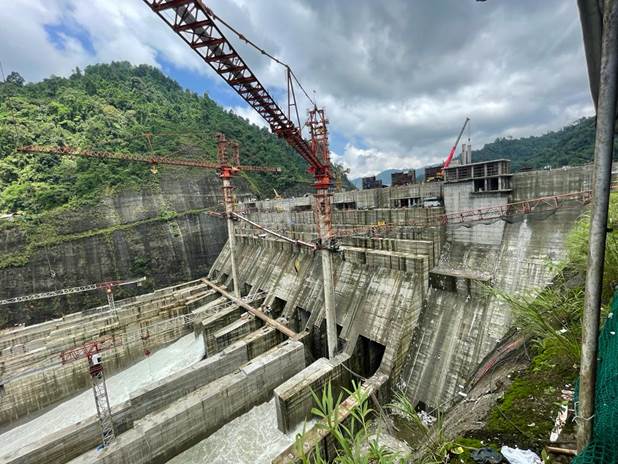
(Feature Image: Lower Subansiri HEP dam. Source: PIB, June 2023)
An interesting study reported this week reveals Big Dams are costly gambles and explains why this is so. In fact, the explanations go on to reveal that this is by design, the costs are systematically under estimated and benefits are exaggerated, so the dams fail to provide the promised benefits. So Big Dams are actually not gambles, but frauds. They get away with all this due to lack of transparency and accountability in the governance, the study reveals.
For those following the global debate on big dams over the decades know that there is nothing new here. A number of studies earlier exposed all this, including the Independent Review of the Sardar Sarovar Project instituted by the World Bank, the World Commission on Dams report, the India Country study done for WCD, among others.
However, it is useful and necessary to reiterate these findings through period new studies to remind all concerns about the implications of these every few years. The report rightly reveals that the fixation on building more dams means non implementation of many viable alternatives. This becomes even more pertinent in the changing climate, the liabilities of big dams are becoming even more pronounced and costly.
Australia Why building more big dams is a costly gamble Our recent research (https://iopscience.iop.org/article/10.1088/2515-7620/ad7fbe) reveals large dam projects are costly gambles with public money. They often fail to deliver promised economic benefits. They also have major environmental, financial and social impacts.
In New South Wales, some members of the Lower Lachlan River community were concerned about plans to expand Wyangala Dam. They first asked us in 2020 to investigate its full costs and benefits, with findings presented at a local workshop in 2022. The first WaterNSW estimate of capital and operating costs was A$620 million in 2018. Within a few years, it had soared to as much as $2.1 billion. In 2023, the project was scrapped because it wasn’t economically viable. We found total project costs were underestimated by at least 116%. The benefits were inflated by 56%. This meant the true impacts on the environment, agriculture and local communities were misrepresented.
To avoid repeating costly mistakes and mismanaging taxpayers’ money, we need a smarter approach to major water projects. This includes independent assessments and greater transparency, with business cases made public and decision-making open to scrutiny. And planning for climate change must become a priority.
The fixation on building and expanding dams means innovative alternatives are often ignored. These other options include recycling water, managing demand and carefully recharging aquifers (using aquifers as underground dams). https://theconversation.com/why-building-more-big-dams-is-a-costly-gamble-for-our-future-water-security-and-the-environment- (28 Oct. 2024)
HYDRO POWER PROJECTS
Report Hydro power generation lags for 2nd consecutive year Good rains should usually result in higher hydro power generation. However, India’s hydro power sector is seeing no such bounty this year. Hydro power generation increased by a sober 4 percent in April-September this year compared to 5.5 percent growth in thermal and 22 percent rise in nuclear power generation. Hydro power generation lagged other sources of electricity production in Apr-Sep 2023 also. https://www.moneycontrol.com/news/opinion/chart-of-the-day-hydro-power-generation-lags-for-second-consecutive-year-12853322.html (29 Oct. 2024)
CWC Himalayan glacial lakes expand by 10.81% from 2011 to 2024 The Central Water Commission’s (CWC) report, which was accessed by PTI, states that with a 33.7 per cent expansion of the surface area, the lakes in India experienced an even more substantial rise. “The total inventory area of glacial lakes within India was 1,962 hectares during the year 2011 which has increased to 2,623 hectares during the year 2024 (September). There is a 33.7 per cent increase in area,” the report said. It also identified 67 lakes in India that witnessed an over 40 per cent increase in surface area, placing them in the high-risk category for potential GLOFs.
-Ladakh, Himachal Pradesh, Uttarakhand, Sikkim and Arunachal Pradesh showed the most notable expansions, signalling a heightened risk of GLOFs and the need for intensified monitoring and disaster preparedness. Glacial lakes and other water bodies across the Himalayan region saw an overall area increase of 10.81 per cent from 5,33,401 hectares in 2011 to 5,91,108 hectares in 2024 due to climate change, the report said. The rapid expansion of these lakes is attributed to accelerated melting of glaciers due to rising temperatures in the region, with potentially severe consequences for downstream communities, infrastructure and biodiversity, it said.
-The CWC stressed that the increased water spread of these lakes demands rigorous monitoring and urgent risk management strategies. The CWC report also underscored the transboundary risks posed by expanding glacial lakes in neighbouring countries, including Bhutan, Nepal and China. Given the interconnected nature of river basins across the Himalayan watershed, collaboration with these countries is crucial to managing the potential impacts of GLOFs, it underlined. The report called for joint monitoring efforts and data sharing to build a more comprehensive risk assessment and mitigation strategy.
-It highlighted the urgent need for international and regional cooperation in developing early warning systems, enhancing disaster management plans, and promoting community awareness initiatives to safeguard vulnerable populations. The implications of area expansion of glacial lakes extend beyond flood risks and can impact water availability in the region’s major river systems, including the Ganga, Brahmaputra and Indus. https://www.business-standard.com/pti-stories/national/himalayan-glacial-lakes-saw-10-81-per-cent-area-expansion-from-2011-to-2024-report-124110300193_1.html (03 Nov. 2024)
MoEF Relevant Agenda for the Meeting of EAC to be held on Nov 6, 2024 DIVERSION OF 83.838 HA FOREST LAND (INCLUDING EX-POST FACTO APPROVAL OF 1.142 HA FOREST LAND) FOR INTEGRATED ANANDPUR BARRAGE PROJECT IN KEONJHAR (WL), KARANJIA & BALASORE (WL) DIVISION IN THE DISTs OF KEONJHAR, MAYURBHANJ & BALASORE OF ODISHA https://forestsclearance.nic.in/AgendaDetail.aspx?id=307%21dis1&fbclid
DAMS
Kaleshwaram Project 3 barrages filled to capacity on KCR’s orders: Ex-ENC This is the fourth time Venkateshwarlu, who was removed by the Congress govt after it came to power, appeared before the one-man inquiry commission on Monday (Oct. 28). He provided proofs and documents of various decisions taken by the BRS govt on the Kaleshwaram project. On the sinking of piers in block 7 of Medigadda barrage, he said that it was due to operation and maintenance issues and opined that the barrage was damaged due to non-availability of tail water and operation of gates.
He also submitted geo-technical foundation tests and axis change documents of Annaram barrage to the inquiry commission. Last week, when the ex-ENC appeared before the commission, he said the BRS govt spent 13,250 crore for the Kaleshwaram project out of the total 14,000 crore sanctioned for the Pranahitha-Chevella project. The BRS govt renamed the project as Kaleshwaram project and changed the scope and designs of the project, he said. He also said problems cropped up in Nov 2019, which continued till 2023. https://timesofindia.indiatimes.com/city/hyderabad/kcrs-orders-led-to-full-capacity-of-three-barrages-claims-former-engineer-in-chief/articleshow/114704373.cms (29 Oct. 2024)
Vigilance report spotlights KLIS design flaws, rush, cutting corners Repeated change of designs of the barrages of the Kaleshwaram project, cutting corners to save on costs, and no supervision of maintenance were among the reasons that led to the problems at Sundilla, Annaram, and Medigadda barrages, an investigation into the causes of problems and damages at the barrages by the vigilance & enforcement wing is learnt to have found. The V&E wing is learnt to have submitted its report to the government two days ago.
– The report is also learnt to have concluded that the secant pile system approved by the irrigation department officials at that time was not suitable for the soil conditions at the barrage sites. The diaphragm wall cut-off designs that were originally proposed by WAPCOS, a Central PSU which prepared the detailed project report, were the ones that were suitable for the where the barrages were built, the V&E report is learnt to have concluded. https://www.deccanchronicle.com/vigilance-report-spotlights-klis-design-flaws-rush-cutting- (29 Oct 2024)
Telangana Desiltation drive to begin with Kaddam project Since its construction in 1949, the Kaddam Project has not undergone any desilting exercise, leading to a reduction in its gross storage capacity from 7.603 Thousand Million Cubic feet (TMC) to about 4.82 TMC, approximately 40 percent of its original capacity. This reduction has impaired its ability to provide irrigation water to 68,150 acres of agricultural land. Officials have estimated that approximately 135.92 million tons of silt has accumulated in the Kaddam Project. Nearly 40 percent of this silt consists of fine sand, which can be repurposed for construction and other uses, while the remaining 60 percent is clay, which is useful for application to soils in agricultural land to add up to their fertility.
The problem of siltation is not unique to the Kaddam Project. All major irrigation projects in Telangana have experienced a loss of 25 percent to 30 percent of their gross water storage capacity due to increasing silt accumulation. The State government, currently without a specific policy addressing siltation issues, is planning to follow guidelines from the Ministry of Jal Shakti to tackle the problem. Significant sand deposits have been identified in various projects. For instance, the Medigadda Barrage on the Godavari River was found to have over Rs 800 crore worth of sand deposits when the barrage was emptied for structural inspection earlier this year. Part of this sand has already been extracted. https://telanganatoday.com/telanganas-desiltation-drive-to-begin-with-60-year-old-kaddam-project (02 Nov. 2024)
INTERSTATE WATER DISPUTES
Mahanadi Water Dispute ‘Will build barrage and dam’: Odisha CM Mohan Majhi on Nov 3 said his govt is concerned about the Mahanadi water dispute and already held discussions with his Chhattisgarh counterpart Vishnu Deo Sai twice on the issue. Majhi, who was on a two-day visit to Balangir to inaugurate several projects, said his govt is making substantial efforts to address the issue while seeking the Centre’s assistance in expediting a resolution. He further said the state govt is accelerating the construction of the proposed barrage and dam projects on the Mahanadi. Majhi asserted that while the previous govt had disregarded the issue, his administration would not do the same. https://timesofindia.indiatimes.com/city/bhubaneswar/mahanadi-water-dispute-odisha-cm-talks-to-chhattisgarh-counterpart/articleshow/114923581.cms (04 Nov. 2024)
IRRIGATION
Tamil Nadu 85% work on 2nd check-dam at Palar completed: WRD official Officials of the WRD said the check-dam was the second such facility across the Palar, covering Vellore, Ranipet and Tirupattur districts. The first check-dam was built at Udayandevan village near Vaniyambadi town in Tirupattur in 2002. Funded under the Permanent Floods Restoration Scheme 2023-24, with funds from the National Bank for Agriculture and Rural Development, the ₹18.32-crore check-dam would be 200 metres long and 1.5 metres wide. It would be able to store 6.66 million cubic feet (mcft) of water. WRD officials said that after over two decades, Poigai was chosen for the second check-dam mainly due to overexploitation of groundwater in the region. Farmers along the river were severely affected. Water supply for domestic consumption has also been irregular in the region. The new check-dam will be ready by 2025. https://www.thehindu.com/news/national/tamil-nadu/85-of-work-on-second-check-dam-at-palar-river-completed-wrd-official/article68819136.ece (02 Nov. 2024)
URBAN RIVERS
Musi; Hyderabad RFD should not a be a project of mega displacement, land grab and privatization! by National Alliance of People’s Movements https://countercurrents.org/2024/10/musi-river-rejuvenation-should-not-a-be-a-project-of-mega-displacement-land-grab-and- (31 Oct. 2024)
Concerns raised ahead of megaproject launch The joint statement initiated by the National Forum of Urban Struggles (SHRAM) of the National Alliance of People’s Movements (NAPM) calls for an immediate and comprehensive review of the project, urging that it be transformed into a consultative, people-centric, and ecologically just initiative for environmental revival.
The key demands put forth by the activist signatories emphasize that the Musi River Rejuvenation project should “not be a project of mega displacement, land grabbing, or privatization.” They argue that it should not proceed without a detailed project report or a rehabilitation and resettlement policy. The statement advocates for ensuring the ecological free flow of the river by eliminating industrial and municipal pollution, rather than commodifying urban commons or diverting forests and farmlands under the guise of megaprojects. https://www.siasat.com/environmentalists-raise-concerns-ahead-of-musi-rejuvenation-megaproject-launch-3123485/ (31 Oct. 2024)
RFD to be made on PPP mode”: CM Tenders will be floated in the 1st week of Nov for channelising Godavari river from Mallannasagar to Osmansagar, and from Osmansagar, a canal will be dug into the Himayatsagar, so that the water could enter Musi river from both the reservoirs. A check-dam barrage-cum-bridge will be constructed at Bapughat, from where purified water will be released downstream of the river. The CM said drawings for Ph-I will be ready in 45 days.
In the first phaset, 20.5 km length along two streams beyond Bapughat till the twin reservoirs will be taken up for development, he said. The two streams are from Osmansagar (Musa) with 11 km, and Himayatsagar (Esi) with 9.5 km. Bapughat, which houses the mortal remains of Mahatma Gandhi, will be developed as a ‘vegetarian and eco-friendly’ destination, complete with installation of the tallest Gandhi statue and launch of a Gandhi Ideology Centre there.
The government is targeting 1 lakh tourist footfalls in the circuit, through development of world class educational, entertainment, and health facilities. A giant wheel along the lines of London Eye, a nature cure hospital, off campus colleges of world renowned universities and educational institutions, and eco-friendly theme parks are a few concepts shared for the development. Starting from the Qutb Shahi Tombs up to Langar Houz, the entire stretch will be developed as tourist destination. There are also plans to develop street markets which would run 24×7 in two cycles of 9 a.m. to 5 p.m. and 5 p.m. to 9 a.m. https://www.thehindu.com/news/national/telangana/musi-project-to-be-in-ppp-mode-says-cm-revanth/article68810928.ece (30 Oct. 2024)
The underdogs of the beautification of Musi There is a natural way to beautify the Musi river’s banks, which has been happening for decades. With the state government’s ambitious efforts to rejuvenate the river and create sustainable livelihoods for the people living on its banks, an opportunity has come to make rag-picking an occupation worth pursuing.
Sustainable livelihoods is one of the objectives of the Musi Riverfront Development Project, and solid waste management is one of the crucial aspects of the river’s rejuvenation and beautification. In an already established and thriving industry, an opportunity to channelize the processes and utilise the services of the rag-pickers could be explored by the state govt, feel observers. https://www.siasat.com/hyderabad-the-underdogs-of-the-beautification-of-musi-3122756/ (2 Nov 2024)
Ludhiana BBC video report on how industrial effluents have been polluting Buddha Dariya and in turn Satluj river and how it has been impacting health of people living along the rivers.
https://www.youtube.com/watch?v=OLMKY-gvP-A (04 Nov. 2024)
Panchkula Cleaning Ghaggar not a priority for MC, irrigation dept Even though the Ghaggar river bank is littered with trash after Ganesh Visarjan, preparations are in full swing to celebrate Chhath Puja at the same site. On the directions of the NGT, the city authorities had put up iron nets on the Ghaggar overbridge. However, people now throw the trash over the nets, with some landing on the railings itself. A member of ‘Save Ghaggar’ campaign, Mohit Gupta pointed out, “As per directions of the Central Pollution Board, the municipal corporation has to build immersion pond for events like Ganesh Visarjan, but it has failed to do so. Besides, garbage and untreated sewage also flows into the river. This all needs to stop.” While residents are worried about the foul smell and insanitary conditions, authorities do not seem bothered, with the MC and irrigation department passing the buck. https://timesofindia.indiatimes.com/city/chandigarh/ghaggar-river-cleanliness-neglected-amid-festival-celebrations/articleshow/114896184.cms (03 Nov. 2024)
एनजीटी की ओर से गठित एक समिति ने जीरकपुर में 17.3 एमएलडी एसटीपी को गैर-कार्यशील पाया गया। जिससे आंशिक रूप से उपचारित सीवरेज 3.5 किलोमीटर के भूमिगत पाइपलाइन के माध्यम से सीधे घग्गर में बह रहा था। समिति ने सुखना चो के किनारों, विशेष रूप से बलटाना क्षेत्र के पास, प्रदूषण संकट को बढ़ावा देने वाले व्यापक ठोस और निर्माण कचरे का दस्तावेजीकरण किया। चंडीगढ़ के डिप्टी कमिश्नर विनय प्रताप सिंह की अध्यक्षता में गठित समिति ने सुखना चो के मूल से घग्गर नदी में मिलने तक प्रदूषण के स्रोतों की पहचान के लिए 26 सितंबर, 2024 को भौतिक सर्वेक्षण किया था। समिति का गठन 11 जुलाई, 2024 के एनजीटी आदेश पर किया गया था। https://www.amarujala.com/punjab/mohali/sewerage-water-is-being-released-from-zirakpur-without-treatment-ghaggar-is-getting-contaminated-mohali-news-c-71-1-mli1006-120929-2024-10-21 (21 Oct. 2024)
The CPCB has observed that domestic untreated sewage was being discharged into the N-choe at different locations in Mohali district. In compliance to the directions of the NGT, the Regional Directorate (Chandigarh) of the CPCB carried out a survey and monitoring of the N-choe to assess the water quality of the drain from the point of origin to the point where it merges into Ghaggar river, on Jan 29 & 31 2024. At the time of visit, the team monitored the Ghaggar before and after entry of the drain to assess the impact on the water quality. It was found that the BOD level in the river increased from 27 to 31 mg/L in downstream after the confluence. https://www.tribuneindia.com/news/chandigarh/untreated-sewage-entering-n-choe-in-mohali-area-central-pollution-control-board-602271/ (20 March 2024) मोहाली एरिया में 4 जगह गिराया जा रहा एन-चो में सीवरेज, घग्गर का पानी नहाने लायक भी नहीं रहा https://www.bhaskar.com/local/chandigarh/news/sewerage-is-being-spilled-at-4-places-in-mohali-area-ghaggar-water-is-not-even-fit-for-bathing-132747927.html (March 2024)
RIVERS
Meghalaya OCU, KHADC, Dorbar Shnong confabulate on saving Umkaliar river Much has been said about allocating funds for the Wah Umkhrah riverfront project but so little is invested in ensuring that the tributaries of the Umkhrah remain pollution free and vibrant. Operation Clean-Up (OCU), a team of concerned citizens with a passion for the environment who came together in 2019, has been cleaning a particular stretch of the Wah Umkaliar, a tributary of the Wah Umkhrah. But their efforts are frustrated by those who treat the river as their garbage dump. https://theshillongtimes.com/2024/10/29/ocu-khadc-dorbar-shnong-confabulate-on-saving-umkaliar-river/ (29 Oct. 2024)
Telangana Once a lifeline, Musi turns into Nalgonda’s sorrow Even as a political slugfest is on in Telangana over the state government’s prestigious Musi Riverfront Development Project, South First takes a reality check of a few villages that once depended on the river — now a stinking disease-bearing, cattle-killing bane of Nalgonda. https://thesouthfirst.com/telangana/ground-report-once-a-lifeline-musi-river-turns-into-nalgondas-sorrow/ (30 Oct. 2024)
Odisha BDA forms committee to save river from pollution A committee, “Save Daya”, has been formed at Bhubaneswar Development Authority (BDA) level to examine the pollution of the Daya river and devise a plan to protect the river from further degradation. Housing and urban development minister Krushna Chandra Mahapatra told the assembly about it in a written reply to a question raised by Bhubaneswar (Ekamra) MLA Babu Singh on steps taken for protection of the river from pollution. https://timesofindia.indiatimes.com/city/bhubaneswar/bda-forms-committee-to-save-daya-river-from-pollution/articleshow/111972949.cms (24 July 2024)
Odisha-Gujarat NGT flags solid, sewage waste management issues The tribunal said that there was a gap of 531 MLD in the Gujarat’s sewage management.About the EC amount, the tribunal said, “Details of the ring-fenced account are not disclosed’- The next report should also indicate funds allocated to each ULB to fill the gap in sewage and solid waste management.”
Odisha had a gap of 146.90 MLD in sewage management, the tribunal said, adding, “The utilisation of installed STP capacities at Bhubaneswar, Cuttack, Sambalpur and Rourkela is unsatisfactory. In these cities, urgent action is required to ensure full capacity utilisation.” The tribunal also said there was no proper explanation regarding the details of the EC amount being transferred to the ring-fenced account.
The tribunal sought fresh reports from both states and posted the matter for considering Odisha’s report on April 28, 2025, and Gujarat’s report on July 22. https://www.business-standard.com/india-news/ngt-flags-solid-sewage-waste-management-issues-in-gujarat-and-odisha-124110300313_1.html (03 Nov. 2024)
GANGA Uttar Pradesh Demarcate Tedhi floodplain by Jan 15, 2025: NGT The NGT has termed the request of the authorities as “unreasonable” showing a “lethargic attitude” after it sought seven months to demarcate a river’s floodplain zone. A bench of Justice Sudhir Agarwal and expert member Afroz Ahmad instead asked the authorities concerned to complete the demarcation and identification of the floodplain zone of Tedhi River, a tributary of River Ganga, by Jan 15, 2025. “In our view, the request for seven months is unreasonable and shows a lethargic attitude on the part of authorities… the remaining work can be completed within less than half the time requested by the authorities concerned,” the tribunal said.
The 230 km long River Tedhi originates from Chitaurah Lake in Bahraich district; traverses through the Gonda district and merges with River Ghagra near Lolpur village in the Basti district. In its order passed on October 18, the tribunal said, “River Ghagra ultimately merges with River Ganga and therefore River Tedhi for all purposes is a tributary of River Ganga attracting provisions of River Ganga (Rejuvenation, Protection and Management) Authority’s order of 2016.” The matter would be further heard on January 17. https://timesofindia.indiatimes.com/india/ngt-says-lethargic-attitude-after-up-authorities-seek-7-months-to-demarcate-river-floodplain/articleshow/114853353.cms (01 Nov. 2024)
Uttarakhand NGT seeks response on paper mill pollution The NGT has sought responses from the Union environment ministry and the SPCB regarding a petition alleging that Gangotri Paper Mills Pvt Ltd paper mill in Roorkee, Haridwar district, is polluting the surrounding water and air. Arvind Kumar, a Roorkee resident, had filed the plea. His counsel informed the court that the mill is discharging effluents that are flowing beyond its premises, contaminating the surrounding area. The next hearing in the matter is scheduled for Feb 19, 2025. https://timesofindia.indiatimes.com/city/dehradun/ngt-probes-polluting-paper-mill-in-roorkee-air-and-water-contamination-concerns/articleshow/114890338.cms (02 Nov. 2024)
Pindari glacier melts “The Pindari glacier has retreated by more than half a kilometer in the last 60 years,” said Padma Shri awardee Anoop Sah, a member of the Uttarakhand State Wildlife Board, after his recent visit to the glacier. Researchers at the Wadia Institute of Himalayan Geology have corroborated Sah’s statement through their studies. During their recent expedition, Sah observed extensive use of cement and concrete on trekking routes, posing a significant threat to glacier health. “Cement and concrete are detrimental to glaciers. Instead, local resources like bamboo and ringal should be utilised for construction, preserving the glacier’s integrity and the region’s natural beauty,” Sah said. https://www.newindianexpress.com/nation/2024/Oct/25/global-warming-plays-truant-pindari-glacier-melts (25 Oct. 2024)
SANDRP Blog यमुना में पर्यावरणीय प्रवाह बढ़ाने के हों ठोस प्रयास पर्यावरणीय प्रवाह ही यमुना नदी को पुनर्जीवित करने का दीर्घकालिक समाधान है। चिंताजनक है दिल्ली से ऊपर यमुना नदी में 9 गैर मानसूनी महीनों के दौरान पर्यावरणीय प्रवाह का नितांत अभाव होता है। इस दिशा में सम्बंधित राज्य सरकारों एवं केंद्र सरकार के जल शक्ति मंत्रालय को मिलकर सुनियोजित तरीके से प्रभावी कदम उठाने की सख्त जरूरत है। अगले वर्ष यमुना जल बंटवारे संधि की समीक्षा के दौरान यमुना नदी हित में पर्यावरणीय प्रवाह बढ़ाना इस दिशा में पहला सार्थक कदम हो सकता है। https://shorturl.at/6uETR (31 Oct. 2024)
Article by Bhim Singh Rawat, Associate Coordinator SANDRP emphasing on significance of restoring environmental flows in Yamuna published in today’s Dainik Jagran, Delhi edition.

AAP blames neighbouring states for Yamuna foam Bhim Singh Rawat, a Yamuna activist and member of the South Asia Network on Dams, Rivers and People (SANDRP) said that all three states share responsibility for polluting the river. “The extreme levels of frothing clearly indicates that the ecological health of the river is very bad and it has no dissolved oxygen. In long term, sprinkling defoaming agents is not a solution. One measure could be release of more water from Hathnikund barrage to flush the river and ensure ecological flow. Right now, only 3000-10,000 cusecs of flow is being noticed.” https://www.hindustantimes.com/cities/delhi-news/aap-blames-neighbouring-states-for-yamuna-foam- (21 Oct. 2024)
Except for Palla, fecal coliform bacteria were much higher than the maximum permissible limit at all seven locations in Delhi. However, none of the locations could meet the criteria for BOD. Ravi Agarwal, director, Toxics Link, a non-profit body, said: “Yamuna has basically two kinds of pollutants: chemicals and sewage, which is organic. The source of chemicals is industries and some domestic contribution in the form of oil, grease, and soap, while sewage comes from households. There is also water flowing back from the agricultural fields. It is a kind of polluted mass of things as all these pollutants interact with each other in Yamuna. Oil, grease and soap result in the formation of a sticky foam, which floats on the river. Some other pollutants sink to its bottom.” https://timesofindia.indiatimes.com/city/delhi/rituals-amidst-toxic-foam-yamunas-pollution-crisis-during-chhath-puja/articleshow/114918351.cms (03 Nov. 2024)
Opening of sluice gates adds to Yamuna woes The phased opening of the five sluice gates over the past week at the Okhla Barrage by the Uttar Pradesh irrigation department has sent more silt, sludge and froth cascading into the Yamuna at Kalindi Kunj. The silt and sludge have also created additional problems in the stretch immediately downstream of the barrage.
Delhi Jal Board set up a temporary lab there to monitor the water. Taking one other measure beside the usual spraying of chemicals from boats to prevent foam forming, DJB has also installed green nylon nets at Kalindi Kunj to stop the foam from accumulating near the riverbank.
“Seven anti-frothing automatic sprinklers have been installed under the bridge over the river. These spray the de-frothing liquid to suppress the foam and we have achieved the target of producing a clean water surface,” a DJB official claimed on Thursday (Oct. 24). According to officials, additional silt from the barrage has not only increased the pollution levels exponentially but also made it difficult for boats to move around for sprinkling the anti-froth chemicals.
The UP irrigation department said that the sluice gates were opened to allow maintenance of the Agra Canal. “Between Dussehra and Diwali, we clear the silt from the canal and carry out repairs to ensure irrigation for the rest of the year. Since the canal is closed, the upstream water had to be released.” https://timesofindia.indiatimes.com/city/delhi/yamuna-river-pollution-crisis-ups-sluice-gates-open-environmental-impact-exposed/articleshow/114557535.cms (25 Oct. 2024)
The white blanket of toxic foam in the Yamuna river in Delhi, which has been making headlines, has been captured on satellite from space. https://www.indiatoday.in/india/story/toxic-white-froth-yamuna-river-delhi-satellite-images-2620697-2024-10-21 (21 Oct. 2024)
Residents and political leaders in New Delhi have raised concerns about pollution after toxic foam was seen floating on the Yamuna River in the Kalindi Kunj area on Friday (Nov. 01). The foam appeared ahead of Chhath Puja, leading authorities to spray chemical defoamers to address it. https://timesofindia.indiatimes.com/city/delhi/toxic-foam-in-yamuna-raises-pollution-concerns-in-delhi-ahead-of-chhath-puja/articleshow/114840945.cms (01 Nov. 2024)
New timelines set for Yamuna revival Delhi govt has been given timelines by land-owning agencies to finish initiatives aimed at revitalising the Yamuna. By March 2025, the Kalindi Aviral Extension Project is expected to be finished, while the Hindon Sarovar, spread over 30 acres, will be completed by April 2025. Similarly, the Mayur Nature Park will take over a year to complete — its deadline is March 2026. Additionally, a 30-acre eco-tourism area is being planned according to details given by the landowning agency to Delhi govt. A senior official said that these projects will infuse vitality into Delhi’s green spaces and contribute to the rejuvenation of the Yamuna. https://timesofindia.indiatimes.com/city/delhi/yamuna-river-revival-new-timelines-unveiled-for-eco-friendly-projects-in-delhi/articleshow/113883903.cms (02 Oct. 2024)
Haryana NGT directs Sonepat DC to issue speaking order for Barhi units NGT has instructed the Deputy Commissioner of Sonepat to issue a speaking order to recover Environmental Compensation (EC) from industries in Barhi accused of violating pollution norms and illegally extracting groundwater. This directive comes after the Punjab and Haryana High Court recently dismissed a petition from 24 industrialists. The Haryana State Pollution Control Board (HSPCB) had initially imposed an EC of Rs 157 crore on 24 industries in the HSIIDC industrial zone for pollution violations, prompting the industrialists to approach the high court. Following a complaint, the NGT asked the HSPCB to submit a report. After review, the Deputy Commissioner reduced the EC from Rs 96 crore to Rs 24 lakh, leading the complainant to file an execution application with the NGT against the reduction.
In response, the NGT deemed the Deputy Commissioner’s decision unjustified and ordered restoration and recalculation of the EC based on norms established on November 29, 2022. Consequently, the EC was recalculated, increasing it from Rs 96 crore to Rs 157.19 crore, and show-cause notices were served on the industries. The industrialists then appealed to the Punjab and Haryana High Court, which disposed of their petition. Following the high court’s ruling, the NGT directed compliance with its previous order dated November 29, 2022. The NGT further instructed the Sonepat DC to pass a detailed speaking order within three months and address the pending execution application. https://www.tribuneindia.com/news/haryana/ngt-directs-sonepat-dc-to-issue-speaking-order-for-barhi-units/ (31 Oct. 2024)
HC upholds Rs 157 cr fine on 24 units for flouting pollution rules Punjab and Haryana high court has upheld imposition of an environmental compensation (EC) of Rs 157 crore on 24 factories in Sonipat. The fine was imposed on the units for violating environmental norms and illegally extracting groundwater. Haryana Water Resources Authority (HWRA) had imposed the EC in Jan, following a directive from NGT in response to a plea by Delhi-based activist Varun Gulati. Gulati had alleged that numerous units were unlawfully withdrawing groundwater while authorities failed to tackle the issue.
The affected units challenged the notices in court, but the HC dismissed their petitions, saying that the issuance of show-cause notices adhered to the principles of natural justice. The court instructed the competent authority to pass speaking orders — explaining the reason for the fine and why it was imposed — within one month after granting a hearing to the notices. It said no coercive actions would be taken against the petitioners during this period. The court refrained from commenting on the merits of the cases and urged the competent authority to decide the matter impartially. https://timesofindia.indiatimes.com/city/gurgaon/punjab-and-haryana-hc-upholds-massive-rs157-crore-fine-on-24-factories-for-groundwater-violations/articleshow/114438375.cms (22 Oct. 2024)
Nodia Authority ponders RFD development on Hindon floodplains The Noida authority on Tuesday (July 30) said it is mulling over a proposal to develop a river front on the floodplains of river Hindon in Gautam Budh Nagar district. To that end, Noida authority chief executive officer Lokesh M has formed a committee to carry out a site inspection and a detailed study of the floodplains of Yamuna and Hindon. The committee will be headed by additional CEO Satish Pal and comprise five other members, including Abhisht Gupta, who was the petitioner in several cases filed before the NGT in the past demanding protection of floodplains and ecology.
Additional CEO Pal formed the committee after Gupta gave a presentation about the need to conserve floodplains in Noida. “As of now, the water flow and other conditions in the Hindon and Yamuna are not conducive for developing the river front project. But we are exploring measures to protect the floodplains that help in groundwater conservation and rainwater recycling,” said Lokesh M, chief executive officer, Noida authority.
Pal, in his letter on committee formation, said as per the Master Plan 2031, Noida is spread over 20,316 ha of which 5,036 ha form the floodplains of the two rivers. And the authority has used 15,280 ha for urbanisation. The master plan says that 5,036 ha of floodplains is meant for agricultural activities, floriculture, horticulture and recreational purposes, and no permanent construction can be allowed on the floodplain. It also raises concern about rampant illegal construction on the flood plain. https://www.hindustantimes.com/cities/noida-news/noida-ponders-development-of-river-front-on-hindon-floodplains-101722366430357.html (31 Jul 2024)
NGT seeks report from chief secy on solid waste along Hindon The NGT has taken note of media reports on Hindon pollution and sought a report from the chief secretary. It has also directed the Noida Authority to crack the whip on waste generators or collection vehicles for dumping solid waste along the river. The tribunal’s order follows a March news report where the irrigation department had accused three men from Gadhi Chaukhandi village for dumping waste into the river. The case was heard by an NGT bench on July 11.
Earlier, an UPPCB report noted there were 358 industries along the Hindon across the seven districts — Saharanpur, Ghaziabad, Baghpat, Meerut, Shamli, GB Nagar and Muzaffarnagar — through which it flows. Of these, 81 units were dumping untreated effluents into the river. “The pollution department has issued notices to 51 of these non-compliant industries and also issued closure orders against 13 industries. Besides, Rs 156.26 lakh green compensation has been imposed on them,” the tribunal said. A CPCB report, dated July 9, also states an estimated 200 metric tonnes of solid waste, mostly construction and demolition debris, was regularly dumped along Hindon in Garhi Chaukhandi village.
The Authority and police were also told to take actions against waste generators or collection vehicles for illegally dumping waste near the riverbed. NGT also sought a report on action taken or proposed from the chief secretary a week before its next hearing on Oct 14. https://timesofindia.indiatimes.com/city/noida/ngt-seeks-report-on-solid-waste-dumped-in-hindon/articleshow/111819374.cms (18 July 2024)
RIVERS BIODIVERSITY
Uttar Pradesh Dolphin stranded in Sharda dies A dolphin, weighing about 90 kg and stranded in Sharda/Indira Canal was rescued while another dolphin weighing 150 kgs died. Both were female.
Experts said the dolphins were stranded due to low level of water in the canal. The dolphins were stranded between CH 140-141km of Sharda/Indira Canal near Mati village. The Uttar Pradesh government had declared Dolphin as state aquatic animal in October 2023. https://www.hindustantimes.com/cities/lucknow-news/dolphin-stranded-in-sharda-indira-canal-rescued-another-dies-101729884599032.html (26 Oct. 2024)
कानपुर घाटमपुर के चतुरीपुर गांव में तालाब में अचानक 200 कछुए मर गए। ग्रामीणों ने मरे हुए कछुओं को तालाब में देखा तो पुलिस को फोनकर घटना की सूचना दी। मौके पर पहुंची पुलिस ने वन विभाग की टीम को जानकारी दी। https://www.bhaskar.com/local/uttar-pradesh/kanpur/news/more-than-200-turtles-died-in-kanpur-133902507.html (3 Nov 2024)
Bihar NGT books govt for failure in removing bridge collapse debris Taking cognisance of the debris of a collapsed under-construction bridge that is endangering the Gangetic Dolphins in Bhagalpur district, the NGT has booked several agencies of the Bihar government. The bridge in question is situated on Sultanganj-Aguani ghat on river Ganga and the case will commence on Jan 6, 2025, at NGT’s eastern zone bench in Kolkata.
The case was filed after a petition was submitted to NGT by an engineer Hemant Kumar, who highlighted the threat posed to the dolphins from the huge debris of the collapsed bridge as it is in close proximity with Vikramshila Gangetic Dolphin Sanctuary. The govt agencies facing the lawsuit include SPCB, DM Bhagalpur, and NMCG, Bihar Forest, Environment and Climate Change Dept, Chief Wildlife Warden Bihar and most importantly the Union Ministry of Jal Shakti. https://www.downtoearth.org.in/wildlife-biodiversity/ngt-books-bihar-government-for-failure-in-removing-bridge-collapse-debris-threatening-gangetic-dolphins (28 Oct. 2024)
Odisha Dolphin carcass washes ashore in Kendrapada Carcass of a female bottlenose dolphin, over 8-ft-long, washed ashore in the mangrove forests near Bhitarkanika National Park on Oct 30. The dolphin seemed to have died in the sea a few days ago and washed ashore in Jamboo forest block within Mahakalapada forest range. “We buried the carcass after post-mortem,” said Sudarshan Gopinath Yadav, divisional forest officer of Bhitarkanika. “The reason behind the death is yet to be ascertained,” added the forest officer. https://timesofindia.indiatimes.com/city/bhubaneswar/mysterious-death-of-bottlenose-dolphin-discovered-near-bhitarkanika-national-park/articleshow/114795160.cms (31 Oct. 2024)
Madhya Pradesh Mystery behind 2008 gharial death in Chambal After spending 16 years researching gharial habitats and behaviours, the Gharial Ecology Project found that the reptiles, most of them sub-adults, were exposed to toxins in a stretch of the Chambal itself – much higher upstream than initially thought. They came to this conclusion after discovering through their monitoring that sub-adult gharials were quite restricted in their movement. Therefore, the source of the toxins that killed them had to be within a 15-km range of where their bodies were later found. 100 gharial were found dead in Chambal 80 km upstream from its confluence from Yamuna in 2008. https://theprint.in/feature/around-town/chambals-gharial-deaths-were-a-mystery-for-india-in-2008-then-a-task-force-cracked-it/2075574/ (8 May 2024)
FISH, FISHERIES, FISHERFOLKS
Uttar Pradesh NGT orders action against illegal breeding, farming of African catfish The green body was hearing a plea claiming two people were breeding the banned fish variety in the Shahpur Nij Morta village of Ghaziabad district. In a recent order, a bench of NGT Chairperson Justice Prakash Shrivastava noted a 2019 order of the tribunal, according to which, “Breeding of exotic magur (catfish) is not allowed without the approval of the national committee on exotic fishes and also the state government concerned because of its potential to cause ecological damage in our country.”
The bench said the matter concerning the breeding of exotic catfish or its hybrid Thai magur had been settled by the tribunal by banning it. “We dispose of the original application, directing the director, fisheries department, to duly consider the complaint and take necessary action following the (previous) order of the tribunal. The director will get the site inspection done and will find out if the allegation of the applicant is found to be correct, then necessary action will be taken by him,” the bench said. https://www.deccanherald.com/india/uttar-pradesh/ngt-orders-action-against-illegal-breeding-farming-of-african-catfish-in-uttar-pradesh-3260302 (03 Nov. 2024)
Mass fish death happening due pollution in Ami river under Unval Nagar Panchyat area in Gorakhpur. https://www.youtube.com/watch?v=_HQnRF53wKY (03 Nov. 2024)
SAND MINING
Chhattisgarh Forest officials brutally attacked by sand mafia Forest Department officials faced a vicious assault by alleged sand mafia members in Kawardha district, leaving four injured and underscoring concerns over the growing influence of illegal mining syndicates. The assault, carried out by suspected members of the sand mafia, occurred late Sept 24 night as the officers attempted to prevent illegal sand mining in the Kudoor Jhori nala near Dalmauha village. https://www.thestatesman.com/india/forest-officials-brutally-attacked-by-sand-mafia-in-chhattisgarh-1503347253.html (26 Sept. 2024)
Punjab NGT directs CPCB to analyse satellite images The NGT has directed the CPCB to obtain satellite images of the stretch concerned of last 5 years, excluding the monsoons, analyse them and ascertain the extent of illegal sand mining, especially 1000-metres on both sides of the bridge on the Swan river which was damaged in July 2023. The Bench of Justice Prakash Shrivastava, Justice Sudhir Agarwal, Justice Arun Kumar Tyagi and Dr. Afroz Ahmad heard a Suo Motu matter registered on the basis of the report relating to the closure of the bridge on the Swan river connected Nangal with Garhshankar due to indiscriminate illegal sand mining in the area concerned. The next hearing on 4 Dec 2024. https://indialegallive.com/constitutional-law-news/courts-news/swan-river-punjab-ngt-cpcb-satellite-images-illegal-sand-mining/ (7 Sep 2024)
Himachal Pradesh Despite warnings, illegal mining continues on Yamuna Despite multiple directives from the district administration and police officials, illegal sand and gravel mining along the Yamuna riverbed continues unabated even during the monsoon season. Illegal miners are not only flouting the law but also risking the lives of labourers who work under perilous conditions. The situation is particularly alarming near Yamuna Bridge, which connects Himachal Pradesh with Uttarakhand. The bridge is already in a deteriorating state, with funds allocated for its repair last year remaining unused. Despite the bridge’s fragile condition, illegal miners have continued their operations around the structure, digging so close to its foundational pillars that it is now at serious risk of collapsing. https://www.tribuneindia.com/news/himachal/despite-warnings-illegal-mining-continues-on-yamuna-riverbed/ (01 Aug. 2024)
Uttar Pradesh Farmers stage Jal Satyagrah in Yamuna Prayagraj- In a remarkable demonstration of dissent, hundreds of farmers, led by the Bhartiya Kisan Union (BKU), gathered at the Yamuna River near Madaripur Kanjasa village in Prayagraj to commence an indefinite Jal Satyagraha.
The primary issues raised by the BKU encompass: Lease of Sand Mining Rights: Granting sand mining leases at the Yamuna River ghats to the Nishads and Mallahs. Singh emphasized that the current restrictions on sand mining have severely impacted the livelihoods of workers from the Yamunapar area, pushing many to the brink of starvation and forcing youth to migrate to cities like Delhi and Mumbai for employment. https://en.themooknayak.com/livelihood/up-farmers-submerge-themselves-in-yamuna-river-temporarily-call-off-jal-satyagraha-after-official-assurance (25 June 2024)
Haryana Illegal mining a big ‘threat’: Parliamentary panel The report discloses a staggering total of 3,792 cases of illegal mining reported in the five years across five districts in Haryana through which the Yamuna flows. Yamunanagar district, which has nearly a 100 km stretch of the river, tops the list with a shocking 2,599 cases, followed by Palwal with 559, Sonepat with 281, Karnal with 202, and Panipat with 151 reported cases in the five years. The extent of the problem becomes even clearer when considering the financial penalties imposed, with Yamunanagar alone accounting for the highest recovery of Rs 21.22 crore. https://www.tribuneindia.com/news/haryana/parliamentary-panel-illegal-mining-a-big-threat-to-yamuna-ecosystem-588438/ (8 Feb 2024)
Bihar गया में डूबने से दो बच्चियों की मौत हो गई है. बेलागंज थाना क्षेत्र के राम बीघा गांव में यह घटना हुई है. बताया जाता है कि, रविवार (Oct. 27) दोपहर बाद दोनों अपने घर से निकली थी. इसके बाद अपने घर नहीं लौटी थी. परिजन दोनों बच्चियों की तलाश कर रहे थे, लेकिन रविवार की रात तक काफी खोजबीन के बाद भी दोनों का कुछ पता नहीं चल सका. वहीं सोमवार (Oct. 28) को दोनों का शव पानी में देखा गया. जानकारी के अनुसार, दोनों बच्चियां का शव अवैध बालू उत्खनन से बने गहरे गड्ढे में छहलाया हुआ था. मृत बच्चियों की पहचान बेलागंज के राम बीघा के रहने वाले सतीश यादव की 10 वर्षीय पुत्री अंजली कुमारी और इसी गांव के राजकुमार की 7 वर्षीय पुत्री अनुष्का कुमारी के रूप में की गई है. https://www.etvbharat.com/hi/!state/two-girls-died-due-to-drowning-in-gaya-bihar-news-brs24102807087 (28 Oct. 2024)
सीवान जिले के मुफ्फसिल थाना क्षेत्र के श्यामपुर पुल के पास बालू लदा ट्रक पलट गया। जानकारी के अनुसार दूसरी गाड़ी को बचाने के दौरान हादसा हो गया। इस दौरान गाड़ी में मौजूद ड्राइवर और खलासी ने गाड़ी से कूदकर अपनी जान किसी तरह बचाई। https://www.bhaskar.com/local/bihar/siwan/news/truck-loaded-with-sand-overturned-child-driver-and-helper-narrowly-escape-133891826.html (31 Oct. 2024)
बथनाहा। सहियारा थाना क्षेत्र के रीगा सेमेजरगंज जानेवाली सड़क पर महादेव पुल के निकट तेज गति से जा रही बालू से लदी ट्रक के ठोकर से एक मोटर साइकिल सवार की मौत हो गई। मृतक की पहचान डायन छपरा पंचायत के महादेव गांव के वार्ड नं 5 निवासी रामबाबू सिंह के पुत्र मनीष कुमार के रुप में की गई है। https://www.livehindustan.com/bihar/sitamarhi/story-tragic-accident-sand-laden-truck-kills-motorcyclist-in-bathnaha-201730312903717.html (30 Oct. 2024)
बालू लदे ट्रक ने बाइक सवार युवक को रौंदा मौत, गुस्साए लोगों ने 3 घंटे सड़क जाम किया https://www.bhaskar.com/local/bihar/muzaffarpur/news/a-truck-loaded-with-sand-crushed-a-bike-rider-to-death-angry-people-blocked-the-road-for-3-hours-133879692.html (27 Oct. 2024)
बुढ़िया नदी में बालू खनन से बने गड्ढे में डूबने से मजदूर की मौत https://www.bhaskar.com/local/bihar/gaya/sherghati/news/a-laborer-died-after-drowning-in-a-pit-created-by-sand-mining-in-the-budhiya-river-133725177.html (Oct. 2024)
औरंगाबाद जिले के दाउदनगर थाना क्षेत्र अंतर्गत केरा गांव के समीप बुधवार (July 31) रात असंतुलित होकर बालू लदा ट्रक सोन कैनाल नहर में पलट गया। दुर्घटना में चालक की मौत हो गई। मृतक ट्रक चालक की पहचान बक्सर जिला निवासी झूलन सिंह के रूप में की गई है। जानकारी के अनुसार, चालक बताया पूर्णा बिगहा के आगे एक डंपिंग स्थल से बालू लोड कर औरंगाबाद-पटना मुख्य पथ पर जा रहा था। नहर पर बने लोहे के पुल पर आया। ट्रक का आधा भाग पुल पार कर गया था। आधा असंतुलित पुल में लटक गया। https://www.jagran.com/bihar/aurangabad-aurangabad-truck-loaded-with-sand-became-unbalanced-and-fell-into-the-canal-driver-died-on-the-spot-23769855.html (01 Aug. 2024)
लखीसराय के किऊल थाना क्षेत्र अंतर्गत किऊल नदी में बने गड्ढे में दब कर एक मजदूर की मौत हो गयी. प्राप्त जानकारी के अनुसार किऊल थाना क्षेत्र के वृंदावन निवासी बनारसी पासवान के पुत्र 60 वर्षीय जनता पासवान किऊल नदी में गये थे. वहां गड्ढे के नीचे जाने के बाद मिट्टी धंसने से वह मिट्टी के नीचे दब गये. इधर, बताया जा रहा है कि वे बालू मजदूर था. अपने परिवार का भरण पोषण के लिए किऊल नदी से बालू निकाल कर बेचा करते थे. हालांकि घटना को लेकर पुलिस में किसी तरह की शिकायत नहीं की गयी है.
बालू माफिया द्वारा किऊल नदी व इसके किनारे बनाये गये बड़े-बड़े गड्ढे में लोगों का डूब कर एवं दबकर मौत हो रही है. अब तक आधा दर्जन लोग बालू माफिया के बनाये गये मौत के कुआं में अपनी जान गवां चुके हैं. मरने वाले में अधिकांश युवक मजदूर एवं बच्चे शामिल है. किऊल नदी के किनारे वृंदावन गांव में अब तक दो लोगों की मौत हो चुकी है. रविवार को किऊल नदी के एक गड्ढे में धंसना गिरने के कारण एक मजदूर की मौत हो गयी है. इससे पूर्व इसी गांव में एक गड्ढे में एक बच्ची का शव बरामद की किया गया था. जिसकी मौत के बारे में अभी तक लोगों को पता नहीं चल पाया है. इससे पूर्व कवैया, लाली पहाड़ी, महिसोना में गड्ढे में नहाने एवं शौच के क्रम में तीन युवक की जान जा चुकी है. कुल मिलाकर अब तक आधा दर्जन लोगों की मौत हो चुकी है. https://www.prabhatkhabar.com/state/bihar/lakhisarai/laborer-died-after-getting-buried-under-sand-in-a-pit-in-the-kiul-river-axs (09 June 2024)
Assam Dumper truck crashes into house in Khanapara A sand-filled dumper truck crashed into a house in Guwahati’s Khanapara area on Saturday (June 08) night. According to sources, the dumper truck crashed into a house, breaking down the boundary wall. The incident caused significant damage to a four-wheeler and a scooter. Meanwhile, citizens have raised concerns over rising accidents caused by dumper trucks in the state. Last month, a horrible and tragic collision between a car and a dumper claimed the life of one person while critically injuring two others in Hailakandi district. The incident took place near Lala town at the Chandrapur NH bypass, where a stone-laden dumper collided with a Maruti Alto car in front of a petrol pump. The accident killed one person on the spot, while two others sustained grievous injuries. https://assamtribune.com/guwahati/dumper-truck-crashes-into-house-in-guwahatis-khanapara-1539421 (9 June 2024)
Meghalaya Protests erupt against alleged illegal sand mining Residents and various civil society organizations from Assam and Meghalaya gathered today to protest against alleged illegal sand mining operations that have threatened their livelihoods and the ecological balance of the region., reports India Today NE.

The meeting, led by the Mothers’ Union of Assam and Meghalaya, was held at the Nokmakundi village playground and culminated in a rally aimed at drawing attention to the government’s inaction regarding the complaints raised by the community. The protestors have vowed to continue their demonstrations until concrete actions are taken to halt the illegal mining activities, which they believe are not only damaging their environment but also threatening their future. https://nagalandpost.com/index.php/2024/11/03/protests-erupt-against-alleged-illegal-sand-mining-along-assam-meghalaya-border/ (03 Nov. 2024)
Opinion The ecological cost of concrete The current global per capita consumption of concrete is 4 T/yr. In contrast, the per capita annual food grain consumption is under 0.30 tonnes. The amount of concrete produced each year far exceeds the mass of all the biomass and fossil fuels we use annually. Globally, about 105 Gt of materials are consumed across all sectors annually, with the construction sector alone accounting for 62 Gt (~60 %). Hence, the global annual per capita consumption of construction materials amounts to about 8 T, over 60% is aggregates.
-The global annual consumption of aggregates is about 40 Gt and it is expected to touch 60 Gt by 1930. There are expectations to meet the demand through circularity, i.e., recycling non-organic solid wastes generated from demolition of structures, and byproducts of industries and mines. The total quantity of solid wastes generated that are useful as aggregates does not even meet 15 per cent of the requirement.
-In the Indian context, the useful non-organic solid wastes (for aggerates) generated annually are less than 0.20 Gt, while the annual aggregate requirement is over 4 Gt. A similar scenario exists across the globe. The aggregate crisis is imminent and will soon explode. We may not have a dearth of cement and steel at least in the near future, but aggregates for building concrete structures will become unavailable. (B V Venkatarama Reddy) https://www.deccanherald.com/opinion/the-ecological-cost-of-concrete-3251164 (28 Oct. 2024)
WETLANDS, LAKES, WATER BODIES
Report India to increase number of Ramsar wetland sites to 100 India will soon take the Ramsar sites number to 100. An announcement to this effect was made on Tuesday (Oct. 29) by minister of state for environment Kirti Vardhan Singh while delivering the country’s statement at the ongoing 16th session of the UN Convention on Biological Diversity (COP16) at Cali in Colombia. India, at present, is at the top among Asian countries for having the highest number of such designated wetlands in the continent and at number three globally after the UK (175) and Mexico (144). There are 2,522 such sites in the world. India has increased Ramsar sites numbers from 26 to 85 in the past 10 years. https://timesofindia.indiatimes.com/india/india-to-soon-increase-number-of-ramsar-wetland-sites-to-100/articleshow/114801679.cms (31 Oct. 2024)
Himachal Pradesh Illegal farming continues in Pong wetland despite SC ban Despite a Supreme Court ban imposed in February 2000 on all non-forestry activities in wildlife sanctuaries across India, illegal cultivation has resumed on wildlife sanctuary land near the Pong wetland in the lower Kangra hills. Local wildlife authorities have struggled to prevent influential individuals from cultivating this land, resulting in growing frustration among residents of about a dozen gram panchayats surrounding the Pong wetland. Environmentalists allege that political influence enables these offenders to continue cultivating sanctuary land with impunity. https://www.tribuneindia.com/news/himachal/illegal-farming-continues-in-pong-wetland-despite-sc-ban/ (02 Nov. 2024)
Jammu & Kashmir ‘Avian airport’ dries up, threatens winged guests The govt’s flood mitigation plan in Kashmir to protect the Valley from the floods like the one in 2014 which left behind a trail of destruction spurring losses over USD 16 billion, filled large swatches of this wetland with earth and slit. This deluge followed encroachments and pollution which had already reduced the size of wetland from 1875.04 hectares in 1969 to 1300 hectares, leaving the wetland gasping for breath. The two gates with sluices are part of the comprehensive flood management project are under construction from September 2022 at an estimated cost of over Rs 28 crore within 14 months. But the project has missed multiple deadlines stretching over 25 months. https://www.etvbharat.com/en/!bharat/kashmirs-avian-airport-dries-threatens-winged-guests-enn24110204852 (02 Nov. 2024)
WATER OPTIONS
Bengaluru Making treated water from STPs potable Boson Whitewater, a water utility company, has launched India’s first indirect potable water reuse project in partnership with Biome Environmental Trust. This initiative in Devanahalli will convert treated water from STPs into high-quality drinking water by using managed aquifer recharge, a method aimed at sustainable water reuse. The project, functional for over a year, produces 6.4 lakh litres of drinking water a day, and supplies it to residents of Devanahalli. It can recover between 50 and 75% of potable water from the STP. However, the remaining water is sent back to the STP and the system does not send any water to the drain.
The project is called “indirect potable water reuse” because it incorporates environmental buffers like lakes for dilution and an aquifer for natural filtration before water undergoes final treatment and distribution. The project is part of a larger mission to restore 65 lakes across Bengaluru using treated water and rainwater. In Devanahalli, the project involved reviving an old well, drilling borewells, and setting up water treatment plants in two phases, ultimately supplying around 6.4 lakh litres of water daily to 45,000 residents.
Currently operational in Bengaluru, Hyderabad, Pune, Chennai and Coimbatore, the system can be installed in any apartment where there are over 200 families and has a functional STP. The system, however, cannot be installed in independent homes or smaller apartments as these structures will not have STPs. It is a tertiary treatment system designed to only improve the quality of treated water from STPs. https://www.newindianexpress.com/cities/bengaluru/2024/Nov/02/making-treated-water-from-stps-potable (02 Nov. 2024)
Punjab IAS farmer grows paddy using only 25% water IAS Kahan Singh Pannu-64, who retired in Sept 2020, now manages 17 acre of farmland in Jai Nagar village, Patiala. Initially, on one acre of land, he successfully grew paddy using the Seeding of Rice on Beds (SRB) technique, achieving a yield of 26.5 quintals per acre—equivalent to yields from larger fields where traditional flooding methods are used. He has even invented a machine to assist with this method and is encouraging other farmers to adopt it to help conserve precious underground water.
-The primary cause is the cultivation of water-intensive paddy during the hot summer months, where one kilogram of rice requires approximately 5,000 litre of water using traditional methods. In contrast, SRB requires only about 25 per cent of the water needed for conventional puddling.
-He also emphasized that SRB does not require standing water, thereby reducing methane emissions. Additionally, the open soil structure enhances rainwater absorption and fosters beneficial soil microbes. This technique, which costs relatively little, is accessible for village cooperatives, agro-service centres, and large-scale rice cultivators.
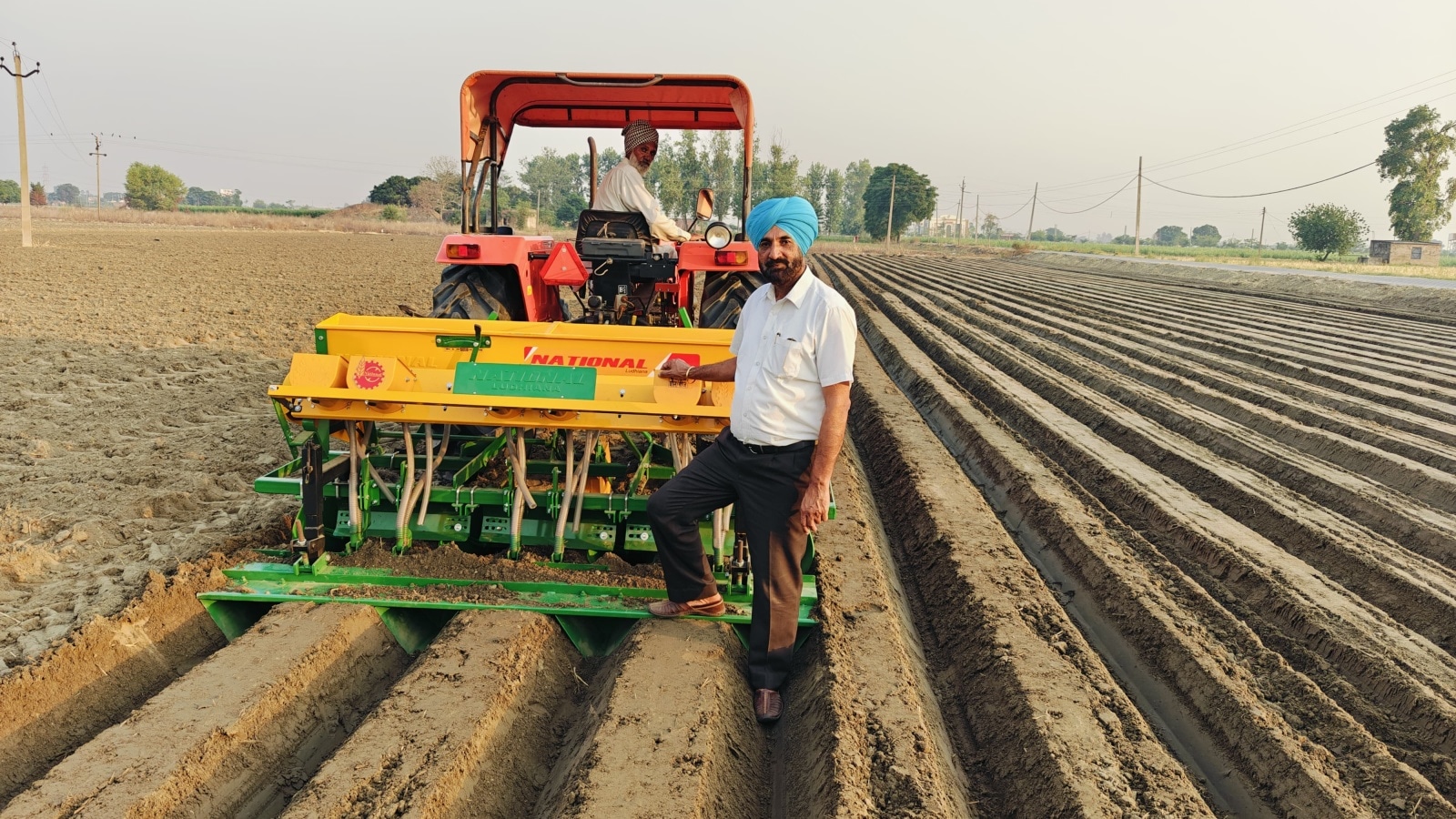
-Pannu has a history of advocating for sustainable agriculture. He was involved in drafting the Punjab Preservation of Subsoil Water Act of 2009, which restricts paddy transplantation before June 10, and introduced laser levelling in Punjab in 2010, saving 25 per cent of water used in rice cultivation. He considers SRB an improvement over the Direct Sowing of Rice (DSR) method, as it requires even less water. https://indianexpress.com/article/cities/chandigarh/punjab-ias-officer-turned-farmer-paddy-water-9650090/ (02 Nov. 2024)
Farmers cultivating a network for ZBNF A group of farmers led by Narinder Singh, a 48-year-old from village Ajjowal of Hoshiarpur with an MSc in IT, had quietly defied conventional practices. Narinder, who owns 7 acres, and his group started practicing near-zero-budget natural farming in 2011, well before the govt’s policy shift. Rather than relying on costly inputs, they embraced natural and sustainable practices. Over the years, Narinder and his small group of about 15 like-minded farmers organised workshops and farm visits, sharing insights on how to make use of on-farm resources. Their efforts have paid off, and today, nearly 75 farmers in the region are following similar practices on over a 100 acres and making a chain of such farmers. https://indianexpress.com/article/cities/chandigarh/seeds-of-change-how-punjab-farmers-are-cultivating-a-network-for-zero-budget-natural-farming-9650700/ (03 Nov. 2024)
Haryana Interesting story of farmers of Tarawadi village in Karnal dist of Haryana who are not burning the crop residue. 700 farmers are mulching the 8750 tons of crop residue into the land since 2010-11, now for 14 years. The group led by Vishal Chaoudhary is called Society for conservation of natural resources and empowering Rural Youth.

Tamil Nadu Soil conservation boosts water retention in 40 tribal villages Soil conservation and water retention measures were rolled out across 40 tribal villages in the Tirupattur Forest Division as part of a project aimed at reclaiming and improving tribal lands. The initiative, spearheaded by Tamil Nadu Biodiversity Conservation and Greening Project Climate Change Response (TBGPCCR), is expected to benefit these villages by reducing soil erosion and boosting groundwater levels. Project director I Anwardeen said eight methods were introduced to manage natural water resources more effectively. These methods include well recharge pits, water absorption trenches, trench-cum-bunds, stone bunds, loose rock check dams, recharge shafts, and percolation ponds. Each technique was tailored to address specific soil and water challenges in the region. https://timesofindia.indiatimes.com/city/chennai/innovative-soil-conservation-techniques-enhance-water-retention-in-40-tribal-villages/articleshow/114664127.cms (28 Oct. 2024)
Madhya Pradesh Transformation of Khadkiya Ghat village through water access Khadkiya Ghat village under Bhanpura Panchayat in the Dhar dist, has undergone a remarkable transformation from a community grappling with water scarcity and health issues to one thriving with access to clean drinking water. This change has largely been fueled by the initiatives of the Dehradun-based Centre for Business and Entrepreneurial Development and supported financially by Frank Water, UK. This case study highlights the journey of Durgabai Muwel, a 41-yr-old villager, and her family, illustrating the significant impact of these efforts on the entire community. https://www.indiawaterportal.org/drinking-water/from-scarcity-to-abundance (23 Oct 2024)
West Bengal RWH potential zones in Purulia This paper “Addressing water scarcity challenges through rainwater harvesting: A comprehensive analysis of potential zones and model performance in arid and semi-arid regions: A case study on Purulia” (https://www.sciencedirect.com/science/article/pii/S2589757824000118?dgcid=rss_sd_all) aims to develop a model that efficiently identifies rainwater harvesting potential zones using principal variables, combining geographical information systems methods with multi-criteria decision-making (MCDM) and machine learning techniques.
– Purulia exhibits characteristics typical of areas near the Tropic of Cancer, featuring undulating geomorphology in some locations. An examination of variables influencing rainwater harvesting potential reveals that rainfall is uneven across the region. The western part receives the least rainfall, averaging less than 1,300 mm annually, affecting about 17% of the area. Rainfall increases eastward, with approximately 15% of the area receiving more than 1,350 mm. A third of the central region experiences rainfall between 1,400 mm and 1,500 mm yearly, while only 12% of the extreme eastern area receives about 1,500 mm annually.
– The analysis of rainwater harvesting potential zones reveals that less than 2% of the study area is unsuitable for rainwater harvesting, primarily located in the western section. Only 8% is deemed poorly suitable, indicating that the potential for rainwater harvesting is nearly non-existent there. Approximately one-third of the western and southern regions are classified as having moderate potential. Notably, around 45% of the area is highly suitable for rainwater harvesting, with the central eastern part showing the greatest potential and considered “very highly suitable”, covering less than 12% of the total area. https://www.indiawaterportal.org/groundwater/rainwater-harvesting/rainwater-harvesting-potential-zones-in-purulia (27 Oct. 2024)
GROUNDWATER
Assam Arsenic found in groundwater in 19 districts A study conducted by the Columbia University states that long-term exposure to arsenic in water may increase the risk of cardiovascular diseases. The study, which pointed out heart disease risk even at exposure levels below the regulatory limit (10μg/L), assumes significance for Assam because of the fact that arsenic has been found in several districts of the State.
According to Central Ground Water Board data, 19 districts in Assam – Sivasagar, Jorhat, Golaghat, Sonitpur, Lakhimpur, Dhemaji, Hailakandi, Karimganj, Cachar, Barpeta, Bongaigaon, Goalpara, Dhubri, Nalbari, Nagaon, Morigaon, Kamrup, Darrang, and Baksa have arsenic above 0.01 mg/l. Also Read – Huge gap between demand & supply, Assam relies heavily on purchased power Many districts in Bihar, Gujarat, Haryana, Madhya Pradesh, Punjab, Tamil Nadu, Uttar Pradesh, and West Bengal also have presence of arsenic above 0.01 mg/l. https://assamtribune.com/assam/arsenic-found-in-groundwater-in-19-districts-of-assam-central-govt-data-1556748 (02 Nov. 2024)
URBAN LAKES, WETLANDS
Opinion Mumbai To Chennai – Cries To Save Waterbodies What prevented the so-called urban planners in Chennai or Mumbai, or any major city for that matter, from designing a proper stormwater drainage system? These are all highly qualified officers, and it is difficult to believe that they do not have knowledge of El-Nino & climate change. (BN Kumar) https://www.freepressjournal.in/mumbai/mumbai-to-chennai-cries-to-save-waterbodies (2 Nov 2024)
Bengaluru Lake Trust pushes NGT to axe pipeline approval The Yelahanka Puttenahalli Lake and Bird Conservation Trust (YPLBCT) approached the National Green Tribunal (NGT), requesting the court to quash the permission given by the forest department to Bruhat Bengaluru Mahanagara Palike (BBMP) for laying down hume pipes inside the reserve. The Trust, in its application, also requested NGT to issue an order to BBMP and Bangalore Water Supply and Sewerage Board (BWSSB) to restore the damage done to the reserve and to stop any activity even in the buffer zone of the lake. The Trust approached the green court after sewage mixed with stormwater entered the lake again during recent rain spells in the city. According to the trust, BBMP and BWSSB violated NGT’s order. https://bangaloremirror.indiatimes.com/bangalore/civic/lake-trust-pushes-ngt-to-axe-pipeline-approval/articleshow/114662426.cms (28 Oct. 2024)
Triveni Nagar and KR Puram residents were thrilled when the BBMP (Bruhat Bengaluru Mahanagara Palike) Lakes Department began rejuvenating Gangashetty Lake in December 2022, with an estimated budget of ₹4 crore. Over a year later, however, environmentalists and residents are disappointed that the lake has yet to fill with water despite the completed work. https://bangaloremirror.indiatimes.com/bangalore/civic/gangashetty-lake-rejuvenation-fails-to-deliver-clean-water/articleshow/114826735.cms (01 Nov. 2024)
Noida Lack of upkeep keeping winter birds away from wetlands Okhla Bird sanctuary’s deteriorating condition is believed to be the reason behind the absence of these avian visitors. Similarly, Surajpur wetland has also experienced a lack of winter birds, with only five species observed as of last week against 15-20 species last year. Over the past few years, the sanctuary’s ecosystem has been negatively impacted by various factors, resulting in a diminished capacity to attract and support the wide array of migratory birds that previously frequented its waters.
Ecologist TK Roy told TOI, “Unfortunately, due to mismanagement and the destruction of wildlife and birdlife habitats, the sanctuary has been transformed into a highly disturbed entertainment park.” Roy added that unauthorised concrete structures have been erected on the grounds, which has further degraded the natural environment that once supported a thriving ecosystem. As a result of these detrimental changes, the resident water bird population has suffered a significant decline, with fewer than 15 species now present in the sanctuary — and their numbers have dwindled to alarmingly low levels. https://timesofindia.indiatimes.com/city/noida/winter-birds-absent-from-noida-wetlands-due-to-neglect/articleshow/114891924.cms (03 Nov. 2024)
URBAN WATER
Study Combination of interventions is key to water conservation Contrary to popular belief that increasing water tariff might curtail usage, a study by the Indian Institute of Management Bangalore (IIMB) shows that it is actually a combination of price and non-price interventions that could help in achieving conservation effects that are large and persistent. https://www.thehindu.com/news/cities/bangalore/combination-of-interventions-is-key-to-water-conservation-finds-indian-institute-of-management-bangalore- (28 Oct. 2024)
Eloor Municipality serves notice on 3 violators The Eloor municipality has served closure notices on three agencies for alleged illegal commercial extraction of groundwater from private wells near the Periyar. The notices were issued after inspections by the health wing of the civic body found that the units were extracting groundwater in violation of norms. The municipal council decided to close similar units near the riverbed engaged in illegal commercial water extraction, including supply to industries, households, and businesses. https://www.thehindu.com/news/national/kerala/illegal-groundwater-extraction-eloor-municipality-serves-notice-on-three-violators/article68822836.ece (02 Nov. 2024)
Hyderabad Water Board offers interest waiver on pending bills According to HMWS&SB’s Managing Director, Ashok Reddy, Rs 1706 crore in outstanding water bills is due to the Water Board. To encourage customers to clear their dues, the OTS-2024 scheme offers a waiver of Rs 1189 crore in accumulated interest. Of the 13.50 lakh drinking water connections in Hyderabad, about 7 lakh customers are eligible to benefit from the OTS scheme for clearing pending water bills. This includes those who have not previously taken advantage of the scheme. For those who have, a 50 % waiver on the remaining interest is still available. https://www.siasat.com/hyderabad-water-board-offers-interest-waiver-on-pending-bills-3118212/ (23 Oct. 2024)
Mumbai 24×7 water supply remains a distant dream Currently, the city receives 3,950 million litres of water (MLD) every day from seven lakes and the BMC is trying to push the Gargai dam project, which will provide an additional 440 MLD. The desalination project can provide 200 MLD in the first phase. So, if these projects succeed, the water supply will increase by 660 MLD in the next four to five years. However, 24×7 water supply will still elude the civic body. https://www.mid-day.com/mumbai/mumbai-news/article/mumbai-24-7-water-supply-to-remain-a-distant-dream-for-maximum-city-23419059 (28 Oct. 2024)
WATER POLLUTION
Karnataka Death toll from water contamination in Vijayanagara rises to 5 The death toll in the water contamination case in Harapanahalli taluk of Vijayanagara dist has risen to five, with three more villagers succumbing Oct 22 night at a govt hospital in Davangere. The issue of water contamination in Tambigeri village has persisted for two weeks. Damaged water supply pipes near the village allowed impure water to mix into the main water line, leading to numerous hospitalizations. Around 25 people have been admitted to hospitals in Davangere and nearby areas. This marks the seventh death due to water contamination in Karnataka within the past week. https://www.newindianexpress.com/states/karnataka/2024/Oct/23/death-toll-from-water-contamination-in-vijayanagara-rises-to-five (23 Oct. 2024)
JJM/ RURAL WATER SUPPLY
Uttarakhand In Kumaon, water’s not under the bridge The Raji community is a particularly vulnerable tribal group (PVTG) that lives in and around Pithoragarh district of Kumaon region. Historically, the Raji people have depended on the forest for resources and livelihoods. “But now that all the water sources in the mountain are drying up and banj (Himalayan oak) and bamboo forests are being taken over by pine, depending on the forest is no longer a possibility,” says Mahesh Rajwar, a member of the Raji community in Jouljibi village. As a result, community members are now moving towards agriculture and wage labour.
Two big reasons for the drying up of perennial springs are erratic rainfall patterns and the construction and broadening of roads in the mountains. This is believed to cut off the base flow by disconnecting recharge areas from discharge areas, disturbing the mountain geology. This can completely dry up springs or reduce their flow as well as affect water quality. “Better roads are helping us reach the cities more easily. But these changes also have many negative impacts,” says an inhabitant of Kalika village.
The changing forest ecology further exacerbates the issue. Traditionally, the Kumaon Himalayas have had a la rge oak tree population that helps maintain water levels and prevent soil erosion and degradation. But as pine forestation continues to increase, risks of poor water recharge, forest fires, and soil degradation have multiplied. Traditionally, the people of the Kumaon region depended on perennial springs for irrigation as well as drinking water. With the springs drying up, rainfed irrigation is the only alternative.
For drinking water, houses in the area depend on piped water provided by the Jal Jeevan Mission (JJM). However, the quality of this water remains an issue, with a rise in stomach ailments in the region in recent years. Additionally, the water supply under JJM is also dependent on local water bodies. With drying base flows, the source sustainability of JJM remains a challenge. https://idronline.org/ground-up-stories/in-kumaon-waters-not-under-the-bridge/
Opinion Swachh Bharat must focus on the invisible sanitation worker Data from 2018 to 2023 reveals that over 400 people died while cleaning septic tanks and sewers. Yet, authorities routinely deny the existence of manual scavengers and informal sanitation workers. The current budget does not have any provisions to rehabilitate manual scavengers or sanitation workers. While the 2022 NAMASTE scheme by the Ministry of Social Justice and Empowerment mentions rehabilitation as one of the objectives, the emphasis is on providing safety and skill training to the workers. This fails to address the historical injustices faced by these communities. (Lyla Mehta and Hariprasad V M) https://indianexpress.com/article/opinion/columns/swachh-bharat-must-focus-on-the-invisible-sanitation-worker-9649181/ (02 Nov. 2024)
MONSOON 2024
In first post monsoon month Uttarakhand has received only 2.9 mm rainfall against the normal average of 31 mm thus facing 91% deficit. Similarly, against the normal average of 25.4 mm the Himachal Pradesh registered only 0.7 mm and is 97% rainfall deficit.


Himachal Pradesh 3rd driest October since 1901 The state received the third lowest rain this October in the past 124 years. Against the normal rainfall of 25.1mm in October, the state received only 0.7 mm this year, which amounts to 97 per cent deficiency. Hamirpur, Bilaspur, Solan, Sirmaur, Kullu and Chamba districts have received no rainfall last month.
The two occasions when even lesser precipitation was recorded than this Oct, occurred in the past 10 years. While Oct 2017 saw 99 per cent deficiency, the rain in Oct 2020, was 98 % less than normal. Ever since 2010, Oct has received less than normal rainfall every year, barring three occasions. In Oct 2021, 107 % more than normal rainfall was recorded. The highest rainfall in Oct (413.5 mm) was in 1955. https://www.tribuneindia.com/news/himachal/himachal-witnesses-third-driest-october-since-1901/ (02 Nov. 2024)
FLOOD 2024
Himachal Pradesh Muck dumping: Villagers raise alarm over flood risk Villagers of Shanag, Buruwa and Palchan in Himachal Pradesh are increasingly concerned about the risks of flooding, which they attribute to a muck dumping site from the construction of the Atal Tunnel. According to Shanag panchayat president Roshan Lal, a recent cloudburst in the Anjani Mahadev area on July 25 led to flash floods in the Pagal nullah. The surge breached containment walls and crate wires, spreading debris downstream and causing significant damage in Shanag and Palchan villages. Residents argue that the muck, removed during the tunnel’s construction and stored in a vulnerable dumping site, now threatens their communities. https://www.tribuneindia.com/news/himachal/muck-dumping-villagers-raise-alarm-over-flood-risk/- (30 Oct. 2024)
CM Sukhvinder Singh Sukhu dedicated to state developmental projects worth Rs 30.70 crore at an event held in Kinnaur district on Saturday (Nov. 02). The CM laid foundation stones for several flood protection works, including those at Rokti Nallah in Sangla gram panchayat with an estimated cost of Rs 1.35 crore and at Shango (Left Bank) in Katgaon gram panchayat, Tehsil Nichar, with a budget of Rs 6.95 crore. He also initiated projects for flood protection in Sapni village, costing Rs 5.13 crore, the channelization of Kotangtee Khad in Tehsil Kalpa with an expenditure of Rs 1.88 crore and a flood protection project worth Rs 94.38 lakh on the Baspa River at Rakchem in Rakchem gram panchayat. Furthermore, he laid the foundation stone for a sewerage scheme worth Rs 3.96 crore for Namgia village. https://www.business-standard.com/india-news/himachal-cm-dedicates-development-projects-worth-rs-30-70-crore-to-state-124110300062_1.html (02 Nov. 2024)
HFL BREACH
Tamil Nadu River Kallar in Cauvery basin at Odendurai site in Coimbatore district has missed breaching HFL 331 meter dated 02.12.2019 by 0.01 meter. The flood level in the river had also touched the same HFL last year on 23.11.2023..

URBAN FLOODS
Chennai Corporation Council on Tuesday (Oct. 29) passed a resolution to start maintenance of storm water drains, canals, roads, streetlights and civic infrastructure in industrial estates, in areas such as Ambattur and Guindy to improve flood mitigation in the city. The Council also resolved not to declare any vending zones in roads of the industrial estates. Tamil Nadu Small Industries Development Corporation has already resolved to hand over the facilities in Guindy and Ambattur to Chennai Corporation. In the past few years, the councillors have been complaining about civic issues, including flooding in the area because of inadequate manpower. https://www.thehindu.com/news/cities/chennai/chennai-corporation-council-passes-resolution-to-take-over-drains-canals-in-important-industrial-estates-for-flood-mitigation/article68810639.ece (29 Oct. 2024)
Bengaluru Why Bengaluru is prone to flooding Bengaluru witnessed rampant flooding in several parts of the city, especially along the technology corridor after heavy rains last week.
Raj Bhagat @rajbhagatt, Geoanalyst at @WRIIndia says that rampant urbanisation minus scientific planning is the main cause and if corrective measures are not taken, the situation will continue and likely worsen in the coming years. https://www.youtube.com/watch?v=4Skvo4vP2qs (29 Oct. 2024)
DROUGHT
Gujarat Is extreme rainfall leading to ‘green drought’ in Western India? In India, farmers in rural Gujarat are caught in a cycle of droughts and floods, and increasingly frame the impacts of these co-located hazards in the form of ‘leelo dukaal’ (green drought). Researchers here argue that while much of the attention remains on episodes of ‘extremes’, it is the slow onset or creeping hazards that need our attention. For the last two years, the research team has been exploring how local communities in Banaskantha (North Gujarat) experience and cope with the extremes of drought and floods, which have become more frequent in the past decade.
– Amidst the different classifications of drought, such as meteorological or hydrological drought, green droughts are a deceptive scenario where vegetation appears lush and green despite underlying water stress at the roots. Green droughts are characterised by stunted plant growth and reduced crop yields, making them challenging to detect and diagnose. Contributing factors include uneven rainfall patterns, high temperatures, shallow-rooted plants, and soil compaction, which hinders water reaching down to the root zone. https://www.ids.ac.uk/opinions/is-extreme-rainfall-leading-to-green-drought-in-western- (24 Oct. 2024)
ENVIRONMENT GOVERNANCE
Report In 5 yrs, 301 Indian plants enter ‘threatened’ list As many as 301 species of plants in India — trees to grass — have joined the list of various threatened categories assessed between 2020 and 2024, taking the total number of species in such a position to 762, according to the IUCN. Two species have been classified extinct in the last three years. Since 1998, 3,501 plant species have been assessed in India of which 762 (21per cent) species were found to be facing varying degrees of threats. The data analysed by DH showed that there were 154 species classified “critically endangered” just below the stage of “extinction in the wild”.
There were 282 “endangered” species facing “very high risk of extinction in the wild”, 239 species were “vulnerable” at high risk of unnatural extinction and 86 were “near threatened” close to being endangered in future. https://www.deccanherald.com/environment/in-5-yrs-301-indian-plants-enter-threatened-list-3254241 (30 Oct. 2024)
Book Launch India’s environmentalism didn’t start with Chipko Guha presents an intellectual history of Indian environmentalism by chronicling the lives and contributions of ten varied individuals — some well–known, like Rabindranath Tagore, Verrier Elwin, and Mirabehn, and some far lesser–known, like JC Kumarappa, M Krishnan, and Radhakamal Mukerjee. “This book was conceived during the time of Chipko, and it’s appearing 40 years later during the time of climate change,” said Guha. “Climate change is a real threat to India and the world. But even if it didn’t exist, India would be an environmental basket case.”

As to why India isn’t seeing a movement like Chipko or the Narmada Bachao Andolan today, Guha said: “From 2004, the Indian state has been suppressing dissent much more, particularly environmental dissent,” he said. “The state in the 80s and 90s was different, it allowed space for civil society. And the other reason why we don’t see such a movement today is because of the smartphone — which individualises everything, including dissent.” https://theprint.in/feature/around-town/indias-environmentalism-didnt-start-with-chipko/2338672/ (2 Nov. 2024)
Uttarakhand Govt lacks infrastructure to fight forest fires, NGT told NGT had appointed advocate Bansal as amicus curiae in April to assist with proceedings regarding leaf burning in Badkot forest range along Rishikesh Dehradun road. While submitting his report, Bansal emphasised that Uttarakhand suffers from a “glaring lack of essential infrastructure required for efficient forest fire management.” The report, furnished last week, stated “it was imperative to address critical deficiencies and violations hindering effective forest fire management in state.” “This encompasses a lack of firefighting equipment such as protective goggles, protective gear, weapons, etc, insufficient patrolling vehicles to access remote areas, and a dearth of communication devices such as wireless and satellite phones essential for coordination and timely response during fire emergencies,” it stated. The report highlighted that forest department was facing infrastructure challenges, including a shortage of new structures to meet increasing demands. The forest guard or forester chowkis being situated in remote areas, devoid of basic amenities, also poses a critical hurdle. https://timesofindia.indiatimes.com/india/uttarakhand-lacks-infrastructure-to-fight-forest-fires-ngt-told/articleshow/114899184.cms (03 Nov. 2024)
CLIMATE CHANGE
COP 16 India needs Rs 81.6k crore per year up to 2029-30 to meet biodiversity goals India has committed to prioritise effective restoration of at least 30% of its degraded terrestrial, inland water, and coastal and marine areas by 2030 in sync with the country’s 23 national biodiversity targets as well as the global 30×30 biodiversity goals. It said the country would need an annual average amount of Rs 81,664 crore for implementation of its updated pledges up to 2029-30. India in its updated National Biodiversity Strategy and Action Plan (NBSAP) claimed that it spent around Rs 32,207 crore annually on biodiversity protection, conservation, and restoration from 2017-2018 to 2021-2022.
The country unveiled its voluntary commitments in its updated National Biodiversity Strategy and Action Plan (NBSAP) during the 16th session of the UN Convention on Biological Diversity (COP16) at Cali, Colombia where countries representatives are negotiating multiple issues to protect nature, including a financial mechanism to support countries towards their efforts.
India in its updates also outlined its 23 national biodiversity targets, aligning it with the Kunming-Montreal Global Biodiversity Framework (KM-GBF) adopted by 196 countries in Montreal during COP15 in 2022 as part of a larger global goal to protect 30% of the planet Earth by 2030 (popularly known as 30×30 targets) through halt and reverse biodiversity loss and achieve a nature-positive world. https://timesofindia.indiatimes.com/india/india-needs-rs-81-6k-crore-per-year-up-to-2029-30-to-meet-biodiversity-goals/articleshow/114867277.cms (02 Nov. 2024)
India submits biodiversity plan India has submitted its updated National Biodiversity Strategy and Action Plan at the Convention on Biological Diversity (CBD) COP16 at Cali, Colombia on Oct 31 with key areas focusing on “area based conservation” and “agrobiodiversity”. Apart from these, the focus also lies on delivering on 23 national biodiversity targets which are aligned with global targets. https://www.hindustantimes.com/india-news/protected-areas-agrobiodiversity-focus-areas-of-india-s-biodiversity-plan-101730352366889.html (31 Oct. 2024)
The first open-source atlas of the world’s ecosystems launched A new conservation tool, the Global Ecosystems Atlas, has been launched with the goal of providing a comprehensive and harmonised resource for mapping and monitoring all the world’s ecosystems. Unveiled this week at the 2024 United Nations Biodiversity Conference (COP16) in Cali, Colombia, by the Group on Earth Observations (GEO), the atlas aims to support the protection, restoration, and sustainable management of ecosystems – a task that is critical to addressing global environmental crises.
By providing access to high-quality, reliable and standardised data on ecosystems worldwide, the atlas will help identify priority areas for conservation & restoration – which could make it a resource for policymakers, financial institutions, private companies & local communities. https://geographical.co.uk/science-environment/global-ecosystems-atlas (25 Oct 2024)
COP16 suspended without agreement on new fund for nature The 16th UN biodiversity talks in Colombia’s Cali were suspended on Saturday (Nov. 02) without an agreement on setting up a new fund for the protection of nature. The conference, which ran around 12 hours past its scheduled end, did yield an important agreement to establish a subsidiary body that will include indigenous peoples in future discussions and decisions on biodiversity conservation. https://www.thehindu.com/sci-tech/energy-and-environment/cop16-suspended-without-agreement-on-new-fund-for-nature/article68823957.ece (03 Nov. 2024)
SOUTH ASIA
NEPAL 2 indian workers killed in Arun III HEP accident Two Indian workers lost their lives in a tragic tipper accident on Wednesday night at the Arun III Hydropower Project site. The accident occurred in Phyaksinda Doban, Makalu Rural Municipality-5 when the tipper veered off the road and plunged 50 m downhill. Two more Indian workers were injured in the accident. https://www.ditible.com/2-indian-workers-killed-in-arun-iii-hydropower-accident/ (31 Oct. 2024)
Pakistan Terrorists kill 5 dam workers in Balochistan At least five people were killed and two injured when terrorists fired on workers at the site of an upcoming dam in Panjgur district of Pakistan’s Balochistan, local authorities said Tuesday (Oct. 29) in what was the latest in a wave of strikes aimed at projects in the restive province. The shooting occurred as PM Shehbaz Sharif left for Riyadh on a visit aimed at attracting Saudi investments. Shahid Rind, a spokesperson for the Balochistan govt, said the attack took place in Paroom area of Panjgur. Security officials said the attackers came on motorcycles and escaped unhurt after shooting at the workers and setting fire to some machinery used in the dam’s construction. https://timesofindia.indiatimes.com/world/pakistan/terrorists-kill-5-dam-workers-in-balochistan/articleshow/114743966.cms (30 Oct. 2024)
MEKONG
‘Mekong Ghost’ rediscovered after missing for nearly 20 years While the world discusses how to save biodiversity at the CBD COP16 in Cali, Colombia, the rediscovery of the elusive Giant Salmon Carp, previously feared extinct and nicknamed the Giant Mekong Ghost Fish, was announced.
The rediscovery of the large predatory fish represents an urgent call to action for all freshwater ecosystems (referred to as ‘Inland Waters’ by the Convention on Biological Diversity) and all the species, including humans, that rely on them. https://shoalconservation.org/mekong-ghost-rediscovered/ (30 Oct. 2024)
EUROPE
Spain Flash floods in leave 95 dead At least 95 people have died and others were missing after devastating flash floods hit eastern Spain, according to the local authorities, in one of the worst natural disasters to hit the country in recent years. The catastrophic floods, fueled by an unrelenting deluge that began on Monday, washed away cars, inundated homes and knocked out power across eastern Spain. Rescuers waded through neck-high waters to reach some residents.
– In the town of Chiva in the eastern Valencia region, practically a year’s worth of rain fell over eight hours, Spain’s meteorological agency said on Wednesday, illustrating the ferocity of the storm. Other areas across the south and east saw more than a month’s worth of rain in less than 24 hours. In the town of Chiva in the eastern Valencia region, practically a year’s worth of rain fell over eight hours, Spain’s meteorological agency said on Wednesday, illustrating the ferocity of the storm. Other areas across the south and east saw more than a month’s worth of rain in less than 24 hours. People said there had been no warning about the storm’s dangers. More people are missing and the death toll is likely to rise. https://www.nytimes.com/2024/10/30/world/europe/spain-floods- (30 Oct. 2024)
Why was Valencia flooding so deadly? Climate scientists and meteorologists have blamed the flooding on something called a ‘cut-off low pressure storm system’ that had migrated from an unusually wavy, stalled jet stream. This system then got stuck over the region, pouring down a year’s worth of rain in eight hours. It is a natural weather event that usually hits Spain in Autumn and Winter. This phenomenon is so common it has its own acronym, a DANA or Depresion Aislada en Niveles Altos.
– Local authorities have been criticised for failing to issue timely warnings about the potential dangers of the storm. Valencia’s government has admitted it only sent out text messages warning residents of the catastrophe eight hours after floods were first reported and 10 hours after AEMET issued a warning about “extreme danger” in the region. This brief message sent just after 8pm on Tuesday came too late for many who were already trapped in their homes, in shops or in their cars on the streets as the deadly flooding hit.
– The World Meteorological Organization said on Friday that effective flood warning systems could haved helped avoid the level of destruction that occurred in Valencia. “We do need to ensure that the early warnings reach those who need them,” WMO official Clare Nullis told a regular UN briefing. “We need to ensure that early warnings lead to informed early action.” https://www.euronews.com/green/2024/10/31/why-was-valencia-flooding-so-deadly-did-warning-texts-come-too-late-and-whats-the-climate- (31 Oct. 2024)
Unprecedented floods that killed more than 200 The storms concentrated over the Magro and Turia river basins and, in the Poyo riverbed, produced walls of water that overflowed riverbanks, catching people unaware as they went on with their daily lives, with many coming home from work on Tuesday (Oct. 29) evening. Spain’s national weather service said that in the hard-hit locality of Chiva it rained more in eight hours than it had in the preceding 20 months, calling the deluge “extraordinary.”
-Scientists trying to explain what happened see two likely connections to human-caused climate change. One is that warmer air holds and then dumps more rain. The other is possible changes in the jet stream — the river of air above land that moves weather systems across the globe — that spawn extreme weather. The extreme weather event came after Spain battled with prolonged droughts in 2022 and 2023. Experts say that drought and flood cycles are increasing with climate change.
-Older people in Paiporta, ground zero of the tragedy, claim that Tuesday’s floods were three times as bad as those of 1957, which caused at least 81 deaths and were the worst in the history of the tourist eastern region. That episode led to the diversion of the Turia watercourse, which meant that a large part of the city was spared of these floods. https://apnews.com/article/flash-floods-spain-valencia-climate-change-what-to-know-f942142b82de24f5b4a18867bc32ae00 (01 Nov. 2024)
This is the worst natural disaster Valencia has seen in decades. A year’s worth of rain dumped in less than 8 hours, according to Spain’s meteorological agency. The water came rushing down the rivers and tributaries towards the Mediterranean Sea, picking up cars and destroying bridges along the way. More than 200 people have been killed, with authorities warning the death toll is likely to rise. But it is not unprecedented. Valencia suffered a similar deadly flood in October 1957 caused by the same seasonal weather phenomenon known as a Gota Fria or a Cold Drop. That disaster killed dozens of people when the Turia burst its banks in the crowded neighborhoods of Valencia city. It was so deadly that the city spent millions to reroute the river years later. https://edition.cnn.com/2024/11/01/europe/spain-floods-warning-too-late-intl/index.html (1 Nov 2024)
The floods have battered Valencia’s infrastructure, sweeping away bridges, roads and rail tracks, and submerged farmland in a region that produces about two-thirds of Spain’s citrus crops like oranges, which the country exports globally. In the hard-hit rural town of Utiel, some 85 km (53 miles) inland, the Magro River burst its banks, sending up to three metres (9.8 feet) of water into the mostly single-storey homes.
The tragedy is already Spain’s worst flood-related disaster in modern history, and meteorologists say human-driven climate change is making such extreme weather events more frequent and destructive. In 2021, at least 185 people died in heavy flooding in Germany. Prior to that, 209 people died in Romania in 1970 and floods in Portugal in 1967 killed nearly 500 people. https://www.reuters.com/world/europe/spanish-rescue-teams-hunt-missing-after-deadly-floods-2024-10-31/ (31 Oct. 2024)
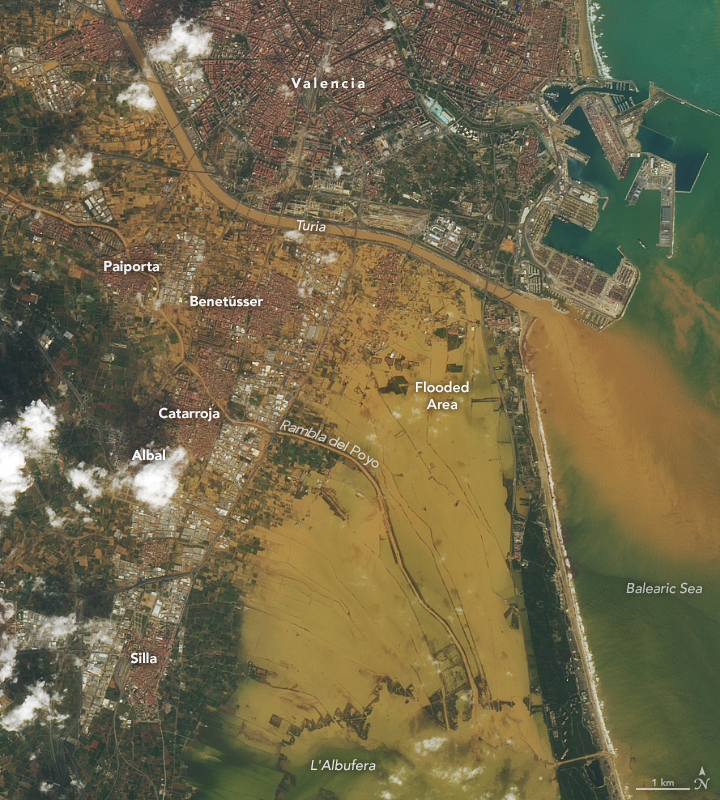
The rains came from a high-altitude low-pressure weather system that became isolated from the jet stream, according to AEMET. These storm systems are known locally by the Spanish acronym DANA or more generally as cut-off lows. They occur where cold fronts encounter warm, humid air masses, such as over the Mediterranean Sea. The storms can remain relatively stationary before dissipating, amplifying their flooding potential. https://earthobservatory.nasa.gov/images/153533/valencia-floods (31 Oct. 2024)
THE REST OF THE WORLD
USA Oklahoma reps to hold study on controversial proposed PSP Interesting to see that a 1200 MW Pump Storage Project in Oklahoma has become controversial and a number of stake holders are opposing the project including impact on water availability, indigenous sites among others. https://www.hydroreview.com/world-regions/north-america/oklahoma-reps-to-hold-study-on-controversial-proposed-pumped-storage- (24 Oct. 2024)
Breathing new life into urban rivers While the idea of an urban river renaissance is providing hope for cities like Chicago and Portland, there’s still plenty of work to be done. Of the 3.5 million miles of rivers in the U.S., 50% are too polluted for fishing, boating or swimming, according to American Rivers, a group focused on protecting and restoring rivers. https://www.cbsnews.com/news/urban-rivers-portland-chicago/ (21 Oct. 2024)
Compiled by SANDRP (ht.sandrp@gmail.com)
Also see: DRP 28 Oct. 2024 & DRP 21 Oct. 2024
Follow us on: www.facebook.com/sandrp.in; https://twitter.com/Indian_Rivers

 SANDRP