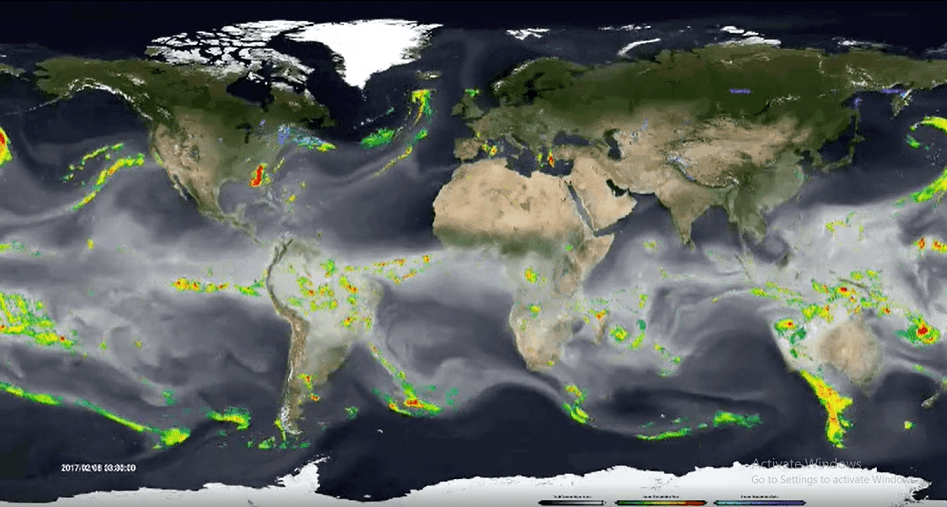
(Feature Image (Screenshot): Atmospheric rivers occur all over the world, as this animation of global satellite data from February 2017 shows. Credit: NASA/Goddard Space Flight Center Scientific Visualization Studio)
A number of reports listed below this week throw fresh light on functioning of global water cycle, some of the findings should be seriously worrying. The studies show how the countries across the globe have water connections that go far beyond shared rivers, lakes and seas. And how these components of global water cycles are not only changing, but are under unprecedented stress and could take the global water cycles off balance.
Another study about atmospheric rivers that provides some of the largest high intensity rainfalls show that these rivers are shifting, which can have far reaching consequences for large sub-tropical areas, polar areas and others. For understanding their implications, more studies particularly focusing on shifting El Nino and La Nina streams are required.
As if to show how all these are already making changes, there are stories this week about the unprecedented drought in Amazon basin, rainfall in Sahara Desert and key changes in Indian monsoon, closer home.
All this should drive all concerned, but particularly the governments and its various pillars, to action towards mitigating and adaptation to climate change, but also more studies to understand the far-reaching implications of all these changes already happening.
Report Global water cycle is off balance for 1st time Decades of destructive land use and water mismanagement have collided with the human-caused climate crisis to put “unprecedented stress” on the global water cycle, said the report published Oct 16 by the Global Commission on the Economics of Water, a group of international leaders and experts.
The report differentiates between “blue water,” the liquid water in lakes, rivers and aquifers, and “green water,” the moisture stored in soils and plants. While the supply of green water has long been overlooked, it is just as important to the water cycle, the report says, as it returns to the atmosphere when plants release water vapor, generating about half of all rainfall over land. Disruptions to the water cycle are “deeply intertwined” with climate change, the report found.
A stable supply of green water is vital for supporting vegetation that can store planet-heating carbon. But the damage humans inflict, including destroying wetlands and tearing down forests, is depleting these carbon sinks and accelerating global warming. In turn, climate change-fueled heat is drying out landscapes, reducing moisture and increasing fire risk.
The report says world govts must recognize the water cycle as a “common good” and address it collectively. Countries are dependent on each other, not only through lakes and rivers that span borders, but also because of water in the atmosphere, which can travel huge distances — meaning decisions made in one country can disrupt rainfall in another. The report calls for a “fundamental regearing of where water sits in economies,” including better pricing to discourage wastefulness and the tendency to plant water-thirsty crops and facilities, such as data centers, in water-stressed regions. https://edition.cnn.com/2024/10/16/climate/global-water-cycle-off-balance-food-production (16 Oct 2024)
Study Atmospheric rivers are shifting poleward, reshaping global weather patterns A new study published in Science Advances, University of California, Santa Barbara, climate scientist Qinghua Ding and others show that atmospheric rivers have shifted about 6-10° toward the two poles over the past four decades.
The study shows that atmospheric rivers have been shifting over the past four decades. In both hemispheres, activity has increased along 50° north and 50° south, while it has decreased along 30° north and 30° south since 1979. In North America, that means more atmospheric rivers drenching British Columbia and Alaska.
One main reason for this shift is changes in sea surface temperatures in the eastern tropical Pacific. Since 2000, waters in the eastern tropical Pacific have had a cooling tendency, which affects atmospheric circulation worldwide. This cooling, often associated with La Niña conditions, pushes atmospheric rivers toward the poles.
In the subtropics, where atmospheric rivers are becoming less common, the result could be longer droughts and less water. Many areas, such as California and southern Brazil, depend on atmospheric rivers for rainfall to fill reservoirs and support farming. Without this moisture, these areas could face more water shortages, putting stress on communities, farms and ecosystems.
In higher latitudes, atmospheric rivers moving poleward could lead to more extreme rainfall, flooding and landslides in places such as the U.S. Pacific Northwest, Europe & even polar regions.
In the Arctic, more atmospheric rivers could speed up sea ice melting, adding to global warming and affecting animals that rely on the ice. An earlier study found that the trend in summertime atmospheric river activity may contribute 36% of the increasing trend in summer moisture over the entire Arctic since 1979.
So far, the shifts we have seen still mainly reflect changes due to natural processes, but human-induced global warming also plays a role. Global warming is expected to increase the overall frequency & intensity of atmospheric rivers because a warmer atmosphere can hold more water.
How that might change as the planet continues to warm is less clear. Predicting future changes remains uncertain due largely to the difficulty in predicting the natural swings between El Niño and La Niña, which play an important role in atmospheric river shifts. https://phys.org/news/2024-10-atmospheric-rivers-shifting-poleward-reshaping.html (14 Oct. 2024)
Study Climate change altered 2024 monsoon The study, covering 729 districts, reveals a staggering diversity in rainfall patterns. Of these, 340 districts experienced normal rainfall. However, there were significant deviations at both ends of the spectrum, with 158 districts witnessing excess rainfall and 48 districts facing large excess rainfall. On the other hand, 178 districts, including 11 with large deficits, suffered from inadequate rain.
The 2024 monsoon recorded the highest number of heavy rainfall events in the past five years. June 2024 saw the second-highest occurrences of very heavy rainfall events in the last five years. July followed this trend, reporting the second-highest number of extremely heavy rainfall events. In Aug, 753 stations recorded very heavy rainfall—the highest since 2020. Sept further marked a new record, with 525 stations logging significant rainfalls. https://www.indiatoday.in/environment/story/climate-change-altered-2024-monsoon-study-warns-of-increasing-weather-extremes-2618540-2024-10-17 (17 Oct 2024)
Study Land and Atmospheric Drivers of the 2023 Flood in India Summary In July 2023, North India experienced a severe flood that caused significant damage to lives, agriculture, and infrastructure. However, the exact causes of this flood have yet to be examined. Using in situ, satellite, and reanalysis data, we examined the drivers of the flood. Favorable atmospheric and land conditions created a unique situation that led to a significant flood in north India. For instance, extreme precipitation during 7–10 July enhanced antecedent soil moisture conditions in the hilly and plain regions. Anomalously high moisture transport caused intense rainfall, which, combined with high soil moisture, produced high runoff and streamflow conditions. Flood inundation caused damage to the Sutlaj and Yamuna river basins. Our findings show the need to monitor soil moisture and atmospheric processes for early warning of floods in hilly regions. https://agupubs.onlinelibrary.wiley.com/doi/10.1029/2024EA003750 (20 Oct. 2024)
Drought in Amazon Basin Record dry conditions in South America have led to wildfires, power cuts and water rationing. The world’s largest river system, the Amazon, which sustains some 30 million people across eight countries, is drying up. Electricity cuts across an entire nation. A capital rationing water. A mayor encouraging people to shower together to save precious drops. The world’s largest river system, the Amazon, which sustains some 30 million people across eight countries, is drying up.
(https://www.nytimes.com/2024/10/19/world/americas/south-america-drought-amazon-river.html Oct 19 2024)
HYDRO POWER PROJECTS
Eastern Ghats Revoke clearance for PSPs As the Eastern Ghats are as ecologically sensitive as the Western Ghats are, I request your Ministry to intervene urgently and revoke clearance for all such projects, before they lead to ecological disasters. All those projects will drain the locally available scarce water resources on which tribal communities critically depend and to allow such projects to come up would adversely affect their lives. by E A S Sarma https://countercurrents.org/2024/10/revoke-clearance-for-pumped-storage-projects-being-set-up-by-the-adani-group-and-others-in-the-eastern-ghats-as-they-will-lead-to-ecological- (16 Oct 2024)
Maharashtra EAC halts Adani PSP The EAC raised concerns over the drastic increase in forest land required for the project, from 24.50 ha to 88.98 ha, more than three times the original estimate. The committee has instructed Adani to reapply with a proposal that minimises the environmental impact, noting that the current configuration of the Warasgaon Warangi pumped storage project would pose a threat to the ecologically sensitive Western Ghats region. Initially, the project received preliminary approval in Feb 2023, but the company sought to expand its capacity from 1,200 MW to 1,500 MW.
In addition to rejecting the clearance, the panel said, “No final approvals for pumped hydropower projects in the Western Ghats would be granted without comprehensive site visits to assess environmental impacts.” Although preliminary clearances have been issued for 15 such projects in the region, final clearance hinges on thorough environmental impact assessments and site inspections. https://www.tribuneindia.com/news/india/govt-halts-adani-project-in-western-ghats/ (15 Oct. 2024)
Himachal Pradesh Punjab should hand over Shanan HEP: CM The CM on Oct. 18 while addressing mediapersons later, said that the lease period of the Shanan project had expired and hence the Himachal Government had the right to take over its possession. He added that the Shanan project did not fall under the Punjab Reorganisation Act and the Punjab Government had filed an appeal in the Supreme Court regarding the matter.
By the end of December, 2024, or January, 2025, power generation will be started in the Uhl Power Project after completing all technical investigations, the CM said. He said that the lack of funds would not be allowed to hinder the completion of the project. He said that Rs 100 crore was provided for the project in March this year. Tata Power Limited has been entrusted with the responsibility under the Third Party Quality Control to ensure quality in the construction work of the Uhl project. Sukhu announces additional Rs 85 crore as a ‘sovereign guarantee’ for the Uhl project. https://www.tribuneindia.com/news/himachal/sukhvinder-singh-sukhu-its-time-punjab-handed-over-shanan-power-project-to-himachal/ (19 Oct. 2024)
Jammu & Kashmir Fate of New Ganderbal HEP The New Ganderbal Hydropower project was announced more than two decades ago. Coming up on river Sindh, the project is coming up at a cost of over 800 crore was announced in 1996. The project was conceived as a run-of-the river scheme on Sindh nallah with three units of 31 MW each. Official sources said that in 2014 a two stage bidding process was adopted for the selection of the EPC contractor for construction of the project in which HCC emerged as the successful bidder with a negotiated cost of Rs 819.18 Crore. However, for a variety of reasons M/S HCC failed to implement the project till 2017 and subsequently the contract was cancelled. https://www.greaterkashmir.com/kashmir/will-new-ganderbal-hydropower-project-see-progress-now/ (19 Oct. 2024)
Arunachal Pradesh State is home to 36 Snow Leopards: Survey The report provides the first-ever scientifically robust estimates of the snow leopard population, density and a baseline of the state of snow leopards in Arunachal Pradesh to establish a long-term monitoring plan for the species. The snow leopard (Panthera uncia) is the apex predator of the trans-Himalayas. It also has a high significance in the local folklore, culture and traditions of the Himalayan communities that share space with this species.
This is the first study that attempts a robust assessment of the population of snow leopards in the state and does it at a scale that covers the entire potential habitat of the snow leopards. It was also identified that the development of large-scale infrastructure and free-ranging dogs seriously threatens the wildlife in high-elevation areas of the West Kameng and Tawang districts. https://www.ndtv.com/india-news/arunachal-pradesh-is-now-home-to-36-snow-leopards-reveals-survey-6800024 (16 Oct. 2024)
DAMS
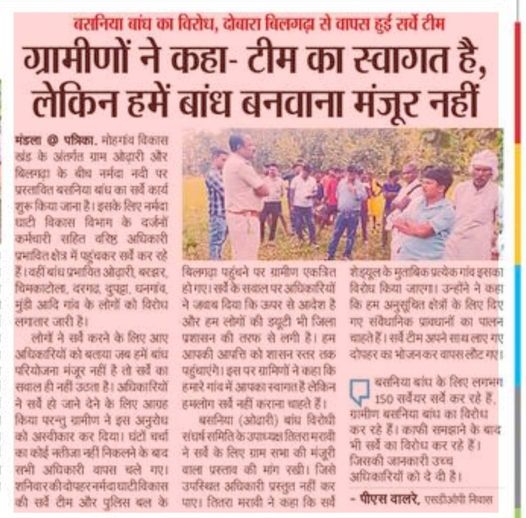
Madhya Pradesh People in Upper Narmada basin in MP are opposing survey for the proposed Basania Dam.
Himachal Pradesh 5 decades on, over 6k Pong dam displaced families await rehab Even after five decades have passed since thousands of families were uprooted to make way for the construction of Pong Dam in Kangra district, the cases of 6,736 families, who await rehabilitation, are still pending. These details were shared during a review meeting of the Pong Dam displaced, relief and rehabilitation committee chaired by state revenue minister Jagat Singh Negi on Friday (Oct. 18). Additional chief secretary Onkar Sharma shared that 20,722 families in various sub-divisions of Kangra district were affected by the construction of the Pong Dam. https://www.hindustantimes.com/cities/chandigarh-news/pong-dam-displacement-5-decades-on-over-6k-families-still-await-rehabilitation-101729272564033.html (18 Oct. 2024)
Karnataka KRS dam objective marred by drinking water projects: Farmer leader Reacting to the launch of the Cauvary fifth phase project, to supply drinking water to 110 villages that were merged into Bruhat Bengaluru Mahanagara Palike (BBMP) recently, Farmers’ leader Sunanda Jayaram on Oct. 17 said that already, the farmers in the villages of Maddur and Malavalli taluks, at the tail-end of the canals that originate in KRS Dam, are not getting water for crops. “Bigger and newer drinking water projects will only aggravate the problems of the farmers in Mandya district, as a major portion of the Cauvery River water from KRS Dam would be exploited for drinking water needs. The KRS Dam was built to irrigate farmlands. But now, most of its water is being used for drinking water purpose,” she pointed out.
“With 4-phases of the project, Bengaluru was supplied 1.58 tmc-ft of drinking water every month. With the implementation of the fifth phase of the project, it has increased to 2.4 tmc ft of water per month”. The full capacity of the KRS Dam is 49.45 tmc ft. If water is supplied to Bengaluru for 12 months a year, Bengaluru alone needs 28.8 tmc ft, nearly 60 % of the full capacity.
“Besides, drinking water is supplied to Mysuru, Mandya, Channapatana & Ramanagar cities. Water can be spared for irrigation, only if the dam fills multiple times, in a year,” she said. “The drinking water projects will have an adverse effect on farmers, agriculture and food production, in future. It is unfortunate that Malavalli MLA P M Narendraswamy presided over the event, that will badly affect the farmers of his own constituency. The onus is now on the farmers to fight for their rights & protect the water for irrigation,” Sunanda said. https://www.deccanherald.com/india/karnataka/objective-of-building-krs-dam-marred-by-drinking-water-projects-farmer-leader-3236960 (17 Oct. 2024)
Reservoirs lost 6% of storage capacity The four Cauvery basin reservoirs – Krishna Raja Sagara (KRS), Harangi, Hemavati, and Kabini – have lost nearly 6% of their total storage due to accumulated sediments between the first (1982) and most recent (2009) years of surveys. While the cumulative gross capacity of these reservoirs was 3,244.26 Mcum during their first survey year, the last survey results show that it has now gone down to 3,027.59 Mcum.
Experts say estimation of dams’ capacity is an important exercise to note the rate of sedimentation and thus analyse the implication of annual loss of storage over a period of time. It also helps in the proper estimation of loss of storage at the planning stage. “Apart from the drop in storage capacity, sedimentation reports also show impact of soil conservation measures taken in the catchment area of the reservoirs, if any. Sediment accumulation in reservoirs is tricky as de-silting of dams is costly. The extracted silt has environmental impacts too. The only sustainable solution is to manage soil erosion in the catchment area,” said a hydrologist. https://bangaloremirror.indiatimes.com/bangalore/others/getting-sedimental/articleshow/114129331.cms (11 Oct. 2024)
Vani Vilas Sagara approaches capacity The Vani Vilas Sagara reservoir on Vedavati river in Chitradurga district has reached 24 tmcft of water, thanks to substantial rainfall and water release from the Bhadra reservoir. With a total capacity of 30 tmcft, the reservoir is on the verge of overflowing for the third time since its construction, the first being in 1933. On Sept 2, 2022, after 89 years, the dam was filled to the brim. The dam crossed the 120-feet mark several times, including in 1932, 1933, 1934, 1956, 1957, 1958, 2000, 2021, 2022, and this year presently 124 feet. However, in 2017, the dam experienced dead storage due to a severe drought.
The dam has also contributed to the irrigation of more than one lakh hectares in Hiriyur taluk through the right and left bank canals. It serves as a source of drinking water for Hiriyur, Hosadurga, Chitradurga, and Challakere taluks. The VV Sagara was constructed by the Mysuru maharajas during the pre-independence era across the Vedavati River. The work commenced in 1897 and was completed in 10 years. https://timesofindia.indiatimes.com/city/hubballi/vani-vilas-sagara-reservoir-nearing-overflow-a-lifeline-for-chitradurga-amidst- (14 Oct. 2024)
Mullaperiyar Dam TN engineers walk out of sub-committee inspection The sub-committee on Mullaperiyar dam could not carry out a scheduled inspection of the structure on Oct 16, as the Tamil Nadu Water Resources Organisation engineers walked out in protest against the Kerala Minor Irrigation Division for not allowing maintenance work at the dam site for six months. https://www.thehindu.com/news/national/tamil-nadu/tamil-nadu-engineers-walk-out-of-sub-committee-inspection-of-mullaperiyar-dam/article68760979.ece (16 Oct 2024)
INTERSTATE WATER DISPUTES
Krishna Water Disputes SC bench refers matter to CJI for relisting The Supreme Court today (October 18) sought the relisting of a writ petition filed by the State of Telangana against the Andhra Pradesh Government and Krishna River Management Board after Justice Sanjay Kumar recused from the hearing. The matter came up before a bench of Justices Sanjiv Khanna and Kumar, when Justice Khanna said: “This will go before another bench…Subject to others of honourable Chief Justice of India, the present writ petition may be listed before another bench of which one of us, my brother [referring to Justice Kumar] is not a member. After Diwali.”
The final order of KWDT-II has not been notified by the central government yet. Both the states of Maharashtra and Karnataka have filed applications before the top court seeking modification of its 2011 interim order and for a direction to the Centre to notify the decision and final report of the tribunal, as well as the further report published in 2013. In 2021, the Karnataka government filed an additional affidavit in the 2019 interlocutory application to direct the central government to publish the tribunal’s modified final order subject to the outcome of the pending special leave petitions. https://www.livelaw.in/top-stories/krishna-river-water-dispute-justice-sanjay-kumar-recuses-bench-refers-matter-to-cji-for-relisting-272871 (18 Oct. 2024)
URBAN RIVERS
Musi; Hyderabad Questions over Seoul trip A delegation of nearly 20 people is visiting Seoul, South Korea to study Cheonggyecheon riverfront development project. And this is exactly what raises questions. Both projects have more differences than similarities. Unlike River Musi, Cheonggyecheon is a stream. While River Musi flows through nearly 250 kms, Cheonggyecheon covers about 13 kms and joins Jungnancheon, which connects to Han River and empties into the Yellow Sea.

The Cheonggyecheon riverfront project commenced in 2003 and was completed in 2005. Before taking up the project, a flyover that was constructed over the stream was demolished as the pillars were sinking and alternate roads were constructed in different areas to avoid traffic issues. More importantly, STPs were established at several places to arrest the flow of murky water and ensure flow of treated water into the stream. https://telanganatoday.com/questions-over-seoul-trip-as-musi-korean-projects-have-more-differences-than-similarities (20 Oct. 2024)
What River actually needs Environmentalists, activists and others feel that the Revanth Reddy govt is failing to focus on core issues like ensuring flow of treated water in the river, and instead focusing more on cosmetic changes, which might look good but serve no long-lasting purpose.
Estimated to cost around Rs.16,800 crore, the most crucial part of the project was to treat the water that flows in the nalas before reaching the Musi. The plan was to ensure 100 percent sewage treatment by setting up 31 sewage treatment plans with a capacity of 1,200 MLD, at a cost of Rs.3,886 cr. Most of these projects were already operational and the remaining were nearing completion. https://telanganatoday.com/what-river-musi-actually-needs-according-to-experts (20 Oct 2024)
RFD project triggers political row The long-neglected river that passes through Hyderabad that has virtually become a drainage canal filled with stinking wastewater from various parts of the city. Encroachments in the riverbed have further worsened the situation. The demolitions along the riverbed and other parts of the city caused an uproar and triggered strong opposition, with victims taking to the streets and alleging that they had been staying there for decades.
KTR alleged that the Musi project was the country’s biggest scam. Stating that a plan was already in execution to beautify the river, he said it could be implemented at a much lower cost. He criticised the government for inflating the project cost by two times. “The initial budget for the project was ₹50,000 crore but later it was changed to ₹1.5-lakh crore,” he said. The controversy has sparked a heated debate, with opposition parties demanding clarity on the project’s cost and implementation.
As the row escalates, Revanth Reddy has appealed to opposition leaders to make suggestions and provide an action plan for the project. The CM also announced plans to hold a special assembly session to debate the Musi revival project. The Musi River rejuvenation project comes 115 years after the city witnessed a major flood in 1908. The then Nizam rolled out two major projects — one to avoid such losses in the future and build a modern city — after the flood devastated the city. https://www.thehindubusinessline.com/news/national/musi-river-revival-project-trigger-political-row/article68775560.ece (20 Oct. 2024)
Buddha Dariya; Ludhiana River faces tipping point One vexed problem of the pollution of the Buddha Dariya, a tributary of the Sutlej, has reached a decisive phase with the Punjab Pollution Control Board ordering dyeing units to stop discharging their untreated water into the dariya.
The only possible solution is that CETPs of the dyeing industry must opt for Zero Liquid Discharge Technology and reuse their water, as is being done by the dyeing industry of Tirupur, Tamil Nadu, following an order by the Madras High Court. On Jan 28, 2011, the Madras HC had ordered the closure of more than 700 bleaching and dyeing units & effluent treatment plants in Tirupur. It had directed the industry to adopt the ZLD technology. For the Buddha Dariya too, the industry & govt should work out a way to switching to the ZLD technology, with some support from the Centre.
The authorities cannot ignore the horrendous effects of pollution on public health, their economical and psychological suffering or, rather, the slow killing of people. The environment is also degraded by pollution. The time has come for the Punjab CM to fulfil his promise of cleaning the Buddha Dariya. (Col Jasjit Singh Gill Retd). https://www.tribuneindia.com/news/comment/polluted-by-industry-buddha-dariya-faces-tipping-point/ (18 Oct. 2024)
SPCB officials inspect project progress Amidst the uproar surrounding the Buddha Dariya Rejuvenation project, the secretary of the science and technology department of the Punjab govt, Priyank Bharti, arrived in Ludhiana on Thursday (Oct. 04). Accompanied by chief engineer of the Punjab Pollution Control Board (PPCB) R K Ratra, XEN Kuldeep Singh, and other officials, Bharti sought to understand the ground situation of the project. https://timesofindia.indiatimes.com/city/ludhiana/ludhianas-buddha-dariya-rejuvenation-project-faces-scrutiny-amid-pollution-concerns/articleshow/113920559.cms (04 Oct. 2024)
Industry association warns activists An industry association has warned environmental activists against any attempt to block the flow of wastewater from dyeing units’ common effluent treatment plants (CETPs) which have been polluting the Buddha Dariya, saying that they would be able to gather a crowd of 1 lakh industrialists and workers to stop them. The warning came on Oct 3, after the activists of Kale Pani Da Morcha set a Dec 3 deadline for the units to stop discharging the treated wastewater, saying they would block the outlet drains of the CETPs.
Bobby Jindal from Punjab Dyers Association said the original plan was that the dyeing units had to install CETPs and the state govt was going decide what to do with treated wastewater. “But state govt has not done anything. We have knocked at the doors of National Green Tribunal and we are hopeful of some relief. We have also talked to senior officials about this issue,” Jindal said.
The activists had initially given three months to state govt to take steps to curb pollution in the drain and the deadline got over on Sept 15. Kale Pani Da Morcha had announced its activists would block the outlets on Oct 1, but they deferred the plan after Punjab Pollution Control Board had issued directions to special purpose vehicles (SPVs) of three CETPs to not throw treated wastewater into Buddha Dariya. Morcha activist Kuldeep Singh Khaira said once they are done with the CETP outlets, they will move towards sewage treatment plants of the civic body, as even domestic treated water was not allowed to be dumped inside the drain. https://timesofindia.indiatimes.com/city/ludhiana/industrial-association-threatens-activists-over-buddha-dariya-pollution-blockade/articleshow/113888745.cms (03 Oct. 2024)
Activists to stop illegally operating CETPs on Dec 3 Despite recent instructions prohibiting the flow of treated water into the Buddha Dariya via CETPs, activists of Kale Pani Da Morcha are not willing to back down. Addressing a press conference in the presence of police on Oct 2, activists of the morcha, which has run a sustained campaign against pollution of the drain, announced that they would block the flow of polluted water into the water body at Tajpur Road on Dec 3.
Activists claimed that they were being pressurised to roll back the campaign, for which they were receiving phone calls from senior police officials. They claimed that the government wanted to suppress the campaign against those polluting water bodies and contributing to the incidence of cancer. Activists said that dyeing units were dumping an estimated 10.5 crore litres of polluted water inside the drain, which was being supplied to people of Punjab and Rajasthan through the Satluj river. https://timesofindia.indiatimes.com/city/ludhiana/activists-to-block-polluted-water-flow-from-illegal-cetps-on-december-3/articleshow/113865086.cms (02 Oct. 2024)
‘Govt not serious’, Activists A month after they staged ‘Kale Pani da Morcha (war against black water), a civil movement to save Punjab’s Sutlej river from the toxic flow of untreated effluents from Ludhiana’s industries into its tributary Buddha Nala, environmentalists announced that they will block the flow of effluents into the tributary. This movement was launched on Jun 18 this year.
During their maiden protest at Ludhiana on August 24, environmentalists had given an ultimatum to the Punjab government to act against erring industries, failing which they would be forced to stop the flow of effluents into the Buddha Nala. The protestors have now said that they will camp near the Verka Milk Plant situated on the Ludhiana-Ferozepur highway. https://thewire.in/environment/punjab-sutlej-environmentalists-protests (02 Oct. 2024)
Dyeing industry wonders after PPCB order The dyeing industry is baffled by Punjab Pollution Control Board (PPCB) orders prohibiting it from dumping even waste treated in the three CETPs into the Buddha Dariya. As dyeing unit owners wonder what to do, PPCB officials claim that they have only acted on orders issued by the Central Pollution Control Board, according to which special purpose vehicles (SPVs) running the CETPs were supposed to reuse treated water instead of dumping it inside the water body.
According to industrialists, when these CETPs were established, the industry was assured that treated water would be used for irrigation in Moga and surrounding areas through old Buddha Dariya. However, the old Buddha Dariya has been encroached upon for a long time. To implement such solution, the government would have to free the area of encroachments, which it has not.
Since the dyeing industry is related to textile and hosiery industry, a ripple effect can be expected. Ashok Makkar, chairman, Punjab Dyers Association said, “Dyeing industry is the mother of textile and hosiery industry. If we do not dye clothes or yarn, how will they do their job? While PPCB ordered not to dump treated water from dyeing units into Buddha Dariya, it did not specify what to do with the 105 MLD water generated per day. Around 200 dyeing units made three clusters to treat wastewater coming from their units. The plants were made fully operational in 2022. https://timesofindia.indiatimes.com/city/ludhiana/is-it-the-end-dyeing-inc-wonders-after-ppcb-order/articleshow/113752141.cms (28 Sept. 2024)
RIVERS
BRAHMAPUTRA Assam Trapped by climate change The seppa, bair, darki, duyer, diyaar are just some of the indigenous bamboo fishing traps that Jalal Ali crafts for a living. But truant monsoons have shrunk Assam’s many waterbodies, and the demand for fishing traps has fallen sharply, and so has his income.
https://ruralindiaonline.org/en/articles/trapped-by-climate-change-in-the-brahmaputra/ (17 Oct 2024)
Telangana Activists rally against Navy radar station Damagundam forest Environmentalists have warned that deforestation linked to the project could disrupt water flows to the Esi, Musi and Kagna rivers, which serve as crucial water sources for eastern Telangana. Water from the Ananthagiri hills, located in the region, flows eastward via Pudur and Sivareddipet, while the Kagna river connects from the west, creating an essential catchment system.
Citizen groups have asked the project be moved to the second site identified by the Navy for the radar project, which is located in Kolar Gold Fields in Kolar district, Karnataka. They have also called for the release of the project’s Environment Impact Assessment report that has remained classified for reasons of national security. https://www.downtoearth.org.in/forests/activists-and-locals-rally-against-navy-radar-station-in-telanganas-damagundam- (15 Oct. 2024)
Report PIL demands notification of river conservation zones The Supreme Court of India bench headed by CJI Chandrachud on Oct 14, 2024 has issued notices on a petition under article 32 (Ashok Kumar Raghav Vs Union of India and others WP (Civil) 621/2024) regarding illegal constructions and encroachment of river floodplains and catchments alleging that MoEF and MoJS have not taken required action including not notifying River Regulation Zones since 2015. https://www.livelaw.in/top-stories/notify-river-conservation-zones-prevent-illegal-constructions-on-river-banks-pil-in-supreme-court- (15 Oct. 2024)This Tribune report says the notices have also been issued to CWC, CPCB and Union Ministry of Earth Sciences. It also provides some information about the petitoiner. https://www.tribuneindia.com/news/himachal/unauthorised-constructions-on-riverbed-supreme-court-notice-to-3-ministries-cpcb-cwc/ (13 Oct. 2024)
GANGA Bihar Out of 13 NMCG funded STPs only 7 work Seven of 13 STPs in Bihar, constructed in the last decade with central funds, were operational, the NMCG has told the NGT. The state received Rs 3,914.53 crore for the plants that were built under the Namami Gange Programme, said the NMCG in an affidavit to the NGT. The NMCG listed the following reasons as to why six were not functional — one had been built but awaited a power connection, another had incomplete effluent pipeline work, while the state pollution control board was yet to start sampling in the remaining three. Even the seven operational ones had not complied with regard to the presence of faecal coliform in the river.
According to the NMCG, the Centre allocated over Rs 370 crore to Bihar under two phases of GAP for 14 sanctioned STP projects. While GAP concluded in 2000, the Narendra Modi government in 2014 launched the Namami Gange Programme, an initiative to clean the Ganga. Since then, it has transferred Rs 3,914.53 crore for STP-related works to Bihar. https://theprint.in/judiciary/centre-gave-bihar-rs-3900-cr-for-13-sewage-plants-on-ganga-only-7-work-faecal-matter-high-in-water/2314505/ (16 Oct. 2024)
Prayagraj Prefabricated STPs to treat wastewater at Kumbh Uttar Pradesh govt is going to set up 3 prefabricated STPs of 0.5 MLD capacity at Jhunsi, near Nagvasuki temple and in Phaphamau to treat wastewater from drains emptying into the river. The STPs would be functioning on hybrid granular sequential batch reactor (hgSBR) technology developed by Bhabha Atomic Research Centre (BARC). For this, the sewerage branch of UP Jal Nigam (urban) has been designated as the implementing agency. In addition, faecal sludge treatment plants with capacities of 50 KLD and 100 KLD are being constructed in Jhunsi and Naini areas of the Maha Kumbh Mela area. The trial run of the Naini-based plant has already commenced while a 50 KLD capacity plant built under the AMRUT programme is already operational in the Salori area. https://timesofindia.indiatimes.com/city/allahabad/revolutionary-prefabricated-stps-to-transform-wastewater-treatment-at-maha-kumbh/articleshow/113771524.cms (28 Sept. 2024)
Uttarakhand A perilous highway to salvation in Himalaya The paper presents the study results of fully or partially road-blocking landslides between Rishikesh and Joshimath, along National Highway (NH-7) in Uttarakhand. Based on instances of more than 300 landslides along the 250 km-long corridor after exceptionally high rainfall between September and October 2022, the study identified “309 fully or partially road-blocking landslides along the 247 km long road, which amounts to an average landslide density of 1.25 landslides per kilometre”. (C. P. Rajendran) https://www.thehindu.com/opinion/lead/a-perilous-highway-to-salvation-in-the-himalayas/article68770152.ece (19 Oct. 2024)
Study 2023 landslide occurred due to tectonic & human activities The research study, which was a collaborative work led by Dr Sreejith K M of SAC ISRO and Dr Sunil P S of the Department of Marine Geology and Geophysics, Cusat, found an alarming increase in the velocity of landslides in the Himalayan region. According to Dr Sunil, during the reserach, the team used the Interferometric Synthetic Aperture Radar (a radar technique used in geodesy and remote sensing), Global Positioning System (GPS) and rainfall measurements to understand the geometry of the motion of the Joshimath landslide.
During the research, the geophysicists found that the Himalayan landslides occurred due to tectonic, hydrological and human activities. “The trigger for our research was the catastrophic landslides that shook Joshimath, a densely populated Himalaya town during December 2022 and January 2023. Around 700 buildings got damaged,” said Dr Sunil. The study also found another active landslide 6 km southwest of Joshimath town that has been moving at a speed of approximately 75 mm per year since mid-2018. https://www.newindianexpress.com/nation/2024/May/06/2023-uttarakhand-landslide-occurred-due-to-tectonic-and-human-activities-study (06 May 2024)
Chamoli In the video, many people are seen running to save their lives. BRO commander Ankur Mahajan said the video is from Oct 12 and the landslide happened near the 5 km long under-construction bypass from Helang to Marwari, about 12 km from Joshimath city of Chamoli district. In the video shared on social media, it was claimed that the govt did not give any permission for blasting for road cutting, yet the contractor went ahead with it. Asked about it, Mahajan said that no blasting took place during hill cutting. https://www.etvbharat.com/en/!videos/massive-landslide-in-joshimath-chamoli-district-in-uttarakhand-enn24101501537 (15 Oct. 2024) चमोली जिले में जोशीमठ के पास भारी भूस्खलन हुआ है। हाईवे पर काम कर रहे मजदूर बड़ी मुश्किल से जान बचाकर भागे। दरअसल जोशीमठ के पास हेलंग-मारवाड़ी बाईपास पर निर्माण कार्य चल रहा है। https://www.bhaskar.com/local/uttarakhand/dehradun/news/landslide-on-the-under-construction-bypass-in-joshimath-133804207.html (15 Oct. 2024)
Rudraprayag Concern grows as ‘skeleton lake’ is shrinking Roopkund lake is situated 16,500ft above sea level at the base of Mt Trishul in the Garhwal Himalayas. Known as the “lake of skeletons”, it is spread over an area of around 2 acres and has a depth of around 9ft. Divisional forest officer (DFO) of Badrinath forest division in Chamoli, Sarvesh Dubey, said, “The lake is shrinking in width and depth by about 0.1% to 0.5% annually. Traditionally, the area around Roopkund would experience snow flurries during rainfall, but now rain is more common, causing loose moraine to slide down into the lake. We believe this shift in precipitation pattern is directly linked to climate change and global warming, which is altering the natural balance of the region.” https://timesofindia.indiatimes.com/india/concern-grows-as-uttarakhands-skeleton-lake-is-shrinking/articleshowprint/114196899.cms (14 Oct. 2024)
Haridwar Railway tracks appear under Ganga canal With the closure of the canal and the water receding eventually, officials were stunned to see the old railway tracks beneath the Ganga water showing up around 3 km from the Haridwar Railway Station.
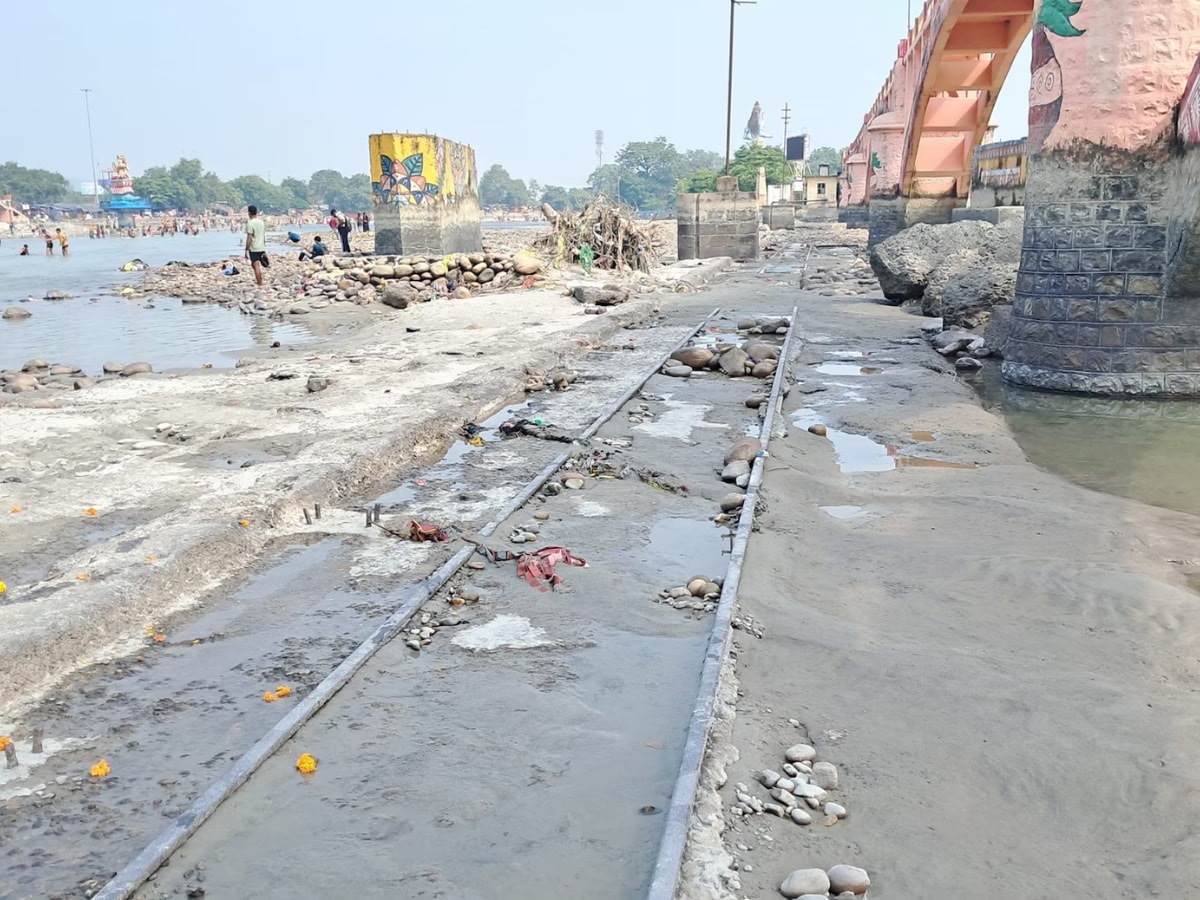
While many theories are circulating online, long-time resident Adesh Tyagi said that during the construction of the canal in around 1850, handcarts used to run on these tracks to transport construction material. After the completion of the dam and embankment from Bhimgoda Barrage to Dam Kothi, British officers used these tracks for inspection, he speculated. History expert Professor Dr. Sanjay Maheshwari also supported this theory, saying the canal was a major project for the then-British era governor, Lord Dalhousie. It was built under the supervision of engineer Thomas Cautley. Many such big projects from the British period play a significant role in modern India. https://www.news18.com/lifestyle/railway-tracks-appear-under-the-ganga-in-haridwar-onlookers-stunned-see-pics-9088754.html (17 Oct. 2024)
Study Kosi river system’s contribution to Mt Everest’s increasing height -A new study published in Nature Geoscience earlier this month said that a river network caused the world’s tallest mountain, Mount Everest, to spring up between 15 and 50 metres over the past 89,000 years. The study provides sharper insights into the evolution of the young mountain range and the impact that the large number of river networks emanating and flowing across the dynamic mountain system have had on it. https://www.hindustantimes.com/analysis/ecostani-kosi-river-system-s-contribution-to-mt-everest-s-increasing-height- (15 Oct. 2024)
YAMUNA Delhi Froth covers river The Yamuna in Delhi was seen covered with a thick layer of white froth on Oct 18, with experts saying this poses health hazards for people, especially as the festive season approaches. Videos circulating on social media show vast sections of the river frothing, resembling clouds over the water, which gradually dissipated later in the day.
Bhim Singh Rawat of SANDRP (quoted in several reports) told PTI that normally, the upper segment of the Yamuna experiences significant flood spells, but this year, there was no such spell during the just-concluded southwest monsoon. “This is unusual as the river generally witnesses at least a couple of low or medium flood spells in this segment every year,” Rawat said. He highlighted that the pollution in the river is a serious concern affecting human health and wildlife. While the river has some natural cleansing ability, the pollution levels are alarming, Rawat said, adding that the white froth that was seen during monsoon this year becomes more noticeable during festival times. https://www.deccanherald.com/india/delhi/froth-covers-yamuna-ahead-of-festive-season-posing-health-hazards-in-delhi-3239300, https://news.abplive.com/cities/delhi-s-yamuna-river-is-covered-in-white-foam-due-to-pollution-raising-health-concerns-, https://www.newindianexpress.com/cities/delhi/2024/Oct/19/toxic-foam-in-yamuna-river-poses-health-hazards-warn-, https://www.hindustantimes.com/india-news/yamuna-river-covered-in-toxic-froth-ahead-of-chhath-puja-netizens-react-101729326523940.html, https://www.thehindu.com/news/cities/Delhi/froth-covers-yamuna-river-in-delhi-ahead-of-festive-season-posing-health-hazards/article68772457.ece, https://english.jagran.com/india/delhi-yamuna-river-viral-video-covered-with-heavy-froth-ahead-of-chhath-puja-diwali-celebration-air-pollution-high-aqi-in-national-capital-bjp-manoj-tiwari-reacts-latest-updates-10195343 (18 Oct. 2024)
Speaking to ANI, Professor Sachchida Nand Tripathi, Dean of the Kotak School of Sustainability at the Indian Institute of Technology, Kanpur, explained that the froth is primarily caused by high concentrations of surfactants from soaps, detergents, and untreated wastewater being discharged into the river. These pollutants, which are not properly filtered out by existing wastewater systems, play a major role in the formation of this froth.
According to Professor Tripathi, “After the monsoon season, stable atmospheric conditions and increasing temperatures create the perfect setting for froth formation. By October, when the temperatures begin to drop, the froth stabilises further. This froth, however, contains harmful organic substances that release volatile gases directly into the atmosphere, contributing to air pollution. These gases can serve as precursors to the formation of secondary organic particulate matter, which is hazardous to both the environment and public health.” https://www.mid-day.com/news/india-news/article/toxic-froth-in-yamuna-river-raises-environmental-and-health-concerns-warn-experts-23414353 (20 Oct. 2024)
Haryana Act against illegal dyeing units: NGT Taking suo motu cognizance of a TOI report that dyeing units were operating illegally in the city, the NGT last month directed SPCB to carry out a survey and take action accordingly. The bench also issued notices to MoEF, CPCB, SPCB and Gurgaon DC to submit their responses at least a week before the next hearing on Oct 16. “The HSPCB is now tasked with surveying and taking action against these illicit units. The afore mentioned news item indicates a violation of the provisions of the Water (Prevention and Control of Pollution) Act, 1974, and the Environment (Protection) Act, 1986,” it said. TOI reported on Aug 22 that several dyeing units were officially closed, but continued to operate, specifically in Sector 103, Basai and Sector 36. https://timesofindia.indiatimes.com/city/gurgaon/ngt-orders-action-against-illegal-dyeing-units-in-gurgaon-following-toxic-pollution-concerns/articleshow/113918038.cms (04 Oct. 2024)
RIVERS BIODIVERSITY
SANDRP Blog 2024: Dams, Mining, Construction Damaging Gangetic Dolphin Habitats Despite declaring Gangetic Dolphin a National Aquatic Animal in May 2010, launching of Project Dolphin in Aug 2020 and recognizing Oct 5 as National Dolphin Day since 2022, the key species indicating river health continues to face unnatural deaths and threats from various developmental activities.
This overview highlights the incidents of suspicious death of precious mammal and looming threats on its habitat along with some noteworthy steps being taken by conservationists and governments to protect the endangered species. https://sandrp.in/2024/10/20/2024-dams-mining-construction-damaging-gangetic-dolphin- (20 Oct 2024)
Kerala Post-flood earthworm deaths tied to rare mass migration Mass earthworm deaths after the devastating 2018 floods are linked to their migration, a study has found. Scientists say the soil dwellers moved downhill probably in search of moisture to cope with a rare dry period following extreme rains which saw numbers proliferate. The study adds to monitoring efforts to show what earthworm movements may mean for other organisms around them, especially plants.

Earthworms only migrate about 10 metres each year. They are extremely sensitive to their surroundings, and breathe, move, digest, and feed through their moist skin. Such mass migration has never been reported in the Western Ghats — a biodiversity hotspot. On a small scale, irregular and sporadic migrations have been reported from other parts of India, says Narayanan. https://www.nature.com/articles/d44151-024-00162-z (02 Oct. 2024)
FISH, FISHERIES, FISHERFOLKS
Chennai Ennore fishers urge govt to clear blockages in Kosasthalaiyar In a letter to Minister for Revenue KKSSR Ramachandran, District Revenue Establishment, Deputy Collectors for Disaster Management, and P. Amudha, Principal Secretary to the Revenue and Disaster Management Department, members of the fishing community sounded the alarm about the dangerously-choked condition of Ennore Creek and its backwaters, which face siltation and blockage from industrial encroachment, fly ash, debris, and invasive species, like kaaka aazhi mussels. https://www.thehindu.com/news/cities/chennai/ennore-fishers-urge-government-to-clear-blockages-in-kosasthalaiyar-river-to-alleviate-flooding-impact-in-chennai/article68753184.ece (14 Oct. 2024)
Bengaluru Fish kill at Chikkanagamanala lake; waste plant blamed Hundreds of fish were found dead on Friday (Oct. 18) morning at Chikkanagamangala Lake, leaving residents shocked and concerned about the state of the lake’s ecosystem. This is not the first time fish have died at Chikkanagamangala Lake. Last year, thousands of fish were reported dead in a similar incident, which residents say was caused by toxic water entering the lake from a nearby waste management plant.
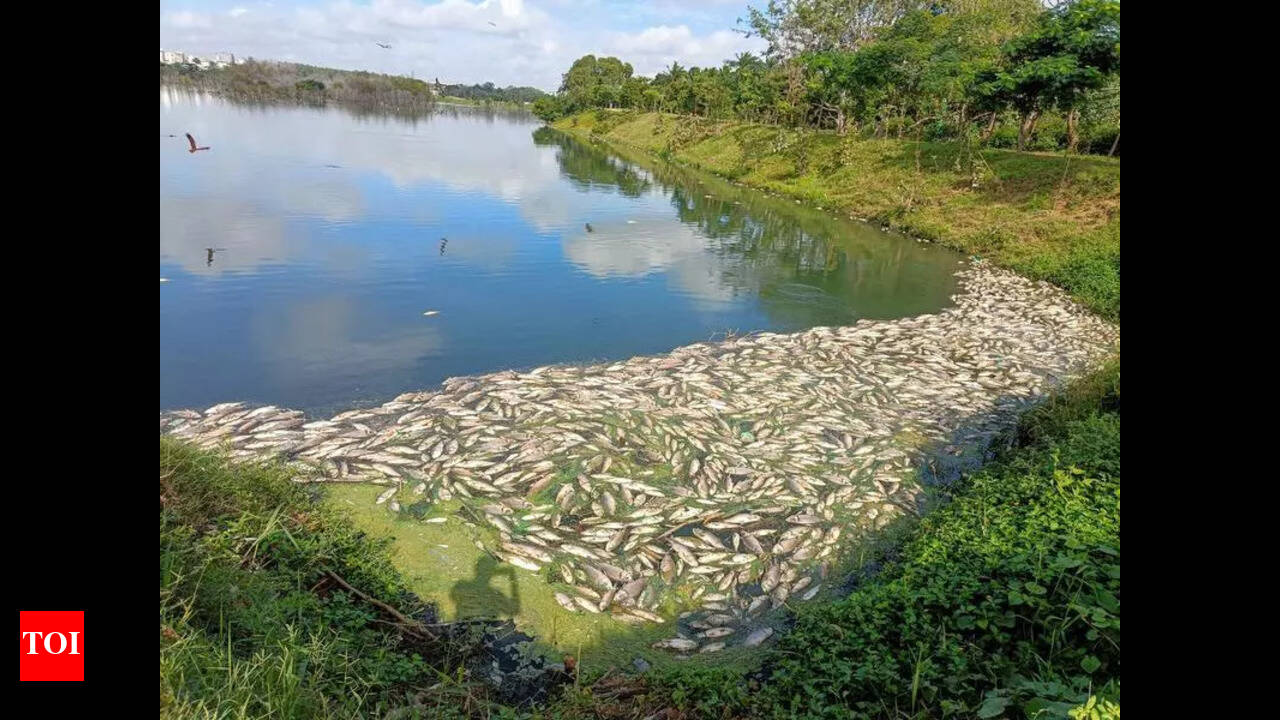
Residents have long voiced their concerns about the contamination, claiming that leachate – a liquid that drains from the solid waste – from the waste management plant located on Chikkanagamangala Doddanagamangala Road is seeping into the lake. The plant is operated by Bengaluru Solid Waste Management Limited (BSWML), and residents allege that its operations are polluting the surrounding water bodies and groundwater. https://bangaloremirror.indiatimes.com/bangalore/others/fish-kill-at-lake-waste-plant-at-chikkanagamanala-blamed/articleshow/114357606.cms (19 Oct. 2024) Thousands of dead fish were found floating at Chikkanagamangala lake on Friday morning (October 18) in a second such incident in the past two years. The lake was rejuvenated by Biocon. https://www.thehindu.com/news/cities/bangalore/mass-fish-kill-at-chikkanagamangala-lake/article68769293.ece (18 Oct. 2024) Residents said they had informed the Karnataka State Pollution Control Board and expect the officials to come inspect the lake water. https://www.hindustantimes.com/trending/thousands-of-fish-die-mysteriously-at-bengalurus-chikkanagamangala-lake-video-goes-viral-101729333270563.html (19 Oct. 2024)
SAND MINING
Jharkhand PESA can save river from sand mining damage PESA is not yet implemented in the state, but it holds the promise of environmental protection in future as gram sabhas are taking a stand against rampant sand mining from the rivers under their ambit. https://www.newsclick.in/shifting-sands-can-pesa-save-jharkhands-rivers-death-knell (18 Oct 2024)
Rajasthan CBI raids 10 places The CBI on Oct 17 conducted searches at 10 different locations across the state, including Jaipur, as part of its ongoing investigation into illegal sand mining activities. The raids were carried out at the residential & official premises of some people suspected in the case, covering areas in Jaipur, Tonk, Ajmer and Bhilwara. During the searches, the CBI recovered incriminating documents related to illegal sand mining operations.
The probe began following an order by Rajasthan High Court’s Jaipur Bench on April 16, which transferred the case to the CBI after expressing dissatisfaction with the local police’s handling of the case. The case was originally registered with Sadar Police Station in Bundi district under Section 379 of the Indian Penal Code (IPC) and Section 21(4) of the Mines and Minerals (Development and Regulation) Act (MMDR Act). https://timesofindia.indiatimes.com/city/jaipur/cbi-raids-10-locations-in-rajasthan-over-illegal-sand-mining-shocking-developments/articleshow/114358203.cms (18 Oct. 2024)
WETLANDS, LAKES, WATER BODIES
Assam Rs 796.88 cr project to rejuvenate 129 wetlands In a bid to enhance flood resilience and increase fish production, the Assam government has launched a major initiative to restore 129 beels (wetlands) across 3,800 hectares. To address this, the project focuses on dredging, desilting, and constructing water-retaining structures, aiming to improve water storage capacity and create optimal conditions for fish breeding.
– The initiative is being implemented in partnership with the Asian Development Bank (ADB), which will fund 80 per cent of the Rs 796.88 crore project, while the state government will cover the remaining 20 per cent. Out of 190 beels initially identified by District Fisheries Development Officers, 129 were selected for the rejuvenation plan.
– These wetlands have already been geo-mapped by the Assam State Application Centre (ASSAC), and 22 beels have been prioritized for immediate restoration, with contract agreements expected to be signed by February 2025. The project will involve deepening river channels to enhance water flow, facilitating fish migration, desilting, and creating water pools to improve retention and support fish production. A feasibility study and draft Detailed Project Report (DPR) have been submitted, with the final DPR slated for completion by November 2024. https://www.thestatesman.com/india/assam-rs-796-88-cr-project-to-rejuvenate-129-wetlands- (17 Oct. 2024)
Tamil Nadu Revise incomplete coastal zone maps, verify ESZ: NGT The Southern Bench of the NGT has directed the Tamil Nadu State Coastal Zone Management Authority (SCZMA) to rectify the incomplete draft Coastal Zone Management Plan (CZMP) maps, and carry out ground truthing of ecologically sensitive areas before holding a public hearing. Delivering the judgment on a case filed by a fisher, Jesu Rathinam, the Bench — comprising Justice Pushpa Sathyanarayana and expert member Satyagopal Korlapati — on Oct 17 instructed the SCZMA and the National Centre for Sustainable Coastal Management to verify the ecologically sensitive areas, as specified in the earlier orders of the Madras HC and the NGT.
The petition, filed by Ms. Rathinam in July 2023, highlighted the lack of essential components in the draft maps, including fishing zones, breeding and spawning grounds, communal properties of fishermen, and a comprehensive plan for the long-term housing needs of coastal fishing communities — all of which are legally required under the Coastal Regulation Zone Notification, 2019. Subsequently, the Bench stayed the public hearing scheduled for Aug 18, 2023. https://www.thehindu.com/news/national/tamil-nadu/revise-incomplete-coastal-zone-maps-verify-eco-sensitive-locations-says-ngt/article68766123.ece (18 Oct. 2024)
Report Disappearing wetlands warning sign of drastic biodiversity loss The gradual impacts of global warming, habitat destruction, and biodiversity loss are bringing the world closer to the edge of various tipping points, beyond which changes in earth systems will be sudden and irreversible. The disappearance of Chennai’s wetlands is an example of an early warning before local tipping points are reached, states this year’s Living Planet Index (LPI) by World Wide Fund for Nature (WWF).
In 2015 Chennai, faced a flood that was called “the worst in a century”. Then, in 2019, water levels dropped so severely that many said “day zero” had arrived. Rapid urbanisation led to the degradation of around 85% of the city’s wetlands, and the “damage inflicted on the city was made worse by the destruction of species-rich wetlands and natural drainage systems, which used to shield people from the worst impacts of both droughts and floods,” the report says.
Between 1940 and 2014, India lost about one third of its wetlands to urbanisation. There are other alarming trends too – a majority of bird species in India are on the decline, signaling rapid habitat loss, including from ecosystems like open savannah grasslands. Local tipping points can have ripple effects regionally, and sometimes globally. https://india.mongabay.com/2024/10/indias-disappearing-wetlands-are-an-early-warning-sign-of-drastic-biodiversity-loss/ (18 Oct. 2024)
WATER OPTIONS
Madhya Pradesh A dam the village built People of the Bilpura village in Panna district own roughly 80 acres of land that lies between the dam and their village. “Earlier there was a small naala [stream] and it was used in a few acres,” says Maharaj Singh. “Only after the dam came, have we all been able to plant in our fields.” Since the dam was rebuilt in 2016, he has not had to go – his earnings from farming are sustaining him and his family. Water from the dam now lasts through the year and it’s also used for cattle.
The move to rebuild the dam was the outcome of public meetings held by the People’s Science Institute. The state had built a dam on a pond near a grove of kaitha (wood apple) trees. It was built not once, but three times over 10 years. The last time it caved during a monsoon, state officials decided enough was enough and reduced the size of the dam. The small dam did not suffice: “water barely reached the fields, and it dried out well before summer so was of no use for our irrigation needs,” says Maharaj. “Only about 15 acres could be cultivated & only one crop.”
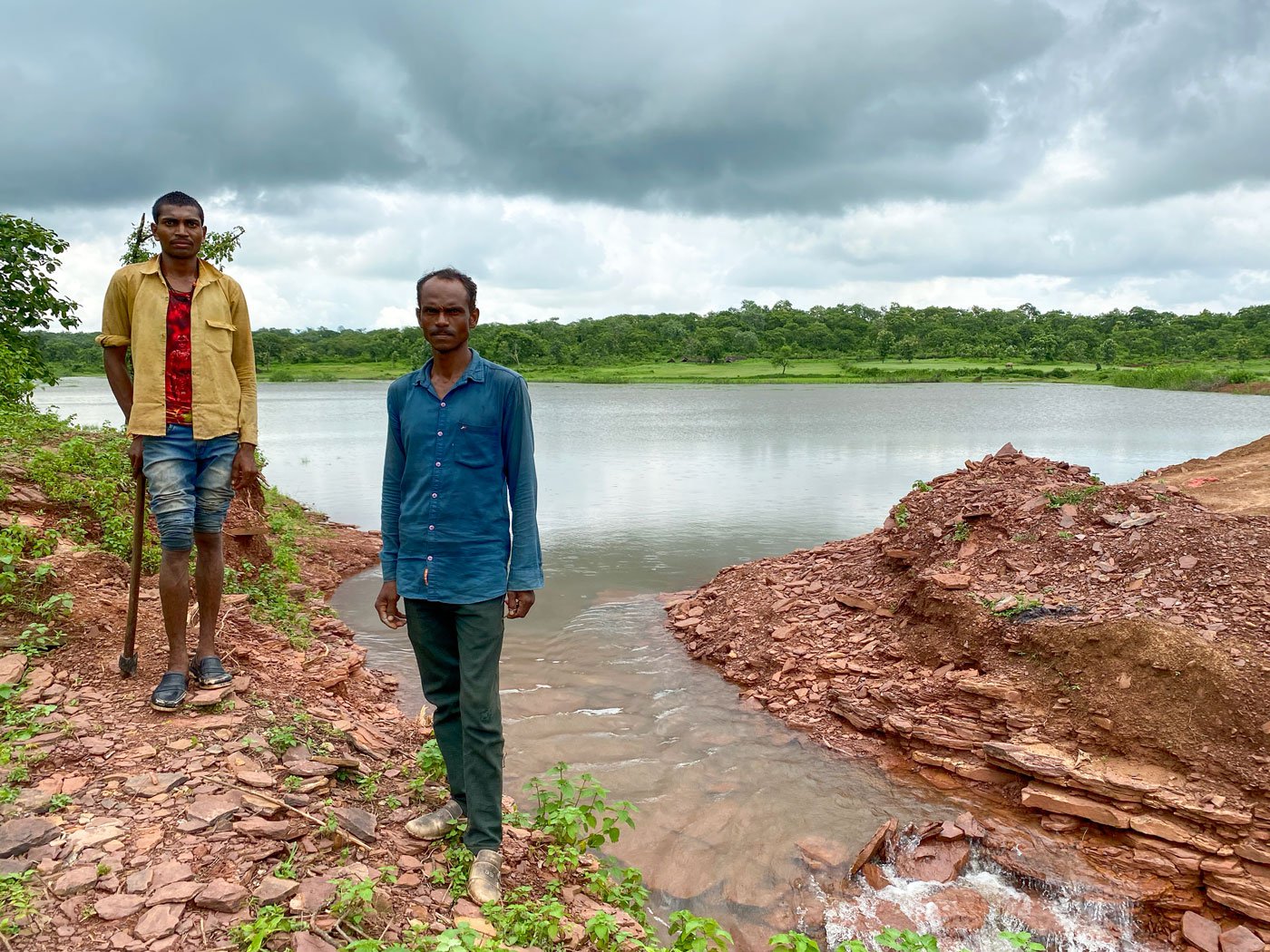
In 2016, people from the village decided to take matters into their own hands and offered their labour as donation to rebuild it. “We carried mud, dug, broke stones and placed them, and in one month we had finished the dam. All the people were from our village, mostly Adivasi and some Other Backward Class,” says Maharaj who also took part. The new dam is bigger in size and has not one but two weirs to allow the water to flow out evenly and prevent another break. https://ruralindiaonline.org/en/articles/the-dam-the-village-built/ (13 Oct. 2024)
Report Govt floats 50% reuse mandate for bulk users by 2031 These regulations will require entities consuming over 5,000 litres daily to register with authorities and implement comprehensive wastewater treatment measures. For new bulk users, the minimum reuse mandates will gradually ramp up. Residential societies, for instance, will start at a 20% reuse requirement in the 2027-28, progressing to 50% by FY31. https://www.business-standard.com/india-news/tapping-wastewater-govt-floats-50-reuse-mandate-for-bulk-users-by-2031- (12 Oct. 2024)
GROUNDWATER
Report Arsenic kills by stealth in villages Since 1983, when arsenic contamination of groundwater sources was officially confirmed in West Bengal, the situation has remained unaddressed, with reports suggesting that the problem may have actually worsened. This is a result of inadequate coordination between the central and state governments, which paid little attention to fix the crisis. Central government information released in 2016 suggested that 9.6 million people in the state of West Bengal, 1.6 million in Assam, 1.2 million in Bihar, 500,000 in Uttar Pradesh, and 13,000 in Jharkhand – a massive swathe of territory in India’s Ganga Basin – were at “immediate risk” from arsenic contamination of groundwater.
More recently, an extensive study found that groundwater in about 20% of India’s total land mass contains “toxic levels of arsenic,” exposing more than 250 m people across the country to Arsenic. https://thediplomat.com/2024/10/arsenic-kills-by-stealth-in-indias-villages/ (10 Oct. 2024)
URBAN LAKES, WETLANDS
Hyderabad HYDRAA given additional powers to protect public assets The govt has conferred new powers on HYDRAA under the GHMC Act on Wednesday, October 16. HYDRAA (Hyderabad Disaster Response and Asset Protection Agency), constituted by the Congress led Telangana is now empowered to protect all public assets including roads, drains, water bodies, parks etc belonging to the Greater Hyderabad Municipal Corporation or the state government. The government action comes even as HYDRAA’s constitution and powers have been challenged in court and Justice K Lakshman of the Telangana High Court had questioned HYDRAA Commissioner Ranganath over arbitrary action. HYDRAA was introduced by Telangana Chief Minister Revanth Reddy on July 12, 2024. The organisation formed under the National Disaster Management Act, was set up to manage natural disasters and to protect government properties, curb encroachment of ponds and lakes and to get rid of illegal constructions and structures. https://www.thenewsminute.com/telangana/telangana-govt-gives-hydraa-additional-powers-to-protect-public-assets-in- (16 Oct. 2024)
Bengaluru Sewage diversion channel breached again Following heavy rainfall on Oct 15, the sewage diversion channel along Varthur Lake has breached again, polluting lake water. It is the second time that the sewage diversion channel, constructed by the Bengaluru Development Authority (BDA) to facilitate the restoration of the lake, has been breached. The sewage diversion channel was breached in Oct 2023 polluting water and causing the death of thousands of fish. Residents of Varthur and environmentalists have demanded the BDA authorities to prevent such incidents in the future by strengthening the bund of the sewage diversion channel. https://bangaloremirror.indiatimes.com/bangalore/others/sewage-diversion-channel-breached-again/articleshow/114325099.cms (18 Oct. 2024)
Chennai Hospitals fined for dumping medical waste in Pallavaram lake The southern bench of the NGT on Oct 17 directed the SPCB to levy environmental compensation on two private hospitals who had dumped medical waste in Pallavaram lake. The bench also directed TNPCB to collect the amount the board had spent on collecting and transporting the waste from the site.
The bench comprising judicial member Justice Pushpa Satyanarayana and expert member Satyagopal Kolarpati was hearing a case taken up suo motu based on a newspaper report pertaining to dumping of medical waste in the lake by two hospitals, MIOT International and GEM Hospital. The local body, Tambaram Corp, had also sent notices to the hospitals based on which the hospitals paid a penalty of Rs 5 lakh each. https://www.newindianexpress.com/cities/chennai/2024/Oct/18/ngt-fines-hospitals-for-dumping-medical-waste-in-pallavaram-lake (18 Oct. 2024)
Bhopal Trees cut in Bhoj wetlands forest An incident of tree-cutting in Bhoj wetland area in Bhopal on intervening night of Friday-Saturday has come to the fore. Green activists have complained to collector and DFO. Trees were cut in Nathu Bharkheda village, which comes under Bhoj wetland project. As per complaint, the land from where the trees have been illegally felled and its adjoining plots are full of trees and look like a forest. The Google earth image and other photographs clearly show that the entire area is as good as forest qualifying the meaning of forest. https://www.freepressjournal.in/bhopal/madhya-pradesh-trees-cut-in-bhoj-wetland-forest-department-orders-probe (20 Oct. 2024)
URBAN WATER
Bengaluru 12-hr rainfall equals Cauvery phase-5’s full month supply Bengaluru has received an extraordinary 30 mm of rainfall in just 12 hours, covering an area of 750 square kilometers, a social media post said. The amount of rain collected in this brief period is equivalent to the full month’s planned water supply from the Cauvery phase-5 project, which is set to be inaugurated on Oct 16. https://www.hindustantimes.com/cities/bengaluru-news/bengalurus-12-hour-rainfall-equals-cauvery-phase-5-projects-full-month-supply-claims-social-media-post- (15 Oct 2024)
CM announces 6th phase CM Siddaramaiah on Wednesday (Oct. 16) announced that the government would draw an additional 500 million litres per day (MLD) of water from river Cauvery, which is about 110-km away from the city. The Bengaluru Water Supply and Sewerage Board (BWSSB), he said, has prepared a feasibility study for Cauvery sixth stage, which may cost about Rs 7,200 crore. He made the announcement at the grand inauguration of Cauvery fifth stage in Mandya. The project – costing around Rs 4,336 crore – involves bringing 775 MLD of water to the IT city. With this, Bengaluru will start drawing a total of 2,225 MLD of water, helping around 15 lakh connections. https://www.deccanherald.com/india/karnataka/bengaluru/bengaluru-to-draw-more-cauvery-water-cm-siddaramaiah-announces-sixth-phase-3235353 (16 Oct. 2024)
Mumbai How long before “water for all” becomes a reality In 2012, we at Pani Haq Samiti filed a PIL in the Bombay High Court, demanding water for all in Mumbai, as per Article 21 of the Constitution, which highlights the right to dignity and the right to life. The HC verdict directed the BMC to create a “Water for All” Policy. However, even after the HC order, numerous complications delayed the implementation and people’s access to legal water for years. Here’s an overview of what we learned through the PIL, the drafting of the policy, and its implementation.
Officials seem to believe that water should not be easily accessible. They prefer a system where residents must struggle for their rights rather than receive water as a fundamental entitlement. There is also a pervasive fear among officials that providing water connections to one basti might encourage more people to settle in the area, exacerbating issues of urban density. Ironically, this concern does not extend to illegal buildings. https://citizenmatters.in/the-long-road-to-mumbais-water-for-all-policy/ (18 Oct. 2024)
Lucknow City spending future GW The abundance of underground water made Lucknow a city of gardens. Helped the city grow and build the city across and across the Gomti river. Statistics suggest the city’s groundwater levels are towards a decline in most parts. Year 2006 after monsoon, Tariban 30 sq km. The groundwater in the area was below 25 meters. After the 2015 monsoon, its scope increased to 125 square km.

According to an assessment in 2015, the Lucknow Water Institute was supplying more than 400 million litres of water daily (MLD) from groundwater in the city. Also 350 MLD or more groundwater was being carried out daily through private-govt tubewells and small-large boring. In 2021 only Lucknow Water Institute was supplying about 404 MLD from groundwater and 400 MLD-canal water. This report does not include assessment of tubewells in private-govt buildings. There was a difference of 6 MLD in demand and supply. It is estimated that the demand for water in Lucknow city will increase to 945 MLD by 2025. The difference between demand & supply may be 33 MLD.
These statistics are of Lucknow Water Institute, whereas countless submersible pumps are installed to meet the need of water in the city. https://indiaspendhindi.com/cover-story/lucknow-city-is-spending-future-groundwater-right-now-927445
AGRICULTURE
Karnataka Prolonged rains damage agricultural crops In Haveri district, approximately 1,015 ha of agricultural crops such as paddy, jowar, cotton, groundnut, and soybean were affected in October. Additionally, 30.25 hectares of horticultural crops, including chilli, cucumber, tomato, ridge gourd, papaya, and ginger, have suffered damage. In Kalaburagi district, crops over 19,500 hectares have been affected due to rain particularly in September, according to agriculture department officials. Among the damaged crops are tur, urad, green gram, soya bean, and cotton. Officials noted that some of these crops were close to being harvested, with urad and green gram suffering heavy losses due to waterlogging.
The situation is similar in Gadag district, where heavy rainfall has damaged around 800 hectares of crops near Bennehalla and another 500 hectares in Nargund Taluk. Chilli and onion crops have been the worst hit, and even a small quantity of tur dal has been impacted. Chamarasa Maali Patil, honorary president of Karnataka Prantha Raitha Sangha, expressed concern about the damage in the Kalyana Karnataka region. “In Bidar, Kalaburagi, Yadgir, and parts of Raichur of Kalyana Karnataka (Hyderabad Karnataka) region, we have seen significant losses in tur and cotton crops due to recent rains. Chilli crops have also been severely damaged,” he said. https://www.deccanchronicle.com/southern-states/karnataka/prolonged-rains-damage-agricultural-crops-in-northern-karnataka-1830638 (16 Oct. 2024)
MONSOON 2024
IMD SW monsoon completely withdraws The southwest monsoon has completely withdrawn from the country and the northeast monsoon has begun over southeast peninsular India, the India Meteorological Department (IMD) said on Tuesday (Oct. 15). This year, the southwest monsoon reached Kerala on May 30 and covered the entire country by July 2. It began its retreat from northwest India on September 23. Typically, the southwest monsoon arrives in Kerala by June 1 and covers the country by July 8, with its withdrawal from northwest India starting around September 17 and completing by October 15. The IMD said India did not experience any “break monsoon” conditions this year because of the large number of low-pressure systems. https://www.business-standard.com/india-news/southwest-monsoon-completely-withdraws-from-entire-india-says-imd-124101500764_1.html (15 Oct. 2024)
Report Northeast monsoon sets in Northeast Monsoon over India has a traditional onset date in mid-October. Since 1871, the onset date has always been on or after 15 October. The most delay was in 1951 when it began on 6 November. Through 1871 to 2010, IMD’s data sets indicate that the mean onset date of Northeast Monsoon remains unchanged while withdrawal often extended from December to January.
Last year, the Northeast Monsoon began in southern India on 22 October, with both Thirunelveli as well as Thoothukudi in Tamil Nadu witnessing record-breaking rain that day. But the Northeast Monsoon continues to be erratic over the southern states, resulting in varying total rainfall. While the last five years averaged 455 cm of rain over Tamil Nadu, for example, just 2021 saw over 710 cm of rain. In the preceding years of 2022 to 2019, the onset was on October 29, 26, 28, and 17th respectively. https://theprint.in/environment/heavy-rain-batters-chennai-bengaluru-is-this-years-northeast-monsoon-an-aberration/2314578/ (16 Oct. 2024)
FLOOD 2024
Kerala Community-led forecasting gathers steam Both the Community Resource Centre (CRC) and Meenachil River Protection Council (MRPC) are community-driven flood monitoring systems, and both, and many others like them, are a response to the 2018 deluge the state witnessed, one that is called the great flood in Malayalam (mahapralayam), and one that resulted in the death of 483 people and damage estimated at ₹40,000 crore.
All are powered by daily measurements of ground- and river water levels, and rainfall, meticulously recorded by volunteers and compiled by activists and scientists at the community level in different regions of Kerala. These community initiatives are fast becoming crucial cogs in the creation of early warning systems for floods in a state where climate change continues to pose significant challenges. Completely operated by people, such systems are proving to be the difference when the response of government machinery during emergencies has been found wanting in the state. https://www.hindustantimes.com/india-news/in-flood-prone-kerala-community-led-forecasting-gathers-steam-101728844175726.html (14 Oct. 2024)
HFL BREACH
SANDRP Blog SW Monsoon 2024: Rivers Crossing HFLs Between 4 months from June to September of southwest monsoon season 2024, there have been at least 64 incidents of HFL breach in 10 rivers basin of India comprised of 59 level monitoring and 05 level forecast sites. The maximum 39 of HFL breaches have taken place in Ganga basin including 16 in Yamuna basin.

While rivers in Krishna basin have crossed old HFLs at 7 sites, the Brahmaputra rivers have seen HFL breaching at 5 sites. Narmada basin has witnessed HFL breach at 4 sites followed by 3 in Barak & other river basin, 2 sites in West Flowing rivers between Tapi and Tadari basin. The Indus, Godavari, Mahi and Tapi rivers have seen HFL breach incidents at single sites only. https://sandrp.in/2024/10/16/sw-monsoon-2024-rivers-crossing-highest-flood- (16 Oct. 2024)
URBAN FLOODS
Chennai City might struggle to mitigate floods Storm Water Drain (SWD) works have moved at a slow pace and are pending in several pockets of the city. Some projects that have been completed were damaged by Chennai Metro Rail Limited (CMRL) work while another contributing factor for flooding are drains carrying water into canals and rivers with insufficient capacities.
Although the GCC in November 2023 announced that 92% of the SWD works are complete, even after 11 months, as of October 2024, they remain incomplete. An 82.52 km stretch in the Kosasthalaiyar Basin and 21.36km stretch in the Kovalam basin (phase II) are yet to be completed. The proposed 140km stretch that extends to Kovalam basin under phase III of the SWD project is yet to take off. https://www.thenewsminute.com/tamil-nadu/why-chennai-might-struggle-to-mitigate-floods-this-monsoon (15 Oct. 2024) Despite the availability of relief centres, limited public awareness about their locations left many residents dealing with rainwater entering homes and power outages on Tuesday (Oct. 15). https://www.newindianexpress.com/states/tamil-nadu/2024/Oct/15/heavy-rains-lash-chennai-disrupts-public-life-as-northeast-monsoon-sets-in (16 Oct. 2024) Drone video shows flooding in a residential area of Chennai, after heavy rains. Schools and government offices are closed and more rainfall is forecast. https://www.aljazeera.com/program/newsfeed/2024/10/16/drone-video-shows-flooding-in-indias-chennai (16 Oct. 2024)
Chennai Corporation will start maintenance of three important canals in the city as part of flood mitigation measures. The State government on Friday (Oct. 18) issued a government order, handing over Veerangal Odai, Virugambakkam Canal and Otteri Nullah from the Water Resources Department to the Greater Chennai Corporation. “The Virugambakkam – Arumbakkam canal is the only canal that is beyond the tidal range. The canal has shrunk in width, reducing the quantity of water discharge during heavy floods. Widening of the canal may not be feasible. So the GCC should construct a loop canal in the form of a tunnel to facilitate discharge of more water in Virugambakkam – Arumbakkam Canal and disposal near the STP in Koyambedu on government land,” said an official. https://www.thehindu.com/news/cities/chennai/chennai-corporation-to-start-maintenance-of-three-major-canals/article68769755.ece (19 Oct. 2024)
Despite many ponds in the city filling up to the brim in the first spell of north east monsoon preventing water stagnation, the locals in many areas mainly in Tiruvottiyur and Sholinganallur said they did face prolonged inundation. According to the Greater Chennai Corporation, 59 ponds in the city had filled up and were overflowing. These structures had helped prevent stagnation in many areas, according to a GCC release. https://www.thehindu.com/news/cities/chennai/chennais-flood-relief-efforts-a-tale-of-two-perspectives-chennai-corporation-says-ponds-fills-helping-control-inundation-public-say-otherwise/article68775523.ece (21 Oct. 2024)
Bengaluru Following a brief break from the relentless downpours that wreaked havoc earlier in the week, Bengaluru once again experienced heavy rain on Saturday, causing traffic snarls and flooding in several parts of the city. The IMD reported that by 8.30 PM on Saturday, Bengaluru city had received 17.4 mm of rainfall, while HAL recorded 12 mm, The Hindu reported. https://www.hindustantimes.com/cities/bengaluru-news/50-of-bengaluru-underwater-heavy-rains-return-flooding-strikes-amid-imd-yellow-alert-101729395714013.html (20 Oct. 2024)
LANDSLIDES
Kerala A first analysis of Wayanad landslide The journal Landslides has just posted a paper (https://link.springer.com/article/10.1007/s10346-024-02385-8) that provides a first proper analysis of the Wayanad landslide (which is also known as the Vellarimala landslide) of July 30 2024. Das (2024) examines the rainfall event that triggered the failure. A local rain gauge, at Thettamala, recorded 409 mm of rainfall in the 24 hours up to 8:30 am on 30 July (the landslide occurred at 2 am that day), an unusually high total even in the monsoonal area.
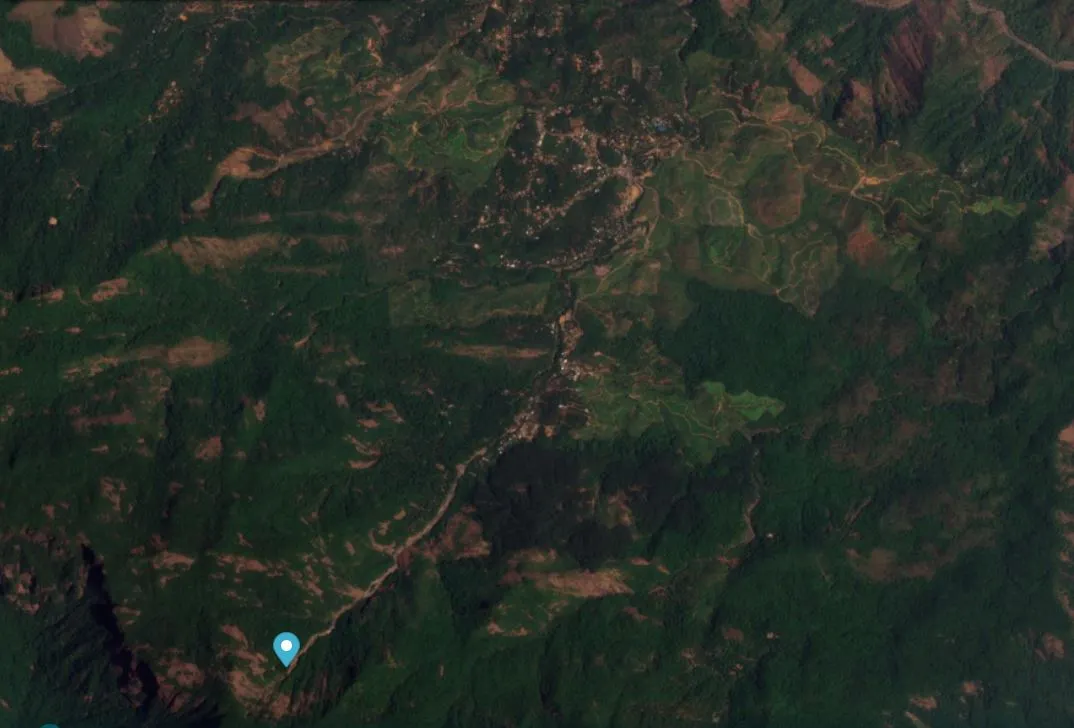

– The resultant landslide extended 8 km, having started in a source area that had suffered previous failures. The surface area of the source zone was 86,000 m2, comprising of shallow, weathered deposits. This initial failure transitioned into a channelised debris flow, which in places had a depth of 7.5 metres. It is unsurprising that the impact on the communities located along the channel was devastating, most notably on Chooralmala, which lay directly in the path of the flow. Das (2024) considers the factors that played in a role in the causation of the Wayanad landslide. Key issues may have been the loss of forests, the nature of the geology and the steep topography. This requires a more detailed analysis in due course.
– The paper also briefly considers the psychological impact of the landslide on the survivors: “Survivors, many of whom are grappling with severe physical injuries, face an even greater battle against the mental trauma that now haunts them. For those who have lost everything, including their loved ones, the path to recovery seems impossible. Sleepless nights and a crippling fear of rain will now a part of their reality. While discussions around rehabilitation are ongoing, the psychological scars of such a disaster cannot be easily mended. The Kerala Health Department deployed a 121-member team of psychiatrists, clinical psychologists, psychiatric social workers, and counselors soon after the disaster to provide immediate and long-term mental health support.” This is a much neglected topic for disasters in general, and landslides specifically. https://eos.org/thelandslideblog/wayanad-4 (17 Oct. 2024)
Himachal Pradesh Drone survey to identify landslide prone areas in Shimla In the wake of increasing incidents of landslides in Shimla, the State Disaster Management Authority is set to conduct a detailed drone-based LiDAR survey in Shimla. Under this, a drone survey of Shimla City will be done from October 21 to November 21. Deputy Commissioner (DC) Anupam Kashyap said, “Shimla has witnessed a concerning rise in landslides and subsidence cases in recent times. The government raised this issue with GSI for a comprehensive study. This led to the approval of the detailed survey.” https://www.hindustantimes.com/cities/chandigarh-news/drone-survey-to-identify-landslide-prone-areas-in-shimla-101729353459608.html (19 Oct 2024)
ENERGY OPTIONS
Carbon Copy Discoms battle Solar’s growing costs M Rajshekhar: India has tried to boost domestic manufacturing through import restrictions on Chinese panels and incentives (like PLI) for domestic manufacturers. With these, the country has seen a spike in domestic manufacturing. Over the last year, with protectionism, the prices of domestically manufactured modules have spiked. This profiteering is another barrier to growth. Two, the sector continues to enjoy subsidies from discoms. We have to ask if discoms, their customers and tax payers can afford the accompanying doubling of subsidies. In effect, the country is subsidising a few manufacturers and developers right now. Intro: https://carboncopy.info/price-surge-or-power-surge-indias-solar-conundrum/ Why India’s seeing a module manufacturing boom: https://carboncopy.info/chasing-the-sun-unlikely-firms-are-betting-big-on-solar/ And the question of risk mitigation: https://carboncopy.info/caught-in-the-power-maze-indias…/ https://carboncopy.info/caught-in-the-power-maze-indias-discoms-battle-solars-growing- (17 Oct. 2024)
ENVIRONMENT GOVERNANCE
Interview ‘Keep environmental justice at the core’ India’s economic growth model, which is based on passing costs to the poor and marginalised while the benefits are for another class of people, makes environmental justice urgent. Environmental issues are seen as problems to be solved with technological interventions, individual actions, or judicial solutions but the need is to educate-organise-agitate. For people in cities, with their stark power hierarchies and sharp class-caste divides, to protect natural areas, livelihoods, and identities, it is important to break barriers, build allyship, and organise creative collective action.
Working on resource distribution and management, especially the conflicts around them, Manshi Asher has spent 26 years on jal, jungle, zameen (land, water and land rights) and environmental justice issues. Her insights into the interface between society and nature, and the relationship between people and nature, have informed several campaigns over the years in the Himalayan Mountain regions. She is the co-founder of the Himdhara Collective, a Himachal-based environment research and action collective that was formed in 2009, working with small grant support and community collaborations to break barriers around environmental issues. https://questionofcities.org/keep-environmental-justice-at-the-core-not-mere-environmentalism/ (4 Oct. 2024)
Assam Opposition to Vedanta’s proposed oil field A 21 sqkm protected area (PA) in upper Assam, and the only PA in India named after a species of an endangered primate and home to around 125 Western Hoolock Gibbon is now being threatened of becoming an open oil exploration field. A controversial Indian mining and oil conglomerate accused of lobbying to “dilute” environmental regulations has been granted clearance for oil and gas exploration inside a notified ecologically sensitive zone (ESZ) by the BJP government in the state.
The dissenting voices in Assam have all cried foul in unison citing that this clearance will be the death knell for this ecologically fragile PA, akin to an oil disaster that struck another such ESZ region also in upper Assam in 2020. Alarmed at the immediate perils that a future oil/gas drilling at an ESZ inside a compact wildlife sanctuary, along with a recent past history of an oil blowout disaster that had engulfed Baghjan in upper Assam in 2020, has now compelled a section of dissenting voices to knock at the doors of the NGT to get relief. This comes close to the heels of the simmering controversy at Kaziranga National Park and Tiger Reserve (KNPTR) as chief minister Himanta Biswa Sarma-led state government’s hell-bent on setting up a high-end resort and a five-star hotel on spots considered to be the corridors of wild elephants. https://thewire.in/environment/locals-environmentalists-oppose-vedantas-proposed-oil-field-in-assams-endangered-gibbon-habitat (18 Oct. 2024)
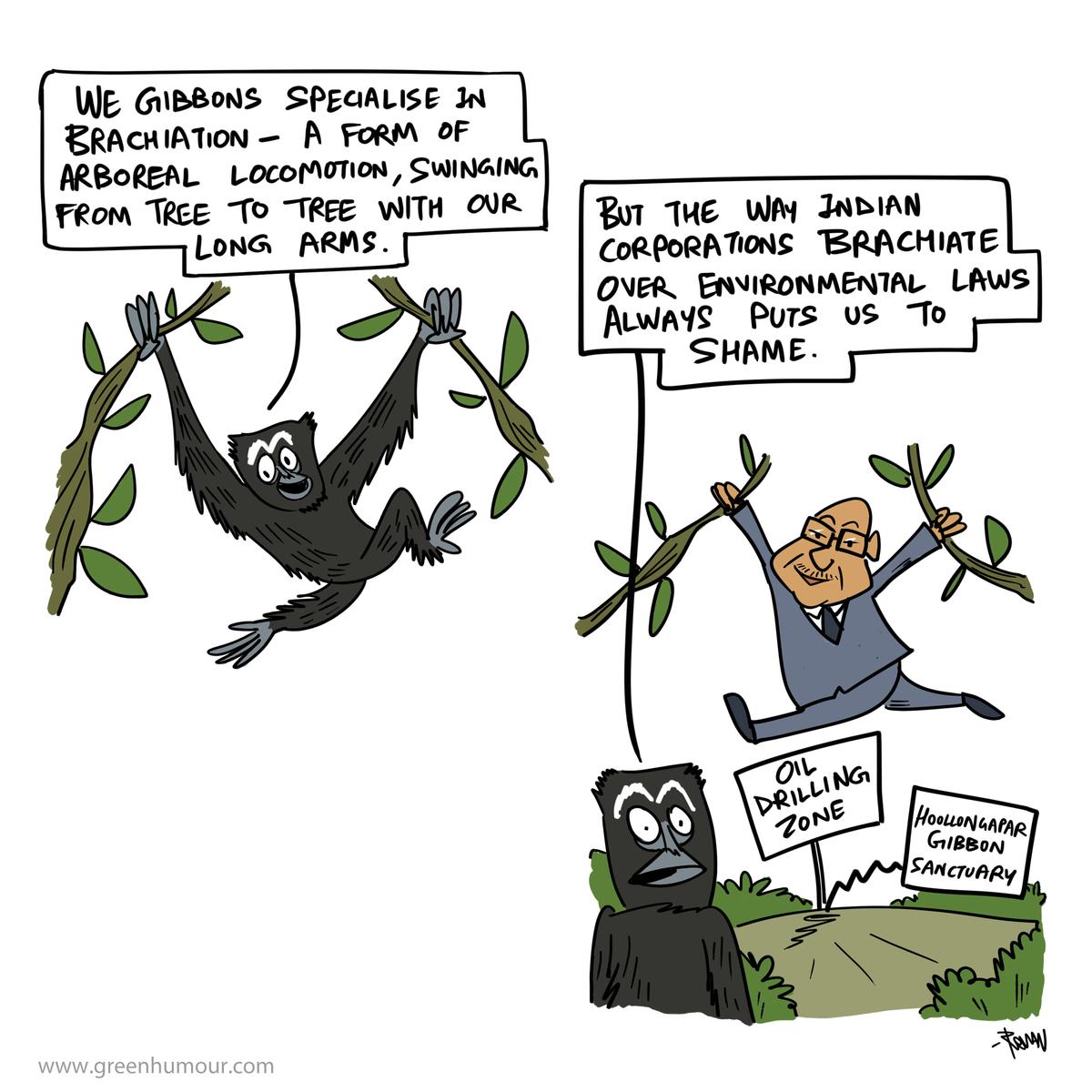
Jammu & Kashmir 7 killed at tunnel site in terrorist attack Suspected Pakistani terrorists shot dead six workers and a doctor in the biggest targeted attack on construction employees in more than three decades of violence in J&K — firing automatic weapons around 8.15 pm Sunday (Oct. 20) at a camp of a private company building a tunnel in central Kashmir’s Ganderbal district. Sources said the camp was near the construction site of Apco Infratech, a UP-based firm building the 6.5 km Z-Morh tunnel for all-weather connectivity between Gagangir and the tourist hub of Sonamarg. The highway connects Kashmir valley with Ladakh. The project is slated to be inaugurated in the first week of November. https://timesofindia.indiatimes.com/india/six-workers-doctor-killed-in-terrorist-attack-in-kashmir/articleshow/114404497.cms (21 Oct. 2024)
Mumbai Resettling Dharavi residents on Deonar landfill The Deonar dumping ground, situated in eastern Mumbai, is one of the city’s largest and oldest landfills, and has long been a significant source of pollution and environmental degradation in the city. The toxic gases, foul air, and particulate matter permeating the area have put residents — mostly from lower income families — at an increased risk of health issues.
Despite persistent criticism of the state’s failure to address these environmental concerns, the Maharashtra government made a controversial cabinet decision on October 14, allocating a 124-acre portion of the dumping ground to the Adani Group, for housing units as part of the proposed Dharavi Redevelopment Project (DRP). This decision to house thousands of residents in such close proximity to a biohazardous site has raised serious questions about the efficacy and intent behind the state’s actions. https://indianexpress.com/article/cities/mumbai/resettling-on-waste-housing-risks-at-deonar-landfill-9630401/ (21 Oct. 2024)
CLIMATE CHANGE
Opinion Empower urban local bodies for climate resilience While constitutional amendments may be a long-term goal, an immediate step could involve making a comprehensive central law on climate mitigation and adaptation with the city as a unit of governance. Also, the Ministry of Housing and Urban Affairs (MoHUA) could update NMSH 2.0 with detailed guidelines for city-level Climate Action Plans. Such guidelines would ensure a standardised approach across cities while allowing for localized strategies aligned with national goals. Additionally, providing financial incentives—such as climate finance or additional transfers from the State Finance Commission (SFC) or Central Finance Commission (CFC)—would encourage ULBs to initiate climate risk assessments, implement green mobility projects, and undertake other climate-resilient initiatives.
Institutionalising climate governance at the local level is only the first step. Local governments must also be given clear and measurable targets, necessitating the localisation of NDCs and SDGs. Incorporating cities into future updates of the NAPCC and SAPCC would allow for a more bottom-up approach to planning adaptation and mitigation strategies. Furthermore, establishing a centralised decision-making body at the city level would facilitate better collaboration among city agencies, ensuring a more coordinated response to climate risks. (Sonal Singh, TERI) https://www.dailypioneer.com/2024/columnists/empower-urban-local-bodies-for-climate-resilience.html (18 Oct. 2024)
Study Trees & land absorbed almost no CO2 last year It begins each day at nightfall. As the light disappears, billions of zooplankton, crustaceans and other marine organisms rise to the ocean surface to feed on microscopic algae, returning to the depths at sunrise. The waste from this frenzy – Earth’s largest migration of creatures – sinks to the ocean floor, removing millions of tonnes of carbon from the atmosphere each year. This activity is one of thousands of natural processes that regulate the Earth’s climate. Together, the planet’s oceans, forests, soils and other natural carbon sinks absorb about half of all human emissions.
– But as the Earth heats up, scientists are increasingly concerned that those crucial processes are breaking down. In 2023, the hottest year ever recorded, preliminary findings by an international team of researchers show the amount of carbon absorbed by land has temporarily collapsed. The final result was that forest, plants and soil – as a net category – absorbed almost no carbon. https://www.theguardian.com/environment/2024/oct/14/nature-carbon-sink-collapse-global-heating-models-emissions-targets-evidence- (14 Oct. 2024)
COP 16 Biodiversity targets at UN conference The agreement signed by 196 countries at the United Nations Biodiversity Conference calls for protecting 30 per cent of land and water by 2030, known as 30 by 30. When the agreement was signed, 17 per cent of terrestrial and 10 per cent of marine areas were protected — which hasn’t changed significantly. At the conference known as COP16, countries next will report on progress made toward the goals, and governments are expected to agree on mechanisms to assure the implementation of them, according to a European Parliament report.
The two-week meeting in Cali, Colombia will also focus on efforts to raise hundreds of billions of dollars to protect nature by 2030 — with the payment of USD 20 billion for developing countries due next year. Twenty-three targets will be discussed including cutting food waste and preventing the introduction of invasive species.
The nearly 200 countries are supposed to submit national plans ahead of the conference showing actions they are taking to meet the 30 by 30 goals. But as of this week, around 46 per cent of countries have submitted targets and less than 15 per cent submitted plans for reaching them. Australia has yet to submit its targets while India has not submitted a national plan. Brazil, which includes much of the Amazon rainforest, hasn’t submitted targets or a plan. The United States, which is not party to the biodiversity convention, is not required to submit any plans. But the Biden administration has committed to protecting a third of American land and waters by 2030. https://www.theweek.in/wire-updates/international/2024/10/16/fgn73-cop16-biodiversity-explainer.html (16 Oct. 2024)
Africa Rare rainfall in Sahara Desert after 50 years For the first time in the last half-century, the Sahara Desert has flooded severely. This rare extreme weather came after two days of continuous rainfall in the southeastern Morocco region of the North African desert. It dramatically changed the barren land in that area. In a single day, Tagounite received 100 millimeters, which goes beyond the annual rainfall for many other local areas. This overflow occurred during late summer when rainfall is extremely rare in this part of the world.
The ultimate influence of the event was the filling of Lake Iriqui. This lake had been dry since 1925, a period of 50 years. According to meteorologists, this is a rare rainfall and they also suggested that this might be an indication of changed climate patterns in the region. Experts such as Houssine Youabeb, of Morocco’s meteorology office mentioned that such heavy rains had not been seen for decades. Such consequences of this storm can be perceived as an increase in moisture in the atmosphere, which could see an increased frequency of extreme weather in the Sahara. https://timesofindia.indiatimes.com/etimes/trending/rare-rainfall-in-the-sahara-desert-after-50-years-heres-why/articleshow/114178120.cms (13 Oct. 2024)
SOUTH ASIA
Nepal From 18-hour blackouts to wasting 500 Mw daily On Sept 30, 2020, the Nepal Electricity Authority (NEA) recorded a wastage of up to 5 million units of electricity, largely attributed to low domestic energy demand and problems within the electricity distribution system. The issue recurred in Sept 2023, with 30 hydropower plants wasting 500 MW of the electricity they produced. Currently, Nepal is said to be wasting more than 700 MW of electricity produced during peak season. Nepal’s electricity production capacity has reached 3,157 MW. However, the country’s peak electricity demand is only 2,650 MW. Eight years ago, per capita energy consumption was 131 units, which has now increased to 400 units. https://myrepublica.nagariknetwork.com/news/nepals-new-challenge-from-18-hour-blackouts-to-wasting-500-mw-daily- (18 Oct. 2024)
ASIA
South Korea River Wall: Hiking a watery stretch of Demilitarized Zone This story is part of journalist Paul Salopek’s multiyear, 38,000-km walk across the world.
For 67 km from a concrete flood embankment north of Seoul to the shore of the Yellow Sea, the two nations face off across the Han River, whose broad, silty currents flood a sprawling estuary before pouring into salty waves. Since humans are banned from the Demilitarized Zone (DMZ), the Han River may nurture one of the most pristine deltas in the world. No docks or industrial sites mar its banks. Not a single ferryboat, navigational buoy, or fishing smack bobs in the Han’s frontline waters. Instead, a legacy of mass violence has frozen an entire river ecosystem in time. Endangered black-faced spoonbills hunt mullets on tidal flats untouched by a gumboot for decades. Water deer teem in the shaggy reeds. This muddy paradise can be admired from behind rows of riverside guard towers, electrified chain-link fences, minefields, and coiled razor wire. https://outofedenwalk.nationalgeographic.org/articles/2024-10-river-wall (16 Oct. 2024)
UAE Govt to build dams, canals to mitigate impact of heavy rainfall The United Arab Emirates has announced plans to build dams and canals in 13 residential areas to prevent flooding and mitigate the impact of heavy rainfall. On Oct 18, the Executive Committee for the President’s Initiatives approved water infrastructure projects, following President Sheikh Mohamed bin Zayed Al Nahyan’s directives and under the follow-up of Vice President Sheikh Mansour bin Zayed Al Nahyan.
The initiative aims to enhance the UAE’s strategic water infrastructure, aligning with the objectives of the Water Security Strategy 2036 by boosting the capacity of water installations, the Emirates News Agency (WAM) reported. The project includes nine new water dams, expand two existing ones, and build a number of embankment barriers. The measures aim to enhance infrastructure for climate change adaptation and increase water reserves by collecting rainwater and floodwaters, with a storage capacity of up to 8 million cubic meters. The projects, which will be completed within 19 months, will involve the construction of nine 9km-long water canals. https://www.siasat.com/uae-to-build-dams-canals-to-mitigate-impact-of-heavy-rainfall-3115498/ (18 Oct. 2024)
THE REST OF THE WORLD
USA Fate of thousands of dams hangs in balance Dams across the country are aging and facing intensifying floods wrought by climate change. But the price tag to fix what’s broken is estimated in the hundreds of billions of dollars.
– Maple Dale in southwestern Wisconsin’s Vernon County in USA is one of thousands of dams constructed by the U.S. Department of Agriculture’s Natural Resources Conservation Service, beginning in the mid-20th century, for the purposes of flood control. In 2018, five similar dams in the region failed during a massive rainstorm that caused property damage in the tens of millions of dollars. A study determined that several other dams in the watersheds hit hardest by the flood, including Maple Dale, were also vulnerable to failure but would be too expensive to replace.
– As a result, local officials are voting on whether to dismantle the dams by cutting large notches in them, allowing the water to flow again, in a process called decommissioning. Experts say it could be the most dams ever decommissioned in a single county in the U.S. And it could be a harbinger for other communities.
– “When [the dams] work, they work, but when they go out, it’s 10 times worse than a regular flood,” Frank Easterday, a member of the Vernon County board, said during an August 15 meeting. At the meeting, the board voted to accept federal funding from NRCS so the agency can move forward with decommissioning. Nearby La Crosse and Monroe counties, which have a handful of such dams between them, have followed suit.
– In the American Society of Civil Engineers’ latest Infrastructure Report Card, released in 2021, the group gave the nations’ more than 91,000 dams a “D.” That’s largely because of their age — the average age of a dam in the U.S. is over 60 years old, said Del Shannon, the lead author of that section of the report card. On top of that, climate change is leaving question marks about how dams will perform under new weather conditions.
– In 2015, now-retired NRCS watershed program engineer Larry Caldwell warned in a memo that a “perfect storm” of problems with watershed dams could put people and property at risk. He outlined seven such problems: these dams are everywhere across the nation; downstream landscapes have filled in since they were constructed; they’re getting old; climate change is bringing more extreme weather; limited funds for repairs; loss of institutional knowledge about the dams; and the fact that the failure of smaller dams can kill — and have killed— people. “Any one condition is cause for concern. The presence of two or three would be cause for alarm,” Caldwell wrote. “But all seven are occurring simultaneously, which will eventually create a crisis for many communities.”
– The Association of State Dam Safety Officials, which works to improve dam safety through professional development and lobbying, estimates the cost to fix nonfederal dams, which make up the vast majority of the nation’s dams, at $157.5 billion. The bipartisan infrastructure law, passed in 2021, provided somewhat of a shot in the arm: $3 billion was earmarked for dam safety, including $118 million for the rehabilitation of the USDA watershed program dams.
– “I think we are going to see more dams under stress, or even failing,” Spragens said. “It’s not really fun to look at in the future.” https://grist.org/politics/the-fate-of-thousands-of-u-s-dams-hangs-in-the-balance-leaving-rural-communities-with-hard- (14 Oct .2024)
Brazil $30 billion compensation deal with miners over 2015 dam collapse Miners Vale (VALE3.SA), opens new tab, BHP (BHP.AX), opens new tab and Samarco are discussing a near $30 billion compensation deal with Brazilian authorities related to the 2015 Mariana dam collapse, they said on Friday (Oct. 18), with an agreement set to be signed on Oct. 25, sources said.
The collapse of the dam at an iron ore mine owned by Samarco, a joint venture between Vale and BHP, near the city of Mariana nine years ago unleashed a wave of toxic tailings in a disaster that killed 19 people, left hundreds homeless, flooded forests and polluted the length of the Doce River. https://www.reuters.com/world/americas/brazil-ink-deal-with-miners-over-mariana-dam-collapse-oct-25-sources-say-2024-10-18/ (19 Oct. 2024)
NILE Water-sharing accord comes into force without Egypt’s backing? A regional partnership of 10 countries says an agreement on the equitable use of water resources from the Nile River basin has come into force despite the notable opposition of Egypt. The legal status of the “cooperative framework” was formally confirmed by the African Union after South Sudan joined the treaty, the Nile Basin Initiative said in a statement Sunday (Oct. 13). Ethiopia, Uganda, Rwanda, Burundi and Tanzania have ratified the accord. Egypt and Sudan declined to sign, while Congo abstained. Kenya has not yet deposited its ratification documents with the African Union. https://apnews.com/article/nile-river-accord-egypt-ethiopia-water-sharing- (15 Oct. 2024)
SANDRP
Also see: DRP 14 Oct. 2024 & DRP 07 Oct. 2024
Follow us on: www.facebook.com/sandrp.in; https://twitter.com/Indian_Rivers

 SANDRP