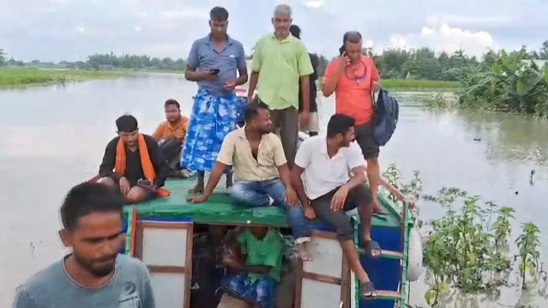
(Feature Image: Flood-affected people move to a safer place on a boat in Nalbari district on Friday, July 5, 2024. Image Credit: PTI/Source HT)
We are in the thick of monsoon and also flood season. To manage floods, key inputs are accurate forecasts and prompt, accurate, location, river specific rainfall. India Meteorological department has a key role to play in all these aspects that can help us manage floods, as a very pointed Editorial in Indian Express stated in the context of Assam Chief Minister Himanta Biswa Sarma’s flip flops.
The edit referred to the 2021 parliamentary panel report that asked the Centre to set up modern weather stations in the upstream catchment of the Northeast’s rivers and install sirens to alert people downstream of floods. North East and rest of the country continues to lack such systems.
On the contrary, IMD’s performance seems to go downhill if we by what happened around heavy rains in Delhi on June 28 or other such incidents. In case of Delhi, as the Hindustan Times reported, two of its three doppler radars are not functioning, the state of installation and functioning of this crucial equipment across the country for over a decade is far from inspiring.
The floods happened in rivers due to rainfall in their catchments, but IMD’s reporting of rainfall river basin wise continues to remain callous to put it most charitably. This year, IMD has also stopped giving state-wise, sub-division wise and national rainfall reporting maps that it gave till last year. In fact, we see no real improvement in IMD’s forecasting and reporting of rainfall for many years now.
The performance of Central Water Commission, another key agency that can help manage floods is far from credible. A case in point is reservoir operations like in case of Sardar Sarovar Dam in Sept 2023. The trouble is both IMD and CWC are mostly holy cows for most of the media. There is a lot that can be done to improve the performance of these key agencies that can help manage floods, say beginning with better transparency and accountability. Judiciary, media, civil society, governments and elected representatives can do a lot to achieve this.
EDIT: Why Assam keeps flooding The state’s continuing vulnerability to floods stems from outmoded solutions. State government must do better than blaming geography.
Last year in October, after flood waters had receded in Assam, Chief Minister Himanta Biswa Sarma announced 54 projects to mitigate the effects of swelling rivers. These initiatives, he had said, “would bring us close to a flood-free Assam”. The state government, however, is nowhere close to securing people’s lives and properties against the rising and raging waters… Now, CM Himanta Biswa Sarma has struck a note of despair — “floods are due to geographical factors beyond the state’s control”, he has said.
Despite flood after flood exposing the hazards of the embankment-centred approach, the state’s authorities have not course corrected. Most of these flood control structures date back to the 1960s and 1970s, when the hydrology of Assam’s rivers, including the mighty Brahmaputra, was poorly understood. Solutions such as tapping into the knowledge systems of indigenous people to build flood-resistant houses, dredging rivers, arresting erosion or even building more resilient embankments have either remained on paper or haven’t been adequately implemented. In 2021, a parliamentary panel asked the Centre to set up modern weather stations in the upstream catchment of the Northeast’s dams and install sirens to alert people downstream of floods. However, the region continues to lack state-of-the-art warning systems. https://indianexpress.com/article/opinion/editorials/why-assam-keeps-flooding-9435619/ (06 July 2024)
Infra adds to IMD’s forecast woes Ever since the monsoon arrived, not only has IMD been getting its daily forecasts wrong for Delhi, its short-term forecasts – meant for the next four to six hours – are also impacted, with the Met department revising its daily weather bulletins for Delhi multiple times a single day.
Delhi has three DWRs – at Palam, Lodhi Road, and Ayanagar, which have ranges of 400km, 250km, 100km respectively. DWRs at Palam and Lodhi Road are currently down for maintenance and out of operation for at least a month, which is particularly problematic in the monsoon season, when they’re most required. This means that only the Ayanagar DWR is currently functional, leaving Delhi reliant on the radar with the smallest range for forecast.
Scientists are also forced to rely on the DWR in Patiala (with a range of 300km), nearly 250km away, for short-term forecasts. This, experts said, is a big reason why IMD scientists struggle to give accurate rain predictions for Delhi. https://www.hindustantimes.com/cities/delhi-news/infra-adds-to-imd-s-forecast-woes-101720206083369.html#google_vignette (06 July 2024)
Climate crisis forces shift in forecasting approaches Large, rain-filled convective clouds form and dump copious amounts of rain over relatively limited areas taking the authorities by surprise (Jayashree Nandi). https://www.hindustantimes.com/india-news/climate-crisis-forces-shift-in-forecasting-approaches-101720376700116.html (08 July 2024)
HYDRO POWER PROJECTS
Uttarakhand Fate of 21 HEPs hangs in balance The future of 21 hydropower projects in Uttarakhand, totaling 2,123MW capacity, will be decided in a forthcoming meeting presided over by the principal secretary of the PMO. This decision follows a recent meeting in Delhi involving officials from the Union ministry of energy, Ministry of Jal Shakti (MoJS), Ministry of Forest, Environment & Climate Change, along with an Uttarakhand govt team. Chief minister Pushkar Singh Dhami had earlier written to PM Narendra Modi seeking approval for these projects from the MoJS. R Meenakshi Sundaram, secretary (energy) of the state govt, who attended the meeting in Delhi, said, “The matter is sub-judice currently.” https://timesofindia.indiatimes.com/city/dehradun/fate-of-21-hydropower-projects-in-uttarakhand-hangs-in-balance/articleshow/111471313.cms (4 Jul 2024)
Govt awaits SC verdict in Sept Now, the state govt is saying it would wait for the Supreme Court verdict in September. However, officials of the state Power Department informed that the MoJS authorities recalled in a similar meeting at the PMO in 2019 described these projects as not feasible. https://www.thestatesman.com/india/jal-shakti-ministry-mum-on-20-power-projects-uttarakhand-awaits-sc-verdict-in-sept-1503316408.html#google_vignette (03 July 2024)
पीएमओ पर राज्य की निगाहें जून माह में मुख्यमंत्री पुष्कर सिंह धामी ने इस संबंध में प्रधानमंत्री मोदी को पत्र भेजा था। इसमें उन्होंने बताया था कि जल शक्ति मंत्रालय की असहमति होने पर इन परियोजनाओं का विकास संभव न होगा। मामले में सुप्रीम कोर्ट में अंतिम सुनवाई की तिथि सात अगस्त तय है। उन्होंने पत्र में कहा है कि पिछले साल सात जुलाई को प्रमुख सचिव पीएम कार्यालय की अध्यक्षता में हुई बैठक में चरणबद्ध तरीके से इन परियोजनाओं को अनुमति का अनुरोध किया गया था। https://www.amarujala.com/dehradun/jal-shakti-ministry-again-obstructs-21-hydropower-projects-uttarakhand-news-in-hindi-2024-07-03 (03 July 2024)
Arunachal Pradesh -Two anti-mega dam activists, Ebo Mili and Dungge Apang, were detained on July 8, ahead of Union Power Minister Manohar Lal Khattar’s visit to the Northeastern state. The duo were supposed to hand over a memorandum to Khattar at the Itanagar Secretariat, according to the Siang Indigenous Farmer’s Forum (SIFF). However, before that meeting, Itanagar Police summoned them to a police station in the state capital and detained them. https://www.downtoearth.org.in/dams/arunachal-anti-dam-activists-detained-ahead-of-union-ministers-visit (08 July 2024)
Odisha Govt asks OHPC to use max reservoir water With monsoon becoming resurgent and IMD predicting good rainfall in the next five days, the state government has directed the Odisha Hydro Power Corporation (OHPC) to use maximum water of the reservoir for hydro power generation, official sources said. https://www.newindianexpress.com/states/odisha/2024/Jul/04/odisha-govt-asks-ohpc-to-use-max-reservoir-water (04 July 2024)
Report Climate Action plans falling short India’s policies on renewable energy, especially its push for large hydropower projects to generate renewable energy, have been criticised by experts on account of a lack of consideration for communities residing on these lands, as well as for financial and scientific reasons. “Far from being cost-effective, these have ended up causing distress to people, especially communities living around river basins,” said Shripad Dharmadhikary of Manthan Adhyayan Kendra, a Pune-based centre that monitors and analyses water and energy issues. “There is no cumulative impact assessment of these projects, though some of them are in very close proximity, becoming the reason for environmental disasters.”
Experts have pointed out that hydropower dams pollute and also precipitate natural disasters, as IndiaSpend reported in November 2021. Large hydropower projects often ignore the complexity and risk of construction on the local terrain, geology, hydrology and ecology. This negligence impacts local communities significantly during or after construction, several organisations from Himachal Pradesh said, in a submission made on May 14 to the state government. “Recently, in Barot valley of Kangra district, the underground forebay near the 25 MW Lambadag Hydropower Project, constructed by Megha Engineering Infrastructure Limited, experienced rapid water leakage, causing penstock pipe to burst, causing extensive damage to fields, shops and homes in Multhan due to water flow,” the organisations said in a press note. https://www.indiaspend.com/climate-change/how-indias-climate-plans-are-falling-short-914806 (06 July 2024)
MoEF Agenda of EAC meeting of River Valley Projects to be held on July 18-19 2024:
1. Upper Sileru Open loop Pumped Storage Project (1350 MW) in 332.44 Ha at Village Valasagedda, Busikonda, Sub Dist Gudem Kotha Veedhi, Dist Alluri Sitharama Raju, Andhra Pradesh by AP Power Generation Corp Ltd: FOR. EC
2. Jhariya Pumped Storage Project (1620 MW), in 333.97 ha at Village Badarwa, Tehsil Robertsganj, Dist Sonbhadra, Uttar Pradesh by Jhariya Ananturja Pvt Ltd: TOR
3. Rouni Open Loop Pumped Storage Project (2100 MW) in 370 ha at Village Bhadikona, Chhichhli and Rajpuri R F, Sub-dist Bagicha, Dist Jashpur, Chhattisgarh by Chhattisgarh Power Generation Company Ltd: for TOR
4. Panaura Pumped Storage Project (1500 MW), in 236.5 ha at Village Soman, Argarh. Chichli etc Tehsil Robertsganj, Dist Sonbhadra, Uttar Pradesh by Adani Green Energy Ltd: For TOR
5. Kutehr Hydro-electric Project (240 MW) in 69.3783 ha at Village Machhettar, Sub Dist Bharmour, Holi, Chamba Dist Chamba, Himachal Pradesh by Jsw Energy (Kutehr) Ltd: Ext of EC Validity
6. Subansiri Upper HE Project (1605 MW) in 2972 ha at Village Pairijo, Tehsil Gussar, Dist Upper Subansiri, Arunachal Pradesh by NHPC Ltd: TOR
7. Cumulative Impact Assessment and Carrying Capacity Study of Yamuna River Basin in Uttarakhand by Indian Council of Forestry Research & Education, Dehradun: Additional TOR
8. Cumulative Impact Assessment and Carrying Capacity Study of Yamuna River Basin in Himachal Pradesh by Indian Council of Forestry Research and Education, Dehradun: TOR https://parivesh.nic.in/utildoc/81028116_1720011738362.pdf (July 2024)
DAMS
Polavaram Project MoJS plans new diaphragm wall The MoJS has decided to go for the construction of a new diaphragm wall for Polavaram project. Although a panel of international experts had suggested that D-wall could be restored with repairs, Central Water Commission (CWC) took the final call to construct new D-wall keeping in view of the safety of the project. CWC went through the preliminary findings of the experts’ panel and held detailed discussions with the project engineers before bringing curtains down on the issue of D-wall. CWC chairman Kushvinder Vohra, who participated in the deliberations, made it clear that the decision has been taken based on the inputs from the experts’ panel as well as the project engineers.
The experts’ panel which initially felt that the damaged portions of the D-wall could be repaired, believed to have made a retreat after getting soil reports and structure stability reports from the project site. The panel wanted the soil test reports from 18 borewells from the cofferdam area but they could get two reports by the time they sent the initial report to the CWC. “It is extremely difficult to come to a conclusion on the issue of diaphragm wall based on the inputs shared by the project engineers and our field visit experiences. We need to go deep to further ascertain the facts. We strongly believe that it would be better to go for the construction of the new diaphragm wall,” the panel reported to have briefed the CWC chairman. The team reported to have observed that other issues related to seepage from cofferdams and vibro-compaction were not major issues to worry.
Meanwhile, the CWC has asked the panel to submit its interim recommendations in the next two weeks on other technical issues related to the project including the location of the new D-wall. The panel would suggest the complete roadmap on how to take the project works ahead. An international dam designer is already working in Polavaram project who will ready the final designs after getting the interim report from the international experts panel. https://timesofindia.indiatimes.com/city/vijayawada/union-jal-shakti-ministry-decides-to-construct-new-diaphragm-wall-for-polavaram-project/articleshow/111498802.cms (05 July 2024)
Diaphragm wall can be restored: Experts The international dam safety experts have observed that the damaged diaphragm wall of the Polavaram dam could be restored with minor repairs. Experts panel comprising David Paul, Richard Donnelly, Franco and Hinchberger felt that damaged portions could be reconstructed by continuing the existing structure. They will give their final recommendations after four days visit ending on July 3. They expressed that d-wall structure would not be damaged even it get soaked in flood waters. They have also observed that d-wall could be utilised by connecting the washed away portion with new structure.
The engineers from the construction agency, Meil, also expressed their concerns that compromising with d-wall might result in the dam’s safety. However, the international experts have allayed their fears saying that d-wall could be strengthened without much difficulty. They have also referred to the instances where the d-wall was repaired 20 years after its original construction. “The d-wall in Polavaram project was completed very recently in 2018, which was washed away during the floods of 2019 and 2020. It is just five-year-old structure. It could be repaired by taking up structures on the damaged portion,” an expert told the officials. The experts advised the officials to conduct solidity tests by directly drilling the parts of the d-wall instead of depending on the electrodes as done by the NHPC. https://timesofindia.indiatimes.com/city/vijayawada/experts-suggest-damaged-polavaram-diaphragm-wall-can-be-restored-with-minor-repairs/articleshow/111444280.cms (03 July 2024)
Experts to submit interim report soon The four -member team of international experts from the US and Canada would give their interim report in a week or two, with recommendations on how to take up works on damaged components of the Polavaram irrigation project from November.
The experts and the agencies reportedly arrived at a decision to go ahead with the construction of a new D-wall replacing the damaged one. They also suggested managing the seepage from underneath the structures of cofferdams, to go ahead with the construction of D-wall, as it appeared to be not possible to completely stop the seepage from the soil of the riverbed. They also examined the vibro compaction works done at ECRF Gap-1 and 2. https://www.deccanchronicle.com/southern-states/andhra-pradesh-experts-to-submit-interim-report-on-polavaram-project-soon-1309413 (03 July 2024)
Kaleshwaram Project Long-term safety need re-engineering: Study The model study for Medigadda at IIT Roorkee on June 13 and 14, and again on June 27 and 28, has once again demonstrated the inadequacies in design of the downstream structures of the barrage including its apron, and flood force dissipation arrangement using cement concrete blocks. It is now believed that because of these design shortfalls, water from the upstream side of the barrage forced its way from under the foundations causing serious damage to Block 7 of the Medigadda barrage. The experts who conducted the model studies have recommended not only an extension of the downstream apron from its current 7.98 metres to 48 metres but also design it in such a way that a three-metre pool of water stays on the extended apron to serve to dissipate flood water energy on the downstream side. “In effect, what the barrage urgently needs is a 48-metre long stilling basin made of cement concrete bed. This in itself will require new designs, and will be a major construction activity,” an irrigation engineer said.
A similar study for Annaram done at the Central Water and Power Research Station, Pune, too ended up in a recommendation of extending the structure on downstream side of the barrage for a total of 60 metres, but in this case, the stilling basin was recommended to have a total depth of 6 metres for effective flood force dissipation given the geographic requirements at the location. Engineers working at Annaram had also informed irrigation minister N. Uttam Kumar Reddy about the need for the 60-metre long stilling basin during his recent inspection of the three barrages to check on the National Dam Safety Agency recommended interim flood protection measures. https://www.deccanchronicle.com/southern-states/telangana/long-term-safety-of-klis-barrages-need-re-engineering-study-1309015 (01 July 2024)
Medigadda flooding: Farmer moves HC, seeks ₹5 lakh per acre as crop damage A farmer has approached the Nagpur bench of Bombay high court, seeking compensation for severe crop and farmland damage in approximately 25 to 30 villages in Sironcha tehsil of Gadchiroli. The damage was allegedly caused by water leakage from the Medigadda barrage, which has been constructed by the Telangana govt. Petitioner Satyanand Gallapalli, supported by a panchnama conducted by revenue authorities, argued that the barrage built on Godavari has adversely affected lands belonging to numerous farmers in the area. Represented by counsel Shilpa Giratkar, Gallapalli asserted that the affected farmers deserve compensation for the damage caused by the October 21, 2023, flood. On July 4, a division bench of justices Nitin Sambre and Abhay Mantri issued notices to principal secretary of the MOEFCC, the Maha govt, the Gadchiroli collector, and L&T Company, among others. The respondents were instructed to submit their replies by August 7. The petitioner claimed that substandard construction has led to leaks and structural failures.
On Oct 21, 2023, floodwaters breached the barrage, inundating fields in several villages across Sironcha. The flooding turned farmlands into riverbeds, causing extensive losses to farmers who have since been rendered landless. Despite assessments and documentation of the damage, no compensation has been provided to the affected farmers. Previous complaints to the Gadchiroli district collector yielded no results, prompting Gallapalli to file a Public Interest Litigation (PIL) in the matter. Giratkar emphasized the dire condition of the affected farmers and demanded compensation of Rs5 lakh per acre for the losses incurred. https://timesofindia.indiatimes.com/city/nagpur/medigadda-flooding-farmer-seeks-compensation-for-crop-damage-in-nagpur-hc/articleshow/111498494.cms (05 July 2024)
Govt plans to auction sand from Medigadda barrage As per the irrigation and mines departments estimations, Medigadda has a huge 92 lakh metric tonnes sand — piled up at the barrage site over the years. “We are expecting about Rs 500 crore to Rs 600 crore revenue through the bids. There is huge demand for the Godavari river sand which is of fine quality,” a senior official involved in the tendering process said.The Telangana Mineral Development Corporation has recently floated tenders for sand mining for 14 blocks around the barrage. The response from the bidders has been overwhelming with 383 contractors participating in the bids. While the technical bids were opened on July 5, financial bids will be opened on July 8. Since the water was stored in Medigadda barrage since 2019, sand got accumulated in large quantities at the barrage. “Had there been water flow in the Godavari continuously, the sand would have been washed off to the downstream of the barrage which, however, did not happen,” an expert said.
While successful bidders extract the sand for a two-year term, a majority of them start immediately after getting permission letters before monsoon. “The mineral development corporation approximately gets Rs 400 per tonne, while the bidders sell the sand at Rs 1,000 to Rs 1,200 per tonne,” a source in the govt said. The irrigation and the mineral development corporation also conducted a survey at Annaram and Sundilla barrages. Since there was water flow at the barrages, sand accumulation was not much at the two places. https://timesofindia.indiatimes.com/city/hyderabad/medigadda-barrage-sand-auction-to-generate-rs-500-crore-revenue-for-govt/articleshow/111545649.cms (07 July 2024)
35 pumping units at 3 barrages ready The Kaleshwaram Lift Irrigation Project (KLIP) could soon roar back into life, with Irrigation officials firm on resuming the pumping operations under the project and keeping all the pump houses ready. The project involves several pumping facilities. It has in all 35 units that manage the project’s outflows at the Medigadda, Annaram and Sundilla barrages. The Kannepalli pump house comprises 17 giant motor pumps, each weighing 2,376 metric tonnes, and are meant for lifting water from Godavari in the first stage. These powerful pumps, known as ‘Baahubali motors’, have a capacity to lift 3 Thousand million cubic feet (TMC ft) of water every day. All of them are now kept ready for resuming operations.
– Since no impounding of water is allowed at this stage in the Medigadda barrage, the possibility of lifting from the natural flows has been examined. Only Medigadda barrage has been receiving some inflows, thanks to the contribution of the Pranahita river. Lifting of water from Medigadda would be possible if the inflows are in the order of some 30,000 cusecs to 35,000 cusecs. The inflows at Medigadda are in the order of 17000 cusecs now and are expected to be doubled within a week.
The project officials are planning to build a makeshift cofferdam or weir kind of structure after three months to retain water in the Medigadda Barrage to facilitate pumping into the Annaram Barrage in the lean period. The pump houses at Annaram and Sundilla barrage were also overhauled and kept ready to resume operations. No significant inflows were, however, received at both the barrages so far. The interim works recommended by the National Dam Safety Authority (NDSA) on the two barrages were in their crucial final phase. They would be completed in less than a week, said officials. Water can be impounded in the two barrages once the works are completed and final clearance was received from the State government as well as the NDSA. The NDSA team is expected to revisit the barrages soon. https://telanganatoday.com/kaleshwaram-to-be-back-in-action-soon-all-35-pumping-units-at-three-barrages-ready (07 July 2024)
Sardar Sarovar Dam Patkar’s conviction and more than 20 years of inconvenient questions The Narmada Bachao Andolan activist faces a jail term for defaming the man who once tried to vilify a mass movement for questioning the Indian state. (Dilip D’Souza) https://scroll.in/article/1070093/true-patriots-be-damned-medha-patkars-conviction-and-more-than-20-years-of-inconvenient-questions (03 July 2024)
Karnataka Farmers stage protest against proposed trial blast near KRS The KRRS faction led by Badagalapura Nagendra said that though the district administration was carrying out the exercise to pave the way for the trial blast as directed by the High Court of Karnataka, the KRRS has urged the authorities to plead for additional time from the High Court. “We have lot of doubts and uncertainties and as stakeholders they need to clarified before commencing the trial blast,” said Mr. Nagendra. Besides, who is to ascertain that the trial blast itself was safe and did not endanger the dam, he questioned.
Citing from various documents, Mr. Nagendra said that the administrative machinery including the Cauvery Neeravari Nigam Ltd. was not competent to decide whether trial blast was safe or not and as per the Dam Safety Act, 2021, a committee of experts from various departments has to be constituted to give an opinion. As the expert committee has not been constituted, the authorities should plead for additional time, said Mr. Nagendra.
Mr. Nagendra said that there are concerns that the results of the trial blast outcome could be used by the mining lobby to claim that there was no threat to the safety of the dam in their bid to get the mining ban lifted. Meanwhile, another group of farmers staged a demonstration urging the authorities to hold the trial blast and questioned whether one should reach any conclusion even before the exercise is conducted. https://www.thehindu.com/news/national/karnataka/farmers-stage-protest-against-proposed-trial-blast-near-krs/article68363087.ece (03 July 2024)
Water to be released from KRS and Kabini reservoir to fill up lakes However, they have made it clear that the water is meant to fill up lakes and waterbodies, besides meeting drinking water requirements of cattle. Normally, water is released to VC canal in the second week of July every year. But this year, a decision on it had been taken on July 8 itself as no water could be released during March in view of the insufficient water availability in the reservoir. The decision to release water for 15 days from July 8 had been taken only to ensure that lakes and other waterbodies were filled up with water and facilitate the drinking water requirements of the cattle, he said, adding that a decision to release water for crops would be taken after assessing the monsoon over the next 15 days and the quantum of inflow into the reservoir. https://www.thehindu.com/news/national/karnataka/water-to-be-released-from-krs-and-kabini-reservoir-to-fill-up-lakes/article68377953.ece (07 July 2024)
Mumbai Morbe dam protest turns violent Around 3000 Project Affected People (PAP) of Morbe Dam have been protesting against the government at the Morbe Dam demanding jobs for the villagers and proper compensation to them. In the course of the protest, the villagers have broken the dam gates and entered the dam premises and also closed the valves of water to Navi Mumbai. The protest had started on June 27, and since none of the officials took note of the strike, the villagers became violent on Thursday (July 04).

The Dam, situated in Khalapur Taluka in Raigad District, supplies water to Navi Mumbai and some nodes of CIDCO and is owned by NMMC. According to the corporation, the Maharashtra Jal Pradhikaran (MJP) had started the work on dam in the year 1990 and due to lack of funds, they had put the dam on sale for nearby corporations. NMMC decided to acquire the dam and the last payment was made in the year 2010. The corporation said that the agreement was between them and MJP and no promise of jobs were made to the villagers.
“We have been silently protesting for our demands but none of the officers took cognizance. On July 3, we finally decided that we would close the valves of the water supply to Navi Mumbai and on July 4, we did the same,” Jagannath Patil, one of the PAPs said. “In the year 1990, the land of the villagers was acquired. We never got the right compensation or jobs. None of the Acts that are usually applied in land acquiring process has been implemented in this case”, Arjun Kadam, another PAP said. https://www.freepressjournal.in/mumbai/navi-mumbai-morbe-dam-protest-turns-violent-as-villagers-shut-water-valves-demand-jobs-and-compensation (04 July 2024)
Uttarakhand CM directs to speed up Jamrani, Song dams paper work The CM gave orders to start the Jamrani Dam Multipurpose Project and Song Dam Drinking Water Project, with proceedings to be completed by Sept. The Jamrani Dam Project was allocated Rs 710 crore and will increase the availability of 117 MLD of drinking water in Haldwani and surrounding areas, and provide additional irrigation to around 57,000 hectares. The Song Dam Project, allocated Rs 300 crore, will provide 150 MLD of drinking water in Dehradun and suburban areas until 2053.
It was discussed in the meeting that reservoirs have been constructed on Tharkot Lake in Pithoragarh, Kolidhek Lake in Champawat, and the Gagas River in Almora for clean drinking water, tourism development, fisheries, and groundwater enhancement. https://timesofindia.indiatimes.com/city/dehradun/cm-dhami-directs-irrigation-department-to-expedite-flood-protection-efforts/articleshow/111471974.cms (04 July 2024)
INTERSTATE WATER DISPUTES
Yamuna Water Sharing UYRB tenure ending; water sharing talks to start next year Bhim Singh Rawat, a Yamuna activist, and member of SANDRP said that over the years UYRB has become a totally opaque organisation with a non-functional website and inadequate staffing. Worse, minutes of its meetings are no longer made public.
Rawat said that there has been unscientific allocation of water among the states as well for the river, almost killing the river. “Rajasthan is added as a basin state for Yamuna even though it has no direct connection to the river. Only 10 cumecs (or the flow of 10,000 litres per second) of water has been left for the river as ecological flow and even the National Institute of Hydrology has established that is insufficient and the river should have at least 25 cumecs (flow of 25,000 litres per second) water.” The release of water needs an independent monitoring, he added.
Rawat said that the board is only functioning with five officers with a few other on deputation. “UYRB has become a formality and needs major overhaul,” he added. “Delhi is increasing its dependence on river. It should think of modern alternatives of treated water, ground water recharge strategies and other ways,” he said. “In this tussle between the states, someone will have to also look at the rights of the river Yamuna.” https://www.hindustantimes.com/cities/delhi-news/tenure-of-watershed-deal-nears-end-yamuna-sharing-talks-to-start-next-year-101720116907160.html (05 July 2024)
Mahadayi Water Sharing Dispute -A team from the Mahadayi River’s central authority, the Progressive River Authority for Water and Harmony (PRAWAH), visited Belagavi district on July 7, 2024, as part of a tour of the three states through which the river flows: Goa, Karnataka and Maharashtra. The visit has reopened conversations on a four-decade-old dispute between Karnataka and Goa about sharing the river. https://www.downtoearth.org.in/water/goa-karnataka-at-loggerheads-again-over-kalasa-banduri-project-as-central-body-inspects-mahadayi-basin (08 July 2024)
IRRIGATION
Andhra Pradesh Krishna delta unlikely to get water from Aug: WRD Minister Andhra Water resources minister Nimmala Ramanaidu said that it might not be possible to release water for the Krishna delta till August. He said that they are struggling to pump water from Pattiseema lift irrigation scheme as all the pumps got rusted due to negligence of the previous govt.
Ramanaidu said that release of water depends on inflows to Srisailam, Nagarjuna Sagar and Pulichintala projects on the Krishna basin. He said that all the projects in the Krishna basin turned empty and there is no scope to draw water for cultivation. “It is extremely difficult to release water to the Krishna delta till August as there is no sufficient water left in any of the projects on the Krishna basin,” said Ramanaidu. He said that previous govt did not take measures to protect the projects even after the gates in Pulichintala and Gundlakamma projects were washed away. He said that huge water was lost from the projects due to the damaged to the crest gates. https://timesofindia.indiatimes.com/city/vijayawada/krishna-delta-water-release-delayed-till-august/articleshowprint/111525142.cm (06 July 2024)
Ramanaidu said, “We used to store and use 40 tmc of water in the Pulichintala project. At present, there is not even half a tmc of water and hence we are unable to provide irrigation water to Pulichintala.” He said, “Through Pattiseema, we are able to give some drinking and irrigation water to the Krishna Delta. But (Many of) the Pattiseema motors are not working due to their poor maintenance in the last five years.” Ramanaidu said that 15 out of the 24 pumps under the Pattiseema lift scheme have been started and these would lift water.” A total of 21 pumps are likely to be operational in the next three to four days. As a result, the water of Pattiseema is likely to reach the Krishna Delta in the next two to three days.” https://www.deccanchronicle.com/southern-states/andhra-pradesh/andra-pradesh-no-release-of-water-to-krishna-delta-region-till-august-says-minister-1808726 (05 July 2024)
URBAN RIVERS
PRC RFDs grabbing common resources A compendium of six case studies on Riverfront Projects in seven different Indian cities: Musi River in Hyderabad, Ganga River in Varanasi and Patna, Tapi River in Surat, Mula-Mutha River in Pune, Khan Saraswati River in Indore, and Yamuna River in Delhi. PRC aims to critically examines the state-led grey and blue infrastructure projects in these areas. The construction of these riverfront have vast impact on the local socio-ecology therefore causing huge losses of urban commons and grave climatic injustice. https://prcindia.in/publications/books/emerging-fronts-dwindling-rivers-grabbing-common-resources-destroying-ecology-growing-real-estate/ (25 June 2024)
QoC Plastic chokes drains but bans are not enough -Bhim Singh Rawat, associate coordinator, South Asia Network for Dams, Rivers and People (SANDRP), found that water bodies in and around Dehradun city were bunged up with solid waste, most of which was plastic. “There is not a single stream or river that has not turned into a dumping yard of municipal plastic waste here. Certain places of the Rispana, Bindal, Asan rivers have turned into plastic rivers,” he says. Clearly, the plastic ban lacks teeth or has been poorly implemented.
Importantly, it is at odds with industrial policies and projects that push for more plastic use without a foresight of its environmental, social and health consequences, says Rawat, “This shows the failure of governance and that remains our reality.” While one arm of the government pushes its use, another imposes a blanket ban; something is bound to slip in between. https://questionofcities.org/plastic-chokes-drains-but-bans-are-not-enough/ (29 June 2024)
Indrayani; Pune MPCB initiates legal action against 3 MCs The Maharashtra Pollution Control Board (MPCB) has initiated legal action against three local bodies including the Pimpri-Chinchwad Municipal Corporation (PCMC), Talegaon-Dabhade Municipal Council and Wadgaon Nagar Panchayat for polluting the Indrayani, Pawana and Mula rivers. As part of the action, the board on Tuesday, July 2, issued prosecution notice to the three local bodies asking them to submit a response within 15 days.
According to the notice, the Wadgaon Nagar Panchayat and Talegaon-Dabhade Municipal Council are discharging through a nearby nullah three and 19 MLD of untreated sewage water, respectively. The local bodies have failed to provide STPs to treat 100% domestic effluent, causing pollution in the rivers. The PCMC too is discharging untreated domestic effluent into the rivers. It has not provided uninterrupted power supply to all the STPs. It has not completed the work of laying interceptor lines along the rivers to collect untreated domestic effluent. Moreover, the corporation has not upgraded/designed STPs for BOD 10 mg/l to achieve permitted standards. It has also failed to submit a time-bound programme for the upgradation of STPs https://www.hindustantimes.com/cities/pune-news/indrayani-river-pollution-mpcb-initiates-legal-action-against-three-local-bodies-101719948006539-amp.html (03 July 2024)
Sarang Yadwadkar, an architect and environmentalist, explains what floodlines are, what’s wrong with Pune’s floodlines and the legal battle for the same. https://www.youtube.com/watch?v=dYpI8_Juyvc (04 July 2024)
Ludhiana New move to clean Buddha Dariya flowing in the periphery and inside Ludhiana city whose brackish water merges into the Satluj, a number of pro-environment organisations and individuals have decided to start a campaign for independence from highly polluted and contaminated water, naming it ‘Kale Paani Da Morcha’ (morcha against black water).
Water activists have increased the scope of activism for cleaning the stream, earlier limited to Ludhiana, and have decided to rope in people from parts of the states where the Satluj flows. The first meetings of Kale Paani Da Morcha have been planned in Ferozepur, Faridkot and Moga on July 8. The 42km Buddha Dariya starts from Koomkalan village in Ludhiana district. The water is a bit clean in the first 14km, but turns brackish during its 28km course through Ludhiana city. By the time it reaches the conluence with Satluj in Walipur, the stream is highly polluted. https://timesofindia.indiatimes.com/city/chandigarh/new-campaign-kale-paani-da-morcha-launched-to-clean-buddha-dariya/articleshow/111563616.cms (08 July 2024)
RIVERS
Manipur Barak’s pristine ox-bow lakes threatened Some interesting information on ox-bow lakes formed by Barak river and concerns over increasing eutrophication problem impacting aquatic eco-system and ecology of these lakes: -In the last five to seven years, Rupaibali Lake has completely been covered by water hyacinth. According to locals, this was not the situation even a decade ago. From their childhood experiences, the elders also opined that during the monsoons, when the lake was full to the brim, Barak usually could absorb the excess water. Now the situation is different. The problem they pointed out is an artificial dam, ‘manmade artificial dams’ created exclusively for extensive fishing.
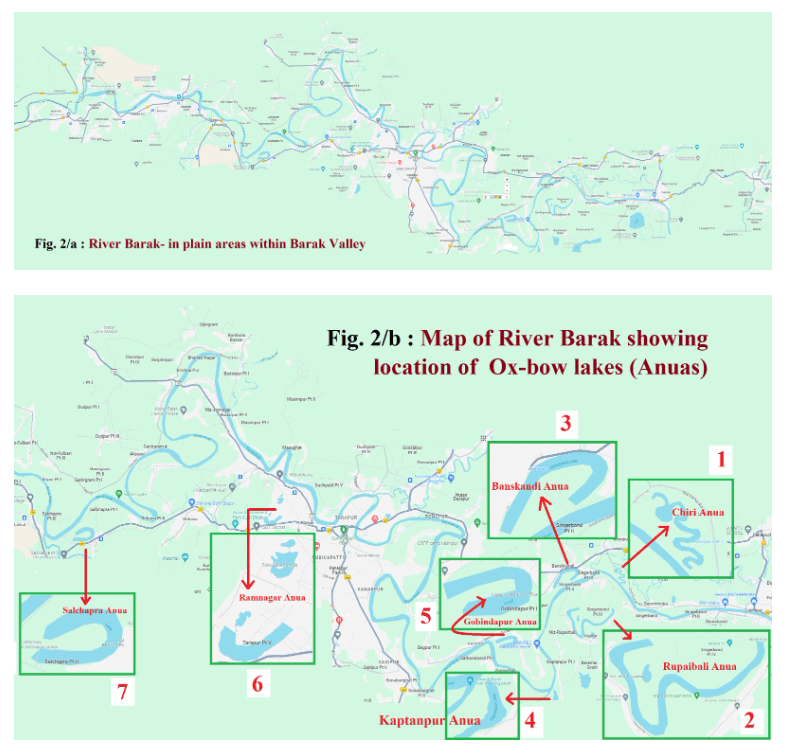
-Excessive growth of water hyacinth has been witnessed in the Rupaibali ox-bow lake. In many places, more than half of the area has now been covered with this freshwater weed. Deep down the story, the same fact is revealed. ‘Excessive greed’! As per government rules, a lease for the ox-bow lakes is earmarked for a certain community. This is admitted, but what about the Dos and Don’ts regarding the use of all such lake water? Why is SoP lacking in this case? What about the knowledge on ‘aqua-health’ and ‘aqua-environment’ related matters for the persons belonging to that specific community(ies)? This is the Grey area. Fishermen who are officially given the lease, have just one agenda. Grow more and more fish, catch them, sell them in the market, and earn more and more money. Hence, the catalyst, ‘Urea’.
Urea is not just mixed in the water of a particular ox-bow lake. Wherever there are fisheries in the valley, this type of misuse of urea is taking place in almost 9 out of 10 instances. The obvious question that arises is, here what is the ‘thumb-rule’? For the larger benefit of society, will the officials of the concerned department(s) shed some light on this important aspect that directly concerns human health? We all are looking forward to hearing straightaway from the horse’s mouth! Don’t know, how long we shall have to wait. Or, whether, at all, we’ll hear from the yellow, brown, golden or dark horses? (Prof. Parthankar Choudhury is the Dean and former Head of the Department of Ecology and Environmental Science, Assam University, Silchar) https://www.barakbulletin.com/bn_BD/natures-pride-at-risk-river-baraks-pristine-ox-bow-lakes-threatened-by-urea-pollution/ (04 July 2024)
BRAHMAPUTRA Arunachal Pradesh Parshuram statue to come on Lohit river Under the Pilgrimage Rejuvenation and Spiritual Heritage Augmentation Drive (PRASHAD) scheme, a substantial grant of Rs 37.87 crore has been allocated to elevate Parshuram Kund into one of the region’s largest pilgrimage centers. The ambitious project includes the installation of a 51-feet statue of Sage Parshuram, generously donated by the VIPRA Foundation, an organisation associated with the promotion and development of Parshuram Kund since 2021. The foundation work for the installation of Lord Parshuram’s statue has been completed and the installation of the statue is likely to start soon. https://arunachal24.in/arunachal-51-feet-statue-of-sage-parshuram-to-come-up-on-holy-bank-in-lohit/ (02 July 2024)
Telangana Peddapalli bridge girders collapse again For the second time in a month, girders of an under-construction bridge in Peddapalli collapsed due to strong winds and heavy rain. The incident occurred on Tuesday night (July 02), affecting four girders between 17 and 18 pillars of the bridge at Odedu in Muttaram mandal. The bridge, with an estimated cost of Rs 49 crore, is being constructed across the Manair river to connect Odedu in Peddapalli district and Garimella village in Jayashankar Bhupalpally district. Construction began in 2016, but was halted in between due to lack of funds, with no allocations for the last nine years. https://www.newindianexpress.com/amp/story/states/telangana/2024/Jul/04/telangana-peddapalli-bridge-girders-collapse-again (04 July 2024)
Karnataka Rain brings rivers to life It is raining good news in Chikkamagaluru district as the rivers originating here are in full spate. The district has regained its lifeline after pre-monsoon and monsoon showers. Tunga, Bhadra, Hemavathi, Nethravathi and Vedavathi rivers originate in the district. Streams and rivulets too, take birth in the region. If the rivers are full in the region, half of Karnataka will get water throughout the year. People in the district are expecting good rains in July as well. https://www.deccanherald.com/india/karnataka/rivers-regain-glory-in-chikkamagaluru-thanks-to-rain-3095904 (07 July 2024)
अंग्रेजों द्वारा लगाया गया एक विशिष्ट पत्थर जो मंकनहल्ली जिला हासन कर्नाटक में स्थित है। इस पत्थर के दाहिनी ओर गिरने वाला वर्षा जल कावेरी नदी से पूर्व की ओर बहकर बंगाल की खाड़ी में चला जाता है और बायीं ओर गिरने वाला वर्षा जल नेत्रावती नदी से पश्चिम की ओर अरब सागर में चला जाता है।
GANGA Prayagraj Raw sewage flowing into Ganga-Yamuna confluence: NGT The tribunal on July 01 said the report of the joint committee has highlighted many shortcomings. For instance, 468.28 MLD sewage is generated through the drains and sewage network in Prayagraj every day. Of this, 73.80 MLD is falling into the Ganga-Yamuna confluence through the 44 untapped drains. The remaining 394.48 MLD sewage is being sent to 10 STPs with a capacity of 340 MLD. The NGT said clarity was required as the amount of sewage being produced was in excess of the capacity to treat it. How was the sewage being treated, it asked?
-The court also pointed to the fact that 166,456 houses are yet to be connected to the sewage network. In such a situation, will the sewage be sent for treatment to the existing STP or to the proposed STP? This requires an explanation. The next hearing in the case is on September 23, 2024. That is when the state government will have to submit a progress report to the tribunal regarding action taken appropriate steps to prevent sewage discharge. https://www.downtoearth.org.in/water/6-months-before-mahakumbh-starts-at-prayagraj-raw-sewage-flowing-into-ganga-yamuna-confluence-ngt (04 July 2024)
Uttarakhand सिलक्यारा टनल में जिस कंपनी की लापरवाही से हादसा हुआ था, उससे 7 महीने बाद भी रेस्क्यू ऑपरेशन पर खर्च हुए 100 करोड़ नहीं वसूल जा सके। न ही अब तक टनल का मलबा साफ हुआ है। एक RTI के मुताबिक, राज्य व केंद्र सरकार ने आपदा राहत कोष से रेस्क्यू की राशि का भुगतान करने से मना कर दिया है। कहा कि ये दुर्घटना प्राकृतिक आपदा नहीं थी। ऐसे में अब यह राशि उन विभागों के गले पड़ गई है, जिन्होंने इसे खर्च किया था। हालांकि, अभी तक इसका ठीक हिसाब भी नहीं लगाया गया है कि रेस्क्यू ऑपरेशन पर कुल कितनी राशि खर्च हुई थी? आरटीआई के मुताबिक, करीब 92 लाख एनएचआईडीसीएल के, 5.49 करोड़ रु. एनईसीएल के और राज्य के 13 विभागों के करीब 65.41 लाख रु. खर्च हुए थे।
उत्तराखंड भूस्खलन शमन एवं प्रबंधन केंद्र के निदेशक शांतनु सरकार के नेतृत्व में छह सदस्यीय विशेषज्ञ पैनल ने 70 पेज की रिपोर्ट में सुरंग परियोजना में कई खामियां बताईं। त्रासदी की स्थिति में कोई बचने का रास्ता और अलार्म सिस्टम नहीं था। निगरानी भी उचित नहीं थी। हैरत की बात यह है कि एनएचआईडीसीएल ने इस राज्य सरकार की इस रिपोर्ट को खारिज कर दिया। निदेशक अंशु मनीष खलखो ने कहा, हम इन निष्कर्षों से सहमत नहीं हैं। मंत्रालय की रिपोर्ट पर ही भरोसा करेंगे। इंटरनेशनल टनलिंग एंड अंडरग्राउंड स्पेस एसोसिशन के अध्यक्ष, बैरिस्टर, साइंटिस्ट और इंजीनियरिंग प्रोफेसर अर्नोल्ड डिक्स ने बताया, हादसे से पहले टनल में 21 बार भूस्खलन हो चुका था, पर ध्यान नहीं दिया गया। चयनित अलाइनमेंट ठीक नहीं था। ऑडिट में भी अनदेखी हुई।
इस सुरंग के निर्माण का ठेका एनएचआईडीसीएल को 1383.78 करोड़ रु. में दिया गया था। एनएचआईडीसीएल ने नवयुगा इंजीनियरिंग कंपनी लिमिटेड (एनईसीएल) को यही ठेका जून 2018 में 853.79 करोड़ में दिया। सिलक्यारा टनल का ठेका मिलने के चार महीने बाद ही नवयुगा पर 26 अक्टूबर 2018 को आयकर छापे पड़े और छह महीने बाद इसने 19 अप्रैल 2019 को 30 करोड़ रु. के चुनावी बॉन्ड भाजपा को दिए। 2020 के मध्य में नवयुगा को सरकार की महत्वाकांक्षी ऋषिकेश-कर्णप्रयाग रेल लिंक परियोजना भी मिल गई और 10 अक्टूबर 2022 तक इस कंपनी ने कुल 55 करोड़ के चुनावी बॉन्ड भाजपा को दिए। नवयुगा ने भी 3 अन्य कंपनियों श्री साई कंस्ट्रक्शन, नव दुर्गा और पीबी चड्ढा को मजदूरों को ठेका दे दिया। तय हुआ कि टनल, एस्केप पैसेज और अप्रोच रोड 8 जुलाई 2022 तक बन जाएंगे। जुलाई 2018 में काम शुरू हुआ, लेकिन अब तक 56% ही हो पाया। अब इसकी डेडलाइन मई 2024 भी गुजर चुकी है। https://www.bhaskar.com/national/news/uttarakhand-silkyara-tunnel-latest-news-updates-133284235.html (07 July 2024)
अल्मोड़ा जनपद में एक पुल ढहने का वीडियो सामने आया है. देखते ही देखते ताश के पत्तों की तरह पुल ढह गया. नदी का जलस्तर बढ़ने से पुल गिर गया. इसके गिरने से मार्ग पूरी तरह बंद हो गया है. मिली जानकारी के अनुसार, यह पुल रामनगर से रानीखेत और अल्मोड़ा को जोड़ने वाला मोहान के पास का पुल है. पुल गिरने की घटना शनिवार (July 06) शाम 6 बजे की बताई जा रही है. https://hindi.news18.com/news/uttarakhand/almora-bridge-collapsed-video-viral-it-was-connecting-ramnagar-to-almora-8469513.html (06 July 2024)
रविवार (July 07) को हल्द्वानी-देहरादून स्टेट हाईवे पर चकलुवा के पास बने पुल को भी खतरा पैदा हो गया है। पानी के तेज बहाव ने पुल के दोनों पिलर क्षतिग्रस्त हो गए हैं। ऐसे में यह पुल कभी भी ढह सकता है। पिथौरागढ़ जिले में दारमा घाटी के माइग्रेशन ग्राम बोन को जोड़ने के लिए च्युति गधेरे में बना पुल भी बारिश की भेंट चढ़ गया है। इसके चलते गांव के 30 परिवारों का संपर्क मुख्य सड़क से कट गया है। तीजम और वतन तोक को जोड़ने वाला लकड़ी का पैदल पुल बह गया है। इससे 18 परिवारों का संपर्क कट गया है। उधर, चीन सीमा को जोड़ने वाला कैलाश मार्ग पर स्थित बैली ब्रिज भी खतरे की जद में है। https://www.amarujala.com/dehradun/uttarakhand-weather-bridge-on-haldwani-dehradun-highway-in-danger-due-to-rain-both-pillars-damaged-2024-07-07 (07 July 2024)
Bihar Plea in SC seeks structural audit of all bridges The PIL not only seeks an audit but also the formation of a high-level expert committee. This committee would be responsible for a detailed examination and continuous monitoring of all the bridges to ensure they are safe for public use. The petitioner sought real-time monitoring of the bridges based on the same methodology developed by the Ministry of Road Transport and Highways, Government of India through its policy dated Mar 4, 2024, for Preservation of National Highways and Centrally Sponsored Scheme. https://www.livelaw.in/amp/top-stories/bihar-bridge-collapse-plea-in-supreme-court-seeks-structural-audit-of-all-bridges-in-bihar-their-real-time-monitoring-262212 (04 July 2024)
Calls for third-party investigation as 6 bridge collapses in 13 days Worryingly, the Bihar Engineering Services Association (BESA) has warned that many more bridges may collapse once the monsoon season begins in the State. “Ordering a probe or inquiry or suspending junior-level engineers will not have any effect. A third-party investigation and neutral assessment of the causes of bridges coming down should be conducted,” said a retired engineer of the Road Construction Department, preferring anonymity.
A member of the BESA, wishing not to be named, emphasised the need for “quality control in the work, adherence to the approved design during construction, use of good quality material and regular supervision at the ground level”. “It is often found that officials [junior engineers responsible for supervision] form a nexus with the contractors, who in turn use sub-standard materials and violate prescribed norms and rules. Usually, the quality of materials and measurements are compromised and this often leads to bridges falling when there are floods,” the retired engineer added. https://www.thehindu.com/news/national/bihar/calls-for-third-party-investigation-as-bihar-sees-six-bridge-collapses-in-13-days/article68355678.ece (02 July 2024)
15 engineers suspended after 12 bridges collapse in over 2 weeks After a total of 12 bridges collapsed over two weeks, the state government on Friday (July 05) suspended as many as 15 engineers. The government has also ordered the reconstruction of the new bridges. The cost of the construction will be imposed on the contractors found guilty. The decision was taken after the flying squads submitted their reports, pointing out that engineers were negligent and monitoring was ineffective as the main reasons behind the collapse of the bridges. https://www.indiatoday.in/india/story/bihar-bridge-collapse-engineers-suspended-monitor-effectively-2562888-2024-07-05 (05 July 2024)
As part of the preparations for the monsoon, contracts were issued for the dredging and desilting of stretches of rivers in the state and the unscientific manner in which this was done has led to the collapse of these bridges, indicating lapses on the part of the contractors and also the administration. While desilting the rivers, an official said, mud and silt were also removed from around the pillars on which the bridges stood, leaving them without any kind of base. Dredging, which involves removing mud, rocks and other material from the bottom of the river, was also done to increase the flow of water, but the effect on the embankments wasn’t taken into account. https://www.ndtv.com/india-news/overzealous-desilting-may-be-behind-bihars-record-bridge-collapses-officials-6034244 (04 July 2024)
As per some reports, desilting and dredging activities, aimed at preparing for the monsoon, could be reason behind the collapses. The removal of mud and silt around the bridge pillars may have destabilized their foundations. The increased water flow from dredging also impacted the embankments, further weakening the bridges. https://economictimes.indiatimes.com/news/india/why-bihar-bridges-are-falling-like-pins-here-are-the-possible-reasons/articleshow/111513172.cms (05 July 2024)
Details of five more bridges got damaged in one day on Gandaki and Dhamhi rivers including 3 in Siwan and 2 in Chhapra district of Bihar. Soil erosion exposing pillars and guide walls of bridges is being stated as primary reason behind collapse of the bridges.
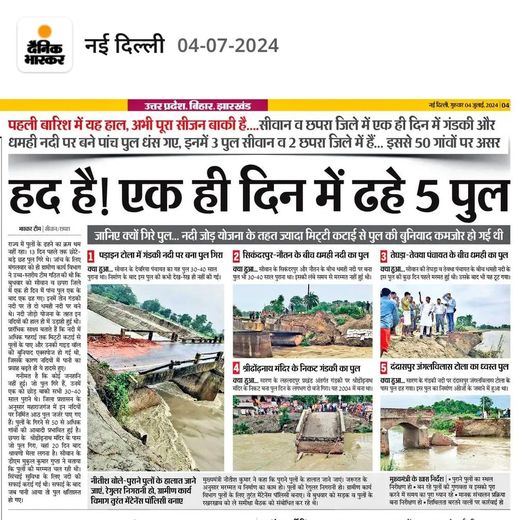
Another bridge collapses in Saran, 10th such incident in over 15 days The latest incident was reported from Saran which witnessed two more bridge collapses in the last 24 hours, District Magistrate Aman Samir said. No casualty was reported after the structure, built 15 years ago by local authorities, collapsed this morning (July 4), he said. https://www.thehindu.com/news/national/bihar/another-bridge-collapses-in-bihar-10th-such-incident-in-over-15-days/article68365925.ece/amp/ (4 July 2024)
YAMUNA Delhi A year after historic floods, where is River Governance? Despite multiple NGT orders, the DDA so far has neither mapped nor demarcated the Yamuna floodplain. Moreover, DDA has been proposing changes in the O Zone status to regularize unauthorized colonies in the floodplain. Even after High Court order the DDA has not removed construction waste dotting riverscape in Delhi.
In Feb. 2024, the Parliamentary Committee report has recommended the DDA and concerned agencies to prepare guidelines and rules regarding dumping of construction and other waste in the Yamuna. It has also asked to establish common portal to furnish and update data on sand mining, floodplain/wetland encroachment and dumping of waste into the river. However there has been no progress in this regard. https://sandrp.in/2024/07/04/yamuna-manthan-040724-a-year-after-historic-floods-where-is-river-governance/ (04 July 2024)
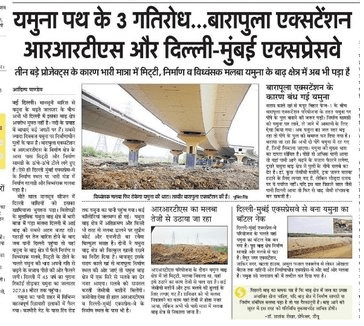
मानसूनी बारिश से यमुना के बढ़ते जलस्तर के बीच अभी भी दिल्ली में इसका बाढ़ क्षेत्र अवरोध मुक्त नहीं है। नदी के प्रवाह में बाधाएं कई जगहों पर हैं। सबसे ज्यादा दिक्कत यमुना पर निर्माणाधीन पुलों के पास है। बारापुला एक्सटेंशन व आरआरटीएस के निर्माण क्षेत्र के आस पास मिट्टी और निर्माण सामग्री के ऊंचे-ऊंचे टीले लगे हुए हैं। ऐसे ही दिल्ली मुंबई एक्सप्रेस-वे के निर्माण स्थल पर भारी मात्रा में निर्माण सामग्री और विध्वंसक मलबा पड़ा है। https://www.amarujala.com/delhi-ncr/three-deadlocks-of-yamuna-path-in-delhi-barapullah-extension-rrts-and-delhi-mumbai-expressway-2024-07-07 (07 July 2024)
No desilting done in recent years In response to an RTI query, Delhi govt responded that the Yamuna has not been dredged in recent years. However, the state govt’s reply claimed that ‘maintenance work’ was carried out on specific sections of the river. This report does not clarify when was the last dredging done, if at all and what does maintenance of river mean.
IFC defended itself by saying that it does not carry out any desilting, but undertakes other measures to ensure proper flow of the river. A departmental official said, “Dredging and desilting is a scientific process and takes place after studying and analysing the course of the river. Aggregation and degradation keep on happening in a river. What we did instead was pilot cutting at five locations – downstream of Wazirabad, at Vasudev Ghat, upstream of the Old Railway Bridge and at Geeta Colony bridge and ITO. In pilot cutting, mounds and islands in the river hindering the stream or channel are removed. This increases the carrying capacity of the river.” https://timesofindia.indiatimes.com/city/delhi/no-yamuna-desilting-done-in-recent-years/articleshowprint/111501195.cms (05 July 2024)
No good news for river River activist Bhim Singh Rawat, associate coordinator of the South Asia Network on Dams, Rivers, and People, said, “An analysis of the water quality status of the Yamuna compared with last year shows that the river has become a monsoonal, rain-fed river. When the upper catchment of the river receives rain and gets flow, the water quality shows improvement. When there is no rain, the Yamuna remains heavily polluted. There is no control, treatment or pollution abatement in the river.”
Another activist, Diwan Singh, said, “The levels of pollutants increase after the Yamuna enters Delhi. The river has also been absolutely deprived of its freshwater flow, worsening its condition. It continues to be a sewage canal.” He added that the river seemed to have no rights since the city was prioritised rather than the river at every step. https://timesofindia.indiatimes.com/city/delhi/yamuna-river-pollution-report/articleshow/111524494.cms (06 July 2024)
No data on river pollution No data on Yamuna water quality has been available since February, raising concerns about river pollution levels and impact on aquatic life. The report quotes BS Rawat of SANDRP saying that absence of data means it is not possible to tell if the state of Yamuna has worsened or improved. https://www.hindustantimes.com/cities/delhi-news/how-polluted-is-the-yamuna-no-data-to-tell-101720119488142.html (05 July 2024)
Pollution worsens 42 times Experts said the latest report confirms what environmentalists had been suspecting, adding Delhi the water quality does not improve as sewage continues to flow into the river. “Until we stop sewage from flowing into the Yamuna, the water quality will not improve, but simply fluctuate, depending on the flow of the river. If there is more water in the river, as it does during the monsoon, parameters will improve again, but that is only a temporary improvement,” said Diwan Singh, an activist who took up the cause of Yamuna protection in 2007.
“The Yamuna has turned into a drain that is now solely dependent on water flow. Any improvement recorded is solely down to an increased flow of water and not because of the action by the government,” said Bhim Singh Rawat of SANDRP. https://www.hindustantimes.com/cities/delhi-news/pollution-in-yamuna-worsens-42-times-when-crossing-delhi-101720205966012.html (6 July 2024)
Submerged basements at Games Village This Aug 05, 2023 ToI report reveals CWG Village built on Yamuna floodplain in 2010 suffered severe water logging problems during monsoon last year. There is information of basement of the building getting water logged in last week of June 2024 following heavy rainfall spell.
The apartments may be owned, among others, by DDA, Central Public Works Department, external affairs ministry and public-sector undertakings, but nothing has been done to stop the soaking. The residents claim that the inundation seemed to have been triggered by DDA constructing a lake on the eastern bank of Yamuna and later, a cycling track and road in the river water catchment area.
A bemused Mathur asked, “Why invest crores of rupees to build on the floodplain, knowing there will be excessive water there? Did the authorities conduct studies on what would happen if a waterbody were developed on the floodplain?”
The maintenance staff said the power bill this month has shot up due to the continuous operation of the pumps, without which water accumulates inexorably. “The water level rises at an alarming rate of 8 inches every day,” said one worker.
The complex does not have a residents’ welfare association, but according to the nodal officer, Amarnath, a retired judge, resolving the problem will need professional expertise and expensive repair and renovation work, which is “beyond the scope of my powers”. https://timesofindia.indiatimes.com/city/delhi/submerged-basements-give-that-sinking-feeling-at-games-village/articleshowprint/102440755.cms (05 July 2024)
Greater Noida UPPCB wants STPs along Hindon, Yamuna The state pollution board has written to the Greater Noida Authority to build STPs along the Dasna and Hawaliya drains, which empty untreated water into the Hindon and Yamuna. While the Dasna drain flows from Ghaziabad and Hapur before emptying into the Hindon in Greater Noida, the Hawaliya drain comes from the Surajpur wetland.
UPPCB regional officer (Greater Noida) DK Gupta said the Greater Noida Authority has agreed to install a 100 MLD STP along the Hawaliya drain near Momnathal village where the drain meets the Hindon. “Another 45 MLD STP will also be installed on the Bisrakh drain, which also empties untreated wastewater into the river. Tenders have been called for both the plants,” he said. The official added the board has also written to the Ghaziabad and Hapur administrations as nearly 80% of the 200 MLD of water that Dasna drain empties into the Hindon every day comes from the two districts. The STP on the drain will be built jointly by the Greater Noida Authority, Ghaziabad and Hapur administrations, he said. It is likely to come up near Gaur City in Greater Noida West where the drain joins the river. https://timesofindia.indiatimes.com/city/noida/drains-polluting-hindon-yamuna-state-board-wants-stps-along-them/articleshow/111545379.cms (07 July 2024)
RIVERS BIODIVERSITY
Assam Brahmaputra’s lone female gharial’s long wait for a mate could end soon Wildlife officials and specialists are not sure how this gharial came to inhabit a stretch of the Brahmaputra river within the Kaziranga National Park and Tiger Reserve. But they are certain that the reptile, presumed almost an adult by its size, is the key to repopulating the river with gharials. Distinguished from other crocodilians by its elongated snout, the gharial (Gavialis gangeticus) is believed to have been wiped out from the Brahmaputra River system in the 1950s, although there were claims of sightings in the 1990s.
The female gharial was first spotted in 2021 within the Biswanath Wildlife Division of the 1,307.49 sq. km. Kaziranga. Water bodies, primarily a 107-km stretch of the Brahmaputra, comprise more than 80% of this division measuring 401 sq. km. The same female gharial, now 2.55 metres in length, was recorded twice basking 500 metres apart in one of the three priority habits chosen during a 10-day survey of aquatic reptiles along the Brahmaputra in January. https://www.thehindu.com/sci-tech/energy-and-environment/wanted-mate-for-the-brahmaputras-lone-gharial/article68362767.ece (05 July 2024)
North East 2 venomous snake species found in Arunachal & Nagaland A team of researchers has found two species of venomous snakes from Arunachal Pradesh and Nagaland. The snakes, which have been reported for the first time from India, were Suzhen’s krait (Bungarus suzhenae) and the Zayuan pit viper (Ovophis zayuensis). While the Suzhen’s krait was found from the Jessami-Meluri road on the Nagaland and Manipur border, the Zayuan pit viper was found from the Dri River bank near Etabe village in Dibang Valley district. https://arunachaltimes.in/index.php/2024/06/30/2-venomous-snake-species-found-in-arunachal-and-nagaland/ (30 June 2024)
FISH, FISHERIES, FISHERFOLKS
Delhi यमुना में लाखों मछलियों की मौत -यमुना में ऑक्सीजन का स्तर घटने से बीते कुछ दिनों में लाखों की तादाद में मछलियां मर गई हैं। अन्य जलीय जीवों की जान भी खतरे में है। यमुना किनारे रहने वाले किसान और मछुआरे बताते हैं कि यमुना में केमिकल युक्त पानी छोड़े जाने से मछलियां मर रही हैं, जबकि जीव वैज्ञानिकों का मानना है कि गर्मी के दिनों में पानी में ऑक्सीजन का स्तर बेहद कम हो जाने के कारण अक्सर ऐसा होता है।
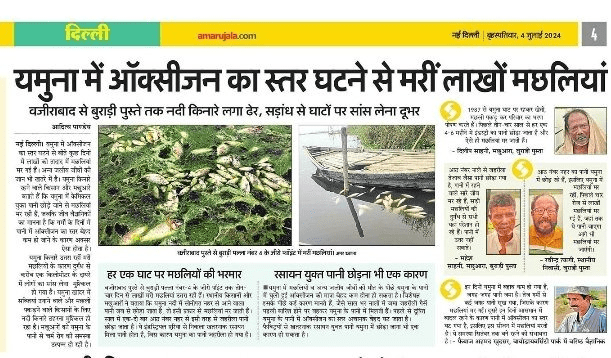
यमुना किनारे उतरा रहीं मरी मछलियों के कारण दुर्गंध से करीब एक किलोमीटर के दायरे में लोगों का सांस लेना मुश्किल हो गया है। वजीराबाद पुस्ते से बुराड़ी पल्ला नंबर-4 के जीरो पॉइंट तक तीन-चार दिन से लाखों मरी मछलियां उतरा रही हैं। स्थानीय किसानों और मछुआरों ने बताया कि यमुना नदी में सोनीपत नहर से आने वाला पानी जब से छोड़ा जाता है, तो इसी प्रकार से मछलियां मर जाती हैं। साल में एक-दो बार आठ नंबर नहर से इसी तरह से जहरीला पानी छोड़ा जाता है। ये इंडस्ट्रियल एरिया से निकला खतरनाक रसायन मिला पानी होता है, जिस कारण यमुना का पानी जहरीला हो गया है। https://www.amarujala.com/delhi-ncr/lakhs-of-fish-died-due-to-decreasing-oxygen-level-in-yamuna-2024-07-04 (04 July 2024)
Jammu & Kashmir Mass fish death in Srinagar stream Thousands of fish have been found dead in a local stream Tsoont Koel near Barbar Shah area of Srinagar with officials citing lack of oxygen and pollution as the reason. An official told news agency—Kashmir News Observer (KNO) that the primary cause is the depletion of oxygen in the water bodies. “This is a common occurrence during the summer months,” an official from the fisheries department said.
Meanwhile, local residents have expressed anguish over the incident and stated that it will impact the livelihood of those dependent on fishing. “This is not just about the death of fish, it’s about the entire ecological balance and our means of sustenance being threatened,” said a local resident. https://www.greaterkashmir.com/kashmir/thousands-of-fish-found-dead-in-srinagar-stream-officials-cite-lack-of-oxygen-pollution/ (07 July 2024)
SAND MINING
Karnataka Forum seeks Kudru protection, action on Mines dept for misleading admin Representatives of Samana Manaska Sanghatanegala Janti Vedike on Friday, July 5, urged Dakshina Kannada district in-charge Minister Dinesh Gundu Rao to save the Pavoor-Uliya Kudru in Netravati River from the onslaught of illegal sand extraction. In a representation to the Minister, the Vedike also demanded stringent action against personnel from the Mines and Geology department for allegedly joining hands with the sand mafia and misleading the district administration by stating that no sand extraction was taking place around the Kudru.
Despite clear evidence for continued illegal sand extraction around the Kudru that threatened the existence of 55 resident families, the department claimed that there was no sand extraction. While the Kudru had sunken in size following unabated sand extraction, the department claimed that the Kudru had expanded, from about 39 acres to about 95 acres, the Vedike told the Minister. The department personnel used boats of the sand mafia, to conduct their inspection, the Vedike alleged. https://www.thehindu.com/news/cities/Mangalore/forum-seeks-kudru-protection-action-on-mines-department-for-misleading-administration/article68370824.ece (05 July 2024)
Elected representatives have called for a complete ban on sand extraction near Pavoor-Uliya, a small island located about 12km from Mangaluru and home to 52 families. At the Karnataka Development Programme (KDP meeting chaired by District Minister Dinesh Gundu Rao on Jul 5, MLC Ivan D’Souza highlighted the issue of unauthorized sand extraction, which has left island residents in fear and uncertainty. https://newskarnataka.com/karnataka/mangaluru/demand-for-total-ban-on-sand-extraction-near-pavoor-uliya-island/06072024/ (06 July 2024)
Following a report on June 19, the deputy commissioner (DC) has established a committee to investigate the illegal sand mining activities at Pavoor Uliya.The committee, tasked with probing the sand mining and associated mafia at Pavoor Uliya, will be led by assistant commissioner Harshvardhan S J and will include Prof Raj Mohan and Prof Swathi from NITK Surathkal, ACP Mangaluru South Dhanya Nayak, Joint director of the forest, environment, and ecology department Sushmitha, and Sheikh Dawood. The DC has directed the committee to submit their report within a week.
This initiative by the DC is a direct response to report on the illegal sand mining operations. On June 19, a team from Daijiworld visited Pavoor Uliya for a reality check and discovered several boats engaged in the illegal sand mining that is endangering the island’s natural beauty.
The public outcry on social media underscores the demand for a thorough investigation and transparency from the authorities regarding the situation in Pavoor Uliya. Activists and the public continue to press for decisive action to address and resolve the illegal sand mining issue. On July 5, concerned organizations appealed to district in-charge minister Dinesh Gundu Rao to put an end to the illegal sand mining at Pavoor Uliya. https://daijiworld.com/news/newsDisplay?newsID=1205222 (05 July 2024)
In 2014, the then deputy commissioner (DC) of Dakshina Kannada, A B Ibrahim, had banned all types of sand mining within a one-kilometre radius of the island in response to continuous complaints, issuing an order to that effect on November 28, 2014. However, in recent years, illegal sand mining has resumed in the area, allegedly with the tacit support of local police. Those who filed complaints have reported that their details were leaked to the perpetrators by the police. https://www.daijiworld.com/news/newsDisplay?newsID=1205137 (05 July 2024)
Pavoor Uliya island on the outskirts of Mangaluru is slowly “disappearing” because of rampant illegal sand mining. Around 50 families are now living in fear there. Under the slogan, “Save island, protect people’s life”, members of Catholic Sabha of Mangaluru and a delegation from like-minded organisations visited the island on Monday (June 24). Fr Manohar D’souza, parish priest of Infant Jesus Church, said, “Those involved in illegal sand mining must be booked for murder. Our pleas to the district administration and departments concerned did not receive any positive response.” https://www.newindianexpress.com/states/karnataka/2024/Jun/25/mangalurus-pavoor-uliya-island-disappearing-slowly (25 June 2024)
Tamil Nadu 3 men gang controls sand mining: ED As per the Enforcement Directorate’s investigation into the alleged Rs 4,730 crore river sand mining scam across 28 sites in Tamil Nadu, just three people allegedly controlled the entire sand mining business in the state. Government tender conditions were manipulated to ensure that only those entities linked to these three pocketed all the contracts, the ED said.
A Japanese sand excavator manufacturer has also told ED that all the 273 excavators sold by the company in Tamil Nadu since 2011 were bought by entities that come under a business group owned by one of these contractors. The details are part of the dossier sent on June 14 by the central agency to the Tamil Nadu Director General of Police under Section 66(2) of the Prevention of Money Laundering Act (PMLA) of 2002, sources said. The agency alleged that state government officials colluded with these contractors to illegally mine sand over and above the quantum allowed under the contract with the government. https://www.newindianexpress.com/states/tamil-nadu/2024/Jun/28/three-men-gang-controls-tn-sand-mines-enforcement-directorate (28 June 2024)
While the sand quarries on the riverbed of the Cauvery and the Kollidam rivers remain closed, illegal sand mining continues in a few areas in Karur, activists have alleged. The Water Resources Department operated sand quarries at Nanniyur and Mallampalayam. However, after Enforcement Directorate officials carried out simultaneous searches at various sand quarries in September 2023, the quarries at Vangal and Mallampalayam in Karur district closed down. No legal mining has taken place at the quarries since then. But, it has been alleged that illegal sand mining is taking place at various points from the Cauvery river. Though there is no activity during daytime, the habitual sand miners indulge in smuggling of sand between 11 p.m. and 5 a.m. https://www.thehindu.com/news/cities/Tiruchirapalli/illegal-sand-mining-continues-in-cauvery-river-in-parts-of-karur-district-allege-activists/article68332302.ece (25 June 2024)
Andhra Pradesh Free sand supply policy to come into force The free sand policy will come into force across the State from Monday (July 08). Officials of various departments have made all arrangements for free supply of sand. Sand will be supplied from the stock points located at Rudramkota, Dacharam, Vinjaram, Ibrahimpatnam and Chebrolu in Eluru district, the Joint Collector said. “The free sand policy will be implemented as per the guidelines of the State government. One person will be given 20 tonnes of sand per day. Only seigniorage and GST would be collected from the consumers,” said the officials. Sand will be supplied from 6 a.m. to 6 p.m, and Tahsildars will act as special officers to monitor the supply. Boards with the prices and stock availability should be displayed at the stock points, officials said. In some districts, public representatives will launch the scheme, along with the officials. https://www.thehindu.com/news/national/andhra-pradesh/free-sand-supply-policy-to-come-into-force-in-andhra-pradesh-from-today/article68379119.ece (07 July 2024)
Uttarakhand Govt outsources policing and royalty collection to private players Ignoring the conflict of interest, the BJP government has encouraged tax-collecting private companies to also mine the rivers in the ecologically-fragile Himalayan state. All done in the name of preventing disasters. https://www.reporters-collective.in/trc/uttarakhand-violates-sc-orders-on-river-mining (02 July 2024)
A 15 year old drowned in a river near Hardwar, locals say it is due to indiscriminate sand mining. https://timesofindia.indiatimes.com/india/teen-drowns-in-river-locals-blame-illegal-mining/articleshow/111528206.cms (06 July 2024)
Bihar बालू खदान के पानी भरे गड्ढे में डूबने से सात वर्षीय मासूम की मौत थाना क्षेत्र के सिमराही नगर पंचायत अंतर्गत वार्ड नंबर 10 स्थित एक अवैध बालू खदान में शनिवार (June 29) को सात वर्षीय बच्चे की डूबने से मौत हो गयी. जिसके बाद अन्य बच्चों द्वारा घटना की सूचना दिए जाने के बाद परिजनों ने स्थानीय लोगों की मदद से उक्त खदान में बच्चे को खोजने में करीब आधे घंटे तक मशक्कत किया, जिसके बाद बच्चे का शव बरामद हुआ. मृतक की पहचान स्थानीय अभिनंदन सादा के सात वर्षीय पुत्र शंभु कुमार के रूप में की गयी. -स्थानीय लोगों ने बताया कि मृतक शंभु के पिता बाहर रहकर मजदूरी करता है. मृतक की मां घर के आसपास ही खेत में काम करने के लिए गयी थी. इसी क्रम में बच्चा बगल स्थित बालू खदान के पास खेलने के लिए चला गया. जहां उसका पैर फिसलने के कारण वो गहरे पानी में चला गया, जिसके कारण उसकी मौत हो गयी. https://www.prabhatkhabar.com/state/bihar/supaul/child-dies-due-to-drowning-in-water-filled-pit-3 (29 June 2024)

Illustration in Dainik Bhaskar 2 July 2024 linking increasing bridge collapse incidents with illegal sand mining which is true to some extent.
Jharkhand अवैध बालू खनन रोकने के लिए सड़क पर ग्रामीण -झारखंड के कई जिलों में बालू माफियाओं का गिरोह एक्टिव है। एनजीटी से लगी रोक के बावजूद कई इलाकों में खनन जारी है। खूंटी के कारो नदी इलाके में कई ऐसे अवैध बालू घाट हैं, जहां से देर रात बालू का उठाव हो रहा है। खूंटी में जरियागढ़ इलाके में अवैध बालू खनन का कारोबार चल रहा है। देर रात जब अवैध बालू खनन के लिए हाइवा पहुंचे ,तो ग्रामीण रास्ते में सो गए। पिछले कई दिनों से ग्रामीण इसका विरोध कर रहे हैं। ग्रामीणों ने आज खूंटी डीसी लोकश मिश्रा से मिलकर मदद की गुहार लगाई है। ग्रामीणों ने बताया कि दो बार हाइवा पकड़ा गया। 23 जून को 16 हाइवा अवैध खनन करते ग्रामीणों ने पकड़ा। 27 जून को दस हाइवा पकड़ा लेकिन पुलिस प्रशासन ने ग्रामीणों पर दबाव बनाकर हाइवा छोड़ दिया।
-ग्रामीणों ने दिए गये पत्र में बालू माफिया का नाम लिखा है। ग्रामाीणों ने इसमें हस्ताक्षर भी किए हैं। ग्रामीण इसका विरोध कर रहे हैं लेकिन बालू माफिया ग्रामीणों को धमका रहे हैं। ग्रामीणों का आरोप है कि पुलिस प्रशासन की मदद से इन इलाकों मे अवैध खनन हो रहा है। इस अवैध खनन के माध्यम से हर गाड़ी से बालू माफिया एक हजार रूपए की वसूली करते हैं। एक दिन में कई हाइवा दो से तीन ट्रिप बालू निकाल रहे हैं। 150 से अधिक हाइवा कारो नदी के कई घाटों में अवैध खनन कर रही है। बालू माफिया इन गाड़ियों से एक दिन में 3 लाख से अधिक की वसूली कर रहे हैं। बालू की बिक्री से माफिया अलग कमाई कर रहे हैं। ग्रामीणों का आरोप है कि एक दिन में करोड़ों की कमाई होती है। https://www.bhaskar.com/amp/local/jharkhand/news/villagers-on-the-road-to-stop-illegal-sand-mining-133245439.html (29 June 2024)
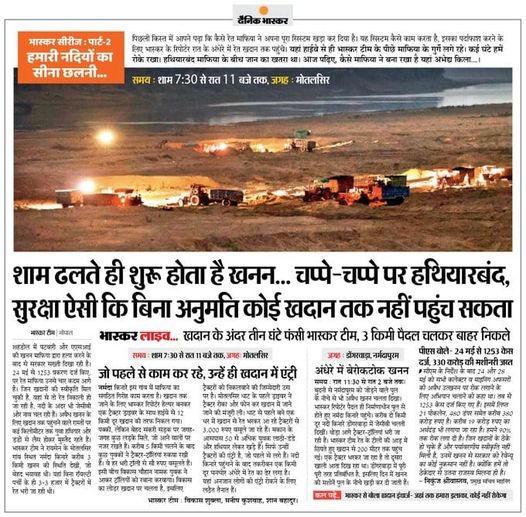
Madhya Pradesh Sand Mining Policy prohibits mechanized mining in Narmada river, however this ground report by Dainik Bhaskar reveals mechanized mining taking place in Narmada river at Motilsir under Raisen district and Dongarwara in Narmadapuram district even during night hours. (Dainik Bhaskar, 30 June 2024)
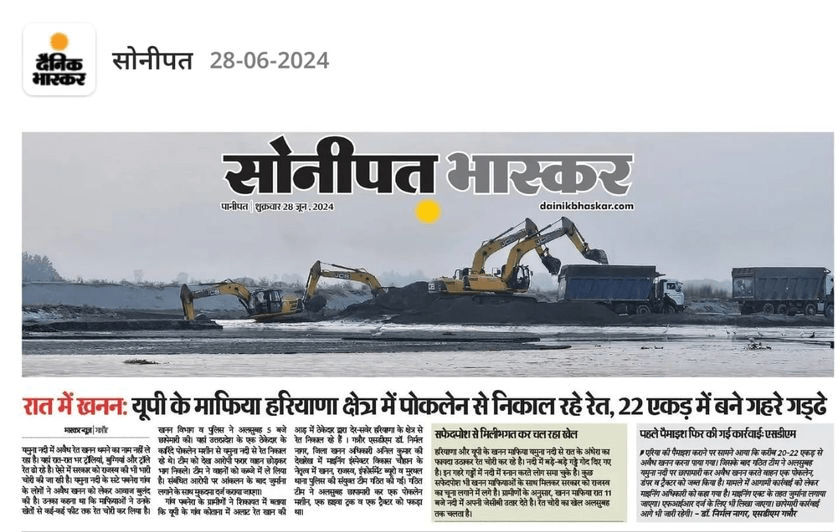
Haryana Farmers worried over flood threat due to illegal mining Farmers living in areas along the Yamuna are worried over the possibility of flood due to extensive mining activities there. They allege that despite repeated complaints, mining continues unabated along the river, posing risks to their crops, homes and livelihoods as in previous years.
With the monsoon approaching, farmers in Chandrao, Chaugama, Garhpur, Kalsora, Japti Chapra, Samaspur and surrounding villages are worried that the ongoing mining along the river may weaken the embankment, aggravating the risk of floods in their villages. The farmers alleged that last year during monsoon major breaches at some areas had submerged crops and residential areas, causing huge losses to them. One of the farmers alleged that mining vehicles commute rashly, damaging roads and causing accidents and the authorities should take steps to curb the problem. “Large-scale mining along the Yamuna should be stopped to save our villages from flooding,” he said.
Another farmer said illegal mining, over 10-foot deep along the river, is making the area prone to floods. When the river’s water level exceeds the danger mark, it will lead to a flood-like situation in the nearby villages,” he added. Mining officer Kamlesh Rani said their team inspected the site and found the excavated sand, which was confiscated. “The investigation is going on to determine the persons involved. Since the sand was dumped on the panchayat land, we will issue a notice to the sarpanch and determine who was involved,” she added. https://www.tribuneindia.com/news/haryana/farmers-worried-over-flood-threat-due-to-illegal-mining-along-yamuna-636802 (05 July 2024)
Miners from Uttar Pradesh side carrying out illegal mechanized sand mining creating deep pits in farmlands belonging to Pabnera village of Sonipat Haryana along Yamuna floodplain. (Dainik Bhaskar 28 June 2024)
WETLANDS, LAKES, WATER BODIES
Madhya Pradesh कार्यपालिका के सामने लाचार–असहाय न्यायपालिका किशोर सागर तालाब को कब्ज़ा मुक्त करने के मामले में एनजीटी के आदेश का पालन कराने में 31 माह में 40 पेशी – नतीजा शून्य. 1 नवम्बर 2021 को पहली सुनवाई थी। अंतिम सुनवाई 20 मई को। अब नियत दिनांक 10 जुलाई 2024
तारीख पर तारीख में छतरपुर प्रशासन के मुखिया कलेक्टर संदीप जी आर को व्यक्तिगत पत्र लिख अदालत नें प्रतिवेदन माँगा। कलेक्टर नें जवाब देना उचित नहीं समझा। अदालत में अवमानना का आवेदन दिया पर अदालत नें कार्यवाही नहीं की।
कुल मिलाकर किशोर सागर तालाब को एनजीटी के आदेश पर कब्ज़ामुक्त करने के मामले में मूल आदेश झूठ और कोर्ट अवमानना में झूल रहा है। पिछले 31 माह में 40 पेशी हो चुकी। सुनवाई दौरान कई बार अदालत की अवमानना हुईं पर अदालत अपनी अवमानना मानने को तैयार नहीं है। देश के मुख्य न्यायधीश, रजिस्ट्रार,, मध्यप्रदेश के मुख्य न्यायधीश और रजिस्ट्रार व छतरपुर के सत्र न्यायधीश के पास पूरे मामले को भेजा जा रहा है कि किस तरह एनजीटी के एक आदेश को पालन कराने के लिये अदालत में न्याय भटक कर कार्यपालिका के सामने असहाय हो जाता है। https://indiaclimatechange.com/2024/07/कार्यपालिका-के-सामने-लाच/ (05 July 2024)
GROUNDWATER
Study North India lost nearly 450 cubic km of GW in 2 decades This is about 37 times the quantity of water the Indira Sagar dam — India’s largest reservoir — can hold at full capacity, lead author Vimal Mishra, Vikram Sarabhai Chair Professor of Civil Engineering and Earth Sciences at IIT Gandhinagar, said. The team, comprising researchers from the National Geophysical Research Institute (NGRI) in Hyderabad, said lesser rainfall during the monsoons and warming of winters will increase irrigation water demand and reduce groundwater recharge, further stressing the already depleting groundwater resource in north India. https://www.business-standard.com/india-news/north-india-lost-nearly-450-cubic-km-of-groundwater-in-2-decades-study-124070700117_1.html (07 July 2024)
How can we better track groundwater recharging? Researchers in Darwin recently undertook the largest analysis to date of long-term rainfall recharge across Australia. They used 98,000 estimates of recharge rates, using data from bores and machine learning algorithms. The result was surprising. They estimated the average recharge rate for the Australian continent was just 44 millimetres per year. But it differs a great deal depending on where you are. In humid, wet climates such as across the Top End, the water table rose by 203mm a year. But in arid climates, it was just 6mm. For comparison, the typical annual rainfall in Sydney and Brisbane is just over 1,000mm per year.
This study poses a challenge to our understanding of groundwater recharge. The estimates in this study are substantially lower than studies relying on contemporary water balance models, which report more than double the amount of recharge for Australia. One issue is the Darwin research was not able to show where the groundwater came from or how old the water is. You might think groundwater recharges quickly, but a quick recharge means it takes years. A slow recharge can take thousands of years.
This gap is a concern. Our water authorities need the most accurate data possible on annual recharge rates – and the age of the water. Our network of hydrological loggers are now gathering underground data in sites such as the gold mine in Stawell, in Victoria, and South Australia’s Naaracoorte Caves, famous for fossils, as well as mines and tunnels in New South Wales, Queensland and Tasmania.
Natural caves and groundwater are often fairly shallow. We wanted to get deeper data, which is why we chose mines. Our deep sites are over 100 metres underground. Our sensors can detect each groundwater recharge event by doing something very simple: counting drips from the ceiling, and comparing them to what’s happening on the surface, so we can see where and when groundwater recharges. https://theconversation.com/how-quickly-does-groundwater-recharge-the-answer-is-found-deep-underground-230943 (25 June 2024)
Haryana Village struggling with polluted groundwater Kharkhara, a village in Rewari district, is grappling with severe water pollution issues. A village pond, a receptacle for household sewage, has become a significant concern. The contamination in the pond is degrading the quality of the groundwater, causing hand pumps and borewells to produce foul-smelling water. The problem is not new. Prakash Yadav, a village resident, filed a petition with NGT in June 2023, highlighting the issue and the tribunal constituted a committee to investigate the matter. Greywater generated from households ends up causing waterlogging in absence of proper drains in villages.
The entire village has been affected, said Sushila, village Sarpanch (head). “We have faced this issue before, but it is more serious now because the village population has increased, leading to higher water consumption and thus more wastewater being released,” she said. The village’s ponds are polluted due to wastewater inflow, affecting the quality of the groundwater, stated the petition filed by Yadav. The petition disclosed that all household sewage flows into the 5-acre village pond, contaminating the groundwater, as the hand pumps and bore wells produce dirty water. The stagnant, dirty water in the pond stinks and causes diseases due to mosquitoes and flies. https://www.downtoearth.org.in/water/greywater-issues-plague-this-haryana-village-struggling-with-polluted-groundwater-treatment-woes (28 May 2024)
URBAN LAKES, WETLANDS
Chennai Residents fighting against city corp for Pallikaranai wetland The residents in capital city are up against the Chennai Corporation over conservation of the Palikkaranai marshland. The residents have claimed that the Chennai Corporation is set to build a public park that would disturb the entire ecosystem in the region.
They also said that the marshland serves as a shield during the monsoons that can secure the entire area from heavy flooding and subsequent disaster. The residents said the region has suffered a lot from the encroachments by both private and public use. Reacting to these claims, the Chennai Corporation stated that they have no such plans to put the citizens’ lives at risk. The civic body added that they have taken recommendations from various environmentalists and are fully dedicated to conserving the marshland in the region. https://www.timesnownews.com/chennai/why-chennai-residents-are-fighting-against-city-corporation-for-pallikaranai-wetland-a-ramsar-site-tamil-nadu-article-111404988 (01 July 2024)
Bengaluru Mixed responses from Kere Mitras V Ram Prasad, co-founder of Friends of Lakes and a former Kere Mitra, says that the selection process needed more deliberation. “There was no training of the volunteers and some of them do not have proper knowledge about lake preservation. It seems like Kere Mitra is yet another complaints forum, and some of the complaints are not even being resolved on time.” He points out that there are already thriving citizen-led lake groups, some of which have been monitoring lakes for years now. “Why not connect with them to monitor the lakes? They are knowledgeable and committed.”
The other issue is that one volunteer per lake may not be adequate. Depending on the size of the lake, more volunteers would be required. The BBMP chief engineer says that an online meeting was held with all the volunteers to discuss how to go about lake monitoring. But the question remains: How effective are online meetings, apps and WhatsApp in fostering an in-depth understanding of lake ecology?
There are several nuances to lake management. “To protect the lake from sewage ingress, the kere mitras need to understand the catchment too,” says Ram Prasad. They need to look into biodiversity aspects inside the lake and around it, and livelihoods dependent on lakes should also be protected. “Kere mitras should concentrate on core lake assets and water quality than just walking around the path and focusing on cosmetic peripheral aspects only,” he adds. https://citizenmatters.in/bbmps-kere-mitra-initiative-bridges-the-gap-or-misses-the-point/ (08 July 2024)
Revival works at Bellandur, Varthur lakes falter Bellandur and Varthur lakes continue to suffer neglect and inefficiency with incomplete dredging and unchecked sewage inflow being major concerns. Agencies involved in their revival, though, are busy pointing fingers and shifting the blame. Directives from the NGT to form a lake development monitoring committee have been ignored, exacerbating the issues faced by critical waterbodies. Lack of funds and poor coordination between BDA and BBMP are the other issues stymieing rejuvenation efforts. “Desilting operations at Bellandur Lake, spread over 900 acres, are only 60% complete. About 12 lakh cubic metres of silt is yet to be removed and this is severely impacting the lake’s ecosystem,” said a senior lake activist. https://timesofindia.indiatimes.com/city/bengaluru/revival-works-at-bellandur-and-varthur-lakes-facing-challenges/articleshowprint/111498629.cms (05 July 2024)
CSR-funded lakes turn toxic Residents of E Bengaluru are expressing concerns about the deteriorating state of water bodies in villages outside BBMP limits. They point out that the water bodies recently rejuvenated through CSR initiatives are in the worst condition. Mullur Lake in Kodathi village near Sarjapur Main Road serves as a prime example. Local lake activists report that the lake, developed a year ago by an NGO in collaboration with a private firm, has already deteriorated into a large septic tank, with sewage and industrial effluents flowing in unchecked. https://bangaloremirror.indiatimes.com/bangalore/civic/csr-funded-lakes-in-east-bengaluru-turn-toxic-due-to-sewage-and-industrial-effluents/articleshow/111522739.cms (6 Jul 2024)
Madiwala lake transferred to BBMP The Bruhat Bengaluru Mahanagara Palike (BBMP) Lakes Department has floated a tender inviting bidder for the comprehensive development Madiwala Lake that is known for hitting the headlines for wrong reasons. The water body was under the Karnataka State Forest Department and it was transferred to the BBMP Lakes Department in 2020. However, it was restored with the Karnataka State Forest Department after a year and then again transferred to the BBMP Lakes Department last year.
Now, the BBMP Lakes Department has floated a tender inviting a bidder (for the second time) as there was no response to its earlier tender notification. The BBMP Lakes Department has decided to take up developmental works at an estimated cost of Rs 15 crore.
However, residents of areas nearby and lake wardens are not happy with the water body being transferred again to the BBMP Lakes Department in November 2023. The volunteer community, through the lake wardens, used to work in coordination with the Karnataka Forest State Forest Department. They used to get revenue of Rs 1.20 crore to Rs 1.50 crore per year through boating, parking and entry fee from the visitors. The money was used for the upkeep of the lake. https://bangaloremirror.indiatimes.com/bangalore/cover-story/madiwala-lake-development-tender/articleshow/111498704.cms (05 July 2024)
URBAN WATER
Ahmedabad AMC to buy tertiary treated water, sell it to industry at a loss In the standing committee meeting on Jan 18, the civic body approved projects worth Rs 951 crore, including a new 240 MLD sewage treatment plant costing Rs 335 crore, a new 160 MLD tertiary treatment plant costing Rs 509 crore and a treated sewage storage tank costing Rs 107 crore, all to be developed on public-private partnership basis. The authority to sign MoUs with various associations was delegated to the commissioner.
Now, the proposal to be put to the standing committee on July 4 involves the AMC buying tertiary treated water from the contractor who will build the plant. AMC will have to supply 160 MLD of sewage to the treatment plant every day. If AMC fails to supply the sewage, it will have to pay the contractor for operation and maintenance.
The contractor will treat the sewage water and AMC will buy 95% of the treated water at Rs 40 per kl. It will then sell this to industries at Rs 30 per kl. Regardless of whether industries buy the water, the AMC will have to pay the contractor. https://timesofindia.indiatimes.com/city/ahmedabad/amc-to-buy-tertiary-treated-water-sell-it-to-industry-at-a-loss/articleshowprint/111472236.cms (04 July 2024)
The AMC will set up two STPs at a cost of Rs 829 crore. Of these, one will treat sewerage water from the eastern part of the city and other will be a tertiary plant to treat water from factories in Narol- Dani Limda areas. The water from the treatment plant of Narol will be supplied to factories for reuse at Rs 30 per litre. This will help save water as the factories will not need to take water from bore wells. The existing 106 MLD plant at Pirana is old and has become inefficient. The AMC will set up a new 240 MLD plant for the purpose. The estimated cost of the tertiary plant is Rs 107 crore. The Gujarat water supply and sewerage board will contribute 50 per cent of the cost. https://www.ahmedabadmirror.com/abad-to-get-two-new-stp-plants/81870632.html#goog_rewarded (4 Jul 2024)
Bengaluru Residents in outskirts struggle with acute shortage The monsoon rains have provided a measure of relief to Bengaluru’s severe water shortage but in some areas, there is no respite in sight. In February this year, TNM had reported on Ramagondanahalli, where borewells were being dug rampantly to supply water to the rest of the city. This urban village, situated close to Whitefield, has not received regular water supply for the last year.
Most recently, the area went without water for about a month, only receiving water after daily complaints to the Bruhat Bengaluru Mahanagara Palike (BBMP). A kiosk maintained and operated by the Bengaluru Water Supply and Sewerage Board (BWSSB), which provides 20 litres of drinking water at Rs 5, has been “under repair” for over a month. During that time, the only source of water the residents could access was a water tanker that supplied free water to the area. https://www.thenewsminute.com/karnataka/no-water-for-a-month-residents-in-bengaluru-outskirts-struggle-with-acute-shortage (05 July 2024)
Delhi ED raids multiple cities over money laundering allegations The Enforcement Directorate on Jul 3 conducted searches in Delhi, Ahmedabad, Mumbai and Hyderabad in connection with alleged corruption in the award of Rs 1,943 crore worth of works for 10 sewage treatment plants of Delhi Jal Board (DJB) at Pappankalan, Nilothi, Najafgarh, Keshopur, Coronation Pillar, Narela, Rohini and Kondli.
The anti-money laundering agency is probing alleged cartelisation in the award of the tenders and suspected bribery to public servants, including ministers and bureaucrats. According to the case file, three joint venture companies participated in the four STP tenders mutually to ensure that each one got the tender.
During the search operations, the agency seized unaccounted cash of Rs 41 lakh, various incriminating documents and digital evidence. All the three JV companies that were awarded the contract by the DJB submitted the same experience certificate issued from a Taiwan Project. The DJB accepted them without any verifications, ED said. https://timesofindia.indiatimes.com/city/delhi/delhi-jal-board-corruption-case-ed-raids-multiple-cities-over-money-laundering-allegations/articleshowprint/111507112.cms (5 July 2024)
₹41L recovered during raids on DJB: ED It has also been alleged that the tendering conditions were made restrictive, including the adoption of Integrated fixed film activated sludge (IFAS) technology to ensure that a select few entities could participate in the 4 bids.
“The cost estimates initially prepared was ₹1,546 crore but was revised during the tender process to ₹1,943 crore. It is further alleged that the contracts were awarded to the three JVs at inflated rates which caused a substantive loss to the exchequer,” ED added. https://www.hindustantimes.com/cities/delhi-news/41l-recovered-during-raids-on-stp-projects-of-djb-ed-101720205724141.html (06 July 2024)
Heavy rainfall over the past week has led to a spike in ammonia levels of the Yamuna over the past three days, as evidenced by testing of raw water drawn from the river at Wazirabad, according to the DJB, which cited slush of industrial waste from upstream Haryana as the cause for the spike. https://www.hindustantimes.com/cities/delhi-news/yamuna-ammonia-level-spikes-as-water-flows-in-from-upstream-states-delhi-blames-haryana-101720372314370.html (07 July 2024)
WATER POLLUTION
Punjab NGT slaps Rs 1 cr fine on Amritsar dyeing unit In a detailed order in “Public Action Committee versus State of Punjab”, the four-judge Bench led by Chairperson Justice Prakash Shrivastava came down heavily on Amritsar-based manufacturer of chemical dyes. Referring to the conduct of the polluting industry and PSPCB, the judgment says: “The polluting industry has continuously violated environmental laws. PSPCB failed to take appropriate action against the respondent despite frequent, repeated and flagrant violations.”
Recommending criminal prosecution of the factory owners, the bench said, “The violation of environmental laws is also an offence. The regulatory authority must initiate criminal prosecution for past violations as well as continued violations by lodging criminal complaints.” The NGT also constituted a high-powered committee with CPCB shall be the nodal agency for coordination and compliance to visit the industrial site, and submit a report to Member Secretary, PSPCB; whereupon appropriate action for closure of the industry shall be taken by PSPCB. The closure shall continue till all violations are removed by the industrial house.
The Public Action Committee (PAC), an NGO for betterment of environment in Punjab, had taken up alleged violations of pollution said the polluting unit had been disposing of chemical waste in the open, and the local office of the PSPCB had warned and acted against it several times. However, the unit got relief from higher authorities of the PPCB. Thus, the statutory body failed to discharge its duty, they said. https://www.tribuneindia.com/news/punjab/ngt-slaps-1-cr-fine-on-amritsar-dyeing-unit-raps-pollution-board-637475 (07 July 2024). https://indianexpress.com/article/cities/chandigarh/ngt-closure-amritsar-dye-factory-penalty-9437745/ (07 July 2024)
Madhya Pradesh After Sagar & Mandla24 admitted in Rewa After Sagar and Mandla districts, more than 24 people fell ill primarily due to consuming ‘contaminated water’ in Rewa district. These people are residents of Duda Duwari village under Sitapur village panchayat. Chief medical and health officer, Rewa, Dr Sanjeev Shukla told TOI, “Prima facie it seems that the infection is due to water contamination, as all the victims were dependent on a single source of water, a hand pump. https://timesofindia.indiatimes.com/city/bhopal/24-people-admitted-in-rewa-due-to-water-contamination/articleshow/111563463.cms (08 July 20240
JJM/ RURAL WATER SUPPLY
Madhya Pradesh बुंदेलखंड में हर घर नल से जल पहुंचने का सरकारी दावा खोखला साबित मध्य प्रदेश के दो अपेक्षाकृत छोटे ज़िले- बुरहानपुर और निवाड़ी – मार्च 2022 में ही ‘हर घर नल से जल’ प्राप्त करने वाले जिले घोषित किए जा चुके हैं. इस उपलब्धि पर बुरहानपुर ज़िले को राष्ट्रपति पुरस्कार भी मिल चुका है. लेकिन, मीडिया रिपोर्ट्स इस सरकारी दावे का खंडन करती हैं. केंद्र एवं राज्य सरकार द्वारा पर्याप्त बजट आवंटन के बावजूद मध्य प्रदेश के अन्य जिलों में भी पेयजल की जमीनी हकीकत में कोई बड़ा बदलाव दिखाई नहीं दे रहा है.
-छतरपुर के सामाजिक कार्यकर्ता राजेंद्र सिंह चौका ने बताया कि जल जीवन मिशन से संबंधित योजनाओं का बुंदेलखंड के गांवों में कोई खास प्रभाव दिखाई नहीं दे रहा है. बड़े- बड़े दावों के बावजूद ग्रामीण पेयजल के लिए हलाकान हैं. जिले के खिरवा, दलीपुर, डिकोली, देवपुर, पुरापट्टी जैसे जिन गांवों में पूर्ण कवरेज दिखाया गया है वहां भी सभी घरों तक पानी नहीं पहुंचा है. ग्रामीणों की दिक्कत है कि वे शिकायत करें तो किससे. पंचायत और ठेकेदार दोनों में से कोई भी समस्या हल करने की जिम्मेदारी लेने को तैयार नहीं है.
-मध्य प्रदेश के धार और बड़वानी जिले के करीब दर्जन भर गांवों का दौरा कर हमने पाया कि टेंडर की शर्तों के अनुसार 6 माह में पूरी होने वाली योजनाएं 4 वर्षों बाद भी अधूरी हैं. काम की गुणवत्ता से ग्रामीण और जनप्रतिनिधि असंतुष्ट हैं. वे योजनाओं की ऊंची लागत पर सवाल उठाते हुए इनमें भ्रष्टाचार की ओर भी इशारा कर रहे हैं.
जल जीवन मिशन संबंधी पेयजल योजनाओं की निर्णय प्रक्रिया में स्थानीय जनप्रतिनिधियों की भूमिका न होने को वे इनके दयनीय प्रदर्शन की मूल वजह बताते हैं. https://thewirehindi.com/278622/union-govt-jal-jeevan-mission-tap-water-to-every-home-claim/ (2 July 2024)
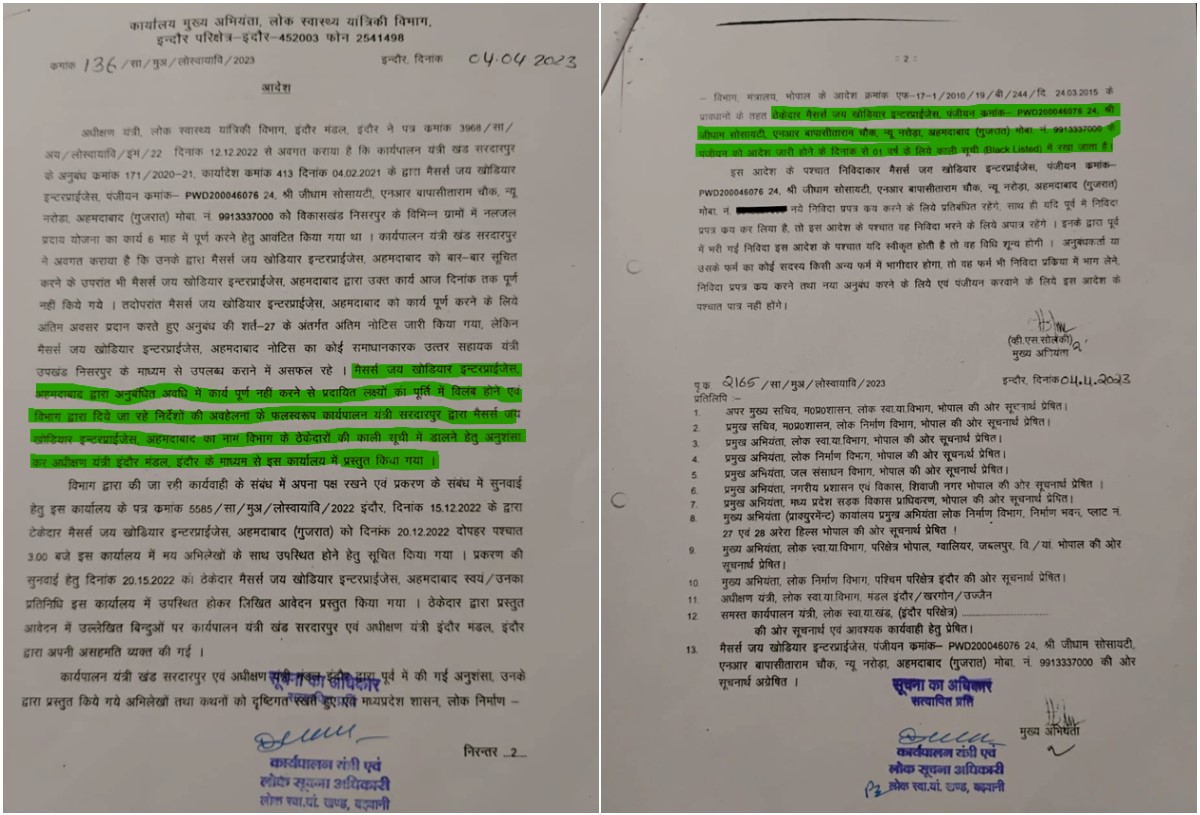
जल जीवन मिशन के तहत हर घर नल से जल पहुंचाने के दावों के बीच द वायर हिंदी की पहली किश्त में सामने आया कि जिन गांवों के हर घर तक नल का जल पहुंचाने के दावे सरकारी कागजातों में किए गए हैं, वहां ज़मीनी हकीकत विपरीत है. इस दूसरी किश्त में समझिए मध्य प्रदेश में इस योजना का फर्जीवाड़ा. विभिन्न जिलों की 15 ग्रामीण योजनाओं के दस्तावेजों की पड़ताल से स्पष्ट हुआ कि बजट का बड़ा हिस्सा खर्च हो जाने के बावजूद इनमें से अधिकतर योजनाएं सालों से लंबित है, योजनाओं को लागू करने वाली कंपनी भी ब्लैकलिस्ट हो गई, और इस तरह योजना का लाभ नागरिकों को नहीं मिल पा रहा है. https://thewirehindi.com/277532/jal-jeevan-mission-madhya-pradesh-ground-reality-irreguarities/ (07 July 2024)
Rajasthan GW level takes a dip as water mafias emerge About 40 kms away from the Balotra district headquarters, lies the village of Khardi that does not get the water claimed by the Union government claims on its Jal Shakti ministry’s website that under the Jal Jeevan Mission. Jor Singh, a 28-year-old man, who lives at the far end of the village, complains that he does not receive any water through his connection. “Even if the water supply is available for 30 minutes, the figure dips in some houses to just 10 minutes. The pressure is also very low. We don’t depend on tap water and call tankers to meet our daily water requirements,” Singh said. Dilip Bidawat, a social activist based in Balotra, pointed out that influential villagers have installed large motors on the pipeline.This has created bigger holes in it than what is officially allowed. https://www.downtoearth.org.in/water/tanker-economy-revealed-rajasthans-groundwater-level-takes-a-dip-as-water-mafias-emerge (04 July 2024)
WATER
Report Govt’s plan to address water crisis The government plans to more than triple waste water recycling by the end of the decade to 70%, according to a federal government policy document dated Oct. 21, 2023 that listed priorities for the next five years. Krishna S. Vatsa, a senior official at the state-run National Disaster Management Authority, confirmed the targets in an interview last week.
Authorities also plan to cut the extraction of fresh water – ground water and surface water from rivers and lakes – to less than 50% by the end of the decade from 66%, the highest rate in the world, said the document, which has not been made public and was reviewed by Reuters.
It will also launch a national village-level programme this year to recommend crops to farmers based on local water availability, Vatsa said. Details of plans to address the water crisis have not been previously reported.
PM Narendra Modi launched a near $50-billion program in 2019 to provide all rural households with tap water. The government says it has now covered 77% of more than 193 million such families, up from 17% five years ago, but residents and experts say not all pipes have water. “It makes the issue of conservation far more urgent,” Vatsa said. “You cannot sustain such a national pipeline without the availability of water. The pipes will run dry.” He agreed some taps could already be dry.
Founder Arun Lakhani said the freed up fresh water will be enough to take care of the expected population growth of the city for the next 35 years. Some industries are investing in waste water recycling and rain harvesting to cut their dependence on fresh water. Tata Steel plans to cut its fresh water consumption to less than 1.5 cubic meters per tonne of crude steel produced at its Indian operations by 2030, from about 2.5 cubic metres now. JSW Steel also has similar plans.
“At least to plug the gaps in urban areas, treated waste water is going to be one important resource that we need to start acknowledging,” said Nitin Bassi at Indian think-tank The Council on Energy, Environment and Water. Experts say nearly 90% of water supplied to homes can be recycled, but infrastructure for water distribution and sewage treatment has failed to match the growth of major cities and untreated waste ultimately flows into rivers.
Modi’s administration is adding sewage treatment capacity to lift the current rate of 44% in urban areas so more water can be recycled and used in industries, agriculture and other areas. Between 2021 and 2026, it plans to invest about $36 billion to ensure equitable water distribution, reuse of waste-water and mapping of water bodies, the government has said.
“The elephant in the room is agriculture,” said Lakhani of Vishvaraj. “We still use flood irrigation, we are not on drip or sprinkler irrigation. If we save just 10% water used in agriculture, it will take care of water problems of all the Indian cities.” The government plans to implement a nationwide rural programme on water use this year, said Vatsa, the disaster management official.
“For every village we need to have water budgeting,” he said. “How much water is available? How much should be used for irrigation? How much should be used for your domestic purpose? That would determine what kind of crops you are going to plant.” Asked about possible resistance from farmers, who are a powerful voting bloc, he said: “There’s no other choice. The water table is just going down and at some point it becomes completely unviable. The borewells fail.” https://www.livemint.com/economy/how-water-crisis-is-becoming-a-major-threat-to-indias-surging-economy-11720068078899.html (04 July 2024)
MONSOON 2024
SANDRP Blog June 2024: High Rainfall district days lowest in 4 years In June 2024, there were 384 instances when a district received over 50 mm of rainfall in a day. This number of 384 is the lowest in last four years. The rainfall in Jun 2024 was also lowest in last four years.
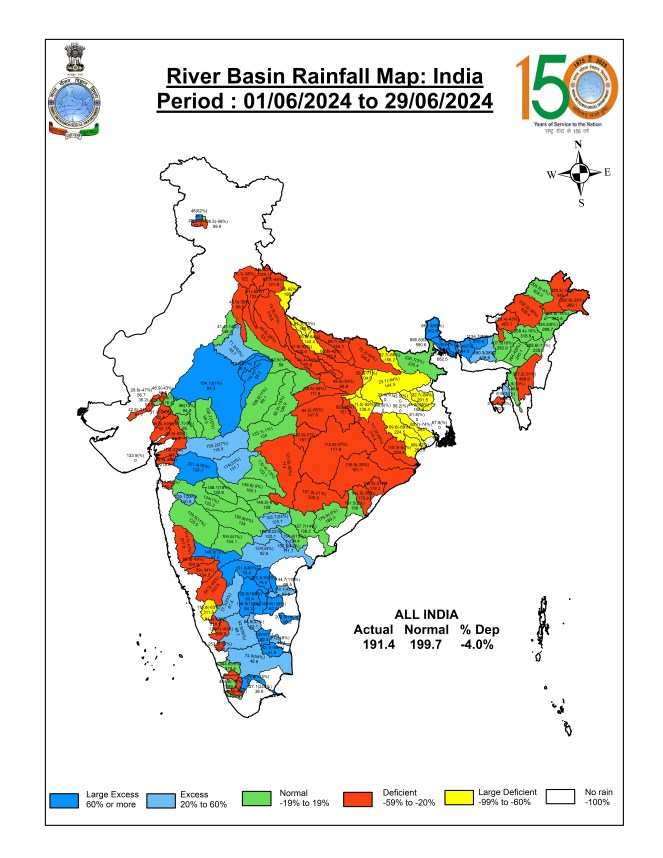
These figures and analysis give state wise figures of such instances when a rainfall in a dist is 50-100 mm, 100-150 mm, 150-200 mm, 200-250 mm and above 250 mm in a day. The Data and analysis are based on IMD figures. In all 153 of 729 districts of India had such instances in Jun 2024. This figure of 153 districts too is the lowest in last four years. https://sandrp.in/2024/07/05/june-2024-high-rainfall-district-days-in-indias-sw-monsoon-lowest-in-four-years/ (05 July 2024)
June 2024: District wise rainfall in SW Monsoon This article provides district wise rainfall for each state and union Territory of India for June 2024, all data from IMD. It also provides IMD maps for state wise, Sub division wise, river basin wise and district wise rainfall for June 2024. It also provides bar chart for daily June 2024 rainfall for All India and for four regions: NW India, E & NE India, Central India and South India. https://sandrp.in/2024/07/03/june-2024-district-wise-rainfall-in-indias-sw-monsoon/ (03 July 2024)
The all-India rainfall for the month of June was deficit by 11 per cent. The rains made quite a recovery in the last 10 days after the deficit had increased to 20 per cent on June 18 due to the stalling of the monsoon winds. Even then, the distribution of the rains has been skewed throughout the month, leading to a cycle of dryness and flood-like situations. Forty-nine per cent of India’s districts have received deficient (20 per cent to 59 per cent below normal) or large deficient rainfall (>60 per cent below normal) in June 2024. Of these, 31 per cent had deficient and 18 per cent had large deficient rains. https://www.downtoearth.org.in/climate-change/monsoon-2024-it-was-drought-deluge-or-both-for-india-in-june-a-tell-tale-sign-of-climate-change (01 July 2024)
Delhi Claims of preparedness bite dust Himanshu Thakkar, Coordinator at SANDRP said, “In Delhi, on June 28, 228 mm of rainfall occurred in one location – Safdarjung observatory, while in other parts of Delhi, it was below 200 mm, with some areas experiencing rainfall in single digits also. The overall average rainfall in Delhi was 139 mm. “Some locations broke rainfall records, but not the entire city. Across India, there is a deficit in rainfall, although some areas have recorded high rainfall. Climate change is a significant factor contributing to changes in the monsoon, increasing the frequency and intensity of high-intensity events,” he added. “This shift is influenced by climate change which leads to change in the pressure at some areas and wind patterns. The forecast indicates that rainfall will increase in August and September due to the La Niña weather pattern, which is expected to intensify rainfall in the city,” Thakkar further added. https://thepatriot.in/reports/delhi-rains-claims-of-preparedness-bite-dust-capital-drowned-in-torrential-rain-52604 (05 July 2024)
Heavy rain not due of cloudburst, something close to it: IMD Addressing a press conference on July 1, IMD chief Mrutyunjay Mohapatra said the Safdarjung Observatory, the city’s primary weather station, recorded 91 mm rainfall between 5 – 6 am on June 28. Similarly, the Lodhi Road weather station logged 64 mm from 5 – 6 am and 89 mm from 6 am to 7 am. “These do not warrant to be declared as cloudbursts, but it was very close to a cloudburst,” Mohapatra said.
Delhi-NCR will get three more Doppler radars in the next two to three years, along with a flood warning model, additional automatic weather stations and rain gauges to improve weather forecasts, IMD chief Mohapatra added. https://www.business-standard.com/india-news/heavy-rain-in-delhi-not-due-of-cloudburst-something-close-to-it-imd-124070100730_1.html (1 Jul 2024)
Haryana Driest June in 5 yrs Haryana recorded 29.3mm of rainfall this June, a deficit of 46%. Its normal precipitation is 54.7mm for the month. On the other end of the scale was June 2023, which witnessed multiple spells of pre-monsoon showers, leaving the state with surplus rainfall of 80.7mm. The last time that the state recorded deficit rain in June was in 2022 (36mm). Precipitation in June 2020 and 2021 was nearly ‘normal’.
Data also showed that rainfall patterns across districts varied. In Ambala, Chandigarh and Panchkula, showers in June this year were 90% below the normal level. Only Nuh, Gurgaon, Faridabad and Panipat recorded excess rainfall, and that too, because of a sudden deluge of showers on June 28.
“Climate change influences precipitation patterns in complex ways. A shift in seasonality is one such disruption, wherein the timing and distribution of precipitation during a year are altered. Under a changing climate, an increase in the frequency and magnitude of extreme weather events, such as heavy rainfall, cyclones, and droughts, is observed. This is likely to worsen in the coming decades, with adverse implications for climate-sensitive sectors such as agriculture,” said Dr Indu K Murthy, sector head for climate, environment & sustainability at Center for Study of Science, Technology & Policy. https://timesofindia.indiatimes.com/city/gurgaon/haryana-records-driest-june-in-5-yrs/articleshow/111416187.cms (02 July 2024)
Report Forecast of above-normal rain in July The IMD chief said the prediction of above-normal rainfall “certainly” indicates a higher probability of very heavy rainfall in certain areas. “Especially, if you look at states like Himachal Pradesh, Uttarakhand & Jammu and Kashmir and the foothills of the western Himalayas, we are expecting above-normal rainfall activity,” he said.
“This is the region where you can have devastating impacts in terms of cloudbursts, heavy rainfall leading to landslides, floods, etc. Many rivers also originate here. In central India too, we are expecting above-normal rainfall in Godavari, Mahanadi and other river basins. So the probability of floods there is high,” Mohapatra said.
The IMD also said India recorded below-normal rainfall in June, with the deficit standing at 11 per cent, the highest in five years. Data compiled by the IMD shows in 20 of the 25 years when the June rainfall was below normal (less than 92 per cent of the LPA), the July rainfall was normal (94-106 per cent of the LPA) or above normal. In 17 of the 25 years when the June rainfall was below normal, the seasonal rainfall was normal or above normal, the data said.
Experts from the International Centre for Integrated Mountain Development have also warned about a difficult monsoon season for the countries in the Hindukush Himalayan region, including Bangladesh, Bhutan, India, Nepal and Pakistan.
“In spite of the fact that last year saw below-average rainfall in many parts of the HKH countries, catastrophic floods still hit region after region, community after community,” said Mandira Shrestha at ICIMOD. https://www.telegraphindia.com/india/high-chance-of-floods-in-western-himalayas-central-india-amid-forecast-of-above-normal-rain-in-july/cid/2030860 (01 July 2024)
जुलाई में सामान्य से अधिक बारिश की संभावना: मौसम विभाग -आईएमडी के महानिदेशक डॉ. मृत्युंजय महापात्रा ने एक जुलाई, 2024 को वर्चुअल प्रेस कॉन्फ्रेंस के माध्यम से कहा कि रिकॉर्ड पर 1901 के बाद जून 2024 अब तक का सबसे गर्म महीना रहा खास कर उत्तर-पश्चिम भारत गर्मी से संबसे अधिक प्रभावित रहा। मौसम विभाग ने जुलाई में सामान्य से लेकर सामान्य से अधिक बारिश होने की 80 प्रतिशत संभावना जताई है। https://hindi.downtoearth.org.in/weather/june-2024-is-the-hottest-month-since-1901-july-is-likely-to-receive-above-normal-rainfall-imd (01 July 2024)
33% कम बारिश ने बढ़ाई खरीफ फसलों की चुनौती -इस साल मानसून सीजन में सामान्य से अच्छी बारिश के अनुमान के बावजूद जून महीने में मौसम काफी असामान्य रहा है। मौसम विभाग के अनुसार, जून में पूरे देश में सामान्य से 11 फीसदी कम बारिश दर्ज की गई। यह पिछले पांच वर्षों में जून में हुई सबसे कम बारिश है। उत्तर-पश्चिम भारत में वर्ष 1901 के बाद इस साल जून का सबसे गर्म महीना रहा है। इस दौरान औसत अधिकतम तापमान सामान्य से 1.96 डिग्री सेल्सियस अधिक रहा और औसत बारिश सामान्य से 33 फीसदी कम हुई। भीषण गर्मी और कम बारिश से उत्तर भारत में खरीफ फसलों की ग्रोथ और उत्पादन पर असर पड़ सकता है। 1 से 30 जून तक मध्य भारत में सामान्य से 14 प्रतिशत कम और पूर्वोत्तर भारत में 13 प्रतिशत कम बारिश दर्ज की गई। जबकि दक्षिण भारत में सामान्य से 14 प्रतिशत अधिक बारिश हुई। देश के 12 प्रतिशत क्षेत्र में अत्यधिक, 38 प्रतिशत में सामान्य और 50 प्रतिशत में कम बारिश हुई। https://www.ruralvoice.in/latest-news/warmest-june-since-1901-and-33-percent-less-rainfall-increased-the-challenge-for-kharif-crops.html (01 July 2024)
Climate models could be underestimating the impacts of future rainfall in India A new study, correcting and downscaling the CMIP6’s projections, finds that at a regional scale over India, the CMIP6 is underestimating the magnitude of long and short duration extreme rainfall events in the future. “These findings may provide fundamental insights to formulate national climate change adaptation policies for the extreme rainfall events,” the researchers, from the Indian Institute of Tropical Meteorology and the National Institute of Technology, Rourkela, wrote in the paper.
The baseline period for models and observations used are IMD data from 1980 to 2014. While most other downscaled models include only the precipitation component, this study is among the first few to also include sea surface temperature in its projections, which is an important determinant of the Indian summer monsoon’s progress. https://india.mongabay.com/2024/07/climate-models-could-be-underestimating-the-impacts-of-future-rainfall-in-india/ (04 July 2024)
बाढ़ग्रस्त इलाके में सूखा और सूखे इलाके में बाढ़ क्यों? नीति अनुसंधान संस्थान की एक रिपोर्ट कहती है कि पिछले एक दशक में यानी साल 2012 से 2022 में लगभग 55% तहसीलों में मॉनसून की बारिश में बढ़ोतरी हुई है और ऐसा ज्यादातर पारंपरिक रूप से सूखे राज्यों राजस्थान और गुजरात में हुआ है. दूसरी ओर, देश भर के 11 प्रतिशत तहसीलों में पिछले एक दशक में मॉनसून की बारिश में दस प्रतिशत तक की कमी आई है और ऐसा उन मैदानी इलाकों में हैं, जो भारत के कृषि उत्पादन में आधे से अधिक का योगदान करते हैं. यानी सूखे में बारिश और बारिश वाले इलाके में सूखा वाली स्थिति स्पष्ट है. लेकिन बात केवल कहाँ बारिश हो रही है और कहाँ नहीं तक नहीं है. सवाल – बारिश कब हो रही है, का भी है. https://newspotli.com/why-indias-monsoon-patterns-have-the-worrying-changes/ (01 July 2024)
FLOOD 2024
Himachal Pradesh BBMB to install EWS at Pandoh dam The Bhakra Beas Management Board (BBMB) is set to instal an early warning system at Pandoh Dam. This system aims to alert residents from the dam to Mandi city whenever the dam gates are opened to release water. The announcement was made by BBMB Superintending Engineer Ajaypal Singh during the 48th foundation day celebration of the Beas-Sutlej Link (BSL) project at Pandoh Dam. He stated that the tender for the sensor-based early warning system has been placed and installation will commence within the next two months. Six omni-directional hooters will be strategically placed along the Beas River from Pandoh Dam to Mandi city. These hooters will emit loud warnings and broadcast voice messages to alert the public. Unlike the previous system, which was manually operated and only covered areas near the dam and market, the new system will operate automatically.
– In addition to the early warning system, Singh mentioned a proposal to construct a security wall in residential areas near Pandoh. The project, estimated to cost between ₹8 to ₹10 crores, is currently in the planning phase, with the drawing ready and awaiting final approval. Construction will begin once funding is secured. https://thenewshimachal.com/2024/07/bbmb-to-install-early-warning-system-at-pandoh-dam/ (07 July 2024)
Dams filled to the brim with onset of monsoon The pre-monsoon surge is driven by intense heat that has accelerated melting of glaciers, pushing water levels in many dams to precarious thresholds. The reservoirs at Bhakra and Pong dams stand out as the few which are yet to their maximum levels — currently 31 and 28 metres below their respective maximum levels. However, the situation has set the alarm bells ringing as even these dams are expected to hit the cap soon. The state has 23 operational large dams and their safety is the principal concern of the directorate of energy.
The increased water levels is a double-edged sword. While they bode well for the electricity and water needs of neighbouring states Punjab and Haryana, which heavily depend on Himachal’s rivers, there is a looming risk of devastation from potential floods during heavy monsoon rains.
SJVN plant executive director head Narender Kumar said, “Two days ago, there was a flash flood in Baspa river, the water level rose by 150 cumecs, and the dams absorbed the water. Glacial melt has accelerated water flow helping us to generate more power. Right now the situation is under control.”
Dam authorities have already been directed to set up a monitoring network and set up an early warning system (EWS) as mandated under law. “Besides, river basin monitoring and EWS integrating the network of all power projects need to be put in place immediately. State disaster management authority is keeping a close tab on the water levels in the dams,” state disaster management authority director DC Rana said. https://www.hindustantimes.com/cities/chandigarh-news/himachal-dams-filled-to-the-brim-with-onset-of-monsoon-101720074049379-amp.html (04 July 2024)
Uttarakhand Several pilgrims stranded, 2 washed away At least two pilgrims were swept away, and several others remain stranded in Devgad after a temporary bridge collapsed on July 5. The incident occurred approximately 8-9 km ahead of Gangotri on the Gomukh footpath. At least 30 to 40 pilgrims are stranded. The temporary bridge reportedly collapsed due to a sudden increase in water flow in a river at Devgad. IANS, reported that a glacier approaching Chirbasa on the Gangotri-Gomukh trek caused an alternative bridge to collapse. https://www.livemint.com/news/india/uttarakhand-pilgrims-stranded-two-washed-away-temporary-bridge-collapses-increase-in-river-water-flow-devgad-gangotri-11720179632476.html (5 July 2024)
Assam Human folly to blame for Beki changing course 2004 was the year when the Beki started to carry 80 per cent of the silt load of two rivers — itself and the Manas, which flows into the Brahmaputra.
“Since the Beki river is carrying almost all the discharge of a huge catchment area, its flood hazard became severe day by day. The river’s bank is being eroded during its meandering course through Barpeta and Baksa districts. There have been a number of devastating floods starting from 2004 due to release of excess water from the Kurichu Dam in Bhutan. This has created severe flood havoc including erosion in almost all the (river’s) reaches,” stated the Detailed Project Report (DPR) of the water resources department.
As a result, the DPR stated, the Beki river which was flowing westward in its upstream course and eastward downstream, changed its path. This caused severe erosion in the Manas National Park upstream, which has become a threat to the riparian area. https://www.downtoearth.org.in/environment/beki-was-human-folly-to-blame-for-brahmaputra-tributary-changing-course-displacing-state-highway (05 July 2024)
-In India, floods have swamped the northeastern state of Assam, with six persons killed in the last 24 hours, Assam’s Disaster Management Authority said on July 7. That takes the death toll from the downpours since mid-May to 58. https://www.thehindu.com/news/international/14-killed-9-missing-following-flood-and-landslide-in-nepal/article68378562.ece (07 July 2024) -In India, floods have swamped the northeastern state of Assam, with six people killed in the last 24 hours, the Assam State Disaster Management Authority said on Sunday (July 07). That takes the death toll from downpours in the state since mid-May to 70, according to the PTI news agency. https://www.aljazeera.com/gallery/2024/7/7/fourteen-killed-in-nepal-as-monsoon-rains-cause-flooding-in-south-asia (07 July 2024)
Arunachal Pradesh Floodwaters submerge several villages Continuous rainfall resulting in overflow of rivers has caused widespread flooding in the region, leaving thousands stranded and in need of urgent assistance. The most affected villages are Udoipur-II, Mudoi Deep, Bijoypur, and Dharmapur-I in Diyun and Miao circles. Many villages in Kharsang and Namphai areas have also been submerged. More than 40,000 people have been affected by the monsoon flood.Rivers are flowing above the danger mark in Namsai subdivision. https://arunachaltimes.in/index.php/2024/07/03/floodwaters-submerge-several-villages-in-namsai-changlang/ (02 July 2024)
Bailey bridge over Kurung river washed away The Bailey bridge over the Kurung River in Kurung Kumey district was washed away in the wee hours of Monday (July 01) due to incessant heavy rainfall. The bridge was important as it linked district headquarters Koloriang with Sangram, and with adjoining districts. A source, requesting anonymity, informed that the bridge collapsed probably due to dumping of debris from the work on NH 713 to connect Joram and Koloriang, via Palin. The Bailey bridge had been rebuilt in 2022 by the National Highways & Infrastructure Development Corporation Limited. https://arunachaltimes.in/index.php/2024/07/02/bailey-bridge-over-kurung-river-washed-away/ (02 July 2024)
Damin, Parsi Parlo and Panyasang administrative circles of Kurung Kumey district are reportedly cut off from the rest of the state, following incessant rain this week that triggered major flashfloods and landslides. https://arunachaltimes.in/index.php/2024/07/08/3-circles-of-remote-k-kumey-cut-off-from-rest-of-state/ (07 July 2024)
Ladakh: Image posted on X by Manish Prasad reporter with India TV on July 1 mentioning that the T 72 tank which got washed away on June 28 night causing death of five army men is still stuck in the heavy flow of the Shyok River (locally known as river of death) at Saser Brangsa and would be taken out only after the flow reduces. The image also shows muddy waters flowing in the river which normally happens during floods. There still no information in public domain on reasons behind the unfortunate incident. https://x.com/manishindiatv/status/1807668601085673975 01 July 2024)
With their tank getting submerged and rescue efforts underway, the five stood on the top of it for almost six hours before the river washed them and the tank away, the Army sources said. The Shyok was flowing at almost 40 km per hour that night. The Army’s attempts to launch rescue missions failed with one rescue team barely surviving a mishap of its own. A Court of Inquiry, which is currently underway, is looking at multiple angles behind the mishap.
There was a sudden increase in its water level due to the melting of snow. The terrain is tree-less and the water after the melting of snow at the mountain peaks rushes straight into the river running through the valley. The river is about 60-70 m wide and swimming in these conditions would have been impossible for the rescue team as also for the five who got washed away, the sources added. https://www.tribuneindia.com/news/india/5-jawans-held-on-to-tank-for-six-hours-before-drowning-637653 (08 July 2024) Incessant questions on why 5 soldiers’ lives lost in Shyok? https://www.youtube.com/watch?v=4aASNtIudW4 (07 July 2024)
HFL BREACH
Assam This quite unusual and Central Water Commission must find out reasons behind River Dikhow at Sivasagar site in Sivsagar district of Assam has crossed HFL five times in last six years including twice in 2023. The has set a new HFL at the site as 94.35 meter at 16:00 hour today. Details of previous HFL and date is given below
Old HFLs and dates
94.34 m 11.08.2023
94.27 m 17.07.2023
94.24 m 22.06.2020
94.23 m 01.08.2018
94.19 m 25.06.1998
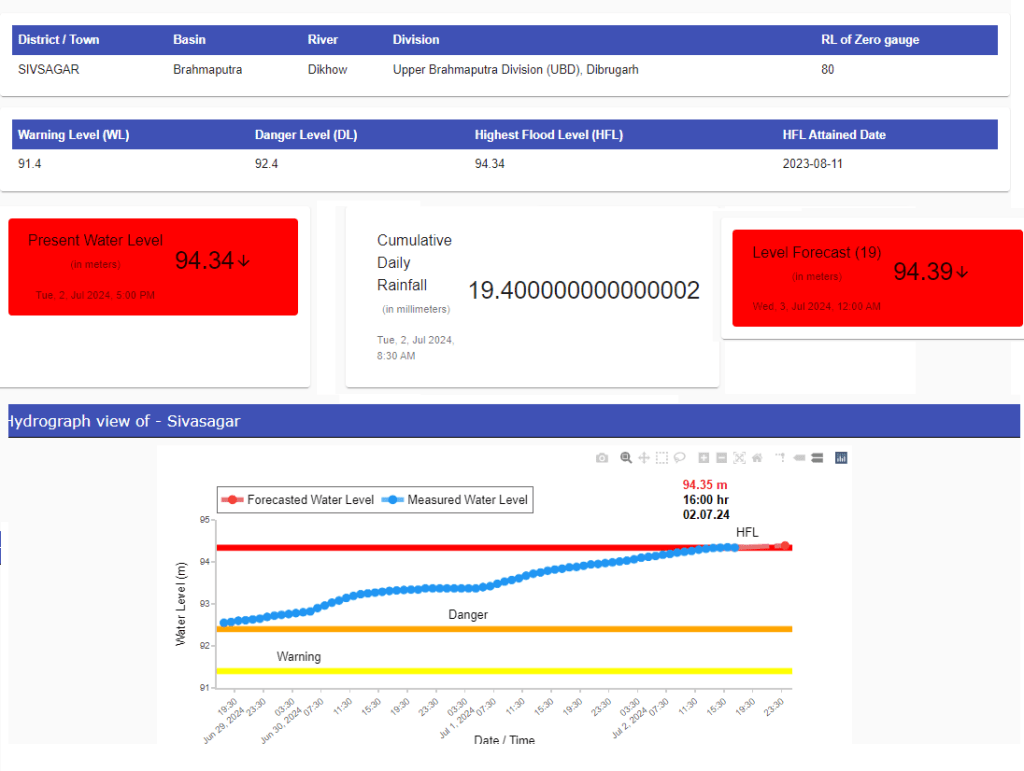
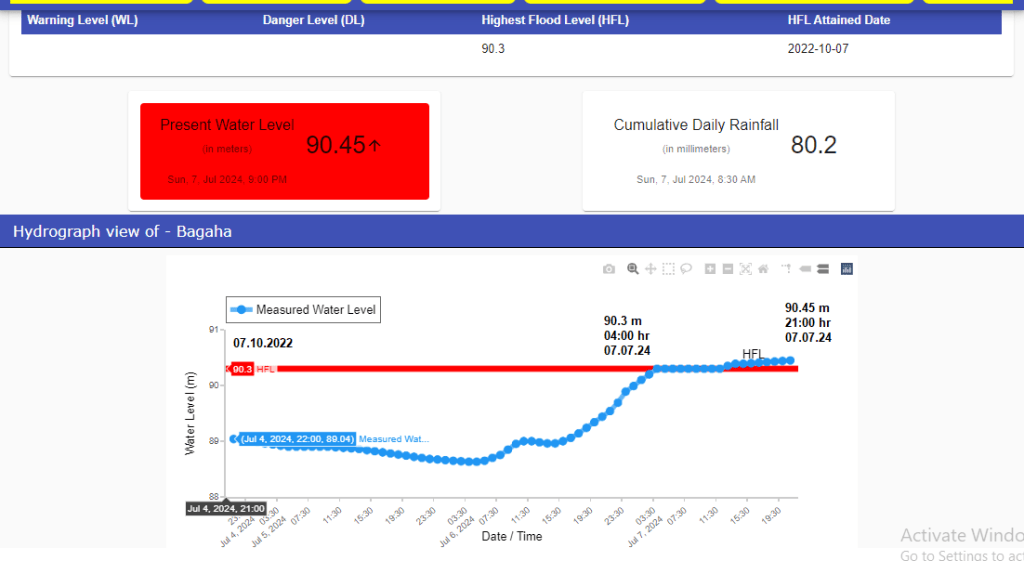
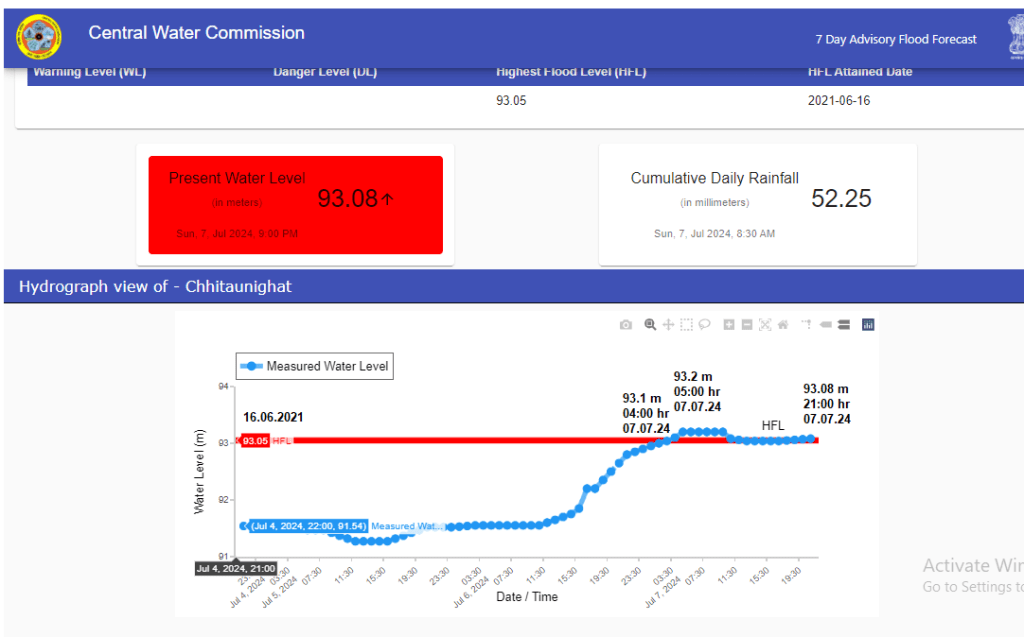
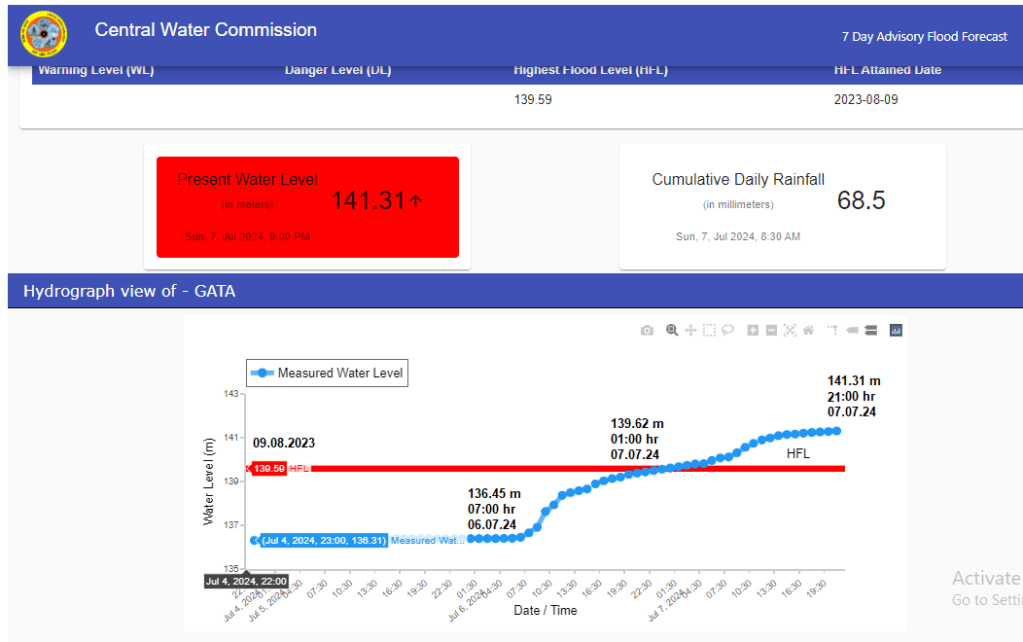
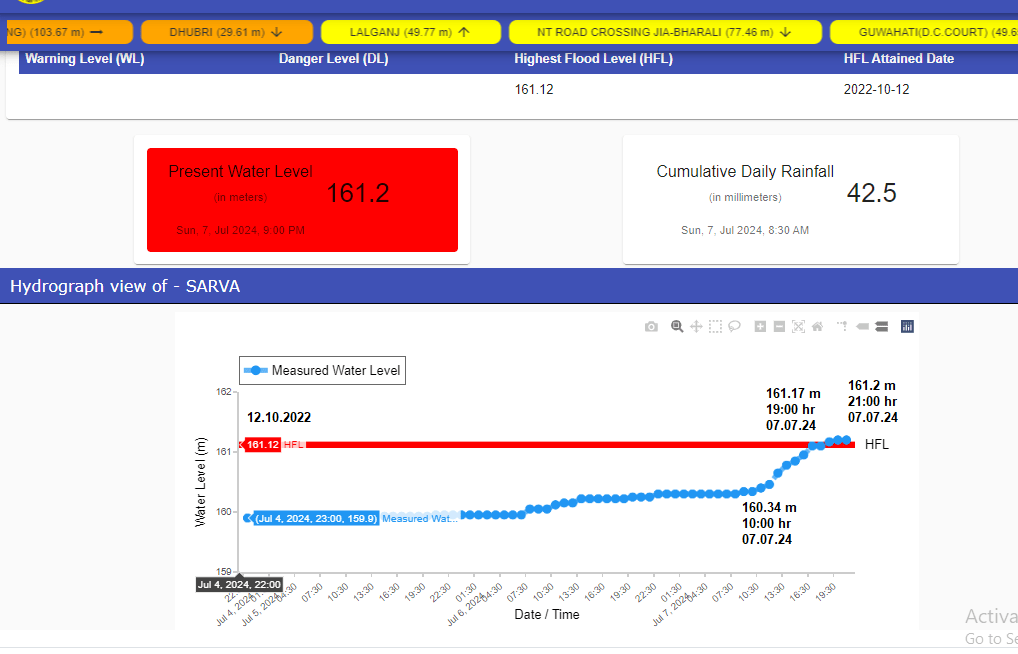
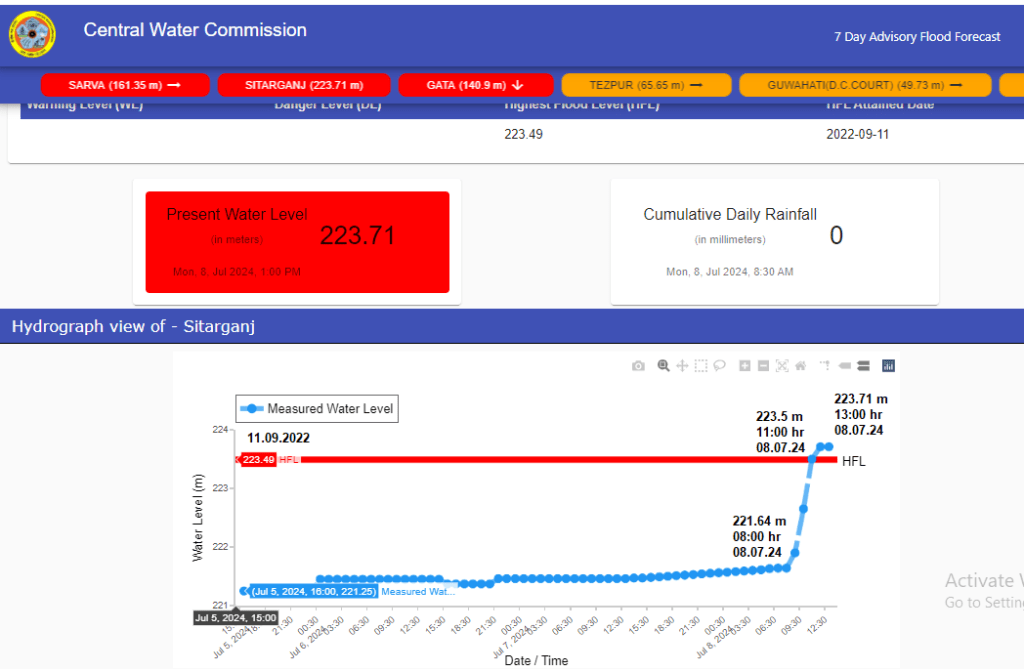
Madhya Pradesh -River Vesli in lower Yamuna basin at Gata site in Bhind district has crossed HFL 139.59 meter dated 09.08.2023. Present flood level is 141.31 meter at 21:00 hour on 07.07.2024 with rising trend.
River Pana in lower Yamuna basin at Sarva site in Bhind district has crossed HFL 161.12 meter dated 12.10.2022. Present flood level is 161.2 meter at 21:00 hour on 07.07.2024 with stable trend.
Uttar Pradesh -River Gandak at Chhitaunighat site in Kushi Nagar district has crossed HFL 93.05 meter dated 16.06.2021 in Kushi Nagar district. Present flood level is 93.08 meter at 21:00 hour on 07.07.2024 with rising trend.
Bihar -River Gandak at Bagaha site in Paschim Champaran district has crossed HFL 90.3 mete dated 07.10.2022. Present flood level is 90.45 meter at 21:00 hour on 07.07.2024.
Uttarakhand River Deoha at Sitarganj site in US Nagar district has crossed HFL 223.49 meter dated 11.09.2022. Present flood level is 223.71 meter at 13:00 hour on 08.07.2024 with stable trend.
URBAN FLOODS
QoC Cities are not prepared for extreme heat & high rainfall “Looking at the current trajectory, we are destined to get worse floods before we make any improvements,” says Himanshu Thakkar, coordinator of SANDRP, “Even when pre-monsoon work is done, it’s clearly not enough. They do it at the last moment; I have seen it in our colony in Delhi.”
– Cities are, ultimately, about imagination. “You can choose a manner of urbanisation, and still urbanise,” argues Himanshu Thakkar, “For example, a concrete footpath can be designed in such a way that it also has the capacity to percolate water. You can have rainwater harvesting even on roads. And most cities have huge open spaces such as parks – Delhi is one of them – which can be hugely used for rainwater harvesting.”
– If the government, as the biggest landowner, were to ensure this, it would make a difference to the city, Thakkar adds. “Groundwater is our biggest storage capacity, it doesn’t involve costs, and it is decentralised…It may not be possible to flood-proof cities but it is possible to reduce floods. This will also improve water security in cities. We can also use treated sewage as a resource to rejuvenate wetlands, streams and local water bodies.” https://questionofcities.org/why-indias-cities-are-not-prepared-for-extreme-heat-and-high-rainfall/ (28 June 2024)
Climate disasters are connected to the way our cities are planned Cities have completely ignored their natural areas. If mapped and made available on a public database, people can be empowered with the knowledge about them and can decide to protect them. Mapping a city’s ecology can radically change the way people see development. Mumbai, for example, is a city built on water. The watershed boundaries should have been matched to civic boundaries as the city was expanded and development should have been around water. Ecological maps and databases create evidence to protect natural areas in cities; we can exist only if nature does. https://questionofcities.org/climate-disasters-are-connected-to-the-way-our-cities-are-planned/ (28 June 2024)
India’s urban development model is collapsing -To coverup their unpreparedness, municipal bodies often hide behind the excuse of extreme weather and unexpected rains triggered by climate change. However, the loss of life and public property we see every year in our cities is mainly due to the bad or no drainage systems, or clogged drainage systems. Poor quality infrastructure is also a reason behind these mishaps.
-The vertical growth of cities where sprawling multi-storeyed, multitower apartments occupy hundreds of acres entails unrestricted extraction of groundwater which is leading to an alarming fall in the water table. To build these townships, roads, and other infrastructure we encroach water bodies, destroy natural stormwater drain systems (which transport water to natural water bodies and, thus, prevent flooding) and cement almost every inch of land preventing the possibility of any groundwater recharge. In the absence of an efficient solid waste management system, we see landfills and garbage dumps all over the cities. (Hridayesh Joshi) https://www.deccanherald.com/opinion/indias-urban-development-model-is-collapsing-3092368 (04 July 2024)
Urban expansion makes Delhi susceptible to flooding -The national capital is undergoing one of the world’s fastest urban expansions, with little regard for the land’s natural topography and drainage capacity. This has left Delhi vulnerable to flooding during spells of intense rainfall. “Topography determines drainage patterns,” Manu Bhatnagar, principal director, Natural Heritage Division, INTACH, told The Indian Express. “If one looks at Delhi’s historic cities — from Tughlakabad, Mehrauli, and Shahjahanabad to Civil Lines, New Delhi, and the Cantonment area — all were carefully selected, and built on higher ground. In Delhi’s villages too, the centre of the village would always be five to six metres higher than the village periphery,” he said.
-This allowed rainwater to drain out. But as the city has expanded, not enough thought has gone behind building with regards to the land’s drainage capacities. Thus, with high-intensity rain there is significant run-off (unconfined flow of water, which occurs when there is more water on the land’s surface than it can absorb), and existing drainage systems have been inadequate, Bhatnagar explained. https://indianexpress.com/article/explained/how-urban-expansion-makes-delhi-susceptible-to-flooding-9427017/ (02 July 2024)
Delhi Tunnel vision: Drainage overlooked A five-member PWD committee formed in March submitted a report in April about the area’s problems, but govt agencies didn’t take any steps to prevent or manage the waterlogging in and around the tunnel before the rainy season began.
-The expert report determined that one of the reasons for the waterlogging was the involvement of two different agencies working on different components of the Pragati Maidan complex redevelopment. The tunnel network, connected with Bharat Mandapam managed by ITPO, experiences significant water infiltration from the underground parking ramps and branch tunnels after every spell of rain leading to frequent closure of the tunnel. PWD, responsible for managing the transit network, attributes the problem to the incomplete drainage system within the Bharat Mandapam campus.
-Among the suggestion made by the expert committee in its report, dumping of water by civic authorities, mainly NDMC, around the tunnel was a major problem and should be stopped. An NDMC official countered, “This is just a blame game. It is PWD itself which resorts to dumping rainwater inside the tunnel.” The high-level report also highlighted the need for a new drain around the tunnel, in addition to the two existing drains. https://timesofindia.indiatimes.com/city/delhi/tunnel-vision-drainage-issues-at-pragati-maidan-transit-corridor/articleshow/111372058.cms (30 June 2024)
IIT lab flooded -This raises questions not only at the institute’s administration and management but also at the Ministry of Education. How can an IIT be architecturally incompetent at handling rainwater? How can an institute that creates problem-solvers and innovators not have a solution to the problem of waterlogging? Not only was the incident unfortunate, but the aftermath was equally distressing. The institute is not properly handling the lab’s biomedical waste. Rather than calling for an expert team to clear the waste, the administration chose to risk the lives of untrained sanitation workers to clear the mess. https://www.thequint.com/my-report/iit-delhi-lab-flooded-in-rain-biomedical-lab-destroyed (04 July 2024)
Gurugram GMDA finds logs, walls in stormwater drains Gurugram Metropolitan Development Authority (GMDA) said it found wooden logs, construction debris and remnants of walls in stormwater drains it cleaned over the past week, citing the same as reason for waterlogging in residential colonies of Palam Vihar during the intense spell of rainfall on Wednesday (July 03). An authority official said that an inspection of drains was done last Friday (June 28) after a spell of heavy rain caused waterlogging in several residential areas, despite cleaning and desilting them over the past few months. https://www.hindustantimes.com/cities/gurugram-news/gmda-finds-logs-walls-in-stormwater-drains-blame-dumping-for-waterlogging-101720116727068.html (5 July 2024)
Mumbai The Mumbai experienced over 300 mm of rainfall in various locations between 1 am and 7 am today (July 08). This heavy rain caused waterlogging in some low-lying areas, leading to disruptions in suburban train services. https://economictimes.indiatimes.com/news/india/mumbai-drowned-in-300-mm-rain-in-6-hours-mumbaikars-share-visuals-of-flood-like-situation/articleshow/111566151.cms (08 July 2024)
Chennai Incorporating lake sensors can prevent flooding This project is the first of its kind in Chennai. The WRD has initiated a pilot project to install lake sensors in around 90 lakes, with construction currently ongoing at Chitlapakkam Lake. While constructing these sensors, we must ensure that lake control rooms and sensors have a proper power backup and internet support. As power outages are common in the monsoon, it is essential to have alternative power supply to avoid losing crucial data.
-It will also be important for the lake control room to work with field workers and disaster management command centre teams. Once the integrated control room and disaster management teams identify the level of water in the lake, as well as the inflow or outflow at each point in time, authorities can send field workers accordingly.
-In recent years, there has been no monitoring of the inflow and outflow of rainwater into the lake, leading to a lack of real-time measurement records. Earlier, lakes were mostly situated in rural areas with large agricultural catchments. But, with rapid urbanisation, there is extensive construction in and around lakes, leading to severe flooding in the city.
-The discharge of rainwater has increased over the years, estimated to be at least three times higher. It is important to document these changes. By understanding the extent of this discharge, we can implement technologies like macro drains to manage specific volumes of floodwater, directing them to other lakes or deepening existing water bodies. https://citizenmatters.in/incorporating-lake-sensors-chitlapakkam-lake/ (03 July 2024)
Kochi ₹14.5-cr project to resolve waterlogging The ₹14.5 cr project aims to eliminate waterlogging and flooding at Alfia Nagar, Arafa Nagar, Vidyanagar, and Cochin University as well, and will be completed within nine months, said Industries Minister P Rajeeve, who is also the Kalamassery MLA. As per the plan, the Pottachal canal will be widened and protected using the box culvert. The culvert will also be reconstructed, according to an official statement here. https://www.newindianexpress.com/amp/story/states/kerala/2024/Jul/04/rs-145-crore-project-to-resolve-waterlogging-in-kochis-kalamassery (04 July 2024)
CLOUD BURSTS
Arunachal Pradesh Cloud burst at Sagalee triggers Pare HEP to release huge amount of water A record 1334.00 Cumecs of water has been discharged from the Pare Dam at 8:00am of Monday (July 01), which is the highest since 2014. In 2023 the highest water discharge from the dam was recorded at 688.00 Cumecs on 21.06.2023. The discharge from the Pare river dam may increase in coming days due to heavy rainfall in the catchment area of the river,” Gagung added while appealing the public to be alert and abide by the safety guidelines issued by the District Administration. https://arunachal24.in/arunachal-cloud-burst-at-sagalee-triggers-pare-hydro-project-to-release-huge-amount-of-water/ (01 July 2024)
Rains wreak havoc Heavy rainfall, flash flood, a cloud burst and landslides have affected normal lives and public private proterties in several districts of Arunachal Pradesh: -In Papum Pare district, a cloudburst in Sagalee triggered the Pare Hydropower Project (PHEP) to release a huge amount of water, and the district administration has cautioned the public against venturing near the water bodies. PHEP Assistant General Manager (Technical) Taba Gagung Tebw appealed to the residents downstream of the project to be vigilant and not venture near the riverbanks for fishing in the next few days.
“A cloudburst occurred at around 3:30 am on Monday (July 01) near Sagalee, leading to heavy rainfall in the entire Pare River catchment area and flooding of all the tributaries of the Pare River,” he said, adding that “discharge from the Pare River dam may increase in the coming days due to heavy rainfall in the catchment area of the river.” -The Pare River catchment area comprises streams and nallahs in Leporiang, Sagalee, Nimte, Laptap, Tashi, Kheel, Toru and Mepsoro. The swollen Pare River has also flooded the compound of the government girls’ residential school in Sarkha Happa. https://arunachaltimes.in/index.php/2024/07/02/rains-wreak-havoc-in-arunachal/ (02 July 2024)
जम्मू– कश्मीर डोडा के ठाठरी में बादल फटा, कई वाहन चपेट में डोडा जिले के ठाठरी बाजार इलाके में शुक्रवार ( June 28)तड़के तीन बजे बादल फटने से अचानक आई बाढ़ ने तबाही मचा दी। बटोत-किश्तवाड़ राष्ट्रीय राजमार्ग से सटा एक बड़ा इलाका जलमग्न हो गया। बादल फटने की घटना के परिणामस्वरूप इलाके में भारी भूस्खलन हुआ। मलबा ठाठरी शहर के पूरे बाजार क्षेत्र में फैल गया। बटोत-किश्तवाड़ एनएच 244 पर कुछ आवासीय घरों के अलावा कुछ खड़े वाहन भी मलबे में फंस गए। कई घंटे यातायात बंद रहा।
-एसडीएम ठाठरी मसूद अहमद ने कहा, बादल फटने से काफी बड़ा भूस्खलन हुआ। हालांकि जहां घटना हुई सेना के गेट के पास वाले इलाके में आबादी काफी कम है। इसलिए कोई बड़ा नुकसान नहीं हुआ। पूरे बाजार क्षेत्र में मिट्टी और मलबे के ढेर लग गए।
-20 जुलाई 2017 में ठाठरी शहर में बादल फटने से भारी तबाही हुई थी। इसमें जामिया मस्जिद के पास एक दर्जन ढांचे बह गए थे और कई लोग घायल हो गए। https://www.amarujala.com/jammu-and-kashmir/udhampur/udhampur-news-udhampur-news-c-10-jam1006-390457-2024-06-29 (29 June 2024)
Himachal Pradesh सिरमौर में बादल फटने से मंदिर क्षतिग्रस्त सिरमौर जिले के ट्रांसगिरी क्षेत्र के दाना गांव के जंगल में रविवार (June 30) देर रात बादल फटने से एक मंदिर क्षतिग्रस्त हो गया है। इसके अलावा भूमि कटाव के साथ पेयजल लाइन भी टूट गई है। गांव की संपर्क सड़क को भी नुकसान पहुंचा है। https://www.jagran.com/himachal-pradesh/shimla-temple-damaged-due-to-cloud-burst-in-sirmaur-late-night-imd-issues-orange-alert-of-heavy-rain-23750669.html (02 July 2024)
Uttarakhand रुद्रप्रयाग में फटा बादल; रास्तों व खेतों में भरा मलबा एक दिन पहले नैनीताल में बादल फटने की घटना सामने आई और अब बुधवार (July 03) को रुद्रप्रयाग में बादल फटा है। यहां रुमसी देवीदार तोक में बादल फटने के कारण स्कूल का रास्ता व कुछ खेतों में मलबा आया है। अधिकारीयों ने घटना स्थल पर पाया कि देवधार में जूनियर हाईस्कूल का रास्ता एवं कृषि भूमि का आंशिक रूप से क्षतिग्रस्त हुए हैं। इस घटना में किसी प्रकार से कोई जानमाल, जनहानि एवं पशु हानि नहीं हुई है। https://www.jagran.com/uttarakhand/rudraprayag-monsoon-2024-rain-in-uttarakhand-cloud-burst-in-rudraprayag-23751461.html (03 July 2024)
Report जंगल की आग और बादलों के फटने की घटनाओं का करीबी संबंध वैज्ञानिक पत्रिका ’एटमॉस्फीयरिक एनवायरमेंट’ में फरवरी 2021 में प्रकाशित एक शोध के अनुसार जंगल की आग और बादलों के फटने की घटनाओं का करीबी संबंध है। हेमवती नंदन बहुगुणा गढ़वाल (एचएनबी) विश्वविद्यालय और भारतीय प्रौद्योगिकी कानपुर द्वारा संयुक्त रूप से किए गए इस अध्ययन में वैज्ञानिकों ने क्लाउड कंडेनसेशन न्यूक्लियर की सक्रियता को मापा है। साथ ही उन्होंने पहली बार मध्य हिमालय के पारिस्थितिकी तंत्र के रूप से संवेदनशील क्षेत्रों में मौसम की विभिन्न स्थितियों के प्रभाव में अधिक ऊंचाई वाले बादलों के निर्माण और स्थानीय मौसम की घटनाओं की जटिलता पर इसके प्रभाव का अध्ययन किया है।
इन वैज्ञानिकों के अध्ययन से पता चला है कि बादल की छोटी बूंदों के आकार के बराबर कण जिस पर जलवाष्प संघनित होकर बादलों का निर्माण करती है, उनमें और जंगल की आग की घटनाओं के बीच गहरा सम्बन्ध है। इन छोटे कणों को क्लाउड कंडेनसेशन न्यूक्लियर (सीसीएन) के नाम से जाना जाता है। शोध से पता चला है कि जंगल में लगने वाली आग की घटनाओं के समय ऐसे कणों की मात्रा चरम पर थी। वैज्ञानिकों ने एचएनबी विश्वविद्यालय के स्वामी राम तीर्थ (एसआरटी) परिसर में स्थित हिमालयन क्लाउड ऑब्जर्वेटरी (एचसीओ) में छोटी बूंदों को मापने के लिए इस्तेमाल की जाने वाली तकनीक (डीएमटी) सीसीएन काउंटर की मदद से इन क्लाउड कंडेनसेशन न्यूक्लियर को मापा गया था, जोकि अतिसंतृप्ति (एसएस) की मौजूदगी में कोहरे या बादल की बूंदों के रूप में सक्रिय और विकसित हो सकते हैं। https://www.amarujala.com/columns/blog/forest-fire-and-cloudburst-know-connection-and-its-impact-2024-07-03 (03 July 2024)
DISASTERS
Sikkim Experts measure with, depth of glacial lakes The Sikkim science and technology department has conducted a two-week long scientific expedition of the East Rathong glacier and three glacial lakes in the Gyalshing district. The expedition was carried out to assess the risk of a potential glacial lake outburst flood (GLOF) on the waterbodies and the status of the glacier. The expedition was conducted from June 22 to July 4 as a part of the department’s ongoing study of glacier dynamics and assessment of potential GLOF risks. In Sikkim, 19 potentially vulnerable glacial lakes have been identified so far and they include the three lakes where the study was conducted.
– The initiative after last year’s flash flood that had devastated the state on October 4. The GLOF on the South Lhonak Lake, which is in the Mangan district of Sikkim, triggered the deluge. The East Rathong glacier, source of Rangit river, is located at an elevation of 4,600 metres to 6,700 metres above the sea level near the Khangchendzonga National Park. https://www.telegraphindia.com/west-bengal/experts-measure-width-and-depth-of-sikkim-glacial-lakes-in-gyalshing-district/cid/2032179 (08 July 2024)
LANDSLIDES
Arunachal Pradesh Landslides snap surface communication in several dists -Surface communication to several districts was snapped following landslides triggered by incessant rain, officials said on Saturday (June 29). A key stretch from Aalo in West Siang district to Mechukha in Shi-Yomi district was damaged in between Roing and Pene villages due to the continuous downpour, they said. https://arunachaltimes.in/index.php/2024/06/30/landslides-snap-surface-communication-in-several-dists/ (30 June 2024)
Himachal Pradesh Cracks resurfaced on Kiratpur-Manali NH According to locals, even after spending lakhs on a retaining wall, parts of the Kiratpur-Manali highway still sank due to heavy rainfall and has gone down by about two feet. Questions are being raised on the quality of the construction of the wall. During the monsoon season, the road is prone to landslides, especially between Mandi and Manali. Last year, a major repair work was done after severe damage on the same stretch. New retaining walls to fortify the highway against recurring threats were constructed by the NHAI. As per the data with the state emergency operation centre, as many as 115 roads including 107 in Mandi, four in Chamba, three in Solan and one in Kangra district are closed for vehicular traffic following rains and 212 transformers are disrupted in the state. https://www.newindianexpress.com/nation/2024/Jul/04/cracks-resurfaced-on-kiratpur-manali-national-highway-115-roads-closed-due-to-heavy-rains (04 July 2024)
A major landslide blocked a road on NH 707 near Shimla’s Rohana after heavy rains. The highway, which connects Hatkoti and Paonta Sahib in Himachal Pradesh, has been closed. A 30-second video shows a massive portion of a hill crumbling and falling on the road and large rocks blocking the route. So far, over 80 roads across Himachal Pradesh have been closed. Thirty-eight roads in Mandi, 14 in Kullu, five in Shimla, four in Sirmaur and one in Kangra district are closed for traffic following heavy rains on Saturday (July 06). https://www.ndtv.com/india-news/video-massive-landslide-in-himachal-pradeshs-shimla-after-heavy-rain-6051626 (07 July 2024)
Uttarakhand Significant routes, including the NH to Badrinath, have been blocked by landslides, causing further disruption in the hill state. On Saturday (July 06), two pilgrims from Hyderabad were killed after boulders from the hillside hit them when they were returning from Badrinath on their motorcycle in the wake of a landslide near Chatwapeepal area of Karnaprayag in Chamoli district. https://indianexpress.com/article/india/weather-update-rainfall-uttarakhand-himachal-char-dham-yatra-monsoon-9438270/ (07 July 2024)
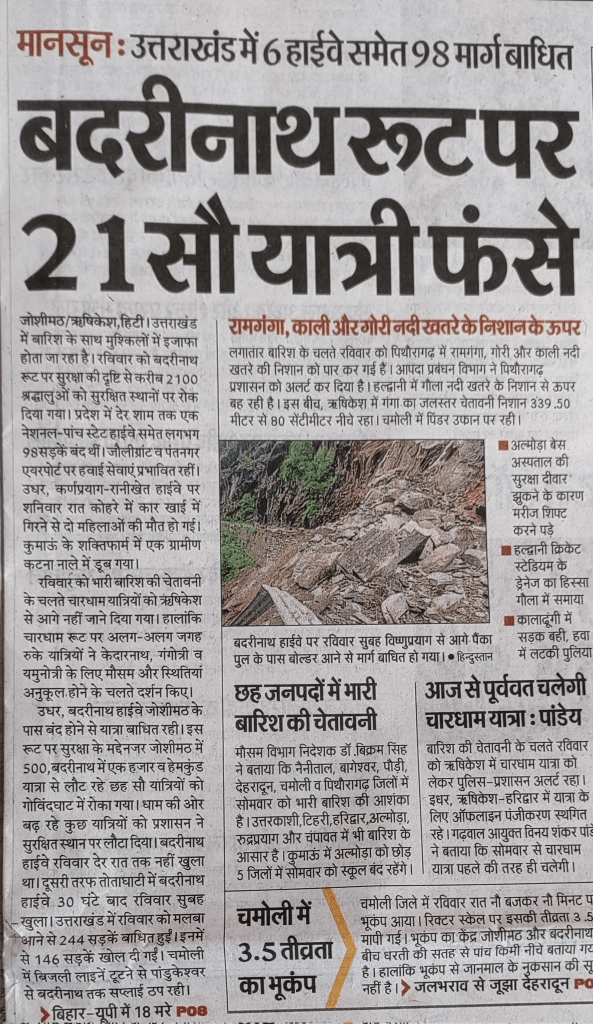
उत्तराखंड में बारिश के बाद मलबा और बोल्डर गिरने से बदरीनाथ हाईवे कई जगह बंद हो गया है। जिसके चलते सैकड़ों यात्री रास्ते में ही फंस गए हैं। तोताघाटी , सफेद पहाड़ और विष्णु प्रयाग में हाईवे पर भारी मात्रा में बोल्डर गिरे हैं। हाईवे पर सड़क का कुछ हिस्सा भी क्षतिग्रस्त हुआ है। जिससे रास्ता बंद है। तीर्थयात्री हाईवे खुलने का इंतजार कर रहे हैं। https://www.amarujala.com/photo-gallery/dehradun/uttarakhand-weather-badrinath-highway-closed-at-many-places-due-to-falling-debris-and-boulders-pilgrims-stuck-2024-07-07 (07 July 2024) https://www.livehindustan.com/uttarakhand/story-badrinath-route-2100-passengers-stranded-at-many-places-traffic-halted-98-roads-6-highways-uttarakhand-10404081.html (08 July 2024)
The CM also directed the completion of remediation work in the Baliyanala landslide area in Nainital and Gwalgaon landslide area in Dharchula, Pithoragarh, and to work on landslide prevention near Haldapani Law College in Chamoli district. https://timesofindia.indiatimes.com/city/dehradun/cm-dhami-directs-irrigation-department-to-expedite-flood-protection-efforts/articleshow/111471974.cms (04 July 2024)
ENVIRONMENT GOVERNANCE
Madhya Pradesh Forest officers flag concerns over govt appraisal rules -Indian Forest Service officers have expressed concern over a Madhya Pradesh government order issued on June 29 which states that the work of divisional forest officers, conservators and chief conservators posted at the district level and involved in field activities such as those that are related to the forest rights act, land acquisition, ecotourism, or mining activities in forest areas will be appraised by district collectors and divisional commissioners separately, pointing out that this is in violation of Supreme Court orders, and could also result in situations where senior officers are appraised by those junior to them. https://www.hindustantimes.com/india-news/forest-officers-flag-concerns-overmadhya-pradesh-appraisal-rules-101720205246779.html (6 Jul 2024)
Andhra Pradesh Govt probes arson of PCB, APMDC files The files, hard disks, general documents of employees, pay bills, minutes of the meetings, maintenance and other daily administrative documents belonging to the Pollution Control Board (PCB) and Andhra Pradesh Mineral Development Corporation (APMDC) are being verified to identify its purpose and find out any irregularities.
-It may be recalled that on Wednesday (July 03) night, two PCB employees were arrested for setting files pertaining to PCB and APMDC on the outskirts of Pedapulipaka village. The State government has ordered a detailed probe into the incident. The accused have been identified as Rama Rao, who works in the PCB, and Nagaraju – a car driver. https://www.newindianexpress.com/states/andhra-pradesh/2024/Jul/06/andhra-state-probes-arson-of-pcb-apmdc-files (06 July 2024)
Dehradun City on the brink of disaster (Dr S Ganguli, Group Advisor – Education, Aditya Birla Group, Mumbai) The very fabric of the city is under threat! The land of trees and rivers is choking. The city which used to wake up to birds chirping now wakes up to vehicles honking. Rice fields have been turned into highways and pockets of Dehradun known for its quality Basmati rice have transformed into potential zones for property dealers.
Residents believe that unplanned and thoughtless development plans have claimed a lot of land. There is a general consensus that the situation worsened after Dehradun became the state capital and the government, driven by people with power, introduced economic policies that skyrocketed real estate prices. https://timesofindia.indiatimes.com/blogs/voices/why-dehradun-is-on-the-brink-of-disaster-and-what-we-can-do-about-it/ (02 July 2024)
Report India scores low in EPI rank In 2022, at COP 15 in Montreal, over 190 countries made what has been called “the biggest conservation commitment the world has ever seen.” The Kunming-Montreal Global Biodiversity Framework called for the effective protection and management of 30% of the world’s terrestrial, inland water, coastal, and marine areas by the year 2030, commonly known as the 30×30 target. While there has been progress towards reaching this ambitious goal of protecting 30% of land and sea on paper, the recently released 2024 Environmental Performance Index (EPI).
While the highest overall EPI scores are concentrated in Europe, in contrast, emissions in the world’s largest economies, such as the U.S. (which is ranked 34th), are falling too slowly or are still rising, such as in China, Russia, and India, which are ranked 176th (27.6), with the lowest scores go to Southern and Southeast Asian countries. https://indianexpress.com/article/trending/trending-globally/top-10-countries-with-best-environment-2024-9432501/ (05 July 2024)
SOUTH ASIA
India-Bangladesh Govts prepare to renew Ganga treaty As India and Bangladesh prepare to begin negotiations to renew a nearly three-decade-old treaty for sharing the waters of the Ganga river, the impact of the climate crisis on water flows and the role of West Bengal government are emerging as crucial factors in the deal. People familiar with preparatory work done by the two countries said on condition of anonymity that the effect of the climate crisis on the flow of the Ganga is a crucial issue that has to be factored into the negotiations. This is a factor that has had an impact on the flows of numerous cross-border rivers that traverse India, they said.
– The people pointed out the Union Jal Shakti ministry set up an internal committee in July 2023 that included representatives of the Bihar and West Bengal governments. West Bengal nominated its representative to the internal committee in August 2023, and participated in three of the panel’s four meetings. The West Bengal government also sent a communication to the committee on April 5, 2024, that provided its drinking and industrial water requirements for inclusion in the Ganga Waters Treaty beyond 2026, the people said. The internal committee’s final report, submitted on June 14, 2024, is being examined by the Jal Shakti ministry, which has also formed a joint technical committee to begin discussions with Bangladesh.
– According to a report released by Kathmandu-based International Centre for Integrated Mountain Development (ICIMOD) in 2019, the climate crisis will begin altering water levels in the Ganga and the Brahmaputra over the next three decades, and the rivers could record an abrupt decrease in flow after 2050. This will diminish the water available for drinking, irrigation and producing electricity for roughly 250 million people living downstream. https://www.hindustantimes.com/india-news/india-bangladesh-prepare-to-renew-ganga-treaty-101720119730826.html (05 July 2024)
India-Bhutan PHPA-I to go ahead with dam construction if both parties agree on stabilisation measures After 11 years, 34 Technical Coordination Committee (TCC) meetings, numerous geo-technical studies, and cost escalation running into billions, the stalled dam construction for the 1,200MW Punatsangchhu-I hydropower project might finally resume after the TCC meets for the last time in New Delhi, India next month to make the final call. The PHPA-I dam construction was stopped after a major slide occurred on the right-bank of the site, leading to an indefinite deferral. After experts carried out several rounds of geo-technical studies, two possible solutions were floated – to either build a dam or barrage – to salvage the mega hydropower project.
– During the deliberation of the Public Accounts Committee (PAC) review report at the joint sitting on July 3, the Minister for Energy and Natural Resources, Gem Tshering, said that a final decision could not be reached at June TCC meeting in Delhi.
– Lyonpo said that the final decision will be made at the TCC meeting scheduled this month, which will be the final meeting of the Committee. “For now, the decision is to construct the dam with appropriate stabilisation and mitigation measures,” Lyonpo said.
– Both international and Bhutanese experts identified deep-seated fractures and a shear zone on the right bank of the dam site. Initially, the Indian counterparts did not accept the presence of these fractures but they now acknowledged it, added Lyonpo. The Chairperson of the PAC, Eminent Member Phuntsho Rapten, said that PHPA-I powerhouse is nearing completion. However, it cannot be used for several years due to the delay in the completion of the dam and other associated issues.
– The National Council member from Paro, Ugyen Tshering, said that the PHPA-I issue has persisted for 11 years, resulting in an annual revenue loss of Nu 5.5 billion and interest accumulation amounting to Nu 5 billion, which is a substantial loss for the country. The Punatsangchhu-I project is executed under a mutual beneficial bilateral agreement signed between the government and the Government of India in July 2007. The construction works on the hydro project kicked off in November 2008. The cost overrun for Puntshangchhu-I has reached a whopping Nu100 billion from the initial project cost of Nu 35 billion. So far, the project has spent around Nu 86 billion. The government of Bhutan hired a third independent foreign company, Stucky, to review the dam site and they recommended a barrage. The Bhutanese side is advocating for the construction of a barrage, while the Indian side is pushing for the construction of a dam. The cost of constructing the barrage is estimated to be Nu 16-18 billion. https://kuenselonline.com/phpa-i-to-go-ahead-with-dam-construction-if-both-parties-agree-on-stabilisation-measures/ (04 July 2024)
IWT Pakistan’s request on Ratle HEP to be heard by permanent court of arbitration The Permanent Court of Arbitration (PCA) in the Hague will hear Pakistan’s request on 5th July regarding the Kishanganga and Ratle hydroelectric projects on the Chenab and Kishanganga rivers. https://profit.pakistantoday.com.pk/2024/07/04/pakistans-request-on-controversial-indian-hydropower-projects-to-be-heard-by-permanent-court-of-arbitration-on-july-5/ (04 July 2024)
Nepal 7 injured, 2 trapped in accident at under-construction HEP At least seven construction workers were injured in an accident at the under-construction Bhotekoshi-1 Hydropower Project in Sindhupalchok district on Friday (July 05). The Sindhupalchok District Police Office said the workers were buried under concrete after a structure collapsed during construction.
The condition of two others trapped at the bottom of the structure is yet to be ascertained. The 40-MW project is being constructed by Electro Power Company Limited at a cost of around Rs8 billion. https://kathmandupost.com/province-no-3/2024/07/05/seven-injured-two-trapped-in-accident-at-under-construction-hydel-project (05 July 2024)
14 killed, 9 missing after floods & landslides -Lashing rains in Nepal causing flash floods and landslides have killed at least 14 persons across the country, with disaster teams searching for nine missing, police said on July 7. “Police are working with other agencies and locals to find the missing people,” Nepalese police spokesman Dan Bahadur Karki told AFP. Those killed and missing are in multiple locations.
Parts of Nepal have been receiving heavy rainfall since July 4, prompting disaster authorities in the Himalayan nation to warn of flash floods in multiple rivers. There have been reports of inundation in several districts of lowland areas bordering India. Last month 14 persons were killed in Nepal in ferocious storms that brought landslides, lightning and flooding.. https://www.thehindu.com/news/international/14-killed-9-missing-following-flood-and-landslide-in-nepal/article68378562.ece (07 July 2024)
During a National Assembly meeting on Jul 5, Minister of Labour, Employment, and Social Security, Dol Prasad Aryal, briefed members on the casualties caused by the monsoon havoc. “As of now, there have been a total of 55 flooding incidents resulting in 4 deaths, 1 person missing, and 2 injured. Landslides have claimed 24 lives and injured 19. Heavy rainfall has been reported in 77 locations, resulting in injuries to 4 people. This totals to 24 deaths, 1 missing, and 25 injured. Additionally, 46 houses have been completely damaged and 36 partially damaged. Lightning has affected 32 districts, causing 19 deaths and 35 injuries,” Aryal stated. https://www.indiatoday.in/world/story/47-dead-in-nepal-as-heavy-rain-triggers-floods-landslides-2563455-2024-07-07 (07 July 2024)
Pakistan Neelum Jhelum HEP: Some serious design flaws identified Pakistan is said to have identified serious design flaws in the 969MW Neelum Jhelum Hydropower Project with the Chinese company and asked for early rectification of faults, well informed sources said. https://www.brecorder.com/news/40310633/969mw-neelum-jhelum-hydropower-project-some-serious-design-flaws-identified (01 July 2024)
Bangladesh Floods leave at least 8 dead -The death toll from floods in Bangladesh this week has risen to eight, leaving more than two million affected after heavy rains caused major rivers to burst their banks, officials have confirmed. In the worst-hit Kurigram district, eight out of nine rural towns have been marooned by flood water, local disaster and relief official Abdul Hye said. “We live with floods here. But this year the water was very high. In three days, Brahmaputra rose by 6- to 8ft [2-2.5 metres],” Abdul Gafur, a local councillor in the district, said. https://www.theguardian.com/world/article/2024/jul/06/eight-dead-and-2m-affected-by-bangladesh-floods (06 July 2024)
Flooding in India, as well as in downstream Bangladesh, has also caused widespread damage and impacted millions. In low-lying Bangladesh, downstream from India, the disaster management agency said floods had impacted more than two million people. https://www.thehindu.com/news/international/14-killed-9-missing-following-flood-and-landslide-in-nepal/article68378562.ece (07 July 2024)
CHINA
Dyke breach at second-largest freshwater lake Around 5,700 residents were relocated after waters breached a dike at China’s second-largest freshwater lake in the south of the country, while rescue workers rushed to contain further damage from outflows, Chinese state media said on Saturday (July 06). More than 2,300 rescue personnel were working to build a second line of defence for floodwaters after Friday’s (July 05) breach across a 226-metre (740-foot) area in Hunan province, China Central Television reported. Footage from state media showed a wave of water surging through a breach in the dike past several overturned lorries, into pools engulfing several houses. https://www.hindustantimes.com/world-news/dam-breach-at-chinas-second-largest-freshwater-lake-5700-residents-relocated-101720252291217.html (06 July 2024)
THE REST OF THE WORLD
USA Ecuador Court rules pollution violates rights of a river A ruling described by activists as “historic,” a court in Ecuador has ruled that pollution has violated the rights of a river that runs through the country’s capital, Quito. The city government appealed the ruling, which is based on an article of Ecuador’s constitution that recognizes the rights of natural features like the Machángara River. “This is historic because the river runs right through Quito, and because of its influence, people live very close to it,” said Darío Iza, whose group Kitu Kara filed the complaint on behalf of the river.
– The court ruled that while appeals proceed, the government will have to come up with a plan to clean up the Machángara. The city of 2.6 million people dumps all sorts of effluents and contaminants into the Machángara, which starts high in the Andes mountains. But by the time it runs through Quito, it encounters problems such as a near-total lack of treatment of the waste water that is dumped into it. https://www.theguardian.com/world/article/2024/jul/07/ecuador-court-river-pollution-violates-rights (07 July 2024)
Residents return home after dam breach leads to evacuations People living downriver of a Wisconsin dam that was breached by floodwaters have been allowed back into their homes following an evacuation order, police said July 6. The dam in Manawa along the Little Wolf River was breached July 5 afternoon by rain-driven floodwaters that eroded an estimated 50-foot-wide (15.2-meter-wide) portion of the dam, said Manawa Police Chief Jason Severson. The dam breach happened after the National Weather Service said a deluge of about 127 mm rain fell on that area of eastern Wisconsin in a few hours on July 5. Homes south of Manawa’s dam were ordered evacuated Friday, but that order was lifted at 5 p.m. in the city about 55 miles (88 kilometers) west of Green Bay after the flooding subsided. https://apnews.com/article/manawa-wisconsin-dam-flooding-rain-evacuation-cd25eed1786a2e288f7eb34d1a3f465b (06 July 2024)
SANDRP
Also see: DRP 01 July 2024 & DRP 24 June 2024
Follow us on: www.facebook.com/sandrp.in; https://twitter.com/Indian_Rivers

 SANDRP