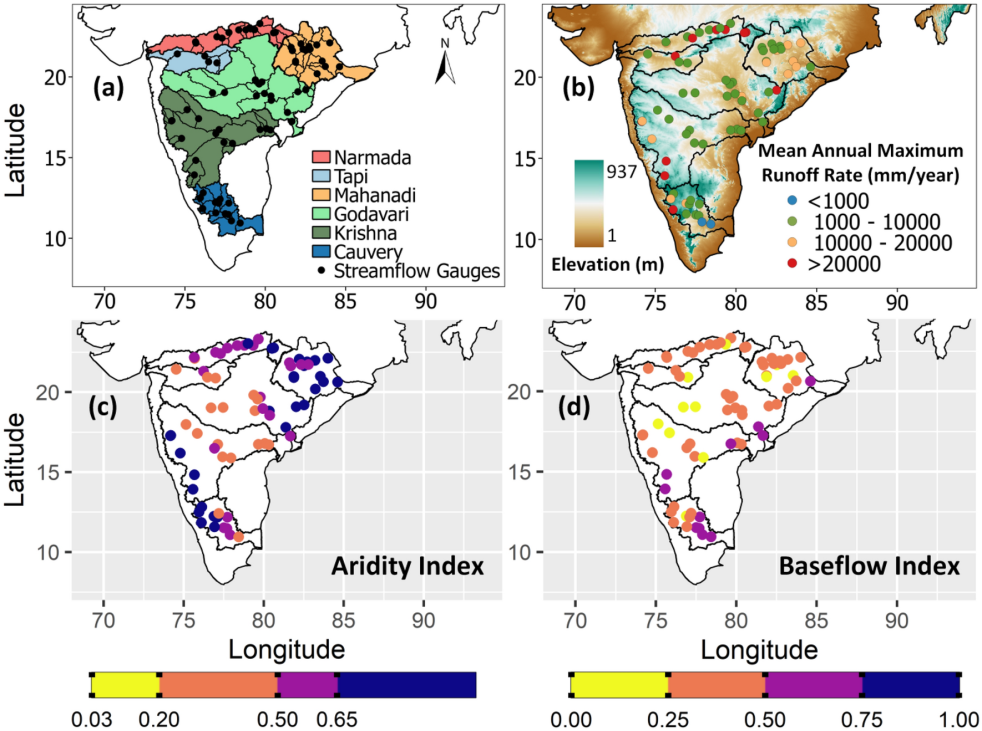
(Feature Image: (a) Locations of streamflow gauges with catchment boundaries in six major river basins of Peninsular India, (b) elevation map and mean annual maximum runoff rate (streamflow per unit catchment area), (c) Aridity Index (AI) and (d) Baseflow Index (BFI). The maps in first row are prepared in QGIS (Version 2.14.0 ‘Essen’ (2016), URL: http://qgis.org) and the maps in second row are generated using R (Version 4.2.2 (2022), URL: https://www.R-project.org/). Source: Baseflow significantly contributes to river floods in Peninsular India )
A recently published study, see details given below throws light on the role of groundwater contribution to baseflow in rivers and their flooding in Peninsular India’s river like Narmada, Tapi, Mahanadi, Godavari, Krishna and Cauvery. The found that while baseflow contributes more to river flows, its share in the flood event flow magnitude decreases as surface runoff accounts for a larger proportion of flood discharge on the day of the flood.
Most significant are the findings related to dam induced flood that SANDRP has been writing for long and the finding corroborate exactly what SANDRP has been saying: Sudden releases of water from a dam can raise river levels during extreme rainfall events, especially when the dam is nearly full. The impact of sudden floods is more destructive because people living in nearby areas are often unprepared. Without a dam, floodwaters rise slowly over time, allowing people to take preventive measures. However, sudden floods caused by dam releases offer little or no time to prepare, increasing the risks associated with dam-induced flood hazards. Furthermore, the construction of dams alters the natural regime of rivers, leading to changes in sediment transport and erosion patterns. These changes can heighten the risk of flooding downstream from a dam.
The study is not only very useful in its own right, but it also underlines the need for many more studies on Rivers in India, one of the least studied subjects. One of the reasons for such studies not being done or delayed, as pointed out in the study is the non-availability of stream flow data in public domain. It is high time that the govt and Central Water Commission make these public promptly on daily basis.
Study ‘Baseflow among most important factors driving river flooding in Peninsular India’ The study, (https://www.nature.com/articles/s41598-024-51850-w), was published January 13, 2024 in journal Scientific Reports of Nature portfolio. Author Shailza Sharma:
Water storage in the upper layer of soil (the unsaturated zone) is referred to as soil moisture, while water storage in the saturated zone is known as groundwater. Below the water table, groundwater can flow into a river, which is generally referred to as baseflow. This study examines six major river basins — Narmada, Tapi, Mahanadi, Godavari, Krishna and Cauvery — to identify the dominant mechanisms that generate floods.
Most studies on floods in India have focused on rainfall data because discharge data has only recently been made publicly available through the India-Water Resource Information System website. This is the first study to use observed discharge data from Indian river basins to enhance our understanding of the process-based factors influencing river floods.
Trends in the annual mean baseflow showed a pattern similar to trends in flood magnitudes, indicating a relatively strong correlation. In contrast, rainfall and soil moisture trends were less consistent with flood trends, resulting in a weaker correlation. These findings suggest that multi-decadal trends in baseflow have had a significant impact on trends in flood hazards in Peninsular India. We examined the relationship between annual floods and their drivers for antecedent periods ranging from 1 to 14 days. Baseflow is the dominant factor for shorter time lags, while rainfall plays a more significant role at longer antecedent periods. A catchment with higher baseflow indicates wetter conditions, leading to an increased likelihood of rapid runoff with incoming rainfall events.
We examined the correlation between floods and baseflow on the flooding day and the days leading up to it to further validate our findings. Across Peninsular catchments, a high positive correlation was observed five days before the flood event, reinforcing the strong influence of baseflow on floods. To understand what happens to this association on the flooding day, we investigated the relative contribution of baseflow to peak flows using the Baseflow Index (BFI). A negative correlation was observed between flood magnitudes and BFI, indicating that while baseflow contributes more to river flows, its share in the event flow magnitude decreases as surface runoff accounts for a larger proportion of flood discharge on the day of the flood. Moreover, a flood event cannot occur without substantial rainfall, even if the landscape has high baseflow.
Sudden releases of water from a dam can raise river levels during extreme rainfall events, especially when the dam is nearly full. The impact of sudden floods is more destructive because people living in nearby areas are often unprepared. Without a dam, floodwaters rise slowly over time, allowing people to take preventive measures. However, sudden floods caused by dam releases offer little or no time to prepare, increasing the risks associated with dam-induced flood hazards. Furthermore, the construction of dams alters the natural regime of rivers, leading to changes in sediment transport and erosion patterns. These changes can heighten the risk of flooding downstream from a dam.
Indeed, the duration of floods has increased following the construction of dams in Peninsular India. Reservoir regulation has extended flood duration by approximately 65 per cent. Floods in regulated catchments tend to last longer but are generally less severe, with smaller peaks and lower volumes, compared to floods in natural catchments. Hydrologic processes need more attention, alongside atmospheric processes, for a better understanding and management of floods.
Integrating flood forecasting with dam releases could be beneficial in controlling fluvial floods. Generally, these floods occur during the monsoon season, when dams are nearly full and have limited capacity to accommodate inflow during extreme rainfall events. As a result, dam engineers are often forced to execute sudden releases of water from dams. Effective flood forecasting, with a sufficient lead time, would help dam engineers manage dam water levels and maintain sufficient flood storage capacity. https://www.downtoearth.org.in/interviews/water/-baseflow-one-of-most-important-factors-driving-river-flooding-in-peninsular-india–95864 (29 April 2024)
HYDRO POWER PROJECTS
SANDRP Blog May 2024: Rockfall incident at Chanju III HEP kills 1; injures 2 The Chanju III and Deathal Chanju HEPs are coming up above 2000-m elevation in Chanju valley which is covered by 4000 to 5300 m high mountains with number of glaciers and experiences heavy snow fall spells, however the EIA reports have overlooked threats of avalanches, glacial moraines and are mute on cloudburst induced flashflood disaster to all the HEPs on Chanju river.
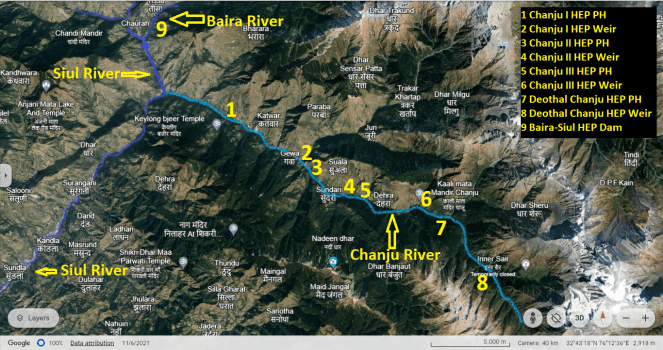
The construction of large number of tunnels, approach roads, workers colonies, ropeways, power transmission lines and other project infrastructures for the HEPs along Chanju river have increased the geological and climatic disaster potential of Chaurah valley manifold which required timely precautionary measures including scrapping of unviable HEPs and strict compliance to environmental norms before it is too late. https://sandrp.in/2024/05/05/may-2024-chanju-iii-hep-in-chamba-hp-rockfall-incident-kills-1-injures-2/ (05 May 2024)
Himachal Pradesh Ecological disaster in Kinnaur This photographic series examines the intricate story of the Sutlej, a river in the northwest Himalayas. The transformation that its surrounding landscape and basin has witnessed over the past fifty years has been dramatic, leading to profound environmental damage and repercussions for communities living near it. Much of this damage stems from incessant construction and hydroelectric projects. https://caravanmagazine.in/environment/kinnaur-ecological-destruction (01 May 2024)
ग्रामीणों ने गुनल हाइड्रो प्रोजेक्ट के खिलाफ एक बार फिर आवाज उठाई मनाली उजी घाटी के शिल्ह में 1.5 मेगावाट के गुनल हाइड्रो प्रोजेक्ट के खिलाफ लोगों ने एक बार फिर आवाज उठाई है। ग्रामीणों ने बिजली परियोजना का विरोध किया और एक स्वर से कहा कि वे इस 1.5 मेगावाट की परियोजना को किसी भी कीमत पर नहीं होने देंगे. यदि इस परियोजना को लागू करने का प्रयास किया गया तो चारों पंचायतों के लोग लोकसभा चुनाव का बहिष्कार करने से नहीं डरेंगे. बैंची पंचायत प्रधान जोगिंदर मेहरा ने कहा कि चार पंचायतों के लोग करीब दो साल से बिजली परियोजना का विरोध कर रहे हैं. जिला प्रशासन को भी कई बार अवगत कराया जा चुका है, लेकिन प्रशासन के अधिकारी भी समस्या का समाधान नहीं तलाश रहे हैं. जिससे स्थानीय लोगों में प्रशासन व सरकार के प्रति आक्रोश बढ़ता जा रहा है.
उन्होंने कहा कि बिजली परियोजना के निर्माण से यहां के लोगों की सैकड़ों बीघे जमीन और सेब के बगीचों की सिंचाई के लिए पानी की कमी हो जायेगी. इस नहर में पीने के पानी के स्रोत हैं। जहां बिजली परियोजना का काम चल रहा है, वहां देवी-देवताओं के पवित्र स्रोत भी हैं। इस प्रोजेक्ट से लोगों की ईश्वर में आस्था को ठेस पहुंचेगी. उन्होंने कहा कि उपायुक्त को एक ज्ञापन भी भेजा गया है, जिसमें लोगों की ओर से स्पष्ट किया गया है कि अगर समय रहते इस परियोजना को बंद नहीं किया गया, तो चारों पंचायतों के लोग लोकसभा चुनाव का बहिष्कार करेंगे. https://jantaserishta.com/local/himachal-pradesh/villagers-once-again-raised-their-voice-against-gunal-hydro-project–3240353 (26 April 2024)
Manipur Livelihood disaster in Mapithel region Jajo Themson While attempt is made with the Mapithel dam of Thoubal Multipurpose Project to harness the target benefit of power @ 7.5 MW, Drinking water supply to Imphal city @ 10-12 Million Gallon Daily (MGD), Irrigation of 33,449 ha of land to Thoubal district and Flood control, the affected villagers sacrificed around 2000 hectares of land and forest areas and further many un-surveyed areas have also been adversely affected. Moreover, approximately 15 km range of Yangwui Kong/Thoubal River is vanished without compensation claimed.
Submergence of capital asset such as wetland agricultural field, river areas, home-stead portions and low-lying forest directly led to end of agriculture practice, halted access to river and collapse of farm based economic activities. This in turn resonated counter-negative impacts on livelihood; villager’s employment, income generation, economy, food sovereignty; day to day life sustenance and living standard of the affected communities in the post dam period. https://e-pao.net/epPageExtractor.asp?src=features.Livelihood_Disaster_in_Mapithel_Region_By_Jajo_Themson.html (28 April 2024)
Jammu & Kashmir CHENAB valley in Kashmir sinking in three districts of Doda, Ramban and Kistwar. Besides large number of mega hydro projects, big highways and railways joining Jammu and Srinagar pass here with multiple tunnels. It is also a seismic zone. But these major interventions done without any disaster risk assessment.
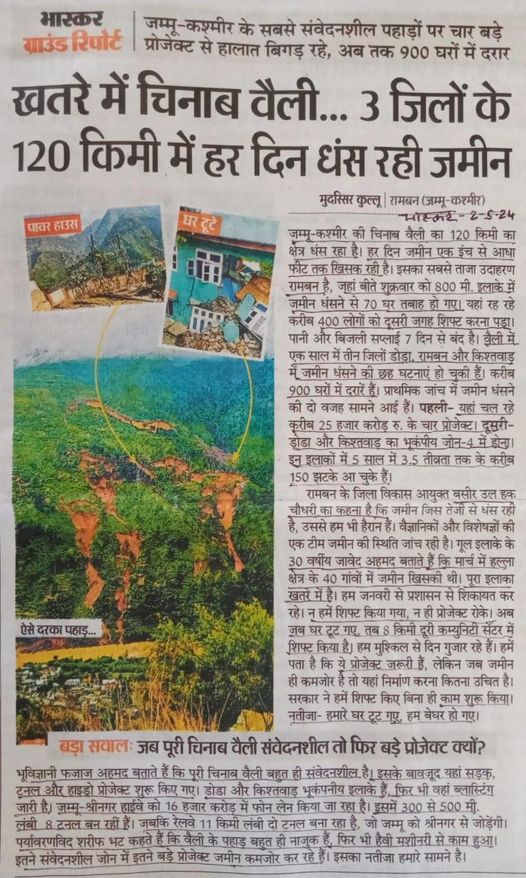
https://www.bhaskar.com/national/news/jammu-kashmir-land-sinking-situation-update-chenab-valley-ramban-132960435.html (02 May 2024)
-Experts suggest that unscientific liquid waste management is one of the reasons for land subsidence in the Parnote area of Ramban, which is densely populated. However, many experts also point out that chaotic construction and large-scale development projects, such as the construction of tunnels, highways, and railways, have had an impact on the mountains surrounding the Ramban area, making them more susceptible to landslides and land subsidence.
-Udhampur-Srinagar-Baramulla Rail Line project has been undertaken in the region, said local resident Sanjeev Kumar. “The mountains have been subjected to blasting over the last 10 years, causing considerable disturbance. Furthermore, a large amount of tunnelling and construction waste has been dumped into the Chenab river, leading NGT to penalise a construction company for this offence. In many places, the water flow of the Chenab river has been obstructed, impacting the mountains. This disruption to the river’s natural course could also contribute to land subsidence,” Kumar said. https://www.downtoearth.org.in/news/urbanisation/unplanned-constructions-wastewater-seepage-causing-land-subsidence-in-chenab-valley-95986 (06 May 2024)
Worst spring power crisis in decades – The electricity woes plaguing Kashmir have reached a critical juncture, with residents experiencing an acute shortage of power that surpasses anything witnessed in recent memory during the spring. Despite the arrival of spring, typically a period of respite for locals, the Valley remains engulfed by darkness due to prolonged power outages. The resident said that despite a significant increase in electricity tariffs (mostly for non-metered areas) over the past six months, they are facing drastic drops in supply, leading to widespread frustration and disruptions in daily life. https://www.dailyexcelsior.com/worst-spring-power-crisis-in-kashmir-in-decades-residents-aghast/#google_vignette (29 April 2024)
Interview Anatomy of a fault In this interview seismologists CP and Kusala Rajendran warn about the possible impending major earthquake in middle Himalayas, due at least since 1934. The scientists also say that there is a lot we can do to minimise the impacts, but we are not doing those things. https://www.hindustantimes.com/lifestyle/art-culture/anatomy-of-a-fault-a-wknd-interview-with-cp-and-kusala-rajendran-101714129880383.html (26 April 2024)
Uttarakhand Kundan Energy to build 42 Mw HEP Kundan Green Energy has secured a mandate to build a 42 MW hydropower plant at Okhali with a potential to expand to 60 MW, said Udit Garg, director and CEO, Kundan Green Energy. https://energy.economictimes.indiatimes.com/news/renewable/kundan-green-energy-to-build-42-mw-hydropower-plant-in-uttarakhand/109712758 (30 April 2024)
Karnataka L&T loses legal battle for Sharavathi PSP Justice M Nagaprasanna, presiding over the single-member bench, dismissed L&T’s plea, stating that a non-participant in a tender process should not seek to halt it. L&T then appealed, contending that the 21-day tender period was unusually short, typically requiring at least 90 days, arguing that this was meant to benefit specific bidders.
-However, the division bench, chaired by Chief Justice NV Anjaria and Justice Krishna S Dixit, affirmed the legitimacy of the tender process, noting that KPCL had the authority to determine tender timelines and that L&T had participated in the pre-bid phase, making their objections inconsistent. The project was subsequently awarded to engineering and infrastructure major Megha Engineering and Infrastructures Ltd, marking a significant step forward for KPCL’s power generation plans. https://www.downtoearth.org.in/news/environment/l-t-loses-legal-battle-against-kpcl-over-sharavathi-pumped-storage-project-in-karnataka-95849 (29 April 2024)
MEIL bags 2000Mw Sharavathi PSP -Infrastructure firm Megha Engineering and Infrastructure (MEIL) on Monday (April 29) said it has bagged a 2,000-megawatt Sharavathi pumped storage power project in Karnataka entailing an investment of Rs 8,000 crore. The Sharavathi river is a vital source of hydroelectric power in Karnataka, a company statement said, adding that with a planned total power generation capacity of 2000 MW, it is the country’s largest pump storage power generation unit. https://economictimes.indiatimes.com/industry/energy/power/megha-engineering-and-infrastructure-bags-2000mw-sharavathi-pumped-storage-project/articleshow/109700644.cms (29 April 2024)
NHPC -As per the MoU, NHPC and Ocean Sun will explore key areas of cooperation for demonstration of Ocean Sun’s floating solar energy technology based on photovoltaic panels. The panels would be mounted on hydro-elastic membranes, at relevant sites to be identified by NHPC. https://pib.gov.in/PressReleaseIframePage.aspx?PRID=2019129 (30 April 2024)
DAMS
Farakka Barrage CM talks tough on Ganges W Bengal CM has, on May 1, in election rallies in N Bengal, asked people to question the impact of 1996 Indo Bangladesh Ganga water treaty and demanded compensation and desilting of Farakka. https://en.somoynews.tv/news/2024-05-02/mamata-talks-tough-on-ganges-after-foiling-teesta-deal (02 April 2024)
Himachal Pradesh Bilaspur admin frames new rules on muck dumping The Bilaspur district administration has framed new rules for muck dumping in the district and put a temporary ban on as many as 75 private constructions along the Kiratpur-Manali highway due to illegal and unscientific disposal of debris by owners. Officials said that owners of these new construction sites along the highway were found to be violating environmental norms by disposing muck unscientifically in forest areas and nullahs that feed the Bhakra dam reservoir. The administration has also made it mandatory the submission of a muck-dumping plan and only after permission is granted by the departments concerned, construction activities will be allowed.
– The administration has also roped in local panchayats in its plan to curb this illegal activity. The panchayats have been authorised to issue no objection certificates to applicants, who have arranged for legal dumping sites. The DC has also ordered the officials of the pollution control board, town and country planning department, and mining department to visit these construction sites and issue challans. https://timesofindia.indiatimes.com/city/shimla/bilaspur-district-administration-frames-new-rules-on-muck-dumping/articleshow/109798310.cms (3 May 2024)
Construction of Renuka dam delayed, assembly told “The commencement of construction for the diversion tunnels is expected in Aug 2024, but the main dam construction is anticipated to begin in Feb 2025,” Sukhvinder Singh Sukhu-led govt stated in the Himachal assembly during the ongoing budget session. According to govt, out of total 954.27 hectares of private land required for the project, 947.4 hectares has been acquired and 909 hectares forest land will be transferred after stage II or after final clearance under the Forest Conservation Act is granted. The compensatory afforestation plan has also been submitted to the MoEF and a final forest clearance is expected before March 31, govt added.
State govt further stated that a panel of geological experts, which was formed on the suggestion of the Central Water Commission (CWC), the project design consultant, had recommended investigations for the design of the dam and diversion tunnels. “The investigations in the main dam area have been completed and will shortly begin in the spillway and downstream cofferdam area. Based on these investigations, the CWC will proceed to design the dam and diversion tunnels,” govt stated.
Under the project a 148m high rock-fill dam across the Giri river, a tributary of the Yamuna river, is envisaged at Dadahu in Sirmaur district. The dam will have a 24-km long reservoir and a powerhouse of 40-MW capacity for hydel power generation. Proposed to be built at an estimated cost of around Rs 7,000 crore, the project will provide water to NCR of Delhi. According to state govt reply, so far the Centre has released Rs 1,702.7 crore for the project and the beneficiary states have contributed Rs 517.32 crore. https://timesofindia.indiatimes.com/city/shimla/construction-of-renuka-dam-delayed-hp-assembly-told/articleshow/108029673.cms (27 Feb. 2024)
Pandoh dam Executive Engineer issues alert Senior executive engineer of BBMB project Pandoah Vivek Chopra has issued an alert about opening of spillway gates of Pandoh Dam. In a release the XEN said, “Due to melting of snow on higher reaches the water level in Pandoh dam is rising fast & the spillway gates of the dam can be opened anytime to release water from the dam.” He said, “This can lead to sudden increase in water level of river Beas and warned people living near the river and tourists not to go near the river as a precautionary measure.” https://himachalguardian.com/2024/05/pandoh-dam-executive-engineer-issues-alert/ (2 May 2024)
Uttarakhand Locals object govt’s plan to fell 2k trees in RF Residents have expressed their concerns over the state’s move to ostensibly meet water shortage by felling over 1,800 trees from Khalanga reserve forest and constructing a reservoir to channel water to deficit areas in Dehradun. Locals are upset at the move and have raised their objections through email as tender of Song dam drinking project is due to be opened. “While our state is battling against wildfires due to climate adversity, the plan to fell 2,000 trees from reserve forest requires serious rethinking ,” said one of the activists who is campaigning against the proposed move. The tender for construction of a 130.6 metre-high concrete gravity dam and appurtenant works, totaling Rs 1,306 crore, is to be completed within 60 months. Once objections from residents were received, representatives of Dehradun would officially meet the state govt with their grievance against felling trees. https://timesofindia.indiatimes.com/city/dehradun/locals-object-governments-plan-to-fell-2k-trees-in-khalanga-forest/articleshow/109849246.cms (05 May 2024)
Karnataka Vented dam at Moodubettu Mata collapses Constructed 15 years ago, the vented dam was a crucial water source for farmers in Soorinje, Ekkaru, and Kateel villages. Additionally, many students relied on the dam’s footpath to commute to schools and colleges in Kateel and Soorinje. However, following the collapse, people now face a detour of at least 10 km. With the monsoon season approaching in just a month, immediate repairs to the vented dam are not feasible. The construction of a new dam will require time to complete the necessary procedures, leaving agriculturists concerned about the water supply to their crops for the next two years.

Concerns have been raised regarding the structural integrity of the dam, as the base has noticeably shifted to one side. Locals allege that illegal sand excavation from the dam’s base contributed to its collapse. Despite complaints from the public, no action was taken by the authorities. Agriculturists believe that if not for the constant sand excavation, the dam could have remained functional for at least 50 years. They are urging PWD engineers to conduct a comprehensive investigation into the matter. https://daijiworld.com/news/newsDisplay?newsID=1188943 (05 May 2024)
INTERSTATE WATER DISPUTES
Cauvery Water Dispute River dry, no water from Karnataka to TN: CWRC – The Cauvery Water Regulation Committee (CWRC) on Tuesday (April 30) rejected Tamil Nadu’s demand for further release of Cauvery river water from Karnataka’s reservoirs as the water scarcity situation became grim. The committee stated that both states have just enough water in the reservoirs to meet the drinking water demands.
-Acres of land have turned barren and arid after river Cauvery across Kushalnagar has parched up. Rock fragments that are usually submerged under the river have now popped up, hinting at an acute water crisis in the near future. Although mega project AMRUT 2.0 was expected to end the water crisis across Kushalnagar, there is no water in the river to enable pipelined supply. The non-availability of water in Cauvery river has forced authorities to source water from borewells to meet the needs of residents. https://www.newindianexpress.com/nation/2024/May/01/cwrc-river-dry-no-water-from-karnataka-to-tn (01 May 2024)
TN to pursue SC for water rights -The more than a century-old dispute over the sharing of Cauvery waters between Karnataka and Tamil Nadu reached a flashpoint on Tuesday (April 30) at the 95th meeting of the Cauvery Water Regulation Committee (CWRC), chaired by Vineet Gupta, when CWRC agreed with Karnataka’s claim that it did not have adequate water even to meet its demands, and rejected Tamil Nadu’s demand outrightly,
-Reacting to the development at the CWRC, which was seen as taking a stand in favour of Karnataka, Tamil Nadu Water Resources Minister Duraimurugan said that the State would approach the Supreme Court for remedy and added that the neighbouring State had never bothered to release the due share of water with Tamil Nadu. https://www.deccanchronicle.com/nation/politics/tamil-nadu-to-pursue-supreme-court-for-cauvery-water-rights-891945 (01 May 2024)
IRRIGATION
Tamil Nadu Water being drawn illegally from Bhavanisagar dam Farmers and farmers associations say a few owners of large farms have laid pipelines to illegally draw water from the dam to supply to their lands; the district is reeling under a water shortage and all other farmers have been told water cannot be supplied for irrigation. https://www.thehindu.com/news/cities/Coimbatore/despite-low-levels-water-continues-to-be-drawn-illegally-from-bhavanisagar-dam-allege-farmers-in-erode/article68109114.ece (26 April 2024) The water flow to the dam is decreasing due to lack of rainfall in the catchment area of the Nilgiris for the past few months. As the water level continues to decrease, fish are floating dead in the Dam. Due to this, the area smells bad. Farmers are worried as the water level in the dam continues to decrease, there is a risk of drinking water shortage in Erode district. https://www.afternoonnews.in/article/dead-fish-floating-in-bhavanisagar-dam-in-erode (29 April 2024) -Officials of the Water Resources Organisation (WRO) of the Public Works Department (PWD) have removed pipelines that were laid by a few farmers to draw water illegally, from the water spread area of the Bhavanisagar dam in Erode. https://www.thehindu.com/news/cities/Coimbatore/after-th-report-officials-remove-pipelines-drawing-water-illegally-from-bhavanisagar-dam-in-erode/article68123966.ece (30 April 2024)
URBAN RIVERS

Vikalp Sangam Re-envisioning riverscapes & urban riverfronts For over a decade, experts in river ecology have been warning against prioritizing cosmetic beautification of rivers over their genuine restoration and revitalization. Himanshu Thakkar, an environmental activist working on water related issues with South Asia Networks on Dams, Rivers and People (SANDRP), highlights the importance of considering a river’s “character, purpose, and cultural value,” stating that neglecting these factors could result in more problems than solutions. Over the years, with an increasing number of dams for hydropower generation and rising impacts of climate change, Indian rivers, especially in urban areas, are facing the dichotomy of water scarcity and flash flooding. The solution to both problems lie in ensuring that the ecological flow of rivers (linear, horizontal, and vertical) across all the seasons is maintained.
To truly restore rivers and enjoy their beauty, we need to create and sustain democratic participatory processes that include mapping hydrology and stakeholders (including non-human) of the rivers. Thereafter, we need to successfully implement Rights of Nature by recognizing rivers’ right to exist and regenerate. It is compelling that we prioritize bioregional governance and strategies for addressing the looming climate and biodiversity crises. By embracing the solutions offered by nature, we can pave the way for restoration and regeneration and secure our future.
At the policy level, the River Cities Alliance in India serves as a platform facilitating the exchange of best practices and lessons among river cities. Drawing insights from the challenges encountered in RFDs, particularly concerning social and ecological concerns, offers valuable learning opportunities for other river cities to avert similar pitfalls. As the leader of the Global River City Alliance, India has the opportunity to demonstrate its leadership through action and ideology by setting a precedent for advocating a river-centric perspective and endorsing the rights of rivers as fundamental principles for the 275+ global cities within this alliance. https://vikalpsangam.org/article/re-envisioning-riverscapes-and-urban-riverfronts-in-india-toward-ecological-and-social-harmony/ (02 May 2024)
Kukrail; Lucknow Despite stay, homes demolished for Riverfront, Plaza Around 10,000 people, most with small jobs and low incomes, have lived in constant fear of losing homes built over decades of toil in a working class settlement alongside Kukrail drain in Lucknow. Despite a stay on demolitions from the Allahabad High Court and pending final hearing of their petition in the Supreme Court, residents have faced demolition squads, loss of belongings and livelihoods.
In Apr 2023, the govt of India’s Central Zoo Authority gave an in-principle approval to the project for a night safari and wildlife park in Kukrail forest. Once the project kicked off on 1 Dec 2023, officials began to work on a feasibility study. On 21 December, the first bulldozer rolled into Akbar Nagar, but before the demolition work could begin, the Allahabad high court’s Lucknow bench ordered a stay. https://article-14.com/post/in-lucknow-a-poor-neighbourhood-is-being-razed-for-a-riverfront-plaza-despite-a-stay-order-from-the-high-court-6632f55272fa0 (2 May 2024)
Buddha Dariya; Ludhiana Treated water not for irrigation The committee highlighted that according to the analysis results of the samples collected from various critical locations of Buddha Nullah, the concentration of various parameters is elevated, and dilution of Buddha Nullah is necessary before using it for irrigation. Based on the analysis reports of effluent samples collected from various critical locations of Buddha Nullah and considering the current situation, the committee concluded that the water of Buddha Nullah does not appear to be suitable for irrigation purposes until the water from all outlets falling into Buddha Nullah is properly treated. https://timesofindia.indiatimes.com/city/chandigarh/treated-water-not-for-irrigation/articleshow/109674720.cms (29 April 2024)
RIVERS
Books Ecological fiction masterpieces “Restless Waters of the Ichhamati” by Bibhutibhusan Bandyopadhyay celebrates the flora and fauna of Bengal. Through the gaze of a slow-moving river-farer, the novel considers the vibrant plant life and traces of human habitation along the Ichhamati river’s banks.

Bandyopadhyay’s poetic prose evokes the flow of time and the interconnectedness of generations with the river and its surroundings. The novel’s form, devoid of chapter breaks, mirrors the fluidity of the river’s course, inviting readers to immerse themselves in the ebb and flow of nature’s rhythms. https://feminisminindia.com/2024/04/23/10-ecological-fiction-masterpieces-weaving-indias-environmental-ethos/ (23 April 2024)
Report India to be among top 4 contributors of microplastics in waterbodies China, India, the United States and Japan will account for 51 per cent of this volume, according to the 2024 Plastic Overshoot Day (POD) Report. India will release 391,879 tonnes of microplastics and will be the second leading polluter of the waterbodies after China (787,069 tonnes) in the world, the analysis by Swiss non-profit EA Earth Action showed.
In 2024, at least 291,071 T of chemical additives will be discharged into the waterbodies, according to the POD report. Of this, 40 per cent will come from four nations — China, India, the Russian Federation and Brazil, the scientists wrote. India will release 31,483 T of chemical additives from microplastics and will be the second leading polluter of waterways through this method after China (59,208 T), according to the authors. https://www.downtoearth.org.in/news/waste/in-2024-india-to-be-among-top-4-contributors-of-microplastics-released-into-waterbodies-95883 (30 April 2024)
Tamil Nadu DC allays fear of contamination in Thamirabarani Thamirabarani Pathukappu Iyakkam General Secretary Ayko had reportedly claimed that the colour of Thamirabarani river’s water at Srivaikuntam and Eral areas had turned green in colour due to the release of sewage water, chemical wastes, and medical wastes of government and private hospitals in the areas. Ayko’s statement had also alleged that the two dumpyards located close to the waterbody and pig rearing activities on the banks in Srivaikuntam has been polluting the river.
According to the locals, water flow has reduced after water discharge from Papanasam dam was stopped on March 31. Since the level of contamination is high in the little water available in the river, the water has turned green in colour, the locals claimed. The change in the colour had also created panick among the public as the river is the main source of water for Tirunelveli, Tenkasi, Thoothukudi, Virudhunagar, and Ramanathapuram districts. Any contamination could trigger a disease outbreak, the locals added. In view of the panic, the collector ordered TWAD and WRD to conduct tests, which he said, returned normal. https://www.newindianexpress.com/states/tamil-nadu/2024/Apr/28/thoothukudi-collector-allays-fear-of-water-contamination-in-thamirabarani (28 Apr 2024)
Odisha REMAINS OF A RIVER in Balangir district. (The Hindu 02 May 2024)

GANGA Uttar Pradesh Floodplain encroachment & pollution continuing The NGT, while hearing a recent case, has remarked that the Ganga’s floodplain at Sarjupurba, downstream of Ranighat in Kanpur district, is being illegally encroached in direct contravention of its 2017 order. Not just that, garbage, polythene and sewage are being dumped into the river, the bench of NGT Chairman and Justice Prakash Srivastava stated on April 22, 2024.
The bench, after perusing the report filed by the Uttar Pradesh Irrigation Department on February 10 this year, said the latitude and longitude provided by the Central Water Commission at the concerned place has not been marked as a ‘No Development Zone’ and ‘No Construction or Regulatory Zone’. Also, the order given in the 2017 Ganga verdict regarding the demarcation of floodplains has not been acted upon, said the bench.
The bench said certain construction permissions have been granted in the regulatory zone, including keeping the plinth level above the floodplain and constructing the roof and first storey keeping in mind the flood level of 100 years. The bench said the demarcation of ‘No Development Zone’ and ‘No Construction or Regulatory Zone’ should be done as per the 2016 order. At present, the Uttar Pradesh Council has sought three weeks’ time to file a reply in this matter. The next hearing of the case is now on August 5, 2024. https://www.downtoearth.org.in/news/pollution/ganga-illegal-floodplain-encroachment-pollution-continuing-in-kanpur-says-ngt-95952 (03 May 2024) The report can be seen in Hindi here. https://www.downtoearth.org.in/hindistory/river/ganga/illegal-settlement-in-flood-plain-ganga-pollution-continues-95936 (02 May 2024)
Bihar फल्गू में गन्दा नाला कैसे बहने लगा? -सरकार ने 2022 में रबड़ डैम इस मकसद से बनवाया था कि बिना पानी की नदी कही जाने वाली फल्गू नदी में हमेशा गंगाजल रहे. करीब 150 किमी दूर से गंगा नदी से पानी यहां लाने का इंतजाम किया गया. “गंगाजल तो आया नहीं मगर फल्गू जरूर गंदे नाले में बदल गई है. रबड़ डैम की वजह से बरसात का गंदला पानी अटक गया है और इसमें डाला जाने वाला पिंड सड़ कर बदबू देता रहता है. पहले पानी नहीं था मगर बारिश का पानी आने पर पिंड बह जाता था. नदी साफ-सुथरी थी. जरा-सा बालू हटाते ही पानी निकल आता. हम जजमानों को नदी में बिठाकर पिंडदान कराते थे. अब तो नदी में पांव देने में भी हिचक होती है.” पांडे बयान करते जाते हैं. https://www.indiatodayhindi.com/magazine/state/story/20240424-gaya-loksabha-elections-the-stinking-falgu-and-the-deserted-courtyard-of-buddha-drowns-in-slogans-981271-2024-04-25 (25 April 2024)
West Bengal Where men migrate & river meanders In the 1960s, the Ganga changed the course of thousands of people’s lives after it was channelled into the Farakka Barrage Project, setting them up for displacement and uncertainty. Shiv Sahay Singh meets those most affected by the project to understand the link between the erosion of the riverbank and men leaving the State to seek employment elsewhere.
Kalyan Rudra, chairperson of the SPCB and author of the book Rivers of the Ganga-Brahmaputra-Meghna Delta, says that on the map of Malda, it can be seen that the river formed a mighty bend between Manikchak and Farakka Barrage. “More than 200 sq. km has been eroded along the left bank of the river,” he says. Experts say that the sediment deposition is leading to the emergence of chars in Malda. The river is eroding the left bank in the district, and the relatively sediment-free water downstream Farakka is eroding the right bank in Murshidabad, and in both these cases, West Bengal is losing land. As the land is lost and agricultural land denuded, people continue to move out of the State to look for work.
“It all started with the construction of the Farakka Barrage (that diverted Ganga water to the Bhagirathi-Hoogly river system from 1975). Mother Ganga is pleading with us to let her flow,” Khidir Box, in his 50s, a resident of Bangitola village under Mothabari Assembly seat adds. For the past few years, Box and his friend, Torikul Islam, have been raising issues regarding river erosion under the banner of the Ganga Bhangan Pratirodh Action Nagarik Committee. The committee has issued an open letter to candidates contesting the Lok Sabha elections, demanding that the people affected by river erosion be compensated, and that the areas of West Bengal that now fall under the administrative control of Jharkhand be brought back to the State. https://www.thehindu.com/news/national/west-bengal/where-men-migrate-and-the-river-meanders/article68136972.ece (05 May 2024)
Uttarakhand 2 tourists washed away in Ganga in Rishikesh According to the Lakshman Jhula police station officials, a group of eight youths from the NCR had arrived at Mast Ram Baba Ganga ghat in Lakshman Jhula on Sunday (April 28) to spend their weekend. While bathing near Lakshman Jhula area of Pauri Garhwal district, two members of the group were washed away in the flow of the Ganga. https://www.hindustantimes.com/cities/dehradun-news/2-tourists-washed-away-in-ganga-in-rishikesh-sdrf-launches-search-101714306393063.html (28 April 2024)
YAMUNA SANDRP Blog SC stays 4 NBWL cleared Dams in Kalesar WS Disappointingly the National Board of Wildlife (NBWL) had approved the dams ignoring the Wildlife Institute of India (WII) report warning about adverse impacts of these dams on the terrestrial as well as aquatic biodiversity in the protected area. As per the WII report, the Irrigation Department, Haryana had planned building of six dams costing about Rs. 125 cr. on streams feeding Pathrala river in the national park.

The WII report found that construction of six dams would require over 220 hectare of land and damage over 1.50 lakh trees. The report had recommended shifting of four dams outside Kalesar national park area. Even the Forest Department of Haryana had raised concerns over these dams as a threat to existing pattern of habitat use of various species in the sanctuary.
In addition to above reasons, the dams would affect the catchment of Yamuna further compromising the water sources and flows in the river. Off late the Haryana government has been planning and pushing various dams in the area. Absurdly, one of the reasons behind dams on Somb and Pathrala rivers which fed Yamuna in the district is to ‘revive’ lost Saraswati river while the Yamuna is already starved of essential flows. https://sandrp.in/2024/05/02/yamuna-manthan-0105-sc-stays-4-nbwl-cleared-dams-in-kalesar-wildlife-sanctuary/ (02 April 2024)
Delhi Residents along Yamuna flag host of issues For the most part, the river lies forgotten until it is pulled into the middle of a political tussle over its polluted state — especially during Chhath Puja rituals every year when a blanket of foam covers its surface. Those who live near the Yamuna or on its floodplains, however, said political parties, leaders and governments alike have made many promises to ‘clean’ the river — only to break them. As Delhi votes later this month in the Lok Sabha polls, The Indian Express visited colonies situated along the 22-km stretch of the river in the city, that were flooded last year, to speak to residents about what they want from those they vote for. https://indianexpress.com/article/cities/delhi/only-the-poor-live-near-the-river-where-else-can-we-settle-lok-sabha-polls-weeks-away-residents-along-yamuna-flag-host-of-issues-9308438/ (05 May 2024)
RIVERS BIODIVERSITY
Report Diatoms will never let this man’s name die -Prof Hemendrakumar Prithviraj Gandhi was no ordinary man but he never knew that. Having spent 46 years collecting and recording diatom samples from across India, he discovered 299 new diatom taxa — a feat that remains unmatched to this day in Indian diatom research. Gandhi died on June 5, 2008, unacknowledged and forgotten. He was 85. The research world woke up to his extraordinary work, and what relentless pursuit of one’s passion could achieve, only after he was bestowed with the title of ‘Father of Indian freshwater diatom science’ two months after his death. Today, several new domains have opened for diatomists like deciphering water quality, climate change, targeted drug delivery, nanotechnology and even forensics.
-Between 1959 and 1971, Gandhi published 35 research papers in journals like Hydrobiologia, Bombay Natural History Society and Nova Hedwigia. His publications served as the main reference for all phycological research, particularly diatomology in the Earth’s tropics. Left to his own resources, he established contact with some of the world’s leading diatomists like Friedrich Hustedt, B J Cholnoky, John Lund and Ruth Patrick and exchanged letters with them.
-Experts say that in India alone, there could be about 16,000 species of diatoms. “We are trying to trace Gandhi’s research. Several of his notes cannot be traced. We estimate it will take us almost five decades if we were to replicate Gandhi’s work,” says Balasubramanian. https://timesofindia.indiatimes.com/city/ahmedabad/diatoms-will-never-let-this-mans-name-die/articleshow/109567921.cms (24 April 2024)
FISH, FISHERIES, FISHERFOLKS
Madhya Pradesh Fishermen lose homes, livelihood to solar plant 1877 members of the fishermen’s community are reported to be affected by the Omkareshwar Floating Solar Project in Madhya Pradesh. Ground report from the affected village Ekhand. https://groundreport.in/groundreport/omkareshwar-floating-solar-and-fishermen-livelihood-question-4536539 (04 May 2024)
SAND MINING
Madhya Pradesh Cop run over by sand mafia A policeman was run over by a tractor carrying illegally mined sand late last evening, the police said. Mahendra Bagri, Assistant Sub Inspector, Shahdol, had gone to the site to check illegal mining in the area along with two constables – Prasad Kanoji and Sanjay Dubey. He was crushed to death when he tried to stop the speeding tractor carrying sand. Mahendra Bagri died on the spot, while Mr Kanoji and Mr Dubey somehow managed to escape unhurt. Officials said the driver and truck owner’s son have been arrested, while the owner of the tractor is on the run. https://www.ndtv.com/india-news/madhya-pradesh-cop-run-over-by-tractor-used-for-illegal-sand-mining-5592176 (05 May 2024)
The slain cop, 37-year-old Mahendra Bagri, was a father of two. He was a native of Singhpur in Satna and was posted at Beohari police station, 560km from Bhopal. The tractor driver and an accomplice were arrested, reports Amarjeet Singh. Shahdol SP Kumar Prateek said ASI Bagri had gone with two constables to execute an arrest warrant in Badoli village. This region, around 100km north of Shahdol, is notorious for illegal sand mining and there are frequent run-ins between govt officials and gangsters. https://timesofindia.indiatimes.com/india/asi-tries-to-stop-sand-mafia-tractor-in-mp-mowed-down/articleshow/109866923.cms (06 May 2024)
Despite Bagri signalling the driver to stop, the vehicle ran over him and continued forward. The driver, Raj Rawat, then jumped off the tractor, causing it to go out of control and fall off a bridge. Police have arrested Rawat and the vehicle owner’s son, Ashutosh Singh, both residents of Jamodi village. The owner, Surendra Singh, who was arrested in August 2023 for illegal sand mining, is currently absconding. Authorities have announced a reward of ₹30,000 for information leading to his arrest. This incident follows a similar case in December last year, where a revenue department official (Patwari) was killed by illegal sand miners in the Shahdol district.
Between 2019 and 2022, according to a report by Down to Earth, some 39 people including police and activists were killed for exposing or acting against illegal mining operations across the country. Experts have warned that extracting sand where it plays an active role, such as rivers, and coastal or marine ecosystems, can lead to erosion, salination of aquifers, loss of protection against storm surges and impact on biodiversity, which pose a threat to livelihoods through, among other things, water supply, food production, fisheries, or to the tourism industry. https://www.hindustantimes.com/india-news/asi-crushed-to-death-by-sand-mafia-2-held-101714933637092-amp.html (06 April 2024)
Bihar 2 killed in firing over illegal sand mining Two persons were killed in an exchange of fire between two rival groups engaged in illegal sand mining at Rajapur village under the Koilwar police station area in Bhojpur district in the wee hours of Thursday (May 02). The firing took place at Kamaluchak Ghat along the Sone river over supremacy in the riverine area.
According to police, the victims were identified as Vikash Mahto (20) and Sudarshan Rai (40), both from Chakiya village in Saran district. While Vikash died on the spot, Sudarshan succumbed to his injuries while being taken to Patna Medical College Hospital (PMCH). One Purnwasi Mahto (40), who was injured in the firing, was admitted to PMCH treatment.
“Purnwasi was guarding his agricultural field when a group of around 12 people reached there and started firing indiscriminately,” SHO of Koilwar police station Narottam Chandra said, adding two rival groups – one led by Satyendra Pandey and another by Guddu Rai – were involved in illegal sand mining and other criminal activities. https://timesofindia.indiatimes.com/city/patna/2-killed-in-firing-over-illegal-sand-mining/articleshow/109798698.cms (03 May 2024)
Karnataka Vented dam at Moodubettu Mata collapses Constructed 15 years ago, the vented dam was a crucial water source for farmers in Soorinje, Ekkaru, and Kateel villages. Additionally, many students relied on the dam’s footpath to commute to schools and colleges in Kateel and Soorinje. However, following the collapse, people now face a detour of at least 10 km. With the monsoon season approaching in just a month, immediate repairs to the vented dam are not feasible. The construction of a new dam will require time to complete the necessary procedures, leaving agriculturists concerned about the water supply to their crops for the next two years.
Concerns have been raised regarding the structural integrity of the dam, as the base has noticeably shifted to one side. Locals allege that illegal sand excavation from the dam’s base contributed to its collapse. Despite complaints from the public, no action was taken by the authorities. Agriculturists believe that if not for the constant sand excavation, the dam could have remained functional for at least 50 years. They are urging PWD engineers to conduct a comprehensive investigation into the matter. https://daijiworld.com/news/newsDisplay?newsID=1188943 (05 May 2024)
Rajasthan HC orders CBI to probe deep into illegal sand mining scandal Following a directive from the High Court, the Central Bureau of Investigation (CBI) has launched a thorough inquiry into the allegations of illegal sand mining in the state. The case, which was earlier under local police jurisdiction, has been transfered to the central level, signaling the gravity of the issue.
The High Court’s intervention has led the CBI to re-register the case, initially lodged as FIR No. 527/2023 at the Bundi police station. The accused, nabbed on the 24th of October last year, was caught red-handed transporting a hefty 40 metric tons of sand without a speck of legal documentation. The owner of the vehicle used in the illicit act has also been clamped down by the state police and is now in judicial custody, pondering over his choices behind bars.
The High Court has widened the CBI’s net, instructing them to also sniff out any connections with the ‘mafias’ — a term colloquially used to describe organized networks involved in such rackets. These mafias are believed to operate in the Chambal and Banas river regions, areas notorious for illegal mining activities. The CBI is compiling a comprehensive report, gathering all the FIRs and details of similar crimes, and is poised to clamp down on these networks with full force. https://www.the420.in/high-court-orders-cbi-investigation-rajasthan-sand-mining/ (27 April 2024)
Meanwhile, on May 1, the mining department has set up 27 teams to prevent illegal mining and transport of such minerals. Illegal sand mining, estimated to be three times the legal permit, continues to be major problem in Rajasthan. It has resulted in excavators damaging riverbeds by creating pits and craters as deep as seven metres, leading to ponding effect in the river flow and creation of boulder heaps and driveways for the transporting vehicles.
In February, the Enforcement Directorate (ED) had raided one such big player, Meghraj Singh. The findings of its probe are not yet known. Politicians in Rajasthan are accused of looking the other away as illegal sand mining continues for decades. Insiders peg the estimated bribes involved in sand mining to the tune of Rs 360 crore a year against the government’s revenue of Rs 125 crore annually.
The CBI probe is a welcome move. However, the menace of illegal sand mining cannot be permanently solved until alternative sources of sand, such as by desilting dams, are explored. A lasting option for the government could be enforcing a total ban on mining in riverbeds for a few years while exploring alternative means of sand supply, such as extracting sand from dams, which will also help optimise their water-bearing capacities.
The government has awarded desilting cum dredging contracts at the Bisalpur (in Tonk), Som Kamla Amba (Dungarpur) and Gudda (Bundi) dams. The contracts cover removal of silt, gravel and mixed deposits through dredging in the submergence areas to boost water storage capacity, separation of sand from silt and stocking at the bidders’ sites, and channelling the silt-free water back into the reservoirs.
It is estimated that over the next 20 years, the Bisalpur dam will yield 150 million tonnes of silt, which can earn the state government about Rs 6,100 crore in royalty and revenue. Besides, the government will save expenses to the tune of Rs 9,000 crore on desilting, dredging, transport and dumping of the waste. At 5 million tonnes of sand processed from silt every year, about 70 per cent of the state’s current demand of sand (legal and illegal) from rivers and dams can be met.
The MoEF, through its notification in March 2020, had exempted dredging and desiltation of dams from environmental clearances, differentiating the activity from mining. However, the NGT, in its November 2023 order, stayed desiltation of the Bisalpur dam pending environmental clearance. The Rajasthan government is contesting this in the Supreme Court. https://www.indiatoday.in/india-today-insight/story/why-the-cbi-probe-into-illegal-sand-mining-in-rajasthan-is-welcome-2534569-2024-05-02 (02 May 2024)
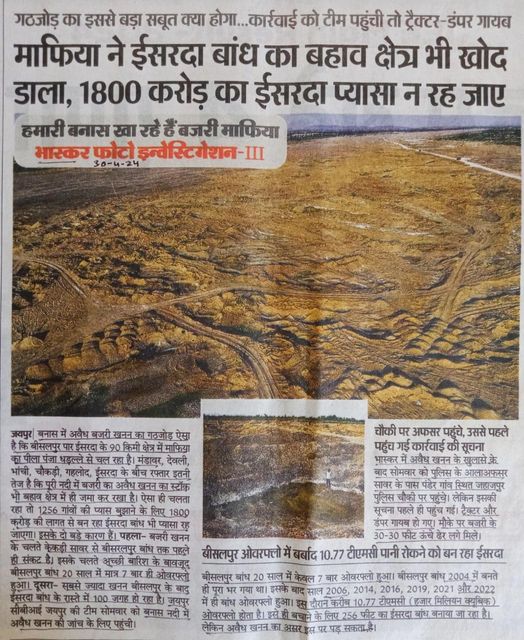
Indiscriminate, illegal sand mining in the catchment area of under construction Isarda Dam, downstream of Bisalpur dam on Banas river in Rajasthan close to Jaipur, is leading to fears that Isarda dam may not get any water. Bisalpur dam, commissioned in 2004, has been full only seven times in 20 years, in 2004, 2006, 2014, 2016, 2019, 2021, 2022. (Dainik Bhaskar, 30 April 2024)
Odisha NGT seeks fresh replies against plea on ‘excess’ mining The NGT has directed the state authorities to file fresh affidavits giving specific replies to a petition alleging unchecked extraction of sand by a lessee from the Kusei riverbed at Deogaon in Keonjhar district. The NGT’s east zone bench in Kolkata issued the direction while expressing dissatisfaction over the replies filed by the SEIAA and SPCB in response to the PIL filed by Tapas Kumar Bal, a local resident, on Apr 30. Bal alleged extraction of sand beyond the permitted area, which intersects Jajpur and Keonjhar.
The sand quarry is located near Jajpur. He alleged the sand is being illegally mined in Jajpur and transported to Keonjhar. The bench of Justice B Amit Sthalekar (judicial member) and Dr Arun Kumar Verma (expert member) said the affidavits filed by SEIAA and OSPCB were silent about the allegations. “In fact, the affidavits are in an essay form,” the bench observed while directing the SEIAA, OSPCB and the deputy director of mines to file para-wise counter-affidavits by May 31, the date fixed for the next hearing on the matter.
The bench allowed time till then to the lessee to file a reply. The bench took note of the petitioner’s additional affidavit which pointed out that the calculation of 4,869 cubic metres of illegally extracted sand, compared to the total mining of 7,365 cubic metres arrived at by the inspection committee, is too low. The additional affidavit filed through advocate Sankar Prasad Pani claimed the inventory of vehicles indicates that at least 960 truckloads of sand was excavated and transported from Sep 8 to Oct 8, 2023. https://timesofindia.indiatimes.com/city/cuttack/ngt-seeks-fresh-replies-against-plea-on-excess-mining-of-sand/articleshow/109867924.cms (06 May 2024)
Haryana File report on pollution: NGT The petitioner has raised objections, saying stone crushers are operating in violation of environmental norms. “Stone crushers are located close to plantations, reserved forests, educational institutions and in clusters. The area is critical and over-exploited and groundwater is being illegally extracted. There is a scarcity of water even for drinking,” petitioner Vinod Kumar Jangra, a resident of Charkhi Dadri, alleged. According to Jangra, there is no proper disclosure and evaluation of the source of water for operation of stone crushers, and no steps have been taken to mitigate dust and air pollution. https://timesofindia.indiatimes.com/city/gurgaon/ngt-directs-hspcb-to-file-pollution-load-report-for-mahendergarh-by-august-first-week/articleshow/109764895.cms (02 May 2024)
WETLANDS, LAKES, WATER BODIES
Haryana 6 more weeks for Hry to set deadline for wetland notification The NGT has granted an extension of weeks to the Haryana govt for filing an affidavit specifying the timeline for declaring Najafgarh Jheel as a transboundary wetland during a hearing. The counsel for NCT of Delhi had earlier informed the tribunal about its decision to declare the water body as a wetland on Dec 22, 2023. However, the Haryana govt sought more time to file the affidavit in the case which dates to 2014, when INTACH, Delhi filed an application in the NGT demanding the lake be declared a wetland and adequate steps be taken to conserve it.
“The Haryana wetland authority has submitted that all the incumbent except member secretary of the authority have been reshuffled in March. The member secretary has been assigned parliamentary election duty in Sikkim since March 2024. Therefore, the meeting could not be convened, and the affidavit could not be filed. Having regard to the difficulty, which is expressed in the application for adjournment, the prayer is allowed and further six weeks are granted to the Haryana govt to file the affidavit,” stated chairperson Prakash Shrivastava and expert member A Senthil Vel in the order. The next hearing for the case is scheduled for July 30. https://timesofindia.indiatimes.com/city/gurgaon/6-more-weeks-for-hry-to-set-deadline-for-wetland-notification/articleshow/109673136.cms (29 Dec. 2024)
Tamil Nadu Concerns loom over damage to Pulicat wetland The initiation of settlement of claims for local communities residing in 13 revenue villages within Pulicat Birds Sanctuary boundary limits has raised concerns over the shrinking of the sanctuary’s eco-sensitive zone (ESZ).
The concern arises from the fact that the State government plans to denotify a sizable area of the sanctuary. During the 77th meeting of the Standing Committee of National Board for Wildlife held in January 2024, a proposal for the use of 215.83 hectares of non-forest land for the development of an industrial park inside the eco-sensitive zone, and 5 km from the bird sanctuary, was discussed. https://www.thehindu.com/news/cities/chennai/concerns-loom-over-damage-to-pulicat-wetland-as-claim-settlement-of-villages-in-the-sanctuary-begin/article68099021.ece (23 April 2024)
GROUNDWATER
NGT grants last chance to 13 cricket stadiums to respond on GW issue The NGT on Thursday (May 03) granted a final opportunity to 13 cricket stadiums across the country to respond to its earlier notices on a plea against use of groundwater without considering alternative sources like rain water and STP treated water. The bench noted that out of the 22 stadiums impleaded, only 9 had filed responses. In an April 2021 order, it had directed the Secretary, MoJS to hold a joint meeting with the nominees of the Ministry of Youth Affairs and Sports (not below the rank of Joint Secretary) and representatives of the BCCI and the CPCB to consider the issue of regulating extraction of ground water for maintenance of cricket grounds. Counsel for the applicant informed the Tribunal that these directions were not complied with and cricket stadiums were using groundwater without the requisite no objection certificate (NOC). Further, he submitted that the stadiums had not set up rain water harvesting systems and had not explored the possibility of utilising STP treated water.
The Tribunal had in 2023 issued notices to the concerned stadiums and called for reports that had not yet been submitted. Accordingly, as a final opportunity, it granted three weeks to the stadiums to file their responses. Counsel for one of the stadiums also informed the NGT that its application for grant of NOC to the concerned state ground water authority had been pending for nine months. The NGT took note and directed that all the applications by stadiums pending before the concerned authorities will be decided expeditiously. The matter will be heard further on August 13. https://www.barandbench.com/news/ngt-grants-last-chance-to-13-cricket-stadiums-to-respond-on-this-issue (04 May 2024)
The CGWA had revealed to the tribunal last year that of 26 stadiums, 24 had borewells or tubewells for extracting groundwater. Out of those 24, only four stadiums had permissions for using groundwater and were complying with directions to use treated water. The CGWA had also submitted in an affidavit last year that 11 grounds were found to be non-compliant with the tribunal’s 2021 order. https://indianexpress.com/article/india/ngt-to-cricket-bodies-submit-report-on-use-of-rainwater-for-grounds-or-face-action-9304548/ (03 May 2024)
Gujarat Book examines groundwater crisis & its politics – Excerpted from India’s Forgotten Country: A View From the Margins, Bela Bhatia, Penguin India: Aside from this problem of overexploitation, growing inequity in groundwater use is both a critical consequence and a major cause of overexploitation. This growing inequity compounds earlier economic inequalities based on land ownership, with the result that the agricultural community in Gujarat is increasingly sharply divided between a minority of prosperous farmers who monopolize most of the land and water and a majority of small farmers and agricultural labourers who are increasingly alienated from both of these means of production.

Inequity and overexploitation are, thus, twin aspects of the groundwater crisis in Gujarat, ultimately inseparable insofar as their common cause lies in the anti-social appropriation of groundwater by a minority of large farmers. They can be seen as two sides of the same coin. https://scroll.in/article/1066751/a-new-book-examines-the-groundwater-crisis-and-its-politics-in-gujarat (01 April 2024)
Rajasthan बीकानेर में गड्ढा क्यों हुआ? -बीकानेर की लूणकरणसर तहसील के सहजरासर गांव में 16 अप्रैल 2024 को भूमि के धँसने से एक विशालकाय गड्ढा बन गया था। इस प्रकार के गड्ढे विदारक (सिंक-होल/sink hole) कहलाते हैं। इन्हें भूगर्भ विज्ञानी Lykins (लाइकिंस) कहते हैं। वैज्ञानिक इस किसी भूमिगत पानी के स्रोत के सूखने को जोड़कर देखते हैं तो ग्रामीण प्राकृतिक आपदा अथवा दैवीय प्रकोप भी मान रहे हैं। इस घटना में लगभग डेढ़ बीघा भूमि लगभग 22 मीटर नीचे धँस गई है। यह स्थान बीकानेर से लगभग 70 किलोमीटर उत्तर-पूर्व में है। इनके सिंकहोल कहलाने का कारण सिंक में जलनिकास के लिए बने छिद्र के समान इनका गोलाकार होना है। यही नहीं; इनके बनने के कारण में जल का, अथवा यह कहें कि भू-जल के सूख जाने का योगदान रहता है। और धँसान की प्रक्रिया भी सिंकिंग कहलाती है। इससे पूर्व 2021 में भी बीकानेर जिले के बीकानेर से लगभग 50 किलोमीटर पश्चिम में) कोलायत तहसील के रणधीसर तथा बुर्ज गाँव के निकट भी इसी प्रकार की घटना हुई थी। (अरविन्द व्यास) https://shorturl.at/lNQR3 (02 May 2024)
Punjab The principal bench of NGT has summoned the Director, NEERI and MS, SPCB to explain the delay in filing the status report and what immediate measures can be taken to resolve the problem of groundwater contamination in Sangrur. https://www.livelaw.in/environment/ngt-ground-water-contamination-raps-punjab-pcb-neeri-for-its-failuretake-immediate-measures-in-sangrur-says-problem-so-serious-summons-top-officials-251208 (04 March 2024)
URBAN LAKES, WETLANDS
Bengaluru Neglected, polluted lakes of Peenya Addressing water contamination in industrial areas such as Peenya is critical not just for protecting the ecological integrity of water bodies, but also for promoting the long-term development of Bengaluru’s industrial sectors.
-It is also important to understand how, within water bodies, contamination is not just limited to an affected water body, but also travels further to contaminate other water bodies that may share the same catchment area, or fall on the same channel network. We dissect this phenomenon, taking the case of Shivpura Lake in Peenya Industrial Area.
-Governance issues and overlapping jurisdictions over the SWDs and lakes have further complicated their maintenance.
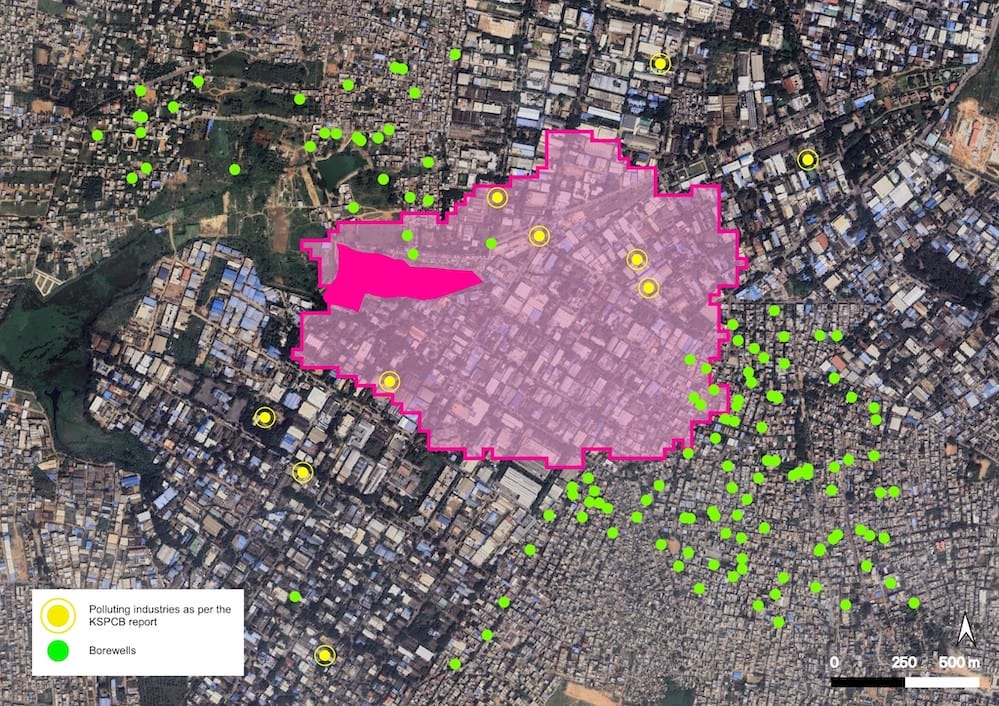
-Currently, while the ownership of the lakes and SWDs comes under the BBMP, the KSPCB is responsible for monitoring and regulating industrial effluent disposal. Along with this, the BWSSB’s responsibility is to identify the residential units discharging sewage directly into SWDs and connect them to the grid.
-This fragmented, chaotic governance structure has led to a lack of coordination and a standard governance philosophy across these entities that results more in blame games than concrete plans of action. https://citizenmatters.in/water-contamination-in-bengaluru-peenya-industrial-area-lakes-groundwater/ (02 May 2024)
125 of 800 lakes dry up; 25 more to become empty soon Of the nearly 800 lakes coming under BBMP (Greater Bengaluru) and Bengaluru Urban district areas, as many as 125 have gone dry, exposing the severity of the summer this year and 25 more BBMP lakes are heading in that direction, with only a good spell of rain in the next two weeks could save them. Of the 125 dried-up lakes, 100 are in Bengaluru Urban district and 25 in BBMP limits. Some of the lakebeds have overnight become cricket pitches for local boys and youngsters to exploit their sporting skills, according to BBMP officials. There are 184 lakes in BBMP’s custody, of them 50 are in dire straits. Bengaluru Urban district has over 600 lakes beyond the BBMP area, but within their jurisdiction, and nearly 100 of them have dried up this year. https://timesofindia.indiatimes.com/city/bengaluru/125-of-800-lakes-in-bluru-dry-up-25-more-to-become-empty-soon/articleshow/109868780.cms (06 May 2024)
Promise of desilting lake unfulfilled Lake activists from Tala Cauvery Layout and Basavanagar stated that the BBMP had promised desilting of the Vibhutipura Lake and releasing treated water by March end but nothing has been done so far. https://www.newindianexpress.com/states/karnataka/2024/Apr/28/bbmps-promise-of-desilting-lake-unfulfilled (28 April 2024)
Chennai Water hyacinth dries up lakes faster Lakes have gone ‘green’ in the city, with a blanket of plants and some lavender-coloured flowers floating on the waters. But these weeds are killing stagnant and sewage-ridden waterbodies and the water resources department has no plans to remove them.
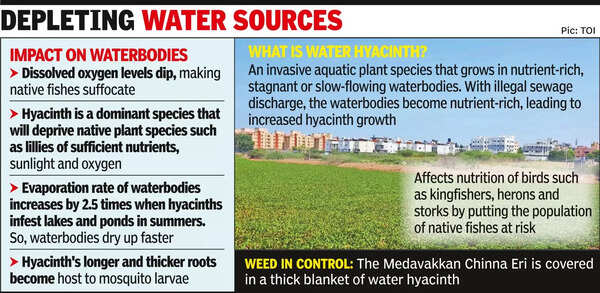
-Water hyacinths are invasive aquatic plants sucking up oxygen, blocking sunlight, and making water evaporate 2.5 times faster, according to research. “Water evaporates more from a lake infested with hyacinths. This is because the plants undergo transpiration,” said Shyamala Lionel, a former plant chemistry professor at Madras Christian College. Transpiration refers to expelling excess water from the leaves after plants absorb water from the roots. Therefore, summer heat and hyacinths are drying up lakes faster. https://timesofindia.indiatimes.com/city/chennai/water-hyacinth-impact-on-lakes-drying-up-faster/articleshow/109740523.cms (01 May 2024)
Residents flood CS with post cards to save lakes -Around 1,000 Medavakkam residents, irked by govt negligence, have taken to postcards to demand restoration of Medavakkam’s lakes. From 9am on Saturday (May 04), many people started posting postcards addressed to chief secretary Shiv Das Meena. Kalleri is a six-acre lake, south of the 200-acre Periya Eri on Ravi Main Road. Chinna Eri is a 12.6-acre lake to the east of the latter. While Periya Eri has some waterspread, Kalleri and Chinna Eri are blanketed with water hyacinths, as sewage flows continuously into them, drying them faster.
-Medavakkam, still a town panchayat, is a locality of lakes — within a 3km-radius, there are four to five lakes. Residents have filed CM cell complaints and used RTI to restore lakes, but barely any action was taken. In 2022, there was a 10 crore proposal to deepen and enhance some lakes, including Periya Eri, by the water resources department. But the proposal was dropped. https://timesofindia.indiatimes.com/city/chennai/residents-flood-chief-secy-with-postcards-to-save-lakes/articleshow/109847891.cms (05 May 2024)
Mumbai Mangrove faces imminent threat Concerns are mounting over the precarious state of the mangrove ecosystem in Sector 17, Kharghar, as miscreants have obstructed the flow of tidal water in the area’s creek. Environmental activists have sounded the alarm, highlighting the detrimental impact of this blockade on the delicate balance of the mangrove habitat.
In recent days, the flow of tidal water into the creek at Sector 17 has been severely restricted, leading to rapid drying of the channel passing through the mangrove area. The combination of deliberate blockages and intensified summer heat poses an existential threat to the ecosystem, with healthy mangroves now facing decay. https://www.newsband.in/article_detail/mangrove-ecosystem-in-sector-17-kharghar-faces-imminent-threat-due-to-blockage-of-tidal-water-flow (2 May 2024)
7 flamingos spotted near DPS Lake Wetland killed Avian enthusiasts and environmental activists are seeking a thorough investigation to find the cause of the death of the seven flamingos and urging authorities to take necessary action. “We, in coordination with the Navi Mumbai Municipal Corporation (NMMC), wrote to CIDCO to stop being careless about the DPS wetland, but the destruction continued,” said B N Kumar, the Director of NatConnect Foundation.
In the preliminary observation, it was found that two out of three inlets of the lake were blocked by the newly constructed high-rise roads by CIDCO which resulted in stagnant water, disregarding the fact that flamingos typically inhabit areas with flowing water. Stalin D of Vanashakti NGO said, “The defunct Nerul Jetty constructed by CIDCO serves no purpose and is instead blocking the inlets, thereby destroying the natural habitat of these birds.” As the habitat of these migratory birds is threatened, flamingos are increasingly found aimlessly roaming on the streets, endangering their lives. Despite appeals from the forest department, CIDCO is yet to address the issue of drying wetlands.
These incidents are constantly happening in the officially declared ‘flamingo city’ at the exact location where a massive ‘Flamingo festival’ was celebrated two years ago. “In the past, CIDCO pledged to preserve 40% of the area for the environment and green cover, but today, they seem indifferent, leading to a significant decline in the migratory bird population from around 5 lakhs to nearly 1 lakh,” said Kumar.
Every year, flamingos that migrate at Thane Creek during the season, seek refuge in the Navi Mumbai wetlands for roosting when there is a high tide in the creek, but these habitats are now facing significant threats. Moreover, the NRI wetlands in Seawoods are endangered by the Golf Course project proposed by CIDCO, sanctioned by the Maharashtra Coastal Zone Management Authority. https://indianexpress.com/article/cities/mumbai/7-flamingos-spotted-near-dps-lake-wetland-killed-activists-blame-cidcos-development-plan-9294247/ (02 May 2024)
Gurugram Sultanpur wetland is being deliberately dried up Drying up the water bodies, officials said, was essential. In Jan this year, the wildlife department shut off water supply from the Gurgaon canal to Sultanpur, a designated Ramsar site. It was because they had spotted catfish last year. Catfish is an invasive species that consumes smaller fish rapidly.
Though the monthly supply of 10-15 cusecs of water was stopped, officials didn’t expect large parts of the wetland to dry up completely and rapidly. They suspect the lack of non-monsoon rainfall might be to blame this year. Still, they believe they are in control and have a contingency plan. https://timesofindia.indiatimes.com/city/gurgaon/ecosystem-under-siege-why-sultanpur-wetland-is-being-deliberately-dried-up/articleshow/109705614.cms (30 April 2024)
Kolkata Mayor Firhad Hakim on Wednesday (April 03) said a “policy” has to be framed for the demolition of illegal structures in the wetlands, for which he would call a meeting with the environment minister and environment secretary. “I will call the environment minister (Md. Ghulam Rabbani) and the environment secretary (Roshni Sen) for a meeting after Id. There has to be a policy in place for the demolition of illegal construction in the wetlands. We will have to sit and plan it out,” Hakim told reporters at the Kolkata Municipal Corporation (KMC). https://www.telegraphindia.com/my-kolkata/news/a-policy-to-be-framed-for-demolition-of-illegal-structures-in-wetlands-mayor-firhad-hakim/cid/2011020 (04 April 2024)
URBAN WATER
Bangaluru City’s infra woefully unprepared for monsoon test BWSSB Chairman Ramprasath Manohar V said around 11,000 manholes in the city are damaged, with 2,500 being severely compromised and posing a risk of road accidents and flooding. Bengaluru has nearly three lakh manholes linked to the city’s vast network of underground drains. The infrastructure faced a critical test last week with even light to moderate rainfall leading to widespread traffic congestion. Stormwater drains overflowed, and underground drainage systems leaked, highlighting the city’s vulnerability to flooding during the upcoming monsoon season.
To solve the problem, the BWSSB is desilting underground drains. In response to water scarcity, the BWSSB also authorised the drilling of 313 borewells throughout the city. “Currently, 144 borewells have been successfully drilled. The remaining 169 borewells will resume pending work, taking into account potential rainfall, and conducting of area-specific surveys,” stated Manohar.
The BWSSB has not completed drilling borewells or constructing pipelines in many areas, nor have they replaced missing or damaged manhole lids. This lack of action has raised concerns among citizens and daily commuters about the risk of road accidents. The concerns among citizens stem from both severe heat and dry spells this year and the historical pattern of haphazard urban planning by civic bodies. Mismanagement of drainage systems and construction debris along roads has exacerbated issues, especially during the monsoon season in flood-prone areas. https://www.deccanherald.com/india/karnataka/bengaluru/open-manholes-missing-lids-bengalurus-infrastructure-woefully-unprepared-for-monsoon-test-3008955 (06 May 2024)
Ahead of monsoon the BWSSB has constructed 986 recharge wells at various locations over the last month to replenish depleting groundwater levels and overcome the water crisis. The board has mainly attributed the current water crisis in the city to inefficient rainwater harvesting and lack of proper water tanks to recharge groundwater. https://indianexpress.com/article/cities/bangalore/monsoon-bengaluru-builds-recharge-wells-boost-depleting-groundwater-level-9308898/ (05 May 2024)
Coimbatore Pillur dam gets water from Nilgiris Water level in the Pillur dam increased to 72ft against its full capacity of 100ft on Saturday (May04), from 55.25ft on April 30, with the district administration and the civic body bringing water from the Upper Bhavani and Porthimund reservoirs in the Nilgiris to it to address water crisis. According to an official source, the Pillur dam now has enough water to meet the requirements of the city till the first week of June. “Water from the Upper Bhavani reservoir was drawn through a natural stream. It didn’t take much effort. However, water from the Porthimund reservoir was pumped to Kundah hydro power station and then brought to the Pillur dam through a pipeline. Electricity generation was partially halted for transferring water.” https://timesofindia.indiatimes.com/city/coimbatore/pillur-dam-water-supply-from-nilgiris/articleshow/109849470.cms (05 May 2024) ince mid-March, several parts of Coimbatore city have faced shortages in drinking and groundwater availability, with the northern parts, including Thudiyalur, G.N. Mills, Saravanampatti, Chinnavedampatti and Sivananda Colony, among the hardest hit, according to the Coimbatore City Municipal Corporation (CCMC).Groundwater levels in these areas currently range between 600 and 800 feet. https://www.thehindu.com/news/cities/Coimbatore/groundwater-levels-hit-all-time-low-in-north-coimbatore-vellalore/article68142228.ece (05 May 2024)

City to be supplied water once in 15 days, people told to use it judiciously. https://www.newindianexpress.com/states/tamil-nadu/2024/May/02/coimbatore-to-be-supplied-water-once-in-15-days-people-told-to-use-it-judiciously (02 May 2024)
Puducherry 7 smart city projects shelved The installation of rooftop solar systems in public buildings, at an estimated cost of Rs 22.05 crore, suffered the same fate. This is despite the mandatory requirement for developing renewable (both solar and non-solar) power sources within the UT to meet its renewable purchase obligation (RPO) through physical energy. Even projects under innovative financing models, such as the rooftop solar under the RESCO (Renewable Energy Service Company) model, valued at `6 crore, were abandoned. https://www.newindianexpress.com/states/tamil-nadu/2024/May/01/cash-crunch-at-least-seven-smart-city-projects-shelved-in-puducherry (01 April 2024)
Dhubri Climate change a growing concern With the rising temperature across the globe, the town of Dhubri in Assam has been experiencing a palpable shift in its climate patterns over the last few years. According to local residents, senior citizens and local environmentalists, the temperatures have been climbing steadily while the rainfall has seen a noticeable decline, especially this year, when the absence of significant rainfall has heightened concerns. Environmentalist Joydeep Shil said that the disappearance of primary forests in the region is one of the major factors contributing to the local climate crisis.
The few remaining patches of forest are also under severe threat, further exacerbating the situation. Environmental degradation has had a stark impact on local biodiversity. Common species such as butterflies, moths, dragonflies, damsel flies and fireflies have nearly vanished from the area. More recently, populations of frogs, snakes, and other amphibians and reptiles have dwindled, becoming a rare sight. Meanwhile, when the election campaigns are at their peak in the district, interestingly, ‘Climate Change’ finds no space in the fiery speeches of none of the campaigners from any of the political parties. https://assamtribune.com/assam/climate-change-in-dhubri-a-growing-concern-1533814 (04 May 2024)
Mumbai Act against groundwater thefts: State to collectors The state water supply and sanitation department has refused the demand of Mumbai collectors to appoint BMC and its officers as authority to take actions against those indulging in illegal well water extraction and its selling. According to groundwater activist Sureshkumar Dhoka this directive is thus a clear indication that collectors and their designated officers appointed by central ground water authority (CGWA) will have to pull up their socks and not pass on the same responsibility of penalising and seizing tankers of those carrying illegal sale and extraction of groundwater to the civic bodies such as BMC.
Collectors through their letters to the state water supply authorities had pointed out that all the men, machinery, mapping and records of wells required to take penal or ground-level actions against groundwater thieves were available with the local civic bodies such as BMC and hence collectors and their officials should be spared from such a responsibility. However, the state authorities in their letter to collectors have emphatically disagreed and refused the request and thus want designated officers with collectors to begin actions as groundwater law has already designated revenue officials for vigilance and actions, Dhoka pointed out.
In order to decentralise and strengthen monitoring and compliance mechanisms as per CGWA guidelines, the officials of revenue and industries department of the state are appointed as authorised officers, and NOCs issued for groundwater use by CGWA are forwarded to magistrates and collectors. In case of any violation of CGWA directions and non-fulfilment of conditions laid down in the NoCs, the authorised officers can then file an appropriate petition for action against scamsters, dhoka pointed out. As per the delegation of powers against illegal groundwater withdrawal the CGWA has already appointed the district magistrate/district collector/sub divisional magistrates and authorised officers in each revenue district by empowering them to seal illegal wells, disconnect electricity supply to pumps, launch prosecution against offenders including grievance redressal. https://timesofindia.indiatimes.com/city/mumbai/not-bmc-you-act-against-groundwater-thefts-as-directed-by-cgwa-state-to-collectors/articleshow/109411134.cms (18 April 2024)
Panchkula Water waste will lead to disconnection To stop wastage of water in Panchkula during summer months, Haryana Shehri Vikas Pradhikaran superintendent engineer Rajiv Sharma has directed officers to carry out a special checking drive throughout the city. Teams have also been formed to ensure that orders are followed by city residents. As per the order, the teams will conduct checks in the city from 5 am to 9 am. Violators will be issued a fine of Rs 5,000 for first time offence and for repeated offence, the violator will face a fine of Rs 5,000, along with disconnection of water link. For getting the connection back, the offender will have to pay the fine first, along with a additional fee of Rs 1,000. https://timesofindia.indiatimes.com/city/chandigarh/water-wastage-crackdown-in-panchkula-leads-to-disconnection-of-supply/articleshow/109848670.cms (05 May 2024)
Delhi NGT seeks reply on Ghazipur landfill blaze The NGT has asked for a response, within five weeks, from relevant authorities, including the Central Pollution Control Board (CPCB) and the Municipal Corporation of Delhi (MCD), concerning the recent fire incident at the Ghazipur landfill site. The tribunal initiated proceedings after taking suo motu cognizance of a newspaper article detailing the extensive blaze at the landfill located in East Delhi on April 21. The matter is scheduled for further proceedings on August 6. https://www.newindianexpress.com/cities/delhi/2024/May/06/ngt-seeks-authorities-reply-on-ghazipur-landfill-blaze (06 May 2024)
WATER POLLUTION
Uttar Pradesh 2 sanitation workers die while cleaning Noida sewage shaft Two sanitation workers, both hailing from West Bengal, died after allegedly inhaling poisonous fumes inside a sewage shaft at a house in Noida, police said on Saturday (May 04).
The incident took place on Friday (May 03) evening when Nooni Mandal and Tapan Mandal were working at the residence of an individual named Sumit Chawla in Sector 26. According to police officials, both workers hailed from Malda district in West Bengal and were residing in a slum in Noida Sector 9. https://www.newindianexpress.com/nation/2024/May/05/two-sanitation-workers-die-while-cleaning-noida-sewage-shaft (05 May 2024)
Death of workers in sewer: Firm MD, 2 others booked A day after Sobhran Yadav, 57, and his son Sushil Yadav, 30, died while working in the unused sewer line, Wazirganj police in Lucknow lodged an FIR against the firm and the contractor. The FIR was written on the complaint of the victim’s younger son, Vinay Yadav, 25. Himanshu Gupta, director, KK Span India Private Limited and two contractors KC Pandey and Kailash Dixit have been booked under IPC section 304 (culpable homicide not amounting to murder), said police. Vinay, in the FIR, stated that his brother and father were instructed by the three accused to enter the sewer line without proper safety equipment or machinery which resulted in their suffocation, leading to their untimely demise. https://timesofindia.indiatimes.com/city/lucknow/death-of-workers-in-sewer-firm-md-2-others-booked/articleshow/109798197.cms (03 May 2024)
2 sanitation workers die septic tank in Unnao Lucknow: Two sanitation workers died allegedly after inhaling poisonous gases on Wednesday while cleaning a septic tank at a food factory in Unnao district. The workers – Chunnu (26) and Rahul Raidas (25), both from Unnao – did not have any safety gear when they entered the septic tank of Rustam Foods Factory. Police said they have filed a case against the factory owner, who is now absconding. https://www.newsclick.in/UP-2-Sanitation-Workers-Die-Cleaning-Septic-Tank-Unnao-Families-Seek-Compensation (04 Feb. 2023)
Sewer cleaning job claims 4 lives in Lucknow and Rae Bareli Four sanitation workers were killed in separate incidents after they allegedly inhaled toxic gases while cleaning sewers in Lucknow and Rae Bareli, said police. In Lucknow, Puran, 26, and Karan, 28 – both workers of a private agency hired by Lucknow Water works (Jal Sansthan) – died while cleaning a manhole in Gulabnagar locality of Saadatganj, in the old city area. Two others were rescued by local residents. It appeared as though the deceased were not provided with adequate safety equipment by the agency, police said.
Similarly, two workers – Yogesh, 35, and Sanju Nagar, 45 – hired by a private outsourced agency, died while cleaning a sewer on Manika road in Rae Bareli, police said. Locals alleged that they were not provided safety gear for the job. The duo fainted inside the manhole, nagar kotwali in-charge officer Raghavan Singh said. They were pulled out after a few local residents raised an alarm and were rushed to the district hospital where doctors declared them brought dead. Their post-mortem examination was underway, he said. https://www.hindustantimes.com/cities/lucknow-news/sewer-cleaning-job-claims-four-lives-in-lucknow-and-rae-bareli-101648567176464.html (30 March 2022)
JJM/ RURAL WATER SUPPLY
Opinion Why water is not central issue this election? Rashme Sehgal Water should be at the centre of all political debates because it is getting scarcer and will affect us all, as do floods, forest fires, air pollution and the increasing levels of pollution in our water bodies. Lip service has been made to the issue of environment since it is included in the manifestos of all our national parties, but politicians have failed to connect disasters or environmental pollution with livelihood and governance issues.
Our political leaders think that environmental concerns will gain currency only after we address the fundamental human needs of food and water. But, can they address those issues when erratic and uneven monsoon rains cause lower yields and crop damages, reducing farmers’ incomes and causing food prices to rise? This impending water crisis can cripple India’s agriculture sector, and yet we are holding an election where water is scarcely mentioned.
Water scarcity is such a pressing matter that stakeholders across all parties should get together and chalk out a meaningful strategy for forest and water conservation. For that, they need to rein in the real estate corporates and the mining mafia. If we deplete our groundwater resources, how will these be regenerated. It took nature millions of years to create these aquifers, but the current regime seems hellbent on squandering them. The farmers and their families in Vidarbha and Marathwada have taken matters in their own hands. They have warned politicians who go there seeking their vote that if they do not give them water, they will boycott the elections. Maybe people in more regions should also raise their voice on this issue. https://www.deccanherald.com/opinion/why-isn-t-water-the-central-issue-this-election-3002288 (1 May 2024)
Madhya Pradesh राजधानी भोपाल से करीब 35 किलोमीटर दूर इछावर तहसील के आदिवासी बाहुल्य गांव खामखेड़ा, बमलादड और बलोदिया समेत कई गांवों में न जलजीवन मिशन का पानी पहुंचा है और न ही टैंकर..
ये 18 साल तक मुख्यमंत्री रहे शिवराज सिंह चौहान का गृह जिला है। संकट ये भी है पानी के अभाव में यहां साल 8 महीने खेत खाली पड़े रहते हैं, सिर्फ मानसून सीजन में कुछ फसलें हो पाती हैं। https://www.youtube.com/watch?v=Zp1bhEJJKGI (01 April 2024)
WATER
Jammu & Kashmir Climate change causing water scarcity Due to climate change, temperatures are rising and precipitation is declining. The snow- and rainfall that normally build up the glaciers in wintertime are insufficient to make up for the summer melt. This has caused the glaciers to shrink, threatening the downstream communities that rely on the summer flows. Changing wind patterns also play a role in the decreased rainfall. Normally, storms called western disturbances bring large amounts of rainfall to the Himalayas. Wind coming from the West picks up moisture over the Mediterranean. The airmass then drops the water when it hits the Himalayas. In recent years, however, the frequency of these storms has declined by 43%.
A 2019 study conducted by the American Meteorological Society found that the diminishing frequency and intensity of western disturbances would result in a 15% reduction in mean winter rainfall over northern India. Scientists say that the situation in the Himalayas could still get a lot worse, putting additional pressure on the region’s already strained irrigation and hydropower systems. The dry weather is affecting more than just the fishing and agricultural industries. The famous tourist destinations like Gulmarg and Pahalgam are strangely empty.
In the winter of 2023–2024, the vital annual rainfall was weak. The Kashmir Meteorological Department recorded Srinagar’s driest January in 58 years. Furthermore, the annual “Chillai-Kalan” the traditionally harsh 40-day winter period ending on January 29, saw the driest conditions in Srinagar since 2015. Special prayers have been held in several parts of Kashmir as the people fear that the absence of snowfall in the region will affect crop production and lead to water and food scarcity in the summer months. https://www.fairobserver.com/world-news/india-news/kashmir-now-faces-water-scarcity-as-himalayan-glaciers-melt/ (03 May 2024)
Maharashtra 2,952 water tankers deployed With only 28.3% water remaining in Maharashtra’s dams, a total of 2,952 water tankers have already been deployed to supply water to villages and hamlets in the state. Last year, the number of water tankers being used in the first week of May was only 187.
The data from water supply and sanitation department shows that 2,952 tankers are being deployed in 2,344 villages and 5,749 hamlets. Last year, only 213 villages and 563 hamlets were being supplied water using tankers. Out of these tankers, nearly 1,532 are used in Marathwada (Chhatrapati Sambhajinagar) region where 1,022 villages and 356 hamlets are taking the service of water tankers. In Marathwada, Chhatrapati Sambhajinagar (636), Jalna (442) and Beed (310) are three districts with highest consumption of water tankers.
In Nasik division, which covers north Maharashtra, a total of 653 tankers are being used in 608 villages and 2,060 hamlets. Out of these, the highest usage of 294 tankers is in Nasik district while Ahmednagar district is using 267 tankers. In Pune division, a total of 571 tankers are being used for 507 villages and 2,760 hamlets. Satara (174), Pune (164) and Solapur (121) are three districts with highest consumption of tankers in Pune division. Interestingly, the entire Vidarbha region with Amravati and Nagpur division covering 11 districts has only 62 tankers in use. https://indianexpress.com/article/cities/mumbai/28-percent-water-dams-2952-water-tankers-deployed-maharashtra-compared-187-last-year-9306305/ (04 May 2024)
Ujani dam water level in negative Water in the Ujani dam at Indapur tehsil has receded to -41.99% of the total dead storage capacity of 66.67TMC, leaving as many as 15 villages with a population of over 20,000 in a dire situation. Unable to pump water, villagers are facing an acute water shortage. The affected villages are situated in the dam’s backwaters and their crops depended wholly on the water supply from the dam.
Sources said many farmers were using earth movers to dig pits in the dam bed in search of water. A farmer from Dalaj village and president of the Ujani Dharangrast Bachao Kruti Samiti, Arvind Jagtap, told TOI, “The situation is grim in the 15 villages due to water shortage. Crops are badly affected and some farmers have abandoned their plantations.”
Tillers in the villages echoed the sentiment. They blamed the state irrigation department for unscientifically releasing dam water into the Bhima river under political pressure. Jagtap said, “A section of politicians from Solapur put pressure on the irrigation department and forced them to release around 15TMC water in each rotation to their district for drinking purposes. As a result, the water level of the dam receded quickly. Resultantly, backwater villages’ farmers who pump water from the dam are suffering.” https://timesofindia.indiatimes.com/city/pune/ujani-dam-water-level-crisis-15-villages-in-dire-situation/articleshow/109741779.cms (01 May 2024)
Tucked away in the interiors of Badnapur tehsil, Tapovan village, located near the Jalna-Bhorkardan road, does not have natural water sources and is dependent on water tankers every day. According to villagers, the groundwater sources in the village have dried up in the last three months, forcing the women and children to walk at least 2 to 4 km looking for drinking water in the nearby areas and making several trips in the blistering heat daily. https://www.freepressjournal.in/pune/maharashtra-jalna-village-women-children-forced-into-daily-water-quest (04 May 2024)

Women draw water from a well in Kasara, Thane district on a hot may afternoon. (The Hindu 02 May 2024)
Karnataka Water projects to take centre stage in Phase 2 The BJP govt, in its 2023-24 budget, had proposed to declare the Upper Bhadra irrigation project as a national project and earmarked Rs 5,300 crore for it. However, the Centre is yet to issue notification to this effect. Also, Mahadayi irrigation project envisaging supply of drinking water to four districts in north Karnataka — Belagavi, Gadag, Dharwad — has also been a bone of contention as clearances from the Centre are pending despite the Supreme Court upholding the tribunal award. “Water projects are the main poll issue in North Karnataka as the BJP govt has denied people of this region their right,” said Basavaraj Rayaredi, chairman of Congress campaign Prajadhvani 2. https://timesofindia.indiatimes.com/city/bengaluru/lok-sabha-election-2024-water-projects-to-take-centre-stage-in-phase-2-polls-in-karnataka/articleshow/109709377.cms (30 April 2024)
AGRICULTURE
Opinion Healing the soil Ashok Gulati This article rightly advocates need to improve soil carbon content, that can also help improve the soil-moisture absorbing capacity. https://indianexpress.com/article/opinion/columns/to-ensure-a-hunger-free-nation-protect-soil-9295840/ (29 April 2024)
FLOOD 2024
Report Shifting WDs bring more flooding to India -A new study published in the journal Weather and Climate Dynamics found a seasonal shift in western disturbances: They are now occurring more frequently in summer months, when they were once rare. Western disturbances have become twice as common in June in the past 20 years than during the previous 50 years.
-Typically, western disturbances occur between December and March. That timing benefits farmers and boosts water security, because the heavy precipitation recharges mountain glaciers and snowpack that lose mass in the warmer summer months.
-“We had anecdotal evidence of western disturbances interacting with the monsoon, but now we have been able to show the trend [in shifting patterns] more clearly,” Hunt said. Flash floods in 2013 in the Himalayan state of Uttarakhand claimed around 6,000 lives. They happened in June, when western disturbances struck during the summer monsoon. The same happened in July 2023, leading to floods in many northern Indian states, including in the capital, New Delhi.
-The changing pattern of western disturbances is “very concerning,” especially because it has the potential to result in weather extremes, said Rajib Chattopadhyay, a meteorologist at the Indian Institute of Tropical Meteorology. https://eos.org/articles/shifting-winter-storms-bring-more-flooding-to-india (01 May 2024)
Assam Rains, Flood disrupts road, rail links Heavy rainfall led to a flood-like situation and landslides in Dima Hasao district, snapping road and rail communication at several places in the hill district.
The entire Barak Valley was also cut off from rail connectivity due to severe waterlogging in many areas. Incessant rain led also to waterlogging in several areas of the district, including Haflong Town. Railway services have also been disrupted between Jatinga-Lampur and New Harangajao due to landslides. https://www.news18.com/india/assam-heavy-rain-triggers-flood-like-situation-in-dima-hasao-district-waterlogging-landslides-disrupts-railway-services-8875641.html (02 May 2024)
Jammu & Kashmir Flash floods in Kupwara, several villages inundated Several bridges across the district were damaged due to flash floods which include Shumriyal Bridge, Khumriyal Bridge, Shatmuqam Bridge, Sohipora-Hayhama Bridge, and Farkiyan Bridge. Several roads were also damaged due to flash floods including Budbugh-Darbal Bala Road. Shumryal-Gundajhanger Road along with a few other roads remained cut off due to landslides. Two Rural Development Department buildings and the Assistant Director Handicrafts’ office building located at Kupwara were damaged due to flash floods. A landslide damaged the school building and bathrooms of Government Middle School Khanpora Dardhaji in the Rajwar area of Handwara. https://www.greaterkashmir.com/front-page-2/flash-floods-in-kupwara-several-villages-inundated/ (30 April 2024)
Rains, landslides, flashfloods disrupt life in Chenab Valleys Inclement weather over the past few days has paralysed normal life in Kashmir and Chenab Valleys as torrential rains resulted in closure of the main highway connecting the region with Jammu with landslides and flooding incidents reported from several areas. The Srinagar city also witnessed water logging at several places despite the recent redevelopment of the city under the ‘Smart City’ project. In the Handwara and Kupwara areas of northern Kashmir, several areas were flooded and the administration had to carry out the rescue operations. In Anantnag district of southern Kashmir, flash floods damaged a bridge and washed away some orchards as well. https://economictimes.indiatimes.com/news/india/rains-landslides-flashfloods-disrupt-life-in-kashmir-and-chenab-valleys/articleshow/109744329.cms (01 April 2024)
10 rescued in Boniyar -Authorities on Monday (April 29) successfully rescued ten people who were buried after a house collapsed due to heavy rains in north Kashmir’s Boniyar. An official said that the house collapsed due to flash floods caused by heavy rains, and ten people were trapped inside. https://preciouskashmir.com/2024/04/30/10-rescued-in-boniyar/ (30 April 2024)
DISASTERS
Uttarakhand Forest fires: Forest staff, vehicles deployed on poll duty in violation of orders Documents reviewed by Newslaundry have now suggested that the deployment of forest staff and vehicles for election duty – in violation of orders from the state government, Election Commission and NGT – affected official preparedness to deal with the problem. In letters to all the district magistrates on February 3 and April 5, Uttarakhand principal secretary (forests) Ramesh Kumar Sudhanshu had clarified that the forest department should be kept away from election activities. The paragraph 18 of the letter on February 3 stated, “Every year, severe incidents of forest fire occur in the state during summer season (from February 15 to June 30).
All the officers/employees of the forest department are ready 24×7 for forest fire control/management. Keeping in view the forest fire season 2024, the personnel posted at the field level of the forest Department should be exempted from Lok Sabha election duty. Also, vehicles allotted in the circles/divisions of the forest department should not be acquired during the forest fire season-2024, because during the forest fire season, forest personnel are in great need of vehicles for transportation to control forest fires.” Similar concerns were raised in the letter on April 5.
Citing the 2023 guidelines of the Election Commission, the CEC appointed by the Supreme Court – to advise the court on environmental issues in 2005 and now a permanent panel under the ministry of environment and forests – had also pointed to the same reason to exempt forest staff. Notably, the guidelines issued by the Election Commission of India are constitutionally binding on all administrative authorities involved in the conduct of the election process under Article 324 of the Constitution of India and the RP Act, 1951. https://www.newslaundry.com/2024/05/06/uttarakhand-forest-fires-forest-staff-vehicles-deployed-on-poll-duty-in-violation-of-orders (06 May 2024)
Opinion Mending forests, putting out fires The Himalayan forest fires are preventable. But it calls for a joint action front of the State and local communities, with short- and long-term solutions. (Shekhar Pathak) https://www.hindustantimes.com/opinion/mending-the-forests-putting-out-the-fires-101714930338834.html (06 May 2024)
ENERGY OPTIONS
Uttar Pradesh PM Surya Ghar Bijli Yojana leaves many confused Due to the promotion using the word ‘free’, people didn’t realise they had to pay for the installation. Many solar vendors from Lucknow and Ayodhya districts stated that people have been arguing with them about what the government claims is a free electricity scheme, but the vendors are charging for it. Under the PM Surya Ghar Muft Bijli Yojana, which will run for three years, the central government is providing a Rs 78,000 subsidy, and the Uttar Pradesh government offers an additional Rs 30,000 for solar setups up to 3 kW. The estimated cost of 3 kilowatt rooftop solar system is about Rs 1.8 lakh. After the subsidy, the total cost to the consumer is around Rs 72,000. A 1 kW solar setup typically produces 4-5 units of electricity per day, while a 3 kW setup generates 300-400 units per month. https://www.downtoearth.org.in/news/renewable-energy/solar-city-ayodhya-pm-surya-ghar-bijli-yojana-promoted-as-free-electricity-scheme-during-polls-leaves-many-confused-95960 (02 May 2024)
ENVIRONMENT GOVERNANCE
Opinion Environment policy needs a fix -What we need to ask is whether the promises made on safeguarding the environment are backed up by action from the government’s side. The Indian government in the last decade has passed contentious environmental laws like the Forest Conservation (Amendment) Bill, 2023 and the Biodiversity (Amendment) Bill, 2023, which weakened environmental protection. Through the newly initiated Green Credits program, the government is now making it easier for companies to use it as an excuse for the forest diversion requirements for mining activities and industrial expansion, etc. in exchange for their credits for compensatory afforestation – which can never compensate for the complex biodiversity of a natural forest. (C.P. Rajendran) https://thewire.in/environment/indias-environment-policy-needs-a-fix-but-the-bjps-election-manifesto-does-nothing (30 April 2024)
EDIT Concerns over GCP -But can arbitrary tree plantation — such drives often end up as mono-plantations dominated by one species — compensate for the loss of the priceless diversity of forests? As it stands, the GCP evidently prioritizes volume over quality — a testament to a typical bureaucratic mindset — by ignoring the importance of ecological variations among tree species while basing the award of credits solely on numbers. https://www.telegraphindia.com/opinion/greed-credit-editorial-on-the-concerns-over-the-green-credit-programme/cid/2017091 (02 May 2024)
Delhi ‘City doesn’t need an ornamental park, but a forest’: HC The Delhi High Court on Friday (May 03) asked the Delhi Development Authority (DDA) to consider whether a 55-acre land identified by the authority can be developed as a ‘”dense forest”. The HC was hearing a petition related to permissions granted by tree officers concerned for felling trees without passing speaking orders. Justice Singh queried as to what is an urban forest and whether it has been defined anywhere, to which the court was told that an urban forest is one which is inside a city. The HC, thereafter, orally said, “Delhi does not need an ornamental park. It needs a forest”. “This is not acceptable, ” the judge said. Justice Singh said that the affidavit filed by the DDA “seems to suggest” that the court’s earlier order has been “totally misunderstood”. The matter is listed on May 17. https://indianexpress.com/article/cities/delhi/delhi-ornamental-park-forest-high-court-9307202/ (04 May 2024)
SOUTH ASIA
Nepal WB, ADB to invest US $4 bln in Upper Arun & Dudhkoshi HEPs The World Bank (WB) and Asian Development Bank are jointly making investments in the 1063 MW Upper Arun hydroelectricity project and 635 MW Dudhkoshi hydropower project. This is the first time, the two financial institutes are providing loan and grant assistances in Upper Arun said Managing Director of Nepal Electricity Authority (NEA), Kulman Ghising. “Almost US $4 billion is being invested in the two mega hydropower projects. World Bank will lead the construction of Uppper Arun while the construction ofDudhkoshi hydropower project will be led by ADB,” said MD.
– WB and ADB on Dec 6, 2023, had signed an agreement to collaborate in the hydropower investments in the Himalayan nation. According to the agreement, WB will invest US $82.5 million while US $150 will be invested by ADB. Besides, European Investment Bank will invest US $500 million and JICA will invest US $150 million. Similarly, the Organization of the Petroleum Exporting Countries (OPEC) will invest US $100 million, the Saudi Fund will invest US $100 million while US $400 million will be invested by various institutes of Nepal. Likewise, the Nepal govt will invest US $620 million as the share capital of the NEA. A total of US $2.845 billion will be raised for the project.
– Dudhakoshi hydropower project is a reservoir-based hydropower project to be built in the Duthkoshi River that flows between Khotang and Okhaldhuga districts. ADB will invest US $600 million followed by the WB with US $200 million, European Investment Bank will invest US $300 million while AIIB, OPEC, the Saudi Fund will invest US $600 million. Public institutes of Nepal will invest US $ 50 million, NEA and the Nepal government will invest US $450 million. https://en.nepalkhabar.com/news/detail/9109/ (23 April 2024)
Video Story How a village was entirely relocated The fields of the hamlet of Samdzong in Nepal were washed away by the river. The inhabitants had to leave and build a new village from scratch in Namasung.
As they start a new life in the new settlement, climate change is increasing the risk of floods and drought in the region, and they pray to be safe. https://www.bbc.com/reel/video/p0htxkvy/how-a-village-in-the-himalayas-was-entirely-relocated (01 April 2024)
Bhutan Energy, Sustainability & Resilience: Lessons Compare traditional large-scale, centralized power generation requiring extensive grid transmission and distribution capacity compared to small-scale power generation nodes operating close to demand. DERs (Distributed Energy Resource) – in this case small hydro – benefit from effective grid networks and can contribute back to the grid, but they can also provide electricity locally (if allowed by local regulation), making each node more resilient to shocks from global energy markets or geopolitics. https://www.forbes.com/sites/robertwolcott/2024/05/01/energy-sustainability–resilience-lessons-from-bhutan–bangladesh/?sh=57d878385189 (01 April 2024)
Bangladesh Future gw potential mapping using machine learning algorithms & climate change scenarios Conclusion: – The study’s findings can assist policymakers in Bangladesh in creating efficient groundwater management plans, maximizing existing infrastructure for groundwater extraction, selecting the best locations for groundwater monitoring and data collection, ensuring the long-term sustainability of groundwater resources, and creating efficient water management plans that encourage efficient management techniques and take into account potential climate change effects on groundwater resources. We suggest that, in future investigations, the comparative analysis be expanded to incorporate Support Vector Machines, Random Forest, and Decision Trees. Furthermore, the inclusion of novel variables such as alterations in land use and aquifer properties within RCP scenarios can augment the precision of predictions, thereby fostering a more holistic comprehension of groundwater dynamics and providing valuable insights for the development of sustainable approaches to water resource management. https://www.nature.com/articles/s41598-024-60560-2 (06 May 2024)
CHINA
Study Impact on urban river pollution control EMPs based on SMS-Mike21 coupled simulation Conclusion: -In this paper, we considered the variation of water quantity and water quality in different hydrological periods, and established a two-dimensional hydrodynamic-water quality coupling model by SMS and Mike21 to make the model simulation results more available. This approach allows for a more comprehensive study into the impact of NSPC expansion on the water environment in the main sewage discharge area of the Bai River (Nanyang section). Therefore, SMS-Mike21 coupling model has good accuracy and applicability for simulating and predicting water environments in similar scenarios. https://www.nature.com/articles/s41598-024-57201-z (18 March 2024)
ASIA
Philippines Drought dries up dam to reveal centuries-old town The ruins of an almost 300-year-old town have resurfaced as searing temperatures in the Philippines partially dried up a major dam. Pantabangan town was submerged in the 1970s to build a reservoir. But it emerges from the water on extremely rare occasions, when the weather is dry and hot.
It comes as almost half the country is experiencing a drought, with temperatures reaching highs in several areas. This is the longest the town has ever been above water since the dam was constructed, Marlon Paladin, an engineer with the state agency that operates the country’s dams, told news agency AFP. https://www.bbc.com/news/world-asia-68852451 (30 April 2024)
THE REST OF THE WORLD
SANDRP Blog May 2024: Brazil Dam Collapse leads to death, destruction A dam which was part of the 14 de Julho hydropower plant in Brazil has partially collapsed on May 2, 2024, following heavy rains that started on Apr 29 and expected to be continued to May 3. The breached dam, located between Cotiporã municipality and Bento Gonçalves city, reportedly created a 2m wave, exacerbating the floods in the already inundated areas.
Meteorologists attribute the extreme weather event to an unusual amalgamation of soaring temperatures, elevated humidity levels, and fierce winds. The 100 MW project, also called Catorze de Julho, is located on the estuary of the Antas River. The roller-compacted-concrete (RCC) dam has a maximum height of 42 m. The underground powerhouse contains two Kaplan turbine-generator units. The first unit began commercial operation in January 2009. 14 de Julho is part of the 360 MW CERAN complex. https://sandrp.in/2024/05/06/may-2024-brazil-dam-collapse-leads-to-death-destruction/ (06 May 2024)
Dam Floods Brazil Dam collapses & death toll rises -A hydroelectric dam has collapsed in southern Brazil after days of heavy rains that triggered massive flooding, killing more than 30 people. The burst dam triggered a two-metre (6.6ft) wave, causing panic and further damage in the already flooded areas.
The dam is located between the municipality of Cotiporã and the city of Bento Gonçalves. The extreme weather has been caused by a rare combination of hotter than average temperatures, high humidity and strong winds. https://www.bbc.com/news/world-latin-america-68948239 (02 May 2024)
International Rivers expresses its concern and solidarity over the unfolding tragedy in southern Brazil, where a partial dam collapsed after torrential rainfall at the 14 de Julho hydroelectric plant and unleashed a wall of water on communities downstream. At least 30 people have reportedly died and dozens more are missing. More than 300,000 people remain without electricity and over 200 communities have been impacted. Thirteen dams have been put on alert and a state of emergency has been declared as the heavy rain and flooding persist and search efforts continue for the stranded and missing.
This is unfortunately the latest high-profile dam collapse, which are expected to become more frequent as climate change-induced floods mix with an aging fleet of dams. Last year, Libya experienced the world’s second deadliest dam disaster after a severe rainstorm collapsed two dams, killing thousands. This is of particular concern for Brazil, which has among the most large dams of any country in the world. A 2022 analysis showed that 1 million people in Brazil live near a dangerous dam, and in 2023 the country experienced a record number of natural disasters. https://www.internationalrivers.org/news/statement-on-the-dam-collapse-in-rio-grande-do-sul-brazil/ (03 May 2024)
Dam Floods Kenya Around 50 killed in villages near Mai Mahiu town -The sudden wave of floodwater was initially attributed to a nearby burst dam by local officials. However, the Kenyan ministry of water, sanitation and irrigation said on Monday (April 29) evening that the incident occurred as a result of a tunnel – which channels the River Tongi under a railway line – becoming blocked with “debris, stones, trees and soil” during the recent downpours. This prevented water flowing through it to move downstream, leading to a pool of water suddenly sweeping over the railway line, the ministry said in a statement. “The area has no dam and the only dam upstream in a different tributary is the Matches Dam which is in good condition and stable,” it added. The small villages of Kamuchiri and Kianugu were among those that bore the brunt of the disaster. https://www.bbc.com/news/world-africa-68896456 ( 29 April 2024)
-Monday’s (April 29) dam collapse comes six years after a similar accident at Solai in Nakuru county killed 48 people, sending millions of litres of muddy waters raging through homes and destroying power lines. The May 2018 disaster involving a private reservoir on a coffee estate also followed weeks of torrential rains that sparked deadly floods and mudslides. https://www.ndtv.com/world-news/42-dead-as-kenya-dam-bursts-rescue-ops-underway-to-find-survivors-5548542 (29 April 2024)
-Homes were swept away and roads were cut off after the dam burst in Kamuchiri village in western Kenya. “Forty-two dead, it’s a conservative estimate. There are still more in the mud,” Nakuru county governor Susan Kihika told AFP news agency. “The water came at high speed from Old Kijabe Dam and washed away many houses and vehicles. We have never seen such devastating floods since we were born here in Mai Mahiu. Very many people are still missing,” resident David Kamau tod the BBC. https://www.bbc.com/news/world-africa-68896456 (29 April 2024)
A blockage in an underpass or tunnel that channels water to the Tongi river led to the bursting of a dam in Kenya’s Nakuru County on April 29, 2024, according to the country’s government. The ongoing heavy rainfall in Kenya has deposited debris, stones and soil. This caused the tunnel to become blocked and ultimately burst, according a statement by the Kenyan ministry of water.
The dam tragedy at the village of Kamuchiri near the town of Mai Mahiu is not the first one in Kenya. In 2018, a similar incident occurred at the Solai dam, also in Nakuru County in the Rift Valley during heavy rains, killing 48 people. It resulted from a makeshift private dam bursting its banks, sending water gushing downhill across homesteads. https://www.downtoearth.org.in/news/africa/kenya-why-did-the-nakuru-dam-burst-channel-blocked-by-rain-swept-debris-the-reason-says-government-95911 (01 May 2024)
In pictures: Deadly floods cause dam burst in central Kenya https://www.reuters.com/pictures/pictures-deadly-floods-cause-dam-burst-central-kenya-2024-04-29/4AO7NRHGDVKX7I3JYRNZH7O7PU/ (29 April 2024)
Report Extreme weather strikes on opposite sides of globe in Brazil, Texas, Vietnam & Indonesia. https://www.downtoearth.org.in/news/natural-disasters/east-and-west-extreme-weather-strikes-on-opposite-sides-of-globe-in-brazil-texas-vietnam-indonesia-95975 (06 May 2024)
NILE GERD Energy trades could help resolve Nile conflict As the demand for energy, water, and food in Africa is steadily increasing, the study, led by The University of Manchester in collaboration with regional organizations, offers a glimmer of hope at a resolution. The research, published in the journal Nature Water, moves away from traditional water-centric agreements, and presents a detailed simulation of the combined energy-water system to reveal how different scenarios of international energy trades could help alleviate the Nile water conflict. At the heart of the dispute lies the Grand Ethiopian Renaissance Dam (GERD)—a large dam on the Blue Nile River in Ethiopia constructed to improve Ethiopia’s electricity access and to export electricity to neighboring countries. https://phys.org/news/2024-04-energy-nile-conflict.html (26 April 2024)
SANDRP
Also see: DRP 29 April 2024 & DRP 22 April 2024
Follow us on: www.facebook.com/sandrp.in; https://twitter.com/Indian_Rivers

 SANDRP