
(Feature Image: Climate change catoon by Jug Suraiya & Partho Sengupta. ToI, 23 June 2018)
The decision of the IMD to shut down 199 of its district agromet units across India is disturbing on a number of counts. In the era of climate change when the key parameters are undergoing such rapid change, there is need for increasing monitoring and sharing of climate information by the IMD and need to in fact decentralize the whole effort. But this decision of IMD is going against this basic requirement.
In fact, the IMD has become a sort of holy cow, while in reality its performance in monitoring, forecasting and sharing information in time is far from satisfactory. This is increasingly evident every year when IMD fails to provide not only accurate, actionable, rainfall forecasts sufficiently in advance to help reduce the flood disasters and also take timely decisions on reservoir operations, IMD also fails to provide even timely information about the actual rainfall on ground and how that rainfall is going to get converted to inflows in rivers and reservoirs. Similarly, the district agromet units can provide farmer level and decentralized accurate rainfall monitoring and forecasting information that can help farmers take timely decisions.
As we have been noting for several years, the IMD’s reporting of river basin wise rainfall has been most callous, inaccurate and incomplete. It is not of much use in the current form, most of the time.
In fact, as IMD said, the need was to make this more effective and also expand it to all districts across India. Instead, the union govt (IMD do not seem to be for such a decision) seems to have taken the decision to close these 199 district units.
Report IMD to shut down 199 district agromet units pan India The Centre has decided to discontinue the services of all 199 district agromet units that provide crucial and detailed weather-related advisories to millions of farmers at the block level, officials said on Feb 1 2024. This is likely to cause loss of employment to around 400 scientists and scientific staff who were manning these units, while also deprive farmers of customised advisories or guidance provided by scientists at district level units.
– Each of these units have an automatic weather monitor and they regularly measure soil moisture levels. “These units are very important. They had a clear advantage and benefit to farmers. Each of these units were manned by a scientist and an assistant. Often farmers are not able to interpret advisories. Farmers used to visit these units and get individual advise from scientific staff which was very helpful for them,” said M Rajeevan, former secretary, ministry of earth sciences. https://www.hindustantimes.com/environment/imd-to-shut-down-199-district-agromet-units-pan-india-impacting-millions-of-farmers-101706841412183.html (02 Feb. 2024)
Buoyed by the initial success of such units, it was decided to set up a total 530 district agromet units (DAMUs) covering all districts of the country by the year end which is why the decision to shut them down has come as a bolt from the blue for farmers. Besides, the fate of around 400 employees, including 200 scientists, now hangs in balance with no clarity on their future service or re-engagement.
“The units helped enhance agriculture output and farm income besides reducing the load of crop insurance premium under PM Fasal Bima Yojana. As per the initial agreement, the scheme was to continue till 2026,” said an official privy to the development.
DG of IMD Mrutyunjay Mohapatra said the meteorological department has nothing to do with the decision which has been taken as per the advice of the Ministry of Finance. “Weather forecasts and related information will now be provided by Agriculture department through the 130 agro met centres functioning under agriculture universities,” he added. https://www.newindianexpress.com/states/odisha/2024/Jan/31/centre-to-shut-down-199-district-agro-meteorology-units-across-the-country (31 Jan. 2024)
A total of 130 agromet field units (AMFUs) have been set up in agro-climatic zones in the country over the years in collaboration with the Indian Council of Agricultural Research (ICAR). AMFUs provide advisories at the zonal level, each catering to four to five districts. In 2018, the government decided to extend the reach of GMSV by setting up 530 district agromet units on the premises of Krishi Vigyan Kendras (KVK). However, the Covid pandemic impacted the process, and only 199 DAMUs could be set up. Each DAMU has two employees — SMS Agromet and Agromet Observer. https://www.theweek.in/wire-updates/national/2024/02/01/del57-imd-agromet-project.html (01 Feb. 2024)
HYDRO POWER PROJECTS
Sikkim SC issues notice over damages to Teesta dam The Supreme Court has issued a notice to the Government of Sikkim in response to SLP (appeal) by the Sikkim Democratic Front (SDF) for seeking an independent central agency investigation on complete destruction of the Teesta Stage III Dam and insurmountable loss of lives and damage to properties.
– The SDF has sought thorough investigation on the ruling SKM government over their alleged non-compliance of the mandatory provisions of the Disaster Management Act, 2005, deliberately not taking any preventive or mitigation measures despite clear classification of South Lhonak Lake and Chungthang, along with subsequent downstream settlement, as a high GLOF hazard zone
“There was also non-compliance of the mandatory provisions of the Dam Safety Act 2021 due to which huge damages and losses have been caused including the complete destruction of the Teesta stage III Dam at Chungthang and other hydro power structures downstream”, added the press release.
“In the PIL, we sought from the Government of Sikkim (a) a status report regarding updated and reviewed State Disaster Management Plan in compliance to the National Plan, November, 2019, on Management of GLOF and the NDMA Guidelines on Management of GLOF October, 2020, and (b) status report regarding work done in compliance to the National Plan, November, 2019 on Management of GLOFs, The NDMA Guidelines of GLOF October, 2020 and the Dam Safety Act, 2021. In the PIL, it is prayed before the Hon’ble High Court seeking direction against the Govt to file status report for reliefs provided to affected families by the disaster caused by the South Lhonak Lake GLOF on the 3rd & 4th of October 2023 and to file a report on losses caused by the said South Lhonak Lake GLOF”, concluded the press note. https://www.indiatodayne.in/sikkim/story/sc-issues-notice-to-sikkim-government-over-damages-to-teesta-dam-loss-of-lives-during-glacial-lake-outburst-797925-2024-01-31 (31 Jan. 2024)
Himachal Pradesh Villagers affected by Luhri HEP stage protest The villagers living in various panchayats affected by the coming up of the 210 MW Luhri hydel project on Feb. 02 staged a protest at Nirath in support of their demands. The villagers along with Himachal Kisan Sabha members have been holding meetings with the villagers to apprise them about the adverse impact of the Luhri project.
What has irked the villagers is that none of the promises made to them, including providing at least a job to one member of each of the project-affected families, has been fulfilled. A large number of women took part in the protest and blocked road, which was opened only after receiving an assurance from the SDM that their grievances would be resolved. The project is being developed on the Satluj, near Nirath village, in the Shimla and Kullu districts amidst strong opposition by the locals. The foundation stone of the project was laid by PM Narendra Modi in December 2021 and is expected to be commissioned by April 2026.
People living in the ecologically fragile areas of the tribal district of Kinnaur and parts of Shimla and Kullu districts have been opposing coming up of hydel projects, which, they claim, were having adverse impact on the flora and fauna of the area. Fertile agricultural land was being adversely affected, houses were developing cracks due to blasting and the traditional water sources were drying, the villagers lamented. https://www.tribuneindia.com/news/himachal/villagers-affected-by-luhri-hydel-project-stage-protest-586752 (03 Feb. 2024)
Shop owners in the local market did not open their shutters, while labourers from the project also struck work to join the farmers in solidarity. Given the deadlock, a call has been given to advance the movement with a rural strike on February 16 in case the administration fails to move on their demands. Numbers have already swelled since the SJVN agreed to expanding the ‘affected villages’ tag to four more villages after the last protest held in December 2023, this reporter was informed by Prem Chauhan, president of Rampur Kisan Sabha.
At another HEP downstream at Sunni, where acquisition is underway, the bypassing of LARR 2013 is once again coming into the news. Land clearing has started even before the villagers have consented to the terms of the acquisition. With anger swelling here as well, the February 16 call for a rural strike may attract many villages along the Satluj basin affected by different hydropower projects. https://www.newsclick.in/hp-luhri-hydro-project-affected-villages-hold-dharna-call-rural-strike-feb-16 (03 Feb. 2024)
Pong PAFs protest airport expansion Residents of Gaggan near Dharmshala are protesting against the land acquisition for the airport expansion without ascertaining feasibility. They are also demanding better compensation for those getting displaced again as they were earlier displaced for the Pong dam. https://www.tribuneindia.com/news/himachal/gaggal-residents-protest-airport-expansion-move-584634 (26 Jan. 2024)
Jammu & Kashmir Kiru HEP: CBI raids 8 places CBI has conducted searches at around eight locations in Delhi and Jammu and Kashmir in the ongoing investigations of a case related to alleged irregularities in the award of tender for civil works of 624 MW Kiru HEP in Kishtwar district being executed by Chenab Valley Power Projects (P) Ltd (CVPPPL). The instant case was registered on the basis of a reference received from government of J&K against then chairman, then MD, then directors of CVPPPL, a private company and unknown others. “It was also alleged that though a decision was taken in the 47th board meeting of CVPPPL for re-tender through e-tendering with reverse auction, after cancellation of ongoing tendering process, same was not implemented and the decision of 47th board meeting, was reversed in the 48th board meeting,” said the spokesperson. https://www.hindustantimes.com/cities/chandigarh-news/kiru-hydroelectric-project-case-cbi-raids-8-places-in-delhi-jk-101706555647068.html (30 Jan. 2024)
Chenab diverted in tunnel to speed up Ratle HEP work Chenab river has been diverted through diversion tunnels on Jan 27 for starting dam construction for the Rs 5282 Cr 850 MW Ratle HEP in Kishtwar district with deadline of May 2026. The project is being executed by Ratle Hydropower Corporation Ltd, a 51: 49 Jt venture of NHPC and J&K govt. https://energy.economictimes.indiatimes.com/news/power/govt-diverts-chenab-river-water-to-expedite-hydro-electric-project-in-jk/107231098 ; https://pib.gov.in/PressReleasePage.aspx?PRID=2000309 (29 Jan. 2024)
Dams aren’t just for development “These projects are an embodiment of control and domination over the disputed territory and its waters… This is a manifestation of state policy wherein politics and political interests in the region take precedence over the ecological and social fragility, and vulnerability that such projects cause to people and their habitats.”
– “By examining outcomes such as dispossession, displacement, loss of livelihood, migration and environmental effects, this research brings into notice how laws and policies governing development are dis-embedded and utilitarian in nature, how development is political and how the affected people are deprived of their share in decision making over their resources.” https://theprint.in/pageturner/excerpt/kishanganga-to-bursar-why-jk-dams-arent-just-for-development/1948625/ (01 Feb. 2024)
Uttarakhand Joshimath locals seek rehab office, relocation The Joshimath Bachao Sangarsh Samiti (JBSS), which is spearheading a public movement on the issue, on Friday (Feb. 02) reiterated its plea for a rehabilitation and reconstruction office in the subsidence-hit town of Joshimath. Atul Sati, the group’s convener, said, “Following a prior govt order, the immediate setup of this office, with essential staff, is crucial. Additionally, as discussed in our meeting with the chief minister last year, all residents affected by the disaster should be compensated.”
The JBSS has called for relocating affected individuals to secure Army land, seeking to forward this proposal to the central government. Sati said, “We propose moving the Army unit in Joshimath closer to the border, resettling affected people in that area.” Residents of the subsidence-hit town also demand an immediate start to stabilisation work in the affected areas of Joshimath. The JBSS also stressed the prompt compensation for affected houses under the Rajiv Awas or PM Awas schemes. https://timesofindia.indiatimes.com/city/dehradun/joshimath-locals-seek-rehab-office-jbss-relocation-compensation/articleshow/107376112.cms (03 Feb. 2024)
Report Hydropower ambition dampened by protests, cost overruns, accidents Lower Subansiri project cost has gone up from USD 756 M to over 2.4 B, the project was to commission in 2011, not sure when it will be commissioned.
– The 800-MW Parbati II HEP in the Kullu district, HP was originally supposed to be completed by 2010 at the cost of US$471 million. As of January 2024, the dam has still not been built, and the final cost is estimated at US$1.3 billion. Slow progress on the project has been blamed on “geological constraints” and heavy rainfall.
– Hydropower currently accounts for a low single-digit percentage of the energy supply. But growth has been slow. A decade ago, India had 39.4 GW of installed capacity from large hydroelectric dams. Today, installed big hydro capacity is just 47 GW, with 18 GW under construction and 21.8 GW approved but, for a variety of reasons, not yet started.
– The slow pace of approved and under-construction projects has prompted energy experts to predict that large hydropower could be put on the back burner, at a time when solar and wind energy tariffs are falling. According to Vibhuti Garg, South Asia director of the Institute for Energy Economics and Financial Analysis (IEEFA), a think tank, large hydro’s share of the energy mix has fallen as capacity has stagnated. Environmental and social concerns surrounding big hydro projects, including the large-scale displacement of local communities, have led to delays and huge cost overruns, she observes.
– Opposition to large hydroelectric power projects from people living downstream, as well as budget shortfalls and natural disasters, have slowed dam-building in India to a trickle. The last decade has seen a near-complete withdrawal of the private sector from large hydro projects, and the government has had to step in to keep projects afloat. In January 2023, work stopped on the 520 MW Tapovan-Vishnugad dam in Uttarakhand following large-scale land subsidence in the nearby town of Joshimath. Local residents and environmentalists blamed the landslide on the construction of the Tapovan-Vishnugad dam, and that of the nearby 444 MW Vishnugad-Pipalkoti dam. Although the state’s high court allowed work to restart in May, construction of the Tapovan-Vishnugad dam has been slow, while the Vishnugad-Pipalkoti dam has been hobbled by a funding shortfall.
– The cost of the Tapovan-Vishnugad dam has risen from a projected US$358 million to US$926 million, while the expected outlay on the Vishnugad-Pipalkoti dam has jumped from US$300 million to US$464 million. The 180 MW Bajoli Holi project in Himachal Pradesh, the 120 MW Rammam dam in the Himalayan state of Sikkim and the 76 MW Phata Byung project in Uttarakhand are among private sector-funded hydro projects to have hit the rocks. The 400 MW Maheshwar project in Madhya Pradesh has been suspended since 2011 after the developer ran into cash flow problems. The state government terminated the power purchase agreement in 2020 and the developer has since filed for bankruptcy.
– A senior official from India’s power ministry, who spoke to Eco-Business on condition of anonymity, said that India is looking at large hydro more as projects that secure the energy supply and stabilise the grid than as commercial opportunities. https://www.eco-business.com/news/indias-hydropower-ambition-dampened-by-protests-cost-overruns-and-accidents/ (01 Feb. 2024)
Notes on Renewable Energy & Sustainability Report This article says about REN21’s Jan 2024 report on Sustainability of Renewable Energy Resources (https://www.ren21.net/renewable-energy-and-sustainability-report-2024/): “The report downplays impacts and ignores the most problematic issues related to renewable energy sources by omitting well known crucial facts, using questionable selection of arguments, and relying on carefully preselected sources (many of those severely outdated). All this together, at least in case of hydropower, is selling proclaimed (false) intentions of the industry as the factual green achievements of the sector and is completely distorting and misrepresenting the discourse on impacts of hydropower on ecosystems and human rights… Most interesting, that at the end the Report still shows extreme risks and inefficiency of hydropower, but in such a crooked way, that it cannot be credited to the quality of the report, but just shows global reality, that steadily resists greenwashing efforts.” https://www.transrivers.org/2024/3900/ (03 Feb. 2024)
Budget 2024 Hydropower may unlock sustainable energy potential? Author is director of Kundan Green Energy, which is hoping to invest in hydro projects in UKD and Sikkim. He accepts: “Naturally, the financing sentiment in the hydropower sector has been quite damp in the past two years with no major financial closure being reported. Stressed projects and assets have led to mergers and acquisitions in the sector as companies are looking to sell assets to reduce the burden of debt.” https://www.businessworld.in/article/Budget-2024-Hydropower-May-Unlock-Potential-Of-Sustainable-Energy-In-India/31-01-2024-508338/ (31 Jan. 2024)
Power PSUs get 17% more budgetary allocation The budgetary allocation to power sector Central Public Sector Undertakings (CPSUs) was increased at least 17 percent to Rs 93,200 crore in the interim Budget 2024, compared to the revised estimate of Rs 79,616 crore in 2023-24. Among the listed companies, the highest increase in the allocation was for Power Grid Corporation of India Limited (PGCIL) with Rs 12,250 crore, an increase of 39 percent from Rs 8,800 crore in the revised estimate for 2023-24. This signifies the country’s current need for laying thousands of square kilometres of transmission lines to meet the upcoming large capacities of renewable energy.
The lowest allocation was made to India’s largest state power generating company NTPC Ltd, which got Rs 22,700 crore as against Rs 22,454 crore in the revised estimate for 2023-24. With several hydropower projects under construction, NHPC Ltd received 31 percent more budgetary allocation, which increased to Rs 11,762 crore from Rs 9,006 crore. Currently, projects totalling 31,000 MW are under the pipeline. India’s current operational hydropower capacity is nearly 47,000 MW. Among other listed power sector PSUs, IREDA which comes under the Ministry of New and Renewable Energy received 26 percent higher allocation, while SJVN saw the same increase by 20 percent. https://www.moneycontrol.com/news/business/budget/energy-budget-power-psus-get-17-more-budgetary-allocation-12174461.html (01 Feb. 2024)
MoEF Decisions in Minutes of the EAC meeting on River Valley Projects held on Jan 23 2024:
1. Tiruvannamalai Close Loop Pumped Storage Project of capacity 2000 MW at Village Gengavaram, Sub-District Kalasapakkam, Dist Tiruvannamalai (TN) by Eco Leap Technologies India Pvt Ltd – Terms of References: More Info Sought.
2. Kalamb Thakurwadi Close Loop Pumped Storage Project (1000 MW) in 157 ha at Village Ambavane, Sub-District Mulshi, District Pune, Maharashtra by M/s Renew Solar Power Pvt Ltd – Terms of References: PP requested for deferment
3. Saruali Close Loop Pumped Storage Project of 840 MW at Village Saruali, Tehsil Rengali, Dist Deogarh (Odisha) by Jindal Renewable Power Pvt Ltd – Terms of Reference: More Info sought
4. Dharampur Close Loop Pumped Storage pproject of 1500 MW in 278.7 ha at Village Bhanval, Sub-District Dharampur, Dist Valsad (Guj) by Adani Green Energy Ltd – Terms of Reference: already granted terms of reference in this location to Torrent Power Ltd: Returned.
5. Bilaspur Close Loop Pumped Storage Project of capacity 1000 MW in 301.5Ha in Village Manjurpah & Karichhaper, Dist Bilaspur, Chhattisgarh by Jindal Renewable Power Pvt Ltd: TOR: Site Visit by EAC sub committee. https://parivesh.nic.in/utildoc/43401834_1706856164300.pdf
Agenda for EAC on River Valley Projects to be held on Feb 9 2024: -1. Upper Sileru Open loop Pumped Storage Project (1350 MW) in 332.44 Ha at Village Valasagedda, Busikonda, Sub Dist Gudem Kotha Veedhi, District Alluri Sitharama Raju, Andhra Pradesh by Andhra Pradesh Power Generation Corp Ltd – Environmental Clearance
2. Rouni Open Loop Pumped Storage Project (2100 MW) in 370 ha at Village Bhadikona, Chhichhli and Rajpuri R F, Sub-district Bagicha, District Jashpur, Chhattisgarh by Chhattisgarh State Power Generation Company Ltd– Terms of Reference
3. Dangari Open Loop Pumped Storage Project (1400 MW) in 499 ha at Village Dangari, Madia and Rajpuri R F, Sub-district Bagicha, District Jashpur, Chhattisgarh by Chhattisgarh State Power Generation Company Ltd– Terms of Reference
4. Attunli Hydroelectric Project (680 MW) on Tangon river as a run-of-the-river in 261.53 Ha Village Athunli, Edilin and Gunil, Sub- District Etalin, District Upper Dibang Valley, Arunachal Pradesh by M/s SJVN Ltd – Terms of Reference https://parivesh.nic.in/utildoc/43167642_1706794787104.pdf
Relevant decisions in FAC meeting held on Jan 17 2024: –1. Diversion of 315.74 ha forest land for Renovation of Asolamendha Irrigation Project in Saoli, Mul and Pombhurna talukas of Chandrapur District in Maharashtra: WL clearance required, other info sought. https://forestsclearance.nic.in/writereaddata/FAC_Minutes/2111121412141document(17).pdf
DAMS
India needs dam decommissioning policy Himanshu Thakkar With increasing stock of old, unsafe, unwanted dams, India needs decommissioning policy India thus urgently needs a policy, plan and program for dams decommissioning dams, considering the increasing stock of old, unsafe and unwanted dams and also increasing risks that we face from such dams. The changing climate is making this need even more urgent. https://www.counterview.net/2024/02/with-increasing-stock-of-old-unsafe.html (02 Feb. 2024)
Kaleshwaram Project Preliminary report on Medigadda damage holds L&T responsible The Telangana Vigilance & Enforcement department (V&E), which is investigating the damage of Medigadda barrage under Kaleshwaram project, is understood to have finalised its preliminary report with a prima facie conclusion that the contract agency Larsen & Toubro (L&T) had handed over a defective structure to the Irrigation department in 2019. https://www.thehindu.com/news/national/telangana/ve-preliminary-report-on-medigadda-damage-holds-lt-responsible/article67808296.ece (03 Feb. 2024)
Beginning was also start of end “Removal of the cofferdam takes a few weeks but the then BRS government was in a hurry to have the project inaugurated by Chandrashekar Rao. As per the contract, L&T was to dismantle the cofferdam. It did not do so. Despite knowing that the cofferdam must be removed first, the BRS government went ahead with filling up the Medigadda barrage,” revealed sources in the V&E wing that is probing the sinking of the piers.
– The Medigadda barrage disaster appears to have had its roots in its hurried inauguration by the then BRS government headed by then Chief Minister K. Chandrashekar Rao, who also held the irrigation portfolio. The explanation by the then BRS govt — that the sinking of a portion of the Medigadda barrage was a result of the unprecedented 2022 floods in the Godavari River — held no water. “Rule 14 of the contract between the irrigation department and the joint venture company formed by L&T and PES clearly states that all cofferdams are to be removed before making the barrages functional,” the sources said. To nail the claim, and check the works claimed to have been completed in the records with the ground reality, the V&E wing has requisitioned satellite imagery of the project area from the National Remote Sensing Agency (NSRA).
– Though the damage started becoming visible in 2019, and despite reports from site engineers to their higher-ups that stress cracks were beginning to form, no action was taken. https://www.deccanchronicle.com/nation/current-affairs/beginning-was-also-the-start-of-end-for-medigadda-880705 (01 Feb. 2024)
More defects, deviations tumble out Abdication of responsibility and callousness in execution of work by contract agency L&T led to the extensive damage to the Medigadda Barrage of the Kaleshwaram project in October last, turning the mega structure into a failure in just four years’ time, an ongoing inquiry by the V&E Department into the fiasco has found.
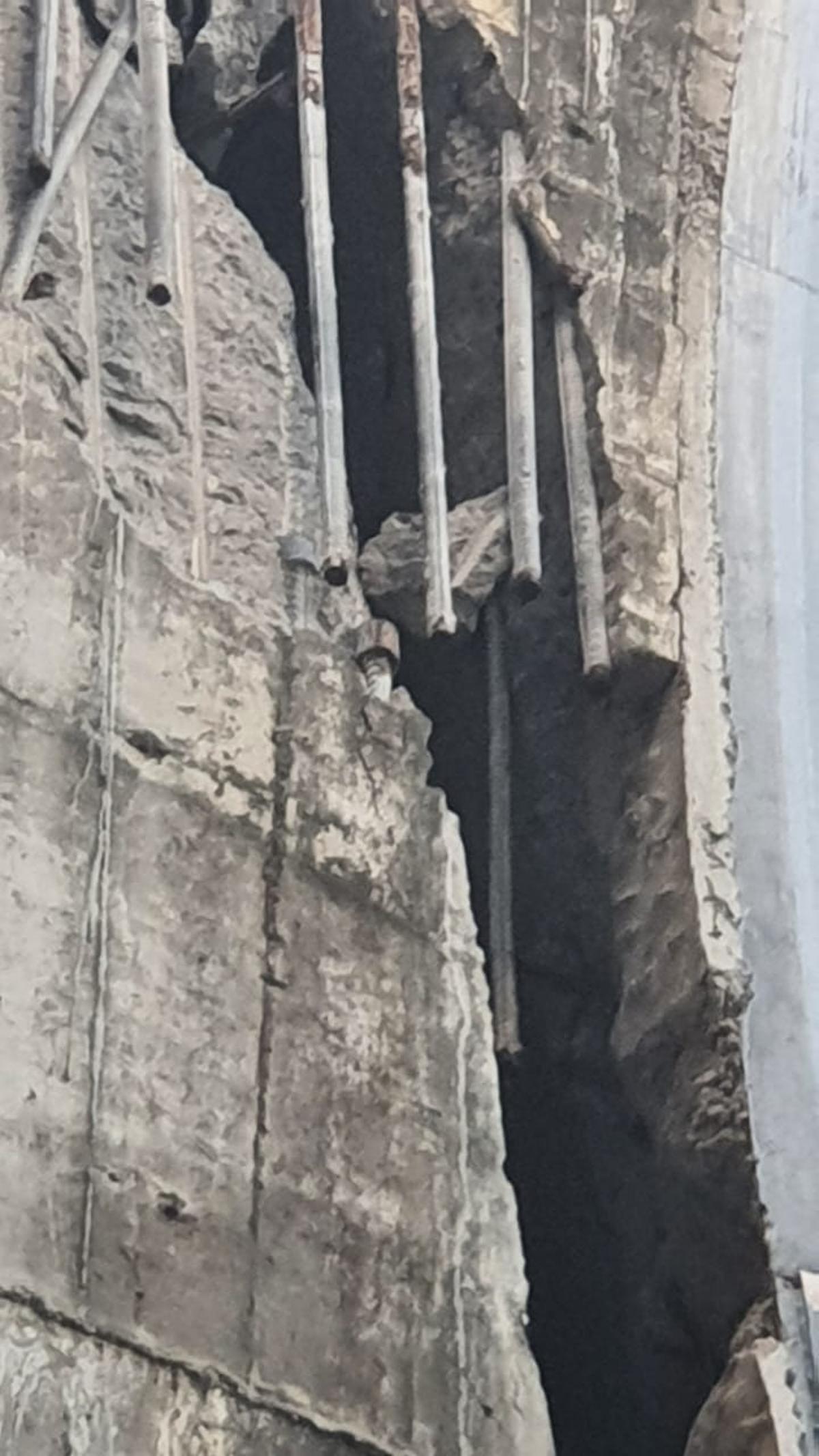
As the inquiry with the help of engineering experts makes headway towards a logical conclusion, more and more lapses are tumbling out. Irregularities and deviations from the prescribed norms are coming to light in the construction, periodic quality checks, inspection (supervision) and operational maintenance stages. https://www.thehindu.com/news/national/telangana/more-defects-deviations-tumble-out-in-vigilance-probe-into-medigadda-fiasco/article67796373.ece (31 Jan. 2024)
Riverbed not levelled by contractor as required Among the several reasons that led to a portion of the Medigadda barrage sinking was the neglect in levelling the Godavari river bed. Doing so would have ensured uniform flow of water towards the barrage, investigations into the barrage collapse by the V&E wing has found. Sources said that after the impounded water was drained, officials found that one deeper portion where the water used to flow when the river was diverted using cofferdams, stayed that way. “This resulted in uneven pressure on the (Medigadda) structure with one section coming under increased stress where the water level was deeper when the river was in full flow during the 2019 and the 2022 floods, and also when it was first filled up in 2019,” sources said.
– The river bed upstream of the barrage for a few hundred metres was found to be highly uneven, with dunes sticking out —clear evidence that the river’s channel was never levelled. “The stipulation was that the levelling was to be at 88 metres (above sea level) and this was not done, which itself is yet another violation by the contractor.” sources explained. https://www.deccanchronicle.com/nation/river-bed-not-levelled-by-contractor-as-required-880688 (01 Feb. 2024)
L&T sitting on crucial documents The company was “requested” to furnish the ‘Barrage Maintenance Register’, and ‘Log sheet/load register of batching plant’ immediately on top priority by the executive engineer of the irrigation department at the barrage site a week ago, on January 23, apparently under duress from the vigilance and enforcement wing, which is probing the sinking of the barrage. The letter on January 23 was the second sent to the project manager of L&T, whose office is located at Ambatpally in Jayashankar Bhupalpally district, with no response from the company to a similar “request” on January 20.
It may be recalled that this is not the first time that the absence of crucial barrage maintenance and construction records has turned into a serious issue. Some of the records sought earlier by the National Dam Safety Authority (NDSA) soon after the sinking of a portion of the barrage, had resulted in a controversy with the then BRS government claiming that every record sought by the NDSA was submitted by the irrigation department, while NDSA maintained that it did not receive the records it had sought. https://www.deccanchronicle.com/nation/current-affairs/lt-sitting-on-crucial-records-of-medigadda-barrage-880636 (01 Feb. 2024)
Medigadda cost escalated by ₹1,350 cr after ‘work completion’ The cost of Medigadda Barrage, which suffered structure-threatening damage in October last due to poor quality of work done by the contract agency in the absence of any quality check and supervision by the Irrigation department, was escalated even after ‘completion’ without any basis but with a deliberate aim to benefit the contractor. It is the new and startling revelation the V&E inquiry into the issue stumbled upon as part of the ongoing exercise. The escalation of cost is found to be a whopping 41.5% even after revising the cost once from the initial amount for the administrative approval was given. https://www.thehindu.com/news/national/telangana/cost-of-medigadda-barrage-escalated-by-1350-crore-after-work-completion/article67804476.ece (02 Feb. 2024)
Polavaram Project PIL filed in HC V Umesh Chandra Varma, an advocate from Amalapuram, filed the public interest litigation urging the High Court court to declare the action of the government in not ordering an inquiry against the officials, who had given permission to build the diaphragm wall before constructing the upper cofferdam, as arbitrary. The petitioner also wanted the court to constitute an expert committee to supervise the construction of the Polavaram project. He also sought interim orders seeking a report from the officials on the present status of the diaphragm wall and the cofferdams. Secretaries of Union Home Ministry, Jal Shakti Ministry, CEO of Polavaram Project Authority, Director of National Dam Safety Authority and Andhra Pradesh State Chief Secretary were named as the respondents. The petition is likely to come up for hearing next week. https://www.newindianexpress.com/states/andhra-pradesh/2024/Jan/31/pil-filed-in-hc-on-polavaram-project (31 Jan. 2024)
Sardar Sarovar Project Narmada waters flood Kutch Rann By Pankti Jog The Narmada waters are continuously flowing in the Little Rann of Kutch areas for the last two plus months, spreading to up to as far as 40 km inside, inundating widespread areas of the Rann. The Narmada waters are released in large quantity in rivers like Rupen, Banas and small-big streams in Surendranagar, Patan, Kutch districts and streams for the purpose of irrigation, but they reach the Rann areas, thus get wasted. This happens mostly December onwards.
– Large scale water released from the Narmada canal during the salt season makes severe impact on the salt farming inside the Rann. Salt farms are inundated, and the density of the brine reduces when the Narmada waters get mixed with the brine in the salt farms. Sometimes bunds constructed by saltpan farmers are washed away by these waters. The salt farmers’, or Agariyas’, access to their well and farm (Agar) gets restricted, thereby affecting salt production. Worse, once the Rann is flooded with Narmada waters, water tankers and mobile health vans cannot reach the Agariyas, depriving them of health service and drinking water supply. In fact, floods in Rann due to Narmada waters are a recurring incident and this has been going on for the past several years.
-In 2017, the sudden release of waters in Banas river led to huge floods and the Agariyas had to immediately rush back to their villages from salt farms. One pregnant Agariya women died as she got labour pain and could not reached hospital on time. In 2021, Kharagodha and Zinzuwada were flooded with Narmada waters, and 159 salt farms were destroyed. A committee headed by the director (civil) Sardar Sarovar Narmada Nigam (SSNNL) visited the Rann and met Agariyas for analyzing the situation and filed a report. Damage assessment was done but no compensation was given.
-The Rann is the Wild Ass Sanctuary, and such frequent floods with Narmada waters are bound to affect the rare species’ habitat, apart having adverse impact on the biodiversity of the Rann. The wild ass requires a dry desert environment, and it can’t reside in wetlands. It walks, wanders and runs in the dry mudflats of the wild ass sanctuary. More than 6,000 wild asses are conserved here. Inundation of the desert during winter and summer restricts the movement of the wild ass, which may have long-term impact on its habitation and growth. Additionally, the Rann has many species like spiders which make rare nets in the mud-flat cracks, and reptiles stay in underground holes. All of this may also get affected.
-One wonders: What is the reason for releasing Narmada waters in Banas and Rupen rivers? Has the SSNNL estimated the water requirements of the farmers on the periphery of the Rann in order to release reasonable amount of water? What is the planning by the SSNNL for storing extra waters that are not used by farmers? Who is responsible for such a huge loss of Narmada waters? Who will give compensation for the livelihood loss of the Agariyas? https://www.counterview.net/2024/02/adverse-impact-on-saltpans-biodiversity.html (03 Feb. 2024)
When two livelihoods collide The brackish water ecology of the Little Rann of Kutch, is made up of a mix of seawater, river run-off and rainwater, which makes it an ideal nursery ground for ginger prawns. However, this hydrological regime where ginger prawn thrives is broken by the expansion of marine salt works and reduced freshwater runoff from rivers. Rann Sarovar, a proposed freshwater lake in the Little Rann of Kutch, would, if approved, deal a final blow to this small-scale fishery. https://india.mongabay.com/2024/02/when-two-livelihoods-collide/ (02 Feb. 2024)
Mullaperiyar Dam TN parties condemn Kerala bid to build new dam Kerala government’s renewed attempts to build a new Mullaperiyar dam have drawn condemnation from the political parties in Tamil Nadu. PMK founder S Ramadoss urged the Tamil Nadu government and Union government to not accept Kerala’s proposal. The customary policy address of Kerala governor Arif Mohammed Khan to the state assembly on Thursday said the government was of the view that construction of a new dam in the downstream reaches of the existing dam, was the only solution to protect the safety of people.
In a statement, Ramadoss said the situation did not arise for building a new dam since the Supreme Court had certified the safety of the dam in 2014. The court also observed that water level can be raised to 152ft after executing the strengthening measures. “Demanding the construction of a new dam not only amounts to contempt of court, but also an attempt to strain the relations between two states,” the PMK leader said, criticising the Kerala government for not allowing Tamil Nadu to even fell trees near the dam to enable strengthening work. Former chief minister O Panneerselvam urged chief minister M K Stalin to categorically inform his ally and Kerala counterpart, Pinarayi Vijayan, that there was no room for talks for a new dam, and the latter should extend support to strengthen the existing dam. https://timesofindia.indiatimes.com/city/chennai/tn-parties-condemn-kerala-for-bid-to-build-new-mullaperiyar-dam/articleshow/107177837.cms (27 Jan. 2024)
Meghalaya Mawrah multi-purpose reservoir inaugurated CM Conrad K Sangma on Jan. 30 inaugurated the Mawrah Multi-Purpose Water Reservoir. The CM said that conservation of water bodies and creation of reservoirs is one of the important agenda of the government. “We will be investing approximately 400 crores in the next three years in creating reservoirs across the state,” he said. He informed only about 4-5 per cent of rain water is retained by the State and the rest flows to the neighboring state and country and creating reservoirs in the only way to retain the rain water.
The CM also said that the Mawrah Multi-Purpose Water Reservoir would also serve as a multi-purpose project promoting Tourism, Aquaculture and Farming. Work on the dam in on April 2021 at a Project Cost of Rs 1.50 Crore through the project funding from NABARD. Later on, other financial assistances were also received from State Plan and the Meghalayan Age Ltd. for the construction of the Footbridge Over Dam, Approach Roads Footpaths, Boating Platform and other infrastructures. The Dam of the Reservoir has been designed in an arc shape for the purpose of structural stability and aesthetic beauty. The total water spread of the reservoir is approximated at 7.7 hectare to 8.0 hectare (19 to 20 acres) with the deepest point of 10.50 m. Its maximum storage capacity is 5,28,000 cubic meter or 528 million litres which is capable to cater water needs to several villages. https://theshillongtimes.com/2024/01/30/conrad-inaugurates-mawrah-multi-purpose-water-reservoir/ (30 Jan. 2024)
INTERLINKING OF RIVERS
Ken-Betwa Linking Govt gets no tenders for dam India’s first river linking project Ken-Betwa in Bundelkhand region has faced a hurdle as there have been no takers for the tender to construct the Daudhan Dam and two tunnels in the Panna Tiger Reserve in Madhya Pradesh’s Chhatarpur, which are considered the heart of the project, said people familiar with the matter. The National Water Development Authority (NWDA) floated a tender for the construction of Daudhan Dam and two tunnels in August 2023 with a deadline in October, but no company participated in the tender process. According to an officer, NWDA extended the last date for filing tenders till January 18, 2024, but companies sent queries related to permission, cost and technology but showed no interest in submitting the tender. The NWDA has now extended the last date for the third time till March 5. Officials familiar with the matter said if the companies don’t go for tender, this would increase the cost of the project.
– “Seeing no response and hesitation among companies for the project of about ₹5,000 crores to ₹6000 crores, the NWDA officers have decided to invite companies to discuss their problems and issues on February 2 by releasing a public notice. We want to give equal opportunities to address the queries and issues related to it so that at least three companies could participate in the tender process of the project,” said a senior NWDA official, who is working on the Ken Betwa Link Project. An officer, requesting anonymity, said, “The companies are also concerned about environmental clearance as the dam is going to be constructed in the core area of the Panna Tiger Reserve.” https://www.hindustantimes.com/cities/bhopal-news/indias-first-river-linking-project-faces-hurdle-as-govt-gets-no-tenders-for-dam-101706712445852.html (31 Jan. 2024)
Parbati-Kalisindh-Chambal Link CM’s aerial survey for ERCP; engr suspended Rajasthan CM Bhajanlal Sharma and Union jal shakti minister Gajendra Singh Shekhawat on Sunday conducted an aerial survey of the pre-constructed and proposed main components of the revised Parbati-Kalisindh-Chambal Link (integrated ERCP) project including Bisalpur Dam, Mej Barrage, Kalisindh dam, Chambal crossing, Navnera Barrage, Dungri Dam, Rameshwar Ghat, and Isarda dam. During their visit to the under-construction Navnera dam, junior engineer Ashok Kumar Meena of JVVNL, posted in Budhadit, was found to be absent and was suspended. https://timesofindia.indiatimes.com/city/jaipur/cms-aerial-survey-for-ercp-engr-suspended/articleshow/107412273.cms (05 Feb. 2024)
INTERSTATE WATER DISPUTES
Krishna Water Disputes KRMB taking over common projects trigger political storm In a crucial meeting held in Hyderabad on Thursday (Feb. 01), the Engineers in Chief of both the states agreed to hand over the projects to the Krishna River Management Board (KRMB) but disagreed on the management of the hydroelectric projects. https://www.deccanherald.com/india/telangana/union-govts-krishna-river-board-taking-over-common-projects-trigger-political-storm-in-telangana-2878119 (03 Feb. 2024)
KRMB to supervise water releases only, nothing handed over: ENC The irrigation department on Friday (Feb. 02) declared that it has not handed over any of its projects on the Krishna to the KRMB and that it had only agreed to a 3 member committee’s decision on water releases from the river in Telangana and Andhra Pradesh. “All that has been agreed to at Thursday’s meeting is that KRMB will implement the decision of the committee with respect to water releases. The KRMB will have no other role other than to supervise the decisions of the committee,” engineer-in-chief C. Muralidhar Rao told reporters.
“There has been no change in the share of water between the states though we have made it clear to KRMB that Telangana stands by its demands that include a 50-50 share of water until a final arbitration is made on the share by the Krishna Water Distribution Tribunal.” Principal secretary, irrigation, Rahul Bojja, said at no point of time had Telangana state agreed to hand over full control of the projects on Krishna to the board. “We have also written to the Centre that the minutes of the January 17 meeting in Delhi on the river water sharing and other issues were incorrect and that we agreed to hand over the projects in 30 days to the KRMB,” he said. https://www.deccanchronicle.com/nation/current-affairs/krmb-to-supervise-water-release-only-nothing-handed-over-says-enc-880841 (02 Feb. 2024)
The Telangana and Andhra Pradesh governments on Thursday (Feb. 01) agreed in principle to hand over the operation and maintenance of inter-state irrigation projects of Srisailam and Nagarjunasagar on Krishna river to KRMB. However, they insisted that there should be a clarity on river water sharing before the board takes over the projects, officials said.. https://www.hindustantimes.com/india-news/telangana-andhra-to-handover-projects-to-central-body-101706814940249.html (02 Feb. 2024)
The Andhra Pradesh and Telangana states have in principle agreed to hand over the 15 water outlets on the reservoirs – 6 on AP side and 9 on TS side – to the KRMB. A three-member committee held a meeting in Hyderabad on Thursday (Feb. 01), which was chaired by KRMB chairman and participated by engineer-in-chiefs from both the states. They discussed the long-pending issues of Srisailam and Nagarjunasagar projects. This was a follow-up to a recent meeting held by the Jal Shakti secretary in New Delhi. https://www.deccanchronicle.com/nation/in-other-news/dams-ap-ts-to-hand-over-15-water-outlets-to-krmb-880718 (01 Feb. 2024)
IRRIGATION
Maharashtra Jayakwadi dam left canal overhaul to cost Rs3,300 cr The irrigation department has prepared a detailed project report (DPR) to undertake an overhaul of the left canal of the dam that goes from Paithan to Parbhani district, the official said. “The DPR is almost ready, and the project will cost Rs 3,300 crore. The canal cannot handle the pressure of water released over 2100 cusecs. As a result, the water reaches late to the tail end of the canal,” Samadhan Sabbinwar, chief engineer of the irrigation department, told PTI.
While the designed capacity of the left canal is 3600 cusecs, water was never released above 2800 cusecs, he said. With the overhaul, the canal will be able to carry 3200 cusecs water, increasing the carrying capacity by 1100 cusecs, he said, adding that the DPR will be submitted to the state government for further sanctions. https://www.freepressjournal.in/pune/jayakwadi-dam-left-canal-overhaul-set-to-cost-rs-3300-crore-boost-capacity-by-1100-cusecs (01 Jan. 2024)
URBAN RIVERS
Pune Experts to draft a declaration for rights of rivers Citizens from across Pune came together to draft a declaration for the rights of rivers. This draft is being prepared with the help of experts working for river conservation and protection, aiming to protect rivers and freshwater ecosystems, not only in Pune but across Maharashtra. “This declaration will be submitted to the State government on February 14, and subsequently to all the departments that are associated with rivers,” said Shailaja Deshpande, founder member of Living River Foundation. Talking about the declaration, Deshpande said, “There are three rights we have included in this draft. The first one is the right to own land, the second one is the right to flow without any hurdles and the third one is a healthy river.”
-Speaking about this Parinita Dandekar, an internationally acknowledged river researcher said, “Rivers have been considered sacred entities since ancient times, and many people worship them. Citizens regard rivers as living entities, and hence they deserve their rights. However, today’s rivers are in a deplorable condition and need immediate intervention. As a result, individuals in Pune are drafting a proclamation regarding the rights of rivers.” The river is divided into various zones including the Blue, Green, and Red which consist of the origin of the river, the riverbed and the river ecology, and the area where the flood water has reached in the last 100 years. The land that is occupied under these three zones should be declared under the ownership of that particular river and no other activities should be carried out on those lands. https://www.hindustantimes.com/cities/pune-news/experts-to-draft-a-declaration-for-rights-of-rivers-101706465621198.html (29 Jan. 2024)
Netravathi, Mangaluru Protest warned over RFD The ongoing Netravathi Riverfront Promenade project of Mangaluru Smart City Limited (MSCL), with an allocated budget of Rs 70 crore for 2.1 km, is unscientific and negatively impacting the livelihoods and operations of boat building and fishing enterprises, said Athaulla Rehman, president, Citizen Forum for Justice. He said on Jan 25, that boat building yards and fish net making establishments, which have obtained financial loans from MSME, Pradhan Mantri Matsya Sampada Yojana (PMMSY), and other financial sources for the establishment of their facilities, are currently facing the possibility of closure due to the construction of a wall-like structure along the riverside, which will result in cutting off the access to the river.
– “The MSCL project is posing a threat of eviction to the boat building yards, fishnet making, and other establishments in the area leading to a reduction in the number of boatyard repairers and negatively impacting the local fishing industry in Mangaluru. This potential closure would also lead to significant unemployment among thousands of skilled workers with minimal or no formal education, many of whom are beneficiaries of below poverty line (BPL) schemes. The MSCL has not conducted a social impact assessment or conducted public hearings regarding the project,” he said. He warned of staging a protest if their grievances are not addressed. https://timesofindia.indiatimes.com/city/mangaluru/protest-warned-over-riverfront-project/articleshow/107159385.cms (26 Jan. 2024)
RIVERS
Madhya Pradesh जीवन के लिए संघर्ष कर रही मोक्षदायिनी क्षिप्रा नदी बांधों, नदियों और लोगों पर दक्षिण एशिया नेटवर्क (सेंड्रप) के समन्वयक हिमांशु ठक्कर बताते हैं कि एक नदी से पानी लाकर दूसरी में प्रवाहित किया जाना तकनीकी रुप से संभव तो है लेकिन वित्तीय दृष्टि से अत्यंत महँगा होने के कारण भारत जैसे तीसरी दुनिया के गरीब देशों के लिए यह तरीका कारगर नहीं है।
प्रदूषण पर निगरानी रखने वाली संस्था प्रदूषण नियंत्रण बोर्ड की क्षमता पर सवाल खड़ा करते ठक्कर कहते हैं कि भारत में प्रदूषण नियंत्रण बोर्ड का गठन हुए 50 साल हो गये है। इस बोर्ड की इकाईयां राज्यो में काम करती है। लेकिन इस बोर्ड ने आज तक किसी एक छोटी सी भी जल संरचना या नदी को साफ किया हो करवाया हो ऐसा उदाहरण नहीं मिलता।
वह बताते हैं कि यह बोर्ड सरकार के अधीन काम करता है जिसका अपना कोई बुनियादी ढाँचा नहीं है। इसके अपने न तो कोई लक्ष्य निर्धारित हैं और न ही इसकी कोई जवाबदेही है। इसके क्रियाकलाप में पारदर्शिता भी नहीं है ऐसे में इससे किसी जल संरचना के प्रदूषण मुक्त करने की उम्मीद कैसे कर सकते हैं? वे कहते हैं कि स्वायत्तता देकर ही इससे कोई उम्मीद की जा सकती है। https://www.downtoearth.org.in/hindistory/river/river-projects/ground-report-mokshadayini-Kshipra-river-is-fighting-for-its-life-94063 (24 Jan. 2024)
Bihar गांधी के रास्ते, कोशी पीड़ितों के न्याय वास्ते सत्याग्रह पदयात्रा सुपौल से हुई रवाना। सत्याग्रह पदयात्रा को भगत सिंह के भांजे प्रो जगमोहन ने किया रवाना। शहीदों के संकल्पों को जिंदा रखना नौजवान पीढ़ी की जिम्मेदारी। प्रो जगमोहन सुपौल 30/31 जनवरी l महात्मा गांधी के बलिदान दिवस पर उनके चित्र पर पुष्पांजलि अर्पित कर, कोशी पीड़ित अपनी मांगों को लेकर सत्याग्रह पदयात्रा शहर के बैरिया मंच से शुरुआत किए इस यात्रा को शहीद भगत सिंह के भांजे प्रो जगमोहन सिंह ने रवाना किया। https://www.newsclick.in/bihar-koshis-floods-and-erosion-victims-start-250-km-satyagraha-padyatra-justice (01 Fe. 2024)
CAUVERY Tamil Nadu 1.2 tonne of clothes removed from river in Srirangam Ahead of Thai Amavasya, the Trichy Corporation on Friday (Feb. 02) cleaned the banks of the river Cauvery and Amma Mandapam ghats in Srirangam. The ghats in Srirangam are a preferred location for locals and visitors to perform rituals for their ancestors during Thai Amavasya, scheduled to be observed on February 9 this year. A special team of workers was engaged in the cleanliness drive for the event. People drop their old clothes in the river as part of the rituals. Old clothes pollute the river and at times affect the water flow. Bins provided by the local body were seldom used.
“As the water in river is away from the banks at present, devotees are not using the bins placed on the banks. We instructed our workers to guard the ghats to sensitise the devotees to use only the bins to dump old clothes,” a corporation official said. Last year, around two tonne of clothes were removed from the river. This year, the quantity of waste came down to 1.2 tonne. The civic body has appointed an agency to collect old clothes and process waste either for recycling or for being reused as rags in automobile workshops. https://timesofindia.indiatimes.com/city/trichy/1-2-tonne-of-clothes-removed-from-river-cauvery-in-srirangam/articleshow/107367045.cms (02 Feb. 2024)
SATLUJ Punjab Patiala sewage waste flows into Ghaggar This report suggests sewage load increased in Ghaggar river by 10 MLD, after acting on NGT order, MC stopped sewage discharges into Chhoti Nadi. The report also mentions Patiala City is generating ~92 MLD sewage against treatment capacity of 71 MLD. As much as 92 MLD sewage is being generated in Patiala city, whereas the STPs have the capacity to treat 71 MLD sewage everyday. The untreated water is flowing into the Ghaggar through Jacob and Model Town drains. There is no provision to drain rain water in the city and it flows into the sewer lines. An officials of the Patiala Municipal Corporation said, “The two STPs at Shermajra with 46 MLD and 15 MLD capacity and one in Ablowal with a capacity of 10 MLD receive more than 90 MLD of waste water daily.”
An MC official said the sewage discharge was increased after illegal connections, laid by residents to drain out untreated water into the Chhoti Nadi, were snapped following the orders of the NGT. It increased the sewage discharge by 10 MLD. But the STPs operating in the district are unable to handle the additional burden. According to Rajiv Sharma, a resident, said, “We have written to the Patiala MC numerous times, but to no avail. Untreated water is getting discharged into the drains. Residents living along the drains have severe health issues.” https://www.tribuneindia.com/news/punjab/patiala-sewage-load-beyond-stps-capacity-waste-flows-into-ghaggar-586816 (03 Feb. 2024)
GANGA Uttarakhand NGT seeks action report on sale of plots at Ganga bank Taking suo motu cognizance of development of a residential colony ‘Ganga Heritage’, a stone’s throw from river Ganga, the NGT has sought an action taken report from the district administration and the SPCB in Haridwar on how the coloniser was granted permission for the same.
On November 7 last year, the NGT took cognizance of an advert stating “Residential plots with private ghat starting at Rs 25 lakh, NH 34 – 5 minutes” and directed the district magistrate to inspect the spot and submit a status report. The tribunal held this as a violation of the River Ganga (Rejuvenation, Protection and Management) Authorities Order, 2016, prohibiting construction on the riverbed. A joint team headed by the deputy district magistrate, Ajayveer Singh, including the secretary of Haridwar Roorkee Development Authority (HRDA), executive engineer of irrigation department and RO of the SPCB conducted a spot inspection in Shyampur village on January 18 and found that the land fell under the “prohibited area”. HRDA secretary Uttam Singh Chauhan said, “Notices were issued to the developer, following which he bulldozed the demarcation of plotting on the said land for which he had earlier issued advertisements.” https://timesofindia.indiatimes.com/city/dehradun/ngt-seeks-action-report-on-sale-of-plots-at-ganga-bank-dehradun/articleshow/107246735.cms (30 Jan. 2024)
As norms are ignored, state faces tunnelling disasters Himanshu Thakkar, coordinator, South Asia Network on Dams, Rivers and People (SANDRP), emphasised that guidelines existed to ensure safety, during and after tunnelling, as well as to minimise impacts to the local population and the environment. The real problem, he told The Third Pole, was that guidelines were not thoroughly implemented, and the required assessments, especially those concerning environmental impacts, were superficially done for faster completion and cost-cutting purposes. https://www.thethirdpole.net/en/climate/as-norms-are-ignored-uttarakhand-faces-tunnelling-disasters/ (31 Jan. 2024)
Silkyara tunnel collapse: Overhaul must in infra works: Report The collapse of the Silkyara-Barkot tunnel in Uttarakhand last year has unveiled critical issues in tunnel construction in the Himalayan geology and emergency response plans, according to an investigation report of the Uttarakhand State Disaster Management Authority (USDMA). The investigation identified substantial shortcomings in the design project report (DPR), citing a lack of detailed geotechnical and geophysical investigation. The report advocates for future projects to prioritise comprehensive site studies, minimising unforeseen geological challenges. Furthermore, it points to the inadequacy of boreholes during the DPR stage, proposing more exploratory boreholes to reduce risks.
– The report reveals a collapse zone approximately 200 meters from the tunnel portal, characterised by a shear zone in the rock, indicating vulnerability in that specific geological formation. The report proposes recommendations to address gaps identified in the Silkyara tunnel project, enhance safety measures and guide future tunnel constructions in challenging geological conditions. https://www.tribuneindia.com/news/india/silkyara-collapse-shows-overhaul-must-in-infra-works-says-report-585877 (31 Jan. 2024) Construction has resumed on the Silkyara tunnel that collapsed last year, trapping 41 workers for 17 days — with at least one of those men back on the job, reports Tuesday (Jan. 30) said. The transport ministry gave permission last week for work to resume, nearly two months after the collapse. https://www.ndtv.com/india-news/cant-stop-working-over-fear-rescued-worker-back-at-tunnel-that-crashed-4958401 (30 Jan. 2024)
Prayagraj Colonies on floodplains ‘flout’ construction ban In Prayagraj, action on properties of jailed gangster-turned-politician Atiq Ahmed and his associates has revived a debate on how illegal colonies mushroomed across the city, especially the floodplains, despite a 2011 order of the Allahabad High Court banning construction within 500 m from the highest flood level of the Ganga. As the state govt is cracking down on Atiq Ahmed, the Prayagraj Development Authority (PDA) has informed the Department of Housing and Urban Planning that it has identified 30,715 illegal constructions – the highest in the state. Prayagraj is followed by Varanasi (24,758) and Gorakhpur (23,389), according to the data submitted to the housing department. The numbers were up to the period of 28 February 2023.
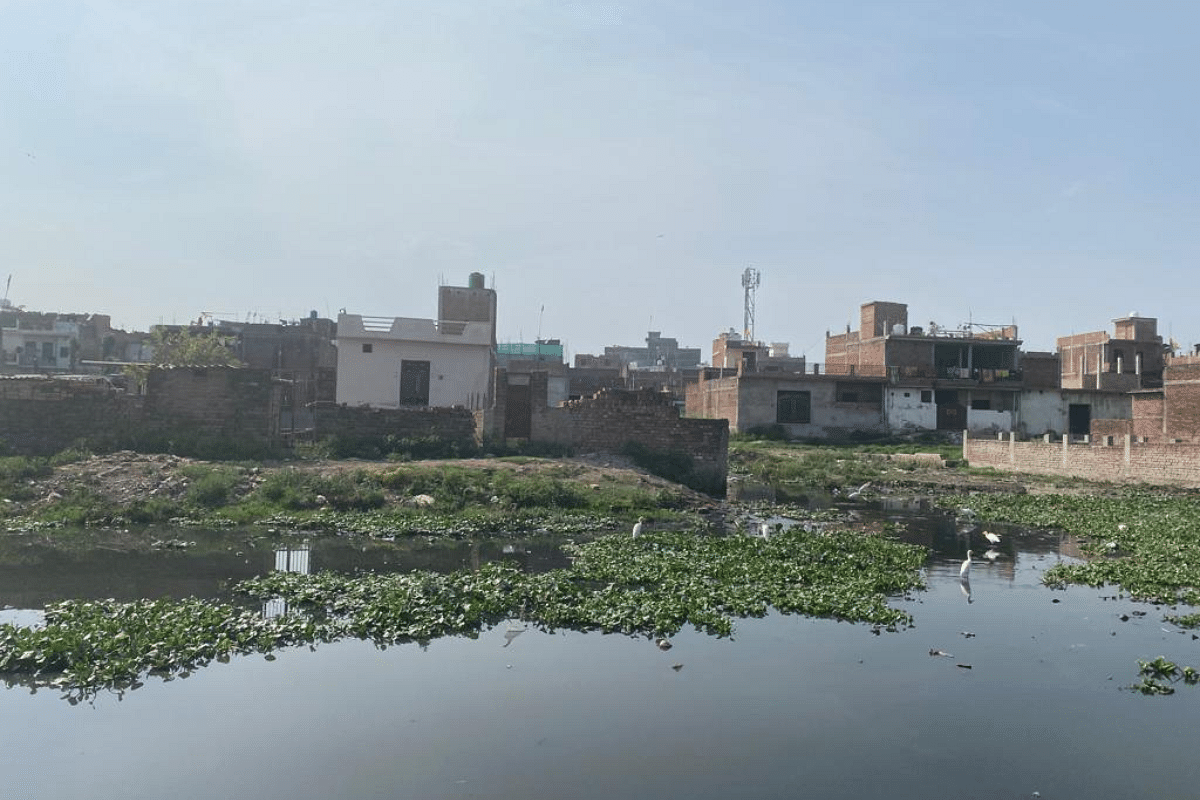
The data collated from all development authorities was uploaded on the housing department’s portal, official sources said, adding that the government directed them to prepare a roadmap to “dispose of” illegal constructions. A PDA official told ThePrint that the maximum number of illegal properties were identified in areas like Naini, Jhalwa, Jhunsi, Sulemsarai and Phaphamau and in the outer areas of Prayagraj. Asked about such illegal colonies in floodplains of Prayagraj, principal secretary (housing) Nitin Ramesh Gokarn says the department has sought an action plan from different authorities for action against such illegal constructions. In floodplains, demolition is the only solution, he agrees.
Senior advocate Arun Gupta, the amicus curiae in the Ganga pollution case which led to the 2011 construction ban ruling, says that the numbers are very less as ‘kacchhar kshetra’ (floodplains in local parlance) has illegal colonies spread across Prayagraj. “Some colonies were built before the court order, but thousands of houses have come up even after the ban. Lakhs of houses have come up in Kareli, Daraganj, Neeva, etc. During the case proceedings, the government filed several affidavits and shared the details of constructions on directions of the court,” he says. https://theprint.in/india/colonies-on-prayagrajs-floodplains-are-not-just-for-poor-heres-how-rich-mighty-flout-construction-ban/1505994/ (09 April 2023)
Uttar Pradesh Road Widening: Permission given to fell 112,000 trees along Upper Ganga Canal The state forest department has cleared the felling of more than 100,000 trees and shrubs in the protected forest area of three forest divisions — Ghaziabad, Meerut and Muzaffarnagar — for the construction for two lanes of the 111-km Kanwar Marg from Muradnagar to Purkaji near the Uttarakhand border, officials aware of the matter said on Tuesday (Jan. 30). The Kanwar Marg, which runs along the Upper Ganga Canal, at present has two lanes that run parallel to the water body along the eastern embankment. The new project, officials said, will run along the western embankment of the canal. The ₹658-crore project is to be taken up by the PWD, and will be funded by the state government.
Environmental activists, meanwhile, noted that felling such a large number of trees will adversely affect the biodiversity in the region. “The trees along the Upper Ganga Canal are fully matured and old. Felling them will adversely impact the local biodiversity and will also displace wildlife. It will also adversely impact the environment due to loss of forest and tree cover,” said Akash Vashishtha, a Ghaziabad-based environmentalist and lawyer. https://www.hindustantimes.com/cities/noida-news/upgives-permission-to-fell-112-000-trees-for-road-along-upper-ganga-canal-101706638678138.html (31 Jan. 2024)
Study Assessment of groundwater vulnerability in Ganges delta The spatial distribution of the vulnerability map indicates that eastern and some isolated south-eastern and central middle portions are very vulnerable in terms of Arsenic (As) and Fluoride (F−) concentration. The overall prediction demonstrates that 29% of the areal coverage of the Ganges delta is very vulnerable to As and F− contents. Finally, this study discusses major contamination categories, rising security issues, and problems related to groundwater quality globally. Henceforth, groundwater quality monitoring must be significantly improved to successfully detect and reduce hazards to groundwater from past, present, and future contamination. https://www.nature.com/articles/s41598-024-51917-8#Abs1 (13 Jan. 2024)
YAMUNA Delhi NGT seeks response from Centre, state govt on July 2023 floods The NGT has sought a response from the MoEF, MoJS, the Delhi govt and others in a matter regarding the 2023 floods in the national capital, allegedly caused by unauthorised constructions on the Yamuna floodplain. The green panel was hearing a matter in which it took suo motu (on its own) cognisance of a newspaper report that said there was large-scale encroachment on the floodplain, with around 76 unauthorised colonies along the 22-kilometre stretch from Wazirabad to Palla. The delineation of floodplain was required to prevent the encroachments, which caused the floods, the report said.
According to the report dated January 29, the committee identified broad actions and “the shortest possible time” for demarcation, two weeks for “remote determination of areas (based on ownership and land use separately)” and “preparation of high-resolution images on determined area to facilitate ground demarcation”, and “four weeks for ground verification”.
It said, “The high-level committee deliberated at length the timelines required for the exercise and found that the entire operation needs massive inter-departmental collaboration, collection of data, ground surveys and verifications and on-ground demarcation to ensure effective implementation of this tribunal’s directions and thus requires more time.” Allowing the prayer sought, the tribunal said because of “the nature of the issue and seriousness of the matter, including the need for inter-departmental coordination”, it was impleading as parties several authorities. These include officials from the Delhi govt & environment department, DPCC, MCD, NMCG and MoEF. “Respondents are directed to file their responses within one month,” the tribunal said. The matter has been posted to March 21 for further proceedings. https://www.business-standard.com/india-news/ngt-seeks-response-from-centre-delhi-govt-on-2023-yamuna-floods-124013101118_1.html (31 Jan. 2024)
Delhi govt asks for 12 weeks to demarcate floodplain Experts have long held that there is a simple reason why the Delhi government has been unable to protect the Yamuna floodplains — they have never been demarcated and defined. After the NGT, in October, pushed the administration to do so by setting up a panel for the task, the Delhi government, in a submission to the body on January 29, has sought 12 weeks to complete the virtual demarcation of the floodplains, and a physical demarcation on the ground through signage and pillars.
– NGT, in October, took cognizance of a media report and formed a committee headed by the Delhi chief secretary to identify, demarcate and notify the floodplains of the Yamuna as per the River Ganga (Rejuvenation, Protection and Management) Authorities Order, 2016. It added that the delineation of Yamuna was required to prevent illegal developments in the floodplains. The committee also comprises a nominee from Delhi Development Authority, the Secretary (Environment); the Secretary, MoJS; executive director, NMCG; and commissioner, MCD.
– In a submission on January 29, the environment department of the Delhi government told the tribunal that it will take two weeks for the remote determination of the floodplain area, followed by another two weeks to prepare high-resolution images using Geospatial Delhi Limited (GSDL), a company that maintains and update spatial data through mapping and surveys, and four weeks for on-ground verification of the same area, after which physical demarcation on the ground will commence.
– In its submission, the Delhi government added: “The committee has deliberated at length the timelines required for the exercise and found that the operation needs massive interdepartmental collaboration, collection of data, ground surveys, verification and on-ground demarcation to ensure effective implementation of this Tribunal’s directions and thus requires more time. It is prayed further a time of 12 weeks may be granted to the concerned agencies to complete the exercise and ensure compliance.”
– The submission added that DDA estimates the so-called Zone O of the Yamuna to be 9,700 hectares with the area occupied by the river itself being around 1,146 hectares. Of the balance, land available for development is 3,493 hectares (1,647 hectares of this is with DDA); the remaining 5061 hectares is with other department and agencies, and also home to 94 unauthorised colonies. The Delhi government department also said that DDA carried out a floodplain area demarcation , based on a 2015 NGT order that sought the demarcation keeping in mind a possible “1-in-25 year flood” (a rare occurrence with a 4% chance of occurring every year).
– “DDA has said it has done a 1-in-25 year floodplain demarcation in the past, but we don’t see any bollards or markings in the Yamuna, barring a few limited places, like Baansera. The O-zone also exists on paper and until there is clear demarcation of floodplain area, how can we stop projects from taking place on floodplain land?” asked Bhim Singh Rawat, a Yamuna activist and member of the SANDRP. https://www.hindustantimes.com/cities/delhi-news/delhi-govt-asks-for-12-weeks-to-demarcate-yamuna-s-floodplain-101706635375129.html (30 Jan. 2024)
Ground reality belies panel’s claims of cleaner river A year after it was constituted in Jan 2023, the high-level committee (HLC) on the Yamuna claimed at its meeting this month that certain pollution parameters of the river water had shown a 70% improvement. The assessment was based on comparison of the faecal coliform level between Dec 2022 and Dec last year at Asgarpur, the point where the river exits the city. However, belying the claims of improvement, the contamination of the water remains high even as the deadline for treating all sewage flowing into the river has been shifted from Dec 2023 to March. The committee held only eight meetings in the year since its formation. No meetings were held in Nov and Dec last year despite the NGT’s mandate being to meet every month.
According to the minutes of the meeting chaired by Delhi chief secretary earlier this month, a fresh deadline was set for sewage treatment after noting there was a gap of 227 MGD between installed capacity and actual treatment.
In response to NGT’s observations on Jan 9, HLC said that of the 22 drains that flow into the Yamuna, only 9 had been tapped. The 13 others are still discharging 2,976 MLD of sewage into the river. Najafgarh and Shahdara drains, the main sources of sewage discharge of 507.4 MGD, are said to be unfeasible for interception and there is no timeline for the completion of the interceptor sewer project to divert flow of these two drains. https://timesofindia.indiatimes.com/city/delhi/yamuna-river-pollution-ground-reality-contradicts-committees-claims/articleshow/107245136.cms (30 Jan. 2024)
Panel wants 83 parks linked to STPs The HLC for rejuvenation of the Yamuna has asked DPCC to prepare a network plan in consultation with DJB and DDA to connect 83 parks to STPs. DDA had earlier informed the HLC that these 83 parks have no source of water, except borewells.
According to the latest meeting of the HLC, out of 565 MGD of treated STP water, 125 MGD is used for horticulture and lake rejuvenation and water bodies, and 267 MGD is the mandatory return flow in the Yamuna. The committee had earlier proposed utilising 100 MGD for groundwater recharge the DJB marshy land near the Coronation Pillar, Bhalswa lake and Jahangirpuri drain by March this year. However, there is a gap of 73 MGD of unused treated water.
Officials said they are preparing a plan to maximise the use of treated STP water in various ways, including artificial lakes, horticulture, parks, golf courses and party lawns and explore the possibility of mandatory use in big construction projects in Delhi after further treatment. During the eighth HLC meeting on January 10, the matter of DDA’s 83 parks was taken up. It was decided during the meeting that Geospatial Delhi Limited (GSDL) will work out the distance of each of the 83 parks from the nearest STP of DJB. https://timesofindia.indiatimes.com/city/delhi/yamuna-panel-wants-83-parks-linked-to-stps/articleshow/107214329.cms (29 Jan. 2024)
DPCC apologises for delay in report submission DPCC has requested the tribunal to accept the action-taken report and not levy a penalty on its officials. The report was to present the facts on the construction being done by public agencies in Rohini area, causing pollution. The tribunal said the detailed report was expected by Aug 2023, but was submitted in Nov 2023. The delay allowed environmental damage to continue for a longer period, the tribunal said, as quoted by the DPCC in its report, dated Jan 15, and published on NGT’s website on Wednesday (Jan. 24). DPCC said the error was “inadvertent”. https://timesofindia.indiatimes.com/city/delhi/dpcc-apologises-to-ngt-for-delay-in-submission-of-status-report-on-pollution/articleshow/107128490.cms (25 Jan. 2024)
Turn the drain into a river before aarti Two red sandstone elephants, a 300-kg bell and a Ram temple replica have already arrived at the Vasudev ghat of Yamuna near Kashmere Gate in the run up to the plan to hold grand aarti on the banks – along the lines of Haridwar, Rishikesh and Varanasi. Workers are constructing a grand flight of stairs, mini gardens and a gateway. But the makeover can’t hide the garbage and industrial effluents that float by on the Yaumna’s thinning shallow surface. The question of chronology – clean the river or make it a living river – is fair but has been a non-starter.
Earlier known as Qudsia Ghat, the Vasudev Ghat is being developed between Wazirabad and the Old Railway Bridge on the western bank of the river. Work started in 2023 but was disrupted due to the Yamuna floods before it was resumed in December, said Ashok Bharti, one of the workers at the site. The Najafgarh drain is the first major polluter that joins the Yamuna at Wazirabad in Delhi, and is known to contribute the maximum to the river’s pollution load. “Puja or aarti is performed in the river and not in any drain. Right now, Yamuna is completely a drain. Therefore, the first need is to convert this drain into a river and then we can think about an Aarti,” said Vimlendu. https://theprint.in/ground-reports/is-yamuna-ready-for-aartis-like-kashi-haridwar-turn-the-drain-into-a-river-first/1952834/ (04 Feb. 2024)
Traffic restrictions for religious event in Khadar The ‘Ram Katha’ program by Dhirendra Shastri, popularly known as ‘Bageshwar Dham Sarkar’ will be organised in 4th pusta road, Kartar Nagar, North East Delhi, Yamuna Khadar from Wednesday to Saturday (Jan. 31- Feb. 03). https://www.news18.com/india/traffic-restrictions-imposed-in-delhis-yamuna-khadar-ahead-of-religious-event-8760371.html (31 Jan. 2024)
Himachal Pradesh Dumping yard turned into tourist spot after eco initiative at Paonta The unchecked dumping of waste in the open had marred the otherwise scenic stretch along the Yamuna river in the historic town of Paonta Sahib. It not only led to the degradation of valuable forest land, but the foul smell repelled tourists and visitors from this beautiful location. In 2022, the Forest Department decided to impose a monetary penalty for open dumping. In a bid to convert it to a green space, then DFO Kunal Angrish, along with the local administration, chalked out a detailed plan. The plan got an impetus when the chairman of the NGT laid its foundation in September, 2022. After assuming charge in February, 2023, DFO Aishwarya Raj, who had previously worked on eco-restoring a dumpyard to a green zone in 2021, enthusiastically took up the task. While works such as paving paths for the park began in February 2023, key work for eco-restoration began in October-November.
Regarding the project as an ecological New Year’s gift to the residents, Raj said, “We planned and eventually developed a landscape approach with ecological considerations of restoration, edutainment (education and entertainment) models for visitors, along with waste-to-wonder uses such as an elephant sculpture made of plastic waste.” The park has several zones, including ‘Miyawaki’ zone, which houses over 100 forestry and fodder trees of native species.
Trees for the canopy layer, the middle layer and the lower/shrub layer, alongside some endemic trees disappearing from our forests have been added to the park. “The focus was on ensuring that the native species get their rightful space to bloom in the coming years .The zone is expected to pace up several folds of carbon sequestration potential of the otherwise degraded area in some years from now.” The ‘Story of Yamuna’ section displays 3D artwork and edutainment boards depicting facts about the river. https://www.tribuneindia.com/news/himachal/dumping-yard-turned-into-tourist-spot-after-eco-initiative-at-paonta-587202 (04 Feb. 2024)
Noida 4 SEZs to come up along Yamuna Expressway The Yamuna Expressway Industrial Development Authority (Yeida) has approved a plan to develop a 10,500 hectare urban centre — about half the size of Noida city — along the 165km Yamuna Expressway to Agra, with an aim to facilitate the setting up of manufacturing units to generate jobs and new business opportunities in the region, officials who took part in the authority’s 79th board meeting on Monday said. While the board also approved Yeida’s Master Plan 2041, a blueprint for the next 18 years for developing areas under its jurisdiction, it did not arrive at a decision on hiking the toll on Yamuna Expressway, said officials. https://www.hindustantimes.com/cities/noida-news/10500-hectare-manufacturing-hub-with-4-sezs-to-come-up-along-yamuna-expressway-101706553668182.html (30 Jan. 2024)
Mathura Govt to acquire 5,000 ha around Yamuna e-wa The state government sanctioning a fresh interest-free loan of Rs 1,500 crore that will boost the process of acquiring land for various projects. This is the second tranche of loan that UP has granted the YEIDA for acquiring 5,000 hectares over the next 10 years. In November last year, the government had disbursed Rs 1,779 crore. Now that a government loan of around Rs 3,300 crore is already in its accounts, YEIDA will contribute an equal share to create a Rs 6,500-crore corpus and acquire the land to develop housing, commercial and industrial projects in the area that has shot into focus because of the upcoming Noida international airport. With the Rs 1,779 crore it received last November, YEIDA started acquiring 1,200 hectares of industrial land in sectors 10, 28, 29 and 32 and in Tappal Bajna for the proposed logistics park. https://timesofindia.indiatimes.com/city/noida/government-to-acquire-5000-hectares-around-yamuna-expressway-in-10-years/articleshow/107101359.cms (24 Jan. 2024)
RIVERS BIODIVERSITY
Western Ghats New kangaroo lizard species discovered The biodiverse forests of Western Ghats have thrown up yet another marvel of evolution – a new species of tiny lizards, which researchers have described as a “diminutive dragon.” Agasthyagama edge or the northern kangaroo lizard, which belongs to the Agamidae family, is known to have a maximum snout-vent length of 4.3 cm. A group of scientists from various institutions in India and abroad discovered the new species from the southern Western Ghats at Kulamavu in Idukki. The species is the second one of the Agasthyagama genus after A. beddomii or Indian kangaroo lizard that has been previously reported from Sivagiri hills in Tamil Nadu. https://www.thehindu.com/sci-tech/energy-and-environment/scientists-discover-new-kangaroo-lizard-species-from-western-ghats/article67792494.ece (30 Jan. 2024)
FISH, FISHERIES, FISHERFOLKS
West Bengal Meet the ‘boatman’ of Bengal Anthropologist Swarup Bhattacharyya, who is passionate about the ancient mode of transport, has helped preserve the tradition of country boats in West Bengal. “My models are scientific and they help preserve a boat for posterity, because many of them are slowly becoming extinct and soon no one would have an idea what they looked like. Compared to pictures, models give a better understanding of boat architecture,” Mr. Bhattacharyya, who recently held an exhibition in Kolkata of his boat models and photographs, said. “Each traditional boat type of a particular region has evolved after hundreds and hundreds of years of trial-and-error methods of rigorous experiments done by the boat builders. So, a boat typology typical to a place is considered to be the ideal type of that particular region, considering the natural environment condition and the service it caters to. Topological variations of boats depend on various factors like water current, depth, wave size, wave pattern, wind velocity, etc. In Bengal, tradition too plays an important role,” Mr. Bhattacharyya said.

According to him, Bangladesh, which has far more river bodies than West Bengal, once upon a time boasted of 176 varieties of country boats; and that West Bengal, which today has 30 varieties remaining, was likely to have had about 100 kinds of boats at the peak of water transport about a century ago.
“Chhot, Sangara, Sangor — these three became extinct in the last three decades. And Betnai, Khorokisti, Sultani — these three became extinct in the last decade because boats became motorised. On the verge of extinction is Merhli of Malda, and that’s because heavy river transport is no longer required upstream at Farakka, where downstream movement is also restricted due to the barrage,” Mr. Bhattacharyya said.
Of the 30 varieties remaining in the State, according to him, the dingi is the most popular. It’s an all-purpose boat, spoon shaped, anywhere between 10 to 50 feet long. The British had adopted the term to designate small boats, and that’s how lifeboats on ships came to be called dinghy.
Mr. Bhattacharyya has spent as much time interacting with scholars abroad — he has been associated with Viking Ship Museum in Denmark and Centre for Maritime Archaeology, Southampton University, and presently with Exeter University (both in the U.K.) — as with boat makers of Bengal.
“For 26 years now, I have interacted with the boat makers, always amazed by their level of skill and perfection, acquired through generations and not by formal education. There is a decline in the craft due to the decline in demand, and highly-skilled professionals are drifting to non-skilled jobs like daily-wage labourers. The transition is painful to see. The Dihimandalghat, for example, once renowned for its boat builders, housing more than 100 skilled professionals, today has hardly 10 craftsmen left,” he said. https://www.thehindu.com/news/cities/kolkata/meet-the-boatman-of-bengal/article67796137.ece (31 Jan. 2024)
Maharashtra Jayakwadi fishermen warn of protest against solar plant Fishermen from Chhatrapati Sambhajinagar and neighbouring Ahmednagar district have threatened to start a Jal Samadhi from Feb 7 as the government authorities have not taken a call on cancelling the proposed floating solar power project at Jayakwadi dam yet. In a letter addressed to different government authorities and public representatives, the Save Jayakwadi Fishermen committee has claimed that fishermen, along with their families, will meet a watery grave due to the project. Union minister of state for finance Bhagwat Karad — the brainchild of the project — however, was firm on its implementation and said he would take the fishermen into confidence before starting the works.
The fishermen claimed the project was being done in an illegal manner and would affect their livelihood. “The Centre and state are pushing the project in an illegal manner. The project is bound to flout all norms related to the core area and eco-sensitive zones of the Jayakwadi bird sanctuary. Also, it will snatch the income of fishermen,” Bajrang Limbore, the president of the committee, said. The fishermen also said the large panels coming up inside Nathsagar, the reservoir of Jayakwadi dam, would obstruct the entry of sunlight into the water. https://timesofindia.indiatimes.com/city/aurangabad/fishermen-threaten-protest-against-solar-plant-at-jayakwadi-dam-latest-news/articleshow/107246788.cms (30 Jan. 2024)
Andhra Pradesh Fish, pigs die due to water pollution at Srisailam dam Hundreds of fish have died in Lingalagattu near the Krishna River, close to the Srisailam reservoir, over the past few days. The matter gained attention on Saturday (Jan. 27) when affected fishermen filed a complaint with the officials. Further, a few pigs were found dead. A gauging pond near the bridge in front of the Srisailam dam saw a significant accumulation of dead fish. The water in the front portion of the Srisailam reservoir displayed a noticeable change in colour. Local fishermen attribute these incidents to water pollution, speculating that the pigs might have died from consuming the dead fish or drinking the contaminated water. Concerns are growing that the polluted water could adversely affect the health of residents in nearby areas, particularly in Lingalagattu and Sunnipenta.
Raghava Reddy, joint director of the fisheries department, said that officials had collected water samples and dead fish and sent them to the laboratory for analysis. Bharat Lal Naik, fisheries development officer, Srisailam, said that the deaths might be due to oxygen depletion and the accumulation of algae, as there is no flowing water in the dam. He explained that such incidents often occur in winter. https://www.deccanchronicle.com/nation/fish-pigs-die-due-to-water-contamination-at-srisailam-dam-880094 (27 Jan. 2024)
Tamil Nadu Thoothukudi remains cut-off for 44 days A sense of helplessness and intense anger overflows in the fishermen colony at Kovalam near here as the tiny village with 60 families still remains cut-off from other parts of the district due to stagnation of floodwater for the past 44 days. https://www.thehindu.com/news/national/tamil-nadu/fishermen-agonise-as-hamlet-near-thoothukudi-remains-cut-off-for-44-days-after-south-tn-floods/article67792776.ece (30 Jan. 2024)
Gujarat When two livelihoods collide The brackish water ecology of the Little Rann of Kutch, is made up of a mix of seawater, river run-off and rainwater, which makes it an ideal nursery ground for ginger prawns. However, this hydrological regime where ginger prawn thrives is broken by the expansion of marine salt works and reduced freshwater runoff from rivers. Rann Sarovar, a proposed freshwater lake in the Little Rann of Kutch, would, if approved, deal a final blow to this small-scale fishery. https://india.mongabay.com/2024/02/when-two-livelihoods-collide/ (02 Feb. 2024)
Changing landscape spurs decline in ginger prawn fishing Little Rann of Kutch supports two seasonal livelihoods, prawn fisheries and inland salt farming. The region is the largest nursery ground of the ginger prawn species endemic to the Gulf of Kutch and almost 50,000 fishers on foot earn an income from fishing it juvenile. After the fishing season is when salt production from sub-soil brine takes place. However, the expansion of salt works is impacting prawn fisheries which is on the decline. https://india.mongabay.com/2024/02/changing-landscape-spurs-decline-in-ginger-prawn-fishing/ (01 Feb. 2024)
SAND MINING
Tamil Nadu ED attaches more than 200 excavator trucks The Enforcement Directorate (ED)on Friday (Feb. 02) said it has attached 209 excavator trucks worth crores of rupees as part of a money laundering investigation against some individuals involved in ‘illegal’ sand mining in Tamil Nadu. A provisional order for attachment of assets worth a total Rs 130.60 crore has been issued under the Prevention of Money Laundering Act (PMLA). Out of this, the 209 sand excavators are worth Rs 128.34 crore while Rs 2.25 crore of funds are deposited in 35 bank accounts belonging to individuals named Shanmugam Ramachandran, Karuppaiah Rethinam, Paneerselvam Karikalan and others who are involved in ‘unlawful’ sand mining activities in Tamil Nadu, the ED said in a statement.
The ED claimed that an analysis of geofencing reports submitted by the manufacturers and suppliers of the excavators utilised in illegal sand mining revealed that the excavators were predominantly deployed ‘beyond the permitted quarry area’. This unequivocally confirmed the occurrence of illegal and excessive sand mining activities, it said. The agency said it had earlier searched about 17 premises in this case at Chennai, Trichy and Pudukottai and had seized ‘unreported’ cash amounting to Rs 2.33 crore, gold jewellery worth Rs 56.86 lakh and numerous other ‘incriminating’ evidence. https://www.deccanherald.com/india/tamil-nadu/ed-attaches-more-than-200-excavator-trucks-in-tamil-nadu-in-illegal-sand-mining-case-2877270 (02 Feb. 2024)
Green Humour by Rohan Chakravarty on the red sand dunes of Tamil Nadu, called ‘theri’. https://www.thehindu.com/sci-tech/energy-and-environment/tamil-nadu-green-humour-cartoon-rohan-chakravarty-theri-red-sand-dunes-desert/article67788327.ece (01 Feb. 2024)
Punjab Stop illegal mining, CM tells DCs Amid concerns over the slow revenue receipts from sand and gravel mining in CM Bhagwant Mann has asked all Deputy Commissioners (DCs) in the state to ensure that no “illegal mining” is being done in the areas under their respective jurisdiction. The concerns raised by the CM are in the backdrop of allegations by Opposition party leaders about illegal mining operations being carried out in different parts of the state.
The Punjab State Minor Mineral Mining Policy, 2023, provided for electronic surveillance and geo-tagging of mines. The CAG in its annual review report said this was not done. However, Mines and Geology Department claims that the geo-tagging and geo-fencing were in place before the start of mining operations.
While evaluating the revenue from the mining operations in the state, the CM is learnt to have asked the Department of Mines to ensure higher income after all illegal mining activities are brought to an end. Official sources in the Mining Department said the income from mining this year had crossed Rs 225.50 crore. It was expected to cross Rs 300 crore by the end of this fiscal, they said. In 2022-23, the revenue from mining was Rs 247 crore. “The income has increased in spite of the fact that the department has already surrendered 50 per cent of the area for mining to the Water Resources Department,” said a top officer in the Mining Department.
Mining sand in river beds was allowed as part of desilting process, but it was banned by the Punjab and Haryana High Court last year. Sources say that had this continued, the income from mining would have gone up by Rs 450 crore. The government now proposes to increase the public mining sites by 10. As of now, there are 54 public mining sites operational in the state. Once approved by the CM, these public mining sites would increase the supply of sand and gravel and revenue earned from their sale. Other than this, the environmental clearance for starting mining operations at 40 new sites is expected this month. This too would lead to additional income from the mining operations. https://www.tribuneindia.com/news/punjab/stop-illegal-mining-mann-tells-dcs-586458 (02 Feb. 2024)
Bundelkhand अवैध खनन, गुमनाम मौतें और एक अदद तहरीर का इंतजार by सतीश मालवीय बुंदेलखंड में पैसों के पहाड़ हैं। ये पहाड़ खरीदे जाते हैं, बेचे जाते हैं। फिर इनसे पैसे बनाए जाते हैं। कई खरीदे जा चुके हैं, कई खरीदे जाने बाकी हैं। इन पहाड़ों में अवैध खनन से ग्रेनाइट निकलता है और हादसों से इंसानों की लाशें। फर्क बस इतना है कि ग्रेनाइट का तो एक-एक ग्राम हिसाब मांगता है, लेकिन मौतों का हिसाब यहां नहीं रखा जाता। हिसाब क्या, मौतें दर्ज तक नहीं की जाती हैं क्योंकि मरने वाले आम लोग हैं, गरीब हैं, मजदूर हैं. पुलिस नहीं चाहती कि उसके पास मरे हुए लोगों की एफआइआर हो। ठेकेदार और खदान मालिकान भी नहीं चाहते कि कानूनी पचड़े में उनका व्यापार फंसे। इसलिए इनके बीच एक अघोषित समझौता है कि उनकी लापरवाही से कोई मजदूर मर जाए तो उसके परिवार का मुंह पैसे से बंद करा दो। कोई बोले तो उसे गायब करवा दो, मरवा दो। मध्य प्रदेश के बुंदेलखंड की खदानों में लगातार अनाम मौत मर रहे मजदूरों पर सतीश मालवीय की जमीनी पड़ताल https://followupstories.com/environment/only-cash-no-justice-for-piling-illegal-mining-deaths-in-bundelkhand-mp/ (30 Jan. 2024)
Report Could Graphene be a sustainable solution to ‘Sand Crisis? The team at Rice University has utilized their distinctive flash Joule-heating (FJH) technique on metallurgical coke to produce a form of graphene that has the potential to replace sand in the concrete production process. Comparative studies between traditional concrete and the new graphene-infused version have also shown encouraging outcomes, with the graphene-enhanced concrete matching or surpassing the strength and durability of standard concrete. However, James Tour, Professor in Rice University, cautioned that the cost-effectiveness of using graphene in concrete on a large scale would require time, due to the current price of graphene. Yet, he affirmed the importance of exploring sustainable alternatives.
Satish Nagarajaiah, another key contributor to the research and a professor in civil and environmental engineering and mechanical engineering at Rice University, stressed the urgency of finding substitutes for sand, given its significant proportion in concrete and the looming sand crisis. He suggested that metallurgical coke could not only enhance concrete quality but also lead to considerable economic savings. This could have a major impact on one of the biggest industries in the world… We compared concrete made using the graphene aggregate substitute with concrete made using suitable sand aggregates, and we found our concrete is 25% lighter but just as tough. James Tour, Rice’s T. T. and W. F. Chao Professor and a Professor of Chemistry, Materials Science and Nanoengineering. https://www.azom.com/news.aspx?newsID=62474 (29 Jan. 2024)
WETLANDS, LAKES, WATER BODIES
SANDRP Blog WWD 2024: Participatory Decision Making needed to Protect Ramsar Wetlands In reality, most of the Ramsar sites in the country have been facing the common problems of pollution, abuse, siltation, encroachments by private as well as public bodies adversely affecting their eco-systemic services and in turn livelihoods of dependent people. Disappointingly, there has been no concrete measures or plans taken so far either by governmental bodies or Ramsar convention itself to effectively address these issues. On the contrary, the Indian governments have been pushing destructive beautification and tourism projects making the plight of Ramsar wetlands and dependent people worse. https://sandrp.in/2024/01/30/wwd-2024-participatory-decision-making-needed-to-protect-ramsar-wetlands/ (30 Jan. 2024)
WWD 2024: Both Wetlands & Human Beings Remain Neglected While the theme for World Wetlands Day (WWD) 2024 is Wetlands and Human beings, this compilation of top ten wetlands (other than Ramsar Wetlands) reports reveals that on ground most of the wetlands and dependent people in India continue to be subject of degradation and neglect primarily due to absence of holistic restoration plans and clearly defined wetlands governance. https://sandrp.in/2024/01/31/wwd-2024-both-wetlands-human-beings-remain-neglected/ (31 Jan. 2024)
WWD 2024: Lot of schemes for India’s Wetlands-Little Credible Action On the World Wetlands Day (WWD) 2024, this report compiles top ten developments related to Central and state govt actions for wetlands in India. The year 2023 has seen release of first water body survey and launch of Amrit Dharohar & MISHTI schemes by central govt. India has signed institutional framework agreement for the Central Asian Flyway (CAF) to strengthen conservation efforts for migratory birds and their habitats. The state govts have announced more wetland plans which are becoming a routine with no change in ground situation. Despite judicial intervention the respective govts have not taken necessary actions to protect and restore Najafgarh jheel, Dhanauri wetlands and wetlands in Goa. Broadly, the year 2023 has passed with no remarkable achievement on govt front which provide hope for better future for India’s wetlands. https://sandrp.in/2024/02/01/wwd-2024-lot-of-schemes-for-indias-wetlands-little-credible-action/ (01 Feb. 2024)
WWD 2024: Top Ten Judicial Actions for Wetlands The report shows that the judiciary is increasingly petitioned with legal disputes as the governmental bodies dealing with urban authorities and particularly the regulators have been failing to check unabated pollution and encroachments of the wetlands in their jurisdiction. The legal cases pertaining to encroachments and degradation of Ramsar sites and other wetlands in Himachal Pradesh, J&K, Ladakh, Bhoj lake in Bhopal, Tampara lake in Odisha and Sundarbans in West Bengal clearly indicate the fate of lesser known but equally important water bodies in the country. Overall, the judiciary seems to be finding it tough to stir executioners and unwilling governments and is not equally effective everywhere. However, it has made some landmark orders. https://sandrp.in/2024/02/01/wwd-2024-top-ten-judicial-actions-for-wetlands-in-india/ (01 Feb. 2024)
WWD 2024: Top Ten Citizens Actions for Wetlands Protection Celebrating World Wetlands Day (WWD) 2024, this article compiles top ten inspiring reports showcasing how the relentless efforts by individuals, citizen groups and community have been successful in protection and reviving of wetlands, mangroves, waterbodies and lakes in India during 2023. https://sandrp.in/2024/02/02/wwd-2024-top-ten-citizens-actions-for-wetlands-protection-in-india/ (02 Feb. 2024)
WWD 2024: Citizens Efforts to Protect Wetlands & Mangroves in Mumbai The citizen groups in Mumbai including Vanshakti, Save Navi Mumbai Environment Group, NatConnect, Environment Life Foundation and others have for years been making significant efforts to save the remaining wetlands and mangroves in and around Mumbai from ill-conceived developmental projects and abuses. During 2023 they continued their mission through peaceful protests, filing RTIs, writing letters to all concerned and even approaching courts to protect every single piece of wetlands and mangroves in and around the city.
They have got some successes and even faced many dead-end situations but carried on the cause of wetlands and mangroves. This report compiles top ten mangroves and wetlands development from Mumbai region along with highlighting the persistent efforts of citizen groups. https://sandrp.in/2024/02/03/wwd-2024-citizens-efforts-to-protect-wetlands-mangroves-in-mumbai/ (03 Feb. 2024)
MoEF 5 more Ramsar sites selected 3 of these sites, Ankasamudra Bird Conservation Reserve, Aghanashini Estuary and Magadi Kere Conservation Reserve are located in Karnataka whereas 2 Karaivetti Bird Sanctuary and Longwood Shola Reserve Forest are in Tamilnadu. With the addition of these five wetlands to List of Wetlands of International Importance, the total area covered under Ramsar sites is now 1.33 million ha which is an increase of 5,523.87 ha from existing area (of 1.327 million ha. Tamil Nadu continues to have maximum number of Ramsar Sites (16 sites) followed by Uttar Pradesh (10 sites). https://pib.gov.in/PressReleasePage.aspx?PRID=2000838 (31 Jan. 2024)
Union Environment Minister Bhupender Yadav: -The number of Ramsar sites has increased to 80 and the Centre is asking states to notify and recognise more small and large wetlands, and involve local people and communities in their management, union environment minister, Bhupender Yadav said in an interview with HT. Our focus at the Ministry has been to strengthen the institutions responsible for regulation – that is the state and UT wetland authorities. Several states are also establishing wetlands authorities at the district level so that enforcement of regulation is taken to the last mile. https://www.hindustantimes.com/india-news/interview-centre-plans-to-identify-conserve-more-wetlands-says-union-minister-101706727218406.html (01 Feb. 2024) Bhupender Yadav said his ministry was planning to bring Ramsar sites under a “systematic management evaluation system” on the lines of protected areas which will enable wetlands managers to self-evaluate their performance, and make necessary mid-course correction. “Our vision is that the management of Ramsar Sites should serve as demonstration and replicable models for other wetlands,” said Yadav. https://timesofindia.indiatimes.com/india/5-more-wetlands-get-ramsar-tag-takes-india-to-4th-position-globally/articleshow/107310084.cms (01 Feb. 2024)
Report 5 more wetlands added to Ramsar list 5 more Indian wetlands have been added to the global list of wetlands of international importance under the Ramsar Convention, taking the total number of such highly recognised waterlogged ecosystems in the country to 80, Union Environment Minister Bhupender Yadav said on January 31. Of the five wetlands added to the Ramsar list, Magadi Kere Conservation Reserve, Ankasamudra Bird Conservation Reserve, and Aghanashini Estuary are in Karnataka and Karaivetti Bird Sanctuary and Longwood Shola Reserve Forest are in Tamil Nadu. The aim of the Ramsar list is “to develop and maintain an international network of wetlands, which are important for the conservation of global biological diversity and for sustaining human life, through the maintenance of their ecosystem components, processes and benefits”. https://www.thehindu.com/sci-tech/energy-and-environment/five-more-indian-wetlands-added-to-ramsar-list/article67795594.ece (31 Jan. 2024)
Shaping a Wetlands Conservation Agenda Beyond Ramsar Sites International South Asia organised a public event at Juniper Hall, India Habitat Center, New Delhi to sensitize society to the multiple values of wetlands and their role in human well-being. Ms Sunita Narain stated that while the Ramsar designation is crucial for identifying significant wetlands, more integrated and cross-sectoral strategies are required to protect wetlands in our complex development settings. Wetlands need to be repositioned beyond their ecological value to their role as vital components of water and food security in an increasingly climate insecure world.
The urban planning approaches had tended to disconnect wetlands as local water security solutions, and instead focused heavily on getting water from upstream sources through engineering means. In an increasingly contested and water scarce environment, these approaches have only aggravated water conflicts. On the other hand, an increase in sewage generation, without investment in effective sewage management solutions had led to use of wetlands and rivers as wastelands. She called for reconnecting wetlands to urban planning and water security solutions. https://south-asia.wetlands.org/news/5771/ (02 Feb. 2024)
Mapping, demarcation required to protect wetlands Venkatesh Dutta About 90 per cent of wetlands in Uttar Pradesh are outside protected areas. Majority of them are even yet to be notified as wetlands. This is leading to easy conversion of the land, from waterbodies to real estate. Many of these wetlands had originally been leased out by the revenue department to local fisher folk and farmers for fisheries and aquaculture. However, as the water levels gradually diminished, these farmers transitioned to cultivating the wetlands. As the leases were never officially revoked, the land, in numerous instances, was sold to real estate developers for housing projects.
It is important to delineate the boundary of the wetlands correctly; generally pre-monsoon water spread of the wetlands is almost half of the post-monsoon water spread. Therefore, the best time to mark the boundary is post-monsoon which shows the actual spread of the wetlands. The boundary should include all structural components such as marshy area, mudflats and aquatic vegetation. Of the four types of aquatic vegetation found on wetland—floating, emergent, submerged and benthic—only floating and emergent vegetation can be captured by the drone camera or satellite pictures.
Duration and extent of flooding is important as it would determine the vegetation and habitat for birds and other animals. The depth of the water table relative to the ground surface would also determine how quickly water is going to disappear. If the groundwater table is declining fast and shallow aquifers are stressed, the water in the wetlands will not last long. Wetlands support predominantly hydrophytes, the drying would mean replacement of hydrophytes with upland vegetation. This is how many wetlands are fast disappearing in Uttar Pradesh. https://www.downtoearth.org.in/blog/water/world-wetlands-day-2024-before-we-save-them-we-have-to-know-where-they-actually-are-94229 (02 Feb. 2024)
Tamil Nadu 2 more Ramsar sites Tamil Nadu now has the highest 16 number of such sites in the country. Longwood Shola covers 116.07 hectares. It is among the places deemed Important Bird and Biodiversity Areas. It is home to more than 700 species of flora and fauna. Of the 177 bird species, 14 are endemic to the Western Ghats. It is rich in herpetofauna diversity, with several species endemic to the Western Ghats, and is also considered by the International Union for Conservation of Nature (IUCN) to be threatened. Longwood Shola is an integral part of the fragile Nilgiris ecosystem, and is a major source of water for Kotagiri, supplying water to 18 villages downstream.
The Karaivetti Bird Sanctuary covers 453.7 hectares. The wetland is also one of the Important Bird and Biodiversity Areas of Tamil Nadu. The site is home to more than 500 species of flora and fauna. The sanctuary lies in the Central Asian Flyway, and is an important breeding and foraging ground for waterbirds. The department has taken up the task of preparing integrated management plans for Ramsar sites, in collaboration with the Wildlife Institute of India, Ms. Sahu said. https://www.thehindu.com/sci-tech/energy-and-environment/tn-gets-two-more-ramsar-sites-tops-the-country-with-16-sites/article67797025.ece (01 Feb. 2024)
Longwood Shola bags Ramsar wetland status Spread across 116 hectares, the Longwood Shola known to the local Badagas in the Nilgiris as ‘dodda solai’ or ‘big forest’ has been a source of water and firewood for several villages around Kotagiri town. In a first in Tamil Nadu and second in India, the site had bagged the Queen’s Commonwealth Canopy accreditation in August 2022. It is the only shola (evergreen forest of indigenous trees) pocket located in an urban area in the Nilgiris. Another important thing is that the shola is well connected to the local community and provides water to at least 18 habitats located in its surroundings and a larger part of Kotagiri town.
B J Krishnan, senior environmental lawyer and a member of Madhav Gadgil Committee, told TOI, “Taking this as a precedent, all national parks and sanctuaries with underground aquifers could be declared as wetlands. The tag could be effectively used to challenge questionable developmental activities.” Given its uniqueness, he said, the Longwood Shola could have been declared as a small sanctuary or national park to provide it legal protection under the Wildlife Protection Act.
While there are many shola pockets in the reserve forests in the Nilgiris, the Longwood Shola is the only one located in the urban town. Though exploited much in the past, it somehow grabbed the government’s attention for conservation. One of the builders of modern Kotagiri, Margret Cockburn was the first to move into the area with her ‘Longwood’ bungalow. Thus, the reserve area got its name. A renowned ornithologist and artist, she was the daughter of M D Cockburn, collector of Salem district in Madras presidency.
Until the 1900s, the shola was not inhabited by anyone. However, it became a victim of environmental degradation in the 1980s. In 1998, a group of committed people living in and around the shola got together to form a Longwood Shola Watchdog Committee with the help of forest officials. Their sincere efforts brought a remarkable change in the protection and preservation of the Longwood Shola. https://timesofindia.indiatimes.com/city/chennai/longwood-shola-ramsar-wetland-status-and-conservation-efforts-in-tamil-nadu/articleshow/107329261.cms (01 Feb. 2024)
Karnataka 3 new Ramsar sites Three Karnataka wetlands – Magadi Kere conservation reserve, Ankasamudra bird conservation reserve and Aghanashini estuary – are among the five new water bodies that on Wednesday (Jan. 31) received the international Ramsar Convention site status, taking the total number of such protected wetlands to 80 in India.
With a size of more than 4,800 ha, Aghanashini estuary is the largest one. Located in Uttara Kannada district, it supports over 66 waterbird species and over 1% of the biogeographic population of 15 waterbird species including river tern, oriental darter, lesser black-backed gull, woolly- necked stork and Eurasian oystercatcher. The brackish water of the estuary provides diverse ecosystem services including flood and erosion risk mitigation, biodiversity conservation and livelihood support. It also provides livelihoods to 6,000- 7,500 families by supporting fishing, agriculture, collection of edible bivalves and crabs, shrimp aquaculture, traditional fish farming in the estuarine rice fields, bivalve shell collection and salt production.
Other two wetlands are smaller. Ankasamudra is an irrigation tank built centuries ago and spread over an area of 98 ha whereas Magadi Kere is a human-made wetland (54.38 ha) is home to over 166 species of birds, of which 130 are migratory. The wetland in Gadag district is also one of the largest wintering grounds for the Bar-headed goose in southern India. It is a designated Important Bird Area and listed as a priority area for conservation in India as nearly 8000 birds visit the site in winter. Ankasamudra in Bellary district is rich in biodiversity, comprising over 210 species of plants, eight species of mammals, 25 species of reptiles, 240 species of birds, 41 species of fishes, three species of frogs, 27 species of butterflies and 32 species of odonates (flying insects), the union environment ministry says in a statement. Over 30,000 waterbirds nest and roost at this wetland, which also supports more than 1% of the biogeographic population of Painted Stork and Black-headed Ibis.
The recognition for the new Karnataka sites came two years after Ranganathittu Bird Sanctuary received the Ramsar tag, making it Karnataka’s first such protected wetland. For comparison, the first two Indian Ramsar sites were Keoladeo National Park in Rajasthan and Chilika Lake in Odisha, both receiving the status in 1981. https://www.deccanherald.com/india/karnataka/three-new-ramsar-sites-in-karnataka-2874048 (31 Jan. 2024)
Change in water dynamics at Perumbakkam wetland? The Perumbakkam wetland is a major component in a combination of natural and man-made system that carries rainwater through a series of “conveyor belts”(which includes Okkiyam Maduvu and the Buckingham Canal), ultimately draining the excess water into the sea. In the past few years, Perumbakkam wetland has come under greater focus as a conveyor of rainwater. To facilitate the movement of rainwater, Water Resources Department ensured a deep and wide earthen channel cuts through the western section of the wetland. That could partly be contributing to a situation where water does not accumulate in the southern and south-western sections of the wetland at levels they used to.
This might not have hindered the birds’ connection with the wetland, only altered the details of that connection, as the accumulation of water has increased in another side of the wetland as a naturally-ocurring compensatory mechanism. It is however necessary to keep an eye on how anthropogenic activities, even the essential and positive ones, impact habitats of this kind. Ornithologist V. Shantaram notes that through citizen science, there has to be continual documentation of how anthropogenic activities impact a habitat so that when the balance begins to tip unfavourably towards environment, it does not go unnoticed. https://www.thehindu.com/news/cities/chennai/is-there-a-change-in-the-water-dynamics-at-perumbakkam-wetland/article67788115.ece (29 Jan. 2024)
Gujarat Rising water levels deter birds at 2 Ramsar sites Two Ramsar sites in Gujarat – Nalsarovar and Wadhwana — are facing the problem of plenty. Excess irrigation water from the Narmada flowing into these lakes is impacting migratory bird numbers and local vegetation on which several species like diving ducks and waders depend. Forest officials said the fluctuating levels at Wadhwana remain a matter of concern. Wadhwana is essentially an irrigation lake that provides water to surrounding villages and hence a certain level of water must be maintained. Forest department officials say water from the Narmada canal is released into this lake throughout the year. But erratic levels have impacted the number of migratory birds. “Sudden rise in water levels keeps many migratory bird species away. So, we have taken up the issue with the irrigation department and are making efforts to ensure that the water level remains stable during the four winter months. Lower levels during the migratory season will make the wetland an ideal site for birds,” said Raviraj Rathod, divisional forest officer (DFO).
– The department has also written to SSNNL authorities asking them to check the release of water into areas around Nalsarovar, besides asking local village panchayats to have water released only as per requirement. https://timesofindia.indiatimes.com/city/ahmedabad/impact-of-rising-water-levels-on-birds-at-ramsar-sites-in-gujarat/articleshow/107340237.cms (02 Feb. 2024)
Bhopal Lower Lake not wetland? Govt seeks to go ahead with infra projects The UNESCO may have recognised both Upper Lake and Lower Lake of Bhopal as wetlands of international importance and named them as Ramsar sites but for the MP government and Bhopal Municipal Corporation (BMC), don’t consider Lower Lake a wetland. In fact, MP Housing & Infrastructure Development Board (MPHIDB) in its application before the NGT, seeking dismissal of the petition challenging its redensification project on the banks of the Lower Lake in Professors’ Colony under which it proposes to construct the collectorate building and a commercial complex, said that the criteria of leaving 50 metre open space (as applicable for the wetlands under the wetlands rules, 2017) applies only to the Upper Lake and no other lake of Bhopal.
Referring to the original petition by environmental activist Nitin Saxena seeking cancellation of the notification regarding the project issued by the urban development & housing department on July 21, 2023, the MPHIDB application said that the petitioner has alleged that the construction zone near the full tank level (FTL) of the lake has been reduced from 50 metres to 33 metres. However, it is wrong because the Bhopal Development Plan- 2005 says that the area to be kept open for Upper Lake is 50m and area to be kept open with respect to other lakes, including Lower Lake, is 33 metres
Environmental activist Subhash C Pandey said that not only did BMC, district administration, department of urban administration and housing “forget” that Lower Lake is a Ramsar site but the department of environment, which is responsible for preserving wetlands, in its notification on March 22, 2022 on dos & don’ts on and around the wetland also “omitted” the Lower Lake and the notification relates only to the Upper Lake. Pandey, later, not only lodged a complaint with the department of environment in this regard but has also moved the MP high court challenging the said notification. https://timesofindia.indiatimes.com/city/bhopal/controversial-stance-of-madhya-pradesh-government-on-lower-lake-as-wetland/articleshow/107276384.cms (31 Jan. 2024)
Indore IMC facelift to Sirpur, releases 2.5L fish seeds Indore Municipal Corporation (IMC), which released around 2.5 lakh fish seeds in Sirpur Pond and carried out other works of developments for World Wetlands Day’s event at this Ramsar site, has received approval of a fund of Rs 2.3 crore for it. According to senior IMC officials, it took around two months of hard work to transform entire Sirpur Pond including removing around 5,500 dumper-loaded water hyacinth from one of two (small) ponds while many other works including developing roads without concreting, butterfly park, knowledge park along with plantation, painting and beautification. “For all aforesaid works, EPCO has sanctioned a fund of Rs 1 crore while the central government has sanctioned around Rs 1.3 crore” IMC additional commissioner Abhilash Mishra said. https://timesofindia.indiatimes.com/city/indore/world-wetlands-day-imc-facelift-to-sirpur/articleshow/107394996.cms (04 Feb. 2024)
Punjab Greens raise concern over Sutlej, Beas colour change Jaskirat Singh of PAC said that the visible colour change of Sutlej and Beas rivers to black and green respectively is an an indicator to the unaddressed pollution problem of Punjab. “The reason for the colour change is the discharge of effluents and sewage from channels like Buddha Dariya and Kala Sanghian drain that dump waste water of industrial towns of Ludhiana and Jalandhar into the Sutlej,” he said. The campaigners aim to bring together like-minded people who have love for environment and are committed to do something for its restoration, said Jaskirat told The Indian Express. https://indianexpress.com/article/cities/chandigarh/punjabs-harike-waterbody-concern-sutlej-beas-colour-change-9142064/ (03 Feb. 2024)
Maharashtra HC sends Panje wetlands issue to Environment Dept The case dates back to Nov 11, 2020 when the state environment department asked City and Industrial Development Corp (CIDCO) and Raigad district collector to ensure that intertidal water flow to Panje wetland is not blocked. Meanwhile, BN Kumar of NatConnect recalled that the then CM Devendra Fadnavis had declared on Dec 4, 2015 that the State Wildlife Board has cleared three bird sanctuaries at Sewree-Mahul, Panje-Funde and NRI-TS Chanakya. The govt unfortunately is yet to implement this decision, Kumar regretted. “Even the Mangrove Cell and BNHS are keen to protect the wetlands but CIDCO has been in a denial mode. Panje also forms part of the Satellite Wetland Development Plan for the Thane Creek Flamingo Sanctuary – a Ramsar site – prepared by the Mangrove Foundation in association with BNHS,” Kumar said and regretted that the govt has failed to notify Panje as a wetland though it figures in the National Wetland Inventory Atlas prepared by the ISRO. https://www.freepressjournal.in/mumbai/bombay-hc-sets-aside-ngt-order-on-panje-wetland-in-navi-mumbai-issue-sent-to-state-environment-department (31 Jan 2024) https://www.freepressjournal.in/mumbai/bombay-hc-sets-aside-ngt-order-on-panje-wetland-in-navi-mumbai-issue-sent-to-state-environment-department (31 Jan. 2024)
The international recognition hasn’t stopped these wetlands from degrading, being polluted or encroached upon. https://india.mongabay.com/2024/02/india-adds-five-more-wetlands-to-its-list-of-ramsar-sites/ (02 Feb. 2024)
Chennai Learn lessons from 2023 floods; don’t alienate wetlands: HC Sending a strong message across that it shall never allow diversion of wetlands for infrastructure projects and make Chennai city suffer once again due to flooding during the rainy season, the Madras High Court on Friday (Feb. 02) set aside the allotment of eight acres of Kazhuveli (backwaters) land to Indian Statistical Institute (ISI). The first Division Bench of Chief Justice Sanjay V. Gangapurwala and Justice D. Bharatha Chakravarthy quashed a Government Order (G.O.) issued on May 16, 2014 transferring 3.23.80 hectares of Kazhuveli land at Karapakkam village in Sholingamallur Taluk for the construction of a campus for ISI. https://www.thehindu.com/news/national/tamil-nadu/learn-lessons-from-2023-chennai-floods-dont-alienate-wetlands-madras-high-court-tells-tn-govt/article67804767.ece (02 Feb. 2024)
NGT expresses shock over G.O. granting Velachery lake land to TNHB During the hearing of a petition filed by Velachery Eri Pathukappu Iyakkam, the Additional Advocate General presented two government orders before the Tribunal. The one dated February 8, 2022, constituted a committee to protect government lands from encroachments with priority given to waterbodies. In the other order, dated August 9, 2023, the Revenue Department said the government had decided to accept the decision taken by the 3rd Empowered Committee and ordered to alienate Velachery Eri for 5 on land pertaining to the Water Resources Department, Revenue and Disaster Management Department, Municipal Administration and Water Supply Department and Greater Chennai Corporation in favour of the Tamil Nadu Housing Board.
“We are not only surprised but also shocked to see the G.O. (Ms) No. 422 dated 09.08.2023 passed when the above original applications are pending before us, where the Government departments are parties, particularly the Tamil Nadu Housing Board, Tamil Nadu Urban Habitat Development Board and also the District Collector – Chennai,” the bench comprising Justice Pushpa Sathyanarayana and expert member Satyagopal Korlapati noted on Thursday.
Directing the State government to file reports on the progress made with respect to the two government orders, the bench ordered the Additional Chief Secretary to Revenue and Disaster Management Department to submit a report explaining their further course of action. “We are fully conscious of the fact that it may be the policy of the Government. However, if the policy is not acceptable and detrimental to environmental interests, the Courts can always interfere with it, that too when the Hon’ble Apex Court has banned conversion of waterbodies even if they are in disuse,” the bench said. The case has been posted for next hearing on February 21. https://www.thehindu.com/news/cities/chennai/ngt-expresses-shock-over-go-granting-velachery-lake-land-to-tnhb-amidst-ongoing-case-against-encroachments/article67805114.ece (02 Feb. 2024)
Delhi Wetland panel not to acquire 115 acres in Najafgarh due to financial burden The Najafgarh Wetland Committee (NWC) has decided not to acquire around 115 acres of inundated land around Najafgarh Jheel because of its large financial implication of Rs 268 crore. NWC has informed the HLC for the rejuvenation of the Yamuna that it will preserve the lake in its current state. Najafgarh Jheel is a transboundary wetland shared between Haryana and Delhi. In Feb 2023, the NGT had directed HLC to look at the rejuvenation of the lake since the committee was already dealing with the issue of pollution of drains and waterbodies impacting the Yamuna. NGT also directed Haryana’s chief secretary to deal with the portion of the lake that lay in that state. Both Delhi and Haryana governments had prepared an environmental management plan.
However, during a meeting of HLC held on Jan 10, NWC told HLC that acquiring the land around the lake would cost around Rs 268 crore, a significant financial burden. “The DM (Southwest) briefed HLC on the NWC decision and how the option of land acquisition had a huge financial implication of about Rs 268 crore for 115 acres affected by inundation. Further, there would be a threat of encroachment of acquired land if the water receded. NWC had unanimously concluded that the Jheel area in its current nature needed to be maintained,” say the minutes of the meeting. The minutes also say, “It was decided that gram sabha land may be identified and replaced or given in exchange by DM (Southwest) to the landowners of permanently inundated land to protect the Najafgarh wetland to the extent possible and at a minimum cost to the exchequer with the approval of the competent authority.” https://timesofindia.indiatimes.com/city/delhi/najafgarh-wetland-committee-no-acquisition-of-115-acres-in-najafgarh/articleshow/107245163.cms (30 Jan. 2024)
Goa After HC rap, action against polluters of Saipem lake Following a rap by the high court of Bombay at Goa on Wednesday (Jan. 25) in the hearing over the PIL concerning pollution in the Saipem lake, the Margao Municipal Council (MMC) has decided to take coercive action against those found guilty of releasing raw sewage into the Saipem lake. The petitioner in the case, Antonio Alvares said that the authorities have failed to prevent contamination of the Saipem lake for the last 25 years. He said that the STP set up by the corporation was not functioning. “The fields surrounding the Saipem lake need to be desilted. We approached the court with a prayer that the fields be restored to a cultivable state. Raw sewage is discharged directly into the lake through gutters and from slum areas,” Alvares said. The high court directed MMC to file progress reports and the SPCB to file sample test reports in the context of the inspection report conducted earlier this month wherein sewerage was found to be released in the storm water drains at seven different places. The court also directed the Navelim panchayat to be impleaded as a respondent in the case. The case has been adjourned to February 14. https://timesofindia.indiatimes.com/city/goa/after-hc-rap-action-against-polluters-of-saipem-lake/articleshow/107154668.cms (26 Jan. 2024)
Lucknow 108 wetlands to be restored “Lucknow has 1370 wetlands identified via remote sensing, and among these, 108 have been earmarked for restoration work, for now,” said Prof Venkatesh Dutta. “We have selected only those wetlands for restoration work that are over 2 hectares in area. Such wetlands are capable of sustaining rich biodiversity and are suitable for the stay and breeding of birds,” said Ravi K Singh, divisional forest officer (Awadh range). Officials said that the 1370 wetlands are spread across Lucknow and have been duly marked. “We have designated Ekana Wetland as a forest area in revenue records. Thus, no one can lay claim to this land in the future,” said Singh. Asad Rehmani, a member of the governing body of Wetlands International South Asia, said: “We know that 360 bird species are wetland-dependent, or they live in wetlands. Hence, conserving wetlands is like giving life to birds. Officials said that no mechanical work will be conducted at these sites. Instead, only manual work to clear the area from brick and cement work will be undertaken, along with cleaning unwanted weeds. “Wetlands are discharge zones where water comes naturally and not groundwater recharge pockets, as is commonly believed. Artesian wells fill water, and this keeps the land wet for birds. Hence, nothing mechanical is done on wetlands,” said Prof Dutta.
– Experts stated that the identified wetlands will undergo natural revival. Initially, small pillars will be installed to demarcate the wetlands and ensure that no one encroaches on the land for any other purpose. The area will be allowed to develop with biodiversity suitable for birds to inhabit. https://www.hindustantimes.com/cities/lucknow-news/reviving-lucknow-s-ecosystem-108-wetlands-set-for-restoration-101706893627157.html (02 Feb. 2024)
Jammu and Kashmir Challenges wetlands facing? Instances such as Dal Lake succumbing to municipal waste and pollution from local and external sources, exemplify this neglect. Similarly, Wular Lake, Manasbal Lake, Haigam Rakh, Hokersar, Anchar, and Shalbug are not immune to the prevailing apathy. These water bodies grapple with issues like sedimentation, land use and land cover (LULC) changes, infrastructural impediments, haphazard planning, and vested interests from various segments of society, including development authorities like LAWDA and WUMDA. https://kashmirlife.net/what-challenges-are-kashmiri-wetlands-facing-340548/ (02 Feb. 2024)
Open expanse of Dal Lake increased to 20.3 sqkm Authorities in Jammu and Kashmir on Friday (Feb. 02) said one-third of Dal Lake in Srinagar has been rejuvenated and its open expanse has been increased for the first time to more than 20.3 square kilometres. The information was given at a meeting chaired by Chief Secretary Atal Dulloo here to review the measures taken so far for the beautification and cleansing of the famous Dal and Nigeen lakes, an official spokesman said. The Chief Secretary took note of the implementation of Rs 273 crore Dal Lake conservation plan which includes works like dredging, catchment area management, development of sewerage network, eco-parks, viewing decks, jetties and ghats and other conservation works. Moreover, the authority delineated lake boundary for the first time, besides carrying out drone surveys in 2020 and 2023.
The meeting was also informed that a bathymetric survey for a scientific de-weeding and dredging has been done and plantation of 1.60 lakh plants for treatment of catchment area has also been completed. As far as the waste and sewage management is concerned, a load of 48 MLD has been calculated out of which 36 MLD is catered by five STPs to which all the houseboats have been connected. About dredging of the lake, it was revealed that 20 navigation channels 10 km in length were retrieved. About 150,000 cubic metre of silt has been dredged out from the settling basin during the last two years.
The meeting was told that the programmable aerators-cum-fountains at seven clusters with more than 760 nozzle or fountains are going to be made functional soon, while the concerned authority is in a process of installing a high super jet fountain of 85 metre tall inside Dal Lake, the spokesman said. For the purpose of monitoring of lake quality parameters, an Online Continuous Effluent Monitoring System is being deployed at STPs, the spokesman said, adding, 48 CCTV cameras have been installed around the lake to keep a vigil on illegal transportation of construction material in the prohibited areas of the lake. https://www.business-standard.com/india-news/open-expanse-of-dal-lake-in-j-k-increased-to-20-3-sq-kms-in-past-2-years-124020201779_1.html (03 Feb. 2024)
WATER OPTIONS
Andhra Pradesh Drought-prone Anantapur witnesses rise in water level The difference is not only the unrelenting farmer’s faith, but also the water management initiatives taken up over River Chitravati in the last six years. ‘Project Jaldhara’ taken up by S.M. Sehgal Foundation improved livelihoods of 6,750 beneficiaries in the belt of villages that are known to be perennially drought-prone in the undivided Anantapur district.
– The two check dams built in Koduru-Subbaraopeta and Madhurepalli-Kandurparthi stretches in the year 2020 became the game changer in preventing run-off and allowing percolation. “There is a 35% increase in the area under irrigation and 75% rise in crop yield, while 82% of farmers have witnessed improved yield quality,” asserts Anjali Makhija, trustee and chief executive officer of S.M. Sehgal Foundation. All the check dams are carefully monitored by the 92 members formed into seven Water Management Committees, including 17 women. https://www.thehindu.com/news/national/andhra-pradesh/drought-prone-anantapur-witnesses-rise-in-water-level-ushers-in-reverse-exodus/article67775495.ece (25 Jan. 2024)
GROUNDWATER
Kerala Govt. asked to check faecal contamination of groundwater The MoJS has asked the Kerala government to submit a report on groundwater pollution based on its inference that around 80-90% of groundwater has increased concentration of faecal coliform. The direction was issued by the DG of the NMCG under the Ministry based on an observation made by the Central Public Health and Environmental Engineering Organisation (CPHEEO) under the Ministry of Housing and Urban Affairs that sewage generated from densely populated areas is being directed underground.
The Ministry has asked the authorities to look into this problem and take appropriate action. The Ministry has suggested that the government explore adopting the Hybrid Annuity Model (HAM) to fast-track the setting up of STPs, which has been hit by paucity of funds. The Ministry has also proposed considering the feasibility of decentralised STPs which are easy to implement and have minimal capital and maintenance cost. The suggestions were made when the government authorities pointed out that they have submitted proposals for funding under the NRCP. The Central authorities suggested exploring other financial sources in view of the limited funds under the NRCP.
In this PPP investment mode, govt pays 40% of the capital cost of the project in equal instalments during the construction period. The remaining 60% is paid as an annuity amount over the operation and maintenance period of 15 years. The developer will also receive O&M payments bi-annually along with annuity payments. https://www.thehindu.com/news/cities/Kochi/jal-shakti-ministry-asks-kerala-government-to-take-steps-to-check-faecal-contamination-of-groundwater/article67788730.ece (29 Jan. 2024)
Andhra Pradesh 188 villages declared as ‘over-exploited’ The State government has declared 188 villages spread across seven districts of the State as ‘over-exploited’. With this, no well can be sunk in these areas except for public drinking purposes. Similarly, a hand pump can not be sunk for public or private drinking water purposes and sand mining is also prohibited in these villages. The AP Water, Land and Trees Authority notified these villages as per the powers conferred under the AP Water, Land and Trees Act, 2002. The panchayat raj and rural development department issued orders notifying these villages as over-exploited, till further orders.
The 7 districts where the 188 villages are notified as over-exploited are from Rayalaseema, north coastal Andhra and coastal Andhra regions, with majority of the notified villages are from drought-prone Rayalaseema. Prakasam district has the highest of 57 over-exploited villages followed by 53 in Srikakulam, 42 in Sri Sathya Sai, 16 in Palnadu, 13 in Kadapa, six in Anantapur and one in Chittoor. These villages have been identified by the Groundwater Department, and digging of borewells and pumps, and sand mining has been banned to regulate the usage of groundwater. Ground water department officials said a particular village can be notified as over-exploited if the ground water levels fall below 20 metres. https://www.newindianexpress.com/states/andhra-pradesh/2024/Jan/29/188-villages-in-andhra-pradesh-declared-as-over-exploited (29 Jan. 2024)
Study Rapid groundwater decline & some cases of recovery Here we compile and analyse in situ measurements of groundwater-level trends in about 170,000 monitoring wells. The measurements provide new constraints on the prevalence of rapid and accelerating groundwater-level declines and their correlation with land use and climatic drivers. Furthermore, the measurements highlight individual cases in which groundwater levels have recovered following policy changes and inter-basin water transfers. https://www.nature.com/articles/s41586-023-06879-8#Sec1 (24 Jan. 2024)
URBAN WATER
Bengaluru Citizens raise alarm over debris dumping at Subedeharana Kere Several vehicles are converging on Subedeharana Kere on Begur Road (behind SNN Raj Serenity apartment) to illegally deposit debris and soil into the waterbody. Residents in the vicinity fear encroachment on the lake could lead to flooding of their neighbourhood. While an earthmover has been deployed to dump soil into the water-filled lake, an eyewitness reported that one truck arrives every five minutes for the illicit dumping. Despite repeated complaints from residents, authorities have not intervened to halt these activities. The community is alarmed about the potential ecological damage and the subsequent depletion of the groundwater table due to the encroachment on the lake.
A senior BBMP official responsible for lakes assured DH that the officials have stopped the dumping. He said: “Private persons have claimed ownership of the area where they have been dumping the mud. We have stopped the work. A joint survey will be conducted to verify their claims.” he said. Court orders reiterate that private individuals have no authority to carry out construction activities on a lake buffer zone, even if it is privately owned. https://www.deccanherald.com/india/karnataka/bengaluru/citizens-raise-alarm-over-debris-dumping-at-subedeharana-kere-2877875 (03 Feb. 2024)
Groundwater level plunging in Urban taluks The groundwater levels in all five Taluks (Anekal, Bengaluru North, Bengaluru South, Bengaluru East, and Yelahanka) under Bengaluru Urban district have gone down significantly owing to the poor rains, the recent report by the Minor Irrigation department has revealed. According to the data by the department, the groundwater levels have gone down by nearly 7.42 metres in Anekal, 7.31 metres in Yelahanka, 5.81 metres in Bengaluru East, and less than a metre in Bengaluru South and Bengaluru North. This was in comparison with the mean groundwater levels recorded over the last ten years. Over the last few months, many areas of the city have been struggling with a water crisis since many borewells in the city have turned dry. However, even amid the drought, the 117 taluks across the state have managed to see a rise in groundwater levels, and 119 taluks have recorded a fall in the levels. Officials from the department opined that the lake-filling projects were creating an impact now and hence the groundwater levels had gone up in many districts, especially in Kolar, Ramanagar, and Chikkaballapur. https://www.deccanherald.com/india/karnataka/bengaluru/groundwater-level-plunging-in-bengaluru-urban-taluks-2871830 (31 Jan. 2024)
Chennai Greed for groundwater killing city acquifers. In 2023, the city extracted 127.5% of its groundwater, against the national extraction average of 59.3%, say the latest central government statistics. Since 2009, the city has always drawn more groundwater from deep aquifers than the recharge. The rate of exploitation has, however, been falling. In 2009, 400% of the potential recharge was extracted and 226% was extracted in 2011. This has gradually decreased to 133% in 2022 and 127.5% in 2023, say data with the Central Ground Water Board (CGWB).
The CGWB’s 2023 National Compilation on Dynamic Ground Water Resources of India said over-exploitation was more in core areas of Chennai than added areas. “This is because the density is higher in core areas than added areas, hence the water demand is also high. There are around 26,000 people per kilometre in the core city,” said former Anna University urban engineering professor K P Subramanian. https://timesofindia.indiatimes.com/city/chennai/greed-for-groundwater-killing-city-acquifers/articleshow/107271279.cms (31 Jan. 2024)
Residents oppose sewage pumping plant work The construction of a sewage pumping station in Pammal came to a grinding halt on Sunday (Jan. 28) after the local residents opposed the move following concerns of probable groundwater pollution. The Tambaram corporation had previously commenced underground drainage works in Pammal and Anakaputhur for Rs 212 crore. As part of this, sewage pumping stations are being built in five locations and they will be connected to a STP, construction for which is also underway. One of the sewage pumping stations was proposed to be constructed on a vacant plot at Anna Salai in Pammal. “However, the corporation hurriedly began the work on a public holiday (Jan. 26). An earlier plan to construct the station in this residential area was dropped in 2021 owing to public opposition,” the residents said.
M Raghuveeran, an advocate from Pammal, said the residents had continuously expressed their opposition to the pumping station’s construction. “It will pollute the groundwater and even the nearby ponds and other waterbodies. This residential area will become unfit to live in,” he said. The vacant land reportedly belonged to a local temple and a pond was situated there. “This plot was leased out by the temple administration. With the temple currently under the aegis of the HR&CE department, the pumping station is being forced on us without taking the people into confidence,” says T T Sambandam, a resident of Pammal. https://www.newindianexpress.com/cities/chennai/2024/Jan/30/opposition-from-residents-throws-a-spanner-in-the-works-of-sewage-pumping-plant-in-chennai (30 Jan. 2024)
Hyderabad 254-year-old lake of Asaf Jahi era in troubled waters The Bam Rukn ud-Dowlah in Rajendranagar mandal of Rangareddy district, which is mentioned variedly as Bomrukud-Dowla lake (HUDA Park Lake) and Bumrunudowla lake in the Hyderabad Metropolitan Development Authority’s records, is being encroached at such an expeditious pace that in the last four to five months, nearly half the lake has been filled up and levelled. Historical records mention that the Bam (reservoir in Persian) was built in 1770 for drinking water by the then PM of Hyderabad Nawab Musa Khan Rukn ud-Dowlah during the rule of Nizam Ali Khan, the Asaf Jah II. Bam Rukn ud-Dowlah is part of the Mir Alam Tank’s basin of which 13 tanks had already disappeared as per a report from 2017. Survey of India toposheets from 1975 show it as a dry tank with seasonal flows. With its stone dam and its surplus weir egregiously compromised, the seasonal flows this time will have nowhere to go but the surrounding colonies. https://www.thehindu.com/news/national/telangana/254-year-old-lake-of-asaf-jahi-era-in-troubled-waters/article67804788.ece (04 Feb. 2024)
Gurugram Rs 380 cr spent in 6 years to clear Bandhwari waste MCG has spent Rs 377.5 crore for solid waste management in the past six years after it entered into a contract with Ecogreen. Despite this, the waste mountain at Bandhwari has barely reduced in size. According to MCG records, Rs 174.5 crore was spent for waste management in Gurgaon, Rs 75 crore in Faridabad, which was also paid by MCG, and Rs 128 crore was given to other agencies when Ecogreen was not able to fulfill garbage collection. An additional Rs 150 crore had been sanctioned to the civic body for legacy waste processing at Bandhwari, which MCG officials said was supposed to be done by Ecogreen. However, the concessionaire claimed legacy waste processing is not in their scope of work. https://timesofindia.indiatimes.com/city/gurgaon/mcg-spent-380cr-in-6-years-but-couldnt-clear-bandhwari-waste/articleshow/107214308.cms (29 Jan. 2024)
Greater Nodida No water in condo for a week, residents visit friends, relatives Over 2,000 residents of Panchsheel Hynish in Greater Noida West have been facing water shortage for over a week now. Residents said they visited their friends and relatives as there was no water in their washrooms and kitchens. On Thursday, they discussed the matter with the district magistrate. “We have been facing a water shortage for about 12 days. It remains disrupted for 12 hours every day. The problem has persisted since January 13,” said Ram Mohan Singh, a society resident, adding that many residents did their basic routine in neighbouring societies after Wednesday.
Anuj Sain, a member of the ad hoc apartment owners association (AOA) said the apartment complex is still in the builder’s control, which is why the ad hoc AOA is operational. “The builder hasn’t paid the water dues amounting to nearly Rs. 2 crores. Thus, the Authority has shut down the water supply. Submersible pumped water was supplied to us, but it is inadequate. The maintenance in charge is not giving us a clear picture despite repeated complaints,” said Saini. https://timesofindia.indiatimes.com/city/noida/no-water-in-condo-for-a-week-residents-visit-friends-relatives/articleshow/107208628.cms (28 Jan. 2024)
WATER POLLUTION
UNEP Concerns about phosphorus environmental impact Globally, phosphorus losses from land to fresh waters have doubled in the last century and continue to increase. As much as 80 per cent of the mineral is lost or wasted during use. Along with the environmental fallout, that costs farmers, factory owners and others about US$265 billion a year. Wastewater discharges some 3 millions tonnes of phosphorus into the environment every year globally. Proper treatment could reduce the concentration of phosphorus and nitrogen in wastewater by at least 80 per cent.
Excess phosphorus, like the other key nutrient, nitrogen, depletes soils of their richness. It also pollutes lakes, rivers and the ocean in a process known as eutrophication. This leads to algal blooms which contaminate supplies of drinking water and create oxygen-starved dead zones, which can kill fish and other aquatic species. Phosphorus pollution is a prime driver of biodiversity loss and contributes to the degradation of ecosystems on which humanity depends. Eutrophication is estimated to cost the US economy alone US$2.2 billion annually. https://www.unep.org/news-and-stories/story/what-phosphorus-and-why-are-concerns-mounting-about-its-environmental-impact (24 Jan. 2024)
JJM/ RURAL WATER SUPPLY
Telangana Gram panchayats to take over Mission Bhagiratha village water supply The State government has issued a GO directing the gram panchayats to maintain the intra-village water supply system from overhead service reservoir (OHSR) to household connection. The government has also tasked the gram panchayats also with operations such as chlorination and cleaning of OHSRs, issue of new tap connections, and repairs to pipelines. Estimates for the works pertaining to maintenance being taken up by the gram panchayats will be prepared by the mandal intra-village AEE and AE of the Mission Bhagirtha and the Panchayats would execute them under the supervision of intra-village AEEs or AEs.
The expenditure would be met from the funds of the Central Finance Commission, State Finance Commission or of the panchayats concerned. Gram panchayats, as per the order, will be the custodian of all water supply assets and they should maintain all the asset registers and network maps. Any damage caused to infrastructure of the Mission Bhagiratha due to miscreant action would be penalised by the gram panchayat as per policy. The water supply system in the villages was entrusted to the gram panchayats as it was noticed that in many places the intra-village water supply was not properly maintained and water is not reaching up to the household level. https://telanganatoday.com/telangana-gram-panchayats-to-take-over-mission-bhagiratha-village-water-supply (02 Feb. 2024)
WATER
Opinion The future of water Menaka Guruswamy senior advocate at the Supreme Court In India, water pricing is determined by states in terms of the mandates of their respective municipality frameworks. There is no central authority for the regulation of water pricing. What we do have is a Constitutional principle regarding the distribution of natural resources. Water would fall within this category of natural resources. Article 39 of the Constitution in the Directive Principles of State Policy chapter provides that the state shall direct its policy towards securing that the ownership and control of material resources of the community are so distributed to subserve the common good.
There is a strong movement to privatise water supply called “water sector reforms”. In 2010, Manthan Adhyayan Kendra in its report Water: Private Limited noted that “water sector reforms” would involve “processes like unbundling, independent regulatory authority to free the sector from ‘political interference’, increasing tariffs, retrenchment, full cost recovery, elimination of subsidies, cutting off supplies for non-payment, removal of public standposts, public-private partnerships, allocation of water to highest value use through market mechanism.” The future of water must not be that it is simply unaffordable to many of our species. For when water is traded or privatised out as a scarce commodity and not treated as a constitutionally protected natural resource to be distributed for the larger common good, then thirst will be the norm and quenching it unaffordable for many. https://indianexpress.com/article/opinion/columns/water-crisis-water-market-in-california-water-supply-and-demand-9141457/ (03 Feb. 2024)
MONSOON 2024
IMD Northwest India recorded just 3.1 mm of rainfall (91% less than normal) in January, the second lowest since 1901, IMD said. https://timesofindia.indiatimes.com/city/delhi/91-rain-deficit-in-nw-india-in-jan-2nd-highest-since-1901/articleshow/107307628.cms (01 Feb. 2024)

According to this IMD rainfall map for January 2024, the first winter month of this year as described by IMD, India received just 7.2 mm rainfall, 58% below normal rainfall of 17.1 mm. Seven states/UTs had large excess: Goa, Kerala, Karnataka, Tamil Nadu, Puducherry, Lakshadweep and Andaman-Nicobar. Odisha had excess rainfall. Three had normal: Gujarat, Jharkhand, W Bengal. MP had deficit and rest of India had large deficit. Ladakh had no rainfall.
LANDSLIDES
Himachal Pradesh Shimla doomed by a ‘legal technicality’ Avay Shukla When the epitaph of Shimla is written in the not too distant future, as is inevitable, it will be recorded that its death warrant was issued on the 11th of January, 2024, when the Supreme Court chose to go by legal technicalities and assurances of the state govt. rather than on merits of a case, ignoring in the process ground realities and the opinions of any number of experts and environmentalists. https://avayshukla.blogspot.com/2024/02/shimla-doomed-by-legal-technicality.html (02 Feb. 2024)
Landslides triggered by heavy rainfall on 7 to 14 July 2023 Dave Petley: A new paper published in the journal Landslides (Sana et al. 2024) provides an initial review and description of this event. The paper outline a wide rage of outcomes across Himachal Pradesh, which include: 223 lives lost; 29 flash floods between 7 and 14 July; 70,000 tourists stranded; 5,400 landslides and road cut slope failures between 9 and 11 July; At least 1,300 road closures. The authors provide a number of images showing the damage. A properly developed landslide management strategy is needed, but sadly this is currently lacking in Himachal Pradesh. We will see more of these events in the coming years. https://eos.org/thelandslideblog/himachal-pradesh-1 (31 Jan. 2024)
DROUGHT
Andhra Pradesh Between drought & despair In 2023, Rayalaseema region witnessed the most severe drought in the past decade-and-a-half. The ramifications were particularly severe in the erstwhile composite Anantapur district, where almost 90% of the agricultural fields faced the brunt with 49 out of the 63 mandals officially declared as drought-affected. This not only triggered economic hardship but also led to a surge in mass migrations and suicides among
farmers. While Anantapur and Sri Sathya Sai districts are considered the epicentre of the drought in the State, the neighbouring districts of Kurnool and Annamayya also reported a significant impact, with 24 and 18 mandals affected, respectively. In Chittoor district, only four out of 31 mandals were declared drought-hit, leaving farmers there dissatisfied. https://www.thehindu.com/news/national/andhra-pradesh/between-drought-and-despair/article67800049.ece (02 Feb. 2024)
ENERGY OPTIONS
Union Budget 300 units of free electricity per month for 1 crore houses under rooftop solar project: FM “Savings of ₹18,000 crore are expected for households annually through free energy and selling their excess generation to the grid,” the Finance Minister said in her Budget speech.
Last month, PM Narendra Modi announced the Centre’s plan to install rooftop solar on one crore households under the Pradhanmantri Surodaya Yojna. The scheme aims to provide electricity to low and middle-income individuals through solar rooftop installations, along with offering additional income for surplus electricity generation. The Ministry of New & Renewable Energy launched the second phase of the rooftop solar programme in 2019 with an objective to achieve 40 GW of rooftop solar. https://www.thehindu.com/business/budget/budget-2024-nirmala-sitharaman-free-electricity-rooftop-solar-programme-crore/article67799542.ece (01 Feb. 2024)
Govt to raise subsidy for rooftop solar installation to 60% The scheme will be implemented through Special Purpose Vehicles (SPVs) established by central public sector enterprises (CPSEs) designated for each state under the new PM Suryoday Yojana, union minister for new and renewable energy R.K. Singh said on Friday (Feb. 02). “They (CPSEs) will set up SPVs for implementing this. They will take the loans. And the excess unit that will be generated, will go to pay off the loan,” Singh said, adding that the loan tenure is expected to be up to 10 years. Post the 10 years when the loan is repaid, the rooftop solar infrastructure would be transferred to the household, which can then sell the excess power to the discoms, said Singh, who also holds the power portfolio.
Presenting the interim budget for FY25 on Thursday (Feb. 01), union finance minister Nirmala Sitharaman had said that the 10 million beneficiaries of the new scheme would be able to get 300 units of free power through the rooftop solar installations, resulting in an annual saving of ₹15,000-18,0000 per year. Union finance secretary TV Somanathan after the presentation of the budget said that the government has provisioned ₹10,000 crore for rooftop solar in the budget. The plan to come up with a new scheme was announced on 22 January by PM Narendra Modi. State-run REC will be the implementing agency of the scheme and will lend up to ₹1.2 lakh crore for the installation of rooftop solar panels.
The scheme comes at a time when the target of rooftop solar installations of the government has not picked momentum. In May last year, the parliament standing committee on energy had said that against a target of 40 GW to be achieved by the end of 2022, only 5.87 GW of rooftop solar projects was installed, which is less than 15% of the target. Currently grid-connected solar rooftop capacity stands at 11.08 GW out of the total solar capacity of 72.31 GW, according to the ministry of new and renewable energy. Under the government’s energy transition plans, solar power is expected to account for 292 GW out of a total renewable capacity of 500 GW by 2030. https://www.livemint.com/industry/energy/govt-to-raise-subsidy-for-rooftop-solar-installation-to-60-11706883795969.html (02 Feb. 2024)
Centre likely to bear ₹1 lakh-crore bill of PM rooftop solar scheme As part of a renewed thrust to increase adoption of household rooftop solar systems (h-RTS) via the PM Suryoday Yojana, the Centre will effectively bear the entire cost of setting up such systems for households that consume less than 300 units of electricity per month. This could potentially cost at least ₹1 lakh crore and in a departure from the existing approach to h-RTS, it will see central government companies – as opposed to the current set up of individual state-run power distribution companies – taking on the responsibility of powering beneficiary households.
For implementation, public sector units of the Power Ministry, such as the National Thermal Power Corporation (NTPC) will be charged with identifying in States, households that consume less than 300 units per month. This won’t be challenging as about 85% of Indian households, on average, use 100-120 units a month. This done, they will install RTS with eligible householders having to pay effectively nothing. “60% of the cost of installation will be subsidised by the Centre. For the rest, the PSU will take a loan (from a bank) and will repay from the cost of electricity (used by the household) over and above the 300 units. You as a householder pay nothing,” RK Singh, Minister for Power and New and Renewable Energy, said in an interaction on Friday (Feb. 02). Households with a consumption over 300 units can use the scheme. However, they would be required to fund the 40% themselves via a loan or self-financing.
There is as yet no budgetary outlay specified for the scheme. However back-of-the-envelope calculations suggest that electrifying one crore households, could cost atleast ₹1.5 lakh crore. A 2-3 kilowatt (kw) system is sufficient to draw a minimum 300 units, for a household. Currently it costs about ₹50,000 per kw, said Mr Singh, implying a ₹150,000 capital cost per household. The Budget documents suggests that only ₹4,555 crore has been allotted this year for the scheme but being an interim Budget, this could change, and Mr. Singh said that “all necessary funds required for the scheme would be provided.” There is as yet no deadline for the scheme. However, India currently has 6.7 lakh households, Mr. Singh reported, with rooftop solar systems. Reaching one crore households is thus an exponential expansion. “It will not take many years; it is not a straight-line progression. Uptake has been low so far because people so far were unaware on how to install RTS. From now on, people (PSU) will reach out to those households (<300 units). The speed of installation will go up 4-5 times faster.”
Currently household rooftop solar installations are only about a quarter of the nearly 12 GW (1 GW is 1000 megawatt) rooftop solar installations. The Centre had committed to achieving RTS installations worth 40 GW by 2022 but hasn’t met that target. Among the reasons cited are that the scheme currently relies on state discoms providing such installations and the large subsidies available on supplied electricity as well as low consumption of electricity in the majority of Indian households. While this hikes up the cost of solar power, de-centralised electricity from RTS systems, potentially takes away paying consumers from discoms who have high monthly consumption. To be sure, most household solar systems – across the world -also have back-up grid-based electricity. https://www.thehindu.com/news/national/centre-likely-to-bear-1-lakh-crore-bill-of-pm-rooftop-solar-scheme/article67805111.ece (02 Feb. 2024)
New rooftop solar power scheme launched This isn’t the first scheme for promoting the installation of rooftop solar power systems, though. In 2014, the government launched the Rooftop Solar Programme that aimed to achieve a cumulative installed capacity of 40 gigawatts (GW) by 2022 — watt is a unit of power and is calculated as the amount of energy used over time, specifically one Joule per second.
However, this target couldn’t be achieved. As a result, the government extended the deadline from 2022 to 2026. The PM Suryodaya Yojana seems to be a new attempt to help reach the target of 40 GW rooftop solar capacity. Here is a look at the new scheme, India’s current solar capacity, the Rooftop Solar Programme, and why solar energy is important for the country. https://indianexpress.com/article/explained/modi-launches-new-rooftop-solar-scheme-pradhan-mantri-suryodaya-yojana-9122514/ (24 Jan. 2024)
Delhi Solar Policy 2024 Under the Delhi Solar Policy 2024, consumers who opt for solar power generation will be financially rewarded. The scheme is likely to be notified in the next 10 days. “Till now the policy of 2016 was in force. Under the new solar policy, those who install solar panels on their rooftop will have zero electricity bills, no matter how many units of electricity they consume. With this, you can earn Rs 700-900 every month,” Kejriwal added while making announcement about the scheme. The policy also mandates the installation of rooftop solar panels in all government buildings with an area of 500 square metres within the next three years.
It is worth noting that the Delhi government’s 2016 policy has already resulted in the deployment of over 250 MW of rooftop solar plants and 1,250 MW of utility-scale solar plants, contributing to a total of 1,500 MW. This impressive figure meets approximately 7.2% of Delhi’s annual electricity demand. https://economictimes.indiatimes.com/industry/renewables/kejriwals-gift-to-delhi-earn-rs-900-monthly-plus-enjoy-zero-electricity-bills-delhi-rooftop-solar-scheme-aap/articleshow/107233296.cms (29 Jan. 2024)
Delhi govt will conduct a rooftop assessment through satellite imagery to calculate solar power generation under its new policy. This will help the govt carry out an analysis of the shadow and sun rays at different times of the year for better calculation of power generation. The state govt will also create a portal that will have details of empanelled agencies installing solar panels and information that consumers would find useful.
The state solar power portal will “act as a one-stop-shop for all information on the solar policy, benefits of solar systems, installation related guidelines and the technically qualified vendors, etc.”, said an official. People can also learn about the policy at camps. “Many people are not showing an interest in this for lack of awareness. But once they hear about the details, they will certainly show more interest,” the official said. “All RWAs of the area will be invited to the camps.”
The Delhi Solar Policy 2024 also has innovative deployment models like community solar for consumers who have constraints of funds or rooftop space. For the first time in the country, community solar model will be put in place under the policy. It will enable consumers who do not have a suitable roof for installing a solar plant to be part of a community-owned solar system installed at a third-party location yet still avail of the benefits. https://timesofindia.indiatimes.com/city/delhi/delhi-govts-new-policy-rooftop-assessment-for-solar-power-generation/articleshow/107339050.cms (02 Feb. 2024)
ENVIRONMENT GOVERNANCE
Report SC orders full-scale, periodic audits of 26 green bodies The Supreme Court has ordered a comprehensive and periodic audit of 26 central and state bodies involved in environmental governance and said Constitution courts would continue to ensure these organisations functioned vibrantly to protect and enrich India’s green wealth.
– the green bench of Justices B R Gavai, P S Narasimha and P K Mishra said, “The role of Constitution courts is to ensure that such environmental bodies function vibrantly, and are assisted by robust infrastructure and human resources. The courts will monitor the functioning of these institutions so that the environment and ecology is not only protected but also enriched.”
– The SC lamented that though several laws, rules and regulations exist for protection of the environment, their objective has not been achieved as there is a considerable gap as these laws remain unenforced or ineffectively implemented.
– It listed out 26 environment protection organisations, which included Animal Welfare Board, Atomic Energy Regulatory Board, central and state pollution control boards, Director of Wildlife Preservation, national and state boards for wildlife, Central Zoo Authority, National Tiger Conservation Authority, Coastal Zone Management Authority, Central Groundwater Board, national and state biodiversity authorities, national and state disaster management authorities, national and state compensatory afforestation fund management and planning authorities, Environment Impact Assessment (EIA) authorities, National Green Tribunal, and Forest Survey of India. https://timesofindia.indiatimes.com/city/delhi/supreme-court-orders-fullscale-periodic-audits-of-26-green-bodies/articleshow/107394554.cms (04 Feb. 2024)
SC upholds empowered panel on environment The Supreme Court on Wednesday (Jan. 31) said India has myriad “regulators, bodies and authorities” engaged in protecting ecology, forests and wildlife, but their scrutiny has been felt to be “insufficient”. Many a time, despite these environmental bodies, the apex court was left to battle alone to create a “critical mass of environmental jurisprudence” over the years. “The scrutiny by regulators was felt to be insufficient. Their judgment, review, and consideration did not inspire confidence and therefore, then the court took up the issue and would decide the case,” a three-judge Bench headed by Justice B.R. Gavai noted in a judgment.
The verdict upheld a government notification of September 5, 2023 constituting a permanent Central Empowered Committee (CEC) to replace the 20-year-old ad hoc panel formed by the Supreme Court. The notification was issued after the apex court found that the old panel had members who were over 75 years of age and living abroad. Besides, new environmental laws and regulatory bodies had come into existence since the constitution of the ad hoc CEC by the court. “Much water had flown under the bridge,” Justice Narasimha noted.
“As new bodies, authorities, and regulators for environmental governance emerge from time to time, their institutionalisation assumes extraordinary importance… Their effective functioning is imperative for the protection, restitution, and development of the ecology… The rule of law regime is one that has effective, accountable, and transparent institutions; responsive, inclusive, participatory, and representative decision making and public access to information,” the Supreme Court emphasised. https://www.thehindu.com/sci-tech/energy-and-environment/sc-directs-institutionalisation-of-environmental-regulators-says-their-scrutiny-felt-to-be-insufficient/article67797546.ece (31 Jan. 2024)
Maharashtra Agricultural conversion and afforestation destroys savanna biodiversity A study performed by researchers in the 7 districts of Maharashtra have found that agriculture conversions such as tillage agriculture and afforestation, destroys and degrades undervalued the savanna biodiversity, an ecosystems with a lot of grasses and few trees found in temperate and tropical regions.
The study titled, ‘Tillage agriculture and afforestation threaten tropical savanna plant communities across a broad rainfall gradient in India’ was published on November 22, 2023, in Journal of Ecology by British Ecological Society.
The researchers are concerned that as a signatory to the Bonn Challenge, India’s commitment to restore millions of hectares wrongly targets old-growth savannas for afforestation. The Bonn Challenge is a global effort to bring 150 million hectares of deforested and degraded land into restoration by 2020 and 350 million hectares by 2030. India has committed to restore 26 million hectares of degraded and deforested land by 2030.
Pranav Mhaisalkar said, “We hope that conservation scientists and environmental policymakers will use our results as evidence of the negative consequence of tree planting in old-growth savannas and implement safeguards against afforestation. Finally, amid the emphasis on climate change in ecology and conservation, our results from savannas of India remind us not to lose sight of the immediate threat of land-use change to tropical biodiversity.” https://www.thehindu.com/news/cities/mumbai/agricultural-conversion-and-afforestation-destroys-savanna-biodiversity-in-maharashtra/article67788091.ece (31 Jan. 2024)
Tamil Nadu Bulk waste disposal issues raising stink The regular flouting of the waste disposal norms in Tamil Nadu, which is otherwise progressive in taking green initiatives, renders it vulnerable to environmental degradation. https://www.thehindu.com/news/national/tamil-nadu/raising-high-stink-tns-bulk-waste-disposal-issues/article67809111.ece (04 Feb. 2024)
CLIMATE CHANGE
Study Unprecedented ocean heating shows risks of world 3C warmer Record-high ocean temperatures observed in 2023 could become the norm if the world moved into a climate that is 3°C warmer than pre-industrial levels, according to a new study. Dr. Till Kuhlbrodt, of the University of Reading, led the study. He said, “The extraordinary heat in the North Atlantic and missing sea ice in the Southern Ocean in 2023 tell us the oceans are sounding an alarm. We urgently need to understand exactly why parts of the ocean are warming rapidly so we can prepare for more frequent weather disruption across the planet. How often we get hit by more of these extremes hangs on figuring out what’s driving the Atlantic and Southern Oceans into uncharted territory.”
The study highlights that Earth’s energy imbalance is likely a key driver of extreme ocean temperatures. This imbalance has grown fast over recent decades mainly due to heat-trapping gases from human activity. This increasing energy surplus is propelling ocean warming, with more than 90% of the excess energy accumulated by Earth being funneled into the oceans.
Since 2016 the Atlantic Ocean has warmed faster than other ocean basins in the top 100 meters of ocean. This enhanced Atlantic warming may be linked to record low levels of sea ice in the Southern Ocean, the researchers suggest. The rapid Atlantic warming has coincided with a sharp decline in sea ice cover surrounding Antarctica. In 2023, Antarctic winter sea ice extent reached by far the lowest levels since satellite monitoring began in the late 1970s. https://phys.org/news/2024-01-unprecedented-ocean-world-3c-warmer.html (31 Jan. 2024)
SOUTH ASIA
Myanmar Mine waste failure in the Hpakant Earlier this week a video appeared on social media showing a mine waste failure. The video is remarkable – probably the best example of a progressive failure of a mine waste dam that has appeared to date. It is a truly astonishing sequence, showing very clearly the way in which the dam itself fails progressively, and then rapidly collapses once the breach is initiated.
The breach in the dam can be clearly seen, with a substantial drawdown of waste in the pond. Fortunately, it appears that there was a lower basin that has intercepted the mine waste, preventing further escape of the material. This area of Myanmar has a long and terrible history of landslides, as previous posts on this blog have shown. Sadly, it shows no sign of getting any safer. https://eos.org/thelandslideblog/myanmar-1 (02 Feb. 2024)
India- Nepal SC issues show-cause notice against the govt over signing of a bilateral agreement to export 10,000 Mw of electricity to India The Supreme Court (SC) has issued a show-cause notice against the government regarding the recently signed long-term Power Trade Agreement (PTA) with India. A single bench of SC Justice Nahakul Subedi issued the order on Jan 30 2024 in response to a writ filed against the bilateral agreement. After the two countries signed the PTA, Surya Nath Upadhyay, filed a writ seeking the SC’s intervention against the government’s move. Upadhyay, also a member of the Nepal-India Eminent Persons’ Group, has emphasized the need to endorse the bilateral agreement through parliament. As the agreement extends beyond electricity trading to include the production and construction of infrastructure, Upadhyay’s writ argues that the issue should be brought to the federal parliament for discussion.
– In the show-cause notice, the apex court has asked the government to clarify issues, including whether the agreement is related to the distribution of natural resources and their utilization, and whether it requires endorsement by a majority of parliament members. The SC has also called for hearings from both sides to decide whether to issue interim orders or not. https://myrepublica.nagariknetwork.com/news/sc-issues-show-cause-notice-against-the-govt-over-signing-of-a-bilateral-agreement-to-export-10-000-mw-of-electricity-to-india/ (02 Feb. 2024)
Nepal Take comprehensive disaster preparedness measures to protect investment in hydel projects A number of hydropower projects in Nepal suffered substantial damages as a result of floods and landslides that were not predicted in the recent past. The devastation caused by the floods and landslides in the hydropower power plants has highlighted an urgent need for resilience in the construction and design of these vital infrastructures. The catastrophic events, particularly the tragic incident at the Super Hewakhola hydropower project in June 2023 in Chainpur, Sankhuwasabha, acutely shows the vulnerability of such projects to the growing impacts of climate change. Experts have rightly called for an increased investment in measuring instruments to enhance the country’s ability to predict and mitigate the impacts of climate-induced disasters on hydropower projects. https://myrepublica.nagariknetwork.com/news/take-comprehensive-disaster-preparedness-measures-to-protect-investment-in-hydel-projects/ (29 Jan. 2024)
Pakistan People of the Indus: Portraits from a changing river Photo Essay: On a journey from mountain to sea, The Third Pole meets people whose lives are intertwined with the nourishing, destructive and evolving Indus along its 3100 km long journey from Tibet to Arabain Sea. https://www.thethirdpole.net/en/culture/people-of-the-indus-portraits-from-a-changing-river/ (24 Jan. 2024)
ASIA
MEKONG Laos Planned dam sparks concerns that Luang Prabang could lose World Heritage status
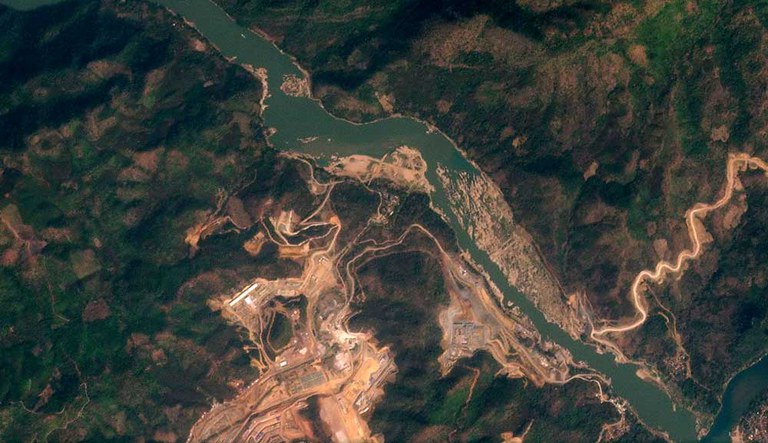
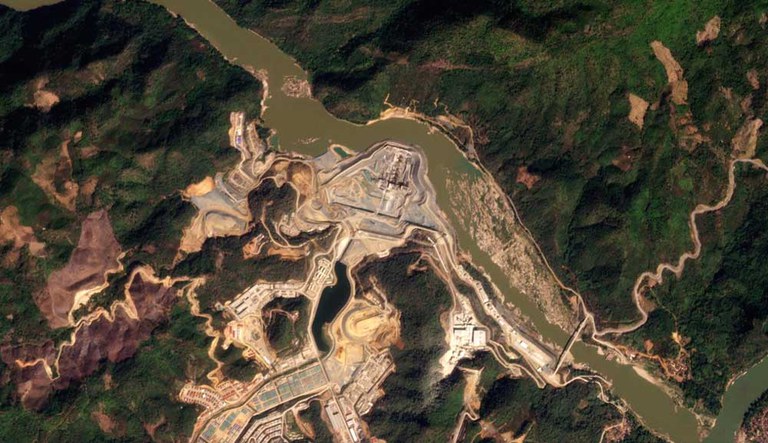
A satellite photo comparison dated Feb. 2, 2024 and Feb. 7, 2021 shows vast construction in preparation for controversial Luang Prabang hydropower dam across the Mekong River, about 25 kilometers upstream of the historic Lao town of Luang Prabang, a UNESCO World Heritage site. The Lao government is playing down speculation the dam project puts the UNESCO status at risk. https://www.rfa.org/english/news/laos/world-hertiage-status-02022024170302.html (03 Feb. 2024)
THE REST OF THE WORLD
Brazil Mining giants told to pay $9.7bn over dam disaster A federal judge in Brazil has ordered mining giants BHP, Vale and their Samarco iron ore joint venture to pay 47.6bn reais ($9.67bn) in damages over a deadly dam burst in 2015. The collapse of the Fundão dam in the south-east of the country caused a giant mudslide that killed 19 people. It also severely polluted the Rio Doce river, compromising the waterway to its outlet in the Atlantic Ocean.
-Judge Vinicius Cobucci said the companies were liable for “moral damages”, or non-material harm, such as emotional distress suffered by those affected by the incident. He added that the money, which will be adjusted for inflation since 2015, will be put into a state fund and used for projects and initiatives in the area impacted by the dam collapse. The ruling came in response to a civil action brought by state and federal public prosecutors. https://www.bbc.com/news/business-68102511 (27 Jan. 2024)
USA CONSIDERING DECOMMISSIONING LOWER SNAKE RIVER DAMS The U.S. Army Corps of Engineers operates four run-of-river dams and locks on the lower Snake River in Washington that together provide 1,000 average MW of capacity and up to 3,033 MW of capacity at their peak. The dams, constructed between 1955 and 1961, are Ice Harbor, Lower Monumental, Little Goose and Lower Granite. Construction and operation of the dams altered the physical, chemical, hydrological and biological processes in the river, and all species of salmon that use the Snake River are listed as threatened or endangered under the Endangered Species Act. With salmon being “central to culture and wellbeing in tribal nations throughout the Pacific Northwest,” there have been discussions about breaching the dams. https://www.hydroreview.com/world-regions/north-america/congressional-subcommittee-to-hold-hearing-on-plan-to-remove-lower-snake-river-dams/ (22 Jan. 2024)
Local citizens weigh in on proposal to decommission flood control dams More about public hearing for decommissioning of the five dams (three dams in the Coon Creek Watershed and two in the West Fork Kickapoo) that failed in Aug 2018 floods. https://www.swnews4u.com/local/local-citizens-weigh-proposal-decommission-flood-control-dams/ (31 Jan. 2024)
Corps increases potential breach emergency status of Arkabutla Dam to ‘watch’ On Jan. 28, the U.S. Army Corps of Engineers issued a potential dam breach “watch” for Arkabutla Dam in DeSoto and Tate counties in northwest Mississippi. The Corps said the physical condition of the dam is unchanged, and a dam breach is not imminent. The Vicksburg District has increased the potential breach emergency status at Arkabutla Dam from “alert” because of increasing reservoir levels due to recent week-long precipitation and snow/ice melt in the Arkabutla Lake drainage basin. Constructed in 1943, Arkabutla Dam on the Coldwater River is 65 feet high and 10,000 feet long and reduces flood risk for 19,000 residents. The potential breach is associated with observed signs of distress discovered in May 2023. The district’s Emergency Operations Center (EOC) activated after crews discovered a depression near the toe of the dam, where the dam meets the earth, which could cause severe foundation loss and a breach if left untreated.
– Currently, reservoir pool elevation is 213.6 ft, spillway crest elevation is 238 ft and the spillway is not activated. The Arkabutla Dam pool restriction is 204 ft elevation, and releases are 2,000 cubic feet per second. https://www.hydroreview.com/world-regions/north-america/corps-increases-potential-breach-emergency-status-of-arkabutla-dam-to-watch/ (29 Jan. 2024)
Atmospheric rivers hitting California right now The storms hitting California this week are part of a “Pineapple Express” system, which is just one kind of atmospheric river. Named for their origin around the Hawaiian Islands, they are often strong systems and have been known to unleash torrents of precipitation when they reach the west coast of the US and Canada. According to the National Ocean Service, they can dump as much as 5in of rain on California in a single day.
This week’s storms have put officials and residents on edge, in part because of their timing. The back-to-back systems are packing a stronger punch together and carry greater potential wreak havoc when systems are already inundated and soils are saturated. California saw a similar pattern last year when a a series of brutal atmospheric rivers drenched the state, unleashing historic levels of rainfall that caused urban flooding, landslides and road closures. The dangerous conditions caused 22 confirmed fatalities and researchers at Stanford University tallied more than $3bn in losses.
While these storms were incredibly destructive and dangerous and, in some cases, set new records, scientists have warned that they are just a taste of what’s to come. Fueled by the climate crisis, the risks of a catastrophic megaflood – one that could displace millions and generate over $1tn in losses – has doubled in California. Despite their potential for damage, ARs are incredibly important in California, and welcomed by water officials still navigating the emergence from prolonged drought. Even with the wet weather, California’s snowpack is lagging this year and there are hopes a heavy dusting could get it closer to historic averages by the end of the wet season in April. https://www.theguardian.com/world/2024/jan/31/what-are-atmospheric-rivers-california-storms (31 Jan. 2024) Life-threatening flood threat for California as heavy rain and winds batter the state. https://edition.cnn.com/us/live-news/california-atmospheric-river-storms-flooding-rain-02-04-24/index.html (05 Feb. 2024)
UK 17 landfills in England make toxic liquid hazardous to drinking water Seventeen landfills across England are known to be producing a highly toxic liquid substance containing some banned and potentially carcinogenic “forever chemicals”, in some cases at levels 260 times higher than that deemed safe for drinking water, it can be revealed. However the government says it does not know where these landfills are. https://www.theguardian.com/environment/2024/feb/01/seventeen-landfills-in-england-make-toxic-liquid-hazardous-to-drinking-water (01 Feb. 2024)
SANDRP
Also see: DRP 29 Jan. 2024 & DRP 22 Jan. 2024
Follow us on: www.facebook.com/sandrp.in; https://twitter.com/Indian_Rivers

 SANDRP
https://www.channelnewsasia.com/tengeh-reservoir-floating-solar-farm-officially-opens-big-step-towards-environmental-sustainability-says-pm-lee-2020521
Can we also use our reservoirs in India for such plants instead of building ie investing in HEPs as water availability seems to be dwindling day by day!
LikeLike
Yes, but it has its downside too. The fisher people who depend on these reservoirs for fishing loose their livelihoods when it is used for floating solar panels.
LikeLike
Do all our reservoirs support fishing communities? It can be done with those which don’t have fishing as livelihood. Since we cannot let our high Himalayan and forest ecologies to be ruined by such infrastructure projects as HEPs, even smaller ones as government has announced that no clearance is needed, we need alternative arrangement urgently.
LikeLike
Almost all reservoirs support fisheries. What is needed is that there should be credible impact assessments, public hearings, compensation and rehabilitation mechanisms and proper options assessment.
Roof Top solar needs to be pushed. Glad the govt has started doing that now.
LikeLike