
(Feature Image: Drone image from the site of the Teesta III dam in Sikkim, looking towards Chungthang town. Image by Praful Rao of Save the Hills, Source: The Landslide Blog by Dave Petley.)
In this fourth part of annual overview, SANDRP compiles the issues affecting the safety and sustainability of dams and hydro power projects in India during 2023. The report starts with governance and management issues of dams and hydro power projects as highlighted in our weekly Dams, Rivers & People News Bulletin (DRP NB) and blogs all through the year amid rising concerns and disasters on these structures across the country. It then covers some relevant judicial interventions and governments decisions on the issue.
Please also see part one of the series compiling dams and hydro projects related disasters in India in 2023; part two on peoples resistance against destructive dams and hydro projects, part three on dam induced flood incidents in 2023. In the fifth and final part, we have tracked the important dams and hydro projects related decisions taken by Expert Appraisal Committee (EAC) and Forest Advisory Committee (FAC) during 2023.
2023: DRP NB on Dams, Hydro Projects Safety, Sustainability
Dam Disasters bring focus on Dam Safety Governance in India Is the Dam Safety Panel (DSP) report dated Nov 1 2023 on Medigadda barrage on Gadavari in Telangana, a self-indictment of the Dam Safety Mechanism in India? The report concludes: “it is construed that the I&CAD (Irrigation and Command Area Development) Dept. has nothing to submit about instrumentation data, pre-monsoon & post monsoon inspection reports, completion reports, quality control reports, condition of gates and many other inputs sought in the list therein”.
How and why did the NDSA (National Dam Safety Authority) allow such a state of affairs to continue for such an important dam that has huge implications for life and economy as the report itself says? What steps did the NDSA take before this disaster struck to ensure that all these basic dam safety measures were indeed in place and functioning? What is NDSA doing to ensure that all such basic steps and measures are in place at all the large dams in India? What did NDSA do to ensure that this dam, important from the point of view of life and economy, was also listed in CWC’s National Register of Large Dams? What has NDSA done to ensure that CWC’s National Register is indeed updated every year with inclusion of all large dams of India (Large dam as per its definition) and all their salient features? What has NDSA done to ensure that all Dam Safety information is in public domain promptly?
The answer, unfortunately, seems like: NDSA has done nothing on any of these fronts. That way, the Medigadda Dam Safety Report is a self-indictment of India’s Dam Safety Mechanism. https://sandrp.in/2023/11/06/drp-nb-061123-dam-disasters-bring-focus-on-dam-safety-governance-in-india/ (06 Nov. 2023)
Need to be serious about Dam Safety, Flood Forecasting, Use of Early Warnings Experts say the Sikkim incident exemplifies blind spots in both legislation and implementation. The DSA does not promote risk-based decision-making and fails to incentivise transparency. Himanshu Thakkar, an environmental activist and coordinator of South Asia Network on Dams, Rivers and People (SANDRP), says that the frequency and scale of such disasters reveal a pattern of neglect: “It keeps happening regularly, people face disastrous consequences and we call these ‘natural disasters’. But there’s nothing natural about them.”
A robust DSA should allow different stakeholders to access information easily, but India’s framework falls short. “Dam safety is a public purpose function. Everything about dam safety, functions of all the institutions and committees and authorities, their reports, decisions minutes and agendas, everything should be promptly available to the public,” says Mr. Thakkar. “But nothing is in the public domain.” He adds that transparency is further obstructed when national and State bodies comprise government employees and engineers who worked on these projects, compromising objective decision making and lacking “people with a proven track record of taking independent decisions.” https://www.thehindu.com/sci-tech/energy-and-environment/does-india-need-to-relook-the-dam-safety-act-explained/article67447034.ece (22 Oct. 2023)
Similarly, we need to be a little more serious about flood forecasting and not see as an academic exercise that seems to be the case. The flood forecasting is highly inadequate, but there is no system in place to evaluate its efficacy and hold the forecasters accountable.
This lacuna was seen even during June 2013 Uttarakhand flood disaster and even during Feb 2021 Chamoli disasters, but we are clearly not doing anything to correct this. Clearly we need to be much more serious regarding Dam Safety norms, flood forecasting and disaster management systems. We are NOT as of now. https://sandrp.in/2023/10/23/drp-nb-231023-need-to-be-a-little-serious-about-dam-safety-flood-forecasting-use-of-early-warnings/ (23 Oct. 2023)
Kaddam Dam Rehabilitation: Many more will need this Telangana’s Kaddam Dam, built with inadequate spillway capacity, has seen multiple threats and disasters over the years, starting from the very first year after its commissioning in 1958. The dam again saw threat of being washed away during monsoon this year.
The Telangana government has decided to rehabilitate the dam at a cost of Rs 640-700 Cr, by reconstruction of spillway and installation of new gates. We hope the new spillway capacity will be in line with the changed monsoon rainfall pattern and will be able to take care of the higher probable maximum precipitation and higher probable maximum flood. Though we are unlikely to get to know how this is going to happen, as the standard operating procedure (SOPs) of all dam owners in India is secrecy rather than transparency even in dam safety aspects. One also hopes this is done at the earliest, and till that is achieved, the dam rule curve will be changed to ensure the dam does not face disastrous situations during monsoon.
What is happening at Kaddam dam is something that is urgently required for most large dams in India. But there is no sign of the need to reassess the design floods of large dams in India keeping in mind the new rainfall regime and also new threats including Glacial Lake Floods in Himalayan dams. The consequences are starkly in front of us in the washing away of the Teesta 3 dam in Sikkim earlier this month, largely due to non-operation of spillway gates and inadequate spillway capacity. Many other dams are facing these threats, requiring urgent action. https://sandrp.in/2023/10/16/drp-nb-161023-kaddam-dam-rehabilitation-in-telangana-many-more-will-need-this/ (16 Oct. 2023)
Karam dam disaster: people suffer, engineer set free, contractor building more dams It was on Aug 13, 2022, a year ago when the Karam dam wall in Dhar district in Madhya Pradesh started leaking water. Two days later it collapsed. The people who suffered during the disaster continue to suffer. The engineers who were supposed to ensure proper construction of the dam, following all the norms, did not do that, were supposed to be suspended, but got reinstated elsewhere. They kept quiet in the courts. The black listed contractor continues to build more dams.
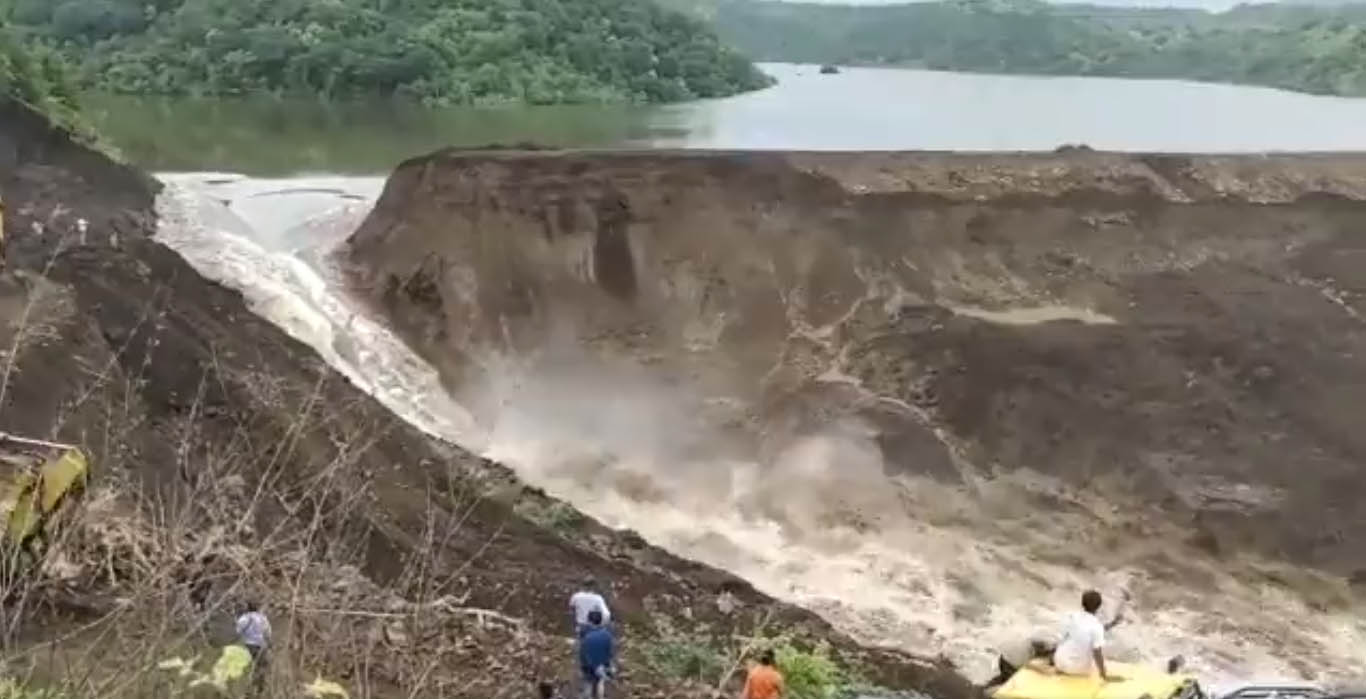
A clearer evidence of the nexus that supports unwanted, destructive, costly, corruption ridden and disastrous dams would be difficult to find. As the destruction due to dams and such other unaccountable infrastructure development plays out in Himachal Pradesh & elsewhere this year, the nexus that thrives on opaque, unaccountable and non-participatory governance continues to happily grow even as the changing rainfall patterns bring greater disasters before our eyes. https://sandrp.in/2023/08/14/drp-nb-140823-a-year-after-karam-dam-disaster-people-suffer-engineer-set-free-contractor-building-more-dams/ (14 Aug. 2023)
India’s regulators blind to increasing threats in Himalayas This week the weekly DRP bulletin brings news of increasing threats from changing climate in inherently disaster prone Himalayas. The news come from Ladakh in the NW to Nagaland in the NE, and includes Uttarakhand among others. The news is about retreating glaciers, increasing threats of Glacial Lake Outburst floods and landslides. The news also notes that factors like indiscriminate infrastructure development and lack of drainage are worsening the disaster potential of the Himalayan states. Most importantly, implicitly more than explicitly, the news reports highlight complete inattention of the regulators to these increasing threats and risks in inherently vulnerable Himalayas while considering new infrastructure projects like Highways, Railways, Hydropower projects, Dams and urbanisation and also in terms of disaster management laws and practices.
It underlines that the threats and risks in the Himalayan states is also increasing due to changing rainfall patterns due to changing climate. This trinity of inherent vulnerability, changing climate and inattention to the risks of indiscriminate infrastructure projects is clearly very very dangerous, but there is little hope for any immediate change. One clear indication is the handling of the Joshimath disaster, a clear case of how not to handle communication as Dave Petley has noted. The Prime Minister’s office is sitting on the report submitted by the investigating agencies several weeks ago. Why should this report be a secret or will we get a negotiated report? https://sandrp.in/2023/03/06/drp-nb-060323-indias-regulators-blind-to-increasing-threats-in-himalayas/ (06 Nov. 2023)
Why this culture of opaque governance around Joshimath? It is clear that the Union and the Uttarakhand government did not want the reports prepared by different national institutes related to Joshimath Sinking, to be made public and the state High Court had to order it to do so. The government’s view of the report is clear from that. It took the judiciary so many months to finally order the report to be made public. What is it that the government wanted to hide? Why? From whom? Why is there this culture of opaque governance even in disaster management related issues?
Is it growth fundamentalism that is driving the government as the single most factor? Or is it the arrogance and adamant attitude of the governance, not wanting to consider any questions raised against their decisions? Why is there so little faith in the people, society and transparent, accountable governance? Why is the judiciary allowing such a culture to prevail generally? These are some of the key questions that arise from this and other such episodes. https://sandrp.in/2023/10/02/drp-nb-021023-why-this-culture-of-opaque-governance-around-joshimath/ (02 Oct. 2023)
Welcome Himachal action against Dam safety violations The Chief Secretary’s proposed action against violations by 21 of 23 big hydro projects in the state for violations of Dam Safety Act and CWC 2015 guidelines are welcome. We hope there will be no backlash against this from the central govt. In fact Central Govt agencies like Central Water Commission (CWC), National Disaster Management Authority (NDMA), Central Electricity Authority (CEA) and Ministry of Power will welcome and support the HP action and also ask all states to follow suit. In fact all dam owner states need to follow the HP example. SANDRP and other like-minded organisations like Himdhara in HP have been saying this for long and we are glad that there is some though long overdue action on this issue.
A lot more needs to be done. All information related to dam operations and dam safety must be without exception, promptly in public domain, Flood forecasting needs to get out of the ad-hoc-ism now prevailing and possibly needs to be handed over to a new independent organisation that has no axe to grind, unlike CWC. Earlier we bring all these changes, the better it will be for our disaster management. https://sandrp.in/2023/08/21/drp-nb-210823-welcome-himachal-action-against-dam-safety-violations/ (21 Aug. 2023)
The world is moving away from Big Dams: Are we? This well substantiated report from Yale School of Environment this week shows that the end of the big dam era is approaching. The well argued report from Jacques Leslie uses the reports from UN University, International Renewable Energy Agency, Oxford University, Inclusive Development International, China, among others to show how the pace of construction of dams and hydropower projects and also pace of financing such projects have hugely reduced in recent years and decades.
Even International Hydropower Association (IHA), sensing the change, is now advocating pump storage hydro rather than conventional hydro and that too off stream version, to complement the power from solar and wind. Emerging economics with rising cost of hydropower projects and rising cost of power from such projects compared to solar, wind (on shore and off shore) are a major reason for the massively slowing pace of new hydropower projects.
Considering the increasing siltation of reservoirs and increasingly older stock of dams, there is clear need to provide funds for existing dam projects. But even a rich country like USA is unable to do that as it clear from the failure of spillway of North Form Dam in California in January 2023, in spite of warnings about it since 2017 Orville Dam episode. The changing rainfall pattern under global warming is making this even more urgent. The best investment under the circumstances is to work towards decommissioning of old, unsafe and the dams that are no longer serving the purpose for which they were proposed.
This is even more true of a country like India with huge stock of old dams, poor maintenance and even worse track record in terms of safe operation of large dams. But leave aside working to make existing dams safe, decommissioning old, unsafe and those dams not serving useful purpose, we seem to be still pushing the outdated technology, destroying not only the forests, biodiversity, environment, but also the meager adaptation capacity there is against impacts of climate change. The World is moving away from the big dams. When will we? https://sandrp.in/2023/04/24/drp-nb-240423-the-world-is-moving-away-from-big-dams-are-we/ (20 April 2023)
US EPA starts reporting methane emissions from dams In a landmark move the United States Environment Protection Agency has started reporting methane emissions from dams and hydropower projects in its annual reporting to UN in 2022. It needs to go a step further and make it mandatory for all dams and hydropower projects to annually report such emissions on their websites. This will not only help clear the mistaken notion that hydropower projects are climate friendly, it will also help take right policy measures and project construction or decommissioning decisions. It will also lead to more scientific accounting of global warming causing emissions. It will also give the consumer right picture about GHG emissions from such projects when they look at options for electricity supply. There is a lot that India and rest of the world that needs to learn from this and implement on urgent basis as US EPA seems to be the first agency to do this. https://sandrp.in/2023/02/20/drp-nb-200223-us-epa-starts-reporting-methane-emissions-from-dams/ (20 Feb. 2023)
Time to Focus on Natural Water Storages Given the omnipresent & increasing shortages of cumulative storage capacity and adverse impacts of built water storages especially big reservoirs and dams; it is time global bodies like UN, World Bank, policy makers and governments at large must focus on conservation and replenishment of natural water storages, which are far better, cost effective options available to address and mitigate ever increasing and evolving climatic threats on human water security and sources.
The natural water storages in the form of forests, hills, grasslands, local water systems, rivers, wetlands, soil moisture, underground aquifers etc. are essential components of hydrology. As part of larger water cycles, they naturally absorb, harvest, store, recharge and replenish the rainwater and have been catering to human consumption to the largest extent. Protection of forests, hills, grasslands is prerequisite to supply flows in rivers, wetlands, local water bodies and aquifers. At the same time, the carbon rich soil can store moisture in large amounts. Similarly, the revival and management of local water bodies, floodplains & riverbeds can provide security against floods and droughts. https://sandrp.in/2023/03/20/drp-nb-200323-time-to-focus-on-natural-water-storages/ (20 March 2023)
Study Need to re-think global water storage – Over the past 70 years, large dam construction globally has resulted in the loss of biodiversity and ecosystem services and threatened the livelihoods and well-being of hundreds of millions of people. Not only have many communities been displaced by reservoir inundation, but changes in river flow downstream have undermined riverine (aquatic) ecosystems and the livelihoods of many people (e.g. fisherfolk).
– Consequently, the planning of, and investment in, water storage must go far beyond dams. Generating economic growth to lift the world’s poorest people out of poverty and meet their basic water, food, and energy needs can only be sustainably achieved if future investments are rationalized and redirected away from traditionally built infrastructure. Instead, investments should be focused on implementing technology that is affordable, socially and culturally acceptable, and environmentally sustainable. Actions to stop and reverse the loss of both natural and built water storage would help enhance water security and buffer the negative impacts of climate change on ecosystems and society. https://www.iwmi.cgiar.org/2023/08/as-the-demand-for-water-rises-we-need-to-re-think-global-water-storage/ (4 August 2023)
2023: SANDRP Blogs on Governance & Management of Dams, Hydro Projects
Dam Safety Act & role of Dams in 2023 HP Floods In order to have high standards of dam safety the prerequisites are designing and constructing dams with reasonable safety margins; operating and maintaining them safely; and having emergency arrangements to address situations that might arise. Operation of dam within its ambit also includes thorough understanding of likely impacts and its management in case of flooding, in any emergency situation or in the event of dam failure, both upstream and downstream on communities living there, their livelihoods and also on infrastructure and property which can get affected.
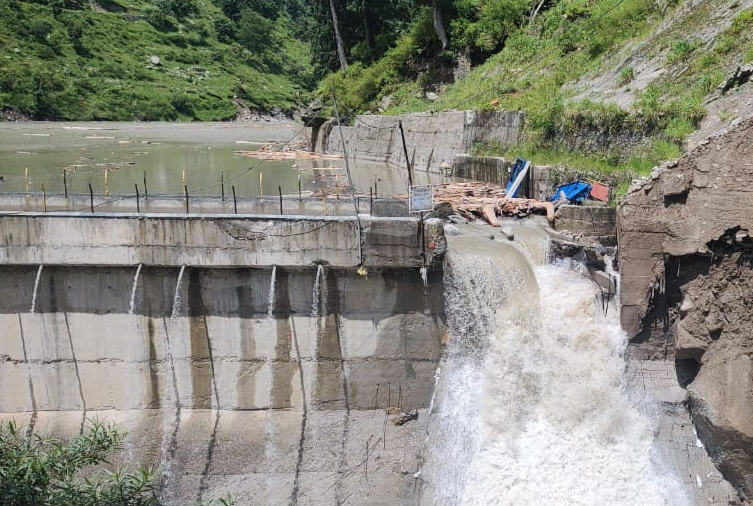
The safety of a dam facility is a combined function of the technical systems, information management, the organisation and the people responsible for operating the systems. A good dam safety law therefore should be able to regulate all these aspects adequately. It is important to mention that in order to effectively manage the consequences in case a dam failure occurs or there is an emergency due to unprecedented flooding, apart from having a robust dam safety law, efficacy of regulation of certain other parameters is also equally important. Land use in flood plain zones in the downstream of dams, catchment area treatment plans, preparedness of disaster management authorities and its coordination with other district administration authorities all these become extremely relevant and important factors. https://sandrp.in/2023/10/11/dam-safety-act-the-role-of-dams-in-the-2023-hp-floods/ (11 Oct. 2023)
Why India needs Dam Decommissioning policy and program Dams are not natural solutions. The climate scientists are telling us to look for nature based developmental path and solutions. The world and India are facing multiple interconnected crises, from climate change, to injustice, to the loss of rivers, nature and biodiversity and increasing disasters. Rivers flow through these challenges, and river restoration can be a powerful nature based solution. Restored, free flowing rivers are also required for cultural needs, livelihoods and life in general. India thus urgently needs a policy, plan and program for dams decommissioning dams, considering the increasing stock of old, unsafe and unwanted dams and also increasing risks that we face from such dams. The changing climate is making this need even more urgent. https://sandrp.in/2023/12/15/why-india-needs-dam-decommissioning-policy-and-program/ (15 Dec. 2023)
Dams Decommissioning going up globally All large dams have finite life. What happens to the dams once the useful life of a dam is over? It would need to be decommissioned. Decommissioning of a dam generally refers to complete removal of the dam and its associated structures. This is a very relevant question for India as the third largest dam builder of the world. It becomes even more important as large dams are no longer required or are no longer viable and importance of a flowing river is increasingly appreciated. It needs to be kept in mind that a dam cannot be allowed to remain on the river, without proper maintenance as such a dam would remain a huge safety hazard for society and economy downstream from the dam. https://sandrp.in/2023/12/13/dams-decommissioning-going-up-globally/ (13 Dec. 2023)
Dam Safety Panel report of Medigadda Dam Disaster indicts Govt., L&T & Dam Safety in India The Dam Safety Panel Report of Medigadda Dam disaster on Godavari River in Kaleshwaram Project is not only a serious indictment of the Telangana government, the construction company L&T and also, by implication, of the Dam Safety Mechanism in India. The report from Union Jal Shakti Ministry, dated Nov 1 2023 says that the whole of Medigadda dam and possibly also two downstream dams will have to be fully re-built. Please Read, Share. https://sandrp.in/2023/11/03/dam-safety-panel-report-of-medigadda-dam-disaster-indicts-telangana-lt-and-dam-safety-in-india/ (03 Nov. 2023)
GLOF destroys Teesta-3 Dam A Glacial Lake Outburst Flood (GLOF) that originated at South Lhonak Glacial Lake at around 00.40 hours on Oct 4, 2023, washed away the 60 m high dam of Sikkim’s biggest hydropower project, the 1200 MW Teesta 3 HEP. The flood has brought unprecedented disaster all along the river in Sikkim and further downstream in W Bengal and then Bangladesh. Central Water Commission (CWC) reported early in the morning of Oct 4 that there was cloud burst at the site of the lake burst, the cloud burst could have played the role in triggering the lake burst. https://sandrp.in/2023/10/04/glacial-lake-flood-destroys-teesta-3-dam-in-sikkim-brings-wide-spread-destruction/ (04 Oct. 2023)
2023: Reports on Siltation & Sedimentation of Dams
National Framework for Sediment Management A National Framework for Sediment Management is certainly a long standing requirement and any move in that direction would have been welcome. Not only because the sediment accumulation destroys storage capacity of India’s Dams, created at such massive costs but also because sediment is an integral part of river flow and also very important for the rivers to stop or reduce erosion at deltas. There are other issues related to sediment including creation and disposal of toxic sediment and impact of sediment free water flowing downstream from the hydropower projects.
But we need much more serious and sincere efforts in this direction than what has been suggested in following government press release. The movement on such an important subject is so snail paced, half hearted, non-comprehensive, unscientific and non-sincere that it is not clear how this is going to help. https://sandrp.in/2023/06/26/drp-nb-260623-national-framework-for-sediment-management/ (26 June 2023)
There is an urgent need for sustainable management of sediments in reservoirs and rivers in the country, a senior Central Water Commission (CWC) official said on June 19, 2023, adding an estimated 34 billion cubic meters (BCM) out of 258 BCM of live storage has already been lost. CWC Chairman Kushvinder Vohra said that average loss of gross storage is about 0.45 per cent per year, and that of live and dead storage is about 0.3 per cent and 0.95 per cent per year, respectively. This results in a huge economic loss over a period of time, he said at the national workshop on Integrated Management of Sediments in River Basins and Reservoirs for Sustainable Development.
– National Framework for Sediment Management has been notified in 2023 by DoWR& GR and provides comprehensive framework for management of sediments in river and reservoir simultaneously, covering statutory aspects of sedimentation, its environmental impact & various clearance. https://pib.gov.in/PressReleasePage.aspx?PRID=1933453 (19 Jun 2023) National Framework for Sediment Management. https://nmcg.nic.in/writereaddata/fileupload/52_National%20Framework%20for%20Sediment%20Management%20-%20English%20(1).pdf https://sandrp.in/2023/06/26/drp-nb-260623-national-framework-for-sediment-management/ (26 June 2023)
Karnataka Silt eats into storage capacity of KRS, Kabini, Harangi dams -KRS Dam, with a capacity of 49.45 tmcft (thousand million cubic feet) of water, has accumulated silt across an area of 131 sqkm since its completion in 1932, without any silt removal efforts. Karnataka Engineering Research Station (KERS) conducted an Integrated Bathymetric Survey (IBS), survey revealed that approximately 2.34 tmcft of silt has accumulated in the Dam.
– In the case of Kabini Dam, located at Beechanahalli in H.D. Kote, silt accumulation is estimated at 1.35 tmcft, which is lower due to the forested and mountainous areas from which water flows. In the Harangi Dam in Kodagu over 1 tmcft of silt has accumulated, with an increase after natural disasters in 2018. The KERS report stating this accumulation prompted the Cauvery Neeravari Nigam Limited (CNNL) to prepare a Detailed Project Report (DPR) worth Rs. 130 crore for silt removal, check Dam construction, retaining walls and other development work. However, the State Government has not taken any action thus far.
-Numerous studies have been conducted over the years to assess silt deposition in these Dams, but no practical solutions have been implemented on the ground. While Governments allocate substantial funds for various irrigation and water resource projects, they have yet to allocate even a fraction of that amount to de-silt these reservoirs. Siltation and it significantly diminishes the benefits of these expensive Dams. Siltation can also lead to increased evaporation losses, backwater flooding and damage to power house turbines. https://starofmysore.com/silt-eats-into-storage-capacity-of-krs-kabini-harangi-dams/ (07 Sept. 2023)
Study 3,700 dams in India will lose 26% storage capacity by 2050 Around 3,700 dams in India will lose 26 per cent of their total storage by 2050 due to accumulation of sediments which can undermine water security, irrigation and power generation in future, warns a new study by the United Nations. China, meanwhile, the world’s most heavily dammed nation, has lost about 10 per cent of its storage and will lose a further 10 per cent by 2050, it said.
The Central Water Commission, had in 2015, reported that among 141 large reservoirs which are over 50-years-old, one quarter had lost at least 30 per cent of their initial storage capacity. https://www.moneycontrol.com/news/india/3700-dams-in-india-will-lose-26-storage-capacity-due-to-sedimentation-by-2050-un-study-9835031.html (09 Jan. 2023)
2023: Climate Change Threats on Dams & Hydro Projects
Report Libya dam collapse raises alarm for India’s 234 dams over 100 yrs old Experts warn those above 50 years old are at risk, call for govt to revisit Dam Safety Act. Himanshu Thakkar, coordinator of the SANDRP, observed that “dams above 50 years are of high risk”. “In the context of climate change, dam management needs to be fine-tuned. More intense rains are now occurring. This means that the spillway capacity for which the dams were originally designed is outdated. There should be an independent review to examine the safety aspects of all dams in India. The CWC is undertaking this task, but it has a poor track record,” Thakkar added.
Thakkar added that structural flaws were not the only issue with dams, as newly built structures too had cracked in the recent past in India. In August last year, the wall of an under-construction dam in Madhya Pradesh’s Dhar district collapsed, affecting 18 villages. Similarly, in July 2019, the Tiware dam in Ratnagiri district of Maharashtra gave way due to heavy rains, resulting in the loss of 19 lives. The dam was built only in 2000. https://www.business-standard.com/india-news/libya-dam-collapse-raises-alarm-bells-for-india-s-234-dams-over-100-yrs-old-123092601042_1.html (26 Sept. 2023)
Damned by our dams as safety issues swirl There had been 42 dam failures in India till September this year, according to a presentation by S.K. Sibal, chairman of the National Dam Safety Authority (NDSA). The failure of the Machchu dam in Gujarat in 1979 was the worst, in which 2,000 people perished. Not just older dams, most failures have actually involved “newly built dams, chiefly in the first 10 years,” according to NDSA’s Sibal.
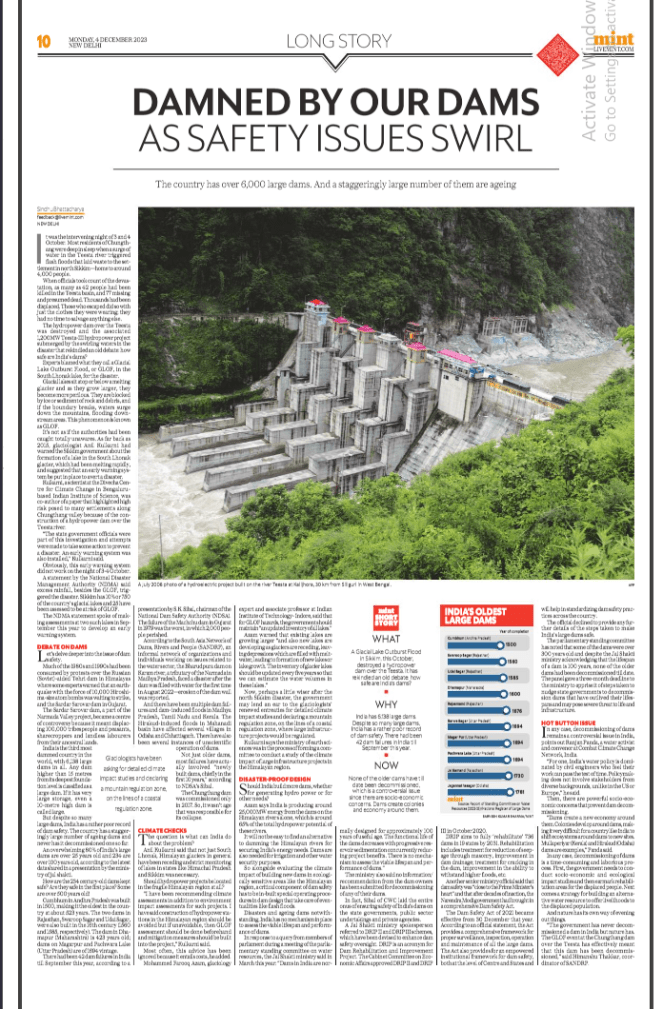
The parliamentary standing committee has noted that some of the dams were over 300 years old and despite the Jal Shakti ministry acknowledging that the lifespan of a dam is 100 years, none of the older dams had been decommissioned till date. The panel gave a three-month deadline to the ministry to apprise it of steps taken to nudge state governments to decommission dams that have outlived their life spans and may pose severe threat to life and infrastructure.
In any case, decommissioning of dams is a time-consuming and laborious process. And nature has its own way of evening out things. “The government has never decommissioned a dam in India but nature has. The GLOF event at the Chungthang dam over the Teesta has effectively meant that this dam has been decommissioned,” said Himanshu Thakkar, coordinator of SANDRP. https://www.livemint.com/news/damned-by-our-dams-as-safety-issues-swirl-11701605096020.html (03 Dec. 2023)
Sikkim Teesta III Dam gate openings under lens The high storage volume in the Teesta-III dam’s reservoir and the failure to open its spillways are two key factors being looked into as probable triggers that exacerbated the GLOF’s impact. Himanshu Thakkar, coordinator of the SANDRP, said that the Teesta-III dam was not included in the CWC’s National Register of Large Dams (NRLD). “Commissioned in 2017, it is inexplicably missing in the NRLD compiled in 2019. There is no information on the Dam Safety Mechanism of Teesta-III and the last inspection of the dam and its spillway gates,” he said. https://indianexpress.com/article/india/as-sikkim-picks-up-pieces-teesta-iii-reservoir-opening-of-its-gates-under-lens-8974047/ (09 Oct. 2023)
Dam Site ‘Completely devastated’ – Dam operation is crucial under such circumstances. However, the Dam Safety Act of 2021 focuses only on the structural safety of the dam and not operational safety, said Thakkar. The latter is extremely important and needs to be included in the Act, he added. Similarly, information about dam safety must be in the public domain and there is a dire need to include independent dam experts in committees rather than relying on government officials, he commented.
– Decommissioning a dam should also be included as part of a dam’s life cycle and “we the people should fight for this – otherwise people pay the price for it, as does the environment”, Thakkar said. However, this does not figure in the Dam Safety Act at all and the Central Water Commission, which is responsible for dam safety, acts more as a “lobby for dams”, he alleged during the press conference. https://thewire.in/environment/dam-site-completely-devastated-loss-assessment-sikkim-disaster-time (13 Oct. 2023)
GLOF warnings ignored Himanshu Thakkar, coordinator of the SANDRP, an advocacy group, said that large hydro projects were “unfit” for the fragile Himalayan region and were financially unviable, as reporting has borne out. “That large hydro projects are becoming economically unviable can be seen from the trend that private players are pulling out of large hydro projects and public sector units are taking them over,” said Thakkar. “In Sikkim, both Teesta Stage III and Stage VI were to be developed by private players but public sector units subsequently took them over to rescue the projects.”
– “Government agencies did not learn from the 2021 Chamoli disaster in Uttarakhand,” said Thakkar. “The NDMA is speaking of installing an early warning system only after the disaster has happened. Teesta Stage III should not have been allowed without adequate spillway capacity, proper dam safety mechanism and an early warning system put in place.” If the dam was unviable, it should never have been built in the first place, he said. https://article-14.com/post/disaster-on-the-teesta-ignoring-warnings-of-melting-glacier-sikkim-hoped-large-dams-would-earn-money–6531e7e374f75 (20 Oct. 2023)
Investigating EWS at Teesta III: RK Singh Interesting statements from Union Power Minister: Almost two weeks after the Sikkim disaster of Oct 3-4, the Power Minister still does not know if the Teesta 3 project, washed away by the GLOF, had an early warning system (EWS) or not. They are still “looking into this”. Similarly, while claiming early warning systems have been installed at some hydropower projects, it is not clear which are these, there is no list forthcoming. This report also mentions that DRDO has been roped in, in Dec 2022 to put early warning systems, but not clear what is the progress. https://www.moneycontrol.com/news/business/sikkim-flash-flood-power-ministry-investigating-early-warning-system-at-teesta-urja-hydropower-project-rk-singh-11557411.html (18 Oct. 2023)
Himachal Pradesh Questions over hydropower projects Himanshu Thakkar, coordinator of the SANDRP, said there is a “lot of ad-hocism in our country” regarding flood forecasting and early warning. “This attitude needs to change and responsibility should be fixed through the National Disaster Management Act.”
“Be it the Uttarakhand floods of 2013 or the Kashmir floods in 2014, the devastating floods of Himachal, and in Punjab this year; in each of these episodes, the CWC did not forecast the floods. Every time they are asked why they could not forecast, they say in each instance the state government did not seek a forecast so we did not do it. This ad-hocism is proving to be too costly and the risks are going to be worse with each passing year.”
Thakkar said the CWC is not the right agency for flood forecasting as it does a lot of work – from sanctioning large dams and reservoirs to making rules, monitoring, and giving permissions – and many of these roles are contradictory. “This creates a conflict of interest and hence we have been demanding that a completely independent and neutral body be given the responsibility of flood forecasting and monitoring of rivers and reservoirs.” https://www.newslaundry.com/2023/08/18/no-coordination-greed-buried-in-himachal-rubble-questions-over-hydropower-projects (18 August 2023)
Jammed gates of Malana dam yet to be fixed There is no media update on the issue since Sept. 2023. The dam reportedly overflowed and gates were blocked due to siltation and debris following a ‘cloudburst’ incident. The flood gates of 100-mw Malana-II dam had got jammed due to large amounts of silt and boulders following a flash flood in the Malana rivulet on Jul 24. As the management was unable to open the gates, the dam started overflowing, triggering fear, panic downstream & prompting Kullu admin to issue an alert.
Sources said that the management has been trying to move hydraulic machinery for removing silt without success as an approach road to the dam site was also washed away. The electricity generation at the Malana-II also remains suspended since July 24. “The dam management is now waiting for the water level in the Malana rivulet to go down before starting repair work. The work on rebuilding the approach road to the dam is also presently on. Thankfully, there was no flash flood in Malana rivulet after July, otherwise anything could have happened,” said a source. https://timesofindia.indiatimes.com/city/shimla/month-later-jammed-gates-of-malana-dam-yet-to-be-fixed/articleshow/103564953.cms (11 Sept. 2023) The NDRF and BBMB officials having failed to open the jammed two gates of the Malana 2 hydropower project of HP since July 24, now technicians from Delhi Have been called. https://www.tribuneindia.com/news/himachal/technicians-from-delhi-called-to-open-kullu-dam-floodgates-531533 (3 August 2023)
Reports GLOFs are a growing threat to hydropower plants Himanshu Thakkar, coordinator of SANDRP, says the provisions in the Act are not enough. “The Dam Safety Act does not require the information it monitors to be publicly available. Dam safety is first and foremost about transparency. The Committees formed under the Act don’t have much space for independent experts.”
– Around 66 percent (177 hydropower plants out of 259 assessed across Himachal Pradesh, Sikkim, Uttarakhand, Bhutan and Nepal were located along potential GLOF tracks) of hydropower plants in Himalayan states fall in glacial lake outburst floods (GLOF) tracks, finds a 2016 study, demonstrating the scale of the risk. Scientists say modeling for impacts in the event of a GLOF should become a more common practice, especially if the hydropower plant is in the vicinity of at-risk glacial lakes. “Up to one third of these HPP could experience GLOF discharges well above local design floods, as hydropower development continues to seek higher sites closer to glacial lakes. We compute that this systematic push of HPP into headwaters effectively doubles the uncertainty about GLOF peak discharge in these locations,” says the study.
– While the CWC is in charge of monitoring 477 large glacial lakes in the country, a parliamentary panel report from earlier this year noted that no government agency had any information on areas that are likely to be impacted by GLOFs.
– A recent presentation by officials with the CWC of glacier lakes in the Chenab basin shows how the hazards posed by GLOFs can transform over time. The presentation looks at 11 hydropower projects in the basin and shows how, even though distance from the lake remains the same, as its size increases the time taken for the flood to reach the lake reduces, the volume of water it carries increases, and it the velocity with which it comes down can increase. https://india.mongabay.com/2023/10/glacial-lake-outburst-floods-are-a-growing-threat-to-hydropower-plants/ (13 Oct. 2023)
Climate change, earthquakes & hydropower in Himalayas With climate change impacting weather patterns, melting glaciers and destabilising mountain slopes, it is already adding to the dangers associated with earthquakes in the Himalayas. Meanwhile, new research suggests that climate change may even be having an effect on the frequency of earthquakes in the region.
– An analysis of seismic activity in the Himalayas from 1900-2010 found a sharp uptick in the number of earthquakes recorded, particularly after 2000. According to the analysis, the Himalayas experienced fewer than 100 earthquakes per year in the decade 1960-70, but between 2000 and 2010 this had increased to 500-600.
– The rapid ongoing change in glacial mass in the Himalayas could trigger more earthquakes thanks to a process called isostasy, according to Mudassir Bhat, an earth scientist at the University of Kashmir. Isostasy describes how the Earth’s crust rises and settles based on the weight it bears; the impact of glaciers on this process is known as glacial isostatic adjustment (GIA). Since the Himalayan region is crossed by several major faults, Bhat believes that the movement in the earth’s crust caused by loss of glacial mass via GIA could trigger more earthquakes. This process has been demonstrated in other regions. https://www.thethirdpole.net/en/climate/explained-climate-change-earthquakes-and-hydropower-in-the-himalayas/ (11 May 2023)
Hydro projects vulnerable to warming climate & increased precipitation “I have written several letters to the MoEF&CC and its Expert Appraisal Committee (EAC) on River Valley Projects in the last 15 years. We had been demanding robust climate risk assessment studies before sanctioning hydro projects and dams, especially in the fragile Himalayan regions. There is a need for a course correction in policies governing hydro projects. There should be studies to determine the area’s existing disaster potential before these projects. Also, on what additional disaster elements the new projects can add in such areas post construction and operations,” Himanshu Thakkar, Coordinator at the SANDRP, told Mongabay-India.
– The IIT Gandhinagar study also advocated advanced EWS to prepare the HEPs better to counter adverse conditions. However, Thakkar from SANDRP pointed out that these are not new recommendations. The delay happens at the execution level. “EWS was long recommended by the Ravi Chopra Committee in 2014 and even earlier. But even after that, in most HEPs, it remains non-existent, which could have saved many lives. Be it the February 2021 Chamoli floods or many other floods at HEPs in Himalayan states, the lack of EWS led to more losses. Even today, hardly any HEPs in India have advanced EWS systems with credible, transparent and accountable governance. Moreover, all information related to the EWS must be mandatorily and promptly in the public domain for everyone to know and to fix accountability,” Thakkar added. https://india.mongabay.com/2023/03/climate-change-making-hydropower-projects-vulnerable/ (29 March 2023)
Expensive Himalayan hydropower projects Most of the finance for new hydropower projects in the Himalayas is coming from state coffers, through public sector banks, state governments or other public sector units. In the event of a disaster caused or exacerbated by these projects, the cost for rehabilitation and compensation will also come from public money.
– India can ill afford such a waste of public funds, which in effect are being transferred to a small dam-building lobby, with little discernible benefit to the country. Given the success and scalability of solar and wind projects, planned investment in energy storage technologies and the decline in power storage costs, new investment in hydropower in the Himalayas are a high-risk low-return bet. (Also quotes SANDRP). https://scroll.in/article/1045251/crores-for-construction-crores-for-disaster-relief-indias-expensive-himalayan-hydropower-projects (06 April 2023)
Study Himalayas deserves political attention The assessment of glaciers, snow, and water in the Hindu Kush Himalayan region shows huge changes in the offing for eight watershed countries. The key sentence in the most comprehensive report to date on the Hindu Kush Himalayan “cryosphere”, or icy areas, is that the region is “undergoing unprecedented and largely irreversible changes over human timescales, primarily driven by climate change”.
– The assessment, released on 20 June by the International Centre for Integrated Mountain Development (ICIMOD), describes vast changes: glaciers are retreating more quickly, snowfall days are dwindling, permafrost is melting. These will have key impacts on states, societies, and biodiversity. https://www.thethirdpole.net/en/climate/drastic-changes-himalayas-ice-snow-water-deserves-political-attention/ (23 June 2023)
Warming climate’s warnings for hydropower plants Hydropower plants are susceptible to weather extremes, especially those in the sensitive region of the Himalayas. But as climate warms, most of the dam operations are also likely to face increased risk of heavy inflows and flooding and would require robust warnings, shows a new study led by researchers from Indian Institute of Technology (IIT), Gandhinagar. The sudy analysed the future climate risks of at least 46 of the big hydropower plants (more than 25 MW) situated across 13 river basins of the country.
– The team found that each of the power plants is expected to experience varying levels of challenges in reservoir monitoring, as a warming climate leads to high rainfall events. Not only will there be a high frequency of high inflow events for most hydropower dams, but frequency of high reservoir storage would also go up. “We need to relook at the traditional practice of storing more water in the reservoirs, because there are increased risks of sudden heavy inflows in some of these dams,” said one of the authors, Professor Vimal Mishra, from IIT Gandhinagar, adding that the impact may not be uniform across all dams and would require timely warnings. https://www.news18.com/news/india/extreme-inflows-flood-risk-study-reveals-warming-climates-warning-for-hydropower-plants-across-india-6893461.html (23 Jan. 2023)
Himalayas losing glaciers & snow: more hazards in the offing Permafrost thaw makes surfaces, slopes and infrastructure unstable, making a good case for a change in government policies on large hydropower projects in the region, a debate that has been raging in India for some time. Additionally, permafrost thaw leads to increased sedimentation in rivers which damages dams and turbines, Steiner added. https://india.mongabay.com/2023/07/himalayas-losing-glaciers-and-snow-more-hazards-in-the-offing-a-new-study-finds/ (25 July 2023)
Uttarakhand 77 new glacial lakes add to Kumaon flood risk A field study conducted by a professor of Kumaun University has revealed the presence of 77 new glacial lakes in the Gori Ganga region of the Kumaon Himalayas. The water bodies, situated at an elevation of over 3,500 metres, formed over three decades — between 1990 and 2020 — due to shrinking of snow-covered areas in the Gori Ganga region in Munsiyari in the border district of Pithoragarh. The Gori Ganga region mainly consists of Milam, Gonkha, Ralam, Lwan and Martoli glaciers. The largest glacial lake, with a 2.7-km diameter, was found in Gonkha. ‘Glacial Gori Ganga watershed saw severe flash floods over 10 years’. Any future geological activities can cause the lake to burst, triggering a flash flood,” the study mentioned.
– In November 2021 the Uttarakhand disaster management department had inked an MoU with the Indian Institute of Remote Sensing (IIRS) to carry out a satellite-based mountain hazard assessment, including monitoring of glacial lakes, glaciers and landslides zones and avalanche-prone areas in Uttarakhand. As per an estimate of the disaster management department, there are over 1,000 glaciers and over 1,200 small and big glacial lakes in the higher mountainous region of Uttarakhand. When glacial lakes burst, they create a Glacial GLOF, a stream of fast-moving ice, water and debris that can quickly destroy settlements downstream. https://timesofindia.indiatimes.com/city/dehradun/77-new-glacial-lakes-add-to-kumaon-flood-risk/articleshow/98347815.cms (02 March 2023)
Ladakh 2 retreating glaciers alarm scientists Durung-Drung and Pensilungpa, two glaciers in Ladakh, have retreated by 7.8 sq km out of area of 72 sq km (lost 11% area, retreated 13 m per year) and 1.5 sq km out of total area of 16 sq km (lost about 9% area, retreated by 5.6 m per year) respectively from 1971 to 2019. Alarmed scientists hold climate change and several other factors (Snout geometry, glacier size, elevation range, slope, aspect, debris cover as well as the presence of supra and proglacial lakes) responsible for the melting of glaciers that feed Zanskar river through two tributaries. While DDG is the origin of Doda, the largest tributary of Zanskar, PG is the origin of Suru river. The glaciers are located in Pensi-La pass at an elevation of 14,612 feet in Ladakh.
– Scientists are also surprised by the fact that despite being at an aerial distance of just 1km, the glaciers are retreating at different paces. The findings were authored by scientists of Wadia Institute of Himalayan Geology (WIHG) Manish Metha, Vinit Kumar, PankajKunmar and KalachandSain. https://timesofindia.indiatimes.com/city/dehradun/two-retreating-ladakh-glaciers-alarm-scientists/articleshow/98419742.cms (05 March 2023)
Ladakh’s Parkachik glacier is undergoing significant changes, with the possibility of three new lakes forming as a result of subglacial over-deepening, according to a recent study conducted by scientists from the Wadia Institute of Himalayan Geology. https://www.greaterkashmir.com/ladakh/three-new-lakes-may-form-in-parkachik-glacier-in-ladakh-due-to-glacial-retreat (29 July 2023)
2023: Some Relevant Reports on Judicial Interventions
Sikkim HC Order on Public Safety at Hydropower projects Sikkim High Court Order on Dec 5, 2022 in the matter of death of two persons on May 23 2020 due to drowning following sudden release of water from a private hydropower project flags very important lessons that are relevant for all hydropower projects in India.
Justice Meenakshi Madan Rai’s order in Writ Petition (Civil) No 46 of 2020 in the matter “Dolma Kumari Thatal and another Vs State of Sikkim and others” not only holds the hydropower developer responsible for the deaths, but also underlines some basic safety norms that need to be followed when suddenly huge quantity of water is released from the hydropower project downstream of the dam or power house of such projects. The Judgment also makes it clear that it is the responsibility of the state to ensure that all hydropower projects follow such norms and that responsible officers of the state must physically verify compliance with such norms every two months and make their report public.
The hydropower project in question seems to be the 110 MW Chuzachen hydropower project of Gati Infrastructure Limited in East Sikkim district. The project involves two headrace tunnels taking off from two dams, one each on Rangpo and Rongli rivers, the two tunnels then converge into a common tunnel that ends in a surge shaft followed by a power house with two units of 55 MW each. https://sandrp.in/2023/02/18/sikkim-hc-order-on-public-safety-at-hydropower-projects/ (18 Feb. 2023)
Report SC junks plea against sudden release of water from damsThe SC bench of Justices Surya Kant and Deepankar Datta has on Sept 18 2023 junked a general plea about sudden release of water from dams, saying only subject experts can decide about this. It said the petition is premature! The bench told the petitioner to make a details submission to the concerned authorities first. https://www.deccanherald.com/india/delhi/sc-junks-plea-against-sudden-release-of-water-from-dams-says-only-subject-experts-can-deal-with-it-2691113 (18 Sept. 2023)
Rajasthan NGT bars desilting mineral extraction at Bisalpur Dam without EC NGT has prohibited Eastern Rajasthan Canal Project Corporation Limited (ERCPCL) from proceeding with desilting, dredging, mineral extraction and disposal at the Bisalpur Dam in Tonk district without obtaining environmental clearance. In an order on Friday (Nov. 24), the central zonal bench of the tribunal in Bhopal also directed the SPCB to take necessary preventive, prohibitory, punitive and remedial measures in case of violations of environmental laws. The order came on a petition file by Jodhpur-resident Dinesh Bothra challenging the tender for the contract of sand mining at the Bisalpur Dam for a period of 20 years.
In its order, the tribunal has barred all activities under the project involving dredging, desilting, extraction of silt or sand or gravel from the dam until the required environmental clearance is obtained as mandated by the Environment Impact Assessment Notification of 2006. Additionally, the NGT directed ERCPCL to comply with all environmental laws, obtain required consents, NOCs, clearances, etc. before proceeding with desilting in the dam. The NGT stated that desilting or dredging activities under the guise of mineral extraction through mining operations cannot proceed without adherence to environmental laws.
The petitioner’s counsel Sanjeet Purohit submitted that the bid did not align with the Sustainable Sand Mining Management Guidelines of 2016 and the Enforcement and Monitoring Guidelines for Sand Mining of 2020. He said the state authorities proposed sand removal without preparing the district survey report and classifying it as desilting, a move contrary to established guidelines and the Supreme Court’s directive on DSR provisions. https://www.theweek.in/wire-updates/national/2023/11/26/des22-rj-ngt-ercpcl.html (26 Nov. 2023)
Karnataka De-silting of dams not exempted from EC: NGT NGT South Zone has imposed a penalty of 50 crore rupees on the Irrigation Department of Karnataka for conducting mining activities in Adyapadi and Shamburu Dams in the Dakshin Kannada district without obtaining environmental clearance, in violation of the Environmental Impact Assessment (EIA) Notification of 2006. The bench held that dredging and desilting of dams are not exempted from obtaining prior Environmental Clearance as the sand was being extracted for commercial purposes.
In the present case, 14,51,680 MT of sand is going to be extracted from the silt, and the extracted sand will be sold commercially. The applicant states that the EIA Notification of 2006 exempts the taking of Environmental Clearance only for the purpose of maintenance, upkeep, and disaster management related to the dredging and desilting of dams, but not for commercial sand mining.
The Tribunal found that in this case, the desilting was done not only for the upkeep and maintenance of the dams but also to extract sand from the silt to be sold at a rate fixed by the government, which is an admitted commercial activity. As it involves commercial activity, it cannot be stated that the dredging activity is exempted as provided in Clause 6 of Appendix IX of the EIA Notification, 2006. Therefore, the impugned work order is contrary to the EIA Notification, 2006 for not having obtained the Environmental Clearance. https://www.livelaw.in/news-updates/ngt-impose-costs-karnataka-government-mining-activities-in-adyapadi-and-shamburu-dams-without-environmental-clearance-224741 (25 May 2023)
Telangana NGT orders separate EC for Sitamma Sagar project The NGT has said that the state government cannot start work on the Sitammasagar multipurpose project without obtaining a separate environmental clearance (EC) for it. The government had submitted to the NGT that the multipurpose project was a part of the Sitarama lift irrigation project which had secured the clearance.
The NGT observed that a separate environmental impact assessment study was conducted for the Sitammasagar project and the Union environment, forest and climate change ministry had issued terms of reference. This showed that the multipurpose project required a separate environmental clearance, the NGT said.
In an order dated April 26, the NGT said, “Unless and until the environmental clearance is obtained by them, they cannot commence the project.”The tribunal stressed that if the project proponent was in a hurry, it was for them to expedite the process to get appropriate certificates and approvals from various departments and that they could commence on the project only upon getting the environmental clearance. https://www.deccanchronicle.com/lifestyle/environment/030523/ngt-orders-separate-ec-for-sitamma-sagar-multi-purpose-project.html (03 May 2023) EC mandatory to continue Sitamma Sagar works, reiterates NGT. https://www.thehindu.com/news/national/telangana/ngt-reiterates-need-of-ec-mandatory-to-continue-sitamma-sagar-works/article66790084.ece (29 April 2023)
2023: Some Relevant Reports on Plans & Actions by Various Govts
Parliament House panel red flags 234dams A parliamentary panel has expressed concerns over the safety of aging dams in the country, saying there are 234 functional large dams in India which are more than 100 years old – some of them over 300 years old – but so far none of these dams have been decommissioned.
– The parliamentary panel – standing committee on water that submitted its report to Parliament on March 20 – recommended the Jal Shakti ministry take suitable measures for evolving a “viable mechanism to assess the lives and operations of the dams” and also persuade the states to decommission those which have outlived their lifespan.
– The panel was informed by the ministry that “there is no mechanism to assess the viable lifespan and performance of dams”. The TOI report claims without basis that regular maintenance of dams is, however, undertaken for their health assessment and safety. The TOI report also says dams are mostly owned by state governments/public sector undertakings (PSUs)/ private agencies which carry out the operation and maintenance (O&M) works of the dams in their jurisdiction, but there is no credible supervision or checks and balances to ensure this is actually happening. https://timesofindia.indiatimes.com/india/over-100-year-old-yet-functional-house-panel-red-flags-234-dams/articleshow/99195838.cms (03 April 2023)
MoJS Assessment of Condition of Dams Under the World Bank funded DRIP Phase-I programme, which was implemented during April 2012 to March 2021, 223 existing dams located in 7 States were comprehensively audited and rehabilitated at a cost of Rs. 2,567 crore.
After completion of DRIP Phase I program, Government of India has taken up DRIP Phase-II & III. The scheme envisages rehabilitation and safety improvement of 736 dams located in 19 States, with a budget outlay of Rs. 10,211 crore. The scheme is of 10 years duration. DRIP Phase-II has become operational from 12th October 2021, and is being co-financed by the World Bank and the Asian Infrastructure and Investment Bank. State/Agency-wise number of included dams and the financial outlay under DRIP, Phase-II & III Scheme is given at Annexure. This information was given by the Minister of State for Jal Shakti, Shri Bishweswar Tudu in a written reply in Lok Sabha today (Dec. 21). https://pib.gov.in/PressReleaseIframePage.aspx?PRID=1989127 (21 Dec. 2023)
International Conference on Dam Safety Organised The Vice President of India, Shri Jagdeep Dhankhar inaugurated the International Conference on the theme “Safe & Secure Dams Ensure Nation’s Prosperity” organised by the Department of Water Resources, River Development, and Ganga Rejuvenation, Ministry of Jal Shakti at Rajasthan International Centre (RIC) in Jaipur on 14th September, 2023. Reflecting on the lessons learnt from Macchu Dam, Mr. S.K. Sibal, Member (D&RE), CWC & Chairman NDSA, emphasised the formation of regulatory institutions like NDSA, NCDS, SDSO, and SCDS. Their primary objective is to maintain a uniform set of dam safety protocols. The conference will have participation from 15 countries. https://pib.gov.in/PressReleseDetailm.aspx?PRID=1957179 (13 Sep 2023)
NDMA Govt to start monitoring high-risk glacial lakes next year India aims to install the first part of an early warning system at some high-risk glacial lakes in the Himalayas next year, a senior official said on Monday (Oct 16 2023). There are 56 at-risk glacial lakes in India. If the EWS systems had been installed, they could have given 90 minutes warning before floods from South Lohnak lake engulfed on Oct 3. Krishna Vatsa of NDMA said authorities will aim to set up some of these systems by next year to monitor the weather and environment at the lakes as a first component of an early warning system. The full system would be installed later based on the outcome of monitoring. These will be unmanned systems running on solar or battery power.
– More than 200 such lakes now pose a high hazard to Himalayan communities in India, Pakistan, China, Nepal and Bhutan, according to 2022 research (https://www.sciencedirect.com/science/article/pii/S0048969721055194), and India currently lags behind its South Asian neighbours in deploying glacial flood early warning systems. The Economic Times reported on Monday (Oct. 16) that top officials from multiple ministries will meet on Wednesday (Oct. 18) to formulate a plan for EWS. https://www.reuters.com/world/india/india-start-monitoring-high-risk-glacial-lakes-next-year-2023-10-16/ (16 Oct. 2023)
Power Ministry MoU signed for EWS for hydro projects The Power Ministry on Tuesday (Dec. 27) signed a MoU with Defence Research and Development Organization (DRDO) for the implementation of an early warning system for vulnerable hydro projects or power. The ministry and the DRDO will jointly work towards developing suitable mitigation measures against avalanches, landslides, glaciers, glacial lakes and other geo-hazards, an official release said. The expertise of the DRDO will also be utilized in developing comprehensive Early Warning System for vulnerable hydro projects/ power stations in hilly regions.
– The EWS is an integrated system of hazard monitoring, forecasting and prediction, disaster risk assessment, communication and preparedness for timely action to reduce disaster risks in advance of hazardous events. The ministry has already signed MoUs with CSIR-NGRI, IMD, WIHG and NRSC-ISRO for implementation of EWS. https://www.business-standard.com/article/technology/power-ministry-drdo-signs-mou-for-early-warning-system-for-hydro-projects-122122700557_1.html (27 Dec. 2022)
Panel formed to study geological surprises in hydropower projects The CEA will constitute a committee to study issues in the event of any geological surprise faced in hydroelectric projects and offer recommendations.The authority pointed out that development of hydroelectric projects has been impacted due to various issues including geological uncertainties or constraints, resulting in significant time and cost overruns.
In this regard, the Techno Economic Concurrence issued by the CEA, in general, provides that a project developer shall systematically maintain a record of geological surprises, which are encountered and treatment provided.At the same time, the developer shall request the Power Ministry to constitute an expert committee consisting of representatives from the State, Geological Survey of India (GSI), CWC and CEA. Once this committee is constituted, the developer will submit the proposal for enhanced cost to the committee, which in turn shall examine and recommend the cost thereof.
“In order to obviate the need for creation of separate expert committees for each such case, it is decided to constitute a Standing Technical Committee to study issues in the event of any geological surprise faced in hydroelectric projects and to vet/ examine and recommend the additional time/ cost involved,” the authority said. https://www.thehindubusinessline.com/economy/cea-forms-panel-to-study-geological-surprises-in-hydropower-projects/article67376549.ece (08 Oct. 2023)
Polavaram Project DDRP approves repairs to diaphragm wall The Dam Design Review Panel (DDRP) of the Polavaram Irrigation Project on March 5, 2023 gave its approval for repairs of damaged portions of the diaphragm wall after it was satisfied with a structural stability report issued by the NHPC. This means new diaphragm wall will not be required. The NHPC, which carried out technical investigations of the dam after the floods, submitted its report on the structural stability of the diaphragm wall a few days ago. 38 experts representing the CWC, DDRP, Polavaram Project Authority (PPA), NHPC and State Water Resources Department reviewed the status of the diaphragm wall in Rajamahendravaram during the 21st DDRP meeting held on March 5. The methodology for repair was also discussed. An additional cost of ₹2,000 crore would have to be borne to complete the repairs of the diaphragm wall.
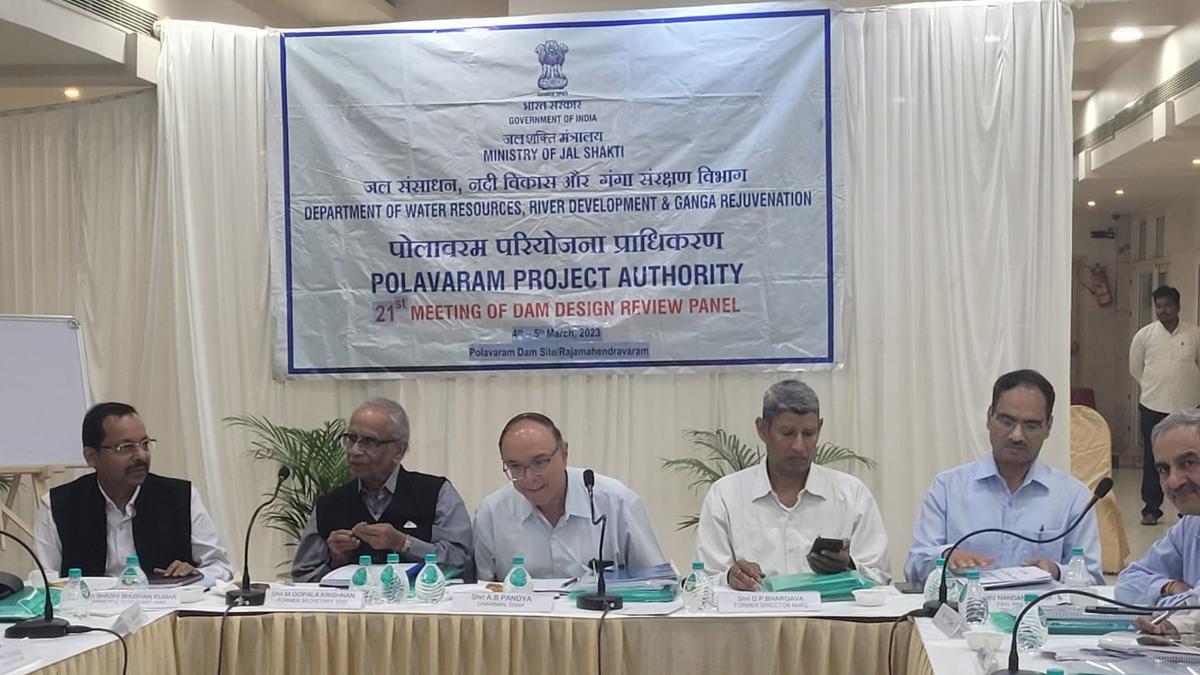
– During the recent Godavari floods, parts of the diaphragm wall had collapsed at two places while the remaining wall up to a length of nearly 700 metres was intact. The NHPC was asked whether the remaining portion of the wall supports repair works or whether a new diaphragm wall needed to be built.
-Meanwhile, addressing the media at the Polavaram irrigation project site, Water Resources Minister Ambati Rambabu said that an additional cost of ₹2,000 crore would have to be borne to complete the repairs of the diaphragm wall as work was delayed by two years. https://www.thehindu.com/news/national/andhra-pradesh/dam-design-review-panel-approves-repairs-to-polavaram-diaphragm-wall-damaged-in-godavari-floods/article66584237.ece (05 March 2023)
An expenditure of Rs 16,035.88 crore has been incurred on the project from April 2014 to December 2022, Rs 13226 Crvhas been released by the Centre and Rs 548 Cr is under examination. Rs. 2390 is not found suitable for reimbursement. https://www.thehansindia.com/andhra-pradesh/polavaram-project-likely-to-be-completed-by-march-24-786330 (06 March 2023)
Hirakud Dam Odisha CSMRS expert team to visit Hirakud dam soon: Minister In a written reply to a question by MLA Soumya Ranjan Patnaik, Minister for Water Resources Tukuni Sahu informed the Assembly that CSMRS and Central Water and Power Research Station (CWPRS) have been approached for the study using the latest technologies.“The relevant information on the reservoir and its present status sought by New Delhi-based CSMRS has been sent on January 24,” she said.
-No detailed study has been conducted since 2020 when a team of dam safety review panel had visited the dam and noticed cracks in its operation gallery, foundation gallery, gate shaft and sluice barrels of both left and right spillways. After the visit in January, 2020, the panel besides recommending a drone based inspection of the downstream face to find out cracks, had suggested to repair the erosion on downstream glacis of the left channel spillway and attend the cracks in right channel spillway to prevent further aggravation. They had also suggested systematic mapping and plotting of cracks on various surfaces of the dam on a regular interval. Even two years after the panel flagged cracks in different structures of Hirakud, the detailed study is yet to be conducted, let alone the restoration part. https://www.newindianexpress.com/states/odisha/2023/feb/26/csmrs-expert-team-to-visit-hirakud-dam-soon-minister-2551118.html (26 Feb. 2023)
Spillway stuck in approval delay Over two years have passed since the Odisha government planned an additional spillway to protect the dam as per the Central Water Commission’s (CWC) recommendation. But the project is yet to get the required administrative approval. Of the two spillways planned five years ago, one was taken up by a joint venture (JV) of Tata Projects Limited and Turkey-based AGE Group at an estimated Rs 369 crore under the World Bank (WB)-funded Dam Rehabilitation and Improvement Project (DRIP). However, the project got stuck after the JV backed out citing delay in resolution of displacement issues. In 2020, the government cancelled the work contract and decided to construct the additional spillway with its own funding through Odisha Construction Corporation (OCC). But it is yet to be decided whether one or two spillways will be constructed.
– The estimated cost of the single spillway has now been revised to Rs 786 crore and as it is more than 15 per cent of the preliminary estimate, the Finance department had sought some clarifications, which the Water Resources department has already complied with.
– The CWC had reviewed the inflow design flood and pegged PMF at 24.5 lakh cusec in 1997. As the existing total discharge capacity stands at 15 lakh cusec through 98 gates, effective discharge is about 13 lakh cusecs due to operational constraint of few gates. Once two spillways are built, the discharge capacity would increase to 18 lakh cusec. https://www.newindianexpress.com/states/odisha/2023/apr/17/hirakud-dam-spillway-stuck-in-approval-delay-in-odisha-2566699.html (17 April 2023)
Rajasthan First centre for earthquake safety of dams Malviya National Institute of Technology (MNIT) in Jaipur has been identified as the National Centre for Earthquake Safety of Dams, the first centre of its kind in the country. The centre will develop indigenous capabilities in making the country self-reliant in handling technology issues related to structural and earthquake safety of dams.
MNIT Director Narayan Prasad Padhy said here that the centre would conduct a pilot study of select dams across the country to develop and revise safety standards, and review the Central Water Commission’s manuals related to the earthquake safety of dams. The institute will later enter into some international collaborations as well. The Ministry of Jal Shakti has approved a financial grant of ₹30 crore for establishing and running the centre for the next five years.
Union Jal Shakti Minister Gajendra Singh Shekhawat said at the Memorandum of Understanding (MoU) signing ceremony here that the Central government was working in a “mission mode” towards the safety and maintenance of dams. More than 25% of the country’s dams have completed over 50% of their lifespan, while several of them are a few hundred years old, he said. https://www.thehindu.com/news/national/jaipur-institute-identified-as-the-first-centre-for-earthquake-safety-of-dams/article66927952.ece (04 June 2023)
Maharashtra SHRC seeks Megholi dam burst relief report The state human rights commission has directed the water resources department (WRD) and revenue department of the district to submit a status report regarding the measures adopted to provide relief to the residents of Megholi village from Bhudargad tehsil which was affected by the bursting of an earthen dam.The commission has asked the authorities concerned to submit a report regarding the reconstruction of the dam.
The hearing of the petitions filed before the commission was held in Kolhapur on Thursday (Feb. 09) and it was presided over by panel members Bhagwantrao More and M A Sayyed. JanataNagariNiwaraSanghatna, a Kolhapur-based forum of the activists, had filed petition on behalf of the people from Megholi affected by the dam burst.
According to the activists, construction of the dam was faulty as found from the complaints registered by the locals. Also, the WRD had carried out frequent repairs. ShivajiraoParulekar, convenor of the forum said, “We wanted the incident to be registered not just as natural calamity, but also as human negligence. https://timesofindia.indiatimes.com/city/kolhapur/rights-panel-seeks-megholi-dam-burst-relief-report/articleshow/97814198.cms (11 Feb. 2023)
Report RTI activist’s recommendations being heard by Govts! Mr Deepak Bache-Patil’s mission has been to find out the quality of security and maintenance of each and every dam not only in Maharashtra but across other states. He used to read in the newspapers about the RTI act and so decided to use it for his knowledge which has turned into his magnificent obsession. To date, he has filed over 3,000 RTI applications and has gathered around 12,500 documents, which include his grievances to various waterworks and irrigation departments, the Mantralaya in Mumbai, and CMs of various states.
– Mr Bache-Patil reveals some shocking details, culled out of the RTI replies which reveal that the security and maintenance of the dams, which are crucial to their efficacy and safety in terms of their structural stability, are compromised. Worse, his information reveals that no survey—barring a handful—of how much silt and debris have accumulated, has been done for most of the dams. Most of the dams would burst in the next 25-50 years if maintenance operations are not carried out well in time – which is now. He finds that the safety plan is not 100% adhered to and in many dams they don’t exist at all. He says safety audits, which are mandatory, are taken casually by the authorities. https://www.moneylife.in/article/recommendations-of-an-rti-user-who-filed-over-3000-applications-on-dams-are-being-heard-by-state-govts/70742.html (12 May 2023)
Jharkhand Govt agrees to Bengal’s proposal on joint regulation of Tenughat Dam’ Jharkhand govt has agreed to the proposal of the Bengal government for joint regulation of the Tenughat dam at the Eastern Zonal Council meeting on Dec 17 2022 under the chairmanship of union Home Minister. So far, the dam has been regulated solely by Jharakhand. In the meeting, the Bengal government also agreed to the Jharkhand CM’s proposal for joint management of Massanjore Dam.
– “The Tenughat Dam has been solely regulated by Jharkhand and we hardly used to get any information of release of water from Tenughat Dam. So, when large volume of water is released from the dam it hits Panchet Dam in our state which gets overflowed and is compelled to release water resulting in flood like situation in areas like Khanakul in Hooghly, Udaynarayanpur in Howrah to name a few” a senior official of WB said. https://www.millenniumpost.in/kolkata/jkhand-agrees-to-bengals-proposal-on-joint-regulation-of-tenughat-dam-502794 (20 Dec. 2022)
Gujarat Govt has asked for inspection of about 30 dams that are 107 to 155 years old to check if they are able to store water safely, if any special work is necessary. Gujarat Dam Safety Org has submitted the report to Gujurat Govt.

Telangana Govt to start Nagarjuna Sagar Dam rehabilitation works According to Engineer in Chief (Operations and Maintenance) B Nagendra Rao, a massive rehabilitation program was taken up on the dam at a cost of Rs.75 crore. https://telanganatoday.com/nagarjuna-sagar-dam-rehabilitation-works-gather-pace (17 May 2023)
Compiled by Bhim Singh Rawat (bhim.sandrp@gmail.com)

 SANDRP