
(Feature Image: Cycles of fisherfolks by the Yamuna and ongoing construction of Metro Bridge downstream of Wazirabad Barrage two weeks before the July 2023 floods. Bhim Singh Rawat/SANDRP, June 28, 2023)
The national capital is witnessing one of the worst flood spells with water level at Railway Bridge breaching the highest recorded 207.49 m of Sept 6, 1978 by 1.17 m. The Yamuna seems eager to reclaim all its relict channel and encroached floodplain areas.
The River has set 208.66 meter as new HFL (Highest Flood Levels) for the site at 18:00 hours on 13 July 2023 which is 1.17 meter higher than the 1978’s HFL. The flood level is receding now.
While the city is still battling the unfolding flood disaster, the concerned government officials and experts are trying to understand possible reasons behind the unusual rise in Yamuna’s flood level in Delhi. This analysis by SANDRP explores some of the possible reasons aggravating the flood situation in the city.
1978 and 2023: A tale of two floods
The official figure of HKB (Hathnikund Barrage now, then Tajewala barrage) peak discharge into Yamuna in 1978 floods was over 7 lakh cusecs (cubic feet per second) while during 2023 flood spell it is 3.6 lakh cusecs for just two hours (11:00 hour and 12:00 hour) on 11 July 2023.
Moreover, there have been 8 lakh cusecs plus discharges from HKB in Yamuna at least twice in the recent past but the 1978’s HFL has never been crossed in the last 45 years. The table below details the peak discharges and peak flood level attained at ORB (Old Railway Bridge), Delhi during previous high flood years.
History of High floods in Yamuna with peak discharges from HKB since 1978
| Year | Discharges in lakh cusec | Peak at ORB Delhi |
| 03 Sept 1978 | 7,09,000 | 207.49 |
| 25 Sept 1988 | 5,77,522 | 206.92 |
| 05 Sept 1995 | 5,36,188 | 206.93 |
| 20 Sept. 2008 | 4,09,576 | 206.00 |
| 20 Sept 2010 | 7,44,507 | 207.11 |
| 17 June 2013 | 8,06,464 | 207.32 |
| 28 July 2018 | 5,03,925 | 206.05 |
| 18 Aug 2019 | 8,28,000 | 206.60 |
| 11 July 2023 | 3,59,760 | 208.66 |
Moreover, the HFL has not been breached at any of the 5 flood monitoring sites of CWC (Central Water Commission) on Yamuna river between HKB and ORB.
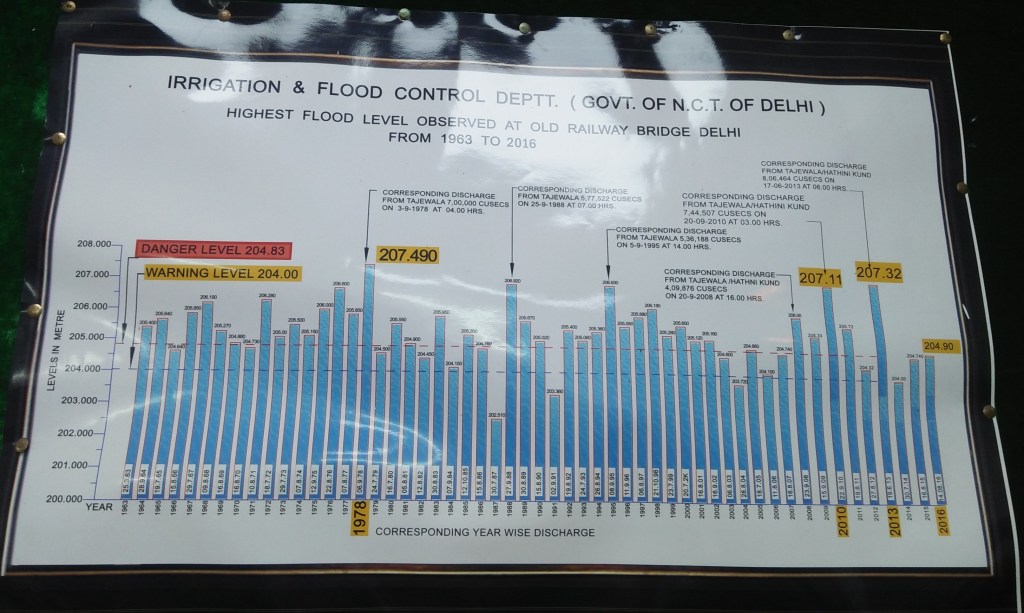
September 1978’s flood has left a lasting impact in the memories of riparian communities all along the upper and middle segment of the Yamuna river. The historic floods had also set the HFL for most of the flood monitoring sites in these segments. The table below and CWC’s hydrographs detail the HFL records at all the flood monitoring sites between HKB and Delhi and the margins by which July 2023 flood missed breaching the HFL there.
| No. | Site | HFL in meter (m) | Date | Peak level in July 2023 Floods | Time & Date | Missing HFL breach by margins |
| 1 | Kalanaur | 268.66 m | 09.09.2010 | 268.00 m | 09:00 hour 10.07.2023 | -0.66 m |
| 2 | Karnal | 250.07 m | 17.06.2013 | 248.91 m | 01:00 hour 11.07.2023 | -1.16 m |
| 3 | Mawi | 232.75 m | 18.06.2013 | 232.30 m | 16:00 hour 12.07.2023 | -0.45 m |
| 4 | Baghpat | 217.18 m | 27.09.1988 | 216.53 m | 01:00 hour 13.07.2023 | -0.65 m |
| 5 | Palla | 212.80 m | 08.09.1995 | 212.55 m | 10:00 hour 13.07.2023 | -0.25 m |
| 6 | ORB | 207.49 m | 06.09.1978 | 208.66 m | 18:00 hour 13.07.2023 | +1.17 m |
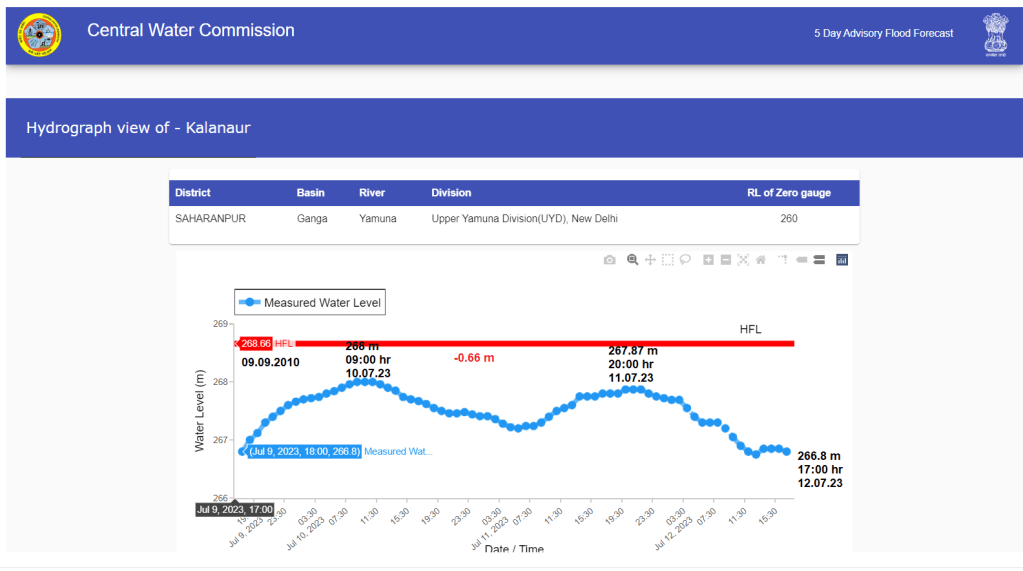
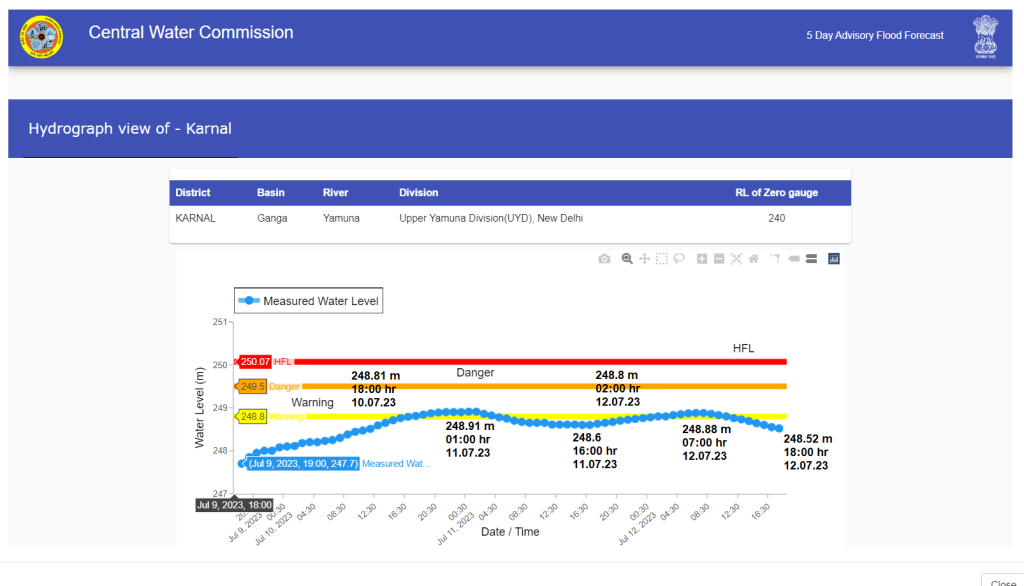
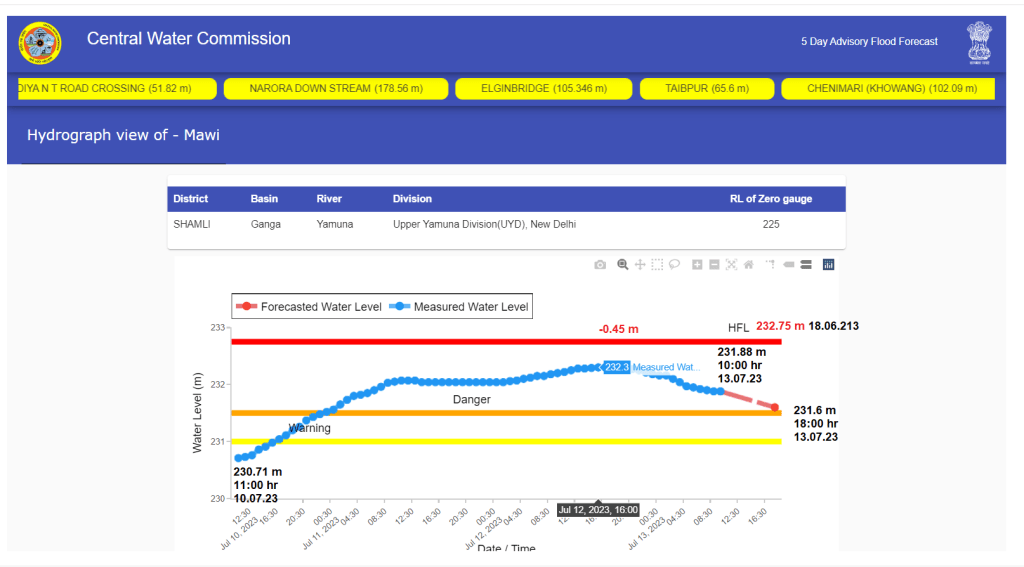
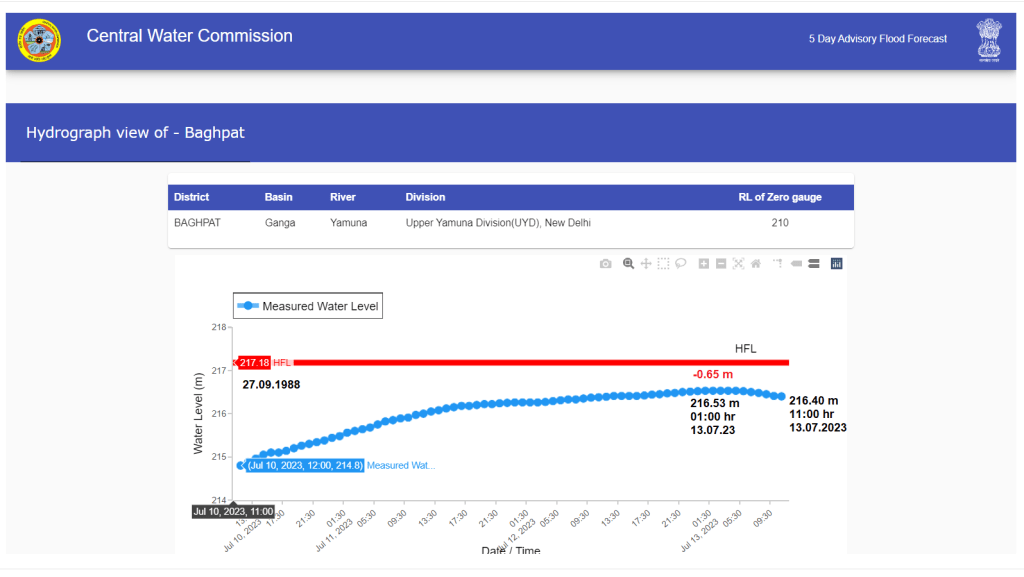
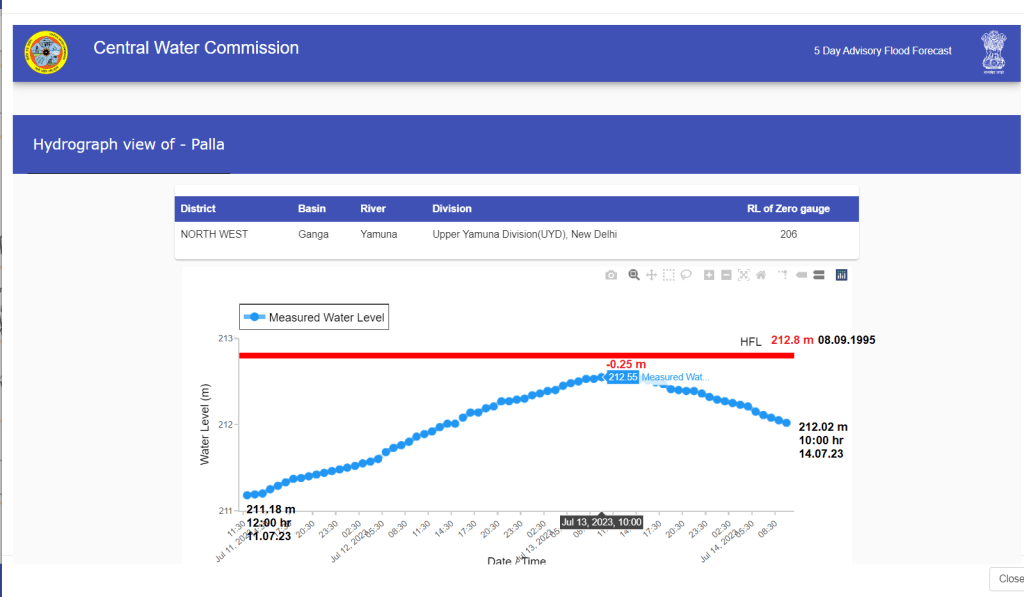
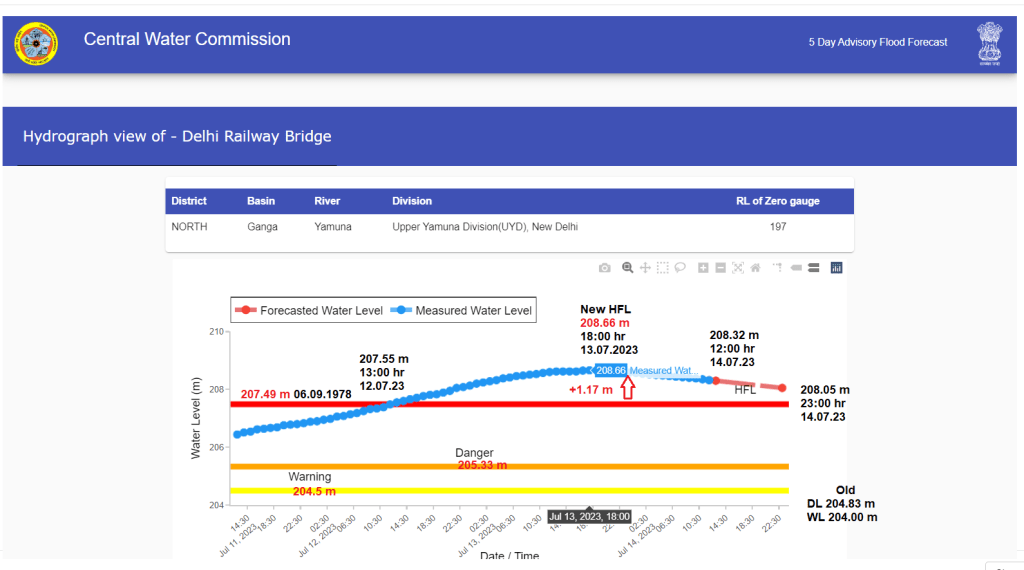
CWC’s hydrograph showing peak flood level at 5 flood monitoring sites between HKB & ORB in July 2023.
Is Heavy Rainfall Responsible for July 2023 Flood Event?
The adjoining districts of Yamuna river in Haryana and Uttar Pradesh downstream HKB and also Gurugram and Delhi have also received prolonged heavy rainfall spells simultaneous to the increase of HKB discharges & ORB levels which could have contributed to flows of Yamuna downstream of HKB. The table below details the Indian Metrological Department (IMD) rainfall figures in millimeters (mm) between 08 to 11 July 2023 (figures are for 24 hrs ending at 0830 hrs on respective days).
| Dates | 08.07.23 | 09.07.23 | 10.07.23 | 11.07.23 | ||||
| Districts | Actual (mm) | Normal (mm) | Actual (mm) | Normal (mm) | Actual (mm) | Normal (mm) | Actual (mm) | Normal (mm) |
| Yamuna Nagar | 16.8 | 10.8 | 125.1 | 6.3 | 102.2 | 6.0 | 98.1 | 8.9 |
| Karnal | 14.3 | 8.2 | 82.4 | 8.5 | 31.6 | 9.3 | 39.1 | 7.1 |
| Panipat | 14.0 | 5.7 | 52.2 | 7.4 | 37.5 | 6.3 | 16.8 | 7.8 |
| Sonipat | 9.7 | 5.0 | 46.6 | 3.7 | 36.7 | 7.9 | 28.9 | 10.5 |
| Gurugram | 4.8 | 6.6 | 35.6 | 5.3 | 30.2 | 5.3 | 16.8 | 8.5 |
| Saharanpur | 2.6 | 11.8 | 73.0 | 6.3 | 91.8 | 7.3 | 109.6 | 9.8 |
| Muzaffar Nagar | 17.5 | 7.8 | 38.6 | 9.1 | 67.6 | 9.4 | 76.6 | 11.2 |
| Shamli | 4.0 | 8.9 | 29.0 | 5.6 | 25.0 | 12.5 | 23.5 | 5.2 |
| Baghpat | 14.3 | 5.7 | 58.3 | 2.5 | 49.7 | 5.3 | 19.7 | 10.4 |
| Delhi | 9.9 | 4.8 | 54.4 | 5.4 | 34.3 | 5.2 | 11.8 | 7.4 |
While most the resultant runoff from Haryana districts goes into Yamuna; it is only a part of rainfall water reaching the river from Uttar Pradesh side districts. Though, there has been excess to large excess rainfall in some of the districts in the segment of Yamuna between HKB & ORB, the peak flood levels attained at 5 flood monitoring stations particularly at Baghpat and Palla show that high rainfall has not been a major factor for increasing Yamuna flood levels 1.17 meter above the historic 1978’s HFL. Moreover, there has not been any rise of water level in Sahibi river (Najafgarh drain) during this period as recorded at Dhansa site in CWC’s hydrograph.
Role of Floodplain Encroachment in Delhi
Over the years various kind of encroachments on Yamuna’s floodplain and riverbed in Delhi has reduced the flood carrying capacity of Yamuna in Delhi stretch. The floodplain is being reduced and encroached upon significantly compromising its longitudinal and lateral connectivity.
Presently of total 9,700 hectare (ha) of Yamuna’s floodplain in Delhi; about is 3,638 ha is regulated by Delhi Development Authority (DDA). It is not clear whether this regulated area is totally built up however the experts have been highlighting that more than 1000 ha of Yamuna’s floodplain has been encroached by various permanent structures the over past one and half decade with Common Wealth Games (CWG) Village, Akshardham Temple, Yamuna Bank Metro Depot, Shashtri Park Metro Depot and IT Park being the major encroachers as mentioned in Nivedita Khandekar’s latest article How Delhi ate into its floodplains bridge by bridge. The details of floodplain area encroached by these structures is given in table below.
| Name of Structures | Floodplain area Encroached |
| CWG Village | 63.5 ha |
| Akshardham Temple | More than 100 ha |
| Yamuna Bank Metro Depot | More than 40 ha |
| Shashri Park Metro Depot | More than 70 ha |
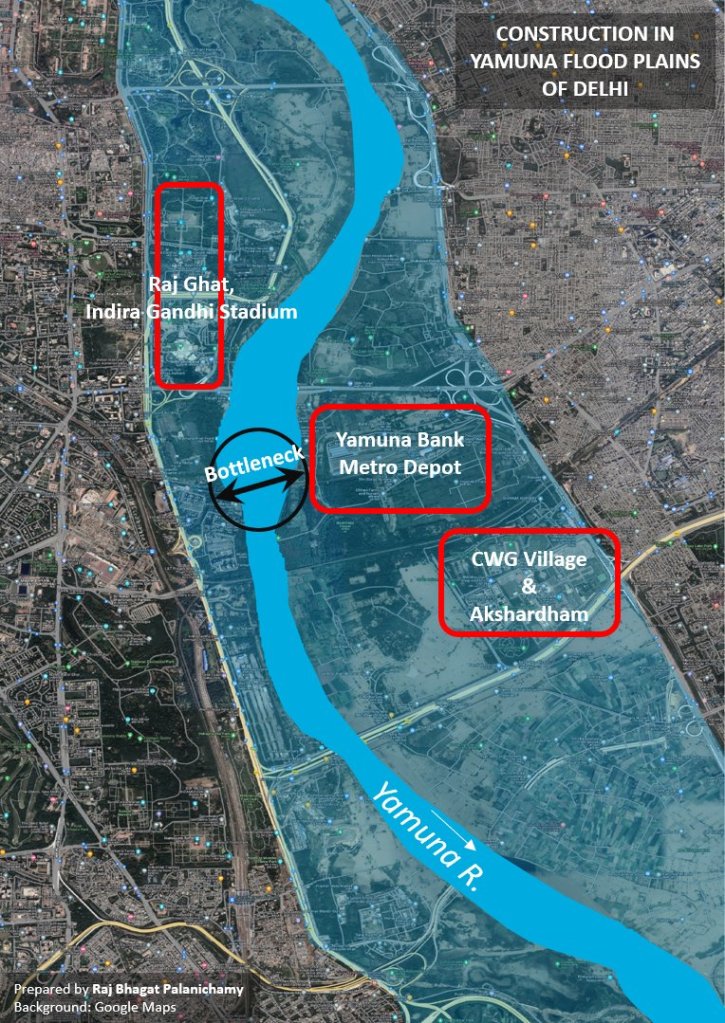
An email exchanged between forest department and DDA officials in July 2022 has also revealed that “there has been encroachment/ development of 2480 ha of land in Yamuna floodplain since 2009…”
Moreover, construction of new bridges and roads along and across the river in Delhi have been straight-jacketing the floodplain from both sides and adversely affecting passage of floods. For example, over years there have been about 26 built bridges; 4 under-construction bridges and 3 barrages (Wazirabad, ITO and Okhala) in the limited 22 km long stretch in Delhi city area fragmenting the floodplain, facilitating the permanent encroachments and obstructing natural flooding pattern of the river. The number of built under construction cross sectional structures on Yamuna in 22 km stretch of Delhi is listed in table below.
| Barrages/ Railways & Metro Bridges | Road Bridges |
| Wazirabad Barrage | Wazirabad Bridge |
| ITO Barrage | Signature Bridge |
| Okhala Barrage | ISBT Kashmiri Gate double lane bridges (2) |
| Under construction Railway Bridge at Red Fort | Geeta Colony Double Lane bridges (2) |
| Old Railway cum Road Bridge double lane | ITO Bridge |
| Delhi Anand Vihar Railway bridge | New ITW double lane bridges (2) |
| Under construction Metro Bridge at Wazirabad | Nizamuddin 3 double lane bridges (3) |
| Shastri Park Metro Bridge | Under construction Barapula double lane bridges (2) |
| Yamuna Bank Metro Bridge | Under construction RRTS double lane bridges (2) |
| Mayur Vihar Metro Bridge | DND bridges double lane (2) |
| Okhala Metro Bridge | Old Okhala bridges |
| New Okhala double lane bridges (2) |
The back-to-back 3 double lane bridges at Nizamuddin have particularly been creating a bottle neck situation during the seasonal flood in the river. SANDRP has in detail highlighted the impact of so many cross sectional structures on river’s hydrology in this blog Bridges-Connecting People, Disconnecting River?.
Further in past five years, DDA has been abusing the floodplain in the name of ‘restoration’ and ‘beautification’ projects and carrying riverfront development, compensatory plantations, ‘biodiversity park’, ‘eco-tourism’ plans on 1515.50 ha increasing the built up encroachment in piece meal and altering the floodplain characteristics thus disrespecting floodplain hydrology and ecology.
The cumulative impact of all these factors is certainly a big reason behind unusual rise in flood level at ORB and unexpected ongoing July 2023 flood crisis in Delhi. On one hand these have significantly taken away floodplain land available for flood absorption (cushion) and on the other hand, these structures have been causing stagnation as well as back flooding of flood waters.
Role of CWC’s & FC& I Departments in Making the Situation Worse
So far there are 6 barrages along entire 1346 km length Yamuna. 2 of the barrages namely Dakpathar in Uttarakhand and HKB in Haryana are about 200 km and 250 km upstream Delhi, and there is only one barrage Gokul in Mathura downstream Delhi.
The existence of 3 barrages Wazirabad, ITO and Okhala in just 22 km stretch of Yamuna has been affecting the flooding pattern of the river in great manner. However, the hourly or even daily flood discharge data of these major infrastructural interventions on the river is not put in public domain to understand how efficiently they are operated in monsoon season. Surprisingly, all these 3 barrages are being maintained by Flood Control & Irrigation (FC&I) Departments of 3 states Delhi, Haryana and Uttar Pradesh.
Moreover, the accidental disclosure on the 5 gates of ITO barrage remaining closed ‘due to siltation’ in peak flood spell is shocking. The barrage with 32 flood gates sits in the middle of the city. Strangely, it is being managed by Irrigation Department, Haryana. Yet, none of concerned departments have revealed for the time period the gates have been malfunctioning.
This shows clear lack of coordination among the FC& I, Departments of all 3 states involved. Further, the issue puts a big question mark on the role and responsibility of CWC and its communication gap with the state FC & I departments. All these agencies have majorly failed to function according to their mandate.
Ironically, CWC is central body headquartered in Delhi and the same city has witness worse flood disaster after 5 decades. However, the flood spell has revealed CWC flood forecasting in want of much more improvement. The agency is seen failing to forecast the arrival time of flood in the city and the gradual unusual rise in flood level at ORB, Delhi.
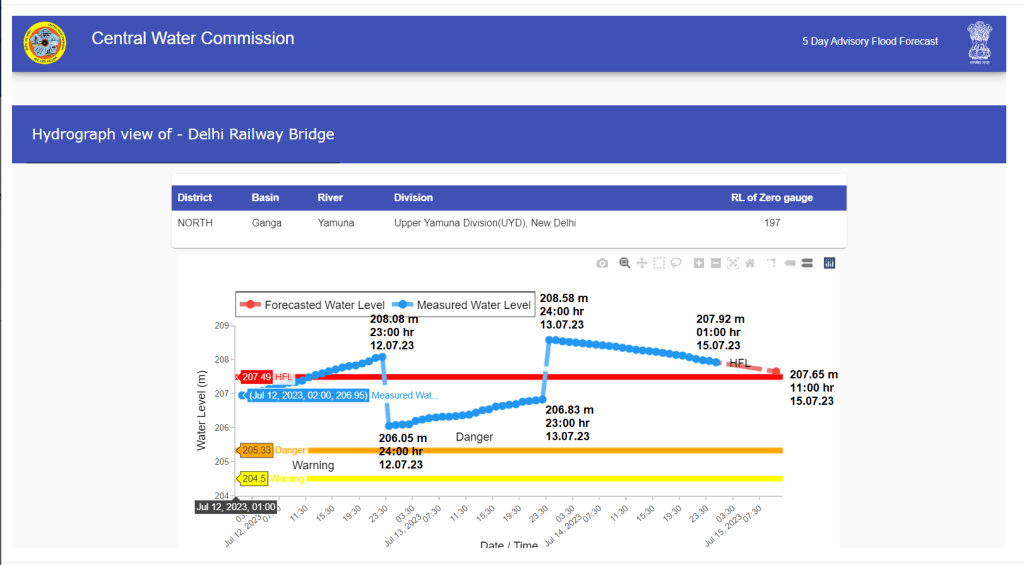
The flood forecast website of CWC could not even maintain the already recorded water level on hydrographs of 10 key monitoring stations on Yamuna downstream HKB and the recorded level upto 14 July 2023 have been changed for entire 13 July 2023. Despite acknowledgment of the unexpected mistakes by the CWC officials, the error was not corrected and the agency on social media kept on sharing hydrographs with wrong flood level all through 15 July 2023.
Is Riverbed Level Rising Up in Delhi & Has it Contributed in Flood Disaster?
Another point subjected to detailed study is that if there is rise in riverbed level in Delhi. The ground observation suggest that the Yamuna riverbed level is gradually rising in Delhi as more sedimentation load from Himalayan and upper segment is on the increase in the river on account of landslide, dumping of road widening muck, increase in construction activities, soil erosion and mechanized riverbed mining upstream Delhi. The river is also receiving significant volume of silts through storm water and sewage drains including Najafgarh, Barapulla strom drainage system year-round from its catchment area.
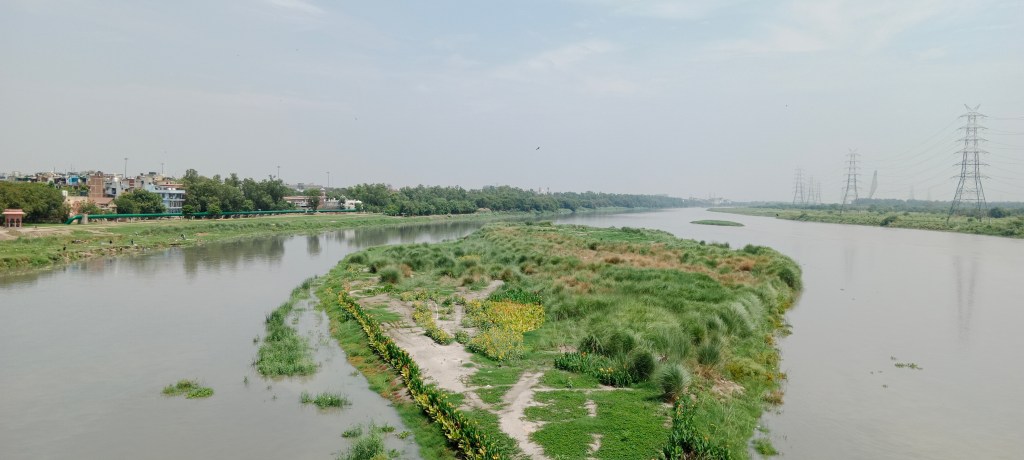
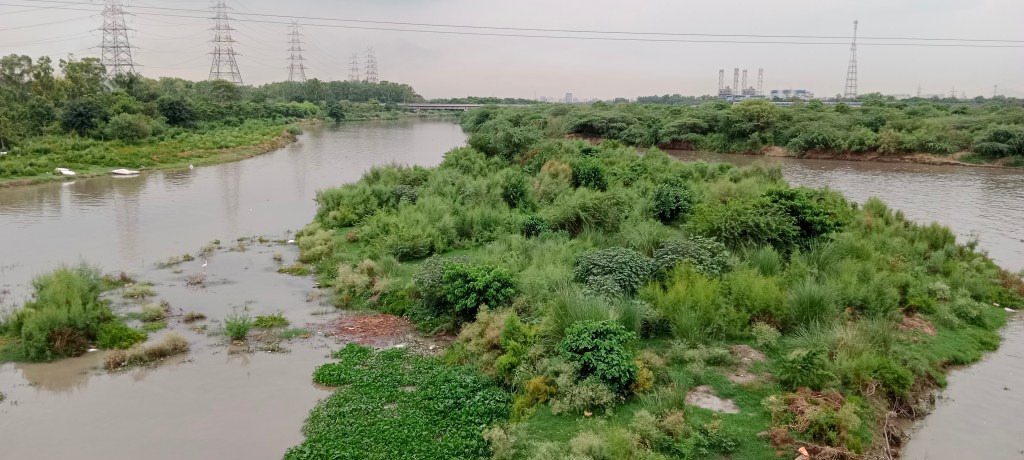
Mid stream sand bars in Yamuna as seen upstream ISBT bridge and downstream ITO bridge on 28 June 2023.
The cumulative impact of this is causing more silt and sediments entering into Delhi stretch round the year but in lack of adequate flows and multiple cross-sectional structures it is getting trapped in Delhi stretch and river is unable to flush out the same volume of silts except during monsoon time. Moreover, there is no mining, dredging exercise happens in Delhi unlike upper, middle and lower segments.
The increase in the number and size of mid-stream sand bars between Wazirabad and Nizamuddin bridges over the years strengthen the observation. The recent survey for water taxi project has also found out shallow riverbed level and lack of adequate depth at multiple sites. Nevertheless, the truth behind the hypothesis and its overall impact of flooding requires a detailed scientific study.
What could be other reasons behind July 2023 Flood Disaster in Delhi?
The change in land use, increase in built-up areas with growing urbanization and concretization, decline in water bodies and green spaces in NCT Delhi do also have a role to play in aggravating the flood situation. Because of these reasons there is decline in groundwater percolation and the runoffs in higher volumes are reaching the river via drains. Due to encroachment and decline in waterbodies and wetlands the flood cushion for local level rainfall and resultant flooding is going down.
Measures CWC Must Take
The CWC being central agency has categorical role to play and resources at its disposal for monitoring rainfall and river flow data to issue timely flood forecasts and warnings to minimize the damage caused by floods. Its technical body which can initiate, prepare advance flood control and mitigation plans in coordination with concerned state departments. It is meant to carry out any necessary research and execution of such plans.
It must proactively coordinate with concerned FC& I, Departments of Delhi, Haryana and Uttar Pradesh before during and after monsoon season. It must monitor and make public the hourly discharges through 3 barrages in Delhi specially during annual flood spell in the river.
CWC is expected to assess the situation of floodplain encroachment, siltation, impact of growing infrastructures on the river on annual basis and release the report publicly to alert the concerned governments, civil societies and key stakeholders regarding the same. Similarly, CWC must analysis the impact of floods on floodplain and encroaching structures after every monsoon season and release detail report recommending important measures to be taken by concerned state departments.
It has to figure out has there been significant rise in run offs reaching river through storm water drains downstream HKB specially in Haryana side and take monitoring, mitigatory decision accordingly to avoid repeat of the same during future floods in the city.
The accountability for malfunctioning of ITO barrage gates must be fixed and its overall impact on aggravating the July 2023 flood situation must be assessed and report be made public.
What Measures Can Be Taken to Avoid Repeat of July 2023 Flood Disaster?
First and foremost, Delhi needs to keep Yamuna floodplain intact with the river. Secondly there is urgent need to increase the flood cushion in river’s city stretch. For this, DDA must reveal the actual and present status of floodplains in Delhi detailing land leased out to construction companies and overall encroached floodplain. It must initiate process of reclaiming floodplain land encroached by big, influential players and restored it with the river.
Secondly, the Yamuna in Delhi is already overburdened with back-to-back bridges, barrages suffocating the river adversely and river eco-system cannot afford construction of any new structure further slicing down already fragmented floodplains compromising the river’s flood carrying capacity.
The structures of the existing bridges must be studied and their flood carrying capacity must be increased accordingly. Presently, the ITO barrage is serving no practical purpose and it’s time for decision makers to chalk out its decommissioning process.
Then, there is urgent need to study if there is increase in siltation load entering Delhi’s stretch of river and getting trapped here or whether it is causing rise in riverbed level and impacting its flood carrying capacity. The corrective steps must be taken accordingly.
The so-called floodplain restoration projects must be stopped by the DDA and associated central agencies as all the activities done so far has been greatly undone by the floods of which the agencies deliberately ignored the pre-warnings by experts resulting in wastage of huge amount of public money.
The accountability for the losses must be fixed and essential lessons the river is imparting time and again must be learnt in serious manner which is to keep the floodplain guarded but undisturbed. And, finally the city needs to do a lot more in terms of rainwater harvesting, protection of water bodies and green spaces.
Summary
While blaming the climate change, heavy rainfall and water discharges from Hathni Kund Barrage (HKB) Haryana is easy part of complex puzzle to shift attention from man-made reasons responsible for the avoidable calamity; in reality, this appears to be a disaster in the making about which the river experts like late Manoj Misra of Yamuna Jiye Abhiyan (YJA) had been warning all concerned central and state government agencies since 2007.
The present unusual flood situation in Delhi and unexpected rise in Yamuna water level at ORB is more due to anthropogenic reasons some which are discussed above warranting a complete overhaul in the prevailing approach through which the floodplain and river are seen and managed by the all concerned government departments in the national capital.
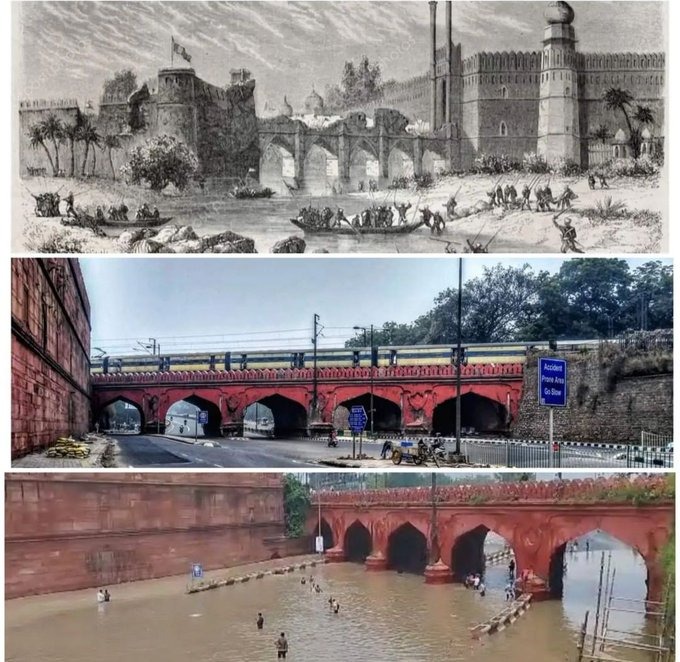
Flooding is natural cycle and essential feature of a river. The July 2023, Yamuna flood spell in Delhi has again reinforced the significance of floodplains for a city and a river. Floodplains if kept intact with river would provide multiple benefits to the all of us. At the same time, encroached and abused floodplains and river Yamuna have the potential to jeopardize the normalcy of national capital and bring large part of city underwater.
Remember, this is not the repeat of 1978 flood cycle. But this is a trailer of bigger floods in store which will certainly be hitting the city in coming years. If the decision makers and planners keep on business-as-usual syndrome and if already encroached floodplains are not restored with the river and more encroachments and abuse of river Yamuna is allowed to happen, then Delhi must be ready for more flood destruction and damages.
Bhim Singh Rawat (bhim.sandrp@gmai.com)

 SANDRP