DRP News Bulletin

DRP 290321: Better options exist to resolve water scarcity

Even as a strong voice of dissent rises from Bundelkhand, Madhya Pradesh, Uttar Pradesh and elsewhere against the fresh push for destructive Ken Betwa Project, this week there is interesting news from across India that reinforces the message that real solutions to Bundelkhand water scarcity not only exist, but they are far less destructive, cheaper, faster and more sustainable even in climate change context. This includes the report from CSE about the success of MGNREGA (Mahatma Gandhi National Rural Employment Guarantee Authority) scheme as “the world’s largest climate change adaptation scheme” particularly for water havesting and water conservation. Similar stories also come from Bundelkhand and elsewhere.

If only the eyes, ears and minds of the decision makers were open and they had any fear of being held accountable for such mindless decisions.

Continue reading “DRP 290321: Better options exist to resolve water scarcity”
DRP News Bulletin

DRP 220321: PM presiding over proposal for destruction of 46 lakh trees, Bundelkhand & Panna Tiger Reserve on World Water Day?

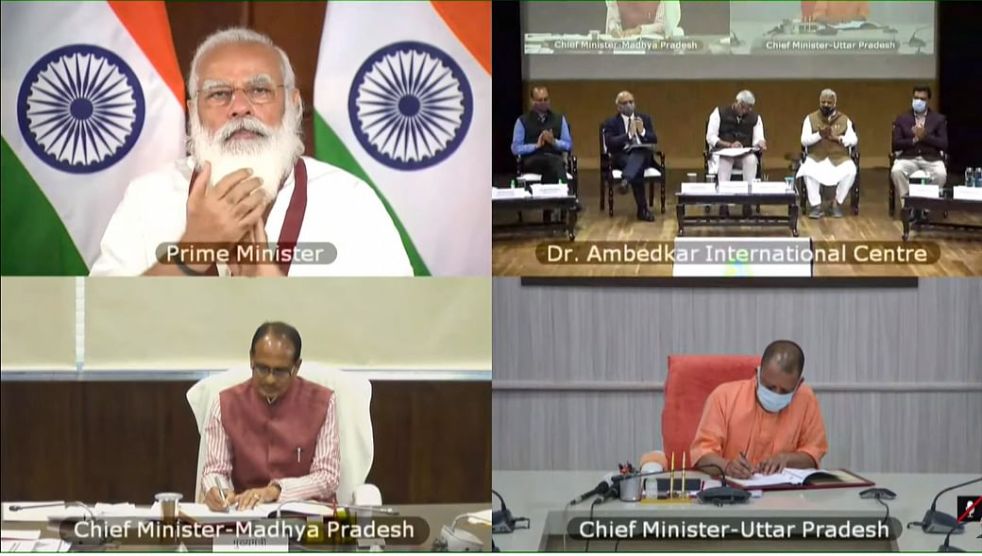
There cannot possibly be any worse news on World Water Day for India than that the Prime Minister is presiding over the agreement between Uttar Pradesh and Madhya Pradesh Chief Ministers to destroy some 46 lakh trees, Panna Tiger Reserve, Ken River, Bundelkhand and also downstream Banda district. All to export water from Bundelkhand to Upper Betwa basin.  All this in the name of pushing the mindless project called Ken Betwa River Link Project. Why is the government pushing this destructive project, a Rs 38 000 Crore proposition? The answer to that question is in that question: it is a Rs 38 000 Cr proposition!

There is still some hope though for the people of Panna, Banda and Bundelkhand if there is any respect for the law of the land. This is because the project does not have final forest clearance and the conditions of the stage I forest clearances are not implementable. The Wild Clearance of the project is challenged by the Central Empowered Committee of the Supreme Court, following a petition. The Environment Clearance to the project has also been challenged before the National Green Tribunal. Let us hope there is sufficient respect for the law of the land, to ensure that the project does not go ahead even with the agreement signed. But a key propriety question arises is, should the prime minister endorse a project that does not have all the statutory clearances and legal challenge to whose clearances are before the judiciary?

But the prime minister’s advocacy for rainwater harvesting on the same also loses a lot of its credibility, seeing that he is presiding over this destruction that goes totally against the central message of harvesting rain where it falls, when it falls.

Continue reading “DRP 220321: PM presiding over proposal for destruction of 46 lakh trees, Bundelkhand & Panna Tiger Reserve on World Water Day?”
DRP News Bulletin

DRP 080321: Will Madras HC action help save water bodies?

While on the face of it the Madras High Court order on March 2, 2021 that all district collectors of Tamil Nadu must upload by March 17, GPS/ satellite images of all the water bodies in their districts is not only welcome, it needs to be done in all the districts across India. This order is by the bench of Chief Justice Sanjib Banerjee and Justice Senthilkumar Ramamoorthy.

The same bench had earlier in January 2021 said, in response to a PIL that the government officials must have zero tolerance towards encroachment of waterbodies and ensure that every inch of such encroachment gets removed at the earliest by following the due process of law. The PIL had sought for removal of encroachments from a two-acre swamp at Arehalla in Ithalar, a village in Nilgiri hills.

While these are welcome, we hope these orders get implemented and provisions be made by the HC to ensure accountability of the DMs to ensure that all information is put out on the district water bodies website in form and manner that people understand as also in english and should be archived so that the information can be used in future. The information from the past should also be put up on such websites and a transparent, participatory monitoring of the water bodies be instituted for each district.

Continue reading “DRP 080321: Will Madras HC action help save water bodies?”
DRP News Bulletin

DRP 010221: Dissolving YMC is retrograde

In a shocking and disappointing move, the National Green Tribunal last week dissolved the Yamuna Monitoring Committee (YMC) in Delhi, UP and Haryana along with Justice Pritam Pal Committee and asked the state government to implement the various measures in earlier YMC and NGT reports and directions. This seems like a major set back for the future of Yamuna and other rivers. This seems to have been a direct fall out of the Supreme Court of India Suo Moto taking up the Yamuna pollution issue. This is not going to help solve the seemingly intraceable issue of tackling pollution of our rivers. If the states were interested and capable of implementing the necessary measures, we won’t have required YMC in the first place. YMC was taking a number of useful steps and as we wrote in the DRP lead story dated January 18, 2021, what is required is strengthening the hands of the YMC, but as if our worst fears were to come true, YMC has now been dissolved, even before it could make its mark in achieving cleaner rivers.

It should be noted that our judiciary does not have very remarkable track record in achieving cleaner rivers. In fact the same Supreme Court took up Yamuna case Suo moto in 1994 and not having been able to achieve any better state of Yamuna, after dealing with it for 23 long years, handed over the case to NGT in 2017. Supreme Court had been dealing with Ganga case even longer, and again not achieving better state of the river, handed over the case to NGT in 2017. It seemed like NGT had done something right in setting up YMC, but that also has been dissolved. Its clear that unless the citizens and society does not rise up, there is no hope for our rivers.

Continue reading “DRP 010221: Dissolving YMC is retrograde”
DRP News Bulletin

DRP 250121: UN warns about aging Dams & Floods in changing climate

A new UN report released on January 21, 2021 UN has warned the major big dam owning counties about the aging population of fast silting up dams in changing climate and urgent need to start working on decommissioning of uneconomical large dams. Among the few countries that UN has warned includes India with its third largest number of big dams. The added problem in India is the ill maintained and ill operated large dams that UN report did not look into. Indian dams are sanctioned based on highly under estimated siltation rates, there is practically no transparency and accountability in operation of Indian dams and dam almost every year get away with creating avoidable flood disasters. This latest problem is not just related to old dams, but even the newest celebrated ones like the Sardar Sarovar Dam as happened in Gujarat in late August-early Sept 2020. No legal regime exists in India for dam safety, either structural safety or operational safety. And in changing climate, with increasing frequency of higher intensity rainfall events, such risks are already increasing multi-fold.

Continue reading “DRP 250121: UN warns about aging Dams & Floods in changing climate”
DRP News Bulletin

DRP 040121: Bangladesh declares Halda River as Fisheries Heritage

Bangladesh has declared the whole 81 km long Halda River, a tributary of Karnaphuli River in Chittagong in South East Bangladesh. The Halda river is also famous for breeding pure Indian carp. This is the only pure Indian carp breeding field of Bangladesh, perhaps in South Asia. This is a remarkable river conservation decision that has a lot of lessons for much bigger India where no river has been protected as fisheries heritage. This is great way to begin the first weekly DRP Bulletin of 2021 and we hope the Indian government, civil society and judiciary will take due note of this.

Controversy is never far away from any such river conservation efforts as is evident from the news about proposal for a Halda River based water supply project for industrial estate that has been opposed by the Fisheries ministry, water resources ministry, the River Conservation Commission, the Department of Environment and independent researchers.

Continue reading “DRP 040121: Bangladesh declares Halda River as Fisheries Heritage”
DRP News Bulletin

DRP: 28 Dec. 2020: Five Positives of outgoing Corona year

The outgoing year 2020 is likely to be remembered as Corona year as Covid 19 pandemic has been the most influential aspect of the year. However, there have been many positives of the outgoing year. We identify five biggest positives as we see them.

Firstly, the complete lockdown that we experienced during March-April 2020, to slow down the spread of the Covid 19 infection showed, among many other things that it is indeed possible to clean up our rivers and also indicated the way forward: tackle industrial pollution. Unfortunately, those clear lessons have not been learnt by the government, its been busy in ease of doing business, not even understanding that in changing climate, clean rivers are going to be a major resource that will help people adapt.

The second notable positive was the major across the country protests, particularly from the younger generation against the government’s attempt to bulldoze the completely anti- environment amendment to the EIA notification. The protests along with the judicial orders have so far stopped the amendment from getting implementation. The government will do well to abandon any attempt to push them.

Similar to the protests against amendments to EIA notification were the protests against trying to bulldoze the massive Etalin Hydropower project in Dibang Valley in Arunachal Pradesh, at the cost of lakhs of trees and biodiversity rich forest and river and against the wishes of the people of Arunachal Pradesh and North East India. Here again it was good to see that the campaign has so far been successful.

India Rivers Week 2020 organised Zonal and National dialogues on river sand mining in India, in which large number of groups and stakeholders from across the country participated and has created a new wave of awareness and energy on this very important but so far largely ignored issue. We are hopeful that this energy will lead to change in governance of river sand mining in India.

Continue reading “DRP: 28 Dec. 2020: Five Positives of outgoing Corona year”
DRP News Bulletin

DRP: 2 Nov. 2020: Citizen Efforts to Save our Rivers

It’s heartening to see at least three citizen efforts that media has brought to limelight this week, two in Odisha and one from the banks of Godavari river in Nasik. Besides being citizen efforts, one common theme is that all these initiatives is that they concern rivers. Great news to celebrate in this festival season, also when India Rivers Week is also conducting weekly Dialogues on River sand mining.

Continue reading “DRP: 2 Nov. 2020: Citizen Efforts to Save our Rivers”
Dams · DRP News Bulletin

DRP: 14 Sep 2020: How should we define a Normal Monsoon?

IMD is happy to declare a monsoon as normal as long as total quantum of rainfall at national scale is within 4% of what is defined as normal monsoon rainfall during June 1 to Sept 30. Even if this means there is spatially or temporally or both spatially & temporally, the total rainfall or its distribution is abnormal in large parts of the country. It was good to see a national newspaper, asking question if the monsoon is normal even though it’s not temporally normal as was the case in large parts of the country this year.

The IMD normal only assures meteorological normal of national monsoon rainfall within given period. It does not assure hydrologic normal nationally or in different parts of the country, nor agricultural normal rainfall nationally or in different parts: sub divisions, states, river basins, districts, talukas/ tehsils or villages and wards. We clearly need much more realistic and nuanced definition of even meteorological Normal monsoon rainfall, which IMD needs to work on. But as far hydrological or agricultural normal rainfall is concerned, both temporally and spatially, those concerned outside IMD will need to work on.

Continue reading “DRP: 14 Sep 2020: How should we define a Normal Monsoon?”
Dams · DRP News Bulletin

DRP: 6 April 2020: Ganga-Yamuna-Cauvery flow cleaner in lockdown: What can we learn?

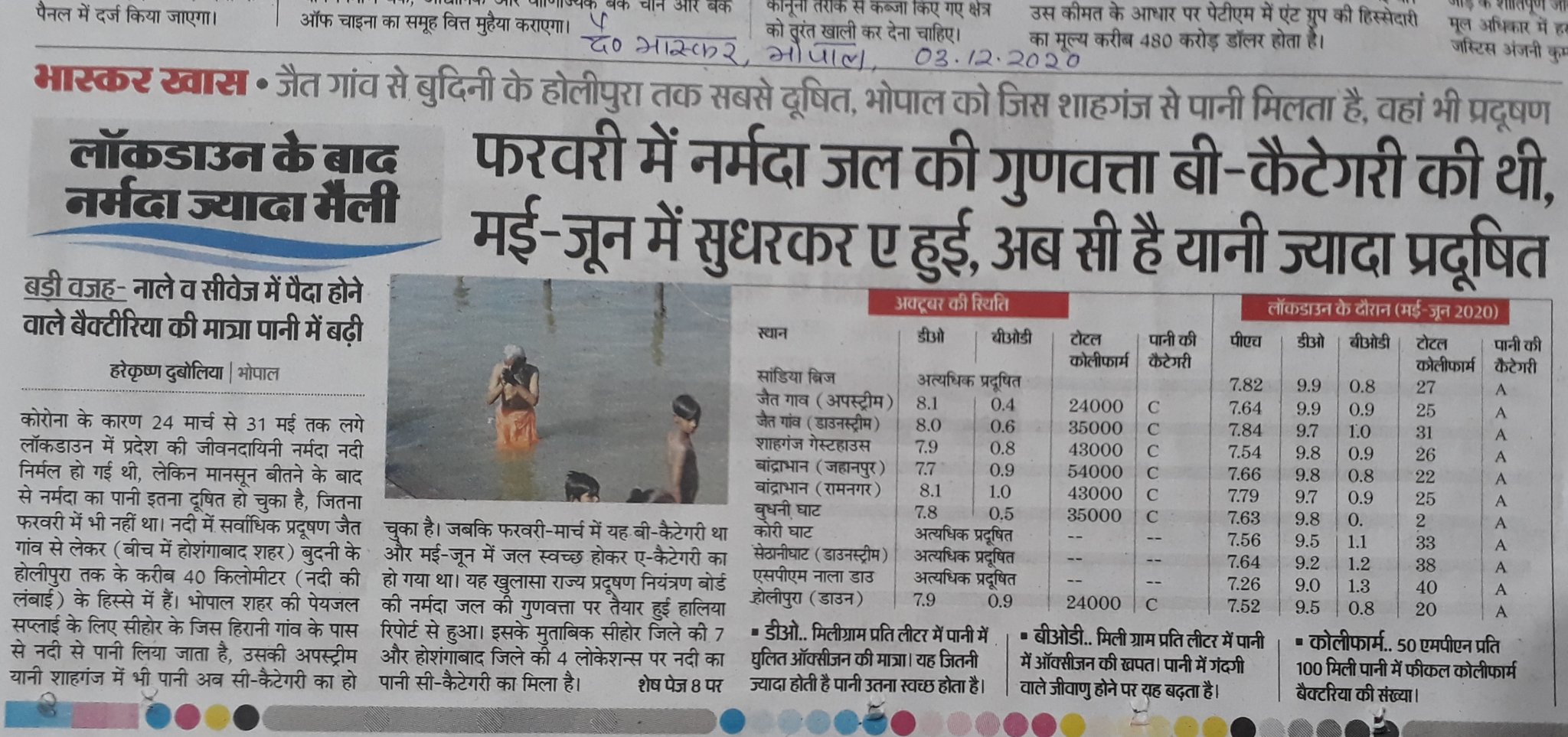
A number of reports have appeared that show that the state of a number of rivers of India, including Hindon, Yamuna, Ganga and Cauvery has improved during the current lockdown due to Covid 19 crisis. That is indeed great news. At Kanpur and Varanasi there are reports that suggest the dissolved oxygen level has gone above 8 ppm and BOD level has gone down below 3 ppm at a number of places. While lack of industrial effluents entering the rivers due to closure of industrial units is a major reason, there are other reasons that has led to this situation, including above average winter rainfall, high snowfall now melting with onset of summer, reduction of irrigation water demand and also stoppage of sand mining along the rivers. The reduction of cultural activities including puja, bathing and cremations have also contributed to this situation.

The biggest lesson we can learn from this cleaner rivers after so many decades is that if our pollution control boards at the state and central level were doing their duty to ensure that no untreated effluents from the industries and also urban sewage enter the rivers, it is not that difficult to achieve cleaner rivers. But unfortunately there is no political will to achieve this simple and legally enforceable objective.

Continue reading “DRP: 6 April 2020: Ganga-Yamuna-Cauvery flow cleaner in lockdown: What can we learn?”