DRP News Bulletin

DRP: 10 Dec. 2018: Yamuna Pollution; Will NGT Panel Make Any Difference? 

Feature image: A Hindu woman worships the sun god in the polluted waters of River Yamuna during Chhath Puja in New Delhi, on Nov. 14. (Image Source: Quartz India.) 

In its latest report, the National Green Tribunal (NGT) appointed monitoring committee overseeing Yamuna River cleaning progress in Delhi says that the river is “fighting to stay alive” and it would not be possible to rejuvenate the Yamuna unless minimum environmental flow is provided as it is “virtually reduced to a trickle and remains dry in some stretches for almost nine months of the year”.

In the action plan, it is mentioned that “Although the Yamuna river flows only for 54 kilometres from Palla to Badarpur through Delhi, the 22 km stretch from Wazirabad to Okhla, which is less than 2 per cent of the river length of 1370 km from Yamunotri to Allahabad, accounts for about 76 per cent of the pollution level in the river”.

The committee has suggested that a team of scientists be formed from CPCB, DPCC and other institutions like IIT Delhi or NEERI to carry out inspections and submit reports to it for remedial action. The team can look into the risks and benefits of an alternative way of routing the same quantity of water which can help in reducing the pollution level, it said.

The monitoring committee also raised objection to the capacity utilisation of common effluent treatment plant (CETP) which is as low as 25 per cent. There are 28 industrial clusters in Delhi and 17 of these are connected to 13 CETPs. The remaining 11 clusters are not connected to any CETP. Another area of concern is the direct discharge of completely unregulated waste from industries and residences into the river.

Continue reading “DRP: 10 Dec. 2018: Yamuna Pollution; Will NGT Panel Make Any Difference? “
Dams · DRP News Bulletin

DRP: 22 October 2018: Looming Drought in Western India

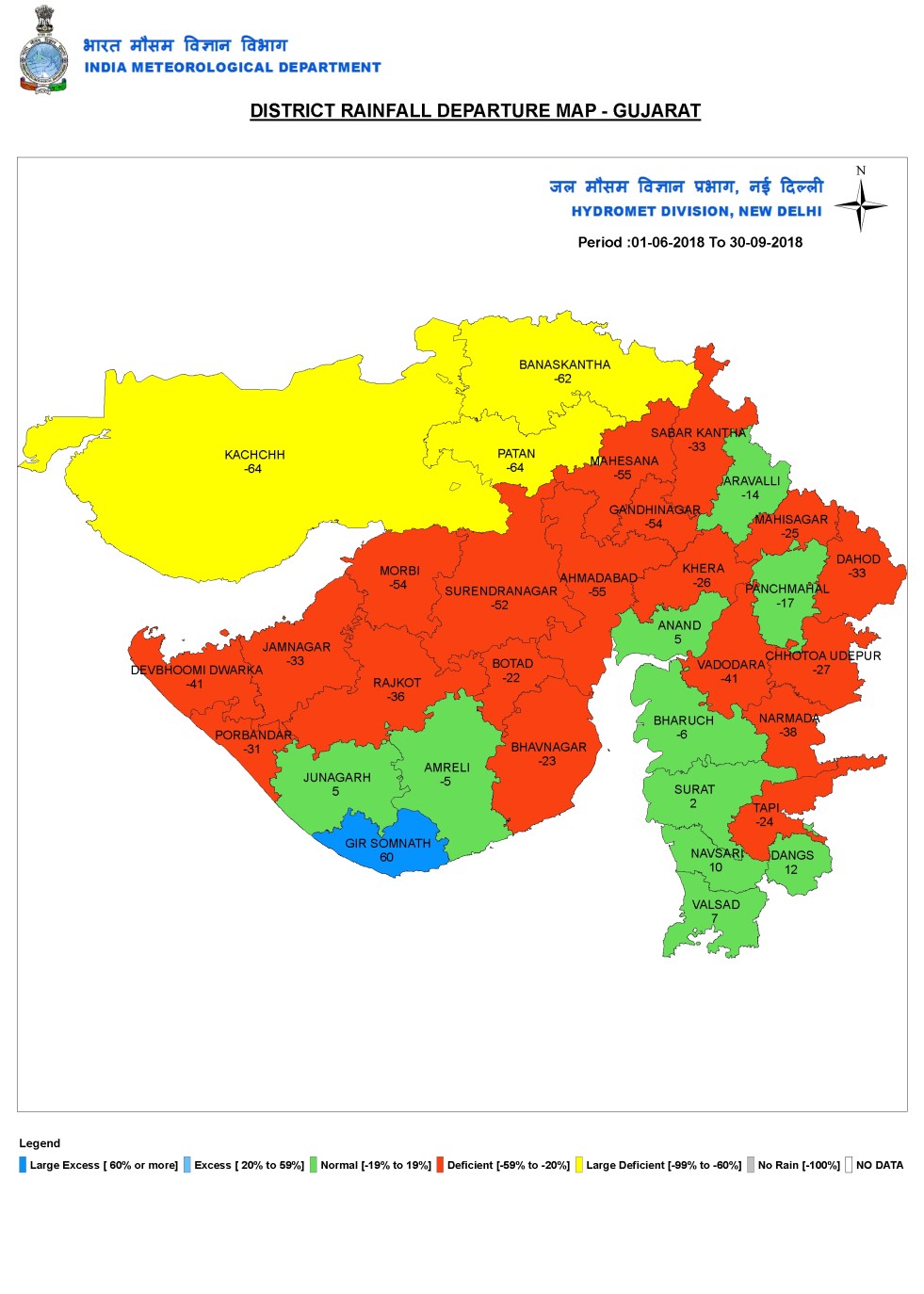
(Feature image Gujarat state cumulative rainfall during SW monsoon 2018; Source: IMD)

Maharashtra State’s groundwater surveys and development agency (GSDA) has warned of a water scarcity in 11,487 villages of 167 tehsils in the State. In its 2018-19 report, the GSDA, which comes under the department of water supply and sanitation, has said the study of the groundwater level (in comparison to the level in October in the last five years) has shown that of the 353 tehsils in the State, 13,984 villages in 252 tehsils have shown a decrease by more than one metre.

Between October 15 and 21, 380 tankers were used across the State, against 91 tankers in the corresponding period last year. A week prior to that the number was 354, and 329 tankers were used in the first week of October.

Continue reading “DRP: 22 October 2018: Looming Drought in Western India”
Dams · DRP News Bulletin

DRP: 8 Oct 2018: “WELCOME CHANGE! Kerala Depletes Reservoir in Anticipation of Deluge from Cyclone”

In spite of all the protests against criticism of Floods worsened by Dams in Kerala in Aug, its refreshing that Kerala now accepts needs for better operation of dams with IMD red alert in three districts:

– Senior officers expressed confidence that the dams can contain the flood waters even if it rains continuously for four days. Better late than never, commented experts on the Kerala State Electricity Board’s (KSEB) decision to keep the water level low. “We’re prepared to face any eventuality. There won’t be any need to open the dam shutters even if it rains continuously for four days. We’re maintaining the water level low in major dams. The water level in Mattupatty dam is close to the full reservoir level and we’ve decided to release water from Thursday. The situation is under control and there’s no need to panic,” said KSEB chairman N S Pillai.

Continue reading “DRP: 8 Oct 2018: “WELCOME CHANGE! Kerala Depletes Reservoir in Anticipation of Deluge from Cyclone””
Dams · DRP News Bulletin

DRP: 3 Sept 2018: CHINA HAS STARTED DECOMMISSIONING DAMS

In a mountain village in southwest China’s Sichuan province, authorities have demolished seven small dam projects this year along a river to clear illegal developments in a new nature reserve. The demolition is part of a nationwide programme to close hundreds of tiny and often ramshackle dams and turbines and bring order to China’s massive hydropower sector after years of unconstrained construction.

The dams sat on an unnamed tributary of the fierce and flood-prone Dadu river, which feeds into the Yangtze, Asia’s largest and longest river, where the government says the “irregular development” of thousands of small hydropower projects has wrecked the ecology. But green groups say the campaign will not necessarily save the environment because it will not affect big state hydropower stations, which they say have caused the most damage.

On the 48 km Zhougong, authorities have already demolished small projects built in nature reserves or encroaching upon new “ecological red lines” drawn up to shield a quarter of China’s territory from development.

The government says small dams have disrupted the habitats and breeding patterns of many rare species of fish, although green groups argue the damage wrought by bigger dams is more severe, with entire towns and ecosystems submerged in water, which they say increases the risk of earthquakes, landslides and even climate change.

Continue reading “DRP: 3 Sept 2018: CHINA HAS STARTED DECOMMISSIONING DAMS”
Dams · DRP News Bulletin

DRP: 27 Aug 2018: WRONG Management of DAMS Create FLOODS, Accept Officials and Experts

Accepting that reservoirs operation and flood management in India lack scientific supports, Madhavan Nair Rajeevan, Secretary, Ministry of Earth Sciences, in an interview has revealed that dams and water reservoirs need flood management systems that use scientific methods to understand when the time is right to open the gates.

“As per my understanding, no big reservoir has a decision support system. So we don’t know when to open them, how to open them… I am not attributing the Kerala floods to an individual. There is a common perception that in India most of the flood management systems are not supported by science… I am very sure we don’t have the decision support system and we need it.” https://indianexpress.com/article/india/not-just-kerala-no-scientific-dam-water-management-across-india-madhavan-nair-rajeevan-secy-earth-sciences-5322003/  (24 Aug. 2018)

In another interview he says that while Kerala records among the highest amounts of rainfall in the country, the State did not have a flood warning system in place. He added that while there were several sophisticated tools to anticipate extreme weather events, India still lacked a mechanism to effectively deploy them. https://www.thehindu.com/sci-tech/energy-and-environment/reservoirs-not-managed-using-a-scientific-decision-support-system-m-rajeevan/article24785253.ece  (26 Aug. 2018)

Further in a detailed interview, he pitches for ‘decision support systems’ at dams, acknowledges the challenge of climate change, warn against repercussions of ‘fast-warming’ Indian Ocean. https://indianexpress.com/article/india/kerala-floods-m-rajeevan-ministry-of-earth-sciences-met-department-5324840/  (26 Aug. 2018)

Continue reading “DRP: 27 Aug 2018: WRONG Management of DAMS Create FLOODS, Accept Officials and Experts”
Dams, Rivers & People

DRP: 30 July 2018: Laos Dam DISASTER: Yet Another Wake Up Call?

The various aspects of tragic Dam Disaster in Mekong Basin in Laos are still unfolding. But it is clear from many accounts that it was an avoidable, man-made disaster due to neglect of contractors, decision makers, consultants and supervising agencies. There is a lot we can learn from this if we want to avoid such disasters in India. We still do not have credible Dam Safety Law or institution, CWC is clearly not the right agency considering the conflict of interest with the various other roles of CWC. But for now let us look at the reports of Laos Dam Disaster.

Reminding the world of one of the worst dam disasters, the under construction dam Xepian Xe Nam Noy Hydro power project breached releasing 5 billion cubic metres of water in Southern Laos on July 23.

The gushing water current swept the surrounding leading to death of about 26 people and displacing about 6600 residents. As per report hundreds of people are still missing from neighbouring villages of Yai Thae, Hinlad, Mai, Thasengchan, Tha Hin, and Samong, which bore the brunt of flooding. The deluge has reportedly destroyed thousands of homes.

Continue reading “DRP: 30 July 2018: Laos Dam DISASTER: Yet Another Wake Up Call?”
Dams · DRP News Bulletin

DRP: 23 July 2018: Landmark CAG Reports on DAM FLOODS & Ineffective; Costly Mega Irrigation Projects

In its latest report, the Comptroller and Auditor General (CAG) has questioned implementation of sixteen National Irrigation Projects. Before this, the CAG has held mismanagement in dams’ operation responsible for Chennai floods in 2015. Both these reports are available on its website now.

The CAG report on National Irrigation Projects, tabled in Parliament on July 20, has revealed that sixteen major multi-purpose water projects, taken up on an expeditious basis about a decade ago, are nowhere near completion, with no work being undertaken in as many as 11 projects despite the incumbent govt’s much-wanted focus on improving irrigation facilities in the country.

The report also mentioned that out of the 16 projects, undertaken under the Accelerated Irrigation Benefits Programme (AIBP) in Feb 2008, only five projects with estimated irrigation potential of 25.10 lakh hectares were under implementation and even these projects suffer from 8 to 99 per cent shortfall in physical progress, the CAG said. The remaining 11 projects with estimated irrigation potential of 10.48 lakh hectares are yet to commence and are at different stages of approval.

Continue reading “DRP: 23 July 2018: Landmark CAG Reports on DAM FLOODS & Ineffective; Costly Mega Irrigation Projects”
Dams · Dams, Rivers & People

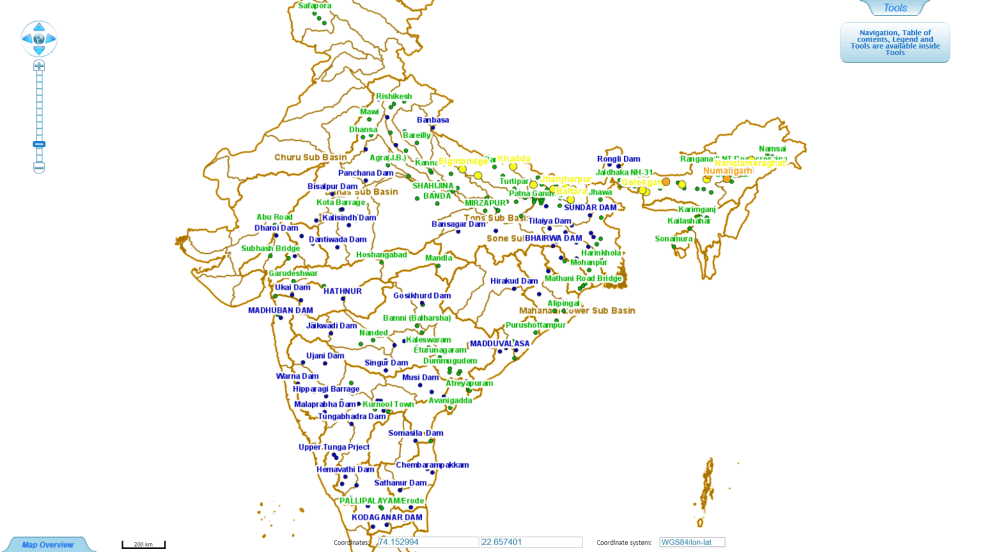
How India Measures Water Storages

Govt and media typically report the status of water storage in India using the CWC’s Weekly Reservoir Storage Bulletin, which contain information about just 91 reservoirs in India. In this article we show that the state websites provide information about huge 3863 reservoirs, which even if not sufficient, is a huge improvement over just 91 reservoirs that CWC bulletin includes. We hope all concerned will try to improve the reservoir storage reporting.

It should be added here that this measures only surface water stored in some of the large reservoirs of India. This excludes large number of big reservoirs, lakhs of smaller reservoirs, groundwater aquifers and soil moisture storage. In spite of these limitations, this provides more accurate picture than just the 91 reservoirs of CWC that everyone in India, including media, govt monitoring and policy makers look at.

Continue reading “How India Measures Water Storages”

Dams · DRP News Bulletin

DRP: 9 Jul 2018: National Meeting on Inland Fishworkers in Delhi

The NATIONAL PLATFORM FOR SMALL SCALE FISH WORKERS (INLAND) is convening a Consultative Meeting on Livelihood Issues of Inland Small Scale Fish Workers 10thJuly 2018, Gandhi Peace Foundation, New Delhi.

The Invitation letter says: “India is gifted with vast and varied inland water bodies bearing rich fish resources.Rivers and canals, reservoirs, ponds and tanks, oxbow lakes, wetlands, backwaters and estuaries yield 7.21 million tonnes of fish which is more than 66% of total fish production of the country. The sector sustains about 4 million fish workers and a total population of around 2 crores.Fish provides good quality animal protein rich in minerals and vitamins. About 800 million Indians eat fish. After milk, fish is the largest source of our animal protein.These huge resources are under severe stress. Rivers are poisoned with heavy pollution. Diversion of water from rivers is harming their ecological flow.

Continue reading “DRP: 9 Jul 2018: National Meeting on Inland Fishworkers in Delhi”
Dams · DRP News Bulletin

DRP: 18 June 2018 (Why this Onslaught of Big Dam Advocacy by CWC Ideologues?)

In a recent article Ashwin B Pandya, Former, Chairman Central Water Commission (CWC) refuses to acknowledge either the adverse impacts of dams or the better option of using groundwater aquifer for storing water. And thus making unscientific arguments against dam decommissioning and for dams. No one is talking of removal ALL dams as the author seems to postulate and then dismiss it as impossible and irresponsible.

Continue reading “DRP: 18 June 2018 (Why this Onslaught of Big Dam Advocacy by CWC Ideologues?)”