Dams · DRP News Bulletin

DRP NB 17 August 2020: The Contempt of Court case against MoEF

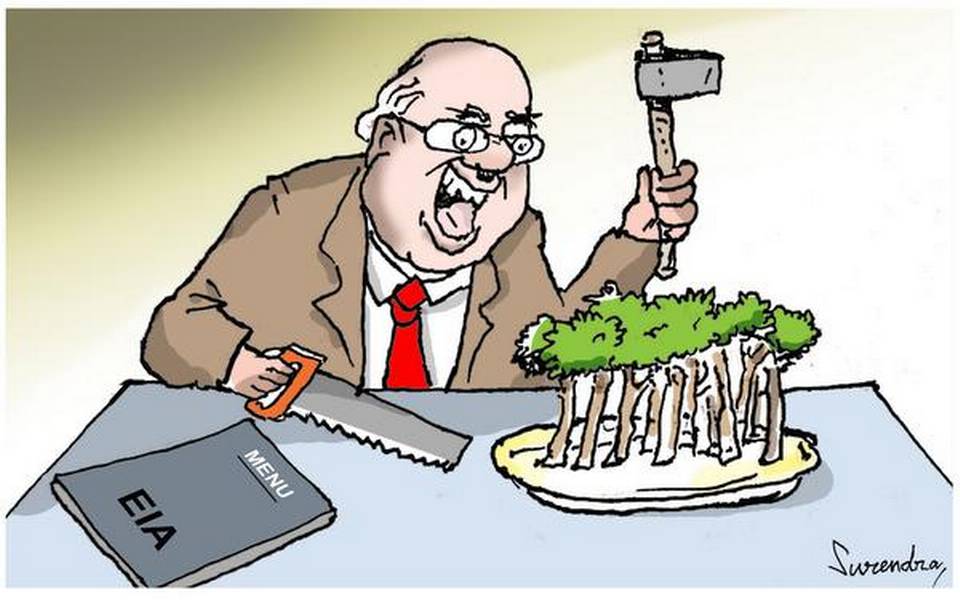
[Feature image: Cartoon on Draft EIA 2020 by Surendra, The Hindu https://www.thehindu.com/opinion/cartoon/cartoonscape-august-12-2020/article32328005.ece (12 Aug. 2020)]

This last week, one Contempt of Court case was deservedly in news, when on the eve of India’s 74th Independence day, the apex Court found public spirited Prashant Bhushan guilty of contempt of Court. Prashant Bhushan’s commitment for the cause of the people and responsible governance of various institutions is beyond question. He is known for being critical of the government and judiciary’s track record and is supported in this by most independent minded persons.

However, there was another contempt case this last week, related to environmental issues, that was not so much in the news. On June 30, 2020, Delhi High Court bench of Chief Justice D N Patel and Justice Prateek Jalan in response to petition by environmentalist Vikrant Tongad had directed, among other things, that Union Ministry of Environment and Forests (MoEF) should translate the Draft EIA (Environment Impact Assessment) Notification of 2020 into all the official languages of India and disseminate widely in ten days. (https://www.thehindu.com/news/cities/Delhi/delhi-hc-extends-public-response-deadline-to-draft-eia-2020/article31951610.ece)

Continue reading “DRP NB 17 August 2020: The Contempt of Court case against MoEF”
Dams · DRP News Bulletin

DRP NB 20 July 2020: Will the Supreme Court stop destruction of Ganga & Himalayas in the name of WIDER Char Dham Road?

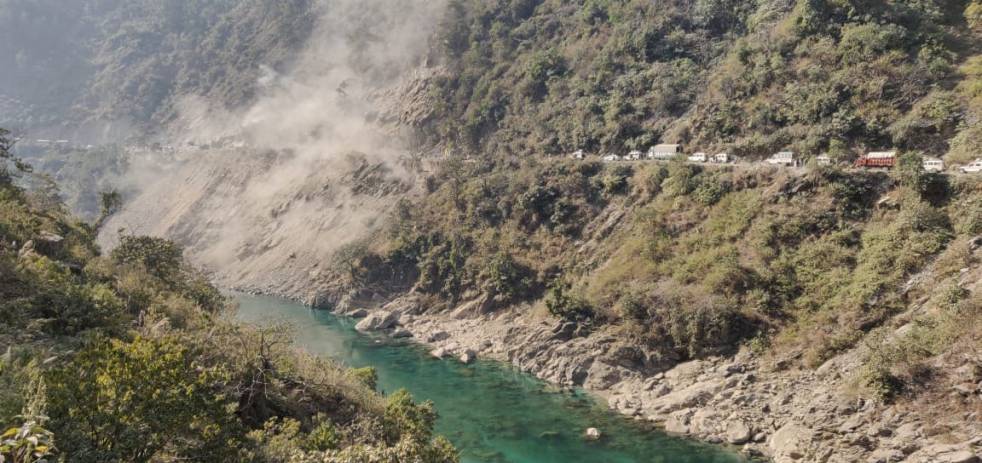
Feature Image: Pithoragarh-Tanakpur Road widening work going and muck being dumped in Saryu river under Chardham project. (Manoj Matwal, April 2019) 

The Supreme Court appointed Ravi Chopra committee has submitted the report on Char Dham Road. It has not said NO to the all weather road which is the slogan of Gadkari and rest of the Union Government. It has in fact, going by the Union Ministry of Road Transport’s’ circular, as late as 2018, suggested that the road be of 5.5 m width with necessary precautions. It has provided elaborate justifications and reasons why it took this decision. And yet twelve govt members of the committee, claiming in the name of religion (as per interview by one of these twelve members in media today) has insisted that the road should be of 10 m width. Not bothering that religion was not part of their mandate, not bothering what impact such a road will have on the Ganga (and the impact will be massive, we will know the full extent only if the impacts are scientifically assessed), on Himalayas (again starting from deforestation, landslides, flash floods and so on will be unbelievably huge) and on people and future generations. One only hopes the Supreme Court will see through the mindlessness of the economic fundamentalism being pushed in the name of religion and not allow the proposal to go ahead.

The Union Environment Ministry is clearly out to destroy even the Bhagirathi Eco-Sensitive Zone by sanctioning the Zonal Master Plan without due process and in complete violation of the letter and spirit of the Bhagirathi notification. This will further open the flood gates for destruction of remaining stretch of Bhagirathi, considered original Ganga stream as it flows from Gangotri. Again one hopes the judiciary will strike this down.

One wonders what is the NMCG, National Mission for Clean Ganga, whose mandate is Ganga rejuvenation, is doing amidst all this? Why is it silent?

Continue reading “DRP NB 20 July 2020: Will the Supreme Court stop destruction of Ganga & Himalayas in the name of WIDER Char Dham Road?”

Dams · DRP News Bulletin

DRP NB 13 July 2020: “Rainwater harvesting is key to solving India’s water woes”

INDEED. With all the emphasis available at our command. We are in the midst of the rainiest season and such a statement is indeed music. It would become even more melodious if one knows who said it: it was none other than Mr G. Asok Kumar, Additional Secretary & Mission Director, National Water Mission, Department of Water Resources, River Development & Ganga Rejuvenation, Ministry of Jal Shakti, Government of India who said it. Speaking on July 8, 2020, he said: “Rainwater harvesting has become inevitable in the current scenario of water scarcity across the country… The idea is to save the rainwater be it on the rooftop, compounds, and premises.” Mr Kumar also emphasised the importance of groundwater recharge. 

We can pass it as run-of-the-mill statement from the government, but one is tempted to think there is more to it than that. One wishes if there was a way to hold these officials accountable for such statements and ask as to how this translates into policies, projects and practices. There is no evidence of any of these, unfortunately. Unless we were to interpret it cynically the way Central Water Commission ideologues do: Dams are also rain water harvesting structures! By that definition, even river linking is also rain water harvesting structure!! But Mr Kumar do not seem to suggest that. So let us hold on to this statement optimistically and push the water resources establishment to implement through right policies, practices and projects. Since that is where solution to India’s water problem indeed is. Unfortunately so far there is no sign that this wisdom is accepted in any serious way by the water resources establishment.

Continue reading “DRP NB 13 July 2020: “Rainwater harvesting is key to solving India’s water woes””

Dams · DRP News Bulletin

DRP NB 6 July 2020: Dear NGT, Yamuna Monitoring Panel needs extension

In July 2018, the National Green Tribunal appointed a Yamuna Monitoring Panel for Delhi, the term of this panel is over and it has submitted its final report. NGT had also appointed similar committees for Haryana and Uttar Pradesh stretch of Yamuna, but those panels never functioned as actively as did the Delhi panel. We urge NGT to accept the petition now filed by Manoj Mishra to give extension to the Delhi Yamuna Monitoring Committee (DYMC) and direct that this committee will continue to function and monitoring and compliance panel for Yamuna river in Delhi.

There is a lot one can say positively about this committee, but arguably the biggest factors are its activeness, responsiveness and transparency. This can be easily seen visiting its website or its twitter page (https://twitter.com/ngtmcyamuna2). The committee also acted as a bridge between various institutions dealing with Yamuna in Delhi and ensured better coordination. The committee’s work is also evident in the number of reports it has submitted, all available on its website. There is always room for improvement in functioning of any such organisation, but this a lot and there are very few cases where one can say this.

Continue reading “DRP NB 6 July 2020: Dear NGT, Yamuna Monitoring Panel needs extension”

Dams · DRP News Bulletin

DRP NB 1 June 2020: No escape from Dam floods as dam lobby continues to dominate

Feature image: Officials of the irrigation department visited the breached Tiware dam near Chiplun in Ratnagiri, in July 2019. (Pratham Gokhale/HT Photo)

The report of the 10 member committee headed by Shri Nandkumar Vadnere, appointed by the Govt of Maharashtra in Aug 2019 was submitted on May 28, 2020. The report titled “A report on Floods 2019 (Krishna Sub-Basin): Experts Study Committee: Analysis, Causes, Remedies” from all accounts is a major let down as is apparent from the way one of the members felt so humiliated that he had to resign: he was not provided basic information to do justice to the Terms of Reference, his chapters were unilaterally removed from the draft report by the chairman, under pressure from higher ups. The report is actually an attempt to show, by hook or by crook that dams were not responsible for the Krishna basin floods of Aug 2019. Almost exactly the same way CWC came out with a shockingly unscientific, contradictory report about Aug 2018 Kerala floods to prove that dams had no role. The report did not even ask if the any of the dams followed the rule curve, though it made recommendation that rule curves should be followed! The story keeps repeating for each of the dozens of instances in recent years. The report of the Tiware dam disaster in Maharashtra in July 2019 has been submitted in Feb 2020, but is not yet in public domain. These few recent instances show how strong a strangle hold the dam lobby has over the official water institutions and governance in India. The Dam Safety bill now before the Parliament will not help as it has no provision to remove or even loosen this stranglehold, there is no place for independent oversight in the bill. Without an accountable reservoir operation policy, legal and institutional paradigm there is no possibility of freedom from dam induced floods.

Continue reading “DRP NB 1 June 2020: No escape from Dam floods as dam lobby continues to dominate”

Dams · DRP News Bulletin

DRP NB 18 May 2020: Signs of Impending Dam Floods in SW Monsoon 2020?

These are rather ominous signs. As per the latest reservoir storage bulletin of Central Water Commission dated May 14, 2020, the 123 reservoirs monitored by CWC has massive, 64.6 BCM (Billion Cubic Meters) in live storage capacity, which is about 165% of the capacity on same date last year and average of last ten years, even as monsoon is just weeks away. Most dams known to create DAM INDUCED FLOODS in the past, including Bhakra dams (we wrote about it earlier this month: https://sandrp.in/2020/05/07/are-we-ready-to-use-more-water-from-snow-melt-in-indus-basin-this-year/), Narmada dams, Odisha and W Bengal dams (Cyclone AMPHAN is going to bring a lot of water here in next few days, even before the monsoon), Krishna basin dams, Cauvery basin dams, Bansagar and Gandhi Sagar Dams, and Kerala dams among others. All these dams have above average storage situation.

Continue reading “DRP NB 18 May 2020: Signs of Impending Dam Floods in SW Monsoon 2020?”

Dams · DRP News Bulletin

DRP News Bulletin 11 May 2020: Jindal accepts Etalin HEP is unviable!

This must be the defining (and predictable, this was the lead story in our DRP NB of April 27, 2020, see: https://sandrp.in/2020/04/27/drp-nb-27-april-2020-for-whom-is-this-unviable-etalin-project-being-pushed/) moment in the campaign to save the Dibang Valley now from the proposed 3097 MW Etalin Hydropower Project. The CEO of Jindal Power Ltd has said in so many words that project is NOT an attractive investment, they will struggle to find buyers for the costly power and only support from government can help make the project viable. The CEO seemed to suggest that they would be happy to sell the project to NHPC or form a joint venture with NHPC to get the govt funding for the project. Again completely on predictable line. The question then is why should government spend previous public money on such an unviable project?

So the question remains the same, the one we asked on April 27, 2020: For whom is this unviable Etalin Project being pushed?

Continue reading “DRP News Bulletin 11 May 2020: Jindal accepts Etalin HEP is unviable!”

Dams · DRP News Bulletin

DRP NB 6 April 2020: Ganga-Yamuna-Cauvery flow cleaner in lockdown: What can we learn?

A number of reports have appeared that show that the state of a number of rivers of India, including Hindon, Yamuna, Ganga and Cauvery has improved during the current lockdown due to Covid 19 crisis. That is indeed great news. At Kanpur and Varanasi there are reports that suggest the dissolved oxygen level has gone above 8 ppm and BOD level has gone down below 3 ppm at a number of places. While lack of industrial effluents entering the rivers due to closure of industrial units is a major reason, there are other reasons that has led to this situation, including above average winter rainfall, high snowfall now melting with onset of summer, reduction of irrigation water demand and also stoppage of sand mining along the rivers. The reduction of cultural activities including puja, bathing and cremations have also contributed to this situation.

The biggest lesson we can learn from this cleaner rivers after so many decades is that if our pollution control boards at the state and central level were doing their duty to ensure that no untreated effluents from the industries and also urban sewage enter the rivers, it is not that difficult to achieve cleaner rivers. But unfortunately there is no political will to achieve this simple and legally enforceable objective.

Continue reading “DRP NB 6 April 2020: Ganga-Yamuna-Cauvery flow cleaner in lockdown: What can we learn?”

Dams · DRP News Bulletin

DRP NB 2 March 2020: Will Mumbai rise up against unwanted, destructive Gargai Dam?

Mumbai Metropolitan Region (MMR), with annual rainfall in access of 2000 mm, does not do much to harvest the rain. It does not protect its local water bodies. It does not recharge groundwater to the extent it can easily do. It does not reduce its transmission and distribution losses. It does not treat its sewage to recycle and thus reduce freshwater demand. It does no demand side management. And yet it keeps demanding more water, and for that building of more dams and thus pushing more destruction. Without any credible options assessment. It has no water policy or water vision for smart water management.

The proposed Gargain Dam that will lead to destruction of over four lakh trees in 720 ha forest mostly in Tansa Wildlife Sanctuary, is a good example of how Mumbai is fuelling such dam building and destruction. The Rs 3105 Cr project will have many other impacts, including displacement of tribals and destruction of livelihoods for thousands others. As SANDRP report showed six years ago, (https://sandrp.in/2013/12/20/dams-in-tribal-areas-of-western-ghats-for-water-supply-to-mumbai-why-are-they-unjustified/, https://sandrp.in/2013/12/18/multiple-dams-for-mumbai-region/) and as our letter to the then Maharashtra Chief Minister emphasised in 2015 (https://sandrp.in/2015/01/13/water-smart-mumbai-open-letter-to-cm-devendra-fadnavis/), MMR region does not need any of these dams.

It was good to see MID DAY news paper report and EDIT highlighting some of these issues. Will the people of Mumbai Rise up, to stop this destructive dam, being pushed in their names, the way they stood up to save the far fewer Aarey Milk Colony trees?

Continue reading “DRP NB 2 March 2020: Will Mumbai rise up against unwanted, destructive Gargai Dam?”

Dams · DRP News Bulletin

DRP NB 24 Feb 2020: Urban Rivers Need Urgent attention: Hiding won’t help

There are large number of stories this week from all over India highlighting the crisis that Urban Rivers in India face. Urban rivers, like the Urban Water sector, exist in complete policy vacuum. There is no policy to guide the Urban water governance. Cosmetic efforts being done when President Donald Trump of USA visits India on Feb 24-25, 2020 at Yamuna (in view of his visit to Agra) or Sabarmati (visit to Sabarmati Ashram in Ahmedabad) won’t really help. The crisis not only affects the rivers, but the health, livelihoods and lives of millions and millions of city dwellers too, in addition to the downstream river users. Our Water Resources establishment has no clue, as is evident from their calling the Dravyawati river channelization in Jaipur as an example of river rejuvenation and suggesting such rivers should be given to corporates to rejuvenate in similar ways! It’s doubtful if the new National Water Policy now being formulated will help, unless it dares to suggest radical changes.

Continue reading “DRP NB 24 Feb 2020: Urban Rivers Need Urgent attention: Hiding won’t help”