Climate Change · Floods · Hydropower

Climate Change & Himalayan Glaciers: A News Round up

This year has witnessed erratic rainfall, increased snowfall, rising sea levels and other extreme weather conditions and the situation is not likely to improve in the coming months. Recent assessments have declared that this is the result of climate change, which we so conveniently blame for every untoward weather condition without properly addressing our own role in bringing it about or perhaps minimizing its effects. The climate is changing and the urgency to address this now is more than ever. Climate change acts as a catalyst and multiplies the threat we already face from certain environmental circumstances. The effects of climate change are being felt worldwide and global urgency is being expressed through various seminars and assessments being carried out by different international bodies like the IPCC (Intergovernmental Panel on Climate Change). Scientists have warned that extreme weather events will increase in intensity if climate change goes unchecked. Unchecked climatic change is also responsible for loss of life and property. According to the World Bank Report ‘Building Resilience: Integrating Climate and Disaster Risk into Development’, “from 1980 to 2012, disaster-related losses amounted to US$3,800 billion worldwide. Some 87% of these reported disasters (18,200 events), 74% of losses (US$2,800 billion) and 61% of lives lost (1.4 million in total) were caused by weather extremes (Munich Re 2013)[i].”

1

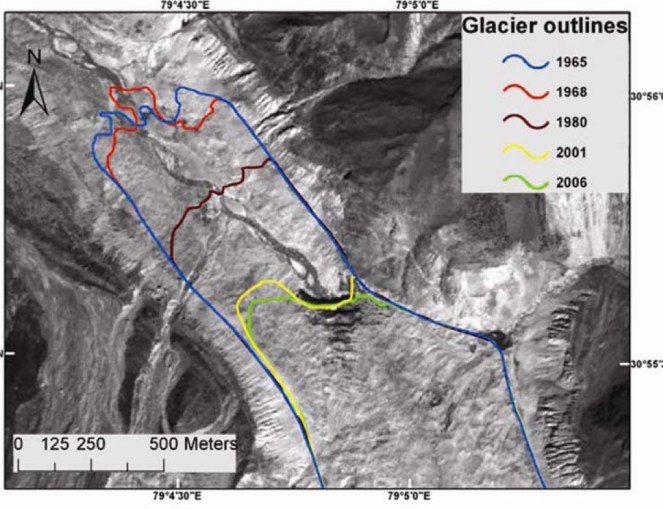
Image showing the retreat of the Gangotri glacier (http://glacierchange.files.wordpress.com/2010/01/gangotri-2006.jpg)

These weather extremes can cause and are in turn caused by changes in various water resources such as seas, lakes, rivers and glaciers. The Himalayas, spreading across over 2500 kms are the source of various life giving rivers in India and other parts of South Asia. The Ganga, Brahmaputra and the Indus, among the most important rivers for the South Asian region, originate in the Himalayan glaciers. The Himalayas have the highest concentration of glaciers outside the polar caps. These glaciers are natural stores and regulators of water in these rivers, which in turn support needs and livelihoods of millions of people, provide water for irrigation, domestic consumption and energy generation. Climate change is likely to result in smaller glaciers and less melt water. For rivers like the Indus, which gets almost half of its water from the melting of glaciers, this can lead to the endangering of the livelihood of millions of people living in low lying areas.

Rapid retreat of Himalayan Glaciers as compared to global averages Courtesy ICIMOD

Even though such fears are being expressed by various groups of people, studies done by the ICIMOD in collaboration with Netherlands’ Utrecht University and research organization FutureWater, observe that the water levels in the Indus, Ganga and the Brahmaputra are likely to increase at least until 2050[ii]. This, they say, is due to an increase in melt-water in the Indus and an increase in precipitation in the Ganges and the Brahmaputra. But these projections, as even the scientists acknowledge, do not say anything about the future of these rivers. With retreating glaciers, what will the fate of rivers like the Indus be, which depend largely on melt-water, is still to be ascertained.

Soaring temperatures, melting glaciers A study prepared by the Uttarakhand government has predicted that the mean annual temperature (MAT) in the Himalayan region is likely to rise by up to 2 degree centigrade by 2030. It has also predicted a rise of 5-13% in rainfall in the next 2 decades. This was disclosed in the Rajya Sabha on 5th of August, 2013 by the then Science and Technology minister, S Jaipal Reddy[iii].

According to a report presented in the Second India Water Forum in 2013, melting of glaciers will lead to a reduction in the critical water supplies for the people of the Himalayas. The International Centre for Integrated Mountain Development (ICIMOD) predicted that Himalayan water flow from the glaciers to the basin would reduce by about 25-50% by the end of this century[iv]. The significant effects of this will be seen in the upper reaches. Taking the case of Ganga, it is seen that though its snow and ice melts contributes only about 1-5% of the water in the Ganga and its tributaries, this is only an annual averageiv. The percentage of melt water becomes higher in the months of March, April and May. This then becomes a very crucial amount of water in the rivers in those summer months where it cannot be recharged through rain.

This is also very important for the hydro projects downstream. Seasonal melt-water serves as the main source of power for an increasing number of hydroelectric dams on the rivers served by the glaciers. The amount of electricity generated depends on the amount of water flow in the river. Thus with changing river patterns in South Asia, the hydropower production will be disrupted. A 1% reduction in stream flow can reduce electricity output by roughly 3%[v]. The unreliable and potentially decreasing flow of water implies that whole hydropower development plans need a comprehensive rethink, also considering the increaed threat of flashfloods and related disasters in changing climate.

Another report by the ICIMOD has found that glacier runoff contributes majorly to river flow for about 2-4 months, mainly from early/mid-summer, till late summer/early fall and reaches its maximum in the Northern hemisphere in July-August. The total mass of the glaciers is much more than what is recharged every year, thus leading to smooth inter-annual flow variability and thus reducing risks of the late summer droughts in hot and dry summers. Climate Change, however, may lead to consistent mass loss in glaciers, hence reducing their inter-annual storage capacity[vi].

The report further reads:

The withdrawal of glaciers and seasonal snow covers as the transient storages for precipitation in certain areas implies first and foremost the loss of flow regulation capacity in basin’s headwaters… Combined effect of the reduction of glacier area and seasonal snow extent on the seasonality of flow from the alpine catchments will be characterized by an increase of the magnitude of the short-term flow variability, in particular, an increase of autumn and winter flow, shift of late spring-early summer peak to earlier dates and possible decrease of mid-late summer flow (assuming no changes in precipitation). Hydrological regimes will be gradually changing from glacio-nival to fluvial, i.e., dependent primarily on rainfall… The glacier runoff simulation results suggest that relative shares of renewable and nonrenewable components in total glacier runoff have undergone a remarkable change: the nonrenewable component increased from 16-30% of total glacier runoff in 1961-1990 to 26-46% in 2001-2010 in all the study basins. However, the increase of non-renewable runoff in none of the basins has been large enough to overweigh the decrease of the renewable component of glacier runoff due to overall reduction of the glacier-covered area.[vii]

According to another study co-authored by Anil Kulkarni, visiting scientist at the Divecha Centre for Climatic Change, entitled, The state and fate of Himalayan glaciers, the rate of loss of glacial mass in the Himalayan and Karakoram (H-K) region, has increased after roughly 1995. Rough estimates suggest that glaciers in the Indian Himalaya are losing mass at the rate of 16 Billion T per year[viii]. The loss in mass for many small glaciers located in low altitude range could be larger than the average suggests, being as high as 1 m per year. This is substantial loss considering mean depth of small glaciers could be between 30 and 50 mviii.  These small glaciers and ice fields are important source of water for many mountain communities. This source of water is and could be significantly influenced in near future and could affect sustainability of many mountain communities. There is today neither a mapping of such vulnerable communities, nor any plans to compensate them for the losses they are suffering and will suffer for no fault of theirs.

This loss of mass, especially if it comprises of non-renewable runoff, can also lead to further complications. According to geophysicist and seismologist, Geological Survey of India, Mr. O.P. Mishra, melting of glaciers due to increasing temperatures and high rainfall also add to the already existing complex of factors influencing earthquake activity in the Himalayan region[ix]. According to him, the ice sheet melting leads to the loosening of the litho static pressure (vertical pressure on the underlying crust)ix. As a glacier retreats and its weight eases, the earth could show a tendency to bounce back up in the form of a moderate or even a strong earthquake. According to him, there is a strong correlation between the retreat of ice sheets and increased seismic activityix. This increase in seismic activity can also lead to further melting of glaciers and a change in their behavior as it has the capacity to alter the axis of rotation, which can then lead to changes in surrounding areas.

According to a study conducted by the Chinese Academy of Sciences (CAS), the glaciers in the Tibetan plateau, which form the source of vital rivers such as the Brahmaputra, have shrunk by about 15%, which would mean about 8,000 square kms since 1980[x].

Retreating glaciers in Tibet Photo: ecns.cn

They also found that the perennial frozen earth in the plateau had decreased by 16% over the past 30 yearsviii. This does not present a favourable scenario for water security in the region and downstream areas of the Brahmaputra. According to scientists, this glacial retreat has accelerated since the 1990s and is making the plateau more vulnerable to the effects of climate change. This again means the plans for hydropower projects in North East India will need a review, but unfortunately, the Environmental and Social Impact Assessments of these projects are not even considering these factors and the MoEFCC’s (Ministry of Environment and Forests and Climate Change) Expert Appraisal Committee on River Valley Projects is not even taking these into consideration while appraising these projects in spite of repeated submissions on this by SANDRP.

2

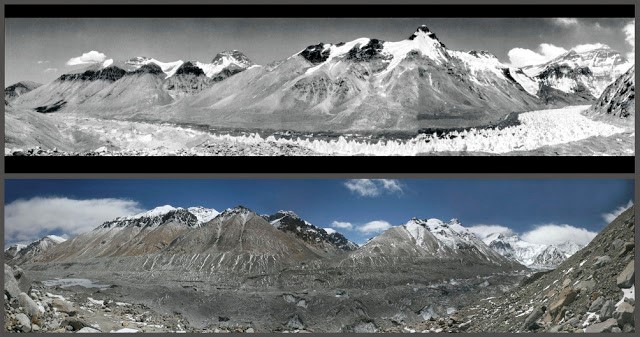
Above: The scale of glacial melting on the west Rongbuk Glacier located in Southern Tibet,between 1921 and 2008. Photo by: RGS and David Breashears. (http://tibet-edd.blogspot.in/2012/03/glacial-meltdown-and-glacial-lake.html)

The situation is similar in the case of the Gangotri glacier. Scientists at the GB Pant University of Himalayan Environment and Development have observed that the gangotri glacier is reducing in volume and size. The glacier is 30.2 km long and is the origin of the Bhagirathi, one of the main tributaries of the Ganga. This has retreated more than 1500 metres in the last 70 years. According to researchers, from the year 2000 onwards, the average rate of retreat of the glacier per year has been about 12-13 metres[xi].

Even while this is happening, there have not been any efforts to sensitize the scores of pilgrims who flock to Gangotri every year towards the condition the glacier is in, and how they can help in not letting it deteriorate further or at least in slowing down the process. They need to be made aware of the danger that the environment is faced with and should be encouraged to take steps towards its conservation. The state and union government also needs to ensure that local projects do not lead to worsening the situation. It is also the responsibility of the local people of the area to conserve what is important for them. They have to come out and take responsible action to ensure that they have a say in the plans made for their area.

Pilgrims at Gomukh, snout of Gangotri Glacier Photo from : http://savegangotri.org/scenes-of-ecological-degradation-and-destruction/

The impact of glacier melting is felt in the upper reaches of the river and also in low-lying areas. For example, the Tawi river in Jammu has become shallow over time so much so that one does not need a boat to cross it anymore at certain locations and certain times. According to the retired director of operations M.M. Munshi, Geological Survey of India, “the glaciers and barrier lakes in the Jujdhar and Seojdhar ranges, which contribute a larger share of water to Tawi, have almost disappeared… water flow in all the rivers is declining… the perpetual snow line in Jammu and Kashmir has gone up to 16,000 feet from 13,000 feet in the last hundred years”[xii]. Such changes affect those who mainly rely on water for their livelihoods, i.e., farmers as also ground water recharge. It is not only the unavailability of water, but also the floods caused due to untimely or heavy rains. In such situations, which are recorded to be increasingly occurring in this region, people have to suffer the loss of land, livestock and thus even livelihood.

Such floods in the upper reaches by the headwaters can also be caused due to the flooding/breaking of glacial lakes. These glacial lakes can either already exist or even get formed in case the precipitation and/or glaciers melt increases. Global warming is seen as one of the key causal factors in their formation. According to recent reports, melting of glaciers is leading to the formation of small lakes in the high reaches of Himachal Pradesh. These lakes pose danger to the villages downstream. Out of the 249 glacial lakes in Himachal, 11 have been identified as having high potential for breach. Glaciers and ice-bodies cover a total of 2472.49 sq km (4.44%) of the total area of 55673 sq km in the state[xiii]. This is made worse by the uncertainty of rainfall and increasing frequency of higher intensity rainfall.

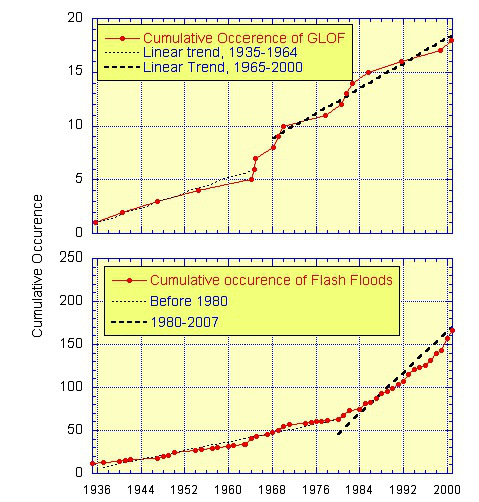
These kind of glacial lakes are forming in many areas in the Himalayas. Such lakes can also have loose moraines with them, which pose a greater threat to downstream areas as there could be a sudden breach of the moraine dams leading to flooding. One of the ways to prevent excessive harm to the people is if the rate of glacier melting can be studied with some degree of attentiveness, then alarm systems can be installed in areas downstream to warn the people in case of a Glacial Lake Outburst Flood (GLOF).

Rapidly increasing frequency of flash floods and GLOFs in Hindukush Himalayas Courtesy: ICIMOD


.3

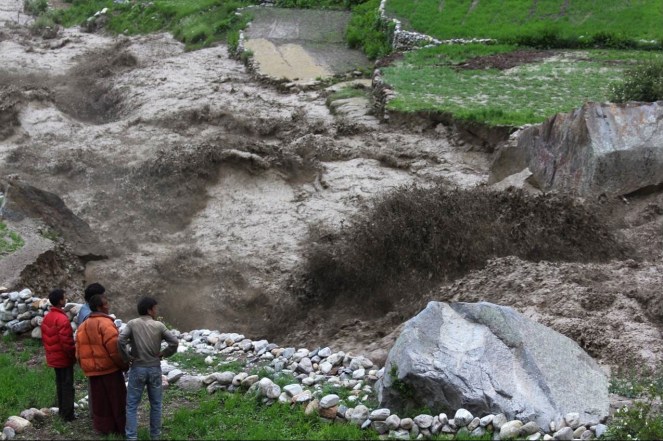
Above: People in Halji Village, NW Nepal, watch as a GLOF destroys their fields. (http://www.asianart.com/articles/halji2/index.html)

The monsoon is likely to become even more unpredictable in the coming years. Thus the threat to our environment from climate change is on the rise and it increases every day that we choose to ignore it. The government had set up the National Action Plan on Climate Change (NAPCC) in 2008 which was intended to serve as a road map on how India plans to combat climate change. There are various missions under the NAPCC amongst which are the National Water Mission and the National Mission for Sustaining the Himalayan Ecosystem, which has been constituted primarily to understand to what extent the glaciers are retreating and how the problem can be addressed. The government plans to review all the missions in 2017. However, as SANDRP publication “Review of NAPCC: There is little Hope here” showed, both content and process of formulation of the NAPCC had nothing to be hoped for particularly as far as vulnerable communities were concerned. A more detailed review of the National Water Mission in SANDRP’s 2012 publication “Water Sector Options for India in a Changing Climate” showed, the process, content and implementation of the National Water Mission is not going to bring any help to sustainable water resources development or to the vulnerable sections.

We have seen various so-called natural disasters happen since 2008, a very significant one of which was the Uttarakhand flood disaster of June 2013. The Uttarakhand government, at the end of last year, proposed a Rs 9,000 crore action plan to minimize the effects of climate change. Under this plan, it had allocated Rs 108 crore to be spent on water resources, like the treatment of catchment areas and flood control, etc. These measures just show the desperation of the government to show that something is being done in the namesake, even though it is not based on any scientific studies or participatory process. It seems to be the same way in which the Disaster Management cell was set up in Uttarakhand to try and manage any disaster that might strike the region, the campus of which was affected in the 2013 floods. The affected people have still not received sufficient help from the government. Even the basic minimum facility like the road that leads into Uttarkashi has not been constructed. The local people have to cross tracts of dusty and congested roads to reach from one place to the other when it has been over a year since disaster struck the town.

What we need is for the community to be involved at every stage from planning, impact assessments, decision making, implementation, operation and maintenance process and awareness creation in the areas which are most vulnerable. The current top-down approach that pushes business as usual situation will clearly not help.

Padmakshi Badoni, SANDRP, padmakshi.b@gmail.com
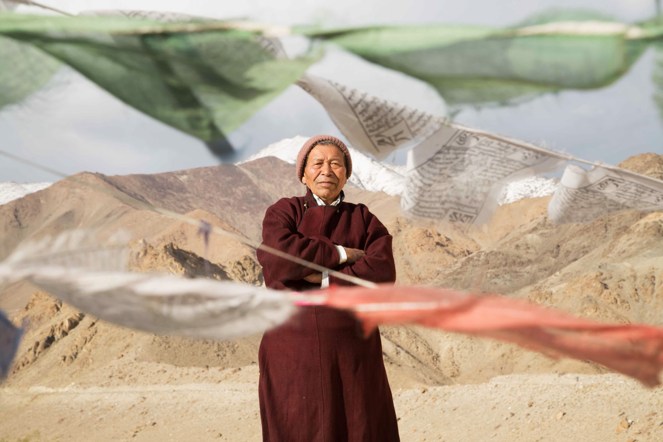
Standing Proud: Chewang Norphel from Ladkah who has been constructing small check dams and helping form artificial glaciers. Photo: climateheroes.oeg
Standing Proud: Chewang Norphel from Ladkah who has been constructing small check dams and helping form artificial glaciers. Photo: climateheroes.org


END NOTES:

[i] http://www-wds.worldbank.org/external/default/WDSContentServer/WDSP/IB/2013/11/14/000456286_20131114153130/Rendered/PDF/826480WP0v10Bu0130Box37986200OUO090.pdf

[ii] http://timesofindia.indiatimes.com/Home/Environment/Global-Warming/Water-supply-in-Ganga-Brahmaputra-will-increase-Study/articleshow/35955391.cms

[iii] http://economictimes.indiatimes.com/environment/global-warming/mean-annual-temperature-in-himalayan-region-to-rise-by-2-degrees-by-2030/articleshow/21625356.cms

[iv] http://www.thethirdpole.net/glacier-melt-will-reduce-crucial-water-supplies-for-people-living-in-the-himalayas/?utm_source=third+pole+newsletter&utm_campaign=8590241a4e-thethirdpole+June+newsletter+2013&utm_medium=email&utm_term=0_43686cf8d5-8590241a4e-46415029

[v] http://www.nature.com/news/climate-change-melting-glaciers-bring-energy-uncertainty-1.14031

[vi] http://www.iwmi.cgiar.org/Publications/IWMI_Research_Reports/PDF/PUB150/RR150.pdf)

[vii] http://www.iwmi.cgiar.org/Publications/IWMI_Research_Reports/PDF/PUB150/RR150.pdf

[viii] http://www.iisc.ernet.in/resehig_himalayan_glaciers.html

[ix] http://www.thethirdpole.net/in-the-jigsaw-of-himalayan-risk-climate-change-and-earthquakes-are-linked/?utm_source=third+pole+newsletter&utm_campaign=f192aa85b1-thethirdpole+June+newsletter+2013&utm_medium=email&utm_term=0_43686cf8d5-f192aa85b1-46415029

[x] http://www.thehindu.com/sci-tech/energy-and-environment/tibetan-plateau-glaciers-have-shrunk-by-15-per-cent/article6130865.ece

[xi] http://www.thehindu.com/sci-tech/energy-and-environment/gangotri-glacier-is-retreating-report/article5549905.ece

[xii] http://www.trust.org/item/20140225155301-lt9p4/?source=hpeditorial

[xiii] http://timesofindia.indiatimes.com/home/environment/global-warming/Melting-glaciers-giving-rise-to-new-lakes-in-Himachal-Pradesh/articleshow/38889169.cms

Delhi · Ganga · Interlinking of RIvers

Rivers and Water in Union Budget 2014-15

In the first annual budget (for the year 2014-15) presented by the new NDA government at the centre on July 10, 2014, it is generally bad news for Ganga and other rivers. Below we have given various provisions on water and river from the budget speech of the Finance Minister Shri Arun Jaitley. Mr Jaitley said in his speech: “In the first Budget of this NDA government that I am presenting before the august House, my aim is to lay down a broad policy indicator of the direction in which we wish to take this country.” The broad policy indicators on rivers do not seem to be any good news for the rivers of the country.

RIVERS FM said, “Rivers form the lifeline of our country. They provide water not only for producing food for the multitudes but also drinking water.” This shows the limited understanding of rivers that the government has. Rivers provides so much more than water. The FM do not seem to have any good news for this lifeline as the budget has several proposals that will harm and destroy the rivers.

River Linking The PIB wrongly claims, “The Budget also contains the first ever effort to link the rivers across the country.” A sum of Rs. 100 crore in the current Budget to expedite the preparation of Detailed Project Reports has been set aside. This is waste of public money. In addition to this, there is a huge allocation for the annual budget for NWDA, whose only mandate is studies for river linking. It is existing for 22 years, but has not produced a single document that will pass independent public scrutiny, and NWDA is afraid to put any document in public domain. Why is the government spending money on such fruitless exercise?

GANGA: Integrated Ganga Conservation Mission The Finance Minister, Shri Arun Jaitley said, “I propose to set up Integrated Ganga Conservation Mission called “Namami Gange” and set aside a sum of Rs 2,037 crores for this purpose.” Shri Jaitley said that the Mission is being launched because a substantial amount of money has been spent in the conservation and improvement of the river Ganga but the efforts have not yielded desired results because of the lack of concerted effort by all the stakeholders. This is admission of even NDA’s failure, since they were in power for at least six years and have not been able to make a dent in the state of the river. They should learn from that experience before jumping into such missions.

This raises a lot of unanswered questions: There is already an existing National Mission for Clean Ganga and if this new mission will be in addition to the old one or if the old one will be abolished? What is new in the new mission? Strangely, the FM did not use the work Ganga Rejuvenation, the charge that Ms Uma Bharti has been given. Does this indicate something is amiss here?

Riverfront Development “The Finance Minister has also set aside a sum of Rs. 100 crore for Ghat development and beautification of river front at Kedarnath, Haridwar, Kanpur, Varanasi, Allahabad, Patna and Delhi in the current financial year since Riverfronts and Ghats are not only places of rich historical heritage but many of these are also sacred.”

The trouble is, this could spell disaster for the river and the cities where such development is planned, if this is going to happen on the lines of Sabarmati river front development. This is because in case of Sabarmati, the Riverfront development meant encroachment of over 200 ha of riverbed. If this is followed the river’s carrying capacity will be reduced. In changing climate, rivers need more and not less carrying capacity as the events of July 2005 in Mumbai, of August 2006 in Surat & recent years in Delhi have indicated. During Uttarakhand disaster of June 2013 the buildings that we saw collapsing were all standing on the riverbeds. That should be a warning for any riverfront development that would encroach on the riverbed.

NRI Fund for Ganga To harness the enthusiasm of the NRI Community to contribute towards the conservation of the river Ganga, an NRI Fund for Ganga will be set up which will finance special projects, the Finance Minister added.

“A project on the river Ganga called ‘Jal Marg Vikas’ (National Waterways-I) will be developed between Allahabad and Haldia to cover a distance of 1620 kms, which will enable commercial navigation of at least 1500 tonne vessels. The project will be completed over a period of six years at an estimated cost of Rs 4,200 crore.”

Watershed Development To give an added impetus to watershed development in the country, a new programme called “Neeranchal” will be launched with an initial outlay of Rs 2,142 crore in the current financial year. This could be a positive move, but we have to await the details. It is also not clear if this is in addition to the ongoing watershed development or in place of it.

Rural Drinking Water For providing safe drinking water, Rs 3600 crore has been earmarked under National Rural Drinking Water Programme in approximately 20,000 habitations affected with arsenic, fluoride, heavy/toxic elements, pesticides/fertilizers through community water purification plants in next 3 years, the Finance Minister added.

Delhi Water Reforms Rs. 500 crore for water reforms to make Delhi a truly World Class City. The budget does not say a word what these reforms would mean, but going by the track record of this government in past, when they say reforms, they mean privatisation, which will be strongly opposed in Delhi.

Allocation for Renuka has no justification The FM said, “In addition, to solve the long term water supply issues to the capital region, construction of long pending Renuka Dam would be taken up on priority. I have provided an initial sum of Rs 50 crore for this.” Firstly Renuka dam does not even have statutory forest clearance and NGT has stopped work on the project. FM, but allocating money for the project in such a situation has indicated that they do not care for statutory clearance process or judicial orders.

Moreover Delhi does not need any more water from outside. It is already privileged with per capita water availability of over 250 lpcd, which is more than most European cities. Delhi does not harvest rain water, does not use flood water to recharge, does not protect its water bodies, does not treat its sewage, does not recycle and reuse the treated sewage, does not reduce its losses, does not do demand side measures and like a spoilt kid, asks more and more water from long distance sources.

Thirdly, Delhi may want exclusive share in water from Renuka, but Upper Yamuna states of Haryana, UP, Uttarakhand, Rajasthan, Himachal Pradesh and Chandigarh are all asking for their share from the project and are ready to share the costs. Going ahead with the project without resolution of the interstate issues may land us in a soup similar to the Munak Canal.

Allocation for Statue of Unity The budget provides Rs 200 crore for ‘Statue of Unity’ in Gujarat. This project is come up in eco sensitive zone, and will affect large no of people and water body, but it has not seen any social or environmental impact assessment or participatory consultative process. It is supposed to come up in the middle of the water reservoir to be created by the proposed Garudeshwar Dam on Narmada river, but that dam has no impact assessment or clearances and stands challenged in NGT. Allocating money for the project under the circumstances is inappropriate.

Welcome Move: National Centre for Himalayan Studies in Uttarakhand “There is a great need to increase the capacity in the country for Himalayan Studies. I propose to set up a National Centre for Himalayan Studies in Uttarakhand with an initial outlay of Rs 100 crore.”

Irrigation The Budget provides Rs. 1,000 crore for Pradhan Mantri Krishi Seenchaayi Yojana. If this is for decentralized local systems, it would be a welcome move, but no details are available.

Welcome move: Organic farming in North East India Rs 100 crore has been provided in the budget to promote organic farming in Northeast India. This is a welcome move.

Welcome move: National Climate Change Adaptation fund for small farmers The FM said, “Climate change is a reality which all of us have to face together. Agriculture as an activity is most prone to the vagaries of climate change. To meet this challenge, I propose to establish a “National Adaptation Fund” for climate change. As an initial sum an amount of Rs 100 crore will be transferred to the Fund.” This is welcome, but we need to see who corners this money. It should go to the rainfed farmers.

Some other  welcome provisions: Finance to 5 lakh landless farmers through Nabard since landless are not able to get bank loans in absence of land as a guarantee; Rs 50 core set aside for blue revolution for inland fisheries. This is provided there is a move to conserve the riverine fisheries.

On the whole, in spite of some welcome moves, on the whole, the budget brings more bad news for the rivers & those depend on rivers and rains, than good.

SANDRP

Sources:

1. Budget speech of the FM: http://indiabudget.nic.in/ub2014-15/bs/bs.pdf

2. PIB Press Releases from Finance Ministry on July 10, 2014: http://pib.nic.in/newsite/erelease.aspx

Additional issues from Media:

1. The Hindustan Times reported that the budget has reduced the allocation for MEF by 15% compared to previous year: http://www.hindustantimes.com/specials/coverage/unionbudget2014/budget2014/environment-gets-raw-deal-renewable-energy-a-fillip/sp-article10-1238988.aspx

2. The Indian Express has reported that the budget provides additional provisions for shutting downNGOs and Trusts: http://indianexpress.com/article/business/business-others/budget-makes-it-easier-for-govt-to-shut-down-ngos-and-trusts/

3. CSE: “Budget 2014 allocates Rs 200 crore for statue and Rs 50 crore for 50 million people who depend on the handloom sector. What does this say of priorities?”

4. BJP’s maiden budget disappointing for farmers: http://www.downtoearth.org.in/content/bjp-s-maiden-budget-disappointing-farmers

5. ‘Budget silent on crucial farmer suicide issue’: http://timesofindia.indiatimes.com/City/Chandigarh/Budget-silent-on-crucial-farmer-suicide-issue/articleshow/38163502.cms

6. Good, bad and ugly – YJA ‘green’ take on the Union Budget 2014-15: https://sandrp.wordpress.com/2014/07/11/good-bad-and-ugly-our-green-take-on-the-union-budget-2014-15/

brahmaputra · Chenab · Ganga · Himachal Pradesh · Himalayas

How do dams affect a river?

That sounds like a rather innocent question and I was asked to write an article, addressing it. But before we go into that, let us try and understand a few things. Firstly, what is a River? Let us first try and understand that.

There is no single definition of this complex entity. For every definition, there is something more a river does.

Take the example of the one of the most complex rivers of all, the Ganga that we think we know. Before being a religious entity cultural icon, etc Ganga is, first & foremost, a River. A perennially flowing river like Ganga flows all the time. But that flow is not constant. It changes from day to night, from one day to another, from one season to another, one year to another, from one place to another.

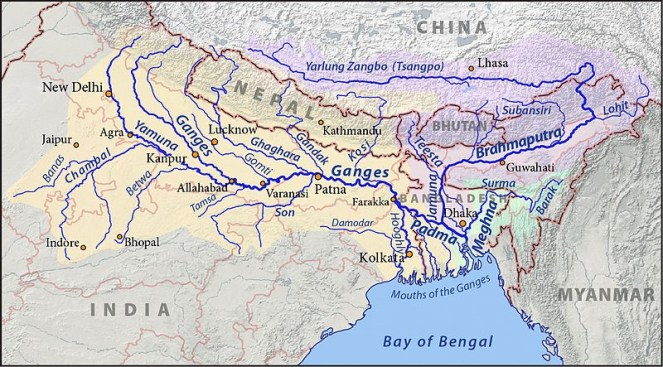
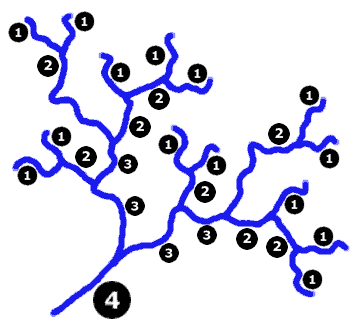
And then, the Ganga that we know is not only a single river but a collection of rivers. So Yamuna, Bhagirathi, Alaknanda, Mandakini, Dhauliganga, Pinder, Ramganga, Kali, Tons, Gomti, Ghaghra, Sone, Gandak, Budhi Gandak, Kosi & Mahananda are some of the major tributaries that directly meet Ganga. Each of them is a river in its own right.

The Ganga Brahmaputra Basin Photo from: Wikimedia Commons

Take Yamuna for example. Some of its major direct tributaries include: Tons, Giri, Som, Sahibi, Hindon, Chambal, Sind, Betwa & Ken, each of them are again significantly big rivers.

Take Chambal, some of the major direct tributaries of Chambal include: Parbati, Kali Sindh (Lakhundar, Ahu, Parwan are some of the tributaries of Kali Sindh, Newaj is one of the tributaries of Parwan, Dudhi is one of the tributaries of Newaj), Banas, Ider, Retam, Sau, Kshipra, Chhoti Kali Sindh, Cham, Siwana, Kural: each of which is a river by its own right.

Take Parbati: some of the major tributaries of Parbati include: Papnaus Ajnal, Sewan Paru, Utawali, Paraparwa, Mawal, Tem, Bhader, Gochi, Gaumukh, Sunk, Negri, Chopan, Uproni, Duhral, Andheri, Beram, Kosam, Ahelil and Sukni. These are all rivers too!

We can go on like this much longer. But such is a vast network of rivers that we call Ganga.

river

Secondly what flows in a river is not just water, though most governments, official agencies & engineers see the rivers as channels of water. Flowing water is surely a major visible defining component of a river. But even a canal or a pipeline can claim that. But unlike a canal or pipeline, a river carries dissolved matter, suspended matter, bed load, microorganisms, many levels of aquatic flora and fauna.

Thirdly, a river is a connected entity. It is connected with upstream and downstream river, biodiversity & landmass, the terrestrial land & life, underground geology and groundwater aquifers and is also connected with the floodplain. Perennial rivers like Ganga meet the sea forming a delta and this connection is vital for the river and as well as the sea. The connections are so strong that a river provides a report card about what is happening upstream and downstream, if read carefully.

From: The River continuum Concept. Species in India will be different, but this represents how biological entitites in a river are linked to each other through a number of processes including nutrient spiralling Oxbowriver.com

This is admittedly a partial description of a river, limited by the constraints of an article or blog. This is also a bit simplistic description of how humans deal with rivers, since there are exceptions. But this provides a broad direction of our journey with the rivers.

from : lakeconesteenaturepark.com

Apart from its many functions like ecological, hydrological, geomorphological ones, a river is also connected with the human society along the banks. The connection with human societies has been as long as the humans have existed. This connection is not really necessary for the river to survive, but we cannot say the same about human survival. Humans cannot survive without the rivers, though is doubtful if the human society understands or even acknowledges that reality.

More importantly, till about a century ago, our interaction with the rivers did not endanger the existence of the rivers themselves. But what we have been doing in last century has created existential threat for rivers. This threat comes in the form of big dams, diversions, chemical pollution from agriculture and industries, large dose of sewage pollution at major urban centers, encroachment on floodplains, deforestation, unsustainable groundwater use, riverfront developments, embankments, and climate change.

What humans have done to the rivers in last century can possibly be described as Terraforming (one of the grandest concepts in science fiction in which “advanced” societies reshape entire planets to suit their needs). Or what some geologists describe as Anthropocene, meaning a new geological age of humans to suggest that humans are now a planet transforming force.

It seems humans have stopped valuing the rivers as they exist in nature and decided that they can stop, bend, tunnel, channelise, divert, encroach, pollute the rivers. So when we build a dam, we do not put any value to the destruction of river & destruction of the services provided by a river that entails in the process of building the dam.

But let us get back to Rivers & what dams do to them. A river, by definition, must flow freely. A dam stops the free flow of river, and impacts the river in the most fundamental ways. In India when we construct a dam (e.g. Tehri), a hydropower project (e.g. 400 MW Vishnuprayag project on Alaknanda in Chamoli district in Uttarakhand) or diversion (Lower Ganga – Bhim Goda at Haridwar, Middle Ganga – Bijnor and Upper Ganga-Narora barrages), we do not have to leave any water for the downstream stretch of river. So complete drying up of the rivers for most of the dry months by these structures is the first direct impact of these structures on the river. To put it mildly, that action practically kills the river. Upstream of the dam too, the river gets killed, for immediate upstream there is stagnant water and further upstream, the river has lost its connections with the downstream river!

Dry Baspa River downstream Baspa II Dam, Himachal Pradesh
Dry Baspa River downstream Baspa II Dam, Himachal Pradesh Photo: SANDRP Partners

This is because these structures not only stop the flow of water to the downstream areas, they also stop flow of everything else that was flowing in the river: the silt, the nutrients, the sand, the organisms, the flora, fauna, and severe every one of the connections of rivers we described earlier

And imagine when a river has to face such death every few kilometers in its journey!

Density of dams in the Upper Ganga Basin Map by SANDRP


That is not all. As the river continues its journey, if the tributaries are flowing reasonably freely, there is some chance for the river to recover some of its defining characteristics. But we have dammed most major tributaries too.

To top it, we also have other elements that help kill the river, like pollution, encroachment, abstraction, etc, as described earlier.

And remember just about a century back Ganga and other rivers were not in such a bad shape. This is an achievement of less than 100 years.

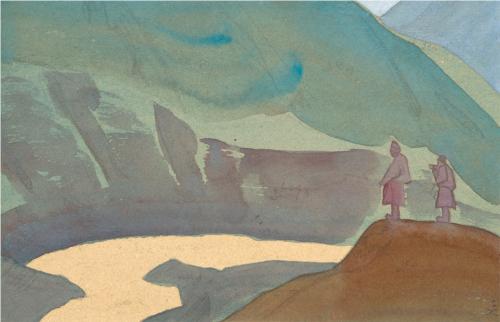
Chandra Basin in Himachal Pradesh depicted by Nicholas Roerich in 1932. The same Chenab Basin now witnesses one of the highest dam densities in Himalayas. From: WikiArt

Some people will read in this a plea to go back by those 100 years. That is not possible, and we all know that. But there are other ways to deal with the rivers. Human society can take what is needed for the society, without destroying the river.

This is true of Ganga, as any other River!

Himanshu Thakkar (ht.sandrp@gmal.com, https://sandrp.wordpress.com/)

~~~~~~~~~~~~~~~~~~~~~~

This is 200th post from SANDRP! We always look forward to your suggestions and comments for improvement.

Our 100th Blog on River Conversations: https://sandrp.wordpress.com/2013/10/08/river-conversations/


Himalayas · Nepal

Explained: Seti River floods in May 2012, Nepal- A chain of events, starting at 25,000 feet!

In late April and early May 2012, what was usually a roaring Seti river in Northwestern Nepal had slowed to a trickle. The milky-white turbid water had turned blue and clear. And then suddenly on May 5, 2012, the flooded river laden with slurry of sediment, rock, and water surged through the Seti valley in the Kaski district, obliterating dozens of homes and sweeping 72 people to their deaths. The floods waters were upto 30 m high at places. It reminded of the sequence of events leading to Tsunami. Questions swirled about where the water had come from and how it arrived with so little warning and that too in a non-monsoon season.

nepal1

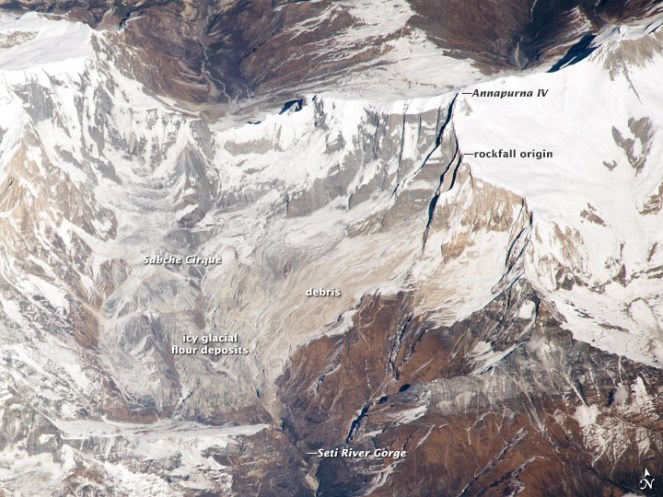
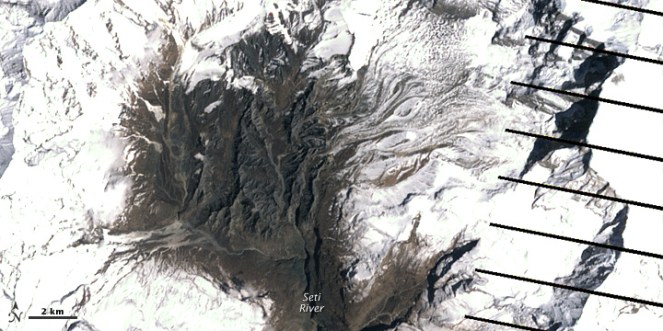
 NASA Earth Observatory (acquired October 7, 2013)

The abstract of the paper by Shreekamal Dwivedi and Yojana Neupane of Department of Water Induced Disaster Prevention of Government of Nepal (presented in a conference in Nov 2012 and published in Nepal Geological Society (2013, Vol. 46)) provided some details of what happened in the floods: “Comparative Analysis of the Landsat ETM satellite images of 20th April, 2012 and 6th May, 2012 revealed that the area of about 32000 square meter of the southern ridge 1.5 kilometer away from the Annapurna IV peak failed in the north western direction. The impact of descending mass of the failed mountain from 6850 meters to 4500 meters almost vertically pulverized the ice, sediment and rock. The impact even triggered seismicity at 9:09.56 AM. local time which was recorded all over the 21 stations of National Seismological Centre. The closest seismic station at Dansing which is 32 km. south west from the area recorded the high signals for 70 minutes which corresponds to the duration of the debris flow. (The seismicity was equivalent to magnitude 3.8-4 in Richter Scale.) Lab analysis of the flood water sample revealed the density of the flow as 1.88 gm/cc. Analysis of the satellite based hourly rainfall GSMaP NRT from the period form 20th April -6th May 2012 revealed that there were just 4 occurrences of rainfall which amounted less than 1 mm/hour in the source area of the avalanche. The rainfall > 6mm/hour which occurred in the Kharapani area on 4 May was localized rainfall which did not extend to the avalanche area. Lack of systematic disaster preparedness caused huge loss of life and property even though the early warning message was received from the Ultralight pilot who was flying close to the area. The avalanche triggered high intensity floods which have similar characteristics to glacier lake outburst floods (GLOFs) have emerged as a new hazard in the Himalaya.”

Now, twenty months after the disaster, experts like Dr Jeffrey Kargel, hydrologist at University of Arizona, are in a position to throw more light what happened. Dr. Kargel has concluded that it was not just one event but a series of event that combined to produce the devastation.

NASA Earth Observatory site describes the affected landscape as: “The landscape in this part of Nepal is shaped by a cycle of landslides and subsequent erosion. As the tectonic collision of India with Asia pushes the Himalaya upward, ice, water, and gravity, assisted by sporadic earthquakes, combine to grind the mountains down. The channel of the SetiRiver itself is cut into the remnants of a much larger debris flow, perhaps 1,000 times as big. 60 to 100 meters (200–330 feet) thick, the landslide deposits are composed of the same limestone as the peaks to the north. Likewise, the May 2012 flow left behind jagged fragments of limestone, carried from the crest of the Himalaya to the foothills in a single event.”

‘Seti’ in local languages means white, and Seti is the ‘White River’, its water is glacial white, turbid and laden with sediment.

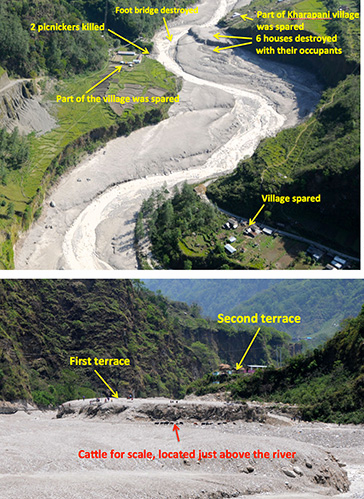
The high intensity floods in May 2012 came in waves, and the first wave alone had around a quarter of a million cubic meters of water in just a few minutes. There were about 27 waves in all over the next hours, according to eyewitnesses, so several million cubic meters of water flowed overall. As Dwivedi et al note, “The huge mass of debris along with ice chunks rushed down the river as a debris flow for 20 kilometres downstream at Kharapani in just 28 minutes (almost 12 meters/second). The flood arrived at Kharapani, where most of casualties occurred, at 9:38 AM and reached the dam of the Seti irrigation system at 10:35 AM… The high-water level at the dam weir at Pokhara was 2.15 meters. The discharge estimation based on the water mark revealed the peak as 935 m3/s (B. Poudel, personal communication). The eye-witnesses in Kharapani area reported huge ice blocks floating in the flood. They felt vibrating ground and heard very loud sound similar to flying of several helicopter together. The smell of the flood water was muddy… Kharapani was a popular spot for picnic and natural hot spring bath… Most of the causalities occurred in this area as the warning message from the Pokhara Airport tower could not reach this area”.

It is heart warming to see that many lives were saved, as Dwivedi et all write, “Capt. Alexander Maximov, the pilot of ultra-light plane of Avia Club Nepal in the morning of May 5 was in a regular sightseeing flight close to the Mountain Machhapuchhre. He noticed a huge dark cloud in the high-mountain depression (Fig. 9) and immediately turned back. He sent a message to the tower of Pokhara Airport. His quick understanding of the unusual event and timely response has saved hundreds of lives during the Seti flood of 5th May 2012. He informed the tower at 9:16 AM and the message was broadcasted through FM radio; police forces evacuated hundreds of people living and working in the bank of the Seti River. Some eye- witnesses in the field said that information about the flood was also received in Kharapani bazar by mobile calls from the people who saw the flooding in the upstream area. This message has helped many people to run to safety. However there was no organized approach of the warning dissemination in the ground.”

Video shot by Capt. Maximov from his aircraft, as the event was was happening:

http://www.youtube.com/watch?v=Uk82ggshSKs

Nepal2

NASA Earth Observatory image (acquired Dec 22 2013)

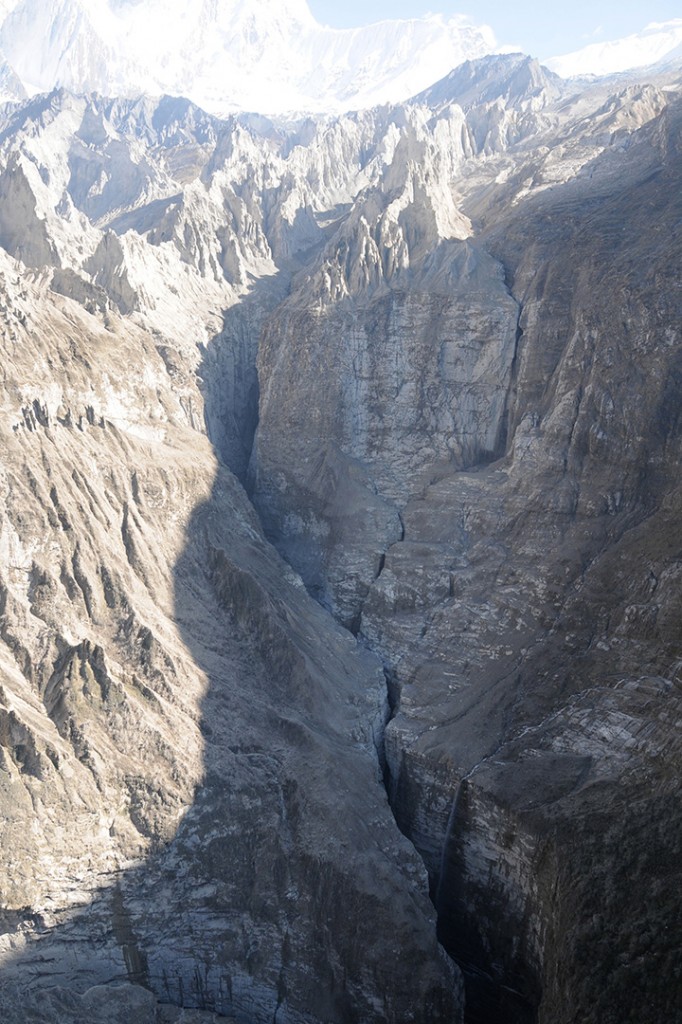
However, the series of event started weeks before the flood with a series of rockfalls that sent debris tumbling into the SetiRiver, backing water up in the extremely deep and narrow gorge. The last of these landslides occurred just a week or so before the flood. The situation grew dire on May 5, 2012, when an unusually powerful ice avalanche and rockfall tumbled down a vertical cliff on a ridge just south of Annapurna IV Mountain peak. The total drop from the Annapurna IV ridgeline to the bed of the Seti below Pokhara is about 6,100 meters (20,000 feet) spread over a distance of only 40 kilometers. The distance between the landslide dam and sight of worst floods was about 29 km.

Prof Jeffrey Kargel, writes (http://earthobservatory.nasa.gov/blogs/fromthefield/2014/01/24/setiriverclues/), “A flash flood—what geologists call a hyper concentrated slurry because it was thick with suspended silt—had torn through some villages along the Seti River, in north-central Nepal, just north of the country’s second largest city, Pokhara. It was immediately recognized as a very deadly event, but the death toll—and a tally of those who remain missing but were clearly also killed—was not known exactly for several months. 72 souls lost. Though not large on the scale of global disasters, this event was terrifying for the fact that it seemed to come from nowhere—literally from beneath a blue sky.”

Neapl3

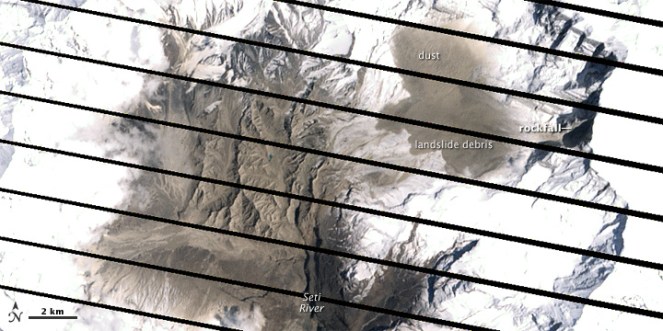
 AFTER IMAGE: shows the area on May 6, 2012, roughly 25 hours after the landslide

 nepal4

BEFORE IMAGE: the same area on April 20.  The diagonal lines are gaps in the data, due to a partial failure of the satellite.

One scenario (see: http://earthobservatory.nasa.gov/IOTD/view.php?id=78070&eocn=image&eoci=related_image) estimates that roughly 22 million cubic meters of rock broke off the slope of Annapurna IV. Colin Stark at Lamont-Doherty Earth Observatory at ColumbiaUniversity said: “There’s a drop of about 2,000 meters into the canyon, so we’re talking an enormous gain in momentum. Then I think the debris ran down the canyon at speeds upwards of 30 meters per second—a guess but what we see for the landslide itself.” Stark estimated that events unfolded in a matter of minutes with no time for a temporary dam to form.

This flood appeared to behave like a glacier lake outburst flood, and the news media can be pardoned for having assumed that it was. Prof Kargel adds: “Seeing that the disaster occurred at the foot of the AnnapurnaRange, within the Greater Himalaya, probably every expert’s first thought was “glacial lake outburst flood” (GLOF), because these were common in Nepal’s Himalaya, and the news accounts of the disaster event resembled accounts of GLOFs”. However, available satellite images showed there were no such lakes. “It was, however, clearly a disaster that had its source in a high Himalayan amphitheatre-like bowl, a glacially-carved structure called the Sabche Cirque. This structure was rimmed by some of Nepal’s most famous, picturesque mountain peaks, including the storied, holy Machapuchare ( “fishtail” peak) & Annapurna IV, a 24,688 ft” mountain.

Nepal5

Annotated photo from Dr. Kargel

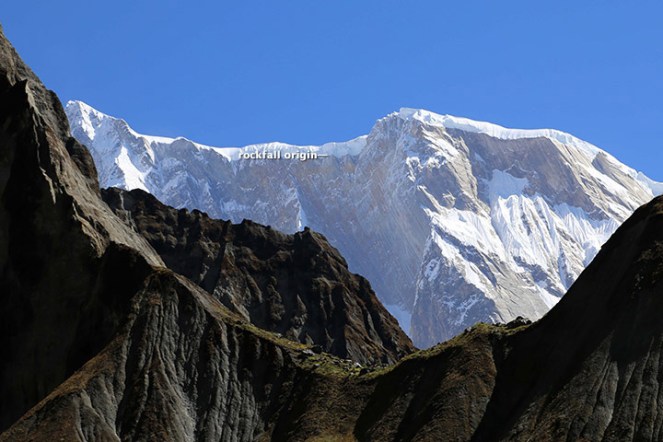
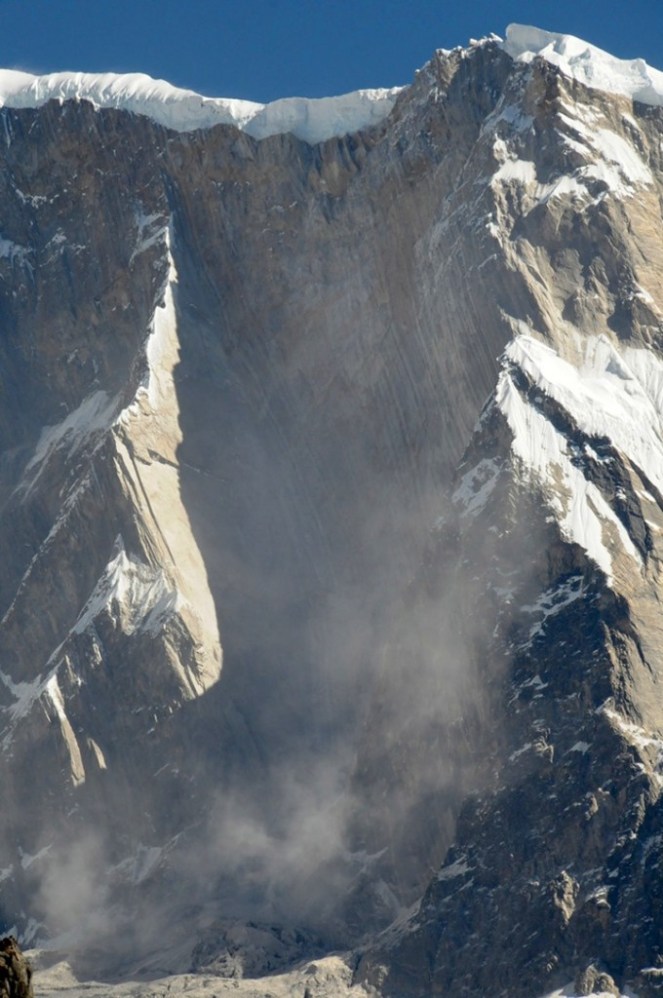
Thanks to video from winged camera of a 2 seater plane incidentally flying over the area at the time of the event, the disaster’s trigger was sourced on a ridgeline near Annapurna IV.  Apparently part of this ridge—probably initially the glacier ice— collapsed, dropping ice and rock over 3000 m almost vertically onto unconsolidated rock debris (glacial moraines and ancient glacial lake silts and gravels) resting unstably in the deep bowl of the Sabche Cirque.  Some of that loose debris was also swept up by the avalanche, and the mass flowed and dropped through an additional 1,500 m into the SetiRiver gorge. Indeed, the conversion of gravitational potential energy to heat could have melted roughly a tenth of the falling snow and ice by the time it reached the SetiRiver.

nepal6

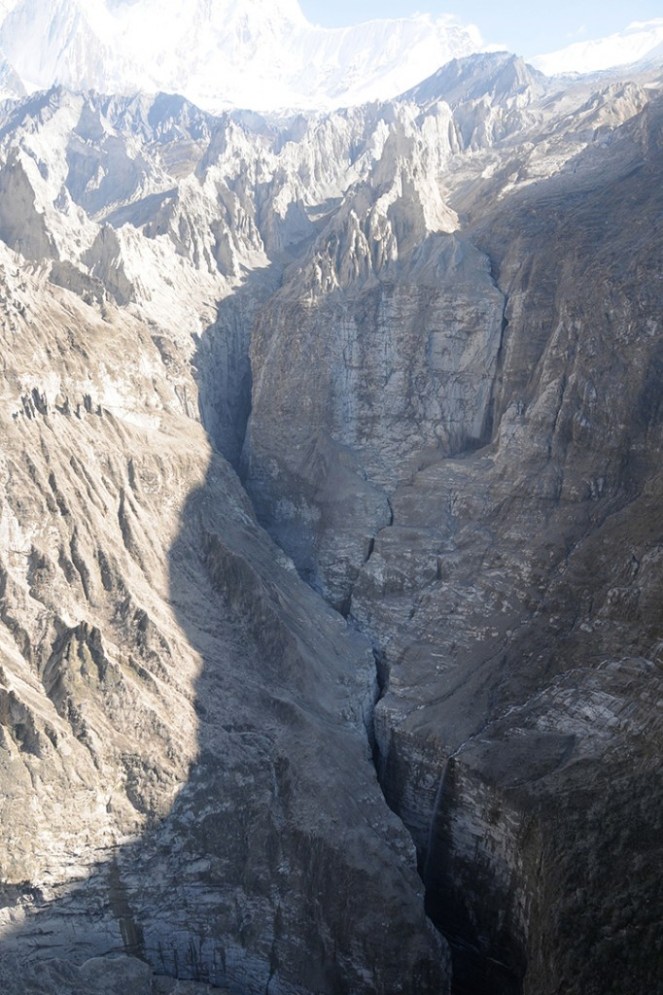
A view of the gorges and also the distant peaks of the Sabche Cirque and the ancient glacial deposits in between. The avalanche entered the gorge from the upper right corner of the scene. (Photo: Dr. Kargel)

One source seemed to be definitely involved, and that was a rockslide-dammed reservoir in the gorge. This was definitely not a GLOF, but was caused by a rockslide into the SetiRiver gorge, formation of an impoundment reservoir over a several week period due to damming of spring snow and ice melt, and then the final triggering event of the mighty rock and ice avalanche off Annapurna IV.

Nepal7

The source area for the avalanche of May 5, 2012. Annapurna IV is just off image to the upper left. (Photo: Dr. Kargel)

Warning: More such events could occur As Dwivedi et al have noted, “The southern slopes of Annapurna range have been experiencing avalanche-triggered high intensity floods also in the past. On August 15, 2003, the Madi River had experienced an unprecedented flash flood which destroyed the recently built rural road and triggered many landslides along its course and killed 5 people”.

“There are good reasons to be concerned,” Jeffrey says, “Something like this will happen again. It’s inevitable.” The Seti River Gorge is unusually prone to dangerous blockages because of how narrow and deep it is. And the same processes that triggered the spring 2012 rockfalls and avalanche are still at work. “The only question is whether future events will be as destructive or whether people in the SetiRiverValley will have absorbed the lessons of 2012 and found ways to move their homes out of the flood plain.” India should not forget that we are downstream country in Seti basin and what happens there will flow down here too.

In an earlier excellent paper on this event, Jorg Hanisch et al recommends that this event requires deep investigations and “Marsyangdi Khola, Madi Khola, Modi Khola and Kali Gandaki, all with apparent origin in the high-mountain environment of Annapurna Range (Hormann 1974; Yamanaka and Iwata 1982) should be included in the investigations… A new catastrophe of similar size would have an apocalyptic impact: about half a million people live in the valley today. A detailed investigation of the circumstances of the disaster on May 5th, especially the possible influence of global warming on the trigger of the disaster, and a reliable forecast of a potential recurrence of similar events or of even much greater scope, are urgently required. For this, the thorough understanding of the conditions, triggers and mechanisms of the huge flows in the past to compare it with the recent flood is indispensable as well.”

The proposal for a 140 MW Tanahu Seti storage project downstream of this flood event & supported by the Asian Development Bank, Japan International Cooperation Agency, European Investment Bank and Abu Dhabi Fund is questionable, says Ratan Bhandari of Nepal. Considering that the Seti River Basin is prone to such events in future, the proposal seems disastrous.

More significantly, this whole episode raises the question as to how much do we really know about the Himalayas. Uttarakhand disaster of June 2013 was a wake up call to understand the Himalayan ecosystem and its implications for future well being of the people and environment of India. However, in stead of learning any lessons, our governments in Uttarakhand (as also in Himachal Pradesh, Kashmir and North East) and at the Centre, with environmentally-challenged Mr Veerappa Moily as the environment minister, are playing into the hands of short sighted vested interests. This is also apparent in the recent decision to sanction the massive Lakhwar dam on YamunaRiver in Uttarakhand without so much as an Environmental Impact Assessment!

We still do not have full explanation for the Uttarakhand disaster of June 2013. This explanation of the Seti River Disaster in the same Himalayas, which happened just a year before the Uttarakhand disaster highlights the urgent need for more serious studies and applying precautionary principle while dealing with the Himalayas, its  rivers and flood plains.

Compiled by SANDRP

Sources:

1. http://earthobservatory.nasa.gov/NaturalHazards/view.php?id=82937&src=nha dated January 25, 2014

2. http://earthobservatory.nasa.gov/blogs/fromthefield/2014/01/24/setiriverclues/ This entry was posted on Friday, January 24th, 2014 at 10:34 am. See the absolutely amazing photos on the site that gives an insight into the situation in the head reaches of Seti River… possibly indicates how little we know about the catchments of our Himalayan Rivers.

3. http://earthobservatory.nasa.gov/IOTD/view.php?id=78070&eocn=image&eoci=related_image dated May 6, 2012

4. http://earthobservatory.nasa.gov/NaturalHazards/view.php?id=78117&eocn=image&eoci=morenh dated May 23, 2012

5. http://blogs.agu.org/landslideblog/2012/05/23/understanding-the-seti-river-landslide-in-nepal/, dated May 23, 2012

6. http://www.icimod.org/?q=7377, dated June 25, 2012

7. “Cause and mechanism of the Seti River flood, 5th May 2012, western Nepal” by Shreekamal Dwivedi and Yojana Neupane, Department of Water Induced Disaster Prevention, Pulchwok, Lalitpur, Nepal (shreekamal @gmail.com), published in Journal of Nepal Geological Society, 2013, Vol. 46, pp. 11-18

8. Famous movie clip of the area, http://www.youtube.com/watch?v=Uk82ggshSKs&feature=related   you can see landslide in the clip at 56-57 seconds of the movie. At this time the avalanche had not occurred yet. After taking one round the aircraft pilot has noticed the dark grey brown cloud formed by the avalanche (see the movie at 2 minute 7 seconds). This is thanks to Shreekamal Dwivedi

9. “The Pokhara May 5th fl ood disaster: A last warning sign sent by nature?” by Jörg Hanisch, Achyuata Koirala and Netra P. Bhandary, Journal of Nepal Geological Society, 2013, Vol. 46, pp. 1-10

brahmaputra · Climate Change · Indus

IWMI report on Glaciers and Snow cover in Himalayas in Changing Climate: Significant Impact on Seasonal flow of the Rivers in India

International Water Management Institute (IWMI) has recently published a study named  Glacier Systems and Seasonal Snow Cover in Six Major Asian River Basins: Hydrological Role under Changing Climate, authored by Oxana S. Savoskul and Vladimir Smakhtin which claims that the hydrological role of the melt-water resources in six major rivers e.g. Indus, Ganges, Brahmaputra, Syr Darya, Amu Darya and Mekong of the Hindukush-Himalayan region (HKH) has been comprehensively assessed for the first time on a basin scale. Reviewing already published studies, this report draws some interesting conclusions regarding the role of glacier and snow meting for six river basins which includes three major rivers basins of India.

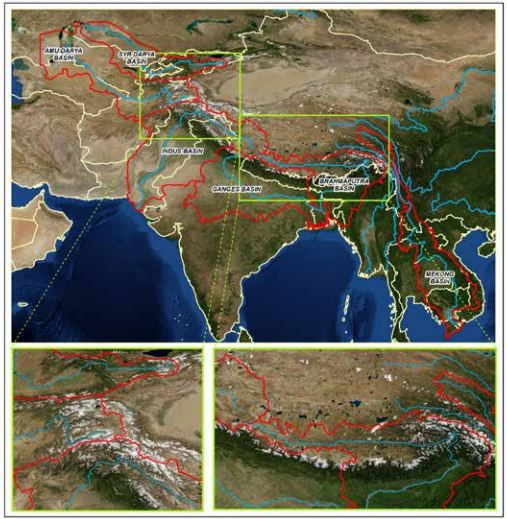
The map below shows area of the river basins included in this study. In this report, the term ‘melt-water resources’ has been used to cover glacier systems and seasonal snow cover. This report uses 1961-1990 status of melt-water resources as the baseline and compares with the 2001-2010 using the following characteristics: specific glacier runoff (average depth of annual discharge from glacier-covered area), basin total glacier runoff, shares of renewable and nonrenewable components in glacier runoff, total seasonal surface snowmelt from non-glaciated areas, portion of seasonal snowmelt lost for the recharge of groundwater aquifers, the contribution of glacier runoff and seasonal snowmelt to mean annual flow (MAF).

Map from the report showing the boundaries of the study basins (red line), state borders (light yellow line) and snow-covered high-altitude belts where glaciers are located (white spots
Map from the report showing the boundaries of the study basins (red line), state borders (light yellow line) and snow-covered high-altitude belts where glaciers are located (white spots)

The authors have used Glacier mass budget-based methods and hydrograph separation techniques which they stated as suitable for basin-scale assessments instead of the temperature-index methods. They say that application of these two methods in semi-distributed models can give the highest currently possible accuracy of +30%. The authors opine that many of the studies done previously had confused between the ‘snowmelt’ and ‘glacier-melt’ because these studies have not dealt with terminologies and methodologies in detail. The report states that there is a scarcity of glacier runoff estimates in peer-reviewed papers, “An analysis of publications on modeling runoff from large- and medium-scale glaciated catchments….. indicates that not many of these dealt with modeling glacier runoff per se. Even fewer report their evaluations of glacier runoff separately from snowmelt, if at all.”

For the three of the six river basins studies and which flow through India, i.e. Indus, Ganges and Brahmaputra the total annual glacier runoff for the period of 1961-1990 was 41 km3,16 km3 and 17 km3 respectively. But in the recent periods of 2001-2010, total glacier runoff was reduced to 36 km3, 15 km3 and 16 km3 respectively for the three basins, see Table 1 for details.

It is clear from the table that while Indus and Brahmaputra basins have similar percentage of  area under glaciers and snowmelt, the reduction in the glacier and snow cover area are more pronounced in Indus basin. Besides, in all the three basins the reduction in glacier area is more pronounced that the snow cover area. However, the contribution of glacier melt and also snow melt to run-off is much higher in Indus basin compared to Brahmaputra basin, showing the greater role of precipitation in Brahmaputra basin. Within the Indus basin even though seasonal snow covers 28% of the total area, much than the 2.6% occupied by glaciers during 1961-90, the contribution of two sources to Mean Annual Flow is almost same. But a question arises, has the contribution of glacier melt to the runoff increased in any of the basins in the recent decade? The answer is surprisingly, no.

Table 1: Recent changes in the glaciers and seasonal snow and their contributions to MAF

Basin Part of basin area(%) covered by Contribution to MAF (%)
Glaciers Seasonal Snow Glacier runoff Seasonal Snowmelt

1961-1990

INDUS

2.6

28 18

19

GANGES

1.2

6 4

2

BRAHMAPUTRA

2.7 27 2

2

2001 -2010

INDUS

1.8 25 15 16
GANGES

0.9

6 3

1

BRAHMAPUTRA

2.2 26 2

2

For the Ganges basin, the report says that heavy summer precipitation almost solely determines MAF volume for the basin. Maximum seasonal snow area in the Ganges basin makes just 6% of the entire basin area. Similar situation were reported for the Brahmaputra basin, where the lower parts of the basin i.e.  Southeastern Tibet and Eastern Himalayas where nearly 75% of the basin’s glaciers are located, witness heavy summer monsoon rains. Regarding Indus basin the report says, “Precipitation in the IndusBasin is more evenly distributed between the seasons, but is highly variable spatially – similar to Brahmaputra and Amu Darya, where annual precipitation in some catchments is tenfold (3,000 mm) of that in the other glacier-covered parts of the basin (300 mm).”

Reviewing already published documents the report states “it appears that the research in High Asia is concerned much more with CC impacts than with objects of the impact. Yet, understanding of the expected basin-scale changes in glacier runoff in response to climate change remains largely unclear.”

The report does an analysis of assessments done on impact of climate change on water availability in Himalayas and concludes that many assessments rely on poorly verified sources. The report refers to the statement made by Cruz et al. (2007) “The current trends of glacier-melts suggest that the Ganga, Indus, Brahmaputra and other rivers that criss-cross the northern Indian plain could likely become seasonal rivers in the near future as a consequence of climate change…,” This statement was admitted as a typing error after publication but even then this has been reiterated as an apocalyptic vision in NGO reports.

Using the Table 2 given below, the report states that glacier contribution is a minor item in the annual river water budgets in the Ganges and Brahmaputra basins. The report says “The impact of climate change was found to be more prominent on seasonal rather than annual water availability.” It is clear from the table that, in the recent decades non-renewable component in all three basins have gone up while renewable and total volume of water from glacier melt have come down. It is also noteworthy that, even though Brahmaputra basin has more area under glacier cover than the Ganges basin (see Table 1), the volume of water from non renewable glacier flow was more in both periods in the Ganges basin. Besides, the percentage of increase in nonrenewable glacier runoff components during 2001-10 is highest among all three basins, signifying that glaciers are melting fastest in Ganga basin.

Table 2: Contribution of renewable and non-renewable components to glacial runoff

Basin Glacier runoff components Total Glacier runoff (km3) Total Glacier runoff contribution to MAF (%)
Renewable (km3) Nonrenewable (km3)

1961-1990

INDUS

33.0

8.14 41.2

18

GANGES

11.0

4.74 15.7

4

BRAHMAPUTRA

12.7

4.29 17.0

2

2001 -2010

INDUS

24.5

11.62 36.1

15

GANGES

8.1

6.95 15.0

3

BRAHMAPUTRA

10.6

5.05 15.7

2

The reports also states, “Glaciers and seasonal snow in CC-impact assessments should be perceived as natural water reservoirs with gradually diminishing storage and flow regulation capacity, both on intra-annual and inter-annual scale. Potential changes of precipitation regime coupled with effects of temperature rise on evapo-transpiration will impact future hydrological regimes of the major rivers much more significantly, affecting both MAF and flow seasonality.”

The authors of this report clear some fog around climate change and Himalayan glacier system and snow-melt. One lacuna of the report is that even though the report discusses glacier run-off it makes no mentions of glacier lakes and glacier lakes induced floods. There are several incidents of glacier lake induced floods happening in the basins discussed. There is evidence to show that in the recent flood devastation in Uttarakhand in India glacial lakes played significant role.

Parag Jyoti Saikia

with inputs from Himanshu Thakkar

South Asia Network on Dams, Rivers and People (www.sandrp.in)

Disasters

Uttarakhand Floods disaster: Lessons for Himalayan states

Many in the media and outside are calling the current Uttarakhand floods disaster of huge but as yet unknown proportions as Himalayan Tsunami somewhat erroneously. By that very name, we connect the combined fate of all Himalayan states and lessons that are inherent that other Himalayan states need to learn from this tragedy.

Similarities between Uttarakhand and Himalayan state like Arunachal Pradesh In fact one article[i] has already been written that draws some parallels, predicting what Uttarkhand experiences today[ii], Sikkim may tomorrow and Arunachal day after. The article did not realize that Himachal Pradesh and Jammu & Kashmir are ahead of North East in this queue. Indeed there are a lot of similarities between the situation in Uttarakhand and Arunachal Pradesh in particular and Himalayan states in general:

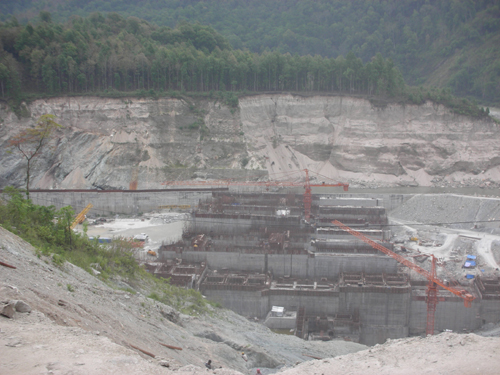
A view of the under-construction dam tunnels at the site of National Hydroelectric Power Corporation's 2000 megawatt Subansiri Lower hydroelectric project in Arunachal Pradesh state, India, Friday, Aug. 21, 2009. It is the biggest hydroelectric power project in India, located on a disputed border between Arunachal Pradesh state and Assam state. (AP Photo/Anupam Nath)
A view of the under-construction dam tunnels at the site of National Hydroelectric Power Corporation’s 2000 megawatt Subansiri Lower hydroelectric project in Arunachal Pradesh state, India, Friday, Aug. 21, 2009. It is the biggest hydroelectric power project in India, located on a disputed border between Arunachal Pradesh state and Assam state. (AP Photo/Anupam Nath)
  • Both Himalayan hill states are fragile, part of new mountain that is prone to high intensity rainfall events, including cloud bursts. In fact the average rainfall in Arunachal Pradesh is much higher than that in Uttarakhand.
  • Both states are also prone to flash floods and landslides.
  • Both states are home to very large number of rapidly flowing silt laden rivers that can turn into ravaging, eroding, force of destruction if not handled carefully. Again Arunachal Pradesh has much large number of major rivers than Uttarakhand. Arunachal rivers are also known to carry more silt than Uttarakhand rivers.
  • Both states are in seismically active area in zone IV and V, with tectonic activities that can lead to impact on land, rivers, increasing the disaster potential.
  • Both states have very high proportion of area under forests, which is necessary for the sustained existence of the local environment, people and biodiversity. Livelihood and water security of people in both states majorly depends on these natural resources.
  • Both states are prone to climate change impacts in major way, Himalayas have already seen increase in temperature that are 2-3 times higher than the average global temperature rise of 0.9° C. These climate change impacts include greater frequency of high intensity rainfall, including cloud bursts that can also increase the potential of landslides and flashfloods.
Broken flood protection walls, Karcham Wangtoo a few km downstream of dam_10.11.2010
Broken flood protection walls, Karcham Wangtoo Hydel Project, Himachal Pradesh a few km downstream of dam. Photo: SANDRP Partners

Lessons from Uttarakhand tragedy Some of the lessons that Uttarakhand and other Himalayan states can draw from the current tragedy include:

  • Ensure credible environmental and social impact assessment of all activities including all dams and all hydropower projects of above 1 MW capacity, such assessments should also include how the projects can increase the disaster potential of the area, how they will affect the adaptation capacity of the local people in the context of climate change, how the projects themselves would be affected in changing climate, among other aspects. Currently, we do not have credible environmental and social impact assessment for any project.
  • Ensure credible environmental compliance mechanism in place for each project in which local people have a key role. Today we have NO credible environmental compliance in place.
  • No projects should be cleared until and unless there is credible cumulative impact assessment for all projects in any river basin and sub basin, which includes carrying capacity study. None of this was done in Uttarakhand and none is in place in any river basin of Arunachal Pradesh.
  • An urgent review of under construction and under planning projects should be taken up, stop projects awaiting such a review. The review should include various environment and river governance policies. Moratorium on dams and hydropower projects til above conditions are satisfied. 
  • Certain rivers and certain high risk zones should be declared as no project areas in each basin.
  • In any case, there should be at least 5 km of free flowing rivers between any two projects. At least 50% of river flows in lean season and at least 30% of river flows in monsoon should be released on daily changing as environmental flows as recommended by IMG recently, pending project and river specific studies. This should be applicable for all projects, including existing and under construction projects.
  • Put in place system of early warning, forecasting and dissemination for all kinds of disasters, particularly those related to rainfall and landslides. It is technologically feasible to predict even cloud bursts at least 3 hours in advance, a Doppler radar system was sanctioned for Uttarakhand since 2008 that would have enabled that, but due to lack of coordination between NDMA, IMD and Uttarakhand government, this was not in place.
  • Put in place a clearly defined monitoring system in place that will give prompt report of actual rainfall events even as the event starts so that the downstream area people and administration can be alerted. This again was absent in Uttarakhand.
  • Protection and conservation of rivers, riverbeds and flood plains, including aquatic biodiversity.
  • Do not allow encroachment of riverbeds and floodplains.
  • Prepare clearly defined space for rivers, have river regulation zone in place and remove all illegal encroachments in river beds and flood plains in a time bound manner urgently through legislative, followed by executive action.
  • Do not allow unsustainable mining of riverbeds.
  • Do not allow blasting for any development activity (Uttarakhand Disaster Management & Mitigation Centre made this specific recommendation after the Rudraprayag disaster of Sept 2012 that lead to death of 69 people) as such blasting leads to increase in landslides.
  • Protection of catchments including forests, wetlands and local water bodies that can play the role of cushion during high rainfall events.
  • All states, including those in North East must have an active state disaster management authority in place that will have key role in all development decisions.

While rainfall and cloud bursts are natural phenomena, the disaster potential of such events directly depends on what we have done on ground over the years. Uttarakhand, by, allowing indiscriminate building of roads, buildings and hundreds of hydropower projects without doing basic assessments and participatory decision making processes, have allowed the disaster potential of current high intensity rainfall in the state increase manifold. While some in the media are calling this as Himalayan Tsunami, many people of Uttarakhand are seeing it as a trailer of such Tsunami, if Uttarakhand does not wake up, much bigger tragedy may await the state.

Himachal Pradesh, Sikkim and Jammu & Kashmir have gone rather too far down that road, but still can wake up and review its development plans and policies and possibly reduce the disaster potential in the respective states. Similarly Arunachal Pradesh has signed over 150 MOUs for big hydropower projects, each of them will entail big dam, long and huge tunnels, blasting, mining, roads, townships, influx of people, transmission lines and so on, without any credible assessment in place. These projects are being pushed under one pretext of another, including the China bogey.

Hydropower Dams in various stages in Arunchal Pradesh. Photo Courtesy: International Rivers

Other Himalayan states like HP, J&K, Sikkim, Meghalaya, Manipur and Mizoram are following the same footsteps. This is surely an invitation to major disaster that will engulf whole of Himalayan region. For Uttarakhand and all Himalayan states there is still time to learn all the lessons that the Uttarakhand experience offers. This is also applicable to neighboring Himalayan countries like Nepal, Bhutan, Pakistan and China (Tibet).

Teesta_Dam_1
Notice the extensive deforestation and unstability of land at an under construction Teesta Hydel Project in Sikkim

If these are not learnt, what could visit Himalayas could actually make the Uttarakhand disaster like a trailer.

Himanshu Thakkar (ht.sandrp@gmail.com)

Landslides in Sikkim in 2012, following earthquake in 2011. Locals blame these on extensive blasting, tunnelling and deforestation for Teesta Hydropower Projects. Photo: Live Mint
Tunnel for Teesta VI HEP in Sikkim, blasted in the mountains. Photo: Smair Mehta, International Rivers
Dams underconstruction and planning in Teesta Basin, Sikkim. Map by SANDRP
Tunnelling at the 330 MW KishenGanga HEP, Gurez, Jammu and Kashmir Photo: Panoramia.com