Dams, Rivers & People

DRP News Bulletin 30 July 2018: Laos Dam DISASTER: Yet Another Wake Up Call?

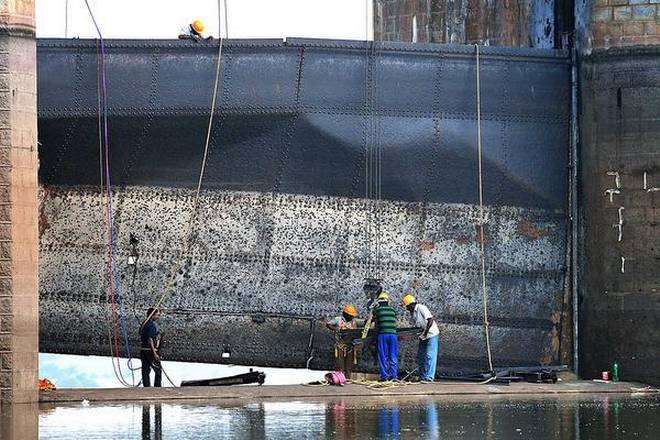
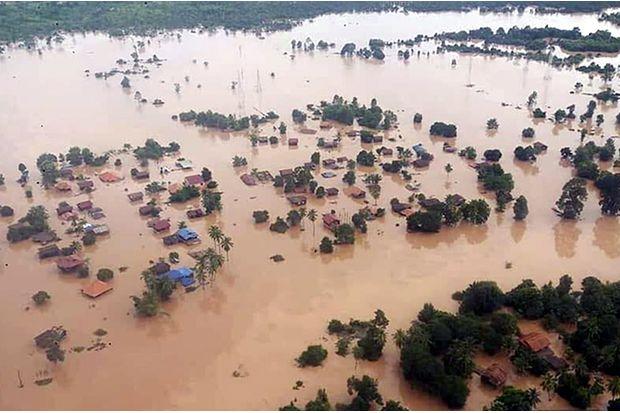
The various aspects of tragic Dam Disaster in Mekong Basin in Laos are still unfolding. But it is clear from many accounts that it was an avoidable, man-made disaster due to neglect of contractors, decision makers, consultants and supervising agencies. There is a lot we can learn from this if we want to avoid such disasters in India. We still do not have credible Dam Safety Law or institution, CWC is clearly not the right agency considering the conflict of interest with the various other roles of CWC. But for now let us look at the reports of Laos Dam Disaster.

Reminding the world of one of the worst dam disasters, the under construction dam Xepian Xe Nam Noy Hydro power project breached releasing 5 billion cubic metres of water in Southern Laos on July 23.

The gushing water current swept the surrounding leading to death of about 26 people and displacing about 6600 residents. As per report hundreds of people are still missing from neighbouring villages of Yai Thae, Hinlad, Mai, Thasengchan, Tha Hin, and Samong, which bore the brunt of flooding. The deluge has reportedly destroyed thousands of homes.

Continue reading “DRP News Bulletin 30 July 2018: Laos Dam DISASTER: Yet Another Wake Up Call?”

Dams · DRP News Bulletin

DRP News Bulletin 23 July 2018: Landmark CAG Reports on DAM FLOODS & Ineffective; Costly Mega Irrigation Projects

In its latest report, the Comptroller and Auditor General (CAG) has questioned implementation of sixteen National Irrigation Projects. Before this, the CAG has held mismanagement in dams’ operation responsible for Chennai floods in 2015. Both these reports are available on its website now.

The CAG report on National Irrigation Projects, tabled in Parliament on July 20, has revealed that sixteen major multi-purpose water projects, taken up on an expeditious basis about a decade ago, are nowhere near completion, with no work being undertaken in as many as 11 projects despite the incumbent govt’s much-wanted focus on improving irrigation facilities in the country.

The report also mentioned that out of the 16 projects, undertaken under the Accelerated Irrigation Benefits Programme (AIBP) in Feb 2008, only five projects with estimated irrigation potential of 25.10 lakh hectares were under implementation and even these projects suffer from 8 to 99 per cent shortfall in physical progress, the CAG said. The remaining 11 projects with estimated irrigation potential of 10.48 lakh hectares are yet to commence and are at different stages of approval.

Continue reading “DRP News Bulletin 23 July 2018: Landmark CAG Reports on DAM FLOODS & Ineffective; Costly Mega Irrigation Projects”

Dams · DRP News Bulletin

DRP News Bulletin,16 July 2018: Dam Safety Is Needed, Can We Depend On CWC Engineers Alone?

India certainly urgently needs credible measures to achieve both structural and operational safety of dams. As the HINDUSTAN TIMES editorial emphasizes, we need much greater transparency, accountability and participation of independent, non government experts at every level of functioning of Dam Safety mechanism. Current Dam Safety Bill draft falls far short of that. This is also underscored by many of the news we bring in this July 16, 208 issue of DRP News Bulletin.

The Tamil  Nadu CAG report, as Indian Express reports, has clearly said that the Chennai floods  of Dec 2015 were majorly due to the wrong decision of dam operators to release 29000 cusecs of water for 21 hours, in violation of all safety norms, but no was punished for this wrong decision. The same has always been the case.

The Bulletin also brings the warning from, no less than Chief Minister of Assam to NEEPCO that if NEEPCO, the operator of the 405 MW Ranganadi Dam releases water from the dam without warning and when downstream areas are facing  floods, they will have to bear the losses people suffer. Continue reading “DRP News Bulletin,16 July 2018: Dam Safety Is Needed, Can We Depend On CWC Engineers Alone?”

Dams · DRP News Bulletin

DRP News Bulletin 9 July 2018: National Meeting on Inland Fishworkers in Delhi on July 10, 2018

The NATIONAL PLATFORM FOR SMALL SCALE FISH WORKERS (INLAND) is convening a Consultative Meeting on Livelihood Issues of Inland Small Scale Fish Workers 10thJuly 2018, Gandhi Peace Foundation, New Delhi.

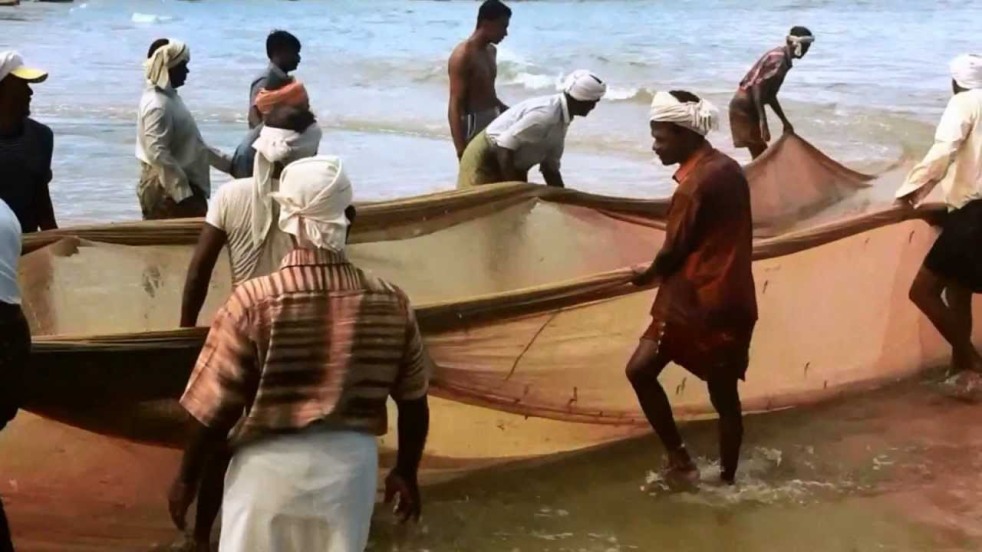
The Invitation letter says: “India is gifted with vast and varied inland water bodies bearing rich fish resources.Rivers and canals, reservoirs, ponds and tanks, oxbow lakes, wetlands, backwaters and estuaries yield 7.21 million tonnes of fish which is more than 66% of total fish production of the country. The sector sustains about 4 million fish workers and a total population of around 2 crores.Fish provides good quality animal protein rich in minerals and vitamins. About 800 million Indians eat fish. After milk, fish is the largest source of our animal protein.These huge resources are under severe stress. Rivers are poisoned with heavy pollution. Diversion of water from rivers is harming their ecological flow.

Continue reading “DRP News Bulletin 9 July 2018: National Meeting on Inland Fishworkers in Delhi on July 10, 2018”

Dams · DRP News Bulletin

DRP News Bulletin 2 July 2018: Punjab Cabinet Meets To Discuss Water crisis, IS IT SERIOUS?

In a rare event, Punjab Cabinet met to discuss water crisis on June 26, 2018. The reports before the meeting seemed to give hope that may be Punjab will look at the water crisis in a fundamental, holistic way. https://indianexpress.com/article/cities/chandigarh/punjab-government-to-firm-up-water-conservation-plan-5233826/ (June 26, 2018)

But the cabinet ended up setting up a committee to assess the ground water situation in the state and submit a detailed proposal for water conservation.

– Punjab has the highest rate of groundwater exploitation and had on average withdrawn 28.2 million acre feet (MAF) water yearly during 2008-2013. However, the yearly average replenishment of water was only 18.9 MAF.

– 73% of Punjab’s irrigated area uses groundwater for irrigation, while only 27% uses surface water. The number of tubewells had gone up exponentially from 2 lakh in 1971 to 12.50 lakh in 2015-16, with 41% of these have water availability beyond the depth of 60 metres. https://timesofindia.indiatimes.com/city/chandigarh/5-member-committee-to-assess-punjab-ground-water/articleshow/64770186.cms  (28 June 2018)

Continue reading “DRP News Bulletin 2 July 2018: Punjab Cabinet Meets To Discuss Water crisis, IS IT SERIOUS?”

Dams · DRP News Bulletin

DRP News Bulletin 18 June 2018 (Why this Onslaught of Big Dam Advocacy by CWC Ideologues?)

In a recent article Ashwin B Pandya, Former, Chairman Central Water Commission (CWC) refuses to acknowledge either the adverse impacts of dams or the better option of using groundwater aquifer for storing water. And thus making unscientific arguments against dam decommissioning and for dams. No one is talking of removal ALL dams as the author seems to postulate and then dismiss it as impossible and irresponsible.

Continue reading “DRP News Bulletin 18 June 2018 (Why this Onslaught of Big Dam Advocacy by CWC Ideologues?)”

Dams · DRP News Bulletin

DRP News Bulletin 11 June 2018 (Groundwater Pollution: The Hidden Killer Menace Lurking All Over)

Aquifers in 16 States in the country are contaminated by uranium, whose presence in drinking water has been linked to chronic kidney disease by several studies, a recent study has shown. More importantly, uranium doesn’t figure on the list of contaminants monitored under the Bureau of Indian Standards’ drinking water specifications. The main source of this contamination is natural, but groundwater depletion by extensive withdrawal of water for irrigation and nitrite pollution due to the excessive use of nitrogenous fertilisers may be exacerbating the problem, said the study.

– The study was carried out by a team of researchers led by Avner Vengosh, professor of geochemistry and water quality at the Nicholas School of the Environment at Duke University in the US. The team, which also included experts from the Central Ground Water Board, the Rajasthan government’s Ground Water Department and Gujarat Water Resources Development Corporation, analysed groundwater samples from 226 locations in Rajasthan and 98 in Gujarat.

Continue reading “DRP News Bulletin 11 June 2018 (Groundwater Pollution: The Hidden Killer Menace Lurking All Over)”

Disasters · Floods

CWC’s Weekly Reservoir Bulletin: Closer look warns of impending disaster

One of the key source of information about India’s water availability that the government provides and media and everyone else quotes is Central Water Commission’s weekly (updated every Thursday) “Reservoir Storage Bulletin”[i]. The Reservoir Storage Bulletin (RSB) currently tells about water storage position of 91 storage dams across India with total live storage capacity of 161.993 BCM (Billion Cubic Meters), spread over 18 states and 12 river basins. CWC uploads it with a disclaimer: “The Data contained in this Bulletin is as received from the State Government/Project Authorities.” Continue reading “CWC’s Weekly Reservoir Bulletin: Closer look warns of impending disaster”

Dams · DRP News Bulletin

DRP News Bulletin 4 June 2018: WED 2018: Environment Protection and Development is NECESSARY and POSSIBLE, provided there is will

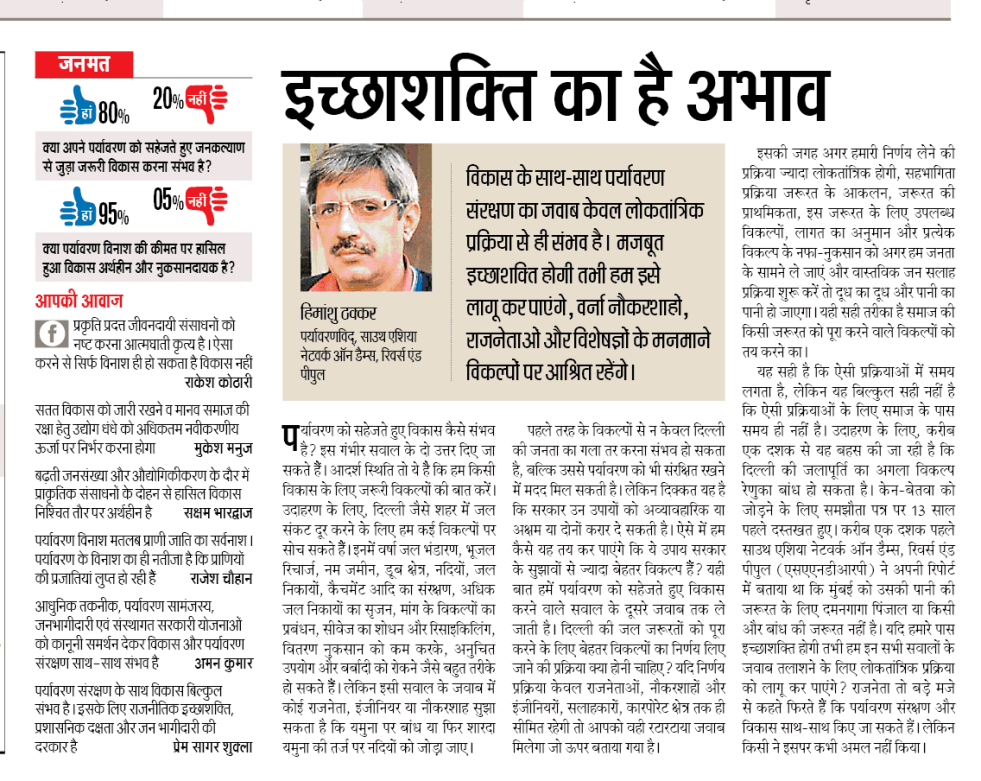
How is development possible along with environment protection?  There are two kinds of answers possible to this question. The standard kind of reply would try to provide a list of options that are available to a given development need. Continue reading “DRP News Bulletin 4 June 2018: WED 2018: Environment Protection and Development is NECESSARY and POSSIBLE, provided there is will”

Dams · Water

India’s Summer of Water Crisis in 2018

North India

HIMACHAL PRADESH Water scarcity leaves Shimla high and dry Residents in the city are reeling under acute water shortage for the last few days. They are getting rationed water supply after four-five days.“Hoteliers are paying private tankers Rs 2,600 for 6,000 litre water,” said Harnan Kukreja, president, Shimla Hoteliers’ Association. The Shimla Municipal Corporation is struggling to ration 21 MLD of water that was pumped from its major sources these days. The water availability per resident was just 5 litre as on May 25.

 The city needs 45 MLD water daily, but the water availability has come down from 29 MLD last week to 21 MLD on May 25, 2018. Guma, which has 20 MLD capacity, and Giri, which has 20 MLD capacity, could supply just 4 MLD and 14 MLD, respectively, revealed MC supply chart. Churat supplied 1.25 MLD, Chair (0.32 MLD) and Koti- Brandi (0.35 MLD).

Around 4-5 MLD water is getting wasted due to leakages in supply lines before it reaches MC storage tanks in the city. The state government and the MC have failed to compensate for the water that it used to get from the Ashwani khud, supply from where was suspended in 2015 following a jaundice outbreak in the city. http://www.tribuneindia.com/news/himachal/water-scarcity-leaves-shimla-high-and-dry/594998.html (The Tribune, 26 May 2018) Continue reading “India’s Summer of Water Crisis in 2018”