Wetlands

Wetlands 2020: Positive Developments

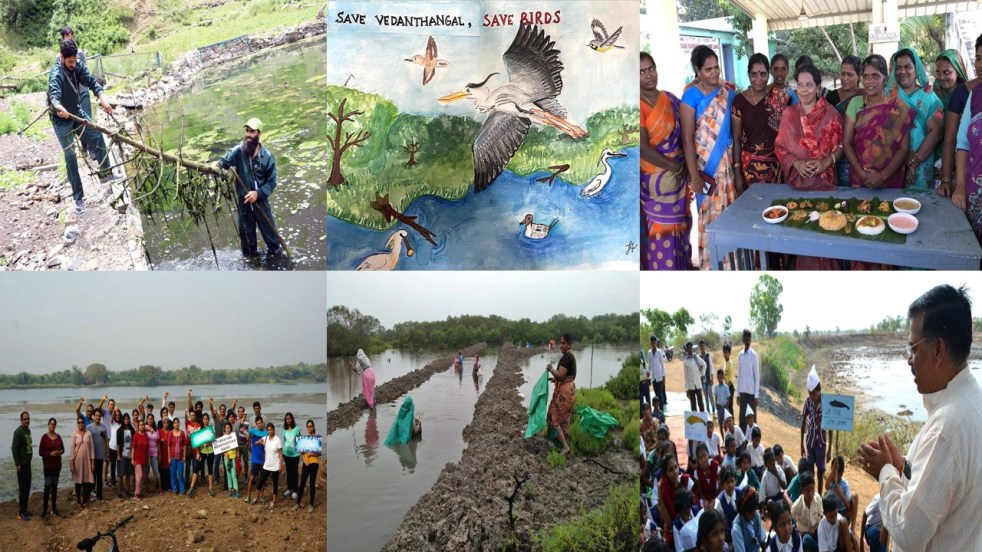
Pondicherry Collector led the revival of over 300 waterbodies The then District Collector and present Secretary to the Chief Minister, A. Vikranth Raja, stepped in with the idea of digging into revenue records to locate the region’s traditional water bodies.  It all started with a query raised at the meeting. When someone asked if Karaikal had the capacity to store 7 tmcft of river water allotted by the Cauvery Water Disputes Tribunal, “the response from officials was an emphatic no,” says Selvaganesh, Assistant, District Collectorate of Karaikal.

In June 2019, in the tiny coastal enclave of Karaikal, administration officers brainstormed about putting in place a sustainable water resource management model for the town’s two lakh people. They found 549 ponds within a small territory spread over 157 sq. km. 40% of these water bodies were in various stages of extinction. Most of them turned out to be dumping yards.

Continue reading “Wetlands 2020: Positive Developments”
DRP News Bulletin

DRP NB 4 Jan 2021: Bangladesh declares Halda River as Fisheries Heritage

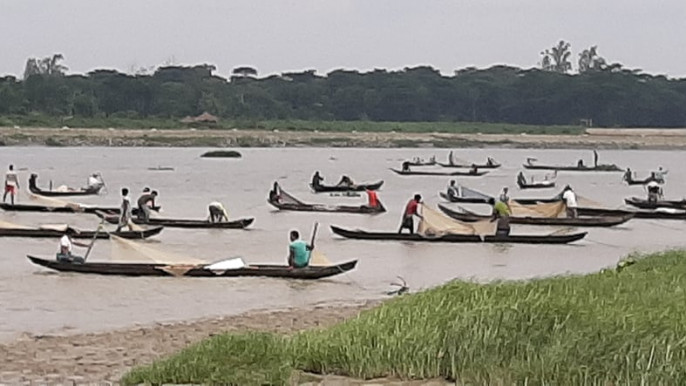
Bangladesh has declared the whole 81 km long Halda River, a tributary of Karnaphuli River in Chittagong in South East Bangladesh. The Halda river is also famous for breeding pure Indian carp. This is the only pure Indian carp breeding field of Bangladesh, perhaps in South Asia. This is a remarkable river conservation decision that has a lot of lessons for much bigger India where no river has been protected as fisheries heritage. This is great way to begin the first weekly DRP Bulletin of 2021 and we hope the Indian government, civil society and judiciary will take due note of this.

Controversy is never far away from any such river conservation efforts as is evident from the news about proposal for a Halda River based water supply project for industrial estate that has been opposed by the Fisheries ministry, water resources ministry, the River Conservation Commission, the Department of Environment and independent researchers.

Continue reading “DRP NB 4 Jan 2021: Bangladesh declares Halda River as Fisheries Heritage”
Fish, Fisheries, Fisherfolk

Inland Fish, Fisheries, Fisher-folks: 2020 Overview

Inland fisheries support millions of people and remains a major source of nutrition for a very large number of poorest people. This includes riverine fisheries, reservoir fisheries, wetland and local water body fisheries. Here we try to provide an overview of developments in this sector during the year 2020.

The overview has following sections: Policy & Governance in Centre, followed by in States, some positive developments, Covid-19 & Fishing Community, Fisher folks’ struggles, New Fish Species, Invasive fish, Fish Deaths & Pollution, Over fishing & Extinction, Studies related to inland fisheries.

Continue reading “Inland Fish, Fisheries, Fisher-folks: 2020 Overview”
Dams · Fish, Fisheries, Fisherfolk

Dammed Fisheries of India

Far out in the estuary of Aghanashini, as Ismail Bhai spread out Indian Mackerel for drying, a carpet of silver spread out before us. “We fish in the river but the Bangde we catch in the sea also have their links to Aghanashini. We owe her everything”. Estuary of the modest, free-flowing Aghanashini supports around 5000 fisherolk. In the neighboring dammed Sharavathi, fish diversity plummets, so do dependent livelihoods. But rivers like Aghanashini are a rarity now.

Continue reading “Dammed Fisheries of India”
Dams, Rivers & People

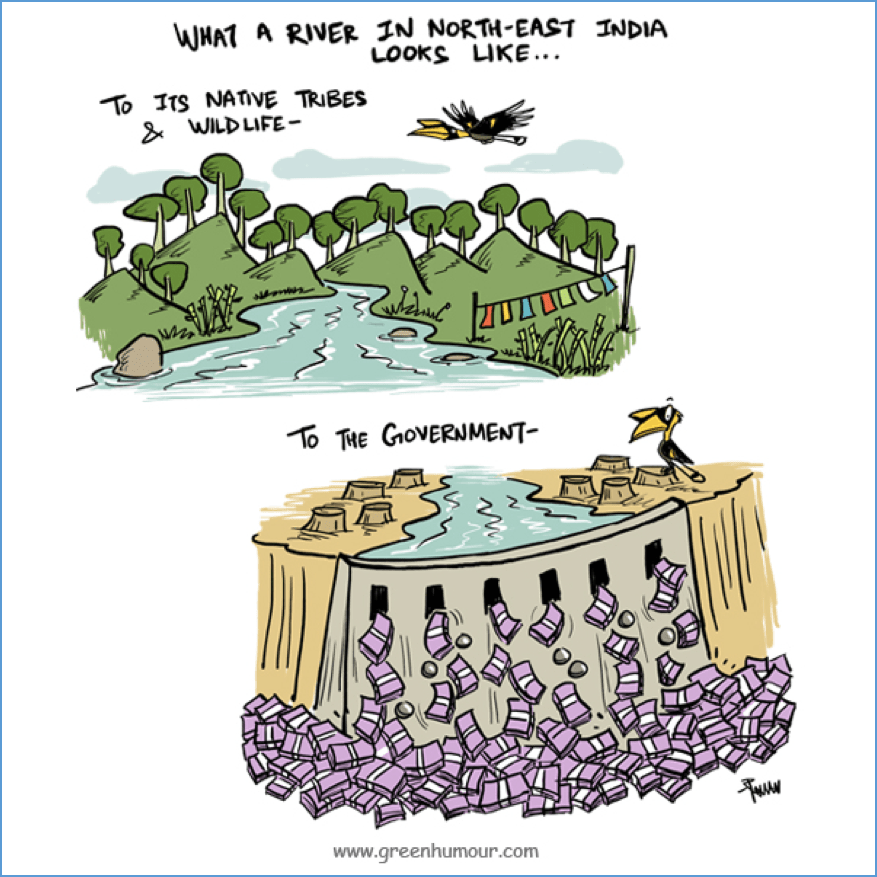
Dams, Rivers & People 2020 through the eyes of the Cartoons

A good cartoon can say a lot more than words and possibly more effectively. As in 2019[i], we are sharing the key events on the issues that we focus on namely Dams, Rivers, Environment and People using cartoons. As you can see, we have sourced them from the various internet sources during the just concluding year 2020.

Continue reading “Dams, Rivers & People 2020 through the eyes of the Cartoons”
DRP News Bulletin

DRP NB 28 Dec. 2020: Five Positives of outgoing Corona year

The outgoing year 2020 is likely to be remembered as Corona year as Covid 19 pandemic has been the most influential aspect of the year. However, there have been many positives of the outgoing year. We identify five biggest positives as we see them.

Firstly, the complete lockdown that we experienced during March-April 2020, to slow down the spread of the Covid 19 infection showed, among many other things that it is indeed possible to clean up our rivers and also indicated the way forward: tackle industrial pollution. Unfortunately, those clear lessons have not been learnt by the government, its been busy in ease of doing business, not even understanding that in changing climate, clean rivers are going to be a major resource that will help people adapt.

The second notable positive was the major across the country protests, particularly from the younger generation against the government’s attempt to bulldoze the completely anti- environment amendment to the EIA notification. The protests along with the judicial orders have so far stopped the amendment from getting implementation. The government will do well to abandon any attempt to push them.

Similar to the protests against amendments to EIA notification were the protests against trying to bulldoze the massive Etalin Hydropower project in Dibang Valley in Arunachal Pradesh, at the cost of lakhs of trees and biodiversity rich forest and river and against the wishes of the people of Arunachal Pradesh and North East India. Here again it was good to see that the campaign has so far been successful.

India Rivers Week 2020 organised Zonal and National dialogues on river sand mining in India, in which large number of groups and stakeholders from across the country participated and has created a new wave of awareness and energy on this very important but so far largely ignored issue. We are hopeful that this energy will lead to change in governance of river sand mining in India.

Continue reading “DRP NB 28 Dec. 2020: Five Positives of outgoing Corona year”
DRP News Bulletin

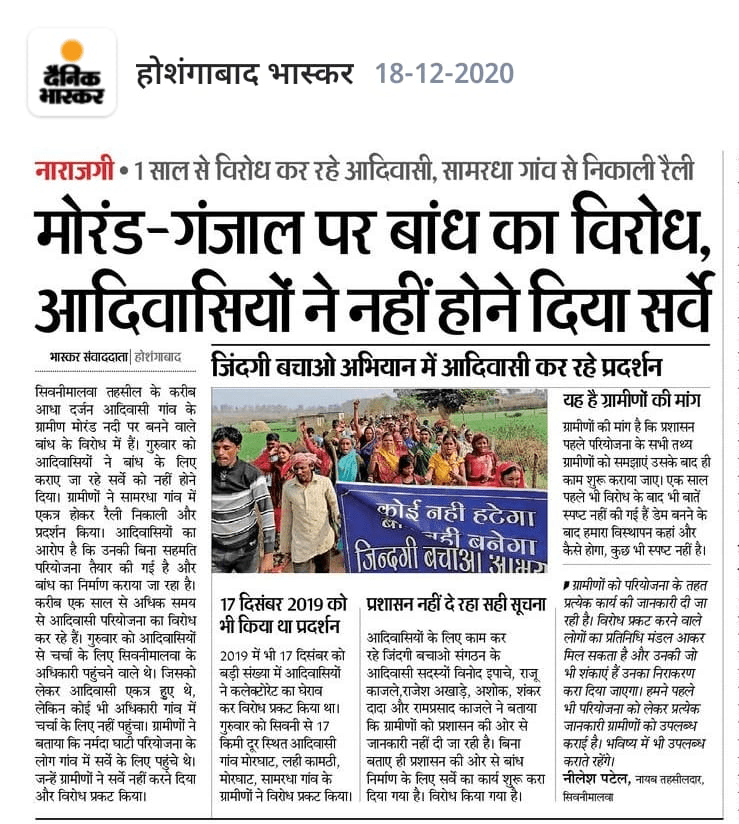
DRP Bulletin 21 Dec 2020: Morand Ganjal Dam opposed in Narmada Valley

Tribals of large number of villages from Seoni Malwa Tehsil of Hoshangabad district in Madhya Pradesh have been strongly opposing the Morand Ganjal dam for several years now, as they again came out in large numbers this week on Dec 17, 2020, also remembering their rally exactly a year ago on Dec 17, 2019. They has simple demand: plz first provide all the information about the project in Narmada Valley and get approval of all the involved villages as required under the law. But the arrogant administration has not even responded to basic demand of all the relevant information.

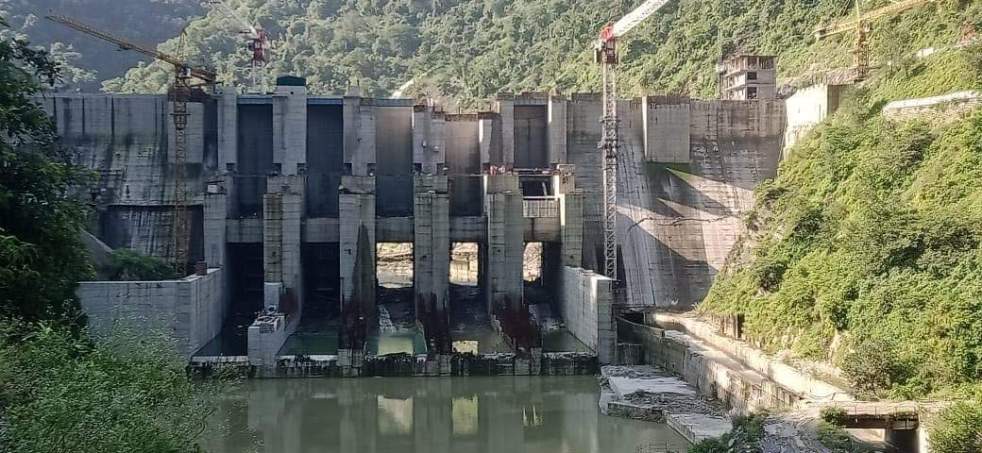
Under the Rs 2813 Cr project, dams are to be built on Morand river near Morghat village of Seoni Malwa tehsil and on Ganjal river near Jawardha village of Rahatgaon tehsil-Harda district with the objective of irrigating 4,617 ha of land in 28 villages of Hoshangabad, 17,678 ha in 62 villages of Harsud tehsil-district Khandwa, and 29,910 ha in 121 villages of Harda, Khirkiya, Sirali and Rahatgaon tehsils of Harda district. The project was approved in 2017. Some 23 villages and over 3000 ha of land is facing submergence, affecting Korku tribals in Hoshangabad, Harda and Betul districts, but there is no rehabilitation plan in place as per the Narmada Valley R&R policies.

Dams are no longer delivering promised benefits and the age of building dams is over. But the political economy of massive funds spent on a major project keeps driving the politicians and officials to keep pushing more projects. The least one can expect from the government is to provide all the relevant information to the affected people in manner and language they can understand, have public consultation and approval in each affected village in front of an independent panel. Without such due process pushing such dams are bound to raise more conflicts, confrontations and opposition.

Continue reading “DRP Bulletin 21 Dec 2020: Morand Ganjal Dam opposed in Narmada Valley”
DRP News Bulletin

DRP NB 14 Dec 2020: Constitution of EAC for River Valley Projects Challenged in High Court

The Karnataka High Court has taken up the petition challenging the constitution of the Expert Appraisal Committee (EAC) on River Valley and Hydropower projects. Notices have been issued to MoEF and also all the members of EAC on a petition filed by the United Conservation Movement Charitable Welfare Trust. Such a scrutiny of the appointment of the EAC was long overdue and urgently required. One hopes the High Court will take the matter to its logical conclusion and ensure that MoEF has a credible, transparent process of appointment of these committees as without such a process, the MoEF gets away with appointing only yes people on the committee who are happy to tow the government line. That nullifies the whole purpose of the constitution of the committee, the EIAs, the public consultations, the appraisals, the clearances and even credible monitoring and compliance. It is complete failure of environment governance and laws and MoEF even gets away with appointment of people with clear conflict of interest. MoEF has no process of selection of the chair and members of these committees. Hoping for the best for the case to correct all this.

Continue reading “DRP NB 14 Dec 2020: Constitution of EAC for River Valley Projects Challenged in High Court”
DRP News Bulletin

DRP NB 30 Nov 2020: J&K SEAC denies EC to sand mining

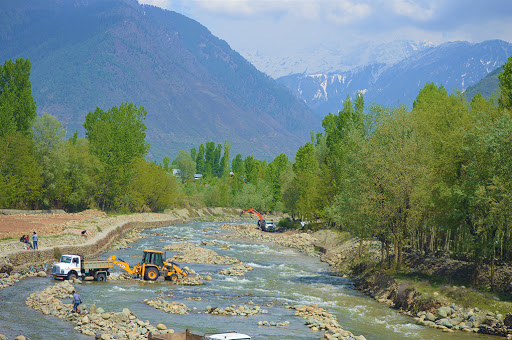
In otherwise bleak governance of sand mining in India, J&K State Expert Appraisal Committee (SEAC) has denied environment clearance to sand mining projects on Jhelum river, since the proposals were not in conformity with the MoEF’s 2016 Sand Mining Management Guidelines, involved in-stream mining, did not have proper District Survey Reports, proper Sand Mining Plan or Replenishment studies. One hope this is emanating from genuine concern for proper governance and this needs to spread to more areas so that at least the guidelines get properly implemented.

Continue reading “DRP NB 30 Nov 2020: J&K SEAC denies EC to sand mining”
Rivers · Sand Mining

East Zone River Sand Mining Dialogue: How can we ensure implementation of court orders?

Higher Courts and NGT has been giving numerous orders and judgments, but the state is happily getting away with non implementation in most cases. How can we ensure that court orders get implemented? Why is the judiciary not concerned about non implementation of its orders? This was one of the central message of the East Zone River Sand Mining Dialogue on Nov 21, 2020 (4-6.30 pm) as part of the India Rivers Week 2020[i] theme “Is Sand Mining Killing our Rivers?” Additional Director R B Lal from Union Ministry of Environment and Forests in his presentation agreed that the sustainable sand mining guidelines have not been implemented. One would have liked to hear how we can achieve their implementation and that MoEF also values participation of people at the grass roots in sand mining governance. He did not mention the local people even once, while praising MoEF’s emphasis on technology in the sand mining guidelines.

The Dialogue was very ably moderated by Dr Malavika Chauhan of Tata Trusts and Dr Debashish Sen of People’s Science Institute (Dehra Dun). This was Fourth in a series of Zonal River Sand Mining dialogues being held after North Zone[ii], South Zone[iii] and West Zone[iv] Dialogues held earlier.

Continue reading “East Zone River Sand Mining Dialogue: How can we ensure implementation of court orders?”