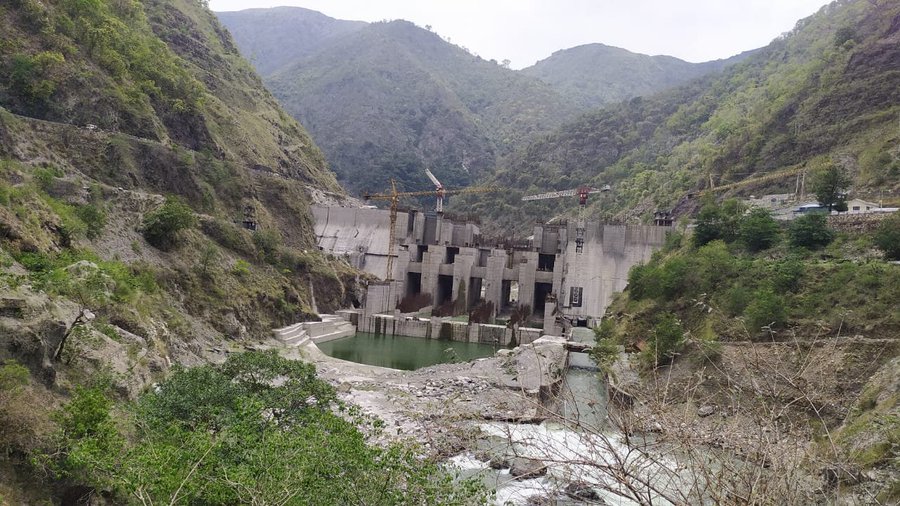
Analyzing a recent paper authored by 37 persons mainly from academics and hydropower related companies on “Sustainable Hydropower”, Eugene Simonov shows why the phrase is an oxymoron, a contradiction in terms. The paper fails to even refer to the most important work on hydropower projects, the report of the World Commission on Dams.
Continue reading “DRP 18 Aug2025: Sustainable Hydropower an Oxymoron?”Tag: Drought
DRP 040825: Arunachal Activists urge Centre to find dimensions of China’s Medog Dam
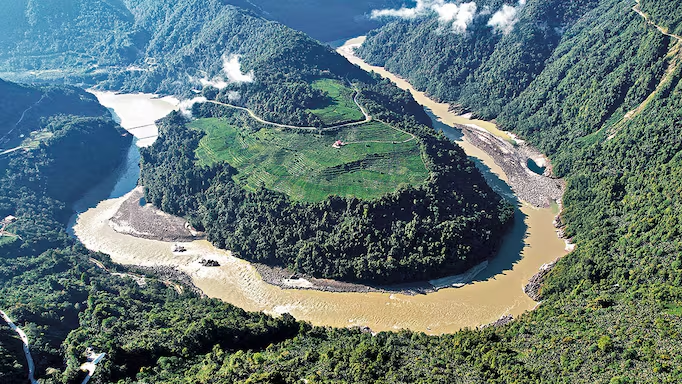
(Feature Image: Aerial view of the Yarlung Tsangpo’s Great Bend, Medog County)
Arunachal and other Himalayan states activists in a press conference in Delhi have rightly urged the Union Government to publicly demand from China all the features and dimensions of the Medog Dam on Yarlung Tsangpo river, their impact assessments and share the same promptly in public domain before even considering any project like the Siang Upper Multipurpose Project (SUMP). This is important since without knowing the features, dimensions, operating procedures and impact assessments, all the projections being made about the possible impacts of the projects are completely speculative and unfounded.
Continue reading “DRP 040825: Arunachal Activists urge Centre to find dimensions of China’s Medog Dam”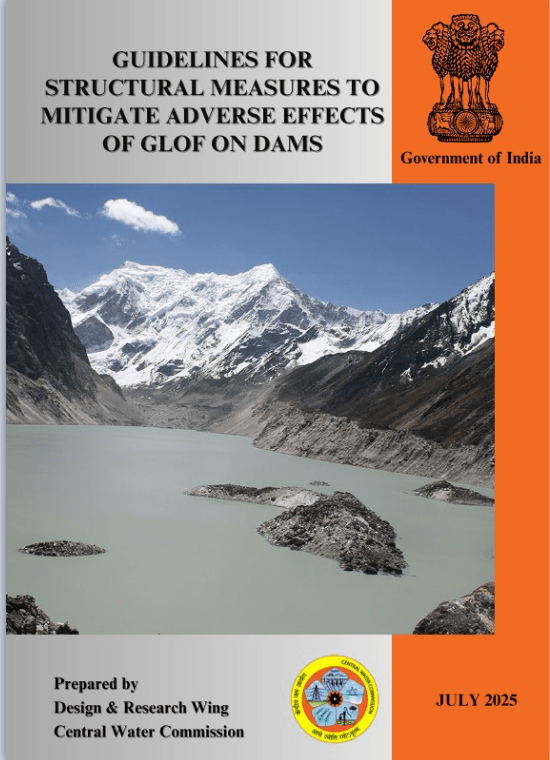
DRP 280725: CWC Guidelines on GLOF should have mandated all information in public domain, independent assessment after every GLOF
Guidelines for Structural Measures to Mitigate Adverse Effects of GLOF on Dams Central Water Commission (CWC) on July 23 has issued new guidelines to safeguard dam infrastructure from risks and threat of flash floods triggered by glacial lake outburst floods (GLOFs). The information about this 40 paged documents named Guidelines for Structural Measures to Mitigate Adverse Effects of GLOF on Dams July 2025 was shared by CWC director Shiv Kumar Sharma, in a LinkedIn post. The document is available in PPT format and a pdf link for the same is still not available.
Continue reading “DRP 280725: CWC Guidelines on GLOF should have mandated all information in public domain, independent assessment after every GLOF”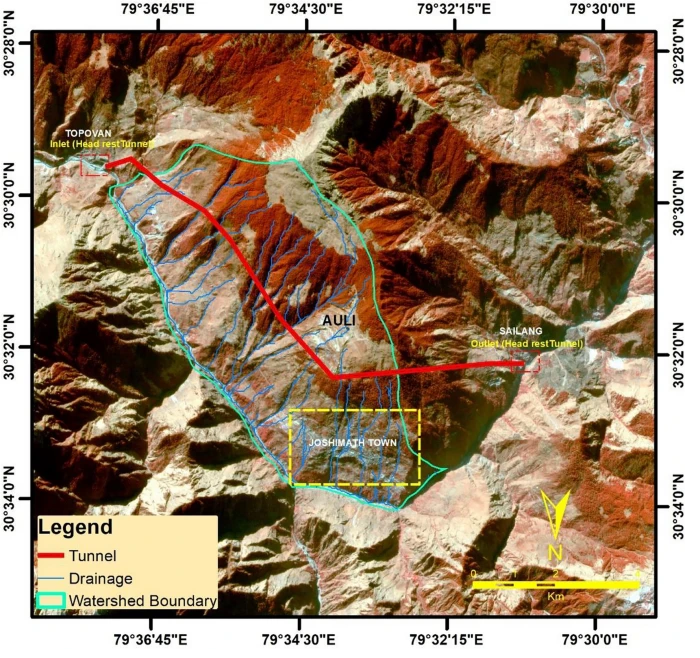
DRP 210725: Moving Joshimath Landslide a threat to Tapovan Vishnugad HEP in UKD?
(Feature Image: Hydropower Tunnel project shown in the Joshimath area along with the Watershed Boundary. This figure is generated using ArcGIS software-version 10.3.1 and CorelDraw Graphics Suite 2019 https://www.coreldraw.com/. Source: Analyzing Joshimath’s sinking: causes, consequences, and future prospects with remote sensing techniques. May 2024)
A paper in scientific journal co-authored by Internationally renowned landslide expert Dave Petley (published on June 16 2025 at: https://doi.org/10.1016/j.enggeo.2025.108201) warns that the Joshimath landslide is moving and can threaten the under construction Tapovan Vishnugad hydropower project in Chamoli district in Uttarkhand. The paper says: “The 2023 rapid deformation at Joshimath was preceded by slow movement years ahead. Deforestation in the Joshimath region might have intensified the slope instability. Additional landslide zones were detected in Hailang, Kalpeshwar with similar pattern. Slow-moving landslides have high potential to cause often underestimated damages.”
Continue reading “DRP 210725: Moving Joshimath Landslide a threat to Tapovan Vishnugad HEP in UKD?”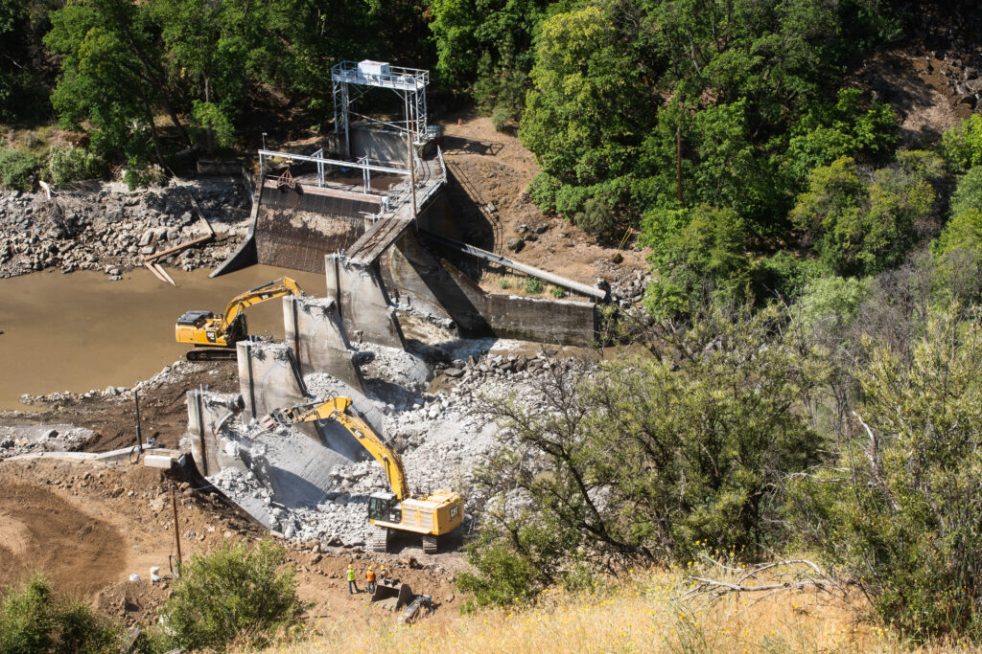
DRP 140725: Dam decommissioning spreads to China
(Feature Image: Copco 2 dam removal on the Klamath River, California. Credit: Swiftwater Films, Source: American Rivers)
China decommissions hundreds of dams along Red river China has claimed to have dismantled 300 dams and decommissioned more than 90 percent of small hydropower stations along the Chishui River, also known as the Red River, a key tributary of the upper Yangtze. The move is seen as one of the largest state-led efforts to restore aquatic biodiversity in Asia’s longest river, reversing decades of hydro-infrastructure development that critically endangered native fish species, including the Yangtze sturgeon, the South China Morning Post reported.
Continue reading “DRP 140725: Dam decommissioning spreads to China”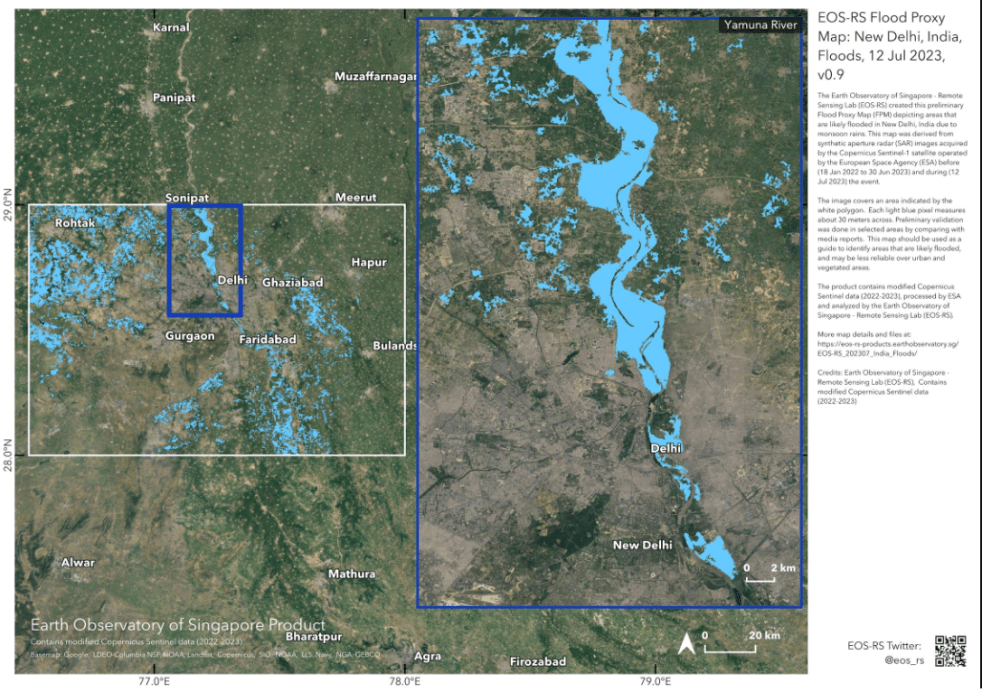
Yamuna Manthan July 2025: Is Delhi Ready for July 2023 like Yamuna Floods?
(Feature Image: EOS-RS Flood Proxy Map: New Delhi, Floods, 12 July 2023,v0.4)
July 13 will mark two years since the Yamuna river stretch in national capital witnessed unprecedented flood spell. The river not just submerged every part of existing available floodplain by several feet but also spilled over to reclaim its lost channels. The unusual flood also breached historic 1978 flood level at Delhi railway bridge by a huge margin, setting new benchmark.
Continue reading “Yamuna Manthan July 2025: Is Delhi Ready for July 2023 like Yamuna Floods?”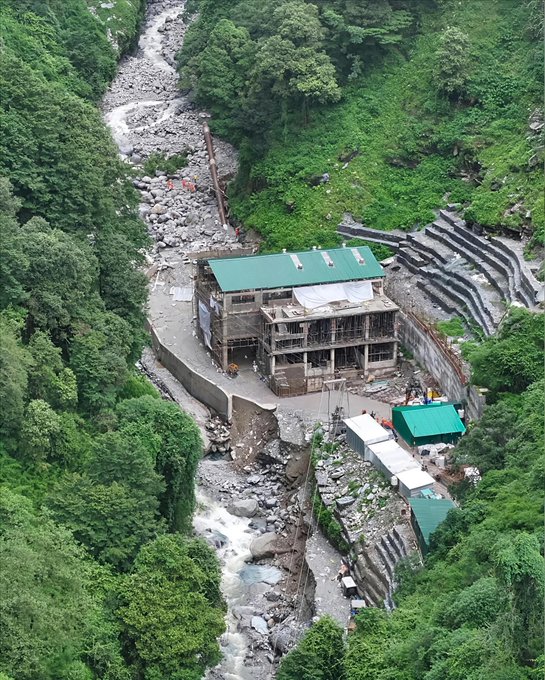
DRP 070725: Demand for Commission of Inquiry on Hydro Obsession in Himachal
(Feature Image: Flood ravaged Priyadarshini HEP in Manuni khad in Dharamshala, Kangra. Source: Social Media)
Hydropower obsession, Himalayan failure The massive hydropower push, another legacy of post-1990s liberalisation, has amplified vulnerability. Dams have mushroomed across river basins in Kinnaur, Lahaul-Spiti, Chamba, and Kullu — with scant regard for ecological thresholds. Muck from these construction sites is routinely dumped into riverbeds, narrowing channels and raising riverbeds. When the rains arrive, this loose muck turns into a lethal force, taking down everything in its path. The hydropower model — built on the assumption of perpetual revenue — has neither delivered long-term employment nor sustainable energy. Instead, it has left behind ecological scars, displaced communities, and made vast swathes of the state more disaster-prone.
Continue reading “DRP 070725: Demand for Commission of Inquiry on Hydro Obsession in Himachal”
DRP 30 June 2025: Dam Safety concerns arise as monsoon sets in
(Feature Image: Kabini Dam. Source: WRD, Karnataka)
The SouthWest Monsoon has just set in and dam safety issues are coming up in large number of dams in Karnataka, Telangana, besides dam disasters in Himachal Pradesh. This shows how much more we need to do to assure structural and operational safety of India’s dams in changing climate.
Continue reading “DRP 30 June 2025: Dam Safety concerns arise as monsoon sets in”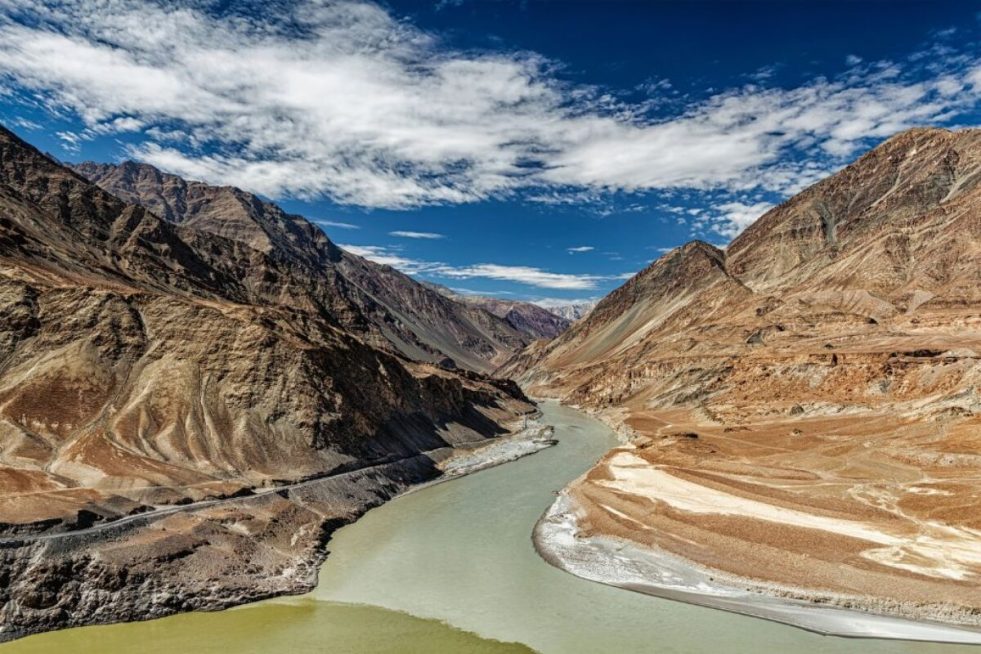
DRP 16 June 2025: “Indus River older than its landscape, Himalayas”
INDUS RIVER: Stephen Alter, in his article “With the River by My Side” says about Indus River that some rivers are older than the landscape through which they pass: “Nowhere is this clash between hydrological and geological history more apparent than along the Indus, as it passed through Ladakh. This seemingly eternal river has followed its winding course since long before the Himalaya were formed, tossing and tumbling over. Boulders, stones and pebbles that the water polishes and grinds into sand. Eroded flanks of the mountains on either side of the river are scarred and twisted by tectonic forces that lifted giant slabs of rock more than eight kilometres into the clouds but failed to block the persistent flow of the Indus. Driving along the highway that runs parallel to the river, from Leh to Kargil, it feels as if the landscape is a timeless epic that the waters of the Indus have etched in stone.”
Continue reading “DRP 16 June 2025: “Indus River older than its landscape, Himalayas””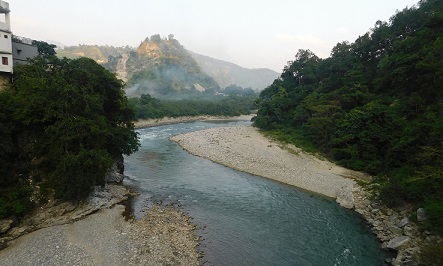
DRP 020625
HYDRO POWER PROJECTS
Jammu & Kashmir In Kupwara district the 12 Mw Karnah in Kishan Ganga sub basin has joined the long list of HEP projects facing reoccurring damages, repeated delays and cost escalation in Himalayan states. The flash flood, landslides and cloudburst disasters in Feb and May 2025 have further damaged the project and extended its completion date.
Continue reading “DRP 020625”
