Climate Change

Feb 2019 Hailstorm, Snowfall Affects Life in Northwest India

Since the beginning of 2019, there have been couple of incidents of hailstorm in Haryana and Punjab. The region has also seen good rainfall in January. The hilly states of Jammu & Kashmir, Himachal Pradesh and Uttrakhand have been repeatedly facing heavy snowfall events gripping the large parts of North India in cold waves.

The initial rains and snowfall were seen usual events and considered as beneficial for rabi crops and water demands. However the unusual hailstorm accompanied by heavy rainfall In January 2019 and again on Feb 7-8, 2019 have caused significant damage to standing crops in large part of Haryana, Punjab and Western parts of Uttar Pradesh.

Continue reading “Feb 2019 Hailstorm, Snowfall Affects Life in Northwest India”

DRP News Bulletin

DRP: 28 Jan 2019: Climate Change Poses Multiple Threats to India: Does Our Governance Care?

This week multiple reports warned of how India is already facing climate change impacts, how the groundwater, India’s water lifeline could be under threat under climate change, how India’s monsoon, the other water lifeline of India is under threat.

In fact, we should be bracing up for the drought that the summer will bring, but as yet there is no signs of any preparedness or plans.

The Dam floods in Indonesia and the Brazil’s disaster due to breach of mine tailings dam should be additional warnings, but our Dam Safety Bill that is before the Parliament does not recognise either of them.

The World wetlands day 2019 later this week has slogan of: “We are not powerless against climate Change… stop draining wetlands”, connecting climate change and wetlands. But the news from Indian wetlands governance is scary.

The day before the World Wetlands Day the Vote on Accounts will be presented before the Parliament as full budget cannot be presented in light of forthcoming Parliament elections. But is there any hope that either the Budget or the elections will deal with the climate change or the environment issue with any sense of seriousness?

The iconic Ardh Kumbh event is going on, but the govt has paid no attention to the fast by Swami Atmabodhanand, even after the death of Prof GD Agarwal for the same cause of Ganga.

Continue reading “DRP: 28 Jan 2019: Climate Change Poses Multiple Threats to India: Does Our Governance Care?”
Dams · DRP News Bulletin

DRP: 19 Nov 2018: India Rivers Week 2018 to focus on Ganga Rejuvenation

The India Rivers Week 2018, in fifth year, will be held at WWF, Delhi during Nov 24-26, 2018. The focus of the IRW this time is: “Can India Rejuvenate Ganga?“. Shri Rajiv Ranjan Mishra, Director General of the National Mission for Clean Ganga will address the inaugural session with Chief Guest Shri Jairam Ramesh, former Union Minister, in Chair. The meeting will see over 150 people from all over India participate to discuss state of India’s rivers at the only meeting in India focussing exclusively on rivers.

The Annual River Lecture will be given by Prof Rajiv Sinha of Indian Institute of Technology, Kanpur. The Bhagirath Prayas Samman award for the best work on River Conservation and the Anupam Mishra Medal for exemplary media work on River conservation will be given away by famous Chipco leader Shri Chandiprasad Bhatt.

Shri U P Singh, Secretary, Union Ministry of Water Resources has agreed to the chief guest at the concluding session on Nov 26, Monday. Started in 2014, the meeting is collectively organised by Yamuna Jiye Abhiyan, WWF-India, INTACH, Toxics Link, People’s Science Institute (Dehradun), Peace Institute and SANDRP.

For more information, please see: https://indiariversforum.org/2018/11/19/india-rivers-week-2018/. Follow IRW at: https://www.facebook.com/IndiaRiversWeek/ and https://twitter.com/IndiaRiversWeek

Continue reading “DRP: 19 Nov 2018: India Rivers Week 2018 to focus on Ganga Rejuvenation”
Dams · Monsoon

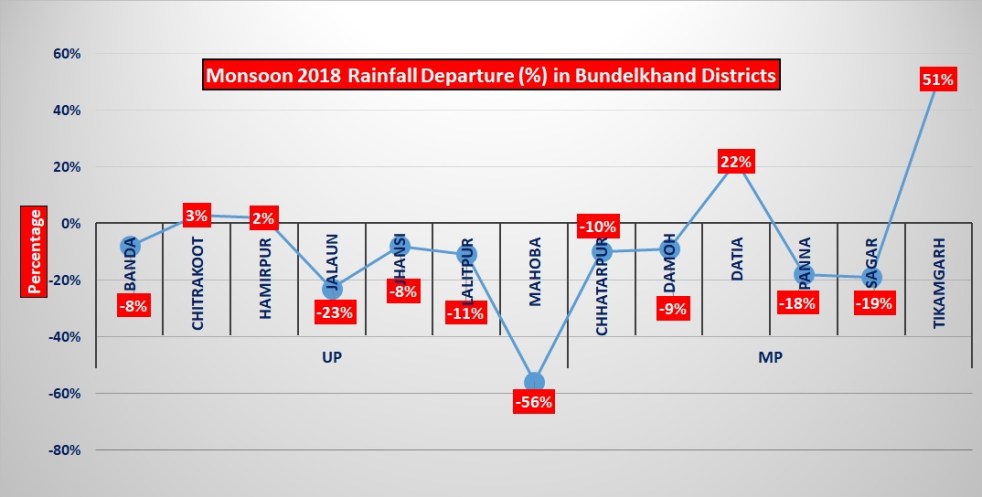
Bundelkhand: Overview of 2018 Monsoon

Bundelkhand is known as a drought prone region. It is comprised of 7 districts of Uttar Pradesh and 6 districts of Madhya Pradesh. Monsoon rains are crucial. However for past several years, the region has faced deficit rains leading to water scarcity particularly for agriculture related activities. Let us the situation of of Monsoon rain in Bundelkhand this year.

Bundelkhand is part of Lower Yamuna Basin, for which IMD provides rainfall figures in its river basin wise rainfall maps. This basin received 785.4 mm rainfall in 2018 monsoon, 9% below  normal rainfall of 863 mm for this sub basin. IMD needs to provide rainfall figures for each sub basins, including Ken, Betwa, Dhasan etc.

Continue reading “Bundelkhand: Overview of 2018 Monsoon”

Dams · DRP News Bulletin

DRP: 23 July 2018: Landmark CAG Reports on DAM FLOODS & Ineffective; Costly Mega Irrigation Projects

In its latest report, the Comptroller and Auditor General (CAG) has questioned implementation of sixteen National Irrigation Projects. Before this, the CAG has held mismanagement in dams’ operation responsible for Chennai floods in 2015. Both these reports are available on its website now.

The CAG report on National Irrigation Projects, tabled in Parliament on July 20, has revealed that sixteen major multi-purpose water projects, taken up on an expeditious basis about a decade ago, are nowhere near completion, with no work being undertaken in as many as 11 projects despite the incumbent govt’s much-wanted focus on improving irrigation facilities in the country.

The report also mentioned that out of the 16 projects, undertaken under the Accelerated Irrigation Benefits Programme (AIBP) in Feb 2008, only five projects with estimated irrigation potential of 25.10 lakh hectares were under implementation and even these projects suffer from 8 to 99 per cent shortfall in physical progress, the CAG said. The remaining 11 projects with estimated irrigation potential of 10.48 lakh hectares are yet to commence and are at different stages of approval.

Continue reading “DRP: 23 July 2018: Landmark CAG Reports on DAM FLOODS & Ineffective; Costly Mega Irrigation Projects”
Dams · DRP News Bulletin

DRP: 9 Jul 2018: National Meeting on Inland Fishworkers in Delhi

The NATIONAL PLATFORM FOR SMALL SCALE FISH WORKERS (INLAND) is convening a Consultative Meeting on Livelihood Issues of Inland Small Scale Fish Workers 10thJuly 2018, Gandhi Peace Foundation, New Delhi.

The Invitation letter says: “India is gifted with vast and varied inland water bodies bearing rich fish resources.Rivers and canals, reservoirs, ponds and tanks, oxbow lakes, wetlands, backwaters and estuaries yield 7.21 million tonnes of fish which is more than 66% of total fish production of the country. The sector sustains about 4 million fish workers and a total population of around 2 crores.Fish provides good quality animal protein rich in minerals and vitamins. About 800 million Indians eat fish. After milk, fish is the largest source of our animal protein.These huge resources are under severe stress. Rivers are poisoned with heavy pollution. Diversion of water from rivers is harming their ecological flow.

Continue reading “DRP: 9 Jul 2018: National Meeting on Inland Fishworkers in Delhi”
Dams · DRP News Bulletin

DRP: 18 June 2018 (Why this Onslaught of Big Dam Advocacy by CWC Ideologues?)

In a recent article Ashwin B Pandya, Former, Chairman Central Water Commission (CWC) refuses to acknowledge either the adverse impacts of dams or the better option of using groundwater aquifer for storing water. And thus making unscientific arguments against dam decommissioning and for dams. No one is talking of removal ALL dams as the author seems to postulate and then dismiss it as impossible and irresponsible.

Continue reading “DRP: 18 June 2018 (Why this Onslaught of Big Dam Advocacy by CWC Ideologues?)”
Dams · DRP News Bulletin

DRP: 21 May 2018 (World Over New Renewables Are Making Large Hydro Unviable & Unnecessary)

According to an energy expert, 6,000 megawatts’ worth of wind and solar contracts had been signed in Cambodia, Vietnam, Thailand and Laos in the last six months, seriously challenging the financial viability of major hydropower projects on the river. Buoyed by a recent Thai government decision to delay a power purchase deal with a major mainstream Mekong dam, clean-energy proponents and economists told the third Mekong River Commission summit that the regional energy market was on the cusp of a technological revolution.

A six-year Mekong River Commission Council study on development plans for the Mekong, which was the focus of the summit, suggested catastrophic impacts upon the health of the river system if all planned hydropower dams — 11 mainstream projects and more than 100 on tributaries — were built.

Continue reading “DRP: 21 May 2018 (World Over New Renewables Are Making Large Hydro Unviable & Unnecessary)”
Dams · DRP News Bulletin

DRP: 19 Mar 2018 (PM Abandons Inauguration of Mapithel Dam in Manipur Following Protests)

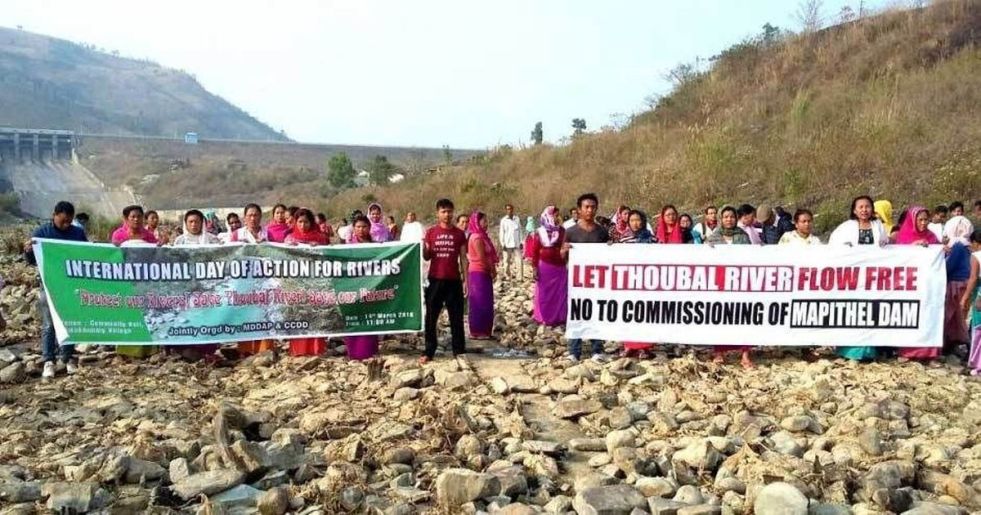
In an important development in Manipur this week, PM Narendra Modi could not commission the controversial Mapithel dam due to local protest. As per, the official statement notifying The PM was  was supposed to launch is the Mapithel dam, part of the Thoubal Multipurpose Project.

As per CRA Manipur blog report, the forum of Mapithel dam affected “Joint Action Committee Against Forced Inauguration of Mapithel Dam had threatened a 48-hour shutdown to coincide with the dam’s scheduled inauguration by Modi. The committee withdrew its call late on March 14, reportedly after the Manipur government agreed to shelve the inauguration.

The action committee is primarily demanding compensation for the people displaced by the project as mandated by the Right to Fair Compensation and Transparency in Land Acquisition, Rehabilitation and Resettlement Act, 2013.

Apart from complaints of inadequate compensation, opposition to the commissioning of the dam itself has grown louder over the years. Local communities claim the project violates the Forest Conservation Act of 1980 and its new avatar, the Forest Rights Act of 2006.  https://cramanipur.wordpress.com/2018/03/16/as-local-communities-protest-manipur-government-cancels-plan-of-modi-inaugurating-mapithel-dam/

Continue reading “DRP: 19 Mar 2018 (PM Abandons Inauguration of Mapithel Dam in Manipur Following Protests)”
Dams · DRP News Bulletin

DRP: 05 Feb 2018 (J&K To Assess The Viability Of Big Hydro Pojects)

In a remarkable development, Jammu & Kashmir Govt is reviewing its Hydro policy to assess whether the Hydro Electric Power Projects (HEPs) are still viable. As per sources, this is for the first time that the Govt is discussing the viability of generating hydro power.

An empowered committee led by the Chief Secretary has started this discussion by calling for an “approach paper” that will give an overall picture of the hydropower industry in India. Top sources in the State Power Development Corporation (SPDC), a government-owned company, told Kashmir Reader that the empowered committee wants to lay a roadmap for power generation in the state. “It will reflect the vision of the government. It will give the picture of hydropower generation in India, its rates, market, demand and supply. It will also lay down a roadmap for large power projects,”

The approach paper will be part of a new hydropower policy which will be submitted before the same committee, and then before the cabinet for approval. The SPDC had submitted a hydro policy draft in April last year, which was returned to it in December. Sources said the approach paper has to be submitted in two months’ time.

At present, India has a surplus generation of hydropower, which has plummeted its rate. This has led to losses for SPDC as it invested in projects whose generation costs were high. The blunt example is that of the 450-MW Baglihar II. SPDC has failed to lure any buyer for more than a year as its selling cost of per unit of energy, Rs 4.4, is nearly Rs 2 higher than the market rate. The SPDC has finally managed to sell the power at about Rs 4 per unit to the Uttar Pradesh government but for one year only. The SPDC may have to struggle again next year if the state of UP does not continue the contract.

Another example is that of Nimuno Bezgo, and Chutak hydropower projects, which sell energy at Rs 13 per unit. The SPDC also buys power from Dulhasti project at Rs 7, when the available rates for power in the market is around Rs 2 and Rs 4. https://kashmirreader.com/2018/02/02/cs-led-panel-to-lay-roadmap-for-power-generation-in-jk/ (Kashmir Reader. 2 Feb. 2018)

As per another report, facing a growing demand for electricity and unable to tap its vast potential for generating hydroelectric power, the state government is looking to boost solar power generation. Given the long gestation period of hydel projects, it is unlikely the generation of hydroelectric power will expand significantly in the near future, said. Hence,  the focus on solar power. Indeed, when solar power potential exists, with lower installation and operation costs and impacts, why States continue after destructive, expensive hydro projects? https://scroll.in/article/866058/kashmir-can-generate-a-lot-more-hydel-electricity-than-it-requires-why-is-it-eyeing-solar-power (Scroll.In, 30 Jan. 2018)

There is one more interesting hydro power development in which the state cabinet of Bihar has approved closing 3 and cancelling the development of 2 others in addition to handing over of 8 hydropower projects to neighboring Jharkhand.

Continue reading “DRP: 05 Feb 2018 (J&K To Assess The Viability Of Big Hydro Pojects)”